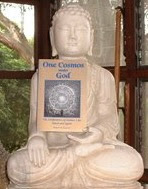
No, because it has more to do with the development of our vision -- our cʘʘnvision. What you see is what you beget, and some of us just live in a more fertile cosmos. It's similar to what Magnus said in a comment yesterday about how love ultimately trickles down from the one source, winding its way through all the cosmic arteries and capillaries by which we are spiritually nourished, and thus maintain contact with the Real.
In an entry from his diary, Abhishiktananda (SA) implies that this state of being is the very goal of the universe, which is to say, "the consciousness of being, the final unveiling of the intuition that constitutes the human being." Of the Cosmic Covanant, he says that it "does not emerge only at one particular stage of man's civilization or cultural development. Rather, it is written into the very nature of things and is embedded in the consciousness of mankind."
Note that specific religiosity would be strictly impossible in the absence of this more general religiosity, or without our intrinsic theomorphism -- just as we must have the general capacity for language in order to learn any particular one. We may only know of God because we first sense God.
Thus, there is is a kind of "natural religion" accessible to most anyone, those few cynical doubtliars notwithstanding. And even then, they're usually just hawking their own private religion in another deusguise. In other words, physics too is a theophany par excellence.
SA agrees that "every man discovers something of it, even if confusedly, the moment he awakes to and becomes present to himself, to the world, and so to God."
But just as in any other human activity, from physics to basketball, some men are "endowed with a greater capacity for spiritual things," and, with the assistance of divine grace, may "penetrate more deeply into the mystery and unveil its secret to their brothers" (ibid).
But none of these wise guys "has ever received or taught anything substantially new. All was given from the beginning." Rather, "the task is only to recognize that which is and to decipher more and more of its mystery." (Again, we are speaking of the Cosmic Covenant, not of any particular contract with the divinity.) Another name for this ground floor of religion is the sanatana dharma, or eternal law.
Oldmeadow (heretofore HO) has a chapter entitled The Cosmic Theophany. Let's see what he has to say about it.
He -- HO -- ha! -- defines the cosmic theophany as "the revelation of the Divine in that tissue of time-space relativities which make up the whole cosmos." He cites Coleridge, who wrote of "the transcendence of the Eternal through and in the temporal," and Eliade, who observed that "nature always expresses something that transcends it."
How very true! It is simply an unavoidable fact that nature herself is supernatural, or she could never be, let alone be intelligible.
How is this not obvious? "Intelligibility" is not some concrete fact, but a necessary condition for knowing anything of our cosmos. And to say "intelligible" is to immediately say "knower," so this transcendent dialectic is woven into the very fabric of reality. You are free to disagree, but anything you say (assuming it makes sense) simply confirms it.
You could say that intelligibilty is the residue of God's immanence, while understanding is grounded in God's transcendence. Thus, "to imagine one without the other would be akin to envisaging a circle with no center" (HO). To paraphrase a rabbinical formula cited in the book, God is not in the universe so much as the universe is in God.
Note also that we could not be here without a physical form. But more importantly, matter could not be here without the divine substance that infuses it: "the world of phenomena is held together by a numinous spiritual presence," without which "the world of 'matter' would vanish instantly and utterly" (ibid). It is impossible to imagine or conceive of an unknowable world -- and again, knowability is transcendent in its immanence.
For HO, one of the purposes of myth and ritual is not just to remind us of this ontological fact, but to allow us to participate in it. But the same reality can be revealed in those random moments we call (?!), "where the membrane, as it were, between the worlds of matter and of spirit is especially permeable" (ibid). It matters not whether we break on through to spirit (↑) or spirit breaks on through to us (↓), for the result is the same, whether it is the guffah ha! experience, the holy smoke!, or the sacred WTF!
Hereagain this speaks to man's function as cosmic mediator in the herebelow. Please note that, since we are in the image of the Creator, it can truly be said that we too contain the cosmos, for to know something is to contain it. Being that there is no such thing as an unknowable cosmos, and there is nothing knowable that man may not potentially know, it is literally true that man contains the cosmos, just as God contains man (i.e., he knows us all right down to the last harebrain).
This is good: HO cites St. Paul, who says in Romans that "the invisible things of him" may be "clearly seen" and "understood by the things that are made." Thus, "Nature is a teaching, a primordial Scripture" (HO). Elsewhere, I remember Schuon saying that the exterior world was one kind of revelation, while the human subject was another. Really, they are two inseparable sides of the same revelation -- like God himself, in whom there may be distinction but no division.
So, where does this cosmic tree leaf us? We've grown as high as our naturally supernatural reason may take us, but we're still in the terrestrial arbor, well short of the celestial sonflower planted in the father shore.
What? How's that?
Yes, Abhishiktananda would like to remind us that Christ in his function as cosmic mediator is a "Column of Light and Fire" that has "one pole penetrating the heavens and the other plunged into the earth..."
And I would add that he contains us that we may contain him.
*****
Children are one of the more obvious theophanies, are they not?