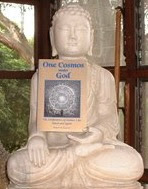
The title of yesterday’s post — The Anthropic Medium is the Celestial Message — highlighted the cosmotheandric truism that the Anthropos is the link, or medium, between Cosmos and Theos. This is actually an unavoidable principle for any science, philosophy, or theology whatsoever, for man is the central clearing house of the Cosmos, and that’s all there is to it. Knowledge of any kind passes through us.
As do lies, distortions, half-truths, propaganda—
That is also correct. You may recall that in Eden there are no books, and in fact no media at all, because there is no need for them. Rather, the experience of God is unmediated: he’s right there ambling about in the garden in the cool of the day. In this mythic scenario one might say that the Serpent is the first journalist, as he mediates the breaking news that You Too Can Be a God, and the rest is history.
Literally, for looked at one way, the so-called fall of man may be seen as our entrance into history. At the very least, it means that we leave one mode of being behind and enter a new one. Some have argued that this is symbolic of the transition from orality to literacy, for what is literacy but the exchange of unmediated for mediated reality? It is also in a sense the transition from RH to LH, which is not bad in itself, in fact far from it. So long as we maintain a complementary dynamism between LH and RH — or map and territory, symbol and symbolized, abstract and concrete, primary and secondary reality — we are in for the ride of our lives. Problems only arise insofar as the LH eclipses the RH or bullies it into submission. If we’re not careful, the LH can become the anthropic snake in the cosmic garden.
Which is reminiscent of Iain McGilchrist’s The Master and His Emissary, a more popular version of his neuropsychiatric theories discussed in Book II. To extend our analogy, the LH is the journalist who mediates the primary reality experienced by the RH. Which is fine, so long as we are dealing with an honest and humble journalist devoted to getting the whole story, and getting it right. But what happens when we enter a post-journalistic age full of rage bait, confirmation bias, narcissistic seduction, digital tribalism, fake news, viral plagues, and irony-free ideological fairy tales? Then it is as if the RH is subject to the the biases and propaganda spun by the LH. We are then enclosed in various ideological matrices or silos, from scientism at one end to religionism at the other. Here, even ideological opposites share the common plight of auto-confinement to the leftorium.
Note that our only meaning-full freedom is located in the vertical, since by definition it transcends horizontal enclosure. And one place this freedom manifests is in the space between symbol and symbolized, or again, in the anthropic medium between Cosmos and Theos. LH capture essentially freezes and kills this living, evolving, and ever-deepening link between man and world, in which case we are well and truly f—
Watch the profanity.
Note that with properly functioning bilateral hemispheres, the Anthropos not only discovers the Cosmos but discovers a Cosmos within the Cosmos, and we are that Cosmos. In other words, we are situated in a Möbius reality in which the outside is in and the inside out, in that ever-deepening or ascending spiral just mentioned. Thus the “inward turn” of LH literacy facilitated the upward turn into O, so long as we don’t conflate the spirit with the letter and enclose ourselves in a pneumatically desiccated and braindead letteralism.
Note that there is always a fine line between the media and mediated. Just as in any other intellectual endeavor, the former can never, under any circumstances, enclose the latter. Rather, there’s always more to the story, since reality is more than any story we tell of it. If we are not careful, then what mediates our world can become our world, and then we’re really f—
You heard me.
∞
A brief review: back in Books I and II we discussed Livi’s five primary evidences that constitute common sense, beginning with CS1, “the existence and of the continual becoming of many ‘things,’ identifiable in their identity (differentiable one from another) and in their relative permanence in being from the moment they appear to the moment they disappear…”
So, the first thing a human being recognizes is distinct and identifiable things that come and go, not excluding us.
Stuff happens.
Nor does it ever stop. The second element of common sense is “The evidence of the I as subject” — the relational subject who knows about and can — supposing literacy — reflect upon, all the stuff coming and going.
Although these are seemingly modest assertions, they are at least “endowed with the most absolute certainty: what is affirmed in these [and the three other CS] judgments is necessarily held as true by all.” In other words, “no one is able to think the contrary of what those judgements affirm as absolutely true.”
For example, in order to deny what was just referenced above, one must first recognize them. Likewise, it would require a self in order to deny the self. Moreover, to whom is one addressing the denials? Other selves — which is our third evidence constituting common sense, i.e., intersubjectivity. And if we ought to be honest in our dealings with these others, then we’ve arrived at evidence #4, freedom and responsibility.
Again, the non-truth of these assertions of common sense is absolutely unthinkable. For example, with regard to CS1, “It is not thinkable that the world does not exist as an ordered whole of entities in movement [i.e., change].” Look around and just try to think otherwise. Likewise CS2: just try thinking that your thinking self does not exist, or that you are not thinking. Nor can you think that other subjects don’t exist (CS3). For example, if you’re reading this, you not only know that it came from another mind, but that you understand this other mind. Indeed, if you deny intersubjectivity, to whom are you even denying it? And although it is commonplace for our tenured apes to deny the existence of free will and its attendant responsibilities, it too is unthinkable, because thought itself is the quintessence of freedom. Besides, to comprehend necessity — for example, mathematics — is to have transcended it. We explain math, while math can never explain us.
Having said all this, is CS5 — God, or something like it — a wild leap or but a logical first and last step?
A leap into the wild Godhead?
Why not? For Livi, God’s nonexistence is actually unthinkable, for you, I, or anyone else, this being the conceptually incoherent idea “that there does not exist a First Cause of the world” — the “undeniable evidence of God as invisible Foundation of all that is visible.”
So, atheism is actually unthinkable?
Only if you try to think it through, and supposing you know what thought is — where it comes from and to what (and to whom) it is ordered. Which brings to mind another gold-plated aphorism: Genuine atheism is to man’s reason what the ten-thousand-sided polygon is to his imagination.
It cannot be imagined, similar to how the reality disclosed by quantum physics literally cannot be imagined. Supposing you have a picture of a wave-particle — or wavicle — in your head, the picture is wrong.
For Dávila, The atheist devotes himself not so much to proving that God does not exist, as forbidding him to exist. He forbids God to exist by enclosing himself an imaginary LH metaphysic in which it is actually possible for God not to exist.
But no God, no science. There exist metaphysical necessities for the possibility of science, in the absence of which science itself becomes literally unthinkable.
Thus we know there is a God of science, whether implicit explicit. But can there be a science of God? We believe so. It is called cosmotheandrism.