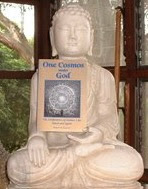
There are some things that human beings may know with metaphysical certitude. In fact, our access to absolute truth is one of the principle things that defines us as human. Obviously, no other animal can know truth, much less absolute truth. The moment you realize this -- assuming you really and truly do -- you will understand that the human state is not a Darwinian "extension" of the animal state, but something fundamentally inexplicable on any materialistic grounds. It is, in fact, a gate of exit out of mere animality -- indeed, out of the relative cosmos itself. Humans are a "hole" in creation that allows them to know the whole of creation.
For in knowing absolute truth, human beings may participate in eternity on this side of manifestation -- in the relative world. The trick is to, so to speak, "prolong" eternity on this plane. We do this by 1) aligning ourselves with truth, and 2) assimilating truth. By "assimilating," I mean that we must metabolize truth so that it is "interiorized" and becomes entwined with our very psychic substance. We must "eat and breathe" absolute truth in order to become it and live it.
Authentic religion is the vehicle of absolute truth. You might say that absolute truth, the Godhead, the Ain Sof, the Supermind, Nirguna Brahman, or the God beyond being, are analogous to white light, whereas each authentic revelation is analogous to a color in the rainbow. This is why religions cannot be mixed "from below," lest you produce a manmade blending of colors that eventually ends up black, not white. However, this hardly means that one religion cannot illuminate this or that obscure or underemphasized doctrine of another.
Christianity, for example, is a obviously a complete religion. Nor will I argue with someone who believes it is the "best" religion. Nevertheless, it is obviously the case that the greatest Christian thinkers -- true theologians such as Meister Eckhart, Origen, or Denys the Areopagite -- exist only at the margins of contemporary Christianity, which is often sadly atheological -- either that, or couched in a ridiculous theology that makes religion itself look ridiculous -- a terrible sin by the way, for it amounts to taking the name of the Lord in vain. At the moment I am thinking of a genial dolt named "Osteen" that I caught on Larry King for a few moments, but it could be anyone.
Once you immerse yourself in, say, the genius of Meister Eckhart, you immediately see the parallels with, say, the greatest Jewish theologian, Moses Maimonides. Then you cannot help seeing certain unavoidable parallels with perhaps the greatest pagan mystic, Plotinus, then it's hard to distinguish him from the immortal Vedantin, Shankara. You needn't "blend" any of these truly celestial beings to appreciate how they are reflected in one another, each a particular color that carries and transmits real light. Most of us cannot know the white light, but each color is in the end nothing other than light, just as rain or snow are nothing other than water. I am as comfortable in a Catholic or Orthodox service as I am in a Vedanta or Jewish temple, so long as they radiate the sacred. However, I am definitely not "eclectic." I do not believe in "cafeteria style" spirituality. It is more like being able to appreciate, say, Arvo Part, Dexter Gordon, Merle Haggard, and James Brown. Each is a musical "avatar" who conveys real musical light, but I wouldn't want to blend them.
Apparently, it is difficult for most rank and file human beings to conceive of the Absolute on its own absolute terms, so they create a human substitute to stand for the Absolute. In short, they intuit the Absolute and believe in the Absolute, but the only way they can "think" about it is to elevate something on the relative plane to the status of Absolute. This is fine as far as it goes, and it does help those who are not metaphysically gifted to think about ultimate things. Nevertheless, it places sharp limits on one's own ability to transcend name and form, and can end up being K-->O, except on a grandiose scale. There is a way to "dwell" in religion to use it as a launching pad into O -- which is the actual purpose of religion in its highest sense. But let's not kid ourselves. Most people must be satisfied to align themselves with an exoteric religion in order to gain what might be called a "second hand" sense of the Absolute -- which is fine, by the way, and certainly preferable to disbelief or to belief in frank nonsense such as atheism or materialism. It is a way of salvation. It is just not our way.
In an article entitled Are You Certain About That?, Jonah Goldberg discusses one of the latest leftist memes. However, it is not so much a meme as the central core of leftism, which in the end embodies an assault on truth and a rejection of the Absolute -- which is impossible both in principle and in fact, which is why leftism is fundamentally and irretrievably incoherent.
Goldberg writes, "Have you heard the news? Belief is bad. Pick up an eggheady book review, an essay in Time magazine, or listen to a thumb-suck session on National Public Radio for very long and you’ll soon hear someone explain that real conviction -- dogmatism! -- is dangerous."
For example, "Andrew Sullivan, in his new book The Conservative Soul, declares a jihad on certainty, by which he means the certainty of fundamentalist 'Christianists' -- the allusion to Islamists is deliberate. The New Republic’s Jonathan Chait proclaims that liberalism is the anti-dogmatic ideology. Sam Harris, a leading proselytizer for atheism, has declared a one-man crusade on religious certainty. Intellectual historian J.P. Diggins writes in the latest issue of The American Interest that there’s a war afoot for 'the soul of the American Republic' between the forces of skepticism and infallibility. And so on."
Superficially, this leftist meme reflects their concern about the alleged “messianic certainty” of President Bush, which "is dangerous and evil in the eyes of supposedly meek and nuanced liberals." Goldberg notes that the meme has naturally trickled down from the laughty mountains of academia, where the nonsensical air is rarified, polluting the rivers, streams, and crocks below, including Hollywood. For example, in Star Wars III, "a young Obi-Wan Kenobi proclaim[s] 'Only a Sith lord deals in absolutes!' Translation: Only evil people see the world as black-and-white." Which is ironic, "since it was Lucas himself who originally explained that the entire universe is divided into light and dark sides." Goldberg also cites retired New York Times moonbat columnist Anthony Lewis, who famously wrote in his last column that the one thing he had learned in his long and tedious career was that "certainty is the enemy of decency and humanity in people who are sure they are right, like Osama bin Laden and John Ashcroft.” As if there is anything more beligerently certain than the idiotorial pages of the New York Times.
But absolute relativism is the sine qua non of metaphysical nonsense. It is one thing thing we can know with certainty that cannot be true, for if the relativist’s belief is true, then he has left relativism behind. Then the question becomes “which Absolute is true?” But there can be only one Absolute, so the question is absurd. However, as Schuon points out, although there can be no absolutely relative, there can obviously be a "relative absolute," which is what I regard as the realm of O-->k. This is where a Meister Eckhart or Jakob Boehme lived, which is a far cry from the space occupied by genial dolts who appear on Larry King.
This does not just apply to contemplatives but to men of action whose shield is Truth, for Goldberg writes that most of the truly heroic figures in human history have been animated “by certainty, by the courage of their convictions” -- by O-->k on the plane of action. Our founders knew with metaphysical certitude that human liberty could only have come from a creator, and that a creator cannot be other than the Creator. For truth is one and liberty is a condition of knowing it: no liberty, no truth, no truth, no liberty; and there can be neither truth nor liberty unless it is principially absolute, like the Creator from which they flow.
Again, the leftist rejection of absolute truth cannot avoid being incoherent. As Goldberg writes, “Martin Luther King Jr. -- to pick liberalism’s most iconic hero -- was hardly plagued with doubt about the rightness of his cause. A Rosa Parks charged with today’s reigning moral imperative not to be too sure of herself might not have sat at the front of the bus. An FDR certain that certainty is the enemy of decency and humanity might have declined to declare total war on Nazism for fear of becoming as bad as his enemy.”
Thus, the rejection of absolutes -- which flow from the Absolute -- is steeped in hypocrisy, since leftists “aren’t offended by conviction per se, but by convictions they do not hold.” “Certainty” has simply “become code among the intellectual priesthood for people and ideas that can be dismissed out of hand. That’s what is so offensive about this fashionable nonsense: It breeds the very closed-mindedness it pretends to fight.”
Imagine if this country were actually founded upon a wimpy rejection of metaphysical certainty and the leftist embrace of relativism?
We hold these preliminary findings to be more or less accurate, at least for now, that all cultures have equal validity, and that each culture has its own ideas about rights and duties and so forth and so on and blah blah blah. In our case, we have hit upon this idea -- no offense, but we have this tentative idea -- subject to further studies, of course -- that we would like the government -- that would be your government -- to cut us some slack so that we can do what we want to do -- basically acquire property and be happy, but not limiting ourselves to that. Anyhoo, it is our culturally conditioned idea that Governments -- not all of them, of course, but ours -- should actually derive their power from the people, although we have respect and tolerance for the contrary view that you folks hold. Nevertheless, some of our more headstrong citizens think that we should be able to form a government based upon these vague hunches of ours, which, after all, are as good as your hunches. No, that was rude -- let's just say that our hunches are different than yours, and leave it at that.... No one can presume to be a judge of whose hunches are best.... At any rate, since, as the saying goes, "different strokes for different folks"....
Friday, December 29, 2006


Thursday, December 28, 2006
Update on the Trinitarian Structure of Modern Humans (12.26.08)
Now, I'm not an anthropopogist. But I did stay at a Holiday Inn, and I do know a thing or two about a thing or three. And one of the things I know is that pre-human hominids only became human because of the specifically trinitarian nature of the human developmental situation: mother-father-helpless baby. This, by the way, is one of the many reasons I do not believe intellignt life will ever be found on other planets, because genes and natural selection are only the necessary but not sufficient cause of our humanness.
In other words, even supposing that life arose elsewhere and began evolving large brains, a large brain would never be sufficient to allow for humanness. Rather, the key to the entire enterprise -- the missing link, so to speak -- is the extremely unlikely invention of the helpless and neurologically incomplete infant who must be born approximately 12 months "premature" so that his brain can be assembled at the same time it is being mothered. If we had come out of the womb neurologically complete, then there would be no "space" for humanness to emerge or take root. We would be Neanderthals. Literally.
Those who have read my book know that I do not find this at all incompatible with a spiritual view. For one thing, I never rule out the invisible hand of providence. Furthermore, infantile helplessness is the space where verticality enters the evolutionary picture. All other animals are completely limited and determined by their genes. Only humans have the privilege of being ushered into a transcendent, non-genetic vertical world of love, truth and beauty which is both timeless and anterior to their discovering it. It was always "there," but only became accessible as a result of the unique circumstances of human development.
Comes now a study by two real anthropologists, Professors Stine and Kuhn, who (unwittingly) provide further evidence for the Gagdadian view: "Diversified social roles for men, women, and children may have given Homo sapiens an advantage over Neanderthals, says a new study in the December 2006 issue of Current Anthropology. The study argues that division of economic labor by sex and age emerged relatively recently in human evolutionary history and facilitated the spread of modern humans throughout Eurasia." Coming out of the contemporary academic milieu, they apparently cannot help putting a quasi-Marxist spin on their findings, seeing them merely in economic terms rather than drawing out their psychological implications: "The competitive advantage enjoyed by modern humans came not just from new weapons and devices but from the ways in which their economic lives were organized around the advantages of cooperation and complementary subsistence roles for men, women, and children." Sort of a combination of Adam Smith and Eve.
To back up a bit, there was a time when two distinct versions of... of folks roamed the planet... much like today, actually. That would be the Neanderthals and us -- or Homo sapiens sapiens. Neanderthals emerged around 250,000 years ago, taking their bow and exiting the evolutionary stage around 30,000 ago. Signs of division of labor only appear with the arrival of modern humans (not Neanderthals) into Europe around 40,000 years ago. (Interestingly, this is right around the time of the "creative explosion" of Homo sapiens sapiens discussed in Chapter 3 of my book, an unprecedented outpouring of cave art, musical instruments, body decoration, burial of the dead, and other distinct evidence of actual "humanness.")
An article in the Times notes that, "At sites occupied by modern humans from 45,000 to 10,000 years ago... there is good evidence of different occupations.... It seems reasonable to assume that these activities were divided between men and women, as is the case with modern foraging peoples. But Neanderthal sites include no bone needles, no small animal remains and no grinding stones for preparing plant foods."
The question is, "what did Neanderthal women do all day?," since the roller derby was a far off dream, and the WNBA only came into existence in the late 20th century. Neanderthal skeletons "are so robustly built that it seems improbable that they just sat at home looking after the children, the anthropologists write. More likely, they did the same as the men, with the whole population engaged in bringing down large game."
In other words, it seems that Neanderthals were not trinitarian but essentially binarian (adult-child) or perhaps even unitarian, in that everyone, even children, participated in the hunt. The study again focuses on the economic angle, speculating that modern humans, because of "their division of labor and diversified food sources, would have been better able to secure a continuous food supply." Furthermore, unlike the Neanderthals, they wouldn't have put their "reproductive core" -- that is, women and children -- at such a great risk.
But there is a shadow side to this picture, and that is the evolutionary effect that completely devoted mothers would have had on children. In chapter 3.3 of my book, Humans and How They Got That Way: Putting the Sapiens into Homo, I argued that it is completely reasonable to assume that humans became human in the distant past in the identical way that they become human today. I can see that I'm not going to have time to flesh out the entire theory here, but that is what the book is for. But the bottom line is that as human brains became larger and larger (and pelvises became narrower due to bipedalism), it became necessary for women to give birth earlier and earlier, to the point that infants had to be born neurologically incomplete, to such an extent that much of the brain's development had to take place outside the womb -- a pattern completely unique among the primates.
More than anything else, it was this delayed development, or neoteny, that created the possibility of our acquisition of humanness. But that is not all. Because human infants were born in this way, it obviously became increasingly necessary for human mothers to specialize in mothering -- otherwise, these helpless infants would not have survived. But there was an obvious benefit, as I believe that this situation of increasingly helpless babies and increasingly devoted mothers created a sort of runaway positive feedback loop for greater intelligence:
"It seems obvious that, in order for babies to survive, they had to become adept at 'evoking' the environment they needed to survive -- specifically, an intelligent, caring mother. Perhaps it sounds odd, but it seems an inescapable conclusion that, in order for babies to specialize in babyhood, they had to 'select' mothers who were intelligent, capable, and empathic enough to be up to the task of caring for them. Think about it: caring for a helpless infant is at least as complex and challenging on a moment-to-moment basis as hunting for game. [Memo from relatively new father: I was not wrong about this -- ed.] Let's face it: those mothers who did not develop these complex mothering skills may have gotten their genes into the next generation, but not long enough for that generation to do the same."
As I said, I don't have time to present the full argument with all of its implications here. However, you will note on page 127 of my book that I cited research indicating that the brains of Neanderthals were actually larger than ours, but that they seem to have become fully developed at an earlier age. In other words, it seems possible that they were not born as premature, so that the window of development slammed shut sooner, so to speak. What this suggests to me is that they were more animal than human, more under the influence of genes than of humanness. All Neanderthals were hunters because that is what their genes designed them to do. Hunting was not a "role," any more than hunting is a role for cats or coyotes. Roles were invented by modern humans, those roles being father, mother, and helpless infant.
And as I also argued in my book, once you have the abstract category of any role, then in effect you have every role. This is why it is foolish for feminists to be upset at the idea that the female of the species was selected by the baby for the role of mothering, because it actually means that women are liberated from genes to choose any role they want to, whether it is the role of mother or the role of Neanderthal roller derby queen.
There is nothing which is more necessary and more precious in the experience of human childhood than parental love.... nothing more precious, because the parental love experienced in childhood is moral capital for the whole of life.... It is so precious, this experience, that it renders us capable of elevating ourselves to more sublime things--even divine things. It is thanks to the experience of parental love that our soul is capable of raising itself to the love of God. --Meditations on the Tarot
In other words, even supposing that life arose elsewhere and began evolving large brains, a large brain would never be sufficient to allow for humanness. Rather, the key to the entire enterprise -- the missing link, so to speak -- is the extremely unlikely invention of the helpless and neurologically incomplete infant who must be born approximately 12 months "premature" so that his brain can be assembled at the same time it is being mothered. If we had come out of the womb neurologically complete, then there would be no "space" for humanness to emerge or take root. We would be Neanderthals. Literally.
Those who have read my book know that I do not find this at all incompatible with a spiritual view. For one thing, I never rule out the invisible hand of providence. Furthermore, infantile helplessness is the space where verticality enters the evolutionary picture. All other animals are completely limited and determined by their genes. Only humans have the privilege of being ushered into a transcendent, non-genetic vertical world of love, truth and beauty which is both timeless and anterior to their discovering it. It was always "there," but only became accessible as a result of the unique circumstances of human development.
Comes now a study by two real anthropologists, Professors Stine and Kuhn, who (unwittingly) provide further evidence for the Gagdadian view: "Diversified social roles for men, women, and children may have given Homo sapiens an advantage over Neanderthals, says a new study in the December 2006 issue of Current Anthropology. The study argues that division of economic labor by sex and age emerged relatively recently in human evolutionary history and facilitated the spread of modern humans throughout Eurasia." Coming out of the contemporary academic milieu, they apparently cannot help putting a quasi-Marxist spin on their findings, seeing them merely in economic terms rather than drawing out their psychological implications: "The competitive advantage enjoyed by modern humans came not just from new weapons and devices but from the ways in which their economic lives were organized around the advantages of cooperation and complementary subsistence roles for men, women, and children." Sort of a combination of Adam Smith and Eve.
To back up a bit, there was a time when two distinct versions of... of folks roamed the planet... much like today, actually. That would be the Neanderthals and us -- or Homo sapiens sapiens. Neanderthals emerged around 250,000 years ago, taking their bow and exiting the evolutionary stage around 30,000 ago. Signs of division of labor only appear with the arrival of modern humans (not Neanderthals) into Europe around 40,000 years ago. (Interestingly, this is right around the time of the "creative explosion" of Homo sapiens sapiens discussed in Chapter 3 of my book, an unprecedented outpouring of cave art, musical instruments, body decoration, burial of the dead, and other distinct evidence of actual "humanness.")
An article in the Times notes that, "At sites occupied by modern humans from 45,000 to 10,000 years ago... there is good evidence of different occupations.... It seems reasonable to assume that these activities were divided between men and women, as is the case with modern foraging peoples. But Neanderthal sites include no bone needles, no small animal remains and no grinding stones for preparing plant foods."
The question is, "what did Neanderthal women do all day?," since the roller derby was a far off dream, and the WNBA only came into existence in the late 20th century. Neanderthal skeletons "are so robustly built that it seems improbable that they just sat at home looking after the children, the anthropologists write. More likely, they did the same as the men, with the whole population engaged in bringing down large game."
In other words, it seems that Neanderthals were not trinitarian but essentially binarian (adult-child) or perhaps even unitarian, in that everyone, even children, participated in the hunt. The study again focuses on the economic angle, speculating that modern humans, because of "their division of labor and diversified food sources, would have been better able to secure a continuous food supply." Furthermore, unlike the Neanderthals, they wouldn't have put their "reproductive core" -- that is, women and children -- at such a great risk.
But there is a shadow side to this picture, and that is the evolutionary effect that completely devoted mothers would have had on children. In chapter 3.3 of my book, Humans and How They Got That Way: Putting the Sapiens into Homo, I argued that it is completely reasonable to assume that humans became human in the distant past in the identical way that they become human today. I can see that I'm not going to have time to flesh out the entire theory here, but that is what the book is for. But the bottom line is that as human brains became larger and larger (and pelvises became narrower due to bipedalism), it became necessary for women to give birth earlier and earlier, to the point that infants had to be born neurologically incomplete, to such an extent that much of the brain's development had to take place outside the womb -- a pattern completely unique among the primates.
More than anything else, it was this delayed development, or neoteny, that created the possibility of our acquisition of humanness. But that is not all. Because human infants were born in this way, it obviously became increasingly necessary for human mothers to specialize in mothering -- otherwise, these helpless infants would not have survived. But there was an obvious benefit, as I believe that this situation of increasingly helpless babies and increasingly devoted mothers created a sort of runaway positive feedback loop for greater intelligence:
"It seems obvious that, in order for babies to survive, they had to become adept at 'evoking' the environment they needed to survive -- specifically, an intelligent, caring mother. Perhaps it sounds odd, but it seems an inescapable conclusion that, in order for babies to specialize in babyhood, they had to 'select' mothers who were intelligent, capable, and empathic enough to be up to the task of caring for them. Think about it: caring for a helpless infant is at least as complex and challenging on a moment-to-moment basis as hunting for game. [Memo from relatively new father: I was not wrong about this -- ed.] Let's face it: those mothers who did not develop these complex mothering skills may have gotten their genes into the next generation, but not long enough for that generation to do the same."
As I said, I don't have time to present the full argument with all of its implications here. However, you will note on page 127 of my book that I cited research indicating that the brains of Neanderthals were actually larger than ours, but that they seem to have become fully developed at an earlier age. In other words, it seems possible that they were not born as premature, so that the window of development slammed shut sooner, so to speak. What this suggests to me is that they were more animal than human, more under the influence of genes than of humanness. All Neanderthals were hunters because that is what their genes designed them to do. Hunting was not a "role," any more than hunting is a role for cats or coyotes. Roles were invented by modern humans, those roles being father, mother, and helpless infant.
And as I also argued in my book, once you have the abstract category of any role, then in effect you have every role. This is why it is foolish for feminists to be upset at the idea that the female of the species was selected by the baby for the role of mothering, because it actually means that women are liberated from genes to choose any role they want to, whether it is the role of mother or the role of Neanderthal roller derby queen.
There is nothing which is more necessary and more precious in the experience of human childhood than parental love.... nothing more precious, because the parental love experienced in childhood is moral capital for the whole of life.... It is so precious, this experience, that it renders us capable of elevating ourselves to more sublime things--even divine things. It is thanks to the experience of parental love that our soul is capable of raising itself to the love of God. --Meditations on the Tarot
Wednesday, December 27, 2006
The Original Sin of Progressives
There is a cliche that slavery was the "original sin" of the United States, but that can't be right. The real meaning of original sin is a primordial choice made by man as such, a choice that places him in a parallel universe that then shapes and determines everything else that follows. Not only was slavery banned within 90 years of our founding, but the framers wrote the costitution in such a way that the conflict over slavery would have to eventually come to a head. They simply put the conflict off to the future in order to make the fragile union of states possible at the outset.
There is obviously some confusion in my use of the terms "left" and "right," because I don't really intend to connote their contemporary usage. Rather, what ends up as this or that policy is founded upon a much deeper characterological and even spiritual divide that determines what follows. In short, I am always dealing with what the steamed Professor Chomsky would call the "deep structure" of left and right.
You might say that the founders were free of political "original sin," and created a system that is about as close to perfection as humans can manage. The sin only came in later, eating away at the foundations of this noble country. What was it? What was the alien meme that entered the American bloodstream and infected half its inhabitants? Whatever it is, it has now come to dominate and shape most of our political debates, in a way that the original Americans would have found puzzling.
In a two part essay entitled Dangerous Obsession, I think Thomas Sowell identifies the real original sin, which is the flight from individualism amidst organic unity to an enforced political collectivism that attacks individual differences by placing equality over liberty. Although Sowell is an economist, economics is simply common sense writ large, whereas most other academic disciplines -- i.e., philosophy, anthropology, psychology -- often come down to error on a grandiose scale. Just as you can't fool mother nature, you cannot fool father economics -- at least not in the long run (i.e., "just wait 'til your father comes home, Venezuela!").
What most seems to annoy leftist intellectuals about the free market is that, not only is it something that they cannot control or understand, but it accomplishes its task much more effectively and efficiently than the most brilliant person -- or group of people -- ever could. Sowell cites a famous essay which pointed out that no single person knows enough to produce so much as a single lead pencil. That is, "there is no single individual anywhere who knows how to grow the wood, mine the graphite, produce the rubber, and manufacture the paint." And yet, no one need ever worry that there won't be enough pencils, so long as we don't interfere with the process: "Complex economic processes cause all these things to be done and coordinated by a wide variety of people, just in order to produce something as simple as a lead pencil. Multiply that by a hundred or a thousand when it comes to the complexity of producing a car or a computer."
Now, if you don't even know how to produce a lead pencil or even to put lead in your husband's pencil (Dupree, that was uncalled for), imagine the hubris of a Hillary Clinton deciding to intervene in an industry that accounts for some 17% of our economy and creating a rigid, top-down national healthcare system? Without so much as a fig leaf of economic rationality to cover this flaccid Marxism?
One of the latest memes of the left is "income disparity," a classic instance of missing the forest for the trees. Yes, there are disparities in income for the same reason that there is so much wealth to begin with. Thus, you cannot attack the one without undermining the other. But as Sowell notes, "If you cannot understand something as simple as making a lead pencil, why should you be surprised that you don't understand why someone is making a lot more money than somebody else?" Nevertheless, this doesn't stop leftists from insisting that this "problem" -- which they do not understand -- is something that requires "fixing," naturally by coercive governmental policy. This means that the collective -- the government -- will inevitably "impose policies based on [their] ignorance of what is going on."
Sowell notes that "when income taxes were imposed in the early 20th century, they applied only to 'the rich' and they took a very small percentage of their income." But "Once the floodgates are opened to this kind of political power... we have seen with the income taxes that they not only spread far beyond 'the rich,' they took a serious share of even middle class incomes."
Remember, the founders saw this coming: "The people who wrote the Constitution were wise enough to understand what a dangerous thing it would be to allow government to take money from people just because those people had it." That is why it required "a Constitutional amendment to enable the federal government to impose an income tax."
I think that right there is our original political sin, for it is the point of entry for every subsequent leftist meme, dream, scheme and scam. The power of contemporary "progressives" is based largely on the power to tax. Its other main sources of power are the judiciary, where they can pack courts to legislate unpopular ideas from the bench, and the MSM and academia, where they control the flow of information in order to make the abnormal and aberrant appear normal and healthy. Thus, "social or ideological bias" are "added to envy and ignorance," producing the progressive "witches' brew on which to base national policy."
It is a truism that progressives are obsessed with the distribution of wealth -- taking it as a given -- while conservatives are concerned with its creation. Nowhere is this more evident than in differing attitudes toward the third world. For just as progressives have no idea why some Americans are wealthier than others, they also have no idea why some nations are so much wealthier than others. Thus, for some 40 years we have been guided by this blinkered policy of simply pouring money into the third world, which disappears like water into a sandy hole at the beach. All of this misguided "idiot compassion" has only made matters demonstrably worse, and put off the day of reckoning when these poorer countries must address the dysfunctional ideas and institutions that keep them mired in poverty.
As usual, progressives have it backwards. They look at the disparities in wealth between various countries and then define the disparities as ipso facto inequalities. "Disparity" is a neutral term, but an "inequality" is something we must courageously do something about! Even if it makes matters much worse!
In asking why the United States, or Japan, or Western Europe have more wealth, "You might as well ask why bees have so much more honey than other creatures." Here again, we see how the original sin insinuates itself into our economic rhetoric, which verbally "collectivizes" all of "the wealth that was produced individually," so that the progressive becomes "aghast at the 'disparities' that are magically turned into 'inequities in the distribution of 'the world's wealth.'"
And one of the most formidable barriers to wealth is culture. There is an ironic parallel between "progressives" and primitives, in that both have dysfunctional economic ideas, even though the one presumes to be helping the other. Although it may have been different in the past, today "the economic effects of these cultural differences often dwarf the effects of differences in material things like natural resources." For example, "Natural resources in Uruguay and Venezuela are worth several times as much per capita as natural resources in Japan and Switzerland. But income per capita in Japan and Switzerland is about double that of Uruguay and several times that of Venezuela."
As always, the problem is bad ideas. But instead of correcting the dysfunctional ideas, progressives want to indulge them while exercising their own equally bad and dysfunctional ideas, all in the name of compassion. We can only thank God that America has always distrusted intellectuals.
So be aware of original sin. It will always come as a seductive idea that seems both liberating and compassionate, but is actually cruel and enslaving.
****
From Taranto's Best of the Web today:
"Cuba's health-care system, a favorite of pinkos everywhere, turns out not to be good enough for communist dictator Fidel Castro, as Reuters reports from Madrid:
'A renowned Spanish surgeon has been rushed to Cuba to treat ailing leader Fidel Castro....The plane carried medical equipment not available in Cuba in case the leader needs further surgery due to his progressively failing health...'"
There is obviously some confusion in my use of the terms "left" and "right," because I don't really intend to connote their contemporary usage. Rather, what ends up as this or that policy is founded upon a much deeper characterological and even spiritual divide that determines what follows. In short, I am always dealing with what the steamed Professor Chomsky would call the "deep structure" of left and right.
You might say that the founders were free of political "original sin," and created a system that is about as close to perfection as humans can manage. The sin only came in later, eating away at the foundations of this noble country. What was it? What was the alien meme that entered the American bloodstream and infected half its inhabitants? Whatever it is, it has now come to dominate and shape most of our political debates, in a way that the original Americans would have found puzzling.
In a two part essay entitled Dangerous Obsession, I think Thomas Sowell identifies the real original sin, which is the flight from individualism amidst organic unity to an enforced political collectivism that attacks individual differences by placing equality over liberty. Although Sowell is an economist, economics is simply common sense writ large, whereas most other academic disciplines -- i.e., philosophy, anthropology, psychology -- often come down to error on a grandiose scale. Just as you can't fool mother nature, you cannot fool father economics -- at least not in the long run (i.e., "just wait 'til your father comes home, Venezuela!").
What most seems to annoy leftist intellectuals about the free market is that, not only is it something that they cannot control or understand, but it accomplishes its task much more effectively and efficiently than the most brilliant person -- or group of people -- ever could. Sowell cites a famous essay which pointed out that no single person knows enough to produce so much as a single lead pencil. That is, "there is no single individual anywhere who knows how to grow the wood, mine the graphite, produce the rubber, and manufacture the paint." And yet, no one need ever worry that there won't be enough pencils, so long as we don't interfere with the process: "Complex economic processes cause all these things to be done and coordinated by a wide variety of people, just in order to produce something as simple as a lead pencil. Multiply that by a hundred or a thousand when it comes to the complexity of producing a car or a computer."
Now, if you don't even know how to produce a lead pencil or even to put lead in your husband's pencil (Dupree, that was uncalled for), imagine the hubris of a Hillary Clinton deciding to intervene in an industry that accounts for some 17% of our economy and creating a rigid, top-down national healthcare system? Without so much as a fig leaf of economic rationality to cover this flaccid Marxism?
One of the latest memes of the left is "income disparity," a classic instance of missing the forest for the trees. Yes, there are disparities in income for the same reason that there is so much wealth to begin with. Thus, you cannot attack the one without undermining the other. But as Sowell notes, "If you cannot understand something as simple as making a lead pencil, why should you be surprised that you don't understand why someone is making a lot more money than somebody else?" Nevertheless, this doesn't stop leftists from insisting that this "problem" -- which they do not understand -- is something that requires "fixing," naturally by coercive governmental policy. This means that the collective -- the government -- will inevitably "impose policies based on [their] ignorance of what is going on."
Sowell notes that "when income taxes were imposed in the early 20th century, they applied only to 'the rich' and they took a very small percentage of their income." But "Once the floodgates are opened to this kind of political power... we have seen with the income taxes that they not only spread far beyond 'the rich,' they took a serious share of even middle class incomes."
Remember, the founders saw this coming: "The people who wrote the Constitution were wise enough to understand what a dangerous thing it would be to allow government to take money from people just because those people had it." That is why it required "a Constitutional amendment to enable the federal government to impose an income tax."
I think that right there is our original political sin, for it is the point of entry for every subsequent leftist meme, dream, scheme and scam. The power of contemporary "progressives" is based largely on the power to tax. Its other main sources of power are the judiciary, where they can pack courts to legislate unpopular ideas from the bench, and the MSM and academia, where they control the flow of information in order to make the abnormal and aberrant appear normal and healthy. Thus, "social or ideological bias" are "added to envy and ignorance," producing the progressive "witches' brew on which to base national policy."
It is a truism that progressives are obsessed with the distribution of wealth -- taking it as a given -- while conservatives are concerned with its creation. Nowhere is this more evident than in differing attitudes toward the third world. For just as progressives have no idea why some Americans are wealthier than others, they also have no idea why some nations are so much wealthier than others. Thus, for some 40 years we have been guided by this blinkered policy of simply pouring money into the third world, which disappears like water into a sandy hole at the beach. All of this misguided "idiot compassion" has only made matters demonstrably worse, and put off the day of reckoning when these poorer countries must address the dysfunctional ideas and institutions that keep them mired in poverty.
As usual, progressives have it backwards. They look at the disparities in wealth between various countries and then define the disparities as ipso facto inequalities. "Disparity" is a neutral term, but an "inequality" is something we must courageously do something about! Even if it makes matters much worse!
In asking why the United States, or Japan, or Western Europe have more wealth, "You might as well ask why bees have so much more honey than other creatures." Here again, we see how the original sin insinuates itself into our economic rhetoric, which verbally "collectivizes" all of "the wealth that was produced individually," so that the progressive becomes "aghast at the 'disparities' that are magically turned into 'inequities in the distribution of 'the world's wealth.'"
And one of the most formidable barriers to wealth is culture. There is an ironic parallel between "progressives" and primitives, in that both have dysfunctional economic ideas, even though the one presumes to be helping the other. Although it may have been different in the past, today "the economic effects of these cultural differences often dwarf the effects of differences in material things like natural resources." For example, "Natural resources in Uruguay and Venezuela are worth several times as much per capita as natural resources in Japan and Switzerland. But income per capita in Japan and Switzerland is about double that of Uruguay and several times that of Venezuela."
As always, the problem is bad ideas. But instead of correcting the dysfunctional ideas, progressives want to indulge them while exercising their own equally bad and dysfunctional ideas, all in the name of compassion. We can only thank God that America has always distrusted intellectuals.
So be aware of original sin. It will always come as a seductive idea that seems both liberating and compassionate, but is actually cruel and enslaving.
****
From Taranto's Best of the Web today:
"Cuba's health-care system, a favorite of pinkos everywhere, turns out not to be good enough for communist dictator Fidel Castro, as Reuters reports from Madrid:
'A renowned Spanish surgeon has been rushed to Cuba to treat ailing leader Fidel Castro....The plane carried medical equipment not available in Cuba in case the leader needs further surgery due to his progressively failing health...'"
Tuesday, December 26, 2006
Today's Score in the Game of Evolution: Conservatives 25, Leftists 0
I'm starting to wonder how I've been able to keep blogging everyday with a baby in the house. He was up last night from about 2:45 to 4:00. Bottom line: I ended up sleeping until about 6:30, then taking care of him until 8:00, since Mrs. G. is also sick. No time for blogging. Therefore, I'm reposting a couple of things from about six months back. However, they are relevent to the discussion we've been having lately, since they explain in empirical terms why I see no need to integrate leftist ideas into my world view. (Previously entitled "Today's Score: Conservatives 25, Progressives 0," and "Progressives: The Hurrier they Go, the Behinder They Get."
*****
In Chapter three of my book I survey history and culture, looking for evidence of what I call “mind parasites” that are ultimately rooted in different different styles of child rearing and which are responsible for so much cultural pathology, including the pathology of Islamism. Although my ideas may appear somewhat speculative, I believe that they cannot not be true once you understand the underlying principles involved.
I just finished a new book that confirms many of the things I wrote in that section, The Central Liberal Truth: How Politics Can Change a Culture and Save It from Itself, by Lawrence Harrison. Although Harrison calls himself a liberal, the book absolutely demolishes many ideas that are central to contemporary liberalism -- most particularly, multiculturalism, cultural relativism, and any kind of liberal victimology, for the book demonstrates with hard data how cultural beliefs, attitudes and values are the key to understanding the evolution of society. The book is actually somewhat shockingly -- but thoroughly refreshingly -- politically incorrect, and says some things that even Petey would probably hesitate to blurt out in public.
In the preface of the book, Harrison -- a long time USAID director -- notes that all of the underdeveloped or underprivileged countries or cultures he worked in were plagued by the same pathologies -- disrespect for law, lack of cooperation with one another, acquiescence to (and extertion of) unbridled authority, passivity when encountering problems, lack of civic consciousness, lack of trust, and pursuit of narrow personal interest. It is much easier for scholars such as Jared Diamond to blame geography, insufficient resources, or “guns, germs, and steel” for the failure of so many cultures, but this entirely begs the question of why certain groups -- most notably, the Jews or East Asians -- thrive wherever they are allowed to take root. In each case, they have a "portable culture" of extremely healthy and adaptive values that stand them in good stead.
Harrsion approvingly quotes the great scholar of Islam, Bernard Lewis, who wrote that “When people realize that things are going wrong, there are two questions they can ask: One is, ‘What did we do wrong?’ and the other is ‘Who did this to us?’” The latter question leads to paranoia, conspiracy theories and liberal victimology, which is why the Islamists and international left share a common cause -- they have the same underlying assumptions about reality and about who is at fault for it.
The book shows how deeply rooted are some of the pathologies of the left. I did not know this, but even in 1948, the American Anthropological Association opposed the U.N. Universal Declaration of Human Rights on the grounds that each culture must decide for itself “what is true, good, beautiful, and efficient,” and no cultures were any better or worse, just “different.” Thus, “liberals” found themselves at odds with a document calling for such things as the right to life, liberty, and security of person, equality before the law, and freedom of thought, conscience, and religion. The more things change....
It never ceases to amaze me that liberals think they are doing these people a favor by supporting their cultural pathologies. As is always the case with leftist thought, it is a monstrous arrogance and condescension masquerading as compassion. Harrsion quotes a brilliant African scholar named Daniel Etounga Mangelle, someone I relied upon in my book. At a conference, he responded with sarcasm to such leftist nonsense:
"I am going to tell the truth. We Africans really enjoy living in shantytowns where there isn't enough food, health care, or education for our children. Furthermore, our corrupt chieftaincy political systems are really marvelous.... It would be boring if free, democratic elections were organized all over Africa. Were that to happen, we would no longer be real Africans, and by losing our identity -- and our authoritarianism, our bloody civil wars, our illiteracy, our forty-five year life expectancy -- we should be letting down not only ourselves but those Western anthropologists who study us so sympathetically and understand that we can't be expected to behave like human beings who seek dignity.... So let us fight with the full support of those Western scholars who have the wisdom and courage to acknowledge that Africans belong to different world.”
It is so glaringly obvious to me that the vast majority of really destructive racism comes form the left, not the right. Undoubtedly individual racists exist, but they are nothing compared to the institutional and ideological racism of the left. Professor John McWhorter, who happens to be black, describes in the book the devastating impact of liberal racism on African Americans. He writes that since the 1960s, the core of black identity has been “rebellion and disaffection.... Misbehavior and criminality are not the only ways this is expressed. Even the most educated blacks with the most assimilated demeanors get their 'black authenticity' stripes to the extent that they subscribe to the notion that being black remains a battle forty years after the Civil Rights Act.”
McWhorter writes that young blacks are indeed “victims” -- not of what they call “racism” but of liberal ideology. This pathological and self-defeating world view would have utterly perplexed “the black Americans who worked so hard before the 1960s to pave the way for blacks to make the best of themselves in an imperfect world. Realizing that culture is the main problem now rather than racism or societal inequity, our task is to pull black America out of [its] detour, freeing us from self-fulfilling prophecies of recreational racial indignation and returning us to a clear-eyed, proactive race leadership that will allow us to truly 'get past race' for good."
As I said, I can't believe this book was written by a so-called liberal. It actually gives me hope for the future.
On pp. 36-37 of Harrison’s book, he lays out a helpful summary of those traits that are characteristic of the evolutionary “progress-prone” culture vs. the static or degenerative “progress-resistant” one. They fall under four main headings: “Worldview,” “Values and Virtues,” “Economic Behavior,” and “Social Behavior,” with a total of 25 subcategories, or "factors."
Beginning with Worldview, it seems to me that the characteristics of progress-resistant cultures are almost an exact description of modern liberal victimology. Regarding the subcategory of “destiny,” the liberal victim is beset by “fatalism and resignation.” With respect to “time orientation,” their obsessive focus on past or even present grievances discourages working hard for the future. Under the heading of “wealth,” liberals generally regard it as a “zero-sum” enterprise, which lies at the heart of their income-redistributing policies. Likewise, knowledge is “abstract, theoretical, cosmological [hey! I heard that], not verifiable.” Exactly. As we have had occasion to discuss many times, liberal academia (specifically, the humanities) is filled with deranged, kooky, abstract, unverifiable and utopian cranks. The rest are just crazy.
The one last subcategory for Worldview is religion. Here you might think that the left has the upper hand, and in most contexts you might be correct. But Harrison makes no distinction between pre- or irrational religiosity vs. the type of sophisticated religiosity we discuss on this blog. Thus, there is no question that the secular left is more rational than primitive African animists or practitioners of Haitian voodoo (even if they themselves would deny that fact because of their PC belief in cultural relativism). But I don’t believe for a moment that modern secularism is more rational than my metarational and transdogmatic religious philosophy. In fact, by comparison, merely secular philosophy is a sophisticated child's game. Furthermore, it remains to be seen if the secularized, hyper-rational societies of Western Europe will even be able to survive their irreligiosity. By and large American religion hardly dismisses the world -- rather, it promotes achievement and material pursuits. It is probably too material for my tastes.
So for the category of “worldview,” conservatives trounce the left four to one or possibly even five-zip.
The next heading is Values and Virtues, which has three subcategories, “ethical code,” “the lesser virtues,” and “education.” Here again, I don’t see how any intellectually honest person can give the nod to the left. Progress-resistant cultures have “elastic” values, while progress-prone ones are “rigorous within realistic norms.” Progress-prone cultures emphasize small virtues that actually end up making a huge difference, such as tidiness, courtesy, “a job well done”.... to which I might add, politeness, not cursing in public, and being free of off-putting tattoos, tongue piercings, and pagan "body art." To the progress-resistant culture, these small virtues are unimportant. (The thing that most strikes me about dailykos or huffingandpissed, aside from the shrill adolescent anger, is the constant, unnecessary profanity. I'm all for the necessary kind.)
The last subcategory is Education, and here again you might think that progressives are at least in the game. But just look what the progressive educational establishment has done to our educational system. They have been in complete control of lower and higher education in this country for at least 50 years, and it is a disgrace. Furthermore, they are specifically opposed to truly progressive policies that could turn things around, such as fostering competition by introducing vouchers into the system. And let’s not even talk about what progressives have done to the university in my lifetime. For one thing, I don’t have enough time. I have to be out of the house in 30 minutes.
The next main factor is Economic behavior, which has seven subcategories. This one is so self-evidently in favor of conservatives that it’s hardly worth debating. Progress-prone cultures believe that competition leads to excellence, that advancement should be based on merit, and that work is one of the primary purposes of life (the “protestant work ethic”). They try to foster a spirit of entrepreneurship, risk-taking, innovation and investment.
Conversely, the progress-resistant are suspicious of prosperity--it is a threat to equality because some will get rich, thus provoking envy. They are uncomfortable with competition, as it is a sign of aggression and a threat to both equality and privilege (such as the privileges enjoyed by the teachers union or by tenured wackademics or New York Times editors). And, of course, they are constitutionally opposed to the idea of merit, and instead believe that the government should get involved in giving special privileges to different racial, cultural and gender categories.
So for economic behavior, it’s conservatives 7, progressives bupkis.
The last main factor is Social Behavior, which has the most subcategories, ten. Some of these are frankly rather bland and neutral, and, being charitable, it is fair to say that most Americans of whatever political stripe share them: belief in the rule of law, a belief in checks and balances and dispersed authority, and the responsibility of elites to society. Others are a bit misleading, for conservatives clearly believe in gender equality, they just don’t believe in gender equivalence.
Other categories that are less innocuous fall clearly in favor of conservatives. For example, the progress-resistant leftist ulture has a much stronger identification with the narrow community -- i.e., multiculturalism. Progressives believe in dividing the country along racial and gender lines, so that one’s primary identification is not, say, “American” but “African American.” Likewise, the progress-resistant culture emphasizes the collectivity rather than the individual (except when it comes to the right to show your breast on TV or ride a bicycle naked in public to protest the war).
The last category is Church-State relations. According to Harrison, the progress-prone culture is “secularized” and believes in a “wall between church and state,” whereas the for the progress-resistant culture, “religion plays a major role in the civic sphere.” How true. The adverse impact of mixing church and state is never more clear than when the religion in question is “Leftist Progressivism.”
*****
In Chapter three of my book I survey history and culture, looking for evidence of what I call “mind parasites” that are ultimately rooted in different different styles of child rearing and which are responsible for so much cultural pathology, including the pathology of Islamism. Although my ideas may appear somewhat speculative, I believe that they cannot not be true once you understand the underlying principles involved.
I just finished a new book that confirms many of the things I wrote in that section, The Central Liberal Truth: How Politics Can Change a Culture and Save It from Itself, by Lawrence Harrison. Although Harrison calls himself a liberal, the book absolutely demolishes many ideas that are central to contemporary liberalism -- most particularly, multiculturalism, cultural relativism, and any kind of liberal victimology, for the book demonstrates with hard data how cultural beliefs, attitudes and values are the key to understanding the evolution of society. The book is actually somewhat shockingly -- but thoroughly refreshingly -- politically incorrect, and says some things that even Petey would probably hesitate to blurt out in public.
In the preface of the book, Harrison -- a long time USAID director -- notes that all of the underdeveloped or underprivileged countries or cultures he worked in were plagued by the same pathologies -- disrespect for law, lack of cooperation with one another, acquiescence to (and extertion of) unbridled authority, passivity when encountering problems, lack of civic consciousness, lack of trust, and pursuit of narrow personal interest. It is much easier for scholars such as Jared Diamond to blame geography, insufficient resources, or “guns, germs, and steel” for the failure of so many cultures, but this entirely begs the question of why certain groups -- most notably, the Jews or East Asians -- thrive wherever they are allowed to take root. In each case, they have a "portable culture" of extremely healthy and adaptive values that stand them in good stead.
Harrsion approvingly quotes the great scholar of Islam, Bernard Lewis, who wrote that “When people realize that things are going wrong, there are two questions they can ask: One is, ‘What did we do wrong?’ and the other is ‘Who did this to us?’” The latter question leads to paranoia, conspiracy theories and liberal victimology, which is why the Islamists and international left share a common cause -- they have the same underlying assumptions about reality and about who is at fault for it.
The book shows how deeply rooted are some of the pathologies of the left. I did not know this, but even in 1948, the American Anthropological Association opposed the U.N. Universal Declaration of Human Rights on the grounds that each culture must decide for itself “what is true, good, beautiful, and efficient,” and no cultures were any better or worse, just “different.” Thus, “liberals” found themselves at odds with a document calling for such things as the right to life, liberty, and security of person, equality before the law, and freedom of thought, conscience, and religion. The more things change....
It never ceases to amaze me that liberals think they are doing these people a favor by supporting their cultural pathologies. As is always the case with leftist thought, it is a monstrous arrogance and condescension masquerading as compassion. Harrsion quotes a brilliant African scholar named Daniel Etounga Mangelle, someone I relied upon in my book. At a conference, he responded with sarcasm to such leftist nonsense:
"I am going to tell the truth. We Africans really enjoy living in shantytowns where there isn't enough food, health care, or education for our children. Furthermore, our corrupt chieftaincy political systems are really marvelous.... It would be boring if free, democratic elections were organized all over Africa. Were that to happen, we would no longer be real Africans, and by losing our identity -- and our authoritarianism, our bloody civil wars, our illiteracy, our forty-five year life expectancy -- we should be letting down not only ourselves but those Western anthropologists who study us so sympathetically and understand that we can't be expected to behave like human beings who seek dignity.... So let us fight with the full support of those Western scholars who have the wisdom and courage to acknowledge that Africans belong to different world.”
It is so glaringly obvious to me that the vast majority of really destructive racism comes form the left, not the right. Undoubtedly individual racists exist, but they are nothing compared to the institutional and ideological racism of the left. Professor John McWhorter, who happens to be black, describes in the book the devastating impact of liberal racism on African Americans. He writes that since the 1960s, the core of black identity has been “rebellion and disaffection.... Misbehavior and criminality are not the only ways this is expressed. Even the most educated blacks with the most assimilated demeanors get their 'black authenticity' stripes to the extent that they subscribe to the notion that being black remains a battle forty years after the Civil Rights Act.”
McWhorter writes that young blacks are indeed “victims” -- not of what they call “racism” but of liberal ideology. This pathological and self-defeating world view would have utterly perplexed “the black Americans who worked so hard before the 1960s to pave the way for blacks to make the best of themselves in an imperfect world. Realizing that culture is the main problem now rather than racism or societal inequity, our task is to pull black America out of [its] detour, freeing us from self-fulfilling prophecies of recreational racial indignation and returning us to a clear-eyed, proactive race leadership that will allow us to truly 'get past race' for good."
As I said, I can't believe this book was written by a so-called liberal. It actually gives me hope for the future.
On pp. 36-37 of Harrison’s book, he lays out a helpful summary of those traits that are characteristic of the evolutionary “progress-prone” culture vs. the static or degenerative “progress-resistant” one. They fall under four main headings: “Worldview,” “Values and Virtues,” “Economic Behavior,” and “Social Behavior,” with a total of 25 subcategories, or "factors."
Beginning with Worldview, it seems to me that the characteristics of progress-resistant cultures are almost an exact description of modern liberal victimology. Regarding the subcategory of “destiny,” the liberal victim is beset by “fatalism and resignation.” With respect to “time orientation,” their obsessive focus on past or even present grievances discourages working hard for the future. Under the heading of “wealth,” liberals generally regard it as a “zero-sum” enterprise, which lies at the heart of their income-redistributing policies. Likewise, knowledge is “abstract, theoretical, cosmological [hey! I heard that], not verifiable.” Exactly. As we have had occasion to discuss many times, liberal academia (specifically, the humanities) is filled with deranged, kooky, abstract, unverifiable and utopian cranks. The rest are just crazy.
The one last subcategory for Worldview is religion. Here you might think that the left has the upper hand, and in most contexts you might be correct. But Harrison makes no distinction between pre- or irrational religiosity vs. the type of sophisticated religiosity we discuss on this blog. Thus, there is no question that the secular left is more rational than primitive African animists or practitioners of Haitian voodoo (even if they themselves would deny that fact because of their PC belief in cultural relativism). But I don’t believe for a moment that modern secularism is more rational than my metarational and transdogmatic religious philosophy. In fact, by comparison, merely secular philosophy is a sophisticated child's game. Furthermore, it remains to be seen if the secularized, hyper-rational societies of Western Europe will even be able to survive their irreligiosity. By and large American religion hardly dismisses the world -- rather, it promotes achievement and material pursuits. It is probably too material for my tastes.
So for the category of “worldview,” conservatives trounce the left four to one or possibly even five-zip.
The next heading is Values and Virtues, which has three subcategories, “ethical code,” “the lesser virtues,” and “education.” Here again, I don’t see how any intellectually honest person can give the nod to the left. Progress-resistant cultures have “elastic” values, while progress-prone ones are “rigorous within realistic norms.” Progress-prone cultures emphasize small virtues that actually end up making a huge difference, such as tidiness, courtesy, “a job well done”.... to which I might add, politeness, not cursing in public, and being free of off-putting tattoos, tongue piercings, and pagan "body art." To the progress-resistant culture, these small virtues are unimportant. (The thing that most strikes me about dailykos or huffingandpissed, aside from the shrill adolescent anger, is the constant, unnecessary profanity. I'm all for the necessary kind.)
The last subcategory is Education, and here again you might think that progressives are at least in the game. But just look what the progressive educational establishment has done to our educational system. They have been in complete control of lower and higher education in this country for at least 50 years, and it is a disgrace. Furthermore, they are specifically opposed to truly progressive policies that could turn things around, such as fostering competition by introducing vouchers into the system. And let’s not even talk about what progressives have done to the university in my lifetime. For one thing, I don’t have enough time. I have to be out of the house in 30 minutes.
The next main factor is Economic behavior, which has seven subcategories. This one is so self-evidently in favor of conservatives that it’s hardly worth debating. Progress-prone cultures believe that competition leads to excellence, that advancement should be based on merit, and that work is one of the primary purposes of life (the “protestant work ethic”). They try to foster a spirit of entrepreneurship, risk-taking, innovation and investment.
Conversely, the progress-resistant are suspicious of prosperity--it is a threat to equality because some will get rich, thus provoking envy. They are uncomfortable with competition, as it is a sign of aggression and a threat to both equality and privilege (such as the privileges enjoyed by the teachers union or by tenured wackademics or New York Times editors). And, of course, they are constitutionally opposed to the idea of merit, and instead believe that the government should get involved in giving special privileges to different racial, cultural and gender categories.
So for economic behavior, it’s conservatives 7, progressives bupkis.
The last main factor is Social Behavior, which has the most subcategories, ten. Some of these are frankly rather bland and neutral, and, being charitable, it is fair to say that most Americans of whatever political stripe share them: belief in the rule of law, a belief in checks and balances and dispersed authority, and the responsibility of elites to society. Others are a bit misleading, for conservatives clearly believe in gender equality, they just don’t believe in gender equivalence.
Other categories that are less innocuous fall clearly in favor of conservatives. For example, the progress-resistant leftist ulture has a much stronger identification with the narrow community -- i.e., multiculturalism. Progressives believe in dividing the country along racial and gender lines, so that one’s primary identification is not, say, “American” but “African American.” Likewise, the progress-resistant culture emphasizes the collectivity rather than the individual (except when it comes to the right to show your breast on TV or ride a bicycle naked in public to protest the war).
The last category is Church-State relations. According to Harrison, the progress-prone culture is “secularized” and believes in a “wall between church and state,” whereas the for the progress-resistant culture, “religion plays a major role in the civic sphere.” How true. The adverse impact of mixing church and state is never more clear than when the religion in question is “Leftist Progressivism.”
Monday, December 25, 2006
A Christmas Message from Dupree
Cousin Bob is taking the day off, but has authorized me to lay down the pliers, set aside the blow torch, and shout out "Merry Christmas" to both troll and non-troll alike -- for today, as much as I hate to admit it, we are all "brothers under the pelt."
I would like to take this opportunity to thank Bob for taking me in after Katrina and providing me with those three precious things that make anyone's life meaningful: something to do, something to look forward to, and someone to mock. It would have been nice for all concerned if there had been a fourth thing -- I am referring, of course, to the murphy bed in the garage -- but we'll let that go.
As you know, Bob is generally creeped out by praise (he undoubtedly likes to believe this makes him "transcendent" when it really just makes him neurotic, IMO). However, it means a great deal to him that those for whom the blog is intended enjoy it, and I can see that he is always deeply touched to hear from readers who testify to the, er... what the hell, it's Christmas -- the wondrous benefits of joining El Maestro in his daily verticalisthenics and mental gymgnostics. In fact, he says it keeps him going, as he feels a certain responsibility to not let them down. He has no interest in being well known, but he would definitely like to reach that tiny but underserved audience of Cosmic Raccoons scattered around the globe ever since our great diaspora after the Atlantis fiasco. Kind of puts Katrina in perspective, don't it?
Anyway, I don't know what the next year will bring me -- the vagaries of interstate extradition laws being what they are -- but I hope yours is filled with light, love, and especially slack. Because let's face it, without slack, you can't have much of a spiritual life, and one thing all of our adversaries share -- both domestic and foreign -- is a desire to diminish or destroy our sacred slack.
I would like to take this opportunity to thank Bob for taking me in after Katrina and providing me with those three precious things that make anyone's life meaningful: something to do, something to look forward to, and someone to mock. It would have been nice for all concerned if there had been a fourth thing -- I am referring, of course, to the murphy bed in the garage -- but we'll let that go.
As you know, Bob is generally creeped out by praise (he undoubtedly likes to believe this makes him "transcendent" when it really just makes him neurotic, IMO). However, it means a great deal to him that those for whom the blog is intended enjoy it, and I can see that he is always deeply touched to hear from readers who testify to the, er... what the hell, it's Christmas -- the wondrous benefits of joining El Maestro in his daily verticalisthenics and mental gymgnostics. In fact, he says it keeps him going, as he feels a certain responsibility to not let them down. He has no interest in being well known, but he would definitely like to reach that tiny but underserved audience of Cosmic Raccoons scattered around the globe ever since our great diaspora after the Atlantis fiasco. Kind of puts Katrina in perspective, don't it?
Anyway, I don't know what the next year will bring me -- the vagaries of interstate extradition laws being what they are -- but I hope yours is filled with light, love, and especially slack. Because let's face it, without slack, you can't have much of a spiritual life, and one thing all of our adversaries share -- both domestic and foreign -- is a desire to diminish or destroy our sacred slack.
Sunday, December 24, 2006
The Post Of Christmas Past: On Hearing the Light
From last year, the post of Christmas Past for our Christmas present, updeitied with various quotes to meditate upon...
Religious ideas have the fate of melodies, which, once set afloat in the world, are taken up by all sorts of instruments, some woefully coarse, feeble or out of tune, until people are in danger of crying out that the melody itself is detestable. --George Eliot
Hearing is the central theological act of perception..., certainly here on earth [where] we must strive above all not so much to see (which is too akin to taking possession of what is seen) as to hear (which is to submit to what has been heard).... The beauty of hearing sounds is that sounds always remain ever evanescent and therefore ungraspable, even as they communicate. --Edward Oakes
The central question of so-called "apologetics" or "fundamental theology" is the question of perceiving form -- an aesthetic problem.... Whoever is is not capable of seeing and "reading" the form will, by the same token, fail to perceive the content. Whoever is not illumined by the form will see no light in the content either. --Hans Urs von Balthasar
Science takes us from the unknown to the known. Religion, properly understood, takes us from the darkness of the known to the light of the greater unknown. Not just any unknown, but into the mysterious heart of unknowable being. Here, life is not a riddle to be solved, but a mystery to be savored and enjoyed. Nothing can actually eliminate this living mystery, but it is possible to pass one's days in the bright light of the merely known, and thereby forego a life of deeper unKnowing.
Some 1500 years ago, the revealed religion of Christianity reached western China and met up with what might be the greatest natural religion, Taoism. The following is adapted from a wonderful ode to the mystery of the universal light and logos, written by someone named Jingjing in 8th century China, who spontaneously merged Taoism and Christianity, undoubtedly because, like me, he was a multi-undisciplinarian who didn't know any better:
"In the beginning was the natural constant, the true stillness of the Origin, and the primordial void of the Most High. The Spirit of the void emerged as the Most High Lord, moving in mysterious ways to enlighten the holy ones. He is Ye Su, my True Lord of the Void, who embodies the three subtle and wondrous bodies, and who was condemned to the cross so that the people of the four directions might be saved....
"My Lord Ye Su, the one emanating in three subtle bodies, hid His true power, became a human, and came on behalf of the Lord of Heaven to preach the good teachings. A Virgin gave birth to the Sacred in a dwelling in the Western Empire. The message was given to the Persians, who saw and followed the bright light to offer Him gifts....
"These teachings can restore goodness to sincere believers, deliver those living within the boundaries of the eight territories, refine the dust and transform it into truth, reveal the gate of the three constants, lead us to life, and destroy death. The teachings of the Religion of Light are like the resplendent sun: they have the power to dissolve the dark realm and destroy evil forever.
"The Lord set afloat the raft of salvation and compassion so that we might use it to ascend to the palace of light and be united with Spirit.... He left twenty-seven books of scriptures to inspire our spirit, He revealed the workings of the Origin, and he gave us the method of purification by water. Thus we purify our hearts and return to the simple and natural Way of the truth. This truth cannot be named, but its power surpasses all expectations. When forced to give it a name, we call it the Religion of Light."
So even if you do it just once a year, take this day to be like Jingjing, do your verticalisthenics, and open your heart, your mind, and your life, to the Light, Love and Mystery of existence. You'd be surprised what you can learn by unKnowing.
If you can for awhile but cease from all your own thinking and willing, you shall hear the unspeakable words of God. -- Jakob Behme
The birth of the Word is death for the ego.... From the viewpoint of temporal flow, the end of our spiritual destiny is really an origin and spirituality is therefore a return to the beginning, a veritable re-ascent of time back to its non-temporal source. -- Jean Borella
Then came, at a predetermined moment, a moment in time
and of time,
A moment not out of time, but in time, in what we call history:
transecting, bisecting the world of time, a moment in time
but not like a moment of time,
A moment in time but time was made through that moment:
for without the meaning there is no time, and that moment
of time gave the meaning...
And when we have built an altar to the Invisible Light, we may
set thereon the little lights for which our bodily vision is made.
And we thank Thee that darkness reminds us of light.
O Light Invisible, we give Thee thanks for Thy great glory!. --T.S. Eliot
Guide us to that topmost height of mystic lore which surpasses light and more than surpasses knowledge, where the simple, absolute, and unchangeable mysteries of heavenly Truth lie hidden in the dazzling obscurity of the secret Silence, outshining all brilliance with the intensity of of their darkness, and surcharging our blinded intellects with the utterly impalpable and invisible fairness of glories which exceed all beauty. --Dionysios the Areopagite
Return you soul to its upright position and extinguish all (me)mories, we're in for a promised landing. Touching down in shantitown, reset your chronescapes and preprayer for arrisall! --Petey the Merciful, the Compassionate, the Evasive
*****
In my mind, I'm sailing with Ben:

What's below deck, in Ben's kitchen?

Mmmmm, dog food.

Perfect. I can see Santa, but he can't see me:

Religious ideas have the fate of melodies, which, once set afloat in the world, are taken up by all sorts of instruments, some woefully coarse, feeble or out of tune, until people are in danger of crying out that the melody itself is detestable. --George Eliot
Hearing is the central theological act of perception..., certainly here on earth [where] we must strive above all not so much to see (which is too akin to taking possession of what is seen) as to hear (which is to submit to what has been heard).... The beauty of hearing sounds is that sounds always remain ever evanescent and therefore ungraspable, even as they communicate. --Edward Oakes
The central question of so-called "apologetics" or "fundamental theology" is the question of perceiving form -- an aesthetic problem.... Whoever is is not capable of seeing and "reading" the form will, by the same token, fail to perceive the content. Whoever is not illumined by the form will see no light in the content either. --Hans Urs von Balthasar
Science takes us from the unknown to the known. Religion, properly understood, takes us from the darkness of the known to the light of the greater unknown. Not just any unknown, but into the mysterious heart of unknowable being. Here, life is not a riddle to be solved, but a mystery to be savored and enjoyed. Nothing can actually eliminate this living mystery, but it is possible to pass one's days in the bright light of the merely known, and thereby forego a life of deeper unKnowing.
Some 1500 years ago, the revealed religion of Christianity reached western China and met up with what might be the greatest natural religion, Taoism. The following is adapted from a wonderful ode to the mystery of the universal light and logos, written by someone named Jingjing in 8th century China, who spontaneously merged Taoism and Christianity, undoubtedly because, like me, he was a multi-undisciplinarian who didn't know any better:
"In the beginning was the natural constant, the true stillness of the Origin, and the primordial void of the Most High. The Spirit of the void emerged as the Most High Lord, moving in mysterious ways to enlighten the holy ones. He is Ye Su, my True Lord of the Void, who embodies the three subtle and wondrous bodies, and who was condemned to the cross so that the people of the four directions might be saved....
"My Lord Ye Su, the one emanating in three subtle bodies, hid His true power, became a human, and came on behalf of the Lord of Heaven to preach the good teachings. A Virgin gave birth to the Sacred in a dwelling in the Western Empire. The message was given to the Persians, who saw and followed the bright light to offer Him gifts....
"These teachings can restore goodness to sincere believers, deliver those living within the boundaries of the eight territories, refine the dust and transform it into truth, reveal the gate of the three constants, lead us to life, and destroy death. The teachings of the Religion of Light are like the resplendent sun: they have the power to dissolve the dark realm and destroy evil forever.
"The Lord set afloat the raft of salvation and compassion so that we might use it to ascend to the palace of light and be united with Spirit.... He left twenty-seven books of scriptures to inspire our spirit, He revealed the workings of the Origin, and he gave us the method of purification by water. Thus we purify our hearts and return to the simple and natural Way of the truth. This truth cannot be named, but its power surpasses all expectations. When forced to give it a name, we call it the Religion of Light."
So even if you do it just once a year, take this day to be like Jingjing, do your verticalisthenics, and open your heart, your mind, and your life, to the Light, Love and Mystery of existence. You'd be surprised what you can learn by unKnowing.
If you can for awhile but cease from all your own thinking and willing, you shall hear the unspeakable words of God. -- Jakob Behme
The birth of the Word is death for the ego.... From the viewpoint of temporal flow, the end of our spiritual destiny is really an origin and spirituality is therefore a return to the beginning, a veritable re-ascent of time back to its non-temporal source. -- Jean Borella
Then came, at a predetermined moment, a moment in time
and of time,
A moment not out of time, but in time, in what we call history:
transecting, bisecting the world of time, a moment in time
but not like a moment of time,
A moment in time but time was made through that moment:
for without the meaning there is no time, and that moment
of time gave the meaning...
And when we have built an altar to the Invisible Light, we may
set thereon the little lights for which our bodily vision is made.
And we thank Thee that darkness reminds us of light.
O Light Invisible, we give Thee thanks for Thy great glory!. --T.S. Eliot
Guide us to that topmost height of mystic lore which surpasses light and more than surpasses knowledge, where the simple, absolute, and unchangeable mysteries of heavenly Truth lie hidden in the dazzling obscurity of the secret Silence, outshining all brilliance with the intensity of of their darkness, and surcharging our blinded intellects with the utterly impalpable and invisible fairness of glories which exceed all beauty. --Dionysios the Areopagite
Return you soul to its upright position and extinguish all (me)mories, we're in for a promised landing. Touching down in shantitown, reset your chronescapes and preprayer for arrisall! --Petey the Merciful, the Compassionate, the Evasive
*****
In my mind, I'm sailing with Ben:

What's below deck, in Ben's kitchen?

Mmmmm, dog food.

Perfect. I can see Santa, but he can't see me:

Saturday, December 23, 2006
What Must We Integrate to Be Integral?
I’m trying to figure out why Integralist is so angry with us and why he thinks I’m a dangerous cult leader with a flock of flying monkeys at my back, when I am a benign vice-overlord of a secret lodge with a gang of merry raccoons at my side. I mean, I try my best to be integral. Apparently, I must be integrating something he thinks should be excluded, or excluding something he thinks must be integrated. Still, no reason to get all huffyngton about it. Why can’t he just ridicule me and be done with it, as I do with my many adversaries, both visible and invisible?
A moment’s reflection will reveal that everyone is always an integralist, or at least trying to be. In other words, no one sets out saying to himself, “I shall spend my life formulating a partial philosophy based upon misunderstanding one small portion of the cosmos.” No, we are always integrating, synthesizing, trying to account for everything. That is what our minds do. Or it’s one thing minds do. As Piaget pointed out, our minds constantly assimilate or accommodate -- they either incorporate new information into an existing framework, or else they alter the framework based upon the new information. In the latter case, a new paradigm is required to account for the novelty.
Now, early in life, we are constantly accommodating -- that is, reorganizing our mental structures in order to incorporate new information or novel aspects of the environment. But it seems that -- at least based upon my experience -- most people simply stop accommodating at a certain arbitrary point and settle on a cognitive schema that they will inhabit for the rest of their lives. Obviously, it’s not just rank and file humans that do this. If anything, it is much more common for intellectuals to do so, since they take their ideas (way too ) seriously, and use thought for all kinds of defensive purposes that normal people don’t. Remember, most of the problems in the world are caused by bad ideas of intellectuals -- including, of course Islamism. Think of all the bad leftist intellectual ideas of the 1960’s for which we will be paying for the rest of our lives.
It is a mistake to think of narcissism as only involving physical beauty. Rather, narcissism is an underlying pathology that will attach itself to whatever the narcissist’s “gift” happens to be, whether it is beauty, intelligence, athleticism, political charisma, cochranesque courtroom treachery, anything. Narcissism will manifest one way in a stupid but attractive Hollywood celebrity, another way in clever lawyer or a brilliant but homely academic. In the case of the latter -- which happens much, much more often than you might realize -- their ideas are not really in the service of truth, but their narcissistic grandiosity. I could name names, but there are just too many. Strutting and preening intellectual popinjays, all of them.
But as I said, a truly open-minded thinker is constantly integrating and synthesizing, or engaging in what Bion called PS<-->D (which we discussed a few weeks ago -- I’ll find the link later). Look at the early Christian fathers, who attempted to integrate Christian revelation with Judaism and neo-Platonic thought, or Aquinas, who did the same with Aristotle. These were men of formidable intellect, much deeper and wider than the typical frivolous wackademic of the sort we discussed yesterday.
Piaget’s theories apply to individual cognitive development, as we move from infancy to adulthood. But what if we apply them to man as such? Obviously, human beings are constantly making new discoveries that must be accommodated or assimilated. For example, a contemporary Aquinas would have to integrate quantum physics -- which, as a matter of fact, Alfred North Whitehead did as early as the mid-1920’s. Or we have to integrate the findings of natural selection, which people like Bergson, Hans Jonas, and Errol Harris have already done.
Now, although I do not identify myself with any “integral movement” as such, my book -- and by extension, this blog -- is obviously my attempt to synthesize all the truth I could find into one big existentialada. The operative word is “truth,” for it can obviously be no part of any integral theory to knowingly integrate lies and truth. That would be a non-starter. For example, there is no need to try to integrate deconstruction, since deconstruction is a philosophy that a priori excludes the existence of objective truth.
Nor is it integral to integrate something on the same level as that which clearly transcends it. Thus, it would be foolish to integrate atheism with theism, or racism and non-racism. Atheism is a philosophy that a priori excludes all of the ontologically real dimensions that transcend the senses, so we needn’t take it seriously, much less try to integrate it. Nor is there any place in my theory to integrate leftist racism -- as far as I am concerned, one cannot integrate the self-evident truth that all men are created equal with the leftist obsession with racial categorization and government-enforced racial discrimination.
In my view, in order to be truly integral, one must first integrate the different modes or expressions of reality, which, at the very least, include matter, life, mind and spirit (hence the subtitle of my book). Any philosophy that ignores one of these modes or tries to collapse or reduce one into another will be hopelessly incomplete.
Each of these modes of existence has a different aspect, which I call objective and subjective, or exterior and interior. For example, as I mentioned the other day, matter has an obvious subjective aspect that we know of as beauty. Matter has a metaphysical transparency that can never be reduced to its mere physicality. To do so is absurd, not to mention non-integral. This is why we needn’t waste any time trying to integrate any philosophy of materialism with ours, because materialism is simply the philosophy of the objective aspect of matter. It cannot even account for the subjective aspect of matter, much less the other modes -- life, mind and spirit.
Nor could we ever elevate natural selection to an all-encompassing integral philosophy. Certainly we take note of whatever truth it contains, but in so doing, we are clearly dealing with a category -- truth -- that cannot be reduced to genetics. At risk of pointing out the obvious, the human ability to know truth is not dependent upon genes. If it were, it wouldn’t be truth.
I’m trying to imagine all of the angry letters they will be receiving at What is Enlightenment? magazine as a result of my interview. What is it about my version of integralism that they will be objecting to? While it’s no excuse to be so pissed off at me, I must be excluding something they think should be included, or including something they think should be excluded. What is it?
Perhaps Integralist provides a hint. In my theory, I find no place for leftism, that is, for any ideas that can trace their squalid genealogy back to Karl Marx. Marx, like every other philosopher, was an ingegralist. In his case, he was trying to integrate Hegel and materialism, or Falsehood with falsehood. In so doing he created many seductive intellectual pathologies that continue to infect the mind of man -- the ideas of class struggle, oppression, exploitation, and collectivism, which have morphed into critical theory, deconstruction, victimology, political correctness, radical environmentalism, gender theory, feminism, afro-centrism, multicultrualism, cultural relativism, queer theory, the designated hitter, etc. There is no place for any of these things in my theory. If that makes me “non-integral” in the minds of some, that’s fine with me. I’m only trying to integrate truth, not lies.
I have much more to say about this, but I'll have to get to it in a later post.
One more quick point: do not confuse our philosophy with a political party. Rather, we simply identify with the party on which our philosophy might have more influence. In the present political mindscape, it just so happens that there is absolutely no place in the Democratic party for people who hold certain foundational truths, such as that the Constitution means what it says, or that racial discrimination is wrong, or that competition would cure the ills of our sick educational system, or that the Judeo-Christian tradition is fundamental to America's identity and character.
A moment’s reflection will reveal that everyone is always an integralist, or at least trying to be. In other words, no one sets out saying to himself, “I shall spend my life formulating a partial philosophy based upon misunderstanding one small portion of the cosmos.” No, we are always integrating, synthesizing, trying to account for everything. That is what our minds do. Or it’s one thing minds do. As Piaget pointed out, our minds constantly assimilate or accommodate -- they either incorporate new information into an existing framework, or else they alter the framework based upon the new information. In the latter case, a new paradigm is required to account for the novelty.
Now, early in life, we are constantly accommodating -- that is, reorganizing our mental structures in order to incorporate new information or novel aspects of the environment. But it seems that -- at least based upon my experience -- most people simply stop accommodating at a certain arbitrary point and settle on a cognitive schema that they will inhabit for the rest of their lives. Obviously, it’s not just rank and file humans that do this. If anything, it is much more common for intellectuals to do so, since they take their ideas (way too ) seriously, and use thought for all kinds of defensive purposes that normal people don’t. Remember, most of the problems in the world are caused by bad ideas of intellectuals -- including, of course Islamism. Think of all the bad leftist intellectual ideas of the 1960’s for which we will be paying for the rest of our lives.
It is a mistake to think of narcissism as only involving physical beauty. Rather, narcissism is an underlying pathology that will attach itself to whatever the narcissist’s “gift” happens to be, whether it is beauty, intelligence, athleticism, political charisma, cochranesque courtroom treachery, anything. Narcissism will manifest one way in a stupid but attractive Hollywood celebrity, another way in clever lawyer or a brilliant but homely academic. In the case of the latter -- which happens much, much more often than you might realize -- their ideas are not really in the service of truth, but their narcissistic grandiosity. I could name names, but there are just too many. Strutting and preening intellectual popinjays, all of them.
But as I said, a truly open-minded thinker is constantly integrating and synthesizing, or engaging in what Bion called PS<-->D (which we discussed a few weeks ago -- I’ll find the link later). Look at the early Christian fathers, who attempted to integrate Christian revelation with Judaism and neo-Platonic thought, or Aquinas, who did the same with Aristotle. These were men of formidable intellect, much deeper and wider than the typical frivolous wackademic of the sort we discussed yesterday.
Piaget’s theories apply to individual cognitive development, as we move from infancy to adulthood. But what if we apply them to man as such? Obviously, human beings are constantly making new discoveries that must be accommodated or assimilated. For example, a contemporary Aquinas would have to integrate quantum physics -- which, as a matter of fact, Alfred North Whitehead did as early as the mid-1920’s. Or we have to integrate the findings of natural selection, which people like Bergson, Hans Jonas, and Errol Harris have already done.
Now, although I do not identify myself with any “integral movement” as such, my book -- and by extension, this blog -- is obviously my attempt to synthesize all the truth I could find into one big existentialada. The operative word is “truth,” for it can obviously be no part of any integral theory to knowingly integrate lies and truth. That would be a non-starter. For example, there is no need to try to integrate deconstruction, since deconstruction is a philosophy that a priori excludes the existence of objective truth.
Nor is it integral to integrate something on the same level as that which clearly transcends it. Thus, it would be foolish to integrate atheism with theism, or racism and non-racism. Atheism is a philosophy that a priori excludes all of the ontologically real dimensions that transcend the senses, so we needn’t take it seriously, much less try to integrate it. Nor is there any place in my theory to integrate leftist racism -- as far as I am concerned, one cannot integrate the self-evident truth that all men are created equal with the leftist obsession with racial categorization and government-enforced racial discrimination.
In my view, in order to be truly integral, one must first integrate the different modes or expressions of reality, which, at the very least, include matter, life, mind and spirit (hence the subtitle of my book). Any philosophy that ignores one of these modes or tries to collapse or reduce one into another will be hopelessly incomplete.
Each of these modes of existence has a different aspect, which I call objective and subjective, or exterior and interior. For example, as I mentioned the other day, matter has an obvious subjective aspect that we know of as beauty. Matter has a metaphysical transparency that can never be reduced to its mere physicality. To do so is absurd, not to mention non-integral. This is why we needn’t waste any time trying to integrate any philosophy of materialism with ours, because materialism is simply the philosophy of the objective aspect of matter. It cannot even account for the subjective aspect of matter, much less the other modes -- life, mind and spirit.
Nor could we ever elevate natural selection to an all-encompassing integral philosophy. Certainly we take note of whatever truth it contains, but in so doing, we are clearly dealing with a category -- truth -- that cannot be reduced to genetics. At risk of pointing out the obvious, the human ability to know truth is not dependent upon genes. If it were, it wouldn’t be truth.
I’m trying to imagine all of the angry letters they will be receiving at What is Enlightenment? magazine as a result of my interview. What is it about my version of integralism that they will be objecting to? While it’s no excuse to be so pissed off at me, I must be excluding something they think should be included, or including something they think should be excluded. What is it?
Perhaps Integralist provides a hint. In my theory, I find no place for leftism, that is, for any ideas that can trace their squalid genealogy back to Karl Marx. Marx, like every other philosopher, was an ingegralist. In his case, he was trying to integrate Hegel and materialism, or Falsehood with falsehood. In so doing he created many seductive intellectual pathologies that continue to infect the mind of man -- the ideas of class struggle, oppression, exploitation, and collectivism, which have morphed into critical theory, deconstruction, victimology, political correctness, radical environmentalism, gender theory, feminism, afro-centrism, multicultrualism, cultural relativism, queer theory, the designated hitter, etc. There is no place for any of these things in my theory. If that makes me “non-integral” in the minds of some, that’s fine with me. I’m only trying to integrate truth, not lies.
I have much more to say about this, but I'll have to get to it in a later post.
One more quick point: do not confuse our philosophy with a political party. Rather, we simply identify with the party on which our philosophy might have more influence. In the present political mindscape, it just so happens that there is absolutely no place in the Democratic party for people who hold certain foundational truths, such as that the Constitution means what it says, or that racial discrimination is wrong, or that competition would cure the ills of our sick educational system, or that the Judeo-Christian tradition is fundamental to America's identity and character.
Friday, December 22, 2006
The Nightmares of a Tenured Cipher
Ah, if only I could go back in time to when I was a college undergraduate... Yes, there is that. But even more than that, it would be so much fun to know exactly what to say to all of my idiot professors. But unfortunately, being just 17 when I started college, I was just as foolish as they were. Well, maybe not that foolish, because I had only spent 13 years in the educational system while they had spent 20 or 30 or 40 years, including their entire adult lives. Most academics have probably never had a real job in the real world, and it shows. They’ve spent their entire lives in the adult sandbox of academia.
I’m very jealous of my gagboy, because he is going have fun being one major pain in the ass to his teachers. Not because I want him to be mindlessly rebellious or skeptical, but because I would like for him to recognize and combat stupidity, which is perhaps what our society needs more than anything else. As Dennis Prager always says, we live in the “age of stupidity,” and no one is more at fault for this than our educational establishment, from K, where they brand 5 year-old boys sexual predators for pinching a girl's bottom, right through graduate school, where they excuse presidents for acting like 5 year-old sexual predators. There is literally no bigger rip-off in all of America than a college education at an elite university. Is there anything else you can think of that costs so much but has no correlation with quality?
What is so shocking to me is that, of all people, my generation -- the baby boomers -- should have been the first to see through the scam. We are the most overeducated generation in history. Since most of us have had the experience of going to college, one would think that we would be the most disenchanted. We have seen behind the curtain. We know full well that for most people it’s just an expensive piece of paper.
Not so for my father, who had only an eighth grade education in England. Although he became a successful businessman, I am sure he was quite self-conscious about his lack of education. And yet, it didn’t show. Speaking with him, you would never know that he hadn’t been to college. In terms of business, I am sure he had as much practical know-how as any MBA. In fact, he had certain innate business skills that no college can teach, in that he was a born salesman. Not in any “hard sell” sense of the term, but because in every interaction with someone, from the mailman, to a bank teller, to his subordinates, he made people laugh and feel a little better about being alive.
Nevertheless, because he hadn’t been to college, it was naturally a very awesome and mysterious place -- even more so, since he had absorbed the class consciousness of England, where everyone knows their place, and if not, there’s someone nearby to remind them of it. So I and my three brothers all went to college, which for me was a singularly underwhelming experience. Even in graduate school, where I did have one particularly brilliant and irreplaceable mentor, the vast majority of my education was self-directed. By then, I had begun an intense inner quest that had its own energy and dynamic, and drew what it needed to itself. And what it needed was far beyond anything college could offer. Being a “student” merely provided me with the time and space required to embark on the journey. The location or status of the physical college would not have mattered.
These meditations were provoked upon reading this editorial by a professor Mark Taylor, Faith That Refuses Questions. A bit of quick research on amazon reveals that he is indeed what I suspected, one of those vacuous postmodern intellectual laborers who gets paid for messing with children’s brains. Here is a description of one of his books, About Religion: Economies of Faith in Virtual Culture: “What is religion about in the late 20th century? In a virtual world where surface images provide the depth of reality, what role does religion play? These are only two of the many questions that Taylor explores in his inimitably playful way. He begins by asking how can we engage in speculation about the existence of God after God's death and he argues that Melville's 'The Confidence-Man: His Masquerade' provides the best portrait of the bankruptcy of faith.”
Playful? Even a game has a point. What’s his?
“In other essays, Taylor.... explores the similarities between ancient alchemy and the virtual Postmodern culture. ‘Today's alchemists,’ he notes, ‘sublimate base matter into immaterialities on fiber-optic networks where everything is light.’ Where is religion in the late modern age? Taylor concludes: ‘The religion that today calls for reflection does not answer questions or provide meaning but abandons us... [It is] forever turning toward what is always slipping away; we can never be certain what religion is about.’ As comfortable talking about Karl Marx as about contemporary sculptors Fred Sandback and Richard Serra, Taylor courses through the history of ideas and the images of pop culture to demonstrate that religion, art and literature are cultural constructs inextricably bound together.”
Playful, or hideously pompous bloviation crying out for an editor? One of those two.
Here’s the first paragraph of the book. Like so much academonic nonsense, it would have to go a long way to be even wrong: “Faith is a confidence game whose stakes are undeniably economic. There is an economy of faith that mirrors and is mirrored by faith in economics. The speculum in which this play of mirrors is staged is the space of speculation. But what does it mean to speculate? What are the stakes of speculation? Is it still possible to credit speculation or to have confidence in any economy? When the economy is theological -- and what economy is not implicitly or explicitly theological? -- do speculative systems credit or discredit the currency of belief? At this late date, might it be possible that the only way to credit faith is to discredit what was once named God?”
What utter, flaming bulls*** masquerading as thought. $40,000 a year to fill your freshman child’s head with this kind of sophomoronic mush?
Anyway, like me, Professor Taylor is worried. However, we are worried about opposite things. While I am worried about his influence on students, he is worried that “more American college students seem to be practicing traditional forms of religion today than at any time in my 30 years of teaching,” which he calls “religious correctness” -- thereby confusing the disease with its cure.
He is obviously upset, because these religiously correct students seem immune to the charms of his academically correct vacuities. “Indeed,” he writes, “it seems the more religious students become, the less willing they are to engage in critical reflection about faith.” Translated, this means that these dangerous students are less willing to confuse a prideful ability to doubt anything with the discernment of truth.
Taylor claims that “professors invite harassment or worse by including ‘unacceptable’ books on their syllabuses or by studying religious ideas and practices in ways deemed improper by religiously correct students.” I find this impossible to believe -- that the real problem on college campuses is not that they are politically correct factories for the inculcation of leftist thought, but that they cater too much to the religiously inclined.
He even makes the paranoid assertion that “Distinguished scholars at several major U.S. universities have been condemned, even subjected to death threats, for proposing psychological, sociological or anthropological interpretations of religious texts.” As if this is a genuine concern -- as if it takes great courage -- or any courage at all -- to denigrate and devalue religion on a college campus. The idea is preposterous. It takes more courage for a Hollywood celebrity to come out as a liberal.
Taylor then says that “In the most egregious cases, defenders of the faith insist that only true believers are qualified to teach their religious tradition.” To which one can only reply, “well duh.” Any religion, in order to be understood, must be understood “from the inside,” because that is precisely the sort of knowledge embodied in religion: interior knowledge. Religions are not about the horizontal, objective, or quantitative world, and to treat them as such is to misunderstand them, precisely. They are specifically roadmaps of the cosmic interior, and only someone who knows the territory on a first hand basis is qualified to teach about it.
It is absolutely no different with, say, psychoanalysis, which cannot be understood objectively, but only subjectively. Its truths must be experienced, or they are no truth at all, just empty “k.” It is no coincidence that the most egregious misunderstandings and misapplications of psychoanalysis have always come from academia, because intellectuals naturally believe it is something that can be greedily understood just like any other merely intellectual system.
The purpose of an elite university education is no longer to become educated -- to acquire a well-furnished mind and familiarize oneself with the best things that have been thought and said -- but to become stupid by elevating a means to an end. Thus, upon contact with his luckless students, Professor Taylor tells them “that if they are not more confused and uncertain at the end of the course than they were at the beginning, I will have failed.” In short, the goal of education is to make students as lost and confused as Professor Taylor, through the deification of man’s capacity to doubt anything.
Yes, the ultimate purpose of higher education is “to cultivate a faith in doubt that calls into question every certainty.” $40,000 per year to learn nothing -- to be steeped in postmodern nihilism and call it education. Again, not even wrong -- just sanction from an adult to engage in adolescent rebellion for the rest of one’s life.
“The aim of critical analysis is not to pass judgment on religious beliefs and practices... but to consider the many functions they serve.”
Oh, I doubt that. I think the purpose of critical analysis is to undermine the sacred covenant between words and things and therefore thought and reality. Said another way, its purpose is to cement the bond between nonsense and tenure, so that third rate minds can have a lifetime job metastasizing their sophistry.
The Professor avers that religions don’t deal in truth, but are merely “networks of symbols, myths and rituals, which evolve over time by adapting to changing circumstances.”
Oh, I doubt that as well. He’s actually talking about his own flabby and undisciplined mind, which is indeed an evolving agglomeration of myths and rituals. Here is an example of what is called projection: “If chauvinistic believers develop deeper analyses of religion, they might begin to see in themselves what they criticize in others.” Un-projecting the statement and returning it to its rightful owner, it should read: if frivolous know-nothing professors engage in a deeper analysis of their ideology, they will see that they are every bit as steeped in faith as the religionists they criticize -- only more so.
Taylor conludes by noting that “Until recently, many influential analysts argued that religion, a vestige of an earlier stage of human development, would wither away as people became more sophisticated and rational. Obviously, things have not turned out that way.”
Obviously not. Those analysts -- including Professor Taylor -- were neither as sophisticated nor as rational as people had supposed, but remain mired in that vestigial stage of human development known as adolescence. It’s just a shame that our own adolescents have to learn the “facts of life” from their fellows instead of an informed adult.
It is corrupting to hear or read the words of men who do not believe in truth. It is yet more corrupting to receive, in place of truth, mere learning and scholarship which, if they are presented as ends in themselves, are no more than parodies of the truth they were meant to serve, no more than a facade behind which there is no substance. --Father Seraphim Rose
I’m very jealous of my gagboy, because he is going have fun being one major pain in the ass to his teachers. Not because I want him to be mindlessly rebellious or skeptical, but because I would like for him to recognize and combat stupidity, which is perhaps what our society needs more than anything else. As Dennis Prager always says, we live in the “age of stupidity,” and no one is more at fault for this than our educational establishment, from K, where they brand 5 year-old boys sexual predators for pinching a girl's bottom, right through graduate school, where they excuse presidents for acting like 5 year-old sexual predators. There is literally no bigger rip-off in all of America than a college education at an elite university. Is there anything else you can think of that costs so much but has no correlation with quality?
What is so shocking to me is that, of all people, my generation -- the baby boomers -- should have been the first to see through the scam. We are the most overeducated generation in history. Since most of us have had the experience of going to college, one would think that we would be the most disenchanted. We have seen behind the curtain. We know full well that for most people it’s just an expensive piece of paper.
Not so for my father, who had only an eighth grade education in England. Although he became a successful businessman, I am sure he was quite self-conscious about his lack of education. And yet, it didn’t show. Speaking with him, you would never know that he hadn’t been to college. In terms of business, I am sure he had as much practical know-how as any MBA. In fact, he had certain innate business skills that no college can teach, in that he was a born salesman. Not in any “hard sell” sense of the term, but because in every interaction with someone, from the mailman, to a bank teller, to his subordinates, he made people laugh and feel a little better about being alive.
Nevertheless, because he hadn’t been to college, it was naturally a very awesome and mysterious place -- even more so, since he had absorbed the class consciousness of England, where everyone knows their place, and if not, there’s someone nearby to remind them of it. So I and my three brothers all went to college, which for me was a singularly underwhelming experience. Even in graduate school, where I did have one particularly brilliant and irreplaceable mentor, the vast majority of my education was self-directed. By then, I had begun an intense inner quest that had its own energy and dynamic, and drew what it needed to itself. And what it needed was far beyond anything college could offer. Being a “student” merely provided me with the time and space required to embark on the journey. The location or status of the physical college would not have mattered.
These meditations were provoked upon reading this editorial by a professor Mark Taylor, Faith That Refuses Questions. A bit of quick research on amazon reveals that he is indeed what I suspected, one of those vacuous postmodern intellectual laborers who gets paid for messing with children’s brains. Here is a description of one of his books, About Religion: Economies of Faith in Virtual Culture: “What is religion about in the late 20th century? In a virtual world where surface images provide the depth of reality, what role does religion play? These are only two of the many questions that Taylor explores in his inimitably playful way. He begins by asking how can we engage in speculation about the existence of God after God's death and he argues that Melville's 'The Confidence-Man: His Masquerade' provides the best portrait of the bankruptcy of faith.”
Playful? Even a game has a point. What’s his?
“In other essays, Taylor.... explores the similarities between ancient alchemy and the virtual Postmodern culture. ‘Today's alchemists,’ he notes, ‘sublimate base matter into immaterialities on fiber-optic networks where everything is light.’ Where is religion in the late modern age? Taylor concludes: ‘The religion that today calls for reflection does not answer questions or provide meaning but abandons us... [It is] forever turning toward what is always slipping away; we can never be certain what religion is about.’ As comfortable talking about Karl Marx as about contemporary sculptors Fred Sandback and Richard Serra, Taylor courses through the history of ideas and the images of pop culture to demonstrate that religion, art and literature are cultural constructs inextricably bound together.”
Playful, or hideously pompous bloviation crying out for an editor? One of those two.
Here’s the first paragraph of the book. Like so much academonic nonsense, it would have to go a long way to be even wrong: “Faith is a confidence game whose stakes are undeniably economic. There is an economy of faith that mirrors and is mirrored by faith in economics. The speculum in which this play of mirrors is staged is the space of speculation. But what does it mean to speculate? What are the stakes of speculation? Is it still possible to credit speculation or to have confidence in any economy? When the economy is theological -- and what economy is not implicitly or explicitly theological? -- do speculative systems credit or discredit the currency of belief? At this late date, might it be possible that the only way to credit faith is to discredit what was once named God?”
What utter, flaming bulls*** masquerading as thought. $40,000 a year to fill your freshman child’s head with this kind of sophomoronic mush?
Anyway, like me, Professor Taylor is worried. However, we are worried about opposite things. While I am worried about his influence on students, he is worried that “more American college students seem to be practicing traditional forms of religion today than at any time in my 30 years of teaching,” which he calls “religious correctness” -- thereby confusing the disease with its cure.
He is obviously upset, because these religiously correct students seem immune to the charms of his academically correct vacuities. “Indeed,” he writes, “it seems the more religious students become, the less willing they are to engage in critical reflection about faith.” Translated, this means that these dangerous students are less willing to confuse a prideful ability to doubt anything with the discernment of truth.
Taylor claims that “professors invite harassment or worse by including ‘unacceptable’ books on their syllabuses or by studying religious ideas and practices in ways deemed improper by religiously correct students.” I find this impossible to believe -- that the real problem on college campuses is not that they are politically correct factories for the inculcation of leftist thought, but that they cater too much to the religiously inclined.
He even makes the paranoid assertion that “Distinguished scholars at several major U.S. universities have been condemned, even subjected to death threats, for proposing psychological, sociological or anthropological interpretations of religious texts.” As if this is a genuine concern -- as if it takes great courage -- or any courage at all -- to denigrate and devalue religion on a college campus. The idea is preposterous. It takes more courage for a Hollywood celebrity to come out as a liberal.
Taylor then says that “In the most egregious cases, defenders of the faith insist that only true believers are qualified to teach their religious tradition.” To which one can only reply, “well duh.” Any religion, in order to be understood, must be understood “from the inside,” because that is precisely the sort of knowledge embodied in religion: interior knowledge. Religions are not about the horizontal, objective, or quantitative world, and to treat them as such is to misunderstand them, precisely. They are specifically roadmaps of the cosmic interior, and only someone who knows the territory on a first hand basis is qualified to teach about it.
It is absolutely no different with, say, psychoanalysis, which cannot be understood objectively, but only subjectively. Its truths must be experienced, or they are no truth at all, just empty “k.” It is no coincidence that the most egregious misunderstandings and misapplications of psychoanalysis have always come from academia, because intellectuals naturally believe it is something that can be greedily understood just like any other merely intellectual system.
The purpose of an elite university education is no longer to become educated -- to acquire a well-furnished mind and familiarize oneself with the best things that have been thought and said -- but to become stupid by elevating a means to an end. Thus, upon contact with his luckless students, Professor Taylor tells them “that if they are not more confused and uncertain at the end of the course than they were at the beginning, I will have failed.” In short, the goal of education is to make students as lost and confused as Professor Taylor, through the deification of man’s capacity to doubt anything.
Yes, the ultimate purpose of higher education is “to cultivate a faith in doubt that calls into question every certainty.” $40,000 per year to learn nothing -- to be steeped in postmodern nihilism and call it education. Again, not even wrong -- just sanction from an adult to engage in adolescent rebellion for the rest of one’s life.
“The aim of critical analysis is not to pass judgment on religious beliefs and practices... but to consider the many functions they serve.”
Oh, I doubt that. I think the purpose of critical analysis is to undermine the sacred covenant between words and things and therefore thought and reality. Said another way, its purpose is to cement the bond between nonsense and tenure, so that third rate minds can have a lifetime job metastasizing their sophistry.
The Professor avers that religions don’t deal in truth, but are merely “networks of symbols, myths and rituals, which evolve over time by adapting to changing circumstances.”
Oh, I doubt that as well. He’s actually talking about his own flabby and undisciplined mind, which is indeed an evolving agglomeration of myths and rituals. Here is an example of what is called projection: “If chauvinistic believers develop deeper analyses of religion, they might begin to see in themselves what they criticize in others.” Un-projecting the statement and returning it to its rightful owner, it should read: if frivolous know-nothing professors engage in a deeper analysis of their ideology, they will see that they are every bit as steeped in faith as the religionists they criticize -- only more so.
Taylor conludes by noting that “Until recently, many influential analysts argued that religion, a vestige of an earlier stage of human development, would wither away as people became more sophisticated and rational. Obviously, things have not turned out that way.”
Obviously not. Those analysts -- including Professor Taylor -- were neither as sophisticated nor as rational as people had supposed, but remain mired in that vestigial stage of human development known as adolescence. It’s just a shame that our own adolescents have to learn the “facts of life” from their fellows instead of an informed adult.
It is corrupting to hear or read the words of men who do not believe in truth. It is yet more corrupting to receive, in place of truth, mere learning and scholarship which, if they are presented as ends in themselves, are no more than parodies of the truth they were meant to serve, no more than a facade behind which there is no substance. --Father Seraphim Rose
Thursday, December 21, 2006
Announcing a New 12-Step Program for the Left: Apparatchiks Anonymous
Once again, I find myself trying to write under a rotoviral sword of Damocles, as there is no way of knowing when His Majesty will wake up screaming and call me away to his service. In an odd way, it doth concentrate the mind... No time to spell check, however.
What an excellent question asked by James Lewis at American Thinker, Why Isn’t the Whole Left Neoconservative? It is such a discredited ideology, so intrinsically wrong, so inconsistent with human nature, so cruel and unworkable in practice, that one can only wonder at the persistent hold it has on millions of minds around the world.
Some day Leftsim will be rejoined with its twin ideology, fascism, which no one takes seriously anymore. Why is that? With the exception of nazi Germany, one could probably argue that fascism in practice was less harmful and more workable than Leftism. In fact, fascism is not a “right wing,” much less “conservative” ideology, but a competing from of socialism. It was the communists who tried to discredit “national socialism” by labeling it “right wing” merely because it wasn’t what they wanted, which was international socialism.
My own journey to so-called “conservatism” hasn’t been a journey at all. In reality, I am more or less the same liberal I have always been. It’s just that, over the past 30-40 years, liberalism has been hijacked by the Left, thereby becoming an illiberal movement. To cite just one example, when I was in college in the 1970’s, being liberal meant being tolerant toward homosexuals. To me this is a given. I cannot imagine otherwise. But for the Left, if you merely “tolerate” homosexuality, you are a bigot, something called a "homophobe." No, you must celebrate and even encourage it. You must never suggest to children that certain sexual arrangements are better than others. If my son wants to marry a man or a woman, it should make no difference to me -- just flip a coin, as it were.
Needless to say, I regard such “thinking” as not only devoid of wisdom, but frankly abusive, narcissistic, and unscientific, completely at odds with what we know about both psychosexual development and the soul of man.
To a large extent, classical liberalism strikes me as common sense, whereas Leftism is always both incoherent and incomplete. It cannot be enunciated in any philosophically consistent manner, and unavoidably truncates the most vital aspects of man’s being. Like Lewis, I wonder why my entire generational cohort hasn’t evolved in the same way I did -- why there is anyone my age (51) who is still clinging to the magical mythology of Leftism:
“After the Soviet Union crashed and no one could possibly ignore the bloody mess the Left kept making over seventy long years. So why didn't all the decent Leftists just read their Milton Friedman and grow up?” So-called neocons (i.e., former Leftists) merely saw "how wrong they had been. They grew up. My question is: What happened to all the others?”
Amazingly, surveys in such “liberal” places as Canada or Europe indicate that the majority of their clueless citizens regard the United States or Israel as the greatest threats to world peace. Lewis notes that in Britain, a recent BBC survey revealed that "the greatest philosopher of all time is considered to be... Karl Marx? A hate-filled parasitical scribbler who spent his life in the British Museum, stoking the fires that killed 100 million people in the 20th century? What is wrong with British education that the plain facts do not shout out for themselves?”
Respectfully, I think it’s the wrong question to ask “what is wrong with British education.” Instead, I think we have crossed the line into genuine soul pathology -- not psychopathology, mind you, which may or may not be copresent, but a disease of the human heart. Indeed, I believe the heart must be diseased to embrace such a profoundly inhuman and anti-human ideology. Marxism is not human, but specifically demonic -- even, one might say, the quintessence of demonology, in that it is the the last word in fallen man’s promethian rejection of reality, whether it is economic reality, historical reality, psychic reality, or suprasensible reality.
One of the most salient characteristics of the Left is that it is peculiarly incapable of learning. In my lifetime, it has been ridiculously wrong about virtually everything, but it is as if facts and reality don’t matter. The same people who were trying to convince us of manmade global cooling in the 1970’s are now trying to convince us of manmade global warming. The same people who argued for our unilateral nuclear disarmament in the 1970’s and 1980’s are now telling us that it didn't matter that Saddam would have undoubtedly acquired nukes or that Iran and other terrorists are on the brink of doing so. The same people who successfully curtailed nuclear power plants in America are now insisting that we must be “energy independent” and that we are only in Iraq for the oil. The same people who argued that Reagan’s tax breaks would destroy the economy have, like everyone else, enjoyed the unprecedented economic growth of the past 25 years, and yet, still want to raise taxes. The same Democratic party that accommodated southern racists for decades continues to argue that race is all-important and that government should be engaged in the task of dividing people by race and gender and giving special privileges to some. And of course, the Democratic part is now the main repository and champion of mankind’s most ancient and vile prejudice, anti-Semitism.
Lewis agrees that “The fact that the Left never, ever learns gives the lie to all its high-falutin' claims of ‘idealism,’ ‘progressivism,’ and superior morality.” Yes, but why are they never blamed for their failures? Why does the bill never come due? Lewis provides one obvious key: the left "still controls the organs of propaganda.... Thus some 90 percent of our media functionaries are left wingers. A predominant percentage of professors and teachers are, too.”
It’s the same old Marxist idea: “who controls the past controls the future; who controls the present controls the past.” Lewis points out that “To hold on to their beliefs leftists must shut down any competing ideas, which is precisely what they do. Just take your favorite leftist friends, and tell them some obvious fact they don't want to hear. You can see it working right in front of your eyes: They just won't hear it.... As long as they control the dominant media, our society will keep teetering at the brink of destruction.”
One of the greatest conceits of the Left is that they are “intellectually curious,” “open-minded,” or “reality based,” when it would be difficult to find minds more parochial, narrow-minded, and self-enclosed than those responsible for the idiotorial pages of the New York Times, or NPR, or CNN, or virtually any MSM outlet.
It is even worse in Europe, where their press is not nearly as free as ours and there is little access to competing views such as talk radio. As Lewis notes, European thought is absolutely stifled by the Left, which "doesn't see any respectable alternative [to itself]..., since conservatism is constantly and deliberately confounded with fascism." And since these hidebound and intellectually inbred reactionaries live in such an echo-chamber, "if one fairy-tale of Earthly Paradise is seen to crash, another one must instantly take its place." Thus, "the commissars of Post-Modernism and Multiculturalism suddenly rose to power all over the West in the 1970s and 80s. The faithful had to find a new way to justify their idee fixe.”
Lewis notes the patent irrationality of this “mental fixedness,” and again wonders why they would continue “peddling the same toxins.” Why are they stuck?
Again, in my view, this is not a psychopathology but a pneumapathology -- a disease of the soul. This is why psychology is powerless to explain it or to do anything about it. In a way, it is analogous to addiction, another problem of the soul that psychology is generally powerless to alter. I don’t know if it’s the same way now, but when I was in graduate school, I was even taught that it would be unethical to try to treat alcoholism with psychotherapy alone. By far the most successful approach is the 12 step program, undoubtedly because it addresses the underlying soul pathology at the heart of addiction.
Perhaps we need a 12 step program for leftists, Apparatchiks Anonymous.
1. We admitted we were powerless over the intoxicating dreams of socialism, and that our lives and governments had become unmanageable.
2. Came to believe that a power far greater than our own omnipotent little egoic dreams of control could restore us to true liberalism.
3. Made a decision to turn our will and our lives over to the Creator and Guarantor of our Liberty.
4. Made a searching and fearless moral inventory of the well-intentioned failures and frank evils of socialism.
5. Admitted to the Creator of our Liberty, to ourselves, and in a live phone call to C-SPAN the exact nature of socialism’s wrongs.
6. Were entirely ready to have the Creator of Our Liberty remove all these defects of ideology.
7. Humbly asked Him to cancel our subscription to the Times.
8. Made a list of all races, genders, and classes we had harmed, and became willing to make amends to them all by realizing that these constructs are irrelevant.
9. Made direct amends to such people by switching parties.
10. Continued to take personal inventory and when we were again tempted to abuse ideology for the purposes of blotting out reality, promptly admitted it.
11. Sought through prayer and meditation to improve our conscious contact with the Source of our Liberty, praying only for knowledge of His will for us and the power to carry that out.
12. Having had a spiritual awakening as the result of these steps, we tried to carry this message to other Leftists, and to practice these principles in all our affairs.
In conclusion, it is hard to imagine a contemporary Leftist ever signing on to the program of this right wing religious fanatic and fascist theocrat:
“We observe today not a victory of party, but a celebration of freedom -- symbolizing an end, as well as a beginning -- signifying renewal, as well as change. For I have sworn before you and Almighty God the same solemn oath our forebears prescribed nearly a century and three-quarters ago.
“[T]he same revolutionary beliefs for which our forebears fought are still at issue around the globe -- the belief that the rights of man come not from the generosity of the state, but from the hand of God.
“Let every nation know, whether it wishes us well or ill, that we shall pay any price, bear any burden, meet any hardship, support any friend, oppose any foe, to assure the survival and the success of liberty.
“To those people in the huts and villages of half the globe struggling to break the bonds of mass misery, we pledge our best efforts to help them help themselves, for whatever period is required...
“To that world assembly of sovereign states, the United Nations... we renew our pledge of support -- to prevent it from becoming merely a forum for invective.... [er, a little too late for that. --ed.]
“Let both sides unite to heed, in all corners of the earth, the command of Isaiah -- to "undo the heavy burdens, and [to] let the oppressed go free."
"In your hands, my fellow citizens, more than mine, will rest the final success or failure of our course. Since this country was founded, each generation of Americans has been summoned to give testimony to its national loyalty. The graves of young Americans who answered the call to service surround the globe.
"In the long history of the world, only a few generations have been granted the role of defending freedom in its hour of maximum danger. I do not shrink from this responsibility -- I welcome it. I do not believe that any of us would exchange places with any other people or any other generation. The energy, the faith, the devotion which we bring to this endeavor will light our country and all who serve it. And the glow from that fire can truly light the world.
“And so, my fellow Americans, ask not what your country can do for you; ask what you can do for your country.
“My fellow citizens of the world, ask not what America will do for you, but what together we can do for the freedom of man.
“Finally, whether you are citizens of America or citizens of the world, ask of us here the same high standards of strength and sacrifice which we ask of you. With a good conscience our only sure reward, with history the final judge of our deeds, let us go forth to lead the land we love, asking His blessing and His help, but knowing that here on earth God's work must truly be our own.”
What an excellent question asked by James Lewis at American Thinker, Why Isn’t the Whole Left Neoconservative? It is such a discredited ideology, so intrinsically wrong, so inconsistent with human nature, so cruel and unworkable in practice, that one can only wonder at the persistent hold it has on millions of minds around the world.
Some day Leftsim will be rejoined with its twin ideology, fascism, which no one takes seriously anymore. Why is that? With the exception of nazi Germany, one could probably argue that fascism in practice was less harmful and more workable than Leftism. In fact, fascism is not a “right wing,” much less “conservative” ideology, but a competing from of socialism. It was the communists who tried to discredit “national socialism” by labeling it “right wing” merely because it wasn’t what they wanted, which was international socialism.
My own journey to so-called “conservatism” hasn’t been a journey at all. In reality, I am more or less the same liberal I have always been. It’s just that, over the past 30-40 years, liberalism has been hijacked by the Left, thereby becoming an illiberal movement. To cite just one example, when I was in college in the 1970’s, being liberal meant being tolerant toward homosexuals. To me this is a given. I cannot imagine otherwise. But for the Left, if you merely “tolerate” homosexuality, you are a bigot, something called a "homophobe." No, you must celebrate and even encourage it. You must never suggest to children that certain sexual arrangements are better than others. If my son wants to marry a man or a woman, it should make no difference to me -- just flip a coin, as it were.
Needless to say, I regard such “thinking” as not only devoid of wisdom, but frankly abusive, narcissistic, and unscientific, completely at odds with what we know about both psychosexual development and the soul of man.
To a large extent, classical liberalism strikes me as common sense, whereas Leftism is always both incoherent and incomplete. It cannot be enunciated in any philosophically consistent manner, and unavoidably truncates the most vital aspects of man’s being. Like Lewis, I wonder why my entire generational cohort hasn’t evolved in the same way I did -- why there is anyone my age (51) who is still clinging to the magical mythology of Leftism:
“After the Soviet Union crashed and no one could possibly ignore the bloody mess the Left kept making over seventy long years. So why didn't all the decent Leftists just read their Milton Friedman and grow up?” So-called neocons (i.e., former Leftists) merely saw "how wrong they had been. They grew up. My question is: What happened to all the others?”
Amazingly, surveys in such “liberal” places as Canada or Europe indicate that the majority of their clueless citizens regard the United States or Israel as the greatest threats to world peace. Lewis notes that in Britain, a recent BBC survey revealed that "the greatest philosopher of all time is considered to be... Karl Marx? A hate-filled parasitical scribbler who spent his life in the British Museum, stoking the fires that killed 100 million people in the 20th century? What is wrong with British education that the plain facts do not shout out for themselves?”
Respectfully, I think it’s the wrong question to ask “what is wrong with British education.” Instead, I think we have crossed the line into genuine soul pathology -- not psychopathology, mind you, which may or may not be copresent, but a disease of the human heart. Indeed, I believe the heart must be diseased to embrace such a profoundly inhuman and anti-human ideology. Marxism is not human, but specifically demonic -- even, one might say, the quintessence of demonology, in that it is the the last word in fallen man’s promethian rejection of reality, whether it is economic reality, historical reality, psychic reality, or suprasensible reality.
One of the most salient characteristics of the Left is that it is peculiarly incapable of learning. In my lifetime, it has been ridiculously wrong about virtually everything, but it is as if facts and reality don’t matter. The same people who were trying to convince us of manmade global cooling in the 1970’s are now trying to convince us of manmade global warming. The same people who argued for our unilateral nuclear disarmament in the 1970’s and 1980’s are now telling us that it didn't matter that Saddam would have undoubtedly acquired nukes or that Iran and other terrorists are on the brink of doing so. The same people who successfully curtailed nuclear power plants in America are now insisting that we must be “energy independent” and that we are only in Iraq for the oil. The same people who argued that Reagan’s tax breaks would destroy the economy have, like everyone else, enjoyed the unprecedented economic growth of the past 25 years, and yet, still want to raise taxes. The same Democratic party that accommodated southern racists for decades continues to argue that race is all-important and that government should be engaged in the task of dividing people by race and gender and giving special privileges to some. And of course, the Democratic part is now the main repository and champion of mankind’s most ancient and vile prejudice, anti-Semitism.
Lewis agrees that “The fact that the Left never, ever learns gives the lie to all its high-falutin' claims of ‘idealism,’ ‘progressivism,’ and superior morality.” Yes, but why are they never blamed for their failures? Why does the bill never come due? Lewis provides one obvious key: the left "still controls the organs of propaganda.... Thus some 90 percent of our media functionaries are left wingers. A predominant percentage of professors and teachers are, too.”
It’s the same old Marxist idea: “who controls the past controls the future; who controls the present controls the past.” Lewis points out that “To hold on to their beliefs leftists must shut down any competing ideas, which is precisely what they do. Just take your favorite leftist friends, and tell them some obvious fact they don't want to hear. You can see it working right in front of your eyes: They just won't hear it.... As long as they control the dominant media, our society will keep teetering at the brink of destruction.”
One of the greatest conceits of the Left is that they are “intellectually curious,” “open-minded,” or “reality based,” when it would be difficult to find minds more parochial, narrow-minded, and self-enclosed than those responsible for the idiotorial pages of the New York Times, or NPR, or CNN, or virtually any MSM outlet.
It is even worse in Europe, where their press is not nearly as free as ours and there is little access to competing views such as talk radio. As Lewis notes, European thought is absolutely stifled by the Left, which "doesn't see any respectable alternative [to itself]..., since conservatism is constantly and deliberately confounded with fascism." And since these hidebound and intellectually inbred reactionaries live in such an echo-chamber, "if one fairy-tale of Earthly Paradise is seen to crash, another one must instantly take its place." Thus, "the commissars of Post-Modernism and Multiculturalism suddenly rose to power all over the West in the 1970s and 80s. The faithful had to find a new way to justify their idee fixe.”
Lewis notes the patent irrationality of this “mental fixedness,” and again wonders why they would continue “peddling the same toxins.” Why are they stuck?
Again, in my view, this is not a psychopathology but a pneumapathology -- a disease of the soul. This is why psychology is powerless to explain it or to do anything about it. In a way, it is analogous to addiction, another problem of the soul that psychology is generally powerless to alter. I don’t know if it’s the same way now, but when I was in graduate school, I was even taught that it would be unethical to try to treat alcoholism with psychotherapy alone. By far the most successful approach is the 12 step program, undoubtedly because it addresses the underlying soul pathology at the heart of addiction.
Perhaps we need a 12 step program for leftists, Apparatchiks Anonymous.
1. We admitted we were powerless over the intoxicating dreams of socialism, and that our lives and governments had become unmanageable.
2. Came to believe that a power far greater than our own omnipotent little egoic dreams of control could restore us to true liberalism.
3. Made a decision to turn our will and our lives over to the Creator and Guarantor of our Liberty.
4. Made a searching and fearless moral inventory of the well-intentioned failures and frank evils of socialism.
5. Admitted to the Creator of our Liberty, to ourselves, and in a live phone call to C-SPAN the exact nature of socialism’s wrongs.
6. Were entirely ready to have the Creator of Our Liberty remove all these defects of ideology.
7. Humbly asked Him to cancel our subscription to the Times.
8. Made a list of all races, genders, and classes we had harmed, and became willing to make amends to them all by realizing that these constructs are irrelevant.
9. Made direct amends to such people by switching parties.
10. Continued to take personal inventory and when we were again tempted to abuse ideology for the purposes of blotting out reality, promptly admitted it.
11. Sought through prayer and meditation to improve our conscious contact with the Source of our Liberty, praying only for knowledge of His will for us and the power to carry that out.
12. Having had a spiritual awakening as the result of these steps, we tried to carry this message to other Leftists, and to practice these principles in all our affairs.
In conclusion, it is hard to imagine a contemporary Leftist ever signing on to the program of this right wing religious fanatic and fascist theocrat:
“We observe today not a victory of party, but a celebration of freedom -- symbolizing an end, as well as a beginning -- signifying renewal, as well as change. For I have sworn before you and Almighty God the same solemn oath our forebears prescribed nearly a century and three-quarters ago.
“[T]he same revolutionary beliefs for which our forebears fought are still at issue around the globe -- the belief that the rights of man come not from the generosity of the state, but from the hand of God.
“Let every nation know, whether it wishes us well or ill, that we shall pay any price, bear any burden, meet any hardship, support any friend, oppose any foe, to assure the survival and the success of liberty.
“To those people in the huts and villages of half the globe struggling to break the bonds of mass misery, we pledge our best efforts to help them help themselves, for whatever period is required...
“To that world assembly of sovereign states, the United Nations... we renew our pledge of support -- to prevent it from becoming merely a forum for invective.... [er, a little too late for that. --ed.]
“Let both sides unite to heed, in all corners of the earth, the command of Isaiah -- to "undo the heavy burdens, and [to] let the oppressed go free."
"In your hands, my fellow citizens, more than mine, will rest the final success or failure of our course. Since this country was founded, each generation of Americans has been summoned to give testimony to its national loyalty. The graves of young Americans who answered the call to service surround the globe.
"In the long history of the world, only a few generations have been granted the role of defending freedom in its hour of maximum danger. I do not shrink from this responsibility -- I welcome it. I do not believe that any of us would exchange places with any other people or any other generation. The energy, the faith, the devotion which we bring to this endeavor will light our country and all who serve it. And the glow from that fire can truly light the world.
“And so, my fellow Americans, ask not what your country can do for you; ask what you can do for your country.
“My fellow citizens of the world, ask not what America will do for you, but what together we can do for the freedom of man.
“Finally, whether you are citizens of America or citizens of the world, ask of us here the same high standards of strength and sacrifice which we ask of you. With a good conscience our only sure reward, with history the final judge of our deeds, let us go forth to lead the land we love, asking His blessing and His help, but knowing that here on earth God's work must truly be our own.”
Wednesday, December 20, 2006
Catch a Falling Man... Before it's Too Late
Anything can deliver us from our lost memory of the soul; science, history, art, or the sunlight on the grass taitami mats in the Zendo. And anything can enslave us: science, history, art, or the militarism of a Zen monastery. But if we are lost in time and suffering racial amnesia, then we need something to startle us into recollection. If history is the sentence of our imprisonment, then history, recoded, can become the password of our release. --William Irwin Thompson
This morning I am startled into recollection and inspired by Van der Leun’s beautiful zazen’s grokkings, The Star. Inspired how, you might ask? That I can’t yet say. We’re about to find out.
That is, if the baby doesn’t start screaming. He has a little thing called rotovirus. I will spare you all the vomitaceous diarrhetails, but suffice it to say, I got less sleep than usual and it is now later than usual, so we’ll have to see how far I can proceed into the wild godhead. Either way, I’m afraid it’s going to be a bit sloppier than usual. Perhaps I’ll be able to edit later as time permits....
I’m trying to pluck a quote, but you had best read the whole thing slowly, because it resonates with a certain aftertaste in the soul.... I’ll bet the French have a word for it, but if we do, I can’t think of it.
Theirs was the Age of Myth; a world where night was not clad in the web of lights that now obscures the stars. It was a world lit by flaring torches, dim oil lamps, guttering candles, the phases of the moon and the broad shimmering river of the Milky Way. When the sun went down and night ascended, life withdrew into homes....
The night sky, now so thin and distant, so seldom really seen, was to them thick and close at hand. They reclined on their hill sides, their roofs, or in rooms built for viewing the moon and the stars. They watched it all revolve above them. Remembered. Kept records. They saw beings in the heavens -- giants, animals, the origins of myth -- and knew that in some way it was all connected.
One of my favorite philosophers, Frithjof Schuon, expressed the counterintuitive view that ancient man was normative and that -- especially since the Renaissance -- we moderns have strayed into a hellish deviation that he equates with the kali yuga, or decadent “end times,” of Vedic lore. Modern secular humanism, he wrote, “is the reign of horizontality, either naïve or perfidious; and since it is also -- and by that very fact -- the negation of the Absolute, it is a door open to a multitude of sham absolutes, which in addition are often negative, subversive, and destructive."
We like to think that we have finally emerged from mankind’s long cognitive sleep or evolved out of our spiritual childhood, but Schuon insisted that it wasn’t so. Essentially, whatever we have gained in the realm of quantities -- the horizontal -- has been at the cost of alienation from the realm of precious qualities -- the vertical. Since the vertical is mankind’s true birthright, no amount of “quantity” can ever take its place. Rather, it can only result in getting more of what we really don’t need -- unless we are extremely conscious and careful.
Which, in a way, is one of the main themes of my book and this blog. I am acutely aware of the pathologies of modernity and postmodernity. And yet, is there a way to reintegrate the vertical into our modern world, or is it a hopeless task? For those readers who simply do not comprehend my condemnation of the error of leftism in all its forms, this is precisely why I do so, for I believe it results in a truncated, twisted version of man, with no hope of ever producing a society in which human beings can recapture their lost verticality.
With regard to the modern secular world, Schuon wrote that “there is nothing more inhuman than humanism, by the fact that it, so to speak, decapitates man: wishing to make of him an animal which is perfect, it succeeds in turning him into a perfect animal; not all at once -- because it has the fragmentary merit of abolishing certain barbaric traits -- but in the long run, since it inevitably ends by ‘re-barbarizing’ society, while ‘dehumanizing’ it ipso facto in depth.” The recent passage of the bloodiest century of all has left us with one brutal lesson, “that one cannot improve man by being content with the surface while destroying the foundations.”
Who knows -- rescuing mankind may not even be possible with the classical liberalism of the founders, but I simply know of no other system that comes close to being able to create and maintain a flourishing horizontal world for the purpose of verticality, interiority, and contemplation. John Adam’s said, “I am a revolutionary so my son can be a farmer so his son can be a poet.” Truly, my grandfather in England toiled for the railroad so that my father could emigrate to the United States and be a businessman so that I might abide in primordial slack and circumnavelgaze the divine with my cyberfriends. I can only hope that my son can do the same thing in his own way, irrespective of whether he turns out to be a man of action or of contemplation.
To see something special; something beyond you. To follow it wherever it leads. To always remain prepared for miracle and amazement. That's the inner music of the story of The Star. Like all stories that survive, it is one of the heart and not of the head, and like the heart, it will endure (Van der Leun).
In the end, I must respectfully reject Schuon’s belief that the historical present is beyond redemption, but I do not do so casually. There is great truth in what he says, and Van der Leun’s essay illuminates this. I myself am very much aware of how much our culture has deviated from its vertical bearings in just my lifetime, and Van der Leun touches on this as well: “In 1957, when I was twelve years old, we all lived in a far smaller universe with far fewer stars for God to destroy by way of cosmic birth announcements.” Our conception of the material universe has expanded since then, but this has not brought with it a simultaneous expansion of the mind. Instead, it seems to have engendered a dissipation and dispersal of the mind, as it can no longer come up against any “edge” to define itself.
I am reminded of how the first thing babies seek when they come into the world is not food, not love, but containment, for even food itself is simply something that serves to contain an infinite and boundless experience we call “hunger” but which the infant can only know as a persecutory presence within the horizon of its being. Eventually, with good enough mothering, this persecutory presence will be tamed and contained by a word, hunger, but food will nevertheless always be associated with its more primitive cognitive, even existential, foundation (which is why we have “eating disorders,” obesity, the plague of type II diabetes -- people eating not for the purposes of nourishment, but for emotional containment).
I think what Schuon means about the superior vertical ambiance of antiquity is that it more adequately “contained” and answered to man’s vertical needs than any watered down gruel that modern science can offer us. For man was not made for science, nor was science made for man, at least in terms of a place to live spiritually. This is a new, alien world we are living in, as we have essentially allowed a method for investigating material reality to eclipse and dominate the more direct modes with which man has always encountered his universe. Van der Leun writes that, with the passage of time,
“more intricately argued sciences would rise upon the structures of the proto-sciences of astrology and alchemy. These new fact-based sciences would push the first sciences into the realm of myth, speculation, superstition and popular fantasy.
“The new sciences, you see, were much, much more about ‘Reality.’ They would never be tossed aside as so many playthings of mankind's youth. The authority of astronomy, biology, physics, chemistry and others was as certain as the pole star. Unlike astrology and alchemy, they would never be questioned.... We could see (almost) into the moment of Creation. We could see (almost) into the mute heart of matter. We had the proven method. We had the hard evidence. Nothing was, in time, beyond our knowing. There was no doubt. We were Alpha and Omega.”
There are few things that modern man “endures less readily than the risk of appearing naïve; everything else can go by the board so long as the feeling of not being duped by anything is safeguarded” (Schuon). But in reality, it is the height of naïvety to believe that man can escape from naïvety on every plane, including the celestial plane which has always served as a sacred symbol of something far surpassing us.
Our over-educated blind men insist that we doubt all of "the original myths that have made us and sustained us as individuals and as a people across the centuries. In their pointless world, they would have us cast off the old myths and embrace their ‘new and improved myths -- complete with evidence'; myths made of purposeless matter ‘hovering in the dark.’"
Yes, our soulless elites are engaged in the endless project of evicting us from the interiority of things. And yet, as Van der Leun concludes, “every year a bit more it seems, a tide has shifted in the hearts of men and we turn like a lodestone to the deeper myths of the human heart; that place where The Star will always shine, always within and yet always beyond us.” If so, there lies our salvation, the rediscovery of man, and with it, God.
The sacred is the projection of the Immutable into the mutable; as a result, the sense of the sacred consists not only in perceiving this projection, but also in discovering in things the trace of the Immutable, to the point of not letting oneself be deceived and enslaved by the mutable.... The sense of the sacred is also the innate consciousness of the presence of God: it is to feel this presence sacramentally in symbols and ontologically in all things.... --F. Schuon
This morning I am startled into recollection and inspired by Van der Leun’s beautiful zazen’s grokkings, The Star. Inspired how, you might ask? That I can’t yet say. We’re about to find out.
That is, if the baby doesn’t start screaming. He has a little thing called rotovirus. I will spare you all the vomitaceous diarrhetails, but suffice it to say, I got less sleep than usual and it is now later than usual, so we’ll have to see how far I can proceed into the wild godhead. Either way, I’m afraid it’s going to be a bit sloppier than usual. Perhaps I’ll be able to edit later as time permits....
I’m trying to pluck a quote, but you had best read the whole thing slowly, because it resonates with a certain aftertaste in the soul.... I’ll bet the French have a word for it, but if we do, I can’t think of it.
Theirs was the Age of Myth; a world where night was not clad in the web of lights that now obscures the stars. It was a world lit by flaring torches, dim oil lamps, guttering candles, the phases of the moon and the broad shimmering river of the Milky Way. When the sun went down and night ascended, life withdrew into homes....
The night sky, now so thin and distant, so seldom really seen, was to them thick and close at hand. They reclined on their hill sides, their roofs, or in rooms built for viewing the moon and the stars. They watched it all revolve above them. Remembered. Kept records. They saw beings in the heavens -- giants, animals, the origins of myth -- and knew that in some way it was all connected.
One of my favorite philosophers, Frithjof Schuon, expressed the counterintuitive view that ancient man was normative and that -- especially since the Renaissance -- we moderns have strayed into a hellish deviation that he equates with the kali yuga, or decadent “end times,” of Vedic lore. Modern secular humanism, he wrote, “is the reign of horizontality, either naïve or perfidious; and since it is also -- and by that very fact -- the negation of the Absolute, it is a door open to a multitude of sham absolutes, which in addition are often negative, subversive, and destructive."
We like to think that we have finally emerged from mankind’s long cognitive sleep or evolved out of our spiritual childhood, but Schuon insisted that it wasn’t so. Essentially, whatever we have gained in the realm of quantities -- the horizontal -- has been at the cost of alienation from the realm of precious qualities -- the vertical. Since the vertical is mankind’s true birthright, no amount of “quantity” can ever take its place. Rather, it can only result in getting more of what we really don’t need -- unless we are extremely conscious and careful.
Which, in a way, is one of the main themes of my book and this blog. I am acutely aware of the pathologies of modernity and postmodernity. And yet, is there a way to reintegrate the vertical into our modern world, or is it a hopeless task? For those readers who simply do not comprehend my condemnation of the error of leftism in all its forms, this is precisely why I do so, for I believe it results in a truncated, twisted version of man, with no hope of ever producing a society in which human beings can recapture their lost verticality.
With regard to the modern secular world, Schuon wrote that “there is nothing more inhuman than humanism, by the fact that it, so to speak, decapitates man: wishing to make of him an animal which is perfect, it succeeds in turning him into a perfect animal; not all at once -- because it has the fragmentary merit of abolishing certain barbaric traits -- but in the long run, since it inevitably ends by ‘re-barbarizing’ society, while ‘dehumanizing’ it ipso facto in depth.” The recent passage of the bloodiest century of all has left us with one brutal lesson, “that one cannot improve man by being content with the surface while destroying the foundations.”
Who knows -- rescuing mankind may not even be possible with the classical liberalism of the founders, but I simply know of no other system that comes close to being able to create and maintain a flourishing horizontal world for the purpose of verticality, interiority, and contemplation. John Adam’s said, “I am a revolutionary so my son can be a farmer so his son can be a poet.” Truly, my grandfather in England toiled for the railroad so that my father could emigrate to the United States and be a businessman so that I might abide in primordial slack and circumnavelgaze the divine with my cyberfriends. I can only hope that my son can do the same thing in his own way, irrespective of whether he turns out to be a man of action or of contemplation.
To see something special; something beyond you. To follow it wherever it leads. To always remain prepared for miracle and amazement. That's the inner music of the story of The Star. Like all stories that survive, it is one of the heart and not of the head, and like the heart, it will endure (Van der Leun).
In the end, I must respectfully reject Schuon’s belief that the historical present is beyond redemption, but I do not do so casually. There is great truth in what he says, and Van der Leun’s essay illuminates this. I myself am very much aware of how much our culture has deviated from its vertical bearings in just my lifetime, and Van der Leun touches on this as well: “In 1957, when I was twelve years old, we all lived in a far smaller universe with far fewer stars for God to destroy by way of cosmic birth announcements.” Our conception of the material universe has expanded since then, but this has not brought with it a simultaneous expansion of the mind. Instead, it seems to have engendered a dissipation and dispersal of the mind, as it can no longer come up against any “edge” to define itself.
I am reminded of how the first thing babies seek when they come into the world is not food, not love, but containment, for even food itself is simply something that serves to contain an infinite and boundless experience we call “hunger” but which the infant can only know as a persecutory presence within the horizon of its being. Eventually, with good enough mothering, this persecutory presence will be tamed and contained by a word, hunger, but food will nevertheless always be associated with its more primitive cognitive, even existential, foundation (which is why we have “eating disorders,” obesity, the plague of type II diabetes -- people eating not for the purposes of nourishment, but for emotional containment).
I think what Schuon means about the superior vertical ambiance of antiquity is that it more adequately “contained” and answered to man’s vertical needs than any watered down gruel that modern science can offer us. For man was not made for science, nor was science made for man, at least in terms of a place to live spiritually. This is a new, alien world we are living in, as we have essentially allowed a method for investigating material reality to eclipse and dominate the more direct modes with which man has always encountered his universe. Van der Leun writes that, with the passage of time,
“more intricately argued sciences would rise upon the structures of the proto-sciences of astrology and alchemy. These new fact-based sciences would push the first sciences into the realm of myth, speculation, superstition and popular fantasy.
“The new sciences, you see, were much, much more about ‘Reality.’ They would never be tossed aside as so many playthings of mankind's youth. The authority of astronomy, biology, physics, chemistry and others was as certain as the pole star. Unlike astrology and alchemy, they would never be questioned.... We could see (almost) into the moment of Creation. We could see (almost) into the mute heart of matter. We had the proven method. We had the hard evidence. Nothing was, in time, beyond our knowing. There was no doubt. We were Alpha and Omega.”
There are few things that modern man “endures less readily than the risk of appearing naïve; everything else can go by the board so long as the feeling of not being duped by anything is safeguarded” (Schuon). But in reality, it is the height of naïvety to believe that man can escape from naïvety on every plane, including the celestial plane which has always served as a sacred symbol of something far surpassing us.
Our over-educated blind men insist that we doubt all of "the original myths that have made us and sustained us as individuals and as a people across the centuries. In their pointless world, they would have us cast off the old myths and embrace their ‘new and improved myths -- complete with evidence'; myths made of purposeless matter ‘hovering in the dark.’"
Yes, our soulless elites are engaged in the endless project of evicting us from the interiority of things. And yet, as Van der Leun concludes, “every year a bit more it seems, a tide has shifted in the hearts of men and we turn like a lodestone to the deeper myths of the human heart; that place where The Star will always shine, always within and yet always beyond us.” If so, there lies our salvation, the rediscovery of man, and with it, God.
The sacred is the projection of the Immutable into the mutable; as a result, the sense of the sacred consists not only in perceiving this projection, but also in discovering in things the trace of the Immutable, to the point of not letting oneself be deceived and enslaved by the mutable.... The sense of the sacred is also the innate consciousness of the presence of God: it is to feel this presence sacramentally in symbols and ontologically in all things.... --F. Schuon
Tuesday, December 19, 2006
The Loving Integral Embrace of Lies and Truth (12.13.08)
For everything that exists that is good, or true, or beautiful, there is a counterfeit version of it. In fact, this is one of the surest ways to know that objective truth, beauty and morality exist, because uncorrupted human beings have a built in way to recognize sham versions of them. But the operative word is “uncorrupted,” because it seems that most people actually prefer the counterfeit to the real -- which is odd, because why would someone prefer a cheap and tawdry imitation? There must be something about real truth, beauty, and goodness that cuts both ways, and makes the corrupt soul draw away from them.
Consider the fact, for example, that nearly all totalitarian regimes, such as Iran, hold “elections.” They also have a person called “president,” as if there is any analogy at all between an Iranian president and a United States president -- but he’s just a counterfeit version. Obviously there is no meaningful liberty or democracy in Iran, but the Mullahs must nevertheless pretend they exist. Who -- or what -- are they trying to fool? In other words, why don’t they just come out and say what they actually believe? Why the tribute that totalitarianism needs to pay to liberty? No matter how deeply the mullahs are plunged into the Lie, it seems that they still know the Truth -- just as the Soviets knew the truth. They also held sham elections to give the appearance of democracy.
And it is the same way with the American left, which is why they must always either lie about their ideas or couch them in more acceptable terms -- i.e., “investments” instead of tax increases, “redeployment” instead of surrender, “affirmative action” instead of racial discrimination, “civil rights” instead of special rights, “speech codes” instead of censoring non-leftist thought. When the left uses the tired phrase “speaking truth to power,” they nearly always mean “speaking seductive lies to the powerless in order to gain power.”
And the left certainly has its sham versions of courage, for example, giving a “free speech” award to a crude thug such as Sean Penn -- as if great courage, rather than craven conformity, is required for a Hollywood celebrity to criticize President Bush. He'd better be careful -- if he's any more critical of the President, they may be forced to give him another Oscar.
Obviously counterfeit money can only work if there exists real money somewhere. The counterfeit money is entirely parasitic on the existence of sound money. Which makes the situation in American academia so ironic. American universities have become great bastions of counterfeit truth. What makes secular academia (again, we are always speaking of the liberal arts, not the sciences) such a spiritually sick institution is that it is as if only counterfeit truth is allowed. Imagine banning real money, but only allowing counterfeiters. Obviously, the counterfeit money would soon be valueless, because you couldn’t pass it off as “the real thing.” With multiculturalism, moral relativism, and deconstruction, each professor can be his own counterfeiter. Only monopoly money exists.
Yesterday I cited the example of how Dr. Dobson naively tried to use some academic “funny money” in support of truth, and was soon attacked by the counterfeiters. The same thing would happen in Iran if someone were to try to take their counterfeit democracy seriously. They would be attacked by the counterfeiters. If people learn to recognize real money, then the counterfeiters are out of business.
Likewise, the U.N. is an entirely counterfeit institution that allows dictators and tyrants to be placed on the same moral plane as liberal democracies. But who do the leftist counterfeiters denounce? John Bolton, because he sees the U.N. for the den of iniquity that it is, and is incapable of uttering counterfeit words. In the bizarro leftist world of Time Magazine, Ahmadinejad is a "champion of the dispossessed, global Everyman." Can you imagine them saying that of John Bolton, who is a genuine champion of the dispossessed -- including those who are condemned to live under the global everymonster Ahamdinejad?
Counterfeiters have always flourished in the spiritual and religious arenas. But here again there is an upside, for the existence of these phony gurus and sham versions of religion let us know that the real things exist. The “new age” movement is overflowing with counterfeit spirituality, which bears the same relationship to real spirituality as the Iranian mullahs do to real democracy, or the left does to the truly liberal vision of America’s founders.
Yesterday we were visited by one of these types, who tried to pass some counterfeit bills in the Cosmos. One thing you will notice about our regular readers is that they are like spiritual treasury agents. For them, it is the work of an instant to detect a counterfeiter trying to pass phony spiritual ideas. Most of my readers are undoubtedly rather humble, so they may not stop to think about the implications of this ability, but it obviously means that they may be more in touch with Truth than even they realize. For if you can know it by its absence, you clearly have implicit knowledge of Truth. It’s just a matter of fleshing it out and making it more explicit.
This disingenuous counterfeiter, who called himself “Integralist” this time, wrote, “Wow, I'm a bit surprised. After reading Mr. Godwin's book about a year ago and seeing his name related with the budding ‘integral movement,’ I was rather surprised to find his blog such a haven of vitriol and non-integralism (I only just discovered it after reading his enjoyable interview in What Is Enlightenment?).”
We know right off the bat that this person is a liar and a counterfeiter, even if he doesn’t know it. Just because he “read” my book doesn’t mean he actually read it, much less understood it, for if he had understood it, he would know that it is part of no movement to integrate lies with truth. He claims that he is not a leftist but an “integralist” who aspires “towards a synthesis of liberalism and conservatism, the best of both -- not an outright castigation of one extreme in favor of the other.” He says “I've only browsed your website for about an hour, but please point me to a post that embodies an integral embrace of the important aspects of Left and Right? From what I've seen it is almost a spitting image of the same sort of vitriol that you and others here seem to revile in the Dark and Evil Leftist Empire.”
The whole point of leftism is that it is a counterfeit ideology par excellence. Any truth or beauty it possesses is merely a reflection of the real thing, nothing intrinsic to it, for it must always pretend that it is promulgating ideals that it specifically rejects -- just like the mullahs. In effect, what this reader would like for me to do is integrate the counterfeiters into my world view -- the phony image of truth with Truth -- and call it “integral.”
Let’s just look at some of the institutions that have been already been taken over by the left, such as academia. Is it any coincidence that universities have become such factories of foolishness? There is no idea so crazy or stupid that it isn’t taught in a major university that will cost around $35,000 a year to pollute your child’s mind. And this is only possible because the university continues to benefit from its historical association with genuine liberalism, which promoted the pursuit of objective and timeless truth in order to actualize what is latent in the soul so as to be able to realize the good. Truth must always precede goodness. Political correctness is the very opposite of liberalism, for, as we saw yesterday, it mandates a certain narrow outcome ahead of time, thereby displacing both truth and being (from which truth flows) in one fell swoop.
Of course, leftism also represents counterfeit compassion -- which is what is so annoying about the inane term “compassionate conservatism.” For in coining this misleading term, it was as if the treasury were trying to imitate the counterfeiters, instead of vice versa. There is nothing compassionate about racial discrimination masquerading as affirmative action, or economic innumeracy masquerading as “caring for the little guy,” or attacks on the foundations of civilization masquerading as “gay rights,” or judicial tyranny masquerading as “women’s rights.”
These leftist strategies are only effective because they are parasites on the real thing: liberty, justice, the rule of law, compassion, etc. There is nothing “compassionate” about instituting a single payer health care system in which health care is rationed in the form of a six month wait to get an MRI for that tumor that is growing inside of you. There is nothing “just” about causing serious damage to the world’s economy based upon fanciful weather reports, thereby killing and impoverishing millions more people than if you do nothing. There is nothing “fair” about morally equating the only liberal democracy in the whole of the Middle East with the genocidal barbarians who wish to destroy it.
The leftist counterfeiters rely on your very liberality to allow in the lies that are death to liberalism. This is how liberalism rots from within -- when, as Ken Wilber has written, it can no longer remember what it is or where it came from. These phony “integralists” attack me for my classical liberalism, as if they have the slightest interest in integrating my views with theirs. That’s just a lie. I challenge any of them to find an “integralist” who is as angry and hostile toward leftists as they are toward me. Let’s see the “integralist” who uses the same terms to attack Al Gore, or Jimmy Carter, or Hillary Clinton, or Noam Chomsky, as they do to attack me.
They’re not integralists. They’re just leftist counterfeiters trafficking in reflected light.
An astute reader pointed this out a couple of weeks ago. Truth is not a bottom-up, inductive, sum total of all the truths, half truths, lies, and stupid ideas of the world. Rather, truth is anterior to the minds that think it. As Bion wrote in his paradoxical way, the thinker is only required for the lie, in the sense that he must first know the truth in order to lie about it. Truth only requires that we conform ourselves to it. This is why most of the thinkers of the left are merely liars. And only a fool would mingle lies with truth and label it “integralism.”
Consider the fact, for example, that nearly all totalitarian regimes, such as Iran, hold “elections.” They also have a person called “president,” as if there is any analogy at all between an Iranian president and a United States president -- but he’s just a counterfeit version. Obviously there is no meaningful liberty or democracy in Iran, but the Mullahs must nevertheless pretend they exist. Who -- or what -- are they trying to fool? In other words, why don’t they just come out and say what they actually believe? Why the tribute that totalitarianism needs to pay to liberty? No matter how deeply the mullahs are plunged into the Lie, it seems that they still know the Truth -- just as the Soviets knew the truth. They also held sham elections to give the appearance of democracy.
And it is the same way with the American left, which is why they must always either lie about their ideas or couch them in more acceptable terms -- i.e., “investments” instead of tax increases, “redeployment” instead of surrender, “affirmative action” instead of racial discrimination, “civil rights” instead of special rights, “speech codes” instead of censoring non-leftist thought. When the left uses the tired phrase “speaking truth to power,” they nearly always mean “speaking seductive lies to the powerless in order to gain power.”
And the left certainly has its sham versions of courage, for example, giving a “free speech” award to a crude thug such as Sean Penn -- as if great courage, rather than craven conformity, is required for a Hollywood celebrity to criticize President Bush. He'd better be careful -- if he's any more critical of the President, they may be forced to give him another Oscar.
Obviously counterfeit money can only work if there exists real money somewhere. The counterfeit money is entirely parasitic on the existence of sound money. Which makes the situation in American academia so ironic. American universities have become great bastions of counterfeit truth. What makes secular academia (again, we are always speaking of the liberal arts, not the sciences) such a spiritually sick institution is that it is as if only counterfeit truth is allowed. Imagine banning real money, but only allowing counterfeiters. Obviously, the counterfeit money would soon be valueless, because you couldn’t pass it off as “the real thing.” With multiculturalism, moral relativism, and deconstruction, each professor can be his own counterfeiter. Only monopoly money exists.
Yesterday I cited the example of how Dr. Dobson naively tried to use some academic “funny money” in support of truth, and was soon attacked by the counterfeiters. The same thing would happen in Iran if someone were to try to take their counterfeit democracy seriously. They would be attacked by the counterfeiters. If people learn to recognize real money, then the counterfeiters are out of business.
Likewise, the U.N. is an entirely counterfeit institution that allows dictators and tyrants to be placed on the same moral plane as liberal democracies. But who do the leftist counterfeiters denounce? John Bolton, because he sees the U.N. for the den of iniquity that it is, and is incapable of uttering counterfeit words. In the bizarro leftist world of Time Magazine, Ahmadinejad is a "champion of the dispossessed, global Everyman." Can you imagine them saying that of John Bolton, who is a genuine champion of the dispossessed -- including those who are condemned to live under the global everymonster Ahamdinejad?
Counterfeiters have always flourished in the spiritual and religious arenas. But here again there is an upside, for the existence of these phony gurus and sham versions of religion let us know that the real things exist. The “new age” movement is overflowing with counterfeit spirituality, which bears the same relationship to real spirituality as the Iranian mullahs do to real democracy, or the left does to the truly liberal vision of America’s founders.
Yesterday we were visited by one of these types, who tried to pass some counterfeit bills in the Cosmos. One thing you will notice about our regular readers is that they are like spiritual treasury agents. For them, it is the work of an instant to detect a counterfeiter trying to pass phony spiritual ideas. Most of my readers are undoubtedly rather humble, so they may not stop to think about the implications of this ability, but it obviously means that they may be more in touch with Truth than even they realize. For if you can know it by its absence, you clearly have implicit knowledge of Truth. It’s just a matter of fleshing it out and making it more explicit.
This disingenuous counterfeiter, who called himself “Integralist” this time, wrote, “Wow, I'm a bit surprised. After reading Mr. Godwin's book about a year ago and seeing his name related with the budding ‘integral movement,’ I was rather surprised to find his blog such a haven of vitriol and non-integralism (I only just discovered it after reading his enjoyable interview in What Is Enlightenment?).”
We know right off the bat that this person is a liar and a counterfeiter, even if he doesn’t know it. Just because he “read” my book doesn’t mean he actually read it, much less understood it, for if he had understood it, he would know that it is part of no movement to integrate lies with truth. He claims that he is not a leftist but an “integralist” who aspires “towards a synthesis of liberalism and conservatism, the best of both -- not an outright castigation of one extreme in favor of the other.” He says “I've only browsed your website for about an hour, but please point me to a post that embodies an integral embrace of the important aspects of Left and Right? From what I've seen it is almost a spitting image of the same sort of vitriol that you and others here seem to revile in the Dark and Evil Leftist Empire.”
The whole point of leftism is that it is a counterfeit ideology par excellence. Any truth or beauty it possesses is merely a reflection of the real thing, nothing intrinsic to it, for it must always pretend that it is promulgating ideals that it specifically rejects -- just like the mullahs. In effect, what this reader would like for me to do is integrate the counterfeiters into my world view -- the phony image of truth with Truth -- and call it “integral.”
Let’s just look at some of the institutions that have been already been taken over by the left, such as academia. Is it any coincidence that universities have become such factories of foolishness? There is no idea so crazy or stupid that it isn’t taught in a major university that will cost around $35,000 a year to pollute your child’s mind. And this is only possible because the university continues to benefit from its historical association with genuine liberalism, which promoted the pursuit of objective and timeless truth in order to actualize what is latent in the soul so as to be able to realize the good. Truth must always precede goodness. Political correctness is the very opposite of liberalism, for, as we saw yesterday, it mandates a certain narrow outcome ahead of time, thereby displacing both truth and being (from which truth flows) in one fell swoop.
Of course, leftism also represents counterfeit compassion -- which is what is so annoying about the inane term “compassionate conservatism.” For in coining this misleading term, it was as if the treasury were trying to imitate the counterfeiters, instead of vice versa. There is nothing compassionate about racial discrimination masquerading as affirmative action, or economic innumeracy masquerading as “caring for the little guy,” or attacks on the foundations of civilization masquerading as “gay rights,” or judicial tyranny masquerading as “women’s rights.”
These leftist strategies are only effective because they are parasites on the real thing: liberty, justice, the rule of law, compassion, etc. There is nothing “compassionate” about instituting a single payer health care system in which health care is rationed in the form of a six month wait to get an MRI for that tumor that is growing inside of you. There is nothing “just” about causing serious damage to the world’s economy based upon fanciful weather reports, thereby killing and impoverishing millions more people than if you do nothing. There is nothing “fair” about morally equating the only liberal democracy in the whole of the Middle East with the genocidal barbarians who wish to destroy it.
The leftist counterfeiters rely on your very liberality to allow in the lies that are death to liberalism. This is how liberalism rots from within -- when, as Ken Wilber has written, it can no longer remember what it is or where it came from. These phony “integralists” attack me for my classical liberalism, as if they have the slightest interest in integrating my views with theirs. That’s just a lie. I challenge any of them to find an “integralist” who is as angry and hostile toward leftists as they are toward me. Let’s see the “integralist” who uses the same terms to attack Al Gore, or Jimmy Carter, or Hillary Clinton, or Noam Chomsky, as they do to attack me.
They’re not integralists. They’re just leftist counterfeiters trafficking in reflected light.
An astute reader pointed this out a couple of weeks ago. Truth is not a bottom-up, inductive, sum total of all the truths, half truths, lies, and stupid ideas of the world. Rather, truth is anterior to the minds that think it. As Bion wrote in his paradoxical way, the thinker is only required for the lie, in the sense that he must first know the truth in order to lie about it. Truth only requires that we conform ourselves to it. This is why most of the thinkers of the left are merely liars. And only a fool would mingle lies with truth and label it “integralism.”
Subscribe to:
Posts (Atom)
Theme Song