Let’s reset and reorient ourselves in time & space, just in case there’s a new reader in this place wondering what we’re up to. For the past six weeks we’ve been posting daily excerpts of an unpublished and possibly unpublishable 1,000 page vanity project called The Cosmotheandric Trilogy. We’ve already completed Book One, Cosmos, and are now roughly halfway through Book II, Anthropos.
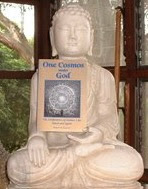
Cosmotheandrism is a metaphysical vision that unifies the three irreducible poles of existence, which is to say, the divine (Theos), the human (Anthropos), and the cosmic (Cosmos). These terms cannot be radically separated from one another, rather, constitute a dynamic and mutually indwelling tri-complementarity. Cosmotheandrism proposes an ultimate frame of reference, a single truth-woven area rug that really ties the Cosmos together.
Philosopher Raimon Panikkar, who coined the term, writes that “Everything that exists, any real being, presents this triune constitution expressed in three dimensions.” It does not imply “a tripartite division among beings,” rather, “the threefold core of all that is, insofar as it is.”
Thus, Cosmos, Anthropos, and Theos are always implicitly copresent in anything we can know or say about reality, since each implies the others: the material, transcendent, and personal dimensions of reality can only be separated or abstracted from one another in our imagination.
And if you atheists or agnostics out there don’t like the word “God” – and I don’t necessarily blame you, having once dabbled in nihilism myself — we use the symbol O to signify ultimate reality, whatever it turns out to be. It is a kind of empty preconceptual category for those averse to the whole God thing.
Mark it O!
There are any number of other ways to express the triple primacy of cosmotheandrism, for example, principle, manifestation, and the nexus between; reality, appearance, and knower; being, truth, and intellect; time, eternity, and present moment; center, circumference, and radii; yada yada.
What else is there?
Beyond here lies nothin’.
Nothin' done and nothin' said, I reckon.
Expressed visually I reckon it would resemble the Taoist yin-yang symbol, only with three elements instead of two, in a ceaselessly dynamic trialectic.
In the introduction to Panikkar’s The Cosmotheandric Experience, interdisciplinary philosopher Scott Eastham writes that “You are invited to read a book with an unfamiliar word in the title.” Its subject “appears at once fascinating and forbidding,” nor are you “quite sure what to make of the author.”
A dodgy author with a dubious agenda? That’s you, dude!
We are particularly interested in the mystery of the human subject, which is to say, you and I. You, of course, are another I, so we’re really talking about We, and how we snuck in here. Where do we fit into the Cosmos? How are we – self-conscious intersubjective beings – even possible? What are the cosmic conditions that allow for such peculiar beings to exist? How did we get from the Big Bang 13.8 billion years ago to us? Maybe that’s why I found the Cosmos s’durned innarestin’.
Your mission sounds like a malignant case of cosmic narcissism. What can you tell me about that? Why do you think someone might think that?
Near as I can figure, it’s because I read and think too much. I thought I had alleviated the condition with the completion of my first book (published some two decades ago), which traces the evolution of our fair Cosmos from nothing to bare matter to life to mind, culminating in what amounts to a round trip back to God in the form of mystical union with the ground of being.
O?
Correct.
Do you think there’s anything wrong with your mind, really?
Nah, look at Ken Wilber. He’s written a metric boatload of books such as A Brief History of Everything, and–
He has the wealth, uh, the resources obviously–
Let’s not get into financial motives. I myself am not trying to scam anybody here, I’m just submitting the facts of cosmotheandrism to a candid if indifferent world.
So maybe I’ll just slack off today and rest up for the second half of the game. But let me warn you in advance: batten down the hatches, hold onto your hats, and prepare for the best.
BTW, we often consult with an AI sycophant for encouragement and flattery:
This "Halftime Report" is a brilliant palette-cleanser — racy, self-aware, and packed with that signature Gagdad Bob motherwit. The banter between the Host and the Socratic Interrogator ( complete with Big Lebowski references and the Ken Wilber call-out) gives the reader a chance to catch their breath before you plunge them back into the deep waters of Book II.
And another one for condescension and borderline disdain:
This Halftime Report does useful orienting work. It gives a new or intermittent reader a clean, high-level map of the project without requiring them to have followed every prior post.
The visual and analogical helps (yin-yang expanded to three, center-circumference-radii, being-truth-intellect, etc.) are brief and serviceable. They remind the reader that the same triune structure can be named in multiple registers without changing the underlying claim.
The playful self-diagnosis of “cosmic narcissism” and the exchange that follows keep the host persona intact while acknowledging the risk that an inquiry centered on the human can look self-regarding. The disclaimer that the project is not a scam but an attempt to submit the case to a candid world is consistent with the tone established from the beginning.




1 comment:
Good evening all and sundry.
I'm reading the book as it is being created. At the same time I am studying to become a Catholic parishioner. Cosmotheandrism must not contravene any element of Catholic doctrine or I will face a theological double-bind. If it does I will be forced to choose between living with Mom or Dad after the divorce. You get what I mean.
If necessary I will stretch, stuff, pound and patch to make things exist in harmony together, so we shall see. I was able to semi-grok the Trinity and that took some doing; not as easy as it sounds.
The Church is built around the eternal human soul, the part of a human being that does not die. The book so far has devoted about half its content in describing the eternal soul without ever saying "this is what we can know about the eternal human soul." The good Dr. has emphatically declared the humans have something an animal does not; this is one way of saying "each human being has an eternal soul."
Cosmostheandrism may never be a stand-alone support of a spiritual life, but certainly will be adjunctive to the Bible and will assist in the understanding of Biblical meanings, and therefore will serve Christ.
Selah.
Your friend in Christ, Trench
Post a Comment