To review our situation: cosmic evolution "arrives finally at man in whom the world succeeds in uniting all the degrees of cosmic being." Again, in the evolution from matter to life, we go from a kind of timelessness to real time, since there can be no time in the absence of an observer, who must "suffer" it. This paradox is somewhat difficult to grasp, but it is nevertheless true: "It is life itself that makes the time from which it distances itself" (DeKoninck).
You could say that matter has exterior succession, in that one damn thing must precede and follow another. But there is no now, no "place" where time happens. Life binds and "uses" this temporal succession in the same way that we use space to build a house. In a way, there is no space until there is an enclosure. Same with time. Life binds space and time, and in so doing, eventually transcends both in Mind and Spirit.
As the biosphere contracts into increasingly dense life-centers, it is "lifted more and more above time." In turn, "beings are perfected to the degree that they are intemporal" (DeKoninck), so the evolutionary vector of time is toward eternity, or O. Schematically, one might say, time everlasting--> time --> timelessness; or perhaps exterior succession --> interior duration --> simultaneously copresent plenitude.
The latter state, instead of a temporal line or a circle, is like a perpetual explosion from the center out, or an overflowing from the Ground. It is the bush that keeps on burning, the fish the feeds the multitudes, and the Slack that cannot be named.
Somewhere in a past post I discussed this cosmic evolutionary scheme in terms of a conquest of dimensionality. The original explanation was somewhat skeletal, and I've always intended to flesh it out. Here it is:
"In many ways, human psychological development can be thought of as a conquest of dimensionality. (Don’t get bogged down in a literal understanding here -- this is a mental exercise to facilitate understanding.) For example, the psychotic mind inhabits a 'zero dimension' of pure mathematical symmetry. It is a world of infinite meaninglessness, with no floor or center, just a roiling panorama of catastrophic, uncategorizable novelty. Symbols are equivalent to what they symbolize and the nameless dread is endless, because there is nothing to contain or anchor it."
Think of this as a kind of existence plunged into sub-matter, without even the reliability of good old solid matter to hold oneself together. It is a pure absence of containment, either in time or space. Perhaps if you've ever had a panic attack, you know the feeling of the ontological ground being pulled out from under your feet. There is literally nothing to hold on to.
I remember once a patient telling me of a panic attack she had while walking around her neighborhood. She was reduced to sitting on the curb, desperately fixing her gaze on an ant that was walking around in the gutter. If she should lose sight of the ant, she was convinced that she would surely lose her mind -- she would just fall and keep falling, swallowed up in the deafening silence of the infinite spaces. Note as well that this is a timeless state; it feels as if the terror is endless, like a kind of hell. One never thinks, "relax, this will all be over in 15 minutes."
According to the psychoanalyst Melanie Klein, this is the type of anxiety we face in coming into the world. Think of the infant's mind as a kind of unbound space that will require parental containment in order to begin the slow process of creating temporal and spatial boundaries that are both "containing" and yet semi-permeable, just like a biological membrane. (Think of the baby as unbound ♂ in search of a ♀.)
A person whose boundaries are too rigid also cannot grow, for he essentially becomes a closed system as a defense against destabilizing knowledge and emotions. In this regard, one often sees adults cling to ideology in the same way an infant clings to the parent. It is not for the purpose of "truth" but containment. Some people do this with religion, others politics or science (e.g., Queeg), but the underlying cause is the same. In this regard, the tenured are no different than any other primitive totem worshipping cultists, except they get the summers off.
Psychological defenses against the Nameless Dread tend to be massive and indiscriminate. Think of vomiting. Your GI system detects something that isn't supposed to be there, and, one way or the other, violently discharges the intruder, along with anything else that might be in the general vicinity.
Psychotic projection is like this. It violently discharges all of the undigested psychic bits into the environment. But unfortunately, that is not the end of the matter. These undigested bits then become a multitude of persecutory entities that pervade everyone and everything, and which must be re-projected.
If you've ever read dailycuss or huffingandpissed, you can see that the sum-total of their world view is a kind of perpetual reaction to their own psychic projectile vomiting. I think this is the real secret behind their new fixation on Rush. Now that Bush-Cheney are no longer there to serve as "toilet breasts" for their violent projections, they desperately need a new receptacle.
Next up, "The (severely) autistic mind may be thought of as one-dimensional. It knows no depth, only points of sensory contact with objects that are known by their feel and texture -- hot, cold, hard, soft, rough, smooth, etc. For them, a communicative expression does not emerge from the human face. Rather, it is simply a bizarre collection of disconnected points -- a nose here, an eye there, a curved mouth down there. The points are not synthesized into an internal representation of the emotional depth or interior of the other.
"The psychoanalyst Francis Tustin wrote about how autistic defenses can operate in neurotic adults as well, for example, in certain repetitive rituals such as 'rocking.' These rituals help to contain an anxiously fragmented mind by focusing on some severely limited sensory perception. Without it, the mind might slip into the terrifying chaos of zero dimensions.
Again, one does not have to be autistic to have experienced this dimension. I remember one patient who was an accomplished physician by day, but after work would have to engage in the ritual of violently rocking back and forth in a rocking chair for an hour at a time in order to "recontain" herself. You might notice versions of this at the margins of your own personality. Any kind of compulsion often serves this purpose, as a kind of solid touchstone for the psyche to cling to.
"Once we reach two dimensions, we are in the realm of something more recognizably human. This was called by Melanie Klein the 'paranoid schizoid position,' and more people (including parts of oneself) inhabit it than you might realize. It is the world of extreme, forced splitting into diametrically opposed emotional categories of good and bad. This type of two-dimensional thinking pervades the Islamic world (i.e., house of Islam and house of war).
"Only with the emergence of the transitional space proper are we dealing with the creative use of three-dimensional psychological space. This is the imaginal realm that emerges between an infant and his or her loving caretakers. But this creative and dynamic space is often hijacked and reduced to two dimensions as a result of the malign imagination of internalized mind parasites.
"The fourth dimension adds time to the mix. This is called the 'depressive position,' a term of art that does not imply clinical depression per se, but the capacity to tolerate ambivalence and mature dependence (as opposed to foreclosing it through splitting) in order to form loving and stable relationships that endure through time.
"One of the reasons this state is 'depressive' is that it involves transcending the omnipotent psychological defenses of the lower dimensions. For example, the 'borderline' patient is not stably in the depressive position. Rather, when they become angry at a person in whom they are emotionally invested, they instantly convert the person into the category of all bad. Not only are they bad now, but they have always been, and always will be, bad. In a very real sense, time and history have been annihilated. The feeling creates the reality. [Obviously, this forms the basis of much leftist thought, in which depth of feeling is confused with clarity of thought.]
"Perhaps you have noticed when you shift from one dimension to another. For example, depression clearly involves a loss of dimensionality. One of its most striking characteristics is that the world seems to lose a vital dimension of emotional depth. Suddenly it is flat, lifeless, and devoid of the meaning that can only be located and experienced in the higher dimensions.
"Moreover, many psychological defense mechanisms operate by descending into a lower dimension. I call these 'dimensional defenses.' For example, there might well be unpleasant meanings and psychological realities located in the fourth dimension -- indeed, there usually are. One way to avoid them is to descend into a lower dimension where those meanings cannot be located or 'entertained' by the mind, any more than a circle can describe a cone. (I think of atheism as a fixed and rigid defense against the higher space of religiosity.)
Let's apply this to the evolution of life. If you were a bacteria, you wouldn't know anything about higher dimensions. Rather, your life would essentially be an eternal point. In the case of slightly higher forms of life, you might discover the line, in the sense that you could move toward food and back away from something dangerous or noxious. I imagine that lower mammals live in a kind of proto-space, and yet, it must be more like an eternal now. In other words, it is missing the fullness of temporal dimension; it is as if they can touch time, but not fully enter it.
To a certain extent, the birth of humanness coincides with the discovery of time -- of past and future, both in relation to this mysterious ontological hole we call "now." Since we live in time, we take it for granted, but it is actually -- obviously -- a very special state. As far as we know, nothing else in the cosmos has awakened to this temporal dimension.
But neither internal nor external reality are limited to four dimensions. In my opinion, one of the things that spiritual development involves first and foremost is the ongoing conquest of higher dimensions. One way to conceptualize this is to understand that each dimension brings with it a new degree of freedom. In the case of spiritual growth, it brings with it the discovery of vertical freedom, does it not?
What did the Master say? "My kingdom is not of this world."
The Book of Genesis is a good example of hyperdimensional prose (which is a good working definition of scripture), since it is something like a crystal through which the divine light is refracted in infinite ways. This is why it supports so many interpretations, each of which conveys the substance of spiritual truth (which feels very different than the substance of mere intellectual-rational truth). As Schuon says, it functions "to provide points of reference for a complex truth and for the sake of the Inexpressible." Postmodern barbarians never understand this, for dogma or doctrine provide "allusive indications..., the implications of which are limitless.... For it is not a question of inventing truth, but of remembering it."
A two-, three- or four-dimensional scientific or religious literalist will simply see something concrete in Genesis: someone dividing light and dark or water and land. A couple of people walking around in a garden. A tree you're not supposed to touch. Etc.
In the past, I have touched on the idea that spiritual experience arrives via spatial delivery at the shoreline between the infinite and the finite, between time and eternity. Consider the fact that we have two biological eyes or ears that are set slightly apart. Because each of the two organs has a slightly different vertex, we are able to see and hear stereoscopically or stereophonically. If you have only one good ear, you can't experience stereo, only mono.
Now, suppose we have a "third eye" or a "third ear." What would reality look like from that perspective? As a matter of fact, it is our third eye that sees into eternity; or conversely, seeing into eternity grows a third eye. Either way, there is a way of living in which these two modes -- the lower and higher eyes -- harmoniously coexist to facilitate the emergence of additional dimensions of depth -- of not being shipwrecked on the rocks of time, nor of being lost in eternity, but somehow experiencing time in eternity and eternity within time.
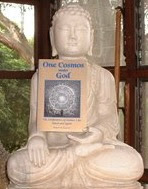
I tried my lovall best to capture this in the Coonifesto. That is, if our perception of spatial depth comes from our integration of different points of view, depth may be thought of as a function of the number of perspectives that are integrated in an experience or perception. I simply tried to integrate as many points of view as possible -- cosmological, biological, psychological, neurological, philosophical, anthropological, theological, mystical, etc.
Having said that, the integration does not come "from the bottom up." Rather, the integration is actually "at the top," but it can only be progressively revealed to us as we grow spiritually. But how do we maintain a stable, balanced life in the material plane when our thoughts are constantly drifting towards intellection of the higher realms?
By finding your own way to be in the world without being of the world -- by participating joyfully in all of the dimensions available to the human being, while at the same time not getting lost in them "from below." After all, this is how the Creator man-ages, isn't it?
Showing posts sorted by relevance for query conquest of dimensionality. Sort by date Show all posts
Showing posts sorted by relevance for query conquest of dimensionality. Sort by date Show all posts
Thursday, March 05, 2009


Sunday, February 26, 2006
On Seeing the Depth of the Cosmos With Your Own Three Eyes
Psychologists don't actually know much about consciousness. However, one thing we do know--or should know, anyway--is that it is not a bag. And yet, in thinking about the nature of consciousness, this seems to be the default setting of most psychologists--as if consciousness is a sort of empty container where mental events take place and are stored. In many respects, this is simply a projection--"injection," actually--and reification of our perception of three dimensional space. But it's the other way around. Three dimensional space is a projection of the mind.
In many ways, human psychological development can be thought of as a conquest of dimensionality. (Don’t get bogged down in a literal understanding here--this is a mental exercise to facilitate understanding.) For example, the psychotic mind inhabits a "zero dimension" of pure mathematical symmetry. It is a world of infinite meaninglessness, with no floor or center, just a roiling panorama of catastrophic, uncategorizable novelty. Symbols are equivalent to what they symbolize and the terror is endless, because there is nothing to contain it.
The autistic mind may be thought of as one-dimensional. It knows no depth, only points of sensory contact with objects that are known by their feel and texture--hard, soft, rough, smooth. For them, a communicative expression does not emerge from the human face. Rather, it is simply a bizarre collection of disconnected points--a nose here, an eye there, a curved mouth down there. The points are not synthesized into an internal representation of the emotional depth or interior of the other. The psychologist Frances Tustin wrote about how autistic defenses can operate in neurotic adults as well, for example, in certain repetitive rituals such as "rocking." These rituals help to contain an anxiously fragmented mind by focusing on some limited sensory perception. Without it, the mind might slip into the terrifying chaos of zero dimensions.
Once we reach two dimensions, we are in the realm of something more recognizably human. This was called by Melanie Klein the "paranoid schizoid position," and more people inhabit it than you might realize. It is the world of extreme, forced splitting into diametrically opposed emotional categories of good and bad. This type of two-dimensional thinking pervades the Islamic world.
For example, just yesterday there was a link on LGF to a transcript on Memri.org of a film seminar on Iranian TV by Professor Hasan Bolkhari, entitled "Tom and Jerry - A Jewish Conspiracy to Improve the Image of Mice, because Jews Were Termed 'Dirty Mice' in Europe." This man is a "professor," and yet, his mind clearly does not operate like yours or mine. Rather, it is simply a caricature of depth, when it is actually operating in the two-dimensional world of extreme splitting.
The professor soberly discourses on how "the Jewish Walt Disney Company gained international fame" with their Tom and Jerry cartoon (for the record, a Hanna Barbera creation). He goes on to suggest that the main motivation "for making this very appealing cartoon was to erase a certain derogatory term that was prevalent in Europe." That is, "If you study European history, you will see who was the main power to hoard money and wealth.... In most cases, it is the Jews. Perhaps that was one of the reasons which caused Hitler to begin the anti-Semitic trend... "
In his two dimensional mind, the Professor observes that "No ethnic group or people operates in such a clandestine manner as the Jews." In fact, "This ultimately led to Hitler's hatred and resentment." Therefore, in nazi Germany, "Jews were degraded and termed 'dirty mice'," so Tom and Jerry had to be made "in order to change the Europeans' perception of mice."
Obviously, this type of two-dimensional thinking is not confined to the Muslim world. In America we have many of our own two-dimensional professors, such as Noam Chomsky, Ward Churchill, and Juan Cole. Their minds are like utterly predictable calculating machines. Whatever data you put into them, they spit out the same results: U.S. bad, everyone else good.
Only with the emergence of the transitional space proper are we dealing with the creative use of three-dimensional psychological space. This is the imaginal space that emerges between an infant and his or her loving caretakers. But this creative and dynamic space is often hijacked and reduced to two dimensions as a result of the malign imagination of internalized mind parasites.
The fourth dimension adds time to the mix. This is called the "depressive position," a term of art that does not imply clinical depression per se, but the capacity to form stable relationships that endure through time. One of the reasons it is “depressive” is that it involves transcending the omnipotent psychological defenses of the lower dimensions. For example, a borderline patient is not in the depressive position. Rather, when they become angry at a loved one, they instantly convert the loved one into the category of all bad. Not only are they bad now, but they have always been, and always will be, bad. In a very real sense, time and history have been destroyed. The feeling creates the reality.
Perhaps you have noticed when you shift from one dimension to another. For example, depression clearly involves a loss of dimensionality. One of its most striking characteristics is that the world seems to lose a vital dimension of depth. Suddenly it is flat, lifeless, and devoid of the meaning that can only be located and experienced in the higher dimensions. Moreover, many psychological defense mechanisms operate by plunging the individual into a lower dimension. I call these “dimensional defenses." For example, there might well be unpleasant meanings and psychological realities located in the fourth dimension--indeed, there usually are. One way to avoid them is to descend into a lower dimension where those meanings cannot be located or "entertained."
I didn't mean for this to be a discourse on psychological development. For one things, these are my own theories, and I doubt if many psychologists would subscribe to them. But any way you look at it, this is as far as conventional psychology can take you--into the four-dimensional space of the depressive position. It's what most people would call "reality."
But neither internal nor external reality are limited to four dimensions. This is pure projection, an artifact of our evolved nervous systems. For example, if you could ask a worm how many dimensions there are in the world, they would undoubtedly say two. Ask a bacterium, and they'd probably say one. Ask most humans, and you get four.
But in my opinion, one of the things that spiritual development involves first and foremost is the ongoing conquest of dimensionality---of higher dimensional space. One way to think about it is that the conquest of each dimension brings with it a new degree of freedom. Think about that insane Iranian professor. How free is he really? In reality, he's free to move in only two directions: Muslim good, Jew evil. Same with Noam Chomsky, at least insofar as his mind touches on politics. His mind is free in only two directions. Conclusions are preordained. He's on a railroad track.
Now several of my readers have pointed out a useful analogy for spiritual experience, one that I myself have used in the past. That is, they compare it to those "Magic Eye" pictures, which look like a bunch of random two-dimensional dots until you relax your gaze, and suddenly a three dimensional object emerges from the page, floating there in the space before you.
Yes. This is an excellent analogy. Genuine spiritual insight involves dwelling in what appear to be meaningless clues, out of which suddenly emerges spiritual "vision." It is there. You "see" it. But that doesn't mean others will see it as well. For example, when I read the Book of Genesis, spiritual insight after insight tumble forth from the pages. But a two-, three- or four-dimensional scientific or religious literalist will simply see something concrete: somebody dividing light and dark or water and land. Some people walking around in a garden. A tree you're not supposed to touch. Etc.
In the past, I have touched on the idea of spiritual experience taking place on the shoreline between the infinite and the finite, between time and eternity. Consider the fact that we have two biological eyes or ears that are set slightly apart. Because each of the two organs has a slightly different vertex, we are able to see and hear stereoscopically or stereophonically. If you have only one good ear, you can't experience stereo, only mono.
Now, suppose we have a "third eye" or a "third ear." What would reality look like from that perspective? As a matter of fact, it is our "third eye" that sees into eternity. If you want, you can even think of it as a right-brain phenomena. That is, the left brain experiences things in sequence, while the right brain experiences them "all at once."
There is a way of living in which these two modes--the lower and higher eyes--harmoniously coexist to facilitate the emergence of additional dimensions of depth--of not being shipwrecked on the rocks of time, or of being lost in eternity, but somehow experiencing time in eternity and eternity within time.
I tried my best to capture this in my book. That is, if our perception of spatial depth comes from our integration of different points of view, depth may be thought of as a function of the number of perspectives that are integrated in an experience or perception. In my book, I tried to integrate as many points of view as possible--scientific, cosmological, biological, psychological, developmental, neurological, philosophical, spiritual, religious, mystical, etc.
I am hardly the only person who has had the experience of the deep unity that subtends--or supertends--the surface multiplicity of the world. As a matter of fact, it's more common than you think. I'm just trying to develop a language to talk about it. Just as we have Euclidean geometry to describe external space, we need to invent a geometry of higher dimensional spiritual space. It's one of the things I'm working on. So if my ideas appear half baked, that’s why. In reality, they’re more like 30-40% baked at this point.
Tuesday, February 06, 2007
Receiving Your Spatial Delivery with Both Feet Planted Firmly in the Air
We didn't properly dodge that last question, did we? "How do I maintain a stable, balanced life in the material plane when my thoughts are constantly drifting towards intellection of the higher realms?" I forgot all about it when my thoughts drifted toward the higher realms.
This is a little difficult for me to answer, because I'm not sure there can be a general rule. I say this because in a sense, the spiritual path is no different than any scientific endeavor, except that you are both the object and the subject of the study. But since each person -- each subject -- represents a unique "problem of God," by definition there can be no "one size fits all" solution.
This comports with something I believe one of my teachers once said with regard to conducting psychotherapy. True, we have a DSM that contains all different diagnostic categories for various psychological disorders. But in reality -- say your patient is named "Jane" -- it is equally accurate to say that she is suffering from something called "Jane's Syndrome," a condition unique to her that the two of you will need to unravel together. It's a bit like those rare "orphan diseases" that no one studies because so few people have them. Looked at from a certain angle, we all have a spiritual orphan disease that is not susceptible to categorization and objective study.
It has been said that a physician diagnoses individuals while a prophet diagnoses mankind. We can extend this to say that a religion also diagnoses man as such, rather than such-and-such a man. In so doing, it endeavors to give an account of your existential symptoms while explaining their etiology and proposing a cure. But these "big box" approaches rarely account for individual differences, which is one reason why schisms occur. A schism is simply one person's "cure" applied anew to all of mankind.
Even when I was in graduate school I could see that the same thing applied to some of the great theorists we studied. While their theories are presented as objective and scientific, as soon as you read a biography of the theorist, you get a pretty good idea of where the theory came from -- how the theorist has elevated something that "saved" his own life and applied it to all of mankind.
I remember once on one of my internships, getting into an argument with a fellow intern about psychoanalysis. He was a behaviorist, a theory which reduces the mind to mere behavior (even thoughts are reduced to a type of "interior behavior") that is either reinforced or extinguished based upon reward or punishment. For him, psychoanalysis was little more than hocus pocus, since everything about the so-called "mind" could be rationally explained by looking at behavior.
At that point in my life, I was still into the sort of competitive intellectual one-upsmanship that characterizes academia, so I actually attempted to win the argument. But the argument was and is strictly unwinnable for the same reason you cannot win an argument with an atheist. Or, to be precise, you can only win an argument with an atheist, except that they won't know it, will they, so what's the point? Why try to convince someone who regards himself as a machine that he is not a machine? You might as well argue with a toaster.
In the past I have spoken of human psychospiritual development as a "conquest of dimensionality" (a term I once heard Terence McKenna use) from point, to line, to space, to four-dimensional spacetime, to hyper (multidimensional) space. In a previous post I wrote that:
"In many ways, human psychological development can be thought of as a conquest of dimensionality. (Don’t get bogged down in a literal understanding here -- this is a mental exercise to facilitate understanding.) For example, the psychotic mind inhabits a 'zero dimension' of pure mathematical symmetry. It is a world of infinite meaninglessness, with no floor or center, just a roiling panorama of catastrophic, uncategorizable novelty. Symbols are equivalent to what they symbolize and the terror is endless, because there is nothing to contain or anchor it. [One does not have to be clinically psychotic in order to have experienced this; it happens to me when I contemplate "President Hillary."]
"The (severely) autistic mind may be thought of as one-dimensional. It knows no depth, only points of sensory contact with objects that are known by their feel and texture -- hot, cold, hard, soft, rough, smooth, etc. For them, a communicative expression does not emerge from the human face. Rather, it is simply a bizarre collection of disconnected points -- a nose here, an eye there, a curved mouth down there. The points are not synthesized into an internal representation of the emotional depth or interior of the other. The psychologist Francis Tustin wrote about how autistic defenses can operate in neurotic adults as well, for example, in certain repetitive rituals such as 'rocking.' These rituals help to contain an anxiously fragmented mind by focusing on some limited sensory perception. Without it, the mind might slip into the terrifying chaos of zero dimensions. [Again, one does not have to be autistic to have experienced this dimension.]
"Once we reach two dimensions, we are in the realm of something more recognizably human. This was called by Melanie Klein the 'paranoid schizoid position,' and more people (including parts of yourself!) inhabit it than you might realize. It is the world of extreme, forced splitting into diametrically opposed emotional categories of good and bad. This type of two-dimensional thinking pervades the Islamic world, including its pseudo-American representatives such as CAIR (i.e., house of Islam and house of war.)
"Only with the emergence of the transitional space proper are we dealing with the creative use of three-dimensional psychological space. This is the imaginal realm that emerges between an infant and his or her loving caretakers. But this creative and dynamic space is often hijacked and reduced to two dimensions as a result of the malign imagination of internalized mind parasites.
"The fourth dimension adds time to the mix. This is called the 'depressive position,' a term of art that does not imply clinical depression per se, but the capacity to tolerate ambivalence (as opposed to foreclosing it through splitting) in order to form loving and stable relationships that endure through time. One of the reasons it is 'depressive' is that it involves transcending the omnipotent psychological defenses of the lower dimensions. For example, the 'borderline' patient is not stably in the depressive position. Rather, when they become angry at a person in whom they are emotionally invested, they instantly convert the person into the category of all bad. Not only are they bad now, but they have always been, and always will be, bad. In a very real sense, time and history have been annihilated. The feeling creates the reality. [Obviously, this forms the basis of much leftist thought, in which depth of feeling is confused with clarity of thought.]
"Perhaps you have noticed when you shift from one dimension to another. For example, depression clearly involves a loss of dimensionality. One of its most striking characteristics is that the world seems to lose a vital dimension of emotional depth. Suddenly it is flat, lifeless, and devoid of the meaning that can only be located and experienced in the higher dimensions. On the other hand, panic can plunge one into a space of infinite dread. Moreover, many psychological defense mechanisms operate by descending into a lower dimension. I call these 'dimensional defenses.' For example, there might well be unpleasant meanings and psychological realities located in the fourth dimension -- indeed, there usually are. One way to avoid them is to descend into a lower dimension where those meanings cannot be located or 'entertained' by the mind, any more than a circle can describe a cone.
This happens both on an individual and a cultural level. For example, the Arab Muslim world cannot tolerate certain meanings with regard to female sexuality, which is why they are so threatened by the "content flow" of globalization, as per Thomas Barnett's theories. In fact, all defense mechanisms can be looked upon as attempts by the mind to create an autonomous closed system within the mind.
Obviously, the same can be said for the left, which is what political correctness is all about. In the final analysis, political correctness is simply an ideological defense mechanism that prevents the mind of the leftist from allowing contact with reality -- with certain unwanted truths. Coincidentally, just this very moment I received an email from a budding Ricky Raccoon who described his political journey from left to right in two sentences:
1. open mind
2. insert logic
Exactly. Once the mind becomes an open system, then growth takes care of itself, so long as it is "fed" truth -- which is one reason why it is so rare for a conservative to regress back to leftism. The operative word is "open," for only an open system is capable of growth. Indeed, only an open system at disequilibrium is alive. To put it another way, a closed mind, or a mind at equilibrium, is quite literally dead -- emotionally, cognitively, and spiritually.
For example, "love" can only occur in an open system between two people. Something is quite literally exchanged in the process, i.e., the "substance" of love. Surely you have felt this substance enter and leave your heart. It is especially fascinating to experience this exchange with Future Leader, not just from my end, but from his, as he "discovers" the separate existence of mommy and daddy and forges an (L) link between us. You'd think it would be easy, but a fair number of adult narcissists never achieve this link, because they are stuck in a one person psychology whose goal is control rather than love. A narcissist is a closed system par excellence. It looks like he is loving another, but it is really just retroflected self-regard.
I don't want to spend too much time with this, but apparently it does not go without saying that the mind must also be an open system cognitively in order for intellectual growth to take place. Here again, it is possible -- in fact, probably more likely than not -- for an academic worker bee-type intellectual laborer to spend his life in the belief that his mind is open, when in fact it is a closed and circular system, usually as a result of some ideology or set of beliefs picked up in graduate school. This is why so much academic scholarship is worthless or harmful (as always, we are speaking of the humanities), since it is quite literally mental masturbation. Real knowledge, like real love, involves the metabolism and internalization of the substance of truth. Once again, I am quite sure that this is not news to Raccoons, although perhaps they have never heard it put this way. But when I refer to the "substance of truth," all Raccoons will know what I am talking about.
(Have we gotten lost again? Or is this post actually going to arrive at its destination? I have no idea. Let us continue hacking away at the dense vegetation.)
Now, if you were a bacteria, you wouldn't know anything about higher dimensions. Rather, your life would essentially be an eternal point. In the case of slightly higher forms of life, you might discover the line, in the sense that you could move toward food and back away from something dangerous or noxious. I imagine that mammals live in a kind of space, and yet, it must be more like an eternal now. In other words, it is missing the temporal dimension. To a certain extent, the birth of humanness co-insides with the discovery of time -- of the past and the future. Since we live in time, we take it for granted, but it is actually -- obviously -- a very special state. As far as we know, nothing else in the cosmos has awakened to its temporal dimension.
But neither internal nor external reality are limited to four dimensions. In my opinion, one of the things that spiritual development involves first and foremost is the ongoing conquest of higher dimensions. One way to coonceptualize this is to understand that each dimension brings with it a new degree of freedom. In the case of spiritual growth, it brings with it the discovery of vertical freedom, does it not?
What did the Master say? "My kingdom is not of this world."
Eh? What? A lowly pauper a -- the -- King?
The Book of Genesis is a good example of hyperdimensional prose (which is a good working definition of scripture), since it is something like a crystal through which the divine light is refracted in infinite ways. This is why it supports so many interpretations, each of which conveys the substance of spiritual truth (which feels very different than the substance of intellectual truth). As Schuon says, it functions "to provide points of reference for a complex truth and for the sake of the Inexpressible." Modern critics never understand this, for dogma or doctrine provide "allusive indications..., the implications of which are limitless.... For it is not a question of inventing truth, but of remembering it."
A two-, three- or four-dimensional scientific or religious literalist -- like my behaviorist colleague -- will simply see something concrete in Genesis: someone dividing light and dark or water and land. A couple of people walking around in a garden. A tree you're not supposed to touch. Etc.
In the past, I have touched on the idea that spiritual experience arrives via spatial delivery at the shoreline between the infinite and the finite, between time and eternity. Consider the fact that we have two biological eyes or ears that are set slightly apart. Because each of the two organs has a slightly different vertex, we are able to see and hear stereoscopically or stereophonically. If you have only one good ear, you can't experience stereo, only mono.
Now, suppose we have a "third eye" or a "third ear." What would reality look like from that perspective? As a matter of fact, it is our third eye that sees into eternity. There is a way of living in which these two modes -- the lower and higher eyes -- harmoniously coexist to facilitate the emergence of additional dimensions of depth -- of not being shipwrecked on the rocks of time, nor of being lost in eternity, but somehow experiencing time in eternity and eternity within time.
I tried my best to capture this in the Coonifesto. That is, if our perception of spatial depth comes from our integration of different points of view, depth may be thought of as a function of the number of perspectives that are integrated in an experience or perception. I simply tried to integrate as many points of view as possible -- cosmological, biological, psychological, neurological, philosophical, anthropological, theological, mystical, etc.
Having said that, the integration does not actually come "from the bottom up." Rather, the integration is actually "at the top," but it can only be progressively revealed to us as we grow spiritually. But "how do I maintain a stable, balanced life in the material plane when my thoughts are constantly drifting towards intellection of the higher realms?"
By finding your own way to be in the world without being of the world -- by participating joyfully in all of the dimensions available to the human being, while at the same time not getting lost in them "from below." After all, this is what the Creator does, isn't it?
Thursday, August 11, 2011
Who Does I AM Say that I AM?
If omniscience is more the mode than the content, then it is clearly in the subject, irrespective of the object(s) it contains and contemplates.
In other words, even if we had access to every single "fact" -- like a vast computer -- we would not be omniscient unless we were in the mode of omniscience. Conversely, even with no "facts," so to speak, omniscience remains omniscience.
I believe it is possible to approach this coonundrum by way of analogy. As it so happens, psychoanalytic theory describes clear developmental stages which result in fundamental transformations to the subject, so that the "objects" within undergo changes as well.
To be perfectly accurate, the objects do not change, but the "vertex" of the subject does, but this seems to bring a new object into being; or at least hidden dimensions are disclosed that can only be perceived in the higher mode.
I've posted on this subject before, but I know not when. I believe I characterized psychological development as a "conquest of dimensionality," a phrase I once heard Terence McKenna use in a more anthropological sense.
For if we consider the long view, human historical development clearly involves an ongoing conquest of dimensionality, or exploration of the cosmic interior.
By the way, just yesterday I noticed a provocative sentence by Ratzinger, which includes the words, "theological advances have not ceased..." Advances. What can he mean by this?
For animals, the world is mostly surface. They have a sensory orientation to the world, which is why their reality is quite unimaginable to us. It's still "the world," obviously. And sometimes they experience much more of it than we do, albeit on a single plane. For example, who can imagine what it would be like to be a dog, whose olfactory sense is so acute that it can detect urine to the tune of one part in ten thousand (or whatever it is)?
But a normal human being comes into to the world oriented to the cosmic interior, to which almost all other animals are entirely closed. However, it doesn't end there, with the simple binary of interior/exterior or human/animal.
Rather, just as there are degrees of sensory attunement -- e.g., dog nose vs. human nose -- there are degrees of interior attunement. For example, psychologists now talk about "emotional intelligence." I'm not one of them, but wikipedia describes it as "an ability, skill or... a self-perceived ability to identify, assess, and control the emotions of oneself, of others, and of groups."
I don't have time to go into the etiology of my own model, but....
BORRR-ring.
Agreed. I just googled myself (it tickles!) and found a previous post in which I discuss the subject.
Now, there is a question in developmental psychology -- at least in integral/transpersonal circles -- as to whether "spiritual development" inhabits its own maturational track, or whether it goes along with psychological maturation in general. It's a little difficult to say, because, for example, one can attain sainthood in the absence of great intellectual development, or, conversely, one may be a great theologian without attaining sainthood.
Still, I think the "more perfect man" would be someone like Aquinas, or Eckhart, or John Paul II, in whom sanctity and intellect are equally developed. Many a fall is caused by good intentions in the absence of intellectual rigor. But so too are falls caused by intellectual development proceeding ahead of emotional and spiritual development.
Another way of saying it is that sanctity may be attained in the realms of truth and/or of virtue, but ideally these two are united, for virtue is the truth of action, while truth is the virtue of intellect.
Sanctity as such is not a "moral concept, but an ontological reality: the divine reality communicating His intimate and proper Life to some of His children. The saint is thus not primarily the humanly perfect Man, but the divinised human person." It is "not so much God-realization on Man's part, as Man-realization on God's part" (preface to Teresa of Avila, The Interior Castle).
Thus, "The progress of a spiritual person towards God is rather the progress of God in him or her. The ascent to the mountain on a person's part (↑) corresponds to the more real descent of God (↓) into his/her being" (ibid., emphasis and sharp objects mine).
Therefore, we might say that God -- and only God -- discloses his omniscience in this (↑↓) trialectic, or what we call the cosmic gyrescape.
Returning to Schönborn, he says that in the "ultimate unity of the conscious subject, in which I know myself, in which I am as it were everything," lies "the clearest analogy to the divine omniscience, which must surely be thought of as a unity, not as an infinite sum of perceptions."
As it pertains to Jesus, he writes (following Rahner) that what "develops" in his human life is, or must be, a kind of gradual disclosure of his own interior. For even -- or especially! -- Jesus was a baby, a boy, an adolescent, a young man. Presumably development took place, just as it does for any human. We are not born adult, which is to say, mature. Eternity takes time.
Quoting Rahner, "This does not of course mean that Jesus 'came upon something' that he absolutely did not previously know but, rather, that he more and more grasps what he already always is and what he basically already knew."
In this way, we are able to, in a sense, reconcile the divine and human, which can be seen as both without confusion and without division.
In a way -- and I'm thinking about this for the first time -- we might think of Jesus as "God deployed in human (developmental) time," since a human being cannot help but be situated in developmental time. Jesus is God refracted through the lens of humanness, but this lens has very specific temporal properties that we need to understand in order to see how God manifests in the human mode.
We (intuitively) know, for example, how God manifests in the mode of nature, since the latter radiates something of the divinity in what Schuon calls its "metaphysical transparency." I suppose that glory, or divine beauty, is ultimately how he manifests in Jesus. Only when we perceive this resplendence are we able to exclaim with Peter, Wo, you really are the Son of the living God!
Like anyone can know that! For again, this is not God-realization on Man's part, but Man-realization on God's part.
I call it a guman... It's pretty much my favorite animal. It's like God and human unmixed and undivided... bred for its skills in salvation...
Tuesday, January 27, 2009
How the Worm Turns and Grows in the Dark
Let us begin with an orthoparadoxical cryptogram by James at Just Thomism, who observes that "The cosmos shows us nothing like the knowledge by which we know it." And even less does it show us anything "like the source from which the knowledge flows."
In other words, not only does the cosmos have an invisible interior, but it directly communicates this perfect nonsense to another, even greater, invisible interior. That would be us.
However, if we fail to turn upstream to the source of this bifurcated interiority, it will remain a complete and utter mystery, which is the fate of the scientific materialist, who is condemned to live in a kind of useless cloud of subjectivity for which he can never account. But if we do turn to that source, then it becomes an awesome and glorious Mystery. If you want to think about it symbolically, from the horizontal perspective, ( ) and (•) give rise to one another. But from the vertical standpoint, both are a function of O.
I am reminded of a comment Churchill once made, to the effect that "we are all worms." However, after a thoughtful pause, he added, "but I do believe that I am a glow worm." Now, for those of us who aren't born that way, to go from worm to glow worm is a matter of repentance, or "metanoia," which simply means to "turn around" -- not from left to right or east to west, but from exterior to interior and down to up.
But I would go even further, and say that this is how you caterpult your buddhafly -- how the humble cocOOn becomes the womb of the christallus through the self-emptying of our voidgin birth.
It all begins with the ability to "read" the world's interiority -- which doesn't just communicate truth, but beauty. That much is obvious, although the materialist tends to focus on the former to the exclusion of the latter, thus disfiguring his metaphysic from the outset. For as Balthasar writes, "Whoever insists that he can neither see it nor read it, or whoever cannot accept it, but rather seeks to 'break it up' critically into supposedly prior components, that person falls into the void and, what is worse, he falls into what is opposed to the true and the good" (emphasis mine).
Now, if you understand that, then you understand the basis of my objection to radical secularism, because it starts with Ø instead of O. As a result, as it proceeds and ramifies horizontally, it only magnifies and concretizes its initial error, which cannot be located in the horizontal stream of knowledge, because it's way back there where you started. "In my beginning is my end," as the poet said.
It very much reminds me of our erstwhile jester, who could not see -- because he could not see -- that I am always attempting to communicate a vision of the whole through parts, which, after all, is the only way you can do it. But he would, with perfect myOpia, wrench one of the parts from its irreducibly aesthetic context in order to prove to himself that the whole does not exist. Truly, this is like cutting off your face despite your nous.
This is why we insist that there is such a thing as spiritual autism, i.e., people who live in a bizarre world of parts, which they cannot unify into the whole -- like the autistic child who can see the skin that covers the front of the skull, but cannot read expressions. And an "expression" is nothing less than the "interior" of the face; or, you could say that the expression is the externalization of the soul. Ether way, cosmically speaking, such a one is barred entry into the cosmos proper, and is condemned to crawling around on its periphery, or "epidermis," just like a... a worm.
Now, the key to spiritual growth is this deepening of our interior, which elsewhere I have called the "colonization of consciousness," or the "conquest of dimensionality," or "raids on the wild godhead," or "ex-perditions over the subjective horizon," or "the hajj to Upper Tonga," etc. Balthasar agrees that "as we proceed from plant to animal to man, we witness a deepening of this interiority, and, at the same time... a deepening freedom [read: conquest of dimensionality] of the expressive play of forms" (emphasis mine).
In other words, each of the following things is related to the others, because they emanate from the "above": interiority, unity, wholeness, beauty, freedom. Deepen one of these, and you deepen the others. Likewise, deny one, and you weaken and eventually "murder" the others. For we are an "image of the One," with all that implies.
Now, the One is the essence of interiority, otherwise it would merely be an agglomeration of externally related parts. Therefore, we are one because the One is one, the difference being that our oneness must be realized, whereas the oneness of the One is intrinsic and cannot not be one. This is why the more immanent the One is, the more transcendent. Its oneness overflows everywhere, so that everything is ultimately its witness and testament.
Here is how Balthasar describes it: "As a totality of spirit and body, man must make himself into God's mirror and seek to attain that transcendence and radiance that must be found in the world's substance if it is indeed God's image and likeness -- his word and gesture, action and drama. This is the simple reason why man's being, even in its origin, is already form, form which does not curtail the spirit and its freedom but which is identical with them."
Again: image --> form --> beauty --> transcendence --> being --> freedom --> God. Or, you could take the same sequence in reverse, and arrive at Man, who is the only being who must be, relatively speaking, of course. In other words, "being is, therefore I am; I am, therefore I think; I think, therefore truth is; truth is, therefore God." Etc.
Conversely, as James suggests, "If the things in the cosmos alone are 'what exists', then I..."
I what? Then I am no more. I have committed metaphysical cluelesside. I am blind and deaf to the divine beauty, to the metaphysical transparency of the One. Therefore,
Our first principle must always be the indissolubility of form.... If form is broken down into subdivisions and auxiliary parts for the sake of explanation, this is unfortunately a sign that the true form has not been perceived as such at all. What man is in his totality cannot be 'explained' in terms of the process by which he has become what he is.... All these dimensions produce material which is then subsumed by the form of man....
Truly, it would not be worthwhile being human if man were but the amalgamation of such 'material', if the one thing necessary, the irreplaceable pearl, were not a reality for the sake of which we would sell everything else. This precious 'pearl' must have been espied in the first place by an eye that recognizes value, an eye which, being enthralled by the beauty of this unique form, dismisses all else as 'rubbish' in order to acquire the one thing which alone is worthy of claiming our life unconditionally. --Balthasar (sorry for the length; with Balthasar, sentences are paragraphs, paragraphs are pages, pages are chapters, etc.)
Wednesday, November 06, 2013
Who Let the I AM In?
Consciousness itself is a mystery; but that it should be so simple, so unified, and yet, dependent upon -- or inclusive of -- so many billions of macro- and micro-processes, is even stranger.
Truly, human subjectivity is either the ultimate or penultimate case of E Pluribus Unum, depending upon whether or not one believes in God. But if one doesn't believe in God, then our self-evident I AM goes from intriguing mystery to annoying impossibility.
Yes, one could say that, just as there can be no inside in the absence of an outside, there can be no object without a subject. The two are complementary. In other words, a thing must have a kind of interior prehension in order to be a thing at all -- otherwise, it's just an indistinct blob. So existence as such implies interiority, because to exist is to exist as an intelligible thing or unit.
Any form of life represents conscious interiority, a bounded area of awareness. But in the case of human beings, this interiority is not just a vague and diffuse, preconscious apprehension of interior wholeness. Rather, it is a highly focused ingathering of interiority that we all fondly refer to as I.
As we've discussed in previous posts, it is as if both the general evolution and individual development of consciousness represent a conquest of dimensionality. This movement is precisely what confers meaning upon time. Otherwise, time is just abstract duration. Watch a child grow (outside and in) and you will intuit time's substance.
The consciousness of, say, a snail, is of surfaces only. Thus, it exists in a kind of quasi-timeless two-dimensional space: forward, toward what facilitates life, and backward, away from what doesn't.
But anyone with a dog or cat can "see" that they live in a more expansive space. For example, they listen for and interpret far off sounds, and are at the center of a rich olfactory matrix we can scarcely imagine. But more importantly, they are tuned into their human masters, which itself expands the intersubjective space in which they live and move.
Now think about the hyperdimensional space in which human beings live. It includes not only our personal past, but the past of the entire species, depending upon how much history one knows. It extends outward, to the farthest horizon of the celestial lightstream, and backward, to the very genesis of this whole cosmic affair. It reaches into humans and other animals via empathy, and deep into oneself via introspection. And some say it can extend so far -- via mystical experience -- that it may know the cosmic Subject, the great I AM from which our own little spark of interiority is derived.
Until hitting page 197 of The Experience of God, I thought I was alone in the bewilderness on this subject. Alert readers will recall a passage on p. 49 of The Book for which the blog is named, where it is written:
"Without the principle of wholeness woven into the very fabric of the universe, it would be impossible for true wholeness to later emerge at the levels of life and mind. The integrated wholeness we see in a living organism discloses a fundamental principle that is absolutely intrinsic to the universe."
Likewise -- and here's the important part -- the transcendental unity of our own subjectivity, "the ordered whole we all effortlessly refer to as 'I,' is another accurate intuition of the wholeness of nature." In the absence of this principle, "there is simply no explanation as to how the billions of individual cellular processes taking place in your brain and body so neatly resolve themselves into the simple, transcendent and unitive experience called 'I.'"
Multi-undisciplinarian that I am, I have a tendency to make a point and quickly move on. It's not just that I get bored easily, but that the Adventure of Consciousness must continue on, in, and up. No looking back!
But Hart spends a few pages expanding upon this notion of the unity of consciousness, agreeing that it ultimately converges upon -- I would say returns to -- God.
"Consciousness is, in its subjectivity, one and indivisible," writes Hart. Yes, there is diversity -- even inconceivable diversity -- "but in order for there to be such a thing as representation, or reason, or conceptual connections, or coherent experience, or subjectivity, or even the experience of confusion, there must be a single unified presence of consciousness to itself, a single point of perspective that is, so to speak, a vanishing point, without extension or parts, subsisting in its own simplicity."
I would modify this somewhat, in that what we discover at this vanishing point is not so much an abstract being but a concrete activity -- an irreducible experience in becoming. In my view, human consciousness is, so to speak, the metabolism of experience. We cannot possibly stop experiences from occurring -- i.e., we cannot stop time -- so it is our unending task to weave this ceaseless flow of experience into our psychic substance, forging ever greater wholeness and unity.
Hart implies something similar, for example, vis-a-vis left and right brain activity. The existence of differing modes of consciousness in the two cerebral hemispheres does not imply that we are somehow inhabited by two different subjects. Rather, what we experience is "a single consciousness" that attempts "to integrate the experiences and behaviors that each hemisphere makes possible."
Indeed, just as the existence of two eyes with slightly different perspectives facilitates the perception of depth, the integration of our "two hemispheres" (and there are more than just two such perspectives) results in a much richer and deeper psychic space.
There are always going to be "discontinuities" in consciousness, or semi-autonomous areas which are poorly integrated into the whole. At a certain point these become mind parasites, but in general, most any form of psychopathology can be understood as a failure of integration.
For example, one person fails to integrate his childhood experience via denial and repression, while another fails to integrate, say, sexual appetite into the human subject. Instead, it exists as a kind of impersonal animal instinct, unconnected to any higher striving or purpose. You might say that it is reduced from a hyperdimensional modality to a two-dimensional one. Or, it falls from a sacrament to a mere genetic whip.
So, what have we learned? For Hart, "Only the 'vanishing point' of a subjective perspective allows the diversity of reality to appear to the mind as a unified phenomenon, to which consciousness can attend."
I would only add the caveat that it doesn't end there. Rather, each end is a fresh new beginning -- or an annoying rendezvous with time, if you allow it to be.
But in any event, "there is no good reason not to accord serious consideration to the ancient intuition that the true order of ultimate causes is precisely the opposite of what the materialist philosopher imagines it is, and that the material realm is ultimately dependent upon mind rather than the reverse..."
Or, just say that I is prior to AM, but that, like God, our I never stops its AMing.
Tuesday, January 06, 2009
Only You Can Prevent the Apocalypse
Today's highly orthoparadoxical invocation:
For in the same being of God where God is above being and above distinction, there I myself was, there I willed myself and committed myself to create this man. --Eckhart
To summarize Bolton's position, the creation bifurcates out into fate (or nature) and providence, so that man represents the possibility of their re-union. In turn, man bifurcates out into body and intellect, the union of which is the soul.
Now, one way to understand cosmic evolution -- which recapitulates in miniature in man -- is to see it as the gradual mastering of fate (and the conquest of dimensionality, more on which later). As Bolton writes, "the moment when man arrives on earth he belongs to Fate, which leads him captive for a long time in the vortex of fatality." You might say that, with the Fall, we are cast naked into the fate stream with no canoe. Still, man "bears a divine seed within him which can never be entirely confounded" by fate.
Nevertheless, it will take mankind countless generations to master fate and slowly discover its destiny, both individually and collectively (individuals were able to do it long prior to any large collectives). From the Raccoon perspective, we look to history for certain easily identifiable points at which there was a tremendous influx of vertical energies to help lift us from fate to destiny. Some of these would be Abraham's failure to sacrifice Isaac, the downloading of the Torah, the Incarnation, the emergence of free markets, the American revolution, the Beatles' first appearance on Ed Sullivan, etc.
Eventually man is able to discover that we are endowed by our Creator with the right to life and liberty, which is to officially plant our colors on the side of destiny. It is to say that we are no longer controlled by fate. Leftism is, of course, the atavistic embrace of fate, i.e., passive victimhood, so it is hardly as if fate has been vanquished.
When the left talks about "freedom," it is necessarily in a highly limited way that paradoxically frees one to abandon oneself to fate. In other words, since they deny the higher realm -- the true object of our free will -- will is reduced to mere horizontal willfulness. It is will with no real freedom, since it denies the sufficient reason for our freedom, which is to know the absolute and govern ourselves accordingly. A will that is not lured by the good, true, and beautiful is not actually free, but a plaything of fate.
So, each of us "has the means to unite himself or herself in an equally natural way to either the Providential or Fatidic order" (Bolton). But again, genuine free will cannot belong to nature, but can only be understood as a gift of Providence. Therefore, our Founders were correct to insist that to deny God is to deny freedom. And as we have mentioned before, it is also ipso facto to deny the mind, which is the "internal space" of freedom's possibilities.
Which invites another paradox, in that only by becoming a "slave" to providence are we actually free. But really, this is no more paradoxical than saying that only by becoming a slave to truth do we gain wisdom. No one has ever gained wisdom by declaring his independence from truth, a sad fact to which our liberal universities offer abundant testimony. No. "The soul which aligns itself with Providence, and therefore with freedom, will thus be the one which realizes the possibilities of the spiritual nature to the fullest extent possible for the individual concerned" (Bolton).
Consider our dispute with the reductionistic Darwinians, who specifically deny Providence and believe they can fully account for man with recourse only to the realm of fate, or nature. Since real ontological freedom is necessarily abolished in this crude reduction, then so too is the possibility of truth -- which is again dependent upon freedom. In other words, if we are not intrinsically free to discover truth, then we can only know what we are fated to know -- which is no knowledge at all, just an extension of necessity.
Again, it is by aligning ourselves with Providence that we actualize our true freedom. This is why the "perfect prayer" includes the formula thy will be done, on earth as it is in heaven. That's what it really really says. It even outlines the way in which this free will is actualized, that is, by assimilating each day our daily vertical bread.
In turn, this is why we must "resist temptation," which specifically refers to the horizontal world of fate, which operates through hypnosis, seduction, and temptation of those parts of ourselves that remain mired in fate, i.e., mind parasites. Again, a mind parasite is like a closed, unevolving, circular entity that goes on being by borrowing a piece of our subjectivity and "going into hiding" below the threshold of consciousness. It then enlists the objects and experiences it needs to continue its viral pseudo-life, or "living death." Only when you start to feel enslaved by your mind parasites are you beginning to break free of them. The most unfree people generally feel quite free, since they don't stir up trouble their mind parasites.
A truly free will would have to be "one," would it not? Since Wisdom is one, it can do all things (Wisdom 7:27). So long as one is inhabited by various sub-wills at cross-purposes with one another, that's a kind of perversion of freedom. It is as if the one will is "broken" into fragments that are then purloined by various subpersonalities. Generally speaking, the sicker the individual, the more autonomous and split off are the subpersonalities. Likewise, the healthier the individual, the more unified the will -- and therefore, the more real the freedom.
Looked at in this way, one can easily see how "the truth sets you free," because freedom is really a prolongation of truth. Again, if there were no truth, there would be absolutely no possibility of freedom, any more than art would be possible in the absence of beauty. Is an artist less free because he is a slave to beauty? Hardly. Beauty is a kind of breach in the fabric of nature through which celestial energies flow, and which always carry with them an ability to "transport" us to their source. In short, beauty is liberating. Haven't you ever noticed how enclosed and "hemmed in" you feel in an ugly environment?
This is also how I would feel in typical university -- and also, sad to say, in a typical church. If a church service doesn't give access to real truth, real freedom, and real beauty, then something has gone wrong. Its only reason for being can be to facilitate an experience in O, which is much deeper than any mere (k). Reduced to (k), religion is hardly better than scientism. Which is one reason why I prefer so many of the premodern theologians, whose minds and beings hadn't yet been hijacked by the cultural demands of a spiritually desiccated scientism.
Speaking of which, contemporary man stands at a crossroads. Which is nothing new, since we are always at that crossroads between fate and destiny, whether we know it or not. However, just as there are historical ingressions of vertical energies, we can equally see periods in which the tiller of history is seized by the horizontaloids. When that happens, the center cannot hold (the interior center being a reflection of the One), and a kind of hell is unloosed from below.
Here's how Bolton describes it: "as mankind fails to realize the role as Mediator, natural forces grow increasingly violent and chaotic, and disasters become more frequent. The Apocalypse is the final extreme of this disorder."
Don't think "it can't happen here," since it can only happen here. And only we are free to prevent it, since the unfree are its architects. (BTW, I'm using "apocalypse" in a more colloquial sense, as "ultimate cataclysm.")
Voice your support for cosmic freedom:
Thursday, June 13, 2013
So Many Worlds, So Little Time
Davie writes that "Although Christian theologians have frequently spoken of the Unacknowledged Christ of the Vedanta, they have been strangely silent about the Unacknowledged Vedanta behind Christianity."
This is unfortunate, because, as alluded to yesterday, the metaphysical principles embodied in Vedanta -- i.e., the Upanishads -- "can be shown to supply the logical precondition of orthodox Christianity."
Certainly they provide a better fit than, say, the dualistic Platonism that some of the early fathers over-relied upon in order to make sense of their new revelation.
More generally, if Christianity is truly universal, there can be no objection to assimilating ideas and concepts from other cultures in ardor to advance our understanding.
True, Christianity is also a historical religion, which can at times work counter to the idea of universality. For example, if the arc of salvation runs only from Jerusalem to Rome, that excludes an awful lot of history. Perhaps we need to reframe the command to preach to the four corners of the world.
World.
There is the exterior world, of course, but more importantly, there is also the interior world. If you take the command literally, you might as well stand alone on top of a mountain in some far off corner of the earth, yelling into the wind.
No, the point is, you have to reach the people who inhabit those corners.
We've all heard about the "first world," "second world," "third world," etc. Every once in awhile it occurs to me that I need to write a post about how there are also various internal worlds in different stages of development.
Starting back-to-front, Professor Wiki says that the 4th world consists of socially excluded sub-populations (even if living in the first world), and hunter-gatherer, nomadic, pastoral, and subsistence farming peoples living beneath the modern industrial norm.
Third world peoples have entered history, and are at least starting to develop, while first world countries are completely there. The second world might be thought of as an attempt to arrest time -- as in the case of contemporary progressives -- via a planned economy.
But as we know from baneful expedience, any effort to control a self-organizing structure from the top down results in chaos, so the second world ends up tending toward the third, as we see in Obamaworld -- e.g., record numbers of people on food stamps and disability, millions giving up on finding work, etc.
How would the above scheme apply to the interior worlds? I suppose you would say that progress in this domain represents a conquest of dimensionality, as we have discussed in the past.
I'm starting to run out of time, but it occurs to me that the interior analogue of the second world would also tend toward the third and fourth, as it involves a rejection of time and of verticality. As we know, there is nothing progressive about progressivism.
Hmm. While searching for something else, it occurs to me that I might have adequately discussed all this in the past, e.g., Pimp-Slapping Obama and Conserving Our Metaphysical Dream of Progress, Universal Religion and the Many Worlds Hypothesis, and Just One Thing I'd Like to Know, How You Stay High, and Live So Low.
Down to 12 minutes. Time enough to say that the fourth world is diffuse mythological/magical, the third world centralized mythic/magical authoritarianism, the second world progressive / leftist / fascist / socialist / atheist statism, and the first world the vertically informed horizontality of American-style classical liberalism.
No time to read them, but probably some more relevant posts under this heading.
And now 5 minutes to spielcheck.
Subscribe to:
Posts (Atom)
Theme Song