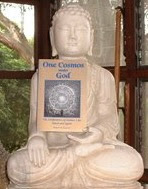
Yes, Yes, I hear you. I realize that there's a substantial proportion of the raccoon population that is sick of the word "Integralist." It was not my intention to spend several posts dwelling down there in that two-dimensional opinion space, but I do not plot these things out ahead of time, and I do require blogfodder for my daily brood. It has to come from somewhere. I no longer have time to read books, and once Future Leader wakes up, the daily distractions begin.
That's why I've come to enjoy blogging so much -- the silence and darkness of the early morning, sitting down and waiting for inspiration -- a little merciful K from O! I don't have much time to prepare, and there are no second drafts, so I pretty much have to light on the first thing that catches my attention. It might be a comment by a reader, or a post from one of my favorite sites, such as American Digest, Dr. Sanity, or American Thinker, or some kernel of an idea for an idea that floated into my noodle the day before, but I basically have to just grab it and run.
Now that I think about it, it's rather interesting, in a Polanyi-esque sort of way -- the idea that we are able to non-consciously intuit the full implications of the kernel of a potentially fruitful idea before we have ever worked them out in any conscious or explicit way. As philosophers go, I hold Polanyi in the highest regard, and believe him to have developed the only philosophy qua philosophy -- i.e., not a theology -- that effectively counters and transcends the plague of deconstuctionism, the latter of which I believe to be a somewhat inevitable, if malodious, development in man's cognitive tool shed. Deconstructionism is literally an adolescent phase in our collective evolution, a weed that sprouted up in the gap between man's pre-critical understanding of the cosmos -- which is to say, the underlying and overarching whole of reality -- and our post-critical understanding of it.
I am not a professional philosopher, so there may well be others, but Polanyi's is the most clear articulation of a post-critical philosophy that I have ever encountered. Furthermore, once you have understood Polanyi, you can then move on to a post-critical mystical theology in a rather seamless way -- which was perfect for the absurcular needs of my book. Because once you have a post-critical theology, then you may circle back to the origins of religion and understand it in an entirely new way -- you may, to paraphrase or possibly plagiarize Eliot, "return to the beginning and know it for the first time." I don't know what to call this new-old phase, because I'm not sure there is a name for it. Call it "neo-traditionalism."
This exactly mirrors my own personal evolution. I won't say that I was ever a deconstructionist per se. For one thing, looking back on it, I can see that embracing such a cynical philosophy that rejects absolute truth is entirely foreign to my nature. Nevertheless, throughout my formal miseducation, this was the backdrop, the culture, the milieau that one could not help imbibing.
Interestingly, this pernicious philosophy doesn't have to have any "content" for it to burrow its way into your soul and begin doing its damage. Rather, one must merely internalize the stance, which is skeptical if not cynical, world-weary, and always ready to prove the superiority of the mind that can disprove anything with mere reason -- a reason that is detached from intellection and thereby become infrahuman, or monstrous, killing God but destroying man in the bargain. Deconstruction is a magic tool that allows the most bovine intellect to imagine itself superior, merely because it can rebelliously dispute the adults on its own adolescent level. It is no wonder that most people don't know how to counter it except, for example, to hold up a cross and insist in the face of such perverse reason that "We preach Christ crucified! He is risen! Now get behind me, satan!"
Naturally, back when I spent my spore time in the moldy academic mildew, I would have probably contemptuously dismissed such an unfungal person to the mulchroom. But now that I have completed the cosmic circle, I understand them entirely. Now, if someone were to ask me if I believe in the literal resurrection, I could say "sure." And yet, somehow "literal" does not mean literal. Hard to describe -- call it "transliteral" or "metaliteral." But sure enough, when I circled back to the origins of Christianity, I found capacious souls that had already beaten me to it -- people such as Origen or Pseudo-Dionysius, who already had a very post-modern cosmic view of things. Thus, within the very heart of paleo-tradition I discovered the neo-tradition that had been there from the start! Such are the miracles of revelation.
Look at what Origen -- who lived between 180 and 254 -- had to say about the interpretation and understanding of scripture, for it is extremely subtle and sophisticated: "[T]o those who are at the stage of infancy and childhood in their interior life... it is not given to grasp the meaning of these sayings..." Later, he says that "divine scripture makes use of homonyms; that is to say, they use identical terms for describing different things." He then distinguishes this capacity from mere reason -- i.e., he is already postcritical -- by referring to the faculty of spiritual gnosis (not to be confused with gnosticism) "by which we go beyond things seen and contemplate something of things divine and heavenly, beholding them with the mind alone, for they are beyond the range of bodily sight."
But "the soul is not made one with the Word of God and joined with Him until such as time as all the winter of her personal disorders and the storm of her vices has passed so that she no longer vacillates and is carried about with every kind of doctrine." In short, being tethered to the Absolute, as reflected in scripture, is the cure for a hypertrophied and stupidly curious reason, a centerless deconstruction that "carries the mind about with every kind of doctrine."
Or consider the great Dionysius (c. 500 AD), who cautioned that the fruits of mystical contemplation are beyond the rationalizing intellect. They are protected from "the uninitiated, by whom I mean those attached to the objects of human thought, and who believe there is no superessential reality beyond, and who imagine that by their own understanding they know him who has made darkness his secret place."
To reach the summit of our being we must "leave behind the senses and the operations of the intellect, and all things sensible and intellectual, and all things in world of being and non-being, that you might rise up unknowingly toward the union with him who transcends all being and all knowledge." Here is "where the pure, absolute, and immutable mysteries of theology are veiled in the dazzling obscurity of the secret silence, outshining all brilliance with the intensity of their darkness, and surcharging our blinded intellects with the utterly impalpable and invisible fairness of glories surpassing all beauty."
This, my fellow nocktrinical marysophicals, is a man who knew all about O-->K, a man who was post-postmodern before there was even modernity. Or to put it succinctly, a man, properly so-called, a Raccoon, a brother under the pelt! Woo woo!
A final orthoparadoxical Dionysian ode to O, only slightly altered:
"Ascending yet higher, we maintain that O is neither soul nor intellect; nor has he imagination, opinion, speech, or understanding; nor can he be expressed or conceived, since he is neither number nor order; nor greatness nor smallness; nor equality nor inequality; nor similarity nor dissimilarity; neither is he immovable, nor moving, nor at rest; neither has he power nor is power, nor is he light; neither does he live nor is he life; neither is he essence, nor eternity nor time; nor is he subject to intelligible contact; nor is he knowledge nor truth, nor kingship, nor wisdom; neither one nor oneness, nor divinity nor goodness, nor is he Spirit according to our understanding, nor anything else known to us or to any other beings of the things that are or the things that are not; neither does anything that is know him as he is... neither can the reason attain to him, nor name him, nor know him, for O is free from every limitation and beyond them all."
And yet, this inexhaustible void became flesh. And we speak of, in, and through it continuously. For how could it be otherwise, without being other than wise?
Saturday, January 06, 2007


Friday, January 05, 2007
Dodging Dupree's Question
Finally, perhaps we're getting somewhere. Dupree asked what I thought was a reasonable question of Integralist. As a matter of fact, it is the same question I asked myself at a certain point around 15 years ago, and which began an inevitable transformation in me. I actually remember the moment distinctly, as I was sitting in the the exact spot where I am now, working on a paper for a psychohistorical journal.
First, the question (actually, several related questions) Dupree asked -- by the way, have you noticed a certain growth in Dupree's own level of maturity since he moved in last year? -- anyway, the question (preceded by a comment) was:
"To the extent that you politicize problems that are existential, psychological, or spiritual, you are a member of 'the left.' How is your own life going in these here United States? Are things okay for you? If not, whose fault is it? What do you need to do to turn things around?"
Integralist's response -- wholly inadequate, even evasive, I might add -- was "you may be right that I am (overly) politicizing issues that are existential, spiritual, etc. But I am only of the 'Left' in relation to folks on this board; to some of my more leftist friends (and parents), I am more right. But, as my moniker says, I like to think that my worldview embraces both Right and Left."
As you can see, he began to answer the question, but does not seriously reflect on it before pleading "all my friends do it, and besides, it's all relative. I'm to the right of them and the left of you. Therefore I'm integral."
Integral or rudderless?
He continues: "As for my life, well that is a personal question!"
Yes, exactly. We are Raccoons. We have nothing to hide. What are you, and what are you hiding?
"It is a work in progress...why do you ask?"
I won't presume to speak for Dupree, but I think I can sense what he was driving at. He wants to know if Integralist has been able to make his own life fully functional before making sweeping judgments about how to solve other people's problems. Because, depending on how you achieve -- or fail to achieve -- your potential, there is a good chance that that is going to be your "recipe" for others. How can it be otherwise? One doesn't discover the key to the universe and not share it. To the contrary, everyone is full of advice on life and how to live it -- including the most clueless and dysfunctional people who have not come close to mastering their own impulses, let alone lives -- for example, the Hollywood nitwiteratti.
Integralist shares one last banality before ending with a rhetorical question: "I will say that as I have gotten older I have become more conservative (although still a raging bleedin' heart compared to most folks here! ;). So I understand the move from Leftism 'rightward' as a kind of maturation, but my own journey has been towards integralism, not the Right. But who knows what the future will bring?"
Spot the contradiction: 1) as I have gotten older I have become more conservative, 2) I understand the move from left to right as a kind of maturation, and 3) but my own journey has been towards integralism, not the Right.
Who knows what the future will bring? Why, Dear Leader does, of course. Obviously, if the same trajectory of maturity continues, Integralist will become, like us, more of a bleeding mind conservative but continue calling it "integralism." At least until he looks down at the ground upon which he is standing, and realizes he is in a new territory that is "against his religion" -- his real religion being leftism, not integralism. Religious conversions are very painful, and mine was no exception. Like virtually everyone of my generation, I had an extremely simplistic identification with liberalism that was about as sophisticated as "four legs good, two legs bad." Long after I began to realize that two legs weren't so bad after all, I still identified myself as a four legged. Then something finally "snapped," and that was it. I looked down at the ground upon which I was standing, and suddenly realized that it wasn't the same ground as Ted Kennedy, or Howard Dean, or Nancy Pelosi -- even though, by then, I was a continent away from them! Indeed, an entire cosmos away. It just took a long time to realize it and accept it.
It reminds me of a Jewish friend. As you know, Jews vote 90% Democrat, even though the Democratic party is no longer the repository of Jewish values -- indeed, it is now, along with academia, the main repository of anti-Semitism. I told him flat out: "You're not Jewish. You're just Democrat." For it was true. I think you'll find that almost all serious Jews are conservative. Its just that most Jews are not serious about their religion, but simply have the cultural identification. I know this because I married into a family of typical Jewish anti-Semites, bless their bleeding hearts.
But I digress. A recent poll by the AP shows the irrationalism behind the leftist critique of America. (By the way, if anyone should be aware of this, it is Jews, who have prospered in America like no other group. My father-in-law, for example, has had an extraordinarily successful and culturally rich life -- largely because he has Jewish values despite the absence of Jewish religion. What is his complaint? It is not a rational complaint, because in his case, it is simply derived from scripture -- scripture for him being the editorial pages of the New York Times. His life is fine -- better than fine -- but if the Times says this is the worst economy since the great depression, then it must be true. One is tempted to say: if gaps in income are such a terrible thing, just give some of yours away until you feel comfortable again. But please, don't ask the government to take mine away at the barrel of a gun!)
But I digress again. The AP poll shows the dramatic contrast between the personal satisfaction of the average American versus how they feel about the nation at large -- which, you might say, is the contrast between the ground under their feet and the false picture that is relentlessly pounded into us by our "two legs bad" MSMistry of Truth. The survey simply asked people how the year 2006 had been for them and their family. A remarkable 76% responded that it had been a good one. However, when asked the same question about the country, 58% saw the year in a negative light. How can this be? How to reconcile the contradiction? How does the personal 76% plunge to collective 42%? Again, partly it has to do with the unremitting negativity of the liberal media and its political action wing, the Democratic party.
It is a truism that if this were a Democratic administration the media would be ceaselessly touting the remarkable economic achievement of the past four years -- high employment, low inflation, soaring stock market, reduced taxes with record high government receipts, and a diminishing deficit which, in any event, is historically below average as a percentage of GNP. The percentage of Americans who own their own homes is at an all time high, and even the size of today's typical home is larger than ever. Leisure time -- a key component of Slack -- is at historically high levels, as is the percentage of household expenditures used to buy nonessential items (another key measure of Slack). "Poor" people today have things that were undreamt of even by the wealthy of just 30 years ago -- including this here internet. In a remarkable editorial in the WSJ, Brian Wesbury writes,
"In 1982, Time magazine’s Person of the Year was a machine -- the personal computer. Twenty-four years later, after being empowered by the computer, the 2006 Person of the year is -- 'You'.... The most interesting thing about this progression is that it did not result from consumer demand. Demand does not create wealth. Consumers were not marching in the streets 30 years ago complaining about the fact that there was no way to share their daily activities and innermost thoughts with thousands of their closest friends. People were not begging for personal computers, email, broadband, the Web, or blogs. Entrepreneurs, futurists, scientists and the very early adopters birthed this technology: Today’s average consumer was either clueless or still in diapers.
"Even though some of this technology existed in the 1970s, the economic environment of those times was not conducive to its rapid development or deployment. Tax rates were high and regulation was stifling. This held back innovation, creativity and productivity. To offset this malaise, many macroeconomists counted on the Fed to hold interest rates low by printing more money, which only stoked inflation. The resulting stagflation created a lousy environment for new inventions.
"In the early 1980s, tax rates were cut, government interference in the economy was reduced, and the Fed followed a tight money policy. As stagflation was cured, entrepreneurs got to work. In garages, basements and cinderblock buildings, today’s technology promptly came to life even before its full usefulness was understood. It took more than a decade for the Internet and email to become real consumer products. It was the supply of this technology that fueled its growth, not the demand for it."
Not the government, not leftists, not the relentlessly negative MSM, but the individual creativity of people who simply looked at the ground beneath them and took it from there. In 1980, if we had adopted leftist "solutions" to their perceived "problems" we would never have developed the remarkably innovative solutions to our problems -- many of which did not even yet exist. Rather, real progress would have been strangled in its crib.
For example, my mother had type I diabetes, as do I. Her's was extremely difficult to control -- she ultimately suffered a stroke -- while mine is relatively easy, so long as I am strictly disciplined, in the manner of a yeomanly Beaglehole. Imagine if, in 1980, to make my mother's life "easier," we had "compassionately" imposed socialized medicine on the land. This would have undoubtedly stifled the remarkable developments that have made my own diabetes so easy to manage. Perhaps today I would have "free" healthcare for my diabetes -- except that it would be the same lousy treatment that was available to my mother. No thanks! Yes, my health insurance is expensive, but I also know that the ongoing innovation of the free market will, at the very least, lead to an external pump that will be able to mimic the pancreas within the next five years or so. I do not want "free" health care at the expense of future innovation. Liberals talk about tax cuts "stealing from our children." To the contrary, if I selfishly demand socialized medicine today, it will in all liklihood delay an actual cure for diabetes should Future Leader ever develop it.
But the left, because it is not rational but a secular religion -- a raging bleeding heart instead of a compassionate bleeding mind -- never learns. It is a hateful religion, full of bile, venom and envy. Just listen to the tone of this recent piece by Bill Moyars, For America's Sake. He says that conervatism is just a "Trojan horse" that "disgorged" its
"hearty band of ravenous predators masquerading as a political party of small government, fiscal restraint and moral piety." There is "no end to the number of bodies" that neoconservatives "are prepared to watch pile up on behalf of illusions that can't stand the test of reality..." Contrary to the direct testimony of the vast majority of Americans who say that life is good for them, the real story of America is "the anonymous, disquieting daily struggle of ordinary people, including the most marginalized and vulnerable Americans but also young workers and elders and parents, families and communities, searching for dignity and fairness against long odds in a cruel market world.... Everywhere you turn there's a sense of insecurity grounded in a gnawing fear that freedom in America has come to mean the freedom of the rich to get richer even as millions of Americans are dumped from the Dream.... [B]ecause of the great disparities in wealth, the 'shining city on the hill' has become a gated community whose privileged occupants, surrounded by a moat of money and protected by a political system seduced with cash into subservience, are removed from the common life of the country. The wreckage of this abdication by elites is all around us."
Misery and cruelty everywhere you turn. Insecurity and wreckage all around us.
"In many ways, the average household is generally worse off today than it was thirty years ago, and the public sector that was a support system and safety net for millions of Americans across three generations is in tatters."
Really? Is this even possible? Of course not. It's just a false religion. He even says so, blasphemously comparing the struggle to impose leftism on America to "the mustard seed to which Jesus compared the Kingdom of God, nurtured from small beginnings in a soil thirsty for new roots, our story has been a long time unfolding."
So again we return to Dupree's observation: To the extent that you politicize problems that are existential, psychological, or spiritual, you are a member of "the left."
And to his question: How is your own life going in these here United States? Are things okay for you? If not, whose fault is it? What do you need to do to turn things around?
Integralist, we're waiting. Tell us about the ground under your feet. And remember, you're only as sick as your secrets -- irrespective of whether they are personal or political.
*****
Related this morning on Dr. Sanity: For the Children, So They Never Have to Grow Up.
First, the question (actually, several related questions) Dupree asked -- by the way, have you noticed a certain growth in Dupree's own level of maturity since he moved in last year? -- anyway, the question (preceded by a comment) was:
"To the extent that you politicize problems that are existential, psychological, or spiritual, you are a member of 'the left.' How is your own life going in these here United States? Are things okay for you? If not, whose fault is it? What do you need to do to turn things around?"
Integralist's response -- wholly inadequate, even evasive, I might add -- was "you may be right that I am (overly) politicizing issues that are existential, spiritual, etc. But I am only of the 'Left' in relation to folks on this board; to some of my more leftist friends (and parents), I am more right. But, as my moniker says, I like to think that my worldview embraces both Right and Left."
As you can see, he began to answer the question, but does not seriously reflect on it before pleading "all my friends do it, and besides, it's all relative. I'm to the right of them and the left of you. Therefore I'm integral."
Integral or rudderless?
He continues: "As for my life, well that is a personal question!"
Yes, exactly. We are Raccoons. We have nothing to hide. What are you, and what are you hiding?
"It is a work in progress...why do you ask?"
I won't presume to speak for Dupree, but I think I can sense what he was driving at. He wants to know if Integralist has been able to make his own life fully functional before making sweeping judgments about how to solve other people's problems. Because, depending on how you achieve -- or fail to achieve -- your potential, there is a good chance that that is going to be your "recipe" for others. How can it be otherwise? One doesn't discover the key to the universe and not share it. To the contrary, everyone is full of advice on life and how to live it -- including the most clueless and dysfunctional people who have not come close to mastering their own impulses, let alone lives -- for example, the Hollywood nitwiteratti.
Integralist shares one last banality before ending with a rhetorical question: "I will say that as I have gotten older I have become more conservative (although still a raging bleedin' heart compared to most folks here! ;). So I understand the move from Leftism 'rightward' as a kind of maturation, but my own journey has been towards integralism, not the Right. But who knows what the future will bring?"
Spot the contradiction: 1) as I have gotten older I have become more conservative, 2) I understand the move from left to right as a kind of maturation, and 3) but my own journey has been towards integralism, not the Right.
Who knows what the future will bring? Why, Dear Leader does, of course. Obviously, if the same trajectory of maturity continues, Integralist will become, like us, more of a bleeding mind conservative but continue calling it "integralism." At least until he looks down at the ground upon which he is standing, and realizes he is in a new territory that is "against his religion" -- his real religion being leftism, not integralism. Religious conversions are very painful, and mine was no exception. Like virtually everyone of my generation, I had an extremely simplistic identification with liberalism that was about as sophisticated as "four legs good, two legs bad." Long after I began to realize that two legs weren't so bad after all, I still identified myself as a four legged. Then something finally "snapped," and that was it. I looked down at the ground upon which I was standing, and suddenly realized that it wasn't the same ground as Ted Kennedy, or Howard Dean, or Nancy Pelosi -- even though, by then, I was a continent away from them! Indeed, an entire cosmos away. It just took a long time to realize it and accept it.
It reminds me of a Jewish friend. As you know, Jews vote 90% Democrat, even though the Democratic party is no longer the repository of Jewish values -- indeed, it is now, along with academia, the main repository of anti-Semitism. I told him flat out: "You're not Jewish. You're just Democrat." For it was true. I think you'll find that almost all serious Jews are conservative. Its just that most Jews are not serious about their religion, but simply have the cultural identification. I know this because I married into a family of typical Jewish anti-Semites, bless their bleeding hearts.
But I digress. A recent poll by the AP shows the irrationalism behind the leftist critique of America. (By the way, if anyone should be aware of this, it is Jews, who have prospered in America like no other group. My father-in-law, for example, has had an extraordinarily successful and culturally rich life -- largely because he has Jewish values despite the absence of Jewish religion. What is his complaint? It is not a rational complaint, because in his case, it is simply derived from scripture -- scripture for him being the editorial pages of the New York Times. His life is fine -- better than fine -- but if the Times says this is the worst economy since the great depression, then it must be true. One is tempted to say: if gaps in income are such a terrible thing, just give some of yours away until you feel comfortable again. But please, don't ask the government to take mine away at the barrel of a gun!)
But I digress again. The AP poll shows the dramatic contrast between the personal satisfaction of the average American versus how they feel about the nation at large -- which, you might say, is the contrast between the ground under their feet and the false picture that is relentlessly pounded into us by our "two legs bad" MSMistry of Truth. The survey simply asked people how the year 2006 had been for them and their family. A remarkable 76% responded that it had been a good one. However, when asked the same question about the country, 58% saw the year in a negative light. How can this be? How to reconcile the contradiction? How does the personal 76% plunge to collective 42%? Again, partly it has to do with the unremitting negativity of the liberal media and its political action wing, the Democratic party.
It is a truism that if this were a Democratic administration the media would be ceaselessly touting the remarkable economic achievement of the past four years -- high employment, low inflation, soaring stock market, reduced taxes with record high government receipts, and a diminishing deficit which, in any event, is historically below average as a percentage of GNP. The percentage of Americans who own their own homes is at an all time high, and even the size of today's typical home is larger than ever. Leisure time -- a key component of Slack -- is at historically high levels, as is the percentage of household expenditures used to buy nonessential items (another key measure of Slack). "Poor" people today have things that were undreamt of even by the wealthy of just 30 years ago -- including this here internet. In a remarkable editorial in the WSJ, Brian Wesbury writes,
"In 1982, Time magazine’s Person of the Year was a machine -- the personal computer. Twenty-four years later, after being empowered by the computer, the 2006 Person of the year is -- 'You'.... The most interesting thing about this progression is that it did not result from consumer demand. Demand does not create wealth. Consumers were not marching in the streets 30 years ago complaining about the fact that there was no way to share their daily activities and innermost thoughts with thousands of their closest friends. People were not begging for personal computers, email, broadband, the Web, or blogs. Entrepreneurs, futurists, scientists and the very early adopters birthed this technology: Today’s average consumer was either clueless or still in diapers.
"Even though some of this technology existed in the 1970s, the economic environment of those times was not conducive to its rapid development or deployment. Tax rates were high and regulation was stifling. This held back innovation, creativity and productivity. To offset this malaise, many macroeconomists counted on the Fed to hold interest rates low by printing more money, which only stoked inflation. The resulting stagflation created a lousy environment for new inventions.
"In the early 1980s, tax rates were cut, government interference in the economy was reduced, and the Fed followed a tight money policy. As stagflation was cured, entrepreneurs got to work. In garages, basements and cinderblock buildings, today’s technology promptly came to life even before its full usefulness was understood. It took more than a decade for the Internet and email to become real consumer products. It was the supply of this technology that fueled its growth, not the demand for it."
Not the government, not leftists, not the relentlessly negative MSM, but the individual creativity of people who simply looked at the ground beneath them and took it from there. In 1980, if we had adopted leftist "solutions" to their perceived "problems" we would never have developed the remarkably innovative solutions to our problems -- many of which did not even yet exist. Rather, real progress would have been strangled in its crib.
For example, my mother had type I diabetes, as do I. Her's was extremely difficult to control -- she ultimately suffered a stroke -- while mine is relatively easy, so long as I am strictly disciplined, in the manner of a yeomanly Beaglehole. Imagine if, in 1980, to make my mother's life "easier," we had "compassionately" imposed socialized medicine on the land. This would have undoubtedly stifled the remarkable developments that have made my own diabetes so easy to manage. Perhaps today I would have "free" healthcare for my diabetes -- except that it would be the same lousy treatment that was available to my mother. No thanks! Yes, my health insurance is expensive, but I also know that the ongoing innovation of the free market will, at the very least, lead to an external pump that will be able to mimic the pancreas within the next five years or so. I do not want "free" health care at the expense of future innovation. Liberals talk about tax cuts "stealing from our children." To the contrary, if I selfishly demand socialized medicine today, it will in all liklihood delay an actual cure for diabetes should Future Leader ever develop it.
But the left, because it is not rational but a secular religion -- a raging bleeding heart instead of a compassionate bleeding mind -- never learns. It is a hateful religion, full of bile, venom and envy. Just listen to the tone of this recent piece by Bill Moyars, For America's Sake. He says that conervatism is just a "Trojan horse" that "disgorged" its
"hearty band of ravenous predators masquerading as a political party of small government, fiscal restraint and moral piety." There is "no end to the number of bodies" that neoconservatives "are prepared to watch pile up on behalf of illusions that can't stand the test of reality..." Contrary to the direct testimony of the vast majority of Americans who say that life is good for them, the real story of America is "the anonymous, disquieting daily struggle of ordinary people, including the most marginalized and vulnerable Americans but also young workers and elders and parents, families and communities, searching for dignity and fairness against long odds in a cruel market world.... Everywhere you turn there's a sense of insecurity grounded in a gnawing fear that freedom in America has come to mean the freedom of the rich to get richer even as millions of Americans are dumped from the Dream.... [B]ecause of the great disparities in wealth, the 'shining city on the hill' has become a gated community whose privileged occupants, surrounded by a moat of money and protected by a political system seduced with cash into subservience, are removed from the common life of the country. The wreckage of this abdication by elites is all around us."
Misery and cruelty everywhere you turn. Insecurity and wreckage all around us.
"In many ways, the average household is generally worse off today than it was thirty years ago, and the public sector that was a support system and safety net for millions of Americans across three generations is in tatters."
Really? Is this even possible? Of course not. It's just a false religion. He even says so, blasphemously comparing the struggle to impose leftism on America to "the mustard seed to which Jesus compared the Kingdom of God, nurtured from small beginnings in a soil thirsty for new roots, our story has been a long time unfolding."
So again we return to Dupree's observation: To the extent that you politicize problems that are existential, psychological, or spiritual, you are a member of "the left."
And to his question: How is your own life going in these here United States? Are things okay for you? If not, whose fault is it? What do you need to do to turn things around?
Integralist, we're waiting. Tell us about the ground under your feet. And remember, you're only as sick as your secrets -- irrespective of whether they are personal or political.
*****
Related this morning on Dr. Sanity: For the Children, So They Never Have to Grow Up.
Thursday, January 04, 2007
Announcing My 'Coondidacy for President
Occasionally a Bob-intoxicated reader, overcome with enthusiasm over some nugget of common sense in one of Dear Leader's posts, will drunkenly shout something along the lines of "Gagdad Bob for President!"
While flattered by these overwrought displays of emotionality, I have always deflected such comments with a polite refusal accompanied by a swift back of the hand, occasionally directing Dupree to ban their IP.
But the more I considered it from various angles, the more I realized that the country really does need a third party candidate who can transcend the rancorous stalemate between right and left, Democrats and Republicans, "moonbats and wingnuts."
So today, I announce my candidacy for the Presidency of the United States of America, under the banner of the Raccoon Party.
The theme of my campaign will be "The Two Americas," for I believe this original slogan -- which was given to me in a dream by an androgynous looking angel with perfectly coiffed hair and a pleasant but vacuous courtroom smile -- to encapsulate all of our most vexing problems and issues. We must again aspire to be one America, the vertical America our founders intended us to be.
My fellow citizens, we can no longer afford to have two Americas, one so ignorant of rudimentary economics that they imagine poverty can be cured by raising the minimum wage or raising income taxes. We cannot tolerate half our citizenry frankly believing in monetary magic instead of the laws of supply and demand. For this reason, I propose a mandated class in basic economics, so that no longer will we have high school graduates who think you can make a man more valuable by paying him more than he is worth. My "No Left Child Behind" program will ensure that our children are not seduced by neo-Marxist ideas before they have the judgment to understand the implications of such a youthful dalliance, for research shows that these dangerous ideas can have a cult-like hold on the personality that persists well into tenurehood, arresting development at the age they first had intercourse with this ideology.
Today we have two Americas, one that can afford to send their children to be indoctrinated by agenda-driven radicals, aging hippies, and perpetual adolescents at our most prestigious and expensive universities. Therefore, with the exception of the hard sciences, we must withdraw all federal funding from these pernicious havens of PC voodoo, and subject them to a little market discipline, otherwise known as reality. Only then will their price come down in accordance with their value, which is approximately that of our great junior colleges. As you know, I myself am a product of our magnificent junior college system, which provides all the education and restrooms a motivated but mildly inebriated person requires, but without most of the hideous leftist brainwashing.
My friends, we cannot tolerate two Americas, one that participates in this grand experiment in spiritual evolution that our founders bequeathed to us, the other half lost and languishing in a meaningless wasteland of materialism, atheism, scientism, and the like. For this reason, I will be proposing a new Spirit Stamp program that will benefit our most spiritually disabled, soul-deprived, and vertically disadvantaged citizens. These spiritual food stamps will be "as good as money" in any house of worship, and can be used for collection plates, tithing, or other charitable forms of giving. We cannot have half the country failing to cultivate a charitable impulse because they have a political ideology that displaces it to the government. A country that consists of givers supporting takers will eventually become, like Western Europe, a debased culture of takers with a handful of gimme but not even so much as a mouthful of much obliged.
Today we have two Americas, one believing in the Constitution, the other in a "living Constitution." This latter misnomer is an oxymoron, for a living constitution is a dying constitution that leads straight down the path of judicial tyranny, as elitists in robes legislate their pet ideologies on the rest of us. My friends, the compromise position between what the constitution says and what judicial tyrants want it to say is a constitution that more or less says what the tyrants want it to say. Decent people can certainly argue over abortion without imagining that the constitution has anything to say about the matter. Likewise, we can all acknowledge America's past history of racism without imagining that the constitution sanctions it in the form of special rights for self-proclaimed victim groups.
In our two Americas, it seems that the benighted half wishes to have even more than two Americas -- a splintered America consisting of numberless groups categorized by race, class, gender, and sexual orientation. It is the opposite of the American creed -- instead of E Pluribus Unum, they offer us E Unum Pluribus, out of one, many (or to be perfectly pedantic, Ex Uno Plura, or something like that).
This is to misunderstand the very purpose of our freedom and the very mission of America. America is, in the words of John White, "a form of God-Realization." As he writes in his forthcoming book, The Pledge of Allegiance & The Star-Spangled Banner: A Patriot's Primer on the American Spirit, America was "predicated on a revolutionary political idea which had never before been tried: expanding the freedom of individual citizens while keeping governmental power to a necessary minimum and government employees as servants of we the people."
But we must lift up that "other America" which, in its spiritual darkness, believes liberty to be an end in itself. For ultimately, as my speech-writer, White, expresses it, "Enlightenment is the goal of human history, for the individual and for the race. The wonderful thing about enlightenment is that it is democratically available to everyone. We are evolving toward enlightenment, individually and collectively. God is drawing us all to His kingdom through a vast process involving all time and space."
Nope, we cannot have half of our citizens imbibing the toxic ideas of multiculturalism -- the notion that America is "just another country," no different -- or possibly worse -- than the others. Rather, being the first experiment in vertical government, America is the first truly universal nation embodying timeless truth. Our founders devised an evolutionarily advanced system, the purpose of which is to guide society "toward God-realization, the goal of life. That is the Spirit of Liberty in action -- not just political liberty but absolute truth and ultimate freedom itself.... Therefore, the essence of America is the future of the world, the goal of history" (and the goal of the cosmos, I might add).
It seems that half of America pledges its allegiance not to America but to that criminal syndicate known as the United Nations. This profoundly regressive and anti-evolutionary institution, which does not derive its powers from the consent of the governed, is literally a crime against humanity. As White writes, "The citizens of the world do not vote for their representatives to the UN in free elections, nor do the citizens of the world have the power to impeach unfit or undesirable representatives." Nevertheless, "membership in the UN obligates its members to abide by a set of international laws... which limit the rights of their citizens while pretending to grant them unlimited democracy.... The UN regards itself as the ultimate world authority and is answerable to no one! That is not 'the consent of the governed.' That is naked dictatorship and tyranny."
Furthermore, the UN's Universal Declaration of Human Rights is hopelessly flawed and completely at odds with American ideals. Specifically, "There is no transcendent basis recognized in it on which our liberty, our sovereignty, our rights, our justice and our human dignity are established. According to the Universal Declaration, human beings have rights because 'they are endowed with reason and conscience.' The source of humanity’s reason and conscience is not named.... Nowhere is there recognition of God as the source of our existence and the goodness toward which humanity strives to build a peaceful world." In the view of these spiritual primitives, "government, not God, is the source of all authority.... Article 29 states: 'These rights and freedoms may in no case be exercised contrary to the purposes and principles of the United Nations.' Article 30 states: 'Nothing in this Declaration may be interpreted as implying for any State, group or person any right to engage in any activity or to perform any act aimed at the destruction of any of the rights and freedoms set forth herein.'”
This is utterly contrary to the spiritually enlightened words of Declaration of Independence, for "when government bestows rights, government can abolish those rights because they are not inherent and inalienable.... Throughout history, government has been the principal enemy of freedom. A world government which bestows rights would therefore be the world’s principal enemy of freedom. The UN way is the way to global tyranny. That's the way freedom will perish from the earth."
In conclusion, my fellow raccoons, since I am running out of gas, and I am already sick of running for president anyway, I will leave you with a few more plagiarized words from Mr. White. Perhaps we can just nominate him and leave me out of it:
"The War for Independence which founded our nation is over, but the American Revolution goes on because it is a spiritual revolution of global dimensions. Our revolution is unique in history: the proclamation of liberty, individual sovereignty, self-determination, inalienable rights, equality of opportunity, justice under the rule of law and human dignity for all, derived from God and guaranteed through constitutional republican government of the people, by the people and for the people -- all for the purpose of enabling us to find individual and collective happiness. Implementing that revolution is called the American Spirit.
"The call of that revolution speaks powerfully and positively to the full range of our human nature. It draws from us that which is latent, waiting to be unfolded. It urges us to strive for something better for ourselves, our families, our communities, our nation, our world. It expresses itself physically, mentally, politically, socially and spiritually -- in all aspects of our lives. It taps our capacity for growth in a way which contributes to the good of everyone. It brings us to the realization of our own highest potential as individuals and as a society, and it urges us toward actualization of that potential. In short, it promises a better world of peace, prosperity and fulfillment for all."
And be sure and check out this CLASSIC video linked here.
While flattered by these overwrought displays of emotionality, I have always deflected such comments with a polite refusal accompanied by a swift back of the hand, occasionally directing Dupree to ban their IP.
But the more I considered it from various angles, the more I realized that the country really does need a third party candidate who can transcend the rancorous stalemate between right and left, Democrats and Republicans, "moonbats and wingnuts."
So today, I announce my candidacy for the Presidency of the United States of America, under the banner of the Raccoon Party.
The theme of my campaign will be "The Two Americas," for I believe this original slogan -- which was given to me in a dream by an androgynous looking angel with perfectly coiffed hair and a pleasant but vacuous courtroom smile -- to encapsulate all of our most vexing problems and issues. We must again aspire to be one America, the vertical America our founders intended us to be.
My fellow citizens, we can no longer afford to have two Americas, one so ignorant of rudimentary economics that they imagine poverty can be cured by raising the minimum wage or raising income taxes. We cannot tolerate half our citizenry frankly believing in monetary magic instead of the laws of supply and demand. For this reason, I propose a mandated class in basic economics, so that no longer will we have high school graduates who think you can make a man more valuable by paying him more than he is worth. My "No Left Child Behind" program will ensure that our children are not seduced by neo-Marxist ideas before they have the judgment to understand the implications of such a youthful dalliance, for research shows that these dangerous ideas can have a cult-like hold on the personality that persists well into tenurehood, arresting development at the age they first had intercourse with this ideology.
Today we have two Americas, one that can afford to send their children to be indoctrinated by agenda-driven radicals, aging hippies, and perpetual adolescents at our most prestigious and expensive universities. Therefore, with the exception of the hard sciences, we must withdraw all federal funding from these pernicious havens of PC voodoo, and subject them to a little market discipline, otherwise known as reality. Only then will their price come down in accordance with their value, which is approximately that of our great junior colleges. As you know, I myself am a product of our magnificent junior college system, which provides all the education and restrooms a motivated but mildly inebriated person requires, but without most of the hideous leftist brainwashing.
My friends, we cannot tolerate two Americas, one that participates in this grand experiment in spiritual evolution that our founders bequeathed to us, the other half lost and languishing in a meaningless wasteland of materialism, atheism, scientism, and the like. For this reason, I will be proposing a new Spirit Stamp program that will benefit our most spiritually disabled, soul-deprived, and vertically disadvantaged citizens. These spiritual food stamps will be "as good as money" in any house of worship, and can be used for collection plates, tithing, or other charitable forms of giving. We cannot have half the country failing to cultivate a charitable impulse because they have a political ideology that displaces it to the government. A country that consists of givers supporting takers will eventually become, like Western Europe, a debased culture of takers with a handful of gimme but not even so much as a mouthful of much obliged.
Today we have two Americas, one believing in the Constitution, the other in a "living Constitution." This latter misnomer is an oxymoron, for a living constitution is a dying constitution that leads straight down the path of judicial tyranny, as elitists in robes legislate their pet ideologies on the rest of us. My friends, the compromise position between what the constitution says and what judicial tyrants want it to say is a constitution that more or less says what the tyrants want it to say. Decent people can certainly argue over abortion without imagining that the constitution has anything to say about the matter. Likewise, we can all acknowledge America's past history of racism without imagining that the constitution sanctions it in the form of special rights for self-proclaimed victim groups.
In our two Americas, it seems that the benighted half wishes to have even more than two Americas -- a splintered America consisting of numberless groups categorized by race, class, gender, and sexual orientation. It is the opposite of the American creed -- instead of E Pluribus Unum, they offer us E Unum Pluribus, out of one, many (or to be perfectly pedantic, Ex Uno Plura, or something like that).
This is to misunderstand the very purpose of our freedom and the very mission of America. America is, in the words of John White, "a form of God-Realization." As he writes in his forthcoming book, The Pledge of Allegiance & The Star-Spangled Banner: A Patriot's Primer on the American Spirit, America was "predicated on a revolutionary political idea which had never before been tried: expanding the freedom of individual citizens while keeping governmental power to a necessary minimum and government employees as servants of we the people."
But we must lift up that "other America" which, in its spiritual darkness, believes liberty to be an end in itself. For ultimately, as my speech-writer, White, expresses it, "Enlightenment is the goal of human history, for the individual and for the race. The wonderful thing about enlightenment is that it is democratically available to everyone. We are evolving toward enlightenment, individually and collectively. God is drawing us all to His kingdom through a vast process involving all time and space."
Nope, we cannot have half of our citizens imbibing the toxic ideas of multiculturalism -- the notion that America is "just another country," no different -- or possibly worse -- than the others. Rather, being the first experiment in vertical government, America is the first truly universal nation embodying timeless truth. Our founders devised an evolutionarily advanced system, the purpose of which is to guide society "toward God-realization, the goal of life. That is the Spirit of Liberty in action -- not just political liberty but absolute truth and ultimate freedom itself.... Therefore, the essence of America is the future of the world, the goal of history" (and the goal of the cosmos, I might add).
It seems that half of America pledges its allegiance not to America but to that criminal syndicate known as the United Nations. This profoundly regressive and anti-evolutionary institution, which does not derive its powers from the consent of the governed, is literally a crime against humanity. As White writes, "The citizens of the world do not vote for their representatives to the UN in free elections, nor do the citizens of the world have the power to impeach unfit or undesirable representatives." Nevertheless, "membership in the UN obligates its members to abide by a set of international laws... which limit the rights of their citizens while pretending to grant them unlimited democracy.... The UN regards itself as the ultimate world authority and is answerable to no one! That is not 'the consent of the governed.' That is naked dictatorship and tyranny."
Furthermore, the UN's Universal Declaration of Human Rights is hopelessly flawed and completely at odds with American ideals. Specifically, "There is no transcendent basis recognized in it on which our liberty, our sovereignty, our rights, our justice and our human dignity are established. According to the Universal Declaration, human beings have rights because 'they are endowed with reason and conscience.' The source of humanity’s reason and conscience is not named.... Nowhere is there recognition of God as the source of our existence and the goodness toward which humanity strives to build a peaceful world." In the view of these spiritual primitives, "government, not God, is the source of all authority.... Article 29 states: 'These rights and freedoms may in no case be exercised contrary to the purposes and principles of the United Nations.' Article 30 states: 'Nothing in this Declaration may be interpreted as implying for any State, group or person any right to engage in any activity or to perform any act aimed at the destruction of any of the rights and freedoms set forth herein.'”
This is utterly contrary to the spiritually enlightened words of Declaration of Independence, for "when government bestows rights, government can abolish those rights because they are not inherent and inalienable.... Throughout history, government has been the principal enemy of freedom. A world government which bestows rights would therefore be the world’s principal enemy of freedom. The UN way is the way to global tyranny. That's the way freedom will perish from the earth."
In conclusion, my fellow raccoons, since I am running out of gas, and I am already sick of running for president anyway, I will leave you with a few more plagiarized words from Mr. White. Perhaps we can just nominate him and leave me out of it:
"The War for Independence which founded our nation is over, but the American Revolution goes on because it is a spiritual revolution of global dimensions. Our revolution is unique in history: the proclamation of liberty, individual sovereignty, self-determination, inalienable rights, equality of opportunity, justice under the rule of law and human dignity for all, derived from God and guaranteed through constitutional republican government of the people, by the people and for the people -- all for the purpose of enabling us to find individual and collective happiness. Implementing that revolution is called the American Spirit.
"The call of that revolution speaks powerfully and positively to the full range of our human nature. It draws from us that which is latent, waiting to be unfolded. It urges us to strive for something better for ourselves, our families, our communities, our nation, our world. It expresses itself physically, mentally, politically, socially and spiritually -- in all aspects of our lives. It taps our capacity for growth in a way which contributes to the good of everyone. It brings us to the realization of our own highest potential as individuals and as a society, and it urges us toward actualization of that potential. In short, it promises a better world of peace, prosperity and fulfillment for all."
And be sure and check out this CLASSIC video linked here.
Wednesday, January 03, 2007
It's All About Me and What I Love
Your Dear Leader is still mildly discombobulated (no pun intended) at the counter-revolutionaries who successfully managed to steal yesterday's post. And now Future Leader is sick with a new and improved virus, so there is no telling how far I will be able to get with this post should he suddenly wake up crying like a liberal at Saddam's funeral.
I don't even remember what yesterday's post was about, and that's the deuce of it, as Colonel Beaglehole might say. Had something to do with a comment left by Integralist... What was it... Oh yes, "Bob, what can I say... You put yourself out in cyberspace and seem to only appreciate adulation.... In other words you are a monologue, only taking in what agrees with you, trashing what disagrees with you. What does this sound like? You're a psychologist, you should know: EGO. Or to put it another way, a cult of personality."
Granted, Integralist is right about the cult of personality, but not even wrong about everything else. Once again we are left with the question of how to integrate bunk, especially after it has been debunked. For once bunk has been debunked, there's really nothing left to integrate. For example, since leftism itself has long since been discredited, it had to reinvent itself with new names and concepts such as multiculturalism, moral relativism, tolerance, deconstructionism, income gaps, "two Americas," self esteem, environmentalism, and the like, all enforced by the illegitimate, thought-blocking force of totolerantarian political correctness. Those of us who are beyond a certain age can see that it's the same old impulse, merely under a new guise. Old whines in new battles.
So, I am a "monologue" only taking in "what agrees with me?" To be honest, there was a time that I could say that I was solidly within the integralist camp. I no longer remember when I started writing my book -- it was probably in around '97-98 -- but it is fair to say that it was done so almost entirely from a yogic perspective that the typical new-ager would probably find acceptable. It was only after I had actually pretty much completed the book -- probably in around 2001 -- that I fell (or was he pulled!) into a profound dimension of Christianity that I had never before appreciated, to put it mildly.
Not too long thereafter I submitted the manuscript, but as I grew in understanding, I became increasingly concerned about what I had written. In a previous post I told the story of how I was somewhat miraculously given the opportunity, in a very limited space of time, to completely disassemble and rewrite the book - especially chapter 4 -- to reflect this new understanding. Even now the growth is obviously ongoing, so if I were to have another crack at it, it would be somewhat different. But it doesn't really matter, because I have the blog to correct any errors, to elaborate fine points, and to work out my own understanding -- which I essentially write about as it comes to me in real time.
In short, I am hardly a "closed system." It all depends on what you are open to. No disrespect to Ken Wilber, but to even mention him in the same breath as a Frithjof Schuon, Meister Eckhart, Pseudo-Dionysius, or Gregory of Nyssa, is somewhat preposterous -- not through any fault of Wilber's, but through the person who is incapable of perceiving the heat and light, the substance of grace, that is transmitted in the words of a genuine bearer of metaphysical truth. It is the difference between intellectualism and intellection, the latter of which being much closer to pure vision than thought. But to transmit this pure vision, language must used in such a way that it is "receptive" to these higher things. It is a very mysterious process, but nonetheless "realer than real" to those who are sensitive to it. There is a veritable flood of grace that emanates from the words of the true theologian -- who must be distinguished from the mere theodoxian, that is, someone who talks about the Divine as opposed to being in the Divine.
In my own limited way, I am always at least trying to be open to this dimension of existence. In my book (p. 222) it is symbolized by the downward arrow; I am sure that Wilber himself would agree that his work would represent a horizontal arrow, which is to say, information that can be unambiguously passed from mind to mind, like from his to Integralist's. This is not to put down Integralist. I myself began reading Wilber in the early 1980's and subsequently read every one of his books through Sex, Ecology and Spirituality in 1995.
Now, it is no exaggeration to say that as recently as 1984, when I met the future Mrs. Gagdad -- which had a strangely civilizing effect on me -- I was still half beast. Which is to say, I was a typical man. And yet, despite my lack of spiritual development, there was nothing in Wilber I could not understand. In fact, I took great pride in doing so, for I thought that understanding his theories was equivalent to being highly evolved, and therefore being better than others. Which was the important thing anyway (you are all well familiar with that smug and superior new age attitude of a Deepak Chopra and the like). I wrote a number of papers for various classes that I could easily submit today to any integralist journal or magazine, and I am sure they would be happy to publish them. They would not be able to tell that the man who wrote them -- who happily no longer exists -- was just a half-beast dabbling in spiritualistic ideas, perhaps well-expressed but ultimately devoid of O. Call it the Alan Watts Syndrome, bless his heart (and I'm not being sarcastic -- Watts was a hugely talented and entertaining man who motivated countless less cynical and manipulative people to pursue the real thing).
At the same time, if you had handed me a Bible in 1982, I would have handed it right back to you. No thanks. I'm an evolutionary integralist. I've transcended that primitive mythology. Not only would I have been unable to discern the difference between, say, Schuon and Ram Dass, I wouldn't have understood a word of the former. To be honest, even my first crack at Meditations on the Tarot lasted for about a chapter and a half. I simply wasn't ready for it. And yet, what force is contained in that book for those who are ready!
And how does one become ready? One thing is certain: it is not by becoming an egomaniac. In fact, you don't have to even worry about egomaniacs gaining access to this precious knowledge, for the simple reason that it is inaccesible to the ego. When Jesus says "Everyone who is of the truth hears My voice," Pilate cynically asks the perennial postmodern question, "What is Truth?"
Now, knowing truth is exactly analogous -- for it must be -- to being virtuous. For to be virtuous means to align oneself with virtue. In so doing, we counter the selfish tendencies of the ego. The leftist engages in the absurdity of trying to do good without being good or cultivating goodness in others, for as a modern day Pilate might ask, "What is good? Your culture says this, my culture says that. How dare you judge others?! It's all good, dude." Or as Integralist said the other day, your Dear Leader's approach is "a rather narrow way" of looking at things. Instead, we should be asking, "can the world accommodate the vast diversity of expression that it manifests?... The world was made for everything that it has made." For Dear Leader to think otherwise is "arrogant self-delusion and ego inflation." You see? We must take the fallen world as it is and accommodate ourselves to it, rather than to the living logos that is anterior to it.
If leftists merely aligned themselves with the Good rather than trying to force their manmade version of goodness upon others, we wouldn't even need the left, would we? Empirical studies show that if liberals merely gave as much to charity as conservatives do, there would hardly be the need for a welfare state. In other words, the purpose of the welfare state is to cater to the selfish and egotistical leftists who make one necesssary.
Now, just as to align oneself with virtue is to counteract the ego, so too, to align oneself with truth is to diminish the ego. How could it be otherwise? To paraphrase Schuon, to know Truth is to die a little. And this process of aligning oneself with truth will be a purifying ordeal, as various unredeemed aspects of the self must be "burned out," so to speak -- karmic patterns, mind parasites, anything that is unworthy of cohabiting with the virgin Sophialogo for whom our dear Mysteress is named.
And now, perhaps another personal anecdote to remind you of the boundless compassion of your Dear Leader. Within a few weeks of submitting the final revised manuscript of my book, I was diagnosed with adult onset type I diabetes. Who knows why I burned out my pancreas, but I did. In any event, thereafter I sunk into a depression. I don't think it was because I was depressed over the diagnosis -- which I stoically accepted like a Beaglehole -- but because I was hormonally messed up, probably even mildly ketoacidotic. But with this depression came a renewed concern that I had done something bad with my book. "Have I made a metaphysical boo boo," I wondered? Had I written something unworthy of the Truth I love? I was especially concerned about the humor. Might people take it the wrong way?
The book then came out in early 2005. To be honest, the reason I started this blog in October of 2005 was because it was the only way I could think of to promote the book -- to try to change it from being the commercial catastrophe it was to the mere commercial failure that it is. But I still had no confidence that what I had done was a good thing. Not until I began receiving emails from satisfied customers, like this one that just came in: "Bob, I offer you my sincere gratitude. We are The Few, The Prideless, The Raccoons. Thank you for bringing us together once again in this lifetime. We are getting close to the Telos, the Eschaton, to Revelation, to Awe, to Realization, to Mashiach. And your daily infusion of Spirit propels us ever closer. All the glory belongs to God, who, by His Grace alone, radiates forth from your words."
Now, to suggest that I could somehow take this in the wrong way to exalt me is to thoroughly misunderstand everything I have just written. First of all, it comes as a relief that my writing is not taken in the wrong way. Secondly, it serves as a testimony or confirmation -- the only kind of confirmation that interests me -- that I am performing a useful service for others.
However, I would like to correct a certain misapprehension. The other day, Hoarhey -- Dupree's brash, fence-swinging assistant -- posted a screaming line-drive up the alley, in which he implied that your Dear Leader thanklessly slaves away at his keyboard each morning, getting nothing out of the process while having to tolerate the slings and arrows of malignant leftists and fatuous new agers. In reality, the blog has evolved into something I could not have foreseen at the outset, because it has become a "community of the like-spirited" that stimulates me to no end. At least I hope it doesn't end. Some people believe we are a "community of the closed-minded," which is patently absurd. For the whole point is that everyone who appreciates the blog does so because it helps them maintain contact with a Truth that transcends us.
I look at it in a thoroughly trinitarian way. Duality is the realm of conflict and contradiction, argument and endless debate. Furthermore, merely loving each other in a binary way is ultimately narcissistic. But a true community consists of anytwo who together love a third thing that brings and keeps them together. Therefore, you not only love the other person, but you love what they love. This makes the person all the more lovable, but only when they love what is good, what is true, and what is beautiful -- which also removes the ego from the love and makes it sustainable. So ultimately this is a dynamic community of love -- not of your Dear Leader, but of That which each of us recognizes and loves from afar. But getting closer all the time.
I don't even remember what yesterday's post was about, and that's the deuce of it, as Colonel Beaglehole might say. Had something to do with a comment left by Integralist... What was it... Oh yes, "Bob, what can I say... You put yourself out in cyberspace and seem to only appreciate adulation.... In other words you are a monologue, only taking in what agrees with you, trashing what disagrees with you. What does this sound like? You're a psychologist, you should know: EGO. Or to put it another way, a cult of personality."
Granted, Integralist is right about the cult of personality, but not even wrong about everything else. Once again we are left with the question of how to integrate bunk, especially after it has been debunked. For once bunk has been debunked, there's really nothing left to integrate. For example, since leftism itself has long since been discredited, it had to reinvent itself with new names and concepts such as multiculturalism, moral relativism, tolerance, deconstructionism, income gaps, "two Americas," self esteem, environmentalism, and the like, all enforced by the illegitimate, thought-blocking force of totolerantarian political correctness. Those of us who are beyond a certain age can see that it's the same old impulse, merely under a new guise. Old whines in new battles.
So, I am a "monologue" only taking in "what agrees with me?" To be honest, there was a time that I could say that I was solidly within the integralist camp. I no longer remember when I started writing my book -- it was probably in around '97-98 -- but it is fair to say that it was done so almost entirely from a yogic perspective that the typical new-ager would probably find acceptable. It was only after I had actually pretty much completed the book -- probably in around 2001 -- that I fell (or was he pulled!) into a profound dimension of Christianity that I had never before appreciated, to put it mildly.
Not too long thereafter I submitted the manuscript, but as I grew in understanding, I became increasingly concerned about what I had written. In a previous post I told the story of how I was somewhat miraculously given the opportunity, in a very limited space of time, to completely disassemble and rewrite the book - especially chapter 4 -- to reflect this new understanding. Even now the growth is obviously ongoing, so if I were to have another crack at it, it would be somewhat different. But it doesn't really matter, because I have the blog to correct any errors, to elaborate fine points, and to work out my own understanding -- which I essentially write about as it comes to me in real time.
In short, I am hardly a "closed system." It all depends on what you are open to. No disrespect to Ken Wilber, but to even mention him in the same breath as a Frithjof Schuon, Meister Eckhart, Pseudo-Dionysius, or Gregory of Nyssa, is somewhat preposterous -- not through any fault of Wilber's, but through the person who is incapable of perceiving the heat and light, the substance of grace, that is transmitted in the words of a genuine bearer of metaphysical truth. It is the difference between intellectualism and intellection, the latter of which being much closer to pure vision than thought. But to transmit this pure vision, language must used in such a way that it is "receptive" to these higher things. It is a very mysterious process, but nonetheless "realer than real" to those who are sensitive to it. There is a veritable flood of grace that emanates from the words of the true theologian -- who must be distinguished from the mere theodoxian, that is, someone who talks about the Divine as opposed to being in the Divine.
In my own limited way, I am always at least trying to be open to this dimension of existence. In my book (p. 222) it is symbolized by the downward arrow; I am sure that Wilber himself would agree that his work would represent a horizontal arrow, which is to say, information that can be unambiguously passed from mind to mind, like from his to Integralist's. This is not to put down Integralist. I myself began reading Wilber in the early 1980's and subsequently read every one of his books through Sex, Ecology and Spirituality in 1995.
Now, it is no exaggeration to say that as recently as 1984, when I met the future Mrs. Gagdad -- which had a strangely civilizing effect on me -- I was still half beast. Which is to say, I was a typical man. And yet, despite my lack of spiritual development, there was nothing in Wilber I could not understand. In fact, I took great pride in doing so, for I thought that understanding his theories was equivalent to being highly evolved, and therefore being better than others. Which was the important thing anyway (you are all well familiar with that smug and superior new age attitude of a Deepak Chopra and the like). I wrote a number of papers for various classes that I could easily submit today to any integralist journal or magazine, and I am sure they would be happy to publish them. They would not be able to tell that the man who wrote them -- who happily no longer exists -- was just a half-beast dabbling in spiritualistic ideas, perhaps well-expressed but ultimately devoid of O. Call it the Alan Watts Syndrome, bless his heart (and I'm not being sarcastic -- Watts was a hugely talented and entertaining man who motivated countless less cynical and manipulative people to pursue the real thing).
At the same time, if you had handed me a Bible in 1982, I would have handed it right back to you. No thanks. I'm an evolutionary integralist. I've transcended that primitive mythology. Not only would I have been unable to discern the difference between, say, Schuon and Ram Dass, I wouldn't have understood a word of the former. To be honest, even my first crack at Meditations on the Tarot lasted for about a chapter and a half. I simply wasn't ready for it. And yet, what force is contained in that book for those who are ready!
And how does one become ready? One thing is certain: it is not by becoming an egomaniac. In fact, you don't have to even worry about egomaniacs gaining access to this precious knowledge, for the simple reason that it is inaccesible to the ego. When Jesus says "Everyone who is of the truth hears My voice," Pilate cynically asks the perennial postmodern question, "What is Truth?"
Now, knowing truth is exactly analogous -- for it must be -- to being virtuous. For to be virtuous means to align oneself with virtue. In so doing, we counter the selfish tendencies of the ego. The leftist engages in the absurdity of trying to do good without being good or cultivating goodness in others, for as a modern day Pilate might ask, "What is good? Your culture says this, my culture says that. How dare you judge others?! It's all good, dude." Or as Integralist said the other day, your Dear Leader's approach is "a rather narrow way" of looking at things. Instead, we should be asking, "can the world accommodate the vast diversity of expression that it manifests?... The world was made for everything that it has made." For Dear Leader to think otherwise is "arrogant self-delusion and ego inflation." You see? We must take the fallen world as it is and accommodate ourselves to it, rather than to the living logos that is anterior to it.
If leftists merely aligned themselves with the Good rather than trying to force their manmade version of goodness upon others, we wouldn't even need the left, would we? Empirical studies show that if liberals merely gave as much to charity as conservatives do, there would hardly be the need for a welfare state. In other words, the purpose of the welfare state is to cater to the selfish and egotistical leftists who make one necesssary.
Now, just as to align oneself with virtue is to counteract the ego, so too, to align oneself with truth is to diminish the ego. How could it be otherwise? To paraphrase Schuon, to know Truth is to die a little. And this process of aligning oneself with truth will be a purifying ordeal, as various unredeemed aspects of the self must be "burned out," so to speak -- karmic patterns, mind parasites, anything that is unworthy of cohabiting with the virgin Sophialogo for whom our dear Mysteress is named.
And now, perhaps another personal anecdote to remind you of the boundless compassion of your Dear Leader. Within a few weeks of submitting the final revised manuscript of my book, I was diagnosed with adult onset type I diabetes. Who knows why I burned out my pancreas, but I did. In any event, thereafter I sunk into a depression. I don't think it was because I was depressed over the diagnosis -- which I stoically accepted like a Beaglehole -- but because I was hormonally messed up, probably even mildly ketoacidotic. But with this depression came a renewed concern that I had done something bad with my book. "Have I made a metaphysical boo boo," I wondered? Had I written something unworthy of the Truth I love? I was especially concerned about the humor. Might people take it the wrong way?
The book then came out in early 2005. To be honest, the reason I started this blog in October of 2005 was because it was the only way I could think of to promote the book -- to try to change it from being the commercial catastrophe it was to the mere commercial failure that it is. But I still had no confidence that what I had done was a good thing. Not until I began receiving emails from satisfied customers, like this one that just came in: "Bob, I offer you my sincere gratitude. We are The Few, The Prideless, The Raccoons. Thank you for bringing us together once again in this lifetime. We are getting close to the Telos, the Eschaton, to Revelation, to Awe, to Realization, to Mashiach. And your daily infusion of Spirit propels us ever closer. All the glory belongs to God, who, by His Grace alone, radiates forth from your words."
Now, to suggest that I could somehow take this in the wrong way to exalt me is to thoroughly misunderstand everything I have just written. First of all, it comes as a relief that my writing is not taken in the wrong way. Secondly, it serves as a testimony or confirmation -- the only kind of confirmation that interests me -- that I am performing a useful service for others.
However, I would like to correct a certain misapprehension. The other day, Hoarhey -- Dupree's brash, fence-swinging assistant -- posted a screaming line-drive up the alley, in which he implied that your Dear Leader thanklessly slaves away at his keyboard each morning, getting nothing out of the process while having to tolerate the slings and arrows of malignant leftists and fatuous new agers. In reality, the blog has evolved into something I could not have foreseen at the outset, because it has become a "community of the like-spirited" that stimulates me to no end. At least I hope it doesn't end. Some people believe we are a "community of the closed-minded," which is patently absurd. For the whole point is that everyone who appreciates the blog does so because it helps them maintain contact with a Truth that transcends us.
I look at it in a thoroughly trinitarian way. Duality is the realm of conflict and contradiction, argument and endless debate. Furthermore, merely loving each other in a binary way is ultimately narcissistic. But a true community consists of anytwo who together love a third thing that brings and keeps them together. Therefore, you not only love the other person, but you love what they love. This makes the person all the more lovable, but only when they love what is good, what is true, and what is beautiful -- which also removes the ego from the love and makes it sustainable. So ultimately this is a dynamic community of love -- not of your Dear Leader, but of That which each of us recognizes and loves from afar. But getting closer all the time.
Tuesday, January 02, 2007
Memo From Dear Leader (Updated)
Yes, that was going to be the title of today's entertaining post, but I can't freaking believe that I lost it again. I don't even know how it happened this time, but Mrs. G., my tech support, is trying to recover it.
My computer died a few weeks back, so I got a new one for Christmas. I hadn't installed word processing yet, so I was just writing my posts on the email, and then copying them to the blog. Unlike the last time I lost a post, I saved about a hundred times as I was writing it. Bottom line question: is my saved email somewhere inside my computer? Or is it lost forever? Mrs. G is currently doing a file search. Any other ideas? By the way, it's a Mac.
In any event, if I can't recover it, I'll just have to post a golden oldie.
UPDATE
I give up. For now. I'm just too busy to try it figure it out now, but I may still be able to recover it later, as your Dear Leader actually built the world's first computer out of used bottle caps and baling wire, even while shooting 19 in a round of golf (Petey distracted me on the 15th hole!) so this should be a snap.
Signed,
Dear Leader
My computer died a few weeks back, so I got a new one for Christmas. I hadn't installed word processing yet, so I was just writing my posts on the email, and then copying them to the blog. Unlike the last time I lost a post, I saved about a hundred times as I was writing it. Bottom line question: is my saved email somewhere inside my computer? Or is it lost forever? Mrs. G is currently doing a file search. Any other ideas? By the way, it's a Mac.
In any event, if I can't recover it, I'll just have to post a golden oldie.
UPDATE
I give up. For now. I'm just too busy to try it figure it out now, but I may still be able to recover it later, as your Dear Leader actually built the world's first computer out of used bottle caps and baling wire, even while shooting 19 in a round of golf (Petey distracted me on the 15th hole!) so this should be a snap.
Signed,
Dear Leader
Monday, January 01, 2007
Bounders and Luminauts
With dull eyes like fish they bump against the glass walls of their mental horizon.
Thump! Thump! Thump!
I was awakened by a thump-thump-thumping sound in the middle of the night, but had no idea what it was until I got up this morning and saw that it was an iamfibbingyous fish named Integralist bumping up against the walls of his mental horizon -- right up against the inside of my computer screen. As you know, this jnani one-gnote often comes here to remind me that I am not Ken Wilber -- as if I or even Ken Wilber could ever be Ken Wilber -- and to preach to us the absolute truth that no one can know absolute truth.
In his first of three composts, Integralist sets the tone by exclaiming "You gotta be frickin' kidding me!" and asks the question that has been on everyone's mind, "How arrogant is this Bob?"
I think I already addressed this question in yesterday's post about our absence of limits around here.
He then asks a trickier question, but it's actually not as difficult as it sounds: "Are you kidding or are you actually this self-deluded?"
I think it is fair to say that we are always kidding in the Cosmos, are we not? It even says so at the top of the blog, e.g., Stand-up Cosmology and Jehovial Witticisms in a Mirthful Atmansphere of Affable Transpersonal Gallantry. If we weren't joking, we wouldn't very well be bloody Raccoons, now would we?, as Colonel Beaglehole might say between puffs on his Victorian hookah.
Perhaps Integralist was asking a different question: "Are you frickin' serious?," which is an entirely different matter.
Yes, we are serious. We are seriously pulling your leg and goosing your egg, Mr. Integralist, for as the Master once upin a timeless put it, "my yokes are easy, my words enlight." I could be right, but you give me no reason to believe someone like you is timorously hardinough for the guffah-ha! experience of our inrisible mythsemantics. Or as a wise man or guy once remarked, "last rung in's a written gag, so your seenill grammar and gravidad may not be malapropriate for my laughty revelation."
In fact, I think it is unfair to avoid saying that this summarizes the essential deference with which you persistently remand us to your authority, thy wilber done. See if you can't clutch my daft: Don't worry, it's just aphasia go through before the noesis in your head becomes real. Ascent you a son, amen for a child's job! That's the New Man, we're just putting him on. When you reach a ribald age, you can grasp the wheel of this broken-down trancebardation. Wilber's theosaurus might help you circumnavigate, but you'll need a plastic exejesus for the darshan your vehicle, that's the crux of the master.
Salvarel pounds of no penurious interest annunciate themselves to hear. First, you seem rather jung and therefore easily freudened. This much is bobvious to the finnagling professional pslackologist. And as my fitfully growning minister of doctrinal enforcement put it to you in my sleep, "You've probably read enough Wilber and the like to intellectually grasp, at least on some level, what Bob is talking about. However, you are utterly without genuine gnosis. You aren't aware of this, of course; how could you be?"
If my Minister is wrong, kill him now, crasstalker! Show me the sword of your true gnosis! Prove where there is Will there is no wu-wei! Show me the phase before you were bearthed and begaialed! Show me Raccoon nature!
Mach Schau, little Beatle!
Ah ha! My marysophial raccoon nous could sniff you a smile away! Silent but deadly, like wind of ex-wife of Bob Dylan! You know something is happening, don't you, Mr. Drones on and on, and besides, we got your point already? But what is it?
Now you say: "Don't get me wrong -- I agree that your blog serves a purpose and one that may be, overall, 'upward serving' (in terms of what you call verticality). But this post, again, reveals the GLARING BLINDSPOT of this blog. Take that for whatever its worth."
We say this. All to gather now: what is upword serving verticalisthenics worth? It all deepens. For you? Nothing. For noble Raccoon? Deity bread before bleakfest, fertile ovasations sonny side up. A luxury corp at pentecost. Eloha, that's a good bye for the Love that removes the sin and other scars (speaking allegheirically). But nobody crosses the phoenix line 'til he be repossessed and amortized, so you go back and do more omwork, or you're not grounded. For life!
You say: "Don't kid yourself that you are a club of folks that are completely free and without pre-existing frameworks (and biases) by which you (mis)understand others. Otherwise you're putting yourself on a self-declared pedestal, above pretty much everyone else, and thus apart from everyone else. You will only ever preach to the choir unless you 'see and 'rectify' this blindspot."
Umm, get off pedestrial and remove preachy spleen blandspot from own I! No spiral, just circle drain. Beholied! I preach what I practice only to high flier choir on fire in aspiraling gyre! Practice make perfect, and vice versa!
*****
To summarize our differences: you conflate boundaries and limits. We adhere to God-given boundaries that may be used as springboards to the limitless, while you reject these absolute boundaries and replace them with your kenmade limits. Good luck in your quixotic endeavor to write without the eternal laws of grammar or to compose music without the scales and chords given to us by our Composer.
Thump! Thump! Thump!
I was awakened by a thump-thump-thumping sound in the middle of the night, but had no idea what it was until I got up this morning and saw that it was an iamfibbingyous fish named Integralist bumping up against the walls of his mental horizon -- right up against the inside of my computer screen. As you know, this jnani one-gnote often comes here to remind me that I am not Ken Wilber -- as if I or even Ken Wilber could ever be Ken Wilber -- and to preach to us the absolute truth that no one can know absolute truth.
In his first of three composts, Integralist sets the tone by exclaiming "You gotta be frickin' kidding me!" and asks the question that has been on everyone's mind, "How arrogant is this Bob?"
I think I already addressed this question in yesterday's post about our absence of limits around here.
He then asks a trickier question, but it's actually not as difficult as it sounds: "Are you kidding or are you actually this self-deluded?"
I think it is fair to say that we are always kidding in the Cosmos, are we not? It even says so at the top of the blog, e.g., Stand-up Cosmology and Jehovial Witticisms in a Mirthful Atmansphere of Affable Transpersonal Gallantry. If we weren't joking, we wouldn't very well be bloody Raccoons, now would we?, as Colonel Beaglehole might say between puffs on his Victorian hookah.
Perhaps Integralist was asking a different question: "Are you frickin' serious?," which is an entirely different matter.
Yes, we are serious. We are seriously pulling your leg and goosing your egg, Mr. Integralist, for as the Master once upin a timeless put it, "my yokes are easy, my words enlight." I could be right, but you give me no reason to believe someone like you is timorously hardinough for the guffah-ha! experience of our inrisible mythsemantics. Or as a wise man or guy once remarked, "last rung in's a written gag, so your seenill grammar and gravidad may not be malapropriate for my laughty revelation."
In fact, I think it is unfair to avoid saying that this summarizes the essential deference with which you persistently remand us to your authority, thy wilber done. See if you can't clutch my daft: Don't worry, it's just aphasia go through before the noesis in your head becomes real. Ascent you a son, amen for a child's job! That's the New Man, we're just putting him on. When you reach a ribald age, you can grasp the wheel of this broken-down trancebardation. Wilber's theosaurus might help you circumnavigate, but you'll need a plastic exejesus for the darshan your vehicle, that's the crux of the master.
Salvarel pounds of no penurious interest annunciate themselves to hear. First, you seem rather jung and therefore easily freudened. This much is bobvious to the finnagling professional pslackologist. And as my fitfully growning minister of doctrinal enforcement put it to you in my sleep, "You've probably read enough Wilber and the like to intellectually grasp, at least on some level, what Bob is talking about. However, you are utterly without genuine gnosis. You aren't aware of this, of course; how could you be?"
If my Minister is wrong, kill him now, crasstalker! Show me the sword of your true gnosis! Prove where there is Will there is no wu-wei! Show me the phase before you were bearthed and begaialed! Show me Raccoon nature!
Mach Schau, little Beatle!
Ah ha! My marysophial raccoon nous could sniff you a smile away! Silent but deadly, like wind of ex-wife of Bob Dylan! You know something is happening, don't you, Mr. Drones on and on, and besides, we got your point already? But what is it?
Now you say: "Don't get me wrong -- I agree that your blog serves a purpose and one that may be, overall, 'upward serving' (in terms of what you call verticality). But this post, again, reveals the GLARING BLINDSPOT of this blog. Take that for whatever its worth."
We say this. All to gather now: what is upword serving verticalisthenics worth? It all deepens. For you? Nothing. For noble Raccoon? Deity bread before bleakfest, fertile ovasations sonny side up. A luxury corp at pentecost. Eloha, that's a good bye for the Love that removes the sin and other scars (speaking allegheirically). But nobody crosses the phoenix line 'til he be repossessed and amortized, so you go back and do more omwork, or you're not grounded. For life!
You say: "Don't kid yourself that you are a club of folks that are completely free and without pre-existing frameworks (and biases) by which you (mis)understand others. Otherwise you're putting yourself on a self-declared pedestal, above pretty much everyone else, and thus apart from everyone else. You will only ever preach to the choir unless you 'see and 'rectify' this blindspot."
Umm, get off pedestrial and remove preachy spleen blandspot from own I! No spiral, just circle drain. Beholied! I preach what I practice only to high flier choir on fire in aspiraling gyre! Practice make perfect, and vice versa!
*****
To summarize our differences: you conflate boundaries and limits. We adhere to God-given boundaries that may be used as springboards to the limitless, while you reject these absolute boundaries and replace them with your kenmade limits. Good luck in your quixotic endeavor to write without the eternal laws of grammar or to compose music without the scales and chords given to us by our Composer.
Sunday, December 31, 2006
Take it to the Limitless One More Time
Once again I didn't intend to post. This may be a short one, unless I am unexpectedly seized by something from above... or beneath... or behind... or within... or yonder. Which, as a matter of fact, is the subject of the post: the essential limitlessness of the soul vs. the limits we place on it. These limits are not always the fault of the limitee. Some people are just not intellectually, or spiritually, or aesthetically, or linguistically gifted, so their minds will only take them so far. Their mental horizons are only so wide and not a millimeter wider. Nevertheless, almost everyone has some "point of entry" to the eternal, whether it is through music, or parenting, or a craft, something which either "dissolves" the ego or allows it to break through and connect with the wider world.
To briefly return to yesterday's post, I spoke of how scripture and revelation can be thought of as a reflection of the eternal within time. The genius of scripture -- something which no human could have accomplished, at least without divine assistance -- is that it speaks to men of all gifts and capacities, at whatever level. The other day, Petey made a cheap shot at one of those vacuous TV preachers, but don't get me, I mean Petey, wrong. Religion must meet a man where he is. It would be as absurd for me to appear on TBN as it would be for Joel Osteen to be the keynote speaker at the annual Raccoon Lodge convention.
But someone must speak the language of eternity in terms the average man can grasp. It's something that is actually quite critical to both the salvation of the individual and to the harmony of society, and is one of the things that makes America great -- i.e., its basic religiosity. I certainly relate to a simple person of faith much more than I do to a sophisticated yahoo such as Sam Harris or Richard Dawkins, who actually have far more soul-deadening limits than those they mock. They truly "don't get it," but are nevertheless enormously proud of their spiritual autism -- technically known as Assburger's Syndrome.
I'm getting sidetracked. This post was actually inspired by a couple of comments made by Frithjof Schuon in reference to the painful struggles of his youth. For a time he was employed in a meaningless occupation that had nothing to do with his true vocation, which he had yet to discover. In dealing with a typical coworker, he had the sense that the coworker was "hemmed in by all the objects and mental images that surround him. I feel that these people adhere flatly to their mental images with all their soul, without any freedom of movement and without any possibility of taking up an objective attitude towards them."
He also observed that "When I speak with people I have the feeling that I can perceive their limitations physically; I see their limits almost tangibly before me and feel oppressed by the awareness that there is no entry and no key to their darkness, and that for them there is no exit, that with dull eyes like fish they bump against the glass walls of their mental horizon.
Now, one thing you must immediately bear in mind is that neither of these comments were intended to convey contempt. Far from it. Rather, they were expressions of a familiar kind of pain that apparently has no name, and which I myself had never adequately articulated until reading these passages. A decent person will not automatically blame the world for the fact that he doesn't fit into it. Rather, in the absence of some kind of emotional support from like-minded people, he will naturally blame himself: the world is right. There's just something wrong with me. I am a misfit. I need to change myself so that I can be like the others. But this is no solution. Rather, it will simply exchange one kind of existential pain for another. A lion can try to fit in with the other sheep by eating grass all day, but that is far from the ideal solution. But what can you do if you've never even met another lion?
The human world is an interpersonal world. It is a tapestry of humanness that comes at us from every possible angle, high and low. Each of us must find our place within this tapestry, but it is much easier for some than for others. An "average" person apparently feels "at home" in the world, for the simple reason that the world was made for him. But if you are far from average, the world is going to literally be an alien place. It is going to be much more painful -- even bizarre. To take a mundane example, the world was made for righthanded people. If you are lefthanded, you are going to have to deal with all kinds of trivial inconveniences for the simple reason that the world literally wasn't made for you. In the not too distant past, parents would even force lefthanded children to be righthanded, which would cause real damage, similar to "enlightened" parents who try to raise their children without a strong sexual identification.
The world was also made for heterosexuals. If you are homosexual, we can only say tough luck. We are not going to overturn the order of the cosmos just so you can feel more comfortable in it. This is such a narcissistic demand. Yes, the homosexual is "different," but not nearly as different as I or my fellow Raccoons are. And yet, we do not expect the world to conform to our needs. I don't expect that a certain percentage of television characters must be Bobbleheads, or that special accommodations should be made for us, or that ballots must be designed so that we can understand them, or that closed-captioning be furnished so that we can understand what the hell is going on on TV.
No, it is enough that we have found each other: a little community of the limitless. Back to Schuon's comment above: When I speak with people I have the feeling that I can perceive their limitations physically; I see their limits almost tangibly before me and feel oppressed by the awareness that there is no entry and no key to their darkness, and that for them there is no exit. I am eager to know how many readers have also felt this, for I certainly do. In dealing with someone, there is a sort of instantaneous -- and oppressive -- intuition of the exact limits of their horizons. Interestingly, it has nothing to do with education. More often than not, the highly educated person has simply internalized an officially sanctioned set of limits, beyond which their minds cannot venture. They are hemmed in by their education, not liberated by it. Imagine the frustration of dealing with the typical New York Times reader or NPR listener -- just incredibly narrow limits masquerading as sophistication.
This also has nothing to do with basic intelligence. Many intelligent people have drifted in and out of this site who have no idea what I'm talking about. People routinely leave comments that make it clear that they not only do not understand my post, but even the point of the blog. Often they will take something I wrote and merely fit it into their existing framework -- in other words, they place me within their own limits.
Let's take an obviously intelligent person, say, Christopher Hitchens. He is a good example, because he is clearly gifted in a sense, and yet, the iron bars within his soul are truly tangible. His gift has ended up sharply limiting his horizons, probably because it also happens to be in the service of a fair amount of narcissism. I would no more get into a debate with him about religion than I would debate my dog, because in both cases I would lose.
One of the persistent misunderstandings of my critics is that the people who agree with me are "followers" -- or that I could even have such a thing. Obviously, the "Bobblehead" designation is always used both ironically and affectionately, for the people who most agree with me are the ones who are probably the most fiercely independent, and who have spent their lives winning their personal insights from the formless infinite void in a world that was either indifferent or even hostile to them.
I met one of our regular readers several months before I started this blog. We engaged in a correspondence that was intensely stimulating on many levels, and now I know why: I had found a fellow Raccoon, a person with no limits! Just as I can instantly sense someone's limits, I now realize that I could sense her freedom. No matter where I went, she could follow -- and vice versa. A particularly brilliant psychoanalyst, Christopher Bollas, refers to this as "the erotics of being," because there is such a tangible joy involved in connecting with someone on this level.
This morning I received an email. I hope he or she will not be embarrassed, because they shouldn't be. But in a perfect synchronicity, it articulates exactly what this particular post is about, and the cosmic service I wish the blog to provide. This person wrote, "The last week or so's posts have been giving me the sense that you were a couple steps ahead of where I've been wanting to [go].... [W]ith today's post I was sure with each word that you were about to completely say what I've been trying to get out and then some.... [It] really sent the neurons a-swirling. A strange thing this blogosphere, a very strange and wondrous thing -- the distance of entire continents is no obstacle for thoughts to bounce off each other and spark still other thoughts afire."
In fact, a couple of days ago, another emailer expressed it this way: "What do I see when I go to your blog? It's like traveling on a dark night, towards a bubble of light on the horizon. You know that once you are there, you can refresh yourself, rest, be edified, and continue the journey." You see? I cannot be a "leader," just a useful bloglight on the horizon of being.
Now, just as I do not have contempt for the person who does not understand me, I do not draw any kind of egoic gratification from these kinds of comments. For one thing, these people are my equals, undoubtedly gifted in certain areas I am not. The point is the same as with the correspondent alluded to above: the erotics of being, the liberating joy of finding another person to play with in hyperspace! We're not alone after all!
So if I am going to have "followers," it can only be in this sense: to help people vault themselves beyond their own limits in their own unique idiom. This is what my most esteemed teachers have done for me. I will always be their humble student but never their follower, or I will have both insulted them and learned nothing in the process. For there is none good but One; and to quote Schuon again, this One "wishes to be worshiped by every man according to the nature He gave him."
To briefly return to yesterday's post, I spoke of how scripture and revelation can be thought of as a reflection of the eternal within time. The genius of scripture -- something which no human could have accomplished, at least without divine assistance -- is that it speaks to men of all gifts and capacities, at whatever level. The other day, Petey made a cheap shot at one of those vacuous TV preachers, but don't get me, I mean Petey, wrong. Religion must meet a man where he is. It would be as absurd for me to appear on TBN as it would be for Joel Osteen to be the keynote speaker at the annual Raccoon Lodge convention.
But someone must speak the language of eternity in terms the average man can grasp. It's something that is actually quite critical to both the salvation of the individual and to the harmony of society, and is one of the things that makes America great -- i.e., its basic religiosity. I certainly relate to a simple person of faith much more than I do to a sophisticated yahoo such as Sam Harris or Richard Dawkins, who actually have far more soul-deadening limits than those they mock. They truly "don't get it," but are nevertheless enormously proud of their spiritual autism -- technically known as Assburger's Syndrome.
I'm getting sidetracked. This post was actually inspired by a couple of comments made by Frithjof Schuon in reference to the painful struggles of his youth. For a time he was employed in a meaningless occupation that had nothing to do with his true vocation, which he had yet to discover. In dealing with a typical coworker, he had the sense that the coworker was "hemmed in by all the objects and mental images that surround him. I feel that these people adhere flatly to their mental images with all their soul, without any freedom of movement and without any possibility of taking up an objective attitude towards them."
He also observed that "When I speak with people I have the feeling that I can perceive their limitations physically; I see their limits almost tangibly before me and feel oppressed by the awareness that there is no entry and no key to their darkness, and that for them there is no exit, that with dull eyes like fish they bump against the glass walls of their mental horizon.
Now, one thing you must immediately bear in mind is that neither of these comments were intended to convey contempt. Far from it. Rather, they were expressions of a familiar kind of pain that apparently has no name, and which I myself had never adequately articulated until reading these passages. A decent person will not automatically blame the world for the fact that he doesn't fit into it. Rather, in the absence of some kind of emotional support from like-minded people, he will naturally blame himself: the world is right. There's just something wrong with me. I am a misfit. I need to change myself so that I can be like the others. But this is no solution. Rather, it will simply exchange one kind of existential pain for another. A lion can try to fit in with the other sheep by eating grass all day, but that is far from the ideal solution. But what can you do if you've never even met another lion?
The human world is an interpersonal world. It is a tapestry of humanness that comes at us from every possible angle, high and low. Each of us must find our place within this tapestry, but it is much easier for some than for others. An "average" person apparently feels "at home" in the world, for the simple reason that the world was made for him. But if you are far from average, the world is going to literally be an alien place. It is going to be much more painful -- even bizarre. To take a mundane example, the world was made for righthanded people. If you are lefthanded, you are going to have to deal with all kinds of trivial inconveniences for the simple reason that the world literally wasn't made for you. In the not too distant past, parents would even force lefthanded children to be righthanded, which would cause real damage, similar to "enlightened" parents who try to raise their children without a strong sexual identification.
The world was also made for heterosexuals. If you are homosexual, we can only say tough luck. We are not going to overturn the order of the cosmos just so you can feel more comfortable in it. This is such a narcissistic demand. Yes, the homosexual is "different," but not nearly as different as I or my fellow Raccoons are. And yet, we do not expect the world to conform to our needs. I don't expect that a certain percentage of television characters must be Bobbleheads, or that special accommodations should be made for us, or that ballots must be designed so that we can understand them, or that closed-captioning be furnished so that we can understand what the hell is going on on TV.
No, it is enough that we have found each other: a little community of the limitless. Back to Schuon's comment above: When I speak with people I have the feeling that I can perceive their limitations physically; I see their limits almost tangibly before me and feel oppressed by the awareness that there is no entry and no key to their darkness, and that for them there is no exit. I am eager to know how many readers have also felt this, for I certainly do. In dealing with someone, there is a sort of instantaneous -- and oppressive -- intuition of the exact limits of their horizons. Interestingly, it has nothing to do with education. More often than not, the highly educated person has simply internalized an officially sanctioned set of limits, beyond which their minds cannot venture. They are hemmed in by their education, not liberated by it. Imagine the frustration of dealing with the typical New York Times reader or NPR listener -- just incredibly narrow limits masquerading as sophistication.
This also has nothing to do with basic intelligence. Many intelligent people have drifted in and out of this site who have no idea what I'm talking about. People routinely leave comments that make it clear that they not only do not understand my post, but even the point of the blog. Often they will take something I wrote and merely fit it into their existing framework -- in other words, they place me within their own limits.
Let's take an obviously intelligent person, say, Christopher Hitchens. He is a good example, because he is clearly gifted in a sense, and yet, the iron bars within his soul are truly tangible. His gift has ended up sharply limiting his horizons, probably because it also happens to be in the service of a fair amount of narcissism. I would no more get into a debate with him about religion than I would debate my dog, because in both cases I would lose.
One of the persistent misunderstandings of my critics is that the people who agree with me are "followers" -- or that I could even have such a thing. Obviously, the "Bobblehead" designation is always used both ironically and affectionately, for the people who most agree with me are the ones who are probably the most fiercely independent, and who have spent their lives winning their personal insights from the formless infinite void in a world that was either indifferent or even hostile to them.
I met one of our regular readers several months before I started this blog. We engaged in a correspondence that was intensely stimulating on many levels, and now I know why: I had found a fellow Raccoon, a person with no limits! Just as I can instantly sense someone's limits, I now realize that I could sense her freedom. No matter where I went, she could follow -- and vice versa. A particularly brilliant psychoanalyst, Christopher Bollas, refers to this as "the erotics of being," because there is such a tangible joy involved in connecting with someone on this level.
This morning I received an email. I hope he or she will not be embarrassed, because they shouldn't be. But in a perfect synchronicity, it articulates exactly what this particular post is about, and the cosmic service I wish the blog to provide. This person wrote, "The last week or so's posts have been giving me the sense that you were a couple steps ahead of where I've been wanting to [go].... [W]ith today's post I was sure with each word that you were about to completely say what I've been trying to get out and then some.... [It] really sent the neurons a-swirling. A strange thing this blogosphere, a very strange and wondrous thing -- the distance of entire continents is no obstacle for thoughts to bounce off each other and spark still other thoughts afire."
In fact, a couple of days ago, another emailer expressed it this way: "What do I see when I go to your blog? It's like traveling on a dark night, towards a bubble of light on the horizon. You know that once you are there, you can refresh yourself, rest, be edified, and continue the journey." You see? I cannot be a "leader," just a useful bloglight on the horizon of being.
Now, just as I do not have contempt for the person who does not understand me, I do not draw any kind of egoic gratification from these kinds of comments. For one thing, these people are my equals, undoubtedly gifted in certain areas I am not. The point is the same as with the correspondent alluded to above: the erotics of being, the liberating joy of finding another person to play with in hyperspace! We're not alone after all!
So if I am going to have "followers," it can only be in this sense: to help people vault themselves beyond their own limits in their own unique idiom. This is what my most esteemed teachers have done for me. I will always be their humble student but never their follower, or I will have both insulted them and learned nothing in the process. For there is none good but One; and to quote Schuon again, this One "wishes to be worshiped by every man according to the nature He gave him."
Subscribe to:
Posts (Atom)
Theme Song