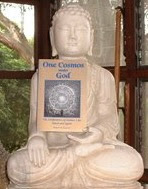
As we mentioned yesterday, human beings, unique among the animals, live in the relative world but can participate in eternity by aligning themselves with what Schuon calls the "relatively absolute" Truth of revelation, which reflects the Real. On superficial consideration, "relatively absolute" seems like a contradiction of terms, but it is the only designocean that adequately floats our skiffuation. Since the absolute is absolute, in order to know it, we must rely upon "reflections" of it in the relative.
Due to the law of analogy (as above, so below), these reflections are everywhere, but we must learn how to detect them. Hints of God are in literally everything, in the most mundane objects and activities, something that modern man has gradually forgotten, much to his spiritual detriment. Pre-Enlightenment man perhaps lived at the other extreme, a completely enchanted world in which nothing was merely what it was. Rather, everything -- mountains, rivers, trees, stars, etc. -- was an occasion for recollection of God. The universe was a theophany -- a garment, so to speak, that both concealed and revealed the naked God.
Now this "ground floor" of the human psyche still exists. We can pretend to ignore it, but it will be at our peril and to our spiritual detriment. For in reality, just as no person can actually successfully repress his unconscious, even the most devout materialistic atheist cannot actually treat the cosmos as a mere object. Look at Carl Sagan, for example. One of the reasons he was such a popular figure is that -- his doctrinaire atheism notwithstanding -- he successfully inspired a sense of wonder in science geeks about the cosmos. One would be wrong to conclude that this wonderment was simply a logical response to the objective science. Rather, this sense of wonder is what inspired Sagan to become a scientist to begin with, and it was infectious for billions and billions of nerds -- perhaps even increasing their reproductive fitness by making them slightly more appealing to women.
Here again we see that the roots of science extend into thoroughly alogical (not illogical) cognitive modalities. The true man of science confronts our numinous cosmos with the same awe and wonderment as the ancients, but simply takes it in a different direction. But in the end, wonder is both science's sufficient cause and its necessary end, for, despite a scientific revolution that has now been going on for well over 300 years, the cosmos is vastly more mysterious and wonderful than even the most imaginative ancient could have conceived. Wonders will never cease, even if our capacity for wonderment continues to be blunted by some of the other deleterious effects of modernity -- it's ugliness, its obsession with the transient and trivial, its elevation of our animal nature to an end rather than a means, etc.
But why a sense of wonder? On the one hand, animals -- and many animal-human hybrids -- have no sense of wonder. They have appetites, desires and impulses, but are essentially content when these are temporarily satiated. But the higher we ascend, the more preoccupied we are with this heightened sense of wonder. I am at the point in my life when I would be satisfied to spend my entire day in a state of contemplative wonder, just patiently waiting for my daily bread -- which always comes, if you wonder long enough.
For the functional aspect of wonder is to clear a space so that one may be shocked by the familiar. It seems that evolution built us in such a way that we can get used to anything. For you menfolk out there, never forget that in a bar somewhere, Billy Bob Thornton is saying, "Angelina? You find her attractive? That annoying drama queen?" And Brad Pitt is saying, "Jennifer? That clinging dolt? I couldn't look at her for another second." Yes, there is nothing we cannot get used to -- which is why we must counter this tendency by cultivating our sense of wonder (and its sister, gratitude). It is what allows us to recognize and escape through the numberless inscapes that dot the horizon.
Me? I am very happily married. Why? Because it never ceases to amaze me that any earth woman would have me. It's something I wonder about all the time. But I didn't intend to get tastelessy personal here, like Col. Beaglehole and Dame Edith.
The celebration of the New Year is a ritual we retain because it allows us to brush up against the eternal. Again, religions are languages of the absolute -- you might say that religious language is suffused with the light of the eternal, allowing us to recognize the "afterglow" from above. It is like a meteor shot down from heaven. Like the wind, we don't know where it comes from, but we can detect it as it whizzes by. By meditating on it, we may "prolong" eternity into time.
But there are "natural" ways to think about the eternal, and the New Year is one of them. How is that? Since I am running out of time, I will mostly quote from a very interesting (and now expensive) book called The Symmetry of God by Rodney Bomford, which does the best job of integrating sophisticated theology and modern psychoanalysis I have ever encountered.
Bomford notes that we cannot actually conceve of eternity, since it is both timeless and changeless, whereas thought naturally takes place in time. But we can grasp it through various analogies in the herebelow, for example, the "everlasting," which "provides the closest image of the timeless within time." Therefore, we gain a sense of timeless in proximity to things that are very old, like a European cathedral, or the Pyramids, or Wrigley Field -- anything "whose beginning is lost in the mists of time, the ancient and the ageless, for these approximate in feeling to the everlasting."
At the same time, at the other end of the extreme, we may also glimpse the eternal in the passing moment, "for such a thing is simultaneously whole and unchanging -- it has no time in which to change.... It is there in its fullness -- and it is gone again." Thus, a mystic such as William Blake could see eternity in a flower or grain of sand
Eternity can also be suggested "by the last event of a series." Bomford cites the example of an aging travel-writer "who had long before visited many places for the first time, and returned often, found a renewed significance in returning once more deliberately for the last time. Places regained the freshness of the first visit." Similarly, "the last words of the dying may be seen as a key to an understanding of a whole life. The last of the series completes the picture, ends the story, and thus hints at the instantaneous wholeness of eternity."
Think "it is accomlished." What was? Oh, I don't know, maybe a little bridge between time and eternity in the heart of the cosmos, making each moment an eternal new year where death touches Life and the former is tranfsigured by the latter.
Today we stand at the edge of time, and therefore, the edge of eternity, as we approach the "end" of one year and the "beginning" of another -- the uniting of old and new, as they touch tomorrow at midnight. The Book of Revelation captures this quality, when the enthroned Christ "announces himself as The First and the Last and the Lord God himself is Alpha and Omega, the beginning and end. Similarly, St. Augustine "addressed God as 'Thou Beauty, both so ancient and so new,' an expression of eternity which plucks at a deep unconscious chord in us."
O first and last truth of Self
Knowing without knowledge all that can be unKnown:
Existence to the end of the beginning.*
Unborn body of the bodiless one,
Dark rays shining from a midnight sun,
Your phase before you were bearthed and begaialed,
Empty tomb of a deathlaz child.
I am? That!
O me ga!
I can explain everything.
I know this place.
Been here before.
Where we started.
No it this time.
The word made fresh.
Telos when it's over.
Now. It is accomplished. --Petey, with *HT to John Lennon and Jesus
Saturday, December 30, 2006


Friday, December 29, 2006
The Absurdity of Absolute Relativity (12.27.08)
There are some things that human beings may know with metaphysical certitude. In fact, our access to absolute truth is one of the principle things that defines us as human. Obviously, no other animal can know truth, much less absolute truth. The moment you realize this -- assuming you really and truly do -- you will understand that the human state is not a Darwinian "extension" of the animal state, but something fundamentally inexplicable on any materialistic grounds. It is, in fact, a gate of exit out of mere animality -- indeed, out of the relative cosmos itself. Humans are a "hole" in creation that allows them to know the whole of creation.
For in knowing absolute truth, human beings may participate in eternity on this side of manifestation -- in the relative world. The trick is to, so to speak, "prolong" eternity on this plane. We do this by 1) aligning ourselves with truth, and 2) assimilating truth. By "assimilating," I mean that we must metabolize truth so that it is "interiorized" and becomes entwined with our very psychic substance. We must "eat and breathe" absolute truth in order to become it and live it.
Authentic religion is the vehicle of absolute truth. You might say that absolute truth, the Godhead, the Ain Sof, the Supermind, Nirguna Brahman, or the God beyond being, are analogous to white light, whereas each authentic revelation is analogous to a color in the rainbow. This is why religions cannot be mixed "from below," lest you produce a manmade blending of colors that eventually ends up black, not white. However, this hardly means that one religion cannot illuminate this or that obscure or underemphasized doctrine of another.
Christianity, for example, is a obviously a complete religion. Nor will I argue with someone who believes it is the "best" religion. Nevertheless, it is obviously the case that the greatest Christian thinkers -- true theologians such as Meister Eckhart, Origen, or Denys the Areopagite -- exist only at the margins of contemporary Christianity, which is often sadly atheological -- either that, or couched in a ridiculous theology that makes religion itself look ridiculous -- a terrible sin by the way, for it amounts to taking the name of the Lord in vain. At the moment I am thinking of a genial dolt named "Osteen" that I caught on Larry King for a few moments, but it could be anyone.
Once you immerse yourself in, say, the genius of Meister Eckhart, you immediately see the parallels with, say, the greatest Jewish theologian, Moses Maimonides. Then you cannot help seeing certain unavoidable parallels with perhaps the greatest pagan mystic, Plotinus, then it's hard to distinguish him from the immortal Vedantin, Shankara. You needn't "blend" any of these truly celestial beings to appreciate how they are reflected in one another, each a particular color that carries and transmits real light. Most of us cannot know the white light, but each color is in the end nothing other than light, just as rain or snow are nothing other than water. I am as comfortable in a Catholic or Orthodox service as I am in a Vedanta or Jewish temple, so long as they radiate the sacred. However, I am definitely not "eclectic." I do not believe in "cafeteria style" spirituality. It is more like being able to appreciate, say, Arvo Part, Dexter Gordon, Merle Haggard, and James Brown. Each is a musical "avatar" who conveys real musical light, but I wouldn't want to blend them.
Apparently, it is difficult for most rank and file human beings to conceive of the Absolute on its own absolute terms, so they create a human substitute to stand for the Absolute. In short, they intuit the Absolute and believe in the Absolute, but the only way they can "think" about it is to elevate something on the relative plane to the status of Absolute. This is fine as far as it goes, and it does help those who are not metaphysically gifted to think about ultimate things. Nevertheless, it places sharp limits on one's own ability to transcend name and form, and can end up being K-->O, except on a grandiose scale. There is a way to "dwell" in religion to use it as a launching pad into O -- which is the actual purpose of religion in its highest sense. But let's not kid ourselves. Most people must be satisfied to align themselves with an exoteric religion in order to gain what might be called a "second hand" sense of the Absolute -- which is fine, by the way, and certainly preferable to disbelief or to belief in frank nonsense such as atheism or materialism. It is a way of salvation. It is just not our way.
In an article entitled Are You Certain About That?, Jonah Goldberg discusses one of the latest leftist memes. However, it is not so much a meme as the central core of leftism, which in the end embodies an assault on truth and a rejection of the Absolute -- which is impossible both in principle and in fact, which is why leftism is fundamentally and irretrievably incoherent.
Goldberg writes, "Have you heard the news? Belief is bad. Pick up an eggheady book review, an essay in Time magazine, or listen to a thumb-suck session on National Public Radio for very long and you’ll soon hear someone explain that real conviction -- dogmatism! -- is dangerous."
For example, "Andrew Sullivan, in his new book The Conservative Soul, declares a jihad on certainty, by which he means the certainty of fundamentalist 'Christianists' -- the allusion to Islamists is deliberate. The New Republic’s Jonathan Chait proclaims that liberalism is the anti-dogmatic ideology. Sam Harris, a leading proselytizer for atheism, has declared a one-man crusade on religious certainty. Intellectual historian J.P. Diggins writes in the latest issue of The American Interest that there’s a war afoot for 'the soul of the American Republic' between the forces of skepticism and infallibility. And so on."
Superficially, this leftist meme reflects their concern about the alleged “messianic certainty” of President Bush, which "is dangerous and evil in the eyes of supposedly meek and nuanced liberals." Goldberg notes that the meme has naturally trickled down from the laughty mountains of academia, where the nonsensical air is rarified, polluting the rivers, streams, and crocks below, including Hollywood. For example, in Star Wars III, "a young Obi-Wan Kenobi proclaim[s] 'Only a Sith lord deals in absolutes!' Translation: Only evil people see the world as black-and-white." Which is ironic, "since it was Lucas himself who originally explained that the entire universe is divided into light and dark sides." Goldberg also cites retired New York Times moonbat columnist Anthony Lewis, who famously wrote in his last column that the one thing he had learned in his long and tedious career was that "certainty is the enemy of decency and humanity in people who are sure they are right, like Osama bin Laden and John Ashcroft.” As if there is anything more beligerently certain than the idiotorial pages of the New York Times.
But absolute relativism is the sine qua non of metaphysical nonsense. It is one thing thing we can know with certainty that cannot be true, for if the relativist’s belief is true, then he has left relativism behind. Then the question becomes “which Absolute is true?” But there can be only one Absolute, so the question is absurd. However, as Schuon points out, although there can be no absolutely relative, there can obviously be a "relative absolute," which is what I regard as the realm of O-->k. This is where a Meister Eckhart or Jakob Boehme lived, which is a far cry from the space occupied by genial dolts who appear on Larry King.
This does not just apply to contemplatives but to men of action whose shield is Truth, for Goldberg writes that most of the truly heroic figures in human history have been animated “by certainty, by the courage of their convictions” -- by O-->k on the plane of action. Our founders knew with metaphysical certitude that human liberty could only have come from a creator, and that a creator cannot be other than the Creator. For truth is one and liberty is a condition of knowing it: no liberty, no truth, no truth, no liberty; and there can be neither truth nor liberty unless it is principially absolute, like the Creator from which they flow.
Again, the leftist rejection of absolute truth cannot avoid being incoherent. As Goldberg writes, “Martin Luther King Jr. -- to pick liberalism’s most iconic hero -- was hardly plagued with doubt about the rightness of his cause. A Rosa Parks charged with today’s reigning moral imperative not to be too sure of herself might not have sat at the front of the bus. An FDR certain that certainty is the enemy of decency and humanity might have declined to declare total war on Nazism for fear of becoming as bad as his enemy.”
Thus, the rejection of absolutes -- which flow from the Absolute -- is steeped in hypocrisy, since leftists “aren’t offended by conviction per se, but by convictions they do not hold.” “Certainty” has simply “become code among the intellectual priesthood for people and ideas that can be dismissed out of hand. That’s what is so offensive about this fashionable nonsense: It breeds the very closed-mindedness it pretends to fight.”
Imagine if this country were actually founded upon a wimpy rejection of metaphysical certainty and the leftist embrace of relativism?
We hold these preliminary findings to be more or less accurate, at least for now, that all cultures have equal validity, and that each culture has its own ideas about rights and duties and so forth and so on and blah blah blah. In our case, we have hit upon this idea -- no offense, but we have this tentative idea -- subject to further studies, of course -- that we would like the government -- that would be your government -- to cut us some slack so that we can do what we want to do -- basically acquire property and be happy, but not limiting ourselves to that. Anyhoo, it is our culturally conditioned idea that Governments -- not all of them, of course, but ours -- should actually derive their power from the people, although we have respect and tolerance for the contrary view that you folks hold. Nevertheless, some of our more headstrong citizens think that we should be able to form a government based upon these vague hunches of ours, which, after all, are as good as your hunches. No, that was rude -- let's just say that our hunches are different than yours, and leave it at that.... No one can presume to be a judge of whose hunches are best.... At any rate, since, as the saying goes, "different strokes for different folks"....
For in knowing absolute truth, human beings may participate in eternity on this side of manifestation -- in the relative world. The trick is to, so to speak, "prolong" eternity on this plane. We do this by 1) aligning ourselves with truth, and 2) assimilating truth. By "assimilating," I mean that we must metabolize truth so that it is "interiorized" and becomes entwined with our very psychic substance. We must "eat and breathe" absolute truth in order to become it and live it.
Authentic religion is the vehicle of absolute truth. You might say that absolute truth, the Godhead, the Ain Sof, the Supermind, Nirguna Brahman, or the God beyond being, are analogous to white light, whereas each authentic revelation is analogous to a color in the rainbow. This is why religions cannot be mixed "from below," lest you produce a manmade blending of colors that eventually ends up black, not white. However, this hardly means that one religion cannot illuminate this or that obscure or underemphasized doctrine of another.
Christianity, for example, is a obviously a complete religion. Nor will I argue with someone who believes it is the "best" religion. Nevertheless, it is obviously the case that the greatest Christian thinkers -- true theologians such as Meister Eckhart, Origen, or Denys the Areopagite -- exist only at the margins of contemporary Christianity, which is often sadly atheological -- either that, or couched in a ridiculous theology that makes religion itself look ridiculous -- a terrible sin by the way, for it amounts to taking the name of the Lord in vain. At the moment I am thinking of a genial dolt named "Osteen" that I caught on Larry King for a few moments, but it could be anyone.
Once you immerse yourself in, say, the genius of Meister Eckhart, you immediately see the parallels with, say, the greatest Jewish theologian, Moses Maimonides. Then you cannot help seeing certain unavoidable parallels with perhaps the greatest pagan mystic, Plotinus, then it's hard to distinguish him from the immortal Vedantin, Shankara. You needn't "blend" any of these truly celestial beings to appreciate how they are reflected in one another, each a particular color that carries and transmits real light. Most of us cannot know the white light, but each color is in the end nothing other than light, just as rain or snow are nothing other than water. I am as comfortable in a Catholic or Orthodox service as I am in a Vedanta or Jewish temple, so long as they radiate the sacred. However, I am definitely not "eclectic." I do not believe in "cafeteria style" spirituality. It is more like being able to appreciate, say, Arvo Part, Dexter Gordon, Merle Haggard, and James Brown. Each is a musical "avatar" who conveys real musical light, but I wouldn't want to blend them.
Apparently, it is difficult for most rank and file human beings to conceive of the Absolute on its own absolute terms, so they create a human substitute to stand for the Absolute. In short, they intuit the Absolute and believe in the Absolute, but the only way they can "think" about it is to elevate something on the relative plane to the status of Absolute. This is fine as far as it goes, and it does help those who are not metaphysically gifted to think about ultimate things. Nevertheless, it places sharp limits on one's own ability to transcend name and form, and can end up being K-->O, except on a grandiose scale. There is a way to "dwell" in religion to use it as a launching pad into O -- which is the actual purpose of religion in its highest sense. But let's not kid ourselves. Most people must be satisfied to align themselves with an exoteric religion in order to gain what might be called a "second hand" sense of the Absolute -- which is fine, by the way, and certainly preferable to disbelief or to belief in frank nonsense such as atheism or materialism. It is a way of salvation. It is just not our way.
In an article entitled Are You Certain About That?, Jonah Goldberg discusses one of the latest leftist memes. However, it is not so much a meme as the central core of leftism, which in the end embodies an assault on truth and a rejection of the Absolute -- which is impossible both in principle and in fact, which is why leftism is fundamentally and irretrievably incoherent.
Goldberg writes, "Have you heard the news? Belief is bad. Pick up an eggheady book review, an essay in Time magazine, or listen to a thumb-suck session on National Public Radio for very long and you’ll soon hear someone explain that real conviction -- dogmatism! -- is dangerous."
For example, "Andrew Sullivan, in his new book The Conservative Soul, declares a jihad on certainty, by which he means the certainty of fundamentalist 'Christianists' -- the allusion to Islamists is deliberate. The New Republic’s Jonathan Chait proclaims that liberalism is the anti-dogmatic ideology. Sam Harris, a leading proselytizer for atheism, has declared a one-man crusade on religious certainty. Intellectual historian J.P. Diggins writes in the latest issue of The American Interest that there’s a war afoot for 'the soul of the American Republic' between the forces of skepticism and infallibility. And so on."
Superficially, this leftist meme reflects their concern about the alleged “messianic certainty” of President Bush, which "is dangerous and evil in the eyes of supposedly meek and nuanced liberals." Goldberg notes that the meme has naturally trickled down from the laughty mountains of academia, where the nonsensical air is rarified, polluting the rivers, streams, and crocks below, including Hollywood. For example, in Star Wars III, "a young Obi-Wan Kenobi proclaim[s] 'Only a Sith lord deals in absolutes!' Translation: Only evil people see the world as black-and-white." Which is ironic, "since it was Lucas himself who originally explained that the entire universe is divided into light and dark sides." Goldberg also cites retired New York Times moonbat columnist Anthony Lewis, who famously wrote in his last column that the one thing he had learned in his long and tedious career was that "certainty is the enemy of decency and humanity in people who are sure they are right, like Osama bin Laden and John Ashcroft.” As if there is anything more beligerently certain than the idiotorial pages of the New York Times.
But absolute relativism is the sine qua non of metaphysical nonsense. It is one thing thing we can know with certainty that cannot be true, for if the relativist’s belief is true, then he has left relativism behind. Then the question becomes “which Absolute is true?” But there can be only one Absolute, so the question is absurd. However, as Schuon points out, although there can be no absolutely relative, there can obviously be a "relative absolute," which is what I regard as the realm of O-->k. This is where a Meister Eckhart or Jakob Boehme lived, which is a far cry from the space occupied by genial dolts who appear on Larry King.
This does not just apply to contemplatives but to men of action whose shield is Truth, for Goldberg writes that most of the truly heroic figures in human history have been animated “by certainty, by the courage of their convictions” -- by O-->k on the plane of action. Our founders knew with metaphysical certitude that human liberty could only have come from a creator, and that a creator cannot be other than the Creator. For truth is one and liberty is a condition of knowing it: no liberty, no truth, no truth, no liberty; and there can be neither truth nor liberty unless it is principially absolute, like the Creator from which they flow.
Again, the leftist rejection of absolute truth cannot avoid being incoherent. As Goldberg writes, “Martin Luther King Jr. -- to pick liberalism’s most iconic hero -- was hardly plagued with doubt about the rightness of his cause. A Rosa Parks charged with today’s reigning moral imperative not to be too sure of herself might not have sat at the front of the bus. An FDR certain that certainty is the enemy of decency and humanity might have declined to declare total war on Nazism for fear of becoming as bad as his enemy.”
Thus, the rejection of absolutes -- which flow from the Absolute -- is steeped in hypocrisy, since leftists “aren’t offended by conviction per se, but by convictions they do not hold.” “Certainty” has simply “become code among the intellectual priesthood for people and ideas that can be dismissed out of hand. That’s what is so offensive about this fashionable nonsense: It breeds the very closed-mindedness it pretends to fight.”
Imagine if this country were actually founded upon a wimpy rejection of metaphysical certainty and the leftist embrace of relativism?
We hold these preliminary findings to be more or less accurate, at least for now, that all cultures have equal validity, and that each culture has its own ideas about rights and duties and so forth and so on and blah blah blah. In our case, we have hit upon this idea -- no offense, but we have this tentative idea -- subject to further studies, of course -- that we would like the government -- that would be your government -- to cut us some slack so that we can do what we want to do -- basically acquire property and be happy, but not limiting ourselves to that. Anyhoo, it is our culturally conditioned idea that Governments -- not all of them, of course, but ours -- should actually derive their power from the people, although we have respect and tolerance for the contrary view that you folks hold. Nevertheless, some of our more headstrong citizens think that we should be able to form a government based upon these vague hunches of ours, which, after all, are as good as your hunches. No, that was rude -- let's just say that our hunches are different than yours, and leave it at that.... No one can presume to be a judge of whose hunches are best.... At any rate, since, as the saying goes, "different strokes for different folks"....
Thursday, December 28, 2006
Update on the Trinitarian Structure of Modern Humans (12.26.08)
Now, I'm not an anthropopogist. But I did stay at a Holiday Inn, and I do know a thing or two about a thing or three. And one of the things I know is that pre-human hominids only became human because of the specifically trinitarian nature of the human developmental situation: mother-father-helpless baby. This, by the way, is one of the many reasons I do not believe intellignt life will ever be found on other planets, because genes and natural selection are only the necessary but not sufficient cause of our humanness.
In other words, even supposing that life arose elsewhere and began evolving large brains, a large brain would never be sufficient to allow for humanness. Rather, the key to the entire enterprise -- the missing link, so to speak -- is the extremely unlikely invention of the helpless and neurologically incomplete infant who must be born approximately 12 months "premature" so that his brain can be assembled at the same time it is being mothered. If we had come out of the womb neurologically complete, then there would be no "space" for humanness to emerge or take root. We would be Neanderthals. Literally.
Those who have read my book know that I do not find this at all incompatible with a spiritual view. For one thing, I never rule out the invisible hand of providence. Furthermore, infantile helplessness is the space where verticality enters the evolutionary picture. All other animals are completely limited and determined by their genes. Only humans have the privilege of being ushered into a transcendent, non-genetic vertical world of love, truth and beauty which is both timeless and anterior to their discovering it. It was always "there," but only became accessible as a result of the unique circumstances of human development.
Comes now a study by two real anthropologists, Professors Stine and Kuhn, who (unwittingly) provide further evidence for the Gagdadian view: "Diversified social roles for men, women, and children may have given Homo sapiens an advantage over Neanderthals, says a new study in the December 2006 issue of Current Anthropology. The study argues that division of economic labor by sex and age emerged relatively recently in human evolutionary history and facilitated the spread of modern humans throughout Eurasia." Coming out of the contemporary academic milieu, they apparently cannot help putting a quasi-Marxist spin on their findings, seeing them merely in economic terms rather than drawing out their psychological implications: "The competitive advantage enjoyed by modern humans came not just from new weapons and devices but from the ways in which their economic lives were organized around the advantages of cooperation and complementary subsistence roles for men, women, and children." Sort of a combination of Adam Smith and Eve.
To back up a bit, there was a time when two distinct versions of... of folks roamed the planet... much like today, actually. That would be the Neanderthals and us -- or Homo sapiens sapiens. Neanderthals emerged around 250,000 years ago, taking their bow and exiting the evolutionary stage around 30,000 ago. Signs of division of labor only appear with the arrival of modern humans (not Neanderthals) into Europe around 40,000 years ago. (Interestingly, this is right around the time of the "creative explosion" of Homo sapiens sapiens discussed in Chapter 3 of my book, an unprecedented outpouring of cave art, musical instruments, body decoration, burial of the dead, and other distinct evidence of actual "humanness.")
An article in the Times notes that, "At sites occupied by modern humans from 45,000 to 10,000 years ago... there is good evidence of different occupations.... It seems reasonable to assume that these activities were divided between men and women, as is the case with modern foraging peoples. But Neanderthal sites include no bone needles, no small animal remains and no grinding stones for preparing plant foods."
The question is, "what did Neanderthal women do all day?," since the roller derby was a far off dream, and the WNBA only came into existence in the late 20th century. Neanderthal skeletons "are so robustly built that it seems improbable that they just sat at home looking after the children, the anthropologists write. More likely, they did the same as the men, with the whole population engaged in bringing down large game."
In other words, it seems that Neanderthals were not trinitarian but essentially binarian (adult-child) or perhaps even unitarian, in that everyone, even children, participated in the hunt. The study again focuses on the economic angle, speculating that modern humans, because of "their division of labor and diversified food sources, would have been better able to secure a continuous food supply." Furthermore, unlike the Neanderthals, they wouldn't have put their "reproductive core" -- that is, women and children -- at such a great risk.
But there is a shadow side to this picture, and that is the evolutionary effect that completely devoted mothers would have had on children. In chapter 3.3 of my book, Humans and How They Got That Way: Putting the Sapiens into Homo, I argued that it is completely reasonable to assume that humans became human in the distant past in the identical way that they become human today. I can see that I'm not going to have time to flesh out the entire theory here, but that is what the book is for. But the bottom line is that as human brains became larger and larger (and pelvises became narrower due to bipedalism), it became necessary for women to give birth earlier and earlier, to the point that infants had to be born neurologically incomplete, to such an extent that much of the brain's development had to take place outside the womb -- a pattern completely unique among the primates.
More than anything else, it was this delayed development, or neoteny, that created the possibility of our acquisition of humanness. But that is not all. Because human infants were born in this way, it obviously became increasingly necessary for human mothers to specialize in mothering -- otherwise, these helpless infants would not have survived. But there was an obvious benefit, as I believe that this situation of increasingly helpless babies and increasingly devoted mothers created a sort of runaway positive feedback loop for greater intelligence:
"It seems obvious that, in order for babies to survive, they had to become adept at 'evoking' the environment they needed to survive -- specifically, an intelligent, caring mother. Perhaps it sounds odd, but it seems an inescapable conclusion that, in order for babies to specialize in babyhood, they had to 'select' mothers who were intelligent, capable, and empathic enough to be up to the task of caring for them. Think about it: caring for a helpless infant is at least as complex and challenging on a moment-to-moment basis as hunting for game. [Memo from relatively new father: I was not wrong about this -- ed.] Let's face it: those mothers who did not develop these complex mothering skills may have gotten their genes into the next generation, but not long enough for that generation to do the same."
As I said, I don't have time to present the full argument with all of its implications here. However, you will note on page 127 of my book that I cited research indicating that the brains of Neanderthals were actually larger than ours, but that they seem to have become fully developed at an earlier age. In other words, it seems possible that they were not born as premature, so that the window of development slammed shut sooner, so to speak. What this suggests to me is that they were more animal than human, more under the influence of genes than of humanness. All Neanderthals were hunters because that is what their genes designed them to do. Hunting was not a "role," any more than hunting is a role for cats or coyotes. Roles were invented by modern humans, those roles being father, mother, and helpless infant.
And as I also argued in my book, once you have the abstract category of any role, then in effect you have every role. This is why it is foolish for feminists to be upset at the idea that the female of the species was selected by the baby for the role of mothering, because it actually means that women are liberated from genes to choose any role they want to, whether it is the role of mother or the role of Neanderthal roller derby queen.
There is nothing which is more necessary and more precious in the experience of human childhood than parental love.... nothing more precious, because the parental love experienced in childhood is moral capital for the whole of life.... It is so precious, this experience, that it renders us capable of elevating ourselves to more sublime things--even divine things. It is thanks to the experience of parental love that our soul is capable of raising itself to the love of God. --Meditations on the Tarot
In other words, even supposing that life arose elsewhere and began evolving large brains, a large brain would never be sufficient to allow for humanness. Rather, the key to the entire enterprise -- the missing link, so to speak -- is the extremely unlikely invention of the helpless and neurologically incomplete infant who must be born approximately 12 months "premature" so that his brain can be assembled at the same time it is being mothered. If we had come out of the womb neurologically complete, then there would be no "space" for humanness to emerge or take root. We would be Neanderthals. Literally.
Those who have read my book know that I do not find this at all incompatible with a spiritual view. For one thing, I never rule out the invisible hand of providence. Furthermore, infantile helplessness is the space where verticality enters the evolutionary picture. All other animals are completely limited and determined by their genes. Only humans have the privilege of being ushered into a transcendent, non-genetic vertical world of love, truth and beauty which is both timeless and anterior to their discovering it. It was always "there," but only became accessible as a result of the unique circumstances of human development.
Comes now a study by two real anthropologists, Professors Stine and Kuhn, who (unwittingly) provide further evidence for the Gagdadian view: "Diversified social roles for men, women, and children may have given Homo sapiens an advantage over Neanderthals, says a new study in the December 2006 issue of Current Anthropology. The study argues that division of economic labor by sex and age emerged relatively recently in human evolutionary history and facilitated the spread of modern humans throughout Eurasia." Coming out of the contemporary academic milieu, they apparently cannot help putting a quasi-Marxist spin on their findings, seeing them merely in economic terms rather than drawing out their psychological implications: "The competitive advantage enjoyed by modern humans came not just from new weapons and devices but from the ways in which their economic lives were organized around the advantages of cooperation and complementary subsistence roles for men, women, and children." Sort of a combination of Adam Smith and Eve.
To back up a bit, there was a time when two distinct versions of... of folks roamed the planet... much like today, actually. That would be the Neanderthals and us -- or Homo sapiens sapiens. Neanderthals emerged around 250,000 years ago, taking their bow and exiting the evolutionary stage around 30,000 ago. Signs of division of labor only appear with the arrival of modern humans (not Neanderthals) into Europe around 40,000 years ago. (Interestingly, this is right around the time of the "creative explosion" of Homo sapiens sapiens discussed in Chapter 3 of my book, an unprecedented outpouring of cave art, musical instruments, body decoration, burial of the dead, and other distinct evidence of actual "humanness.")
An article in the Times notes that, "At sites occupied by modern humans from 45,000 to 10,000 years ago... there is good evidence of different occupations.... It seems reasonable to assume that these activities were divided between men and women, as is the case with modern foraging peoples. But Neanderthal sites include no bone needles, no small animal remains and no grinding stones for preparing plant foods."
The question is, "what did Neanderthal women do all day?," since the roller derby was a far off dream, and the WNBA only came into existence in the late 20th century. Neanderthal skeletons "are so robustly built that it seems improbable that they just sat at home looking after the children, the anthropologists write. More likely, they did the same as the men, with the whole population engaged in bringing down large game."
In other words, it seems that Neanderthals were not trinitarian but essentially binarian (adult-child) or perhaps even unitarian, in that everyone, even children, participated in the hunt. The study again focuses on the economic angle, speculating that modern humans, because of "their division of labor and diversified food sources, would have been better able to secure a continuous food supply." Furthermore, unlike the Neanderthals, they wouldn't have put their "reproductive core" -- that is, women and children -- at such a great risk.
But there is a shadow side to this picture, and that is the evolutionary effect that completely devoted mothers would have had on children. In chapter 3.3 of my book, Humans and How They Got That Way: Putting the Sapiens into Homo, I argued that it is completely reasonable to assume that humans became human in the distant past in the identical way that they become human today. I can see that I'm not going to have time to flesh out the entire theory here, but that is what the book is for. But the bottom line is that as human brains became larger and larger (and pelvises became narrower due to bipedalism), it became necessary for women to give birth earlier and earlier, to the point that infants had to be born neurologically incomplete, to such an extent that much of the brain's development had to take place outside the womb -- a pattern completely unique among the primates.
More than anything else, it was this delayed development, or neoteny, that created the possibility of our acquisition of humanness. But that is not all. Because human infants were born in this way, it obviously became increasingly necessary for human mothers to specialize in mothering -- otherwise, these helpless infants would not have survived. But there was an obvious benefit, as I believe that this situation of increasingly helpless babies and increasingly devoted mothers created a sort of runaway positive feedback loop for greater intelligence:
"It seems obvious that, in order for babies to survive, they had to become adept at 'evoking' the environment they needed to survive -- specifically, an intelligent, caring mother. Perhaps it sounds odd, but it seems an inescapable conclusion that, in order for babies to specialize in babyhood, they had to 'select' mothers who were intelligent, capable, and empathic enough to be up to the task of caring for them. Think about it: caring for a helpless infant is at least as complex and challenging on a moment-to-moment basis as hunting for game. [Memo from relatively new father: I was not wrong about this -- ed.] Let's face it: those mothers who did not develop these complex mothering skills may have gotten their genes into the next generation, but not long enough for that generation to do the same."
As I said, I don't have time to present the full argument with all of its implications here. However, you will note on page 127 of my book that I cited research indicating that the brains of Neanderthals were actually larger than ours, but that they seem to have become fully developed at an earlier age. In other words, it seems possible that they were not born as premature, so that the window of development slammed shut sooner, so to speak. What this suggests to me is that they were more animal than human, more under the influence of genes than of humanness. All Neanderthals were hunters because that is what their genes designed them to do. Hunting was not a "role," any more than hunting is a role for cats or coyotes. Roles were invented by modern humans, those roles being father, mother, and helpless infant.
And as I also argued in my book, once you have the abstract category of any role, then in effect you have every role. This is why it is foolish for feminists to be upset at the idea that the female of the species was selected by the baby for the role of mothering, because it actually means that women are liberated from genes to choose any role they want to, whether it is the role of mother or the role of Neanderthal roller derby queen.
There is nothing which is more necessary and more precious in the experience of human childhood than parental love.... nothing more precious, because the parental love experienced in childhood is moral capital for the whole of life.... It is so precious, this experience, that it renders us capable of elevating ourselves to more sublime things--even divine things. It is thanks to the experience of parental love that our soul is capable of raising itself to the love of God. --Meditations on the Tarot
Wednesday, December 27, 2006
The Original Sin of Progressives
There is a cliche that slavery was the "original sin" of the United States, but that can't be right. The real meaning of original sin is a primordial choice made by man as such, a choice that places him in a parallel universe that then shapes and determines everything else that follows. Not only was slavery banned within 90 years of our founding, but the framers wrote the costitution in such a way that the conflict over slavery would have to eventually come to a head. They simply put the conflict off to the future in order to make the fragile union of states possible at the outset.
There is obviously some confusion in my use of the terms "left" and "right," because I don't really intend to connote their contemporary usage. Rather, what ends up as this or that policy is founded upon a much deeper characterological and even spiritual divide that determines what follows. In short, I am always dealing with what the steamed Professor Chomsky would call the "deep structure" of left and right.
You might say that the founders were free of political "original sin," and created a system that is about as close to perfection as humans can manage. The sin only came in later, eating away at the foundations of this noble country. What was it? What was the alien meme that entered the American bloodstream and infected half its inhabitants? Whatever it is, it has now come to dominate and shape most of our political debates, in a way that the original Americans would have found puzzling.
In a two part essay entitled Dangerous Obsession, I think Thomas Sowell identifies the real original sin, which is the flight from individualism amidst organic unity to an enforced political collectivism that attacks individual differences by placing equality over liberty. Although Sowell is an economist, economics is simply common sense writ large, whereas most other academic disciplines -- i.e., philosophy, anthropology, psychology -- often come down to error on a grandiose scale. Just as you can't fool mother nature, you cannot fool father economics -- at least not in the long run (i.e., "just wait 'til your father comes home, Venezuela!").
What most seems to annoy leftist intellectuals about the free market is that, not only is it something that they cannot control or understand, but it accomplishes its task much more effectively and efficiently than the most brilliant person -- or group of people -- ever could. Sowell cites a famous essay which pointed out that no single person knows enough to produce so much as a single lead pencil. That is, "there is no single individual anywhere who knows how to grow the wood, mine the graphite, produce the rubber, and manufacture the paint." And yet, no one need ever worry that there won't be enough pencils, so long as we don't interfere with the process: "Complex economic processes cause all these things to be done and coordinated by a wide variety of people, just in order to produce something as simple as a lead pencil. Multiply that by a hundred or a thousand when it comes to the complexity of producing a car or a computer."
Now, if you don't even know how to produce a lead pencil or even to put lead in your husband's pencil (Dupree, that was uncalled for), imagine the hubris of a Hillary Clinton deciding to intervene in an industry that accounts for some 17% of our economy and creating a rigid, top-down national healthcare system? Without so much as a fig leaf of economic rationality to cover this flaccid Marxism?
One of the latest memes of the left is "income disparity," a classic instance of missing the forest for the trees. Yes, there are disparities in income for the same reason that there is so much wealth to begin with. Thus, you cannot attack the one without undermining the other. But as Sowell notes, "If you cannot understand something as simple as making a lead pencil, why should you be surprised that you don't understand why someone is making a lot more money than somebody else?" Nevertheless, this doesn't stop leftists from insisting that this "problem" -- which they do not understand -- is something that requires "fixing," naturally by coercive governmental policy. This means that the collective -- the government -- will inevitably "impose policies based on [their] ignorance of what is going on."
Sowell notes that "when income taxes were imposed in the early 20th century, they applied only to 'the rich' and they took a very small percentage of their income." But "Once the floodgates are opened to this kind of political power... we have seen with the income taxes that they not only spread far beyond 'the rich,' they took a serious share of even middle class incomes."
Remember, the founders saw this coming: "The people who wrote the Constitution were wise enough to understand what a dangerous thing it would be to allow government to take money from people just because those people had it." That is why it required "a Constitutional amendment to enable the federal government to impose an income tax."
I think that right there is our original political sin, for it is the point of entry for every subsequent leftist meme, dream, scheme and scam. The power of contemporary "progressives" is based largely on the power to tax. Its other main sources of power are the judiciary, where they can pack courts to legislate unpopular ideas from the bench, and the MSM and academia, where they control the flow of information in order to make the abnormal and aberrant appear normal and healthy. Thus, "social or ideological bias" are "added to envy and ignorance," producing the progressive "witches' brew on which to base national policy."
It is a truism that progressives are obsessed with the distribution of wealth -- taking it as a given -- while conservatives are concerned with its creation. Nowhere is this more evident than in differing attitudes toward the third world. For just as progressives have no idea why some Americans are wealthier than others, they also have no idea why some nations are so much wealthier than others. Thus, for some 40 years we have been guided by this blinkered policy of simply pouring money into the third world, which disappears like water into a sandy hole at the beach. All of this misguided "idiot compassion" has only made matters demonstrably worse, and put off the day of reckoning when these poorer countries must address the dysfunctional ideas and institutions that keep them mired in poverty.
As usual, progressives have it backwards. They look at the disparities in wealth between various countries and then define the disparities as ipso facto inequalities. "Disparity" is a neutral term, but an "inequality" is something we must courageously do something about! Even if it makes matters much worse!
In asking why the United States, or Japan, or Western Europe have more wealth, "You might as well ask why bees have so much more honey than other creatures." Here again, we see how the original sin insinuates itself into our economic rhetoric, which verbally "collectivizes" all of "the wealth that was produced individually," so that the progressive becomes "aghast at the 'disparities' that are magically turned into 'inequities in the distribution of 'the world's wealth.'"
And one of the most formidable barriers to wealth is culture. There is an ironic parallel between "progressives" and primitives, in that both have dysfunctional economic ideas, even though the one presumes to be helping the other. Although it may have been different in the past, today "the economic effects of these cultural differences often dwarf the effects of differences in material things like natural resources." For example, "Natural resources in Uruguay and Venezuela are worth several times as much per capita as natural resources in Japan and Switzerland. But income per capita in Japan and Switzerland is about double that of Uruguay and several times that of Venezuela."
As always, the problem is bad ideas. But instead of correcting the dysfunctional ideas, progressives want to indulge them while exercising their own equally bad and dysfunctional ideas, all in the name of compassion. We can only thank God that America has always distrusted intellectuals.
So be aware of original sin. It will always come as a seductive idea that seems both liberating and compassionate, but is actually cruel and enslaving.
****
From Taranto's Best of the Web today:
"Cuba's health-care system, a favorite of pinkos everywhere, turns out not to be good enough for communist dictator Fidel Castro, as Reuters reports from Madrid:
'A renowned Spanish surgeon has been rushed to Cuba to treat ailing leader Fidel Castro....The plane carried medical equipment not available in Cuba in case the leader needs further surgery due to his progressively failing health...'"
There is obviously some confusion in my use of the terms "left" and "right," because I don't really intend to connote their contemporary usage. Rather, what ends up as this or that policy is founded upon a much deeper characterological and even spiritual divide that determines what follows. In short, I am always dealing with what the steamed Professor Chomsky would call the "deep structure" of left and right.
You might say that the founders were free of political "original sin," and created a system that is about as close to perfection as humans can manage. The sin only came in later, eating away at the foundations of this noble country. What was it? What was the alien meme that entered the American bloodstream and infected half its inhabitants? Whatever it is, it has now come to dominate and shape most of our political debates, in a way that the original Americans would have found puzzling.
In a two part essay entitled Dangerous Obsession, I think Thomas Sowell identifies the real original sin, which is the flight from individualism amidst organic unity to an enforced political collectivism that attacks individual differences by placing equality over liberty. Although Sowell is an economist, economics is simply common sense writ large, whereas most other academic disciplines -- i.e., philosophy, anthropology, psychology -- often come down to error on a grandiose scale. Just as you can't fool mother nature, you cannot fool father economics -- at least not in the long run (i.e., "just wait 'til your father comes home, Venezuela!").
What most seems to annoy leftist intellectuals about the free market is that, not only is it something that they cannot control or understand, but it accomplishes its task much more effectively and efficiently than the most brilliant person -- or group of people -- ever could. Sowell cites a famous essay which pointed out that no single person knows enough to produce so much as a single lead pencil. That is, "there is no single individual anywhere who knows how to grow the wood, mine the graphite, produce the rubber, and manufacture the paint." And yet, no one need ever worry that there won't be enough pencils, so long as we don't interfere with the process: "Complex economic processes cause all these things to be done and coordinated by a wide variety of people, just in order to produce something as simple as a lead pencil. Multiply that by a hundred or a thousand when it comes to the complexity of producing a car or a computer."
Now, if you don't even know how to produce a lead pencil or even to put lead in your husband's pencil (Dupree, that was uncalled for), imagine the hubris of a Hillary Clinton deciding to intervene in an industry that accounts for some 17% of our economy and creating a rigid, top-down national healthcare system? Without so much as a fig leaf of economic rationality to cover this flaccid Marxism?
One of the latest memes of the left is "income disparity," a classic instance of missing the forest for the trees. Yes, there are disparities in income for the same reason that there is so much wealth to begin with. Thus, you cannot attack the one without undermining the other. But as Sowell notes, "If you cannot understand something as simple as making a lead pencil, why should you be surprised that you don't understand why someone is making a lot more money than somebody else?" Nevertheless, this doesn't stop leftists from insisting that this "problem" -- which they do not understand -- is something that requires "fixing," naturally by coercive governmental policy. This means that the collective -- the government -- will inevitably "impose policies based on [their] ignorance of what is going on."
Sowell notes that "when income taxes were imposed in the early 20th century, they applied only to 'the rich' and they took a very small percentage of their income." But "Once the floodgates are opened to this kind of political power... we have seen with the income taxes that they not only spread far beyond 'the rich,' they took a serious share of even middle class incomes."
Remember, the founders saw this coming: "The people who wrote the Constitution were wise enough to understand what a dangerous thing it would be to allow government to take money from people just because those people had it." That is why it required "a Constitutional amendment to enable the federal government to impose an income tax."
I think that right there is our original political sin, for it is the point of entry for every subsequent leftist meme, dream, scheme and scam. The power of contemporary "progressives" is based largely on the power to tax. Its other main sources of power are the judiciary, where they can pack courts to legislate unpopular ideas from the bench, and the MSM and academia, where they control the flow of information in order to make the abnormal and aberrant appear normal and healthy. Thus, "social or ideological bias" are "added to envy and ignorance," producing the progressive "witches' brew on which to base national policy."
It is a truism that progressives are obsessed with the distribution of wealth -- taking it as a given -- while conservatives are concerned with its creation. Nowhere is this more evident than in differing attitudes toward the third world. For just as progressives have no idea why some Americans are wealthier than others, they also have no idea why some nations are so much wealthier than others. Thus, for some 40 years we have been guided by this blinkered policy of simply pouring money into the third world, which disappears like water into a sandy hole at the beach. All of this misguided "idiot compassion" has only made matters demonstrably worse, and put off the day of reckoning when these poorer countries must address the dysfunctional ideas and institutions that keep them mired in poverty.
As usual, progressives have it backwards. They look at the disparities in wealth between various countries and then define the disparities as ipso facto inequalities. "Disparity" is a neutral term, but an "inequality" is something we must courageously do something about! Even if it makes matters much worse!
In asking why the United States, or Japan, or Western Europe have more wealth, "You might as well ask why bees have so much more honey than other creatures." Here again, we see how the original sin insinuates itself into our economic rhetoric, which verbally "collectivizes" all of "the wealth that was produced individually," so that the progressive becomes "aghast at the 'disparities' that are magically turned into 'inequities in the distribution of 'the world's wealth.'"
And one of the most formidable barriers to wealth is culture. There is an ironic parallel between "progressives" and primitives, in that both have dysfunctional economic ideas, even though the one presumes to be helping the other. Although it may have been different in the past, today "the economic effects of these cultural differences often dwarf the effects of differences in material things like natural resources." For example, "Natural resources in Uruguay and Venezuela are worth several times as much per capita as natural resources in Japan and Switzerland. But income per capita in Japan and Switzerland is about double that of Uruguay and several times that of Venezuela."
As always, the problem is bad ideas. But instead of correcting the dysfunctional ideas, progressives want to indulge them while exercising their own equally bad and dysfunctional ideas, all in the name of compassion. We can only thank God that America has always distrusted intellectuals.
So be aware of original sin. It will always come as a seductive idea that seems both liberating and compassionate, but is actually cruel and enslaving.
****
From Taranto's Best of the Web today:
"Cuba's health-care system, a favorite of pinkos everywhere, turns out not to be good enough for communist dictator Fidel Castro, as Reuters reports from Madrid:
'A renowned Spanish surgeon has been rushed to Cuba to treat ailing leader Fidel Castro....The plane carried medical equipment not available in Cuba in case the leader needs further surgery due to his progressively failing health...'"
Tuesday, December 26, 2006
Today's Score in the Game of Evolution: Conservatives 25, Leftists 0
I'm starting to wonder how I've been able to keep blogging everyday with a baby in the house. He was up last night from about 2:45 to 4:00. Bottom line: I ended up sleeping until about 6:30, then taking care of him until 8:00, since Mrs. G. is also sick. No time for blogging. Therefore, I'm reposting a couple of things from about six months back. However, they are relevent to the discussion we've been having lately, since they explain in empirical terms why I see no need to integrate leftist ideas into my world view. (Previously entitled "Today's Score: Conservatives 25, Progressives 0," and "Progressives: The Hurrier they Go, the Behinder They Get."
*****
In Chapter three of my book I survey history and culture, looking for evidence of what I call “mind parasites” that are ultimately rooted in different different styles of child rearing and which are responsible for so much cultural pathology, including the pathology of Islamism. Although my ideas may appear somewhat speculative, I believe that they cannot not be true once you understand the underlying principles involved.
I just finished a new book that confirms many of the things I wrote in that section, The Central Liberal Truth: How Politics Can Change a Culture and Save It from Itself, by Lawrence Harrison. Although Harrison calls himself a liberal, the book absolutely demolishes many ideas that are central to contemporary liberalism -- most particularly, multiculturalism, cultural relativism, and any kind of liberal victimology, for the book demonstrates with hard data how cultural beliefs, attitudes and values are the key to understanding the evolution of society. The book is actually somewhat shockingly -- but thoroughly refreshingly -- politically incorrect, and says some things that even Petey would probably hesitate to blurt out in public.
In the preface of the book, Harrison -- a long time USAID director -- notes that all of the underdeveloped or underprivileged countries or cultures he worked in were plagued by the same pathologies -- disrespect for law, lack of cooperation with one another, acquiescence to (and extertion of) unbridled authority, passivity when encountering problems, lack of civic consciousness, lack of trust, and pursuit of narrow personal interest. It is much easier for scholars such as Jared Diamond to blame geography, insufficient resources, or “guns, germs, and steel” for the failure of so many cultures, but this entirely begs the question of why certain groups -- most notably, the Jews or East Asians -- thrive wherever they are allowed to take root. In each case, they have a "portable culture" of extremely healthy and adaptive values that stand them in good stead.
Harrsion approvingly quotes the great scholar of Islam, Bernard Lewis, who wrote that “When people realize that things are going wrong, there are two questions they can ask: One is, ‘What did we do wrong?’ and the other is ‘Who did this to us?’” The latter question leads to paranoia, conspiracy theories and liberal victimology, which is why the Islamists and international left share a common cause -- they have the same underlying assumptions about reality and about who is at fault for it.
The book shows how deeply rooted are some of the pathologies of the left. I did not know this, but even in 1948, the American Anthropological Association opposed the U.N. Universal Declaration of Human Rights on the grounds that each culture must decide for itself “what is true, good, beautiful, and efficient,” and no cultures were any better or worse, just “different.” Thus, “liberals” found themselves at odds with a document calling for such things as the right to life, liberty, and security of person, equality before the law, and freedom of thought, conscience, and religion. The more things change....
It never ceases to amaze me that liberals think they are doing these people a favor by supporting their cultural pathologies. As is always the case with leftist thought, it is a monstrous arrogance and condescension masquerading as compassion. Harrsion quotes a brilliant African scholar named Daniel Etounga Mangelle, someone I relied upon in my book. At a conference, he responded with sarcasm to such leftist nonsense:
"I am going to tell the truth. We Africans really enjoy living in shantytowns where there isn't enough food, health care, or education for our children. Furthermore, our corrupt chieftaincy political systems are really marvelous.... It would be boring if free, democratic elections were organized all over Africa. Were that to happen, we would no longer be real Africans, and by losing our identity -- and our authoritarianism, our bloody civil wars, our illiteracy, our forty-five year life expectancy -- we should be letting down not only ourselves but those Western anthropologists who study us so sympathetically and understand that we can't be expected to behave like human beings who seek dignity.... So let us fight with the full support of those Western scholars who have the wisdom and courage to acknowledge that Africans belong to different world.”
It is so glaringly obvious to me that the vast majority of really destructive racism comes form the left, not the right. Undoubtedly individual racists exist, but they are nothing compared to the institutional and ideological racism of the left. Professor John McWhorter, who happens to be black, describes in the book the devastating impact of liberal racism on African Americans. He writes that since the 1960s, the core of black identity has been “rebellion and disaffection.... Misbehavior and criminality are not the only ways this is expressed. Even the most educated blacks with the most assimilated demeanors get their 'black authenticity' stripes to the extent that they subscribe to the notion that being black remains a battle forty years after the Civil Rights Act.”
McWhorter writes that young blacks are indeed “victims” -- not of what they call “racism” but of liberal ideology. This pathological and self-defeating world view would have utterly perplexed “the black Americans who worked so hard before the 1960s to pave the way for blacks to make the best of themselves in an imperfect world. Realizing that culture is the main problem now rather than racism or societal inequity, our task is to pull black America out of [its] detour, freeing us from self-fulfilling prophecies of recreational racial indignation and returning us to a clear-eyed, proactive race leadership that will allow us to truly 'get past race' for good."
As I said, I can't believe this book was written by a so-called liberal. It actually gives me hope for the future.
On pp. 36-37 of Harrison’s book, he lays out a helpful summary of those traits that are characteristic of the evolutionary “progress-prone” culture vs. the static or degenerative “progress-resistant” one. They fall under four main headings: “Worldview,” “Values and Virtues,” “Economic Behavior,” and “Social Behavior,” with a total of 25 subcategories, or "factors."
Beginning with Worldview, it seems to me that the characteristics of progress-resistant cultures are almost an exact description of modern liberal victimology. Regarding the subcategory of “destiny,” the liberal victim is beset by “fatalism and resignation.” With respect to “time orientation,” their obsessive focus on past or even present grievances discourages working hard for the future. Under the heading of “wealth,” liberals generally regard it as a “zero-sum” enterprise, which lies at the heart of their income-redistributing policies. Likewise, knowledge is “abstract, theoretical, cosmological [hey! I heard that], not verifiable.” Exactly. As we have had occasion to discuss many times, liberal academia (specifically, the humanities) is filled with deranged, kooky, abstract, unverifiable and utopian cranks. The rest are just crazy.
The one last subcategory for Worldview is religion. Here you might think that the left has the upper hand, and in most contexts you might be correct. But Harrison makes no distinction between pre- or irrational religiosity vs. the type of sophisticated religiosity we discuss on this blog. Thus, there is no question that the secular left is more rational than primitive African animists or practitioners of Haitian voodoo (even if they themselves would deny that fact because of their PC belief in cultural relativism). But I don’t believe for a moment that modern secularism is more rational than my metarational and transdogmatic religious philosophy. In fact, by comparison, merely secular philosophy is a sophisticated child's game. Furthermore, it remains to be seen if the secularized, hyper-rational societies of Western Europe will even be able to survive their irreligiosity. By and large American religion hardly dismisses the world -- rather, it promotes achievement and material pursuits. It is probably too material for my tastes.
So for the category of “worldview,” conservatives trounce the left four to one or possibly even five-zip.
The next heading is Values and Virtues, which has three subcategories, “ethical code,” “the lesser virtues,” and “education.” Here again, I don’t see how any intellectually honest person can give the nod to the left. Progress-resistant cultures have “elastic” values, while progress-prone ones are “rigorous within realistic norms.” Progress-prone cultures emphasize small virtues that actually end up making a huge difference, such as tidiness, courtesy, “a job well done”.... to which I might add, politeness, not cursing in public, and being free of off-putting tattoos, tongue piercings, and pagan "body art." To the progress-resistant culture, these small virtues are unimportant. (The thing that most strikes me about dailykos or huffingandpissed, aside from the shrill adolescent anger, is the constant, unnecessary profanity. I'm all for the necessary kind.)
The last subcategory is Education, and here again you might think that progressives are at least in the game. But just look what the progressive educational establishment has done to our educational system. They have been in complete control of lower and higher education in this country for at least 50 years, and it is a disgrace. Furthermore, they are specifically opposed to truly progressive policies that could turn things around, such as fostering competition by introducing vouchers into the system. And let’s not even talk about what progressives have done to the university in my lifetime. For one thing, I don’t have enough time. I have to be out of the house in 30 minutes.
The next main factor is Economic behavior, which has seven subcategories. This one is so self-evidently in favor of conservatives that it’s hardly worth debating. Progress-prone cultures believe that competition leads to excellence, that advancement should be based on merit, and that work is one of the primary purposes of life (the “protestant work ethic”). They try to foster a spirit of entrepreneurship, risk-taking, innovation and investment.
Conversely, the progress-resistant are suspicious of prosperity--it is a threat to equality because some will get rich, thus provoking envy. They are uncomfortable with competition, as it is a sign of aggression and a threat to both equality and privilege (such as the privileges enjoyed by the teachers union or by tenured wackademics or New York Times editors). And, of course, they are constitutionally opposed to the idea of merit, and instead believe that the government should get involved in giving special privileges to different racial, cultural and gender categories.
So for economic behavior, it’s conservatives 7, progressives bupkis.
The last main factor is Social Behavior, which has the most subcategories, ten. Some of these are frankly rather bland and neutral, and, being charitable, it is fair to say that most Americans of whatever political stripe share them: belief in the rule of law, a belief in checks and balances and dispersed authority, and the responsibility of elites to society. Others are a bit misleading, for conservatives clearly believe in gender equality, they just don’t believe in gender equivalence.
Other categories that are less innocuous fall clearly in favor of conservatives. For example, the progress-resistant leftist ulture has a much stronger identification with the narrow community -- i.e., multiculturalism. Progressives believe in dividing the country along racial and gender lines, so that one’s primary identification is not, say, “American” but “African American.” Likewise, the progress-resistant culture emphasizes the collectivity rather than the individual (except when it comes to the right to show your breast on TV or ride a bicycle naked in public to protest the war).
The last category is Church-State relations. According to Harrison, the progress-prone culture is “secularized” and believes in a “wall between church and state,” whereas the for the progress-resistant culture, “religion plays a major role in the civic sphere.” How true. The adverse impact of mixing church and state is never more clear than when the religion in question is “Leftist Progressivism.”
*****
In Chapter three of my book I survey history and culture, looking for evidence of what I call “mind parasites” that are ultimately rooted in different different styles of child rearing and which are responsible for so much cultural pathology, including the pathology of Islamism. Although my ideas may appear somewhat speculative, I believe that they cannot not be true once you understand the underlying principles involved.
I just finished a new book that confirms many of the things I wrote in that section, The Central Liberal Truth: How Politics Can Change a Culture and Save It from Itself, by Lawrence Harrison. Although Harrison calls himself a liberal, the book absolutely demolishes many ideas that are central to contemporary liberalism -- most particularly, multiculturalism, cultural relativism, and any kind of liberal victimology, for the book demonstrates with hard data how cultural beliefs, attitudes and values are the key to understanding the evolution of society. The book is actually somewhat shockingly -- but thoroughly refreshingly -- politically incorrect, and says some things that even Petey would probably hesitate to blurt out in public.
In the preface of the book, Harrison -- a long time USAID director -- notes that all of the underdeveloped or underprivileged countries or cultures he worked in were plagued by the same pathologies -- disrespect for law, lack of cooperation with one another, acquiescence to (and extertion of) unbridled authority, passivity when encountering problems, lack of civic consciousness, lack of trust, and pursuit of narrow personal interest. It is much easier for scholars such as Jared Diamond to blame geography, insufficient resources, or “guns, germs, and steel” for the failure of so many cultures, but this entirely begs the question of why certain groups -- most notably, the Jews or East Asians -- thrive wherever they are allowed to take root. In each case, they have a "portable culture" of extremely healthy and adaptive values that stand them in good stead.
Harrsion approvingly quotes the great scholar of Islam, Bernard Lewis, who wrote that “When people realize that things are going wrong, there are two questions they can ask: One is, ‘What did we do wrong?’ and the other is ‘Who did this to us?’” The latter question leads to paranoia, conspiracy theories and liberal victimology, which is why the Islamists and international left share a common cause -- they have the same underlying assumptions about reality and about who is at fault for it.
The book shows how deeply rooted are some of the pathologies of the left. I did not know this, but even in 1948, the American Anthropological Association opposed the U.N. Universal Declaration of Human Rights on the grounds that each culture must decide for itself “what is true, good, beautiful, and efficient,” and no cultures were any better or worse, just “different.” Thus, “liberals” found themselves at odds with a document calling for such things as the right to life, liberty, and security of person, equality before the law, and freedom of thought, conscience, and religion. The more things change....
It never ceases to amaze me that liberals think they are doing these people a favor by supporting their cultural pathologies. As is always the case with leftist thought, it is a monstrous arrogance and condescension masquerading as compassion. Harrsion quotes a brilliant African scholar named Daniel Etounga Mangelle, someone I relied upon in my book. At a conference, he responded with sarcasm to such leftist nonsense:
"I am going to tell the truth. We Africans really enjoy living in shantytowns where there isn't enough food, health care, or education for our children. Furthermore, our corrupt chieftaincy political systems are really marvelous.... It would be boring if free, democratic elections were organized all over Africa. Were that to happen, we would no longer be real Africans, and by losing our identity -- and our authoritarianism, our bloody civil wars, our illiteracy, our forty-five year life expectancy -- we should be letting down not only ourselves but those Western anthropologists who study us so sympathetically and understand that we can't be expected to behave like human beings who seek dignity.... So let us fight with the full support of those Western scholars who have the wisdom and courage to acknowledge that Africans belong to different world.”
It is so glaringly obvious to me that the vast majority of really destructive racism comes form the left, not the right. Undoubtedly individual racists exist, but they are nothing compared to the institutional and ideological racism of the left. Professor John McWhorter, who happens to be black, describes in the book the devastating impact of liberal racism on African Americans. He writes that since the 1960s, the core of black identity has been “rebellion and disaffection.... Misbehavior and criminality are not the only ways this is expressed. Even the most educated blacks with the most assimilated demeanors get their 'black authenticity' stripes to the extent that they subscribe to the notion that being black remains a battle forty years after the Civil Rights Act.”
McWhorter writes that young blacks are indeed “victims” -- not of what they call “racism” but of liberal ideology. This pathological and self-defeating world view would have utterly perplexed “the black Americans who worked so hard before the 1960s to pave the way for blacks to make the best of themselves in an imperfect world. Realizing that culture is the main problem now rather than racism or societal inequity, our task is to pull black America out of [its] detour, freeing us from self-fulfilling prophecies of recreational racial indignation and returning us to a clear-eyed, proactive race leadership that will allow us to truly 'get past race' for good."
As I said, I can't believe this book was written by a so-called liberal. It actually gives me hope for the future.
On pp. 36-37 of Harrison’s book, he lays out a helpful summary of those traits that are characteristic of the evolutionary “progress-prone” culture vs. the static or degenerative “progress-resistant” one. They fall under four main headings: “Worldview,” “Values and Virtues,” “Economic Behavior,” and “Social Behavior,” with a total of 25 subcategories, or "factors."
Beginning with Worldview, it seems to me that the characteristics of progress-resistant cultures are almost an exact description of modern liberal victimology. Regarding the subcategory of “destiny,” the liberal victim is beset by “fatalism and resignation.” With respect to “time orientation,” their obsessive focus on past or even present grievances discourages working hard for the future. Under the heading of “wealth,” liberals generally regard it as a “zero-sum” enterprise, which lies at the heart of their income-redistributing policies. Likewise, knowledge is “abstract, theoretical, cosmological [hey! I heard that], not verifiable.” Exactly. As we have had occasion to discuss many times, liberal academia (specifically, the humanities) is filled with deranged, kooky, abstract, unverifiable and utopian cranks. The rest are just crazy.
The one last subcategory for Worldview is religion. Here you might think that the left has the upper hand, and in most contexts you might be correct. But Harrison makes no distinction between pre- or irrational religiosity vs. the type of sophisticated religiosity we discuss on this blog. Thus, there is no question that the secular left is more rational than primitive African animists or practitioners of Haitian voodoo (even if they themselves would deny that fact because of their PC belief in cultural relativism). But I don’t believe for a moment that modern secularism is more rational than my metarational and transdogmatic religious philosophy. In fact, by comparison, merely secular philosophy is a sophisticated child's game. Furthermore, it remains to be seen if the secularized, hyper-rational societies of Western Europe will even be able to survive their irreligiosity. By and large American religion hardly dismisses the world -- rather, it promotes achievement and material pursuits. It is probably too material for my tastes.
So for the category of “worldview,” conservatives trounce the left four to one or possibly even five-zip.
The next heading is Values and Virtues, which has three subcategories, “ethical code,” “the lesser virtues,” and “education.” Here again, I don’t see how any intellectually honest person can give the nod to the left. Progress-resistant cultures have “elastic” values, while progress-prone ones are “rigorous within realistic norms.” Progress-prone cultures emphasize small virtues that actually end up making a huge difference, such as tidiness, courtesy, “a job well done”.... to which I might add, politeness, not cursing in public, and being free of off-putting tattoos, tongue piercings, and pagan "body art." To the progress-resistant culture, these small virtues are unimportant. (The thing that most strikes me about dailykos or huffingandpissed, aside from the shrill adolescent anger, is the constant, unnecessary profanity. I'm all for the necessary kind.)
The last subcategory is Education, and here again you might think that progressives are at least in the game. But just look what the progressive educational establishment has done to our educational system. They have been in complete control of lower and higher education in this country for at least 50 years, and it is a disgrace. Furthermore, they are specifically opposed to truly progressive policies that could turn things around, such as fostering competition by introducing vouchers into the system. And let’s not even talk about what progressives have done to the university in my lifetime. For one thing, I don’t have enough time. I have to be out of the house in 30 minutes.
The next main factor is Economic behavior, which has seven subcategories. This one is so self-evidently in favor of conservatives that it’s hardly worth debating. Progress-prone cultures believe that competition leads to excellence, that advancement should be based on merit, and that work is one of the primary purposes of life (the “protestant work ethic”). They try to foster a spirit of entrepreneurship, risk-taking, innovation and investment.
Conversely, the progress-resistant are suspicious of prosperity--it is a threat to equality because some will get rich, thus provoking envy. They are uncomfortable with competition, as it is a sign of aggression and a threat to both equality and privilege (such as the privileges enjoyed by the teachers union or by tenured wackademics or New York Times editors). And, of course, they are constitutionally opposed to the idea of merit, and instead believe that the government should get involved in giving special privileges to different racial, cultural and gender categories.
So for economic behavior, it’s conservatives 7, progressives bupkis.
The last main factor is Social Behavior, which has the most subcategories, ten. Some of these are frankly rather bland and neutral, and, being charitable, it is fair to say that most Americans of whatever political stripe share them: belief in the rule of law, a belief in checks and balances and dispersed authority, and the responsibility of elites to society. Others are a bit misleading, for conservatives clearly believe in gender equality, they just don’t believe in gender equivalence.
Other categories that are less innocuous fall clearly in favor of conservatives. For example, the progress-resistant leftist ulture has a much stronger identification with the narrow community -- i.e., multiculturalism. Progressives believe in dividing the country along racial and gender lines, so that one’s primary identification is not, say, “American” but “African American.” Likewise, the progress-resistant culture emphasizes the collectivity rather than the individual (except when it comes to the right to show your breast on TV or ride a bicycle naked in public to protest the war).
The last category is Church-State relations. According to Harrison, the progress-prone culture is “secularized” and believes in a “wall between church and state,” whereas the for the progress-resistant culture, “religion plays a major role in the civic sphere.” How true. The adverse impact of mixing church and state is never more clear than when the religion in question is “Leftist Progressivism.”
Monday, December 25, 2006
A Christmas Message from Dupree
Cousin Bob is taking the day off, but has authorized me to lay down the pliers, set aside the blow torch, and shout out "Merry Christmas" to both troll and non-troll alike -- for today, as much as I hate to admit it, we are all "brothers under the pelt."
I would like to take this opportunity to thank Bob for taking me in after Katrina and providing me with those three precious things that make anyone's life meaningful: something to do, something to look forward to, and someone to mock. It would have been nice for all concerned if there had been a fourth thing -- I am referring, of course, to the murphy bed in the garage -- but we'll let that go.
As you know, Bob is generally creeped out by praise (he undoubtedly likes to believe this makes him "transcendent" when it really just makes him neurotic, IMO). However, it means a great deal to him that those for whom the blog is intended enjoy it, and I can see that he is always deeply touched to hear from readers who testify to the, er... what the hell, it's Christmas -- the wondrous benefits of joining El Maestro in his daily verticalisthenics and mental gymgnostics. In fact, he says it keeps him going, as he feels a certain responsibility to not let them down. He has no interest in being well known, but he would definitely like to reach that tiny but underserved audience of Cosmic Raccoons scattered around the globe ever since our great diaspora after the Atlantis fiasco. Kind of puts Katrina in perspective, don't it?
Anyway, I don't know what the next year will bring me -- the vagaries of interstate extradition laws being what they are -- but I hope yours is filled with light, love, and especially slack. Because let's face it, without slack, you can't have much of a spiritual life, and one thing all of our adversaries share -- both domestic and foreign -- is a desire to diminish or destroy our sacred slack.
I would like to take this opportunity to thank Bob for taking me in after Katrina and providing me with those three precious things that make anyone's life meaningful: something to do, something to look forward to, and someone to mock. It would have been nice for all concerned if there had been a fourth thing -- I am referring, of course, to the murphy bed in the garage -- but we'll let that go.
As you know, Bob is generally creeped out by praise (he undoubtedly likes to believe this makes him "transcendent" when it really just makes him neurotic, IMO). However, it means a great deal to him that those for whom the blog is intended enjoy it, and I can see that he is always deeply touched to hear from readers who testify to the, er... what the hell, it's Christmas -- the wondrous benefits of joining El Maestro in his daily verticalisthenics and mental gymgnostics. In fact, he says it keeps him going, as he feels a certain responsibility to not let them down. He has no interest in being well known, but he would definitely like to reach that tiny but underserved audience of Cosmic Raccoons scattered around the globe ever since our great diaspora after the Atlantis fiasco. Kind of puts Katrina in perspective, don't it?
Anyway, I don't know what the next year will bring me -- the vagaries of interstate extradition laws being what they are -- but I hope yours is filled with light, love, and especially slack. Because let's face it, without slack, you can't have much of a spiritual life, and one thing all of our adversaries share -- both domestic and foreign -- is a desire to diminish or destroy our sacred slack.
Sunday, December 24, 2006
The Post Of Christmas Past: On Hearing the Light
From last year, the post of Christmas Past for our Christmas present, updeitied with various quotes to meditate upon...
Religious ideas have the fate of melodies, which, once set afloat in the world, are taken up by all sorts of instruments, some woefully coarse, feeble or out of tune, until people are in danger of crying out that the melody itself is detestable. --George Eliot
Hearing is the central theological act of perception..., certainly here on earth [where] we must strive above all not so much to see (which is too akin to taking possession of what is seen) as to hear (which is to submit to what has been heard).... The beauty of hearing sounds is that sounds always remain ever evanescent and therefore ungraspable, even as they communicate. --Edward Oakes
The central question of so-called "apologetics" or "fundamental theology" is the question of perceiving form -- an aesthetic problem.... Whoever is is not capable of seeing and "reading" the form will, by the same token, fail to perceive the content. Whoever is not illumined by the form will see no light in the content either. --Hans Urs von Balthasar
Science takes us from the unknown to the known. Religion, properly understood, takes us from the darkness of the known to the light of the greater unknown. Not just any unknown, but into the mysterious heart of unknowable being. Here, life is not a riddle to be solved, but a mystery to be savored and enjoyed. Nothing can actually eliminate this living mystery, but it is possible to pass one's days in the bright light of the merely known, and thereby forego a life of deeper unKnowing.
Some 1500 years ago, the revealed religion of Christianity reached western China and met up with what might be the greatest natural religion, Taoism. The following is adapted from a wonderful ode to the mystery of the universal light and logos, written by someone named Jingjing in 8th century China, who spontaneously merged Taoism and Christianity, undoubtedly because, like me, he was a multi-undisciplinarian who didn't know any better:
"In the beginning was the natural constant, the true stillness of the Origin, and the primordial void of the Most High. The Spirit of the void emerged as the Most High Lord, moving in mysterious ways to enlighten the holy ones. He is Ye Su, my True Lord of the Void, who embodies the three subtle and wondrous bodies, and who was condemned to the cross so that the people of the four directions might be saved....
"My Lord Ye Su, the one emanating in three subtle bodies, hid His true power, became a human, and came on behalf of the Lord of Heaven to preach the good teachings. A Virgin gave birth to the Sacred in a dwelling in the Western Empire. The message was given to the Persians, who saw and followed the bright light to offer Him gifts....
"These teachings can restore goodness to sincere believers, deliver those living within the boundaries of the eight territories, refine the dust and transform it into truth, reveal the gate of the three constants, lead us to life, and destroy death. The teachings of the Religion of Light are like the resplendent sun: they have the power to dissolve the dark realm and destroy evil forever.
"The Lord set afloat the raft of salvation and compassion so that we might use it to ascend to the palace of light and be united with Spirit.... He left twenty-seven books of scriptures to inspire our spirit, He revealed the workings of the Origin, and he gave us the method of purification by water. Thus we purify our hearts and return to the simple and natural Way of the truth. This truth cannot be named, but its power surpasses all expectations. When forced to give it a name, we call it the Religion of Light."
So even if you do it just once a year, take this day to be like Jingjing, do your verticalisthenics, and open your heart, your mind, and your life, to the Light, Love and Mystery of existence. You'd be surprised what you can learn by unKnowing.
If you can for awhile but cease from all your own thinking and willing, you shall hear the unspeakable words of God. -- Jakob Behme
The birth of the Word is death for the ego.... From the viewpoint of temporal flow, the end of our spiritual destiny is really an origin and spirituality is therefore a return to the beginning, a veritable re-ascent of time back to its non-temporal source. -- Jean Borella
Then came, at a predetermined moment, a moment in time
and of time,
A moment not out of time, but in time, in what we call history:
transecting, bisecting the world of time, a moment in time
but not like a moment of time,
A moment in time but time was made through that moment:
for without the meaning there is no time, and that moment
of time gave the meaning...
And when we have built an altar to the Invisible Light, we may
set thereon the little lights for which our bodily vision is made.
And we thank Thee that darkness reminds us of light.
O Light Invisible, we give Thee thanks for Thy great glory!. --T.S. Eliot
Guide us to that topmost height of mystic lore which surpasses light and more than surpasses knowledge, where the simple, absolute, and unchangeable mysteries of heavenly Truth lie hidden in the dazzling obscurity of the secret Silence, outshining all brilliance with the intensity of of their darkness, and surcharging our blinded intellects with the utterly impalpable and invisible fairness of glories which exceed all beauty. --Dionysios the Areopagite
Return you soul to its upright position and extinguish all (me)mories, we're in for a promised landing. Touching down in shantitown, reset your chronescapes and preprayer for arrisall! --Petey the Merciful, the Compassionate, the Evasive
*****
In my mind, I'm sailing with Ben:

What's below deck, in Ben's kitchen?

Mmmmm, dog food.

Perfect. I can see Santa, but he can't see me:

Religious ideas have the fate of melodies, which, once set afloat in the world, are taken up by all sorts of instruments, some woefully coarse, feeble or out of tune, until people are in danger of crying out that the melody itself is detestable. --George Eliot
Hearing is the central theological act of perception..., certainly here on earth [where] we must strive above all not so much to see (which is too akin to taking possession of what is seen) as to hear (which is to submit to what has been heard).... The beauty of hearing sounds is that sounds always remain ever evanescent and therefore ungraspable, even as they communicate. --Edward Oakes
The central question of so-called "apologetics" or "fundamental theology" is the question of perceiving form -- an aesthetic problem.... Whoever is is not capable of seeing and "reading" the form will, by the same token, fail to perceive the content. Whoever is not illumined by the form will see no light in the content either. --Hans Urs von Balthasar
Science takes us from the unknown to the known. Religion, properly understood, takes us from the darkness of the known to the light of the greater unknown. Not just any unknown, but into the mysterious heart of unknowable being. Here, life is not a riddle to be solved, but a mystery to be savored and enjoyed. Nothing can actually eliminate this living mystery, but it is possible to pass one's days in the bright light of the merely known, and thereby forego a life of deeper unKnowing.
Some 1500 years ago, the revealed religion of Christianity reached western China and met up with what might be the greatest natural religion, Taoism. The following is adapted from a wonderful ode to the mystery of the universal light and logos, written by someone named Jingjing in 8th century China, who spontaneously merged Taoism and Christianity, undoubtedly because, like me, he was a multi-undisciplinarian who didn't know any better:
"In the beginning was the natural constant, the true stillness of the Origin, and the primordial void of the Most High. The Spirit of the void emerged as the Most High Lord, moving in mysterious ways to enlighten the holy ones. He is Ye Su, my True Lord of the Void, who embodies the three subtle and wondrous bodies, and who was condemned to the cross so that the people of the four directions might be saved....
"My Lord Ye Su, the one emanating in three subtle bodies, hid His true power, became a human, and came on behalf of the Lord of Heaven to preach the good teachings. A Virgin gave birth to the Sacred in a dwelling in the Western Empire. The message was given to the Persians, who saw and followed the bright light to offer Him gifts....
"These teachings can restore goodness to sincere believers, deliver those living within the boundaries of the eight territories, refine the dust and transform it into truth, reveal the gate of the three constants, lead us to life, and destroy death. The teachings of the Religion of Light are like the resplendent sun: they have the power to dissolve the dark realm and destroy evil forever.
"The Lord set afloat the raft of salvation and compassion so that we might use it to ascend to the palace of light and be united with Spirit.... He left twenty-seven books of scriptures to inspire our spirit, He revealed the workings of the Origin, and he gave us the method of purification by water. Thus we purify our hearts and return to the simple and natural Way of the truth. This truth cannot be named, but its power surpasses all expectations. When forced to give it a name, we call it the Religion of Light."
So even if you do it just once a year, take this day to be like Jingjing, do your verticalisthenics, and open your heart, your mind, and your life, to the Light, Love and Mystery of existence. You'd be surprised what you can learn by unKnowing.
If you can for awhile but cease from all your own thinking and willing, you shall hear the unspeakable words of God. -- Jakob Behme
The birth of the Word is death for the ego.... From the viewpoint of temporal flow, the end of our spiritual destiny is really an origin and spirituality is therefore a return to the beginning, a veritable re-ascent of time back to its non-temporal source. -- Jean Borella
Then came, at a predetermined moment, a moment in time
and of time,
A moment not out of time, but in time, in what we call history:
transecting, bisecting the world of time, a moment in time
but not like a moment of time,
A moment in time but time was made through that moment:
for without the meaning there is no time, and that moment
of time gave the meaning...
And when we have built an altar to the Invisible Light, we may
set thereon the little lights for which our bodily vision is made.
And we thank Thee that darkness reminds us of light.
O Light Invisible, we give Thee thanks for Thy great glory!. --T.S. Eliot
Guide us to that topmost height of mystic lore which surpasses light and more than surpasses knowledge, where the simple, absolute, and unchangeable mysteries of heavenly Truth lie hidden in the dazzling obscurity of the secret Silence, outshining all brilliance with the intensity of of their darkness, and surcharging our blinded intellects with the utterly impalpable and invisible fairness of glories which exceed all beauty. --Dionysios the Areopagite
Return you soul to its upright position and extinguish all (me)mories, we're in for a promised landing. Touching down in shantitown, reset your chronescapes and preprayer for arrisall! --Petey the Merciful, the Compassionate, the Evasive
*****
In my mind, I'm sailing with Ben:

What's below deck, in Ben's kitchen?

Mmmmm, dog food.

Perfect. I can see Santa, but he can't see me:

Subscribe to:
Posts (Atom)
Theme Song