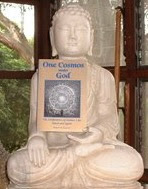
Thursday, June 08, 2017

Fantasies of Finitude & Dreams of Reality

Every morning, upon washing ashore on this side of consciousness, the first thing I do is review the dreams that occurred on the dark side of the cʘʘn. One thing I've noticed over the past decade or more is that my dreams have become increasingly... pleasant. Wondrous. Definitely surreal, but in an enchanting and not alienating way.

This is very much in contrast to before, when my dreams were generally more persecutory in nature. There was always a problem of some kind, with an undercurrent of tension, danger, and an irritating lack of resolution. I don't mean nightmares. Rather, just being hassled by something or someone. I still occasionally get one of those, but not often.

An idea popped into my head. A theory. To the extent that religion is "true," it is true in a way that is much deeper, wider, and more expansive than, say, scientific or mathematic truth. As we know, it speaks to a "deeper" and "higher" part of ourselves. In terms of attachment theory, science is the Wire Mother, while religion is the Cloth Mother, the latter providing another kind of nourishment that is just as vital to survival.

At the same time, dreams obviously speak from a deeper part of ourselves. I wonder if there is some relationship between the speaking-to of religion and the speaking-from of dreams?

Yesterday we spoke of hacking God; perhaps hacking the upper vertical would be a more felicitous way of expressing it. I wonder if religion hacks into the unconscious -- or better, the non-conscious, which extends vertically up and down -- in such a way that the unconscious then hacks into the upper vertical? If so, this would explain the transformation in my dream life.

We've all heard variations of the expression "feeding the soul." It refers to a common experience, and goes to the reality of both the food and the soul: if the soul didn't exist then we wouldn't hunger for (nor be nourished by) the food, and if the food didn't exist we wouldn't be aware of having a soul.

Put it this way. I think we've used this example in the past, but compare it to the sex drive. How do we know we have one? Because we are attracted to certain objects exterior to us. Likewise, how do we know we have a soul? Among other reasons, because of its spontaneous attractions: the attractor and attractee are mutually illuminating.

Yesterday we spoke of Dante's Divine Comedy. What is it but a kind of vivid waking dream of heaven, hell, and purgatory? Countless souls have been nourished by its imagery -- for example, Bob Dylan:

She lit a burner on the stove / And offered me a pipe

I thought you'd never say hello, she said / You look like the silent type

Then she opened up a book of poems / And handed it to me

Written by an Italian poet / From the thirteenth century

And every one of them words rang true / And glowed like burnin' coal

Pourin' off of every page / Like it was written in my soul

From me to you / Tangled up in blue

Then there is this: He [Jacob] lay down to sleep. Then he dreamed, and behold, a ladder was set up on the earth, and its top reached to heaven; and there the angels of God were ascending and descending on it.

Like me, Jacob wakes up, reviews his dream, and says, Surely the Lord is in this place, and I did not know it.

And How awesome is this place! This is none other than the house of God, and this is the gate of heaven!

Wait. What place are we talking about? Is it outside, in some object? Or inside, in the soul? Obviously it is both, the one illuminating the other. At once Jacob perceives God and is awakened to a deeper experience of selfhood.

In The Symmetry of God, Bomford suggests that "the mystics' God be called 'The Unconscious of God' and that any other aspect of God be attributed to 'The Consciousness of God.'" This is a helpful way of looking at it: dogma, for example, goes to the Consciousness of God. You could say that it is addressed to the left brain.

Even so, it inevitably spills over into the right, due to its archetypal symbolism. It has a more "mechanical" effect on the left, a more "organic" one on the right; in the latter it is as if seeds are planted, which grow in unexpected ways.

Bomford quotes the Jesuit William Johnston, who writes that "the consciousness gradually expands and integrates data from the so-called unconscious while the whole personality is absorbed into the great mystery of God."

That sounds about right: left and right spur a mutual growth in one another, which in turn spurs an expansive growth in God. Or you could leave God out of it and just say O: we metabolize O via a kind of psychic metabolism between the conscious and supraconscious realms of the soul.

Two Big Errors: "The first is to infinitize the finite, the second to finitize the infinite. In religious terms both are idolatrous" (ibid.).

With certain qualifications. I would say that it is always an Intrinsic Cosmic Heresy to infinitize the finite, which is Genesis 3 all over again. It is Marxism, materialism, relativism, deconstruction, and any number of other pneumopathologies. It is the Left.

However, we must in some sense finitize the infinite, or we can't think about it at all. It's just that it must not remain static but be deployed as... as what, exactly?

Somewhere Schuon expresses it perfectly. Let me see if I can find it...

"We are here at the limit of the expressible; it is the fault of no one if within every enunciation of this kind there remain unanswerable questions.... [I]t is all too evident that wisdom cannot start from the intention of expressing the ineffable; but it intends to furnish points of reference which permit us to open ourselves to the ineffable to the extent possible, and according to what is foreseen by the Will of God" (emphasis mine).

The Points of Reference represent conscious knowledge of God, but we don't leave it at that. Rather, they are God-given grist for metacosmic dreaming.

Wednesday, June 07, 2017

Hacking into God

Is that possible?

I don't know, the thought just popped into my head. I was over at Instapundit and noticed a link to a book called Language Hacking French: A Conversation Course for Beginners. Sure, I wish I knew French, but that's not my point. Besides, I still have so much English material to get to that hacking another language seems frivolous.

And in any event, what I really want to do is hack into God, and that can be done in any language. If it can be done at all.

Come to think of it, Pentecost Sunday was just a few days ago. What was that all about? I mean originally?

I'm no expert, but it seems the main point was the transmission of a preternatural ability to proclaim God in any and all languages. I suppose that's a case of God hacking the brain's language center so we can in turn hack God (and what is the Incarnation itself but God hacking mankind? "God hacks man so that man may hack God," you might say).

That's an intriguing point, because it is often said that it is impossible to translate the Koran. Rather, one must hear it in the original Arabic, such that any attempt at translation inevitably betrays it.

Not so with Christianity. No one believes you have to speak Aramaic or Greek or Hebrew to get the essential message. Pentecost announces this principle loud and clear, that language is no barrier. Any language can transmit the Word.

Back to the hackery. Note that many if not most philosophers don't even believe it is possible to hack into reality, let alone ultimate reality. Kant, for example, famously claimed that we can know only phenomena. But the noumenon -- whatever reality is behind the appearances -- is forever closed to us. It is the one completely unhackable system.

Lately we've been discussing Gödel's theorems, about which opinions vary. Some people think they mean we can only use logic to chase our own tails, i.e., that we can never escape our absurcular systems of thought. Others -- myself included -- think they mean we can indeed hack the wider reality beyond logic.

Remember the logical positivists? Even though this philosophy has been thoroughly debunked, there are still many implicit or unconscious positivists who maintain that only empirically verifiable statements are true. This despite the fact that the belief that only empirically verifiable statements are true cannot itself be empirically verified. So that's the end of that.

Postmodernists also insist that reality can't be hacked, even while presuming to have discovered the ultimate hack. It is another form of cheap omniscience attainable by anyone, hence its popularity among the tenured.

For example, instead of engaging in the hard work of ascending toward Shakespeare, one just dismisses him as an exemplar of white privilege. One can do the same thing with math, physics, history, any discipline: instant intellectual supremacy. (This guy has countless examples of such systematic idiocy masquerading as scholarship.)

Back to hacking God. I recently read Jennifer Upton's The Ordeal of Mercy: Dante’s Purgatorio in Light of the Spiritual Path. Recall that we spent a month or so blogging about the prequel, which covered Dante's Inferno. Ironically, I enjoyed Hell more than Purgatory.

Note that Dante was so bold as to attempt to not only hack heaven, but purgatory and hell to boot -- or in other words, to provide a comprehensive map of the vertical. All in Italian, of all languages!

That book must have popped into my head for a reason. Let's try to find out what it was.

Ah, here we go. Not only did Dante hack the above three nonlocal localities, but in so doing hacked death itself! For "he presents himself in the Purgatorio as a living man engaged in a pilgrimage through the postmortem states" (Upton).

In fact, these states aren't even that far away, rather, just a micron or quark to the north: "in reality these postmortem states are even closer to us than the impressions brought to us by our five senses."

Which is very close, even touching. Indeed, each of our five senses involves a form of touch, whether of solid matter, lightwaves, air vibrations, or air-/foodborne molecules. Evidently there is a vertical version of each of our senses. Or so we have heard from the wise.

For example, once Dante exits hell and stands on the shore of purgatory, he can see a lot more: "now, when he lifts his eyes, he sees not only Purgatory but the starry sky above. This is deeply renewing to him; through the physical forms perceived by his senses the celestial archetypes are beginning to shine."

But guess what? I think Dante is us and that Purgatory is here. Therefore, we can -- and must -- in this life raise our inner eye upward toward the spiritual horizon and thereby perceive how those celestial archetypes shine herebelow. You know -- metaphysical transparency, or celestial translucency. Subtle vibrations are everywhere.

Conversely, think of how the postmodernist fixes his gaze downward and creates his own hell -- a spiritually opaque world of raw absurdity and naked power.

To be continued...

Tuesday, June 06, 2017

Inside the Mind of Godlessness

Even more than usual I have nothing to say but a compulsion to say it. Therefore, if the posts strike you as more elliptical and wandering, you're no doubt right. We're just casually wondering and blundering around O, taking in the fauna and looking under branches and rocks, with one eye on the subjective horizon. Like a river that can't find the Sea...

Must everything have a point?! No, of course not. Far from succumbing to nihilism, man is dying from the freaking Point of Everything. No longer does he do nothing for the sake of Nothing, which is the only sure way to God (or God's way to man: you have to give him a little space to operate).

For it is literally the case that the Highest Things have no point. What is the point of love? Reduced to some kind of utilitarian calculation it becomes perverse. Same with truth, beauty, and virtue... and this blog. Its point is always the higher pointlessness of being-with-God...

If we could attain complete comprehension of reality, we would have the mind of God; or in other words, only God -- irrespective of whether or not you are a believer -- can conceivably have such total understanding. God is, among other things, the One Who Gets It (and us).

Interesting that we can posit the idea of "total understanding," which makes me suspect someone has it. Just not us.

Hegel certainly thought he had it. Marx took from Hegel the parts he liked -- in particular, the cheap omniscience -- and here we are. But nowadays the omniscience of dialectical materialism has transformed into a kind of omniscient stupidity on the part of the left.

I say this literally because, to paraphrase Schuon, to claim that relativism is the case is to (omnisciently) assert that man's stupidity is total. Like anyone could know that!

Frankly, nothing is that stupid, let alone everything. Even rocks have intelligibility built into them.

"Hegel seriously believed he had reached ultimate truth," meaning that he had managed "to contain all of reality in the conceptual net of his system" (Watts). Nor was he the last. Freud comes to mind. He was especially clever about it, because any criticism of his theory served as proof of the theory -- for example, that you are just acting out a father complex toward the Master.

The left has its own diabolical version of this trick, such that criticism of it is evidence of White Privilege, or the patriarchy, or heteronormativity, or homophobia, whatever. Indeed, this is one of the appeals of the left: a few simple tricks allows one to feel superior -- morally and intellectually -- to one's betters. Any idiot from an elite university with an IQ of 85 can shut down Charles Murray by calling him a racist. QED.

There is no soul so cosmically great that a leftist can't take him down with a single blow. You know the drill: George Washington? Slaveowner. Churchill? Imperialist.

Now, as we know, what makes God omniscient is that in him existence and essence are one; or in other words, his essence is to exist: he alone is necessary being, while the restavus are contingent. Contingency cannot be necessity, but it can know of it (at least humans can). And thanks to revelation, we can know about it as well.

But again, Hegel imagined he knew both of and about the absolute, without any upside assistance, which is surely the last word in pseudo-omniscience. I take that back. One only wishes it were the last word. In a way, it is the first word -- those first human words in Genesis 3, where man presumes to become as God.

Interesting that the first things man says and does involve a rejection of transcendent truth. Which is close to the classic definition of fascism: the violent rejection of transcendence. I suppose we have to wait for Cain to achieve that in the second generation. He is our first homegrown terrorist.

"Hegel did not believe that self-realization and ultimate truth was dependent upon the 'outside assistance' of divine grace." As he put it, "God is only God in so far as he knows himself and he can only know himself through man."

Now, that's a bold statement. In reality it's the converse: Man is only Man in so far as he knows himself and he can only know himself through God. This is self-evident: man and God are complementary; to say one is to affirm the other, at least from our perspective. And when God says Christ, he is affirming his idea of Man, just as when we do, we are affirming our idea of God. Christ is God's icon of man and our icon of God.

It's not that God can only know himself through man, but that he can know himself through man. Not in Hegel's way, but Jesus's way. Or so we have heard from the wise.

Nevertheless, Hegel tries to think his way into God, positing him as pure being. In his personal myth of cosmogenesis, he imagines that God tried to think of himself but failed. Why? Because "it is impossible to think of pure Being." Therefore God "thought nothing, which is the opposite of Being." For Hegel, this goes to the symbolism of the fall.

Eh, I don't buy it. Here is my alternate cosmic fairy tale; naturally it is all "in a manner of speaking," just my own little dream of the Dreamer. But in my dream, the Father-beyond-being "tries" to think of himself and begets the Son, and they in turn beget the Spirit. Ironically, ultimate reality is a kind of eternal trialectic, just not Hegel's kind, whereby God "evolves" in time. For him, the above-noted dialectic between Being and Nothing engenders the Becoming of God-in-history.

You might say that the thesis of Father-Being marries the antithesis of Mother-Nothing, which gives birth to the synthetic Son of Historical Becoming. This latter would be the whole creation, including us. Reality is simply the repetition of this pattern of thesis-antithesis-synthesis.

The good news: eventually "society will reach its final, perfect stage of development, 'reflective unity.'"

The bad news: "For Hegel, this will be manifested by the State, in which individual human will coincides perfectly with the will of the Nation -- personal desires and feelings of personal significance and fulfillment will be rooted in, and perfectly compatible with, one's social existence and duty to the nation." Submission to the State "is to lose one's bourgeois freedom, but to gain a higher freedom."

America's founders, who had the misfortune of being born before Hegel, set in stone the bourgeois freedom guaranteed by the Constitution. But for the past hundred years or so, progressives have been trying to get around this and give us the Higher Freedom of Hegelian statism.

Woodrow Wilson, our first progressive leftist president, studied Hegelianism in Germany. Let's use the google machine to tie this all up into a neat synthesis. This ought to be just the ticket: a review of Woodrow Wilson and the Roots of Modern Liberalism by the PowerLine boys.

Question: "How did the metaphysical speculation of a 19th century German historicist, whose teachings were congenial to Marxists but are anathema to modern analytic and positivist philosophers -- as well as proponents of the Constitution as originally understood -- come to influence our constitutional law?"

"The answer lies in the concept of the 'living constitution' -- and in the influence of Woodrow Wilson." Ironic, isn't it, that the so-called "living constitution" was conceived in order to murder the real one.

It's very much as if left and right posit competing Absolutes: ether our inalienable rights or Hegel's Absolute Idea, and this cosmos isn't big enough for both:

Hegelians believe that, until we reach the end of History, "enduring" rights exist only to be negated by future generations. Thus, Wilson wrote, "Justly revered as our great constitution is, it could be stripped off and thrown aside like a garment, and the nation would still stand forth in the living vestment of flesh and sinew, warm with the heart-blood of one people, ready to recreate constitutions and laws."

The left has been throwing it aside ever since. Wilson "derided what he referred to as the 'Newtonian' underpinning of the Constitution.... Disputing the applicability of fixed laws (other than his own) to History, Wilson wound up opposing the concepts of limited government, separation of powers, and checks and balances."

Soon enough this leads to a government of, by, and for the Worstuvus. So it's a dialectal progression. Straight down.

Monday, June 05, 2017

Irrational Rationality & Insane Sanity

Just a few more points about Gödel before we let it go and move on.

It seems to me that there are two ways of looking at the theorems, my way and the wrong way. The wrong way claims that we are enclosed in the theorems, so to speak, such that we cannot know truth (or truth is essentially reduced to logical entailment, so becomes tautologous).

Conversely, my way claims that in understanding the theorems we transcend them in a way no machine could ever do. It is accurate to say that if the our minds were computers, we could never know it. Rather, we could only know what we are programmed to know, so we could never step outside the program and assess its truth.

As Goldstein explains,

No matter how complicated a "thinking" machine we engineer..., this machine will run according to hard-wired rules that can be stated in a formal system, and when we ask this machine to tell us what the true propositions are it will be able to do so only by seeing which propositions follow according to the rules of the system.

Therefore, there will always be "a proposition that eludes its grasp of truth," such that "No matter how we strengthen the machine, by adding in the previously elusive propositions as axioms, there will be yet another proposition that will elude it... but not [elude] us" (emphasis mine).

In short, we can deeply understand Gödel's theorems and thereby transcend them, whereas no machine can step outside its programing in this way. Rather, a computer is always in the loop.

In an important sense, transcendence goes to precisely what humanness is and does; it is not only what distinguishes us from the rest of creation, but Life Itself does the same thing on another level, except in a non-self-conscious way.

In other words, as Life transcends matter, the Intellect (or soul) transcends Life. This is what our pal Robert Rosen was all about.

Hmm. I wonder what he says about the theorems and how they relate to Life Itself?

Ah, here we go, from one of the amazon reviewers:

This book is a powerful critique of the reductionist and/or simulation (modeling) approach to the mind/body problem and the "what is life" question. Rosen [argues] that mathematical models -- and more generally, scientific rigor -- which ban impredicative loops from scientific discource, would not allow us to build what he calls a "new science," which is needed to account for life and consciousness.

Another reviewer claims Rosen's work "is unquestionably of the level of importance of Einstein's Special/General Theory of Relativity, or Gödel's Incompleteness Theorems. This is a grand claim to make, but once you read Rosen's work, you will see for yourself."

I can't say I understand everything Rosen says, but this much I do understand. But I understand it because he's simply articulating a Truth I -- and we -- all know in our bones. It is the Highest Common Nonsense.

Here we go. I love this: "The celebrated Incompleteness Theorem of Gödel effectively demolished the formalist program," for he "showed that, no matter how one tries to formalize a particular part of mathematics..., syntactic truth in the formalization does not coincide with (is narrower than) the set of truths about numbers" (Rosen).

Bottom line: qualitative is not just poor or fuzzy quantitative, and semantics -- meaning -- can never be reduced to syntax, or to explicit rules of order (as if, say, the meaning of Shakespeare could be reduced to grammar).

Rosen puts it as succinctly as possible, that One cannot forget that Number Theory is about numbers. There is no escape from numbers via numbers, but this hardly means there is no escape! For "There is always a purely semantic residue that cannot be accommodated by that syntactical scheme."

Little semantic residues like, oh, Life and Mind. Mathematical formalization is simply too impoverished a language to map the richness of reality. To paraphrase Rosen, biology only appears "soft" to a physicist because it reveals qualities that cannot be accommodated by its syntax. Life is not simpler than physics, but infinitely more complex. Physics deals with special cases, since the vast majority of systems in the cosmos -- including the Cosmos Itself -- are more complex than anything physics can cope with.

Reality comes first, the model second. Right? Unless you're a socialist or climate scientist. Rosen notes that "a constructive universe, finitely generated, consisting of pure syntax, is too poor to do mathematics in." (One more reason why God isn't a mathematician but meta-mathematician.) We know there will never be a scientific "theory of everything," because no matter how sophisticated, there will nevertheless be an infinite gulf between it and reality. No amount of fine-tuning will get one around Gödel.

So, "Thanks to Gödel's theorem, the mind always has the last word." The human mind "can alway go one better than any formal, ossified, dead system can" (John Lucas, in Goldstein).

Of note, the theorem "suggests that our minds transcend machines," while also making it "impossible to prove that our minds transcend machines."

This of course requires a different sort of proof, one adequate to the object (Subject) in question. Although mathematics surely "flows from God," it cannot lead all the way back up. Rather, there is always the leap of faith between math and reality, man and God.

Some people say you can't prove the existence of God. So what. Nor is there any formal proof of free will. Nevertheless, it not only exists, but is proof of God. Don't kid yoursoph: the only way out is via God, otherwise you are indeed just echoing around your own model. You might as well be insane.

"Just as no proof of the consistency of a formal system can be accomplished within the system itself... no validation of our rationality -- of our very sanity -- can be accomplished using our rationality itself.

"How can a person, operating within a system of beliefs, including beliefs about beliefs, get outside that system to determine whether it is rational? If your entire system becomes infected with madness, including the very rules by which you reason, then how can you ever reason your way out of madness?"

You can't. Thank God and thank Gödel.

A timely observation that describes the conspiratorial, Russians-under-every-bed left:

Paranoia isn't the abandonment of reality. Rather, it is rationality run amuck, the inventive search for explanations turned relentless.... 'A paranoid person is irrationally rational..., characterized not by illogic, but a misguided logic, by logic run wild' (Goldstein).

Friday, June 02, 2017

Saying What Can't be Said

I was out late last night making merry at a high school graduation party, so this will probably be an abbreviated one. But you never know. I just show up at the keyboard. What happens next is what happens next.

High school graduation. I remember mine as if it were yesterday. In many ways I've never gotten over it.

Yesterday we spoke of "liberation." Well, I don't know that I've ever had a sense of liberation that surpasses the feeling of that day. But then, every summer was a little like that -- like an anticipatory fractal of the Big Liberation that occurred with high school.

Many things in life are a kind of rehearsal for death -- losses of various kinds, illnesses, humiliations, IRS audits. I wonder if there is something analogous on the positive side, i.e., rehearsals for salvation or liberation? Must be. Come to think of it, what is the liturgy but a kind of r. for s.? I just ordered this book on the subject, called Nothing Superfluous. The mass is a little like attending your own Wake, isn't it?

And every real celebration marks a birth and a death -- or death and rebirth, Easter being the Urchetype of archetypes. Yesterday's celebration was very much on that order -- more like a psychic bat mitzvah marking the death of the girl and birth of the woman. Mine wasn't like that at all. Rather, more like the death of the caged child and birth of the liberated child. "Manhood" didn't enter into the equation at all.

Birth is a funeral, and a funeral is a birth. Haven't we discussed this before? My brain is a little foggy, so I can't remember. I do recall mentioning something Christopher Hitchens once said. An interviewer, trying to draw him out, asked how he felt upon the birth of his son: "Like I was looking into the eyes of my funeral director."

One doesn't have to go that far to realize that upon becoming Father, one is no longer Son. At least in my case. My father was already gone by the time of my son's birth. You fathers out there whose own fathers are still alive, do you feel like a son? Or is it more of a lateral relationship, father to father?

Back to matters at hand. We're still flipping through this biography of Kierkegaard. Every time I try to finish it and move on, I get hung up on some passage.

Like today, for example. I find it interesting that we don't need actually need Gödel to tell us about his theorems. Rather, they're just common sense: Kierkegaard recognized that "humans are incomplete and all philosophical systems imply completeness." Simple as. This is what I was trying to convey to my internetlocutor over at Instapundit, but he was having none of it.

Which I don't get. In short, he was trying to vigorously defend Gödel while transparently violating him. It's as if he wants to have the birth without the death. My final response to him was a comment by Gödel himself to the effect that "sooner or later my proof will be made useful for religion." Well, duh.

"At the very least," writes Goldstein, "Gödel believed his first incompleteness theorem supported Platonism's insistence on the existence of a suprasensible domain of eternal verities." Any attempts on our part to enclose reality within our "limpid constructions" and thereby "keep out all contradictions and paradox, are doomed to failure." Boom.

It's an orthoparadoxical cosmos. Deal with it. "Gödel's first incompleteness theorem tells us that any consistent formal system... must leave out much of mathematical reality," while the second shows that no formal system can "prove itself to be self-consistent." Therefore, your little system can be consistent or complete, but not both. Never. Forever and ever. Amen. Period.

Now thankfully, God is under no such limitation. Obviously. How do we know this? Because reality -- by which I mean the Real, from top to bottom, inside and out, vertical and horizontal -- is by definition consistent and complete. I mean, just because we can't explain how, this hardly means that reality isn't what it is. Reality always slips through our fingertips. And our TOEs, i.e., Theories of Everything.

It is only "aspects of mathematical reality that must escape our formal systematizing," but "not our knowledge" (ibid.). This is apparently a controversial assertion, but only for people who pretend it is possible to reduce knowledge to math or physics or computation. But according to Goldstein, Gödel "believed our expressible knowledge, demonstrably our mathematical knowledge, is greater than our systems."

In other words, we always know more than we can say, such that what we say can never catch up to what we know. It's why, for example, the blah-blah-blogging goes on forever, irrespective of whether you are pro- or antiBoB.

Therefore -- and this is the, or at least a, Bottom Line of the Whole Existentialada -- "Whereof we cannot formalize, thereof we can still know." Which is a kind of inversion of Wittgenstein's famous gag that "Whereof one cannot speak, thereof one must be silent."

Not true! Indeed, it reminds me of this book by Cardinal Sarah on The Power of Silence: Against the Dictatorship of Noise. Now we're really in the world of orthoparadox, because you might say that the book is an eloquent soliloquy on the silence of ultimate reality. So, you can always say what can't be said. Just don't pretend there's nothing more to say.

Thursday, June 01, 2017

Inward Mobility in the Cosmos

You know the old Zen gag about how, before satori, mountains are just mountains. But upon awakening to one's true nature, wu! Mountains are no longer mountains! However, soon enough, mountains are just mountains again. Wha' happened?

Watts explains that before enlightenment, "one is fully immersed in the finite world of form"; but with enlightenment, there is a kind of switch from finite to infinite: "one feels a deep connection with the infinite but alienated from the world of form which now has lost all its attraction."

In a way, this is a movement from twoness to oneness. But you can't live in oneness forever. I mean, someone has to pay the mortgage and take out the trash. However, the world is different: "there is once again a sense of connection with, and interest in, the finite world of everyday life whilst remaining perfectly in touch with the formless realm of infinity" (ibid.).

This new reality represents a kind of psychic third: recall that with enlightenment we went from two to one. But this new world is a blend or complementarity of the two: everything is completely the same but totally different.

The same pattern is recognized in Christianity, e.g., being "born again from above." Being born of the water or in the flesh surely entails being tossed into finitude, if I recall correctly. D'oh!

In contrast, to be born of the Spirit clearly implies contact with infinitude. Or, it is initiation into the vertical, one's "true home": the immaterial Kingdom of Heaven vs. the material thingdom of heathens.

Prof Wiki cites a passage that sounds like Schuon could have written it:

With the voluntaristic type, rebirth is expressed in a new alignment of the will, in the liberation of new capabilities and powers that were hitherto undeveloped in the person concerned.

With the intellectual type, it leads to an activation of the capabilities for understanding, to the breakthrough of a "vision."

With others it leads to the discovery of an unexpected beauty in the order of nature or to the discovery of the mysterious meaning of history.

With still others it leads to a new vision of the moral life and its orders, to a selfless realization of love of neighbor.... each person affected perceives his life in Christ at any given time as “newness of life."

In short, new strength, new ideas, new patterns, new love or virtue. There's something for everyone!

Furthermore, all these are connected: a rising tide lifts all buddhis. As such, becoming more intelligent should covary with becoming more virtuous, and vice versa. It ought to result in becoming a better and more integrated person.

That little internet dialog I published a few days ago is a good example. The fellow I was debating is obviously intelligent. But he is a hopelessly -- and willfully -- infertile egghead, bound and determined to situate himself in finitude. There is no budging him from that stance unless or until he has a Spirit visitation that shatters all that nonsense. Then he will see finitude from the standpoint of infinitude, and his personal mountain will vanish.

You return to your world, but it's regenerated. All things made new. It's not a one-time-only event -- for that would make it finite -- but ongrowing; or up- and ingrowing: simultaneous ascent and interiorization. Very much in the world, but no longer of it.

Of what then? Of the Spirit, of which we ask God to give us this day (our spiritual sustenance). Detachment (from the world). Attachment (to God). Reattachment (life in the Trialectic, AKA Love).

Is Love higher than Truth? Can't be, for nothing can be more privileged than Truth. Rather, they are two names for the same reality.

The idea is that man is the conscious bridge or link between two worlds (finite and infinite, visible and invisible, local and nonlocal), such that to be born again is to activate the latent energies that flow between them. Our enigmatic old friend Boris describes it thus: "entry into the Kingdom of God is closed to those who have not been born anew." Exterior Man is an infertile egghead who produces no fruit. But with Interior Man, it's always harvest time.

In this context, "freedom" is not merely doing what one wants. Rather, the highest freedom is that of detachment, without which there is no objectivity, and therefore no truth. Schuon says something to the effect that to assimilate an eternal truth is to die a little; recall too Socrates' crack about how philosophy is rehearsal for death. But that only applies to the ego, which feeds on finitude. One might say that the Medicine of Immortality (for the spiritual self or soul) is toxic to the material ego.

Note as well that the Lie is like holy communion for the ego. Which goes to the function of the liberal media, AKA fake news: feeding the Beast. Literally.

Is it even possible to be a self without access to eternal truths? In other words, if we are not grounded in truth, then what are we? Either "whatever we want to be," which is nothing; or, whatever we are compelled to be, which is also nothing.

In reality, freedom and truth are two sides of the same reality, for we must be free to discern and assimilate truth or it's no truth at all. Truth is not dependent upon us, as postmodern relativists maintain; rather, we are dependent upon the truth that pre-exists us.

The cosmos is two things: the world, and our consciousness of it. Neither is reducible to the other, but each is reducible to the Word that is in the beginning. That Word bifurcates into intelligence and intelligibility -- or time and eternity, finite and infinite, absolute and relative, etc. -- but it seems that Job One for us is to assimilate the Word that is prior to the bifurcation, which is how we move on up in the world: inward mobility.

Monday, May 29, 2017

Freedom and Sacrifice, Determinism and Suicide

What follows is a little conversation I had with a fellow commenter on Instapundit regarding an article on whether machines can attain consciousness. The answer is No: not now, not soon, not ever.

Indeed, to even ask the question is to not know what consciousness is, which is to say, qualitative subject and not quantitative object. Why pretend it is possible to reduce the former to the latter? This constitutes the last word in reductionism, since it reduces and thereby eradicates the very entity that caries out the reduction. Truly, it is like jumping into a hole and pulling the hole in after yourself.

Why would you even want to do that? It renders your life quite literally meaningless, with no possibility of any purpose whatsoever.

No, that wasn't a rhetorical question. One could ask the same question of atheists more generally: why do you choose a philosophy that either denies the possibility of choice or renders it absurd?

Well, let's start with the principle that man is what he is, irrespective of what we imagine he is. And one thing man is is epistemophilic. In other words, man loves truth. It's in our nature, and there is no way of getting around it.

If you ask an average atheist if he loves truth, he may or may not admit it. But they always act as if they are devoted to truth, no matter where it leads, in contrast to religious folk, who are attached to childish, consoling, and self-deceptive fairy tales, myths, and superstitions. Atheists are the Adults in the Room, for they are willing to acknowledge Reality without compensatory hallucinations.

So the atheist loves truth as he sees it. Indeed, he loves it so much that he is willing to sacrifice himself on its altar, for he insists that "I believe this, even if it renders all belief, and my life with it, utterly futile."

The commenter with whom I engage below reminds me of this. I don't doubt that he is scrupulously honest -- honest to the point of self-immolation (his responses are indented, while my comments on my comments are in parentheses):

*****

Computationalism is a priori demolished by Gödel, but its simpleminded adherents haven't gotten the memo. Sad!

(That was intended only as a concise little gag. It is literally and eternally true, such that it isn't worth wasting a moment of your life pretending the mind is a computer. I certainly didn't expect an argument against what is certain!)

(Oh and I'm willing to concede that I don't really understand Gödel. If so, then neither does Gödel understand me, and I'm in the right on this matter.)

Godel's Theorems are universal, applying equally to computers and to humans. They don't impinge on computationalism any more or less than anything else.

Yes, but in understanding the theorems we thereby transcend them. In Rebecca Goldstein's bio, she claims that Gödel's point is that man has access to truths that cannot be proved by the systems we construct.

Speaking only for myself, I know with 100% certitude that I have access to suprasensible truths that no computer will ever touch or even know about; they are translogical, not illogical. In short, the limits of truth and limits of logic are very different things: semantics cannot be reduced to syntax -- nor, for that matter, subject to object.

Besides, even if our minds were enclosed in logical tautologies, I would insist otherwise, if only because it's a more fun way to live, and it pisses off all the right people.

That's exactly what Godel proved is impossible. You can't have it both ways.

Use your right brain, man! You're free!

(By which I mean that the left brain is indeed enclosed in logical tautologies, while the right brain transcends all that. Which is why we have one. They are complementary, meant to work in tandem, but the left brain cannot contain the right, any more than the object can contain the subject. And no, I'm not reducing this to brain anatomy; feel free to regard it as an allegory.)

You know how Godel's proofs work? He proved the first Incompleteness Theorem using *arithmetic*. That's how fundamental it is.

It is quite literally inescapable, which is why it is regarded as one of the most important advances ever in the history of mathematics.

Gödel did not show what the mind is, but he certainly showed what it is not, which is to say, a logic machine.

If you take it one step further, among other things, he proved the existence of unprovable arithmetical truths: or in other words -- and this is just common sense -- that there exist things that are both unprovable and true. But only the best things in life.

(Again, literally true: none of the best things in life can be reduced to a logical system. You can try, but you'll be very lonely and bored.)

This is not really something you can have differing opinions on. Godel proved, as you say, that there are statements that are true but unprovable. But we are bound by Godel's proof too. We cannot ever know those statements are true. Sometimes we can know they're unprovable. Sometimes not even that. This is the reality of mathematics, and it's our reality.

The wonderful book Godel, Escher, Bach goes into the implications of this for human and machine intelligence - and art and society as well. I highly recommend it to everyone.

That is not what Gödel believed: he didn't believe his theorems supported reductionism, but rather, a la Plato, the existence of a suprasensible domain of eternal verities. Think of your own case: do you really not know any truths that cannot be proved by logic? -- for example, that man is free to accept or reject truth.

No, I don't know any truths that can't be proved by logic. If they can't be proved by logic, I don't know that they're true. If I don't know that they're true, why call them truths?

There are things I *believe* to be true that I cant prove, of course. But I could be wrong.

I think you're selling yourself short by enclosing truth within logical tautologies. For you, things are true because rational; for me, they are rational because true.

You say you know of no truths that can't be proved by logic. Well, it is impossible to prove man has free will, and yet, we do. One could cite many other examples, but just one suffices to blow up reductionism.

What do you mean by "free will"? There's certainly no evidence that we have any form of free will that contradicts reductionism.

If that's the case, then you were determined to say that, and truth doesn't enter into it. In other words, if we are not free, then we obviously cannot choose truth. Nor could you convince me otherwise, since I too would be bound to believe what I believe.

You ask what I mean by free will: most importantly, freedom to distinguish between truth and error, good and evil, beauty and ugliness, reality and appearances. This is what characterizes the human station. Speaking only for myself, I want to live in a system in which I am free to choose truth, beauty, and virtue.

Freedom is metaphysical, not physical, and is more than adequate proof of our transcendence. And of course, there is nothing compelling one to believe this truth. We are always free to reject freedom.

More to the point: is understanding Gödel's theorems just a logical entailment, or does it situate you outside logical systems? If it's just another tautology, then to hell with it.

*****

That was it. One point I wanted to add is that determinism is for Marxists, Muslims, and behaviorists, not Americans. Especially on this Memorial Day, think about it: we are here because thousands of brave soldiers gave their lives for our freedom.

Yes, but What do you mean by freedom? There's certainly no evidence that we have any form of free will that contradicts reductionism.

Oh? This means that these warriors -- this one, for example -- weren't brave at all, merely foolish or deluded, sacrificing themselves to something that doesn't exist. Meanwhile, the atheist sacrifices his mind to the one thing that supposedly does exist: godless matter. But is there any merit in his sacrifice, being that he has no choice but to make it?

I'll say it again for emphasis: freedom is sufficient proof of our transcendence. And those who have given their all in its defense haven't wasted their lives but testified to its ultimate significance. Which is why we honor them.

(I can hear it now: What do you mean by honor? There's no such thing!)

Friday, May 26, 2017

Growing With the Flow Between Reality and Thought

As a deus-praying Raccoon in good standing, I am bound to agree with Kierkegaard that the deepest -- or highest -- truths do not reveal their "innermost significance when directly communicated" (Watts). But... what I just said right there is among the deepest and highest truths. So, how do I get away with communicating it so nakedly? Is there some kind of exemption for meta-truths?

Why, yes. There must be such an exemption, or we can't think at all. The point is, you have to define your exemption up front and be prepared to live with it. In faith.

For example, there is a widespread faith in contemporary philosophy that metaphysics is impossible. But that's a metaphysical belief -- similar to how the positivist claim that only empirically or logically verifiable statements are true cannot itself be empirically or logically verified. Checkmate.

I often go back to St. Francis Assisi's gag about how we ought to preach the gospel at all times, and even use words if necessary. Thus, words are a kind of poor substitute for experience, which puts the whole notion of "sola scriptura" in an interesting light: for only scripture would equate to no experience and therefore no gospel.

It goes back again to Gödel, doesn't it? I don't mean to namedrop him so often, but what could be more important than knowing up front that what you know can never contain reality? With that in mind you will no longer be fooled or taken in by manmade ideologies, for Gödel has opened an escape hatch that can never be closed.

The same cannot be said for God-given ideologies, assuming they exist. Do they? Let's stipulate that either they do or don't. But if the latter, that falls under Gödel's hammer, because it attempts to contain the uncontainable. The truth is, you can't know a priori if God-given ideologies do not exist. Rather, you have to keep an open mind. Forever.

Which means that, in order to be intellectually honest and consistent, you have to be open to God. But wait. The word "God" has an awful lot of baggage -- cultural, historical, and personal (and the latter both conscious and unconscious). In other words, we are forever trying to get around Gödel by containing what is by definition uncontainable.

Which is why I often apply the unsaturated symbol O to the reality in question. We must always be "open to O" because we cannot not be -- not in reality. That is, unless we arbitrarily close ourselves to O, which is psychic death by asphyxiation or auto-endarkenment. In order to thrive, the psyche needs nonlocal air and light.

In my morning rounds, I bumped into a provocative piece called This is Your Brain on Ideology. The author's name was unfamiliar to me, but a look at his twitter feed finds him to be a bit of an atheistic twit. Or in other words, a closed-minded ideologue.

For example, he pompously claims that "A curious mind is fatally toxic to religions," so "Keep asking questions." I don't know which religion he's talking about... oh wait. I do. However, for us, the whole point of religion-as-such is to maintain an open relationship to the ground of all questions. A curious mind is indeed fatal to ideologies, but if you don't have a permanent and unquenchable curiosity about O, then you're doing it -- not just religion, but Life -- wrong.

I'm hardly suggesting that people don't reduce religion to ideology and even ideolatry. Of course they do -- just as they expand ideology to religion. It has gotten to the point that the whole "religious vs. irreligious" distinction is of no use at all. Rather, man is either religious or pretending not to be.

What we call "faith" does not properly begin prior to thought, although there are people who do deploy faith in that manner. Rather, for us, it begins where thought -- manmade thought, precisely -- ends.

In other words, there is always a gap between thought and reality. But in reality, if you're doing it correctly, there is a kind of circular flow from reality to thought and then back again. It is tempting to crystalize the flow into an ideology, but it can't be done. You just have to grow with the flow.

Really, it comes down to a simple acknowledgement of the infinite, doesn't it? What makes you imagine you can ever contain the infinite within finitude? The same restriction, of course, doesn't apply to God, who does it all the time.

Literally. For what is time but the moving image of eternity? Likewise, what is space but the radiant image of the infinite? O is immanent because transcendent, and transcendent because immanent. There is no way of getting "outside" or "beyond" this statement, because reality is what it is despite the banal rewordgitations of infertile eggheads.

Our Father who art in heaven.

In other words, not "contained" here, but Absolute, Infinite, Transcendent.

Thy will be done, on earth as it is in heaven.

Yesterday it occurred to me that it is as if this is a picture of verticality. Of note, it obviously implies that God's will is not always done down here. Which is why we pray that it be done; which is to say, the point seems to be to align our will with God's will, which I visualize as being open to, and in alignment with, O. It is simultaneously the best we can do and all we can do.

So it would seem that in order to open the doors of consciousness to the dimension of 'infinite reality' with its 'infinite possibilities,' one first needs to renounce one's total trust in, and attachment to, the rational mind... (Watts).

Wednesday, May 24, 2017

A Rabbit Hole Higher than Me

Fell into an unanticipated rabbit hole, the spirit blowing where it will and all...

It was evoked by this provocative point which will stand as our invocation:

According to Bloom, if you are a worthy thinker such as Max Weber, and yet a lesser man than the great-souled Nietzsche, you will inevitably convey something diluted when you try to capture and express Nietzsche’s thought. The only guard against it is to keep saying to your readers, your students, and yourself, as Bloom does, “look higher than me."

Sounds like I ought to reread The Closing of the American Mind. I'm not sure I got much out of it the first time. In my defense, I was still a liberal when it came out in 1987. 1987 was so long ago that the NY Times actually gave it a positive review, according to the blurb on the back. The book was an unlikely bestseller that many more people bought than read.

Hmm. My highlighting suggests that I was one of those who made it to the end. I wonder what I found noteworthy at the time? Pardon the self-indulgence. If I find nothing of general interest, I'll move on.

I do remember this line from the foreword by Saul Bellow: "It may well be that your true readers are not here as yet and that your books will cause them to materialize."

Ah, my True Readers. I guess a few have materialized, but most are taking their time.

When did tenure go from an honorific to a joke, and then from joke to disease? It seems that the latter occurred some time in the 1980s, but most people failed to notice it at the time, perhaps because they projected their past experience of college onto the present; someone who attended college, say, in the 1950s, assumed it had the same value in the 1980s. Therefore, most people missed the deterioration, and here we are, in the end stages of the disease.

The tenured. "Particularly revealing are the various imposters whose business it is to appeal to the young. These culture peddlers have the strongest of motives for finding out the appetites of the young -- so they are useful guides into the labyrinths of the spirit of the times" (Bloom).

What an important but unappreciated point: because of the idiotic idea that everyone ought to attend college, it has become Big Business. And in order to succeed, a business must cater -- if not pander -- to its clientele. The clientele of the university consists of immature minds eager to conform to the latest intellectual fashion. Gravity takes care of the rest.

Truly: it inevitably goes downhill from there, for example, when students make "demands" of the university. In my state, these aggressively illiterate and entitled students thugs demand

a 4-year housing guarantee to live in the Rosa Parks African American Themed House; bring back the building’s lounge; paint its exterior the “Pan-Afrikan colors” of red, green and black; and force all new incoming students to go through a mandatory diversity competency training.

How can a world become so inverted? And yet, no one can look these goons in the eyes and calmly tell them to fuck off. One has to pretend they have a point. I mean, Pan-Afrikan colors. My spellcheck won't even acknowledge the word "Afrikan."

Which only means my computer is racist and must be forced to undergo diversity competency training. Besides, the thing is a kind of silvery color, so that's flat-out triggering.

What ever happened to not judging computers by the color of their monitor but the content of their components?

Students. "[S]tudents are only potential, but potential points beyond itself.... No real teacher can doubt that his task is to assist his pupil to fulfill human nature against all the deforming forces of convention and prejudice."

Er, what human nature? Once you've gotten rid of that, then human potential no longer points beyond itself: a Progressive is born, such that the soul's progress is barred. No, that's too soft a characterization; the soul is aborted, and your reason for being is forever unknown to you. Which is hell, precisely.

Know thyself. Good advice for two or three millennia, at least until the recent discovery that there is no self to know ("who" discovered it, I wonder?). Now we say: know thy self doesn't exist, and besides, it's just a social construct rooted in oppression.

Rawls. Not the wise one, Lou, but the leftist quackademic, John. If you draw out his principles, "indiscriminateness is a moral imperative because its opposite is discrimination." Discrimination is bad, even though it is the quintessence of thought, i.e., discrimination between the real and unreal (also more and less real: for indiscriminate flatlanders there is only one or the other, which excludes the vast spectrum of more and less real).

Minorities. "For the Founders, minorities are in general bad things, mostly identical to factions, selfish groups who have no concern as such for the common good."

You will have noticed that the modern left is precisely an agglomeration of self-styled minorities. It is in principle opposed to the Individual, the real persecuted minority, for there is no smaller unit than one. And the purpose of "civil rights" is to protect this individual. The Constitution knows nothing of groups, except perhaps citizens and non-citizens -- another vital discrimination the left ignores.

Multiculturalism. We -- the Christian West -- invented it, numbskull: "Only in the Western nations, i.e., those influenced by Greek philosophy, is there some willingness to doubt the identification of the good with one's own way." But so-called "multiculturalists" place cultures with no such doubt on the same plane as ours!

Which is not just crazy but suicidal. Literally, as we saw in Manchester the other night. Speaking of which, this is the best book I've read on the subject: Reflections on the Revolution In Europe: Immigration, Islam and the West. That's another rabbit hole I could jump down, but I will restrain myself and stay in this one.

In any event, "The scientific study of other cultures is almost exclusively a Western phenomenon, and in its origin was obviously connected with the search for new and better ways, or at least for validation of the hope that our own culture really is the better way, a validation for which there is no felt need in other cultures."

There is of course a way to rank cultures and distinguish between healthy ones and those that are just collective forms of mental illness. Two words: integration and actualization.

In short, how psychically integrated and actualized are the people produced by this or that culture (or subculture)? In the Palestinian terrortory, for example, we can say "not very." That alone is sufficient for us to determine that it is objectively evil. What about Israel? The question answers itself, except for leftists and other anti-Semites.

Greek philosophers -- our cognitive founders -- were the first to raise this question. "They related the good to the fulfillment of the whole natural human potential and were aware that few, if any, of the nations of men had ways that allowed such fulfillment." True in 300 BC, true today.

Truth? Oh please. Cultural relativism has succeeded in "destroying the West's universal or intellectually imperialistic claims, leaving it to be just another culture." And "imperialistic" is a apt term, for we should want to be conquered by truth. Anyone who doesn't ardently desire to be so conquered makes a god of himself, and it's Genesis 3 all over again.

Bottom line: look higher than me. (As if you don't know that.)

Monday, May 22, 2017

Finitude and Infini-Dude

If you didn't make it to the end of the previous post, we left off with a hint or suggestion that it is as if our two cerebral hemispheres reflect -- or are the reflection of -- two "ultimates," one finite, the other infinite. Each maps a different terrain, one having more to do with physical survival, the other with spiritual awareness and perception.

It is difficult to have a spiritual life without a robustly functioning right cerebral hemisphere -- just as, for example, it would be a challenge to breathe or maintain one's heartbeat without a medulla, or to have an emotional life without a hippocampus.

Now, not only can finitude never contain infinitude, it won't even admit it really exists, except maybe as a word -- a placeholder, like "zero." It never really ponders the ineluctable fact of infinitude.

Conversely, finitude fits easily into a tiny corner of infinitude, with room left over for every philosophy ever devised by man. But reality is under no obligation to fit into the schemes of the tenured, or Gödel was just deepakin' the chopra, bigtime.

Religions are finite expressions of the infinite, or forms of the formless. Christianity goes one step further, and claims that a particular person is an expression of the infinite; and not only an expression, but its very incarnation.

Or in other words, Jesus contains the uncontainable. Which perhaps "explains" -- in a manner of speaking -- the Resurrection, which is a reflection of the fact that Death -- which is finite -- could not contain him.

Death is finite. Whew! That's a relief. But life is infinite, which means that, in order to properly understand it, we must invert the cosmos and look at it bright-side up. As the Fathers said, God became man so that man might become God; in so doing, Life takes on Death so that Death might become Life.

Not biological life, of course, biology as such being merely a "downward projection," so to speak, of the Life Divine (the bio-Logos). If the universe were fundamentally dead, you couldn't squeeze life out of it in... 13.7 billion years, no matter how hard you tried.

Analysis true: "Kierkegaard wants us to realize that, ultimately, we can rationally understand neither the world we live in nor our true nature or purpose in life" (Watts). So stop trying!

Or rather, always situate reason within Reason. In short, in order to be a true Christian Dudeist, you must abide in the dynamic space of complementarity -- the pneumatic third -- between these two: ultimately "between" finitude and infinitude. Animals are finite. God is infinite. You are the monkey in the middle.

For finitude is a mode of the Infinite. Just as creation reflects the Creator, immanence always points to transcendence. Frankly, nothing is merely "natural," full stop. Nature itself is supernatural, everywhere spilling out of itself and flowing back to its nonlocal source.

This is precisely what is happening when you view a landscape of primordial beauty: you are participating in this return -- so long as you are looking through the right brain. Otherwise it's just another blandscape.

Looking through. That reminds me of a comment by William Blake (in Upton): "I question not the doctrines and practices of my religion any more than I would question a window concerning sight; I look through them, not with them."

I'm also thinking of how the synapses of the brain work via electrical polarity. No polarity, no action. For us, what is the ultimate polarity? It is by definition "God and man" -- or Creator and creation, and therefore Infinite and finite, Absolute and relative, Eternal and temporal, Whole and part, etc.

So: in order to cultivate a vibrant spiritual life, one must maintain the polarity between self and God, AKA (¶) and O. This is what prayer is all about; or humility, which is a sine qua non.

Note that humility has nothing to do with "humiliation," but rather, is simply an objective appreciation of our finitude. Awareness of finitude makes a man humble. Or should, anyway.

A kind of "energy" is potentiated with the polarization of God and man. If we fail to polarize, then "we dissipate our energy and squander our lives in a variety of meaningless ways" (Watts). This is where "desire" comes in to fill the void.

Obviously, a kind of polarity is created by what we Want and Don't Have. So we fill our lives accumulating the latter and then re-potentiating until the next purchase. I'm obviously not some anti-capitalist imbecile, but you have to use it, rather than vice versa. We've all been there.

For Kierkegaard, Abraham represents a kind of cosmic hinge. Think about it: he -- the father of us all -- allows himself to be completely polarized vis-a-vis Yahweh (similar to Mary's later submission and polarization). He "represents the first man in the Bible to devote himself in complete faith, and through free choice, to One God -- an act that represented a radically new understanding that formed the foundation of Western civilization" (Watts).

Foundation! I say (!) because this foundation is.... empty, so to speak. It is not an assertion, but a listening, an "active passivity." Go. Go where? To the land I will show you. B-... Just go, alright?

Here is how Rabbi Kushner describes it in one of our favorite little mystical tracts:

Abraham, our father,

Was simply told to leave....

This is the setting out.

The leaving of everything behind.

Leaving the social milieu. The preconceptions.

The definitions. The language. The narrowed field of vision. The expectations....

To be, in a word: Open.

AKA the receptive state of (o).

And

If you think you know what you will find,

Then you will find nothing.

If you expect nothing,

Then you will always be surprised.

Boo!

Friday, May 19, 2017

I UnKnow, Wherefore He Is

Just another wild & wooly Friday post.

However, there is always an underlying method to our muddiness, in that every post, in one way or another, is trying to vault you out of your familiar absurcumstances. If the post can do that, then it has succeeded. So, just sit back and enjoy the ride.

Which actually goes to the explicit subject of the present post, which has to do with the complementarity of knowing and unknowing. Unlike my competitors, I'm not trying to tell you what to think, but rather, to help you break out of what you think you think. It unsays as much in what remains of my sidebar.

The following strikes me as a key complementarity: "knowledge is objectively certain, but cannot tune in to the living process of reality, nor can it embrace the infinite. In contrast to this, faith is highly uncertain, but allows us direct access to the infinite reality of our own being" (Watts).

As such, the opposite -- or complement -- of knowledge is not ignorance but not-knowing, or what Keats referred to as negative capability: the ability to abide "in uncertainties, mysteries, doubts, without any irritable reaching after fact and reason."

As it so happens, I first stumbled upon this concept by way of Bion, who applied it to the practice of psychoanalysis, through which we can only pretend to understand the mind -- beginning with our own, let alone the patient's. Any such knowledge involves the process of an unknown and unknowable reality giving itself over to our understanding on a moment by moment basis: out of the formless and infinite void, thoughts arise, we know not from where.

Or, to paraphrase Jesus, it is like the wind, which blows wherever the heck it wants to -- gosh! -- such that "you hear its sound, but you cannot tell where it comes from or where it is going." As if anyone could know that!

Here is an analogy of what Bion means by what he calls "transformations in O":

"Let us assume a painter sees a landscape and paints it. The landscape, according to our terminology, will be O," whereas the painting is "the end result of a series of transformations." Obviously there is a relationship between the painting (the transformation) and the landscape (O), but the number of potential transformations is literally inexhaustible -- and this is for just one landscape! Each one will transform something "invariant" from the landscape to the painting, otherwise we couldn't recognize the relationship. But there is no limit to the ways this can be accomplished.

It reminds me of an example Christopher Alexander provides in volume one of The Nature of Order. In it he reproduces a series of self-portraits by Matisse, each one showing very different features that couldn't actually be present in the same person. And yet, each one is clearly recognizable as Matisse. How did he do this?

First of all, this is what separates the genius from the Sunday painter, but that doesn't answer the question.

It must go back to what was said above about the mysterious invariant in the transformation. As Alexander puts it, a person's unique character "is something deeper than features: it is an inner thing which exists over and above the features, and is not even dependent on these features" (emphasis mine). That is weird! "What in the world is going on? What is it that Matisse is seeing?"

"The answer is, this 'character' is the wholeness. It is the overall vector, the overall qualitative structure, the overall field effect of the face." You can describe the face in terms of its elements or features, and yet, an accurate depiction by an average painter might not capture the character, while the "inaccurate" one by a gifted artist does.

I'll give you another example that we were discussing just last night. The wife, whose hobby is photography, -- c.f. here, at parkourmom99 -- has been trying to photograph our Great Dane. You'd think this would be easy, but despite hundreds of attempts, none of them capture his character. The photographs could be of just anydane, and simply don't convey his comical and endearing blend of traits. She might capture one of them, but not the unique combination. Maybe someday.

Conversely, our son is somehow a perfect subject. It's as if every photograph captures his spirit. Again, it's weird.

The thing that always bothers me is that we are in such a strange circumstance, and yet, people are forever wanting to normalize it, as if intelligence is "just anything." It's not! Rather, it is a daily miracle, one of three that are enough to keep us busy for the rest of our lives (the other two being existence and life). "With intelligence, the curve springing from God closes on itself like a ring that in reality has never been parted from the Infinite" (Schuon).

Ironically, you can't leave God even if you tried. Rather, one can only pretend to. But this pretense can become like a block of granite or thick layer of ice that forms the boundary between the kingdoms of heaven and hell.

Therefore, you might say that (to mix metaphors) our terrestrial exile is built with bricks of (k), or with the type of self-enclosing knowledge that characterizes scientism and other pneumopathologies. "Theory" is etymologically related to sight, but any theory that pretends to be consistent and complete renders itself blind in a deeper sense.

Schuon has his own way of describing our permanent state of not-knowing, which is always in dialectic with our knowledge: "Whether we like it or not, we live surrounded by mysteries, which logically and existentially draw us towards transcendence." Why is that? Because if we could actually map reality in our heads -- if our knowledge were in perfect conformity to Total Reality -- it would connote complete immanence. Existence would be a closed circle instead of an open spiral.

I have this idea that any manmade map of reality is analogous to pi, which goes on forever without ever being able to resolve itself; in other words, the most perfectly detailed expression of pi is helpless to map the simple reality of a circle -- and what is more simple than a circle, AKA O?

"[T]he information-processing systems of the rational mind," writes Watts, "can comprehend only data existing in the finite world of form, whereas our 'faith-mind,'" -- which is a higher function -- "is the only 'wavelength' of the brain that permits us to attune ourselves to, and realize both the infinite, formless realm and the finite realm of existence."

The linear and timebound left cerebral hemisphere -- so to speak -- can never "contain" the right. But the right contains the left, such that in it we can reconcile finite and infinite. But never in any final way. Rather, its an ongrowing innerprize. It's the work of a lifetime, but the yoke is easy.

Thursday, May 18, 2017

Something About Mary

A last minute cancellation has left an opening. Let's try to use this opening for an Opening.

It goes without saying that the feminine is a dimension of the divine. Nor is it merely an add-on: a compensation, an echo or consort. Rather, it -- She -- is absolutely primordial and essential.

We all -- meaning human beings -- intuit this on some level, so it has to be expressed in some form or fashion. In Christianity the principle form is Mary, but then what happened to Sophia, who is all over the OT? Is it possible they are two formal expressions of the same trans-formal reality?

"Scripture provides a sound basis for calling Wisdom not only a mother but a virgin, bride, partner and playmate as well" (Gottfried Arnold, in Cselenyi).

Hmmm, I like that last one: think of the psychic benefits of having a playful mother. My wife has an incredibly playful relationship with our son. My mom was... kind of a buzzkill. Fortunately, I don't think she was that way when I was a baby, when so many tracks of neurology are laid down and etched into our psyche-soma.

I believe Schuon traces masculinity all the way back and up to Absoluteness, whereas the feminine goes to Infinitude. There is no thinking per se beyond these two primordial categories, i.e., Absolute and Infinite.

By the way, just because Thinking Stops Here, this doesn't imply that reality ceases with it. Rather, it simply means we are at the threshold of the apophatic God -- the Godhead, the Ain Sof, the great Beyond-Being, the Divine Go-round of O. (And we use "O" advaitadly, because it is nothing, a void, until we give it content, i.e. wisdom, or it gives content to us, i.e. revelation.)

Oh, and by the way, I just have this suspicion -- a cosmic hunch -- that O is feminine, just as it looks.

It's like the "womb of God," which is of course represented herebelow by the womb of Mary. In a beautifully orthopardadoxical way, Mary contains that which contains her. But is this not the point of the spiritual adventure? To try to give birth to the God who contains us? We'll no doubt return to this theme as we go along.

Mary is also the Universal Church, or the womb of saints. But what is creation but the womb of saints? That seems to be the whole point of having a cosmos -- which, according to Paul has been groaning as in the pains of childbirth right up to the present time. Ouch!

Now, I concur with Hartshorne that the world is woven of complementarities, but that in any complementarity one side takes precedence. Thus, in the Absolute-Infinite complementarity, the former is first among equals. I mean, someone has to wear the pants in the divine family. HE is strength, while SHE is beauty. (Also, pure infinitude would yield to the cosmic inversion of absolute relativity, or the Left.)

The mother goes to inward relations, the father to outward relations; also, I would say that relationship as such is interior, and that relations are by definition relative. Thus, feminine-infinitude is the divine ground of appearances, of mamamaya.

Note that the Abba-solute has an ontological and not temporal precedence. It is not as if there was a "time" prior to infinitude.

In fact, it is very similar to the orthoparadoxical relationship between Father and Son, wherein Father is obviously primary, even though there was never a time that the Son was (or is) not. Rather, it is a perpetual -- or eternal -- begetting; or better, be-giving. The Father is always giving Being (to the Son), because that is how he rolls, has always rolled, and always will roll.

As the Fathers emphasized, begotten not made, the latter going to temporal creation. In contrast, the Son is... an atemporal creation, or perhaps Logos UnCreate, or something like that.

The command just popped into my head: honor your father and mother. Suddenly that command is loaded with metaphysical implications.

Another point just bubbled up: "Let Us make man in Our image, so male-and-female We is created. (First person plural is prior to first person singular.)

Now, that's provocative and even O-vocative (i.e., giving voice to O): maleandfemale is the unit of creation, and this unit is relation. Why? Because God is relation -- or, as W. Norris Clarke puts it, substance-in-relation.

And what is substance? Every existent thing is a combination of Form and Substance, the latter masculine, the former feminine: substance is like the womb, form the seed. It's mom'n'dad all the way up!

Well, that's about all we have time for. You take it from here. Hopefully you have a few seedlings to play with.

Wednesday, May 17, 2017

Satan's Frenzy and God's Peace

Ever wondered what a demonic swarm looks like? Wonder no more! The media swarm has reached peak frenzy in the last couple of days. Or has it? Will it just burn itself out? Or -- being that it is demonic -- does it draw on an occult source of energy in order to fuel the frenzy?

Yesterday we spoke of grace, another nonlocal energy that fuels the human adventure. However, it is never frenzied. It is energetic, to be sure, but it is a kind of calm energy. It is also focused rather than diffuse, the latter being characteristic of the demonic kind. Both give "pleasure" in their own ways, as do love and hate. Just as scientism is a kind of cheap omniscience, hatred gives an egalitarian joy that is within anyone's reach. It is why the left is addicted to it.

Of note, the left's perpetual tantrum is also wrapped up in a covert superiority that is both a cause and consequence of the hatred. Speaking of demonic influence, it's very much like the Palestinians: if they're hateful enough to use themselves as bombs, then the hatred must be justified! Except it's not. Rather, the hatred comes first, justification for it later.

Sobriety. That's what it is. Is the left ever sober? No, their baseline is hysteria, and hysteria always exteriorizes, fragments, and dissipates.

Conversely, grace interiorizes, centers, and synthesizes. Which is why, as Spitzer notes, "fear and anxiety should be mitigated as quickly as possible by turning to the Lord in trust and prayer." It's the difference between reluxing in the spiritual kingdom of heaven or dissipating (or hardening) in the material thingdom of heathens.

"When I open myself to God's grace," writes Spitzer, "I often find that I am intellectually open, creative, serendipitous, synthetic, and comprehensive." Concur. It seems that "the Holy Spirit works within our creative subconscious and directs us toward 'serendipitous' discoveries in a subtle way -- allowing us to come to the main insight ourselves" (ibid.).

By the way, is grace synonymous with the Holy Spirit? I like to think so. It simplifies matters.

Put it this way: grace is the presence for us of the Holy Spirit, just as Jesus is the presence of the Son.

Note also that this grace is not just an energy but a link: ultimately it is the link between God and man, and this link is of course love. But all love is an iteration or prolongation of this same link: what links us to each other is the very same force that links us to God.

In the past we have discussed Bion's concept of "attacks on linking," a primitive psychological defense mechanism that destroys meaning by dismantling the links -- relations -- it is founded upon. Yesterday I alluded to the mental operation of (PS) <-> (D), which is analogous to catabolism (breaking down) and metabolism (synthesis).

Looked at this way, grace isn't just the metabolism, but a harmonious complementarily between breakdown and synthesis.

In turn, this provides a fruitful way of looking at suffering (which is the subject of Spitzer's book). Look at your own life: I won't even ask you how many times suffering turned out to be the vital prelude of a higher synthesis. Absent the suffering, the synthesis or integration wouldn't have occurred.

The other day I was thinking about the times in my life when certain paths were barred or doors slammed in my face. At the time these were painful or frustrating or puzzling, but in hindsight they were not only vital but life saving -- not biologically but spiritually. Thank God I didn't try to break down those doors or willfully push my way down the closed path. I give up easy. As it pertains to my own ego.

There's a famous passage where Paul thanks God for the affliction of his Thorn. I can relate. Humility is like a self-administered thorn. You can do it yourself or wait for God to take care of it, but his thorn will probably be bigger, depending upon how far up you have fallen from humility. Pride elevates so high that you live beneath yoursoph.

Speaking of which -- or whom -- I've been looking into another mater, the possibility that the Holy Spirit is feminine. I can't wholeheadedly recommend it, but I recently read The Maternal Face of God?, which has got me to wondering (note the question mark in the title). My preluminary answer is Why Yes, of course the Spirit is feminine.

One particular passage caught my attention. I haven't thought it out, but something in it tickled my epiphunny bone:

[M]an is aided by two principles: the Logos and Sophia. The Logos is a principle directed from God toward man while the principle of Sophia is directed from man toward God. The former (God's descent into the created world) is a theurgic act, and the latter (man's ascent to the spheres of heaven and becoming part of the divine) is a sophiurgic act. These two principles meet and unite in the Son of Mary, Jesus Christ.

First of all, this is very clear explication of what we call (↓↑). As we already know, these are not -- and cannot be -- linear arrows that are separate from one another. Rather, they are ultimately two aspects of the same spiraling arrow. You might say their relation is conjugal. Or at least ought to be. Otherwise you're living in sin!

Looked at this way, our ascent is always God's descent, and vice versa.

Mary -- who is all woman, and then some -- represents the last word in perfection attainable on our end. This meets with the descent of the Logos, and voila! The Godman.

Christ's human nature comes from Mary. Does this imply that his human nature is Sophia, so to speak? Might as well be.

Elsewhere Cselenyi reminds us that "there are polarities at every level of being. This proposition is closely related to the Sophia-principle, according to which the highest polarity in creation is the unity of Logos and Sophia" -- which is again Christ. However, I would not say polarity but complementarity; not polarized but conjugal. And of course fruitful. Fertile:

"Sophia increases new life inside individuals.... Sophia is the womb of becoming spiritual, an intermediary between God and world." Cselenyi cites a relevant gag by Angelus Silesius: "Even if Christ is born a thousand times in Bethlehem, but not inside of you, you will remain lost forever."

A womb with a pew or something.

Tuesday, May 16, 2017

States & Traits, Fleeting Sparks & Burning Bushes

Hmm, not sure what's going on with the new look. I suppose I updated the blog when I meant to update the template, and now there's no going back. Oh well. Must be sound reasons for the switch, or good King Google wouldn't have done it.

As always, it's a little difficult to pick up the thread when I haven't posted for a few days. It's like a musician stopping in the middle of a solo and then trying to finish it the next week. It's much more a matter of entering the frame of mind that was present when you left off.

No, that's not right. It's not the frame, nor the content. I can always continue with the same subject, but only in an exterior way. In other words, the problem is reentering the same "space" one was in. As such, a better analogy is waking up and then going to sleep the next night and trying to continue in the same dream.

That right there is a critical point, and it actually converges on our current theme of the futility of merely objective knowledge of God: objective knowledge without subjective experience is not only empty, but Kierkegaard would say it is false. Somewhere he -- or someone -- says, better to be a passionate sinner than a hollow believer. Or some orthopardox to that effect.

The point is, it's no use pretending to be who you're not, or pretending not to be who you are. After all, we're talking about God, who cannot be fooled. He knows exactly who you are.

In psychology there is a distinction between states and traits: "Personality traits are characteristic behaviors and feelings that are consistent and long lasting. Unlike traits, which are stable characteristics, states are temporary behaviors or feelings that depend on a person's situation and motives at a particular time."

You might say that states are more spatial, while traits are prolonged in time. It's as if various potential states are at a right angle to linear time.

For example, there is the well known distinction between sacred and profane time; last Saturday evening we went to church, which I simply use as an opportunity to enter sacred time. Or rather, it is as if sacred time enters me. That is, I just close my eyes and empty my head, and the Spirit takes care of the rest.

I recently read the fourth volume of Robert Spitzer's quartet -- now quintet and rising -- on happiness, suffering, and transcendence, The Light Shines in the Darkness: Transforming Suffering Through Faith, and... Period. That sentence was long enough. Anyway, in it there are some passages that precisely parallel my own experience of what I symbolize as (↓) and (---) in the book.

One common way (↓) manifests is through "little coincidences" to which we must pay attention and not dismiss. Really, it's just a different way of looking at the world -- a more right-brained way involving pattern recognition (or recognosis). Words may jump out, -- BOO! -- whether "on the printed page or on a television program." The Spirit "works with subtle increases in tone and volume, subtle coincidences and gentle proddings."

Pretty soon you discover you're inside a conspiracy of providence! This is when the Raccoon whispers the sacred mantra to himself: Can I buy some pot from you?

As the cosmic coincidences begin to pile up "in conversations, books, and other media," it may mean the Spirit is up to something. He -- or possibly She -- "gives us the 'clue' of what to look for, but we must be attentive to how that opportunity might be actualized in our lives." Is there a way to tell when it's a clue and not a red herring?

Spitzer says Yes: it is a "sense of peace" (---) that "persists and lasts." Conversely, "if discord and anxiousness occur, it could be a sign that the Spirit is moving us away from this particular external opportunity." Or, just say increased fragmentation, AKA (•••••) instead of (•). We are always converging upon Unity -- or fragmentation.

In reality, this is simply the structure of our psychic metabolism, which is a complementarity between the two: we chew our food into fragments so it can be taken up into the higher unity of the body. Just so, all day long we are immersed in "fragments of being" that it is our task to weave into the cosmic area rug that pulls it all together. Indeed, this seems to be one of the functions of dreaming, and why people who cannot dream soon become crazy quilts.

For reasons we won't get into, Bion symbolized this psychic metabolism (PS) <-> (D). Note the two-way arrow, for we are always falling apart and coming back together. It is a process, somewhat like a whirlpool, which maintains its shape even while the content is constantly changing.

Have you ever met someone who can't maintain the whirlpool, but is just a collection of disconnected fragments? I recently had a patient with that problem, which you might say is the Problem of problems. Conversely, there are people who are utterly stable but lifeless: instead of dynamic process-structures, they are static and closed structures that cannot metabolize novelty.

By the way, the peace referenced above is not a static thing. The dead are peaceful in their own way. But real peace is a presence, not an absence; it's a thing.

Or better, a person and a relationship. So it can be accompanied by inspiration and enthusiasm, only it will have a peaceful and not manic quality. This manic quality occurs, for example, when your baseball team has a walk-off victory, or when you just made a Big Purchase, or with certain kinds of rock music. There's nothing wrong with it, just don't confuse it with the more lasting kind.

Come to think of it, "the Evil One uses exaggeration to move fervent and enthusiastic people to discouragement or spiritual pride -- or both" (ibid.). For all intents and purposes, rock music used to be my religion. But even then, there was always something in me that saw behind or beneath or above it to something else. If not for that, I'd just be one of those pathetic aging hippies who haven't taken a new imprint since 1967.

In that regard, we'll be hearing a lot about the Summer of Love, being that it's the 50 year anniversary. It is the last word in boomer narcissism, so prepare to be nauseated. I was only 11 at the time, so don't blame me.

How does all this relate to Kierkegaard? Speaking of the Summer of Love -- and of drugs -- a coincidence: "Most people, through alcohol, drugs, the splendor of nature or perhaps through insight that arises from a book or movie, occasionally have experienced profound and enlightening realizations," AKA (?!).

But then they're gone. This is why our sad old hippies never stop trying to resuscitate this corpse. I suppose you could say it's a substitute for resurrection.

This will seem off-the-wall, but I happened to read this interview with the laughably pompous and self-important Donovan, who was big in 1967. So big he refuses to leave:

... what we are listening to in popular music is really, from 1964 onwards, not only a revolution but a renaissance. The world must understand that the door that was opened -- and I kicked the door open first, it seems -- and the world was in deep trouble after the Industrial Revolution, two World Wars and a Depression and nuclear bombs and the systematic destruction of the ecosystem. We were the change. They call it the new Age of Aquarius.

The world is still not out of trouble and what we brought in, the conscious songwriters of the ’60s, and all the things we did musically, breaking down all barriers... Donovan, Paul and Ringo and my wife Linda, we are still doing the same thing...

Wow. What a jackass! Despite Donovan's efforts -- and even a hand from Ringo -- the world still has some problems. I can't imagine why.

Pretty scattered post, eh? We'll leave off with this:

"[E]nlightenment is a moment-by-moment experience. Subjective truths are the living fruits of awareness that exist only in the burning fire of subjective experience -- when the fire goes out the truth becomes a lifeless, impotent, empty 'word husk'" (Watts).

Like Donovan. Except I'm uncomfortable with that word "enlightenment." The Light is coming in, to be sure, but it's because we're in relationship to a source that transcends us, not because we possess anything.

Thursday, May 11, 2017

Materialism, AKA The Bureau of Missing Persons

Again, certain problems arise the higher we travel up the epistemological food chain, where things become increasingly real.

For example, it is possible to model simple phenomena such as the solar system, and predict where this or that planet will be 100 or 1,000 years hence. This becomes quite difficult in complex systems (such as the climate), but is impossible in principle in complex systems exhibiting subjectivity and personhood -- or in other words, human beings (in short, you can't model freedom, but liberals never stop trying).

For those of you who don't know the backstory, my grad school education in psychology might have been worthless -- if not pernicious -- had it not intersected with two saving graces, one of whom was a particular professor, the other an obscure (at least outside psychoanalytic circles) theorist named W.R. Bion. It was the latter who vaulted me out of my existing orbit and taught me how to think. Or rather, taught me what I was doing when thinking (or pretending to).

However, especially in hindsight, I can see that there wasn't necessarily anything special about Bion. He didn't discover anything new, so no need to run out and purchase his expensive and abstruse little books.

For example, I'm seeing that Kierkegaard raised the same issues, as did many thinkers before him, probably going back to Socrates. As far as we know, Socrates was the first man to consciously avoid pretending to know what couldn't be known, or to always bear in mind the vast realm of the Unknown Unknown, which swamps the other three.

Of course there are the known knowns of everyday science and known unknowns of twilit philosophy. In many ways psychoanalysis is the paradoxical realm the unknown known, e.g., unconscious drives and conflicts that we only pretend not to know.

In this context, you could say that a psychological symptom is the quintessential case of an unknown known, in the sense that your conscious mind doesn't understand what the symptom means, but your unconscious mind must, or it wouldn't be there. The symptom is a communication of knowledge, only the left brain doesn't know what the right brain is up to.

Think about the miracle of mathematics, which allows us to deal with a whole realm of Objects That Aren't Here. Where do my investments exist, for example? I have a piece of paper with a bunch of abstract numbers that somehow relate to these distant objects, but imagine trying to keep track of them without the numbers.

Well, there are certain dimensions of existence that cannot be so treated, for example, human relationships. As Marvin Gaye and Tammi Terrell remind us, "ain't nothin' like the real thing": I got your picture hangin' on the wall / But it can't see or come to me when I call your name / I realize it's just a picture in a frame. Etc.

No abstract symbol can replace or represent the missing person. Nor, for that matter, the missing God. As Bion puts it, certain formulations are "dependent on the presence of the experiences being formulated." We must deal "with the original object without the aid of an intervening model which [we] can manipulate." For example, "there is no brother with whom to work out problems of the relationship with a father."

Likewise, it's no use dealing with models of God, no matter how accurate. Rather, only the original will do.

Note how materialism, or any form of naturalism, simply denies the existence of persons. Materialism is the philosophy of the Missing Person. This person is somehow putting forth a philosophy that denies the existence of the person putting it forth. It is inherently regressive, because it transforms a known unknown -- the person -- into an unknown unknown. This renders the "examined life" impossible, because there is no one to examine.

Nevertheless, like a dead body floating to the surface, one cannot actually rid the cosmos of the personal without it returning unbidden. Indeed, the materialist has things precisely backward and upside down, for the personal is the ultimate category of existence; everything is reducible to it, rather than vice versa.

Yesterday a thoughtlet pops into my head: the love of truth ultimately converges upon the truth of love.

It also occurred to me that a person is never a thing or object, but a link. Or better, a person always refers to. A baby refers to mother, and vice versa. Assuming we grow all the way up, man ultimately refers to God, and vice versa. That "God refers to man" may sound strange, but it's another way of saying Incarnation.

Then it occurs to me that the cosmos is like a vast life-making machine, and that life is a mind-making machine. This makes man the God-making machine.

But this formulation has it all backward, for we must begin with the personhood of the Creator. The Creator wishes to create persons. Everything in existence is marked by traces of personhood; in other words, every existent has an intelligible interior accessible to the human subject. Knowledge is simply the interior of objects calling out to the interior of persons: they refer to us, as we refer to them, in an ever-deepening spiral.

But the ultimate truth is this mysterious human subject itself. Rather, make that the penultimate truth, because it is inexplicable if it doesn't refer to its own source, AKA God. So, to round out this roundabout post, let's get back to what Kierkegaard has to say about all this perfect nonsense:

"Kierkegaard's emphasis on the pointlessness of 'intellectually grasped' truth... explains why throughout history so few seekers have gained enlightenment from the 'great truths' provided by enlightened men..."

"[F]or when the insights of these enlightened masters are spoken by them, or repeated and recorded by others, they are invariably experienced by those listening only as objective, or intellectually acknowledged, truths that do not carry the energy of the subjective experience from which these insights arise."

"For language cannot directly communicate the subjective truth," but only "conceptual representations of their subjective insights." These representations are "signposts that merely point toward a reality that each individual must discover, or subjectively understand for themselves through their own direct experience" (Watts).

In other words, the Subject must be present to the subject. Accept no substitutes. You can't work out your God issues with your daddy, let alone with matter.

Theme Song

Theme Song