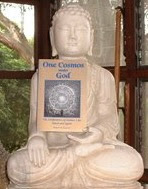
While I do not believe in a specious "God of the gaps" to try to account for what we don't know, I do believe that we are immersed in a universe of irreducible mystery, and that this mystery includes several fundamental problems that will never be solved by science. These mysteries represent limits to our cognition, and while we can think about them rationally , we can never arrive at any satisfactory intellectual answer.
For example, science will never comprehend the mystery of existence--that is, why there is an ordered something instead of mere nothing. Science simply assumes this order, for without it, science would be impossible. This mystery is so hopelessly insoluble that we generally stop even asking about it after childhood. Science actually provides no sensible answers to this question at all. Only esoteric religious metaphysics even begins to touch the issue.
Another irreducible mystery is life itself. We all act as if we know what it is, but it would be much more accurate to say that we know what lifelessness is, and that life seems to be a bizarre and unexpected violation of this general rule.
Even more bizarre and problematic is the existence of consciousness. We have this astounding gift of inwardness, and yet, what is it for? Why would the universe evolve into a subjective horizon containing love, beauty, truth, justice, poetry, music....
We can know so much, and yet, we cannot know anything about these fundamental mysteries of existence, life and consciousness--at least not with reason alone. According to the Buddhist scholar B. Alan Wallace, "Despite centuries of modern philosophical and scientific research into the nature of the mind, at present there is no technology that can detect the presence or absence of any kind of consciousness, for scientists to even know what exactly is to be measured. Strictly speaking, at present there is no scientific evidence even for the existence of consciousness!" Another way of saying it is that, if consciousness did not exist, science would have no trouble explaining the fact.
That is, the only evidence we have of consciousness consists of direct, first person accounts of being conscious. And yet, not everyone is conscious in the same way or of the same things. Although we don’t know what consciousness is, we do know that there are degrees of it. Every psychologist navigates through the use of a developmental model of some kind, in which consciousness unfolds and develops through time. But why? Other animals don’t have degrees of consciousness within their own species, but the gulf between certain humans is as great as the gulf between a dog and Beethoven, or between Nagarjuna and the typical One Cosmos reader.
In my view consciousness is an organ, just like any other organ in the body--heart, lungs, kidneys, etc. But those are material organs that exist in three-dimensional space. Consciousness, however, is an immaterial organ that operates in multidimensional space and time. In short, it is the first hyper-dimensional organ of the cosmos.
What is an organ? Two things, mainly. First of all, it is a differentiated structure. In other words, it is not just a blob or an aggregation, but a definable form that has an identifiable structure. Yesterday, during my nuclear treadmill, I got a good look at my heart. Even with a material organ such as the heart, no one can draw a sharp line say "this is where the heart ends and the vascular system begins." And yet, the heart is an obvious structure with valves, chambers and arteries.
The second characteristic of an organ is that it performs a function through cooperative activity. The heart pumps blood. The lungs exchange oxygen and carbon dioxide. The kidneys filter the blood.
By implication, organs have a third characteristic, that is, pathology. If an organ is defined by a function it is supposed to accomplish, then pathology means failure to accomplish that function.
Although no scientist has ever seen consciousness, it nevertheless has a structure and a function. Part of its structure is a reflection of the structure of our brains, but not all of it. For example, the brain has an obvious horizontal structure in the form of a left and right brain with very different functions that, in a healthy individual, will harmonize in a higher dimension.
Likewise, the brain has a clear vertical structure, in the sense that we have what might be called a reptilian brain, over which there is a mammalian brain, and on top of which is the neocortex: our "human brain."
But this three-dimensional physical structure does not exhaust the structure of consciousness, which is hyper-dimensional, meaning that it exists in a space of more than three (or four) dimensions.
This is a thorny problem, because our normal thinking--especially scientific thinking--takes place in three dimensions. We cannot think scientifically or rationally in higher dimensional space. Take, for example, causation. In the three dimensional world, causation is relatively easy to conceptualize: A causes B, B causes, C, C causes D, etc. D cannot cause A, nor can A and D occupy the same space at the same time.
So how does one "think" in higher dimensional space? As a matter of fact, we do it all the time. For example, dreaming is a form of hyper-dimensional thinking freed from the limitations of the outer, three-dimensional world. This is also how we might understand the cliché that "poets are the unacknowledged legislators of the world." The genuine poet uses language to express realities that transcend the lower-dimensional world.
Think of it this way: the mystery of the dream is that it is the brain’s attempt to represent in three dimensions a space that actually far exceeds three dimensions--like trying to represent a three-dimensional image on a two-dimensional plane. Imagine, for example, people living on a two dimensional plane--a sheet of typing paper. They know nothing at all about the three dimensional world.
Now imagine if you could pass your three-dimensional hand through the sheet of paper. What would it look like to the people in 2D? First they would see five separate points grow into circles, as the fingers touch the paper and move through it. But then the five circles would disappear and become one larger circle--the wrist. Let's say that these people in 2D are very careful scientific observers of empirical phenomena. No matter how much they study the data, they would have no idea that the disparate phenomena are all actually aspects of a higher dimensional object that they cannot see.
This is how dream consciousness operates. A dream might be thought of as analogous to that hand passing through the sheet of paper. In dreams, various elements are connected in a hyper-dense manner that violates all notions of linear logic. Time is abolished, in the sense that you can be in two different times in your life, or your adult self can be side by side with your child self. But if you don’t know how to read the dream, you will see merely a linear, if somewhat crazy, narrative. You won’t know how to unpack all of the different dimensions. As a matter of fact, human history is just such a "crazy dream," with many subterranean connections that will go undetected by the secular mind.
As I have labored to point out in the past, religious metaphysics, properly understood, represents objective knowledge of reality. But clearly, in order to understand reality objectively, we cannot limit ourselves to its illusory three or four dimensions. Rather, we must somehow learn to think in a hyper-dimensional manner analogous to the dream.
Authentic scripture must be understood in this manner. There is no language known to man that is more hyper-dimensional and dreamlike than scripture (some parts of scripture much more so than others--like dreams, scripture waxes and wanes in its dimensional carrying capacity).
And we might also understand, say, Jesus, in the same way. If we limit ourselves to a naive scientific view in trying to understand Jesus, we will simply generate fundamentalist banality or logical absurdity. But if we assume that Jesus is analogous to that multidimensional hand passing through four-dimensional history, now we’re getting somewhere. For where is the “body of Christ?”
I think I saw it pass this way just a moment ago.
Saturday, May 20, 2006


Thursday, May 18, 2006
The Liberal Racial Ghost Dance
I shouldn't say this, but I probably won’t be reading Shelby Steele’s new book, White Guilt: How Blacks and Whites Together Destroyed the Promise of the Civil Rights Era, but only because I rarely read any book where I know ahead of time that I will probably agree with every single word.
The point of the book is so brilliant, so simple and so true. And yet, he will be vilified and treated with contempt by all of the usual liberal suspects, just as, say, Noam Chomsky or Edward Said might be vilified by the right. This is one more reason why I despise the left, because how can you respect people who attack truth and thereby undermine the basis of thinking? Anyone who thinks it is somehow equivalent to dismiss a paranoid, agenda-driven hack such as Chomsky is a deeply lost soul.
It is the same moral confusion that causes someone to equate those who are intentionally murdered by Islamic thugs with those who are accidentally killed in our attempt to liberate them from Islamic thugs, or to equate Israel’s attempt to defend itself from terror with terrorists who wish to destroy Israel, or to maintain that putting murderers to death is the same as murder. During the cold war, the left routinely equated the U.S. and Soviet Union as two equally bad empires. This kind of moral and intellectual confusion pervades the left.
Yesterday we spoke of the existence of defense mechanisms against the upper vertical. Broadly speaking, the upper vertical would be the realm of truth, beauty and morality. We can also apply Bion’s concept of “attacks on linking” to the upper vertical. Understood this way, it would involve a sort of willed stupidity that dismantles the ability to think clearly, not just in the realm of truth, but in the realm of morals as well. For that matter, it would also explain the ugliness and barbarity that now pervades the art world. Apparently, one cannot merely attack the true without also damaging the good and the beautiful, since they are all reflections of one another.
One of the reasons you cannot debate a leftist is that they do not (and perhaps cannot) meet your argument on the plane from which it arises. Instead, they attack that plane and try to drag you down to the level from which their minds operate. This is why they never address the content of your argument, but attack your motivations.
This is so pervasive that it is hardly worth commenting on: if you are against government enforced racial discrimination, you are a racist; if you are against the redefinition of marriage, you are a “homophobe”; if you are against the Kyoto protocols, you wish to destroy the earth; if you are in favor of tax cuts, you simply want to line the pockets of the wealthy; if you are in favor of the liberation of Iraq, it’s just for the oil; if you want to control your own retirement, you just want to give a boon to mutual fund companies; if you are against inefficient socialized medicine, it’s because you want poor children to be sick; if you want to control the borders, you hate Mexicans; etc. The list is endless.
Steele sees through the leftist lies about race so beautifully that if he weren't black, he would be tarred as a vicious racist. In his book he addresses the “conundrum” of why black progress began to reverse itself only after all of the liberal “Great Society” programs of the 1960’s. He notes that for any group that has been recently freed from oppression, “freedom shows them their undevelopment and their inability to compete as equals.” For many, this realization is too painful to bear, so it is converted to “black rage,” but Steele is astute in pointing out that this kind of infantile rage can only be acted out when the person knows deep down that the object of their rage is benign and won’t lash back in kind. This, by the way, is why there is no “Arab rage” directed at Arab governments, only at irrelevant and benign targets such as Israel and the U.S.
In psychoanalysis, “projective identification” is a term used to describe what happens when one person projects into another and “inducts” them into their psychodrama. Thus we see a dance of mutual projective identification between rage-filled blacks (which, I should emphasize, is undoubtedly a loud minority of blacks) and guilt-ridden white liberals who can spuriously eliminate their guilt by adopting a condescending attitude toward blacks: in short, as Steele puts it, "we'll throw you a bone like affirmative action if you'll just let us reduce you to your race so we can take moral authority for 'helping' you."
It matters not one bit that most of these liberal programs are not only ineffective, but that they actually harm blacks. The point is not to have an impact on external reality, but on internal reality: to purpose is to reduce black rage and mitigate white guilt. In this regard, the left certainly is the “reality based community,” since it is rooted in the very real and enduring internal world of psychological fantasy. In many ways, as any psychoanalyst can tell you, this world might even be less subject to change than the external world, which by comparison is relatively easy to manipulate.
Thus, in this classic liberal ghost dance everybody feels better. Plus, the fact that the programs won’t work guarantees that “black rage” will continue, so that the dance can go on ad infinitum. In this little charade, blacks are supposed to be grateful to their liberal masters. If, like Steele, or Thomas Sowell, or Clarence Thomas, or Ken Blackwell, they are not grateful, then they will be attacked by the left as "Uncle Toms." But as Steele points out, “When they called you a nigger back in the days of segregation, at least they didn’t ask you to be grateful.”
*****
UPDATE-Classic example of leftist educational nonsense that has no interest in truth, only in feelings. It shows how, once you abandon truth as the criteria, raw power comes in to fill the void and determine what is "true," one more reason liberalism is so illiberal: it makes lying to children mandatory by law. HT: Larwyn.
PC textbooks full of skewed history
California has tinkered with the past in a foolish attempt to make students feel good about themselves.
By Diane Ravitch
May 16, 2006
(Excerpts)
"TWENTY YEARS AGO, I was invited by then-State Superintendent of Public Instruction Bill Honig to join a committee to revise California's history curriculum. Over 18 months, we produced a document that added more time for the study of American and world history and called for the teaching of the dramatic controversies that make historical study engaging and honest.
"Immediately, however, a wide variety of religious, racial and ethnic groups demanded changes in the document to recognize and honor their history. Blacks, Jews, Native Americans, conservative Christians, Arabs, atheists, Armenians, Poles and others lined up to complain at public hearings about references to their groups.
"What made their complaints powerful is that California, unlike any other state, has mandated by law since 1976 that instructional materials used in the schools must provide positive portrayals of specified groups.
"When it comes to males and females, for instance, the Legislature decreed that "equal portrayal must be applied in every instance." That means, among other things, that an equal number of male and female characters must be depicted in "roles in which they are mentally and physically active, being creative, solving problems … " and that male and female characters in textbooks must show a "range of emotions (e.g. fear, anger, tenderness.)"
"California's textbooks and other materials must instill a "sense of pride" in students' heritages and may not include "adverse reflection" on any group. Cultural or lifestyle differences may not be portrayed as "undesirable." Members of minority groups must be shown "in the same range of socioeconomic settings" as those in the majority.
"And it's not just gender and ethnicity that is "protected." Older people, people with disabilities and people who pursue various occupations have been written into the law.
"So it's not surprising that in recent months gays and lesbians have stepped forward to demand a place at the state's capacious table. They too want their roles to be portrayed positively in textbooks purchased by the state....
"Just a few months ago, Hindu organizations appeared before the state Board of Education complaining that they were offended by references to their religion in the history textbooks — including descriptions of the caste system and depictions of the treatment of women (one group wanted a reference to the fact that women had "fewer" rights in ancient India changed to say that women had "different" rights). Even though scholars insisted that the historical references were accurate, the organizations objected that their religion had been subjected to an "adverse reflection."
"Because of its social-content guidelines, California will never see an end to these rancorous debates about who wins recognition in the textbooks....
"The state's social-content guidelines should be abolished. They put the state Board of Education into the absurd position of deciding which facts are historically accurate and which should be included or excluded, a responsibility for which it is manifestly unqualified. The guidelines are an open invitation to interest groups to politicize textbooks.
"Telling publishers that their books must instill pride only guarantees a phony version of feel-good history...."
The point of the book is so brilliant, so simple and so true. And yet, he will be vilified and treated with contempt by all of the usual liberal suspects, just as, say, Noam Chomsky or Edward Said might be vilified by the right. This is one more reason why I despise the left, because how can you respect people who attack truth and thereby undermine the basis of thinking? Anyone who thinks it is somehow equivalent to dismiss a paranoid, agenda-driven hack such as Chomsky is a deeply lost soul.
It is the same moral confusion that causes someone to equate those who are intentionally murdered by Islamic thugs with those who are accidentally killed in our attempt to liberate them from Islamic thugs, or to equate Israel’s attempt to defend itself from terror with terrorists who wish to destroy Israel, or to maintain that putting murderers to death is the same as murder. During the cold war, the left routinely equated the U.S. and Soviet Union as two equally bad empires. This kind of moral and intellectual confusion pervades the left.
Yesterday we spoke of the existence of defense mechanisms against the upper vertical. Broadly speaking, the upper vertical would be the realm of truth, beauty and morality. We can also apply Bion’s concept of “attacks on linking” to the upper vertical. Understood this way, it would involve a sort of willed stupidity that dismantles the ability to think clearly, not just in the realm of truth, but in the realm of morals as well. For that matter, it would also explain the ugliness and barbarity that now pervades the art world. Apparently, one cannot merely attack the true without also damaging the good and the beautiful, since they are all reflections of one another.
One of the reasons you cannot debate a leftist is that they do not (and perhaps cannot) meet your argument on the plane from which it arises. Instead, they attack that plane and try to drag you down to the level from which their minds operate. This is why they never address the content of your argument, but attack your motivations.
This is so pervasive that it is hardly worth commenting on: if you are against government enforced racial discrimination, you are a racist; if you are against the redefinition of marriage, you are a “homophobe”; if you are against the Kyoto protocols, you wish to destroy the earth; if you are in favor of tax cuts, you simply want to line the pockets of the wealthy; if you are in favor of the liberation of Iraq, it’s just for the oil; if you want to control your own retirement, you just want to give a boon to mutual fund companies; if you are against inefficient socialized medicine, it’s because you want poor children to be sick; if you want to control the borders, you hate Mexicans; etc. The list is endless.
Steele sees through the leftist lies about race so beautifully that if he weren't black, he would be tarred as a vicious racist. In his book he addresses the “conundrum” of why black progress began to reverse itself only after all of the liberal “Great Society” programs of the 1960’s. He notes that for any group that has been recently freed from oppression, “freedom shows them their undevelopment and their inability to compete as equals.” For many, this realization is too painful to bear, so it is converted to “black rage,” but Steele is astute in pointing out that this kind of infantile rage can only be acted out when the person knows deep down that the object of their rage is benign and won’t lash back in kind. This, by the way, is why there is no “Arab rage” directed at Arab governments, only at irrelevant and benign targets such as Israel and the U.S.
In psychoanalysis, “projective identification” is a term used to describe what happens when one person projects into another and “inducts” them into their psychodrama. Thus we see a dance of mutual projective identification between rage-filled blacks (which, I should emphasize, is undoubtedly a loud minority of blacks) and guilt-ridden white liberals who can spuriously eliminate their guilt by adopting a condescending attitude toward blacks: in short, as Steele puts it, "we'll throw you a bone like affirmative action if you'll just let us reduce you to your race so we can take moral authority for 'helping' you."
It matters not one bit that most of these liberal programs are not only ineffective, but that they actually harm blacks. The point is not to have an impact on external reality, but on internal reality: to purpose is to reduce black rage and mitigate white guilt. In this regard, the left certainly is the “reality based community,” since it is rooted in the very real and enduring internal world of psychological fantasy. In many ways, as any psychoanalyst can tell you, this world might even be less subject to change than the external world, which by comparison is relatively easy to manipulate.
Thus, in this classic liberal ghost dance everybody feels better. Plus, the fact that the programs won’t work guarantees that “black rage” will continue, so that the dance can go on ad infinitum. In this little charade, blacks are supposed to be grateful to their liberal masters. If, like Steele, or Thomas Sowell, or Clarence Thomas, or Ken Blackwell, they are not grateful, then they will be attacked by the left as "Uncle Toms." But as Steele points out, “When they called you a nigger back in the days of segregation, at least they didn’t ask you to be grateful.”
*****
UPDATE-Classic example of leftist educational nonsense that has no interest in truth, only in feelings. It shows how, once you abandon truth as the criteria, raw power comes in to fill the void and determine what is "true," one more reason liberalism is so illiberal: it makes lying to children mandatory by law. HT: Larwyn.
PC textbooks full of skewed history
California has tinkered with the past in a foolish attempt to make students feel good about themselves.
By Diane Ravitch
May 16, 2006
(Excerpts)
"TWENTY YEARS AGO, I was invited by then-State Superintendent of Public Instruction Bill Honig to join a committee to revise California's history curriculum. Over 18 months, we produced a document that added more time for the study of American and world history and called for the teaching of the dramatic controversies that make historical study engaging and honest.
"Immediately, however, a wide variety of religious, racial and ethnic groups demanded changes in the document to recognize and honor their history. Blacks, Jews, Native Americans, conservative Christians, Arabs, atheists, Armenians, Poles and others lined up to complain at public hearings about references to their groups.
"What made their complaints powerful is that California, unlike any other state, has mandated by law since 1976 that instructional materials used in the schools must provide positive portrayals of specified groups.
"When it comes to males and females, for instance, the Legislature decreed that "equal portrayal must be applied in every instance." That means, among other things, that an equal number of male and female characters must be depicted in "roles in which they are mentally and physically active, being creative, solving problems … " and that male and female characters in textbooks must show a "range of emotions (e.g. fear, anger, tenderness.)"
"California's textbooks and other materials must instill a "sense of pride" in students' heritages and may not include "adverse reflection" on any group. Cultural or lifestyle differences may not be portrayed as "undesirable." Members of minority groups must be shown "in the same range of socioeconomic settings" as those in the majority.
"And it's not just gender and ethnicity that is "protected." Older people, people with disabilities and people who pursue various occupations have been written into the law.
"So it's not surprising that in recent months gays and lesbians have stepped forward to demand a place at the state's capacious table. They too want their roles to be portrayed positively in textbooks purchased by the state....
"Just a few months ago, Hindu organizations appeared before the state Board of Education complaining that they were offended by references to their religion in the history textbooks — including descriptions of the caste system and depictions of the treatment of women (one group wanted a reference to the fact that women had "fewer" rights in ancient India changed to say that women had "different" rights). Even though scholars insisted that the historical references were accurate, the organizations objected that their religion had been subjected to an "adverse reflection."
"Because of its social-content guidelines, California will never see an end to these rancorous debates about who wins recognition in the textbooks....
"The state's social-content guidelines should be abolished. They put the state Board of Education into the absurd position of deciding which facts are historically accurate and which should be included or excluded, a responsibility for which it is manifestly unqualified. The guidelines are an open invitation to interest groups to politicize textbooks.
"Telling publishers that their books must instill pride only guarantees a phony version of feel-good history...."
Wednesday, May 17, 2006
The Demon Haunted World of the Spiritually Repressed Left
I am still intrigued by Lee Harris’ essay, in which he highlights the psychologically transformative value of leftist thought. Leftism is romantic to the core, allowing the average nobody to imagine that he is a somebody by participating in the righteous fantasy of socialist revolution. Secularists like to poke fun at the “Left Behind” books, but their own thinking is no less absurd and mythological.
“[T]he revolutionary socialist's life is transformed because he accepts the myth that one day socialism will triumph, and justice for all will prevail. What mattered for [Georges] Sorel... is not the scientific truth or falsity of the myth believed in, but what believing in the myth does to the lives of those who have accepted it, and who refuse to be daunted by the repeated failure of their apocalyptic expectations... the myth of socialism will continue to have power, despite the various failures of socialist experiments, so long as there are revolutionaries who are unwilling to relinquish their great myth.”
Thus, we can see that leftism derives its power quite explicitly from the deep structure of religion. It is simply a displacement of religious impulses onto a horizontal substitute, very similar to a sexual perversion, in which the individual, say, becomes fixated on a shoe or another article of clothing for gratification. In fact, we might think of leftism as a religious perversion--an immature and inappropriate form of spiritual gratification. Noam Chomsky's obsessive mental masturbation comes immediately to mind.
This is an idea I have had in the past (I may even have mentioned it in the book), but have never completely fleshed out. That is, if the vertical extends up (into the suprasensible domains addressed by art, religion, and morality) and down (into the personal “Freudian” unconscious), then there must be ego defense mechanisms operating in both directions. The ego is just a little point in between these vast spaces above and below.
We are well acquainted with the psychological defense mechanisms that keep the lower vertical at bay--repression, splitting, denial, projection, sublimation, etc. But I’m not sure if anyone has ever applied the same notion to the upper vertical, and suggested that it is equally possible (and sometimes necessary for developmental reasons) to defend ourselves from “the above.”
To cite just one obvious example, what would happen if a person were to “repress” their impulse for transcendence? Just like the sexual impulse, it doesn’t go away. Rather, it attaches itself to another object, a substitute. Of course, it doesn’t have to necessarily be leftism. It could also be rampant materialism, a desire to accumulate wealth in a completely absurd and meaningless way--as if one could somehow be “saved” by having enough money. This might explain what would drive a billionaire to gamble his billion to acquire another billion that he will never need. When you are dealing with a displaced metaphysical problem, you will never be able to get enough of what you don’t really need. You will have created a disguised religious compulsion that will be entirely absurcular.
The mechanism of projection also takes place in the upper vertical. Projection occurs when qualities, feelings, wishes and objects that a person refuses to recognize, or rejects in himself, are “expelled” and located in another person or thing. What is there in the upper vertical that can be projected? In other words, what is the “content” of the upper vertical? A number of things, depending on the degree of being. But at the very least, there is Brahman (the formless God beyond God), the idea of God, the divine intellect (nous), the conscience (that which knows right from wrong in an objective way that is not culturally conditioned), archetypes, and even angels.
Thus, the secular existentialist who regards reality as ultimately meaningless is engaging in a sort of bizarre projection of Brahman, which is beyond name and form. It is a paradox, for this projection causes the existentialist to convert the relative world into an absolute--absolute meaninglessness. In other words, the idea of the absolute is retained, but projected onto the relative, or the phenomenal world of maya.
As Jesus said, “the Kingdom of Heaven is within you.” But not if you are a leftist. Rather, heaven will be projected onto this world, in what the philosopher Eric Voegelin called “immamentizing the eschaton.” This is why the leftist must always attack religion, because the idea of a “sugar candy mountain” after death infringes on the leftist’s desire to make it happen now. For the leftist, Sugar Candy Mountain is Sweden... or Cuba... or even projected backwards to the good old days of Bill Clinton, when there were no terrorists and everyone loved us. There was also no homelessness, no hurricanes, no global warming, no people who refuse to purchase health insurance....
Speaking of which, you cannot have a religion without a conception of ontological evil. Being of a religious nature, I recognize ontological evil when I see it--Zarqawi, Saddam Hussein, Islamism, Yasser Arafat, Hamas. Being of a bizarro-religious nature, the leftist also recognizes ontological evil: President Bush, Karl Rove, Haliburton, Diebold, Samuel Alito, Fox, Rush Limbaugh, the internal combustion engine, oil companies, and so many more.
That’s the problem with leftism as a religion. Since they deny and split off the upper vertical, they are left with a projected world of imaginary demons haunting an accidental landscape of ultimate meaninglessness. Rage is its "gift of the spirit," envy its unholy Eucharist (or dyscharist).
Oh well. At least it keeps them off the street. Oh, wait a minute... that's another difference--those outdoor revival meetings called "demonstrations."
“[T]he revolutionary socialist's life is transformed because he accepts the myth that one day socialism will triumph, and justice for all will prevail. What mattered for [Georges] Sorel... is not the scientific truth or falsity of the myth believed in, but what believing in the myth does to the lives of those who have accepted it, and who refuse to be daunted by the repeated failure of their apocalyptic expectations... the myth of socialism will continue to have power, despite the various failures of socialist experiments, so long as there are revolutionaries who are unwilling to relinquish their great myth.”
Thus, we can see that leftism derives its power quite explicitly from the deep structure of religion. It is simply a displacement of religious impulses onto a horizontal substitute, very similar to a sexual perversion, in which the individual, say, becomes fixated on a shoe or another article of clothing for gratification. In fact, we might think of leftism as a religious perversion--an immature and inappropriate form of spiritual gratification. Noam Chomsky's obsessive mental masturbation comes immediately to mind.
This is an idea I have had in the past (I may even have mentioned it in the book), but have never completely fleshed out. That is, if the vertical extends up (into the suprasensible domains addressed by art, religion, and morality) and down (into the personal “Freudian” unconscious), then there must be ego defense mechanisms operating in both directions. The ego is just a little point in between these vast spaces above and below.
We are well acquainted with the psychological defense mechanisms that keep the lower vertical at bay--repression, splitting, denial, projection, sublimation, etc. But I’m not sure if anyone has ever applied the same notion to the upper vertical, and suggested that it is equally possible (and sometimes necessary for developmental reasons) to defend ourselves from “the above.”
To cite just one obvious example, what would happen if a person were to “repress” their impulse for transcendence? Just like the sexual impulse, it doesn’t go away. Rather, it attaches itself to another object, a substitute. Of course, it doesn’t have to necessarily be leftism. It could also be rampant materialism, a desire to accumulate wealth in a completely absurd and meaningless way--as if one could somehow be “saved” by having enough money. This might explain what would drive a billionaire to gamble his billion to acquire another billion that he will never need. When you are dealing with a displaced metaphysical problem, you will never be able to get enough of what you don’t really need. You will have created a disguised religious compulsion that will be entirely absurcular.
The mechanism of projection also takes place in the upper vertical. Projection occurs when qualities, feelings, wishes and objects that a person refuses to recognize, or rejects in himself, are “expelled” and located in another person or thing. What is there in the upper vertical that can be projected? In other words, what is the “content” of the upper vertical? A number of things, depending on the degree of being. But at the very least, there is Brahman (the formless God beyond God), the idea of God, the divine intellect (nous), the conscience (that which knows right from wrong in an objective way that is not culturally conditioned), archetypes, and even angels.
Thus, the secular existentialist who regards reality as ultimately meaningless is engaging in a sort of bizarre projection of Brahman, which is beyond name and form. It is a paradox, for this projection causes the existentialist to convert the relative world into an absolute--absolute meaninglessness. In other words, the idea of the absolute is retained, but projected onto the relative, or the phenomenal world of maya.
As Jesus said, “the Kingdom of Heaven is within you.” But not if you are a leftist. Rather, heaven will be projected onto this world, in what the philosopher Eric Voegelin called “immamentizing the eschaton.” This is why the leftist must always attack religion, because the idea of a “sugar candy mountain” after death infringes on the leftist’s desire to make it happen now. For the leftist, Sugar Candy Mountain is Sweden... or Cuba... or even projected backwards to the good old days of Bill Clinton, when there were no terrorists and everyone loved us. There was also no homelessness, no hurricanes, no global warming, no people who refuse to purchase health insurance....
Speaking of which, you cannot have a religion without a conception of ontological evil. Being of a religious nature, I recognize ontological evil when I see it--Zarqawi, Saddam Hussein, Islamism, Yasser Arafat, Hamas. Being of a bizarro-religious nature, the leftist also recognizes ontological evil: President Bush, Karl Rove, Haliburton, Diebold, Samuel Alito, Fox, Rush Limbaugh, the internal combustion engine, oil companies, and so many more.
That’s the problem with leftism as a religion. Since they deny and split off the upper vertical, they are left with a projected world of imaginary demons haunting an accidental landscape of ultimate meaninglessness. Rage is its "gift of the spirit," envy its unholy Eucharist (or dyscharist).
Oh well. At least it keeps them off the street. Oh, wait a minute... that's another difference--those outdoor revival meetings called "demonstrations."
Tuesday, May 16, 2006
The Economic Mythol-Gap
Capitalism is too important and complex a subject to be left to the economists...” --Jerry Muller
Yesterday we were discussing Lee Harris’ important piece on Why Socialism Isn't Dead. In it he makes the key point that socialism’s irrationality is its greatest strength. Since it isn’t operating in the realm of logic, it is therefore impervious to being logically disproved. Although it fails time and again, its failure proves nothing, as failure is simply transformed into a step along the way to inevitable success.
This leads to the startling conclusion that “the whole point of the socialist revolution is not that human societies will be transformed in the distant future, but that the individuals who dedicate their lives to this myth will be transformed... in the present” [emphasis mine]. Paradoxically, the purpose of socialism is not to achieve socialism; rather, “the myth of socialism is a useful illusion that turns ordinary men into comrades and revolutionaries united in a common struggle...”
As I have written before, one cannot transcend religion, for religion embodies objective metaphysical truth. Therefore, if one tries to sidestep it, it will simply return in the form of sub-religious magical thinking, such as scientism or socialism. Just as religion is the most fruitful way to “think about ultimate reality,” capitalism is the most fruitful way to think about economics.
But just as the person who rejects revealed religion falls back on “natural religion” (i.e., what can be revealed by the senses and perceptions), the socialist falls back on what might be called “natural economics,” that is, a flawed way of thinking about the creation and distribution of wealth that is more or less hardwired into our genes.
Remember, only a tiny, insignificant fraction of mankind’s evolution has taken place under modern circumstances. Rather, 99% of our human evolution took place in what is called the “archaic environment.” Where you situate the archaic environment is somewhat arbitrary, but let’s just go back to the emergence of archaic homo sapiens, which was half a million years ago. It is presumed by evolutionary psychologists that our human traits emerged and were selected during this period of time. Included among these traits would be our “natural” way of looking at the accumulation and distribution of goods.
So if we delve into the archaic environment, what can we learn about Economic Man? Certainly he wasn’t a capitalist. One of the most fascinating economics books I have ever read is The Mind and the Market, by Jerry Muller. What makes it so fascinating is that the book is not a history of economics per se, but a history of what people have thought about economics, which is mostly flat wrong, if not plain absurd. In this regard, it is similar to a history of medicine that looks at all of the crazy beliefs human beings have had about sickness and health. Until about a hundred years ago, you were lucky if most medical procedures didn’t actually harm you.
It is the same with economics. Until Adam Smith in the late 18th century, there was no understanding at all of how wealth was created. Hard to believe, but we are still fighting the same battle Adam Smith was, in that we cannot overcome something deeply irrational in the heart of man when it comes to thinking about wealth. By actually developing a true economic discipline, separate from all of the magical thinking that had previously pervaded the subject, Smith unwittingly detached the subject from its deeper irrational roots--as if he literally developed a “conscious economics” split off from “unconscious economics.” But this doesn’t mean that “unconscious economics” will disappear. To the contrary--like the Freudian unconscious, it will simply come back with a vengeance.
What I am suggesting is that in order to understand leftist economics, we must go all the way back to cave man economics, because that’s where it starts. And what do cave men believe? The default setting of mankind seems to be that wealth is fixed, so that it is a matter of fighting over one’s share--one persons gain is another person’s loss. People still struggle with the idea that the creation of wealth is unlimited, and that both parties of a transaction may benefit from it (such as in free trade).
In my opinion, the psychological mechanism of envy was evolved in the archaic environment as an expression of primitive economics. Remember, human beings are fundamentally social animals that evolved in small, face to face bands of only 20 or 30 individuals. Evolution actually selected these small human groups more than individual humans. Therefore, anything that facilitated the survival of these small groups was likely to be selected by evolution.
I believe envy was one of these factors, because envy is in fact a primitive form of socialist egalitarianism that helps to promote social solidarity. Remember, social solidarity is the purpose underlying what might be called the “envy theory” of primordial socialist economics, not the production of wealth. Indeed some (that is, I) might go so far as to say that nothing has changed in this regard: that the contemporary left is an expression of our primordial envy, which cannot help noticing that some members of the group possess more than others. Therefore, those with more must be attacked under the guise of equality.
Just as in the case of our primitive furbears, the purpose of the attack is not to create the conditions that advance the material circumstances of everyone, but to undo the psychologically uncomfortable conditions that make one feel envious. As Helmut Schoeck pointed out in his book Envy (listed in sidebar), the economically successful society must function as if the envious individual does not exist. It must learn to recognize him in his many guises, and ignore him.
Of course, we try our best to do that, and the United States has been the most successful country in trying to ignore its envious citizens, which is why the U.S. is such an economic powerhouse. But in America the enviers have formed their own party that revolves around the expression of their primordial envy. And in Europe the enviers have taken over, which is why European governments work so hard to appease primordial envy--and which is why their economic systems become weaker and weaker (which ends up creating even more envy, as in the rioting in France).
It is fascinating to read Muller’s history of beliefs about wealth, because it is as if the left has learned nothing. Prior to Adam Smith, it was firmly believed that only a shared, top-down vision of the public good would hold society together. The idea that a much more robust order could be achieved by each person pursuing his private interests was literally inconceivable.
You may think that we have transcended cave man economics, but just look at the furor over gas prices. The push for a windfall profits tax is the expression of pure irrational envy. Economically, it would be entirely counterproductive and self-defeating. In the long run, it would actually create more envy. But that is beside the point. Leftist ideas are not rooted in external reality but internal reality. What is important is the emotional satisfaction that can be derived from them, not their actual consequences.
You know this is true because gas prices, adjusted for inflation, aren’t even that high--comparable to 1981. Nor are gas company profits out of line with other industries. Nor, needless to say, is there any furor over all of the thousands of commodities commodities and consumer goods that have come down in price--which they inevitably do--because of the incredible efficiency of our capitalist economy.
In other words, envious man only sees that which provokes his primordial envy. The rest of economic reality goes undetected.
Out of time again. To be continued.
Yesterday we were discussing Lee Harris’ important piece on Why Socialism Isn't Dead. In it he makes the key point that socialism’s irrationality is its greatest strength. Since it isn’t operating in the realm of logic, it is therefore impervious to being logically disproved. Although it fails time and again, its failure proves nothing, as failure is simply transformed into a step along the way to inevitable success.
This leads to the startling conclusion that “the whole point of the socialist revolution is not that human societies will be transformed in the distant future, but that the individuals who dedicate their lives to this myth will be transformed... in the present” [emphasis mine]. Paradoxically, the purpose of socialism is not to achieve socialism; rather, “the myth of socialism is a useful illusion that turns ordinary men into comrades and revolutionaries united in a common struggle...”
As I have written before, one cannot transcend religion, for religion embodies objective metaphysical truth. Therefore, if one tries to sidestep it, it will simply return in the form of sub-religious magical thinking, such as scientism or socialism. Just as religion is the most fruitful way to “think about ultimate reality,” capitalism is the most fruitful way to think about economics.
But just as the person who rejects revealed religion falls back on “natural religion” (i.e., what can be revealed by the senses and perceptions), the socialist falls back on what might be called “natural economics,” that is, a flawed way of thinking about the creation and distribution of wealth that is more or less hardwired into our genes.
Remember, only a tiny, insignificant fraction of mankind’s evolution has taken place under modern circumstances. Rather, 99% of our human evolution took place in what is called the “archaic environment.” Where you situate the archaic environment is somewhat arbitrary, but let’s just go back to the emergence of archaic homo sapiens, which was half a million years ago. It is presumed by evolutionary psychologists that our human traits emerged and were selected during this period of time. Included among these traits would be our “natural” way of looking at the accumulation and distribution of goods.
So if we delve into the archaic environment, what can we learn about Economic Man? Certainly he wasn’t a capitalist. One of the most fascinating economics books I have ever read is The Mind and the Market, by Jerry Muller. What makes it so fascinating is that the book is not a history of economics per se, but a history of what people have thought about economics, which is mostly flat wrong, if not plain absurd. In this regard, it is similar to a history of medicine that looks at all of the crazy beliefs human beings have had about sickness and health. Until about a hundred years ago, you were lucky if most medical procedures didn’t actually harm you.
It is the same with economics. Until Adam Smith in the late 18th century, there was no understanding at all of how wealth was created. Hard to believe, but we are still fighting the same battle Adam Smith was, in that we cannot overcome something deeply irrational in the heart of man when it comes to thinking about wealth. By actually developing a true economic discipline, separate from all of the magical thinking that had previously pervaded the subject, Smith unwittingly detached the subject from its deeper irrational roots--as if he literally developed a “conscious economics” split off from “unconscious economics.” But this doesn’t mean that “unconscious economics” will disappear. To the contrary--like the Freudian unconscious, it will simply come back with a vengeance.
What I am suggesting is that in order to understand leftist economics, we must go all the way back to cave man economics, because that’s where it starts. And what do cave men believe? The default setting of mankind seems to be that wealth is fixed, so that it is a matter of fighting over one’s share--one persons gain is another person’s loss. People still struggle with the idea that the creation of wealth is unlimited, and that both parties of a transaction may benefit from it (such as in free trade).
In my opinion, the psychological mechanism of envy was evolved in the archaic environment as an expression of primitive economics. Remember, human beings are fundamentally social animals that evolved in small, face to face bands of only 20 or 30 individuals. Evolution actually selected these small human groups more than individual humans. Therefore, anything that facilitated the survival of these small groups was likely to be selected by evolution.
I believe envy was one of these factors, because envy is in fact a primitive form of socialist egalitarianism that helps to promote social solidarity. Remember, social solidarity is the purpose underlying what might be called the “envy theory” of primordial socialist economics, not the production of wealth. Indeed some (that is, I) might go so far as to say that nothing has changed in this regard: that the contemporary left is an expression of our primordial envy, which cannot help noticing that some members of the group possess more than others. Therefore, those with more must be attacked under the guise of equality.
Just as in the case of our primitive furbears, the purpose of the attack is not to create the conditions that advance the material circumstances of everyone, but to undo the psychologically uncomfortable conditions that make one feel envious. As Helmut Schoeck pointed out in his book Envy (listed in sidebar), the economically successful society must function as if the envious individual does not exist. It must learn to recognize him in his many guises, and ignore him.
Of course, we try our best to do that, and the United States has been the most successful country in trying to ignore its envious citizens, which is why the U.S. is such an economic powerhouse. But in America the enviers have formed their own party that revolves around the expression of their primordial envy. And in Europe the enviers have taken over, which is why European governments work so hard to appease primordial envy--and which is why their economic systems become weaker and weaker (which ends up creating even more envy, as in the rioting in France).
It is fascinating to read Muller’s history of beliefs about wealth, because it is as if the left has learned nothing. Prior to Adam Smith, it was firmly believed that only a shared, top-down vision of the public good would hold society together. The idea that a much more robust order could be achieved by each person pursuing his private interests was literally inconceivable.
You may think that we have transcended cave man economics, but just look at the furor over gas prices. The push for a windfall profits tax is the expression of pure irrational envy. Economically, it would be entirely counterproductive and self-defeating. In the long run, it would actually create more envy. But that is beside the point. Leftist ideas are not rooted in external reality but internal reality. What is important is the emotional satisfaction that can be derived from them, not their actual consequences.
You know this is true because gas prices, adjusted for inflation, aren’t even that high--comparable to 1981. Nor are gas company profits out of line with other industries. Nor, needless to say, is there any furor over all of the thousands of commodities commodities and consumer goods that have come down in price--which they inevitably do--because of the incredible efficiency of our capitalist economy.
In other words, envious man only sees that which provokes his primordial envy. The rest of economic reality goes undetected.
Out of time again. To be continued.
Monday, May 15, 2006
The Left-Hand Path to God: The Mythological Appeal of Socialism
Dr. Sanity is in the midst of an important post about the societal impact of pathological narcissism. In it she touches on something I have been thinking about, which is the deep emotional structure of socialism, and why it is almost impossible to eradicate this meme from the collective psyche.
Dr. Sanity quotes Lee Harris of TCS Daily, who is one of the deepest thinkers in the blogosphere. His piece is entitled Why Isn’t Socialism Dead?:
“When Hernando de Soto asserts that capitalism is the only rational alternative left to mankind, he is maintaining that capitalism is the alternative that human beings ought to take because it is the rational thing to do. But what human beings ought to do and what they actually do are often two quite different things. For human beings frequently act quite irrationally, and without the least consideration of what economist called their ‘enlightened self-interest.' And it is in this light that we must approach the problem, 'Why isn't socialism dead?’
“.... It may well be that socialism isn't dead because socialism cannot die. As Sorel argued, the revolutionary myth may, like religion, continue to thrive in ‘the profounder regions of our mental life,’ in those realms unreachable by mere reason and argument, where even a hundred proofs of failure are insufficient to wean us from those primordial illusions that we so badly wish to be true. Who doesn't want to see the wicked and the arrogant put in their place? Who among the downtrodden and the dispossessed can fail to be stirred by the promise of a world in which all men are equal, and each has what he needs?
“Here we have the problem facing those who... believe that capitalism is the only rational alternative left after the disastrous collapse of so many socialist experiments. Yes, capitalism is the only rational method of proceeding; but is the mere appeal to reason sufficient to make the mass of men and women, especially among the poor and the rejected, shut their ears to those who promise them the socialist apocalypse, especially when the men who are making these promises possess charisma and glamour, and are willing to stand up, in revolutionary defiance, to their oppressors?
The Florentine statesman and thinker, Guicciardini, once remarked, “‘Never fight against religion... this concept has too much empire over the minds of men.’ And to the extent that socialism is a religion, then those who wish to fight it with mere reason and argument may well be in for a losing battle. Furthermore, as populism spreads, it is inevitable that the myth of socialism will gain in strength among the people who have the least cause to be happy with their place in the capitalist world-order, and who will naturally be overjoyed to put their faith in those who promise them a quick fix to their poverty and an end to their suffering.
“Thus, in the coming century, those who are advocates of capitalism may well find themselves confronted with ‘a myth gap.’ Those who, like Chavez, Morales, and Castro, are preaching the old time religion of socialism may well be able to tap into something deeper and more primordial than mere reason and argument, while those who advocate the more rational path of capitalism may find that they have few listeners among those they most need to reach -- namely, the People. Worse, in a populist democracy, the People have historically demonstrated a knack of picking as their leaders those know the best and most efficient way to by-pass their reason -- demagogues who can reach deep down to their primordial and, alas, often utterly irrational instincts. This, after all, has been the genius of every great populist leader of the past, as it is proving to be the genius of those populist leaders who are now springing up around the world, from Bolivia to Iran.”
Lee’s insight here is so profound that it is well worth pondering. It explains so much, and yet, gives us no guidance for how to solve the problem. This will presumably be Dr. Sanity’s job, as she continues her piece.
Let’s look at some of Harris’ premises:
--Capitalism is the only rational alternative left to mankind.
--What human beings ought to do and what they actually do are often two quite different things (which is at the heart of both psychoanalysis [i.e., unconscious motivations] and religion [i.e., the conscience]).
--Socialism partakes of a pre-logical unconscious, mythological power, which is the real reason it cannot die. A beautiful and appealing idea is no match for an unpleasant truth we wish to deny.
--You cannot eradicate religion with mere reason.
--Socialism has an innate mythological/emotional appeal that capitalism lacks.
The disturbing conclusion suggested by Harris is that capitalism, not socialism, is doomed if it cannot somehow bridge the “myth gap” between it and socialism.
As an aside, let me point out that for many months I had been inexplicably waking up at 4:00 or 4:30AM, allowing me to complete my posts before having to get ready for work in the morning. For whatever reason, that hasn’t been happening in the last few weeks. Instead, I’ve been sleeping until around 6:00, leaving much less time to devote to my posts.
Being that my body is the senior partner in our little enterprise, I always defer to its wishes. Back when I was in high school I didn’t have many goals, but one of them was to never, ever, under any circumstances, use an alarm clock. Amazingly, this dream has largely come true for me. If my body is not interested in blogging at the moment, I’m not going to force the issue.
So I'm almost out of time. To cut to the chase, I believe that Harris is on to an absolutely critical idea. It reminds me of how confused the modern world has become about sexuality. Men and women are clearly built very differently--cognitively, emotionally, even spiritually. To me, this is an utterly banal observation. But that is not what is taught in our institutes of higher learning. Rather, they teach the superstitious and mythological nonsense that men and women are identical. As such, this inevitably leads to misunderstanding and frustration.
So in order to change reality, we must first accept reality for what it is, whether we are talking about sexuality or about economics. And if, in the deep structure of our soul, we have very powerful socialistic motivations, then that is something we had better take very seriously, or else it is going to come back and bite us, just as we are going to run into relationship problems if we do not appreciate the differences between men and women.
Well, that’s all the time I have for this morning. I hope to flesh out my ideas about this dilemma in the next couple of days, if the flesh is willing. However, it appears that Dr. Sanity is being drawn into the orbit of the identical mental attractor I am, in which case my own efforts may be unnecessary. Like mankind, I can just remain asleep.
Dr. Sanity quotes Lee Harris of TCS Daily, who is one of the deepest thinkers in the blogosphere. His piece is entitled Why Isn’t Socialism Dead?:
“When Hernando de Soto asserts that capitalism is the only rational alternative left to mankind, he is maintaining that capitalism is the alternative that human beings ought to take because it is the rational thing to do. But what human beings ought to do and what they actually do are often two quite different things. For human beings frequently act quite irrationally, and without the least consideration of what economist called their ‘enlightened self-interest.' And it is in this light that we must approach the problem, 'Why isn't socialism dead?’
“.... It may well be that socialism isn't dead because socialism cannot die. As Sorel argued, the revolutionary myth may, like religion, continue to thrive in ‘the profounder regions of our mental life,’ in those realms unreachable by mere reason and argument, where even a hundred proofs of failure are insufficient to wean us from those primordial illusions that we so badly wish to be true. Who doesn't want to see the wicked and the arrogant put in their place? Who among the downtrodden and the dispossessed can fail to be stirred by the promise of a world in which all men are equal, and each has what he needs?
“Here we have the problem facing those who... believe that capitalism is the only rational alternative left after the disastrous collapse of so many socialist experiments. Yes, capitalism is the only rational method of proceeding; but is the mere appeal to reason sufficient to make the mass of men and women, especially among the poor and the rejected, shut their ears to those who promise them the socialist apocalypse, especially when the men who are making these promises possess charisma and glamour, and are willing to stand up, in revolutionary defiance, to their oppressors?
The Florentine statesman and thinker, Guicciardini, once remarked, “‘Never fight against religion... this concept has too much empire over the minds of men.’ And to the extent that socialism is a religion, then those who wish to fight it with mere reason and argument may well be in for a losing battle. Furthermore, as populism spreads, it is inevitable that the myth of socialism will gain in strength among the people who have the least cause to be happy with their place in the capitalist world-order, and who will naturally be overjoyed to put their faith in those who promise them a quick fix to their poverty and an end to their suffering.
“Thus, in the coming century, those who are advocates of capitalism may well find themselves confronted with ‘a myth gap.’ Those who, like Chavez, Morales, and Castro, are preaching the old time religion of socialism may well be able to tap into something deeper and more primordial than mere reason and argument, while those who advocate the more rational path of capitalism may find that they have few listeners among those they most need to reach -- namely, the People. Worse, in a populist democracy, the People have historically demonstrated a knack of picking as their leaders those know the best and most efficient way to by-pass their reason -- demagogues who can reach deep down to their primordial and, alas, often utterly irrational instincts. This, after all, has been the genius of every great populist leader of the past, as it is proving to be the genius of those populist leaders who are now springing up around the world, from Bolivia to Iran.”
Lee’s insight here is so profound that it is well worth pondering. It explains so much, and yet, gives us no guidance for how to solve the problem. This will presumably be Dr. Sanity’s job, as she continues her piece.
Let’s look at some of Harris’ premises:
--Capitalism is the only rational alternative left to mankind.
--What human beings ought to do and what they actually do are often two quite different things (which is at the heart of both psychoanalysis [i.e., unconscious motivations] and religion [i.e., the conscience]).
--Socialism partakes of a pre-logical unconscious, mythological power, which is the real reason it cannot die. A beautiful and appealing idea is no match for an unpleasant truth we wish to deny.
--You cannot eradicate religion with mere reason.
--Socialism has an innate mythological/emotional appeal that capitalism lacks.
The disturbing conclusion suggested by Harris is that capitalism, not socialism, is doomed if it cannot somehow bridge the “myth gap” between it and socialism.
As an aside, let me point out that for many months I had been inexplicably waking up at 4:00 or 4:30AM, allowing me to complete my posts before having to get ready for work in the morning. For whatever reason, that hasn’t been happening in the last few weeks. Instead, I’ve been sleeping until around 6:00, leaving much less time to devote to my posts.
Being that my body is the senior partner in our little enterprise, I always defer to its wishes. Back when I was in high school I didn’t have many goals, but one of them was to never, ever, under any circumstances, use an alarm clock. Amazingly, this dream has largely come true for me. If my body is not interested in blogging at the moment, I’m not going to force the issue.
So I'm almost out of time. To cut to the chase, I believe that Harris is on to an absolutely critical idea. It reminds me of how confused the modern world has become about sexuality. Men and women are clearly built very differently--cognitively, emotionally, even spiritually. To me, this is an utterly banal observation. But that is not what is taught in our institutes of higher learning. Rather, they teach the superstitious and mythological nonsense that men and women are identical. As such, this inevitably leads to misunderstanding and frustration.
So in order to change reality, we must first accept reality for what it is, whether we are talking about sexuality or about economics. And if, in the deep structure of our soul, we have very powerful socialistic motivations, then that is something we had better take very seriously, or else it is going to come back and bite us, just as we are going to run into relationship problems if we do not appreciate the differences between men and women.
Well, that’s all the time I have for this morning. I hope to flesh out my ideas about this dilemma in the next couple of days, if the flesh is willing. However, it appears that Dr. Sanity is being drawn into the orbit of the identical mental attractor I am, in which case my own efforts may be unnecessary. Like mankind, I can just remain asleep.
Saturday, May 13, 2006
Symmatriarchal Bobservations
There is nothing which is more necessary and more precious in the experience of human childhood than parental love.... nothing more precious, because the parental love experienced in childhood is moral capital for the whole of life.... It is so precious, this experience, that it renders us capable of elevating ourselves to more sublime things--even divine things. It is thanks to the experience of parental love that our soul is capable of raising itself to the love of God. --Valentin Tomberg
Why do we love our children so much, anyway?
Seems like a stupid question. Nevertheless, it occurred to me during yesterday’s bike ride.
Of course, I’m new at this, so perhaps I’m the wrong person to ask. I’ve only been a father for a little over a year. How is it that I lived all that time without my son, but now I don’t know what I would do without him? As much as he needs me, it’s entirely possible that I need him more.
In this regard, I’m already finding that “love” is a hopelessly inadequate word to describe the situation. It’s way beyond that. Nor is it even a feeling per se. Of course it includes feelings, but it seems much more existential than that.
So anyway, while pondering the question, the following words popped into my head: “He is the foreground of your background, and you are the background of his foreground.”
Ummm, is that you, Petey? Could you repeat that?
Nothing. As usual, just the vapor trail of his present absence.
Not coincidentally, just before my bike ride I had begun reading a new book I’d been waiting to dive into, Thinking, Feeling, and Being, by the Chilean psychoanalyst Ignacio Matte-Blanco. Although generally unknown even among psychoanalysts, I believe Matte-Blanco is one of the most illuminating thinkers that ever lived. Unfortunately, like another one of my influences, W.R. Bion, he probably won’t be accessible to the lay person. Don’t worry. That’s my job.
Matte-Blanco’s ideas are so fruitful and far-reaching, and yet, he has very few followers. Like Bion, he doesn’t so much tell you what to think as provide a new way to think--including how to think about thinking.
I’m going to move the argument along here, so I will just say that Matte-Blanco’s key insight was that Freud’s discovery of the unconscious actually represented the discovery of an entirely different mode of logic, which Matte-Blanco called symmetrical logic. This is in contradistinction to the normal “daytime” Aristotelian logic of the conscious ego.
Freud observed that the unconscious displayed various distinct characteristics that defied normal logic. For example, two entities could occupy the same space (e.g., your wife might be your mother or child), or two different times could be copresent (e.g., your adult and child selves might be side by side). What Matte-Blanco realized was that these strange attributes were possible because of the symmetrical logic that governs the unconscious mind.
Now, back to the question of why we love our children so much. As I mentioned above, for me the whole thing is so intense that it’s pretty obvious that fatherhood has introduced me to vital areas of myself that were dormant before. They were there--they had to be there--but they were unlived. They were in the background--the “unthought known,” as the psychoanalyst Christopher Bollas put it. Call them “thoughts in search of a thinker,” or feelings in search of an object.
But there’s that banal word again, ”feelings," that doesn’t really do justice to the situation. It is much more like part of me--a very large part--was “unborn” and given birth by my son. The child was father to the man. But not really. The child was father to the child, that is, to some part of myself that was forged and forgotten in my own childhood.
Why forgotten? For the same reason that my son, although this is the most intense and formative time of his life, will forget all about it. Our interaction couldn’t be more intense and animated, and yet, he won’t remember a thing.
Consciously. All of it will form the background of his very substance, a background that will be the context and container for his being for the rest of his life. But he won’t “know” it as an object until he becomes a father. Only then will he realize how much he was loved, because the father (and mother) who loved him so much will be reborn in his baby. His symmetrical background will have become his asymmetrical foreground, and only then will he really understand what Mother’s Day is all about.
As Kramer once exclaimed, “Mother nature’s a mad scientist, Jerry!” But it makes sense. We would be psychologically crippled if we loved our parents as much as they love us. We can really only rediscover the intensity of their love in our relationships with others.
I’ve been an orphan now for quite awhile. My father died when I was 29, my mother six years later, before they could be reborn. But their eyes are looking down on me. Or rather, up at me. And down on my son. In that supercharged space in between, you finally get it.
Which is why I can’t repay my son enough for what my parents gave me. That'll be his job.
Why do we love our children so much, anyway?
Seems like a stupid question. Nevertheless, it occurred to me during yesterday’s bike ride.
Of course, I’m new at this, so perhaps I’m the wrong person to ask. I’ve only been a father for a little over a year. How is it that I lived all that time without my son, but now I don’t know what I would do without him? As much as he needs me, it’s entirely possible that I need him more.
In this regard, I’m already finding that “love” is a hopelessly inadequate word to describe the situation. It’s way beyond that. Nor is it even a feeling per se. Of course it includes feelings, but it seems much more existential than that.
So anyway, while pondering the question, the following words popped into my head: “He is the foreground of your background, and you are the background of his foreground.”
Ummm, is that you, Petey? Could you repeat that?
Nothing. As usual, just the vapor trail of his present absence.
Not coincidentally, just before my bike ride I had begun reading a new book I’d been waiting to dive into, Thinking, Feeling, and Being, by the Chilean psychoanalyst Ignacio Matte-Blanco. Although generally unknown even among psychoanalysts, I believe Matte-Blanco is one of the most illuminating thinkers that ever lived. Unfortunately, like another one of my influences, W.R. Bion, he probably won’t be accessible to the lay person. Don’t worry. That’s my job.
Matte-Blanco’s ideas are so fruitful and far-reaching, and yet, he has very few followers. Like Bion, he doesn’t so much tell you what to think as provide a new way to think--including how to think about thinking.
I’m going to move the argument along here, so I will just say that Matte-Blanco’s key insight was that Freud’s discovery of the unconscious actually represented the discovery of an entirely different mode of logic, which Matte-Blanco called symmetrical logic. This is in contradistinction to the normal “daytime” Aristotelian logic of the conscious ego.
Freud observed that the unconscious displayed various distinct characteristics that defied normal logic. For example, two entities could occupy the same space (e.g., your wife might be your mother or child), or two different times could be copresent (e.g., your adult and child selves might be side by side). What Matte-Blanco realized was that these strange attributes were possible because of the symmetrical logic that governs the unconscious mind.
Now, back to the question of why we love our children so much. As I mentioned above, for me the whole thing is so intense that it’s pretty obvious that fatherhood has introduced me to vital areas of myself that were dormant before. They were there--they had to be there--but they were unlived. They were in the background--the “unthought known,” as the psychoanalyst Christopher Bollas put it. Call them “thoughts in search of a thinker,” or feelings in search of an object.
But there’s that banal word again, ”feelings," that doesn’t really do justice to the situation. It is much more like part of me--a very large part--was “unborn” and given birth by my son. The child was father to the man. But not really. The child was father to the child, that is, to some part of myself that was forged and forgotten in my own childhood.
Why forgotten? For the same reason that my son, although this is the most intense and formative time of his life, will forget all about it. Our interaction couldn’t be more intense and animated, and yet, he won’t remember a thing.
Consciously. All of it will form the background of his very substance, a background that will be the context and container for his being for the rest of his life. But he won’t “know” it as an object until he becomes a father. Only then will he realize how much he was loved, because the father (and mother) who loved him so much will be reborn in his baby. His symmetrical background will have become his asymmetrical foreground, and only then will he really understand what Mother’s Day is all about.
As Kramer once exclaimed, “Mother nature’s a mad scientist, Jerry!” But it makes sense. We would be psychologically crippled if we loved our parents as much as they love us. We can really only rediscover the intensity of their love in our relationships with others.
I’ve been an orphan now for quite awhile. My father died when I was 29, my mother six years later, before they could be reborn. But their eyes are looking down on me. Or rather, up at me. And down on my son. In that supercharged space in between, you finally get it.
Which is why I can’t repay my son enough for what my parents gave me. That'll be his job.
Friday, May 12, 2006
Parody of a Self-Parody
Neil Young has a thought-provoking new song that rivals Spinal Tap in its subtlety and profundity, entitled Let's Impeach the President. Petey has penned some new, unimpeachable lyrics for an old one, Ohio:
Tin beanie on Neil Young's noggin,
He’s finally off his nut.
Big bummer his mind is crumblin’,
Brain dead old stoned psycho.
Crosby warned Neil 'bout it,
Agents are tapping his phones,
Should have been stopped long ago.
But now that Bush found him, and
Put a chip in his brain,
How can he sleep when it glows?
Tin beanie on Neil Young's noggin,
He’s finally ‘round the bend.
Much dumber'n a bag of hammers,
Poor dude’s an ol' psycho,
Poor dude’s an ol' psycho,
Grandpa is plum loco,
Old geezer is stone wacko,
Grey doddering AARP nutso,
Old babbling freak schizo,
Self-meds don't work no mo',
Gives ammo to all drug foes,
Steals lyrics from dailykos...
Etc,
Tin beanie on Neil Young's noggin,
He’s finally off his nut.
Big bummer his mind is crumblin’,
Brain dead old stoned psycho.
Crosby warned Neil 'bout it,
Agents are tapping his phones,
Should have been stopped long ago.
But now that Bush found him, and
Put a chip in his brain,
How can he sleep when it glows?
Tin beanie on Neil Young's noggin,
He’s finally ‘round the bend.
Much dumber'n a bag of hammers,
Poor dude’s an ol' psycho,
Poor dude’s an ol' psycho,
Grandpa is plum loco,
Old geezer is stone wacko,
Grey doddering AARP nutso,
Old babbling freak schizo,
Self-meds don't work no mo',
Gives ammo to all drug foes,
Steals lyrics from dailykos...
Etc,
Thursday, May 11, 2006
Verticalisthenics and Other Youth-Defying Wonders
A couple weeks ago I noted that “The best ideas are so deceptively simple that we can fail to properly appreciate them. As such, they must be repeatedly discovered, lest one continue mindlessly searching after Truth. The lower mind--I have problems with the word, but let’s just call it the ego--doesn’t really care about truth per se. Insofar as its cognition is concerned, its function, as Sri Aurobindo noted, is to grind. Put anything in front of it--a cereal box, a TV screen, classified ads--and it will simply grind away.”
So a reader asked, “Bob, could you write more in your blog about this idea of the 'grind'? I have never read Aurobindo, and this is new to me. My higher self likes the silence and openness of meditation and prayer, BUT, I always find myself listening to the news, reading the cereal box ads at breakfast and on and on and on. The only true relief I get is by traveling to remote places away from radio and phones, like the SD Badlands, or last year, an island in Prince William Sound. Ah, peace and quiet, away from the endless chattering. But, how to break away from the grind in day to day life, ah, there's the rub!”
Very true, and yet, this separation of the higher mind from the lower mind forms the basis of any spiritual practice. People tend to think that it only applies to Eastern religions such as Buddhism and yoga, but each tradition emphasizes it in its own way. For example, a famous passage in the Psalms says, “be still and know that I am God.” And Jesus said a number of provocative things in this regard, such as “when you pray, enter into your inner chamber, and having shut your door, pray to your Father who is in secret.”
In my own case, I practiced meditation for a number of years, but initially didn’t really get anywhere with it. Real progress didn't begin until I turned 40 and decided to practice meditation in the context of a particular path. Once I did that, then the meditation seemed to be "energized" by a grace that was clearly not bobocentric but seemed to come from another source. I meditated virtually every single day from 1995 to 2005, but have definitely slacked off in the last two years because of managing my diabetes and my now one year old. But in a certain sense, I feel as if I was "planting seeds" during that decade, and now, with the book and blog, it is a time of "harvest," so to speak. At some point I imagine that I will have to get back to more diligently tending the soil again.
Early on (from the mid-80’s to the mid 90’s), I was very influenced by Ken Wilber. His books are quite intellectual, but he always emphasized that books were not to be confused with God--that you cannot eat the menu and expect to be nourished. Instead, he said that you had to pick a particular path and stick with it. As the Zen saying goes, “chase two rabbits, catch none.” Furthermore, he was very opposed to new-age cafeteria-style spirituality, in which you take whatever flatters your ego and leave behind anything that actually makes demands on you. This is the approach of gurusome spiritual hacks such as Deepak Chopra.
I don’t know if this is true or not, but they say that in India one traditionally spends the first half of life “becoming somebody,” the second half “becoming nobody.” In other words, the first half of life is spent devoted to the external world, to education, career, family, worldly accomplishment, etc. Then, the second half of life is spent more focussed on the interior, in contemplation of the Divine, on the return to our eternal source. This is partly for practical considerations, as it can be difficult for someone in the first half of life to take religion all that seriously. Your life is entirely ahead of you. The younger one is, the more one’s life represents pure potential, and therefore, it gives one a spurious sense of the infinite.
I still remember this feeling quite distinctly, and am sometimes nostalgic for it. I was a mediocre student at best, with no interest in school, so my future never looked particularly bright or promising in any conventional sense. And yet, the future was nevertheless unwritten. I may have been nothing, but I was also “anything,” which brought with it a certain ecstasy. As a matter of fact, many narcissists have specific difficulty acknowledging the passage of time and moving out of this phase. In the narcissistic view, commitment is equivalent to death, because it constrains the omnipotence of the infinite, open-ended future. For example, getting married is not so much a matter of choosing one woman as unchoosing all the rest. As such, a wedding is a funeral, in the sense that it represents the death of many potential selves that will never come into being.
It is the same way with a career. Choosing one vocation means unchoosing all the others. On a deeper existential level, it means cashing in eternity for time, the infinite for the relative, the future for the present. And just like money, the “present value” of a fantasy is not nearly as high as the future value.
So we inevitably become disillusioned as we mature, as the open future becomes the limited present and then the fixed past, and more and more of our life simply becomes what it is and nothing more. Assuming that full awareness of this phenomenon occurs at around mid-life, one is left with two existential choices: either fight the process and try to resuscitate the false infinity of youth, or see through the system and try to pursue the true infinity of God.
This is where the two forms of snake-oil salesmen rush into the breach, and our culture is full of them. On the one hand there are the peddlers of physical youth whose real promise is that the youth so attained will bring with it the innocent but intoxicating illusions of the past. This is where Hollywood creates the age-defying monsters of its expensive laboratories--people who are not children and not adults, just spooky looking corpses whose expressions are frozen in a perpetual “no!” to life. Their adultolescent faces mirror their adultolescent political ideologies.
Hardly better are the false prophets of bogus spirituality, especially those who tap into the same market as the youth peddlers. For they also create narcissistic monsters whose souls are as blank, empty and “un-lived” on the inside as, say, Cher’s face is on the outside. If we could see underneath the superficial beauty, I imagine that we might see a soul that looks and smells more like Keith Richard.
The other day I came across an arresting passage. It was in a review of a biography of the philosopher Roger Scruton, written by Roger Kimball, publisher of The New Criterion:
“Scruton comes bearing news about permanent things, one part of which is the evanescence of human aspiration. Hence the governing word ‘loss.’ There is a sense in which conservatism is anti-Romantic, since it is constitutionally suspicious of the schemes of perfection Romanticism typically espouses.”
“But there is another sense in which conservatism is deeply Romantic: the sense in which it recognizes and embraces the ineradicable frailty, the ultimate futility, of things human. ‘And so,’ Scruton writes, ‘I acquired consciousness of death and dying, without which the world cannot be loved for what it is. That, in essence is what it means to be a conservative.’”
Scruton writes that, “without the consciousness of loss, there is nothing a conservative would find worth conserving. It is only by facing up to loss... that we can build on the dream of ultimate recuperation.” As such, “one of the most harrowing depredations of the modern world is to rob us of the religious sense, which is to say the sense of loss.” Too often, Scruton notes, “there is neither love nor happiness--only fun. For us, one might be tempted to suggest, the loss of religion is the loss of loss.”
So this is the real choice at the mid-life crossroads: the spiritually stultifying loss of loss or the acknowledgment of loss as “prelude to the possession of joy”--to "partcipate joyfully in the sorrows of the world," as somsone once said. This in turn is why a real religion such as Christianity or Judaism carries so much more existential heft than their hollow new age counterparts. In the latter case, the entire project is based on a denial of spirit and an attempt to absolutize what is plainly relative, i.e., the ego.
Hmm. That’s weird. How did I get here? I was going to talk about how to separate the two parts of the mind. I suppose it all comes down to crucifying what is lower in order to resurrect what is higher, or trying vainly to resurrect the incrementally dying ego by denying spirit. More on which tomorrow.
So a reader asked, “Bob, could you write more in your blog about this idea of the 'grind'? I have never read Aurobindo, and this is new to me. My higher self likes the silence and openness of meditation and prayer, BUT, I always find myself listening to the news, reading the cereal box ads at breakfast and on and on and on. The only true relief I get is by traveling to remote places away from radio and phones, like the SD Badlands, or last year, an island in Prince William Sound. Ah, peace and quiet, away from the endless chattering. But, how to break away from the grind in day to day life, ah, there's the rub!”
Very true, and yet, this separation of the higher mind from the lower mind forms the basis of any spiritual practice. People tend to think that it only applies to Eastern religions such as Buddhism and yoga, but each tradition emphasizes it in its own way. For example, a famous passage in the Psalms says, “be still and know that I am God.” And Jesus said a number of provocative things in this regard, such as “when you pray, enter into your inner chamber, and having shut your door, pray to your Father who is in secret.”
In my own case, I practiced meditation for a number of years, but initially didn’t really get anywhere with it. Real progress didn't begin until I turned 40 and decided to practice meditation in the context of a particular path. Once I did that, then the meditation seemed to be "energized" by a grace that was clearly not bobocentric but seemed to come from another source. I meditated virtually every single day from 1995 to 2005, but have definitely slacked off in the last two years because of managing my diabetes and my now one year old. But in a certain sense, I feel as if I was "planting seeds" during that decade, and now, with the book and blog, it is a time of "harvest," so to speak. At some point I imagine that I will have to get back to more diligently tending the soil again.
Early on (from the mid-80’s to the mid 90’s), I was very influenced by Ken Wilber. His books are quite intellectual, but he always emphasized that books were not to be confused with God--that you cannot eat the menu and expect to be nourished. Instead, he said that you had to pick a particular path and stick with it. As the Zen saying goes, “chase two rabbits, catch none.” Furthermore, he was very opposed to new-age cafeteria-style spirituality, in which you take whatever flatters your ego and leave behind anything that actually makes demands on you. This is the approach of gurusome spiritual hacks such as Deepak Chopra.
I don’t know if this is true or not, but they say that in India one traditionally spends the first half of life “becoming somebody,” the second half “becoming nobody.” In other words, the first half of life is spent devoted to the external world, to education, career, family, worldly accomplishment, etc. Then, the second half of life is spent more focussed on the interior, in contemplation of the Divine, on the return to our eternal source. This is partly for practical considerations, as it can be difficult for someone in the first half of life to take religion all that seriously. Your life is entirely ahead of you. The younger one is, the more one’s life represents pure potential, and therefore, it gives one a spurious sense of the infinite.
I still remember this feeling quite distinctly, and am sometimes nostalgic for it. I was a mediocre student at best, with no interest in school, so my future never looked particularly bright or promising in any conventional sense. And yet, the future was nevertheless unwritten. I may have been nothing, but I was also “anything,” which brought with it a certain ecstasy. As a matter of fact, many narcissists have specific difficulty acknowledging the passage of time and moving out of this phase. In the narcissistic view, commitment is equivalent to death, because it constrains the omnipotence of the infinite, open-ended future. For example, getting married is not so much a matter of choosing one woman as unchoosing all the rest. As such, a wedding is a funeral, in the sense that it represents the death of many potential selves that will never come into being.
It is the same way with a career. Choosing one vocation means unchoosing all the others. On a deeper existential level, it means cashing in eternity for time, the infinite for the relative, the future for the present. And just like money, the “present value” of a fantasy is not nearly as high as the future value.
So we inevitably become disillusioned as we mature, as the open future becomes the limited present and then the fixed past, and more and more of our life simply becomes what it is and nothing more. Assuming that full awareness of this phenomenon occurs at around mid-life, one is left with two existential choices: either fight the process and try to resuscitate the false infinity of youth, or see through the system and try to pursue the true infinity of God.
This is where the two forms of snake-oil salesmen rush into the breach, and our culture is full of them. On the one hand there are the peddlers of physical youth whose real promise is that the youth so attained will bring with it the innocent but intoxicating illusions of the past. This is where Hollywood creates the age-defying monsters of its expensive laboratories--people who are not children and not adults, just spooky looking corpses whose expressions are frozen in a perpetual “no!” to life. Their adultolescent faces mirror their adultolescent political ideologies.
Hardly better are the false prophets of bogus spirituality, especially those who tap into the same market as the youth peddlers. For they also create narcissistic monsters whose souls are as blank, empty and “un-lived” on the inside as, say, Cher’s face is on the outside. If we could see underneath the superficial beauty, I imagine that we might see a soul that looks and smells more like Keith Richard.
The other day I came across an arresting passage. It was in a review of a biography of the philosopher Roger Scruton, written by Roger Kimball, publisher of The New Criterion:
“Scruton comes bearing news about permanent things, one part of which is the evanescence of human aspiration. Hence the governing word ‘loss.’ There is a sense in which conservatism is anti-Romantic, since it is constitutionally suspicious of the schemes of perfection Romanticism typically espouses.”
“But there is another sense in which conservatism is deeply Romantic: the sense in which it recognizes and embraces the ineradicable frailty, the ultimate futility, of things human. ‘And so,’ Scruton writes, ‘I acquired consciousness of death and dying, without which the world cannot be loved for what it is. That, in essence is what it means to be a conservative.’”
Scruton writes that, “without the consciousness of loss, there is nothing a conservative would find worth conserving. It is only by facing up to loss... that we can build on the dream of ultimate recuperation.” As such, “one of the most harrowing depredations of the modern world is to rob us of the religious sense, which is to say the sense of loss.” Too often, Scruton notes, “there is neither love nor happiness--only fun. For us, one might be tempted to suggest, the loss of religion is the loss of loss.”
So this is the real choice at the mid-life crossroads: the spiritually stultifying loss of loss or the acknowledgment of loss as “prelude to the possession of joy”--to "partcipate joyfully in the sorrows of the world," as somsone once said. This in turn is why a real religion such as Christianity or Judaism carries so much more existential heft than their hollow new age counterparts. In the latter case, the entire project is based on a denial of spirit and an attempt to absolutize what is plainly relative, i.e., the ego.
Hmm. That’s weird. How did I get here? I was going to talk about how to separate the two parts of the mind. I suppose it all comes down to crucifying what is lower in order to resurrect what is higher, or trying vainly to resurrect the incrementally dying ego by denying spirit. More on which tomorrow.
Wednesday, May 10, 2006
MSM: The Left's Most Braying Asset
No time to post anything new this morning. However, after having absorbed Van der Leun's inspired dyseulogy of the MSM, Our Cracked Bells Will Bleat Until You Love Us, it called to mind an early post of mine dealing with the media. It was written back when my readership was quite small. Being that it now often reaches the high double digits, I'm guessing that there must be dozens of you for whom it will be entirely more of the same.
*****
It should come as no surprise that the divide between left and right in this country is mirrored in the divide between television and radio. With the exception of Fox--which is really more populist than conservative--television news is overwhelmingly to the left, whereas talk radio is overwhelmingly to the right.
The utter failure of Air America just proves the point. Since liberals habitually project their anger and hatred into conservatives, they literally experience them as propagating "hate radio." Therefore, they think that success lies in providing a mirror image of the hatred they feel when they hear conservatives speak. This is why if you tune into Air America and submit yourself to the likes of Randi Rhodes, Stephanie Miller, or Ed Schultz, you will be treated to little more than unmitigated anger, contempt, smirking, and painfully forced adolescent humor.
Likewise, it is very difficult for conservative ideas to compete against the downward emotional pull of histrionic television liberalism. It is much more difficult to wrestle with a weak mind than a strong one. I haven't won an argument yet with my one year-old.
Perhaps surprisingly, the other ideal forum for liberalism is academia. However, the humanities have largely been reduced to an echo chamber of self-validation of liberal ideas that never have to be tested against reality and especially never have to be defended in debate with intellectual equals; imagine Noam Chomsky having to defend his fixed delusional system to informed radio callers instead of the addle-brained college students and moonbat bloggers who idealize him.
For years, liberal newspapers have also been able to shield themselves from honest debate, which is why their readership will continue to plummet, now that there is a choice. None of their editors could survive a day in talk radio, nor would ideas and opinions so predictably lame attract much interest in the blogosphere. In fact, they wouldn'’t even be able to withstand an interview with Bill O'Reilly.
Television is the ideal medium to propagate liberalism, since it is so rooted in emotion rather than thought. Listening involves entering a detached, abstract world of knowledge and meaning, whereas television is an immediate, concrete world of pictures and images. So often, television reports a story as news simply because they happen to have some dramatic pictures to show you. On the other hand, important events with no pictures are not even recognized, much less reported.
Language is an abstraction from experience, while pictures are a concrete representation of it. Pictures do not show concepts, but things. As Neil Postman, author of The Disappearance of Childhood, puts it, unlike sentences, pictures are irrefutable. "A picture does not put forward a proposition, it implies no negation of itself, there are no rules of evidence or logic to which it must conform." Yet, these images "provide a primitive but irresistible alternative to linear and sequential logic,” rendering “the rigors of a literate education irrelevant." Watching television requires no skills and develops none. To paraphrase Postman, there is no one so disabled that he is disabled from staring at the TV.
The really pernicious thing about television is that it provides the illusion that it is simply depicting reality, when it is actually deifying our most primitive way of knowing the world. That is, there is no knowledge at the level of the senses. Television replaces truth with facts, but as Richard Weaver pointed out in his Ideas Have Consequences, it is a characteristic of the barbarian to believe that it is possible to grasp the world “barehanded,” without the symbolic imagination to mediate what the senses are telling us.
We are then faced with the "ravages of immediacy," for without imagination, reality is simply a brute fact with nothing to spiritualize it. The world shrinks down to our simplest way--animal way, really--of knowing it, and with it, our souls constrict correspondingly. In this regard, postmodern skepticism is provincialism of the worst sort, as it imagines that it is getting closer to the reality of things, when it is actually getting more and more distant--like pulverizing a work of art into smaller and smaller parts to try to get at its meaning.
People generally don't realize that it is possible to substitute facts for truth, to replace the higher reality perceived by the intellect and imagination with the lower reality perceived by the senses. When that happens, we literally become disoriented, away from the center and toward the periphery of existence. Today we live in an age in which we are being invaded by horizontal media barbarians who would ruthlessly strip aside the veils of the imagination to try to get at what's real, only to find that there is nothing there. Certainly nothing worth living or fighting for.
Recently we witnessed an orgy of self-congratulation in the liberal media for their brave and unblinking television coverage of hurricane Katrina--for showing America the FACE OF POVERTY, and ripping away our hypocritical pretensions of racial fairness.
True enough, those television pictures did depict a lot of black people. On the face of it, this should not have been altogether surprising, since New Orleans is two thirds black. Therefore, it would have been a statistical anomaly if at least two thirds of the victims had not been black.
As it eventually turned out, the victims were not disproportionately poor. Even so, the television pictures told us absolutely nothing about them except the shade of their skin. In this regard, it is the medium of television (not to mention liberalism in general) that dehumanizes and diminishes blacks and strips them of any other trait, good or bad. They are simply black. And poor. And it is not their fault. Because white people hate them. This is the unconscious template the MSM uses in every story that touches on race. I don'’t recall ever seeing a story in the MSM that focused on what blacks needed to do for themselves as opposed to what whites had done to them and needed to do for them. Therefore, the liberal racial narrative is never about blacks at all, only about the reinforcement of white guilt.
Since television images are atemporal, we do not see that the pictures may well be showing something that is actually the consequence of a bad idea that is not visible on screen--such as the idea that the traditional family is a patriarchal instrument of oppression, or that children do not need a mother and father, or that if restraints on sexual expression are removed we will live in a kind of secular paradise of instinctual free expression. The destructive ideas hatched by white liberal professors do no immediate damage to the professors themselves, so they never see their extraordinarily pathological consequences. They do not see that blacks are in fact the canaries of the liberal ghoul mind.
While there are certainly undeservedly poor people in America, what the television pictures cannot show is that very few people stay in the bottom quintile of income distribution their whole lives. Rather, people are constantly moving in and out of the bottom, and there are very clear behaviors associated with those who stay at the bottom and those who manage to get out.
For example, children born out of wedlock are seven times more likely to live in poverty, and two thirds of all children living in poverty come from single parent homes. Add to this the well known statistic that seventy percent of black children are born out of wedlock, and the television pictures begin to make more sense. The poverty rate of black children who come from an intact traditional family with mother and father is nearly identical to non-black children in the same fortunate circumstance.
But by portraying the poor as victimized automatons, the envious and bitter victim finds his envy and bitterness validated by television, so that he may loot and pillage in good conscience, since he is simply claiming those things that have been unfairly denied him through no doing of his own. Come to think of it, when the angry and entitled victim is exonerated for stealing a giant plasma television, it is just the medium of television looking out for one of its own.
Imagine an educational establishment that was not run by liberals. For example, in "sex education" class, they might teach high school students that traditional marriage is the most appropriate outlet for sexuality, or about the archetypal differences between men and women, or about the disastrous economic consequences of having children out of wedlock, or about how not being married carries the approximate health risk of smoking cigarettes (since people who are married live significantly longer and healthier lives on average).
But what are the chances? Liberals are too busy teaching all about family diversity, multiculturalism, and social justice, when the surest route to social justice is the decidedly un-diverse monoculturalism represented by the traditional family. And that system is totally rigged to benefit people who don't make stupid decisions.
*****
You can't reason with a liberal, because they're too immature to know what's good for them.

*****
It should come as no surprise that the divide between left and right in this country is mirrored in the divide between television and radio. With the exception of Fox--which is really more populist than conservative--television news is overwhelmingly to the left, whereas talk radio is overwhelmingly to the right.
The utter failure of Air America just proves the point. Since liberals habitually project their anger and hatred into conservatives, they literally experience them as propagating "hate radio." Therefore, they think that success lies in providing a mirror image of the hatred they feel when they hear conservatives speak. This is why if you tune into Air America and submit yourself to the likes of Randi Rhodes, Stephanie Miller, or Ed Schultz, you will be treated to little more than unmitigated anger, contempt, smirking, and painfully forced adolescent humor.
Likewise, it is very difficult for conservative ideas to compete against the downward emotional pull of histrionic television liberalism. It is much more difficult to wrestle with a weak mind than a strong one. I haven't won an argument yet with my one year-old.
Perhaps surprisingly, the other ideal forum for liberalism is academia. However, the humanities have largely been reduced to an echo chamber of self-validation of liberal ideas that never have to be tested against reality and especially never have to be defended in debate with intellectual equals; imagine Noam Chomsky having to defend his fixed delusional system to informed radio callers instead of the addle-brained college students and moonbat bloggers who idealize him.
For years, liberal newspapers have also been able to shield themselves from honest debate, which is why their readership will continue to plummet, now that there is a choice. None of their editors could survive a day in talk radio, nor would ideas and opinions so predictably lame attract much interest in the blogosphere. In fact, they wouldn'’t even be able to withstand an interview with Bill O'Reilly.
Television is the ideal medium to propagate liberalism, since it is so rooted in emotion rather than thought. Listening involves entering a detached, abstract world of knowledge and meaning, whereas television is an immediate, concrete world of pictures and images. So often, television reports a story as news simply because they happen to have some dramatic pictures to show you. On the other hand, important events with no pictures are not even recognized, much less reported.
Language is an abstraction from experience, while pictures are a concrete representation of it. Pictures do not show concepts, but things. As Neil Postman, author of The Disappearance of Childhood, puts it, unlike sentences, pictures are irrefutable. "A picture does not put forward a proposition, it implies no negation of itself, there are no rules of evidence or logic to which it must conform." Yet, these images "provide a primitive but irresistible alternative to linear and sequential logic,” rendering “the rigors of a literate education irrelevant." Watching television requires no skills and develops none. To paraphrase Postman, there is no one so disabled that he is disabled from staring at the TV.
The really pernicious thing about television is that it provides the illusion that it is simply depicting reality, when it is actually deifying our most primitive way of knowing the world. That is, there is no knowledge at the level of the senses. Television replaces truth with facts, but as Richard Weaver pointed out in his Ideas Have Consequences, it is a characteristic of the barbarian to believe that it is possible to grasp the world “barehanded,” without the symbolic imagination to mediate what the senses are telling us.
We are then faced with the "ravages of immediacy," for without imagination, reality is simply a brute fact with nothing to spiritualize it. The world shrinks down to our simplest way--animal way, really--of knowing it, and with it, our souls constrict correspondingly. In this regard, postmodern skepticism is provincialism of the worst sort, as it imagines that it is getting closer to the reality of things, when it is actually getting more and more distant--like pulverizing a work of art into smaller and smaller parts to try to get at its meaning.
People generally don't realize that it is possible to substitute facts for truth, to replace the higher reality perceived by the intellect and imagination with the lower reality perceived by the senses. When that happens, we literally become disoriented, away from the center and toward the periphery of existence. Today we live in an age in which we are being invaded by horizontal media barbarians who would ruthlessly strip aside the veils of the imagination to try to get at what's real, only to find that there is nothing there. Certainly nothing worth living or fighting for.
Recently we witnessed an orgy of self-congratulation in the liberal media for their brave and unblinking television coverage of hurricane Katrina--for showing America the FACE OF POVERTY, and ripping away our hypocritical pretensions of racial fairness.
True enough, those television pictures did depict a lot of black people. On the face of it, this should not have been altogether surprising, since New Orleans is two thirds black. Therefore, it would have been a statistical anomaly if at least two thirds of the victims had not been black.
As it eventually turned out, the victims were not disproportionately poor. Even so, the television pictures told us absolutely nothing about them except the shade of their skin. In this regard, it is the medium of television (not to mention liberalism in general) that dehumanizes and diminishes blacks and strips them of any other trait, good or bad. They are simply black. And poor. And it is not their fault. Because white people hate them. This is the unconscious template the MSM uses in every story that touches on race. I don'’t recall ever seeing a story in the MSM that focused on what blacks needed to do for themselves as opposed to what whites had done to them and needed to do for them. Therefore, the liberal racial narrative is never about blacks at all, only about the reinforcement of white guilt.
Since television images are atemporal, we do not see that the pictures may well be showing something that is actually the consequence of a bad idea that is not visible on screen--such as the idea that the traditional family is a patriarchal instrument of oppression, or that children do not need a mother and father, or that if restraints on sexual expression are removed we will live in a kind of secular paradise of instinctual free expression. The destructive ideas hatched by white liberal professors do no immediate damage to the professors themselves, so they never see their extraordinarily pathological consequences. They do not see that blacks are in fact the canaries of the liberal ghoul mind.
While there are certainly undeservedly poor people in America, what the television pictures cannot show is that very few people stay in the bottom quintile of income distribution their whole lives. Rather, people are constantly moving in and out of the bottom, and there are very clear behaviors associated with those who stay at the bottom and those who manage to get out.
For example, children born out of wedlock are seven times more likely to live in poverty, and two thirds of all children living in poverty come from single parent homes. Add to this the well known statistic that seventy percent of black children are born out of wedlock, and the television pictures begin to make more sense. The poverty rate of black children who come from an intact traditional family with mother and father is nearly identical to non-black children in the same fortunate circumstance.
But by portraying the poor as victimized automatons, the envious and bitter victim finds his envy and bitterness validated by television, so that he may loot and pillage in good conscience, since he is simply claiming those things that have been unfairly denied him through no doing of his own. Come to think of it, when the angry and entitled victim is exonerated for stealing a giant plasma television, it is just the medium of television looking out for one of its own.
Imagine an educational establishment that was not run by liberals. For example, in "sex education" class, they might teach high school students that traditional marriage is the most appropriate outlet for sexuality, or about the archetypal differences between men and women, or about the disastrous economic consequences of having children out of wedlock, or about how not being married carries the approximate health risk of smoking cigarettes (since people who are married live significantly longer and healthier lives on average).
But what are the chances? Liberals are too busy teaching all about family diversity, multiculturalism, and social justice, when the surest route to social justice is the decidedly un-diverse monoculturalism represented by the traditional family. And that system is totally rigged to benefit people who don't make stupid decisions.
*****
You can't reason with a liberal, because they're too immature to know what's good for them.

Tuesday, May 09, 2006
Salvolution History
The state of intoxication expresses itself not only in lynchings, in pogroms, in barricade-happy street demonstrations of mobs and frivolous students, but also in more peaceful forms of various superstitions which even today are tremendously widespread. For the essence of superstition is a renunciation of clarity of consciousness in favor of the darkness of the subconscious freed from the conscience... It is equally a state of intoxication in which the conscious mind has “cast itself down from the pinnacle of the temple.” Actually, superstition is present everywhere--whether in magic or in science.... --Valentin Tomberg
Secularists habitually steal things from religion and then either pretend that they invented them or presume that they can be wrenched from their sacred context without doing grave damage to them. For example, secularists benefit just as much as anyone else from the blessings of Judeo-Christian values, while at the same time doing everything possible to attack or belittle the source of those values. Many things we take for granted in the West developed specifically in a Christian context and nowhere else: the infinite worth of the individual, democracy, science, etc.
History is another case in point. It’s hard to imagine what it would mean to be a human without history, and yet, historical consciousness is something that only developed within history. Furthermore, as Van der Leun pointed out yesterday, just as many people in our modern dark age have become “post literate,” there are apparently an equal number who are becoming “post historical,” coming full circle and mirroring the pre-Jewish pagans of antiquity. For the Jews invented history as we know it. They were the first to rise above the stream of time, and view history as having a definitive direction.
Therefore, the postmodern view of historical meaninglessness is quite similar to primitive cosmologies, which either viewed the cosmos as a cyclical process of “eternal return” (like the seasons) or as a degenerate process of departure and increasing distance from an idyllic past. Only with the Hebrew approach to history did mankind begin to discern a “direction” in history, and with it, a sense of history’s purpose. That is, for the first time, history was seen as trying to “get somewhere,” and was looked upon as somehow interacting with some G-D thing on a “vertical” plane--a trans-subjective force which both intervened in history and drew human beings toward it.
This is one of the primary reasons why secular progressives are so ironically named. They can never really be progressive, since their materialistic metaphysic denies meaningful progress at the outset. Scratch a leftist and you will always discern a nostalgic, backward-looking metaphysic--the painful recollection of the lost entitlement of infancy, the desire for a romantic merger with the eden of childhood--only projected into the future.
As I have mentioned before, in the absence of religion, people will fall back onto more primitive, pre-religious modes of thought, but then imagine that they are progressing beyond religion. But this is impossible, for religion discloses objective metaphysics. Therefore, anything short of real religion descends into mere mythology: relying upon it to orient yourself in the cosmos, you will move laterally and eventually backwards, as we see in contemporary Europe--a fine example of trying to live off the fumes of Christian values in the absence of the Christianity that gave rise to them.
The vast majority of our contemporary pagan scholars would undoubtedly agree that history has no direction, purpose or meaning outside the individual historian’s mind. For a secularist, this is necessarily the case. If history does not refer to something outside itself, it has to be without meaning or purpose, truly the proverbial "tale told by a tenured idiot, full of sound and fury, but signifying a nice paycheck.” While there can be limited purposes within history, there is no transcendent meaning to any of these endeavors, any more than there can be transcendent meaning to your individual goals and pursuits. It's all ultimately pointless. History is simply history--just a material process, a journey of many roads leading nowhere.
But if this were true, mankind would never have found the exit out of its closed circle of material and instinctual existence. In the logoistic understanding of Christianity, history is witness to a literal descent of the logos into the stream of horizontal time, so as to forge a concrete link between the vertical and horizontal--between time and eternity. To say that "God became man" or "Word became flesh" is just another way of saying that the vertical, that is, the ultimate, timeless ground, outside time and anterior to manifestation, poured itself into material form and chronological time--not just in a single human being, but in humanity.
Only humans can serve as a bridge between the higher and lower planes that are manifest in the outward flow of history. Indeed, this is our purpose: to nurture and grow the seed of eternity within the womb of time. (This is not dissimilar to the Jewish concept of tikkun--of participating in the repair and completion of God's creation, nor is it dissimilar to Vedanta, where the point is to identify with the divine atman behind the outward personality.)
In the neo-Platonic view, History is the Aeon, a sort of rotating, hyper-dimensional object that throws an illusory shadow we experience as history. When eternity breaks into time, it bifurcates into a left side and a right side, or more exactly a day side (the horizontal) and a nocturnal side (the vertical). In reality, History cannot be understood without reference to these horizontal and vertical streams. The horizontal aspect of History is well known to us, consisting of the “stream of time” that historians dip into to retrieve facts, documents and events.
But contemporary historians, who focus exclusively on the horizontal, have forgotten all about the “vertical,” about the womb of History where things inwardly incubate before becoming events in time, and where events in time go to be “worked over” in the dream logic of the night. Nevertheless, all historians unwittingly operate “vertically,” in the sense referred to above. That is, they approach the historical enterprise with a “topdown” (or “bottom-up”) view which organizes their search and allows them to “see” what is significant in History (at least to them).
What does it mean to say that something has historical significance, that it is important? Only that the fact in question is a particular that illuminates, or is illuminated by, the values of the historian. But if that is true, then History has only the value given to it by the historian, and is only valuable as long as the illusion lasts.
To contemporary observers, the life of Jesus, or of the Hebrew prophets, was invisible. This is highly instructive. That is, the most important and influential events in human history were completely undetected and overlooked by contemporary sophisticates. Rather, they were noticed only by a handful of provincial rubes who "saw" and "heard," not with their eyes and ears, but in a trans-cerebral, intuitive manner. It is no different today. The most important events and trends will go unnoticed by the secular mind.
History had a beginning, of that we may be certain. Regardless of where you situate the point in time, there was a moment when a particular species on a particular planet violated all that had happened before in the cosmos, broke with nature, and “lifted” itself out the stream of mere duration, so that the stream could be observed. Up to that time there was only the stream, then suddenly humans discovered that they were “floating” on the stream that carried them along. By virtue of this fact alone, we see that we are not equivalent to the material stream. But at the same time, our lives are lived in and on the stream, and the stream appears to be antecedent to our having been here.
Since the selection of historical facts is guided by what the historian regards as important or meaningful, I would like to suggest that the most important historical fact is the presence of both history and historians, and what makes them possible, specifically, this other dimension of History operating perpendicular to the horizontal flow of time: vertical history. This type of history is not a product of history, but is the origin of history, the basis of history, and the ultimate point of History. Using this approach, we look at horizontal, exterior history for evidence of vertical, interior history.
The analogy with an individual person's history is exact. For example, patients come to therapy with a narrative of their past life, chronicling their experiences with parents, their education, their friendships, loves, passions, conflicts, etc. But as a psychologist, I am not so much interested in this horizontal narrative as I am of evidence of influences coming from a vertical dimension called the unconscious. All along, their lives have been shadowed by this unconscious, which has continuously created, shaped, sabotaged, or prevented events in the horizontal, even (or especially) if they have been completely unaware of it. Some lucky people are also aware of a higher vertical influence that has been influencing and guiding their life “from above.”
In fact, the great discovery common to all religions is the existence of a vertical influence operating both personally and collectively, this one coming from a “higher” dimension rather than from the unconscious below. It is what the Book of Genesis refers to in mythological terms when it says that man was created in God’s image (in that we are “mirrors” of the One who exists outside horizontal time), or in the Gospels, where John the Baptist bears witness to the (vertical) light--when the spirit “descended like a dove” on Jesus. In fact, the figure of Jesus is regarded as the essence of the vertical energies deposited into horizontal time, or the “word made flesh.” What is salvation history but the attempt to look for the meaning of History in light of its ultimate vertical perspective, the “exclamation point” or (eschclamation point) at the end (or top)?
Time for human beings is not the mere abstract duration of physics, but the very substance of our being, the “form of inner sense," as Kant put it. The soul is a mysterious point of potential freedom in space, while the human species is engaged in a sprint toward the realization of this freedom in historical time. History is really only one great cosmic event: the attempt to become conscious and return to God, opposed at every step by deterministic forces on the horizontal plane and by lower, anti-Divine ones on the vertical.
The time allotted to us is analogous to the shutter of a camera; it opens with our birth, allowing in the small amount of light we must work with before it closes and the universe vanishes. With that light we must enter our “dark room” and develop our conception of existence--what we are, why we are here, and what is our relationship to the whole. There are pneumagraphs laying around that others have left behind--scripture, books, images and institutions. Some of them were successful in capturing the Light, others only darkness visible.
There is so little time, but time is literally all we have: we must work while it is day, for the night cometh, when no man can work. Saying you have no time is logically equivalent to saying that you have no life, light or freedom. If you are not free, then your time really is nothing more than duration. And if you have no light, you are free in the illusory way that an animal is--free to be led horizontally by your instincts and learned behaviors.
Time. Freedom. Light. If you don’t have one, you really don’t have the others either. Your life is history.
You and I are told we must choose between a left or a right, but I suggest there is no such thing as a left or right. There is only an up or down. Up to man's age-old dream: the maximum of individual freedom consistent with order, or down to the ant heap of totalitarianism. --Ronald Reagan
The natural course of the world is aging, sickness, and death; this means degeneration. This is not a path, but rather an unconscious gliding down of consciousness into the realm of unknowing, of forgetting, sleep and death. In contrast to this exists a path going in the opposite direction to the “way of the world,” like swimming against the the stream of the world.... Over and against the soporific influence of the world stands the way of awakening. Calls to awaken go forth from age to age originating from powerful Awakened Ones, each of whom is the central point of an awakening impulse, and who teaches the appropriate way, exemplified in himself. --Valentin Tomberg
Secularists habitually steal things from religion and then either pretend that they invented them or presume that they can be wrenched from their sacred context without doing grave damage to them. For example, secularists benefit just as much as anyone else from the blessings of Judeo-Christian values, while at the same time doing everything possible to attack or belittle the source of those values. Many things we take for granted in the West developed specifically in a Christian context and nowhere else: the infinite worth of the individual, democracy, science, etc.
History is another case in point. It’s hard to imagine what it would mean to be a human without history, and yet, historical consciousness is something that only developed within history. Furthermore, as Van der Leun pointed out yesterday, just as many people in our modern dark age have become “post literate,” there are apparently an equal number who are becoming “post historical,” coming full circle and mirroring the pre-Jewish pagans of antiquity. For the Jews invented history as we know it. They were the first to rise above the stream of time, and view history as having a definitive direction.
Therefore, the postmodern view of historical meaninglessness is quite similar to primitive cosmologies, which either viewed the cosmos as a cyclical process of “eternal return” (like the seasons) or as a degenerate process of departure and increasing distance from an idyllic past. Only with the Hebrew approach to history did mankind begin to discern a “direction” in history, and with it, a sense of history’s purpose. That is, for the first time, history was seen as trying to “get somewhere,” and was looked upon as somehow interacting with some G-D thing on a “vertical” plane--a trans-subjective force which both intervened in history and drew human beings toward it.
This is one of the primary reasons why secular progressives are so ironically named. They can never really be progressive, since their materialistic metaphysic denies meaningful progress at the outset. Scratch a leftist and you will always discern a nostalgic, backward-looking metaphysic--the painful recollection of the lost entitlement of infancy, the desire for a romantic merger with the eden of childhood--only projected into the future.
As I have mentioned before, in the absence of religion, people will fall back onto more primitive, pre-religious modes of thought, but then imagine that they are progressing beyond religion. But this is impossible, for religion discloses objective metaphysics. Therefore, anything short of real religion descends into mere mythology: relying upon it to orient yourself in the cosmos, you will move laterally and eventually backwards, as we see in contemporary Europe--a fine example of trying to live off the fumes of Christian values in the absence of the Christianity that gave rise to them.
The vast majority of our contemporary pagan scholars would undoubtedly agree that history has no direction, purpose or meaning outside the individual historian’s mind. For a secularist, this is necessarily the case. If history does not refer to something outside itself, it has to be without meaning or purpose, truly the proverbial "tale told by a tenured idiot, full of sound and fury, but signifying a nice paycheck.” While there can be limited purposes within history, there is no transcendent meaning to any of these endeavors, any more than there can be transcendent meaning to your individual goals and pursuits. It's all ultimately pointless. History is simply history--just a material process, a journey of many roads leading nowhere.
But if this were true, mankind would never have found the exit out of its closed circle of material and instinctual existence. In the logoistic understanding of Christianity, history is witness to a literal descent of the logos into the stream of horizontal time, so as to forge a concrete link between the vertical and horizontal--between time and eternity. To say that "God became man" or "Word became flesh" is just another way of saying that the vertical, that is, the ultimate, timeless ground, outside time and anterior to manifestation, poured itself into material form and chronological time--not just in a single human being, but in humanity.
Only humans can serve as a bridge between the higher and lower planes that are manifest in the outward flow of history. Indeed, this is our purpose: to nurture and grow the seed of eternity within the womb of time. (This is not dissimilar to the Jewish concept of tikkun--of participating in the repair and completion of God's creation, nor is it dissimilar to Vedanta, where the point is to identify with the divine atman behind the outward personality.)
In the neo-Platonic view, History is the Aeon, a sort of rotating, hyper-dimensional object that throws an illusory shadow we experience as history. When eternity breaks into time, it bifurcates into a left side and a right side, or more exactly a day side (the horizontal) and a nocturnal side (the vertical). In reality, History cannot be understood without reference to these horizontal and vertical streams. The horizontal aspect of History is well known to us, consisting of the “stream of time” that historians dip into to retrieve facts, documents and events.
But contemporary historians, who focus exclusively on the horizontal, have forgotten all about the “vertical,” about the womb of History where things inwardly incubate before becoming events in time, and where events in time go to be “worked over” in the dream logic of the night. Nevertheless, all historians unwittingly operate “vertically,” in the sense referred to above. That is, they approach the historical enterprise with a “topdown” (or “bottom-up”) view which organizes their search and allows them to “see” what is significant in History (at least to them).
What does it mean to say that something has historical significance, that it is important? Only that the fact in question is a particular that illuminates, or is illuminated by, the values of the historian. But if that is true, then History has only the value given to it by the historian, and is only valuable as long as the illusion lasts.
To contemporary observers, the life of Jesus, or of the Hebrew prophets, was invisible. This is highly instructive. That is, the most important and influential events in human history were completely undetected and overlooked by contemporary sophisticates. Rather, they were noticed only by a handful of provincial rubes who "saw" and "heard," not with their eyes and ears, but in a trans-cerebral, intuitive manner. It is no different today. The most important events and trends will go unnoticed by the secular mind.
History had a beginning, of that we may be certain. Regardless of where you situate the point in time, there was a moment when a particular species on a particular planet violated all that had happened before in the cosmos, broke with nature, and “lifted” itself out the stream of mere duration, so that the stream could be observed. Up to that time there was only the stream, then suddenly humans discovered that they were “floating” on the stream that carried them along. By virtue of this fact alone, we see that we are not equivalent to the material stream. But at the same time, our lives are lived in and on the stream, and the stream appears to be antecedent to our having been here.
Since the selection of historical facts is guided by what the historian regards as important or meaningful, I would like to suggest that the most important historical fact is the presence of both history and historians, and what makes them possible, specifically, this other dimension of History operating perpendicular to the horizontal flow of time: vertical history. This type of history is not a product of history, but is the origin of history, the basis of history, and the ultimate point of History. Using this approach, we look at horizontal, exterior history for evidence of vertical, interior history.
The analogy with an individual person's history is exact. For example, patients come to therapy with a narrative of their past life, chronicling their experiences with parents, their education, their friendships, loves, passions, conflicts, etc. But as a psychologist, I am not so much interested in this horizontal narrative as I am of evidence of influences coming from a vertical dimension called the unconscious. All along, their lives have been shadowed by this unconscious, which has continuously created, shaped, sabotaged, or prevented events in the horizontal, even (or especially) if they have been completely unaware of it. Some lucky people are also aware of a higher vertical influence that has been influencing and guiding their life “from above.”
In fact, the great discovery common to all religions is the existence of a vertical influence operating both personally and collectively, this one coming from a “higher” dimension rather than from the unconscious below. It is what the Book of Genesis refers to in mythological terms when it says that man was created in God’s image (in that we are “mirrors” of the One who exists outside horizontal time), or in the Gospels, where John the Baptist bears witness to the (vertical) light--when the spirit “descended like a dove” on Jesus. In fact, the figure of Jesus is regarded as the essence of the vertical energies deposited into horizontal time, or the “word made flesh.” What is salvation history but the attempt to look for the meaning of History in light of its ultimate vertical perspective, the “exclamation point” or (eschclamation point) at the end (or top)?
Time for human beings is not the mere abstract duration of physics, but the very substance of our being, the “form of inner sense," as Kant put it. The soul is a mysterious point of potential freedom in space, while the human species is engaged in a sprint toward the realization of this freedom in historical time. History is really only one great cosmic event: the attempt to become conscious and return to God, opposed at every step by deterministic forces on the horizontal plane and by lower, anti-Divine ones on the vertical.
The time allotted to us is analogous to the shutter of a camera; it opens with our birth, allowing in the small amount of light we must work with before it closes and the universe vanishes. With that light we must enter our “dark room” and develop our conception of existence--what we are, why we are here, and what is our relationship to the whole. There are pneumagraphs laying around that others have left behind--scripture, books, images and institutions. Some of them were successful in capturing the Light, others only darkness visible.
There is so little time, but time is literally all we have: we must work while it is day, for the night cometh, when no man can work. Saying you have no time is logically equivalent to saying that you have no life, light or freedom. If you are not free, then your time really is nothing more than duration. And if you have no light, you are free in the illusory way that an animal is--free to be led horizontally by your instincts and learned behaviors.
Time. Freedom. Light. If you don’t have one, you really don’t have the others either. Your life is history.
You and I are told we must choose between a left or a right, but I suggest there is no such thing as a left or right. There is only an up or down. Up to man's age-old dream: the maximum of individual freedom consistent with order, or down to the ant heap of totalitarianism. --Ronald Reagan
The natural course of the world is aging, sickness, and death; this means degeneration. This is not a path, but rather an unconscious gliding down of consciousness into the realm of unknowing, of forgetting, sleep and death. In contrast to this exists a path going in the opposite direction to the “way of the world,” like swimming against the the stream of the world.... Over and against the soporific influence of the world stands the way of awakening. Calls to awaken go forth from age to age originating from powerful Awakened Ones, each of whom is the central point of an awakening impulse, and who teaches the appropriate way, exemplified in himself. --Valentin Tomberg
Monday, May 08, 2006
Cosmic War I
I’m very pressed for time this morning and undoubtedly don’t have enough time to say what I wanted to say. Once again, the idea occurred to me on a whim, after leaving a comment on American Digest in response to Van der Leun's piece about the left’s meltdown upon hearing George Bush refer to the war on terror as ”World War III”.
Remember the other day, I made reference to Bion’s idea about “attacks on linking,” in which the individual dismantles the thinking process so as to be unable to recognize truth? The left’s reaction to the President’s statement is a fine example. In order to not perceive the simple truth that we are in a world war--if for no other reason than our enemies are in a global war with us--the mind must unconsciously “attack” any evidence that leads to that conclusion. Thus, it may look like President Bush is being attacked, but he is incidental to the deeper process of attacking and dismantling a reality that the left does not wish to see.
Anyway, in response to the piece, I impulsively typed the comment, “I realize that it's not fashionable to say so, but it's actually the denouement of Cosmic War I.” That is, we divide history into this or that war, but if we truly stand back and take a “martian’s eye view” of the situation, and try to look at history from without rather than within, we can see that this is so. In reality, human history has been just one long battle.
There are two ways of looking at this, one way rather pessimistic, the other way more optimistic. The pessimistic view is that there is something innate--perhaps even genetic--that makes human beings love war. There is this romantic notion that deep down human beings are gentle and peace-loving noble savages, but I presented some of the latest research in my book explaining how this is not the case. Rather, primitive groups were actually much more violent than we are. It’s just that the violence took place on such a small scale, that it’s not as noticeable.
In his book Constant Battles, archaeologist Steven LeBlanc noted that the “cruel and ugly” truth is that in traditional societies an average of twenty-five percent of the men died from warfare. Anthropologist Lawrence Keeley, in his War Before Civilization, noted that “Whenever modern humans appear on the scene, definitive evidence of homicidal violence becomes more common.... If anything, peace was a scarcer commodity... than for the average citizen of a civilized state.”
Indeed, LeBlanc writes that the homicide rate of some prehistoric villages would have been 1400 times that of modern Britain and about 70 times that of the United States in 1980. Although roughly 100 million people died from all war-related causes in the twentieth century, Keeley estimated that this figure is twenty times smaller than the losses that might have resulted if the world’s population were still organized into bands, tribes and chiefdoms.
Keep that last figure in mind in considering the nature of World War III---or what I believe is Cosmic War I. At the moment, our enemies are limited to killing only as many as they can. But what if they were only limited by how many they wanted to kill? I think you get Keeley’s point. The primitives with whom we are at war are limited only by the means, not the will. We, on the other hand, are not limited by our means, but by our will. If any of you read that gruesome story this weekend about the beheaded Iraqi journalist, it is hard to imagine that our enemies would repeat this infinitely evil act upon millions and millions of people if only they could. And yet, they would--to you, your children, anyone they could get their hands on
Because of “attacks on linking,” we are not even allowed to think about the possibility of using nukes against Iran, because that would be "too cruel." But should Iran obtain nuclear weapons, I imagine the only thing that might stop them from using them is that they would not be cruel enough.
Well, I’m really running short of time. What I really wanted to discuss was the nature of Cosmic War I, but I see that Van der Leun has beat me to the punch anyway. His wonderful essay this morning, Clear History, touches on many of the themes I might have if I had had the time. He captures the pan-historical sweep of the war we are engaged in, whereas I barely have time to spiel-check what I’ve just spieled.
One more thing--I mentioned that there is an "optimistic" way of looking at the cosmic war we are engaged in. Van der Leun implicitly touches on this, but unfortunatley I am flat out of time, so it will have to wait until tomorrow.
*****
Good thing it's only a hammer.
Remember the other day, I made reference to Bion’s idea about “attacks on linking,” in which the individual dismantles the thinking process so as to be unable to recognize truth? The left’s reaction to the President’s statement is a fine example. In order to not perceive the simple truth that we are in a world war--if for no other reason than our enemies are in a global war with us--the mind must unconsciously “attack” any evidence that leads to that conclusion. Thus, it may look like President Bush is being attacked, but he is incidental to the deeper process of attacking and dismantling a reality that the left does not wish to see.
Anyway, in response to the piece, I impulsively typed the comment, “I realize that it's not fashionable to say so, but it's actually the denouement of Cosmic War I.” That is, we divide history into this or that war, but if we truly stand back and take a “martian’s eye view” of the situation, and try to look at history from without rather than within, we can see that this is so. In reality, human history has been just one long battle.
There are two ways of looking at this, one way rather pessimistic, the other way more optimistic. The pessimistic view is that there is something innate--perhaps even genetic--that makes human beings love war. There is this romantic notion that deep down human beings are gentle and peace-loving noble savages, but I presented some of the latest research in my book explaining how this is not the case. Rather, primitive groups were actually much more violent than we are. It’s just that the violence took place on such a small scale, that it’s not as noticeable.
In his book Constant Battles, archaeologist Steven LeBlanc noted that the “cruel and ugly” truth is that in traditional societies an average of twenty-five percent of the men died from warfare. Anthropologist Lawrence Keeley, in his War Before Civilization, noted that “Whenever modern humans appear on the scene, definitive evidence of homicidal violence becomes more common.... If anything, peace was a scarcer commodity... than for the average citizen of a civilized state.”
Indeed, LeBlanc writes that the homicide rate of some prehistoric villages would have been 1400 times that of modern Britain and about 70 times that of the United States in 1980. Although roughly 100 million people died from all war-related causes in the twentieth century, Keeley estimated that this figure is twenty times smaller than the losses that might have resulted if the world’s population were still organized into bands, tribes and chiefdoms.
Keep that last figure in mind in considering the nature of World War III---or what I believe is Cosmic War I. At the moment, our enemies are limited to killing only as many as they can. But what if they were only limited by how many they wanted to kill? I think you get Keeley’s point. The primitives with whom we are at war are limited only by the means, not the will. We, on the other hand, are not limited by our means, but by our will. If any of you read that gruesome story this weekend about the beheaded Iraqi journalist, it is hard to imagine that our enemies would repeat this infinitely evil act upon millions and millions of people if only they could. And yet, they would--to you, your children, anyone they could get their hands on
Because of “attacks on linking,” we are not even allowed to think about the possibility of using nukes against Iran, because that would be "too cruel." But should Iran obtain nuclear weapons, I imagine the only thing that might stop them from using them is that they would not be cruel enough.
Well, I’m really running short of time. What I really wanted to discuss was the nature of Cosmic War I, but I see that Van der Leun has beat me to the punch anyway. His wonderful essay this morning, Clear History, touches on many of the themes I might have if I had had the time. He captures the pan-historical sweep of the war we are engaged in, whereas I barely have time to spiel-check what I’ve just spieled.
One more thing--I mentioned that there is an "optimistic" way of looking at the cosmic war we are engaged in. Van der Leun implicitly touches on this, but unfortunatley I am flat out of time, so it will have to wait until tomorrow.
*****
Good thing it's only a hammer.

Thursday, May 04, 2006
Vindicating the Sixties: Throwing Out the Babies With the Bong Water
Nothing happened in the sixties except that we all dressed up. --John Lennon
When I write my posts in the morning, I just start writing--or typing, anyway. When I begin, I have no idea whether the topic that has chosen me will actually sustain an entire post, much less round itself out with a nice beginning, middle and end. But somehow, it usually does. I’m starting to realize that by working in this more spontaneous way I come up with better things than I could have if I had relied upon my conscious mind to think things out in advance.
Today is a case in point. I have just the germ of an idea that popped into my head yesterday, but I have no idea if I will be able to flesh it out into an entire post. It’s as if I picked up the end of a thread. If I follow it, will it lead anywhere? Or is it just a worthless piece of string? I guess we’ll find out. Petey will let us know.
The idea occurred to me while writing about the “seven deadly sins,” and associating these with a lot of the nonsense that was unleashed in the 1960’s: “Ideas have consequences, bad ideas as much as good ones. And toxic ideas that are hatched in the high country of the mind have a way of flowing downhill, trickling into the rivers, streams and creeks below.... One of the central psycho-spiritual ‘mind parasites’ that infected all of the water in the 1960’s was the idea that our outward, civilized personalities are inauthentic. Rather, the ‘real you’ is that repressed id, your undisguised animal drives and passions.... You can see just how pervasive this attitude has become. It gets to the heart of the ‘culture war,’ one side celebrating ‘authenticity’ and its close cousin, ‘attitude,’ the other side wishing to preserve traditional standards of excellence and decency.”
The problem here is that I consider myself a full-blooded “child of the sixties,” and I did not take away the above lesson. For just as there was an obvious shadow side of the 1960’s, the very presence of the shadow must indicate that there was light somewhere. In my case, I believe I absorbed a lot of the light, but instinctively rejected the darkness.
I think a lot of it has to do with my age. Most people would situate the “long 1960’s” between the date of JFK’s assassination in November of 1963, when I was just eight years old, and Nixon’s resignation in August of 1974, when I was still nineteen. Interestingly, Rudolf Steiner says that we do not become completely “ensouled” until around the age of nine, from which point on we have a more or less continuous recollection of our past. Before that, our memories are usually somewhat spotty.
That’s certainly how it was for me. My conscious mind started coming “on line” at exactly the same time that the 1960’s really got underway. I was still eight years old when I saw the Beatles on Ed Sullivan in 1964, which for me was that “Wizard of Oz” moment when the world suddenly turned from black and white to color. I was just 11 during the “Summer of Love” (way too young to do anything about it but enjoy the spectacle), 12 when King and Robert Kennedy were assassinated, 13 for Woodstock (thus greatly enjoying drugs without ever having actually tried any at that point), 14 for Kent State, and 17 when the draft ended, making for a particularly carefree senior year of high school. I was really not aware of the ugly politics of the era, except as a sort of dramatic backdrop. From my vantage point, it just looked like a lot of people trying to have fun vs. a lot of people trying to stop them from having it.
It is impossible to convey to someone who wasn’t there the importance of the Beatles. For me and for all of my friends, they were so far beyond music--they were like magicians or religious figures. There was simply no way that anything else in life could compete with them--not school and certainly not religion. By comparison--with the exception of sports--everything else in the adult world seemed comparatively “dead.” They seemed to be the only grown-ups who “got it” and were having fun. It’s as if they had seen through the cosmic joke.
You see this in the early press conferences, with the stiff, unhip, and clueless reporters--just like today--asking their inane questions. But instead of taking them seriously, the Beatles just made fun of them--not in the obnoxious, angry, profane, or self-righteous way that celebrities do today, but with wit and charm. The Beatles ran circles around them, but the reporters didn’t even know what was happening. It is obvious by their condescending attitude that they thought themselves superior to the Beatles, but the Beatles never responded in kind. They simply toyed with them and used them as props.
I suppose what bothers me is that the Left considers itself the heir to the 1960’s, when they are the actually the same clueless and tedious people who didn’t get it then and don’t get it now. We saw it just the other day with their reaction to the Stephen Colbert routine at the White House Correspondents Dinner. Bush, in the best irreverent Beatles-Monty Python tradition, ran circles around the clueless establishment press, but was followed by the scolding and sanctimonious Colbert, who threw water on the proceedings by being even more establishment than the conformist establishment press: the angry head sheep of leftist flockthink.
I suppose that’s the central issue: who is the repressive establishment, and who are the liberating revolutionaries? Who are the fun-loving, life-affirming bob vivants, and who are the sour, dogmatic, angry, no-fun-allowed crowd? Put it this way: have you ever read anything the least bit witty on dailykurse or huffingtonpissed? Of course not. Again, these are the same people I have objected to since 1964. One of the reasons I enjoy National Review so much is that it is so funny. But leftists, as usual, never get the joke. I subscribed to The Nation back in the 1980's, and I don't remember a single witty or lighthearted comment. It was like Katrina van der Heuvel with PMS, if that's not redundant.
I am not one of those people who believe that political labels mean nothing, but they can be quite confusing. For example, in my lifetime, the word “liberal” has gone from meaning “liberal” to now meaning “illiberal.” In point of fact--with the exception of a relatively brief flirtation with true leftism while in graduate school in the 1980’s--I am the same liberal I’ve always been. It’s just that now classical liberalism is called “conservatism.” Don’t get me wrong--don’t confuse “conservatism” with “Republicanism.” Furthermore, there are certain annoying strands of conservatism that I don’t relate to at all. It’s just that if you are a classical liberal, there is no longer a place for you in the Democratic party, which is now a leftist, not liberal, party.
One of the great insights of psychoanalysis is that the surface structure---the conscious mind--might change, but the deeper structure of the unconscious endures and “calls the shots.” Now, one result of the 1960’s is that we do in fact have much more freedom in terms of lifestyle--sexual freedom, educational freedom, occupational freedom. There really is no limit to one’s lifestyle choices today, especially as compared to previous generations of Americans.
But this outward freedom can be deceptive, for if we are not inwardly free, then we will simply have a greater range of options with which to express our unconscious enslavement. What’s that, Petey? Yes, Petey says that the rest of this post is probably worthless, but that this is a key point, so I’ll say it again in a different way: the left confuses license with liberty, and resents any effort to link freedom and transcendence. In short, they want only more horizontal freedom with which to act out their mind parasites in good conscience.
Take the case of that all-purpose lowlife, Madonna, who, if you major in “Women’s Studies,” you will learn was a great liberator of female sexuality. But in reality, she’s just a pathetically sick soul, acting out her psychopathology for all the world to see. However, 100 years ago, she wouldn’t have had the freedom to act out her pathology in this way--much less be celebrated for it. Instead, she would have undoubtedly been a frustrated housewife or garden variety hysteric with strange physical symptoms as a result of “sexual repression.”
Today, unlike 100 years ago, psychotherapy is available to help such individuals resolve these issues. But at the same time, people are much more free to simply act out their conflicts and fixations in a multitude of unhealthy ways. Thus, nothing has changed for such a person. Although they do indeed have more “freedom,” the freedom is simply squandered, for freedom that does not converge on something higher is meaningless. People were also much thinner in the past, but that is only because less food was available. Calling Madonna sexaully “free” is like calling an obese person “healthy,” just because there are so many more ways to be fat today.
(By the way, it is the same way with religion. In the past, religious a-holes only had religion through which to express their repressive religiosity. Now they have so many other means available--atheism, materialim, leftism, scientism, feminism, Marxism, existentialism, etc.)
Obviously, freedom itself cannot be the goal of freedom, for that is a nonsensical tautology. But for the left, it is. This is why most leftist “liberation” movements quickly devolve into the liberation of one’s own inner slave master to further enslave them. Thus, the feminist movement has nothing to do with truly valuing femininity or allowing a woman to truly become herself in the deepest sense. In order to do that, you must specifically rebel against feminist dogma. Likewise, “sexual liberation” hardly leads to anything beyond self-indulgence. The civil rights movement which began with such noble ideals quickly became nothing more than an entrenched establishment platform for venal ethnic lobbying and special consideration. This reached another new low last week, with the massive criminal marches all over the U.S. Why does the left relate to these entitled narcissists? Oh, that’s why.
This comes back to Polanyi’s vital distinction between the open and the free society, which I discussed a couple of days ago. As a result of the 1960’s, we have much more freedom--which is all to the good--but also much more openness--which is bad. For the free society uses its freedom to aim at something higher. Paradoxically, freedom actually binds us in the same way that truth does. That is, since we live in a free society, we are free to discover truth. But if truth actually exists, isn’t that a contradiction in terms? In other words, while we may freely discover truth, we are, at the same time, bound by the truth so discovered.
We are also radically free to discover lies and even to live them. But what kind of freedom is that? Doesn’t real freedom imply acquiescence to reality, whatever reality is?
Because we live in freedom, we are free to discover the truth of ourselves. But for the left, our freedom is confused with relativism, and that is again the key point. For once you place freedom above truth, you have converted freedom itself to a massive lie and to another form of enslavement.
Let’s bookend this post with another quote from John Lennon, who said, “Reality leaves a lot to the imagination." This is exactly right, but it all depends on what you mean by the term “imagination.” For as applied to spirituality, imagination is a term of art, not to be confused with the lower, dreamlike imagination. This lower form of imagination is somnolent, passive, and present in beasts. Much spiritual warfare specifically involves the struggle against this hypnotic state in which most human beings will spend their entire lives. The noetic use of imagination is oriented in a direction diametrically opposed to this, and involves actively gathering and assimilating forces and influences emanating from a higher world, not the lower one. Dwelling in religious symbolism is specifically a way to imaginatively engage in pure intellection of higher realites.
So reality does leave a lot to the imagination, if by reality you mean the mere horizontal wasteland where we are enslaved by our meaningless freedom. “Imagine there’s no heaven, it isn’t hard to do.” Indeed. Nothing above and no one below--except for those who believe there is something above. They're the lowest, because they remind the rebellious ego of the illusory, shadow side of freedom.
*****
Who am I? One hand on my entitlement, the other hand hammering away at the foundations.

When I write my posts in the morning, I just start writing--or typing, anyway. When I begin, I have no idea whether the topic that has chosen me will actually sustain an entire post, much less round itself out with a nice beginning, middle and end. But somehow, it usually does. I’m starting to realize that by working in this more spontaneous way I come up with better things than I could have if I had relied upon my conscious mind to think things out in advance.
Today is a case in point. I have just the germ of an idea that popped into my head yesterday, but I have no idea if I will be able to flesh it out into an entire post. It’s as if I picked up the end of a thread. If I follow it, will it lead anywhere? Or is it just a worthless piece of string? I guess we’ll find out. Petey will let us know.
The idea occurred to me while writing about the “seven deadly sins,” and associating these with a lot of the nonsense that was unleashed in the 1960’s: “Ideas have consequences, bad ideas as much as good ones. And toxic ideas that are hatched in the high country of the mind have a way of flowing downhill, trickling into the rivers, streams and creeks below.... One of the central psycho-spiritual ‘mind parasites’ that infected all of the water in the 1960’s was the idea that our outward, civilized personalities are inauthentic. Rather, the ‘real you’ is that repressed id, your undisguised animal drives and passions.... You can see just how pervasive this attitude has become. It gets to the heart of the ‘culture war,’ one side celebrating ‘authenticity’ and its close cousin, ‘attitude,’ the other side wishing to preserve traditional standards of excellence and decency.”
The problem here is that I consider myself a full-blooded “child of the sixties,” and I did not take away the above lesson. For just as there was an obvious shadow side of the 1960’s, the very presence of the shadow must indicate that there was light somewhere. In my case, I believe I absorbed a lot of the light, but instinctively rejected the darkness.
I think a lot of it has to do with my age. Most people would situate the “long 1960’s” between the date of JFK’s assassination in November of 1963, when I was just eight years old, and Nixon’s resignation in August of 1974, when I was still nineteen. Interestingly, Rudolf Steiner says that we do not become completely “ensouled” until around the age of nine, from which point on we have a more or less continuous recollection of our past. Before that, our memories are usually somewhat spotty.
That’s certainly how it was for me. My conscious mind started coming “on line” at exactly the same time that the 1960’s really got underway. I was still eight years old when I saw the Beatles on Ed Sullivan in 1964, which for me was that “Wizard of Oz” moment when the world suddenly turned from black and white to color. I was just 11 during the “Summer of Love” (way too young to do anything about it but enjoy the spectacle), 12 when King and Robert Kennedy were assassinated, 13 for Woodstock (thus greatly enjoying drugs without ever having actually tried any at that point), 14 for Kent State, and 17 when the draft ended, making for a particularly carefree senior year of high school. I was really not aware of the ugly politics of the era, except as a sort of dramatic backdrop. From my vantage point, it just looked like a lot of people trying to have fun vs. a lot of people trying to stop them from having it.
It is impossible to convey to someone who wasn’t there the importance of the Beatles. For me and for all of my friends, they were so far beyond music--they were like magicians or religious figures. There was simply no way that anything else in life could compete with them--not school and certainly not religion. By comparison--with the exception of sports--everything else in the adult world seemed comparatively “dead.” They seemed to be the only grown-ups who “got it” and were having fun. It’s as if they had seen through the cosmic joke.
You see this in the early press conferences, with the stiff, unhip, and clueless reporters--just like today--asking their inane questions. But instead of taking them seriously, the Beatles just made fun of them--not in the obnoxious, angry, profane, or self-righteous way that celebrities do today, but with wit and charm. The Beatles ran circles around them, but the reporters didn’t even know what was happening. It is obvious by their condescending attitude that they thought themselves superior to the Beatles, but the Beatles never responded in kind. They simply toyed with them and used them as props.
I suppose what bothers me is that the Left considers itself the heir to the 1960’s, when they are the actually the same clueless and tedious people who didn’t get it then and don’t get it now. We saw it just the other day with their reaction to the Stephen Colbert routine at the White House Correspondents Dinner. Bush, in the best irreverent Beatles-Monty Python tradition, ran circles around the clueless establishment press, but was followed by the scolding and sanctimonious Colbert, who threw water on the proceedings by being even more establishment than the conformist establishment press: the angry head sheep of leftist flockthink.
I suppose that’s the central issue: who is the repressive establishment, and who are the liberating revolutionaries? Who are the fun-loving, life-affirming bob vivants, and who are the sour, dogmatic, angry, no-fun-allowed crowd? Put it this way: have you ever read anything the least bit witty on dailykurse or huffingtonpissed? Of course not. Again, these are the same people I have objected to since 1964. One of the reasons I enjoy National Review so much is that it is so funny. But leftists, as usual, never get the joke. I subscribed to The Nation back in the 1980's, and I don't remember a single witty or lighthearted comment. It was like Katrina van der Heuvel with PMS, if that's not redundant.
I am not one of those people who believe that political labels mean nothing, but they can be quite confusing. For example, in my lifetime, the word “liberal” has gone from meaning “liberal” to now meaning “illiberal.” In point of fact--with the exception of a relatively brief flirtation with true leftism while in graduate school in the 1980’s--I am the same liberal I’ve always been. It’s just that now classical liberalism is called “conservatism.” Don’t get me wrong--don’t confuse “conservatism” with “Republicanism.” Furthermore, there are certain annoying strands of conservatism that I don’t relate to at all. It’s just that if you are a classical liberal, there is no longer a place for you in the Democratic party, which is now a leftist, not liberal, party.
One of the great insights of psychoanalysis is that the surface structure---the conscious mind--might change, but the deeper structure of the unconscious endures and “calls the shots.” Now, one result of the 1960’s is that we do in fact have much more freedom in terms of lifestyle--sexual freedom, educational freedom, occupational freedom. There really is no limit to one’s lifestyle choices today, especially as compared to previous generations of Americans.
But this outward freedom can be deceptive, for if we are not inwardly free, then we will simply have a greater range of options with which to express our unconscious enslavement. What’s that, Petey? Yes, Petey says that the rest of this post is probably worthless, but that this is a key point, so I’ll say it again in a different way: the left confuses license with liberty, and resents any effort to link freedom and transcendence. In short, they want only more horizontal freedom with which to act out their mind parasites in good conscience.
Take the case of that all-purpose lowlife, Madonna, who, if you major in “Women’s Studies,” you will learn was a great liberator of female sexuality. But in reality, she’s just a pathetically sick soul, acting out her psychopathology for all the world to see. However, 100 years ago, she wouldn’t have had the freedom to act out her pathology in this way--much less be celebrated for it. Instead, she would have undoubtedly been a frustrated housewife or garden variety hysteric with strange physical symptoms as a result of “sexual repression.”
Today, unlike 100 years ago, psychotherapy is available to help such individuals resolve these issues. But at the same time, people are much more free to simply act out their conflicts and fixations in a multitude of unhealthy ways. Thus, nothing has changed for such a person. Although they do indeed have more “freedom,” the freedom is simply squandered, for freedom that does not converge on something higher is meaningless. People were also much thinner in the past, but that is only because less food was available. Calling Madonna sexaully “free” is like calling an obese person “healthy,” just because there are so many more ways to be fat today.
(By the way, it is the same way with religion. In the past, religious a-holes only had religion through which to express their repressive religiosity. Now they have so many other means available--atheism, materialim, leftism, scientism, feminism, Marxism, existentialism, etc.)
Obviously, freedom itself cannot be the goal of freedom, for that is a nonsensical tautology. But for the left, it is. This is why most leftist “liberation” movements quickly devolve into the liberation of one’s own inner slave master to further enslave them. Thus, the feminist movement has nothing to do with truly valuing femininity or allowing a woman to truly become herself in the deepest sense. In order to do that, you must specifically rebel against feminist dogma. Likewise, “sexual liberation” hardly leads to anything beyond self-indulgence. The civil rights movement which began with such noble ideals quickly became nothing more than an entrenched establishment platform for venal ethnic lobbying and special consideration. This reached another new low last week, with the massive criminal marches all over the U.S. Why does the left relate to these entitled narcissists? Oh, that’s why.
This comes back to Polanyi’s vital distinction between the open and the free society, which I discussed a couple of days ago. As a result of the 1960’s, we have much more freedom--which is all to the good--but also much more openness--which is bad. For the free society uses its freedom to aim at something higher. Paradoxically, freedom actually binds us in the same way that truth does. That is, since we live in a free society, we are free to discover truth. But if truth actually exists, isn’t that a contradiction in terms? In other words, while we may freely discover truth, we are, at the same time, bound by the truth so discovered.
We are also radically free to discover lies and even to live them. But what kind of freedom is that? Doesn’t real freedom imply acquiescence to reality, whatever reality is?
Because we live in freedom, we are free to discover the truth of ourselves. But for the left, our freedom is confused with relativism, and that is again the key point. For once you place freedom above truth, you have converted freedom itself to a massive lie and to another form of enslavement.
Let’s bookend this post with another quote from John Lennon, who said, “Reality leaves a lot to the imagination." This is exactly right, but it all depends on what you mean by the term “imagination.” For as applied to spirituality, imagination is a term of art, not to be confused with the lower, dreamlike imagination. This lower form of imagination is somnolent, passive, and present in beasts. Much spiritual warfare specifically involves the struggle against this hypnotic state in which most human beings will spend their entire lives. The noetic use of imagination is oriented in a direction diametrically opposed to this, and involves actively gathering and assimilating forces and influences emanating from a higher world, not the lower one. Dwelling in religious symbolism is specifically a way to imaginatively engage in pure intellection of higher realites.
So reality does leave a lot to the imagination, if by reality you mean the mere horizontal wasteland where we are enslaved by our meaningless freedom. “Imagine there’s no heaven, it isn’t hard to do.” Indeed. Nothing above and no one below--except for those who believe there is something above. They're the lowest, because they remind the rebellious ego of the illusory, shadow side of freedom.
*****
Who am I? One hand on my entitlement, the other hand hammering away at the foundations.

Tuesday, May 02, 2006
Classical Mind Parasitology: The Seven Deadly Sins (or Seven F***ing Awesome Virtues)
In the latter times the man of virtue appears vile. --Tao Te Ching
After my recent post on the envy of the left, a number of readers suggested that I do a series on the other “deadly sins.” One reader in particular observed that the left not only rejects the entire concept of sin--much less “deadly sins”--but that they actually seem to elevate these sins to virtues. Before even thinking it through, I knew that the reader was right. Just one of those instantaneous insights provided by Petey.
As a matter of fact, in the past, several readers have asked me if it might be possible to correlate my concept of “mind parasites” with the deadly sins. I said “sure,” even though I had never thought that out either. But if two things are true, then they can’t contradict each other, even if they might appear to on the surface.
It reminds me of when I was frantically trying to finish my book exactly two years ago. The deadline was approaching, and at the last minute I had disassembled the entire last chapter and was in the process of trying to put it back together again. I was trying to come up with a suitable ending, and I thought to myself, “why not show how the Ten Commandments and the Upanishads, understood esoterically, convey the identical perennial psychospiritual know-how to serious seekers? Call them the ten ‘Commanishads’ or ‘Upanishalts.’”
As soon as I thought of it, I knew that it was possible. But I needed help. At the time, I happened to be on a plane flying back from New York to L.A. I was on the right plane, because I needed a rabbi in a hurry. Normally I’m not the kind of guy who just walks up to to a total stranger and introduces himself, but something came over me.
I had seen this guy enter the plane, and if he wasn’t a rabbi, then he was hardcore Orthodox, and that was good enough for me. I walked down the aisle to where he was sitting, absently flipping through a magazine, and blurted out, “are you a rabbi?” He seemed a little disconcerted at first, but he could see that I wasn't Arab and I explained to him that this was a spiritual emergency and that I needed some immediate assistance. He didn’t know anything about the Upanishads, but when I mentioned that some people believe that “Abraham” and “Brahman” might be etymologically related, he was intrigued. I have no idea if that’s true, but at least it got the conversation going. I knew we were on the same wavelength when he started his discourse by saying that the first five commandments have to do with man’s relationship to God, while the second five govern man’s relationship to man. “Hey, vertical and horizontal! You 'da mensch!” And now you know the rest of the story.
So anyway, at the moment I am in need of priest or a Jesuit. Not having one around, I’ll just have to do my best to cobble this together with the assistance of Petey, who, like Muhammad, has passing, if often rather garbled, acquaintance with many other traditions.
“The Greek monastic theologian Evagrius of Pontus first drew up a list of eight offenses and wicked human passions. They were, in order of increasing seriousness: gluttony, lust, avarice, sadness, anger, acedia, vainglory, and pride. Evagrius saw the escalating severity as representing increasing fixation with the self, with pride as the most egregious of the sins. Acedia... denoted ‘spiritual sloth.’
“In the late 6th century, Pope Gregory reduced the list to seven, folding vainglory into pride, acedia into sadness, and adding envy. His ranking of the Sins' seriousness was based on the degree from which they offended against love. It was, from most serious to least: pride, envy, anger, sadness, avarice, gluttony, and lust. Later theologians, including St. Thomas Aquinas, would contradict the notion that the seriousness of the sins could be ranked in this way. The term ‘covetousness’ has historically been used interchangeably with ‘avarice’ in accounts of the Deadly Sins. In the seventeenth century, the Church replaced the vague sin of ‘sadness’ with ‘sloth.’”
So first we have to decide which system we’re going to use. I think it makes sense to merge vainglory and pride, and we certainly want to keep envy in the mix. But I think we lose something by conflating sadness and acedia. In fact, sadness belongs to a special category, since there are definitely times that it is self-indulgent (more often than you would think), other times when it is clearly a clinical condition outside the person’s control. So I’ll go with pride, envy, anger, acedia (encompassing sloth), avarice, gluttony, and lust.
Bill Clinton is adored by the left. In fact, in his new book, Manliness, Harvey Mansfield calls him “the envy of vulgar men.” How true. For Clinton embodies so many of these sins as character traits, including pride, gluttony, lust, and acedia, while Mrs. Clinton complements him and rounds out the mix with anger and envy. As a team they are quite nakedly avaricious, certainly for power. Thus, a complete set. The perfect liberal couple.
For me, what immediately comes to mind in attempting to correlate the deadly sins with mind parasites is the theoretical system of the great psychoanalyst R.D. Fairbairn. Here again, his ideas, like those of Michael Polanyi discussed yesterday, are so simple, and yet profound and far reaching. For Fairbairn was the first psychoanalyst to move away from Freud’s “drive model” of the unconscious, to an interpersonal and intersubjective model that now goes by the name of “object relations.” The nomenclature is confusing, because in Freud’s model, the “object” refers to the aim of an instinct--for example, the instinct of hunger seeks out the breast as its object.
But Fairbairn turned this theoretical formulation on its head, and regarded the object as primary, not something we seek simply for the purposes of instinctual release. In other words, we come into the world human beings and not just animals. As such, from the moment we’re born---and probably in the womb as well--we primarily seek relationships, not with “objects” but with other subjects. Therefore, it would have been less confusing if the new theory had been called “subject relations,” but what can you do? Just as early Christians went to great pains to link their new theology with the more established and venerable tradition of Judaism, Fairbairn didn’t want to appear too radical, and wanted to demonstrate the continuity with the established orthodoxy of Vienna.
Freud actually developed two different models of the mind, first the topographical (conscious, preconscious and unconscious), later the structural (id, ego and superego). But in each case, the implicit assumption was that human beings were fundamentally animals with a veneer of civilization on top. In order to be civilized, we had to repress and sublimate our animal instincts (the id), while internalizing the sometimes arbitrary restrictions of civilization (the superego). (I’m simplifying and streamlining things for the sake of moving the argument along.)
Now interestingly, Freud was immediately seized upon by the Marxist left as an adjunct to their diagnosis of human alienation, especially in the 1950’s and 1960’s, in the form of very popular (but now completely irrelevant) thinkers such as Herbert Marcuse (e.g. Eros and Civilization) and Norman O. Brown (Life Against Death). These vulgarizations were not really fair to Freud, who was both a genius and a subtle and hard-headed thinker who would have been deeply skeptical of their left-wing utopian nonsense.
But ideas have consequences, bad ideas as much as good ones. And toxic ideas that are hatched in the high country of the mind have a way of flowing downhill, trickling into the rivers, streams and creeks below. So one of the central psycho-spiritual “mind parasites” that infected all of the water in the 1960’s was the idea that our outward, civilized personalities are inauthentic. Rather, the “real you” is that repressed id, your undisguised animal drives and passions: “If it feels good, do it.” “Love the one you’re with.” “Do your thing.” Why don't we do it in the road?" “It’s my life, and I’ll do what I want.” "Looking out for number one." (There were so many others, but I can’t think of them at the moment. However, the lesson was obvious to all who heard it: express yourself and let your freak-flag fly!)
I think you can see just how pervasive this attitude has become. It gets to the heart of the “culture war,” one side celebrating “authenticity” and its close cousin, “attitude,” the other side wishing to preserve traditional standards of excellence and decency. In fact, this is where it is almost impossible to even have a meaningful conversations with someone who has been contaminated by the toxic water of the vulgar Freudians: So what if Janet Jackson exposed her breast on national TV! She was just expressing herself! So what if Bill Clinton was serviced by an intern in the oval office! At least he’s not a hypocrite!
Here we truly do see a monstrous moral inversion at the heart of the left, in which our animal nature is exalted above our higher human strivings, while the realm of the truly human is devalued and denigrated as hypocrisy. This, by the way, is why there is so much cursing on the left. It seems like a small thing, but it’s not. On most any left-wing blog, you will see that they can rarely express themselves without cursing, as profanity is a sort of “stamp of authenticity.”
Now the truth of the matter is that pervasive cursing is a helpful shorthand that allows us to discern those people who are incapable of expressing themselves without it. Therefore, we needn’t take them seriously. As one blogger expressed it today on huffingtonpissed, “If you don’t like obscenity, you don’t like the truth.” What he means is, “I’m so angry I can’t even express it, but you will know the emotional truth of my omnipotent anger by my profanity.”
In fact, there is another story there of Madonna’s recent performance last weekend, she being the poster child for barbaric crudity masquerading as daring and courageous authenticity. “During an energetic rendition of her song I Love New York, Madonna roared, ‘Just go to Texas and suck George Bush's d**k.’”
Of course, I suppose it could be argued that she is simply extolling the virtue of thoroughness to her fans, since even Madonna can't be everywhere, and Bush’s is one the few that she personally overlooked.
Well, with that, I’ve run flat out of time. More tomorrow on Fairbairn, sins, virtues, mind parasites and the left.
*****
"Mmmmm,shiny.... I want, therefore I am."
After my recent post on the envy of the left, a number of readers suggested that I do a series on the other “deadly sins.” One reader in particular observed that the left not only rejects the entire concept of sin--much less “deadly sins”--but that they actually seem to elevate these sins to virtues. Before even thinking it through, I knew that the reader was right. Just one of those instantaneous insights provided by Petey.
As a matter of fact, in the past, several readers have asked me if it might be possible to correlate my concept of “mind parasites” with the deadly sins. I said “sure,” even though I had never thought that out either. But if two things are true, then they can’t contradict each other, even if they might appear to on the surface.
It reminds me of when I was frantically trying to finish my book exactly two years ago. The deadline was approaching, and at the last minute I had disassembled the entire last chapter and was in the process of trying to put it back together again. I was trying to come up with a suitable ending, and I thought to myself, “why not show how the Ten Commandments and the Upanishads, understood esoterically, convey the identical perennial psychospiritual know-how to serious seekers? Call them the ten ‘Commanishads’ or ‘Upanishalts.’”
As soon as I thought of it, I knew that it was possible. But I needed help. At the time, I happened to be on a plane flying back from New York to L.A. I was on the right plane, because I needed a rabbi in a hurry. Normally I’m not the kind of guy who just walks up to to a total stranger and introduces himself, but something came over me.
I had seen this guy enter the plane, and if he wasn’t a rabbi, then he was hardcore Orthodox, and that was good enough for me. I walked down the aisle to where he was sitting, absently flipping through a magazine, and blurted out, “are you a rabbi?” He seemed a little disconcerted at first, but he could see that I wasn't Arab and I explained to him that this was a spiritual emergency and that I needed some immediate assistance. He didn’t know anything about the Upanishads, but when I mentioned that some people believe that “Abraham” and “Brahman” might be etymologically related, he was intrigued. I have no idea if that’s true, but at least it got the conversation going. I knew we were on the same wavelength when he started his discourse by saying that the first five commandments have to do with man’s relationship to God, while the second five govern man’s relationship to man. “Hey, vertical and horizontal! You 'da mensch!” And now you know the rest of the story.
So anyway, at the moment I am in need of priest or a Jesuit. Not having one around, I’ll just have to do my best to cobble this together with the assistance of Petey, who, like Muhammad, has passing, if often rather garbled, acquaintance with many other traditions.
“The Greek monastic theologian Evagrius of Pontus first drew up a list of eight offenses and wicked human passions. They were, in order of increasing seriousness: gluttony, lust, avarice, sadness, anger, acedia, vainglory, and pride. Evagrius saw the escalating severity as representing increasing fixation with the self, with pride as the most egregious of the sins. Acedia... denoted ‘spiritual sloth.’
“In the late 6th century, Pope Gregory reduced the list to seven, folding vainglory into pride, acedia into sadness, and adding envy. His ranking of the Sins' seriousness was based on the degree from which they offended against love. It was, from most serious to least: pride, envy, anger, sadness, avarice, gluttony, and lust. Later theologians, including St. Thomas Aquinas, would contradict the notion that the seriousness of the sins could be ranked in this way. The term ‘covetousness’ has historically been used interchangeably with ‘avarice’ in accounts of the Deadly Sins. In the seventeenth century, the Church replaced the vague sin of ‘sadness’ with ‘sloth.’”
So first we have to decide which system we’re going to use. I think it makes sense to merge vainglory and pride, and we certainly want to keep envy in the mix. But I think we lose something by conflating sadness and acedia. In fact, sadness belongs to a special category, since there are definitely times that it is self-indulgent (more often than you would think), other times when it is clearly a clinical condition outside the person’s control. So I’ll go with pride, envy, anger, acedia (encompassing sloth), avarice, gluttony, and lust.
Bill Clinton is adored by the left. In fact, in his new book, Manliness, Harvey Mansfield calls him “the envy of vulgar men.” How true. For Clinton embodies so many of these sins as character traits, including pride, gluttony, lust, and acedia, while Mrs. Clinton complements him and rounds out the mix with anger and envy. As a team they are quite nakedly avaricious, certainly for power. Thus, a complete set. The perfect liberal couple.
For me, what immediately comes to mind in attempting to correlate the deadly sins with mind parasites is the theoretical system of the great psychoanalyst R.D. Fairbairn. Here again, his ideas, like those of Michael Polanyi discussed yesterday, are so simple, and yet profound and far reaching. For Fairbairn was the first psychoanalyst to move away from Freud’s “drive model” of the unconscious, to an interpersonal and intersubjective model that now goes by the name of “object relations.” The nomenclature is confusing, because in Freud’s model, the “object” refers to the aim of an instinct--for example, the instinct of hunger seeks out the breast as its object.
But Fairbairn turned this theoretical formulation on its head, and regarded the object as primary, not something we seek simply for the purposes of instinctual release. In other words, we come into the world human beings and not just animals. As such, from the moment we’re born---and probably in the womb as well--we primarily seek relationships, not with “objects” but with other subjects. Therefore, it would have been less confusing if the new theory had been called “subject relations,” but what can you do? Just as early Christians went to great pains to link their new theology with the more established and venerable tradition of Judaism, Fairbairn didn’t want to appear too radical, and wanted to demonstrate the continuity with the established orthodoxy of Vienna.
Freud actually developed two different models of the mind, first the topographical (conscious, preconscious and unconscious), later the structural (id, ego and superego). But in each case, the implicit assumption was that human beings were fundamentally animals with a veneer of civilization on top. In order to be civilized, we had to repress and sublimate our animal instincts (the id), while internalizing the sometimes arbitrary restrictions of civilization (the superego). (I’m simplifying and streamlining things for the sake of moving the argument along.)
Now interestingly, Freud was immediately seized upon by the Marxist left as an adjunct to their diagnosis of human alienation, especially in the 1950’s and 1960’s, in the form of very popular (but now completely irrelevant) thinkers such as Herbert Marcuse (e.g. Eros and Civilization) and Norman O. Brown (Life Against Death). These vulgarizations were not really fair to Freud, who was both a genius and a subtle and hard-headed thinker who would have been deeply skeptical of their left-wing utopian nonsense.
But ideas have consequences, bad ideas as much as good ones. And toxic ideas that are hatched in the high country of the mind have a way of flowing downhill, trickling into the rivers, streams and creeks below. So one of the central psycho-spiritual “mind parasites” that infected all of the water in the 1960’s was the idea that our outward, civilized personalities are inauthentic. Rather, the “real you” is that repressed id, your undisguised animal drives and passions: “If it feels good, do it.” “Love the one you’re with.” “Do your thing.” Why don't we do it in the road?" “It’s my life, and I’ll do what I want.” "Looking out for number one." (There were so many others, but I can’t think of them at the moment. However, the lesson was obvious to all who heard it: express yourself and let your freak-flag fly!)
I think you can see just how pervasive this attitude has become. It gets to the heart of the “culture war,” one side celebrating “authenticity” and its close cousin, “attitude,” the other side wishing to preserve traditional standards of excellence and decency. In fact, this is where it is almost impossible to even have a meaningful conversations with someone who has been contaminated by the toxic water of the vulgar Freudians: So what if Janet Jackson exposed her breast on national TV! She was just expressing herself! So what if Bill Clinton was serviced by an intern in the oval office! At least he’s not a hypocrite!
Here we truly do see a monstrous moral inversion at the heart of the left, in which our animal nature is exalted above our higher human strivings, while the realm of the truly human is devalued and denigrated as hypocrisy. This, by the way, is why there is so much cursing on the left. It seems like a small thing, but it’s not. On most any left-wing blog, you will see that they can rarely express themselves without cursing, as profanity is a sort of “stamp of authenticity.”
Now the truth of the matter is that pervasive cursing is a helpful shorthand that allows us to discern those people who are incapable of expressing themselves without it. Therefore, we needn’t take them seriously. As one blogger expressed it today on huffingtonpissed, “If you don’t like obscenity, you don’t like the truth.” What he means is, “I’m so angry I can’t even express it, but you will know the emotional truth of my omnipotent anger by my profanity.”
In fact, there is another story there of Madonna’s recent performance last weekend, she being the poster child for barbaric crudity masquerading as daring and courageous authenticity. “During an energetic rendition of her song I Love New York, Madonna roared, ‘Just go to Texas and suck George Bush's d**k.’”
Of course, I suppose it could be argued that she is simply extolling the virtue of thoroughness to her fans, since even Madonna can't be everywhere, and Bush’s is one the few that she personally overlooked.
Well, with that, I’ve run flat out of time. More tomorrow on Fairbairn, sins, virtues, mind parasites and the left.
*****
"Mmmmm,shiny.... I want, therefore I am."

Subscribe to:
Posts (Atom)
Theme Song