Monday, April 26, 2021

Racism, Antiracism, and Anti-Antiracism

The following represents a preliminary attempt to wrap my mind around a very large subject.

Lately I've been reading a book on evolutionary psychology called Individualism and the Western Liberal Tradition, by Kevin MacDonald (see sidebar). Like anyone else who honestly considers the evidence of racial differences that are more than skin deep, the author is smeared as a hatethinker. Such heretics call themselves "race realists," while progressives call them Nazis. I suppose I would call myself as moderate race realist, which is still more than sufficient for banishment to the hate community.  

Granted, it's a touchy subject for a number of reasons, but it needn't be. Compare it to something a little less controversial, sexual differences. Despite the insane propagandizing of the left, normal people not only understand that men and women are fundamentally different, but prefer it that way. 

The sexes evolved through different evolutionary pathways, but are obviously complementary, one specializing in strength, competition, and abstract intelligence, the other in nurturing, intersubjectivity, and emotional intelligence, with obvious overlap in between. Why is this a problem?  

It's a problem because it clashes with progressive theology, the first principle of which is Thy Slate Shall be Blank, or Else! If we are born a blank slate, then the state can push us around like so many bags of wet cement in order to bring about utopia. 

At the same time, the evidence of evolutionary psychology implies that human nature isn't necessarily a simple and straightforward concept. For if the races are different, which is the real human? 

Here again, I don’t see this as a big problem, for just as human nature is fully instantiated in both men and women, so too is it present in all human beings of any race. Essence cannot be actualized in the absence of a form that simultaneously expresses and constrains it. 

Ah, but here’s an interesting catch, for where did this concept of a transcendent human nature come from? We don’t see it in Africa, or Asia, or India. Here at One Cosmos we regard it as a Christian idea, but for a strict evolutionist this begs the question and puts the cultural cart before the genetic horse.  

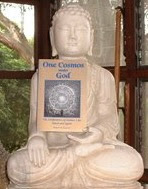
Suffice it it to say, I’ve been pondering this question for several weeks, and I believe I’ve arrived at a satisfactory resolution. Those who have read the book of the same name will recall that I tackled this subject in my own freewheeling and somewhat naive way in Chapter 3, Psychogenesis: the Presence of Mind.    

I say "naive" for two reasons, first because I didn't understand back then that evolutionary psychology was such an offense against the one true faith of progressive Blank Slatism, and second, because I actually succumbed to a bit of B.S. of my own, since I... how to put it... overemphasized the discontinuous leap into universal human freedom, while underemphasizing the particularized genetic continuity.  

Because of the latter, it is as if human nature is present in different musical keys, or perhaps like pure light passing through a prism and coming out different colors. Thus, human nature is simultaneously no race and all races. It reminds me of the pseudo-controversy of Jesus' race. The fact that he was of Middle Eastern descent is entirely accidental to his incarnation as and of human nature as such, which no mere race can ever exhaust, otherwise we could ourselves be perfect men. 

The fact that no man can be perfect tells you a great deal, for it means that he has an essence he can never reach but is perpetually striving toward. 

The other aspect of my resolution to this problem involves the difference between belief and discovery. For example, we don't dismiss the universal truth of the theory of relativity because it was discovered by a Jew. Just as there is no such thing as "Jewish physics," I would say there is no such thing as "Christian personhood," even though Christians are responsible for discovering personhood (with all its cosmic and meta-cosmic implications).

Conversely, evolutionary psychologists regard any and all religious belief as constrained and determined by genes -- as if there is a gene for "belief," with no possibility that the belief might actually conform to transcendent truth. Obviously, biologism doesn't allow for transcendent truth, even though -- like all ideologies -- it makes an exception for the affirmation of its own truth.

On the practical/political side of the equation, the only possible solution would be a passionate embrace of the objective principles animating western civilization (rooted in genuine discoveries about human personhood), and an insistence that anyone coming into this country understand and live by them. But the left embodies the opposite: a passionate rejection of those timeless truths, accompanied by a cynical strategy of killing them via the democide of open borders. 

Let's end with an observation by Schuon, in order to deflect attention from myself:

Races exist and we cannot ignore them, less than ever now that the time of closed [genetic] universes has come to an end....

If racism is something to be rejected, so is an antiracism which errs in the opposite direction.... the fact that races are not separated in completely watertight compartments in no way means that pure races are not to be found as well as mixed ethnic groupings. Such an opinion has no meaning for the simple reason that all men have the same origin and that humanity as a whole -- often wrongly referred to as the human race -- constitutes one single species.
Or this:
the existence of Christ or of the Vedantic doctrine adds nothing to the value of a white man with a base nature any more than the barbarism of certain Africans tribes takes anything away from a black man of saintly soul...

foreign races have something complementary in relation to ourselves without there being in principle any 'lack' in us or in them either. 

And about progressives who deny the provenance of progress?

Now, there are few things so absurd as the anti-Westernism of those who are themselves westernized.

Friday, April 23, 2021

Waiting for the Thunderbolt

Ever had that feeling that you've said everything there is to say? I get it every six months or so. You could say I'm waiting for the next thunderbolt. I'm also anticipating another thunderbolt -- this one exterior -- that collapses the deranged Empire of Wokeness. For what cannot  continue will not continue.

I've decided to reinstate the Now Reading list to the sidebar, because readers have a right to know what I'm inhaling. As you can see, it's a diverse and contradictory list, from traditionalism to evolutionary psychology to demonic influences to alt-right hate thinkers. My job is to somehow reconcile them all, which isn't that easy. Some would say it's frankly impossible, but I am committed to making diversity work.

For example, the alt-right tends to be indifferent or hostile to Christianity. I sympathize with their view, as I would certainly choose moderate atheism before, say, the radical National Council of Churches, or any other form of leftist Christianity -- which is just mental illness or demon possession masquerading as Christianity.

The other problem I'm seeing with the alt-right is the rejection of universalism. It's a mirror image of the left's absurd relativism, which devolves to tribe vs. tribe, and ultimately to power. Realpolitik types will say that we are naive, since politics always reduces to the will to power anyway. All the fancy rhetoric just covers naked self-interest.  

Well, even if universalism was discovered by white Europeans, it's still universal. In other words, it makes no sense to me to attribute abstract universalism to racial particularism, just as it makes no sense to say that modern physics is a Jewish thing. If there are no universals then we are screwed. I don't care which race discovered them. 

Yes, western civilization is probably doomed in the long run -- human nature being what it is -- but we certainly won't pull out of our suicidal death spiral by rejecting the universalism of the founders, rather, by reaffirming it. If I reject the identity politics of the left, it's because it is barbaric and regressive, not because of my own tribal loyalty. 

Moreover, half my tribe is composed of lunatics, idiots, craven conformists, the power hungry,  and the demon-possessed. Obviously, I have much more in common with Thomas Sowell or Clarence Thomas than with Joe Biden or Rachel Maddow. 

I'm not naive about racial differences. I just think we should hold all races to the same universal standards and let the chips fall where they may. If the entire NBA is black, or the entire Berkeley math department is Asian, I couldn't care less. 

I guess the deepest analysis goes to the very nature of intelligence, which is, among other things, the capacity for discerning principles. If it's merely a function of biology, then to hell with it. Sure, a German Shepherd is smarter than a Great Dane, but neither can ever transcend dogginess and know the absolute.

Intelligence is obviously bound up with natural selection, but to reduce it to such is both self-defeating and ultimately absurd. We could say that intelligence is accidentally genetic but essentially transcendent, on pain of being able to say nothing about it that isn't reducible to reproductive interest, or "selfish genes." If that's the case, then Europeans are wrong and Muslim immigrants are correct, because the latter have more children.

If we are to prevail it can't be just because we are more intelligent, but because we understand what intelligence essentially is; and

One of the keys to the understanding of our true nature and of our ultimate destiny is the fact that the things of this world never measure up to the real range of our intelligence. Our intelligence is made for the Absolute, or it is nothing. Among all the intelligences of this world the human spirit alone is capable of objectivity, and this implies -- or proves -- that what confers on our intelligence the power to accomplish to the full what it can accomplish, and what makes it wholly what it is, is the Absolute alone (Schuon).

Moreover, to be intelligent is to know reality and to thereby be more real:

Intelligence is the perception of a reality, and a fortiori the perception of the Real as such. It is ipso facto discernment between the Real and the unreal -- or the less real... 
Intelligence gives rise not only to discernment, but also to the awareness of our superiority in relation to those who do not know how to discern.... we cannot help being aware of something that exists and is perceptible to us thanks to our intelligence, precisely....

But the same intelligence that makes us aware of a superiority, also makes us aware of the relativity of this superiority and, more than this, it makes us aware of all our limitations. This means that an essential function of intelligence is self-knowledge: hence the knowledge -- positive or negative according to the aspects in view -- of our own nature (ibid.). 

Now, leftism is predicated on the denial of human nature, so it is intrinsically stupid, irrespective of race. 

Waiting for the Thunderbolt

Ever had that feeling that you've said everything there is to say? I get it every six months or so. You could say I'm waiting for the next thunderbolt. I'm also anticipating another thunderbolt -- this one exterior -- that collapses the deranged Empire of Wokeness. For what cannot  continue will not continue.

I've decided to reinstate the Now Reading list to the sidebar, because readers have a right to know what I'm inhaling. As you can see, it's a diverse and contradictory list, from traditionalism to evolutionary psychology to demonic influences to alt-right hate thinkers. My job is to somehow reconcile them all, which isn't that easy. Some would say it's frankly impossible, but I am committed to making diversity work.

For example, the alt-right tends to be indifferent or hostile to Christianity. I sympathize with their view, as I would certainly choose moderate atheism before, say, the radical National Council of Churches, or any other form of leftist Christianity -- which is just mental illness or demon possession masquerading as Christianity.

The other problem I'm seeing with the alt-right is the rejection of universalism. It's a mirror image of the left's absurd relativism, which devolves to tribe vs. tribe, and ultimately to power. Realpolitik types will say that we are naive, since politics always reduces to the will to power anyway. All the fancy rhetoric just covers naked self-interest.  

Well, even if universalism was discovered by white Europeans, it's still universal. In other words, it makes no sense to me to attribute abstract universalism to racial particularism, just as it makes no sense to say that modern physics is a Jewish thing. If there are no universals then we are screwed. I don't care which race discovered them. 

Yes, western civilization is probably doomed in the long run -- human nature being what it is -- but we certainly won't pull out of our suicidal death spiral by rejecting the universalism of the founders, rather, by reaffirming it. If I reject the identity politics of the left, it's because it is barbaric and regressive, not because of my own tribal loyalty. 

Moreover, half my tribe is composed of lunatics, idiots, craven conformists, the power hungry,  and the demon-possessed. Obviously, I have much more in common with Thomas Sowell or Clarence Thomas than with Joe Biden or Rachel Maddow. 

I'm not naive about racial differences. I just think we should hold all races to the same universal standards and let the chips fall where they may. If the entire NBA is black, or the entire Berkeley math department is Asian, I couldn't care less. 

I guess the deepest analysis goes to the very nature of intelligence, which is, among other things, the capacity for discerning principles. If it's merely a function of biology, then to hell with it. Sure, a German Shepherd is smarter than a Great Dane, but neither can ever transcend dogginess and know the absolute.

Intelligence is obviously bound up with natural selection, but to reduce it to such is both self-defeating and ultimately absurd. We could say that intelligence is accidentally genetic but essentially transcendent, on pain of being able to say nothing about it that isn't reducible to reproductive interest, or "selfish genes." If that's the case, then Europeans are wrong and Muslim immigrants are correct, because the latter have more children.

If we are to prevail it can't be just because we are more intelligent, but because we understand what intelligence essentially is; and

One of the keys to the understanding of our true nature and of our ultimate destiny is the fact that the things of this world never measure up to the real range of our intelligence. Our intelligence is made for the Absolute, or it is nothing. Among all the intelligences of this world the human spirit alone is capable of objectivity, and this implies -- or proves -- that what confers on our intelligence the power to accomplish to the full what it can accomplish, and what makes it wholly what it is, is the Absolute alone (Schuon).

Moreover, to be intelligent is to know reality and to thereby be more real:

Intelligence is the perception of a reality, and a fortiori the perception of the Real as such. It is ipso facto discernment between the Real and the unreal -- or the less real... 
Intelligence gives rise not only to discernment, but also to the awareness of our superiority in relation to those who do not know how to discern.... we cannot help being aware of something that exists and is perceptible to us thanks to our intelligence, precisely....

But the same intelligence that makes us aware of a superiority, also makes us aware of the relativity of this superiority and, more than this, it makes us aware of all our limitations. This means that an essential function of intelligence is self-knowledge: hence the knowledge -- positive or negative according to the aspects in view -- of our own nature (ibid.). 

Now, leftism is predicated on the denial of human nature, so it is intrinsically stupid, irrespective of race. 

Monday, April 19, 2021

Biology & Meta-Biology, Bobology & Meta-Bobology

Gödel's theorems mean that no matter how complete the formal system, it will always leave a semantic residue: semantics cannot be reduced to syntax, meaning to grammar, reality to mathematics, quality to quantity, etc. This seems intuitively obvious, but it's nice to have logic on one's side. 

The bottom line is that man will never arrive at a theory of everything, but will be perfecting it until perishing from global warming in a few years. 

At the moment, I'm cross-referencing our favorite logician, Gödel, with our favorite biologist, Robert Rosen. 

As Gödel was a "meta-logician," I suppose we could say that Rosen was a meta-biologist, although he would no doubt object to the characterization, since it might imply an element of woo-woo or oogily-boogily. 

Rather, he believed that he was the one pursuing hard science, while pulling no metaphysical punches. It's the reductionists who are the softheads. Rosen was a real scientist, proof of which is found in the fact that I don't understand half of what he says. I do, however, get the big picture.

Indeed, the big picture is the meta-picture, precisely. I won't say it's the only thing that interests me. Then again, it does seem to be my default setting, and indeed the default setting of any philosopher properly so-called. Now, to even call oneself a "philosopher" strikes me as unbearably pompous, for what is philosophy but error on a grandiose scale, with no hope of arbitrating between this doozy and that whopper?

If I actually believed that, I would despair, for it would mean that the bOb is pointless in a double sense, or nihilism squared. It would of course mean that life -- anyone's life -- is utterly meaningless. But it would also mean that my life in particular is not even meaningless, what with its meta-preoccupation with universal truths. 

The moment I began studying psychology, I couldn't help thinking about metapsychology, i.e., the larger system of which one's psychological theories must be a part -- both the truths entailed in one's psychology, and the axiomatic truths it presupposes. 

Moreover, without consciously realizing it, I was always on the lookout for logical and meta-logical inconsistencies in this or that system or paradigm. In general, the only way to harmonize such inconsistencies is with recourse to a higher truth in a vertical spectrum. Once you do this, you realize that, for example, mind cannot be a material process for the same reason that physics cannot describe reality. Again, there is always a semantic residue in such attempts at reducing one level to another.

For Rosen the duality of quantity and quality is not the same as that between hard and soft science, respectively. Rather, it rests on "presuppositions about the nature of material reality and on how we obtain knowledge about it." The duality between syntactics and semantics goes to "what is true by virtue of form alone, independent of any external referents, and what is not."

Which raises an interesting question: can formal truth be true in anything other than a trivial sense? In other words, is mathematics true only within its own system, or does it disclose real truth about the actual world? If one says Yes to the latter, this has enormous metaphysical (because meta-mathematical and trans-human) consequences.

The reductionist is guided by the conviction that "Qualitative is nothing but poor quantitative." Given this presupposition, "everything we call a quality or a percept is expressible in terms of numerical magnitudes, without loss or distortion.... therefore, every quality can be quantitated, and hence, measured or computed." Thus, "Everything else we call science is ultimately a special case of physics."

Put that way, it sounds almost like a straw man. And yet, it must be the metaphysical underpinning of science, so long as science is "true." If reductionism is not the case, then what is the foundation of the world? Not in some airy-fairy way, but precisely? What are the ultimate truths that must be and cannot not be, in order for mundane science to be true (at least as far as it goes)?

Now, some people couldn't care less about such questions: "most practicing mathematicians, like most practical (empirical) scientists, go on about their business, indifferent to such matters, convinced to the depths of their soul about the reliability of what they do." 

Wait a minute -- depths? Soul? How did these contaminants get into the lab?! I suppose we can say that wherever the reductionist goes, he goes there too and spoils it.

In Hilbert's formalistic school of thought, semantics can "always be effectively replaced by more syntactic rules." That is to say, "any external referent, and any quality thereof, could be pulled into a purely syntactic system." 

But a syntactic system is "a finite set of meaningless symbols" guided by a finite set of rules for combining them. Such a system is necessarily consistent, but is it complete? Yes, if you and I are machines. But if we were machines, could we ever know it? If math is just about more math, where's the inscape hatch? And if math is about the world, what is the world about? 

Well, thanks to both Gödel and common sense, we know that whatever the mind is, it isn't a machine or computer. 

But if reductionism is obviously wrong, does this imply that the opposite approach is the correct one? I don't think so. Rather, I suspect a kind of eternal complementarity between the extremes of empiricism-idealism, subjectivity-objectivity, quality-quantity, etc.  

The ancients began at the other end -- the other end of reductionism -- in that for them

life simply was; it was a given; a first principle, in terms of which other things were to be explained.

To us this may seem naive, but is it any more naive than for a conscious lifeform to declare itself to be absolutely contingent? Whence this absoluteness? How did it sneak into the lab? Must have been smuggled in by Soul and Depth.

We are told that biology reduces to physics. But what if physics is an entailment of metabiology or something? Well, stranger things have happened.  

On the one hand, biologists have convinced themselves that life is somehow the inevitable necessary consequence of underlying physical (inanimate) processes.... But on the other hand, modern biologists are also, most fervently, evolutionists; they believe wholeheartedly that everything about organisms is shaped by essentially historical, accidental factors, which are inherently unpredictable and to which no universal principles can apply.

In short, "they believe that everything important about life is not necessary but contingent." 

That's what you call meta-irony, only without the self-awareness necessary to generate a guffah-HA! experience.

I'm running out of time, so I'll end with this thoughtlet: biology is indeed reducible to physics at one end, while referring to life at the other. But what does it mean to be "about" life? For that is life?

I'm going to go out on a limb and suggest that what we call life is ultimately rooted in the principle of Life Itself, just as the mind is grounded in the principle of Consciousness Itself, and persons in the principle of Divine Personhood. Above that it goes dark. Which is not to say that we can know nothing about it, only that it exceeds our puny models. Call it the principle of Divine Overflow.

Biology & Meta-Biology, Bobology & Meta-Bobology

Gödel's theorems mean that no matter how complete the formal system, it will always leave a semantic residue: semantics cannot be reduced to syntax, meaning to grammar, reality to mathematics, quality to quantity, etc. This seems intuitively obvious, but it's nice to have logic on one's side. 

The bottom line is that man will never arrive at a theory of everything, but will be perfecting it until perishing from global warming in a few years. 

At the moment, I'm cross-referencing our favorite logician, Gödel, with our favorite biologist, Robert Rosen. 

As Gödel was a "meta-logician," I suppose we could say that Rosen was a meta-biologist, although he would no doubt object to the characterization, since it might imply an element of woo-woo or oogily-boogily. 

Rather, he believed that he was the one pursuing hard science, while pulling no metaphysical punches. It's the reductionists who are the softheads. Rosen was a real scientist, proof of which is found in the fact that I don't understand half of what he says. I do, however, get the big picture.

Indeed, the big picture is the meta-picture, precisely. I won't say it's the only thing that interests me. Then again, it does seem to be my default setting, and indeed the default setting of any philosopher properly so-called. Now, to even call oneself a "philosopher" strikes me as unbearably pompous, for what is philosophy but error on a grandiose scale, with no hope of arbitrating between this doozy and that whopper?

If I actually believed that, I would despair, for it would mean that the bOb is pointless in a double sense, or nihilism squared. It would of course mean that life -- anyone's life -- is utterly meaningless. But it would also mean that my life in particular is not even meaningless, what with its meta-preoccupation with universal truths. 

The moment I began studying psychology, I couldn't help thinking about metapsychology, i.e., the larger system of which one's psychological theories must be a part -- both the truths entailed in one's psychology, and the axiomatic truths it presupposes. 

Moreover, without consciously realizing it, I was always on the lookout for logical and meta-logical inconsistencies in this or that system or paradigm. In general, the only way to harmonize such inconsistencies is with recourse to a higher truth in a vertical spectrum. Once you do this, you realize that, for example, mind cannot be a material process for the same reason that physics cannot describe reality. Again, there is always a semantic residue in such attempts at reducing one level to another.

For Rosen the duality of quantity and quality is not the same as that between hard and soft science, respectively. Rather, it rests on "presuppositions about the nature of material reality and on how we obtain knowledge about it." The duality between syntactics and semantics goes to "what is true by virtue of form alone, independent of any external referents, and what is not."

Which raises an interesting question: can formal truth be true in anything other than a trivial sense? In other words, is mathematics true only within its own system, or does it disclose real truth about the actual world? If one says Yes to the latter, this has enormous metaphysical (because meta-mathematical and trans-human) consequences.

The reductionist is guided by the conviction that "Qualitative is nothing but poor quantitative." Given this presupposition, "everything we call a quality or a percept is expressible in terms of numerical magnitudes, without loss or distortion.... therefore, every quality can be quantitated, and hence, measured or computed." Thus, "Everything else we call science is ultimately a special case of physics."

Put that way, it sounds almost like a straw man. And yet, it must be the metaphysical underpinning of science, so long as science is "true." If reductionism is not the case, then what is the foundation of the world? Not in some airy-fairy way, but precisely? What are the ultimate truths that must be and cannot not be, in order for mundane science to be true (at least as far as it goes)?

Now, some people couldn't care less about such questions: "most practicing mathematicians, like most practical (empirical) scientists, go on about their business, indifferent to such matters, convinced to the depths of their soul about the reliability of what they do." 

Wait a minute -- depths? Soul? How did these contaminants get into the lab?! I suppose we can say that wherever the reductionist goes, he goes there too and spoils it.

In Hilbert's formalistic school of thought, semantics can "always be effectively replaced by more syntactic rules." That is to say, "any external referent, and any quality thereof, could be pulled into a purely syntactic system." 

But a syntactic system is "a finite set of meaningless symbols" guided by a finite set of rules for combining them. Such a system is necessarily consistent, but is it complete? Yes, if you and I are machines. But if we were machines, could we ever know it? If math is just about more math, where's the inscape hatch? And if math is about the world, what is the world about? 

Well, thanks to both Gödel and common sense, we know that whatever the mind is, it isn't a machine or computer. 

But if reductionism is obviously wrong, does this imply that the opposite approach is the correct one? I don't think so. Rather, I suspect a kind of eternal complementarity between the extremes of empiricism-idealism, subjectivity-objectivity, quality-quantity, etc.  

The ancients began at the other end -- the other end of reductionism -- in that for them

life simply was; it was a given; a first principle, in terms of which other things were to be explained.

To us this may seem naive, but is it any more naive than for a conscious lifeform to declare itself to be absolutely contingent? Whence this absoluteness? How did it sneak into the lab? Must have been smuggled in by Soul and Depth.

We are told that biology reduces to physics. But what if physics is an entailment of metabiology or something? Well, stranger things have happened.  

On the one hand, biologists have convinced themselves that life is somehow the inevitable necessary consequence of underlying physical (inanimate) processes.... But on the other hand, modern biologists are also, most fervently, evolutionists; they believe wholeheartedly that everything about organisms is shaped by essentially historical, accidental factors, which are inherently unpredictable and to which no universal principles can apply.

In short, "they believe that everything important about life is not necessary but contingent." 

That's what you call meta-irony, only without the self-awareness necessary to generate a guffah-HA! experience.

I'm running out of time, so I'll end with this thoughtlet: biology is indeed reducible to physics at one end, while referring to life at the other. But what does it mean to be "about" life? For that is life?

I'm going to go out on a limb and suggest that what we call life is ultimately rooted in the principle of Life Itself, just as the mind is grounded in the principle of Consciousness Itself, and persons in the principle of Divine Personhood. Above that it goes dark. Which is not to say that we can know nothing about it, only that it exceeds our puny models. Call it the principle of Divine Overflow.

Saturday, April 17, 2021

Leftists May Have No Consistent Standards, But at Least they're not Hypocrites

For obvious psychopolitical reasons, the following passage from Incompleteness caught my attention:

no validation of our rationality -- of our very sanity -- can be accomplished using our rationality itself.

Thus, there exist millions of people who are completely sane from within their ideological system, but only insane from outside it. We call these lunatics progressives.  It's not quite correct to say that they "can't be reasoned with." Rather, they can only be reasoned with -- in the manner described by Chesterton in chapter 2 of Orthodoxy, The Maniac:

The madman is not the man who has lost his reason. The madman is the man who has lost everything except his reason.

Similarly, Goldstein writes that "Paranoia isn't the abandonment of rationality. Rather, it is rationality run amuck, the inventive search for explanations turned relentless." Such a person is "irrationally rational," characterized by "logic run wild." 

More cosmic Orthodoxy via Chesterton:

Poetry is sane because it floats easily in an infinite sea; reason seeks to cross the infinite sea, and so make it finite.... The poet only asks to get his head into the heavens. It is the logician who seeks to get the heavens into his head. And it is his head that splits.

Flipping through this maniacal chapter, there are some additional statements that prefigure Gödel:

the strongest and most unmistakeable mark of madness is this combination between a logical completeness and a spiritual contraction. The lunatic's theory explains a large number of things, but it does not explain them in a large way....

His cosmos may be complete in every rivet and cog-wheel, but still his cosmos is smaller than our world (emphasis mine).

One more important observation:

As long as you have mystery you have health; when you destroy mystery you create morbidity.

The normal man "has always cared more for truth than for consistency. If he saw two truths that seemed to contradict each other, he would take the two truths and the contradiction along with them. His spiritual sight is stereoscopic, like his physical sight: he sees two different pictures at once and yet he sees all the better for that."

Note that this stereoscopy isn't so much horizontal as vertical: it requires the recognition of a hierarchy of levels, both on the terrestrial and celestial planes. To reduce the hierarchy to a single level is to guarantee inconsistency and ultimately absurdity. To appreciate hierarchy is to situate things in their proper place. 

Contrast this with the ideologue, the man of system, the progressive lunatic. As Goldstein says, "Anything at all can be deduced within an inconsistent system, since from a contradiction any proposition can be derived." 

Thus, it is common for conservatives to point out the daily hypocrisies of the left, but this gets us nowhere, since it is utterly beside the point. You can't be a hypocrite if you have no consistent principles. Rather, they would only be hypocrites if they were to deny their hypocritical expediency in service to power. 

Leftists May Have No Consistent Standards, But at Least they're not Hypocrites

For obvious psychopolitical reasons, the following passage from Incompleteness caught my attention:

no validation of our rationality -- of our very sanity -- can be accomplished using our rationality itself.

Thus, there exist millions of people who are completely sane from within their ideological system, but only insane from outside it. We call these lunatics progressives.  It's not quite correct to say that they "can't be reasoned with." Rather, they can only be reasoned with -- in the manner described by Chesterton in chapter 2 of Orthodoxy, The Maniac:

The madman is not the man who has lost his reason. The madman is the man who has lost everything except his reason.

Similarly, Goldstein writes that "Paranoia isn't the abandonment of rationality. Rather, it is rationality run amuck, the inventive search for explanations turned relentless." Such a person is "irrationally rational," characterized by "logic run wild." 

More cosmic Orthodoxy via Chesterton:

Poetry is sane because it floats easily in an infinite sea; reason seeks to cross the infinite sea, and so make it finite.... The poet only asks to get his head into the heavens. It is the logician who seeks to get the heavens into his head. And it is his head that splits.

Flipping through this maniacal chapter, there are some additional statements that prefigure Gödel:

the strongest and most unmistakeable mark of madness is this combination between a logical completeness and a spiritual contraction. The lunatic's theory explains a large number of things, but it does not explain them in a large way....

His cosmos may be complete in every rivet and cog-wheel, but still his cosmos is smaller than our world (emphasis mine).

One more important observation:

As long as you have mystery you have health; when you destroy mystery you create morbidity.

The normal man "has always cared more for truth than for consistency. If he saw two truths that seemed to contradict each other, he would take the two truths and the contradiction along with them. His spiritual sight is stereoscopic, like his physical sight: he sees two different pictures at once and yet he sees all the better for that."

Note that this stereoscopy isn't so much horizontal as vertical: it requires the recognition of a hierarchy of levels, both on the terrestrial and celestial planes. To reduce the hierarchy to a single level is to guarantee inconsistency and ultimately absurdity. To appreciate hierarchy is to situate things in their proper place. 

Contrast this with the ideologue, the man of system, the progressive lunatic. As Goldstein says, "Anything at all can be deduced within an inconsistent system, since from a contradiction any proposition can be derived." 

Thus, it is common for conservatives to point out the daily hypocrisies of the left, but this gets us nowhere, since it is utterly beside the point. You can't be a hypocrite if you have no consistent principles. Rather, they would only be hypocrites if they were to deny their hypocritical expediency in service to power. 

Thursday, April 15, 2021

High on Ideology

I'm not quite retired, so this post ends abruptly in mid-flow. 

A few quick hits from Incompleteness; ponder them in terms of the permanent truths of metaphysics as opposed to mere math:
--Once proved, a theorem is immune from empirical revision. 
--Mathematicians carry all their gear in their craniums, which is another way of saying that mathematics is a priori.
--Gödel's conclusions are mathematical theorems that manage to escape mathematics. They speak from both inside and outside mathematics.... Our minds, in knowing mathematics, are escaping the limitations of man-made systems, grasping the independent truths of abstract reality.
--They [the theorems] are at once mathematical and metamathematical.... It is as if someone painted... a landscape or portrait that represents the general nature of beauty and perhaps even explains why it moves us the way it does. 
--It is extraordinary that a mathematical result should have anything at all to say about the nature of mathematical truth in general.... mathematical reality must exceed all formal attempts to contain it (emphasis mine).
As to the latter, it is indeed extraordinary that mere quantity should reveal so much about qualities that seemingly transcend it. For it is as if money actually can buy you love after all. 

But how does math escape its own logic and break its own rules? How can 1 + 1 = 3, let alone beauty or laughter? Put in abigger way, how does the cosmos transition from 13 billion years of tedious and repetitive Isness to a regime of living Ought? How does existence turn itself inside out and become experience? What is experience? I'm having one now, as are you. But what is it and how does it get here?

The answers may surprise you. For they are -- like mathematical truth -- a priori. However, unlike the mathematical, the requisite gear for answering them is located not only in the cranium but in the thorax region. Attaining a total view requires the integration of these -- or, in the words of Schuon, "the Unicity of the Object demands the totality of the subject," "totality" being cranium + thorax, or head + heart. 

Limited to the head, 1 + 1 would always add up to 2; limited to the heart, 1 + 1 seems always to result in THAT'S RACISS!

With these thoughtlets in mind, let's get back to our central question, which is whether or not -- as with any other formal system -- the theorems may tell us something exoteric doctrines. The reason why this is important is because it may explain why the absurdities of exoterism are inevitable, as is true of any formal system, whether secular or religious. It doesn't imply that they are wholly false, just incomplete.

Empiricism and rationalism, for example, generate absurdities, but this doesn't mean they don't provide pieces of the puzzle or that they are devoid of truth. Rather, if pushed too far, they reveal will reveal inconsistencies. 

Same with religious dogma. It too is quite useful, especially in a practical sense, just as, say, Newtonian physics is quite helpful in our day-to-day lives, even if we now understand that it becomes inconsistent at the margins (where quantum and relativity theories take over and provide a more accurate picture of the macro- and microcosmos).

In an essay called Esoterism and Tradition (contained in the book Frithjof Schuon: Life and Teachings), Laude writes that religious tradition may provide "the best possible approximation on the terrestrial level of a conformity to Reality," even if it begins to fray at the "human margin." 

This is because tradition as such involves the attempt to clothe the formless in form. God is -- by definition -- supraformal, but is,  in the absence of a form, literally unthinkable. Thus,
the form is and is not the essence. The form prolongs the essence but it may also veil it. The essence transcends the form but it also manifests itself through it.

Hmm. Is and Is Not. We're not in Athens anymore! -- i.e., no longer dealing with Aristotelian logic, where things can't both be and not be at the same time. But this is precisely the dilemma Gödel resolves vis-a-vis the theorems. For just as no formal system exhausts reality, "the Divine Essence... transcends all determinations" (Laude):

We could say, simplifying a little, that exoterism puts the form -- the credo -- above the essence -- Universal Truth -- and accepts the latter only as a function of the former; the form, through its divine origin, is here the criterion of the essence.

Esoterism, on the contrary, puts the essence above the form and only accepts the latter as a function of the former; for esoterism... the essence is the criterion of form; the one and Universal Truth is the criterion of the various religious forms of the Truth (Schuon).

Now, "Inconsistent systems are of course complete, because we can prove anything at all in them. They're overcomplete" (Goldstein). They simultaneously explain too much and not enough -- or rather, it is precisely in explaining too much that they paradoxically fall short of a complete explanation.

I cited several examples of this phenomenon in the previous post -- Marx and Freud, for example, in explaining everything, end up explaining nothing. But this is what any ideology does: it superimposes a limiting framework on reality, thus conflating what is with what the ideology permits us to see. 

Z Man's post this morning touches on our subject, as it seems that hateminds think alike (The Narcotic of Unreality: https://thezman.com/wordpress/?p=23484):
This is how our public discourse has become increasingly bizarre. As soon as you exclude realty from the debate, you are left with various forms of unreality. Since none of the unrealistic options can possibly lead to a solution, the debate breaks free from the problem itself. The measure of acceptance is no longer about facts and reason, but some other standard.
Thus, our real crisis isn't about Chinese opioids or Chinese flu,
but the unreality pandemic plaguing our rulers. As the range of acceptable debate narrows, they are left with an increasingly bizarre set of choices.... Like an addict searching for the next high, our rulers are riding a dragon of depraved reality avoidance, taking the rest of us into the abyss where all addiction leads.
This is obviously true, but why is it true? I don't want to imitate our leftist fiends and try to explain too much, but if Genesis 3 All Over Again teaches us anything, it is that man is always tempted to reject transcendent truth in favor of seduction, hypnotism, narcissism, and idolatry. 

This being the case, confining oneself to some faux-complete ideology will always feature these characteristics. From the outside they look crazy, but from the inside the craziness is completely normalized, and we are the abnormal ones.

High on Ideology

I'm not quite retired, so this post ends abruptly in mid-flow. 

A few quick hits from Incompleteness; ponder them in terms of the permanent truths of metaphysics as opposed to mere math:
--Once proved, a theorem is immune from empirical revision. 
--Mathematicians carry all their gear in their craniums, which is another way of saying that mathematics is a priori.
--Gödel's conclusions are mathematical theorems that manage to escape mathematics. They speak from both inside and outside mathematics.... Our minds, in knowing mathematics, are escaping the limitations of man-made systems, grasping the independent truths of abstract reality.
--They [the theorems] are at once mathematical and metamathematical.... It is as if someone painted... a landscape or portrait that represents the general nature of beauty and perhaps even explains why it moves us the way it does. 
--It is extraordinary that a mathematical result should have anything at all to say about the nature of mathematical truth in general.... mathematical reality must exceed all formal attempts to contain it (emphasis mine).
As to the latter, it is indeed extraordinary that mere quantity should reveal so much about qualities that seemingly transcend it. For it is as if money actually can buy you love after all. 

But how does math escape its own logic and break its own rules? How can 1 + 1 = 3, let alone beauty or laughter? Put in abigger way, how does the cosmos transition from 13 billion years of tedious and repetitive Isness to a regime of living Ought? How does existence turn itself inside out and become experience? What is experience? I'm having one now, as are you. But what is it and how does it get here?

The answers may surprise you. For they are -- like mathematical truth -- a priori. However, unlike the mathematical, the requisite gear for answering them is located not only in the cranium but in the thorax region. Attaining a total view requires the integration of these -- or, in the words of Schuon, "the Unicity of the Object demands the totality of the subject," "totality" being cranium + thorax, or head + heart. 

Limited to the head, 1 + 1 would always add up to 2; limited to the heart, 1 + 1 seems always to result in THAT'S RACISS!

With these thoughtlets in mind, let's get back to our central question, which is whether or not -- as with any other formal system -- the theorems may tell us something exoteric doctrines. The reason why this is important is because it may explain why the absurdities of exoterism are inevitable, as is true of any formal system, whether secular or religious. It doesn't imply that they are wholly false, just incomplete.

Empiricism and rationalism, for example, generate absurdities, but this doesn't mean they don't provide pieces of the puzzle or that they are devoid of truth. Rather, if pushed too far, they reveal will reveal inconsistencies. 

Same with religious dogma. It too is quite useful, especially in a practical sense, just as, say, Newtonian physics is quite helpful in our day-to-day lives, even if we now understand that it becomes inconsistent at the margins (where quantum and relativity theories take over and provide a more accurate picture of the macro- and microcosmos).

In an essay called Esoterism and Tradition (contained in the book Frithjof Schuon: Life and Teachings), Laude writes that religious tradition may provide "the best possible approximation on the terrestrial level of a conformity to Reality," even if it begins to fray at the "human margin." 

This is because tradition as such involves the attempt to clothe the formless in form. God is -- by definition -- supraformal, but is,  in the absence of a form, literally unthinkable. Thus,
the form is and is not the essence. The form prolongs the essence but it may also veil it. The essence transcends the form but it also manifests itself through it.

Hmm. Is and Is Not. We're not in Athens anymore! -- i.e., no longer dealing with Aristotelian logic, where things can't both be and not be at the same time. But this is precisely the dilemma Gödel resolves vis-a-vis the theorems. For just as no formal system exhausts reality, "the Divine Essence... transcends all determinations" (Laude):

We could say, simplifying a little, that exoterism puts the form -- the credo -- above the essence -- Universal Truth -- and accepts the latter only as a function of the former; the form, through its divine origin, is here the criterion of the essence.

Esoterism, on the contrary, puts the essence above the form and only accepts the latter as a function of the former; for esoterism... the essence is the criterion of form; the one and Universal Truth is the criterion of the various religious forms of the Truth (Schuon).

Now, "Inconsistent systems are of course complete, because we can prove anything at all in them. They're overcomplete" (Goldstein). They simultaneously explain too much and not enough -- or rather, it is precisely in explaining too much that they paradoxically fall short of a complete explanation.

I cited several examples of this phenomenon in the previous post -- Marx and Freud, for example, in explaining everything, end up explaining nothing. But this is what any ideology does: it superimposes a limiting framework on reality, thus conflating what is with what the ideology permits us to see. 

Z Man's post this morning touches on our subject, as it seems that hateminds think alike (The Narcotic of Unreality: https://thezman.com/wordpress/?p=23484):
This is how our public discourse has become increasingly bizarre. As soon as you exclude realty from the debate, you are left with various forms of unreality. Since none of the unrealistic options can possibly lead to a solution, the debate breaks free from the problem itself. The measure of acceptance is no longer about facts and reason, but some other standard.
Thus, our real crisis isn't about Chinese opioids or Chinese flu,
but the unreality pandemic plaguing our rulers. As the range of acceptable debate narrows, they are left with an increasingly bizarre set of choices.... Like an addict searching for the next high, our rulers are riding a dragon of depraved reality avoidance, taking the rest of us into the abyss where all addiction leads.
This is obviously true, but why is it true? I don't want to imitate our leftist fiends and try to explain too much, but if Genesis 3 All Over Again teaches us anything, it is that man is always tempted to reject transcendent truth in favor of seduction, hypnotism, narcissism, and idolatry. 

This being the case, confining oneself to some faux-complete ideology will always feature these characteristics. From the outside they look crazy, but from the inside the craziness is completely normalized, and we are the abnormal ones.

Tuesday, April 13, 2021

Fun with Gödel

So, I hate it when people start their sentences with "so."

Anyway, yesterday I was flipping through The Largish Black Book of Bob's Quasi-Infallible Aphorisms, Epigrams, Gags, Zingers, Precepts, Gnomes, & Oracles and came across one that goes to our present discussion of Gödel's Theorems and how they might relate to the exoterism/esoterism distinction in religion:

The founder of an ideology is someone to whom the ideology doesn't apply. 

For example, consciousness is determined by one's class. Except for Marx, who somehow transcended the formal constraints of his own class consciousness in order to peer into the eternally true dialectic of scientific socialism. Nice trick! 

Or Freud, who proved that the conscious mind is determined by the unconscious. Except for his conscious mind, of course. Likewise, natural selection proves our minds are genetically determined. Except for people who promulgate genetic determinism. At least if free will doesn't exist, then no one can be wrong about its existence.

Structural racism proves it's impossible for black people to succeed in a white world. Oddly, the argument is made by black people who are more affluent than I'll ever be, such as Oprah or even the founder of BLM. She owns several more houses than I do, thus confirming another epigram: In the contemporary West, who knows how to be a victim knows everything. She lives by the adage, Marx for thee, Smith for me. 

This is reminiscent of an old saw to the effect that if someone is good at lying, then he's good at everything. Take current President Obama: is there anything he doesn't know?

It was at this point that I realized two things: first, that many of Bob's aphorisms make this same point, if not directly then in a roundabout way; and second, that Gödel's Theorems are one of the wellsprings of humor. In other words, if the comments about Marx or Freud or BLM are amusing, it is thanks to our implicit understanding of the theorems, which generate a kind of endless paradox due to the shift of levels (i.e., from within and beyond the formal system).

Let me cite a few of Bob's more Gödelian aphorisms:

Fidelity to the dictionary is resistance to tyrants. This is because the left never stops using language in order to undermine language -- in their case from below rather than above. 

I know how to doubt. Do you know how to believe?

Note that it is via doubting the formal ideological system of the Matrix that we are able to transcend the Matrix. Not so the blue-pilled Eloi, who are captive to the formal system of the Conspiracy.

A rationalist is someone who has forgotten where his premises came from. 

For they came from outside his rationalist system, precisely.

I'm not a believer, just a lapsed unbeliever. 

In other words, faith is not just an open and living communion with the Cosmic Subject, but first and foremost an escape from the "belief" that the Matrix is reality.

Truth is nice, but repelling error is enough.

Possessing truth is for Matrix dwellers. For fugitives from the Matrix, love of, and communion with, Truth is all there is. Among other reasons, this is because truth is a person, and a person can be defined (at least negatively) as the thing that transcends any formal system.

Leftists don't have ideas. Ideas have them.

Self-explanatory. If to be conservative is to reject ideology, to be progressive is to be confined to, and constrained by, one, which results in the larger portion of reality being unknowable, unthinkable, and unsayable.

With certain caveats, since reality will still be known, only this knowledge will be denied and projected, mainly into "conservatives," who are thereby seen to be everything leftists deny in themselves: racist, misogynist, greedy, selfish, superstitious, anti-science, etc.

Here's a good one: Ignorance is infinite, therefore God exists.

Note that for the ideologue, his ideology contains reality within finitude, thus "disproving" God. What's really happening is he's explicitly denying omniscience while implicitly assuming it, for if God doesn't exist, only He can know it; and if He does exist, only He could not know it.

Why not just throw more Asians in prison?

Here again, this is a commentary on the kookery of structural racism: the left likes to say there are too many blacks in prison, which is just another way of saying there aren't enough Asians, Jews, and Norwegians. 

Being born in the U.S. isn't fair!

If your first principle is equality, then it is entirely unjust that you are an American citizen of whatever race. So move out already! We don't need more immigrants, rather, fewer citizens.

Man does not live by facts alone. For Life Itself is the transcendence of mere fact. 

More Gödelian hijinks:

There is an inherent right to privacy, and babies don't have it.

Sure, he knows everything. But that's all he knows. 

True, a PhD in education knows nothing, but at least she knows how to teach it.

It is in the nature of a progressive to disbelieve in human nature.

To be continued...

Fun with Gödel

So, I hate it when people start their sentences with "so."

Anyway, yesterday I was flipping through The Largish Black Book of Bob's Quasi-Infallible Aphorisms, Epigrams, Gags, Zingers, Precepts, Gnomes, & Oracles and came across one that goes to our present discussion of Gödel's Theorems and how they might relate to the exoterism/esoterism distinction in religion:

The founder of an ideology is someone to whom the ideology doesn't apply. 

For example, consciousness is determined by one's class. Except for Marx, who somehow transcended the formal constraints of his own class consciousness in order to peer into the eternally true dialectic of scientific socialism. Nice trick! 

Or Freud, who proved that the conscious mind is determined by the unconscious. Except for his conscious mind, of course. Likewise, natural selection proves our minds are genetically determined. Except for people who promulgate genetic determinism. At least if free will doesn't exist, then no one can be wrong about its existence.

Structural racism proves it's impossible for black people to succeed in a white world. Oddly, the argument is made by black people who are more affluent than I'll ever be, such as Oprah or even the founder of BLM. She owns several more houses than I do, thus confirming another epigram: In the contemporary West, who knows how to be a victim knows everything. She lives by the adage, Marx for thee, Smith for me. 

This is reminiscent of an old saw to the effect that if someone is good at lying, then he's good at everything. Take current President Obama: is there anything he doesn't know?

It was at this point that I realized two things: first, that many of Bob's aphorisms make this same point, if not directly then in a roundabout way; and second, that Gödel's Theorems are one of the wellsprings of humor. In other words, if the comments about Marx or Freud or BLM are amusing, it is thanks to our implicit understanding of the theorems, which generate a kind of endless paradox due to the shift of levels (i.e., from within and beyond the formal system).

Let me cite a few of Bob's more Gödelian aphorisms:

Fidelity to the dictionary is resistance to tyrants. This is because the left never stops using language in order to undermine language -- in their case from below rather than above. 

I know how to doubt. Do you know how to believe?

Note that it is via doubting the formal ideological system of the Matrix that we are able to transcend the Matrix. Not so the blue-pilled Eloi, who are captive to the formal system of the Conspiracy.

A rationalist is someone who has forgotten where his premises came from. 

For they came from outside his rationalist system, precisely.

I'm not a believer, just a lapsed unbeliever. 

In other words, faith is not just an open and living communion with the Cosmic Subject, but first and foremost an escape from the "belief" that the Matrix is reality.

Truth is nice, but repelling error is enough.

Possessing truth is for Matrix dwellers. For fugitives from the Matrix, love of, and communion with, Truth is all there is. Among other reasons, this is because truth is a person, and a person can be defined (at least negatively) as the thing that transcends any formal system.

Leftists don't have ideas. Ideas have them.

Self-explanatory. If to be conservative is to reject ideology, to be progressive is to be confined to, and constrained by, one, which results in the larger portion of reality being unknowable, unthinkable, and unsayable.

With certain caveats, since reality will still be known, only this knowledge will be denied and projected, mainly into "conservatives," who are thereby seen to be everything leftists deny in themselves: racist, misogynist, greedy, selfish, superstitious, anti-science, etc.

Here's a good one: Ignorance is infinite, therefore God exists.

Note that for the ideologue, his ideology contains reality within finitude, thus "disproving" God. What's really happening is he's explicitly denying omniscience while implicitly assuming it, for if God doesn't exist, only He can know it; and if He does exist, only He could not know it.

Why not just throw more Asians in prison?

Here again, this is a commentary on the kookery of structural racism: the left likes to say there are too many blacks in prison, which is just another way of saying there aren't enough Asians, Jews, and Norwegians. 

Being born in the U.S. isn't fair!

If your first principle is equality, then it is entirely unjust that you are an American citizen of whatever race. So move out already! We don't need more immigrants, rather, fewer citizens.

Man does not live by facts alone. For Life Itself is the transcendence of mere fact. 

More Gödelian hijinks:

There is an inherent right to privacy, and babies don't have it.

Sure, he knows everything. But that's all he knows. 

True, a PhD in education knows nothing, but at least she knows how to teach it.

It is in the nature of a progressive to disbelieve in human nature.

To be continued...

Sunday, April 11, 2021

All Cretans are Liars and All Leftists are Cretins

Before getting to the heart of the matter, I want to highlight a few more passages from Rebecca Goldstein's Incompleteness. Frankly, I don't understand why more people don't talk about Gödel. Then again, whenever the Matrix excludes or vilifies an idea or a person, there's a damn good reason: it's not helpful to the Matrix. 

For the left, anything outside the Narrative simply doesn't exist. And if it insists on existing, then that's when the left becomes explicitly (instead of just implicitly) violent. 

For example, why doesn't BLM celebrate Thomas Sowell or Clarence Thomas or Candace Owens? Why does the Party of Science flee from the science of IQ? Why don't AGW hysterics push for nuclear energy? Why do feminists reject womanhood? Why do the Champions of Democracy want to dilute your vote by flooding the country with illegal Democrats and making it easer to cheat? Why doesn't the founder of Black Lives Matter want to live amongst blacks?  

As alluded to in our previous offering, postmodern proglodytes don't mind the Theorems so long as they can twist them to their ends, i.e., that there is no truth and man can't know it. This is essentially an updated version of "all Cretans are liars," i.e., "all leftists are cretins." 

Jumping ahead (or above) a bit, another question I want to delve into is the possibility of an a priori metaphysics. Long story short, this is a non-starter (literally) for Thomism, which insists that we must begin the vertical ascent at the bottom and the exterior, AKA objects and sensations. 

I'm a somewhat simple but definitely vulgar man so I'm no doubt missing something, but the statement all knowledge begins in the senses isn't a sensation. Just sayin'.

I suspect the reasons Thomas says this are twofold, 1) to protect the majesty of both God and formal revelation, and 2) to prevent man from getting too full of himsoph.  As pride is the root of all sin, humility is the foundation of... No, it's just the foundation, period. And if you think you can read God's mind, well, you're like Adam, only worse!

Later we'll circle back to Genesis, only literally, for extremes meet.

Now, you don't have to be a mathematician to know that mathematics is a priori. Why not metaphysics? 

In ether worlds, we don't need matter to know that 2 + 2 = 4, let alone that 1 + 1 = 3. Why then would we start at the contingent end to trace the contours of Necessary Being? 

As 2 + 2 will always be 4 in every real world (leftworld being fundamentally unreal, which is the whole point), we can affirm with equal certitude that -- for example -- the Absolute is, that Absoluteness entails infinitude, and that infinitude implies radiation, extension, creation, and mayaplicity (i.e., appearances "separate" from Reality).  

About the apriorism of math, Goldstein agrees that 

the mathematician neither resorts to any observations in arriving at his or her mathematical insights nor do these mathematical insights, in and of themselves, entail observations, so that nothing we experience can undermine the grounds we have for knowing them.

Nothing we experience can undermine the grounds we have for knowing them. Bear that in mind.

Now, I ask you: wouldn't it be nice if we could say the same of our ultimate theory, or of our theory of the Ultimate? But in a post-truth, anti-intellectual world plunged into the tyranny of relativism, we are supposed to repeat with a straight face the crooked farce that There is no Truth, and Man is its Messenger. 

Well, there are degrees of bullshit, and that last statement attains the highest and most "esoteric" (in an inverse manner) one. Indeed, this is the cautionary entalement of Genesis 3, precisely. You could go so far as to say that this is the quintessence of Satan's own metaphysic. If you don't believe me, believe the Aphorist:

No one is more respectful of “others’ beliefs" than the devil.
For as it pertains to the pervertical diseases of multiculturalism, "diversity," and moral relativism, Satan is OG. Again, he is the ontological sponsor, guide, and protector of the left in all its forms throughout all of history: he is the divider and the scatterer, the very principle of chaos, entropy, and vertical gravity. Here are a couple more wise slayings just to twist the hammer:

The proclamation of our autonomy is the founding act of Hell.

Here begins the gospel of Hell: In the beginning was nothing and it believed nothing was god, and was made man, and dwelt on earth, and by man all things were made nothing.

 Now, by way of inverse analogy, we do in a very real way begin with the senses. Here's another aphorism to prove the point, but only to people in need of no proof:

Mysticism is the empiricism of transcendent knowledge. 

I'm going to stop right there, not because we're anyone close to finished with this subject, but because I don't want to make the reader sick. I hear that people who go on this "internet" thing prefer concision and brevity, so I've been doing it all wrong. 

All Cretans are Liars and All Leftists are Cretins

Before getting to the heart of the matter, I want to highlight a few more passages from Rebecca Goldstein's Incompleteness. Frankly, I don't understand why more people don't talk about Gödel. Then again, whenever the Matrix excludes or vilifies an idea or a person, there's a damn good reason: it's not helpful to the Matrix. 

For the left, anything outside the Narrative simply doesn't exist. And if it insists on existing, then that's when the left becomes explicitly (instead of just implicitly) violent. 

For example, why doesn't BLM celebrate Thomas Sowell or Clarence Thomas or Candace Owens? Why does the Party of Science flee from the science of IQ? Why don't AGW hysterics push for nuclear energy? Why do feminists reject womanhood? Why do the Champions of Democracy want to dilute your vote by flooding the country with illegal Democrats and making it easer to cheat? Why doesn't the founder of Black Lives Matter want to live amongst blacks?  

As alluded to in our previous offering, postmodern proglodytes don't mind the Theorems so long as they can twist them to their ends, i.e., that there is no truth and man can't know it. This is essentially an updated version of "all Cretans are liars," i.e., "all leftists are cretins." 

Jumping ahead (or above) a bit, another question I want to delve into is the possibility of an a priori metaphysics. Long story short, this is a non-starter (literally) for Thomism, which insists that we must begin the vertical ascent at the bottom and the exterior, AKA objects and sensations. 

I'm a somewhat simple but definitely vulgar man so I'm no doubt missing something, but the statement all knowledge begins in the senses isn't a sensation. Just sayin'.

I suspect the reasons Thomas says this are twofold, 1) to protect the majesty of both God and formal revelation, and 2) to prevent man from getting too full of himsoph.  As pride is the root of all sin, humility is the foundation of... No, it's just the foundation, period. And if you think you can read God's mind, well, you're like Adam, only worse!

Later we'll circle back to Genesis, only literally, for extremes meet.

Now, you don't have to be a mathematician to know that mathematics is a priori. Why not metaphysics? 

In ether worlds, we don't need matter to know that 2 + 2 = 4, let alone that 1 + 1 = 3. Why then would we start at the contingent end to trace the contours of Necessary Being? 

As 2 + 2 will always be 4 in every real world (leftworld being fundamentally unreal, which is the whole point), we can affirm with equal certitude that -- for example -- the Absolute is, that Absoluteness entails infinitude, and that infinitude implies radiation, extension, creation, and mayaplicity (i.e., appearances "separate" from Reality).  

About the apriorism of math, Goldstein agrees that 

the mathematician neither resorts to any observations in arriving at his or her mathematical insights nor do these mathematical insights, in and of themselves, entail observations, so that nothing we experience can undermine the grounds we have for knowing them.

Nothing we experience can undermine the grounds we have for knowing them. Bear that in mind.

Now, I ask you: wouldn't it be nice if we could say the same of our ultimate theory, or of our theory of the Ultimate? But in a post-truth, anti-intellectual world plunged into the tyranny of relativism, we are supposed to repeat with a straight face the crooked farce that There is no Truth, and Man is its Messenger. 

Well, there are degrees of bullshit, and that last statement attains the highest and most "esoteric" (in an inverse manner) one. Indeed, this is the cautionary entalement of Genesis 3, precisely. You could go so far as to say that this is the quintessence of Satan's own metaphysic. If you don't believe me, believe the Aphorist:

No one is more respectful of “others’ beliefs" than the devil.
For as it pertains to the pervertical diseases of multiculturalism, "diversity," and moral relativism, Satan is OG. Again, he is the ontological sponsor, guide, and protector of the left in all its forms throughout all of history: he is the divider and the scatterer, the very principle of chaos, entropy, and vertical gravity. Here are a couple more wise slayings just to twist the hammer:

The proclamation of our autonomy is the founding act of Hell.

Here begins the gospel of Hell: In the beginning was nothing and it believed nothing was god, and was made man, and dwelt on earth, and by man all things were made nothing.

 Now, by way of inverse analogy, we do in a very real way begin with the senses. Here's another aphorism to prove the point, but only to people in need of no proof:

Mysticism is the empiricism of transcendent knowledge. 

I'm going to stop right there, not because we're anyone close to finished with this subject, but because I don't want to make the reader sick. I hear that people who go on this "internet" thing prefer concision and brevity, so I've been doing it all wrong. 

Theme Song

Theme Song