Wednesday, July 22, 2015

Big Man & Little Cosmos

If we ask ourselves what reality is "like," it is more like an economy or the weather than it is, say, the laws of physics, or chemistry, or electromagnetism. And when I say "like," this is because we can only use analogies in describing reality.

After all, reality is what it is, and there is only one. Moreover, we are in it, not outside it. Therefore, the best we can do is arrive at a more or less useful analogy, for we cannot know the thing itself. Only God can do that. In fact, that would be a good working definition of God: the being who knows the totality because he transcends it while being immanent in every part so ptee.

Once you realize that analogy is the only way to approach reality as such, then religion suddenly doesn't seem so cognitively unsophisticated -- except to the cognitively unsophisticated. What is especially unsophisticated is the naive belief that scientific truth is fungible with reality. If this were so, then the tenured could use the laws of physics to create their own universe. While they do dwell in their own private ego- and idahos, this is not how they manage that trick.

The laws of physics are just models, and a model is just an analogy. Thus, when physicists say that light is a wave or particle, depending upon how one looks at it, this is a function of the observer and his theory. It does not mean light is literally a particle or wave. Rather, light is what it is, while "particle" or "wave" are what we can say about it.

But no one can say what light actually is. Again, except God. In fact, man cannot say what a single thing is, not even himself. That being the case, why pretend to understand what things outside the self are?

It brings to mind the story of a person who asked a famous scientist for an explanation of electricity. After a demonstration of some of the many things electricity does, he "expressed his wish to be informed as to what electricity [is]." The scientist "patted his back and said: 'No matter, that is the only thing about electricity which you and I do not know'" (in Jaki).

So, we know everything about electricity except for what it actually is. But far from being an exception, this turns out the be the ironyclad rule: as we have expressed it in the past, we can only have (partial) knowledge of things because they are (ultimately) unknowable (by us).

That might sound a little cute, but it is a rockbottom ruling orthoparadox. For there are only two other possibilities, one or the other of which are probably believed by the majority of postmodern schlock mobsters.

That is, there is the credulous scientistic belief that we can actually know everything about something, perhaps even about everything, thus the equally ingenuous quest for the Theory of Everything; then there is the antipodal postmodern belief that we really don't know anything about anything, but are simply trapped in a circle of signifying jive where Power gets to define what reality is.

Or to paraphrase the song, clowns to the left of me, jokers to the far left. Or, Kant to the south of us, Derrida in hell.

One thing I learned -- or at least cannot unlearn -- from the late great Robert Rosen is that while physics is a fine and noble discipline, there is absolutely no reason to assume that it should be our paradigmatic science, the King of Epistemology, such that all other disciplines are its more or less distant subjects.

In this highly constricted and ultimately anti-human view, we start with physics, upon which chemistry is parasitic, followed by biology, psychology, and everything in between. Appearances to the contrary notwithstanding, there are no gaps or spaces in this picture; rather, your last thought above is just a kind of emanation of the physics down below, like a breaking of existential wind.

Which it often is, but let's leave the left's behind for the moment.

The point is, if your world is organized by one of the above paradigms, the conspiracy has its teeth in your spiritual vitals, thus foreclosing the divine imagination, contracting time, and dimming the Spark. Or just say you are more or less bereft of space, time, and light.

Never forget that the main tool of the Conspiracy is existential shrinkage. The infertile eggheads of academia are just extreme cases of a more general phenomenon; likewise ovary tower feminists, credentialed sodomites, and dumb-as-a-postgraduate doctators.

So, analogy: what is the world like?

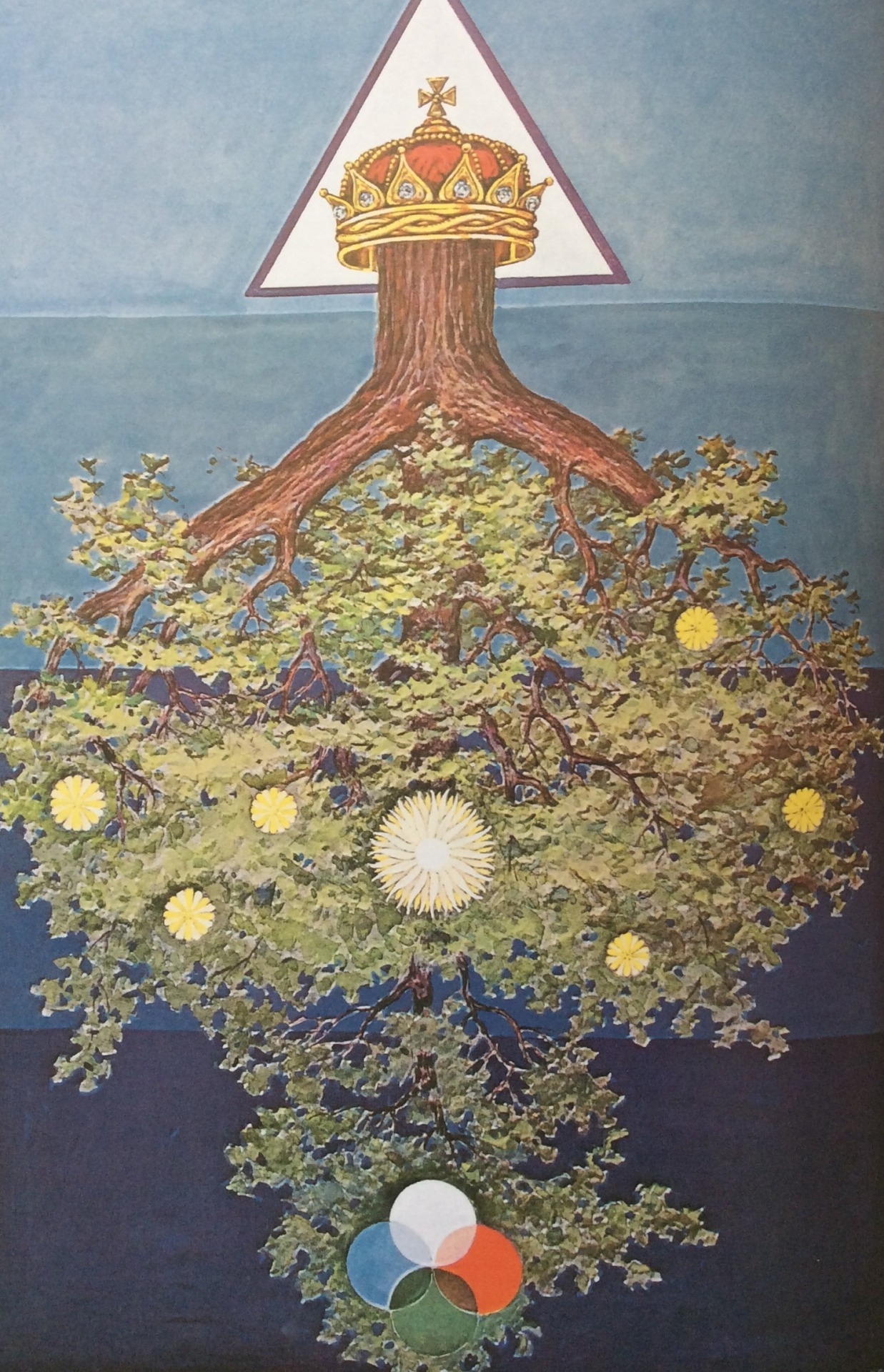
There is a whole school of thought that inverts the cosmos and regards it as a Big Man and man as the Little Cosmos. Is there something fundamentally wrong with this premise? For even the naive scientistian implicitly believes that the exterior world is somehow reflected in his head. This is what he calls "truth."

But how is this different from any other animal? In other words, if truth is just the correspondence between our mind and the world, that is a tautology. Besides, Gödel rendered that kind of rustic philosophizing inoperative. This is because any model we have of the world will contain assumptions or principles that cannot be explained by the model. How did they get there? And what reason do we have to believe them?

Let's go back to the idea that man is the microcosm and the cosmos the macro-anthropos. The question is not so much whether this is true as whether it is fruitful: does it get us anywhere, vertically speaking?

You know, until this moment I never thought I'd have any use for this book I bought a few decades ago, but this must be why I brought it home. It is The Secret Teachings of All Ages, and I have the now ridiculously expensive hardcover edition which is smaller still than the original. It's a beautiful book, but...

But nothing! Let's pry open the cosmic secret!

Hmm... I guess this would be closest, chapter LXXIII, THE HUMAN BODY IN SYMBOLISM, although there are a couple of good images from other chapters here and here.

Let's see what we have here. "The oldest, the most profound, the most universal of all symbols is the human body." Indeed, various ancient schools "considered a philosophical analysis of man's triune nature to be an indispensable part of ethical and religious training," such that "the laws, elements, and powers of the universe were epitomized in the human constitution; that everything that existed outside of man had its analogue within man" (emphasis mine).

As said at the top of this post, "The universe, being immeasurable in its immensity and inconceivable in its profundity, was beyond mortal estimation." That being the case, we might as well start with the close-at-hand; thus, "the early philosophers turned their attention from the inconceivable Divinity to man himself, within the narrow confines of whose nature they found manifested all the mysteries of the existential spheres."

With this in mind, perhaps we can see how Christ crucified becomes the last word in this way of looking at the world, or that that these ancient visions were stumbling and bumbling preminotions of the Incarnotion:

Is this idolatry? I don't think so, unless we confuse image with likeness and set about worshiping the former. Rather, the point is to see through them to what they represent.

"The philosophers of antiquity realized that man himself was the key to the riddle of life, for he was the living image of the Divine Plan," as fully realized in the Incarnation.

This too is helpful: "Both God and man have a twofold constitution, of which the superior part is invisible and the inferior visible" -- thus Paul's gag about the visible things of this world showing forth the invisible realities of God.

It's the same with man: when we say we know someone, it doesn't mean we've seen his physical form. Spirit is "anterior to form," which brings us back to the principle that we cannot begin with the mathematical forms of physics, for Spirit is before all that.

This notion of the microcosmic person is all over Finnegans Wake. Finnegan is indeed the Cosmic Person who lives in the broadest way immarginable in his rushlit toofarback for messuages before joshuan judges had given us numbers or Helviticus committed deuteronomy...

Tuesday, July 21, 2015

Psychic Space, Ultimate Causes, and the Containment of Being

As Augros correctly points out, everyone believes in a first cause, whether they say so or not. Rather, it's just the nature of this first cause, i.e., material or spiritual.

But if you think about it at all, then the first cause cannot be material, or we couldn't think about it at all. Rather, thought itself would simply be a more or less distant prolongation of matter, and matter doesn't think.

First of all, must there be a first cause, or can causes just keep going on back or down forever? If they did go on forever, this would be analogous to objects being suspended in mid-air -- like a chain extending from a lamp but connected to nothing above.

In fact, that is how Stanley Jaki puts it: "the reality of one's free will bring[s] one face to face with that realm of metaphysical reality which hangs in mid-air unless suspended from that Ultimate Reality best called God, the Creator."

In short, man's mysterious ability to initiate a causal series (as discussed yesterday) is not like the lamp that dangles from nothing, but rather, hangs from the Creator. To extend the metaphor, the converse view would be analogous to expecting a chain to stand up on its own, with the lamp at the top. Sure, anything can happen, but which explanation is more likely, barring magic?

"Free will is experienced personally and in that sense is subjectivity itself." Think about that one, for what is subjectivity but a space between instinct and expression, impulse and act, desire and fulfillment? In the material world there is no such delay: kick a can down the road, and it doesn't hesitate a moment before deciding which way to go. Rather, there is no space between cause and effect.

Which means that man must in a sense dwell between cause and effect. Which brings us right back 'round to economics, because if man weren't capable of delaying gratification, there could be no economics. All of economics takes place in that universe of alternative uses, and a deterministic universe has no alternatives. As a wise man once said in another context, no alternative, no problem.

Make no mistake, there are tenured people in high places -- or high people in tenured places -- who believe this rot. The average physicist, for example, will say that free will is an illusion. Why? Because the intellectual paradigm he chooses to live in doesn't permit it. Trying to squeeze free will into physics utterly overturns the paradigm: it is the ultimate black swan that disproves the whole enterprise, at least in terms of being an all-encompassing metaphysic.

Therefore, it is better to deny free will than to lose the precious paradigm. Which says something very interesting about human beings. It reminds me of Harry Harlowe's attachment studies, in which the baby monkeys prefer the cloth mommy with no food to the wire mommy with a milk bottle. In short, they prefer attachment to food. They will take just enough nourishment to survive before scurrying back to the cloth mother.

Oops. We're unexpectedly getting deep down into attachment theory, which is one of the keys to the human kingdom.

Let's go back to the human space in which we live. Presumably, in our intra-uterine life this space must be attenuated, in that the umbilical cord assures that needs are met before we can even be aware of them -- barring extraordinary circumstances such as starvation in the mother (or some other exigencies that we won't go into).

But what is so dodgy about the extra-uterine state is this sudden awareness of "need." However, we can't even say need, because this is just a word, and babies don't have words. It's not even a "state of mind," because it goes deeper than that. Rather, it is a new state of being, and it seems that human beings never completely reconcile themselves to this state -- or perhaps we're in the evolutionary process of coming to terms with it, or I would be out of business.

As the recently late James Grotstein put it, "From one point of view one can consider all psychopathology as due to the failure, to one degree or another, of proper attachment and bonding."

It sounds simple enough, but it's much more complicated than mere physics, for which reason it is perhaps understandable that the physicist might want to seek emotional refuge in his cloth-monkey mythematical abstractions. Strokes & folks.

As Grotstein characterizes them,

"These developmental sequences are determined by a fantastic, almost surrealistically complex choreography that integrates postnatal anatomic and neurochemical development so that they unfold in an intricately coordinated series of contacts with the maternal-social environment -- all in an orchestration of specifically timed phases of availability to a holding environment of appropriate, mediating caregiver functions that at first sooth, validate, and confirm, then stimulate, challenge, and encourage, the sequential interventions that appear to be absolutely necessary for neural development -- and, as a consequence, the roots of the infant's emotional development -- to occur."

First of all, I dare anyone to diagram that sentence.

"Put another way," writes the Germanically prolix Dr. G., "it is the prefrontal cortex generally -- and the right hemispheric orbito-frontal cortex specifically -- that is most responsible for the establishment and mediation -- and even development of the humanness of the infant!"

Well, why didn't you say so!

I read somewhere that there is a website called "explain it to a five year old." Others through history have implied that if you cannot do so, then you really don't understand your subject.

What is really going on here is that we are born into a world in which our minds -- our being -- are not contained. You could say that we are in a space, but that the space is unbounded and therefore anxiety-provoking in the extreme.

Perhaps you've just never noticed it because you enjoyed good-enough parenting. It is one of those things that will only be noticed if Something Went Wrong at the outset -- and even then, it will require personal insight.

I'll give a random example of someone who never managed to contain herself, with devastating consequences, the immortal Dusty Springfield. I haven't read the biography, but just from samples and reader reviews it is obvious that she suffered from a Borderline Personality Disorder, which is one of the most serious attachment disorders out there. Sexual identity confusion, self-loathing, grandiosity, poor impulse control, self-medicating (i.e., attempted emotional containment via drugs), she had it all.

And now I'm suddenly out of time. I don't know if we got anywhere, but there it is.

Monday, July 20, 2015

The Summa Total of God and Economics

Random thoughts from the vertical spindle.

To be a consequence of forces exterior to oneself is to be a liberal. Therefore, a liberal is someone who pretends to be responsible for others while having no responsibility over himself. This infinite regression grounds the ideology in irrationality.

This thought was prompted by a book I've never gotten around to discussing, Who Designed the Designer?, which is of course a stupid question -- which never stops atheists -- because God is in principle without cause. Rather, he is the uncaused initiator of vertical causes.

And man is in his image. Or better, -- let's keep an open mind -- man either is or is not in God's image. If he is, then this would explain how it is that man is the only being in creation who can be a self-conscious initiator of causes, including causes "of" himself. Or in other words, this is why man is capable of conscious change and growth. He is the being who can always get better. Or worse, if he forsakes the imperative to transcend his sorry ass.

Dávila wrote over 10,000 aphorisms, but one of my favorites is The permanent possibility of initiating a causal series is what we call a person. Never before in the field of human comment have so few syllables given so much truth to so damn few of us.

In short, we have the possibility of initiating change, AKA potential; and not only, for this must be a permanent possibility, for the very reason that it is a prolongation of the Permanent. Otherwise it has no explanation, for which reason it is understandable that the left would prefer to just make it go away.

But this still makes imperfect nonsense, for what prompts the white liberal to believe, say, that the poor black person is incapable of change, such that only the intervention of white liberal statists can change him? Is this because the white liberal is a person -- i.e., capable of self-change -- and the black person is something less?

In a word, yesandno. The only thing that saves them from overt racism is the belief that white liberals are equally bereft of free will, thus the deranged axiom that we are all racist.

First of all, like anyone could know that. And even if that were true we couldn't know it, because we wouldn't have the freedom to do so. Nevertheless, it means that for the white liberal, the black person is as incapable of controlling his impulse to commit crime as is the white person incapable of controlling his impulse to despise blacks. Both forms of mental slavery require a ginormous state to remedy them.

I know, the whole thing makes no sense, but we must try to understand the sense it does make to the person whose life is organized around this nonsense. Not all religions make rational sense, you know.

By the way, perhaps you have noticed -- I have -- that I haven't been discussing overtly spiritual subjects as much lately, say, an arcanum-by-arcanum discussion of Meditations on the Tarot, or a book-by-book analysis of Balthasar's Theologic, or a comparison of Meister Eckhart and Abhishiktananda.

Well, what I believe I am attempting to do is widen out the cosmic perspective so as to have an all-embracing view of the totality, including things that aren't typically thought of as particularly theological, such as economics.

But just this weekend it came to me quite dramatically that economics is very much at the heart of the whole existentialada. This was brought home to me while reading the excellent Popular Economics. I suppose that whenever and whatever I read I'm always making farflung connections between this and that. For me, nothing is simply what it is, but rather, densely connected to everything else, both horizontally and vertically, making it something else. Everything is relationship and process, not monad and stasis.

Well, in reading this book it occurred to me that even the staunchest defender of the free market is missing an important and even insane point in not tying it together with God. The first thing a vulgar troll will say is something along the lines of "this is nothing new. Religious wackos have always deployed God as an excuse to justify inequality," or some other such nonsense.

That is not at all what we are saying, even though we will say that inequality is most certainly from God. In other words, God is the very principle that accounts for all this hierarchical diversity. In the absence of God, there would be no inequality, just a blob of undifferentiated oneness. And it is because of inequality that equality (or the dynamic movement toward it) is possible. Pure equality would prevent the dynamic tension that has lifted man out of universal poverty -- as in communism, or in human history prior to the market revolution.

As usual, Dávila puts it most succinctly: Hierarchies are heavenly. In Hell all are equal. Or, If men were born equal, they would invent inequality to kill the boredom.

To demand more of the government is to expect less of ourselves. To be Obama is to expect nothing of us except to be in the way. To be something other than a bag of wet cement is to interfere with his plan for progress.

However, to understand progress one must be capable of distinguishing it from regress. And The egalitarian passion is a perversion of the critical sense: atrophy of the faculty of discrimination. The end result is that people like Obama, who are in no position to even identify progress, are forcing it upon us.

Let's go back to what we said above about persons having the potential to initiate change, AKA liberty. Freedom is not a "thing," but a space and a vector. As Dávila says, it is indispensable not because man knows what he wants and who he is, but so he can find out who he is and what he wants.

This means that the state can only "give" a kind of faux-freedom that actually diminishes it, because freedom can only be allowed and protected. For example, to "give" Obamacare or "homosexual marriage" is to deny a host of personal freedoms. It's only starting.

Let me see if I can wrap some words around the thought I had yesterday about God and economics.

Not sure if I can do that, but perhaps I can relate some notes to myself, the sum of which may just be greater than the parts (all inspired if not plagiarized from Popular Economics).

--Membership in the "1%" never lasts long, any more than it does in professional sports

--If you don't like the wealthy, prove it by ceasing to enjoy all the things they made possible, like your smart phone, or boner pills, or automobile

--Forced equality is a ban on success

--A free economy is an information processing system that will generate inequality by matching ideas with capital

--Which is why "supply side" economics is the idea side, the creativity side, the prosperity side

--One must produce or supply something of value before being a consumer

--For which reason it is kooky to believe in Keynesian demand-side macroeconomics

--No one was demanding smart phones before they were supplied by creative people with ideas; conversely, but no amount of consumer demand will make a failed government policy go away

--Taxes are a penalty on work, and ultimately punishment of the productive in order to reward the unproductive

--The capital gains tax is a penalty on success and discouragement of risk

--People only risk because things are unequal. If things were equal, there would be no reason whatsoever to take a risk

--The creative person needs capital to transform ideas into reality

--Why not call it dynamic and generative disequilibrium instead of inequality?

--Under conditions of freedom, not everyone need concern himself with material disequilibrium. For example, I prefer to spend my life thinking about the disequilibrium between myself and God, and doing something about it; time is scarce and has alternative uses, not all of which are about money

--The most significant and consequential facts about a free economy cannot be measured or reduced to quantity. Doing so will entirely miss all the dreadful things that don't happen because of it, nor does it begin to appreciate all the miraculous things that occur when idea meets capital and places a bet on the ability to satisfy a need or desire in man

I'll give you folks the freedom to add it all up. I'm outta here.

Friday, July 17, 2015

God Save Us from the Lovers of Humanity

In order for good to flourish, freedom is required. Conversely, in order for evil to be really productive, it needs a state.

This occurred to me while rereading Williamson's PIG to Socialism. I don't recall ever hearing it put that way, but I doubt I'm the first to notice.

After all, more death and misery have been caused by the state than all other unnatural causes combined. On the other hand, goodness cannot be coerced in a top-down manner. Rather, it can only be permitted, encouraged, and modeled.

And even then, it is never really secure unless and until it is loved for its own sake, and the state certainly cannot compel love. It can punish failure to love -- as in the IRS harassment of conservatives -- but that's not quite the same.

A long time ago -- well, ten years ago, to be precise -- I decided to conduct an experiment in childrearing, whereby I would teach the boy to love the good rather than, say, just punish the bad and make him fear the punishment.

One can encourage a well-behaved child via the alternative modes of positive punishment, negative reinforcement, or negative punishment, but those won't necessarily send down deep roots. Plus, they're going to create resentments, temptations, compulsions, and sometimes even perversions -- as in those Christian ministers caught with the S & M hookers or gay escorts.

To the extent that these fellows were "good," it was rather brittle, to put it mildly. The bad was simply banished to the shadows, where it took on a secret life and was nourished by hidden springs, which can foster a kind of longing for the dark side.

How to bring about a robust goodness? That's the question.

But why is this the question this morning? I'm not even awake yet, and I didn't intend for the post to veer off in this direction. Rather, it started with an innocent comment about how socialism interferes with moral development, and now I am forced to think things through from the ground up. It's not fair!

Let's start with what is close at hand. I marvel at what a good person my son is. What I mean is, I see evidence of his spontaneous goodness all the time. He is a much better person than I was at 10. I was by no means a bad person, but if I'm really honest, part of this was because I was simply afraid to be bad. That's what I mean about temptation. I might have been worse if I weren't such a coward.

Part of me admired the naughty boys, but my son isn't like that at all. Rather, he strikes me as "courageously good." He would be willing to be mocked for his goodness, whereas I would have been much more likely to cave under peer pressure. In contrast, he is irked and repelled by jerks and pseudo-rebels. There's no attraction at all.

So far, anyway. For two years running he's won the "people of faith" award -- whatever that is -- in his school by simply doing what comes spontaneously. He is not remotely repressed. To the contrary, full of life.

It very much reminds me of something Harvey Mansfield said in his Manliness: that in order to be a gentleman, one must first be a man. Otherwise you're just a gentlewimp. And the gentlewimp is often just a mask of the barbarian, as in Obama and his ilk. Poke the wimp, and out comes the cloven hoof, as when that reporter spoiled the party by pointing out that Iran is still holding kidnapped Americans.

I can't say that I came up with the parenting strategy on my own. Rather, I first got the brainwave from Schuon, although I applied it to parenting. Let's see if I can dig out some examples. His pithiest book is Echoes of Perennial Wisdom, and there's a little bit of everything in there, from cosmology to ethics, in concentrated form.

"Love of God is firstly the attachment of the intelligence to the Truth, then attachment of the will to the Good, and finally the attachment of the soul to the Peace that is given by the Truth and the Good."

Here again, there is nothing negative, repressive, or punitive in this. Rather, it starts with loving truth, and who doesn't want to be in love? And when one is in love, certain behaviors follow spontaneously, such as not wanting to do things that damage the love relationship.

It reminds me of how private property spontaneously encourages responsible behavior, because -- as alluded to in yesterday's post -- one is going to be much more careful with one's own property and money than with Other People's Moolah. Thus, the state must always struggle against a built-in moral hazard. Except it doesn't put up much of a struggle.

Likewise, to realize one "belongs to God," and vice versa, in a love relationship, triggers all sorts of consequences. "Wisdom begins with fear of God."

Am I afraid of God? Yes, in the same way I'm afraid of my wife, in the sense that I wouldn't want to do anything to damage the relationship. It's a figure of speech, but then again, there is obvious truth to it. You could say that bodily wisdom begins with fear of gravity, or of fire. It doesn't mean it ends there. ("[T]he integral attitude of man before God" is "made of reverential Fear and confident Love.... for the absence of fear is a lack of self-knowledge.")

We're rambling again, aren't we? If so, it can't be helped. Rambling is how you get to a point you don't yet know. If you already knew it, you'd get straight to it, wouldn't you? See Oakley for details.

"Virtue consists in allowing free passage, in the soul, to the Beauty of God." Thus, "To give oneself to God is to give God to the world." So it's a win-Godwin.

Here is an example of a temptation or snare alluded to above, in that "Virtue cut off from God becomes pride, as beauty cut off from God becomes idol..."

This is why the Good and True must be loved for their own sake, not for any secondary gain. But in so doing, "the repercussions are incalculable." In fact, it works both ways: either love truth or deny truth, but there will be no end to the trouble.

Ah, here we go: "Do not believe that 'it is I who am the virtue'; do not personalize it. The humble man is attached to virtue as such, and consequently to the sentiment that all virtue comes from God and belongs to God."

Which is why "At the bottom of all the vices is found pride..." Therefore, at the bottom of the virtues must be humility. Pride cometh before afall, humility before arise.

Another good one: "Every man loves to live in light and in fresh air; no one loves to be enclosed in a gloomy, airless tower. It is thus that one ought to love the virtues; and it is thus that one ought to hate the vices."

And "If we want truth to live in us, we must live in it."

Nothing good in man is of any value if detached from God. Likewise, love of man is monstrous if not a prolongation and consequence of the love of God. God save us from the lovers of humanity!

[W]ithout a good character -- one that is normal and consequently noble -- intelligence, even if metaphysical, is largely ineffective.

So, Let the world be what it is and take refuge in Truth, Peace, and Beauty, wherein is neither doubt nor any blemish.

Thursday, July 16, 2015

Risk-Aversion is a Wreckless Gamble

In Kevin Williamson's highly insultaining Politically Incorrect Guide to Socialism, he buries his axiom into the heart of the left with the following blow: "State control is more important to the socialist than egalitarianism."

As anyone above the political age of seven understands, egalitarian rhetoric is simply the means to an authoritarian end. Even if the compassionate socialist consciously wishes to avoid that end, it is nevertheless inevitable, because Man.

To be a socialist is to not know what Man is. For which reason it is vital to be ignorant of history, psychology, and anthropology (and the anticipatory wisdom of these embedded in religious mythology and metaphysics).

The free market is a means of transforming self-interest into collective benefits, while socialism is a means of transforming the public interest into private benefits. Or maybe you think Charlie Rangel, the Clintons, Harry Reid, Al Gore, et al, are just brilliant businessmen.

In the same book, Williamson says "the laws of economics can no more be set aside than the laws of physics and biology"; and this is precisely what we've been discussing these last several posts: that there exists economic truth, and that this truth must relate to other truths and ultimately to Truth as such. Which is why we need a word for this multi-undisciplinary approach. Perhaps economystics.

Which needs to be distinguished from the vulgar economystagoguery of the left. What the left doesn't understand is that the free market is already magic. You can't force it to be more magic without inevitably making it less so.

Greece, for example, has spent the last several decades trying to overcome the laws of economics, and to squeeze more magic out of the economy than there is in it. Why?

It must go back to what we were saying yesterday about envy and greed. No matter how much prosperity is generated by the free market, man can always imagine more. But as Socrates said, the unexamined loan is not worth leveraging.

If the free market is the goose that lays golden eggs, it is as if the leftist force-feeds it steroids and fertility drugs while dining out on all the future omelets. Meanwhile the goose just gets sicker and sicker. Obama should be arrested on charges of animal cruelty, for he is flipping a feeble bird to the next president.

Are we rambling again? Perhaps. The wife and child just left to visit relatives in New York, and I might be feeling a little giddy. It's not like I won't miss them, but I do have the house to myself for the next few days. What's that like? I forget. But it's starting to come back to me. It's like... the hills are alive. Only this time in a good way.

Here's an example of a corollary of Williamson's Law: "A government can't control the economy without controlling people. And [the Founders] knew when a government sets out to do that, it must use force and coercion to achieve its purpose" (some guy named Reagan, in Williamson).

So, let me get this straight: some guy named Obama is holding a gun to my head and telling me to shut the fuck up if I know what's good for me. Isn't that something gangsters do? In the movies?

Here's a politically incorrect thought: the free market is all about risk. The successful entrepreneur turns risk into profits. As such, "Highly risk-averse people do not start businesses."

What do they do -- or not do and call it doing -- instead? Well, at the extreme end, they get government jobs. They get tenure. They join public employee unions. Those are as far from risk as it is possible to be, for these privileged parasites enjoy all the benefits with no exposure to risk (unless their greed ends up killing the host, as in Greece).

After all, they're living off Other People's Money, so there is no incentive to use it wisely. Under normal circumstances, money teaches us how to use it, but only if it is our money. One learns nothing by spending someone else's money.

In fact, Williamson tosses in a little economic homily by Milton Friedman, who says there are four ways to spend money, each with very different built-in incentives. To summarize, you can spend your own money on yourself; your own money one someone else; someone else's money on yourself; or someone else's money on somebody else.

This outlines four degrees of personal responsibility in descending order. In the first case you're going to be very responsible with your money (unless you're stupid or impulsive or insane), whereas in the last case you have zero incentive to be responsible. Indeed, you can even call yourself charitable and magnanimous at no personal cost. What a beautiful racket!

And guess what: "that's government. And that's close to 40 percent of our national income" (Friedman).

About that beautiful racket, I was reading an article this morning about Hillary's unpopularity, which includes this cranial-slapper: "Most troubling, perhaps, for her prospects are questions about her compassion for average Americans, a quality that fueled President Barack Obama's two White House victories."

Note how the writers -- "journalsts" -- refer to it as an objective quality in him instead of a perception in the eagerly 'bamaboozled mob. Obama's compassion fueled two White House victories? Is that what you call being profligate with other people's money?

Yes. For anyone left of normal.

Back to the idea of risk-aversion. What is the left but a massive institutionalized wish to avoid risk? Now, it is a biologically incorrect truism that girls are more risk-averse than boys.

Which is why, on balance, little girls grow up to be big Democrats, and why Hillary thinks she can be the first person to become president by waging a campaign targeted solely at the dickless of both sexes. It worked for Obama. He lost the white male vote by a glandslide, but it didn't matter.

So, what have we learned today? Not much. Probably just this:

Wednesday, July 15, 2015

One Small Step for Progressives, One Giant Leap Backward for Mankind

I guess I don't have time for an all new post. However, I do have time to add new material to an old post that also happens to be related to what we've been discussing anyway. It came to my attention via a tweet from someone who claimed it changed his life or something. He didn't give any details, but it sounded like he meant it in a good way. I'm going to review it very carefully to see if I can detect any basis for his extravagant witness, or whether it's just the standard coonchow. New commentary is either within brackets or preceded by double dashes.

As anyone who has read the bʘʘk knows, there’s not much politics in it -- at least nothing explicit. Regarding economics, I can only think of a single paragraph. And yet, it’s probably all you need to know about economics. On page 149 it reads,

“For millennia -- until quite recently -- human beings struggled to rise above subsistence because of a stubborn inability to recognize how wealth is created. Certainly into the late 18th century, people mistakenly believed that there was simply a fixed amount of wealth in the world, and that it was left to individuals and governments to fight over their share. Not until Adam Smith was it recognized that wealth can grow without limits, but obviously even now people have a hard time wrapping their minds around this idea.”

--In fact, Sowell says this is one of the four fallacies that bedevil economic -- or better, uneconomic -- thinking, the zero-sum fallacy. Why is this fallacy so persistent? Why is it so impervious to logical and especially empirical evidence? The answer may surprise you!

In my view, one of the central mechanisms that kept mankind in its rut of subsistence was the expression of constitutional envy ["constitutional envy" is a psychoanalytic term of art, essentially meaning inborn]. In past posts I have theorized that envy was actually selected by evolution because humans evolved in small groups where it functioned to create harmony between members.

Humans were group animals long before they ever became individuals. Like an anthill or beehive the group was the unit of survival, not the individual. Individuation is a very recent historical phenomenon [c.f. Inventing the Individual], at least on any kind of widespread scale. It is accompanied by a new type of mental disturbance, the neurosis, which is a “private culture,” so to speak. Conversely, cultural envy is like a public neurosis.

--For Klein, envy is innate; it is an attack on the good object because of its goodness; it is triggered by an intolerable awareness of being separate from the good object. Therefore, if I can't have it, no one can -- that is, I will destroy the good so as to eliminate my painful envy (which all occurs in unconscious fantasy). Think of an extreme case, such as Hitler. When it became increasingly evident that Germany would lose the war, he expressed an explicit desire to see Germany destroyed, because it had proved itself unworthy of him.

The further back in history we travel, the less individual neurosis we see. Instead, the whole group is nuts. But from the standpoint of the group, the “nut” is the one who will not or cannot conform to the crazy group -- like that decent Muslim who was kicked out of his mosque in Omaha last week for writing an editorial that was critical of Islam. To us, he is “sane,” but to his primitive co-religionists he is a “crazy” or “evil” apostate.

You see similar phenomena in other primitive groups such as the progressive nutroots vis-à-vis their treatment of Joe Lieberman. Here is a fellow who had a near perfect liberal voting record, but he took one forward step outside the closed circle of the liberal hivemind, so he was banished. [And now all it takes is a single stray joke.]

To further quote myself -- I’m almost done -- “One of the things that makes the creation of wealth possible is the accumulation of surplus capital to invest, but here again, for most of human history this was quite difficult to accomplish because of envious mind parasites that could not tolerate the idea of one person possessing more than another.” Thus, envy is "one of the psychological barriers to material development that humans have struggled to overcome.”

The tenured persist in their delusion that primitive groups were egalitarian and that their members got along beautifully. Actually, the opposite is true. Because of completely unregulated envy, individuals would rather part with their possessions than to live with the anxiety of the envious “evil eye” being directed at them. Thus, primitive groups are not envious because they are primitive, but primitive because they are envious.

--Note also how the left transforms its own envy into projected greed. Just the other day a commenter claimed that the "dominant conservative wealthy capitalists... show an utter lack of civic interest, hostility to the very ideas of democracy and human rights, love of hierarchy, fear of technology and progress, reliance on military and force to maintain 'order,' and with no concern of inequality, as if it were an order divinely ordained by God. Elites who dare to argue for increased investment in the common good, infrastructure, and believe that we should lay the groundwork for a better future, are regarded as just silly and soft-headed."

--It is quite impossible -- or pointless, anyway-- to respond to a fantasy, or to argue with a hallucination. "Conservative capitalists talk about 'losing liberty,' the loss of the ability to dominate the people and property under their control -- and, worse, the loss of status and the resulting risk of being held accountable for laws and taxes that they were once exempt from -- is what they're really talking about. Anything that gives more freedom, benefits, and rights to lower-status people can't help but viewed as a loss of capital and limiting the freedom of the wealthy to use the working class as they please. These type of wealthy conservative capitalists have come to dominate present day America."

--What an eery way to live, imagining oneself to be controlled and dominated by one's own projections.

Which brings up a fascinating irony about so-called progressives. Now, it is a truism that progressives are not just ignorant of economics, but that they confidently embrace and promulgate what can only be called economic innumeracy. Why is this? How can people be so confidently and yet demonstrably wrong?

Comes now an article forwarded to me by reader Brian that breaks it all down for One Cosmonauts. Entitled The Economy Revealed: Why Understanding Economics is Hard [link no longer linking], the article reveals.... why understanding economics is hard: “It's not because of complexity. The rules of supply and demand aren't inherently more difficult to fathom than those that apply to, say, politics, or cooking, or sports. Yet while most people have no trouble wrapping their brains around these subjects... few have a similar appetite for economics.”

Cassell refers to a theory by anthropologist Alan Fiske, to the effect that the deep structure of human relations involves only four kinds of interactions which he calls 1) communal sharing, 2) equality matching, 3) authority ranking, and 4) market pricing:

“Communal sharing is how you treat your immediate family: All for one and one for all. Or as Marx put it: From each according to ability, to each according to need.

“Equality matching, by contrast, means we all take turns. From kindergarten to the town meeting, it's all about fair shares, reciprocity, doing your part.

“Authority ranking is how tribes function, not to mention armies, corporations and governments. Know your place, obey orders, and hail to the chief.

“Market pricing, of course, is the basis of economics. It's what we do whenever we weigh costs and benefits, trade up (or down), save or invest.”

Economic conflicts arise when one group or person is operating under a different type of interaction than another. For example, if you are a primitive progressive operating under the aegis of small group “communal sharing,” you may well believe that college, healthcare, housing, infertility treatment, counter-fertility treatment (abortion), tattoos, tattoo removal, and gender reassignment surgery should all be granted to you by the government free of charge.

The problem -- as I touched on in the book -- is that the primitive progressive is operating under an economic theory that is not so much cognitive as genetic. In a way, it’s deeper than thought, since it was programmed into us for survival in small groups (obviously, natural selection did not anticipate a high tech, competitive, free market global economy). Thus, Fiske confirms my speculation that the logic of market pricing was a very late development which is not at all “hard wired” -- and even goes against our genetic programming.

Cassell agrees that this “makes sense. For hunter-gatherers in small bands, sharing, matching and ranking were probably as fundamental to survival as eating and breeding. But market pricing involves complex choices based on mathematical ratios.... Commerce and global trade, of course, require a finely honed version of the market-pricing model. But if humans developed this model relatively late, it might well be less than universal, even today.”

The money money quote:

"In other words, to have an intuitive grasp of economics, you might just need to take a step or two up the evolutionary ladder."

Ho! Progressives need to stop living in the genetic past and evolve into the post-biological world of economic abundance.

In short, to cure oneself of progressivism, one must grow and evolve. This is exactly the problem we are facing in the Islamic world, for if we cannot even lift our own tragically backward progressives out of economic magic and superstition, imagine the difficulty of doing so with an explicitly tribal and authoritarian mindset. Imagine flying over dailykos headquarters and dropping thousands of copies of the works of Friedman or Hayek. Would it help? Probably not. Genes are powerful things.

Brian emailed me a related article, Progressives Come Out! Against Progress! It too reaffirms what I wrote in the book. Like me, the author once thought of freedom "as being something that people... naturally want, which accounts for my tendency to dismiss Marxism and socialism as abnormal systems which have to be imposed by external authorities (generally called 'the government') upon people who only desire to be Left Alone.” But there exist billions of people "who find the idea of being left alone to be culturally repugnant.”

“Even now, the word ‘progressive’ is often used in praise of backward economic systems.... If we use the evolutionary model, I wonder whether the emotional appeal of Communism might have represented an evolutionary step backwards, repackaged rhetorically so that its proponents could pat themselves on the back and maintain they were moving forward.”

Ya think?

The author brings up the recent example of a student who had applied to MIT with a perfect SAT score of 2400. Nevertheless, an admissions expert was quoted as saying that “I am not convinced she's a shoo-in -- I'd want to see more evidence that she's giving back to the community."

The author acknowledges that the communal sharing mindset naturally has its place. "But to inject the idea of ‘giving back’ in the case of a person whose obvious merit has been earned is another example of human progress being attacked by backward thinking primitivism -- smugly masquerading as modern sophistication. Progressives who place primitive principles first tend to be consumed by childish notions of what is ‘fair’ -- which they cannot keep to themselves, but which they must project onto other people. In their minds, success in anything (even at math) means ‘taking’ from someone else.”

From there, it is but “a small step from saying that a person should ‘give back’ to saying that ‘we’ should ‘take it back’ from him.”

Yup, if the most advanced people "are those with a concept of market economics, one of the great tragedies of the modern age has been their systematic destruction by less progressive people who call themselves the most progressive.... I'm wondering whether there might be a basic, persistent inability to distinguish forward from backward. I used to think that ‘progressives’ imagined themselves to be forward in their thinking, but I'm now thinking that ‘scientific Marxism' might have been grounded in an unacknowledged need for primitivism.”

Would this explain how leftist economic theory functions as a sort of seductive door through which all sorts of other barbarisms rush in? To put the answer in the form of a bumper snicker, “Come for equality, stay for the tyranny.”

Tuesday, July 14, 2015

The Science of the Anti-Scientific Left

Just once I'd like to see Obama treat our enemies -- the enemies of mankind -- the way he does Israel, Christians, traditional Americans, conservatives, etc. -- you know, the noble benefactors of mankind.

One can only assume -- I know, no shit, genius -- that he regards us as the real enemy. Since his world is inverted in every other way, it should come as no surprise that it is morally inverted as well.

(I'm not just thinking of the Iran deal, but the new federal assault on the suburbs, the totalitarian policy of forcing racial division into our neighborhoods. Now, only extremely wealthy people such as the Obamas will be able to afford living in a place free of diversity.)

People have called Obama a sociopath, but a sociopath -- a person with no morals -- would actually be preferable to one with an inverted morality, or with a hypertrophied sense of moral righteousness directed at the wrong objects, an attitude which combines the worst of both worlds. Give me an amoral Clinton any day.

We've discussed this in the past -- the distant past, in fact, as it is one of our cosmic touchstones. Others have analyzed the same phenomenon in different ways, but I first encountered it in Polanyi's The Logic of Liberty. Up to then, I didn't even know that Polanyi had delved into politics.

Rather, I knew him only as a philosopher of science. Interestingly, when I first began reading Polanyi -- must have been in the early '80s -- I was still a liberal. Had I known about his political ideas, it might well have turned me away from the rest. So God spared me the deeper truth until I was mature enough to handle it.

But as I believe we are about to see, his whole philosophy is of a piece, such that the science, economics, anthropology, epistemology, and politics cannot be separated. Furthermore, I have a feeling that this all relates to what we've been doing vis-a-vis Sowell, that is, relating economic truth to deeper metacosmic truths, or to Truth as such.

From the foreword of Logic and Liberty: "What Polanyi finds peculiar about totalitarianism is that despite its rejection of transcendent reality, it exhibits a high degree of moral passion. This passion, however, is not a mark of honor -- instead, it is a mark of dishonor." (Think, for example, of the moral passion of Reverend Wright, or Al Sharpton, or V.I. Lenin.)

"Polanyi argues that the moral passions that in fact can animate totalitarianism -- and also some of the less virulent strains of human folly -- have become unhinged from any reality that could constrain them. Here we have moral passion without moral judgment." Here we have Obama.

In this scenario, "a 'moral inversion' has occurred: moral passion now invokes any means, however grotesque and immoral, to satisfy its longings. Under this guise, moral passion serves rather than spurns" the immoral cause. Genocide to follow.

Fascism has been called the violent rejection of transcendence. Given the grossly asymmetrical power relation between the state and the individual, one would have to call Obama a fascist, whatever ideology he clothes it in.

When he cannot find a legal way to assert the state's dominance, as in the race-based assault on the suburbs, he finds an extra-legal way to do so, as in the IRS harassment of conservatives or in encouraging and condoning racial resentment and violence (not to mention hatred of legitimate law enforcement).

In the margin I have a note to myself: "Left: materialistic rejection of realities on which public liberty rests -- truth, justice, equality under law, etc."

That's another way of saying the same thing, i.e., that materialism isn't just a passive "acceptance" of matter but a violent rejection of spirit. It explains how they put the fist into pacifist, whether it involves Obamacare, Israel, the redefinition of marriage, the barbarian invasion of the suburbs, whatever. None of those have anything to do with liberty -- and therefore liberalism.

As mentioned above, I first encountered Polanyi as a philosopher of science. One might say he analyzed the Science of science, or the structure of meta-science. His philosophy answers the question of what we are actually doing when we are doing this thing called science. Note that the emphasis is on the doing, in that it is a free and spontaneous activity long before it is an ideology (i.e., scientism).

Here we see the obvious link to economics because, like economics, science is a spontaneous order resulting "from the interplay of individuals mutually adjusting their actions to the actions of others. Spontaneous orders are the result of human action but not of human design."

It is no coincidence that both science and free markets developed only in the west, because they are two sides of the same metaphysic. Science develops with no one in charge for the same reason there is enough bread for everyone with no bureaucrat telling bakers how much to produce.

In short, there is an invisible hand at work in both domains. And this is what distinguishes the liberal from the libertarian, in that the Scientific Hand only works because there is a nonlocal order for it to grasp:

"... [F]or there to be a scientific order something more is needed -- a channeling 'device' through which the diverse actions of scientists are coordinated. This 'device' is the goal, or end, of science, and Polanyi" -- naive man that he was -- "identifies this end as the pursuit of truth. For Polanyi, it is in the belief in the transcendent reality of truth that science has its extraordinary character as an intellectual system."

When science is corrupted there is top-down interference with the system, a violent forcing of order, as in how climate scientists manipulate data so as to save the theory, or how the state manipulates economic data to benefit itself.

What especially distinguishes classical liberalism from the left is the question of real freedom vs. mere horizontal openness. Yesterday we noted the truism that freedom, in the absence of a telos, reduces to nihilism. Polanyi "champions a free society and not an 'open' one," because the free society is 'dedicated to a distinctive set of beliefs,' namely, belief in the transcendent realities of truth, justice, charity, and toleration." The open society, in contrast, redounds to the tyranny of relativism.

Just as the left must undermine freedom, it must undermine science. For the left, certain beliefs must be true, which shows how a counterfeit transcendence actually reenters through the side door via political and academic correctness. Science is thoroughly corrupted, since certain scientific truths are simply impermissible. Even looking into them will get you into trouble and certainly prevent tenure.

But the central pattern of this corruption is the top-down imposition of order, which always destroys information. To take an obvious example, "rent control" destroys information regarding the supply and demand of rental property, just as Obamacare destroys vital information about the real cost of medical services. What does an apartment in San Francisco or New York "really" cost? No one knows, because the left outlaws the knowledge.

"All movements of thought and practice that attempt to render spontaneous orders nugatory -- that are captured by the idea that all social order either is or should be planned -- also threaten public liberty and, thus, threaten the fabric of a free society."

And a free society is only a good society because it is "animated by a belief in transcendent realities" and because its citizens are free to pursue them.

We'll leave off with some aphorisms, in a step-wise lowerarchy of leftwing horror:

None of the high points of history has been planned.

Elections decide who may be oppressed legally.

Leveling [equality] is the barbarian's substitute for [spontaneous] order.

The devil can achieve nothing great without the careless collaboration of the virtues.

And Hell is the place where man finds all his plans realized (Dávila).

Iran always says we're the Great Satan. Before Obama came along, I didn't really understand what they meant.

Monday, July 13, 2015

It's About Time

We've been discussing the economics of spirit, which revolves around two intertwined principles, 1) that our life is a scarce thing -- there's only one -- and 2) that our lives have alternative uses -- especially under conditions of freedom, in which we are confronted with an infinitude of alternatives as to how to spend -- or squander -- our lives.

Thus, in a free society there is a somewhat paradoxical combination of finitude -- our lifespan -- and infinitude -- or what we might call "lifebreadth," i.e., the overwhelming number of uses to which we may put our lives: so little time, so many choices.

Which goes to why freedom is not, and has never been, especially popular. That is, it exposes us to the infinitude referenced above, and in the absence of a telos, infinitude equates to nothing.

This is necessarily so: in a horizontal world, choice is either determined or arbitrary. To the extent that it is free, there is no intrinsic reason to choose this over that. Rather, there is will and there is power. Or just say leftism.

In this counter-cosmic view, the fact that we can choose most "anything" renders us nothing; unlike all other animals, we have no fixed nature or essence. Therefore, man is a freak of nature, in that he is the animal whose essence is no essence, AKA nothingness. (I've just spared you the burden of reading Sartre's Being and Nothingness. You're welcome.)

But in the real world, freedom is not arbitrary. It is not here "by accident." It is not a freakish mistake of nature, but rather, its freaking purpose.

If we go back to our civilizational uber (or better, unter) text, Genesis, we see that the Creator spends five days creating the world of necessity, while on the sixth day he creates the being of freedom, AKA man.

However, on the seventh day we dwell in the meaning of that freedom; on it you shall do no work, i.e., the necessary things, but rather, focus on the unnecessary, the non-utilitarian, the horizontally pointless: being as opposed to doing; receptivity over activity.

Con-templation relates to being in a space of observation, a temple; or, a temple is a vertical observatory in which the created good converges upon the uncreated good.

Allegorically speaking, of course. One can enter the temple at any time, not just Saturday or Sunday. We all have a key to the door that opens onto the luminous and noble peace of the desert (Dávila).

Along these lines, Pieper notes that animals are not capable of happiness -- contentment maybe, or satiety. Happiness is a -- the? -- human category, for which reason we need to mark it off from mere animal contentment.

I mean, there's nothing wrong with pleasing your monkey, but as Dávila reminds us, It is impossible to convince the fool that there are pleasures superior to those we share with the rest of the animals.

It seems we are granted the power to make ourselves unhappy, but not to make ourselves happy. In other words, although all men want happiness, it is not something we can simply will into existence. If we could, then everyone would be happy, and there would be no liberals. And happier still because there would be no liberals ruining everybody's lives and eating all our steak.

This alone should alert us to our irreducible dependence, since the one thing we are born wanting most of all is annoyingly outside our control. Or in other words, in the absence of God we can truly say that happiness exists, and you can't get there from here. For happiness is never just "satiation of the will," or Hillary Clinton's eyes wouldn't look so dead.

In a purely horizontal world, the desire for happiness would be like an ineradicable itch we are powerless to scratch. For the will strives for happiness "by necessity," and yet, cannot reach it -- like those Buddhist demons with enormous appetites and pinprick mouths.

It seems to me that this in-built desire for happiness speaks to our trinitarian nature, because it means we are born with this desire for a relationship to the transcendent other. If happiness were simply a given, then we would be self-sufficient, and not motivated to seek it beyond the horizon of the self.

Remember what we said about prices being messages about supply and demand, but how the left prefers to shoot the messenger? "Price" occurs at the confluence of scarcity and desire. But the desire for happiness is rooted in a desire for the boundless, so again, it cannot be satisfied if it isn't directed toward its proper end and object.

Really, it's no different than the intellect, which also cannot find its measure in the world, but rather, is conformed to the Absolute-Infinite beyond this world.

So, today's bottom lines:

Liberty is not an end, but a means. Whoever mistakes it for an end does not know what to do with it once he attains it (Dávila).

And,

The brevity of life does not distress us when instead of fixing goals for ourselves we fix routes (ibid.).

In other words, don't waste your scarce time trying to draw your own map from scratch, but ask for directions to the nearest faraway place.

Friday, July 10, 2015

Buying into God

With our metacosmic economic principles in place, perhaps we are in a position to address the perennial question of what a fellow profits if he gains the whole world and loses his soul.

Let's see: profit is what remains after costs are subtracted from value. Therefore, The World minus Your Soul = the Bottom Line.

Speaking of profits, I see that Pope Francis just called capitalism "the dung of the devil." But I wonder if that is what he actually said, for the piece later quotes him as referring to "the unfettered pursuit of money" as "the dung of the devil," which is something else entirely.

For example, Greece -- an anti-capitalist pile of devil dung if ever there was one -- is clearly engaging in an unfettered pursuit of money, the difference being that capitalism actually earns the money by producing something people want. Conversely, Greece produces nothing anyone wants and wants to be paid for it.

Robbing a bank is an unfettered pursuit of money. Offering things people want at prices they can afford is definitely fettered, as any businessman knows. Among other things, it is fettered by production costs, by taxes, by regulations, by competitors, by consumer preferences, and by civil law.

Where but in a socialist tyranny is the pursuit of money unfettered? Even Obama- or Clinton-style crony capitalism is somewhat fettered, unless you believe people send all those millions to the Clintons with no expectation of a return on their investment.

Anyway, back to the econo-pneumatic question posed in paragraph one. As awkwardly alluded to at the conclusion of yesterday's post, time is the economics of eternity. What I mean is that there can be no economics of eternity as such, being that by definition it has no scarcity.

Unless, as I suspect, time and eternity are actually complementary, in which case you might say that time is like a limited supply of eternity. Perhaps it's easier to conceptualize vis-a-vis finite and infinite: finitude is like infinitude bounded and thus limited.

Of which it seems we all have a kind of vertical recollection, as exemplified by mystics everywhere and everywhen. What I mean is that the mystic reverses perspective, as it were, in such a way that the infinite is seen in the finite, the eternal in the temporal, the absolute in the relative, the slack in the conspiracy, etc. Or just say creation.

If this weren't the case, then Jesus's ultimate profit-and-loss statement would make absolutely no sense to us. Of course we would trade our soul for the world, since it would amount to trading nothing for everything.

However, without coming right out and saying so, Jesus implies that this would be a bad deal, because we would actually be trading everything -- or something of infinite value -- for nothing -- or something of finite value, for all the finitude in the world does not add up to a single drop infinitude, which is a quality, not quantity.

Which reminds me. Adam raised a Cain. Or Cane, rather. Rosebud...

In short, bartering away the soul would be a core catastrophe, a spiritual blankruptcy, an eternal mortgage with a fatal balloon payment.

There are numerous other allusions to economics in the Bible. In fact, what is religion but a form of exchange with God? It is never a one way deal. For example, the whole thing starts with a contract between God and his people -- who become his people by virtue of the contract.

Likewise, God "gives" his son, but not without a price. The mystery there is that he does exactly what he says we shouldn't do, in that he sacrifices infinity for the sake of finitude.

More generally, the whole concept of sacrifice -- present in all religiosity -- entails an implicit awareness of spiritual exchange, however warped. For example, the Buddhist sacrifices the ego to nirvana, the leftist our prosperity to his resentments, the Islamist innocent men, women, and children to his transcendent sadism.

And now we are perhaps in a possession to grasp the perfect nonsense on p. 252, e.g., either pay your deus or be nilled to a blank, the rend is now redeemable on your mirromortal garment, and no body crosses the phoenix line lest it be repossessed and amortized. However you say it, Eloha, that's a good bye for the Love that removes the sin and other scars.

Thursday, July 09, 2015

The Economics of Eternity and the Core Catastrophe

Warning: I am not entirely sure this post is fully half-baked. While there is no doubt something to it, I didn't have time to give it the once-over to make sure it makes perfect nonsense. So, proceed at my own peril.

As Sowell says -- and it's amazing that anyone actually has to say it -- "life does not ask us what we want." Rather, it "presents us with options."

Again, there are scarce resources with alternative uses, and economics deals with making decisions about these alternative uses.

Which got me to thinking. If truth calls out to Truth, then what Sowell just said should resonate in a higher key, i.e., the Octave of Spirit.

Now, what would be the scarcest resource of all? As far as I am concerned, it is my life, because there is only one. But this immediately extends to the people I care about, because there's only one of them too.

More generally, Christian metaphysics begins with the principle that the individual is of infinite value because he is an individual, but in any event, we see an economic principle at work here, since value is linked to scarcity.

I suppose if I could walk over to the Quickie Mart and find a wife identical to the present one, she wouldn't be so precious to me. This no doubt sounds a little coldblooded, but she would have the same option at the Bobstore, who knows, maybe even a newer model.

Now, a human life is the ultimate in alternative uses, at least under conditions of political and economic liberty. Most political systems constrain those alternative uses, which, even when not done directly, is accomplished indirectly via the economic system.

What I mean is that in the past we have discussed the the psychoanalytic concept of "idiom." According to this notion, everyone has his own particular idiom, a "psychic organization which from birth forms the self's core," and furnishes an implicit logic "of the familial way of relating into which we are then raised."

Here is the link to economics: "As adults..., we spend our time looking for objects of interest -- human or material -- which can serve to enhance our particular idioms or styles of life -- perpetually 'meeting idiom needs by securing evocatively nourishing objects.' Being willing to risk exposure to such transformational objects is for Bollas an essential part of a healthy life: the readiness to be metamorphosed by one's interaction with the object world."

To express it in economic terms, we begin with our intrinsically scarce self, which is not so much an individual but an on-the-way to it, i.e., individuation. Or in other words, it exists in form or potential, and it is up to us to spend or allocate our time wisely by choosing the objects and relationships that actualize our latent selves.

"The contrast is a refusal of development and self-invention, of open-endedness: the state of psychic stagnation. Bollas saw in what he called the anti-narcissist a willed refusal to use objects for the development of his/her own idiom, and a consequent foreclosure of the true self. The result can lead to what Adam Phillips called 'the core catastrophe in many of Bollas's powerful clinical vignettes... being trapped in someone else's (usually the parents') dream or view of the world.'"

I don't remember the term "anti-narcissist," but it is surely a vital concept, for just as the person can be trapped inside his own reflection, he can be trapped in someone else's. Either one results in a foreclosure of development and a loss of real freedom. Life is literally reduced to a waste of time, and a waste of time is a waste of life.

For what is a human life? From the perspective of pure abstract (modern) liberalism, it is time + freedom. But neither of these has any real meaning at all, because they have no ground and no telos. Thus, they are reduced to the nothingness of existentialism, AKA nihilism. Thus the credo of the left: come for the nihilism, stay for the power.

(Hetero)paradoxically, this leads to the conclusion that life is either of no value, or only of the value we -- or the state -- give it. Which goes directly to why the left has no compunction about diminishing our freedom or about turning us into anonymous wards of the state. Everything follows from one's initial assumptions.

Which leads to the Economics of Religion. What's that about? Clearly, a religious person and a secular person will have radically different ideas about the value of the individual and the proper use of time.

For example, we used to have a leftist troll who made much of his theory that free will doesn't actually exist. However, Marxists have been making this argument ever since they first climbed out of the toilet, just as radical Darwinians make it today. Indeed, you could probably trace it back to some ancient Greek sophist, but if man isn't free, then time has no value, because we don't really have a choice in how to use it.

This pathological idea permeates the left. For example, one of the ineradicable clichés of the left is that "poverty causes crime." This contains the buried assumption that the criminal has no alternatives as to how to spend his time. Rather, he is just a machine. But if he is just a machine, please remind me why we are supposed to give a fuck about him?

Again, the value of a person is predicated on the idea that he is certainly not a machine. It is the left that turns individuals into machines, or classes, or genders, or races. I don't do that, although I will acknowledge that leftist anti-narcissists do this to themselves by the millions.

For example, I will sadly concede that Al Sharpton, or Barack Obama, or Louis Farrakhan, or Eric Holder, are "just" black men. But I deny all responsibility for reducing them to such a paltry category, or inflicting this core catastrophe upon them. Rather, I want all men to have the opportunity to be one.

I suppose you could say that time is the economics of eternity, in the sense that eternity cannot be scarce, but renders itself scarce in its temporal reflection herebelow. It is because of this dialectic between time and eternity that life is precious, and that there are good and bad ways to spend our allotment of time.

Wednesday, July 08, 2015

Information Destruction and Time Distortion

Does economics begin in number or quantity, or only end there? I've told the story of how I flunked out of business school, one reason being Economics. There was Econ 1, followed by Econ 2, and I somehow got past those.

This was followed by Money & Banking, which I literally faked my way through. I think I mentioned that at some point I realized the professor didn't actually read our papers, only mark them. Therefore, I began literally writing stream-of-consciousness nonsense, and would receive it back with a checkmark on top, just like everyone else. Thus, I succeeded in passing (barely) the course without actually learning anything.

This was followed by... whatever comes next, and that is where I hit the Wall. To be precise, I didn't actually flunk out. I just stopped going in the middle of the semester. Phase One of my adventure in higher education had come to an end, nor was there any Phase Two on the immediate horizon. I took it as confirmation that I was ineducable, and I can't say I disagreed with the verdict.
One thing I like about Sowell -- and the Austrians in general -- is that there isn't much math. In this 700 page book, there are almost no numbers except for the pages. The same is true of Hayek or von Mises. Instead of numbers, they deploy common sense, logic, and an understanding of human nature. Take away those three, and you're left with a Paul Krugman.

Put another way, all the math in the world will get one no closer to the truth if one lacks common sense, consistent logic, and a sound anthropology. For example, a Marxist lacks all three; in fact, he lacks all four, being that he has no math either. Keynesians have a great deal of math, and a form of logic that I suppose makes sense given its assumptions. But it lacks all common sense, and applies to a different species than man.

Here is an example of a basic non-economic lesson I learned from Basic Economics: that there are no economic solutions, only trade-offs. This is so because we live in a world of scarce resources with alternative uses. To choose one alternative is to exclude another.

But this is where politics comes in. Remember, the actual cost of something is its foregone alternatives. Take a barrel of oil. Or a cow full of milk. They can be used for gasoline or cheese, plastic or cream, vaseline or yogurt, kerosine or whey powder, fertilizer or butter, etc. Oil and milk have numerous alternative uses, and no person or bureaucracy could ever determine the most efficient way to apportion between them.

Which of course doesn't constrain the left one bit. Why? First, because they only tell us what they plan to "give" us, never what we are trading for it.

Second, remember what we said about time. None of us knows how long we will live, but this doesn't mean we order our lives as if we are going to die today or on some specified future date. Not so the politician, who orders his decisions to the next election and no further.

However, note that this doesn't apply to decisions the politician makes about his own life. For example, a Barack Obama places his own children in a private school, but meanwhile condemns less fortunate children to dysfunctional public schools.

Why? Because Democrats are beholden to the teachers unions on election day. They cannot afford to alienate such a special interest, anymore than they can afford to alienate other selfish and/or low-information groups, from homosexual activists to bitterclittoring feminists.

Thus, we can put forth the axiom that politics shortens the time-horizon, whereas wisdom is generally a consequence of expanding it -- for example, taking care of one's health, or saving for one's retirement, or not pretending one will be 25 forever.

Another point is that prices are simply messengers. Again, an economy is actually a vast information-processing system, with fluctuating prices conveying information about a thing's relative scarcity, and allowing us to plan accordingly.

But what if we don't like the message? In the real world, there's not much one can do about it. For example, I would love to own a pair of speakers costing $100,000, but that's not going to happen. Why? Because the price is prohibitive.

And as Sowell says, all prices are prohibitive in some sense, for this is their very purpose. My actual speakers are more in the range of $5,000. That's not prohibitive for me, but it will be to others. And even if it isn't prohibitive, most people would prefer to spend the money on other things.

I have a note to myself that liberals also pay attention to prices, except that they prefer to shoot the messenger. They especially like to shoot messengers with vital information about the cost of medicine, housing, and higher education; they try to kill the messenger by subsidizing these things, which, in the long run, inevitably results in more Bad News in the form of higher prices.

Often the left will personify the message, attributing it to "greed" or "corporations," or globalization, or what not.

Which they then sell to the low-information crowd, again, in the context of that shortened two- or four-year time horizon. As such, we could say that the left is an organized conspiracy to 1) destroy information, 2) distort time, 3) deny tradeoffs, and 4) put in place a system of perverse incentives which will redound to the very conditions from which the left will promise to save us come the next election.

Now, one mark of civilization is the gap between now and then; to diminish this gap is to reduce us to barbarism. In order to call ourselves civilized, we must be capable of impulse control, delayed gratification, self-discipline, awareness of trade-offs, and acknowledgment of unintended consequences. The left works at cross-purposes to all these things, which is why it is ultimately an anti-human project of re-barbarization. The best evidence for this is found in any city run by Democrats.

Tuesday, July 07, 2015

Life and its Alternative Uses

Today's column by Sowell contains a few zingers. He cites Oliver Wendell Holmes, who said that "a good catch phrase could stop thinking for fifty years." That's a Dávila-worthy insight, in that the left is a mansion of many clichés.

And once inside a cliché, it can be difficult to leave, because the doors lock from the outside. To paraphrase Dávila, there are words we use to deceive others, and more importantly, words we use to deceive ourselves. It is the latter which ensnare us, for which reason "the only man who saves himself from intellectual vulgarity is the man who ignores what it is fashionable to know."

Today, for example, it is fashionable to think it courageous for a sick man to convince himself he is a woman, or to direct animus toward the one race that has, for whatever reason, contributed so disproportionately to the welfare and betterment of mankind. Modesty and good breeding forbid a gentleman from crowing about such an unmerited blessing, but what is the alternative when these barbarians insist you are a devil instead of a benefactor to all?

Oh well. "Intelligence, in certain ages, must dedicate itself merely to restoring definitions" (Dávila). You know, like marriage. I don't give a fig about soccer, but the other day my son asked who I wanted to win in the World Cup. I promptly answered "Japan." I didn't tell him it was because if Japan won, at least children would be spared the spectacle of some musclebound freak kissing her "wife." I remember when perverted old men had to pay good money to see that sort of thing.

Prejudice? Of course. "Prejudices defend against stupid ideas" (ibid.). One man's prejudice is another man's Collective Wisdom of Mankind. After all, we are descendants of the very people who held that particular prejudice. I am personally grateful my mother wasn't encouraged -- or bullied -- to "explore" same sex attraction in college. I mean, it's unsettling enough to think of one's mother having an opposite sex attraction.

"No one wanted to be a slave," writes Sowell. However, until the spread of Christianity, this was never a principled opposition.

Rather, "their rejection of slavery as a fate for themselves in no way meant that they were unwilling to enslave others." There is abundant anthropological documentation for the fact that the mentality wasn't "slavery is morally evil" but "enslave or be enslaved." So a slave didn't so much want to be "free" -- an abstract category that didn't exist -- but simply be the guy with the slaves.

In the link above, Happy Acres Guy alludes to the same thing vis-a-vis collectivism. Think about it: in the zero-sum economic world of the left, the wealthy man is a kind of criminal whose success has come at the expense of "the poor." Therefore, the leftist aspires to be the mirror image of the corrupt plutocrat via state power. Like the erstwhile slave who enslaves, Obama is the man of once modest means who now wields his power like a corrupt mafia lord.

Likewise the Clinton crime family. For them there is no possibility of clean power. Rather, they wish to seize power by any means necessary under the pretext that it will only be used for the benefit of the anonymous multitude of hapless rubes. The leftist convinces himself that his lust for power exists because it is in the service of others. Which is very much like the slaveholder who rationalized that without his paternalism, the childlike and ineffectual slaves would be incapable of caring for themselves.

Speaking of which, Dávila reminds us that power doesn't corrupt, rather, that it "frees up latent corruption." Power did not corrupt George Washington, or Calvin Coolidge, or Winston Churchill, or Harry Truman.

Back to our discussion of the metaphysics of economics. Much of it comes down to the principle that an economy is not really about money or wealth, but rather, about information. This is why we can say there is such a thing as "economic truth."

In a free market, for example, a price consolidates and conveys a vast amount of information about how much of a thing exists and how many people want it -- or about its scarcity and desirability. If too many people want what is too scarce, then the price naturally rises. But at the same time, because of the rising price, more people will be willing to jump in and produce the scarce thing. You can make something a "right" -- like healthcare. But that will hardly make it less scarce.

Especially if the state gets involved and decides the price is "too high," as in college, housing, and medicine. Of course, the state can do nothing to alter the actual cost, which costs what it costs. Reducing the price of diamonds won't magically create more. To the contrary, in the long run it will inevitably result in fewer diamonds. Money doesn't talk. Rather, prices talk and money listens, flowing to where its return will be greatest.

But the real link between metaphysics and economics has to do with time. Recall our definition of economics: the study of the use of scarce resources which have alternative uses. And the flow of scarce resources into this or that use will have a cost. But what is this "cost" in absolute terms? We can't say the cost is this or that amount of money, because that is related to a host of factors, and always changing.

Thus, the real cost of anything is the value of its alternative uses. That's a tricky one to wrap your mind around, but you can apply it to life itself. For example, what is the "cost" of watching television? It is simply the forgoing of whatever else you could have done with the time, which is gone forever. Time is the ultimate nonrenewable resource.

So, I wrote this little memo to myself in the margin: the real value of your life is what else you might have done with it. So choose wisely, my friends!

Monday, July 06, 2015

Meta-Economics or Econo-Metaphysics

I am about to attempt something that probably can't be done, but human thought should always flirt with the impossible, shouldn't it? Otherwise it's like... like what Lao Tse says about the best way to control a bull: just give it a large pasture. The fences are still there, but the bull doesn't notice.

Similarly, any leftist who imagines he's a "free thinker" is simply unaware of the fences. A conservative is someone who ventures out a little further and notices all the barbed and electrified fences with snipers standing by ready to prevent escape to the NorthWest. A PC liberal, like the East Germans, would call the fence an "Anti-Fascist Protection Rampart."

Fortunately, I wasn't really paying much attention in school, so I never fully assimilated the perverse ways of the Conspiracy. Therefore, I never internalized the Wall, or at least it remained rather porous. Now it's just a tourist spot, like Hadrian's wall.

It started yesterday, when I glanced over at Thomas Sowell's doorstop, Basic Economics. It's one of those books that is so full of ideas and information that it's impossible for the non-specialist to take it all in. So I thought I would thumb through it and try to refresh the old memory.

But then I got another idea from left field (or right brain), which was to scan the book from a higher perspecive. In other words, the first time around it was necessarily a view from the ground. But what if we take flight and reframe it from the perspective of metaphysics? This is something Sowell himself would never do, and yet, the book is so full of "essential truth" that it would be a shame to confine it to economics.

Indeed, even though they have nothing else in common, Sowell and Schuon do share the characteristic of being so extraordinarily essential, meaning that they always get right to the essence of things, with no extraneous equivocating, excess verbiage, or academic BS. As a result, they provoke a similar sensation in my nonlocal resonator thingy, despite the radical difference in subject matter.

"I wonder," asked Bob, "if one essential truth speaks to another?" One difference between them is that Sowell is describing the exact dimensions of the real fence that surrounds us, being that we are unavoidably clothed in finitude.

On the other hand, Schuon is clearly speaking from beyond the fence, or better, deploying the forms of universal metaphysics to express formless insights that transcend it: he is using language to say what cannot be said, whereas Sowell uses it to say the most that can be said on this side of the Wall.

But even Sowell would say it's not really an impermeable wall. Rather, one of the points he makes in the book is that the state fails (among other reasons) because it imposes binary or categorical law in an incremental universe. Therefore, it can never reflect the reality of things.

As for Schuon's essentiality, Nasr captured it well, writing that his works "always go to the heart and are concerned with the essence of whatever they deal with. Schuon possesses the gift of reaching the very core of the subject he is treating, of going beyond the forms to the essential formless Center."

As such, "To read his works is to be transplanted from the shell to the kernel," or "from the circumference to the Center."

Now, this is utterly at cross purposes with the left, in that it insists there are no essences and certainly no Center, no Absolute, and no Universal -- with a few incoherent exceptions, for they do regard homosexuality and "whiteness" as essences, the former a sacred one, the latter demonic.

Let's consider Sowell's rock-bottom definition of economics (via Lionel Robbins): Economics is the study of the use of scarce resources which have alternative uses. That's it. Can't get more essential than that.

Why is it essential? Ironically, he alludes to the Garden of Eden which, whatever else it was, wasn't an economy. Why? Because there was no scarcity. Therefore, one of the consequences of the fall is to plunge us into economics! Which gives new meaning to the "dismal science."

Now, the first thing you clever readers will notice is that the left, in denying the fall, also denies economics -- or economic reality, to be precise. You can't actually deny economics because the ineluctable truth is that the things we want are scarce and have alternative uses. Or in other words, this isn't Eden or Heaven. You could even say that Genesis 3:17 introduces man to grim economic reality, i.e., toil and sweat if you want to eat.

Back when I was a liberal, I was sadly influenced by a loon on the radio named Michael Benner. This was back before meaningful talk radio, and when radio stations had to devote a portion of their airtime to "public service." They would do this during hours no one was listening, usually between midnight and 5:00 or 6:00 AM on Sunday and Monday mornings.

Being that I often worked the graveyard shift in the supermarket, I would imbibe his political and spiritual wisdom while stocking shelves. One of his key principles was that there is no such thing as scarcity. If I recall correctly, he said something to the effect that scarcity is just a mental limitation produced by the capitalist mindset.

Sounded good to me! For it meant that I was entitled to be prosperous, but that someone was just stealing it from me. Indeed, it looks like he hasn't changed one bit since I listened to him in the late '70s and early 80s. Speaking of essential truths, one of his is that -- and this is weird, because he even clothes it in a Schuon-like appeal to the Perennial Philosophy, Esoteric Philosophy, and the consensus wisdom "from all cultures and all times about the Spiritual Reality."

In any event, one of the essential truths is that we may magically "manifest and refine form," or turn wishes to horses. For example, the only real challenges to abolishing world hunger forever are "fear of change and the will to do it anyway."

Not only is there no scarcity in his world, but he also has the secret to ending war. How? "The Great Dichotomy of Life is not so much a conflict between good and evil as it is a choice between harmony and discord, between Unitive Love and separative fear." As such "We must feed and educate our 'enemies' — give them bread and books." ISIS is not evil, just in need of a happy meal and a good summer read.

Enough of that grotesque nonsense. Here is Sowell's pithy definition of scarceness: "It means that what everybody wants adds up to more than there is." Simple as.

However, what is the real source of this disconnect between "want" and "have?" It is that human desire is infinite, while the objects of this desire are finite. Therefore, all economics, from Adam Smith to Barack Obama, is a way to allocate the resources. If it isn't done via prices, then it will be done in some other way, e.g., rationing by state bureaucrats.

Liberals like to ridicule "supply-side" economics, but consumer-side economics is just a mob of open mouths and empty hands. In other words, What I Want does not magically transform into What I Have. If that were the case, then Haiti would be the most affluent place on earth.

In order to get from want to have, there is a little thing alluded to in Genesis which comes down to being productive. The things we want don't produce themselves, as in Eden.

You could say, with the the left, that we have a "right" to healthcare. No doubt true in a sense, in that you have the right to take care of yourself. But you do not have the intrinsic right to compel someone at gunpoint to care for you. The trick is to induce this person to, get this, voluntarily do something for your health, i.e., to get him to produce the desired output without placing him in chains.

Well, we didn't get far, and now I gotta get some WORK done. To be continued....

Theme Song

Theme Song