Wednesday, October 15, 2008

Mind and Mater (10.10.11)

Continuing with the High Priestess card. Interesting that the French name, as you can see, is La Papesse, or "The Popess." Interesting because Schuon often refers to the pontiff as the archetype of Man as Such, i.e., "Pontifical Man," the latter being the "vertical being," or microcosm, who bisects all the planes of existence and who contains all potential within himself. The Latin pontifex connotes "builder of bridges," and Man is indeed the ultimate bridge builder, only it is a vertical bridge (or sometimes ladder) between manifestation and principle; or the many and the One; or Heaven and Earth; or the upper waters and the lower waters.

As Rooth notes, the bridge is both conveyance and barrier: "Heaven and Earth were united in the beginning before they were separated by the event of manifestation.... So the bridge represents both the way across as well as the fact of their separation, and in this respect it is equivalent to the axial pillar which both connects and keeps separate." The vertical bridge back to God is the residue, or mysty coontrail, of the Creator's involution into spacetime.

I am intrigued by this implicit idea of "female pope." What could it possibly mean when we combine -- or play with -- the archetypes of pontifex and female? To put it another way, what does female connote in its vertical aspect? I ask this because female is usually associated with all of the words and concepts derived from mother or mater, including matter, meter, mara, maya, mattress, measure. There is the Father Principle, or "pure form," which "fertilizes" pure materiality in order to bring about the manifestation (e.g., the play of purusha and prakriti, or Shiva and Shakti).

Genesis treats this subject in mythological terms, as the woman represents the descending tendency who is seduced by the snake, the ultimate principle of earthbound horizontality. Conversely, Mary is the shadow of Eve (or rather, vice versa), in that she gives birth to the ultimate pontifex, or to the principle within the manifestation. Thus, Mary-Matter-Maya is "pregnant with God," not just 2000 years ago, but for all time. We don't have time to go into Eckhart's many fruitful ideas about the feminine aspect of divinity, e.g., that God perpetually lays on a maternity bed giving birth. Creativity -- which is often seen as a more masculine activity -- is actually far more feminine, both because of the birth motif, but also because true creativity is fertilized "from above."

It can also be fertilized from below. But enough about popular culture and the fallen bastard children of Eve.

UF goes into a lovely little soliloquy on the "gift of tears" which are a sort of fluid membrane between the above and below, a certificate of authenticity of most any encounter with the God of Love. In contrast to the "dry" experience of depersonalized oneness, UF writes that the soul who experiences the miracle of divine love is moved to tears. Only humans cry tears of joy (although our jester will no doubt provide a link to prove to himself otherwise; but this will be a horizontal link, when the only way to actually prove the point is to have the personal experience of the vertical link, i.e., to shed these real tears of joy and/or repentance).

Now, man is in the image of the Creator. The most quintessentially human "faculty" is the intellect, or nous, which actually shares in a part of the "uncreatable" substance of God. Again, it is a purely passive, or "female" principle, as it is a reflection of the light of the Father. This is none other than Sophia, or wisdom herself: "Pure intellect is that which reflects; love is that which acts." (Interestingly, this implies that the solar principle is located in the heart, the lunar principle in the mind; more on which later. But you can well understand why so many so-called "intellectuals" become so pathologically feminized, as they are detached from the solar principle above as well as its manifestation below in the heart, or higher mind.)

UF notes that "the intellect is the feminine side of the soul, whilst the fertilizing imagination is the masculine principle. The intellect that is not fertilized by the imagination guided by the heart is sterile." Here again, we can see why I keep our scientistic jester on the playroll, as he teaches us so much. One thing he teaches us about is the purely feminized mind, which is "all maya," or all quantity. Why would any of us want to return to that cold and dry crone-world?

Back to the Priestess. I won't get into all of the details of UF's reasoning, as I would prefer to focus on the principles. And the main principle embodied in the Priestess is the descent of the word through the stages of reflection, memory, word, and writing. For example, think of the descent of revelation, only the last stage of which is "The Book." In other words, religion begins in the world of principles, or at the center, and moves out to the periphery.

Science, on the other hand, begins with facts -- "the book of nature" -- and attempts to reason from the periphery to the center (which is strictly impossible, as the very conduct of science presupposes the human center). Put another way, the "last stage" of God's involution is the material world, whereas the latter is the starting point of science.

Mysticism is the science of "spiritual touch," and it must be at the heart of all religion. As UF writes, spiritual touch -- or intuition -- "is that which permits contact between our consciousness and the world of pure mystical experience. It is by virtue of this that there exists in the world and in the history of mankind a real relationship between the living soul and the living God -- which is true religion." It is only because of this faculty of spiritual touch -- which is obviously a subtle sense that needs to be nurtured and developed -- that God is something "more than an abstract notion."

But after mystical touch comes gnosis, or the spirit of understanding; and after gnosis, the magical sense, or the ability to put knowledge into action (or non-action, to be precise); and after magic comes the book, MOTT being as fine an example of the latter as one could imagine. As UF writes, if the God-knower "wants all that he has experienced, understood and practiced to be not limited to himself and his time, but to be communicable to others and transmitted to future generations, he must develop the Hermetic-philosophical sense, and in practicing it he will 'write his book.'"

And how eternally grateful we are that so many of these illustrious pneumanauts left their living books for us! For it is only through the very organicity of the living book that the totality of tradition may be "held together," from the top to the bottom, from the center to the periphery, from the vertical to the horizontal. To not have this experience of the living whole is to be possessed by a demon, whether it is the demon of Marxism, or of metaphysical Darwinism, or of materialism, or of scientism. Each of these results in the soul being possessed and ensnared:

"Yes, autonomous philosophical systems separated from the living body of tradition are parasitic structures, which seize the thought, feeling and finally the will of human beings. In fact, they play a role comparable to the psycho-pathological complexes of neurosis or other psychic maladies of obsession. Their physical analogy is cancer."

Ain't it the truth. The only cure is kenotherapy.

Tuesday, October 14, 2008

The Lovely Yoke at the Center of the Cosmic Egg (10.10.11)

Next up: Letter II, the High Priestess. But before moving on to her, is there anything else I'd like to say about the Magician?

Yes, a couple of points. UF makes the critically important point that, with regard to the spiritual world under investigation, everything hinges on the depth of experience. This is not analogous to scientific knowledge, which has no "depth" per se, and may be passed from mind to mind like any other object. The dominance of this latter modality is precisely what leads naive minds to conclude that the world is fundamentally "like an object," which of course is nonsense. If that were true, it could never be known.

We'll leave to one side for the moment Polanyi's argument that the scientific enterprise is actually much closer to spiritual epistemology -- and vice versa -- than scientists realize. The point is, the arcana of which UF writes are like preconceptions, or "empty categories," which must be filled in by experience in order to become genuine knowledge. As he writes, "all superficial, incomplete or false experience is bound to give rise to superficial, incomplete and false conclusions." Therefore, the "effectiveness and value depend on the fullness and exactitude of the experience upon which it is based."

For you callous sophisticates out there who imagine there is something stupid about religion, always consider the source, as there will always be an abundance of stupid people, especially as more of them are spiritually maimed by the privilege of a higher education. This is axiomatic. It is not like your scientific religion, which any idiot can understand. Are there dangers in this approach? Well, duh. Life is dangerous. Qualifications count in any knowledge that is embodied and not just theoretical. I am not impressed if my brain surgeon has merely been to medical school. I want to know if he has assimilated the knowledge and successfully put it into action. I don't want him merely to "know stuff." I want him to physically be the knowledge, to incarnate it in action.

Here again, there is something paradoxically analogous to being childlike, something I especially notice now with my 3.5 year old, who loves his work, which is to play. You can see that he's always hard at work, except that it is in the mode of play. As UF writes, "The little child does not 'work' -- he plays. But how serious he is, i.e., concentrated, when he plays! His attention is still, complete and undivided, whereas with one who approaches the kingdom of God it becomes again entire and undivided.... The Master did not want us to become puerile; what he wanted is that we attain the geniality of intelligence and heart which is analogous -- not identical -- to the attitude of the child...."

It is in this mode of relaxed work-play that we may regain the unity of consciousness, or the union of conscious and unconscious minds; or, if you like, left and right brain, or heart and mind. The Magician embodies the higher synthesis "of the conscious and unconscious -- of creative spontaneity and deliberately executed activity." Here again, these verticalisthenics require serious play, which is why it would be a serious error, or a very unfunny joke, to dismiss Bob as a genial metaphysical entertainer merely because he clothes his bobservations in jehovial witticisms, pithylogical gnosissism, laughty revelations, and the like.

Bob looks at it this way: "Whoever does not receive the kingdom of God like a child shall not enter it." Children -- well, my child, anyway -- are always laughing. Humor and human are of the same essence. Therefore, the journey to hyperborea calls for some seriously deep yucks. In turn, one can see how the empyrean is unreachable for a comedian such as Bill Maher, who is only capable of humor so low, cheap, and broad, that even Larry King gets it.

Now, on to the High Priestess. Here again we have a somewhat chaorderly chapter that I will do my best to summarize.

There is a reason the Priestess follows the Magician, and this has to do with the distinction between the pure light of knowledge -- which is analogous to the sun -- and its reflection in the book -- which is analogous to the moon (the moon is always female). (Note the book on her lap.)

UF then veers into an important aside; here again, his constant asides can be disorienting, but speaking as Bob's Unconscious, I am completely sympathetic. The Unconscious is not "linear"; but this is hardly to say that it is not logical. Rather, it simply follows its own logic. You might call it "night logic," or the logic of the Dream. This logic is rich, holographic, fractal, non-linear, and pregnant with implications. Rather than A leading to B leading to C, it's more like....

Well, frankly, unconscious logic is also intrinsically imagistic, and the image that comes to mind is a lung, an upside down tree, or a burning bush that is never consumed by the Fire. Think of how oxygen enters through a single passage, but then fractally branches off into innumerable byways, until it literally touches the blood. That is how religious in-spiration works as well. It is how one touches the divine -- or rather, vice versa.

Anyway, UF goes into the difference between Christian yoga and yoga-yoga, in that the former aspires to a unity of two rather then the dissolution of twoness into an acosmic and impersonal Oneness. (And don't be put off by the word "yoga," as it simply means the same thing as "religion"; both have to do with "yoking" or "binding" (from the Latin religare, "to bind"). Thus, "my yoga is easy."

Christian yoga is founded on the principle that there is something higher than oneness, and that is the yoke of love. And clearly, love is not possible -- or, it is merely an illusion -- if all is actually one. But Christianity teaches that love is not an illusion, but the essence of God. Thus, the recognition of a trinitarian God, which you might say is "one in love" as opposed to one in.... what? I don't know. That was for all those Councils to figure out 1000 or 1500 years ago, and I don't want to rehash it here.

The point is, this does not mean to imply that this is a dualistic cosmos; but it also isn't a monistic one. Duality, as UF suggests, is always pernicious, as it posits two rival "ultimates" which battle it out until the end of time -- which never ends. But it is absurd to think that there could be two ultimates.

You could claim that one of the ultimates is merely an illusion, which is what materialists do. That is, there is a mind-matter duality that is ultimately reducible to matter. This, of course, is a non-starter, as it represents the worst kind of metaphysical nonsense.

UF asks, "Does there not exist a legitimate twofoldness?... a twofoldness which does not signify the diminution of unity, but rather its qualitative enrichment?

Hmmm, let's see.... I'm thinking of marriage, which strikes me as a legitimate twofoldness that enriches unity. Is there such a thing as a metaphysical marriage? Isn't this why nuns wear wedding rings? More to the point, isn't this what Petey was referring to when he wrote, A little metaphysical diddling between a cabbala opposites, and Mamamaya! baby makes Trinity, so all the world's an allusion?

As Three Dog Night taught us, "one is the loneliest number." And as Petey taught us, It was not good that this Godhead, the Most High, should be allone, so He expired with a big bong and said "let there be higher physics," and it was zo. Now God had a lila Word to play with and keep him company! The point is, eternity would be intolerably dull and monotheotonous without sometwo to love in threeness: Lover, Loved, and the Love that passes between them. Truly, duality's a crowd, but trinity's company.

And God's love would not be particularly admirable if he were merely loving himself by proxy. No, God's love is completely unnarcissary. As UF writes, "If God were only One and if he had not created the World, he would not be the God revealed by the Master, the God of whom St. John says: God is love; and he who abides in love abides in God, and God abides in him."

I suppose I would venture to branch this out a bit, and say that God is also Truth, or Knower, Known, and the Knowledge in between; or Beauty, in the same essential formulation.

The point is, as UF says, mere Being deprived of love "would be the most appalling torment -- the Inferno itself!" Love -- and Truth and Beauty -- is what imbues being with worth, with value and meaning. What is the Resurrection if not the triumph of love over broken being? Being itself is morally indifferent, perhaps even vaguely sinister, in the absence of the divine light of love.

But if we posit love as a a fundamental principle, then we may understand existence to be a "moral process."

Well, we've only touched the surface of the High Priestess card. To be continued tomorrow....

Monday, October 13, 2008

A Magical Mystery Tour of the Interior Cosmos (10.05.11)

Remember, this is Bob's Unconscious speaking to us from beyond the subjective horizon. Also, remember that this is not meant to be -- nor could it ever be -- exhaustive, and cannot be a replacement for reading the book. I have no intention of "saturating" the experience of reading the book with my own ideas.

MY first impression upon rerereading MOTT is that the man could have used an editor. But who could have accomplished such a task? This presupposes an ability to master this infinite and eternal body of knowledge -- to wrap one's arms around it, so to speak, both in time and space -- and then to assimilate and organize it within oneself. In Bionion terms, it means that one would have to be capable of containing what UF contained; one would have to have an interior cosmos that exceeded his, and I doubt if too many people meet those qualifications.

Besides, once something is fully contained, it is functionally dead; it is no longer capable of evolution. Bion used the symbol ♀ for the container, and ♂ for the contained. The relationship between ♀ and ♂ is that between an explosive force and a limiting boundary. Words, for example, are ♀. Although words contain meaning, the meaning constantly escapes the words, which is the only reason why words are capable of saying what cannot be said and evolving meaning. One must be very aware of this function of words when discussing mystical theology; one must never forget the uncontainable ♂ within the ♀.

Bob attempted to discuss this issue in OCUG, which is why he used symbols instead of words for certain key ideas. For example, the word God is a container, an ♀. But how can any word possibly contain the ultimate ♂? It's okay to use the word, so long as you never forget that, especially in the case of God, ♂ vastly exceeds any ♀ you could come up with.

Now, the first arcana is that of the Magician. Before getting into its specific meaning, bear in mind that, even more than a word, this is a symbol, or ♀, which is full of explosive ♂. UF even explains this at the outset, noting that these archetypal symbols of the Tarot have "the virtue of awakening the deeper layers of the soul," i.e., ♂. In other words, you cannot think without symbols. But you must not confuse the symbols with the thoughts they provoke, or reduce thought to symbol.

Here again, Bob touched on this in OCUG, noting that one must develop a new relationship to language, so that you actually speak it, rather than vice versa. When we hear about "speaking in tongues" and the like, I believe this is likely a popular misrepresentation of a deeper principle. This is why we call it "speaking in Tongan," in order to avoid the confusion. You can be sure that the scientific materialist only believes what he does because he is spoken by a particular kind of dry and desiccated language, and has become contained -- and therefore imprisoned -- by it. This is why no real poet could ever be a materialist. The poet knows as well as anyone that ♂ always breaks free of ♀, and that this is a divine mercy.

UF goes on to say that these archetypal symbols have the capacity to awaken "new notions, ideas, sentiments, and aspirations, which means that they require an activity more profound than that of study and intellectual explanation." Rather, one must dive deeply into them, which is to simultaneously dive deeply into the mystery of oneself. For "it is the deep and intimate layers of the soul which become active and bear fruit" in these contemplative exercises. And that is the whole point: to become deep, since God is the ultimate depth.

Here again, UF highlights the ♂ ♀ dialectic of the symbols -- and this goes for any archetypal symbols, including the totality of the Bible -- in that they "conceal and reveal their sense at one and the same time according to the depth of meditation." In Petey's term, they reveil, the veil (♀) being necessary to clothe the (♂) so that it may be thought about in a deepening spiral.

Again, this is a true complementarity, which is why one cannot simply strip away the veil to disclose the underlying reality. This is the approach of those barbarous atheists who imagine they can seize reality with their greedy and grasping meat hooks; but we see how far they get with that, which is to say, nowhere. They merely grasp their nether parts with this nOnanistic activity, which is why they are spiritually barren. They are filled with millions of Unborns who will never see the light of deity because they were never conceived in d'light immaculate.

Now, the magician is the master archetype for our journey into the rest of the symbols. Why is that? Because he is the symbol of what we must become if we are to have a fruitful journey through the rest of them. We must become this magician. And what does this magician represent?

Well, among other things, he embodies the principle of Slack, in that we must leave the field of profane time behind, and enter a different reality that has its own rhythm and sensibility. Here is how UF formulates it:

Learn at first concentration without effort; transform work into play; make every yoke that that you have accepted easy and every burden that you carry light!

The first of these prescriptions has to do with what Petey calls the principle of Higher Non-doodling, which in turn is similar to the wu wei of Taoism. It also coonverges on what Sri Aurobindo calls the attainment of the "silent mind," which is well explained in chapter 4 of The Adventure of Consciousness.

In fact, we see a perfect convergence of these approaches, as Satprem writes that "the major task that opens the door to many realizations is to silence the mind.... Clearly, if we want to discover a new country within us, we must leave the old one behind -- everything depends on our determination to take this first step." (In OCUG, Bob uses the symbol (---) for this step.)

Part of this is in order to escape the (♀) in order to get at the (♂), so to unspeak. In other words, our surface ego, or local self (•) is so hemmed in and contained, that we need to get beyond or behind it, and the best way is to get it to shut the hell up. This is because, as Sri Aurobindo writes, "In a certain sense, we are nothing but a complex mass of mental, nervous and physical habits held together (♀) by a few ruling ideas, desires and associations -- an amalgam of many small, self-repeating forces with a few major vibrations." This outward and external (♀) becomes thicker and more dense, until we are "confined in a construction." No more (♂). Your fortress against reality is complete.

This is why you might say that the first half of life involves learning, while the second half involves unlearning. Or, "be as little children," who are so full of (♂). This requires a leap into faith (o), which Aurobindo describes as "an intuition not only waiting for experience to justify it, but leading toward experience."

Here again, UF agrees that we must achieve calm and silence "at the expense of the automatism of thought and imagination" (the bad kind -- more on which later). Only in so doing will we be capable of truly "speaking" of these matters, instead of merely being on auto-pilot. A Raccoon must never speak of spiritual matters in in this mechanical way. I suppose that doing so has its place, but it is ultimately "by the dead and for the tenured," not for us.

One reason why silence is so critical is that it is only in silence that we become "one." And as UF writes, we must first become one in ourselves if we are to become one with the spiritual world. It's just common sense. Without unity, there can be no knowledge of any kind. For example, the only reason why we may possess scientific knowledge is because a primordial unity subtends the division of subject and object.

However, that is the world of horizontal quantities, whereas the spiritual world is one of vertical qualities. Thus, the next step, according to UF, is to understand the Law of Analogy that governs the qualitative world of the vertical. This, of course, is why Jesus spoke in parables that are full of richly resonant symbolism with which we must "play" as little children.

Well, we're out of time.

Saturday, October 11, 2008

Monkey in the Middle

Time for your weekly rerun from 700 posts ago. This one was originally called My Theory, Which is Mine: The World is Intelligible at One End, Intelligence at the Other, and Human in the Middle, but that was too long for a title. The point is, man is the vertical being who bisects every plane of reality, from the lowdown downdest to the tip toppermost of the poppermost man on a flaming pie. As always, lots of new thoughts have been slipped in as they occurred to me.

***

Who knows where ideas come from, let alone ideas for ideas? But there was some sort of vague notion in yesterday’s post that was trying to get me to think it, but didn’t quite make it over the linguistic horizon. So let’s make another raid on the inarticulate this morning, and see if we can’t drag it across the phoenix line.

The main idea is something of a truism, even though few people seem to draw out its implications. And this idea that I have -- which is mine, by the way -- follows the lines I am about to relate. Ahem. This idea -- which belongs to me -- is as follows. This is how it goes. Ahem. The next thing that I am about to say is my idea, which is mine. Ahem. Ready? My Idea, by El Bob Gagdad. My idea is along the following lines. This is it. This is how it goes. Remember, it's mine:

Religion embodies specifically human knowledge aimed at the human world.

The reason why this is both controversial and axiomatic is that the human world is gradually being eclipsed by a non-human world that results from a human activity, science. Let me back up bit, and lay a frim framdation.

Let us stipulate that there is but one world, a noumenal world that simply is what it is (O), regardless of our theories (k) about it. In short, O = O. O ≠ (k).

O is like the ocean. It tosses up theories about itself like so many grains of sand on the beach. And then it washes them away like tsand castles in a tsunami. The little human monkeys that theorize about O often forget -- especially lately -- that they are as much a product of O as their theories. Thus, at best, their manmade theories can account for everything but the theorizer. Even if these theories approach the penumbra of this thing called Truth, they cannot account for this most shocking aspect of existence, which is not just that Truth exists, but that it permeates existence on every level. Very strange.

Although existence is necessarily One -- if it's not, then your theory has some 'splainin' to do -- it nevertheless discloses many seemingly irreconcilable worlds -- at least if we begin at “the bottom” of the cosmos and try to work our way up. For example, modern physics reveals a world “underneath” (whatever that means) ours that operates along shockingly different lines than the human world. I don’t want to go into all of the details now, but one of the major conceptual problems in physics is that even physicists don’t know what to do about the bizarre micro-world they have discovered, as it cannot be reconciled with the macro-world of relativity, let alone with any human world. It's as if macro existence floats on a swarm of the incomprehensible. And we all know how painful that can be.

And neither the macro-world of relativity nor the micro-world of subatomic physics has anything to do with the human experiential world, at least in the absence of a heroic dose of psilocybin. In fact, the quantum world is so paradoxical that it literally cannot even be imagined. That is, if we try to picture what goes on down there, the picture will most certainly be wrong. This is not to say that we cannot use quantum physics, which we obviously do. It is just that we cannot use it to understand our world, the human world. You cannot read a (post-classical) physics text and expect it to disclose any useful information about our day to day world.

Likewise, with regard to cosmology, the “big bang” undoubtedly conjures up a visual image, but the image has nothing to do with the reality, any more than you could imagine the square root of negative one. For it is not a human world.

Nor is the world of DNA a human world, or even a living world. From the standpoint of the human world, life is not a function of DNA; rather, DNA is a function of life, which is a total freaking mystery. As my son grows older and I pass on to him the eternal secret of the Gagdad way of life, I am not going to hand him a textbook on genetics or natural selection and ask, “any questions?” To do so would be absurd, but absurdity is no barrier to the tide of brain-dead materialism that continues to encroach like weeds upon the human world.

Consciousness too is a complete and utter mystery. You will often hear the cliché that you can learn more about human beings by reading this or that great novelist than you can by studying psychology, and this is often true. There are certain forms of psychology that most certainly do not touch the human world, behaviorism among them. I remember once, during one of my internships, getting into a debate with another intern. He was a behaviorist, while all of my training was in psychoanalysis, the most deeply human of all merely psychological (as opposed to anthropo-theological) theories. It wasn’t so much that he was wrong. Rather, he wasn’t even wrong, because his theory was so detached from psychic reality. Truly, it was like trying to explain to a blind man why he shouldn’t wear white after Labor Day.

Again, science is a wonderful human activity, but it does not disclose a human world or provide any useful information about the meaning of life or even about what it means to be human. In fact, science itself must be placed in the larger context of the human world if we are to avoid reducing humanness to some scientific abstraction.

This is where religion comes in, because -- to restate my theory, which is mine -- it represents the most human of knowledge, aimed at human beings and the human world, which is to say the real world. Yes. This is something that truly needs to be emphasized: that science does not disclose the real world, but various abstract models of the world that humans -- and only humans -- may access, and only because of their humanness.

Thus, science is an extension of the human knower, but it can never explain the existence of the human knower. In other words, it is a small part of the larger world called truth to which humans have unique access. While animals are subject to the laws of the cosmos, the fact that we can know the truth of these laws places us infinitely “above” them (even if not beyond them, at least in the embodied state).

As I have mentioned before, religion often involves implicit metaphysics without explicit knowledge. What I mean is that embedded in any religious tradition are all sorts of exquisite metaphysical insights that are expressed in an obscure, ambiguous, symbolic, or mythological way. Thus, they have to be unpacked and understood. Well, not necessarily. They do their deepest work on a resonant unconscious (or supraconscious) level, but the nousy Raccoon wants to know why and how.

Metaphysics is the science of the Absolute and of the true nature of things. You might say that it is the science of the ultimate Subject, whereas science is the religion of the ultimate object. The purpose of metaphysics is to discriminate between the Real and the apparent, in order to align our will with reality, in a divine-human partnership .

Let us begin with two trippy stipulations, treating them not as religious statements per se but pregnant metaphysical ones:

In the beginning God created the heavens and the earth,

and

In the beginning was the the Word, and the Word was with God, and the Word was God.... All things were made through Him, and without Him nothing was made that was made.

What does it mean, "In the beginning, God created the heavens and the earth"? As I have mentioned before, I believe that it has to do with the creation of the most fundamental duality of the cosmos. This duality can be viewed from many angles, but it can be summarized by saying that "in the beginning God created the vertical and the horizontal," for this duality subsumes the irreducible (irreducible in terms that can be thought about) categories of absolute and infinite, quality and quantity, interior and exterior, eternity and time, whole and part, implicate and explicate, subject and object. In each instance we are dealing with a "limit case" beyond which thought cannot traverse. In fact, the one side of the dualism necessitates the other and represents the conditions of existence and thought. Nothing "mental" can be made without the vertical/horizontal duality as a precondition.

Another way of saying it is that existence comprises two necessary and irreducible poles: existence and intelligence, which ultimately flow from the same Absolute source. This is why both “things” and “subjects” open out to the infinite. In the case of things, they radiate the divine presence in any number of ways (for example, beauty), while in the case of subjects, it is their very nature for the divine presence to inhere in them. It is why the world is intelligible to intelligence; to say one is to say the other, for if the world is not inherently intelligible, there can be no intelligence, and vice versa.

This is in accord with the second Omendment above: In the beginning was the Word, or Logos. Moreover, this Word was with God, or the Absolute, implying that it was there "before the beginning," before the great dualistic creative activity of the first statement. Indeed, if the Word is God, this can be the only logical conclusion.

This then apparently raises language -- that most human of capacities -- to a most exalted status. But clearly not if we merely look at it in the usual way. It's so easy to take language for grunted, when in reality we are dealing with something that is frankly magic, even divine. In fact, the very same Biblical passage cautions us about this, pointing out that the light of the Word "shines in the darkness and the darkness did not comprehend it." Or, to put it in more coontemporary terms expressed in the Book of Petey, the weird light shines in the dark, but the dorks don't comprehend it. For truly, the weirdness was spread all through the world, and yet, the world basically kept behaving as if this were just your ordinary, standard-issue cosmos.

One additional point would appear relevant. From Genesis 1:26 and 27 we read "Then God said 'Let Us make man in Our image, according to Our likeness'.... So God created man in His own image; in the image of God He created him; male and female he created them." We are particularly interested in how our capacity for creativity might mirror the primordial creative activity of the Divine Mind.

What is language, anyway? What is a word? As a matter of fact, a word is a very special thing, because only it has the capacity to bridge the dualistic worlds introduced by primordial creation. Apparently words can do this because they are somehow prior to the great duality and therefore partake of both heaven and earth, above and below, vertical and horizontal.

The literal meaning of the word "symbol" is to "throw together" or across, as if words are exterior agents that join together two disparate things. But the Biblical view would suggest that language actually has this "throwing together" capacity because it somehow subtends the world on an interior level: language is what the world is made of, so it shouldn't surprise us that with it we can see all kinds of deep unities in the cosmos. The unities are there just waiting to be discovered, and language is our tool for doing so.

For man possesses two types of intelligence, a horizontal, analytical, “dividing” mind, and a unifying, synthesizing mind. However, the latter takes priority, for the ultimate purpose of analysis is to synthesize. For example, to paraphrase Aldous Huxley, science is the reduction of multiplicity to unity. And what is the final unity? Why, the same unity we started with, only transformed by the spiraling journey back to its unchanging self.

To summarise: if reality is nothing else, it is One. It is One prior to our bifurcation of it into subject and object, and it will always be One. We can throw out the Oneness with a pitchfork, but it will always rush back in through the walls, up through the floorboards, and down from the ceiling. The wholeness of the cosmos is ontologically prior to anything else we can say about it, and it is precisely because of its wholeness that we can say anything about it at all. In the miracle of knowing, subject and object become one, but the oneness of matter and mind undergirds this process. In reality there is just the one world that miraculously knows itself in the act of knowledge, as "the circle which opens in truth closes in beauty."

In the deep there is a greater deep, in the heights a greater height. Sooner shall man arrive at the borders of infinity than at the fulness of his own being. For that being is infinity, is God. --Sri Aurobindo

Friday, October 10, 2008

Improvisations on the Meditations (10.05.11)

I think it's time to delve back into Meditations on the Tarot: A Journey into Christian Hermeticism (heretofore MOTT). It is the most profound work of Christian spirituality I've ever encountered, and is so dense that you can't possibly read it just once and be done with it. Rather, it is one of those books that needs to be reread every year or so. The problem is, it would probably take a year to properly read, and much longer to actually internalize and assimilate.

I guess I've read it cover to cover maybe four or five times. I know this because I have two copies, each with different colored highlighting. And yet, each time I read it, I get something new out of it. I know this because new passages are highlighted on subsequent go-rounds.

Also, as I mentioned in a comment the other day, the first time I tried to tackle it, I got nowhere. It was just too difficult; we were both too dense. But by the time of my second attempt a year or two later, a transformation had taken place within me that allowed me to understand it. Indeed, it was like entering a vast cathedral, only this time with the lights on. In other words, without the Light, an infinite space can appear as a black wall, which is essentially the predicament in which the atheist finds himself. He imagines he's describing an objective wall, when he's really just disclosing his subjective darkness. It's difficult to imagine a worldview more banal.

There is a reason that all spiritual traditions speak of "illumination." The visible light we see with our eyes is an analogue and symbol of the light we see with our mind. In other words, the intelligibility of the world is prior to its materiality. The spiritual world is an intelligible world, but in order to see it, you will require the uncreated light of the awakened intellect, i.e., the nous. Without it, you will again be staring at a blank wall (or you will simply have to take someone else's word for it). Jesus will just be a community organizer, if he existed at all. Miracles will merely be statistically rare events instead of vertical lessons. The Bible will be a collection of "flat" or even silly stories instead of simultaneously urgent and timeless memos of infinite depth from the Self to your self.

A couple of important points before we begin. The book is not about Tarot reading, nor does it have anything to do with the occult. Rather, the author merely uses the twenty two major arcana of the Tarot as a basis to "riff." It's almost as if he free associates and uses the cards as unsaturated archetypes to explore his own incredibly fertile spiritual imagination. But his ideas are for the most part completely orthodox and intelligible to others, unlike, say, occultists, who may or may not speak truth, but clothe it in idiosyncratic and obscure ways that can be extremely difficult to decode.

While earlier in life the author (who was born in 1900 and died in 1973) was a follower of Rudolf Steiner, he broke with that group and converted to Catholicism at the age of 44. In fact, he was booted from Steiner's Anthroposophical Society for being too independent of Steiner (who died in 1925).

Here again this is interesting, because Steiner was an example of a spiritually gifted occultist whose fluid ideas then reified into an orthodoxy. This is a fine example of how the master ruins the disciples and vice versa. Importantly, this is a dynamic that afflicts virtually all groups, as Bion recognized in some of his early papers. Indeed, it is precisely what had happened to Bion's own field of psychoanalysis, as Freud the explorer became Freud the inerrant prophet of a pseudo-religious order. Bion himself was analogous to the "new messiah" or mystic who challenges orthodoxy, but only in order to return it to first principles.

One sees this pattern again and again, as it is truly universal. For example, a Ronald Reagan appears on the historical stage as a revolutionary, but only in order to reawaken the country to its first principles of classical liberalism. Likewise, although Buddha was a heterodox Hindu, he too was merely attempting to return to the original principles of the Vedas, only in their purest and de-ritualized form.

The author worked on MOTT in his 60's, and it was originally published posthumously in 1984 (in English in 1985). Although the identity of the author is known, he wished to remain anonymous, so we will respect his wishes and refer to him as Unknown Friend (UF), which is what he calls himself. As a matter of fact, this is one of the charms of the book, as UF truly is our friend, and a precious one at that. Not only is he our friend, but he will be the invaluable friend and guide of any serious spiritual seeker from now until the end of time. And it is very much a "brotherly" relationship, despite his obvious spiritual eminence. This is very much in contrast to Schuon, who is so forbidding that one cannot imagine being his peer. (I certainly hope that this blog can be someone's unknown friend a hundred years from now -- not just me, but the whole transdimensional community, or Raccoon clench.)

With regard to my post the other day about the person who was asking for spiritual guidance, UF is a fine example of how one may form a living relationship with a guru, saint, sage, or mentor, despite the person not being "technically" alive. The fact is, they are very much alive, but they will only come to life in the dynamic transitional space between you and them. But how is this different from any other deep friendship? For example, I naturally love my wife, but I also love the space we have created for ourselves. This can go unappreciated, but it is the background context of my whole life. It is the space in which I live and breathe.

By the way, I'm basically engaging in this verticalisthenic exercise for my own benefit, so I'm going to try and pretend you folks aren't here. This is because I'm getting sick of us. Therefore, it's time for Bob's Unconscious to take the helm, and Bob's Unconscious lives in its own Private Idaho, although, at the same time, this particular Idaho is a universal Wedaho. In other words, we all share the same deep unconscious, so the further away I get from you morons, the closer we are (and that includes you, Bob).

One thing I like about MOTT is its jazz sensibility, of which I have written in the past. I adopt the identical approach, in that I have tried my best to internalize and assimilate the major chords of spiritual truth, and then attempt to improvise over them in a spontaneous way. In order to accomplish this, you can't really "try," or it will become immediately evident. Surely you have heard a bad blues singer, who substitutes volume for depth of feeling? Compare a great blues singer such as Muddy Waters, who is always relaxed, to a Janis Joplin, who screams with great effort.

Although I undoubtedly play the occasional clam, this jazzy approach is the only way that I can personally make Spirit come alive. Yes, there is danger in this, in that it can lead to an excessive focus on the individual and to idiosyncratic or eccentric interpretations. But this is the value of tradition, in that I always try to stay within the structure while simultaneously playing "beyond" it, in the same way the jazz immortals use the Great American Songbook as a basis for their improvisations.

Louis Armstrong was the first great jazz improviser. Before him was Dixieland jazz, in which no one stood out from the ensemble. But to improvise means to stand up and play "over" the group. Importantly, to produce great jazz, one must simultaneously be a part of the group while transcending it. This balance is the key, and I think it embodies a general lesson, almost a koan. That is, Man is the group animal whose very groupishness is the matrix out of which his individuality emerges. To be an individual is to live on the surface of the group, so to speak, but with roots deep within it. A narcissist fails to appreciate the importance of the group in making the individual possible, as if he could exist without it. And yet, the group cannot be the the "end" of our existence, as leftists believe.

I suppose it's somewhat analogous to the body/mind relationship. You cannot have a mind without a body, but to reduce the mind to the body is to do away with the person and our very reason for existence. Or again, one could say that this reflects the exoteric/esoteric complementarity of religion. Although I am an esoterist, I do not believe for one moment that esoterism can exist in the absence of exoterism, which is what the new agers believe. Here again, this leads to narcissism and the kind of infertile and even satanic spirituality of the Deepaks of the world.

Anyway, we're just going to riff on UF's riffing, and see where it takes us, beginning with the Foreward. Here we are tipped off at the outset to the jazz sensibility of our unknown friend, who writes of his alignment with a venerable tradition that unites "a spirit of free research with one of respect for tradition." In so doing, his purpose is to "incarnate" his word within this tradition, or to make his own words flesh, so to speak. Again, it is this organicity that you must appreciate, as our Unknown Friend comes to life before us. He will not just evoke a link between us and him, or between you and the great community of spirits who have preceded us on this earth. Rather, he is tossing down a vertical lifeline that situates us at the cosmic center:

For the links in the chain of the tradition are not thoughts and efforts alone; they are above all living beings who were thinking these thoughts and willing these efforts. The essence of the tradition is not a doctrine, but rather a community of spirits from age to age.

So jump into the living waters of this great river, and prepare to meet your Ocean.

****

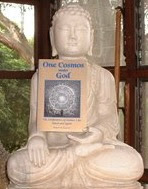
I guess this would be the book's most famous reader. That's the two-volume German edition at the bottom of the pile, right below the poems of Suzanne Somers:

Thursday, October 09, 2008

Keeping Hopelessness Alive

I'm glad that some Raccoons are optimistic about the election. I'm not. I'm not pessimistic either. In fact, as I've mentioned before, I place no hope in politics to begin with, and pretty much lead a hopeless life, at least as it pertains to the World. This probably sounds like bitterness or cynicism, but it certainly doesn't feel that way to me, and I'm quite sure that no one who knows me would consider me embittered.

Actually, it's much more of a Zen thingy, except that I don't have to actually practice Zen to be this way. I can't really claim credit for it, because it's just my nature. However, there was a time that I tried to fight against it and be like The Others, and it's not always easy to explain it to people who don't have a clue as to what I'm talking about.

For example, I tried to explain it to someone at that family function I attended last week. The person actually took sympathy, as if I were depressed or somehow missing out. Perhaps I should point out that this side of the family is Jewish, but only in a deeply secular -- which is to say, materialistic -- sense, so that my way of living is basically incomprehensible to them. The conversation revolved around my relatively late fatherhood, and I made the comment that if a man hasn't more or less seen it all by the age of 40, he's sort of pathetic. Being that I'd seen it all, I wanted to have the one experience I hadn't had, fatherhood. His response was, "noooo, why do you say that? Life isn't over at 40!!!"

But that wasn't at all the point I was attempting to make. Rather, what I meant is that for most people, they have had all the usual worldly experiences by the age of 40; they know what it's like to get drunk, fall in love, have some good meals, make some money, go to Disneyland, see their favorite team win the World Series, have some nice vacations, see their candidate become president. But then they merely try to either perpetuate the same things, or ramp it up and try to wring more pleasure out of these things than there is in them. In this man's case it was a new career and a younger wife, but it's really just the same wine in a new bottle.

That way of living is fine and appropriate for the first half of life, as the sun moves toward its zenith at your personal summer solstice. But to try to hold the sun there as it gravitates back to the winter underworld is again just sort of pathetic. One way or another, the purpose of the second half of life is to make a decisive turn toward the interior adventure, not to cling to the exterior one.

In my case, I'm fortunate to be living this life of radical novelty at an age when things are usually just repeating themselves. The presence of Future Leader assures us that every day is the same, and yet never the same. We are totally rooted in the moment, which is quite liberating. Specifically, we are liberated from the tyranny of linear time. Again, this always came naturally to me, but now it is simply heightened.

I believe it was in How To Know Higher Worlds that Rudolf Steiner makes the point that it is critical to pay attention to organic growth in all of its modalities, whether it is flowers blooming in your garden or watching children grow.

The operative word is life, and there is nothing so alive as a child. I can never be alive in the same vital sense that he is, and yet, I feel as if I have transposed that vitality to a higher key that is appropriate for my age. Extremes meet, so they say that old age is like a second childhood. I'm only 52, so I'm not there yet, but I feel as if I am starting to get there in spirit -- to let go of the world and to allow the others slowly learn the same lessons or fight over the scraps. I'm too consumed enjoying the present.

Anyway, one reason I live this way is that I can then be pleasantly surprised when things turn out well. If you always imagine that things are going to go well, then you are going to experience disappointment and frustration on a continuous basis. I've heard Dennis Prager discuss this same idea, and although I haven't read it, I know he writes about it in his book Happiness.

Also, I think you have to be aware of historical irony. That is, events that look bad constantly lead to good things, and vice versa. You can't just take one abstract "time slice" and decide whether something is good or bad. It's always a mixed bag. I think this is the deeper meaning of "God's will, or that we cannot know the plan of creation. Whether or not you believe in an activist God, it's out of our hands. You just do what needs to be done in the moment.

In fact, there's a famous old Taoist story about a man whose horse runs away. His sympathetic neighbors comment on his bad luck, and he responds, "we'll see." The next day the horse returns with three wild horses following behind. Now his neighbors rejoice and congratulate him on his good luck, but he remains noncommittal: "We'll see." The next day his son is thrown while trying to break one of the horses, and fractures his leg. "Such bad luck." "We'll see." Then the next day the military officials arrive to conscript his son, but he's laid up with the broken leg, so they pass him by. "What luck!" "We'll see." Etc.

So I think this is the deeper meaning of "giving no thought for the morrow." I do everything I need to do in the present, and then just forget about it. The present moment is the field of karma that one is constantly tilling. We are always planting little seeds that have varying timelines of development. Eventually, when something bad or good happens, it's easy to tie it to a proximate cause, much more difficult to relate it to its ultimate cause. I mostly worry about not planting any more lousy seeds.

I never imagine that my life will change in any fundamental way, no matter what happens. I realize that the environment I live in is in my head, and that the only way to really change things is to change my head. Here again, this can be confused with solipsism or narcissism, but it's quite the opposite. I just mean it in a very concrete, experience-near sense. You must be very, very careful about the ideas you allow to take up residence in your head, because they will end up sharply limiting your ability to know the Real, which always transcends any idea you have about it. Life is impossibly rich, with hundreds of little daily pleasures that will pass you by if you do not heighten your awareness and hone your ability to appreciate them. Never imagine that getting what you want will satisfy you so long as you cannot appreciate what you have.

I remember a patient of mine who was contemplating an affair. One reason I don't do therapy anymore is that I constantly blurted out things that therapists aren't supposed to say. In his case, I said words to the effect of, "why do you want another woman when you have no idea how to appreciate the one you have?" My professional training prevented me from adding, "you narcissistic bastard."

A little over four years ago I was diagnosed with adult onset type I diabetes. Such bad luck! Yet, I have never for a moment thought of it that way. It just is what it is. While it has certainly changed my life, I can't even say that it has been for the worse. As soon as the diagnosis came, I merely decided to be the best diabetic in the world. I work out at least once a day, always keep my blood sugar in a normal range, and keep my blood pressure and cholesterol even better than the normal range. Even so, you just never know. No matter what the state of your health, you can only try to tilt the odds in your favor, but there is always a random element, or at least an element that is so multifactorial and non-linear that there's nothing you can do about it.

One thing I do sometimes wonder about is the ticking time bombs that might be hidden in plain sight. For example, for a number of years we had a beautiful Great Dane named Finn. We got him from a rescue, so we didn't know much about his background. He had occasionally been a little aggressive, but it was nothing we thought we couldn't control. However, in 2005, out of the blue, he basically tried to eat me. I was pulling his bed from the living room to the bedroom, and he took it as a grave offense. He came at me like a grizzly bear, and if I hadn't been wearing a bathrobe, he probably would have severed an artery in my arm.

Long story short, all the dog trainers agreed that this was not something that could be trained out of him. It was more like a rage seizure that was totally unpredictable. In hindsight I realized the truth of this, because he would get this far-off look during these episodes, and appeared dazed and out of it for a few minutes afterwards. So with great reluctance, we had to put him down. It was very sad, because he was one of the most beautiful creatures I had ever seen, and most of the time he was quite endearing.

Such bad luck!

But then along came Future Leader a few months later, and I still almost swoon when I think of what might have happened. There is no doubt that he would have innocently crawled into Finn's bed, and then.... well, you probably would heard about it on TV.

So, what have we learned today? I don't know, I don't have time to reflect.

Tuesday, October 07, 2008

On Finding Your Celestial Parent

I'm still cogitating on the question of "where do I begin?" It's difficult for me to answer, because it's very much analogous to asking "how do I fall in love?" You can get all kinds of advice on the matter, but in the end, it will probably just catch you by surprise. Some things you can't arrange, only allow.

In my book I tried to discuss it in as abstract and universal a manner as possible. Once you are convinced that there is a higher reality -- whatever you wish to call it -- then naturally you will want to be in communion with it. It's as simple as saying that there is O and there is (¶), and we want to establish an open system between the two. Once the open system is established, then "evolution" may take place.

I'm thinking of puberty. All of a sudden, it dawns on you that girls exist. Then, you say to yourself, "I want one." How can I establish a relationship with one of these mysterious creatures? What do they want from me? Why does it seem so easy for others? Why can't I have that one?

There is an adage to the effect that disagreement between the sages is a divine mercy. Perhaps God has given the different revelations -- or even the different inflections within each -- because not everyone can fall in love with the same one. For some, it's love at first sight. For others, more like an arranged marriage, in which you marry first and fall in love later. Many people only pretend to be married, with no real passion at all. How do you maintain a passionate marriage?

That's a different question. But is it? I have mentioned before that when Bion saw a patient, he didn't want to know anything about them up front, for example, whether or not they were married. Rather, he wanted to decide that for himself. You see, many people are married, but not really, not in the deeper sense of the word, only in a conventional sense. My parents were "married" for 40 years, but not really, certainly not the way I am. Or, to the extent that they were, much of their bond revolved around what I would call (-p), or "minus passion," the same way our scientistic jester is married to this blog. He's not here to love us, but to argue with us, which is every bit as "binding" as any other passion.

This is not to say that my parents didn't love each other. They did the best they could with the material at hand, but it's very obvious that mind parasites with agendas all their own were also married to one another, in a mutual dance of projective identification. Bion noted that there were three main links between subjects, L, H, and K (or love, hate, and knowledge, plus their "minus" versions). Obviously, in approaching the Divine, we want to do so with the links of L and K. In contrast, the obligatory atheist has just as passionate a relationship to O, only it is through an H link, or often a -K, which accounts for their invariably foolish metaphysics, which only other atheists believe -- and which they believe in order to maintain the passionate H or -K link.

As with marriage, it hardly needs to be emphasized that many people who claim to be religious are not, at least as far as I am concerned. What then are they? Well, it's not just confined to religion. Most people aren't anything, not in any coherent and consistent way. There is no real "center" to them, except perhaps in the vital sense. They have a lot of appetites and sentiments, and that is the arbitrary and shifting center out of which they operate. And even then, "center" is the wrong word. They have a "middle," but no true center, because the latter implies a dynamic, self-organizing interiority which they lack.

Religion very much involves locating your center -- which resonates with the ontological center of being -- and living out of it. In so doing, it becomes more "robust" while becoming both deeper and higher (which amount to the same thing). But again, it can only take place in dynamic rapport with O. One must have a living relationship with the nonlocal order, not merely a "formal" or conventional one. Prayer, meditation, lectio divina -- again, all of these are merely the means to establish and deepen the link to O.

I suppose this is where I part ways with the traditionalists, as my main concern is not so much with maintaining strict fidelity to authorized forms of spiritual transmission, but with establishing the transmission "by any means necessary," so to speak -- although great weight is given to established doctrine, and for most people, this will be their best bet.

As a matter of fact, my doctoral dissertation touched on this subject, as did the second academic paper I published back in 1994 (seems much longer ago -- like several lifetimes). That paper was entitled Psychoanalysis, Chaos and Complexity: The Evolving Mind as a Dissipative Structure. It demonstrated the striking parallels between Ilya Prigogine's theory of dissipative structures and Bion's theory of mental development, or "evolution in O."

In hindsight, one can often see the same recurring "deep structure" in the work of a scientist, artist, or thinker. Now that I look back on it, this would obviously be one of the central threads that runs through my work. In a way, it is as if I had a number of "realizations" in 1985, and the rest has involved working out the implications.

It is a cliche -- but nevertheless true -- that our wounds are often the portals through which we may exit ourselves. In the lead is the gold, as the alchemists used to say; our defect is often a gift (just as every gift carries a curse). In my case, I was aware from the earliest age that something was amiss between me and my parents. No, they weren't abusive in any sense of the word, nor was I materially deprived in any way.

However, it was clear to me from the age of five or so that there was a lack of chemistry. Quite simply, they did not understand me, not in any deep way. It was as if I had landed in the wrong family. They still "related" to me. They weren't at all withdrawn. It's just that it wasn't "me" to whom they were relating. Thankfully, I never became that person. Many people do become the person to whom their parents relate, and then go to a psychologist to fix the problem when they reach adulthood and can't figure out why something is lacking in their life. What is lacking is their true self. Fortunately, I found other ways to identify and develop my true self, but it wasn't easy.

In one sense, I can't say that I blame my parents, as it would have required very unusual people to understand me, and that itself might have had its own downside, as eccentric people often have a lot of baggage. I'm running short on time, so I don't have time to go into all the details, but because of the lack of connection to my parents, I have a heightened awareness of this whenever I experience it in life, which is quite frequently. Indeed, I can now see that one of the reasons I started this blog was to connect with other people who are "like me," and who share the same idiom (idiom being a psychoanalytic term of art that has to do with the people, ideas, and objects we require in order to articulate our true selves).

In any event, if we transpose these ideas to the key of Spirit, we have to imagine God as a good father who -- being good -- wishes to establish an open system with us, in which we connect at our deepest level. In this regard, I can see how different my relationship is with my son, as compared to my father's relationship with me. In the case of my son, from the very start, we have been very aware of his unique subjectivity and idiom, and have tried to respond to him in such a way that he won't feel that sense of alienation that occurs as a result of being unable to locate an "interpersonal world" that corresponds to our deepest self.

Back to the question before the house. O is like a multifacted jewel. It is one, but has diverse modes that correspond to the deepest nature of those who approach it. Locate your center -- your psychic being -- which is "behind" the empirical ego, and is the blueprint of your true self. It is like a bead on a celestial string that descends from God to you. Find the divine language, the logos, that speaks to this true self; in a sense, the two cannot be separated, for to find the idiom is to locate the Self and therefore God. Then it's just a matter of deepening the conversation.

Monday, October 06, 2008

The Bewilderness Adventure: Where Do I Begin?

Good news and bad news. The good news is, with no one else in the house, I slept 10 hours. The bad news is, it's 7:30, so this post is almost over.

I occasionally get emails from people asking for specific spiritual advice or direction, but it's generally difficult to know what to say except that you have to proceed as if your hair is on fire. Normally, this kind of enthusiasm cannot be manufactured, which means that the Raccoon approach pre-selects for a certain kind of person whose hair is already on fire. My job is just to pour on more gasoline.

So it's a bit like asking how to be a professional basketball player. Easy. First, grow to 6' 6". Next....

One of the inevitable problems is that religion (at least in its presentation, not in its essence) is geared for the average mentality, not the exceptional. It's very much like the educational system, which, in order to reach as many people as possible, surrenders depth for breadth. Of course, it didn't used to be that way. Until relatively recently, education was restricted to a class of intellectual elites. Now we have the idea that everyone should go to college, which is one reason why a college education is so meaningless now.

The left was at least clever enough to realize a generation ago that college serves mainly the social function of prodding this herd of intellectual mediocrities to think the same way. This is the reason why your average professor has the identical thoughts as your average MSM journalist. They are the modern day equivalent of medieval peasants who all believed the same thing about religion. Thus, the more "educated" you are, the more likely you are to believe in all sorts of nonsense, from global warming to the redefinition of marriage. Is anyone thinking of global warming today, when we have an actual crisis on our hands?

But the comparison between college and religion only goes so far, as it excludes the element of grace, which is a necessary condition for any spiritual growth. While I am happy to report that grace is everywhere, nevertheless, it is highly focussed in some areas, which is one of the primary purposes of a traditional religion: to serve as a "channel" or focus for grace to operate.

I was just reading about this yesterday in a book about Guenon, who wrote that there is a "spiritual presence" that is activated through the collective work of an initiatory group. You know, "whenever two or more gather in my name," etc. This is obviously a real phenomenon, and is one of the exciting possibilities of the internet. We don't want to trivialize it, but the point is, there really is a Coonosphere, a sort of morphic space that opens up as a result of all these individuals around the world vibrating at the same spiritual frequency.

Rooth speculates that perhaps this presence "manifests in some way at the point where the 'lines of force' between the participants intersect, as if its 'descent' had been summoned directly by by the combined effect of these 'forces' at this particular point providing it with an appropriate support."

So in a way, it is analogous to building a radio tower to pick up the radio waves. We aren't creating them, merely receiving and amplifying them. Obviously, all rituals are intended to accomplish this, as are meditation and prayer.

Well, out of time. I'll just reproduce some of the letter, and toss it out to the community, as I am sure there are many of you in the same boat. It's no one you know, but I think I'll omit some of the identifying details anyway:

"I find myself at a crossroads in my life... I’ve been reading your blog now (as I did your book!) for some time, and I’ve even started reading more Schuon (among others) in an attempt to make sense of what I 'feel,' at least in comparison to what (intellectually) I know to be true… But I must say, it’s not always a pretty picture, and I’m hopeful that with your kind indulgence, I can posit a question or two as to where a lost raccoon might find a warm spot in which to rest his weary bones….

"I’m *** years old, and am in the process of getting divorced after a rather difficult marriage of nearly *** years… In that time, my growing interest in spiritual matters has actually contributed to the schism that exists between me and my (soon to be) ex… And although I’m certainly sad and somewhat depressed at the breakup of the marriage, it is an opportunity for me to more freely explore that 'itch' that has been growing within me for many years now…

"I consider myself an intellectual, but that only means it’s probably harder for me to understand and accept the role that (a lack of) faith and belief have in my (lack of) personal spiritual experiences… In reading your blog and the writings of Schuon (et al), I’ve come to realize that I need more specific tutelage in the esoteric traditions that I’ve come to 'feel' are true in my heart… My question for you then, is how does one go about finding a 'master' willing to take me on as a student???

"There are several Eastern Orthodox churches in the area -- do they offer the best path towards my salvation??? Or is the road I’m on now, one of more individual learning through my readings and subsequent ponderings a more fruitful approach??? I was raised as a Catholic, and have some inner distrust of the main organized religions for some reason -- I’m worried that any organized church will welcome me as a 'paying customer,' but not really welcome a 'raccoon,' who is after personal enlightenment/transcendence, rather that joining the congregation in solving world peace (maybe I’m being selfish here, but I’m trying to save myself first, then I’ll worry about the rest of the world!)…"

"Anyway, I’m hoping that the experiences in your own life may help me answer some of the questions that I have in mine…

"Thanks for your time, and keep up the good work on the blog -- it truly has been an inspiration to me in terms of helping me more clearly understand what I’m looking for in life…"

Sunday, October 05, 2008

Play Date

Mrs. G. decided to take a mini-vacation with Tristan, a friend, and her daughter. Tristan and his young lady friend wasted no time in checking out the hotel bed:

Saturday, October 04, 2008

Atheists and Other Whine Experts

I wish Lileks were a reader of this blog, because he would be so freaking envious that I got to see Monty Hall again last night. Yes, again. He's an old family friend (on my wife's side), so he's there at every family function. Looks amazing for 87. Last night I noticed for the first time how luxuriantly soft his hands are. Plus, you should see how he "floats" and shimmers into the room. I don't mean to brag, but he once took us to a Kings hockey game. He's Canadian, so he's a big fan. In fact, before Let's Make a Deal, he called hockey games on the radio. Did you know that Carol Merrill's son is minor league hockey player? That's the sort of thing that only Monty's intimates know about.

Well, today I have to attend one of those stupid all-day continuing education seminars. It's like losing a whole day of your life, or making a sacrifice to the gods of political correctness. It's one thing for medical doctors to keep up with the latest research. But psychologists? There's been nothing new in psychology since Genesis. Instead, the activists who have taken over the field merely publish fraudulent studies to prove this or that aspect of their leftist agenda in order to bring down western civilization.

Anyway. In honor of Bill Maher's new film, I'm republishing this old rant from two years ago.

*****

I am not surprised that militant atheists have become just another angry victim group, because that is what they have always been, starting with Grandma O'Harebrain. Please bear in mind that I am specifically referring to the easily offended activist kind of atheist who wishes to aggressively rewrite history and efface the Judeo-Christian heritage of this country, not to the person who is really and truly just indifferent to God. I have no quarrel with the latter kind of atheist, nor should they with me. While our respective philosophies are no doubt bizarre to one another, I am fully cognizant of the fact that it takes all kinds to make a world, and that a good atheist will contribute much more to the world than a bad theist, so long as the atheist is in a culture that embodies theistic values. It’s a non-issue to me that there are good and decent atheists.

Nor do I have any problem whatsoever with agnostics. While I regard militant, or “positive” atheism as the commonest form of philosophical stupidity (i.e., the affirmation that God definitely does not exist, as opposed to mere disbelief in God), I would never say that of agnosticism. For one thing, in the absence of transrational and suprasensory sources of information, the mechanical application of profane reason more or less compels agnosticism. There is no way to exit the closed circle of logic with more logic, especially if your premises are all wrong.

There are several ways to end up being what I call an obligatory atheist. Like every other human capacity -- from math to music to hitting a baseball -- the ability to intuit the divine runs along a continuum. Frankly, there are a few people for whom the realm of the sacred really does seem to be a closed book, but I actually focus a lot of my writing on trying to give these good folks a hand up, a way to "get" religion. I would guess that a larger percentage of atheists have been traumatized or repulsed by a dysfunctional version of religion they were exposed to as a child. They are the ones who naturally get more angry, obnoxious and militant. Or, sometimes they are just bitter about other things, and channel their bitterness through anti-religious sentiments.

Another large segment of the atheist population consists of the “not smart enough” who are nevertheless extremely proud of their intellect. This in itself is a contradiction, for they have great faith in the intellect’s ability to know reality, and yet, place an arbitrary limit on what the intellect may know. The placement of this limit is not a result of logic or reason. It is actually more of a religious inclination, for it is an absolute statement about what the human mind may or may not know. And once you are in the realm of the absolute, you are reflecting one of the two irreducible modalities (along with the infinite) of the Divine.

I do not know the first thing about wine. And yet, I know that I do not know, and I also know full well that there are enologists who do know what I don’t. In fact, I am one hundred percent certain both of my ignorance and of their expertise in this area. But since I am ignorant, how do I know this? Among other reasons, I know it because it would be absurd to deny the testimony of thousands of enologists who have trained themselves to make subtle discriminations in the realm of wine. If I were to object and tell them that they are fooling themselves and that there is no empirical proof that one wine is any better than another, they would properly regard me as a gustatory moron.

While numbers obviously aren’t everything (except for the materialist), needless to say, the numbers are on my side, in that billions of human beings have personally experienced the Divine, whereas atheism is an absurdity that makes no sense to all but a few cranks and misfits. More importantly, there are any number spiritual geniuses who have left maps of the domain of spirit that are every bit as subtle and detailed as the maps of science. I have independently verified these maps, so I know to my satisfaction that the territory they describe is ontologically real.

One atheist yesterday took me to task for “trashing” atheism because I hadn’t personally experienced it, but that is categorically false. There was a time that I was an atheist -- a much more effective one, I might add, than our scientistic jester -- but I eventually found its philosophical foundation to be utterly lacking. When I wrote yesterday that positive atheism was naively self-contradictory at every turn, I meant that literally, not as an insult. Most bad metaphysics can be dismissed with a single insurmountable sentence or two, and atheism is no exception. To declare that it is absolutely true that only relative truth exists is nonsensical. But to declare that absolute truth exists is to make a statement so pregnant with metaphysical implications that it alone can lead one out of the abyss of atheism.

One commenter proclaimed yesterday that “I am an Atheist because the universe makes perfect sense to me without putting God in the equation. You say God is easily provable. That is horse manure. There is absolutely no evidence God exists. God is nothing but a manmade idea in order to give one hope for meaning and even everlasting life.”

He dismisses all religion as an “invisible myth that you cling on to. In fact, I now have as much justification that there is an invisible man living under my bed, as there is a God. In other words, I have no reason to believe in either, as no evidence exists that either God or the invisible man under my bed exists.”

How does one respond to such invincible ignorance? “There is no evidence that God exists.” Of course there is evidence. It's just that he is either unfamiliar with the evidence, incapable of understanding the arguments (for no demonstration can convince everyone, least of all the spiritually inadequate), or has chosen to reject or ignore it, which he is naturally free to do. As for the statement that religious belief is an “invisible myth,” the reverse is true: it is only possible to cling to the invisible myth of atheistic materialism in a hermetically sealed environment of fellow fervent believers who are similarly innocent of any direct encounter with transcendent reality. They are free to insist that “all wines are identical,” just as I am free to dismiss them as possessing barbarous palates.

Again, atheism is a purely substitious postmodern mythology. It has nothing to do with an intellectually honest assessment of the evidence, but is simply an assumption dressed up as a conclusion. On the other hand, my theistic belief is based, among other things, on personal experience that I would no more doubt than I would doubt the fact that my eyes see or that I love my child.

One of the reasons I wrote my book is to assist people whose very intelligence may ironically -- ironic because intelligence is a reflection of the Divine Mind-- pose a barrier to religiosity. As a result of mindless repetition, secularists have made significant inroads to the undermining of rational religious belief, which will have catastrophic consequences for the future evolution of mankind, which we can already see with regard to spiritually exhausted old Europe. For a person who is alienated from his own soul and intellect is like a disabled person with missing limbs, except that he doesn’t know it. Better yet, he is like a leper, in the sense that lepers suffer from nerve damage that causes them to be unaware of when they are injuring themselves. To the extent that one is unaware of one’s soul, one will engage in more or less spiritually self-injurious behavior. (No different, really, than the neurotic patient who suffers because he is ignorant of his unconscious motivations.)

As Schuon has noted, the effectiveness of one’s “thinking about God” -- that is, thinking metaphysically -- always depends upon two factors, neither of which falls strictly within the realm of rationalism. First, there is the depth, breadth and profundity of the intelligence involved. Obviously there are plenty of "smart" mediocrities walking around. College campuses abound with them. But they are hardly profound, deep, or wise thinkers. For example, there are presumably thousands of musicologists with Ph.D.s, but who would pretend that their words are remotely as deep or profound as one of Beethoven’s late string quartets? There are many books on poetry, but only one Shakespeare.

The second thing that limits the mere rationalist is an arbitrary restriction on what is taken as evidence. The rationalist limits himself to empirical phenomena (or something reducible to it). But this limitation is not something that can be justified by reason. Rather, it is a pre-logical, a priori assumption.

The religious metaphysician is not hindered in this manner. He does not arbitrarily stop at the external senses, but considers other sources of information, most notably, divine revelation, the testimony of the saints and sages, one’s own personal experience, and the existence of the human subject, or Imago Dei, itself. The rationalist merely defines these things out of existence, and as a result, is unable to reason about God at all. Or we can say that his reasoning will be limited to mundane facts of common experience, not to that which transcends them. They will simply project onto God their own limited understanding, like a two-dimensional circle pronouncing on the nonexistence of spheres. Of course spheres do not exist for such a square. They can prove it with ironclad logic.

This is what happens when reason detaches itself from the intellect, which is the realm of pure, unencumbered intelligence and contemplation. Properly understood, reason is a tool of the intellect, not vice versa. Something is not true because it is logical, but logical because it is true. The rationalist confuses truth with method.

One of the monumental lies of our age is that the intelligence is somehow limited, so that the realm of ultimate issues must be left to faith alone. Who said that intelligence is limited? If so, how do we know that that statement is not equally relative and limited? Who said that human beings are intelligent enough to pronounce on the limitations of intelligence? Either intelligence is in principle unlimited, or else it is arbitrary, relative, and illusory, incapable of saying anything with certitude. But the shallow contemporary thinker wants it both ways: the omnipotent ability to know where to place an absolute line between what is knowable and what is not.

But reason is not autonomous, and cannot reason without data being supplied from elsewhere. As Schuon writes, “Just as it is impossible to reason about a country of which one has no knowledge, so also it is impossible to reason about suprasensory realities without drawing upon the data which pertain to them, and which are supplied, on the one hand, by Revelation and traditional symbolism, and, on the other, by intellective contemplation, when the latter is within reach of the intelligence. The chief reproach to be leveled against modern philosophy and science is that they venture directly or indirectly on to planes which are beyond their compass, and that they operate without regard to indispensable data...”

Bottom line: I would not presume to get into an argument with Van Gogh about what he saw with his eyes. I’d rather just enjoy the depth of his vision. But if you don’t believe in depth of artistic or spiritual vision, then a Van Gogh is no better than a Thomas Kinkade purchased on QVC, and atheism is just as profound as the Upanishads.

Friday, October 03, 2008

Remystifying the World and Finding Your Center of Levity

Ah, remama when you was older than abraham and young as a babe’s I AM and the world was fresh anew, when heaven touched the earth and angels whispered their secrets through the wind, rivers, mountains and stars? I do. Who could forget?

But as we adapt to our baffling new conditions and lose our innocence, the world is increasingly demystified and we become subject to the brutal “reign of quantity” inside the prismhearse of the senses -- or the senses prolonged into mental space, i.e., materialism. Much of spiritual growth involves the reversal of this process, or what I call the remystification of the world. For if you're not amazed, you're just wrong.

As we dissipate outward, we gain a new "center of gravity" and lose the old center of levity. Returning to this eurhythmic center of groovity is the goal of life, or the final coonsummation. To put it another way -- Perry's way, to be precise -- God is always present. It is man who is absent. Which is why we say on our celestial birthday -- which is every day: Come in, open His presence, and report for karmic duty.

As we fall down & out, life at the center is exchanged for life at the periphery; or, we are booted from the spacious interior to the cramped and contracted exterior. Schuon compares it to being trapped below a sheet of ice: “Mistaking the ice that imprisons us for Reality, we do not acknowledge what it excludes and experience no desire for deliverance; we try to compel the ice to be happiness.”

As such, we inhabit an alien world built from the bottom up rather than the top down; or again, the outside in instead of inside out. But since this barren world contains no real or final Truth, it cannot satisfy the exiled soul, which begins its endless quest for greater thrills and excitement to fill the void. No wonder so many would-be humans Rage Against the Machine; the problem is they rage further down and out, where only one last barrier remains: blasphemy and destruction.

The Vital Beings are the ones who do not wish to recover their humanness and who are fully at home in this fallen world. Breaking up through the ice would involve surpassing themselves, the one thing the vital man is loath to do. For he loves -- or lusts after -- the world with all his heart, all his soul, and all his mind -- which is precisely to lack heart, soul and mind, or at least to deny their provenance. It is to be “born again from below," and therefore die to the Real.

Father Rose wrote his piece on nihilism in the late fifties, prior to the vast explosion in crime caused by lenient liberal social policies and a forgiving attitude toward evil. His words proved to be quite prescient: “Crime in most previous ages had been a localized phenomenon and had apparent and comprehensible causes in the human passions of greed, lust, envy, jealousy, and the like; never has there been anything more than a faint prefiguration of the crime that has become typical of our own century, crime for which the only name is one the avant-garde today is fond of using in another Nihilist context: ‘absurd.’”

That is an excellent point, for the absurd sadism of so many of our crimes mirrors the absurdity of an art that celebrates ugliness or “authenticity” and an educational system that promulgates the lie that ultimate truth and absolute morality do not exist. When your elites spend several generations creating an absurd world, don’t be surprised if you end up with absurd people and meaningless crimes, because existence itself becomes a sort of crime against Being.

I remember studying film noir back in film school. The professor divided it into several sub-genres that evolved -- or devolved -- over the years, and which seemed to reflect the societal degeneration of which Father Rose speaks. I won’t get into a whole dissertation here, but early film noir such as Double Indemnity depicts a man who is pulled down into circumstances beyond his control due either to bad luck or some identifiable motive such as greed or lust. But in late film noir, the entire world has become corrupt, both the criminals and law enforcement. In fact, every human institution has become corrupt. In such a world, the antihero or outlaw becomes the hero with whom we identify. The corruption extends even into the family, which becomes a breeding ground for psychopaths, as in White Heat (starring James Cagney) or The Godfather. In these films, evil merely fights evil, so we inevitably find ourselves identifying with evil. There is no “good.” There are only bad people and worse ones, i.e., hypocrites.

In the Real world, Spirit is substance, matter is accident. Spirit precedes matter, the latter of which is the final precipitate of God’s involution into time and space. A corresponding world of the senses arises, but this shifting and "centerless" realm is hardly the world of reality. Rather, the uncorrupted intellect-in-the-heart (which is our own true center) knows objective reality as the Spirit, which can only be here and now, where eternity descends into time. Thus, "To transcend time is to live in the moment and to transcend space is to dwell in the center" (Perry).

As mentioned in a previous post, a counter-religious movement gained steam in the 1950’s, led by the “Beats,” by confused psychoanalysts such as N.O. Brown, and by narcissists such as Timothy Leary and Alan Watts. Just as N.O. Brown wrote that repression was the essence of pathology and that we would live in a sort of eden if we would merely express our lower instincts in an unmediated way, the new age teachers created bastardized forms of Zen and Taoism to exalt “spontaneity” and “naturalism” so as to obscure the deeper desire to stay high and sleep with coeds under a veneer of spiritualism. (Rose was actually a student of Watts at the Academy of Asian Arts in San Francisco in 1955, but soon saw through him and moved on to more serious pursuits. I do give Watts credit for that, as he did at least serve as a pointer and pique an interest in the "real thing" in some of his readers.)

The human being has an animal nature which is not by definition beneath him. It only becomes so “when man renounces his humanity and fails to humanize what he shares with the animals” (Schuon). To humanize is to spiritualize, which is to “open the natural to the supernatural whence it proceeds ontologically.” In other words, this hardly represents repression, but a recovery and actualization of our true being. If anything, the uninhibited and shameless vital man represses and denies his humanness, for one can just as easily repress what is higher as what is lower. There is a "vital center" that is located vertically, and is subject to increased "subtilization."

The psychoanalyst Christopher Bollas writes of the "erotics of being," which refers to that blissful sensation of expressing oneself deeply -- or from the deepest part of oneself -- and being understood, center to center. Frankly, this is why I blog. You know, textual intercourse.

Just as sexuality, in order to be properly human, must be spiritualized, Schuon agrees that intellectual (i.e., spiritual) knowledge has an ecstatic dimension to it, if for no other reason than it is known with the heart (or mind in the heart, the “location” of the higher mind): “There is a spiritualization of sexuality just as there is, conversely, an animalization of intelligence [what we are calling the vital mind]; in the first case, what can be the occasion of a fall becomes a means of elevation; in the second case, intelligence is dehumanized and gives rise to materialism, even existentialism, hence to ‘thinking’ which is human only in its mode and of which the content is properly subhuman.”

But then, these subhuman philosophies become the justification to fall further into vital animality. Postmodern philosophies use the spirit to deny the spirit, leaving us with a wholly horizontal wasteland of matter and instinct. This intellectual operation is a complete success, even though the patient -- the human qua human -- does not survive it. A new kind of infrahuman is born, forgetful of his fall and “at ease in a world that presents itself as an end in itself, and which exempts man from the effort of transcending himself” -- which is to have shunned and bypassed our reason for being here.

The fall is nearly complete. But not before we drag this whole despiritualized existentialada down with us, which we will do tomorrow in discussing the final stage of the nihilist dialectic: destruction.

Theme Song

Theme Song