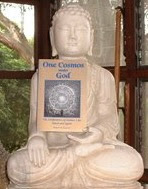
Believe it or not, there is even more introductory rambling in the book than what I inflicted upon you yesterday. I'm going to spare you further inconvenience and fast forward to to some actual content. If nothing else, this will give me the opportunity to eliminate the superfluous material that amuses no one but me.
The deeper point of Panikkar’s cosmotheandric model is that our three terms aren't just stacked one atop the other, but in a state of reciprocal indwelling, such that reality emerges from their dynamic interplay and collaboration. As usual, Dávila has the right idea: The natural and supernatural are not overlapping planes, but intertwined threads.
In short, there is a primordial relation between the Cosmos, Anthropos, and Theos, which is as real as what is related. These three can only be radically separated in our imagination: there is a little bit of each in all and all in each, as in a fractal or hologram. Armed with each of these three bad boys, we have something close to a Total Explanation of Total Reality.
Although Panikkar coined the term, previous thinkers have outlined a similar framework, for example, Nikolai Berdyaev, who writes that “Man bears within himself a double image and likeness: that of the universe and that of God. The final revelation of man is the final revelation of the universe and of God.”
Thus the somewhat shocking conclusion that there is “the disclosure of God in man and man in God," and that "The yearning of man for God comes to light in the yearning of God for man.” In other words, “not only has man need of God, but God has need of man,” but perhaps we can put this in a less jarring manner: supposing the Theos exists, then only the Anthropos is capable of knowing this and behaving accordingly. Such important work cannot be entrusted to a monkey.
Never trust a monkey.
Yes, the Anthropos can surely acknowledge animal rights, but there are no animal responsibilities. Conversely, the Anthropos is aware of a range of responsibilities – to oneself, to others, and certainly to truth itself. Absent fidelity to truth, things quickly go sideways in the cosmos, as proven by a little thing called history.
Philosopher and theologian Thomas Torrance, who would not want to be associated with cosmotheandrism, nevertheless speaks of a “God-man-world” or “God-world-man” entanglement whereby “theological knowledge is bound to be closely related to the knowledge of the universe as the created medium of space and time through which God makes himself known to us,” and in which we are the very means by which the created and thus contingent universe comes to know and reflect upon itself:
Since the universe includes man, it includes his knowing of it within the full process of its reality; it is the cosmos of created being in which the relation between knowing and being falls within being. Thus the knowing of being is to be acknowledged as an operation of being itself, for it is through being known that the structure of the universe manifests itself.... Thus it fulfills its reality in unfolding its nature and order to our rational understanding.
[Yada yada, lets finally get to the 12 Axioms that characterize our cosmotheandrism.]
1. The Axiom of Certitude. This is our self-evident starting point: that truth exists and we may know it, for to deny it is to affirm it, thus the end of any total skepticism. The structure of certitude always has three terms, the knower, the known, and the relational link between, each as real and irreducible as the others.
Before we can claim to know anything about any thing, there must be a principle by virtue of which such knowledge is even possible. What is this principle? For if we're going to know something -- anything -- the knowing subject and the knowable object must share something in common. What sort of something?
Well, for starters, “a certain degree of immateriality is a primary requisite. A universe of matter alone would be simply unintelligible” (Brennan). Now, what is it that renders matter knowable? Its form, which is the intelligible structure that may be known by intelligence, both of which are obviously immaterial.
So, man dwells in a haunted cosmic neighborhood with invisible ghosts of intelligibility running around everywhere. Strange to say, but everything wants to communicate. To an intellect that wants to know everything. Indeed, "the universe has much to 'tell' us of itself that far surpasses our capacity to take it in" (Torrance).
Moreover, we may ascertain truth by its surprising capacity to reveal more surprises, or in other words, a depth dimension. In the words of Torrance, “once a thing is understood it goes on manifesting itself in the power of its own truth,” and “is carried forward by the intrinsic force” that “continually impinges on our minds and presses for fuller realization…” Torrance relates this to how Einstein thought of God “as revealing himself in the wonderful harmony and rational beauty of the universe…”
Modern science has led to the "astonishing revelation of the rational structures that pervade and underly all created reality." Knowledge of these realities is not a Kantian projection of our own a priori forms, rather, "our knowing is determined by the nature of what we know," something every working scientist takes for granted, for as Einstein put it, "the belief in an external word independent of the perceiving subject is the basis of all natural science."
This simply goes to what used to be called "the truth of being," for supposing the opposite -- that being does not reveal its truth to the intellect -- results in the end of all knowledge of reality. We follow nature's lead, as opposed to projecting our own categories upon it.
2. The Axiom of Primordial Complementarity. The Cosmic Area Rug is woven of various complementarities such as the one and many, whole and part, subject and object, vertical and horizontal, immanence and transcendence, time and eternity, intelligence and intelligibility, semantics and syntax, being and becoming, continuity and discontinuity, quantity and quality, etc. Seemingly opposite truths are just two sides of the same rug.
I dig your work. Playing one side against the other.
The most basic of these are Absolute and Infinite, which account for stability and possibility, or static law and exuberant creativity, respectively. The philosopher Frithjof Schuon expresses it thus: “In metaphysics, it is necessary to start from the idea that the Supreme Reality is absolute, and that being absolute it is infinite."
The Absolute is "that which is at once solely itself and totally itself," whereas Infinitude is that “which is not determined by any limiting factor and therefore does not end at any boundary; it is in the first place Potentiality or Possibility as such, and ipso facto the Possibility of things.... Without All-Possibility, there would be neither Creator nor creation…. The Infinite is so to speak the intrinsic dimension of plenitude proper to the Absolute; to say Absolute is to say Infinite, the one being inconceivable without the other.”
Here is another helpful passage: “On the one hand, the Absolute is ‘necessary’ Being, that which must be, which cannot not be, and which for that very reason is unique; on the other hand, the Infinite is ‘free’ Being, which is limitless and which contains all that can be…”
So, Infinitude is very much bound up with the freedom of the Absolute. Indeed, it is why God is "necessarily free," so to speak, to create: The Absolute "makes itself visible through the existence of things; in an analogous manner, the Infinite reveals itself through their inexhaustible diversity." Which is just as Paul says: “For his invisible attributes, namely, his eternal power and divine nature, have been clearly perceived, ever since the creation of the world, in the things that have been made.”
On the one hand, the Absolute is necessary Being, that which must be, or which cannot not be. On the other hand, the Infinite is creative and free Becoming, therefore the principle that renders being more than what it merely is, so to speak. This is perfectly in accord with the traditional concept of the diffusion of the Good, which would be less than good if it didn’t share its goodies with the restavus.
If Infinitude, or All-Possibility, is the first entailment of the Absolute, the result is continuous creation, which is to say the actualization of the possible and the possibility of actuality. If something is actual then it was possible, and if possible then anchored in some prior actuality.
Pure actuality fails because if the ultimate ground were only this, it could not account for potentiality, novelty, or change in the created order, rather, it would be a static perfection. Likewise, pure potentiality fails because if the ultimate ground were only potentiality (as in process philosophy or certain quantum ontologies), it could not account for actuality, substance, or the stable knower.
The remaining possibility -- a dynamic complementarity of Absolute and Infinite -- is the only coherent solution. Absolute and Infinite entail Stable Being and Dynamic Possibility, the rock and the river.
3. The Axiom of Openness. Anthropos, Cosmos, and Theos are all open to each other and within themselves. For example, humans are open to the Cosmos, to each other, and to the Theos. The Cosmos is open to us and to something transcending it. The Godhead is open to the Cosmos and Anthropos, but also within itself, in that it is related to its own Other, even absent the creation.
The Anthropos is the link between appearances and reality, or between intelligence and intelligibility, which reduces to an all-pervasive Logos, which is why being and truth constitute an endless dia-logos: intelligence and intelligibility co-inhere in the Logos that illuminates the space between immanence and transcendence. Human beings are constantly attending and responding to a spectrum of information that is somehow embedded in the Cosmos and radiates outward and inward (into us).
Normally we think of a thing as the subject and openness as the predicate, but in reality openness as such is prior to the things that are open. This irreducible principle is difficult to express without paradox, for example, that “being itself is beyond being” (Schindler), the reason being that being is open to something beyond itself, for example, to us.
The Anthropos is of course situated in being, so what is central to us is likewise our own openness in and to the openness of being. Thus “we share in a privileged way in being’s being more than itself.” One might say that both Cosmos and Anthropos exceed themselves in being open to one another. This results in a duologue or “encounter between the acts of the soul and reality’s act of self-disclosure…” (ibid.).
For one of our cosmotheandric mainstays, Eric Voegelin, the alternative is an ontological closure or “mode of existence in which there are internal impediments to a free flow of truth into consciousness and to the pull of the transcendental.” This is in contrast to the open existence whereby the Anthropos is open to truth, love, beauty, unity, in a word, transcendence.
A self-enclosed Anthropos wouldn’t be one, for we would be, in the words of Josef Pieper, "confined and imprisoned within narrow considerations of immediate usefulness," in which case our material environment "utterly ceases to be a window on the larger ‘world.’"
Besides, get with the times: in post-Einsteinian science, the old conception of "a closed mechanistic and deterministic conception of the universe" has given way "to a dynamic and open-structured understanding of the universe" whereby thinking and being, or epistemology and ontology, are once again reunited.
As for why the cosmos is ordered in this way, we won’t get into that now, but suffice it to say, there are three very good reasons.




1 comment:
Good Morning Dr. Godwin, and readers all.
I am loving the material presented! It is so lucid, so compelling. I am following and grokking without too much difficulty, for a change. Perhaps my long immersion in nascent cosmostheandrism via reading the blog is paying dividends. I am familiar now with the pundits quoted (although a new one was presented in this section).
A question came up regarding this from the post: "So, man dwells in a haunted cosmic neighborhood with invisible ghosts of intelligibility running around everywhere. Strange to say, but everything wants to communicate."
In connection with, pardon my French, the sh*tbirds which own and occupy various places in our haunted cosmic neighborhood, namely the Orion arm: You know, the ones which "don't exist." How are they placed within the cosmic area rug? They are not animals, although they can be trusted less than monkeys. They are not people, so can't be called Andros.
God obviously created and evolved the techno-prodigy bug-headed sons and daughters of that fated gas giant amidst the stellar archipelago; shall these personages, if they can be dignified with that, be accorded the same function and status and humanity within the total picture of reality?
How do they fit in, is the question I suppose. God doesn't make something for no reason, is the working supposition.
Keep up the good work, I'm loving it!
Warmest regards, Colonel Dumont Trench, PPF.
Post a Comment