Showing posts sorted by relevance for query glass bead game. Sort by date Show all posts

Wednesday, July 29, 2009

On Becoming a Master in the Game of Life

It's funny how such diverse things can be woven together in the crazy quilt of the human soul, and can only be woven together there. Unless they are already woven together, and we simply imagine that we do the weaving....

It reminds me of Herman Hesse's Glass Bead Game, which, if I recall correctly (it's probably been 30 years), is about a league of gentlemen slackers who play a sort of game in which the point is to unify diverse strands of knowledge, say, a Bach fugue with the laws of physics.

Here, let me look it up... Yes, here's the description: "Hesse's final novel is set in a 23rd-century utopia in which the intellectual elite have distilled all available knowledge of math, music, science, and art into an elaborately coded game."

Another review says that it is "about humanity's eternal quest for enlightenment and for synthesis of the intellectual and the participatory life. Set in the 23rd century, the novel purports to be a biography of Josef Knecht.... Since childhood, Knecht has been consumed with mastering the Glass Bead Game, which requires a synthesis of aesthetics and scientific arts, such as mathematics, music, logic, and philosophy. This he achieves in adulthood, becoming a Magister Ludi," or Master of the Game.

I have been very aware of playing the Glass Bead Game for, I don't know, 25 years or so, and unconsciously playing it for longer than that. This is what I was alluding to in a recent post, when I mentioned my distaste for school.

The bottom line is that the liberal educational establishment interfered with my Glass Bead Game, and mostly just got in the way. It essentially consisted of transferring "finished products" of other people's thought into my dome in a wholly linear and atomized manner. Or, you might say that it consisted of giving me the "final scores" of other games, but not allowing me to play my own. I suppose some of it was useful for the Game, but other aspects can put an end to the Game altogether if you take them seriously -- for example, radical Darwinism.

The radical Darwinist eliminates himself from the Game, and imagines that those who play it are only doing so at the behest of their genes. In reality, the only entities in the cosmos that get to play at all are the genes. We are simply the byproduct of their unconscious play. Love? Beauty? Truth? All just tricks of those mischievous genes. And there is no point to their play. It's just what they do, so don't ask. It's for them to know and you to find out.

However, if you are remotely intellectually sophisticated -- or if your intellect has not been completely extinguished by this asinine sort of radical secularism -- then you see in an instant that the Darwinist is just playing a very bad form of the Glass Bead Game. For he too wishes to distill all knowledge into one vast (or tiny) system, except that in his case, it is not a system of thought, nor is it a product of the nonlocal intellect, only of the local ego.

In fact, thought -- and therefore truth -- is precisely what is eliminated in the Darwinist's game, reduced to a side effect of genetic competition. Yes, it is -- and they are -- absurd, but if you ask a terminal Darwinian how a Bach fugue and the laws of physics are related, he might say something like, "well, to be honest we don't yet know. But we think it has something to do with gene #5043-K. The main point is that there is a genetic explanation."

Intellectually speaking, this is like borrowing a huge amount of money because one thinks one will receive a windfall in the future in order to pay back the intellectual loan. But in reality, it is like the real estate bubble, except that it is a cognitive bubble that will eventually go bust. The truth of Darwinism is all "on paper" that can never be cashed in for real wealth.

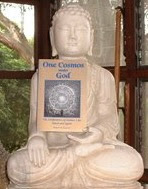
Now, I think it is obvious to one and all that my book is the preluminary result of my own Glass Bead Game. However, the Game obviously continues, as evidenced by the past 1,300 or so posts.

But a couple of points to bear in mind. When I wrote the book, I tried to do so in such a way that my later play would not fundamentally contradict anything in the book. I don't like to be so self-referential, but I frankly don't know who else I can refer to here. But one of my purposes in writing the book was to do so in such a way that reading it would not be at all like my bad experience with education, in which someone else's finished products were simply funneled into the Gagdad melon.

Rather, what I wanted to do was create a book that would allow others to play the Glass Bead Game. In other words, it's really meant to be a sort of template one can use to play the home version of the Glass Bead Game. I believe this is most obvious in book four, with all of the symbols I use for the spiritual life. That practically ensures that I am not "giving you the answer," but showing you how to play the game. In order accomplish my goal, the book had to be simultaneously "fixed" and yet "open." But this is just an analogue to how life, mind, and spirit -- the cosmos itself -- operate.

These thoughts were provoked yesterday in reading Jonah Goldberg's great Liberal Fascism at the same time I am pondering and blogging about Balthasar's Cosmic Liturgy.

Now, I would be willing to bet folding money that I am the first human being in history who has ever read these two particular books at the same time. That is not a comment about me, just about the uniqueness of the individual human, and how each of us uses such different material to play the Game.

Anyway, in reading these two works simultaneously, some cross-pollination is bound to occur as a result of all the bees buzzing in my bonnet. So yesterday afternoon, as I was reading Liberal Fascism, I was furiously making all of these margin notes about the connection between the two -- connections that I imagine that no other human being has previously noted in this exact way, and yet, are just "there," waiting to be noticed by someone.

Therefore, are the connections manmade? Or are we simply the middle man needed to bridge the connections that are already there? And assuming that the connections are already there -- which I believe they are -- what does this say about the mutual "object" they are illuminating?

Well, for starters, it cannot be anything like a three-dimensional object in time and space. Rather, this would obviously have to have more dimensions than three, and it would have to be non-linear. In reality, I believe that it is -- to borrow a term from Terence McKenna -- a "hyperdimensional manifold," a subjective topology which human beings have the unique privilege of "entering" and exploring.

"Hyperdimensional" simply means that it possesses more than four dimensions, while a manifold is a special kind of mathematical space. I call this space O, and I believe that it is ultimately in the form of a complex Klein Bottle (see illustration), in which the outside surface is the inside, and vice versa.

In my particular version of the Glass Bead Game, this is how I understand the distinction between subject and object, spirit and matter, potential and actuality. You might say that consciousness is the "interior" of the cosmos and matter the "exterior." However, theses are simply two sides of the same surface, like the Klein Bottle. We live "inside" the Klein Bottle, while the world we interact with is the "outside" of the Klein Bottle. But on pain of absurdity, object and subject are ultimately "one." The world is infused with intelligent consciousness, while human beings prove that matter can "think."

As I said, that's how Gagdad plays the Game.

It is also how Maximus played the Game, which is why I find him so compatible. For example, Balthasar notes that it is ridiculous to think that two "ways of conceiving the universe can stand in [such a] contradictory relationship to each other that no power of the intelligence will ever be able to remove the contradiction by creating a higher, third possibility."

That is, Maximus was a "creator" who worked with "traditional material but who also [knew] how to arrange the pieces according to their own architectural design." Again, as we mentioned before, he was able to unify -- or to see the hidden unity of -- "five or six intellectual worlds that seemingly had lost all contact," bringing to light "new connections that gave rise, in turn, to unexpected similarities and relationships."

Really, he was just accurately describing the hyperdimensional manifold of O: "His ecstatic vision of a holy universe, flowing forth, wave upon wave, from the unfathomable depths of God, whose center lies always beyond the creature's reach; his vision of a creation that realizes itself in ever more distant echoes, until it finally ebbs away at the borders of nothingness, yet which is 'brought home,' step by step, through the ascending unities of an awestruck love..."

Maximus was a Master of the Game.

And if it's all the same to you, I would prefer that you address me as the Maestro.

Thursday, January 29, 2015

Law and Music

"Law and music."

While gazing at the blank computer screen, that phrase popped into my head. Should I follow up? Is it another cryptic memo from Petey? Or is it just craptic noise? Only one way to find out.

As an aside, I was very much influenced by Herman Hesse's Glass Bead Game (AKA Magister Ludi), even though I don't think I understood a word of it. But I did understand the description of what the book was supposed to be about, and that was enough.

This experimental novel "is set in a 23rd-century utopia in which the intellectual elite have distilled all available knowledge of math, music, science, and art into an elaborately coded game." Just like here in Upper Tonga.

Another review says the book is an intricate bildungsroman....

Excuse me. Bildungsroman?

Ah: "a novel dealing with one person's formative years or spiritual education." As if I didn't know that.

Anyway, as I was saying, Magister Ludi was a big part of my own intricate bildungsroman. It is "about humanity's eternal quest for enlightenment and for synthesis of the intellectual and the participatory life.... Since childhood, [the protagonist] has been consumed with mastering the Glass Bead Game, which requires a synthesis of aesthetics and scientific arts, such as mathematics, music, logic, and philosophy. This he achieves in adulthood, becoming a Magister Ludi (Master of the Game)."

So, the folks who play the game realize that all truth is related, and that it is indeed One Cosmos after all. And although I didn't understand the book, I've been playing the game ever since. It goes like this: take two subjects or disciplines that appear to have nothing to do with each other, and show how they are related. I do it all the time. Or, maybe I can't help doing it.

So, the whispered fragment "law and music" is like an invitation to play the game. Or maybe a taunt. In any event, it doesn't mean I'll win the game. After all, if the outcome were known, it wouldn't be much of a game, would it?

It says here in Law and Revolution that "the most significant difference between Roman law" and law as it later developed in Christendom is that the former, "with certain rare exceptions, was treated as finished, immutable, to be reinterpreted but not changed."

In contrast, the canon law of the Church, for example, "had a quality of organic development, of conscious growth over generations and centuries." "This gave it a somewhat disorderly character," whereas Roman law was nothing if not ordered.

Applying a musical analogy, we can say that the Christian development of law was much more jazzy and swingin', whereas Roman law was staid, static, and predictable.

But of course, it's always a balance of complementaries, isn't it? At the opposite extreme from Roman law is Obama-style lawlessness, whereby the law is so flexible that it is anything he wants it to be.

But even Obama always obeys the law in a rigid manner. It's just a question of deducing the law he obeys and the tune to which he is dancing. For example, what is the ancient law that makes him treat Prime Minister Netanyahu in the hateful manner he does? It is not any explicit "law of the land" -- being that this is a deeply philo-Semitic land -- but rather, an implicit law that governs the squalid precincts of his soul.

Whatever it is, it is very rigid and not subject to learning via experience. One could say the same of his warm feelings for Islam, which seem to be insulated from the influence of any real-world behavior of Muslims. Thus, as of yesterday, the Taliban is not a terrorist group, just an armed insurgency, like the Continental Army.

So you can see that Obama plays his own twisted version of the Glass Bead Game whereby he proves to himself that "one man's terrorist is another man's freedom fighter." He is indeed an "intellectual," a word that does not imply any quality of the thought.

Rather, as Sowell describes it, an intellectual is simply a person who deals in ideas, whether we're talking about someone as brilliant as Thomas Aquinas or someone as retarded as Thomas Friedman or Charles Blow. Being that most ideas are bad ones, most intellectuals are therefore harmful, in particular, if their ideas should be put into practice via politics.

Everyone talks about the "separation of church and state," which, despite the hypertrophied vertical hostility of its votaries, at least reflects a kernel of truth, in that problems arise when terrestrial and celestial powers converge in the same person or institution. This salutary principle found its first historical instantiation with the idea that the Pope is the Pope and the King is the King: two heads of two hierarchies.

Few people, however, talk about the separation of ideology and state. But since leftism is a secular religion, my own glass bead game long ago led to the recognition that the consequences of their fusion are worse even than the convergence of church and state, since it redounds to the consolidation -- the re-fusion -- of unalloyed power unleavened by a trace of spiritual truth.

This is why the politico-media or the university-politico complexes are so destructive of our liberty. It is as if they play an outwardly improvisatory melody rooted in pure expedience, all the while dancing to a predictable Marxian tune.

Consider the movie critic Howard Dean, who makes the outwardly insane observation that the people who like The Sniper are just angry and hateful tea-partiers. But the comment makes perfect sense from a Marxian class warfare perspective. The latter is Dean's "higher law," even though it makes his utterances sound like chaotically insane word salad to us.

More generally, the left masks its power under the form of chaos. It is like compulsory chaos, if you like. For example, a ruling just came down in California that judges are not permitted to be members of the Boy Scouts. Why? Because the latter would prefer to conform to the eternal vertical order, and not have members who might be posing as Boy Scouts while scouting for boys. Being that one man's terrorist is another man's freedom fighter, the freedom-loving Boy Scouts are just homophobic terrorists.

Back to music. Now, music cannot actually be static, in the sense that it is always deployed in time. But it can be repetitive, like an Obama speech or a troll comment. Berman describes how, as the seeds of Christian moral intuitions began sprouting in history, "a new sense of time" appeared, and with it, a "new sense of mission to reform the world. A relatively static view of political society was replaced by a more dynamic view."

Politics is always about order, but here we see a radically new conception of order, which is oriented toward an open future, instead of the future being foreclosed by the repetitions of the past. Note that those living in the old order will resist the new order, either because of fear, or inadequacy, or settled habit, or because it threatens the legitimacy of their power, which is rooted in custom and tradition.

Here again, we're talking about a repetitious tune grounded in some self-serving murky-mythic encounter with ultimate authority, vs. a new reality in which we are at liberty to compose our own damn melody, free of the state's tedious ditty blaring in our ears.

"In the twelfth century there appeared the first European historians who saw the history of the West as moving from the past, through stages, into a new future." The Christian "yearns ardently," in the words of Peter Brown (in Berman), "for a country that is always distant but made ever present by the quality of his love and hope."

The leftist flatlander collapses this love and hope into the now, and as we all know, "Attempts to create heaven on earth invariably produce hell."

Brown also suggests that the great disentanglement of secular and spiritual was analogous to nuclear fission, accounting for the tremendous "release of energy and creativity" that followed. Which is why America quickly became the most energetic and creative nation. And which is why we should be every bit as frightened of the left's attempts at nuclear fusion as the Mullah's efforts at nuclear fission.

Well, we didn't get too far with the music side of the game. We'll end today with a quote by Zuckerkandl:

How is music possible?.... [W]hat must the world be like, what must I be like, if between me and the world the phenomenon of music can occur? How must I consider the world, how must I consider myself, if I am to understand the reality of music?

Friday, January 30, 2015

Interpersonal Neurotheology

Whether you call it grandiose or humble, I could swear that sometimes my otherwise random reading selections are guided by the Holy Spirit.

Then again, maybe the perception is just an artifact of our holistic 20/∞ mindsight, which sees connections others don't. However, even Toots Mondello was prone to seeing connections that didn't exist. But that was mostly after the alcoholic dementia set in.

Yesterday we were talking about the Glass Bead Game, which involves "a synthesis of aesthetics and scientific arts, such as mathematics, music, logic, and philosophy," and more generally, an integration of "the intellectual and the participatory life." The latter -- participatory -- is key, because embodiment -- incarnation -- distinguishes us from the sleepy herd of infertile eggheads grazing in the politico-academic complex.

So yesterday I began reading this Pocket Guide to Interpersonal Neurobiology (IPNB for short). I've only read a few chapters, but the material so far is like a commentary on yesterday's post.

Being that this sort of nonlocal bibliocontinuity happens all the time, it leads me to believe -- okay, insist -- that we are attracted to ideas that simultaneously attract us. There is a mutual attraction going on, which may sound implausible until you realize that behind the idea is a person who wants to be understood.

From yesterday's post: "[F]olks who play the [Glass Bead] game realize that all truth is related, and that it is indeed One Cosmos after all." The rules of the game are simple: "take two subjects or disciplines that appear to have nothing to do with each other, and show how they are related." I should have said two or more, but you get the idea.

The Pocket Guide to IPNB draws upon "a wide range of traditionally independent fields of research -- such as neurobiology, genetics, memory, attachment, complex systems, anthropology, and evolutionary psychology," in the effort to find a "unity of knowledge, or consilience" of "numerous domains of study into a common language and conceptual framework" (emphasis mine).

I've been doing the same thing since my latent cʘʘnvision was awakened on March 4, 1985. Everything I've written since then is a variant of the GB Game.

What especially motivated me was an unwavering conviction that subjectivity is not reducible to objectivity, but rather, that the former is an irreducible category of being. In reality, the two are complementary, not contrary, so any metaphysic that tries to deluminate the subject or reduce it to something else is a non-starter.

Siegel too writes of how he was motivated to create "a common ground in which to bring science and subjectivity into" a fruitful dialogue. The dialogue revolves around "finding the universal principles across many academic fields," and "discovering the consilience that emerges when usually independent research endeavors are explored together" (emphasis mine).

As we will see, I have some slight and/or significant differences with Siegel, one of which would be the idea that the consilience only "emerges" as opposed to being an antecedent condition for the unity. Perhaps he means to say that, but those from the science side of the dialogue would tend to strongly dispute this fundamental Raccoon principle.

Siegel might as well be describing me in graduate school, when "I longed to find a way to connect the power of objective science with the centrality of our subjective mental lives."

Siegel wondered, for example, whether "the molecules I had been studying in the lab that allowed salmon to transition safely from fresh to saltwater" could "be in some way connected to the equally important reality that the way we communicate with another person in crisis can mean life or death" (at the time, he worked on a suicide prevention help line).

There is the Glass Bead Game, and there is Extreme Glass Bead Gaming, and seeking a connection between suicide and salmon molecules would be an example of the latter. Brother Toots, of course, saw the connection, but everybody thought he was crazy.

Eventually Siegel formed a group of forty scientists from a diversity of disciplines, including "anthropology, molecular biology, cognitive science, education, genetics, linguistics, neuroscience, neurosurgery, physics, psychology, psychiatry, mathematics, computer science, and sociology."

Is there any fundamental, underlying principle such a diverse group could agree upon? Frankly, the Raccoon doesn't have time to find out. Rather, he prefers to cut out the middlemen and duit himsoph.

Most scientists won't even try to define the mind, but instead, simply use the word "as a kind of placeholder for the unknown." This is actually not a bad strategery, but only if taken to extremes, which is what I did in the book, giving this empty placeholder the symbol (•). I don't really know how the mind, utilizing its own resources, could define itself, any more than the eye can see itself or the crotch can grab itself -- unless we are able to view the mind from a higher, outside perspective, which science naturally excludes.

One quick point that very much goes to the personal and cultural evolution we recently discussed in the context of Inventing the Individual. Recall how we spoke of the many "disentanglements" that occurred, especially after 1075. Siegel writes of how, "when we differentiate concepts from each other and then link them, we integrate knowledge."

Not only that, but we integrate the person who has differentiated and then re-integrated the concepts. I would say that this is actually a two-way process: that it takes an integrated person to synthesize the diversity, while synthesizing the diversity makes us more integrated. Which is the point of life, for it really goes to what we call "mental health," which runs in the direction fusion --> disentanglement --> integration.

As I wrote in the book, mental health can really be defined along two axes: integration and actualization, the former giving momentum to the latter. As Siegel writes, "when we move energy and information flow toward something called integration, we move toward health." This "makes a stronger, healthier, more flexible, and resilient mind."

So integration results in greater strength, flexibility, and resilience, which is of course the purpose of our daily verticalisthenics, and the anti-purpose of multiculturalism (which flows in the opposite direction, toward disintegration and therefore mental and cultural pathology).

Now, Siegel is at pains to emphasize that human beings are always embodied and embedded. What he means by this is that we have a brain which, via the nervous system (which is just the periphery of the brain), extends throughout the body. Where is the brain? Only partly in the head. It's really "in" the whole body (although it's probably more accurate to say that the body is in the mind, i.e., a representation of it).

But at the same time, "Our mental lives are profoundly relational," and really take place in the space between our neurology and other persons. Thus, "Embodied and embedded is the fundamental nature of mind."

Guess what this made me think of? Yes, the second person of the Trinity, who indeed becomes "embodied and embedded" with the restavus. We explicitly focus on the embodiment -- incarnation -- but it is for the purpose of embeddedness, i.e., the offer of relatedness. If Christ is God's icon of man (and man's icon of God), this should not surprise us. Rather, shock us.

To be continued...

Saturday, February 01, 2025

Reality Comes in Threes

THE FOLLOWING POST CONTAINS RECYCLED MATERIAL

What else is new?

Well, to paraphrase Harry Truman, there's nothing new in the world except the posts we don't remember, in this case a couple from ten years ago, edited in light of subsequent developments, if any. 

In other words, in this weekly exercise in Looking Back, I'm curious to find out if my overall approach has evolved or progressed. If so, then we will edit accordingly:

Way back in my early twenties I read Herman Hesse's Glass Bead Game (AKA Magister Ludi), even though much of it was impenetrable to my only recently activated and mostly content-free mind. I'd begun reading in a random manner, and this book came across my radar because Hesse was a popular author among the hippie set.  

This experimental novel "is set in a 23rd-century utopia in which the intellectual elite have distilled all available knowledge of math, music, science, and art into an elaborately coded game." One reviewer says the book is an intricate bildungsroman--

Bildungwut?

Yes, that's "a novel dealing with one person's formative years or spiritual education." Thus, it played a small part in my own bildungsroman. It is 

about humanity's eternal quest for enlightenment and for synthesis of the intellectual and the participatory life.... Since childhood, [the protagonist] has been consumed with mastering the Glass Bead Game, which requires a synthesis of aesthetics and scientific arts, such as mathematics, music, logic, and philosophy. This he achieves in adulthood, becoming a Magister Ludi (Master of the Game).

So, the folks who play the game presume that all truth is related, and that this is indeed One Cosmos after all. And although I didn't understand the book, I've been playing the game ever since. It goes like this: take two or more subjects or disciplines that appear to have nothing to do with each other, and then show how they are related.

Along these lines, yesterday I began reading a Pocket Guide to Interpersonal Neurobiology (IPNB for short). The book draws upon "a wide range of traditionally independent fields of research," including neurobiology, genetics, memory, attachment, complex systems, anthropology, and evolutionary psychology, in the effort to find a "unity of knowledge, or consilience" of "numerous domains of study into a common language and conceptual framework." 

I've been doing the same thing -- i.e., rummaging around for the multi-undisciplinary Unity of Knowledge -- since my latent cʘʘnvision was activated on March 4, 1985. Most everything I've written since then is a variant of the GB Game.

One thing that motivated me was the suspicion that subjectivity is not reducible to objectivity, but rather, that the former is an irreducible category of being. In reality, the two are complementary, not contrary, so any metaphysic that tries to eliminate the subject or reduce it to something less is a non-starter.

Siegel too writes of how he was motivated to create "a common ground in which to bring science and subjectivity into" a fruitful dialogue. The dialogue revolves around "finding the universal principles across many academic fields," and "discovering the consilience that emerges when usually independent research endeavors are explored together" (emphasis mine).

As we shall see, I have some slight and/or significant differences with Siegel, one of which would be the idea that the consilience only "emerges" as opposed to being an antecedent condition for the unity. But like me, Siegel "longed to find a way to connect the power of objective science with the centrality of our subjective mental lives."

Likewise, he wondered, for example, whether "the molecules I had been studying in the lab that allowed salmon to transition safely from fresh to saltwater" could "be in some way connected to the equally important reality that the way we communicate with another person in crisis can mean life or death" (at the time, he worked on a suicide prevention help line).

Now, seeking a connection between suicide and salmon molecules would be an example of Extreme Glass Bead Gaming. 

Eventually Siegel formed a group of forty scientists from a diversity of disciplines, including "anthropology, molecular biology, cognitive science, education, genetics, linguistics, neuroscience, neurosurgery, physics, psychology, psychiatry, mathematics, computer science, and sociology."

Most scientists won't even try to define the mind, but instead, simply use the word "as a kind of placeholder for the unknown." This is actually not a bad strategy, since it is difficult to know how the mind, utilizing its own resources, could define itself, any more than the eye can see itself, unless we are somehow able to view the mind from a higher, outside perspective, which science naturally excludes.

Siegel writes of how, "when we differentiate concepts from each other and then link them, we integrate knowledge." Not only that, but we integrate the person who has differentiated and then re-integrated the concepts. 

I would say that this is actually a two-way process: that it takes an integrated person to synthesize the diversity, while synthesizing the diversity makes us more integrated. Which is one of the points of life, for who wants to exist as a bunch of incoherent and disconnected fragments?

It seems to me that mental health can be defined along two axes: integration and actualization, the former giving momentum to the latter. As Siegel writes, "when we move energy and information flow toward something called integration, we move toward health." This "makes a stronger, healthier, more flexible, and resilient mind." 

Now, Siegel is at pains to emphasize that human beings are always embodied and embedded. What he means by this is that we have a brain which, via the nervous system (which is just the periphery of the brain), extends throughout the body. Where is the brain? Only partly in the head. It's really "in" the whole body (although it is more accurate to say that the body is in the mind, i.e., a representation of it).

But at the same time, "Our mental lives are profoundly relational," and really take place in the space between our neurology and other persons. Thus, "Embodied and embedded is the fundamental nature of mind."

And guess what this made me think of? Yes, the second person of the Trinity, who indeed becomes "embodied and embedded" with the restavus. We explicitly focus on the embodiment -- incarnation -- but it is for the purpose of embeddedness, i.e., the offer of relatedness. If Christ is God's icon of man (and man's icon of God), this should not surprise us. Rather, shock us.

However, Siegel's ideas are metapsychological but not metaphysical, so no consideration is given to the wider meta-cosmic context in which the mind is situated.

Rather, the cosmos is assumed, as if just any cosmic conditions could give rise to something as strange as persons. Siegel mostly stays within the boundaries of science, but in so doing, expands those boundaries by including the subject in an irreducible way.

For example, read the following, and I'll bet you're thinking what I'm thinking: the triad of mind, brain, and relationships composes "one reality with three independent facets."

As Siegel describes it, "This is not splitting the three aspects." Rather, they "are three aspects of one reality.... With this view, we have one reality with three facets -- not three distinct domains of separate realities."

Siegel is speaking of science, not theology. However, the Raccoon would like to know what kind of cosmos this must be in order for such an irreducibly trinitarian and intersubjective science to exist? 

In any event, within this trinity of mind-brain-intersubjectivity it is as if there are arrows of influence in all directions, such that "the mind is influenced by both relationships and the brain; relationships are influenced by both the mind and brain; the brain is influenced by both mind and relationships." From the IPNB point of view, "this triangle embraces our ground of being."

To which we naturally want to ask, "what came before that?," or "What is beneath this scientific ground?" Which is like asking a physicist, "What came before the big bang?" The physicist cannot answer the question, not because there is no answer, but because his model cannot venture beyond its own horizon. Which is entirely appropriate, since we do not demand that science be religion, nor that stones of tenure turn into the bread of life.

As I mentioned in yesterday's post, we'll probably be discussing the Trinity a great deal in forthcoming weeks, because I just ordered a giant book called On Classical Trinitarianism: Retrieving the Nicene Doctrine of the Triune God. I suspect that the doctrine of Trinity furnishes a key to winning the Glass Bead Game, but we'll see. 

In fact, Peter Kreeft has a book called Why Does Everything Come in Threes?: A Short Book about Everything, which I haven't read, but I think I know the answer.

Monday, August 22, 2016

No Cosmos For Old Men

Might as well continue our review of this Introduction to Polanyi. Like the Tommy Lee Jones character in No Country for Old Men, we "always like to hear about the old-timers. Never miss a chance to do so. You can't help but compare yourself against the old-timers. Can't help but wonder how they'd have operated in these times."

I'll just flip through it and highlight some of my highlights. Here is one that gets right to the heart of the nub of the gist: "Popular thought seemed to imply that only scientific theories were capable of verification (i.e., proof), and that moral or ethical or political or religious ideals and principles were essentially unprovable, mere matters of emotional preference."

Well, not so fast. The existence of both a free science and the free society it depends upon are not themselves scientific principles. Rather, they rest "upon freely held beliefs in ideals and principles that not only could not be proved, but could not even be made wholly explicit." But just because they cannot be proved hardly makes them unworthy of belief.

We'll have more to say on what he means by explicit knowledge as we proceed, but think of it as analogous to one of those magic-eye 3D pictures. The three-dimensional picture is "composed" of the thousands of little two-dimensional dots, but cannot be reduced to them. The dots may be compared to implicit knowledge. Many if not most of our explicit beliefs and convictions are of this nature, such that we cannot specify all of the implicit clues that point to this or that belief.

Come to think if it, this goes to the overall purpose of this blog. We are always trying to understand how the countless clues surrounding us may be reconciled with the whole existentialiada. This is the very meaning of One Cosmos. It is why the book begins with the quote by Richard Weaver, comparing modern man to someone "furiously beating the earth and imagining that the finer he pulverizes it, the nearer he will get to the riddle of existence."

But that direction is not only away from meaning, but renders any logically consistent meaning impossible. Thus, "No synthesizing truths lie in that direction. It is in the opposite direction that the path must be followed..."

How is this latter even possible? Or, more to the point, is the meaning we attain real or only imaginary? This cuts right to the heart of our postmodern dilemma. Postmodernists have no problem per se with meaning. Rather, meaning is anything we want it to be. The text of the constitution means one thing to you, something entirely different to me. So, meaning exists. It's just that it's arbitrary and horizontal, pointing to nothing objective.

One thing Polanyi accomplishes is the reconciliation of our intellectual freedom and objective truth. As such, he is the best cure for postmodernism I've ever discovered. Instead of denying it and fortifying an intellectual position "prior" to it, he blows right through and past it. Truly, he is uniquely post-postmodern.

When I refer to myself as a neotraditional retrofuturist, this is what I'm referring to: I don't want to defend Christianity by denying current sensibilities, but by picking them up and carrying them through to safety. Falling back on mere dogma is fine -- at least it'll keep you out of trouble. But this is explicit knowledge, and it is always pointing to a gnosis that is its fulfillment, AKA (k) --> (n).

Here again, this is the meaning of verticalisthenics and mental gymgnostics. We are not like bodybuilders who only exercise their muscles in order to make them bigger. Rather, we exercise them in order to do something and get somewhere (and be someone). We are spiritual athletes playing a game. The glass bead one, to be exact.

From the first post that pops up:

It reminds me of Herman Hesse's Glass Bead Game, which, if I recall correctly (it's probably been 30 years), is about a league of gentlemen slackers who play a sort of game in which the point is to unify diverse strands of knowledge, say, a Bach fugue with the laws of physics.

Here, let me look it up... Yes, here's the description: "Hesse's final novel is set in a 23rd-century utopia in which the intellectual elite have distilled all available knowledge of math, music, science, and art into an elaborately coded game."

Another review says that it is "about humanity's eternal quest for enlightenment and for synthesis of the intellectual and the participatory life. Set in the 23rd century, the novel purports to be a biography of Josef Knecht.... Since childhood, Knecht has been consumed with mastering the Glass Bead Game, which requires a synthesis of aesthetics and scientific arts, such as mathematics, music, logic, and philosophy. This he achieves in adulthood, becoming a Magister Ludi," or Master of the Game.

Our quest for truth is motivated by an inbuilt passion for it. Think about this orthoparadox: sober science doesn't really get anywhere unless it is drunk with passion -- specifically, "a passion to attain comprehensive and meaningful wholes..." For Polanyi, organisms are "primordially meaning-seeking centers." The very first iteration of life had the ability to detect "meaning," if only the distinction between self and not-self.

Now, the mind, no different from the heart, lungs, and kidneys, is an organ. But it is different from the latter, in that it is obviously invisible. However, it is no less real, for it is our first hyperspatial organ. It is clearly multidimensional, operating transtemporally from past to future, vertically up and down, and horizontally in and out.

That's a lot of dimensions to juggle, but reductionism simply drops the colored balls by reducing their movement to brain activity. The brain too is an organ, but the material brain can never account for the transcendent abilities of our hyperdimensional minds. Truly, that is to reverse the arrow of meaning -- to deny what it is pointing toward and to aim it backwards. With this soph-defeating approach we deny ourselves the ability to novelgaze around the ocean of being.

This is no better than changing street signs in order to create a new world. This is what the British did in order to confuse the Germans in the case of an invasion. If the Germans landed in England and tried to use their maps, they would be utterly confused. Not only would they be meaningless, they would point in the wrong direction.

Is it any wonder that the postmodern beneficiaries of a liberal education are similarly confused, only in the transcendent realm? With a liberal education one internalizes all sorts of signs which either give bad directions or point nowhere.

In reality, the human being "points" to the God who is its sufficient reason, its meaning, its ground and destiny. Take away that vector and the human being is reduced to an absurdity. Postmodernism tries to come to the rescue by saying man is anything we want him to be (even a her), but that only exchanges absurdity for nihilism (a void which is immediately filled by power).

This is a job for which only a child is qualified, for in the child we so vividly see the mind transitioning from meaning to more comprehensive meaning as its world (both interior and exterior) expands. Reminds us of Heraclitus' old gag that The Aeon is a child at play with colored balls. So, amen for a child's job.

Tuesday, February 17, 2015

Original Syntheses and the All of Man

Now that I'm playing the Glass Bead Game between interpersonal neurobiology and Meditations on the Tarot, I see that there are links everywhere. No doubt because I am looking at it from a certain angle, I'm seeing the word "synthesis" all over MoTT.

On p. 20 our unKnown friend mentions Friedrich Schiller, who "advanced a doctrine of the synthesis between intellectual consciousness" (what with its "heavy burdens of duties and rules") and "the instinctive nature of man" and his "urge to play."

This sounds similar to what we've been saying about the synthesis of left and right hemispheres, as well as that between neocortex, midbrain (play) and limbic system (instinct). He was hoping to find that childlike balance in which "duty becomes a delight," concentration becomes effortless, and work is transformed to play.

In short, he was fumbling around for the secret of SLACK. But he was probably just a Freemason, not a Raccoon or Subgenius. Unless the records have been lost.

The idea of play is critical, because one of the things that makes man unique is that he never stops playing. Or at least he is not supposed to stop playing.

This is because, unlike other mammals, man's neoteny is not a temporary condition, but permanent. We never stop learning, growing, creating -- and therefore synthesizing. Play is how a child synthesizes. Synthesis is how an adult plays. Hopefully this will become more clear as we proceed, just in case it isn't obvious. (Hint: the Glass Bead Game never ends. Except in sudden death.)

On the next page, UF outlines what might be called the credo of the magician, or Man of Play: we only truly know "that which is verified by the agreement of all forms of experience in its totality -- experience of the senses, moral experience, psychic experience, the collective experience of other seekers for the truth, and finally the experience of those whose knowing merits the title of wisdom and whose knowing has been crowned by the title of saint."

Do this and you'll be a child, my man! (Apologies to Rudyard Kipling.)

Agreement of all forms of experience in its totality. This includes both vertical and horizontal, subjective and objective, beings and things, ontology and existence. The ONE COSMOS is both the Alpha and Omega of this journey, because again, we begin in relative fusion, move through the bewilderness of diversity and multiplicity, and end in the higher synthesis. Or just say one --> two --> three.

And no, I'm not going all Hegelian on you. This is quite different, in that we must accomplish it, as opposed to it being done through us via some abstract metacosmic geist of pure reason. Nor do I mean it in a pantheistic way when I say that the One Cosmos is alpha and omega, because I mean it in a much more integral way that includes God. I don't just mean the material cosmos.

This is also the principle way to avoid being an infertile egghead. Infertility results from a failure of union and synthesis. It is why the tenured are feckless and not fecund.

In Letter II, UF discusses "the reintegration of the two constituent elements of consciousness as such," i.e., "the active element and the passive element."

Here again we are talking about the fecundity that results from the proper marriage and union of male and female, or sun and moon, or left and right hemispheres. "There is no consciousness without these two elements," just as there is no picking stuff up without an opposable thumb.

Notice how thumb and fingers deploy a kind of force against one another for the higher purpose of grasping. Likewise, we grasp things via the "opposition" of various psychopneumatic complementarities. In turn, every orthoparadoxical complementarity is an important reveilation (in terms of what we were saying yesterday about the veils that reveal).

Another key idea: "Christian yoga does not aspire directly to unity, but rather to the unity of two." Which is what makes it Christian and not yoga (except in the generic sense).

What this means is that the oneness is both anterior and posterior to the twoness. However, this is not a unity of substance, but rather, of essence. And this essence is called Love, baby. Thus, as UF says, it is a non-substantial but essential unity."

Which is precisely what Norris Clarke says in his concise and lucid Person and Being. In it he proposes an "indissoluble complementarity of substantiality, the in-itself dimension of being, and relationality, the toward-others aspect." Ultimately this applies to both God and man because Trinity. Or perhaps better, because Trinity is in-carnated, making possible the journey from unoriginal sin to original synthesis and fruitful union.

UF makes the important point that there is legitimate and illegitimate twoness. I would say that this is because the latter is a vicious (because unresolvable) duality whereas the former is a blessed and fertile complementarity. UF goes so far as to say that evil is a result of illegitimate twofoldness. I'll have to think about that one, but it sounds about right.

Consider, for example, how Job One for the left is to sow illegitimate divisions. I think this is why they are always more comfortable hating than loving. Obama-love could only satisfy them for so long. It is much more natural for them to hate Bush, and now a Scott Walker. They are much more animated by Walker's failure to graduate college (we would say success in avoiding it) than they are by the Islamic State decapitating Christians.

We're out of time. To be continued...

Wednesday, February 04, 2015

Recreating a Realistic Lifestage

The book we are discussing -- the Pocket Guide to Interpersonal Neurobiology -- although suitable for lay readers, is not plagued by the usual agenda-driven PC activism masquerading as psychology. I would dock the author a few points for excessive use of liberal dog whistles such as empowerment, honor, impactful, and healing the planet, but overall it's an excellent summary of what I would consider to be the state of the art of what science can say about the art of human development.

In other words, back off man, he's a psychiatrist.

The book is interdisciplinary, but only up to a point. For example, these ideas are metapsychological but not metaphysical, so no consideration is given to the wider context in which the mind is situated.

Rather, the cosmos is assumed, as if just any cosmic conditions could give rise to something as strange as persons. I would say that Siegel stays within the boundaries of science, but that in so doing, greatly expands those boundaries by including the subject in an irreducible way. I mean, we've been doing the same thing for years, but we are obviously not sanctioned by the Conspiracy.

As alluded to a few days ago, while I have some issues with the field of IPNB, these are going to inevitable, if only because of the limitations of the scientific perspective. While Siegel does actually venture into quasi-religious territory, as a scientist he can only do so in a generic manner that is compatible with such mindfulness practices as Buddhism, yoga, centering prayer, etc., each of which has a real and measurable effect on the brain. He can't deal with such realities as grace, prayer, sin, rebirth, etc.

Which is fine. IPNB is about as interdisciplinary as one can get and still dwell among the tenured. A Raccoon is not dragged down by such terrestrial considerations, by virtue of his multi-undisciplinary orthoparadoxy.

For example, read the following, and I'll bet you're thinking what I'm thinking. The triad of mind, brain, and relationships composes "one reality with three independent facets."

As the council of Nicea Siegel describes it, "This is not splitting the three aspects." Rather, they "are three aspects of one reality.... With this view, we have one reality with three facets -- not three distinct domains of separate realities."

Siegel is speaking of science, not theology. However, the Raccoon would like to know what kind of cosmos this must be in order for such an irreducibly trinitarian science to exist.

In any event, within this interpersonal trinity it is as if there are arrows of influence in all directions, such that "the mind is influenced by both relationships and the brain; relationships are influenced by both the mind and brain; the brain is influenced by both mind and relationships." From the IPNB point of view, "this triangle embraces our ground of being."

To which we naturally want to ask, "what came before that?," or "What is beneath that ground?" Which is like asking a physicist, "What came before the big bang?" The physicist cannot answer the question, not because there is no answer, but because his model cannot venture beyond its own horizon. Which is entirely appropriate. We are not the village atheist. We do not demand that science be religion, or that stones turn to bread.

Now, if man is an image of the ultimate reality, and vice versa, we would have to conclude that the Absolute is similarly a kind of dynamic process of one-in-threeness. Or, it is oneness with interior relations.

Don't worry, we haven't forgotten about music. If we were playing the Glass Bead Game, we might ask the question: what does all of this say about music? Or, how does the reality of music relate to interpersonal triobiology?

Zuckerkandl provides a clue in the form of another question: "If music does not belong in the external world, which physics investigates, nor yet in the inner world, which is the subject matter of psychology, where does it belong?"

Referring back to our interpersonal neurobiological trinity, I would say that it must belong to the same space in which relationship occurs, or between world and neurology.

"Whereas musical tone is always localized in outer space, the localization of sensations of vibration takes place in our own body" (ibid.).

In other words, there are the exterior vibrations that resonate with our own body, which are then seemingly re-projected into the space from which they originated, in a kind of circular movement. The same is true of vision, or of any sense, really.

Even with headphones one does not experience music as something coming from a localized source, nor from in between the ears. Rather, a field is perceived beyond the boundaries of the head.

In audiophile terms, this is referred to as the "soundstage." A good stereo set-up will recreate a wide and deep soundstage, whereas a mediocre one will sound more like it is merely coming from speakers. Or in other words, with a good system the speakers "disappear" into the image they reproduce.

Now, I wonder if life is the same way? Some people have a wide and deep lifestage, whereas others live in a cramped space whose ideological source can be easily identified. Looked at in this way, the purpose of a liberal university education, for example, would be to sell you a cheap stereo in which the higher dimensional image of the world collapses into a two-dimensional facsimile.

Friday, March 06, 2015

The Economics of Interior and Exterior Poverty

Here's one for the Glass Bead Game: what does idiom -- the unthought language of the self -- have to do with economics?

This question occurred to me while reading this piece on the Peruvian economist Hernando de Soto. The question occurred because I immediately recognized the implicit answer. Even now I haven't explicated it -- that's what the post is for -- and yet, I know the answer is there.

In fact, this is a kind of mini-example of idiom in action, or at least an analogous variant of it. It all has to do with recognition -- or re-cognition -- which is "the identification of something as having been previously seen, heard, or known."

Except that I hadn't previously cognized the connection, at least consciously. But the orthoparadoxical term "unthought known" precisely goes to this process of unconscious re-cognition. While it might sound annoying or cute -- like some overworked wordplay the B'ob might force into existence -- it's really the perfect way of expressing it: something we know in our bones but haven't consciously innertained in skulldom. You could call it the realm of the bone-known, but I think you'd agree that Bollas' term is preferable.

Let's start with a question; in fact, Shem's "first riddle of the universe,"-- "dictited to of all his little brothron and sweestureens,"-- "asking, when is a man not a man?" The winner gets "little present from the past."

Give up? "Shem himself, the doctator, took the cake, the correct solution being — all give it up? -- when he is a... Sham."

So, are you a sham or are you the real deal? And how would you know the difference?

Reality is usually thought of as what is outside ourselves. But we couldn't know that reality unless there were something equally real on the inside.

Let's discuss de Soto's view of economic reality; he speaks of how "the Third World's poorest are relegated -- banished from their nations' official economies to what he has called 'the grubby basement of the precapitalist world.'" Now, why are they so banished to this psychopneumatic backwater? Because of "a lack of enforceable property rights."

Now let's go back to idiom, that is, the private language of the self. How is this language spoken? Largely through objects in the external world. You might say that culture is the collective sum total of "psychicized" objects for personal expression.

In other words, culture is in one sense "out there," i.e., exterior to the self. And yet, cultural objects have only the meaning we lend them. If I were to drop you in, say, Saudi Arabia, or interior China, or UC Berkeley, there would be very few objects there -- a very limited vocabulary -- for the expression of your idiom. You would be unable to find -- forbidden from finding -- the objects to express your unique idiom.

Not only that -- and this is a key point -- but your idiom wouldn't even be yours. Rather, with no strictly private property, what's yours really belongs to the state, plus the state puts sharp limits on personal expression anyway.

To take an obvious example, suppose you were an artist working in the Soviet Union or in Nazi Germany. If so, your idiom would have been restricted to socialist realism or classical kitsch. In Germany, for example "modern art was [seen as] an act of aesthetic violence by the Jews against the German spirit." And only Hitler decided "who, in matters of culture, thought and acted like a Jew."

Thus the tyranny of aesthetic correctness, which is ultimately enforced by the absence of any inviolably private property, right down to the first property, which is your soul.

As our fathers told us, certain truths are soph-evident to anyman to the right of the left, that we are endowed by our Creator with the liberty to discover and appropriate our own idiom; and that this right co-arises with -- for it cannot be actualized in its absence -- the right to property.

Looked at this way, "private property" is a kind of language, the idiomatic language of the self. You want what you want, and I want what I want. Liberals hate this idea, because they want you to want only what they want. They want to restrict idiomatic expression to their own idiom.

Or just say PC, which is really a pre-emptive attack on personal idiom, on our cosmic right -- and for Raccoons, our coonstitutional duty -- to be different. Have you ever watched MSNBC? The reason why it is a failure is that it is so dreadfully boring, frankly as boring and didactic as Soviet or Nazi art.

To paraphrase George Carlin, my stuff is your junk, and your junk is my stuff. In other words, stuff I like -- objects that speak to my idiom -- might just be a collection of junk to you, like my shelf full of vintage Barbies.

But on an even deeper level, this is the source of the energy of the private economy: I will give you this for that because I want that more than I do this. Simple as.

Which is not so simple in practice, and can even get you killed in most parts of the world. de Soto himself survived the bombing of his office by socialist terrorists in 1992. As Fox Butterfield might say, "Economist Targeted for Assassination by Leftists Despite Helping Lift Millions from Poverty."

One thinker -- who uses his words instead of bombs to express his idiom -- praises de Soto "for demonstrating how property rights -- often disparaged by left-leaning intellectuals as an instrument of the privileged -- help the poor:

"He has helped explain to convincible [heh] readers how radically egalitarian the rule of law and property rights are. Plutocrats, strongmen -- they have their muscle. They can take what they choose in lawless situations. But the poor and weak are protected by the rule of law and property rights."

So the krugmaniacal Obama, that phony Shampion of the Poor, has spent the last six years undermining the very thing that relieves poverty, both exterior and interior. If he had his way, the whole world would be as financially and intellectually impoverished as MSNBC.

Tuesday, February 10, 2015

Respect Your Monkey! Honor Your Reptile!

As we've been saying, one of the principles of Interpersonal Neurobiology (IPNB) is that mind, brain, and relationships represent an irreducible trinity, in that you can't have one without the others.

However, it occurs to me that each of these components may be further divided (but not separated) into three. For example, vis-a-vis the brain, we have the hindbrain, the midbrain, and the neocortex -- or the reptilian, the mammalian, and the human. Thus, when we talk about integration, it is not just between mind, brain, and relationships, but within the brain itself.

For which reason the Raccoon says: Integrate your monkey! And don't forget your lizard!

Likewise the mind, which I visualize as spanning a vertical hierarchy from the divine to the human to the infrahuman. Importantly, the infrahuman is not analogous to the mammalian or reptilian, but is something far worse than mere animals -- like Nazis, or ISIS, or Al Sharpton. Matter can only go so low.

With regard to relationships, there is always self, other, and the link between them. Here I follow Bion, who mainly posited links of (L), (H), and (K), or love, hate, and knowledge. Others might include empathy, passion, and curiosity, but in each case the link is from interior to interior, or soul to soul. And to meet souls where they actually are, we have to possess the "mindsight" to see them, more on which later.

With this in mind, I think we are in a better position to understand what Siegel means when he says that the triangle of mind-brain-relationships is a "process by which energy and information flow." This is obvious, say, in education, where information passes from one mind to another via our relationship to the teacher (and the relationship turns out to be critically important). But such links also occur in far more subtle ways.

For example, in a paper I published back in 1994 -- before the internet permitted me to bypass the middleman -- I talked about "the back-and-forth interplay between mother and infant" through which we come to know ourselves (and without which we could never know ourselves).

Therefore, certain obstructions, blind spots, and inflexible repetitions in the mother will be internalized by the baby. Although the self cannot develop without a brain, it obviously cannot be reduced to mere brain activity. An isolated brain is just a disorganized blob of cells, while an isolated self isn't really a self at all.

However, there are such things as a healthy brain, a healthy mind, and healthy relationships. Things can go south in each realm, which will in turn affect the others.

For example, a brain tumor will probably not be good for your mind. Likewise, a painful relationship, or a death or loss, will cause real structural and chemical changes in the brain. And we all know how the internalization of a dysfunctional ideology causes both soul and brain damage.

The keynote is integration: "From an IPNB perspective, integration is the definition of good health," and "integration is the linkage of differentiated elements." Failure to integrate always results in one of two outcomes (or else an alternation between the two): either chaos or excessive rigidity.

Here we can see how rigidity may become a habitual defense mechanism against chaos, but how excessive rigidity inevitably results in more chaos. (Of note, this applies to any system, which is why the rigid, top-down economics of the left doesn't work.) Obama, for example, is an unusually rigid ideologue. The result? Global disorder. Economic disorder. Medical system disorder. Racial disorder. Immigration disorder.

As Siegel describes it, "Brains or relationships that are not integrated move outside this river of integration." That is, the integrated flow of an open system can be analogized to a river. On one bank is rigidity, the other chaos. Siegel is absolutely correct that every single diagnostic category of the DSM is characterized by either rigidity or chaos.

To cite some obvious examples, a compulsive personality is too rigid, while a borderline personality always generates chaos. Narcissists are generally too rigid, while a person with bipolar disorder goes from extreme to extreme -- from a static depression to wild mania, the former functioning like a fixed point attractor, the latter a strange attractor in subjective phase space.

As it so happens, I'm reading a rather comprehensive biography of Beethoven in the hope that it might contribute to our Glass Bead Game of integrating music and the structure of reality. Interestingly, Beethoven was deeply unintegrated in certain areas (e.g., emotions, relationships), even while creating perhaps the most vertically and horizontally (and intellectually, emotionally, and spiritually) integrated music that had yet appeared (from what I am told; I don't pretend to be a classical music maven).

Being that he was one of the first representatives of the then new cult of genius, we have ever since had the romantic image of the "crazy genius," but it is not necessarily so. One doesn't have to be crazy to be a genius, but one can see how, in an excessively rigid cultural or academic environment, it may require someone who has no ability to stay within the lines -- the river banks -- to discover new territory. Thus, there are times that chaos can be in the service of development, but it is not the ideal.

On the one hand, Beethoven strived "for unity within diversity," and "struggled for greater unity and at the same time for greater diversity than any composer had aspired to before." And yet, outside the context of composing, he "had little grasp of the world at all. In childhood he did not truly comprehend the independent existence of other people. He never really did. He reached maturity knowing all about music... but otherwise he did not know how to live in the world."

To be continued....

Tuesday, December 15, 2009

Is There Life Before Death?

No, I'm not going wobbly on you, but I'd like to try to weave together the book we had been discussing -- The One and The Many -- with Father Rose's discussion of the soul after death.

Why? I don't know, just a little glass bead parlor game I like to play, that is, putting two random things side by side and seeing how they can be reconciled into a higher unity. For one thing, it helps me vault myself into the unKnown, beyond the edge of the subjective space I've already colonized. You might say it's my hobby. I mean, if you really only want Father Rose's take, you can always get his book.

Remember, all science -- including the science of God -- involves the reduction of multiplicity to unity, or in apprehending the unity underlying the multiplicity. But also, I feel as if I'm actually learning something if, instead of just rewordgitating someone else's work, I let the ingredients macerate in my own crockpot. I may well end up saying the same thing, but at least it will have my own grubby soulprint on it. It may be a crock, but at least it's my own.

As a matter of fact, much of this morbid discussion comes down to the question of whether the soul exists. If she does, then I don't think it's much of a stretch to say that she is nonlocal (both in space and time) and that she could under no absurcumstances result from a strictly blind material process. Therefore, the soul must continue after the event of biological death, or it's not much of a soul, now is it?

Before we veered in this new deadly direction, Bolton was just about to get into this. He notes that Descartes affirms the existence of the soul, but then diminishes its significance by equating it "with things the Scholastics would have called its accidents," that is, mere thoughts. This is in contrast to Aquinas, who maintained (correctly, in my opinion) that the soul must be an individual substance which determines "the nature of the whole person, independently of the conscious phenomena of thoughts and sensations they may entertain."

Now, most any person infected with the soul-killing virus of postmodernism will say that Aquinas is not only wrong, but that he cannot possibly be correct, since he is making an "essentialist" argument, and we all know that essences do not exist. There is no enduring self; rather, it's just a side effect -- a persistent illusion -- that is recreated on a moment-to-moment basis by brain activity. Thus, not only is it not unchanging, but it is always changing, until you croak. Like your body -- or better yet, like a whirlpool -- it is a function of its own activity. At this very moment we're all circling the drain, and soon enough we'll all be down it.

But for Aquinas, the soul is the form of the body; or, body is the substance of soul. The soul is its "immaterial type and causal principle," which is precisely the opposite of the postmodern view that insists the soul is the accidental expression of the body.

There are so many insurmountable problems with the latter view, that it could only gain traction in a world that has lost any sense of the wisdom and truth at its own origin and center. For to say that all is accident and contingency is to say that nothing can be known by nobody, and that there's no earthly reason to pretend to know it anyway.

This is a strictly insane worldview, which would make sanity a kind of insanity, since there would no ontological basis for any kind of stability or continuity, much less post-biological continuity. (Here again, the conservative project of honoring and conserving the "permanent things" is another word for sanity in a world gone mad with relativism and nihilism.)

I think this little preface is helpful, because it lays a foundation for some of the things Father Rose says, which otherwise might sound implausible. We left off with his account of the two angels who meet the newly reposed, like a couple of taxi drivers waiting down at the terminal when you disembark from the plane. I can see them now, holding an improvised cardboard sign saying GOODWIN. (People always add in the extra O.)

By the way, Father Rose makes the important point that while angels are immaterial in relation to us, they are material in relation to God; this accords with the idea of the "ray of creation" extending from the cosmic center to the periphery, and which becomes increasingly material the further it extends from the center. You will have no doubt noticed that as you develop spiritually, you become "lighter" and more "transparent," so to speak. You may become especially aware of it during a religious service, while meditating, doing hatha yoga, etc.

Father Rose next discusses the "visions of heaven" that are sometimes seen by dying people, and which are possibly false and misleading. Often, "these visions are not spiritual, but worldly. They are so quick, so easily attained, so common, so earthly in their imagery, that there can be no serious comparison of them with the Christian visions of heaven..." One immediately thinks of Islamist visions of the afterlife, -- the 72 virgins, and all the rest -- which are pure demonic fantasy disgorged from the primitive unconscious.

In order to provide some additional context, Father Rose next discusses "how man, having originally been capable of the sensuous perception of spirits, has generally lost this capacity as a result of the fall." Interestingly, "by a man's own means," he "can enter into communion with fallen spirits; but he cannot enter into communion with angels except by God's will."

Now, I don't think it matters whether one regards the Fall as literal or metaphorical, for the more important point is the perennial truth it conveys. And it is surely true that, for whatever reason, as a man develops spiritually, it is as if he recover a capacity to discern the spiritual world.

In a way, this is no more mysterious -- indeed, probably less so! -- than what happens to an infant. One of the first things I noticed about having a child is that it is literally like watching someone miraculously age in reverse -- like a person recovering from a crippling stroke. At first he's paralyzed, nonverbal, and incontinent; he can't walk, feed himself, or auto-regulate his emotions.

But it's not just a "physical" recovery. Rather, day by day, he enters the nonlocal human realm and discovers -- recovers? -- himSelf. And I believe -- no, I'm convinced -- that this is a lifelong process. That is, in a very real sense, life is the process of "becoming who you already are." Only someone who is profoundly and tragically alienated from himself is incapable of sensing this.

I might add that this is one of the seals of authenticity in genuine mental illness, e.g., a real depression or anxiety disorder. One of the most difficult aspects of depression is the loss of one's self, as it causes a kind of profound ontological -- and therefore spiritual -- disorientation. Everything that connected oneself to oneself and to the world suddenly goes dead -- as if someone cut the lines. All the signposts of meaning vanish, so that the world becomes flat and empty.

To me, that is death. In other words, "death" is not something that could occur "after" life, only "within" it. It's like they say -- the opposite of love is not hate, but indifference. To lose one's soul is to be dead, whenever it occurs.

To be continued....

Wednesday, February 25, 2015

God is Proof that Man is Intelligent

I don't like to read more than one chapter a day with Schuon. Not that he's difficult per se, just that it's too rich. Dense. Pregnant. Full of implications. You have to allow the time and space, or silence (---) and openness (o), for the spontaneous occurrence of vertical resonance, AKA (≈).

Meanwhile, I started reading Poetic Knowledge, so I can't help drawing it into today's game. In fact, the title of the first chapter of The Face of the Absolute, The Decisive Intuition, goes exactly to what Taylor means by poetic knowledge (and to what I generally mean by [n] as opposed to [k]).

The decisive intuition must ultimately be intuition of God, and this intuition is always of a poetic nature (although it is possible to later work out the logical proof, just as, say, Einstein first had the vision of relativity before working out the math).

Poetic knowledge does not refer to poetry as such. Rather, it is a mode of cognition, "a spontaneous act of the external and internal senses with the intellect, integrated and whole, rather than an act associated with the powers of analytic reasoning" (Taylor). It is pre-analytical, but I would emphasize that it is equally post-analytical, in precisely the way we've been discussing in recent posts.

That is, even if we only regard the neurology as a metaphor, it is very much a kind of inspiraling journey from right brain to left and then back to right, the latter of which being able to integrate the fruit of left brain analysis into a higher and deeper synthesis. This doesn't make the truth of the Decisive Intuition any more true, but it does make it more robust and more intellectually satisfying -- if you have an intellect in need of deep satisfaction, which most people don't, whether religious or secular.

Briefly violating our one chapter at a time rule, in chapter two Schuon mentions how conventional religiosity (or exoterism) "has to take into account the weaknesses of men, and thus also, be it said without euphemism, their stupidity."

But as we alluded to in yesterday's post, the same principle applies no less to the secular world. A conventional university education has to take into account the stupidity of men, especially now that all men are absurdly thought to be fit for college.

As a consequence of this very real limitation, the teaching "must itself take on something" of the intellectual shortcomings alluded to above, "or at least it must allow them some room, on pain of not being able to survive in human surroundings."

So interestingly, truth must be mixed with falsehood -- in a manner of speaking -- in order to reach the average man, again, whether we are talking about religious or secular thought. This is not necessarily a bad thing, unless you want millions of people who are incapable of thought thinking for themselves. That's how we end up with an Obama.

Poetic knowledge is perhaps better thought of as a verb than noun. As a matter of fact, it is the very activity required in order to be a Glass Bead gamer, as it encompasses "religion, art, literature, music, architecture, manners, economics, leisure, and politics" (and more). These things don't just integrate themselves! Hence the sufficient reason of the Mystic Circle of Cosmic Raccoons, who do not shirk the liborious play of total integration.

Schuon writes of how certain religious imagery, "contradictory though it may be at first sight, nonetheless conveys information that in the final analysis is coherent and even dazzlingly evident for those who are capable of having a presentiment of them or of grasping them" (emphasis mine).

For example, "the story of Adam and Eve may clash with a certain need for logic, but we bear it deeply within ourselves..." It inheres in the very nature of intelligence; or better, it is a symbolic expression of a prior truth that "is to be found in the deepest layer of our consciousness or of our being."

If you need "proof" of this statement, the proof is in the fact that we are still talking about it 3,000 (or however many) years later! Furthermore, man -- so long as he remains one -- will always be talking about it, or else about the same truths in another form. Such truths are simply part of our standard equipment.

But the truth can become obscured. Here we can't just blame stupidity, but rather, a kind of willful stupidity that is wrapped up in pride. As Schuon says, this is not a fault of the intelligence per se -- for how could it be? -- but "from a fault of character, of pride above all." It is hard to imagine a proselytizing atheist whose mind hasn't been poisoned by pride, or who embodies the virtue of humility before the Mystery.

Why? Because the Mystery communicates itself, otherwise we wouldn't even have the name.

From humility follows other virtues, and these virtues, you might say, are both cause and consequence of poetic knowledge and decisive intuitions. "In this sense, virtue is a proof of God, as is intelligence" (ibid.).

Or in other words, if you're trying to prove the existence of God with your intelligence, you're going about it backwards; rather, much easier to prove that intelligence is only intelligent because God exists.

After all, it is "intelligence which is capable of conceiving the Absolute," and "virtue which permits man to surpass himself." An "unvirtuous intelligence" is an abomination, as Obama proves every day, and as the Clintons would like to verify for another eight years. Be it said without euphemism.

[W]ithout this poetic sensibility toward things, life deteriorates into brutality and chaos; what is also revealed is the upward movement of the senses and emotions with the intellect that sees the invisible meaning of things. --Taylor

Theme Song

Theme Song