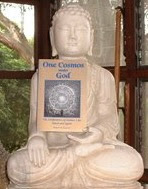
A number of readers have mentioned that stumbling upon G.K. Chesterton's Orthodoxy was instrumental to their spiritual coonversion. It is one of the many books I raced through in the course of writing my own book. Only after the book was published was I able to go back and reread the ones that seemed particularly deep and important, such as Meditations on the Tarot, which I've now read from cover to cover three or four times.
I don't remember when I read Orthodoxy, but it must have been about seven or eight years ago. It didn't make a huge impression on me at the time, probably for a couple reasons. First, it's not at all systematic, almost a sort of free-association. But now I can see that this is a big part of its charm. The man would have been a great blogger, if that's not too vulgar a compliment.
Second, it's not outwardly "mystical" or "esoteric," but I've subsequently come to understand that this is a superficial complaint (if that's even the right word). As Schuon emphasizes, Christianity is already an esoterism; to be precise, it is an esoterism masquerading as an exoterism. It's a profound mystery, but unlike, say, the Greek mysteries, it divulges the mystery at the outset rather than making you patiently work your way up through the various degrees of initiation until, say, like Petey, you finally become Grand High Exalted Mystic Ruler of the West San Fernando Valley Chapter of the Transdimensional Order of the Friendly Sons and Daughters of the Cosmic Raccoon, and then you're finally handed the key to the inner sanctum where they store the sacred Water Balloons.
As Chesterton writes (with my symbols inserted into the text), "The whole secret of mysticism is this: that man can understand everything (O) by help of what he does not understand (o), (---). The morbid logician (•) seeks to make everything lucid (k), and succeeds in making everything mysterious, ø. The mystic allows one thing to be mysterious (O), and everything else becomes lucid (¶)."
Since I've been pretty busy with the mishpocha (they just left on Monday), I gave my new intern, Dupree, the task of outlining the book and helping me reduce it to a post or two. He's a rather slow reader (I can see his lips moving), so he's only about halfway through, but I think we have enough to work with.
Although the book was published in 1908, what is so immediately striking about it is how fresh and coontemporary it is. Not surprisingly, Dupree is most impressed with Chesterton's pungent and witty eviscerations of his ideological opponents. Many of the names mean nothing to us now, but you can get the gist by simply inserting a contemporary name that will mean nothing in the future, such as "Dennett," "Dawkins," or "Maher." As Dupree put it, the book has surprisingly high insultainment value.
It is perhaps critical to point out that Chesterton came of age at the very peak of 19th century atheistic scientific materialism, before that philosophy had been thoroughly discredited. It was widely believed by most intellectuals at the time that science had discovered not just the secret of reality, but the secret of human happiness and progress.
That didn't really begin to change until after the trauma of World War I, which obliterated the fantasy (except among leftists) of a perfectible mankind grounded in the application of pure reason. The primitive unconscious came roaring back with a vengeance, just as it did after our historical snooze between 1989 and 2001. But instead of learning their lesson and returning to the Christian roots of the West, post-war intellectuals lurched into existentialism, romanticism, Marxism, scientism, paganism, nationalism, deconstructionism, multiculturalism, fascism, new-age "realizationism," and other weird and/or sinister isms and ologies -- anything but Orthodoxy (and by "Orthodox," Chesterton simply means the Apostles' Creed).
Now, being that I am someone who, like Chesterton, explored and eventually rejected all of the philosophical and spiritual cul-de-slacks of his day, I think I understand why. It has to do with the distinctions between O, (k), and (n), as outlined in my book.
I'm guessing that most people who read the book will be mystified by these symbols, but they are critical to my whole mission and enterprise. To put it in a nutshell, you can hand someone the Apostles' Creed on a silver platter, but unless they have a personal experience of its interior truth, i.e., O-->(n), it's not going to form the basis of a very robust belief system. I mean, I went to Sunday School. I was dutifully presented with the ground-floor Truth of Western civilization. And yet, like Chesterton I rejected it in favor of all the "idiotic ambitions" of our day: "I did, like all other solemn little boys, try to be in advance of the age. Like them I tried to be ten minutes in advance of the truth. And I found that I was eighteen hundred years behind it."
Chesterton coonfesses that he too tried "to be original; but I only succeeded in inventing all by myself an inferior copy of the existing traditions of civilized religion.... I did try to found a heresy of my own; and when I had put the last touches to it, I discovered that it was orthodoxy."
Now, I too briefly considered founding a heresy of my own. But like Chesterton, I eventually discovered that it was both wholly unnecessary and unholy narcissary. However, the operative word is discovered. Again, the whole point is that this is something that must be discovered for oneself. On the other hand, the discovery could have been made much sooner if I hadn't been brainwashed with so much nonsense during the course of some 23 years of secular miseducation. All of that had to be systematically dismantled in order to make a space for the (re)discovery of truth.
As I mentioned the other day, Schuon maintains that the world would be a better place if we could somehow return to the Middle Ages -- for he believes that even the Renaissance was a huge mistake and disaster -- and go back to a time when everyone was tightly swaddled in primordial Truth, and that was it. No one was actually free to discover it, which is to say, decide for oneself.
But in my view, man, because of his very theomorphic nature, has a built-in epistemophilic instinct that is responsible for leading him to science, reason, and humanism. And because these were "discoveries," they ended up being more "robust" -- at least for a time -- than the top-down religious ideologies they displaced.
But time marches (or spirals) on, and in subsequent centuries scientism has come full circle and now become the new orthodoxy, so it is no longer "free" to discover reality. So now, if you wish to investigate the Real, you must "rebel" against materialism, just as the early materialists had to rebel against religious orthodoxy.
This again goes to my point that the only way to make religious truth truly "secure" is through O-->(n), because once you do so, the arguments of atheists and materialists are "so much straw," not so much wrong as just irrelevant. No blind man is going to tell me that I don't see what I can see with my own eyes. As Schuon says, myopia and blindness are not just diverse ways of looking, but defects of vision. Scientism, materialism, and reductionism all elevate a terrible disability to a virtue.
But even Schuon, despite his insistence upon eternal truth, implicitly allows for the theological jazz improvisation of O-->(n). As he put it, "it is by reestablishing links with ancient truth that one comes to understand it and to find a new and spiritually legitimate originality." Chesterton says much the same thing when he writes of man's need of an "active and imaginative life, picturesque and full of poetical curiosity." Therefore, a proper theology should engage man's imagination and allow him to play theological soul jazz -- which requires the greatest discipline accompanied by the absence thereof, of simultaneous remembrance and I-amnesia. This is what Chesterton calls a life of "practical romance,"
the combination of something that is strange with something that is secure. We need so to view the world as to combine an idea of wonder and an idea of welcome.
Now, scientific materialism creates a sort of deadened cognitive security that moves in such a narrow circle that it simultaneously explains everything and nothing. But religious dogma can do the same thing, for as Chesterton points out, just as the danger of science is a "narrow universality," the danger of religion can be "a small and cramped eternity."
The trick is to make the Cosmos as large as the World -- to re-divinize both Cosmos and Man, so that the former becomes a sacred space, or place of active rest and restful activity, for man's infinite intelligence and eternal soul. This is the ongoing task of a Raccoon.
Showing posts sorted by relevance for query Chesterton orthodoxy. Sort by date Show all posts
Showing posts sorted by relevance for query Chesterton orthodoxy. Sort by date Show all posts
Wednesday, November 21, 2007


Monday, November 26, 2007
Lunacy and Solvation in the Cosmic Funhouse
Thoroughly worldly people never understand even the world; they rely altogether on a few cynical maxims which are not true. --G.K. Chesterton, Orthodoxy
Some additional murmurandoms on this book...
It is a truism that the psychospiritual left is the cult of weirdos -- of misfits, the alienated, the bitter, the troubled, the unhappy, the envious, the reflexively treasonous, the generally abnormal (in the sense of celebrating their deviation from the real human ideal). Chesterton offers some insight as to why these people also tend to be secular, since they are too preoccupied with their externalized concerns to focus on reality.
Furthermore, they reject the idea of "original sin" while implicitly believing that our falleness is susceptible to political remedy. In short, politics is their substitute religion through which they hope to heal their own spiritual alienation by means of political action. As such, they miss out on the true oddness of reality, for "Oddities do not strike odd people. This is why ordinary people have a much more exciting time; while odd people are always complaining about the dulness of life."
Chesterton discusses the irrational folly of trying to comprehend the world with reason alone. Polanyi recognized the same thing, but spelled it out in a more systematic way, showing how every act of perception is an imaginative leap of irreducible creativity. As Chesterton writes, "poetry is sane because it floats easily in an infinite sea," but "reason seeks to cross the infinite sea, and so to make it finite.... The poet asks to get his head into the heavens. It is the logician who seeks to get the heavens into his head. And it is his head that splits."
And why is it so difficult to have a rational discussion with these hyper-rational people? For the simple reason that their minds are not impeded by the distraction of reality. Think of a watch dog. The reason why a dog can be so effective at guarding your property is that it can exclude everything irrelevant to the task. Similarly, "The madman's explanation of a thing is always complete, and often in a purely rational sense satisfactory," but at the cost of moving "in a perfect but narrow circle."
This foreshadows Gödel's theorems, which proved that a formal system can be complete or consistent, but not both. Thus, the end result of atheistic scientism is "a combination between a logical completeness and a spiritual contraction" -- which is why all these atheistic popularizers amount to much ado about everything. By definition, the more they explain, the more they leave out.
As Chesterton points out, the atheist's metaphysic "explains a large number of things" but not "in a large way." But it's difficult to oppose this "insane simplicity," since it requires not so much "arguing with a philosopher" as "casting out a devil." Such a person doesn't need more arguments but more air, which is to say, more breathing room outside the monomaniacal suffocation of their one Big Idea. This idea is actually a trap, a snare, a "clean, well-lit prison," a disability turned into a virtue. Oh, but
How much happier you would be, how much more of you there would be, if the hammer of a higher God could smash your small cosmos, scattering the stars like spangles, and leave you in the open, free like other men to look up as well as down!
For that is what a human being is: situated halfway between the stars above and the dust below -- or between freedom and determinacy, matter and spirit, security and adventure, animal and God, part and whole, time and eternity. So,
Look up -- look up
And seek your maker
Before Mr. Gabriel blows his horn --Francis Albert
If the world were as simple as the atheist insists it is, not only would it not be worth understanding, but it would be too simple to have ever given rise to understanders. And it is "certainly more limiting than any religion," the reason being that the properly religious person should have no difficulty fitting the entire world of the materialist into his metaphysic, whereas the materialist cannot allow for the merest speck of religion. Hence, their fanaticism.
For example, in my neck of the woods, the ACLU carried out a fanatical campaign to remove a tiny cross from the seal of Los Angeles County. The cross had been there for some 50 years, and no one had even noticed it before, much less taken it to be an endorsement of a state religion, but there you go. By definition, any reminders of religion must be effaced in order to make the victimized atheist feel comfortable in their narrow fantasy world.
Are there religious people who think and behave like atheists? Of course. But this is not because of religion; rather, the opposite. It is generally because of their materialism -- for example, insisting on a literal reading of Genesis, for what could be more materialistic than that? Thus, as usual, extremes meet: like the religious literalist, "the materialist's world is quite simple and solid.... materialists and madmen never have doubts."
Real spiritual doctrines do not limit the mind, but allow it to soar, while materialistic prose just makes your aesthetic sensibilities sore. I can't imagine how boring the world would be if I were still trapped behind those bars. Even if God couldn't be proven, I would still be a believer, if only because it's so much more fun:
"Mysticism keeps men sane. As long as you have mystery you have health; when you destroy mystery you create morbidity." The spiritual person situates a Mystery -- O -- at the heart of his metaphysic, which also happens to coincide with the human heart -- which is to say, the higher mind. This mystery grows, even as we illuminate more of it -- just as a flashlight shined into the night time sky only emphasizes the darkness engulfing the narrow beam.
For in the end, "the one created thing which we cannot look at is the one thing in the light of which we look at everything." We share in the light of that central spiritual sun, which cannot be seen but is that by which we see -- and know. On the other hand, the detached intellectualism of materialism is "all moonshine; for it is light without heat, and it is secondary light, reflected from a dead world."
In a word, lunacy.
Some additional murmurandoms on this book...
It is a truism that the psychospiritual left is the cult of weirdos -- of misfits, the alienated, the bitter, the troubled, the unhappy, the envious, the reflexively treasonous, the generally abnormal (in the sense of celebrating their deviation from the real human ideal). Chesterton offers some insight as to why these people also tend to be secular, since they are too preoccupied with their externalized concerns to focus on reality.
Furthermore, they reject the idea of "original sin" while implicitly believing that our falleness is susceptible to political remedy. In short, politics is their substitute religion through which they hope to heal their own spiritual alienation by means of political action. As such, they miss out on the true oddness of reality, for "Oddities do not strike odd people. This is why ordinary people have a much more exciting time; while odd people are always complaining about the dulness of life."
Chesterton discusses the irrational folly of trying to comprehend the world with reason alone. Polanyi recognized the same thing, but spelled it out in a more systematic way, showing how every act of perception is an imaginative leap of irreducible creativity. As Chesterton writes, "poetry is sane because it floats easily in an infinite sea," but "reason seeks to cross the infinite sea, and so to make it finite.... The poet asks to get his head into the heavens. It is the logician who seeks to get the heavens into his head. And it is his head that splits."
And why is it so difficult to have a rational discussion with these hyper-rational people? For the simple reason that their minds are not impeded by the distraction of reality. Think of a watch dog. The reason why a dog can be so effective at guarding your property is that it can exclude everything irrelevant to the task. Similarly, "The madman's explanation of a thing is always complete, and often in a purely rational sense satisfactory," but at the cost of moving "in a perfect but narrow circle."
This foreshadows Gödel's theorems, which proved that a formal system can be complete or consistent, but not both. Thus, the end result of atheistic scientism is "a combination between a logical completeness and a spiritual contraction" -- which is why all these atheistic popularizers amount to much ado about everything. By definition, the more they explain, the more they leave out.
As Chesterton points out, the atheist's metaphysic "explains a large number of things" but not "in a large way." But it's difficult to oppose this "insane simplicity," since it requires not so much "arguing with a philosopher" as "casting out a devil." Such a person doesn't need more arguments but more air, which is to say, more breathing room outside the monomaniacal suffocation of their one Big Idea. This idea is actually a trap, a snare, a "clean, well-lit prison," a disability turned into a virtue. Oh, but
How much happier you would be, how much more of you there would be, if the hammer of a higher God could smash your small cosmos, scattering the stars like spangles, and leave you in the open, free like other men to look up as well as down!
For that is what a human being is: situated halfway between the stars above and the dust below -- or between freedom and determinacy, matter and spirit, security and adventure, animal and God, part and whole, time and eternity. So,
Look up -- look up
And seek your maker
Before Mr. Gabriel blows his horn --Francis Albert
If the world were as simple as the atheist insists it is, not only would it not be worth understanding, but it would be too simple to have ever given rise to understanders. And it is "certainly more limiting than any religion," the reason being that the properly religious person should have no difficulty fitting the entire world of the materialist into his metaphysic, whereas the materialist cannot allow for the merest speck of religion. Hence, their fanaticism.
For example, in my neck of the woods, the ACLU carried out a fanatical campaign to remove a tiny cross from the seal of Los Angeles County. The cross had been there for some 50 years, and no one had even noticed it before, much less taken it to be an endorsement of a state religion, but there you go. By definition, any reminders of religion must be effaced in order to make the victimized atheist feel comfortable in their narrow fantasy world.
Are there religious people who think and behave like atheists? Of course. But this is not because of religion; rather, the opposite. It is generally because of their materialism -- for example, insisting on a literal reading of Genesis, for what could be more materialistic than that? Thus, as usual, extremes meet: like the religious literalist, "the materialist's world is quite simple and solid.... materialists and madmen never have doubts."
Real spiritual doctrines do not limit the mind, but allow it to soar, while materialistic prose just makes your aesthetic sensibilities sore. I can't imagine how boring the world would be if I were still trapped behind those bars. Even if God couldn't be proven, I would still be a believer, if only because it's so much more fun:
"Mysticism keeps men sane. As long as you have mystery you have health; when you destroy mystery you create morbidity." The spiritual person situates a Mystery -- O -- at the heart of his metaphysic, which also happens to coincide with the human heart -- which is to say, the higher mind. This mystery grows, even as we illuminate more of it -- just as a flashlight shined into the night time sky only emphasizes the darkness engulfing the narrow beam.
For in the end, "the one created thing which we cannot look at is the one thing in the light of which we look at everything." We share in the light of that central spiritual sun, which cannot be seen but is that by which we see -- and know. On the other hand, the detached intellectualism of materialism is "all moonshine; for it is light without heat, and it is secondary light, reflected from a dead world."
In a word, lunacy.
Thursday, September 25, 2014
Why are Feminists Such Pussies?
We are batting around this idea of a Cosmic Orthodoxy. If there were a Cosmic Orthodoxy -- a correct way to think and to act -- life sure would be less complicated, wouldn't it? We could just get on with it, instead of having to take time out of our day to battle the follies of liberalism and other cosmic heresies -- although I suppose it must be conceded that the heretics among us do unwittingly serve one purpose, in that they provide us with dense objects against which to burnish our sacred pliers with the blowtorch of love.

I suppose the rock bottom principle underlying the possibility of a Cosmic Orthodoxy would be one, i.e., one human nature and one truth which discloses itself in both material and immaterial reality.
In our quantitative age we seem to have no trouble agreeing that this is the case on the lower planes -- e.g., physics and chemistry -- because few people argue for a multicultural approach to these disciplines (although, to be sure, there are a few in every cloud).
Then again, these same people would disagree that these planes are "lower," since they reject verticality a priori. Thus, to the extent that reality exists, they would insist that it is physical, or electrochemical, or genetic, or what have you -- anything, so long as it isn't human, let alone divine (however, as we shall see, those latter two categories always manage to slip in through the backdoor).
Now, to even perceive the simplest object is to participate in transcendent oneness, otherwise perception would consist in perceiving only an atemporal formless blob with no outlines or divisions -- not even the self-evident distinction between the senses and the intellect.
True, our unaided senses would essentially reveal the murky contours of a blob, but the mind never actually stops there. Even infants learn almost right away that they live in a sea of objects, not just a sea. In other words, they are liberated into and then out of the senses -- and thus ushered into the world of transcendence -- as a birthright (unless something goes catastrophically wrong, as in severe autism or early tenure).
But for a human being, "unaided senses" is very much like the fanciful notion of an "unrelated person." In truth -- and this would be another element of cosmic orthodoxy -- humans are irreducibly intersubjective, meaning that they are members of one another from the ground up. For me, this is a reflection of Trinity (the ultimate metacosmic principle) in man, the microcosmos.
But this intersubjectivity also applies to the nonhuman world. In other words, we are thoroughly entangled with the world, which is precisely why we can truly know it. If this weren't the case, then we would indeed be trapped in Kant's phenomenal world, i.e., in the forms of our sensibility.
Chesterton provides a vivid analogy, writing that it would be as if all knowledge were nothing more than pictures we paint on the inside of our windows, and then mistake for the landscape outside the house.
Yes, Kantianism really is that stupid -- and infertile, since it is impossible for the intellect to mate with reality. Rather, it can only mate with its own images, which is to say, engage in cognitive onanism and call it truth.
This is very much like devoting one's sexual energy to pornography and calling it love. But self-love is an oxymoron. Love is other-directed, beginning in God. Thus, it is important to be lovable, so as to be worthy of the love received. Self-love bypasses this trinitarian circuit. The narcissist's soulmate is himself. Nice to know Obama has found his.
One of our cosmic principles is, of course, that the ultimate reality is not substance but person; or, one might say that the ultimate substance is a dynamic threeness, not any kind of isolated monad. The moment you think about this, it is soph-evident.
To cite one obvious and all-pervading example, there is the knower; there is the known; and there is knowledge. Like the Trinity, these are distinct but not radically divided from one another, or we couldn't really know anything. Rather, we would again be confirmed old bachelors consoling ourselves with mental masturbation, like Kant.
Thus, as Chesterton said -- but I will shout for emphasis -- "SAINT THOMAS AQUINAS WAS ONE OF THE GREAT LIBERATORS OF THE HUMAN INTELLECT"! How? Well, for starters, he liberates us into reality. I was reminded of this yesterday in viewing this short video on feminism. Think of the cosmic irony: the most self-styled "liberated" women in history are voluntarily enslaved to a masturbatory ideology!
Now, the Raccoon believes that if you are going to submit to an ideology, then make it a fun one, not a grim, resentful, joyless, and embittered one, right?
If Kant is right and perception is reality -- or the only reality we can know -- then at least perceive something pleasant, dammit! Besides, as alluded to above, your prime directive is to be lovable, not to imagine that you will finally love yourself if only men stop controlling your pathetic life. There is a reason feminists are unloveable and therefore filled with so much anger and resentment.
They are also weak-willed pussies. I mean, why the reliance on patriarchal government to somehow rid the world of patriarchy? Putting a woman in the White House will be every bit as effective in promoting female happiness as Obama has been in making blacks so deliriously happy. It will only highlight the fact that the state can't cure your misery.

source: Happy and not embittered Acres
Wednesday, September 24, 2014
Cosmic Heresies and their Alternative
In the Aristotle/Thomist tradition, the function of the intellect is to essentially identify form in substance -- to "pull" universals out of particulars, or knowledge from the senses; it is what allows us to see any dawg and immediately know he is a member of the category "Clinton."
It seems to me that Chesterton is trying to do something similar in his book on Thomas Aquinas, only on a much higher level: that is, pull the essence of Thomas himself from his sprawling corpus, which most of us would have neither the time nor brains to assimilate. Etienne Gilson remarked that he had spent his life studying and writing about St. Thomas, and now a journalist comes along and "writes a better book about him than I have!"
This idea of a simple essence -- or essential simplicity -- appeals to me, for reasons alluded to in yesterday's post: I have this sense that things can't be as complicated as scholars make them out to be, and that deep down there must be a simple explanation for It All -- or at least a simple approach to it, and that so many arguments between scholars are at the margins of reality, not at the center. (And I mean scholars within tradition; those outside tradition are each arguing from their own manmade centers, so there is no hope for them.)
Yesterday I read that Charles Hartshorne once planned on writing a book to be called The Universal Orthodoxy. I'm kind of glad he never got around to it, because I am definitely going to steal that title if I ever write another book. Frankly, I've been looking everywhere for that title, so I am relieved to have finally found it. Cosmic Orthodoxy would work just as well.
Now, in order to write it, I will have to do for me what Chesterton did for Aquinas: extract the essence without making me look like a simpleton. But the idea of a Universal Orthodoxy would follow from the principle that there is a Universal Man, or that man exists.
Remember, a nominalist doesn't believe in the existence of universals, so there is no category of man, only individual human beings. Thus, once you take a single step down that path, there is no possibility of universality, of a metacosmic key to unlock the damn world enigma. And in rejecting Thomas, the world stepped right on to that path.
With one exception: mathematics. Mathematics is clearly universal, although there are no doubt feminists and professors of black studies who would insist that math is gendered or that the white man's numbers are privileged. But we give those people Ph.D.s to humor them and make them go away, not because we take them seriously. Everyone else knows that math is math, and that there's not a damn thing we can do about it (notwithstanding liberals who abuse math and statistics to prove anything; the fact that they bother to misuse math is a kind of backhanded respect for its authority).
Math is all well and good, but no one has ever -- or will ever -- be able to use it to create a cosmos. In other words, let's say that physicists eventually find a way to resolve the four fundamental forces into one simple equation. Remember, the equation is abstracted from reality. You cannot reverse imagineer the thing, and magically produce reality from the equation.
It seems to me that this is something those atheistic devotees of science always forget: that science is about reality, not reality itself. Reality Itself always transcends science, obviously. It is an Inexhaustible Mystery, which we mean quite literally.
For what is a mystery? Rizzi speaks for us in defining it as "an area of reality so intelligible that we can never understand it all." So to say "reality is a mystery" is not some kind of evasion or mystagoguery, but an objective principle, indeed, one of the First Unavoidable Principles of Cosmic Orthodoxy.
In this sense, reality -- or being -- is not a puzzle to be solved but a mystery to be enjoyed. True, there can be annoying mysteries, like, for example, "Why do we tolerate the IRS?," but that's not a true mystery, because there is a rational explanation, no matter how irrational.
But real mystery flows from the inexhaustible intelligibility of being. Notice that the essence of scientism is to imagine it possible to contain this mystery in science, which usually comes down to math -- the notion that quality can be reduced to quantity, semantics to syntax, subject to object. Thus, these dweebs must feel that reality is some kind of annoying mystery, like the IRS.
For, you see, nominalism -- which is a cosmic heresy -- is nevertheless, like all heresies, a partial truth. This is most relevant in the study of human beings. The fact that we can say "human being" means that man may be reduced to a universal category.
However, the fact that each soul is unique means that every man escapes -- transcends -- category. Or in other words, that each man is an inexhaustible mystery, analogous in this way to the God who birthed him and to the Being that nourishes him.
Which is also why leftism is a cosmic heresy -- well, there are actually a number of reasons why, but in this case because its first principle is to sacrifice the individual for the group, and thus hack away at man's very reason for being; for if man isn't a significant other, he is an absurd and insignificant unit of the state.
Not much time this morning... to be continued...
Tuesday, November 27, 2007
Life Amidst the Postmodern Ruins
Another post or two about Orthodoxy before we move on. This was another "speed post," so forgive any typos or other infelicities of language....
I was very impressed with how Chesterton, although writing in 1907, had already diagnosed the pathologies of the left. In fact, his ideas mirror exactly what Polanyi wrote some 50 years later about the "moral inversion" of the left, i.e., the dangerous combination of radical skepticism and an unhinged, ruthless moral perfectionism unbound from tradition.
Chesteron writes of the socialist that although he may have a "large and generous heart," it is "not a heart in the right place." And only a human being can have a heart dangerously set in the wrong location. It generally occurs "when a religious scheme is shattered" as a result of their intense skepticism. When this happens, "it is not merely the vices that are let loose." Rather, "the virtues are let loose also; and the virtues wander more wildly, and the virtues do more terrible damage." Just because someone has a moral code, it hardly means that they are moral.
I have written a number of posts on the dynamics of this pathological process, which I thought that Polanyi had been the first to recognize. But Chesterton also writes of how "the modern world is full of the old Christian virtues gone mad. The virtues have gone mad because they have been isolated from each other and are wandering alone." Most every destructive policy put into place by the left can be traced to some Christian virtue gone mad -- i.e., feed the hungry, so steal from "the rich" and call it "giving," or defending abortion on the basis of the sanctity of "liberty," or encouraging every manner of deviancy under the guise of "tolerance." They have the bizarre idea that it is "easier to forgive sins" if "there are no sins to forgive" -- except for the sin of believing they exist.
Or the leftist might extract and focus upon a single virtue to the exclusion of others, which creates a dangerous imbalance, for example, "a merely mystical and almost irrational virtue of charity." John Edwards' campaign is based almost solely upon this idea, but again, what he calls "charity," the rest of us call coercion. And boundless charity in the absence of any obligation on the part of the recipient is a recipe for anthropological disaster.
Schuon would agree with Chesterton that the leftist is "really the enemy of the human race -- because he is so human." Of all the animals, only a human being can sink beneath himself -- and even beneath the animals. And he does so primarily by imagining that an animal is all he is, for when human intelligence is in the service of animal instinct, the result is hell on earth -- and bear in mind that Chesterton was writing before the great atheistic movements of the 20th century -- the Soviet Union, Nazi Germany, Communist China, et al, so he clearly grasped the principle before it actually played out in history.
And Chesterton could prophecize in this manner because he could see directly into the "principial" world of timeless truth embodied in revelation. Again, revelation instantiates metaphysical truths with which it is possible to "think beyond the surface," both in space and in time, interior and exterior. Thus, unlike postmodernists who believe that "perception is reality," he writes that "man was meant to be doubtful about himself, but undoubting about the truth; this has been exactly reversed. Nowadays the part of a man that a man does assert is exactly the part he ought not to assert -- himself." This leads to the erosion of universality and the elevation of particularity to the ultimate -- which quickly devolves into nihilism.
Conversely, the part that a man doubts "is exactly the part he ought not doubt -- the Divine Reason." But this inversion obviously persists -- indeed, it is practically the fault line that runs between left and right -- and is responsible for a range of pathological ideas, from multiculturalism, to moral relativism, to the belief in "self esteem," to reducing standards in general to achieve some preconceived end.
The left also practices a "false humility." After all, it can sound like a plea for humility when the postmodern multiculturalist asks, "who am I to say that I can possess the truth, or that one culture is better than another?" But this attitude is a "more poisonous humility than the wildest prostrations of the ascetic." That is -- and this is apparently a subtle point, so listen closely -- "The old humility was a spur that prevented man from stopping; not a nail in his boot that prevented him from going on. For the old humility made a man doubtful about his efforts, which might make him work harder. But the new humility makes a man doubtful about his aims, which will make him stop working altogether."
This is one of the reasons that the left habitually attacks motives instead of substance, for they first undermine the idea that you can know anything objectively, and then insist that the purpose of knowledge is domination and oppression anyway. For the last several years, "job one" of of the left has been to make us doubtful of our aims in Iraq, in the hope that we will simply become demoralized and surrender.
But they do this so selectively that it is mind-boggling. For example, surely there was more credible evidence that Saddam had WMD than that the earth is undergoing catastrophic manmade warming. But in both cases, their main argument is that people who disagree with them have venal motives. In the case of President Bush, he really wanted to invade Iraq because he thought it would somehow enrich his already wealthy "friends." And in the case of global warming, those who reject the theory are simply on the payroll of Bush's wealthy friends. So for all practical purposes, humility is not possible on the left, since their conspiratorial form of thought means that they always have the answer. And it sounds humble to the stupid, since they are always opposed to the intrinsically racist-sexist-homophobic America.
So, just as the left engages in the moral inversion of detaching virtue from tradition, they engage in a weird "cognitive inversion" that combines "intellectual helplessness" with a kind of monstrously arrogant omniscience. This is how you can spend some $100,000 plus on an elite university education, only to learn that truth doesn't exist and we possess it.
Once again, Chesterton was a prophet with regard to the problem of the "tenured radicals" who have hijacked our higher educational system: "The peril is that the human intellect is free to destroy itself. Just as one generation could prevent the very existence of the next generation, by all entering a monastery or jumping into the sea, so one set of thinkers can in some degree prevent further thinking by teaching the next generation that there is no validity in any human thought." How did he know about the narcissistic boomers 40 years before the first one was born?
Chesterton writes that "there is a thought that stops thought. That is the only thought that ought to be stopped." It is the thoroughly irrational thought that our thoughts have no relationship to reality and that truth is therefore inaccessible to human beings. This radical skepticism was "the ultimate evil against which religious authority was aimed," which is why, "in so far as religion is gone, reason is going. For they are both of the same primary and authoritative kind. They are both methods of proof that cannot themselves be proved. And in the act of destroying the idea of Divine authority we have largely destroyed the idea of that human authority by which we do a long-division sum. With a long and sustained tug we have attempted to pull the mitre off pontifical man; and his head has come off with it."
For if the converse were true -- i.e., the blind materialism of natural selection -- "it does not destroy religion but rationalism," for it nullifies the mind that can know truth. It is the equivalent of "I am not; therefore I cannot think."
Thus, "it is vain for eloquent atheists to talk of the great truths that will be revealed if once we see free thought begin." For we have already seen the effects of this gloriously unbound, "free" thought, since the results are strewn all around us. Indeed, we must try to get through the day -- and our lives -- by making our way through its ruins.
I was very impressed with how Chesterton, although writing in 1907, had already diagnosed the pathologies of the left. In fact, his ideas mirror exactly what Polanyi wrote some 50 years later about the "moral inversion" of the left, i.e., the dangerous combination of radical skepticism and an unhinged, ruthless moral perfectionism unbound from tradition.
Chesteron writes of the socialist that although he may have a "large and generous heart," it is "not a heart in the right place." And only a human being can have a heart dangerously set in the wrong location. It generally occurs "when a religious scheme is shattered" as a result of their intense skepticism. When this happens, "it is not merely the vices that are let loose." Rather, "the virtues are let loose also; and the virtues wander more wildly, and the virtues do more terrible damage." Just because someone has a moral code, it hardly means that they are moral.
I have written a number of posts on the dynamics of this pathological process, which I thought that Polanyi had been the first to recognize. But Chesterton also writes of how "the modern world is full of the old Christian virtues gone mad. The virtues have gone mad because they have been isolated from each other and are wandering alone." Most every destructive policy put into place by the left can be traced to some Christian virtue gone mad -- i.e., feed the hungry, so steal from "the rich" and call it "giving," or defending abortion on the basis of the sanctity of "liberty," or encouraging every manner of deviancy under the guise of "tolerance." They have the bizarre idea that it is "easier to forgive sins" if "there are no sins to forgive" -- except for the sin of believing they exist.
Or the leftist might extract and focus upon a single virtue to the exclusion of others, which creates a dangerous imbalance, for example, "a merely mystical and almost irrational virtue of charity." John Edwards' campaign is based almost solely upon this idea, but again, what he calls "charity," the rest of us call coercion. And boundless charity in the absence of any obligation on the part of the recipient is a recipe for anthropological disaster.
Schuon would agree with Chesterton that the leftist is "really the enemy of the human race -- because he is so human." Of all the animals, only a human being can sink beneath himself -- and even beneath the animals. And he does so primarily by imagining that an animal is all he is, for when human intelligence is in the service of animal instinct, the result is hell on earth -- and bear in mind that Chesterton was writing before the great atheistic movements of the 20th century -- the Soviet Union, Nazi Germany, Communist China, et al, so he clearly grasped the principle before it actually played out in history.
And Chesterton could prophecize in this manner because he could see directly into the "principial" world of timeless truth embodied in revelation. Again, revelation instantiates metaphysical truths with which it is possible to "think beyond the surface," both in space and in time, interior and exterior. Thus, unlike postmodernists who believe that "perception is reality," he writes that "man was meant to be doubtful about himself, but undoubting about the truth; this has been exactly reversed. Nowadays the part of a man that a man does assert is exactly the part he ought not to assert -- himself." This leads to the erosion of universality and the elevation of particularity to the ultimate -- which quickly devolves into nihilism.
Conversely, the part that a man doubts "is exactly the part he ought not doubt -- the Divine Reason." But this inversion obviously persists -- indeed, it is practically the fault line that runs between left and right -- and is responsible for a range of pathological ideas, from multiculturalism, to moral relativism, to the belief in "self esteem," to reducing standards in general to achieve some preconceived end.
The left also practices a "false humility." After all, it can sound like a plea for humility when the postmodern multiculturalist asks, "who am I to say that I can possess the truth, or that one culture is better than another?" But this attitude is a "more poisonous humility than the wildest prostrations of the ascetic." That is -- and this is apparently a subtle point, so listen closely -- "The old humility was a spur that prevented man from stopping; not a nail in his boot that prevented him from going on. For the old humility made a man doubtful about his efforts, which might make him work harder. But the new humility makes a man doubtful about his aims, which will make him stop working altogether."
This is one of the reasons that the left habitually attacks motives instead of substance, for they first undermine the idea that you can know anything objectively, and then insist that the purpose of knowledge is domination and oppression anyway. For the last several years, "job one" of of the left has been to make us doubtful of our aims in Iraq, in the hope that we will simply become demoralized and surrender.
But they do this so selectively that it is mind-boggling. For example, surely there was more credible evidence that Saddam had WMD than that the earth is undergoing catastrophic manmade warming. But in both cases, their main argument is that people who disagree with them have venal motives. In the case of President Bush, he really wanted to invade Iraq because he thought it would somehow enrich his already wealthy "friends." And in the case of global warming, those who reject the theory are simply on the payroll of Bush's wealthy friends. So for all practical purposes, humility is not possible on the left, since their conspiratorial form of thought means that they always have the answer. And it sounds humble to the stupid, since they are always opposed to the intrinsically racist-sexist-homophobic America.
So, just as the left engages in the moral inversion of detaching virtue from tradition, they engage in a weird "cognitive inversion" that combines "intellectual helplessness" with a kind of monstrously arrogant omniscience. This is how you can spend some $100,000 plus on an elite university education, only to learn that truth doesn't exist and we possess it.
Once again, Chesterton was a prophet with regard to the problem of the "tenured radicals" who have hijacked our higher educational system: "The peril is that the human intellect is free to destroy itself. Just as one generation could prevent the very existence of the next generation, by all entering a monastery or jumping into the sea, so one set of thinkers can in some degree prevent further thinking by teaching the next generation that there is no validity in any human thought." How did he know about the narcissistic boomers 40 years before the first one was born?
Chesterton writes that "there is a thought that stops thought. That is the only thought that ought to be stopped." It is the thoroughly irrational thought that our thoughts have no relationship to reality and that truth is therefore inaccessible to human beings. This radical skepticism was "the ultimate evil against which religious authority was aimed," which is why, "in so far as religion is gone, reason is going. For they are both of the same primary and authoritative kind. They are both methods of proof that cannot themselves be proved. And in the act of destroying the idea of Divine authority we have largely destroyed the idea of that human authority by which we do a long-division sum. With a long and sustained tug we have attempted to pull the mitre off pontifical man; and his head has come off with it."
For if the converse were true -- i.e., the blind materialism of natural selection -- "it does not destroy religion but rationalism," for it nullifies the mind that can know truth. It is the equivalent of "I am not; therefore I cannot think."
Thus, "it is vain for eloquent atheists to talk of the great truths that will be revealed if once we see free thought begin." For we have already seen the effects of this gloriously unbound, "free" thought, since the results are strewn all around us. Indeed, we must try to get through the day -- and our lives -- by making our way through its ruins.
Sunday, November 25, 2007
Songs in the Key of Jesus
Having reread Chesterton's Orthodoxy, I can now understand why I wasn't particularly moved by it when I first read it. As I mentioned, it's anything but a systematic defense of the faith, more one man's idiosyncratic account of why he feels that Christianity is the perfect philosophy for him and for the world. But it seems to me that unless you already have a background in theology and metaphysics, you would not find his arguments particularly convincing.
As he points at in the beginning of the book, he tried -- as does any serious person -- to arrive at a comprehensive philosophy, only to realize, when he had completed it, that it already existed in the form of Christian Orthodoxy. I've pretty much had this same experience, allowing for the fact that Christianity is a rather large tent that accommodates virtually all temperaments and levels of intelligence.
This is an important coonsideration, since neither my intellect nor heart or soul could ever "find their rest" in some of the more visible forms of Christianity (which I sometimes think are a conspiracy to make Christianity look foolish). Only by first arriving at my own philosophy and then discovering -- to my surprise -- an antecedent Christian form of the more-or-less identical philosophy was I truly able to have the "ah ha" experience alluded to in a post by Walt a couple of days ago:
"The second assumption is that the Gospel has come down to us from a higher mind than ours. If there is something in it that we do not understand, the difficulty is likely to be in us and in our limitations. In attempting to make sense of the text, whenever there is any question about its intelligence, there is no doubt that the Gospel comes from a higher intelligence than ours. Where our best efforts do not yield a satisfactory sense in the Gospel, there is an opportunity for us to listen quietly with humility so that we may hear what we are not accustomed to hear."
I suppose it's similar to what so many adolescents have to go through on the road to separation and individuation -- to regard their parents as clueless idiots until they gain a little real-world experience and eventually realize how wise they were all along. The prodigal son, yada yada blah blah blah. (When I was in graduate school for my MA, I had an annoying female classmate who ended every sentence in that way [this was well before the yada yada Seinfeld episode]. I sometimes wonder how her patients fared: "Sounds like your mother never really understood you, and yada yada blah blah blah.")
The point is, when you keep independently discovering very specific rock-bottom truths, only to learn that others have discovered the same truths, it starts to look as if either human minds are built along the same lines, or else there is an independent but invisible reality that individual minds converge upon. Obviously both must be true, since our minds are made both for and from the truth. If both of these weren't true, then there would be no way for our minds to comport themselves with any truth. In short, our minds are composed of that which they ultimately seek. Which is an example of something I thought I had discovered, only to -- here, let's pick someone at random, say, Origen:
"The apostle Paul teaches us that God's 'invisible nature' has been 'clearly perceived in the things that have been made'; He shows us that this visible world contains teaching about the invisible world, and that this earth includes certain 'images of celestial realities'.... Perhaps that is what the spokesman of the Divine Wisdom means when he expresses himself in the words: 'It is he who gave me unerring knowledge of what exists, to know the structure of the world and the unerring elements...'"
In other blah blah blah, the inside can only know the outside because the material world is an exteriorization of the same logos which interiorizes itself in the form of human consciousness. Thus, the acquisition of scientific knowledge and of truth in general is completely unproblematic in Christian metaphysics. But ask a thoughtful materialist if materialism is true, and that's the end of his materialism, since matter could never even know of truth, let alone possess it.
And it is because the world is mysteriously bifurcated into this interior and exterior, that life is (or should be, anyway) such an adventure -- adventure being the combination of strangeness and familiarity. Only human beings can be "at once astonished at the world and yet at home in it." If you are fully one or the other, you're really missing out on something vital. If you feel totally at home in the world, then you're more like an animal in the habitat it was selected to fit into. But at the same time, if you were only astonished at the world, you wouldn't be able to function in it. Psychotic people can experience each moment as a calamitous novelty, and the effect isn't pleasant surprise but nameless dread.
I would suggest that if materialism or atheism make total sense to you, it's only because you're walking around with invisible parts of yourself amputated or disfigured in some way. You're living in an environment, but it's not the human environment, which includes the invisible -- which is to say, immaterial -- worlds alluded to above.
For Chesterton, Christianity best realizes this balance of "something that is strange with something that is secure. We need to view the world as to combine an idea of wonder and an idea of welcome. We need to be happy in this wonderland without merely being comfortable." You might say that functional faith operates in the interstices of this dynamic tension between wonder and welcome, security and adventure. It is what spurs our evolution -- which could not occur if we default too far in one direction or the other, i.e., toward radical novelty or complete predictablity.
Once again, I find that jazz improvisation provides the best metaphor for this actvity, since it uses what is known -- the chordal structure of the song -- as a launching pad into the unknown, as the improviser explores the harmonic (vertical) and melodic (horizontal) potential of the chords. In fact, my book was basically an attempt at a sort of "musical performance," starting with the four chords of Matter, Life, Mind, and Spirit. Now, it would be easy enough to say that the latter three chords don't really exist, and that they're all ultimately reducible to the one and only chord of Matter. Can't play much with one chord, but at least you've solved every musical problem known to man. (By the way, you run into the same problem if you reduce the chords to pure Spirit, as do certain eastern philosophies.)
Materialism is a philosophy by the tone deaf and for the tin eared. But as I wrote in the book, if you really want to know reality in its fullness, "it is no longer adequate to be just a materialistic banjo-picker sitting barefoot on a little bridge of dogma; rather, one must have at least a nodding acquaintance with a few other instruments in order to play the cosmic suite. The universe is like a holographic, multidimensional musical score that must be read, understood, and performed. Like the score of a symphony, it can support diverse interpretations, but surely one of them cannot be 'music does not exist.'"
For each of us represents an unrepeatable melodic line that wends itself through the four great chords constituting the song of existence. Some solos are complete and musically satisfying, while others are banal, predictable, and unable to explicate the musical potential hidden in the chords.
I believe Chesterton is saying that for him, Christianity is the ideal accompaniment for this musical adventure we call "life."
As he points at in the beginning of the book, he tried -- as does any serious person -- to arrive at a comprehensive philosophy, only to realize, when he had completed it, that it already existed in the form of Christian Orthodoxy. I've pretty much had this same experience, allowing for the fact that Christianity is a rather large tent that accommodates virtually all temperaments and levels of intelligence.
This is an important coonsideration, since neither my intellect nor heart or soul could ever "find their rest" in some of the more visible forms of Christianity (which I sometimes think are a conspiracy to make Christianity look foolish). Only by first arriving at my own philosophy and then discovering -- to my surprise -- an antecedent Christian form of the more-or-less identical philosophy was I truly able to have the "ah ha" experience alluded to in a post by Walt a couple of days ago:
"The second assumption is that the Gospel has come down to us from a higher mind than ours. If there is something in it that we do not understand, the difficulty is likely to be in us and in our limitations. In attempting to make sense of the text, whenever there is any question about its intelligence, there is no doubt that the Gospel comes from a higher intelligence than ours. Where our best efforts do not yield a satisfactory sense in the Gospel, there is an opportunity for us to listen quietly with humility so that we may hear what we are not accustomed to hear."
I suppose it's similar to what so many adolescents have to go through on the road to separation and individuation -- to regard their parents as clueless idiots until they gain a little real-world experience and eventually realize how wise they were all along. The prodigal son, yada yada blah blah blah. (When I was in graduate school for my MA, I had an annoying female classmate who ended every sentence in that way [this was well before the yada yada Seinfeld episode]. I sometimes wonder how her patients fared: "Sounds like your mother never really understood you, and yada yada blah blah blah.")
The point is, when you keep independently discovering very specific rock-bottom truths, only to learn that others have discovered the same truths, it starts to look as if either human minds are built along the same lines, or else there is an independent but invisible reality that individual minds converge upon. Obviously both must be true, since our minds are made both for and from the truth. If both of these weren't true, then there would be no way for our minds to comport themselves with any truth. In short, our minds are composed of that which they ultimately seek. Which is an example of something I thought I had discovered, only to -- here, let's pick someone at random, say, Origen:
"The apostle Paul teaches us that God's 'invisible nature' has been 'clearly perceived in the things that have been made'; He shows us that this visible world contains teaching about the invisible world, and that this earth includes certain 'images of celestial realities'.... Perhaps that is what the spokesman of the Divine Wisdom means when he expresses himself in the words: 'It is he who gave me unerring knowledge of what exists, to know the structure of the world and the unerring elements...'"
In other blah blah blah, the inside can only know the outside because the material world is an exteriorization of the same logos which interiorizes itself in the form of human consciousness. Thus, the acquisition of scientific knowledge and of truth in general is completely unproblematic in Christian metaphysics. But ask a thoughtful materialist if materialism is true, and that's the end of his materialism, since matter could never even know of truth, let alone possess it.
And it is because the world is mysteriously bifurcated into this interior and exterior, that life is (or should be, anyway) such an adventure -- adventure being the combination of strangeness and familiarity. Only human beings can be "at once astonished at the world and yet at home in it." If you are fully one or the other, you're really missing out on something vital. If you feel totally at home in the world, then you're more like an animal in the habitat it was selected to fit into. But at the same time, if you were only astonished at the world, you wouldn't be able to function in it. Psychotic people can experience each moment as a calamitous novelty, and the effect isn't pleasant surprise but nameless dread.
I would suggest that if materialism or atheism make total sense to you, it's only because you're walking around with invisible parts of yourself amputated or disfigured in some way. You're living in an environment, but it's not the human environment, which includes the invisible -- which is to say, immaterial -- worlds alluded to above.
For Chesterton, Christianity best realizes this balance of "something that is strange with something that is secure. We need to view the world as to combine an idea of wonder and an idea of welcome. We need to be happy in this wonderland without merely being comfortable." You might say that functional faith operates in the interstices of this dynamic tension between wonder and welcome, security and adventure. It is what spurs our evolution -- which could not occur if we default too far in one direction or the other, i.e., toward radical novelty or complete predictablity.
Once again, I find that jazz improvisation provides the best metaphor for this actvity, since it uses what is known -- the chordal structure of the song -- as a launching pad into the unknown, as the improviser explores the harmonic (vertical) and melodic (horizontal) potential of the chords. In fact, my book was basically an attempt at a sort of "musical performance," starting with the four chords of Matter, Life, Mind, and Spirit. Now, it would be easy enough to say that the latter three chords don't really exist, and that they're all ultimately reducible to the one and only chord of Matter. Can't play much with one chord, but at least you've solved every musical problem known to man. (By the way, you run into the same problem if you reduce the chords to pure Spirit, as do certain eastern philosophies.)
Materialism is a philosophy by the tone deaf and for the tin eared. But as I wrote in the book, if you really want to know reality in its fullness, "it is no longer adequate to be just a materialistic banjo-picker sitting barefoot on a little bridge of dogma; rather, one must have at least a nodding acquaintance with a few other instruments in order to play the cosmic suite. The universe is like a holographic, multidimensional musical score that must be read, understood, and performed. Like the score of a symphony, it can support diverse interpretations, but surely one of them cannot be 'music does not exist.'"
For each of us represents an unrepeatable melodic line that wends itself through the four great chords constituting the song of existence. Some solos are complete and musically satisfying, while others are banal, predictable, and unable to explicate the musical potential hidden in the chords.
I believe Chesterton is saying that for him, Christianity is the ideal accompaniment for this musical adventure we call "life."
Monday, March 25, 2024
The Perennial Ideology
Everything that can be reduced to a system ends up in the hands of fools. --Dávila
As often as not the title comes to me before the post. This one is apparently in reference to the perennial philosophy (and religion), the school of thought to which folks like Schuon, Guenon, and Cooomaraswamy belong. For Schuon,
Strictly speaking, there is but one sole philosophy, the Sophia Perennis; it is also -- envisaged in its integrality -- the only religion.
The latter is "the primordial, universal and underlying religion," which comes down to "discernment between the Real and the illusory, or between the Permanent and the impermanent," the practice of which involves an "attachment to the Permanent or to the Real."
Now, the Permanent and the Real are precisely what postmodernism denies, or in other words, it affirms sophistry, Gnosticism, and post-Christian neo-barbarism. And here we are.
Schuon would say that an orthodox religion represents a more or less adequate expression of this a priori and universal one.
I don't disagree -- after all, there is only one Cosmos and one human nature. But what is the the content of this perennial religion? For Schuon, Vedanta is the most adequate expression of it, whereas I am a Trinitarian man, and both can't be true, at least not without some tweaking. Recall Augustine's crack that
that which is known as the Christian religion existed among the ancients, and never did not exist; from the beginning of the human race until the time when Christ came in the flesh, at which time the true religion, which already existed began to be called Christianity.
One way or another, religion conveys an implicit metaphysic that is more or less adequate to the full range of reality. For example, we recently published a post on The Metaphysics of Jesus, which claimed that
one should not be a Christian for any other reason than its truth. Or at least Christianity should be truer than any alternative -- meaning that it should simultaneously explain more than any other metaphysic on offer, without unexplaining anything important.
For us, a Trinitarian metaphysic accounts for a lot of things that the non-Trinitarian must yada yada over, in particular, relation, which turns out to be irreducible to anything less.
Conversely, a radical monist framework is static, immutable, impersonal, and unrelated. As we've suggested before, this is a Greek import that cannot be easily reconciled with a Trinitarian metaphysic.
For Schuon, the first principle is Beyond-Being. But Guess What? It is actually related to Being. He would say that Being is an emanation of Beyond-Being, but we say the Relation between them is the indispensable Thing.
If we're in an adventurous mood, we might even say that Father and Son is a way of speaking of Beyond-Being and Being, respectively -- or generative Source and engendered Word, Origination and Procession, Begetter and Begotten. This originating Source never stops speaking the Word it has always spoken, which speaks to their eternal relation.
God from God, Light from Light,
true God from true God,
begotten, not made, consubstantial with the Father;
through him all things were made.
From, through, and begotten are all relations, which is why we say that ultimate reality is neither substance nor relation, but substance-in-relation. Am I wrong?
But the title of this post is The Perennial Ideology, so let's deal with that. The first thing that occurs to me is Genesis 3 All Over again, or, in the words of the Aphorist,
The radical error -- the deification of man -- does not have its origin in history. Fallen man is the permanent possibility of committing the error.Yesterday we mentioned Chesterton's Orthodoxy, which puts some flesh on this bony assertion. Where Dávila is a man of few words, Chesterton is a man of many, although liberally sprinkled with aphoristic nuggets such as
Thoroughly worldly people never understand even the world; they rely altogether on a few cynical maxims which are not true.
As mentioned in the previous post,
The madman is not the man who has lost his reason. The madman is the man who has lost everything except his reason.
We also alluded to Gödel's Theorems, which prove that a logical system can be consistent or complete, but not both. Similarly, Chesterton writes of how
The madman's explanation of a thing is always complete, and often in a purely rational sense satisfactory.
However,
his mind moves in a perfect but narrow circle. A small circle is quite as infinite as a large circle; but, though it is quite as infinite, it is not so large. In the same way the insane explanation is quite as complete as the sane one, but it is not so large.Along these lines,
Poetry is sane because it floats easily in an infinite sea; reason seeks to cross the infinite sea, and so make it finite....
the strongest and most unmistakable mark of madness is this combination between a logical completeness and a spiritual contraction. The lunatic's theory explains a large number of things, but it does not explain them in a large way (emphasis mine).
Put another way,
The moment his mere reason moves, it moves in the old circular rut; he will go round and round his logical circle.... He is in the clean and well-lit prison of one idea.... He is without healthy hesitation and healthy complexity.
This is "the combination of an expansive and exhaustive reason with a contracted common sense," for example, vis a vis materialism:
As an explanation of the world, materialism has a sort of insane simplicity. It has just the quality of the madman's argument; we have at once the sense of it covering everything and the sense of it leaving everything out.
He understands everything, and everything does not seem worth understanding. His cosmos may be complete in every rivet and cog-wheel, but still his cosmos is smaller than our world.
Recall what the Aphorist says about one truth and countless errors, each of the latter a philosophical non-starter founded upon principles that reduce to absurdity -- for example, the denial of free will:
It is absurd to say that you are especially advancing freedom when you only use free thought to destroy free will.
More generally,
The man who begins to think without the proper first principles goes mad; he begins to think at the wrong end.
This latter being the human -- or all too human -- end instead of the divine one; or Ø instead of O. Do this long enough, and everyone is living in darkness and tenure:
one set of thinkers can in some degree prevent further thinking by teaching the next generation that there is no validity in any human thought.
Another non-starter is evolutionism, or metaphysical Darwinism:
Evolution is either an innocent scientific description of how certain earthly things came about; or, if it is anything more than this, it is an attack upon thought itself. If evolution destroys anything, it does not destroy religion but rationalism.
This is self-evident: a strictly consistent Darwinism can never even account for the truth of Darwinism, for
it means that there is no such thing as an ape to change, and no such thing as a man for him to change into. It means that there is no such thing as a thing. At best, there is only one thing, and that is a flux of everything and anything. This is an attack not upon the faith, but upon the mind; you cannot think if there are no things to think about. You cannot think if you are not separate from the subject of thought.
This attack on the intellect comes down to a systematic violation of the three rules of thought: the principles of identity, non-contradiction, and excluded middle. It reminds me of the gag that the worse your logic, the more *interesting* the consequences to which it gives rise.
And we live in interesting times.
the most characteristic current philosophies have not only a touch of mania, but a touch of suicidal mania (Chesterton).
Friday, September 19, 2014
The Dreary Pursuit of Pleasure and the Joyful Pursuit of Truth
I've been reading Volume 2 of Chesterton's collected works, which includes The Everlasting Man and his biographies of Saints Francis and Thomas.
Chesterton, along with C.S. Lewis, is of course one of the more enduringly popular Christian apologists. Back in 2007 we devoted a long-forgotten series of posts to his Orthodoxy (1908), which was actually written prior to his being received into the Church. The Everlasting Man (1925) is a post-conversion meditation on some of the same themes.
I find that Chesterton's style of writing takes some getting used to. He is definitely not the most organized thinker, let alone systematic, nor is he concise.
The word "sprawling" comes to mind. Undisciplined. At times we see a kind of back-and-forth between insipid intellectual laziness and inspired poetic energy that sends sparks flying from the page. It almost reads as if it were dictated during a manic episode and then not edited.
A typical paragraph fills a whole page, and he throws in all sorts of then-contemporary references that make no sense to us now, often as targets of good-natured opprobrium. He easily veers into irrelevant tangents, nor can he resist the most formulaic wordplay and cringe-making puns. Furthermore, being that he is essentially a journalist, he has no particular qualifications to bloviate on matters that are best left to highly trained philosophers, theologians, scientists, and metaphysicians.
In short, this man is a Raccoon!
I immediately thought of him this morning when reading this awful story about some goofy kids in Iran being whipped and imprisoned for being goofy kids and having fun. Can you imagine?
No, you cannot. Why? Because you have been Christianized in a civilization that has been slowly leavened by Christian joy for the past two millennia. Indeed, the joylessness of the mullahs resembles nothing so much as the dreadful joylessness of the spiritual gulag of leftism. Neither permits real joy. Where the left differs from Islam is that it not only permits but encourages the joyless pursuit of pleasure, i.e., the daily grind of the hedonic treadmill.
Also, the left won't whip you (yet) for being politically incorrect, just ruin your reputation and career: "Authorities arrested the group for contravening Iran’s strict vulgarity laws, which prohibit public displays of dancing.... The Islamic Republic condemned the video as a 'vulgar clip which hurt public chastity,'" and "the whole group was told they would receive 91 lashes each."
I checked out the video, and it is interesting how their dancing is so charmingly awkward and stiff -- as if they have just been incarnated and are getting used to having bodies. It reminds me of a story I read about 15 years ago, about special classes in Japan where they teach people how to smile.
Now, the music to which they are dancing is African American, and such music could only have arisen in America. The song is quite overtly retro, and sounds like an unreleased Curtis Mayfield tune from the early '70s (Prof. Wiki agrees), back when black music was still joyously liberating instead of angry, repulsive, and animalistic.
The reason why their music was joyous was because it was again leavened with Christian joy. After all, a hundred years ago blacks had much more reason to be miserable than they do today, and yet, that is when gospel music emerged and thrived. You'd think they would have been be as morose as the mullahs, but gospel is the very sound of joy, and virtually all the classic soul singers of the 1960s and '70s were trained in the church (not to mention all of the early fathers of rock, e.g., Elvis, Jerry Lee, Johnny Cash; rock only starts becoming palpably dark in the late 1960s, after being hijacked as the primary means of expression for the cultural left).
After all, Christianity (we're going to leave Judaism to the side, because it is a special case) is quite literally the original liberalism -- liberality of mind, of heart, and of body. This is precisely what set it apart in the ancient world: what in the name of Zeus are these people so damn happy about?
Now, this is not to say that the history of Christianity doesn't reveal the gradual encrustation and suppression of this primordial joy -- after all, we're talking about humans here -- but the joy always breaks through and returns, because that is what Christianity is, essentially. Good news, right? Few writers more effectively convey the sober silliness of this truth than Chesterton.
St. Thomas was, for example, "one of the great liberators of the human intellect." This cannot be emphasized enough, because virtually all the competing philosophies of modernity are enslaving, not liberating. Starting with Descartes and Kant on down, most modern philosophies condemn us to a prison of neurology, or linguistics, or economics, or race, or power, or the unconscious, or what have you. We descend from "the truth sets you free" to "there is no truth, and you're not free to discover it anyway."
Thomas says NO: that you are -- at least potentially -- liberated into the real world, which is both beautiful and intelligible, the very ladder with which we may reascend to the Creator. He brings the good intellectual news that "the senses [are] the windows of the soul and that the reason [has] a divine right to feed upon facts..." It is Thomas who teaches "that Reason can be trusted," whereas "it was the very life of Lutheran teaching that Reason is utterly untrustworthy."
Thus we see a hidden and unappreciated link between this latter tradition and any other modern or postmodern philosophy which denies man the intrinsic right to know What the Hell is Basically Going On. Not the details per se, but just the possibility.
As we have rhetorically asked in the past, why on earth are the people who so denigrate humans called humanists? Thomas and his ilk are the ultimate humanists, in that they insist "on the immense importance of the human being in the theological scheme of things." And when we say "human being," we again mean in all dimensions, body, soul, and intellect. You might say that the body is entitled to joy for the same reason the intellect is entitled to truth and the soul to beauty. God did not create us to starve in a prison of matter or a desert of quantity.
Indeed, "a Christian means a man who believes that deity or sanctity has attached to matter or entered the world of the senses." Thus, the Christian Raccoon is literally the most materialistic of all, just as he is the most humanistic. If Christ is "the miraculous medium between heaven and earth," then matter is infused with the highest principle. Every good scientist knows this, and yet, places an arbitrary limit on his own mind, or sets up a roadblock at the outskirts of logic.
Chesterton's pal Belloc says much the same thing, that "delight in existence itself" is "the highest mark of sanity and and reality." The ephemeral is always bisected by the permanent, and our task is to recognize this perpetual crossroads and know that I AM. It's why we call it The Vertical Church of What's Happening Now.
Saturday, April 17, 2021
Leftists May Have No Consistent Standards, But at Least they're not Hypocrites
For obvious psychopolitical reasons, the following passage from Incompleteness caught my attention:
no validation of our rationality -- of our very sanity -- can be accomplished using our rationality itself.
Thus, there exist millions of people who are completely sane from within their ideological system, but only insane from outside it. We call these lunatics progressives. It's not quite correct to say that they "can't be reasoned with." Rather, they can only be reasoned with -- in the manner described by Chesterton in chapter 2 of Orthodoxy, The Maniac:
The madman is not the man who has lost his reason. The madman is the man who has lost everything except his reason.
Similarly, Goldstein writes that "Paranoia isn't the abandonment of rationality. Rather, it is rationality run amuck, the inventive search for explanations turned relentless." Such a person is "irrationally rational," characterized by "logic run wild."
More cosmic Orthodoxy via Chesterton:
Poetry is sane because it floats easily in an infinite sea; reason seeks to cross the infinite sea, and so make it finite.... The poet only asks to get his head into the heavens. It is the logician who seeks to get the heavens into his head. And it is his head that splits.
Flipping through this maniacal chapter, there are some additional statements that prefigure Gödel:
the strongest and most unmistakeable mark of madness is this combination between a logical completeness and a spiritual contraction. The lunatic's theory explains a large number of things, but it does not explain them in a large way....
His cosmos may be complete in every rivet and cog-wheel, but still his cosmos is smaller than our world (emphasis mine).
One more important observation:
As long as you have mystery you have health; when you destroy mystery you create morbidity.
The normal man "has always cared more for truth than for consistency. If he saw two truths that seemed to contradict each other, he would take the two truths and the contradiction along with them. His spiritual sight is stereoscopic, like his physical sight: he sees two different pictures at once and yet he sees all the better for that."
Note that this stereoscopy isn't so much horizontal as vertical: it requires the recognition of a hierarchy of levels, both on the terrestrial and celestial planes. To reduce the hierarchy to a single level is to guarantee inconsistency and ultimately absurdity. To appreciate hierarchy is to situate things in their proper place.
Contrast this with the ideologue, the man of system, the progressive lunatic. As Goldstein says, "Anything at all can be deduced within an inconsistent system, since from a contradiction any proposition can be derived."
Thus, it is common for conservatives to point out the daily hypocrisies of the left, but this gets us nowhere, since it is utterly beside the point. You can't be a hypocrite if you have no consistent principles. Rather, they would only be hypocrites if they were to deny their hypocritical expediency in service to power.
Leftists May Have No Consistent Standards, But at Least they're not Hypocrites
For obvious psychopolitical reasons, the following passage from Incompleteness caught my attention:
no validation of our rationality -- of our very sanity -- can be accomplished using our rationality itself.
Thus, there exist millions of people who are completely sane from within their ideological system, but only insane from outside it. We call these lunatics progressives. It's not quite correct to say that they "can't be reasoned with." Rather, they can only be reasoned with -- in the manner described by Chesterton in chapter 2 of Orthodoxy, The Maniac:
The madman is not the man who has lost his reason. The madman is the man who has lost everything except his reason.
Similarly, Goldstein writes that "Paranoia isn't the abandonment of rationality. Rather, it is rationality run amuck, the inventive search for explanations turned relentless." Such a person is "irrationally rational," characterized by "logic run wild."
More cosmic Orthodoxy via Chesterton:
Poetry is sane because it floats easily in an infinite sea; reason seeks to cross the infinite sea, and so make it finite.... The poet only asks to get his head into the heavens. It is the logician who seeks to get the heavens into his head. And it is his head that splits.
Flipping through this maniacal chapter, there are some additional statements that prefigure Gödel:
the strongest and most unmistakeable mark of madness is this combination between a logical completeness and a spiritual contraction. The lunatic's theory explains a large number of things, but it does not explain them in a large way....
His cosmos may be complete in every rivet and cog-wheel, but still his cosmos is smaller than our world (emphasis mine).
One more important observation:
As long as you have mystery you have health; when you destroy mystery you create morbidity.
The normal man "has always cared more for truth than for consistency. If he saw two truths that seemed to contradict each other, he would take the two truths and the contradiction along with them. His spiritual sight is stereoscopic, like his physical sight: he sees two different pictures at once and yet he sees all the better for that."
Note that this stereoscopy isn't so much horizontal as vertical: it requires the recognition of a hierarchy of levels, both on the terrestrial and celestial planes. To reduce the hierarchy to a single level is to guarantee inconsistency and ultimately absurdity. To appreciate hierarchy is to situate things in their proper place.
Contrast this with the ideologue, the man of system, the progressive lunatic. As Goldstein says, "Anything at all can be deduced within an inconsistent system, since from a contradiction any proposition can be derived."
Thus, it is common for conservatives to point out the daily hypocrisies of the left, but this gets us nowhere, since it is utterly beside the point. You can't be a hypocrite if you have no consistent principles. Rather, they would only be hypocrites if they were to deny their hypocritical expediency in service to power.
Monday, July 22, 2024
God or Absurdity
Before getting to the crux of the master, I want to highlight a few more passages from Rebecca Goldstein's Incompleteness.
On the one hand, I don't understand why more people don't appreciate Gödel. Then again, if a person or idea isn't helpful to the Matrix, the Matrix is adept at marginalizing or excluding them. There's a reason why logic and economics aren't mandatory in state run schools.
As alluded to in our previous offering, postmodern proglodytes don't mind the Theorems so long as they can twist them to their own absurd ends, i.e., that there is no truth and man can't know it, which ends in power being the arbiter of truth.
However, the existence of math alone proves that some truths are a priori. About these, Goldstein observes that
the mathematician neither resorts to any observations in arriving at his or her mathematical insights nor do these mathematical insights, in and of themselves, entail observations, so that nothing we experience can undermine the grounds we have for knowing them (emphasis mine).
Regarding the italicized passage, wouldn't it be nice if we could say the same of our ultimate theory, or of our theory of the Ultimate?
Indeed, wouldn't it be nice if we were entitled to such an explanation? I don't mean this in any presumptuous way, rather, in the same way mouths are entitled to food, lungs to air, or male to female.
Likewise, the intellect is entitled to truth, hence, the only philosophy worthy of man is a common sense realism that presumes the intelligibility of extra-mental being to our intellect.
Which implies we have a God-given right to reject relativism, subjectivism, materialism, scientism, progressivism, or any other ontologically closed sub-reality.
Along these lines, a few more quick hits from Incompleteness which go to those perennial truths to which we say man is entitled.
And by the way, when we say "entitled," perhaps we should emphasize that this only functions if it is complementary to a deep and abiding humility and even gratitude. Put conversely, deprived of its complementary aspect, our entitlement becomes a cosmically dysfunctional pride and presumption, as colorfully depicted in the events of Genesis 3.
On to the quick hits:
--Mathematicians carry all their gear in their craniums, which is another way of saying that mathematics is a priori.
--Once proved, a theorem is immune from empirical revision.
--Gödel's conclusions are mathematical theorems that manage to escape mathematics. They speak from both inside and outside mathematics.... Our minds, in knowing mathematics, are escaping the limitations of man-made systems, grasping the independent truths of abstract reality.
--They [the theorems] are at once mathematical and metamathematical.... It is as if someone painted... a landscape or portrait that represents the general nature of beauty.
--It is extraordinary that a mathematical result should have anything at all to say about the nature of mathematical truth in general.... mathematical reality must exceed all formal attempts to contain it (emphasis mine).
As to the latter, it is indeed extraordinary that mere quantity should reveal so much about qualities that transcend it.
But how does the seemingly closed system of math escape its own logic and break its own rules? How can 1 + 1 = 3? Or, how does a material cosmos loop around itself in the form of living systems? How does existence turn itself inside out and become experience? How does subjective experience make another loop and begin reflecting upon itself?
How is it that the Loop is not a closed circle but an open spiral? This might be the Question of questions, ultimately coming down to whether the cosmos itself is an open or closed system.
Shifting gears back to the perennial truths of metaphysics, in an essay called Esoterism and Tradition, Laude writes that religious tradition may provide "the best possible approximation on the terrestrial level of a conformity to Reality," even if it begins to fray at the "human margin."
This is because tradition as such involves the attempt to clothe the formless in form. God is -- by definition -- supraformal, but is, in the absence of a terrestrial form, literally unthinkable. Thus,
the form is and is not the essence. The form prolongs the essence but it may also veil it. The essence transcends the form but it also manifests itself through it.
It seems that this is precisely the dilemma Gödel resolves vis-a-vis the theorems. For just as no formal system exhausts reality, "the Divine Essence... transcends all determinations" (Laude). Thus,
We could say, simplifying a little, that exoterism puts the form -- the credo -- above the essence -- Universal Truth -- and accepts the latter only as a function of the former; the form, through its divine origin, is here the criterion of the essence (ibid.).
For Schuon,
Esoterism, on the contrary, puts the essence above the form and only accepts the latter as a function of the former; for esoterism... the essence is the criterion of form; the one and Universal Truth is the criterion of the various religious forms of the Truth.
Now, "Inconsistent systems are of course complete, because we can prove anything at all in them. They're overcomplete" (Goldstein). They simultaneously explain too much and not enough -- or rather, it is precisely in explaining too much that they paradoxically fall short of a complete explanation.
I cited several examples of this phenomenon in a previous post -- Marx, Freud, and Darwin, for example, in explaining everything, end up explaining nothing. But this is what any ideology does: it superimposes a limiting framework on reality, thus confining what is to what the ideology permits us to see (and prevents us from seeing).
Now, if Genesis 3 teaches us anything, it is that man is always tempted to reject transcendent truth in favor of a pride-driven, closed system of idea-olatry. But
no validation of our rationality -- of our very sanity -- can be accomplished using our rationality itself (Goldstein).
Thus, there exist millions of people who are sane from within their ideological system, but only insane from outside it. It's not quite correct to say that such ideologues can't be reasoned with. Rather, they can only be reasoned with -- in the manner described by Chesterton in Orthodoxy:
The madman is not the man who has lost his reason. The madman is the man who has lost everything except his reason.
Similarly, Goldstein writes that "Paranoia isn't the abandonment of rationality. Rather, it is rationality run amuck, the inventive search for explanations turned relentless." Such a person is "irrationally rational," characterized by "logic run wild."
More cosmic Orthodoxy via Chesterton:
Poetry is sane because it floats easily in an infinite sea; reason seeks to cross the infinite sea, and so make it finite.... The poet only asks to get his head into the heavens. It is the logician who seeks to get the heavens into his head. And it is his head that splits.
Chesterton makes some additional observations that prefigure Gödel:
the strongest and most unmistakeable mark of madness is this combination between a logical completeness and a spiritual contraction. The lunatic's theory explains a large number of things, but it does not explain them in a large way....
His cosmos may be complete in every rivet and cog-wheel, but still his cosmos is smaller than our world (emphasis mine).
One more important observation:
As long as you have mystery you have health; when you destroy mystery you create morbidity.
The normal man "has always cared more for truth than for consistency. If he saw two truths that seemed to contradict each other, he would take the two truths and the contradiction along with them. His spiritual sight is stereoscopic, like his physical sight: he sees two different pictures at once and yet he sees all the better for that."
Note that this stereoscopy isn't so much horizontal as vertical: it requires the recognition of a hierarchy of levels. To reduce the hierarchy to a single level is to guarantee inconsistency and ultimately absurdity. To appreciate hierarchy is to situate things in their proper place.
Contrast this with the ideologue, the man of system, the progressive lunatic. As Goldstein says, "Anything at all can be deduced within an inconsistent system, since from a contradiction any proposition can be derived."
Where does this leave us this morning? With a binary choice: the cosmos is either open to something transcending it, or closed within itself. But if it is closed, it can't be. In other words, its presumed completeness will always generate inconsistency. Which is another way of saying God or absurdity.
Friday, October 21, 2022
Honey I Shrunk the Cosmos
Everyone likes it when I bring in Chesterton. Or maybe when I leave out Bob. Like Dávila he was a brilliant aphorist, but the style is quite different.
Where Dávila’s are sharp and implosive, Chesterton's are broad and exuberant; likewise, both are funny, but Dávila is tartly ironic, with a bitter half-smile, where Chesterton is a joyous pie in the face of our pseudo-intellectual betters.
I admit that your explanation explains a great deal, but what a great deal it leaves out!
How much larger your life would be if your self could become smaller in it…
And "How much happier you would be, if the hammer of a higher God could smash your small cosmos,” leaving you “free like other men to look up as well as down!”
Ever notice how debating a progressive or
Curing a madman is not arguing with a philosopher; it is casting out a devil.
I’m old enough to remember when our ideological adversaries exhibited “the combination of an expansive reason with a contracted common sense” instead of an absence of both reason and common sense. It’s Brandon and Fetterman all the way down: Branderwomen.
Like materialism, postmodernism “has a sort of insane simplicity.” Simply accept its first premise and you "have at once the sense of covering everything and leaving everything out.”
As we’ve mentioned before, this is a kind of inverse or inside-out omniscience that literally knows everything about nothing; for it “understands everything, and everything does not seem worth understanding.”
But we'd rather be a small nephesh in a big cosmos than a big macher in a small one.
(Sorry. Couldn’t resist. A macher is just Yiddish for “big shot.” And Nephesh is Hebrew for the soul, describing "a part of mankind that is immaterial, like one's mind, emotions, will, intellect, personality, and conscience” [https://en.wikipedia.org/wiki/Nephesh]).
Excerpt it’s hardly a matter of preference, rather, of 20/∞ insight. Nor -- obviously -- are we talking about the physical cosmos, rather, the whole existentialada, up and down, inside and out, subject and object, vertical and horizontal, celestial and terrestrial, heaven and earth.
In any event, you can’t have a metaphysic that explains the pond while unexplaining the nefesh swimming in it: “if the cosmos of the materialist is the real cosmos, it is not much of a cosmos. The thing has shrunk.”
And the same folks are likely to regard religion as somehow limiting. Which is like calling speech a limitation on animality, or intelligence a limitation on instinct, or natural law a limitation on freedom.
Thomistic realism, because it is the height of sanity and common sense, begins in the senses. However, it differs with materialism in that it doesn’t end there: “The man who cannot believe his senses, and the man who cannot believe anything else, are both insane…”
But what is sanity? What is mental health -- or cognitive or spiritual health?
Easy: the conformity of mind to reality, bearing in mind that reality is not a blob but a hierarchy, so conformity to matter is not conformity to spirit.
Yesterday we spoke of the cosmic circle with concentric circles around the central point (which is not so much dimensionless as beyond dimension). To simplify, we could say that God is at the center surrounded by theology, which is surrounded by metaphysics and philosophy, which is in turn surrounded by science.
Conversely, if matter is at the center, there is no center and no one to know it. We will get back to this subject after we've finished plagiaphrasing Orthodoxy for all it’s worth.
Principles. They do exist, and we are always arguing toward or from them. Problem is, our adversaries argue from implicit and unexamined principles that always reduce to absurdity and contradiction -- for example, that we don’t know what a woman is, except she has a right to choose, except for female babies, who have no choice but to be aborted, for example, if the parents don't want a girl. Whatever that is.
The man who begins to think without proper first principles goes mad; he begins to think at the wrong end.
And let’s not even talk about the women. Since we don’t know what they are.
Above we alluded to 20/∞ insight. Not a joke, man. For the normal man's
spiritual sight is stereoscopic, like his physical sight: he sees two different pictures at once and yet sees all the better for that.
Except it’s actually more than two pictures, as implied by “∞,” which is to say, Infinitude.
There are many ways we can conceptualize this, all the way up to the Principial realm itself, where God has perfect Absolute/Infinite transvision.
Down here it manifests in a variety of ways, such as form/substance, left and right cerebral hemispheres, male/female, spirit and letter. The list is… maybe not infinite, but more than I want to detail here because you get the point, which is that we can’t contain the uncontainable. Nevertheless
The morbid logician seeks to make everything lucid, and succeeds in making everything mysterious.
Which is not to be confused with the proper mystic who “allows one thing to be mysterious, and everything else becomes lucid."
This is literally the case because, as we’ve mentioned before, the very same Principle accounts for the intelligibility of everything even while nothing whatsoever is completely intelligible to man.
Is this post getting too long? I lost track of time. If you did too, then Mission Accomplished.
Subscribe to:
Posts (Atom)
Theme Song