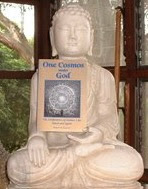
The average man is incapable, not of conceiving the archetypes, no doubt, but of being interested in them; he has need of a myth which humanizes and dramatizes the archetype and which triggers the corresponding reactions of will and sensibility; that is, the average man, or collective man, has need of a god who resembles him. --F. Schuon
Ironically, how much more so does Schuon's statement apply to the godless, whose god is none other than himself!
I once read a remark by Ken Wilber -- I think it was Ken Wilber -- who said words the effect that the people who tend to be the most interested in religion are the brilliant and the dim.
Now, before getting all offended, let us stipulate at the outset that when it comes to intelligence, not everyone is above average. Obviously, half of the population is of below average intelligence. I am hardly an elitist in this area, for there is no correlation whatsoever between intelligence and decency or goodness. There are plenty of smart people -- say, Jimmy Carter or Noam Chomky -- who are perfectly wretched human beings. Our universities are filled with smart and bad people -- for I count as "bad" anyone who arrogantly propagates poisonous ideas such as multi-culturalism, moral relativism, tolerance (in its present bullying and totalitarian connotation), victimology, and the general stance of absolute relativity that absurdly denies transcendent truth.
Yesterday while driving home from work, I caught a bit of the Michael Medved show. His guest was the famous atheist Sam Harris, who has written the bestseller The End of Faith. He is a perfect example of Wilber's dictum, because this man was so intellectually banal, such a metaphysical yahoo, such an adolescent drone, that it is no surprise that he cannot raise his intellect to religion. But, in the American way, he has turned his infirmity into a virtue, and is no doubt making a small fortune in the process.
While Harris was blathering, I was wondering what sort of narcissism -- for there are many kinds -- made him think he had the authority to speak with such confidence on a subject about which he literally knows nothing -- indeed, by his own acknowledgment. For to claim "a-theism" is nothing more and nothing less than a frank confession of ignorance of any ontologically real domains that transcend the senses. So what? Why would one argue with an atheist, unless their atheism is accidental and not obligatory? For to try to convince an obligatory atheist of the reality of God would be as pointless as trying to explain to a blind man why he should not wear brown shoes with a tuxedo. Would a scientist waste a single moment debating an ascientist?
(I'm trying to imagine "debating" a God-impaired person such as Harris. The first question I would ask is, "What personal knowledge do you have of God?" Since he was raised in a Christian culture, he probably has some fidelity to truth in spite of himself, so he would likely give his honest answer, "None." I would then say that I'm sorry to hear that. "Would you like to have that experience, or are you dead-set against it?" "Oh, dead-set against it, because God is a delusion. That's my whole point." "I see. You are not complaining. You are boasting. In that case, I cannot debate you. I am, however, licensed to analyze your cosmic narcissism." "No, I don't believe in psychoanalysis either. It too is a delusion. The so-called mind is simply a meaningless side effect of our neurology that has been naturally selected for purely random reasons." "I see. I think I understand. You are saying that man is not actually intelligent, since an intelligence that cannot know truth hardly deserves the name. If so, why is your nervous system making any assertions about anything -- much less everything? Say, you don't seem to have a very developed sense of irony, do you?" "As a matter of fact, my next book is on irony. It is also a delusion.")
A few days ago, Charles Murray had an interesting editorial entitled Intelligence in the Classroom: Half of all Children are Below Average, and Teachers Can Do Only So Much for Them. Murray points out that with all of our approaches to the problem of education, one vital factor is curiously left out. In fact, it is not even discussed -- as if it were taboo. What is it? Intelligence. Hard to believe that we have an entire educational establishment that does not take intelligence into consideration, but we do... wait, maybe that's not surprising, since the educational establishmet has been completely dominated by leftist activists for decades... In any event, Murray writes that
"Hardly anyone will admit it, but education's role in causing or solving any problem cannot be evaluated without considering the underlying intellectual ability of the people being educated.... Our ability to improve the academic accomplishment of students in the lower half of the distribution of intelligence is severely limited. It is a matter of ceilings. Suppose a girl in the 99th percentile of intelligence, corresponding to an IQ of 135, is getting a C in English. She is underachieving, and someone who sets out to raise her performance might be able to get a spectacular result. Now suppose the boy sitting behind her is getting a D, but his IQ is a bit below 100, at the 49th percentile.
"We can hope to raise his grade. But teaching him more vocabulary words or drilling him on the parts of speech will not open up new vistas for him. It is not within his power to learn to follow an exposition written beyond a limited level of complexity, any more than it is within my power to follow a proof in the American Journal of Mathematics. In both cases, the problem is not that we have not been taught enough, but that we are not smart enough.
"Now take the girl sitting across the aisle who is getting an F. She is at the 20th percentile of intelligence, which means she has an IQ of 88. If the grading is honest, it may not be possible to do more than give her an E for effort. Even if she is taught to read every bit as well as her intelligence permits, she still will be able to comprehend only simple written material. It is a good thing that she becomes functionally literate, and it will have an effect on the range of jobs she can hold. But still she will be confined to jobs that require minimal reading skills. She is just not smart enough to do more than that."
Murray points out that it would be nice if we knew how to raise intelligence, but we do not. Instead we just ignore it, and move on to the false assumption that educators can educate everyone, and that either they or the students just need to try harder. But it won't work -- unless, of course, you reduce standards, which will merely give the illusion of working. In fact, this is what we have done, to such an extent that most any idiot can obtain a PhD in the humanities -- especially psychology!
At the same time, our system produces very intelligent people who obtain PhDs in some narrow scientific field (or even in contemporary philosophy, which has become so parochial and specialized), who then assume that they are fit to opine on metaphysical matters far beyond their gifts. This is how we end up with a Daniel Dennett or Sam Harris -- who are analogous to someone with an above-average or even superior little flashlight trying to illuminate the cosmos. Such a person will tend to conflate the realm of what they see with the realm of what can be seen, the latter being a bit larger, to say the least.
Although we cannot increase the intelligence of a single person within his lifetime, there is strong evidence that intelligence does increase in the species as a result of various evolutionary factors. I posted on this a few days ago, quoting Arnold King, I mean Kling, who wrote that "average IQ has been rising steadily in many countries for most of this century. Average IQ's in Britain may be more than two standard deviations higher than they were a hundred years ago, which says that the average citizen today would have been in the top 5 percent of intelligence early in the 20th century."
Again, this is an astonishing statement if it is even close to the truth. I don't know if you know what a standard deviation is on the IQ scale, but 100 is average, so half are above, half below. The standard deviation is 15 points, meaning that approximately 68% of the population will have an IQ that falls between 85 and 115, while 95% will fall between 70 and 130. Now, someone with an IQ of 70 is what we used to call a "moron." Below that came "imbecile" (IQ between 20-49) and "idiot" (below 20).
If Kling is correct, this means that as recently as 100 years ago in the West -- let alone primitive cultures -- the average person may have been more or less of a... a moron. Being that geographical space is developmental time, it does not surprise me that Charles Murray showed in The Bell Curve -- and as a result, had to endure scurrilous charges of racism from evil-hearted liberals -- that IQs are significantly lower in undeveloped nations -- the so-called "third world."
Now, back to the problem of scripture. Scripture is intended for all men. Right away, I think you see the problem, because "all men" includes morons, imbeciles, idiots, and even secular leftists. Here is the task before you. You are God. You are to write a book that contains the essence of Absolute Truth, so that man may save himself from himself. But it must be addressed to all men, for all time. Can you do it?
Of course! You're God, aren't you? You can do anything!
Thus, until relatively recently -- miraculously, I might add -- scripture did speak to all men -- the supernaturally brilliant, the sublunarally stupid, the primitive, the modern, the literate, the illiterate, kings and slaves. Even now -- I don't have the exact number, but I imagine that, much to Harris' dismay, scripture does still speak deeply to at least two thirds of a very intellectually diverse population, probably more. However, there is no getting around the fact that it no longer speaks to some. The question is, do these people know something we don't, or are they simply lost in the land of the "unknown unknown," not knowing what it is that they do not know?
As I said at the outset, religion does a more than adequate job of reaching the brilliant and the subnormal. What it cannot do -- what it was never designed to do -- is reach people who improperly use their God-given intelligence to replace Truth with an elaborate doctrine of falsehood. And yet, scripture, in its wisdom, certainly anticipates such individuals, making many sly and ironic references to the proud know-nothings who are "wise in their own eyes." We know what happens to the barren soul of such an individual, for whom it will be too late once the darkness cometh when no man can work. But what would become of the culture that collectively rejected Truth? I think scripture provides the answer to that as well. And it is "not pretty," as they say.
We are at something of a historical crossroads, although, truth be told, history -- both individual and collective -- is always at the Crossroads. Back to the question that started this series of posts. Yes, you could say that the story of God "destroying the world" is allegorical if you like. But make no mistake: one way or another, the destruction will come if we ever successfully unmoor our great civilization from its Judeo-Christian foundations. We're halfway there. Do you feel the shaking?
Saturday, January 20, 2007


Friday, January 19, 2007
Heaven Scent Messages
Okay, so why does God destroy humanity, anyway? Maybe it's just a joke. I remember an old Bill Cosby routine, where he mentioned that when his father was really pissed off at him, he'd say, "I brought you into this world, and I can take you out!"
But if one really wants to explore possible answers to this question, it isn't hard to do. There are countless inspired rabbinical commentaries on the matter, and if one truly wants to understand scripture, it is absolutely necessary to acquaint oneself with at least a few of these. It is no different than the great enlightened gurus of Hinduism, who traditionally demonstrate their wisdom by writing commentaries on the Bhagavad Gita or the Upanishads. Scripture does not "speak for itself," but must be "lit up" from the inside out by inspired interpretation. In my book, I compare it to the reflector lights on the back of a car, which are only illuminated by the light that is shined into them. In the end, the Bible can only be illuminated by your own head's light, or not at all. But the fact that this is even possible is, in my opinion, a genuine mirrorcle.
It is critical to bear in mind that the primary concern of scripture is always the inward, not the outward, i.e., the soul. It is trying to impart lessons about life that address multiple levels of our existence -- both horizontal and vertical -- everything from conjugal relations, to child-rearing, to how to treat your fellow man, to how to relate to God, to how to regard death. To cite just one example, last summer I did a series on the esoteric interpretation of the ten commandments, starting with the observation that the first five commandments are vertical and have to do with man-to-God relations, while the second five address the horizontal -- or the vertical "prolonged" into the horizontal -- through proper man-to-man relations.
So it is important not to get "hung up" on what Maimonides and Eckhart called the "outer kernal" of scripture, because at the very least, scripture addresses four levels, 1) the literal, 2) the symbolic, 3) the moral, and 4) the mystical. As Schuon writes, "God cannot contradict himself in essence, but He can appear to contradict Himself within forms and levels." How can contradiction not occur, if God, the distant Abbasolute father, is to manifest in a user-friendly format to his relative children? I'm trying to imagine a good analogy. I hope it isn't a banalogy. But what if you were to try to play Beethoven's Ninth on a... on a Jew's harp, shall we say? What would that sound like, to have something so majestic transposed into a rudimentary human instrument? Obviously, some imagination is required to intuit the substance behind the form.
But to extend the analogy, I am reminded again of that outstanding Howlin' Wolf documentary I saw the other day. I was thinking about this yesterday, and realized that I do not really like music. Rather, I only like artists, because music that is not channelled through the medium of a true artist -- not a mere virtuoso -- is merely sound. Bach was not an artist because his music was great. Rather, his music was great because he was an artist. Certain people will no doubt object to the comparison, but the same is true of someone as "primitive" as Howlin' Wolf. Thousands of people perform the blues, but only a handful are artists, so the gulf between them is more or less absolute. Only a few can make the hair on your arms stand up.
Now, much of the old testament is written in rather rustic language and speaks of rather mundane matters. And yet, it is obviously possible to intuit the "force" behind it. Schuon, for example, writes that "We are always astonished by the fact that unbelievers and even certain believers are strangely insensitive to the direct language of the sacred Messages: that they do not perceive from the very first that the Psalms, the Gospel, the Upanishads, the Bhagavad Gita, could only come from Heaven, and that -- from the point of view of credibility -- the spiritual perfume of these Books dispenses with all theological analysis as well as with all historical research." In fact, "Personally, even if we were neither metaphysician nor esoterist, we would be a believer without the least difficulty; we would be convinced at the outset upon contact with the sacred in all its forms."
Schuon is, of course, talking about our highly developed coon scent or soulfactory organ with which we are able to "sniff out" the divine from miles away. In fact, this is also how we are able to detect false prophets -- sharpies, frauds, and spiritual con-men of various types. They either have no scent at all, or a particularly acrid one (i.e., Deepak Chopra, who burns our sensitive soulfactory membranes).
But let us say that you are a rank and file (possibly even rank and foul) earthling with neither coon vision nor coon scent. What if you are a complete skeptic, trapped within the human state with no lifeline to the suprasensible? Then what?
First of all, few people are truly that spiritually disabled, at least innately. Rather, there is usually some easily recognizable mind parasite responsible for the disability -- pride, anger, resentment, narcissism, a spirit of rebellion, arrested adolescence, spiritual trauma during childhood, even just plain stupidity. But the human soul is miraculously proportioned to the Divine, which easily proves the existence of both -- for why would the soul be so adequately proportioned to something that does not exist? It would make no sense. As one grows spiritually, one's understanding increases exponentially. How is it possible to understand that which cannot be understood? Let alone deeply understand, for how does one deeply understand nothing, unless one is a leftist university professor?
Even so, if you approach scripture with an open mind and no preconceived agenda, it is possible to appreciate its depths solely on a rational basis. This is what Leon Kass, a University of Chicago professor, has been doing for a couple of decades. The fruit of this approach is a fascinating book entitled The Beginning of Wisdom: Reading Genesis.
What is so fascinating about this book is that Kass and his students approach the old testament with no preconceptions whatsover, regarding it solely as a work of philosophy with potentially good or bad, deep or shallow, universal or parochial, wise or unwise, lessons to impart. They literally proceed line by line, verse by verse, attempting to mine the deeper meaning from the text. In the end, students realize that, at the very least, the Bible presents a coherent anthropology and compelling philosophy that "rivals anything produced by the great philosophers," including profound and timeless insights into "the problematic character of human reason, speech, freedom, sexual desire, the love of the beautiful, pride, shame, anger, guilt, death, the arts, the hazards of unity and aloneness, the meaning of the city and its quest for self-sufficiency, and man's desire for fame and immortality."
To paraphrase Kass, you might say that Genesis doesn't just explain what happened once upon a time long ago, but what happens every time. And once you make this rational conclusion, it leads you directly to the threshold of something transcending reason. For what possible rational explanation is there for these chosen barbarians to have known so much more about you than you will ever know about them?
But if one really wants to explore possible answers to this question, it isn't hard to do. There are countless inspired rabbinical commentaries on the matter, and if one truly wants to understand scripture, it is absolutely necessary to acquaint oneself with at least a few of these. It is no different than the great enlightened gurus of Hinduism, who traditionally demonstrate their wisdom by writing commentaries on the Bhagavad Gita or the Upanishads. Scripture does not "speak for itself," but must be "lit up" from the inside out by inspired interpretation. In my book, I compare it to the reflector lights on the back of a car, which are only illuminated by the light that is shined into them. In the end, the Bible can only be illuminated by your own head's light, or not at all. But the fact that this is even possible is, in my opinion, a genuine mirrorcle.
It is critical to bear in mind that the primary concern of scripture is always the inward, not the outward, i.e., the soul. It is trying to impart lessons about life that address multiple levels of our existence -- both horizontal and vertical -- everything from conjugal relations, to child-rearing, to how to treat your fellow man, to how to relate to God, to how to regard death. To cite just one example, last summer I did a series on the esoteric interpretation of the ten commandments, starting with the observation that the first five commandments are vertical and have to do with man-to-God relations, while the second five address the horizontal -- or the vertical "prolonged" into the horizontal -- through proper man-to-man relations.
So it is important not to get "hung up" on what Maimonides and Eckhart called the "outer kernal" of scripture, because at the very least, scripture addresses four levels, 1) the literal, 2) the symbolic, 3) the moral, and 4) the mystical. As Schuon writes, "God cannot contradict himself in essence, but He can appear to contradict Himself within forms and levels." How can contradiction not occur, if God, the distant Abbasolute father, is to manifest in a user-friendly format to his relative children? I'm trying to imagine a good analogy. I hope it isn't a banalogy. But what if you were to try to play Beethoven's Ninth on a... on a Jew's harp, shall we say? What would that sound like, to have something so majestic transposed into a rudimentary human instrument? Obviously, some imagination is required to intuit the substance behind the form.
But to extend the analogy, I am reminded again of that outstanding Howlin' Wolf documentary I saw the other day. I was thinking about this yesterday, and realized that I do not really like music. Rather, I only like artists, because music that is not channelled through the medium of a true artist -- not a mere virtuoso -- is merely sound. Bach was not an artist because his music was great. Rather, his music was great because he was an artist. Certain people will no doubt object to the comparison, but the same is true of someone as "primitive" as Howlin' Wolf. Thousands of people perform the blues, but only a handful are artists, so the gulf between them is more or less absolute. Only a few can make the hair on your arms stand up.
Now, much of the old testament is written in rather rustic language and speaks of rather mundane matters. And yet, it is obviously possible to intuit the "force" behind it. Schuon, for example, writes that "We are always astonished by the fact that unbelievers and even certain believers are strangely insensitive to the direct language of the sacred Messages: that they do not perceive from the very first that the Psalms, the Gospel, the Upanishads, the Bhagavad Gita, could only come from Heaven, and that -- from the point of view of credibility -- the spiritual perfume of these Books dispenses with all theological analysis as well as with all historical research." In fact, "Personally, even if we were neither metaphysician nor esoterist, we would be a believer without the least difficulty; we would be convinced at the outset upon contact with the sacred in all its forms."
Schuon is, of course, talking about our highly developed coon scent or soulfactory organ with which we are able to "sniff out" the divine from miles away. In fact, this is also how we are able to detect false prophets -- sharpies, frauds, and spiritual con-men of various types. They either have no scent at all, or a particularly acrid one (i.e., Deepak Chopra, who burns our sensitive soulfactory membranes).
But let us say that you are a rank and file (possibly even rank and foul) earthling with neither coon vision nor coon scent. What if you are a complete skeptic, trapped within the human state with no lifeline to the suprasensible? Then what?
First of all, few people are truly that spiritually disabled, at least innately. Rather, there is usually some easily recognizable mind parasite responsible for the disability -- pride, anger, resentment, narcissism, a spirit of rebellion, arrested adolescence, spiritual trauma during childhood, even just plain stupidity. But the human soul is miraculously proportioned to the Divine, which easily proves the existence of both -- for why would the soul be so adequately proportioned to something that does not exist? It would make no sense. As one grows spiritually, one's understanding increases exponentially. How is it possible to understand that which cannot be understood? Let alone deeply understand, for how does one deeply understand nothing, unless one is a leftist university professor?
Even so, if you approach scripture with an open mind and no preconceived agenda, it is possible to appreciate its depths solely on a rational basis. This is what Leon Kass, a University of Chicago professor, has been doing for a couple of decades. The fruit of this approach is a fascinating book entitled The Beginning of Wisdom: Reading Genesis.
What is so fascinating about this book is that Kass and his students approach the old testament with no preconceptions whatsover, regarding it solely as a work of philosophy with potentially good or bad, deep or shallow, universal or parochial, wise or unwise, lessons to impart. They literally proceed line by line, verse by verse, attempting to mine the deeper meaning from the text. In the end, students realize that, at the very least, the Bible presents a coherent anthropology and compelling philosophy that "rivals anything produced by the great philosophers," including profound and timeless insights into "the problematic character of human reason, speech, freedom, sexual desire, the love of the beautiful, pride, shame, anger, guilt, death, the arts, the hazards of unity and aloneness, the meaning of the city and its quest for self-sufficiency, and man's desire for fame and immortality."
To paraphrase Kass, you might say that Genesis doesn't just explain what happened once upon a time long ago, but what happens every time. And once you make this rational conclusion, it leads you directly to the threshold of something transcending reason. For what possible rational explanation is there for these chosen barbarians to have known so much more about you than you will ever know about them?
Thursday, January 18, 2007
Theillogical Revallusions and Scryptical Coontradictions
Who would have invented such a ridiculous and unbelievable story if it were not true? --M. Norinaga
Yesterday, in a characteristic burst of idleness, Dupree was "surfing the internet," as they say, lurking about here and there. Sometimes he snoops around, looking for ideas for me to write about, no doubt hoping to increase his value to me. Let us just say that his brainwaves rarely bear fruit. As I have told him many times, "Dupree, I think. You hit. Remember?"
Dupree's perspective tends to be a bit narrow, but today was an exception, because he alerted me to something that may be of more universal significance. We will just use it as a leaping-off point to get into the entire matter of how the sophisticated Raccoon approaches revelation and scripture. Or at least I think they do. We shall see. I don't want to imply that mine is the only way. Obviously, there are different species of Raccoon, e.g., the Common Raccoon of North America, the Tres Marias Raccoon native to the Caribbean, the crab-eating Raccoon of the tropics, the Barbados Raccoon, the Nassau Raccoon. It goes without saying that Raccoon truth is one, although its modes of expression can be diverse.
I am not going to provide a link, because I don't want to needlessly embarrass the person or make them feel self-conscious. Again, their particular dilemma is not the point anyway. Basically, the dilemma has to do with an integral-type person who says he does not comprehend Christian scripture, so he must reject it. He is particularly appalled by Old Testament stories of God expressing his frustration and disappointment with mankind by effacing them from the planet and starting over. Viewing the situation in wholly humanistic, rationalistic, and literal terms, this person can find no possible justification for God's act of mass-killing. And if we interpret this story in an allegorical way, who's to say that we can't interpret everything else in the Bible in such a way, including, say, the resurrection of Jesus? So this person has jettisoned Christianity entirely, in favor of a more abstract and impersonal Buddhistic notion of God.
Now interestingly, in a subsequent post, this person may have provided a hint of insight into his own spiritual infirmity -- indeed, if that is what it is -- by pointing out that he has never in his life been able to comprehend poetry. He doesn't believe this equates to stupidity, since he certainly understands plain English and has no trouble expressing himself. But when it comes to poetry, he either derives no coherent message or a flat and literal one. He cannot intuit the specifically poetic sense of the poem, which obviously rises above the literal.
As I pondered this dilemma, I became fascinated by this notion of being "unable to comprehend poetry," because I cannot quite wrap my mind around it. For how does one understand language at all without understanding poetry? How is one not reduced to a machine or computer? And if that is the case, how could one possibly understand scripture or any other suprasensible reality above the material plane? For the whole point about scripture, as far as I am concerned, is that it is not so much the "word of God" per se. Rather, I see it as a message from man to man -- a divinely inspired message from man's higher self to his lower self, expressed in a language that the lower self can comprehend.
In other words, if scripture were purely in the language of the celestial realm from which it arises, man, as he is presently constituted (and certainly ancient man) would not be able to comprehend it. It would be analogous to teaching calculus to a seven year-old who is only capable of understanding basic arithmetic. There is obviously a connecting link between arithmetic and calculus, but the seven year-old will not be able to grasp it. Therefore, if you are going to introduce math to a child, you must "meet him where he is." Indeed, this is the whole secret of being a gifted and sensitive teacher.
Now, I am no mathematician, but I think it is safe to affirm that the entire world of math is a vertically integrated "one," from calculus, to trigonometry, to geometry, to algebra, to basic math. In my case, my mathematical understanding petered out somewhere between algebra and trigonometry. You might say that I stood pretty firmly on the ground of algebra, but that when I poked my head into trigonometry, I was decapitated. The link was lost, so that was the end of my mathematical adventures. Which is fine with me. I am happy to accept the word of the greatest mathematicians on faith.
Schuon points out that "In the opinion of all unbelievers, it is the absurdities contained in the sacred Scriptures which primarily stand in the way of the credibility of the Message." This is how rationalists, atheists and materialists are able to dispatch the notion of revelation in such a facile way. Reduced to reason in its restricted sense, the mind is almost compelled to reject scripture. But truth can hardly be reduced to the realm of the rational. To paraphrase Schuon, something is not true because it is rational, but rational because it is true. We must never forget this, lest we elevate what is merely a tool at the disposal of the truth-bearing intellect to its totality. Many people in the West are in one sense liberated by reason only to be trapped by it in another sense.
The same, by the way, is true of language. Language clearly liberates us from being buried in the body and trapped in the senses. I can see the intense and joyful liberation in Future Leader, as the "language explosion" has begun and he extricates himself from the mute prison of infancy. But at the same time, it is fair to say that most people merely exchange one prison for another, and eventually become linguistcally trapped within the narrow idiom of their own ideological frame of reference. For as Terence McKenna observed, the world is not made of molecules, or atoms, or quarks. Rather, it is made of language, pure and simple.
Isn't this obvious upon a moment's reflection? Our ability to apprehend reality will be specifically limited -- or expanded -- by our relationship to language. But you can also "go off the shallow end" here, as proven by deconstructionists. They too regard reality as nothing but language to be manipulated and played with. However, in their case, they end up in a circular maze of arbitrary signifiers, since they lose the connecting thread between higher and lower levels of reality. It is as if they reduce the whole world of mathematics to basic arithmetic, and then just fool around with the numbers.
How do we respond to the person who rejects the entirety of scripture based upon this or that seeming absurdity? As Schuon points out, "First of all, it is necessary to envisage Scripture in its totality and not be hypnotized, with perfect myopia, by a fragmentary difficulty, which after all is the perspective of the devil, who disparages a mountain because of a fissure and, conversely, praises an evil because of an inevitable particle of good. When Scripture is envisaged in its totality it imparts global value and its supernatural character to whomever is not blinded by any prejudice and who has been able to preserve intact the normally human sensibility for the majestic and the sacred."
Now this is a critical point, for it is again tied to the use of language to reveal hidden dimensions of reality. As Schuon says, one task of scripture is to reveal the realms of the sacred and of the majestic, to make them experientially present with language. How would one even begin to do this if language were reduced to its rationalistic mode? How does one rationally describe the sacred? The holy? The effulgent Mystery? All of this superfluous Beauty that surrounds us? It can't be done.
There are many time-tested ways to overcome the superficial absurdity of scripture, even if one is not blessed with a synthetic and encompassing Coon vision. The greatest theologians -- true theologians -- achieve something that is analogous to the person who cultivates deep musical appreciation. We might say that the meaning of poetry is analogous to melody, which is composed of numerous notes that are synthesized and "held" in the listener's mind. When music comes out of your loudspeakers, your dog doesn't hear a melody, because his mind is not able to achieve this synthesis (go ahead, ask him). I am reminded of a perhaps apocryphal story of a cocktail waitress who ran out of the Village Vanguard in 1961 covering her ears because John Coltrane was playing. Not only was his music absurd to her untrained ears, it was painful.
But as J.W.N. Sullivan pointed out in his classic Beethoven: His Spiritual Development -- no offense to that waitress, but the difference between a musical mind such as Beethoven's and our own musical mind is as vast as the difference between dog and man. The most sophisticated music has a multitude of implicit harmonic and melodic connections that must be synthized in the mind of the experienced listener, so that -- so to speak -- a hyperdense nonlocal musical "object" emerges in consciousness. This is the object Beethoven is trying to show us, but most of us are not nearly sophisticated enough to grasp it -- to synthesize the multitude of vertical and horizontal connections.
But we must remember that music, like math, is nothing more or less than a specialized form of language. Thus, we might say that the "poetic sense" is analogous to the "musical sense" of the sophisticated listener who is able to pull together all of the diverse musical connections as they are deployed in time (i.e., melodically) and space (i.e., harmonically).
The writers of the gospels were sophisticated and expansive theologians, which is one reason why one cannot simply understand them literally. Rather -- to cite just one example -- there is a dense and rich resonance between the old and new testaments, in the same way that a great symphony will refer back to previous motifs, gathering them up and eventually resolving them by the symphony's conclusion.
A fascinating book by the philosopher Bryan Magee, The Tristan Chord, beautifully describes how Wagner's ability to sustain the dynamic tension of various musical elements before resolving them in a higher unity probably surpassed that of any human being who has ever lived. His musical mind was so expansive that it made room for everything... except Jews, but that's another story.
While I am unable to appreciate either opera in general or Wagner in particular, that doesn't detract from the deeper point that I am trying to make about scripture and the poetic sense. For example, looked at in this way, the resurrection might bear the same relationship to the totality of scripture as does the final chord of Tristan and Isolde that resolves and ties together everything that has preceded. That chord, as one amazon reviewer put it, is "the only point where all discord is resolved... [It is] the musical analogue of freedom from striving, freedom from the tension that is existence. It is like a mystical state of nirvana."
I have a lot more to say about the subject of scripture and revelation, but this has gone on a bit long, so I'll continue tomorrow.
Yesterday, in a characteristic burst of idleness, Dupree was "surfing the internet," as they say, lurking about here and there. Sometimes he snoops around, looking for ideas for me to write about, no doubt hoping to increase his value to me. Let us just say that his brainwaves rarely bear fruit. As I have told him many times, "Dupree, I think. You hit. Remember?"
Dupree's perspective tends to be a bit narrow, but today was an exception, because he alerted me to something that may be of more universal significance. We will just use it as a leaping-off point to get into the entire matter of how the sophisticated Raccoon approaches revelation and scripture. Or at least I think they do. We shall see. I don't want to imply that mine is the only way. Obviously, there are different species of Raccoon, e.g., the Common Raccoon of North America, the Tres Marias Raccoon native to the Caribbean, the crab-eating Raccoon of the tropics, the Barbados Raccoon, the Nassau Raccoon. It goes without saying that Raccoon truth is one, although its modes of expression can be diverse.
I am not going to provide a link, because I don't want to needlessly embarrass the person or make them feel self-conscious. Again, their particular dilemma is not the point anyway. Basically, the dilemma has to do with an integral-type person who says he does not comprehend Christian scripture, so he must reject it. He is particularly appalled by Old Testament stories of God expressing his frustration and disappointment with mankind by effacing them from the planet and starting over. Viewing the situation in wholly humanistic, rationalistic, and literal terms, this person can find no possible justification for God's act of mass-killing. And if we interpret this story in an allegorical way, who's to say that we can't interpret everything else in the Bible in such a way, including, say, the resurrection of Jesus? So this person has jettisoned Christianity entirely, in favor of a more abstract and impersonal Buddhistic notion of God.
Now interestingly, in a subsequent post, this person may have provided a hint of insight into his own spiritual infirmity -- indeed, if that is what it is -- by pointing out that he has never in his life been able to comprehend poetry. He doesn't believe this equates to stupidity, since he certainly understands plain English and has no trouble expressing himself. But when it comes to poetry, he either derives no coherent message or a flat and literal one. He cannot intuit the specifically poetic sense of the poem, which obviously rises above the literal.
As I pondered this dilemma, I became fascinated by this notion of being "unable to comprehend poetry," because I cannot quite wrap my mind around it. For how does one understand language at all without understanding poetry? How is one not reduced to a machine or computer? And if that is the case, how could one possibly understand scripture or any other suprasensible reality above the material plane? For the whole point about scripture, as far as I am concerned, is that it is not so much the "word of God" per se. Rather, I see it as a message from man to man -- a divinely inspired message from man's higher self to his lower self, expressed in a language that the lower self can comprehend.
In other words, if scripture were purely in the language of the celestial realm from which it arises, man, as he is presently constituted (and certainly ancient man) would not be able to comprehend it. It would be analogous to teaching calculus to a seven year-old who is only capable of understanding basic arithmetic. There is obviously a connecting link between arithmetic and calculus, but the seven year-old will not be able to grasp it. Therefore, if you are going to introduce math to a child, you must "meet him where he is." Indeed, this is the whole secret of being a gifted and sensitive teacher.
Now, I am no mathematician, but I think it is safe to affirm that the entire world of math is a vertically integrated "one," from calculus, to trigonometry, to geometry, to algebra, to basic math. In my case, my mathematical understanding petered out somewhere between algebra and trigonometry. You might say that I stood pretty firmly on the ground of algebra, but that when I poked my head into trigonometry, I was decapitated. The link was lost, so that was the end of my mathematical adventures. Which is fine with me. I am happy to accept the word of the greatest mathematicians on faith.
Schuon points out that "In the opinion of all unbelievers, it is the absurdities contained in the sacred Scriptures which primarily stand in the way of the credibility of the Message." This is how rationalists, atheists and materialists are able to dispatch the notion of revelation in such a facile way. Reduced to reason in its restricted sense, the mind is almost compelled to reject scripture. But truth can hardly be reduced to the realm of the rational. To paraphrase Schuon, something is not true because it is rational, but rational because it is true. We must never forget this, lest we elevate what is merely a tool at the disposal of the truth-bearing intellect to its totality. Many people in the West are in one sense liberated by reason only to be trapped by it in another sense.
The same, by the way, is true of language. Language clearly liberates us from being buried in the body and trapped in the senses. I can see the intense and joyful liberation in Future Leader, as the "language explosion" has begun and he extricates himself from the mute prison of infancy. But at the same time, it is fair to say that most people merely exchange one prison for another, and eventually become linguistcally trapped within the narrow idiom of their own ideological frame of reference. For as Terence McKenna observed, the world is not made of molecules, or atoms, or quarks. Rather, it is made of language, pure and simple.
Isn't this obvious upon a moment's reflection? Our ability to apprehend reality will be specifically limited -- or expanded -- by our relationship to language. But you can also "go off the shallow end" here, as proven by deconstructionists. They too regard reality as nothing but language to be manipulated and played with. However, in their case, they end up in a circular maze of arbitrary signifiers, since they lose the connecting thread between higher and lower levels of reality. It is as if they reduce the whole world of mathematics to basic arithmetic, and then just fool around with the numbers.
How do we respond to the person who rejects the entirety of scripture based upon this or that seeming absurdity? As Schuon points out, "First of all, it is necessary to envisage Scripture in its totality and not be hypnotized, with perfect myopia, by a fragmentary difficulty, which after all is the perspective of the devil, who disparages a mountain because of a fissure and, conversely, praises an evil because of an inevitable particle of good. When Scripture is envisaged in its totality it imparts global value and its supernatural character to whomever is not blinded by any prejudice and who has been able to preserve intact the normally human sensibility for the majestic and the sacred."
Now this is a critical point, for it is again tied to the use of language to reveal hidden dimensions of reality. As Schuon says, one task of scripture is to reveal the realms of the sacred and of the majestic, to make them experientially present with language. How would one even begin to do this if language were reduced to its rationalistic mode? How does one rationally describe the sacred? The holy? The effulgent Mystery? All of this superfluous Beauty that surrounds us? It can't be done.
There are many time-tested ways to overcome the superficial absurdity of scripture, even if one is not blessed with a synthetic and encompassing Coon vision. The greatest theologians -- true theologians -- achieve something that is analogous to the person who cultivates deep musical appreciation. We might say that the meaning of poetry is analogous to melody, which is composed of numerous notes that are synthesized and "held" in the listener's mind. When music comes out of your loudspeakers, your dog doesn't hear a melody, because his mind is not able to achieve this synthesis (go ahead, ask him). I am reminded of a perhaps apocryphal story of a cocktail waitress who ran out of the Village Vanguard in 1961 covering her ears because John Coltrane was playing. Not only was his music absurd to her untrained ears, it was painful.
But as J.W.N. Sullivan pointed out in his classic Beethoven: His Spiritual Development -- no offense to that waitress, but the difference between a musical mind such as Beethoven's and our own musical mind is as vast as the difference between dog and man. The most sophisticated music has a multitude of implicit harmonic and melodic connections that must be synthized in the mind of the experienced listener, so that -- so to speak -- a hyperdense nonlocal musical "object" emerges in consciousness. This is the object Beethoven is trying to show us, but most of us are not nearly sophisticated enough to grasp it -- to synthesize the multitude of vertical and horizontal connections.
But we must remember that music, like math, is nothing more or less than a specialized form of language. Thus, we might say that the "poetic sense" is analogous to the "musical sense" of the sophisticated listener who is able to pull together all of the diverse musical connections as they are deployed in time (i.e., melodically) and space (i.e., harmonically).
The writers of the gospels were sophisticated and expansive theologians, which is one reason why one cannot simply understand them literally. Rather -- to cite just one example -- there is a dense and rich resonance between the old and new testaments, in the same way that a great symphony will refer back to previous motifs, gathering them up and eventually resolving them by the symphony's conclusion.
A fascinating book by the philosopher Bryan Magee, The Tristan Chord, beautifully describes how Wagner's ability to sustain the dynamic tension of various musical elements before resolving them in a higher unity probably surpassed that of any human being who has ever lived. His musical mind was so expansive that it made room for everything... except Jews, but that's another story.
While I am unable to appreciate either opera in general or Wagner in particular, that doesn't detract from the deeper point that I am trying to make about scripture and the poetic sense. For example, looked at in this way, the resurrection might bear the same relationship to the totality of scripture as does the final chord of Tristan and Isolde that resolves and ties together everything that has preceded. That chord, as one amazon reviewer put it, is "the only point where all discord is resolved... [It is] the musical analogue of freedom from striving, freedom from the tension that is existence. It is like a mystical state of nirvana."
I have a lot more to say about the subject of scripture and revelation, but this has gone on a bit long, so I'll continue tomorrow.
Wednesday, January 17, 2007
Feminist Body Snatchers
Well, last night I think I sweated out the last of this thing. The antibiotics didn't hurt either. The problem is, when you have diabetes, illness and infection make your blood sugar shoot up in unpredictable ways. All of a sudden you can't control your sugar because of this new random variable (i.e., viral or bacterial parasite) that's been introduced into your system. And then, if you develop a bacterial infection, the sugar feeds the bacteria, in a vicious cycle. So each of my annual colds over the past several years has turned into a bacterial infection, something that never used to happen to me.
Naturally, I thought of how this is analogous to how mind parasites operate in the system of consciousness. First, how do we define mental health and illness? It seems especially important to define the former, or else we'll have no reliable way to gauge the latter. Importantly, we cannot just equate mental illness with "pain," for much psychological pain is healthy and adaptive, while a great deal of mental illness revolves around the inability to tolerate one's pain.
This inevitably leads to an inability to tolerate meaningful pleasure either, for primitive defense mechanisms aren't that discrete. They aren't like "smart bombs" that limit collateral damage. Rather, they're much more analogous to, say, amputating your foot to get rid of a hangnail. It will work, but you will be left with a part of yourself missing. And then, just like an amputee, you will begin to experience "phantom pain" where your limb used to be. There will be pain, but you won't know where it's coming from. As a result, you will do all kinds of dysfunctional things to rid yourself of the pain.
I was reminded of this in reading an article by a formerly promiscuous woman who had bought into the feminist ideology skank, whine and hooker, thus doing untold damage to her feminine nature without even knowing it. For feminism (there are some more traditionalist exceptions, but they are in the minority) is the bizarre ideology that teaches that feminine nature does not exist. As such, it is not so much an ideology as a defense against femininity. For whatever tangled developmental reason, femininity is equated with passivity or powerlessness -- even masochism -- so it must be amputated. As such, radical feminism is the disease it purports to cure.
But in the long run, this won't stop the pain. Rather it will merely increase it, often causing irreversible existential damage, such as in a Barbara Boxer, whose recent vile comments to Condoleezza Rice reveal a soul so depraved by feminism that I am embarassed to live in a state she represents. It's like having Maureen Dowd as a mother, if such an absurdity can be imagined -- a prototypical Woman Without Breasts if ever there was one. That's going to be one hungry baby! (But not as hungry as her internal baby, which never stops crying, column after column.)
This article, by Dawn Eden, is entitled Casual Sex is a Con: Women Just Aren't Like Men. It is a sign of the stupidity of our times that what was once common sense has been successfully driven to the fringes by leftists who deny (and therefore amputate) our divine-human nature in order to recreate a new and improved human being, which is always more or less a monster. But only literally. I am quite sure I have readers who, like me, when they see a Barbara Boxer, "see" a monster with their coon vision. Obviously this is quite distinct from the left, which projects their own inner monstrousness into the right. But only habitually. Here, I'll show you the difference.
Eden recounts her own quasi-groupie past, during which time she behaved as if her sexual nature were no different than a man's. Of course, in order to imbibe the feminist ideology in a big way (as opposed to merely dabbling with it in the manner in which adolescents experiment with different identities), one must be damaged to begin with -- there must be fertile soil for the virus to take root. In order to be healthy, one must ideally have a model of mature femininity and of mature masculinity bonded to one another in a harmonious, loving, and complementary way.
In Eden's case, she had anything but. As she describes it, her earliest attitude toward sex was very much influenced by what she observed in the life of her loser mother, "a free spirit who was desperately trying to make up missing out on the hippie era." Her parents had separated when she was just five, and her father is described as a decent but essentially weak man who "didn’t want to seem prudish and was clearly uncomfortable setting down rules for a daughter he rarely saw. He almost never talked to me about sex. It was simply understood that I would have sex when I was ready -- whether married or not."
Thus, growing up, she had "little concept of the meaning of sex and marriage." This is the void where the lie of feminism takes root and flourishes, for "like millions of other girls," she internalized the "misguided, hedonistic philosophy which urges young women into this kind of behaviour..." While it "harms both men and women," it is "particularly damaging to women, as it pressures them to subvert their deepest emotional desires."
Eden notes the truism that "The champions of the sexual revolution are cynical. They know in their tin hearts that casual sex doesn’t make women happy. That’s why they feel the need continually to promote it." Only now, at 37, does she comprehend the damage she did to herself: "I sacrificed what should have been the best years of my life for the black lie of free love. All the sex I ever had — and I had more than my fair share — far from bringing me the lasting relationship I sought, only made marriage a more distant prospect."
Now that is a critical point: They know in their tin hearts that casual sex doesn’t make women happy. That’s why they feel the need continually to promote it. I would not say that radical feminists consciously understand this, for mind parasites operate unconsciously. Like any other virus, once they take over the host, they reproduce themselves and "spread" to others. The parasite is not alive, but it "borrows," so to speak, from life, and wishes to "go on being," as does any living entity.
This is what explains the odd persistence of the irrational and discredited mind parasites of the left. In order to eradicate them, one must first comprehend the nature of the host! As the host becomes healthy and aligns itself with truth, the internal environment is no longer conducive to the presence of the mind parasite. But so long as the person has a compromised immune system, there will always be fertile soil for the parasite, no matter how many times it is defeated. For viruses don't really die, since they were never really alive. They just become dormant, or lodge into new hosts, or adapt to changing environments by mutating and manifesting in a new way -- the way Marxism mutated into multiculturalism or radical environmentalism. Truly, "the left will always be with us," just like polio or chicken pox.
Which is why, when I think of academia, the image of "body snatchers" always arises -- infected people trying to infect the next generation so that they can continue to feel "normal," even "superior." Imagine the pain one would have to endure at the conclusion of a long academonic career to realize one had spent one's life not educating, but abusing children and propagating illness. Not many have the courage to face this, thus the well-known phenomenon of the "tenured radical" who hasn't taken a new cognitive imprint since 1968. For naturally, the mind parasites do not technically enter the stream of time. Rather, they are a self-renewing "limit cycle," entirely circular and immune to outside influence. They are "deadness come to life."
I had never heard of this Dawn Eden person, but she has obviously become a controversial figure in the angry feminist world, in the sense that my sinus infection regards the antibiotics I am taking as "controversial." Here's one, pulled at random (it was the first that came up), entitled Dawn Eden: Nasty Little Piece of Work. Check out the coarse, hostile, and bitter tone of defensiveness expressed toward "our favorite little judgmental godbag":
"Her whole rationale for becoming chaste was that she wasn’t getting what she wanted -- marriage -- out of fucking drummers and hoping that her technique would result in a ring." "Dawn’s problem, as ever, is that she’s universalizing her own neuroses and damage and prescribing rules for everyone else based on what didn’t work for her... [H]er friendships were unsatisfying when she was desperately trying to get the men she fucked to love her, and it means that nobody can have satisfying friendships unless they’re chaste. Her desperately trying to get the men she fucked to love her and marry her didn’t result in a ring, so nobody can possibly find love and marriage if they’re not chaste..."
Now, I don't doubt that Ms. Eden is likely as neurotic as before. I am not saying that her attitude toward sexuality is without flaws, or that it represents my attitude. However, the difference between her and the unreflective feminists who are so angry with her is that she has some insight into her ideological mind parasites and is trying to prevent them from dominating and ruining her life. Therefore, it is not quite accurate to say that she is "universalizing her own neuroses and damage and prescribing rules for everyone else based on what didn’t work for her." Rather, this is specifically what feminists do. It is the entire basis of their project.
I would say that Eden has sensed certain universal truths about sexuality which she is still pursuing in a somewhat unavoidably neurotic way. She is probably too damaged to harmoniously align herself with the truths she has discovered, at least at this point in her life. This will have to await the establishment of truly healing relationships -- both vertical and horizontal -- so that the truth may be lived and assimilated and the soul may grow to maturity.
*****
I am also reminded of this article that appeared in the NY Times last month, What’s Wrong With Cinderella?:
"I finally came unhinged in the dentist’s office... where I’d taken my 3-year-old daughter for her first exam. Until then, I’d held my tongue. I’d smiled politely every time the supermarket-checkout clerk greeted her with 'Hi, Princess'; ignored the waitress at our local breakfast joint who called the funny-face pancakes she ordered her 'princess meal'; made no comment when the lady at Longs Drugs said, 'I bet I know your favorite color' and handed her a pink balloon rather than letting her choose for herself. Maybe it was the dentist’s Betty Boop inflection that got to me, but when she pointed to the exam chair and said, 'Would you like to sit in my special princess throne so I can sparkle your teeth?' I lost it.
"'Oh, for God’s sake,' I snapped. 'Do you have a princess drill, too?'
"She stared at me as if I were an evil stepmother.
"'Come on!' I continued, my voice rising. 'It’s 2006, not 1950. This is Berkeley, Calif. Does every little girl really have to be a princess?'
"My daughter, who was reaching for a Cinderella sticker, looked back and forth between us. 'Why are you so mad, Mama?' she asked. 'What’s wrong with princesses?'"
Naturally, I thought of how this is analogous to how mind parasites operate in the system of consciousness. First, how do we define mental health and illness? It seems especially important to define the former, or else we'll have no reliable way to gauge the latter. Importantly, we cannot just equate mental illness with "pain," for much psychological pain is healthy and adaptive, while a great deal of mental illness revolves around the inability to tolerate one's pain.
This inevitably leads to an inability to tolerate meaningful pleasure either, for primitive defense mechanisms aren't that discrete. They aren't like "smart bombs" that limit collateral damage. Rather, they're much more analogous to, say, amputating your foot to get rid of a hangnail. It will work, but you will be left with a part of yourself missing. And then, just like an amputee, you will begin to experience "phantom pain" where your limb used to be. There will be pain, but you won't know where it's coming from. As a result, you will do all kinds of dysfunctional things to rid yourself of the pain.
I was reminded of this in reading an article by a formerly promiscuous woman who had bought into the feminist ideology skank, whine and hooker, thus doing untold damage to her feminine nature without even knowing it. For feminism (there are some more traditionalist exceptions, but they are in the minority) is the bizarre ideology that teaches that feminine nature does not exist. As such, it is not so much an ideology as a defense against femininity. For whatever tangled developmental reason, femininity is equated with passivity or powerlessness -- even masochism -- so it must be amputated. As such, radical feminism is the disease it purports to cure.
But in the long run, this won't stop the pain. Rather it will merely increase it, often causing irreversible existential damage, such as in a Barbara Boxer, whose recent vile comments to Condoleezza Rice reveal a soul so depraved by feminism that I am embarassed to live in a state she represents. It's like having Maureen Dowd as a mother, if such an absurdity can be imagined -- a prototypical Woman Without Breasts if ever there was one. That's going to be one hungry baby! (But not as hungry as her internal baby, which never stops crying, column after column.)
This article, by Dawn Eden, is entitled Casual Sex is a Con: Women Just Aren't Like Men. It is a sign of the stupidity of our times that what was once common sense has been successfully driven to the fringes by leftists who deny (and therefore amputate) our divine-human nature in order to recreate a new and improved human being, which is always more or less a monster. But only literally. I am quite sure I have readers who, like me, when they see a Barbara Boxer, "see" a monster with their coon vision. Obviously this is quite distinct from the left, which projects their own inner monstrousness into the right. But only habitually. Here, I'll show you the difference.
Eden recounts her own quasi-groupie past, during which time she behaved as if her sexual nature were no different than a man's. Of course, in order to imbibe the feminist ideology in a big way (as opposed to merely dabbling with it in the manner in which adolescents experiment with different identities), one must be damaged to begin with -- there must be fertile soil for the virus to take root. In order to be healthy, one must ideally have a model of mature femininity and of mature masculinity bonded to one another in a harmonious, loving, and complementary way.
In Eden's case, she had anything but. As she describes it, her earliest attitude toward sex was very much influenced by what she observed in the life of her loser mother, "a free spirit who was desperately trying to make up missing out on the hippie era." Her parents had separated when she was just five, and her father is described as a decent but essentially weak man who "didn’t want to seem prudish and was clearly uncomfortable setting down rules for a daughter he rarely saw. He almost never talked to me about sex. It was simply understood that I would have sex when I was ready -- whether married or not."
Thus, growing up, she had "little concept of the meaning of sex and marriage." This is the void where the lie of feminism takes root and flourishes, for "like millions of other girls," she internalized the "misguided, hedonistic philosophy which urges young women into this kind of behaviour..." While it "harms both men and women," it is "particularly damaging to women, as it pressures them to subvert their deepest emotional desires."
Eden notes the truism that "The champions of the sexual revolution are cynical. They know in their tin hearts that casual sex doesn’t make women happy. That’s why they feel the need continually to promote it." Only now, at 37, does she comprehend the damage she did to herself: "I sacrificed what should have been the best years of my life for the black lie of free love. All the sex I ever had — and I had more than my fair share — far from bringing me the lasting relationship I sought, only made marriage a more distant prospect."
Now that is a critical point: They know in their tin hearts that casual sex doesn’t make women happy. That’s why they feel the need continually to promote it. I would not say that radical feminists consciously understand this, for mind parasites operate unconsciously. Like any other virus, once they take over the host, they reproduce themselves and "spread" to others. The parasite is not alive, but it "borrows," so to speak, from life, and wishes to "go on being," as does any living entity.
This is what explains the odd persistence of the irrational and discredited mind parasites of the left. In order to eradicate them, one must first comprehend the nature of the host! As the host becomes healthy and aligns itself with truth, the internal environment is no longer conducive to the presence of the mind parasite. But so long as the person has a compromised immune system, there will always be fertile soil for the parasite, no matter how many times it is defeated. For viruses don't really die, since they were never really alive. They just become dormant, or lodge into new hosts, or adapt to changing environments by mutating and manifesting in a new way -- the way Marxism mutated into multiculturalism or radical environmentalism. Truly, "the left will always be with us," just like polio or chicken pox.
Which is why, when I think of academia, the image of "body snatchers" always arises -- infected people trying to infect the next generation so that they can continue to feel "normal," even "superior." Imagine the pain one would have to endure at the conclusion of a long academonic career to realize one had spent one's life not educating, but abusing children and propagating illness. Not many have the courage to face this, thus the well-known phenomenon of the "tenured radical" who hasn't taken a new cognitive imprint since 1968. For naturally, the mind parasites do not technically enter the stream of time. Rather, they are a self-renewing "limit cycle," entirely circular and immune to outside influence. They are "deadness come to life."
I had never heard of this Dawn Eden person, but she has obviously become a controversial figure in the angry feminist world, in the sense that my sinus infection regards the antibiotics I am taking as "controversial." Here's one, pulled at random (it was the first that came up), entitled Dawn Eden: Nasty Little Piece of Work. Check out the coarse, hostile, and bitter tone of defensiveness expressed toward "our favorite little judgmental godbag":
"Her whole rationale for becoming chaste was that she wasn’t getting what she wanted -- marriage -- out of fucking drummers and hoping that her technique would result in a ring." "Dawn’s problem, as ever, is that she’s universalizing her own neuroses and damage and prescribing rules for everyone else based on what didn’t work for her... [H]er friendships were unsatisfying when she was desperately trying to get the men she fucked to love her, and it means that nobody can have satisfying friendships unless they’re chaste. Her desperately trying to get the men she fucked to love her and marry her didn’t result in a ring, so nobody can possibly find love and marriage if they’re not chaste..."
Now, I don't doubt that Ms. Eden is likely as neurotic as before. I am not saying that her attitude toward sexuality is without flaws, or that it represents my attitude. However, the difference between her and the unreflective feminists who are so angry with her is that she has some insight into her ideological mind parasites and is trying to prevent them from dominating and ruining her life. Therefore, it is not quite accurate to say that she is "universalizing her own neuroses and damage and prescribing rules for everyone else based on what didn’t work for her." Rather, this is specifically what feminists do. It is the entire basis of their project.
I would say that Eden has sensed certain universal truths about sexuality which she is still pursuing in a somewhat unavoidably neurotic way. She is probably too damaged to harmoniously align herself with the truths she has discovered, at least at this point in her life. This will have to await the establishment of truly healing relationships -- both vertical and horizontal -- so that the truth may be lived and assimilated and the soul may grow to maturity.
*****
I am also reminded of this article that appeared in the NY Times last month, What’s Wrong With Cinderella?:
"I finally came unhinged in the dentist’s office... where I’d taken my 3-year-old daughter for her first exam. Until then, I’d held my tongue. I’d smiled politely every time the supermarket-checkout clerk greeted her with 'Hi, Princess'; ignored the waitress at our local breakfast joint who called the funny-face pancakes she ordered her 'princess meal'; made no comment when the lady at Longs Drugs said, 'I bet I know your favorite color' and handed her a pink balloon rather than letting her choose for herself. Maybe it was the dentist’s Betty Boop inflection that got to me, but when she pointed to the exam chair and said, 'Would you like to sit in my special princess throne so I can sparkle your teeth?' I lost it.
"'Oh, for God’s sake,' I snapped. 'Do you have a princess drill, too?'
"She stared at me as if I were an evil stepmother.
"'Come on!' I continued, my voice rising. 'It’s 2006, not 1950. This is Berkeley, Calif. Does every little girl really have to be a princess?'
"My daughter, who was reaching for a Cinderella sticker, looked back and forth between us. 'Why are you so mad, Mama?' she asked. 'What’s wrong with princesses?'"
Tuesday, January 16, 2007
Coonology For Dummies (1.17.09)
1) The virus is lingering, so I'm sleeping later, 2) the baby could wake up at any time, 3) I have to leave for work earlier today, and 4) I have no topic to write about. This is a bad combination. Therefore, rather than trying to make something up, I'd better just write about something I know well, Raccoon history.
Let's begin before the beginning. How far back can we trace the Raccoon lineage through history? A venerable Raccoon piety maintains that we have no historical origin, and that we antedate the creation of the universe. We were there, if not at God's right hand, then in his hair. In fact, truth be told, we were even ambivalent about this whole creation business. Why do it? Why go to all the bother? Why spoil a good thing? Why a cosmos?
But when God exteriorized his interior and involved himself in the so-called lila of creation, we were swept up in the general mayhem and confusion, and ended up in human form. So it definitely could have been worse, which is why Raccoons are always grateful. But very early in their earth-career, Raccoons had to learn to "pass," something we have been doing ever since. Even today, due to millennia of genetic selective pressure, we are the only humans who, for genetic reasons, instinctively recoil at being a member of a religion that would have us.
The Raccoon is distinct from the prototypical human, for he is not exactly a group animal nor is he a solitary animal. Rather, he craves companionship, but mainly with fellow Raccoons. The trick down through history has been locating them. For example, it is well understood that our genetic line has become weakened because of the difficulty of locating a fellow Raccoon with whom to maintain proper coonjugal relations. How many readers have both a Raccoon mother and father? Being a foolblooded Raccoon, my own 21 month-old kit is somewhat unusual (a "kit" is a young raccoon). I wonder if this will make his life easier or more difficult? Probably both.
Like the story of the lion that is raised by sheep, the literature abounds with poignant strories of Raccoons who have tried to "fit in" with the world, all the while sensing that something was deeply wrong or missing. Not a presumptuous breed, all but the heartiest Raccoons have tended to blame themselves for this, leading to the well-known phenomenon of the "self-hating Coon."
As we know, certain persistent traits set the Raccoon apart from his peers, including a sense of essential Truth, a sense of the sacred, a sense of beauty, a sense of grandeur (or dignity), and a sense of mischief. Taken together, these comprise his "coon vision," accounting for his laughably quasi-infallibility in metaphysical matters. But this mystical intuition is balanced by deep humility and charity, to such an extent that many humans don't even realize it when there is an "unassuming Raccoon" in their midst. Hence the title of the recent best-seller, "The 'Coon Next Door."
Other tawdry books have attempted to cash in on the Raccoon phenomenon. Their titles are well known: "The One-Minute Raccoon," "Tuesdays with Rocky," "Raw Chicken for the Raccoon Soul," "Awakening the Hibernating Raccoon Within," "Raccooneritis," etc. But as we all know, a Raccoon is not something you can "become." It cannot be conferred upon you (except by Petey through the mystical channel of the sacred "book purchase"), nor can it be taken away. In truth, nothing can add to or diminish one's Raccoon nature (unless you order two books or purchase an indulgence from Petey).
Now, as it concerns Raccoon dogma, the Raccoon has the well-attested bi-cosmic ability to simultaneously stand "within" and "above" tradition -- but only above because within. Thus, the Raccoon does not "fly," nor does he crawl. Rather, he walks -- sometimes on two legs, sometimes on four, but always with paws firmly planted on the earth.
The Raccoon is a very curious creature. When it comes to learning, he is an "intelligent omnivore," meaning that his education may be a desultory and chaotic affair. The loftiest theology may mingle side by side with the simple "rhythm and blues" of the American negro tradition.
The word "raccoon" is actually derived from the Algonquian word aroughcoune, "he who scratches with his hands," in our case, our heads. Raccoons vertitably come into the world "scratching our heads," and for many, the itch is never satisfied. Many Raccoon parents will compete over whose kit scratched his head at an earlier age, but research shows that it doesn't really matter, and that late-scratchers normally catch up with their peers. When one Raccoon greets another with the phrase, "How's 'yer bloody scalp?," it means "what eternal verity have you learned today?," as if to suggest blood emanating from the head due to the incessant scratching and "coontemplating." In fact, it is fair to say that true Raccoon knowledge always comes at the cost of real blood.
As we know, the Raccoon is a nocturnal animal, both literally and metaphorically. Epistemologically, his "night vision" is a complement to the "day vision" of the rank and file human. Being that he can "see in the dark," theology and metaphysics come naturally to him, whereas certain "practical" matters, such as how to dress appropriately, may be a closed book. As day vision is to the head, night vision is to the heart, meaning that the center of cerebral activity for the Raccoon is in the chest region. This is not to be confused with the unmoored emotionality of his human brethren, especially his liberal sisterly brothers, who habitually confuse intensity of feeling with depth of thought. Rather, the Raccoon heart represents the higher unity of the modes of thinking and feeling. Furthermore, it is always mingled with doing, which is to say action. The Raccoon "lives his realization," rather than merely thinking or feeling it. This is the paradox of our "non-doodling." We may look like we're just doodling around, but we're not. My in-laws will never understand this.
We have all seen baby Raccoons who sleep "upside down." In fact, Raccoons are born "upside down," which, for us, is "right side up." In practical terms, it means that Raccoons are born with a different orientation to the cosmos than our human counterparts. Specifically, the Raccoon comes into the world with figure and ground reversed, so that their primary orientation is to eternity rather than time. Thus, their birthright is a state of being that would represent the culmination of a lifetime's spiritual practice for the non-Raccoon. But it is not as if this cosmic disorientation represents an unqualified blessing, since it contributes to the Raccoon's alienation. He may not be particularly "worldly," and in fact, it would represent something of an aberration if he were. Much of what the world regards as being of the utmost significance will, for the Raccoon, represent urgent nonsense, or what one Raccoon called "dying of miscellany." The Raccoon is always being "Reasonable," if not necessarily "reasonable," which can lead to friction with other humans. What they call "reality," we call a tight-fitting dream garment woven from the substance of the dreamer.
There is a certain natural "detachment" in the Raccoon, as if he can never completely give himself over to the illusions of the world. And since their primary orientation is to eternity rather than time, they can find it exceedingly difficult to get all excited about this particular time. At the very least, he won't get caught up in the momentary "tempest of the day," as if it has some eternal significance. It is not uncommon for certain Raccoons to feel as if they were "born at the wrong time," but the fact of the matter is, for a Raccoon, time itself is the wrong time. However, once this is realized, then any time can be the right time. Or at least no worse than any other time.
It is difficult to gauge the historical significance of Raccoons, since their influence largely goes unnoticed by those who write history. Indeed, their contributions cannot be weighed on the scales of the world. Rather, their influence is always qualitative, interior, invisible, and hidden. Although not visible to the "historians of the day," one can nevertheless draw a straight line from Raccoon to Raccoon down through the night time of history, and it is the task of each Raccoon to stand in this line, make it "come alive," and hand it down to the next generation. Thus, we have our "tradition" -- tradition defined as the vertical prolonged into the horizontal -- but it is a hidden one.
The Raccoon has few natural enemies, but fewer natural friends. A "coongregation" occurs when any two Raccoons meet "in his name." The Raccoons can be from any tradition, but will nevertheless joyfully recognize each other as "brothers under the pelt." Naturally, they will often find that they have more in common with each other than with the human members of their own traditions. Thus, there are Christian Raccoons, Jewish Raccoons, and esoteric Vadantacoons, but the opposite is not true -- there is no doctrinal "Raccoon Christianity," for example.
Time for just a couple more Raccoon "fun facts." Although Coons can look pretty sluggish at times, they do not actually hibernate. Rather, they go through a period of decreased activity, which is referred to as the "daily torpor." All Coon children know that this torpor lasts until the school bell rings. It was once assumed that adult Coons outgrew this torpor, but it can often persist into one's work life.
Lastly, when introduced into Germany in the 19th century, Raccoons seeking food in wine cellars and storage areas eventually became a threat to the country's wine industry. But worldwide, Raccoons have been a boon to the beer industry. They are especially coonnoisseurs of dark ales, often lapping at one while listening to various forms of music in the American negro tradition.
*****
Tuesday morning, 5:00 AM. Must finish post before sun comes up and daily torpor sets in!

Let's begin before the beginning. How far back can we trace the Raccoon lineage through history? A venerable Raccoon piety maintains that we have no historical origin, and that we antedate the creation of the universe. We were there, if not at God's right hand, then in his hair. In fact, truth be told, we were even ambivalent about this whole creation business. Why do it? Why go to all the bother? Why spoil a good thing? Why a cosmos?
But when God exteriorized his interior and involved himself in the so-called lila of creation, we were swept up in the general mayhem and confusion, and ended up in human form. So it definitely could have been worse, which is why Raccoons are always grateful. But very early in their earth-career, Raccoons had to learn to "pass," something we have been doing ever since. Even today, due to millennia of genetic selective pressure, we are the only humans who, for genetic reasons, instinctively recoil at being a member of a religion that would have us.
The Raccoon is distinct from the prototypical human, for he is not exactly a group animal nor is he a solitary animal. Rather, he craves companionship, but mainly with fellow Raccoons. The trick down through history has been locating them. For example, it is well understood that our genetic line has become weakened because of the difficulty of locating a fellow Raccoon with whom to maintain proper coonjugal relations. How many readers have both a Raccoon mother and father? Being a foolblooded Raccoon, my own 21 month-old kit is somewhat unusual (a "kit" is a young raccoon). I wonder if this will make his life easier or more difficult? Probably both.
Like the story of the lion that is raised by sheep, the literature abounds with poignant strories of Raccoons who have tried to "fit in" with the world, all the while sensing that something was deeply wrong or missing. Not a presumptuous breed, all but the heartiest Raccoons have tended to blame themselves for this, leading to the well-known phenomenon of the "self-hating Coon."
As we know, certain persistent traits set the Raccoon apart from his peers, including a sense of essential Truth, a sense of the sacred, a sense of beauty, a sense of grandeur (or dignity), and a sense of mischief. Taken together, these comprise his "coon vision," accounting for his laughably quasi-infallibility in metaphysical matters. But this mystical intuition is balanced by deep humility and charity, to such an extent that many humans don't even realize it when there is an "unassuming Raccoon" in their midst. Hence the title of the recent best-seller, "The 'Coon Next Door."
Other tawdry books have attempted to cash in on the Raccoon phenomenon. Their titles are well known: "The One-Minute Raccoon," "Tuesdays with Rocky," "Raw Chicken for the Raccoon Soul," "Awakening the Hibernating Raccoon Within," "Raccooneritis," etc. But as we all know, a Raccoon is not something you can "become." It cannot be conferred upon you (except by Petey through the mystical channel of the sacred "book purchase"), nor can it be taken away. In truth, nothing can add to or diminish one's Raccoon nature (unless you order two books or purchase an indulgence from Petey).
Now, as it concerns Raccoon dogma, the Raccoon has the well-attested bi-cosmic ability to simultaneously stand "within" and "above" tradition -- but only above because within. Thus, the Raccoon does not "fly," nor does he crawl. Rather, he walks -- sometimes on two legs, sometimes on four, but always with paws firmly planted on the earth.
The Raccoon is a very curious creature. When it comes to learning, he is an "intelligent omnivore," meaning that his education may be a desultory and chaotic affair. The loftiest theology may mingle side by side with the simple "rhythm and blues" of the American negro tradition.
The word "raccoon" is actually derived from the Algonquian word aroughcoune, "he who scratches with his hands," in our case, our heads. Raccoons vertitably come into the world "scratching our heads," and for many, the itch is never satisfied. Many Raccoon parents will compete over whose kit scratched his head at an earlier age, but research shows that it doesn't really matter, and that late-scratchers normally catch up with their peers. When one Raccoon greets another with the phrase, "How's 'yer bloody scalp?," it means "what eternal verity have you learned today?," as if to suggest blood emanating from the head due to the incessant scratching and "coontemplating." In fact, it is fair to say that true Raccoon knowledge always comes at the cost of real blood.
As we know, the Raccoon is a nocturnal animal, both literally and metaphorically. Epistemologically, his "night vision" is a complement to the "day vision" of the rank and file human. Being that he can "see in the dark," theology and metaphysics come naturally to him, whereas certain "practical" matters, such as how to dress appropriately, may be a closed book. As day vision is to the head, night vision is to the heart, meaning that the center of cerebral activity for the Raccoon is in the chest region. This is not to be confused with the unmoored emotionality of his human brethren, especially his liberal sisterly brothers, who habitually confuse intensity of feeling with depth of thought. Rather, the Raccoon heart represents the higher unity of the modes of thinking and feeling. Furthermore, it is always mingled with doing, which is to say action. The Raccoon "lives his realization," rather than merely thinking or feeling it. This is the paradox of our "non-doodling." We may look like we're just doodling around, but we're not. My in-laws will never understand this.
We have all seen baby Raccoons who sleep "upside down." In fact, Raccoons are born "upside down," which, for us, is "right side up." In practical terms, it means that Raccoons are born with a different orientation to the cosmos than our human counterparts. Specifically, the Raccoon comes into the world with figure and ground reversed, so that their primary orientation is to eternity rather than time. Thus, their birthright is a state of being that would represent the culmination of a lifetime's spiritual practice for the non-Raccoon. But it is not as if this cosmic disorientation represents an unqualified blessing, since it contributes to the Raccoon's alienation. He may not be particularly "worldly," and in fact, it would represent something of an aberration if he were. Much of what the world regards as being of the utmost significance will, for the Raccoon, represent urgent nonsense, or what one Raccoon called "dying of miscellany." The Raccoon is always being "Reasonable," if not necessarily "reasonable," which can lead to friction with other humans. What they call "reality," we call a tight-fitting dream garment woven from the substance of the dreamer.
There is a certain natural "detachment" in the Raccoon, as if he can never completely give himself over to the illusions of the world. And since their primary orientation is to eternity rather than time, they can find it exceedingly difficult to get all excited about this particular time. At the very least, he won't get caught up in the momentary "tempest of the day," as if it has some eternal significance. It is not uncommon for certain Raccoons to feel as if they were "born at the wrong time," but the fact of the matter is, for a Raccoon, time itself is the wrong time. However, once this is realized, then any time can be the right time. Or at least no worse than any other time.
It is difficult to gauge the historical significance of Raccoons, since their influence largely goes unnoticed by those who write history. Indeed, their contributions cannot be weighed on the scales of the world. Rather, their influence is always qualitative, interior, invisible, and hidden. Although not visible to the "historians of the day," one can nevertheless draw a straight line from Raccoon to Raccoon down through the night time of history, and it is the task of each Raccoon to stand in this line, make it "come alive," and hand it down to the next generation. Thus, we have our "tradition" -- tradition defined as the vertical prolonged into the horizontal -- but it is a hidden one.
The Raccoon has few natural enemies, but fewer natural friends. A "coongregation" occurs when any two Raccoons meet "in his name." The Raccoons can be from any tradition, but will nevertheless joyfully recognize each other as "brothers under the pelt." Naturally, they will often find that they have more in common with each other than with the human members of their own traditions. Thus, there are Christian Raccoons, Jewish Raccoons, and esoteric Vadantacoons, but the opposite is not true -- there is no doctrinal "Raccoon Christianity," for example.
Time for just a couple more Raccoon "fun facts." Although Coons can look pretty sluggish at times, they do not actually hibernate. Rather, they go through a period of decreased activity, which is referred to as the "daily torpor." All Coon children know that this torpor lasts until the school bell rings. It was once assumed that adult Coons outgrew this torpor, but it can often persist into one's work life.
Lastly, when introduced into Germany in the 19th century, Raccoons seeking food in wine cellars and storage areas eventually became a threat to the country's wine industry. But worldwide, Raccoons have been a boon to the beer industry. They are especially coonnoisseurs of dark ales, often lapping at one while listening to various forms of music in the American negro tradition.
*****
Tuesday morning, 5:00 AM. Must finish post before sun comes up and daily torpor sets in!

Monday, January 15, 2007
Art and the Spiritual Path
Why is art so important, and why is it such a dreadful thing for it to become detached from spirit? Yesterday we had a couple of posters who minimized its importance, or who didn't see anything unusual about today's coarse aesthetic climate.
For example, one commenter said that "aesthetics is tied to attitude," as if a change in attitude will turn a strip mall into a cathedral, or Snoop Dogg into Howlin' Wolf, or Madonna into Mavis Staples. True, there are many modern objects of beauty, such as certain automobiles, but I think these are the exceptions. Most items of daily use are manufactured and used in the most unconscious manner, with no human maker and no human end.
Likewise, another commenter expressed the wholly relativistic view that beauty was "in the eye of the beholder" -- e.g., that it had no objective ground. He then didn't understand why this view was roundly rejected by subsequent commenters, as if it were just because he had had the temerity to disagree with Dear Leader's crazed cult members. But I never instructed anyone to have the view I have regarding art. Rather, it is a view that any spiritually or metaphysically serious person shares. Art is a revelation of the absolute, and cannot be understood in relative or secular terms.
Now, I wish I had had a more formal art education as a child, but as I have said, my brain didn't even really come fully on line until I was 29, so I've had to do a lot of catching up. My mother tried, but there was just no way I was going to listen to classical music at a time when the contemporary music scene was so extraordinarily rich. All forms of authentic American music were available on a single AM radio station -- R & B, soul, gospel, jazz, blues, country, and a rock music that still retained a close connection to these more pure forms of the soul's expression.
As I expressed it to a friend yesterday, I consider most any form of American roots music to be a sort of archetypal "revelation from the earth," which no single person invented or could have invented. At the time of the formal "birth" of rock music in 1955, Elvis Presley was thoroughly within this spiritual stream. He didn't actually "invent" anything, but was simply expressing his own spontaneous take on the primordial musical forms that surrounded him during his youth. And most of these forms were explicitly or implicitly spiritual.
I was always intensely drawn to music in such a way that it allowed me at an early age to become aware of the soul and to maintain a connection with it. What may have been distraction and dispersal for most was for me a means of vertical recollection, without which I'm not sure how I would have remained tethered to spirit. Despite the fact that it was merely "popular" music, the music of my childhood still had some connection to the uncorrupted soul. Today that connection has largely been severed, so I cannot imagine the spiritual impoverishment of someone who grows up today exposed to the raw musical sewage that passes for entertainment. Much of it is deeply corrupting, and one must generally travel to the fringes to find musicians who still make music for its traditional purpose.
Looking back, it is very clear to me that a visible darkness entered popular music in 1968, to be exact, for I could feel this foreign soul-world at the time, even if I couldn't have articulated it. This is when certain sinister or "demonic" elements began to be introduced wholesale into popular music. Not only could I sense this darkness, but I was repelled by it. Furthermore, I was repelled by the people who enjoyed this kind of music and couldn't distinguish it from the other kind. Even though I was hardly any kind of elitist, I could see that there was something infrahuman in these people. There was also a loss of innocence, nobility, and dignity, and a full identification with, and celebration of, one's animal nature.
While there had always been a dark element in blues, it was always expressed in an ironic or humorous manner. It wasn't a celebration of it, much less a denial of its existence. Likewise, there was always a tragic component in folk music that reflected the human condition -- violence, death, heartbreak -- but it conveyed a kind of sweet and beautiful sadness about life.
I am quite sure that my view has nothing in common with the conservative religious person who cannot make subtle aesthetic distinctions in the realm of rock music, but lumps it all together as "satanic." I still enjoy rock music, but only when it conveys light and spirit, not darkness and mere barbarism. In fact, if you look at footnote 6 on page 298 of my book, you can see all of the various musical influences I wove into the epilogue. The list is quite diverse and sometimes rather random, and could have included hundreds more. But the whole idea was twofold.
First, neo-traditionalist that I am, I wanted to show that contemporary art is not a total loss, and that -- as Will has pointed out -- there was definitely a liberating and life-affirming energy that was unleashed in the 1960's. It's just that this energy was hijacked and co-opted by the left, when in fact, nothing could be more at odds with human liberation than leftism. Furthermore, much of the music of the 1960's was in the service of a spirit of transcendence, however misguided at times. I certainly felt that, and it was a formative influence on my life. I always listened to music with a view toward transcendence.
Consider Bob Dylan, for example, who was first and foremost a traditionalist who submitted himself with absolute fidelity to an existing musical "revelation" of the earth -- i.e., folk music -- before he ever presumed to use it as a template to take it in a new direction. Because he "fell in love" with the form, he wouldn't have done anything to harm or trivialize it. It was the left that attempted to seize folk music for their own crassly political ends, which Dylan soon saw through. He parted ways with them in 1965, and the left still doesn't realize it. He took his music in the opposite direction -- toward an individualistic exploration of consciousness itself, toward an inner liberation which is completely at odds with the left's collective program of forced political "enlightenment" from above.
Likewise, long before the Rolling Stones became the pathetic creatures they are, they started off with absolute fidelity to a traditional "revelation," American blues. And virtually all of the great soul singers came directly out of the black church, which is why their music retains the lineaments of its celestial provenance.
Frithjof Schuon had many important things to say about the critical role of art in the spiritual life. The real purpose of art is not merely to "to induce aesthetic emotions, but to transmit, together with these, a more or less direct spiritual message..." That is, its goal is to transfer "Substance, which is both one and inexhaustible, into the world of accident and to bring the accidental consciousness back to Substance." One might add that it "transposes Being to the world of existence, of action or of becoming, or that it transposes in a certain way the Infinite to the world of the finite, or Essence to the world of forms; it thereby suggests a continuity proceeding from the one to the other, a way starting from appearance or accident and opening onto Substance or its celestial reverberations."
Furthermore, "Art has a function that is both magical and spiritual: magical, it renders present principles, powers and also things that it attracts by virtue of a 'sympathetic magic'; spiritual, it exteriorizes truths and beauties in view of our interiorization, of our return to the 'kingdom of God that is within you.' The Principle becomes manifestation so that manifestation might rebecome the Principle, or so that the 'I' might return to the Self; or simply, so that the human soul might, through given phenomena, make contact with the heavenly archetypes, and thereby with its own archetype."
While genuine art allows spirit to radiate through the phenomena, a profane and despiritualized art "exists only for man and by that very fact betrays him." And that is why art is so important. A merely human "art for art's sake" eases the way for man to sink even further beneath himself, into the circular maze of unredeemed phenomena.
For example, one commenter said that "aesthetics is tied to attitude," as if a change in attitude will turn a strip mall into a cathedral, or Snoop Dogg into Howlin' Wolf, or Madonna into Mavis Staples. True, there are many modern objects of beauty, such as certain automobiles, but I think these are the exceptions. Most items of daily use are manufactured and used in the most unconscious manner, with no human maker and no human end.
Likewise, another commenter expressed the wholly relativistic view that beauty was "in the eye of the beholder" -- e.g., that it had no objective ground. He then didn't understand why this view was roundly rejected by subsequent commenters, as if it were just because he had had the temerity to disagree with Dear Leader's crazed cult members. But I never instructed anyone to have the view I have regarding art. Rather, it is a view that any spiritually or metaphysically serious person shares. Art is a revelation of the absolute, and cannot be understood in relative or secular terms.
Now, I wish I had had a more formal art education as a child, but as I have said, my brain didn't even really come fully on line until I was 29, so I've had to do a lot of catching up. My mother tried, but there was just no way I was going to listen to classical music at a time when the contemporary music scene was so extraordinarily rich. All forms of authentic American music were available on a single AM radio station -- R & B, soul, gospel, jazz, blues, country, and a rock music that still retained a close connection to these more pure forms of the soul's expression.
As I expressed it to a friend yesterday, I consider most any form of American roots music to be a sort of archetypal "revelation from the earth," which no single person invented or could have invented. At the time of the formal "birth" of rock music in 1955, Elvis Presley was thoroughly within this spiritual stream. He didn't actually "invent" anything, but was simply expressing his own spontaneous take on the primordial musical forms that surrounded him during his youth. And most of these forms were explicitly or implicitly spiritual.
I was always intensely drawn to music in such a way that it allowed me at an early age to become aware of the soul and to maintain a connection with it. What may have been distraction and dispersal for most was for me a means of vertical recollection, without which I'm not sure how I would have remained tethered to spirit. Despite the fact that it was merely "popular" music, the music of my childhood still had some connection to the uncorrupted soul. Today that connection has largely been severed, so I cannot imagine the spiritual impoverishment of someone who grows up today exposed to the raw musical sewage that passes for entertainment. Much of it is deeply corrupting, and one must generally travel to the fringes to find musicians who still make music for its traditional purpose.
Looking back, it is very clear to me that a visible darkness entered popular music in 1968, to be exact, for I could feel this foreign soul-world at the time, even if I couldn't have articulated it. This is when certain sinister or "demonic" elements began to be introduced wholesale into popular music. Not only could I sense this darkness, but I was repelled by it. Furthermore, I was repelled by the people who enjoyed this kind of music and couldn't distinguish it from the other kind. Even though I was hardly any kind of elitist, I could see that there was something infrahuman in these people. There was also a loss of innocence, nobility, and dignity, and a full identification with, and celebration of, one's animal nature.
While there had always been a dark element in blues, it was always expressed in an ironic or humorous manner. It wasn't a celebration of it, much less a denial of its existence. Likewise, there was always a tragic component in folk music that reflected the human condition -- violence, death, heartbreak -- but it conveyed a kind of sweet and beautiful sadness about life.
I am quite sure that my view has nothing in common with the conservative religious person who cannot make subtle aesthetic distinctions in the realm of rock music, but lumps it all together as "satanic." I still enjoy rock music, but only when it conveys light and spirit, not darkness and mere barbarism. In fact, if you look at footnote 6 on page 298 of my book, you can see all of the various musical influences I wove into the epilogue. The list is quite diverse and sometimes rather random, and could have included hundreds more. But the whole idea was twofold.
First, neo-traditionalist that I am, I wanted to show that contemporary art is not a total loss, and that -- as Will has pointed out -- there was definitely a liberating and life-affirming energy that was unleashed in the 1960's. It's just that this energy was hijacked and co-opted by the left, when in fact, nothing could be more at odds with human liberation than leftism. Furthermore, much of the music of the 1960's was in the service of a spirit of transcendence, however misguided at times. I certainly felt that, and it was a formative influence on my life. I always listened to music with a view toward transcendence.
Consider Bob Dylan, for example, who was first and foremost a traditionalist who submitted himself with absolute fidelity to an existing musical "revelation" of the earth -- i.e., folk music -- before he ever presumed to use it as a template to take it in a new direction. Because he "fell in love" with the form, he wouldn't have done anything to harm or trivialize it. It was the left that attempted to seize folk music for their own crassly political ends, which Dylan soon saw through. He parted ways with them in 1965, and the left still doesn't realize it. He took his music in the opposite direction -- toward an individualistic exploration of consciousness itself, toward an inner liberation which is completely at odds with the left's collective program of forced political "enlightenment" from above.
Likewise, long before the Rolling Stones became the pathetic creatures they are, they started off with absolute fidelity to a traditional "revelation," American blues. And virtually all of the great soul singers came directly out of the black church, which is why their music retains the lineaments of its celestial provenance.
Frithjof Schuon had many important things to say about the critical role of art in the spiritual life. The real purpose of art is not merely to "to induce aesthetic emotions, but to transmit, together with these, a more or less direct spiritual message..." That is, its goal is to transfer "Substance, which is both one and inexhaustible, into the world of accident and to bring the accidental consciousness back to Substance." One might add that it "transposes Being to the world of existence, of action or of becoming, or that it transposes in a certain way the Infinite to the world of the finite, or Essence to the world of forms; it thereby suggests a continuity proceeding from the one to the other, a way starting from appearance or accident and opening onto Substance or its celestial reverberations."
Furthermore, "Art has a function that is both magical and spiritual: magical, it renders present principles, powers and also things that it attracts by virtue of a 'sympathetic magic'; spiritual, it exteriorizes truths and beauties in view of our interiorization, of our return to the 'kingdom of God that is within you.' The Principle becomes manifestation so that manifestation might rebecome the Principle, or so that the 'I' might return to the Self; or simply, so that the human soul might, through given phenomena, make contact with the heavenly archetypes, and thereby with its own archetype."
While genuine art allows spirit to radiate through the phenomena, a profane and despiritualized art "exists only for man and by that very fact betrays him." And that is why art is so important. A merely human "art for art's sake" eases the way for man to sink even further beneath himself, into the circular maze of unredeemed phenomena.
Sunday, January 14, 2007
It's Getting Better All the Time (or Less Worser, Anyway)
All I care to know is that a man is a human being -- that is enough for me; he can't be any worse. --Mark Twain
Although parts of my book may appear speculative, they are not intended to be. True, the book contains a number shocking! ideas and theories, but I just happen to believe that these theories do the best job of explaining the facts as we know them, especially when placed in a totalistic cosmic context. In other words, my interest wasn't just in trying to integrate each discipline "horizontally" with itself, but vertically with all the others, so that everything makes sense in light of everything else rather than just in isolation. For example, materialism makes perfect sense on its own level. But there is no way to vertically integrate it with human consciousness, much less spiritual reality, so we need a model that embraces them all.
Speaking of shocking theories, when I finished the book, I came up with an over-the-top ad that was supposed to look like a placard for an 19th century circus or freak show. I was afraid to show it to the publisher after their downright chilly reaction to the whimsical autobobography I wanted to put on the back of the book. The ad had all different types of fonts that I cannot reproduce here, but went something like this:
One Cosmos Under God:
The Unification of Matter, Life, Mind & Spirit
KEY TO THE WORLD ENIGMA
The Cosmic Origins and Spiritual Destiny of EVERYTHING!
A Fourfold, Circular Cosmic Suite, Huge Mythunderstanding, and
Magnum Opiate for the Masses
A LOGICAL AND COHERENT ABSURDITY,
FULLY LOADED WITH ALL THE OPTIONAL EQUIPMENT
including
shaky suppositions, blind speculation, peculiar inferences, disembodied sources, 20/20 hindsight, hand-selected evidence, sneaking suspicions, and revealed hunches
Turning the World
Inside Out and Upside Down
Starring (in order of appearance)
Matter, Life, Mind, and Spirit
and featuring
Parallel Universes (one to a customer, please)!
Eternal Life (while you wait)!
Eradication of MIND PARASITES!
Fully Bipedal, Hands-Free APE-WOMEN!
helpless babies
Cosmic Loopholes
Death-Defying Meditation Tricks!
and for the little buckaroos
A Psychotic Fairy Tale Creation Myth!
Order your copy and discover your place in the cosmic scheme! Today!
Anyway, one of the more controversial aspects of the book is my belief that humans have actually continued evolving over the centuries, and that most people and cultures were impossibly cruel, barbaric, and frankly crazy by today's standards. This is an unpopular notion because it doesn't appeal to either traditionalists on the right or contemporary liberals on the left. Traditionalists don't like it because it seems contrary to the idea that human beings were created by God with an unchanging nature: a man is a man is a man, whether 2500 years ago or today. And liberals don't like it for reasons of multiculturalism and moral relativism. As I wrote in the book, the humanities have become "highly politicized, vulnerable as they are to crass politicization and to the noxious practice of 'deconstruction' by various interest groups interested in normalizing abnormality." Ya think?
In other words, for the same reason feminists are silent about the horrors of female treatment in the Islamic world (and hypocritically despise the world's greatest liberator of Muslim women, George Bush), liberals in general do not judge people of the past. They pass over in silence the systematic homosexual abuse of boys in Ancient Greece, or the horrific adolescent initiation rituals of primitive cultures, or the ceaseless and sadistic warfare of so many native American tribes. Of course, the only exception they make is for barbarism perpetrated by Christians, such as the witch trials. That they judge, even though it was a relatively time-limited and proscribed aberration. Or they judge the West's involvement in the slave trade, ignoring the much wider involvement of Arabs and Africans themselves, who had no regard for human life and no opposition to slavery at all. Frankly, it wouldn't have occurred to Africans that it was problematic. That requires Christianity or Judaism.
Although I present the theory that human attachment is the missing link between the macro and micro levels of history, I was careful not to reduce the human psyche to that which is explained by modern psychoanalysis. Rather, what I was specifically attempting to do was build an explanatory bridge between our divine and human natures, and try to account for why human beings are such persistent underachievers, to put it mildly. We need an explanation for just why human beings were (and are) so persistently irrational, self-defeating, narrow-minded, violent, and cruel. To say that we are "fallen" is half-correct, but I feel something is required to help explain why we fall so far. Since virtually no secular academics even believe in the idea that mankind is fallen, they don't consider it a problem. As usual, they are much more naive than the religiously informed.
As I note in the book, traditionally we have been given only three explanations for the apparent variability of human nature, 1) the modern sociobiological belief in a genetically determined, universal human nature that reveals itself in "superficially" different ways in various cultures, 2) the religious idea that we have "fallen" from a prior perfection, and 3) the Freudian/romantic view that we have evolved up from our barbaric roots only by repressing our primitive selves and covering them over with a veneer of civilization.
But in my view, I believe there is a transcendent realm of universal human nature -- a blueprint of our spiritual wholeness, as it were -- and that we do deviate ("fall") from it. Nevertheless, our march through history shows an obvious (if sometimes widely vacillating) tendency of progressive evolution, providing more people with the opportunity in this life to come closer to the divine ideal. There's no reason to review the whole argument here, but beginning on page 142, the section entitled Viral History 101 breezes through various phases of history, showing just how awful it was for the average person.
So it's very gratifying to see that some other would-be Raccoons are beginning to view history in the Gagdaddian way. On TCS Daily, there is an article by Arnold Kling, entitled Appreciating Our Moral and Mental Development that pretty much confirms the view laid out in my book. The article starts with a quote that animal lovers may want to skip, and which I won't repeat here. But neurologist Steven Pinker goes on to say that, "As horrific as present-day events are, such sadism would be unthinkable today in most of the world. This is just one example of the most important and underappreciated trends in the history of our species: the decline of violence." Furthermore, "as far as I know, every systematic attempt to document the prevalence of violence over centuries and millennia (and, for that matter, the past fifty years), particularly in the West, has shown that the overall trend is downward (though of course with many zigzags)."
Kling notes that the emergence in the West of the open system of free markets didn't just create wealth, but actually changed us: "As we get wealthier, we also become enhanced physically, cognitively, and morally, leading to a virtuous cycle of improvements to the standard of living. As the economy improves, human cognitive ability and moral reasoning improves, which helps markets to work better and makes the process of innovation more productive, leading to greater wealth, more mental and moral development, and so on."
Kling points out that "our intuition tells us that the human race is static. We think of ourselves as being like our ancestors." But in reality, "the human race is changing," and not just physically -- i.e., becoming larger and healthier. Rather, he argues "that the increases in human longevity, size, and health have been paralleled by increases in cognitive and moral reasoning. One of the most dramatic illustrations [is] that average IQ has been rising steadily in many countries for most of this century. Average IQ's in Britain may be more than two standard deviations higher than they were a hundred years ago, which says that the average citizen today would have been in the top 5 percent of intelligence early in the 20th century."
That is an absolutely shocking statement, but again consistent with the theory laid out I my book. To put it bluntly -- and with all due respect to our shambling furbers -- I indicated that the majority of people in the past were more or less stupid and crazy -- with obvious exceptions. But we cannot take the exception as the rule -- as if everyone were Plato or Shakespeare instead of Keith Olbermann or Barbara Boxer. If you look at the characteristics of people in the Middle Ages, for example, they very much resemble what we would call a Borderline (or some other) Personality Disorder -- impulsive, violent, childish, credulous, paranoid, etc. Despite the horrors of the 20th century, the death rate due to violence was exponentially higher among primitive peoples.
Kling does not whitewash the present, for there is "plenty of evidence that is inconsistent with moral improvement," for example, "vulgarity and violence portrayed in movies and video games. Clearly, the abuse of civilians by terrorists is not a sign of moral improvement." Nevertheless, "if one could examine every human interaction and attach a measure of the moral reasoning involved in that interaction, the average moral 'score' would be rising." He concludes by noting that "In the study of history, the importance of mankind's mental and moral development has often been overlooked. My guess is that the rate of mental and moral development will accelerate sharply over the next few decades, and the phenomenon will be more widely noticed and its significance better appreciated."
The one thing that does puzzle me, however -- and this is a point brought up by reader Joseph -- is the aesthetic ugliness that accompanies modernity. Why is our aesthetic sense not evolving too? Indeed, we seem to be regressing aesthetically. How to explain the appalling regression of, say, Vanity Fair magazine, from the heights of P.G. Wodehouse and T.S. Eliot to the post-literate depths of a James Wolcott? Why are we producing better humans, but at the same time, making a world that is aesthetically unfit for them? This is a very important concern, for beauty is one of the portals to the Divine. A beautiful world is the occasion for constant remembrance of the Divine, whereas an ugly environs can cause us to forget our divinity and regress to barbarism (is this perhaps why leftism is primarily a phenomenon of big cities?). Perhaps contemporary art is simply the Evil One's strategy for undoing and canceling out the progress made in other human domains. It keeps his hand in the game. The other strategy would be the secular detachment of the mind from the divine intellect, so that our IQs increase even as we become metaphysically more and more blind and stupid.
Although parts of my book may appear speculative, they are not intended to be. True, the book contains a number shocking! ideas and theories, but I just happen to believe that these theories do the best job of explaining the facts as we know them, especially when placed in a totalistic cosmic context. In other words, my interest wasn't just in trying to integrate each discipline "horizontally" with itself, but vertically with all the others, so that everything makes sense in light of everything else rather than just in isolation. For example, materialism makes perfect sense on its own level. But there is no way to vertically integrate it with human consciousness, much less spiritual reality, so we need a model that embraces them all.
Speaking of shocking theories, when I finished the book, I came up with an over-the-top ad that was supposed to look like a placard for an 19th century circus or freak show. I was afraid to show it to the publisher after their downright chilly reaction to the whimsical autobobography I wanted to put on the back of the book. The ad had all different types of fonts that I cannot reproduce here, but went something like this:
One Cosmos Under God:
The Unification of Matter, Life, Mind & Spirit
KEY TO THE WORLD ENIGMA
The Cosmic Origins and Spiritual Destiny of EVERYTHING!
A Fourfold, Circular Cosmic Suite, Huge Mythunderstanding, and
Magnum Opiate for the Masses
A LOGICAL AND COHERENT ABSURDITY,
FULLY LOADED WITH ALL THE OPTIONAL EQUIPMENT
including
shaky suppositions, blind speculation, peculiar inferences, disembodied sources, 20/20 hindsight, hand-selected evidence, sneaking suspicions, and revealed hunches
Turning the World
Inside Out and Upside Down
Starring (in order of appearance)
Matter, Life, Mind, and Spirit
and featuring
Parallel Universes (one to a customer, please)!
Eternal Life (while you wait)!
Eradication of MIND PARASITES!
Fully Bipedal, Hands-Free APE-WOMEN!
helpless babies
Cosmic Loopholes
Death-Defying Meditation Tricks!
and for the little buckaroos
A Psychotic Fairy Tale Creation Myth!
Order your copy and discover your place in the cosmic scheme! Today!
Anyway, one of the more controversial aspects of the book is my belief that humans have actually continued evolving over the centuries, and that most people and cultures were impossibly cruel, barbaric, and frankly crazy by today's standards. This is an unpopular notion because it doesn't appeal to either traditionalists on the right or contemporary liberals on the left. Traditionalists don't like it because it seems contrary to the idea that human beings were created by God with an unchanging nature: a man is a man is a man, whether 2500 years ago or today. And liberals don't like it for reasons of multiculturalism and moral relativism. As I wrote in the book, the humanities have become "highly politicized, vulnerable as they are to crass politicization and to the noxious practice of 'deconstruction' by various interest groups interested in normalizing abnormality." Ya think?
In other words, for the same reason feminists are silent about the horrors of female treatment in the Islamic world (and hypocritically despise the world's greatest liberator of Muslim women, George Bush), liberals in general do not judge people of the past. They pass over in silence the systematic homosexual abuse of boys in Ancient Greece, or the horrific adolescent initiation rituals of primitive cultures, or the ceaseless and sadistic warfare of so many native American tribes. Of course, the only exception they make is for barbarism perpetrated by Christians, such as the witch trials. That they judge, even though it was a relatively time-limited and proscribed aberration. Or they judge the West's involvement in the slave trade, ignoring the much wider involvement of Arabs and Africans themselves, who had no regard for human life and no opposition to slavery at all. Frankly, it wouldn't have occurred to Africans that it was problematic. That requires Christianity or Judaism.
Although I present the theory that human attachment is the missing link between the macro and micro levels of history, I was careful not to reduce the human psyche to that which is explained by modern psychoanalysis. Rather, what I was specifically attempting to do was build an explanatory bridge between our divine and human natures, and try to account for why human beings are such persistent underachievers, to put it mildly. We need an explanation for just why human beings were (and are) so persistently irrational, self-defeating, narrow-minded, violent, and cruel. To say that we are "fallen" is half-correct, but I feel something is required to help explain why we fall so far. Since virtually no secular academics even believe in the idea that mankind is fallen, they don't consider it a problem. As usual, they are much more naive than the religiously informed.
As I note in the book, traditionally we have been given only three explanations for the apparent variability of human nature, 1) the modern sociobiological belief in a genetically determined, universal human nature that reveals itself in "superficially" different ways in various cultures, 2) the religious idea that we have "fallen" from a prior perfection, and 3) the Freudian/romantic view that we have evolved up from our barbaric roots only by repressing our primitive selves and covering them over with a veneer of civilization.
But in my view, I believe there is a transcendent realm of universal human nature -- a blueprint of our spiritual wholeness, as it were -- and that we do deviate ("fall") from it. Nevertheless, our march through history shows an obvious (if sometimes widely vacillating) tendency of progressive evolution, providing more people with the opportunity in this life to come closer to the divine ideal. There's no reason to review the whole argument here, but beginning on page 142, the section entitled Viral History 101 breezes through various phases of history, showing just how awful it was for the average person.
So it's very gratifying to see that some other would-be Raccoons are beginning to view history in the Gagdaddian way. On TCS Daily, there is an article by Arnold Kling, entitled Appreciating Our Moral and Mental Development that pretty much confirms the view laid out in my book. The article starts with a quote that animal lovers may want to skip, and which I won't repeat here. But neurologist Steven Pinker goes on to say that, "As horrific as present-day events are, such sadism would be unthinkable today in most of the world. This is just one example of the most important and underappreciated trends in the history of our species: the decline of violence." Furthermore, "as far as I know, every systematic attempt to document the prevalence of violence over centuries and millennia (and, for that matter, the past fifty years), particularly in the West, has shown that the overall trend is downward (though of course with many zigzags)."
Kling notes that the emergence in the West of the open system of free markets didn't just create wealth, but actually changed us: "As we get wealthier, we also become enhanced physically, cognitively, and morally, leading to a virtuous cycle of improvements to the standard of living. As the economy improves, human cognitive ability and moral reasoning improves, which helps markets to work better and makes the process of innovation more productive, leading to greater wealth, more mental and moral development, and so on."
Kling points out that "our intuition tells us that the human race is static. We think of ourselves as being like our ancestors." But in reality, "the human race is changing," and not just physically -- i.e., becoming larger and healthier. Rather, he argues "that the increases in human longevity, size, and health have been paralleled by increases in cognitive and moral reasoning. One of the most dramatic illustrations [is] that average IQ has been rising steadily in many countries for most of this century. Average IQ's in Britain may be more than two standard deviations higher than they were a hundred years ago, which says that the average citizen today would have been in the top 5 percent of intelligence early in the 20th century."
That is an absolutely shocking statement, but again consistent with the theory laid out I my book. To put it bluntly -- and with all due respect to our shambling furbers -- I indicated that the majority of people in the past were more or less stupid and crazy -- with obvious exceptions. But we cannot take the exception as the rule -- as if everyone were Plato or Shakespeare instead of Keith Olbermann or Barbara Boxer. If you look at the characteristics of people in the Middle Ages, for example, they very much resemble what we would call a Borderline (or some other) Personality Disorder -- impulsive, violent, childish, credulous, paranoid, etc. Despite the horrors of the 20th century, the death rate due to violence was exponentially higher among primitive peoples.
Kling does not whitewash the present, for there is "plenty of evidence that is inconsistent with moral improvement," for example, "vulgarity and violence portrayed in movies and video games. Clearly, the abuse of civilians by terrorists is not a sign of moral improvement." Nevertheless, "if one could examine every human interaction and attach a measure of the moral reasoning involved in that interaction, the average moral 'score' would be rising." He concludes by noting that "In the study of history, the importance of mankind's mental and moral development has often been overlooked. My guess is that the rate of mental and moral development will accelerate sharply over the next few decades, and the phenomenon will be more widely noticed and its significance better appreciated."
The one thing that does puzzle me, however -- and this is a point brought up by reader Joseph -- is the aesthetic ugliness that accompanies modernity. Why is our aesthetic sense not evolving too? Indeed, we seem to be regressing aesthetically. How to explain the appalling regression of, say, Vanity Fair magazine, from the heights of P.G. Wodehouse and T.S. Eliot to the post-literate depths of a James Wolcott? Why are we producing better humans, but at the same time, making a world that is aesthetically unfit for them? This is a very important concern, for beauty is one of the portals to the Divine. A beautiful world is the occasion for constant remembrance of the Divine, whereas an ugly environs can cause us to forget our divinity and regress to barbarism (is this perhaps why leftism is primarily a phenomenon of big cities?). Perhaps contemporary art is simply the Evil One's strategy for undoing and canceling out the progress made in other human domains. It keeps his hand in the game. The other strategy would be the secular detachment of the mind from the divine intellect, so that our IQs increase even as we become metaphysically more and more blind and stupid.
Subscribe to:
Comments (Atom)
Theme Song