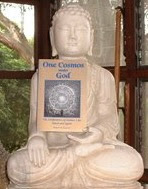
Friday, May 18, 2018

Fridays with the Answer Man

Let's begin with some aphorisms that go to this idea of Christianity disclosing the universal metaphysic, i.e., What's Really Going On Underneath It All.

This is good: Genuine atheism is to man’s reason what the ten-thousand-sided polygon is to his imagination (Dávila).

In other words, a genuine and self-consistent atheism literally cannot be imagined. I was tempted to say that it can only be imagined, but that's giving it too much credit. Bear in mind that this doesn't imply that theism is the case, although it certainly points in that direction.

I suppose all rationalists believe they are being reasonable, but the moment you stop to think about it, you realize that reason cannot even function in the absence of something -- or, more to the point, someone -- transcending it. Restricted to pure reason, the mind would be enclosed in tautology. See Gödel for details.

In truth there is only one way out, and that is up. What is remarkable is that all people with adequate intelligence don't nod their heads in agreement instead of lifting their legs and leaving inane drive-by comments.

You know the old meme, "It is what it is." Well, yes and no. Remove human beings from the picture, and it is indeed what it is, nothing more and nothing less.

But humans introduce several new perspectives to existence, including the I (subjective depth and personhood), Am (being), and Ought (virtue), not to mention past and future. While we're at it let's toss in Beauty as well.

For example, right now I'm looking out my window and it is... beautiful. How did that get in and contaminate the tidy world of pure reason? For that matter, I am looking out. But from where? From inside, i.e., from the perspective of a subject. Now how did that get here? Some people say that life is just a parasite on matter, and mind a queer side effect of life. We have a better idea.

Better how? Again, who sees the most wins, and materialists do not see, precisely. In a remarkable case of auto-castration, they render their minds infertile, using spirit to deny spirit, or in other words, painting themselves into a coroner and spinning into obit.

Militant irreligion gradually transforms the one possessed into a simple imbecile convulsed by hatred. Simple imbeciles convulsed by hatred. Truly, what is the left?

He who speaks of the farthest regions of the soul soon needs a theological vocabulary. True, but so too does he speaks of the soul, full stop. Or maybe you've never met a soulless person. I get it, but if you ever do decide to purchase a television or attend college, you'll see what I mean.

Each one sees in the world only what he deserves to see. And The simplistic ideas in which the unbeliever ends up believing are his punishment.

So if someone tells me he is an atheist, I say "good. You deserve nothing less!" The world has no depth except insofar as it is perceived from the perspective of depth. Is this not obvious, even self-evident? This is the approach I take to my son's home schooling, in which we are instituting a new class called Fridays with the Answer Man. That would be me.

For example, the other day I was telling him about my primary education. I went to school like anyone else -- even in an "elite" school district -- and learned all that stuff.

Now, as it so happens, we have a hoarder living across the street. I told the boy that upon graduation my head was very much like her backyard: just a pile of indiscriminate junk that I had accumulated along the way. There was no organizing principle, nor did I have any idea what to keep or throw away. I didn't know why it was in my head, but there it was.

I want my son to avoid that fate, which will be one of the primary purposes of F's with the A. M.: to discriminate between the essential and the inessential, to discern the inner unity and coherence, and to see beyond appearances to the transcendent reality. That is indeed what the mind is for: ultimately for apprehending the One Cosmos.

Nor can it be accomplished without religion, although religion too must be subject to the same discrimination, discernment, unity, and coherence. You can't just superimpose religious dogma on the pile of junk and call it a collection of treasures.

Returning to my miseducation, you could say that my head was like a dictionary, which is to say, a collection of words. But what is a word without a sentence, a sentence without a paragraph, and paragraph without a Total Narrative and Universal Metaphysic? Indeed, The universe is a useless dictionary for someone who does not provide its proper syntax.

In short, things must be placed in order. But -- and this is critical -- there is a horizontal order and a vertical order. A materialist "orders" things by collapsing the upper into the lower.

You might compare this approach to the manner in which the terrorists on 9-11-01 brought order to the Twin Towers. Pure simplicity! And the tenured do to the humanities what Islamists do to tall buildings.

I am a clinical psychologist -- in California no less -- so I have first hand knowledge of the destruction of the mind to rubble. Psychologists are to the soul what the the Criminal Lawyers Association is to the law. Psychology is just one more malignant tentacle of the totalitarian left.

Just for fun and nausea, let's look up the California Psychological Association website. I don't know whether to vomit or projectile vomit:

In 2003, APA [American Psychological Association] put forth guidelines that reframed the role of psychologists as leaders and advocates of social justice and multiculturalism in all realms of their professional identity.

Specifically, APA Multicultural Guidelines identified foundational principles that “articulate respect and inclusiveness for the national heritage of all groups, recognition of cultural contexts as defining forces for individuals’ and groups’ lived experiences, and the role of external forces such as historical, economic, and socio-political events.”

In 2017, APA updated these guidelines, reconsidering diversity and multiculturalism by adopting intersectionality as it main purview and using a layered ecological model. An external force laden with oppression is immigration documentation status, and how it intersects with individuals’ many identities and aspects of diversity.

Liberation psychology suggests that these providers are overwhelmed with the tasks of actively working to decolonize their own political consciousness given their awareness of the limitations of western individualistic ideologies that favor the privileged, and concomitantly seeking new ways of working with marginalized communities and immigrant families.

Projectile vomit it is! In any event, if you want to be a psychologist in California, your brain will be washed. I'm only permitted because I've been licensed since 1991, so I'm grandfascisted in.

Thursday, May 17, 2018

The Nature of Transnatural Things

I don't know if this goes without saying, but if Christianity discloses a universal metaphysic, it can only be on an esoteric (inward) not exoteric (outward) basis; or better, a combination of the two. There are certain areas that are obviously to be understood symbolically -- e.g., the six day creation of the world, or yanking a rib out of Adam in order to create Eve -- others that can be interpreted on a vertical spectrum from literal to symbolic to mystical.

In the case of the latter, the exoteric doctrine provides points of reference between the local and nonlocal -- very much like a work of art, the purpose of which is to point behind its local surface to the nonlocal depth, or from appearances to reality, form to substance, accident to essence.

Having said this, esoterism is Not Just Anything, nor is it merely an excuse for loose and self-serving interpretations. But this is only because pure esoterism itself must correspond with, and be subordinate to, the inner nature of things -- of those things which cannot not be. This is the domain of the intellect, which in principle operates no differently from the lower mind vis-a-vis empirical science.

The practice of science is predicated on two ineluctable principles: the intelligibility of the world and the unique ability of human minds to discern this intelligibility. Or, just say Intelligence and Intelligibility. And if you think deeply for a long time about how these two relate, you will realize that they must be two sides of a single reality. Or, it can just come to you in a flash of certitude. Either way is fine.

Failing these -- the Flash of Intuition or the Slog of the donkey mind -- then you will have to "take it on faith," which is indeed a sufficient reason of faith, i.e., to convey the essential truths to people who have neither the time nor inclination to be metaphysicians or esoterists.

Especially prior to modernity (which of course includes now), this population consisted of almost everyone, being that everyone was preoccupied with merely staying alive. But all humans at all times are entitled -- yes entitled, for God is merciful and just -- to the Saving Truths in whatever form. God creates man in order to save him, not for the perverse pleasure of condemning him.

Back to the intellect. Merely take what was said about science and the sensory ego, and transpose it to a higher key, and you understand at once what is meant by man being made in the "image and likeness" of the Creator. Ultimately it means that the intellect not only knows God, but shares something of the divine substance -- which is precisely how and why this transformation in (n) can take place.

So right there we have a key principle of esoterism hiding in plain sight: not that the intellect is God, but it's not not-God either! Or, we might say that the intellect is God, but that God is (surely) not the intellect. Analogously, at this moment I am bathed in light and therefore "inside the sun." And yet, the sun is obviously way up there, nine million miles away. So, this light is the sun, but the sun is not (merely) this light.

As a brief aside, we've lately been discussing -- and will get back to -- Tallis' Aping Mankind: Neuromania, Darwinitis and the Misrepresentation of Humanity. Again, he is unique in my experience in championing the utter ontological uniqueness of man, but without anchoring this in any principial reality. In short, you might say that for Tallis, man is in the image and likeness of the Creator, minus the Creator; or there is no God, and man is just like him.

So, Tallis wants to have his crock and eat it too, which is impossible, for this is a Communion of Nothing. Indeed, speaking of which, the other day I was trying to explain the esoteric meaning of Communion to the boy, but what is Communion but an example of pure esoterism? It makes no sense in any other way, Thomas Aquinas' attempt to tame it with reason notwithstanding (i.e., "transubstantiation").

It is not that Aquinas is wrong, only that he's trying to reduce an esoterism to an exoterism, when real understanding must proceed in the other direction, such that the outward is a prolongation of the inner principle.

Nor can any esoteric explanation "contain" such a mystery, which is one of its purposes: to extinguish mere intellection, or better, to show what intellection is, which is nothing less than the metabolization of the Divine Substance, from the mind right down to the cells. We are what we eat, on every plane. I would say that Communion is a quintessential vertical re-collectiom and con-centration, i.e., from dispersal to unity and from periphery to center.

But Bob, that's a hard saying! Yes and no, for His yoke is also easy. Communing with God is at once -- and by definition -- the hardest and easiest thing that can be. Why easy? Because in truth, you are never not communing with God. The hard part is realizing it, and in depth: all the way down to the cells, as it were. That would be a "perfect faith" but also a perfect knowledge, or perfect conformity between mind and truth or Is and Ought.

But again, esoterism cannot merely be an excuse to deepak the chopra. This is what distinguishes it from mere Gnosticism (the bad kind) which is always partial and (more or less) of man instead of God.

One way to avoid this is to understand that esoterism and exoterism are not opposed, but rather, complementary. It is not as if the former is superior to the latter, but rather, must always adopt an attitude of humility toward it. This is why, if you can't anchor your esoterism in tradition, it is probably wrong. For example, I suppose Scientology is simultaneously 100% esoteric and 100% bullshit. It is anchored in nothing but L. Ron Hubbard's cynical and drug-fueled imagination.

Schuon uses the analogy of the pure light of non-formal truth passing through a prism. The former is esoteric, essential, or principial; passing through the prism is analogous to manifestation on the terrestrial plane. Thus, the exoteric is by no means "not light," rather, light made visible. How else -- by what other principle -- could the eternal Logos become flesh?

Let's go back to the very beginning, or beginning of the beginning, AKA Genesis. What does it say there? In the beginning God creates the heavens and the earth (creates, because God transcends time). While looking up various translations, I see that the Latin Vulgate reads in principio creavit Deus caelum et term. Thus, we could reduce this to: In principle the Creator eternally creates, from the toppermost of the poppermost to the bottom of the world.

Putting this together with what was said above, we are in the image of this eternal principle.

And the clock on the wall says we're flat out of time, so to be continued... but not before wrapping things up with an observation by Schuon: Authentic esoterism stems from the nature of things... its seeds are everywhere present, sparks can flash from every flint...

Monday, May 14, 2018

Does Christianity Disclose a Universal Metaphysic?

Which is to say, the universal metaphysic, being that there can be only one. I suppose most Christians will affirm that Christianity is true, but true because revealed, as opposed to being revealed because true. In other words, its ultimate truth must be taken on faith.

Is that true? That ultimate truth is a matter of faith? This would imply that faith is higher than truth, but that can't be, because the merit of faith derives from its object. Faith in, say, Hillary Clinton, is not a meritorious faith.

And yet, there are exceptions. I was reading somewhere... Here it is, in an essay by Schuon called The Sense of the Absolute in Religions:

Normally it is the object that has precedence over faith since it is what determines faith and provides it with a sufficient reason; but from a certain point of view and in certain cases, faith can be more important than its content and can "force" the gates of Heaven despite the insufficiency of some immediate objects of belief.

In other words, God doesn't leave you hanging just because the details of your theology might be a bit off. He doesn't expect you to have a PhD in religious studies, but rather, assumes you are as confused as any religious studies professor.

Think, for example, of slaves who may have received a garbled version of Christianity, in which they nevertheless believed with all their hearts. Would God hold this against them? Indeed, the history of Christianity -- or, go all the way back to Adam if you like -- is a history of mangled doctrine and partial understanding. It's always Light + shadow down here.

Schuon adds that "Faith includes two 'poles,' one objective and dogmatic and the other subjective and mystical," such that "the ideal is perfect faith in an orthodox truth." Nevertheless, there are cases of the pole of faith taking precedence over the idea; for example, the Tibetans claim "that a dog's tooth which is mistaken for a relic and becomes the object of a sincere and ardent faith actually begins to shine."

Still, there can obviously be a malignant side to this process: the cult of celebrity, political messianism, romantic idealization in all its gruesome iderations. Or just violent religions, which is to say, religions in which faith is tied to the mesmerizing spectacle of death and suffering.

Now interestingly, Christianity is all about that "mesmerizing spectacle of death and suffering," isn't it? Indeed, some Christians have even been known to wear necklaces bearing the image of a man being tortured to death. However, the purpose of the image is not bring about more of this; rather, to atone for having had a hand in it.

So, there can be no question of a pure faith in an evil object. In such a case, faith is tainted by the object and loses all merit. Yesterday I was reading about the naive progressive faith of the folk music boom of the early 1960s. Many of those people are still with us, and just as naive today as they were then. Except that a naivete this antiquated becomes a kind of malignant soul rot. I have one that lives down the street -- a seedy looking 70 year old aged hippie and Bernie Bro.

I'm enjoying the musical history, even if passages about the politics make me nauseous. Example. "[M]uch of the socially conscious progress set in motion by young people in the 1960s -- antiwar activism, championship of civil rights, personal and sexual liberation, a questioning of authority, and determination to enjoy life rather than merely get on with it -- was fueled, directly or indirectly, by folk-rock."

In other words, the decade of 1960s has bequeathed to us the social justice bulliers, Blame America Firsters, Black Lives Matter, AIDS, rampant bastardy, moral and intellectual relativism, and mindless hedonism as compensation for a suffocating political correctness. And those are only the good things.

Back to the subject at hand: that universal metaphysic. Now, it is critical to bear in mind that no metaphysic can absolutely model the Absolute, or it would be the Absolute: the map is still a map, no matter how accurate. As Schuon writes -- and this should be obvious to believer and unbeliever alike, but it never is to the latter --

there is inevitably a separation between the thing to be expressed and its expression, that is to say, between the reality and a doctrine. It is always possible to fault an adequate doctrine for being inadequate, since no doctrine can be identified with what it intends to express; no single formulation could take into account what the innumerable needs for causality might demand...

For "If the expression of a thing could be adequate or exhaustive in an absolute sense or from every point of view," then "there would no longer be any difference between the image and its prototype..."

For which reason the Bible sternly warns us against idolatry, which essentially happens when people conflate the image and prototype, or form and substance, or spirit and letter. Nevertheless, idolaters gonna idolize, which is to say, men will be men.

But again, the worst offenders are the votaries of scientism, Darwinism, materialism, etc. They are the literalists, not us. I do not think God created the cosmos in six days, but they actually believe their theories map reality, when we know ahead of time that they do not, cannot, and never will.

Again, the map is not the territory. But this hardly means the map has no purpose, even a vital one. As to the religio-metaphysical map, its role "is to provide a set of points of reference which, by definition, are more or less elliptical while being sufficient to evoke a mental perception of specific aspects of the real." This is all we ask of the map: to show us where we are and to show the way to where we would like to be.

To be continued, but possibly not until Thursday...

Friday, May 11, 2018

My Point Being?

I've been dealing with a cold since Tuesday, hence the temporary suspension of logorrhea. A cold affects all systems, including the delicate blogging system.

Nevertheless, there is ultimately a lesson to be learned from this, or a lesson about ultimacy: that the body is to the mind as the mind is to spirit: in health, each points beyond itself to the next level. But in illness -- even with something as trivial as a cold -- the arrows are reversed, and everything points back to the body.

For example, Tuesday night I don't think I slept more than five minutes at a stretch. I was up all night, but why? Because of my stupid body: sore throat, sneezing, coughing, congestion, etc. I couldn't escape the planet of the apes, AKA the primate body.

Even now my mind is still hovering too close to the body for a full on plunge into the abyss. Let's stick with this subject of bodies and truth. A while back I read Tallis' Michelangelo's Finger: An Exploration of Everyday Transcendence, which goes exactly to our subject. My cold, for example, was an exercise in everyday... immanence, I guess -- whatever is the opposite of transcendence.

The book is about the mundane reality of pointing, which is not only much more consequential than we realize, but in many ways goes to the essence of what man is. It is one of the reasons I don't think we'll ever discover our kind of intelligent life elsewhere, because no matter how intelligent the species, if it can't point, then it falls far short of the human standard.

In the past -- and in the book -- I've discussed this in the context of our irreducible intersubjectivity: there is no human individual beneath the social animal, because the two co-arise in infancy: our individuality -- our twoness -- emerges out of the prior infantile oneness. But once we are two, we can then "rediscover" oneness in a variety of ways, via knowledge, love, beauty, etc. Love, for example, is the rediscovery of oneness out of twoness.

Knowledge too is only possible because of the unity of subject and object, or of intelligence and intelligibility.

Conversely, think of unsophisticated epistemologies that haven't individuated from their cultural matrix. American Indian tribes, for example, are opposed to genetic research because it disproves their cultural fantasies about having been in America "forever," instead of having been recent immigrants. Barbarous feminists feel the same way about sexual differences.

So, it turns out that what really defines the uniqueness of human subjectivity is its aboutness or "intentionality." It is a big problem for materialists, so they naturally want to try to stuff it back into the brain -- as if mere matter can be "about" anything but itself.

Materialism is about matter, without explaining how matter can be about anything. I say materialists just have to accept the cold hard facts of life, no matter how joyous and liberating.

The simple act of pointing points to the realities of intentionality and intersubjectivity. I, as pointer, have to first put myself in your psychic shoes, and imagine what you can't see or don't know. You, as beneficiary of the point, need to adopt my perspective and imagine a line running from my mind, through my eyes, down my arm, and toward its terminal point. That is something no other animal can do.

And it is a metaphor for every transmission of knowledge. This post is not only pointing to various things, but the words and letters themselves are instances of pointing: letters point to words, words to sentences, sentences to paragraphs, etc.

To deploy a well worn analogy, you won't get the point of this post by pointing back to the letters of which it is composed. Those are just forms, and it's the substance that counts.

The entire human world -- truly, the whole existentialada -- is an instance of pointing. You will also have noticed that the reality of pointing defines the civil war between left and right.

For example, for us, the Bill of Rights points to irreducibly real realities such as freedom of speech, religion, and self defense. For the left, these realities don't actually exist except insofar as we agree they exist. I can point to the self-evident truth of free speech, but the leftist merely smells my finger.

So, pointing is our "passport out of nature." More generally, it is like a vector pointing from a center to the periphery.

Now, this center is quite mysterious, but again, it can't be properly understood outside the context of its pointing, its aboutness, its intentionality.

I find it quite intriguing, to say the least, that the Trinity provides a metaphysical ground for this. The Son does not "reduce" to the Father; rather, although the Father is in one sense "prior," the two nevertheless eternally co-arise, the one pointing to the other. A meta-cosmos that intrinsically points beyond itself, and it back to us. Damn convenient.

Other animals are enclosed in their neurology, but intentionality is "a uniquely human breach in the solitude of sentient creatures" that "takes us decisively out of our solitary, transient bodies, subject to the laws of nature."

In another book, Tallis describes how sickness and death reverse the pointing, such that everything points back to our mere embodiment: "Dying takes you deeper into the inscrutable, lampless hinterland of carnal being." It is "a world whose horizons are drawn ever tighter, to the final collapse of space that had been opened up..."

Not to be a drama queen, but the same thing happens to me when I have a cold: I lose my point.

Monday, May 07, 2018

Who Sees the Most Wins

Let's play a game: "Let us suppose," writes Tallis, that "we accept biologism in full." Which is only right and proper, being that man deserves, and always seeks at any rate, an integrated and consistent worldview. What are the implications of taking biologism -- and materialism and scientism and neuromania -- seriously?

Well, we would have to tell ourselves a very different story about ourselves, one that excludes freedom (and with it, responsibility), truth, hierarchy, and anything else that transcends matter:

to be identified with our brains is to be identified with a piece of matter, and this, like all other pieces of matter, is subject to, and cannot escape from, the laws of material nature.... [our actions] are wired into the endless causal net, extending from the Big Bang to the Big Crunch, that is the history of the material universe.... Our destiny, like that of pebbles and waterfalls, is to be predestined (Tallis).

Does this even sound plausible in theory, much less workable in practice? It makes no sense, even on its own terms. It self-destructs upon contact with intelligence.

But the science is settled! Tallis quotes the eminent neurophysiologist Colin Blakemore, who insists that the brain is simply a machine that gives rise to the illusions of consciousness and free will: "All our actions are products of the activity of our brains," such that it is nonsensical "to try to distinguish sharply between acts that result from conscious attention and those that result from our reflexes or are caused by disease or damage to the brain."

Say what you want, but there is an intellectually consistent man, one who draws out the inevitable implications of materialism and sticks to his guns even if it means shooting himself between the eyes: the philosophy of materialism -- or any other philosophy -- is indistinguishable from a hole in the head. Which begs the question of why we have a category called "brain disease," but we'll leave that to the side.

Note that a strict materialism has no Ought -- for example, a healthy brain -- only the almighty Is, and one Is is as good or bad as any other. Again, it reduces the I Am to It Is; if the God of Matter could reveal his eternal name, it would surely be It Is What It Is. This is not even nihilism.

And yet, its shadows -- shadows of the Great Nøthing -- are everywhere. Few people draw out the full implications as does Blakemore, but the left in particular relies upon materialist arguments while drawing short of the abyss. As Davila so accurately says, The theses of the left are rationalizations that are carefully suspended before reaching the argument that dissolves them.

In truth, the materialist merely wishes away God. However, this doesn't necessarily imply that God exists by default. Rather, we need to think this through and determine what makes the most sense. I say existence is a game, the object of which is to see and integrate the most truth. And who sees the most wins. Or rather, seeing is analogous to having men on base. You still have to knock them home, which is to say, integrate them.

For example, there is Matter at first base after hitting a bloop single to left field. Then Mind comes to the plate and hits a liner up the middle, driving Matter to third. How do we get both home safely? If you only drive in Matter and leave Mind stranded on base, you're likely to lose the game.

Boy, that was a strained metaphor. Let's move on.

Tallis has a better analogy. Imagine you have a complete printout of your friend's genome. Would this be identical to the experience of knowing what it's like to be with your friend? Well, Barbra Streisand seems to think so. She cloned Miss Violet and Miss Scarlett, her dogs.

Or, does knowing that water is H2O tell you what it's like to be all wet, which is to say, Barbra Streisand?

Neurologists can wish away God. But no matter how hard they try, they cannot wish away the person. And the person, don't you know, leads straight back to God. Tallis, being an atheist, accepts only the first part -- the real existence of persons -- but not the second -- their rootedness in God:

Those of us who are not brainwashed into thinking that they are brains washed by the laws of physics might be tempted to hazard a daring suggestion: that it is a person, or something like a person, that looks out at, peers into, interprets and shapes the world.

Remember, once you eliminate the person, he's gone, and there is no getting him back. But it is literally impossible to do this without self-contradiction. For among the things one must jettison along with the person is any distinction between past, present, and future, which, as Einstein famously asserted, is just a "stubborn illusion." Tallis draws out the implications:

It is important to appreciate that, in the absence of an observer, time has no tenses; not only does the physical world not have a past and future in which events are located but... it doesn't have the present. For an event to count as being present, there has to be someone for whom it is present, for whom it is "now" as opposed to "then" or "not yet."

Hmm. Where does this leave us? Nowhere? Everywhere? Is it really possible that reality is a view by nobody from nowhere? Well, that is the scientistic ideal. But does it make any sense?

In order to deal with this question, I'm going to shift gears to a challenging essay I read yesterday by Schuon, called Substance: Subject and Object. He'll get us out of this mess!

First of all, as we always say, Subject and Object are not a vicious and sterile dualism but a friendly and fruitful complementarity. The complementary dance between them proceeds all the way up and all the way down. But of the two, the Subject is obviously prior:

The subject as such takes precedence over the object as such: the consciousness of a creature able to conceive the star-filled heavens is greater than space and the heavenly bodies...

Carl Sagan can talk all he wants about those billions and billions of stars, but all of astronomy pales in significance next to the astronomer. Ultimately we are not contained by the galaxies, but rather, vice versa. The cosmos itself isn't even big -- or small -- except in reference to us:

Man is situated, spatially speaking, between the "infinitely big" and the "infinitely small"..., so that it is his subjectivity and not a quality of the objective world that creates the line of demarcation. If we have an impression of being tiny in stellar space, it is solely because what is big is far more accessible to us than what is small, which quickly eludes the grasp of our senses... (emphasis mine).

So, man is situated between -- and defines -- the Very Big and Very Small. And not only. For he is also the "point of junction between two infinitely more important dimensions, namely, the outward and the inward." Indeed, "it is precisely by virtue of the dimension of inwardness, which opens onto the Absolute and so onto the Infinite, that man is quasi-divine."

That's a bold statement. And yet, ultimately soph-evident. There is a world and there are witnesses, "otherwise the Universe would be an unknown space filled with blind stones and not a world perceived under a multitude of aspects." For

Where there are objects, there must also be subjects: creatures that are witnesses of things form an indissoluble part of creation.

There exist not only "knowable things" but "beings endowed with knowledge in varying degrees." And whether you like it or not, "the summit-degree is man, at least for our world," behind or before or above which is "the absolute Witness -- at once transcendent and immanent -- of all things..." There is nothing magical or miraculous per se about this assertion. Again, it's just a matter of returning the cosmos to bright-side up.

Friday, May 04, 2018

Crystallizations of Light & Coagulations of Darkness

I'm guessing Tallis, despite his atheist credentials, would endorse the following:

Scraping the painting, we do not find the meaning of the picture, only a blank and mute canvas. Equally, it is not in scratching about in nature that we will find its sense. --Dávila

How does the sense -- the meaning -- find its way into the cosmos? Not to mention the truth, freedom, beauty, inwardness, and depth? For the Raccoon, this is a false problem that results from inverting the world (and/or ourselves) and viewing it from the wrong end -- both upside down and inside out.

For if there is an outside, then there must be an inside. But clearly the latter must be prior, because pure outsidedness could never redound to insidedness: as said in yesterday's post, you can't get here (inside) from there (outside). Rocks don't one day start thinking, although there are thinkers whose heads are full of rocks. Likewise, no amount of down will result in an upside. But in a hierarchy there is always a down because there is first an up.

This may sound like so much wordplay, but it's not. It is principial. It is the Way Things Are because the Way They Must Be. If they weren't this way, then there could be no way, period.

These principles are not falsifiable, only truth-ifyable, but it is nevertheless up to us -- for we are (in principle!) free -- to realize them; this realization is, as Schuon puts it, "a matter of intellectual capacity, good will, and grace." For the restavus faith fills in the inevitable gaps and vacates the false connections and just-so-stories of scientism.

Here, try this aphorism on for size:

The meanings are the reality; their material vehicles are the appearance.

Thus, it makes no sense to rummage around the basement searching for the meaning of the house. No matter how thorough the search, we will never find it there. It reminds me of a line by the cynical Capn. Renault in Casablanca, when he's trying to impress the Nazi dignitary: "Realizing the importance of the case, my men are rounding up twice the usual number of suspects." But no amount of quantity leads to quality. You can round up all the matter in the world without identifying the party responsible for its Life.

Truly, it all comes down to the complementarity of Form and Substance. Again, as in all primordial complementarities one must be prior, in this case substance: the purpose of the form is to manifest, symbolize, and transmit the substance; or, form is a local manifestation of the nonlocal substance.

I hope this is clear. As Schuon explains, "The fundamental nature of our intelligence, quite evidently, is discernment between what is substantial and what is accidental..." In the final analysis -- or synthesis, rather -- "The substance of knowledge is the knowledge of Substance," ultimately the Divine Substance, or substance of divinity.

Thus -- this time in the words of Dávila -- "The natural and the supernatural are not overlapping planes, but intertwined threads" -- threads of substance and form.

I can't help thinking this might all sound a bit woolly-headed. Let me track down an aphorism or three that bring it into focus. Indeed, note that the aphorism itself is a form of the substance, which is what makes it so powerful. It's what they po↑nt to that counts:

In order to speak of the eternal [the Substance], it is sufficient to speak with talent of the things [forms] of the day.

The transcendence [Substance] that permeates things is the salt that seasons their blandness.

We are saved from daily tedium only by the impalpable, the invisible, and the ineffable [Substance].

The meanings are the reality; their material vehicles [the forms] are the appearance.

This also helps to shed light on who, what, and where we are. We cannot answer these questions via mere introspection, and certainly not via any outward material analysis. Rather, it is more subtle and (ortho)paradoxical than that. The following aphorism captures it perfectly:

I am merely the place from which I perceive -- not the object of my interest but what it is that interests me.

Clearly, this means that the self (or better, person) is not somehow "inside" the brain, much less identical to it (as Neuromaniacs and Darwinitics would have us believe). In the past we have called this "the erotics of being," borrowing the term from Christopher Bollas.

As Prof. Wiki explains, each individual (for this is the substance of our individuality) has his "own idiom for life -- a blend between the psychic organisation which from birth forms the self's core, and the implied logic of the familial way of relating into which we are then raised" (to which I would add the cultural, social, educational, and historical contexts, each providing a range of forms through which to express our being-substance).

This is the irreducible space in which human persons live: clearly, we do not fully live in the "material world," for life itself transcends matter. But nor do we occupy a world of pure transcendence. Rather, we must deal with this potential space on its own terms.

Thus, we very much need the world in order to find out and become who we are. We could never exist as disembodied brains-in-a-vat, as in The Matrix. Rather, as explained by Bollas "we spend our time looking for objects of interest -- human or material -- which can serve to enhance our particular idioms or styles of life -- perpetually 'meeting idiom needs by securing evocatively nourishing objects.'" We must always stand prepared to "be metamorphosed by one's interaction with the object world."

Now, as far as I'm concerned, this all goes back to the metaphysical implications of a triune Godhead. The Father "finds himself" (so to speak) in the Son, as the Holy Spirit finds himself in their mutual knowledge-and-love.

The world speaks to us continuously. However, it says different things to you than it does to me -- or, to be precise, we "hear" and "see" different things, based upon our idiom needs, AKA who we are. In the case of my son, for example, he has discovered his idiom(s) in photography and parkour. No one forced these upon him. Rather, they are purely spontaneous attractions -- forms -- through which he discovers his own substance. For me, it is this blog: it is the form of my substance and substance of my form. Cut it and it bleeds his bObness.

So, the world can be an adventure in the crystallization of Substance. Or a kind of trap involving the psychic coagulation of nothingness. Your choice. For

At a given moment, the most important place on earth can be a palace, a pigsty, or a cell. --Dávila

Wednesday, May 02, 2018

Mystery and Presence, Truth and Person

Continuing with the theme of yesterday's post, I want to begin by highlighting some additional passages indicative of Tallis' highly unusual hafraccoon ethnicity -- i.e., how he is a passionate advocate of human transcendence and uniqueness, but without grounding this in anything beyond itself. He is quick to acknowledge that the question of consciousness is "more than a problem," and even "more than 'a hard problem.'" Rather, "It is a mystery."

Well, yes. Except that a mystery is not just a riddle or conundrum but a mode; not an absence but a presence; not a rupture but a link. Just yesterday I was re-re-re-reading (at least) a book by Schuon in which he makes the following observation:

By "mystery" we do not mean something incomprehensible in principle -- unless on the purely rational level -- but something that opens on to the Infinite or is envisaged in this respect, so that intelligibility becomes limitless and humanly inexhaustible. A mystery is always "something of God."

Precisely. Understood this way, a mystery is not a problem but a portal; not a wall but a window. Not to say there aren't walls and problems! Just don't conflate them with mysteries.

Example. If one adopts a materialist metaphysic, then consciousness -- and life, for that matter -- is indeed a problem. An absolutely insoluble one. And look what you've done in the process! You've boarded up the window, nailed the door shut, and painted over the mirror. Now, why would you want to do that? Intellectual consistency? Yes, that's a fine thing, so long as it doesn't result in intellecticide.

But this is just what virtually every modern and postmodern ideology results in, from Darwinitis to Deconstruction. In fact, the death of the intellect is just collateral damage resulting from the death of the person: abort the person, and you knock out the intellect with it.

Unlike most atheists, Tallis realizes this and doesn't like it one bit. Indeed, he clearly deplores it as much if not more than your typical believer who isn't intellectually sophisticated enough to appreciate what the tenured are up to.

Here is a passage by Tallis that is indistinguishable from something you might find at One Cosmos: some 50,000 years ago -- or whenever it was -- merely genetic Homo sapiens crossed an invisible line and

woke up from being organisms to being something quite different: embodied subjects, self-aware and other-aware [THAT LAST ONE IS KEY -- God] in a manner and to a degree not approached by other animals. Out of this, a new kind of realm was gradually formed. This, the human world, is materially rooted in the natural world but is quite different from it.

That is correct as far as it goes, but one must be quite precise in these matters. It certainly helps to be a fine wordsmith, as Tallis clearly is, but then one must avoid the problem of language getting ahead of itself. Rather, it must be purely objective and descriptive, while not excluding poetic expression, in the manner of Schuon or Dávila.

In my case, it's probably a good thing that I was able to intuit these things before I was able to express them. Truly, I can't even say that I was once a "terrible writer." Rather, I wasn't a writer at all. I like to think I'm still not, in that the Idea is always the primary thing. Over the years I think I'm getting better at clothing the thing in more felicitous language, but as Dávila says in so many ways with so few words,

Wordiness is not an excess of words, but a dearth of ideas. Indeed, perhaps you've noticed that The deluded are prolix. (Ever watch Rachel Maddow?)

Moreover, Only ideas save us from adjectives. Save, as in salvation, more on which as we proceed.

For Words do not communicate, they remind. It's called vertical recollection, which is the cure for spiritual I-amnesia.

And The idea that does not win over in twenty lines does not win over in two thousand pages.

And how appropriate and timely: Words do not decipher the mystery, but they do illuminate it.

And if you do want to mix in a little poetry, just remember that Poetry is God’s fingerprint in human clay, not just humans magically transforming our clay into spirit, or flesh into Word.

Which of course goes to the idea and principle -- the mystery! -- of Incarnation. And this I think is where Tallis goes off the rails, because it is as if he is a champion of the notion of incarnation without the Principle to explain and back it up.

Look, nothing comes from nothing, however much you wish it were otherwise. Nor can the greater come from the lesser, let alone the infinitely greater. How can the Infinite come from the finite, the Absolute from the relative?

You've probably heard the old joke about the traveler who asks the local for directions to some town. He thinks for a second and responds with words to the effect of "I wouldn't start from here." A variant is that "you can't get there from here." Analogously, you can ask a Darwinitic for directions from animal to man, but truly, you can't get here from there. Rather, you can only drag here to there, and with it I (truly) Am to it (merely) is.

And I use that little word "here" advisedly, because it is loaded with (ultimately personal) significance. Do animals know about here? In other words, are they conscious of the here and now? No. We know they're here and now, but they don't.

Coincidentally, yesterday I was reading a book by Schuon called Form and Substance in the Religions. The first chapter is called Truth and Presence. In it he highlights the relationship between these two, noting that "The saving manifestation of the Absolute is either Truth or Presence," although not necessarily exclusively, being that truth is a presence and presence comprises truth.

We might say that the truth of presence is the presence of truth, and that this goes to the Incarnation of the Mystery of Personhood, right here and right now. To be continued....

Tuesday, May 01, 2018

Can Raccoons and Humans Mate?

Vomit alert: the Times ran an editorial yesterday called Happy Birthday, Karl Marx. You Were Right! Bearing in mind the adage that Defeating a fool humiliates us, we Won't Even. The author does, however, confirm exactly what was said in yesterday's post about the left's fundamental impulse to destroy.

So, "what lessons might we draw from [Marx's] dangerous [he means this un-ironically] and delirious [ditto] philosophical legacy? What precisely is Marx’s lasting contribution?"

Let me guess. Helping the mortuary industry flourish?

No. Marx bequeathed to us the "critical weapons" for undermining western civilization. Yes, "The key factor in Marx’s intellectual legacy in our present-day society is not 'philosophy' but 'critique,' or what he described in 1843 as 'the ruthless criticism of all that exists.'"

Okay. And replace it with what? Well, opinion here is divided: "let’s be clear: Marx arrives at no magic formula for exiting the enormous social and economic contradictions that global capitalism entails." Rather, he offers only a magic formula for destroying All That Exists.

Compare to what I wrote yesterday. Perhaps you suspected I was exaggerating or being polemical. No, just literal, as usual:

[Progressives] are essentially addicted to "revolution" for its own sake. Like Tallis, they tear down every institution, but replace them with nothing. Instead of creating their own left wing versions of the Boys Scouts, or the university, or marriage, they just destroy ours. They create nothing but strife.

Truly, their destructiveness is not a bug but a feature. And the existence of Trump has turned this feature up to 11.

Moving on. I've now read several more books by Tallis, including The Black Mirror: Looking at Life through Death, Michelangelo's Finger: An Exploration of Everyday Transcendence, and I Am: A Philosophical Inquiry into First-Person Being.

Despite profound disagreements, I can't help liking the guy. He reminds me of Spock, who is half human and half Vulcan. In Tallis' case, he is half human and half Raccoon, or hafraccoon. He's got the analysis down cold. But this is followed by no synthesis, which is of course the sine qua non of Raccoon style thought, i.e., one cosmos in both objective fact and subjective metaphysic.

I'll be skipping around a lot from book to book, but I want to turn to the coda of his auto-obituary, The Black Mirror. In a chapter called Afterlife, he hedges his bet just slightly, almost as if his Raccoon wings are beginning to sprout:

Is that it then?

There are reasons for thinking that it is. But there are also reasons for thinking that it might not be.

This is his first concession that our self-evident transcendence might not be nothing after all. I mean, if humans can transcend physics and biology, what can't they do? And why should we jump to conclusions? Why not keep an open mind? Of course, this open mind is what we call "faith," but let's not scare him off with such a loaded word. Let's just call it (o) for now, AKA vertical openness, or openness to vertical energies and murmurandoms.

Tallis continues:

It is also difficult to imagine a boundary, however impenetrable, that does not have something beyond it, that doesn't have two sides facing into different territories.

Damn straight. Notice in the following passage how he actually brushes right up against Raccoon doctrine, or ventures close to the orbit of the great nonlocal Attractor, O:

And the idea of an end that was not also a beginning, or at least the possibility of a beginning, of an exit that was not also an entrance elsewhere, had also been beyond the reach of thought.

No it's not! You just thought it. Later he expresses this remarkably Coonish sentiment:

One of his [referring to his formerly living self] most enduring preoccupations had been a mighty gap in our understanding, namely that we have no idea how consciousness, mind, self-consciousness, the sense of the past and of the future, could have arisen out of, fitted into, and acted upon the physical world to which his body belonged.

A scientist, he had early accepted that science would not be able to offer any explanation of this.... Physical laws could not explain how one bit of the material world had formed the concept of "matter" and uttered the word "world." And it seemed to him that mankind could not be entirely a creature of thermodynamics if it had been able to conceive the notion of "entropy."

Well, yes. That is what you call a "good start," not a conclusion to arrive at on one's deathbed.

Given the infinite distance between man and chimp (and everything else in the cosmos), perhaps we ought not so hastily close the debate on man's trans-incarnate possibilities, no?

We have reasons, perhaps, to entertain the idea that our possibilities are different from those available to pebbles, trees, or even chimps.

We should not under-estimate our ignorance.

That's the spirit! Utilize (o) to unsaturate your (k) and make a space for (n). Tallis,

in utero in 1946 had had no idea of the world he was about to enter and strut about in, so knowingly, for a while. It is not impossible that this world has itself been another womb whose walls successfully muffle the rumours of another kind of reality, one perhaps that is even wider and even brighter.

Wo. Can I buy some pot from you?

Monday, April 30, 2018

Creative and Destructive Tension

Not much time, so let's get busy....

Well, I finished Aping Mankind over the weekend. The letdown was anticipated, because I knew in advance that Tallis is all offense and no defense -- literally, in that he demolishes materialism, but when it comes time to proffering a replacement, he's got nothing.

And no one can survive on nothing. Human beings require meaning; even a false religion such as materialism will have more allure than no religion at all. The atheist does not live on bread alone, but from every word that comes from the mouth of godlessness. It's why leftists embrace envy, feminists bitterness, and environmentalists trees.

I was thinking about this while walking the dog yesterday. For us it goes without saying that there is a creative and fruitful tension between faith and reason. Moreover, reason requires faith, while faith is a kind of reason -- not to mention that theology involves reasoning about the data of revelation.

Tallis doesn't seem to understand this, and would no doubt reject it if he did. And yet, he makes a number of unusual points that I've never heard an atheist make, and which sound more like they came from this blog or some other dodgy source.

For example, he insists that human beings "transcend apehood to the same degree by which life transcends mundane chemistry and physics" -- which is to say, infinitely. And yet, he makes nothing of this remarkable fact. He doesn't find it ironic that this is not only what the Judeo-Christian tradition has always taught, but that no one else is teaching: that man's creation is of a different order from everything else in the cosmos.

Of course this is expressed in mythic terms in Genesis, but anyone short of tenure understands that the function of myth is to convey metaphysical truths in a manner assimilable by the multitude. Few people have the time or temperament to be metaphysicians. And even then, left to their own devices, most self-styled metaphysicians will get it wrong.

Again, faith and reason create a fruitful tension, analogous to poetry, in which adherence to a form -- such as a rhyme scheme -- forces one to reach into the unfamiliar in order to reconcile the terms. Analogously, just think of Man and Woman, and how marriage corrals these two into a fruitful tension -- as opposed to feminism, which either denies the tension or renders it toxic.

Speaking of witch, on the same dog walk, after dwelling on the absence of the faith-reason tension in Tallis' thought, it occurred to me that this is true of the left in general. It explains how they are essentially addicted to "revolution" for its own sake. Like Tallis, they tear down every institution, but replace them with nothing. Instead of creating their own left wing versions of the Boys Scouts, or the university, or marriage, they just destroy ours. They create nothing but strife.

In short, Whatever the Left Touches it Ruins, from academia, to art, to sports, to religion, to race and sexual relations, to the Constitution:

The only way to save Western civilization is to convince more people that leftism -- not liberalism -- is a nihilistic force. Quite literally, whatever the left touches it ruins....

The most obvious -- and, therefore, the one more and Americans can resonate with -- is the near destruction of most American universities as places of learning. In the words of Harvard professor Steven Pinker -- an atheist and a liberal -- outside of the natural sciences and a few other disciplines (such as mathematics and business), "universities are becoming laughing stocks of intolerance."

If you send your children to a university, you are endangering both their mind and their character. There is a real chance they will be more intolerant and more foolish after college than they were when they entered college.

When you attend an American university, you are taught to have contempt for America and its founders, to prefer socialism to capitalism, to divide human beings by race and ethnicity. You are taught to shut down those who differ with you, to not debate them. And you are taught to place feelings over reason -- which is a guaranteed route to eventual evil.

Etc. No need to repeat the whole essay. Besides, Davila has many pungent aphorisms that go to just this subject:

The left is made up of individuals who are dissatisfied with what they have and are satisfied with who they are.

In other words, they have the necessary tension between immanence and transcendence backward! A virtuous individual wishes to transcend himself, not compel his neighbor to subsidize his failure to do so. Thus, “Social justice” is the term for claiming anything to which we do not have a right.

When one does not concede to the leftist all that he demands, he proclaims himself the victim of an institutional violence that is licit to repel with physical violence.

Again, the tension is displaced and projected into others; or, the other is involuntarily enlisted into the leftist's psychodrama. The leftist knows (without knowing us) that we are racists (or misogynists, or anti-science), even though we (the only ones with first hand knowledge) know we aren't.

Marxism turns the intelligence that it touches to stone. Stone, because it is rendered lifeless due to the absence of intrapsychic disequilibrium. Thus, The leaden prose of the Marxist offers an irresistible attraction to leaden minds. Like seeks like; progressive man is the mirror of the faux absolute he fashions for himself.

If the leftist is not persecuting, he feels persecuted. Here again, the intrapsychic tension is externalized into political space. This is psychopathology 101.

The left calls a critique of capitalism what is merely a lawsuit for possession. In other words, intellectualized envy. Until envy is transformed into admiration, the psychopolitical illness will continue (think of how the Palestinian terrortories would be utterly transformed by emulating instead of envying Israel; or how urban America would be transformed by emulating Asian Americans instead of discriminating against them with racial quotas).

In order to educate the people, liberalism pampers them until they have been turned into dissolute adults. A liberal education appeases the creative tension by, for example, promoting unearned self-esteem, or awarding trophies to everyone, or via affirmative action or grade inflation.

Again, misplaced tension: The left claims that the guilty party in a conflict is not the one who covets another’s goods but the one who defends his own. The leftist's tension is painfully real, its object a hallucination. The progressive cannot progress until he learns to tolerate, master, and transcend his envy.

Liberals can be divided into those who believe that wickedness is curable and those who deny that it exists. Both stances deny the tension; which is to say, that wickedness exists and is (humanly) incurable. It's why the past is so tense.

It is not enough for the progressive that we respect what he wants to do with his life; he also demands that we respect what he wants to do with our life. He wants to compel away the tension by law -- for example, by forcing Christian bakers to participate in a homosexual marriage, while excusing themselves from involvement with people they deplore.

So many more, but we're out of time...

Friday, April 27, 2018

The Monstrous Implications of Scientism

In the previous post we touched on the complementarity of subject/object, which mutually coarise. Tallis has some novel ideas about this, or at least pushes the materialistic argument to the brink of extinction and beyond. Hey, you can accomplish a lot with reductio ad absurdum. I mean, if matter is all there is, who just said that? And who just heard him?

Really, all one needs is an aphorism or two. So much easier to realize memes than memorize reams of philosophy. The following are not so much hierarchical as mutually reinforcing, like a strong rope made of individual threads:

Man has as much of a soul as he believes he has. When that belief dies, man becomes an object.

Modern man denies himself every metaphysical dimension and considers himself a mere object of science. But he screams when they exterminate him as such.

If the soul is a myth, genocide is a simple problem of effective anesthetics.

Between animal and man there is no other barrier than a palisade of taboos (Dávila).

Speaking of reductio ad absurdum -- reduction to absurdity -- I wonder what the opposite of this would be? Expansion to certitude? "That is absurd which is contrary to the first principles of reasoning," says the venerable Prof. Fernald -- for example, "that a part should be greater than the whole."

Fernald continues: "Monstrous and preposterous refer to what is overwhelmingly absurd." Then there are the ridiculous or nonsensical, which are "worthy only to be laughed at," such as "the lunatic's claim to be a king." Or, for that matter, the Darwinian's claim to truth.

So, depending upon our angle of vision, atheistic materialism might be absurd, paradoxical, irrational, foolish, silly, unreasonable, monstrous, preposterous, ridiculous, or nonsensical. What? The power of and?

Fernald also helpfully provides antonyms of absurd, e.g., certain, consistent, demonstrable, incontestable, incontrovertible, indisputable, logical, sound, true, undeniable, etc. These are the properties -- whether scientific or religious -- we're really after, aren't they? For it's one thing to prove an argument absurd, another thing entirely to find the one that is absolutely certain.

And yet, the two are related. For example, to explicitly affirm the absurdity that all truth is relative is to implicitly utter an absolute truth, thereby negating one's own first principle. All the relativist or neuromaniac or Darwinitwit need do is draw out the implications of his creed, and voila: he is cured of the absurd!

Note that this is precisely how Jordan Peterson rocketed from cult fame to something approaching the real thing: merely by holding his BBC interviewer to her own absurd standards.

By the way, Dávila has a cautionary aphorism for Peterson: No one is important for long without becoming an idiot.

And while looking for that one, I found this, which aphorizes what we are about to prosify. Read slowly and SEE:

The world is explicable from man; but man is not explicable from the world. Man is a given reality; the world is a hypothesis we invent.

This is indeed one of our first principles. And please note that this does not reduce to some form of arbitrary subjectivism or pure idealism. If it does, then it is no better than the dodgy materialism it displaces.

Unfortunately, politics is not only downstream from culture, but from pseudoscience, AKA scientism, or the Fashionable Nonsense of the Tenured. "The assumption... that we have no free will is combined with all manner of would-be progressive social policies claiming to be rooted in neuroscience" (Tallis). Therefore, for example, if we have no free will, then our justice system is patently unjust. We saw how this played out beginning in the 1960s: an entirely predictable explosion of crime.

Ideas have consequences. If crime is not a choice but only an effect of a material or efficient causes, then it leads to the reductio ad absurdum of... of a community organizer president with Al Sharpton as Czar of Race Relations and Black Lives Matter as intellectual vanguard.

Prof. Fernald says we are abusing the word "absurd." The word we are looking for is monstrous.

"Scientism and government have always made unhappy bedfellows" (Tallis). Let us count the (progressive) ways: eugenics, high carb/low fat diets, Keynesian economics, the government-global warming industrial complex, transgenderism, heterosexual AIDS, homosexual marriage...

Hear hear: "if any ideas are important, then ideas about the kind of creatures we are must be of supreme importance." And as we have pointed out on many occasions, "if On the Origin of Species really were the last word on humanity, it could not have been written." Do we really need to explain why? Okay: a brain simple enough for us to explain would not be complex enough to give rise to the explainer.

About those novel arguments alluded to above, here's one. Scientism, in order to be strictly consistent -- or fully monstrous -- must paradoxically adopt the point of view of no point of view, or of the "view from nowhere," in which "all appearances are summarized in the abstract," but are "had by no one in particular, and consequently by no one at all..." Again, it is the "material world seeing itself but from no particular point of view."

There is so much wrong with this that we don't have time to unpack it all. You can't just obliterate conscious selfhood and then try to sneak it in via the side door. Rather, if it's gone, it's gone. You can't secretly resurrect it without recourse to the miraculous. "There are some fundamental elements of selfhood that cannot be denied without self-contradiction," one of which is viewpoint.

We'll end with this, and pick it up on Tuesday: the realm of memory

has no place in the physical world. The physical world is what it is. It is not haunted by what it has been (or indeed, what it might become): by what was and will be. There are, in short, no tenses in material world.

[....]

[I]n the physical world no event is intrinsically past, present, or future. It becomes so only with reference to a conscious, indeed self-conscious, being who provides the reference point, the "now," that makes some events past, others future, and yet others present (Tallis.)

Wednesday, April 25, 2018

Between You & I is What is Between Man & Animal

That title just came to me. I'm quite sure it's true, but I suppose I should explain how and why it is true and how I could know. (Bear in mind that the background of this discussion continues to be Aping Mankind: Neuromania, Darwinitis and the Misrepresentation of Humanity, in which Tallis demolishes the ground of atheistic materialism even while remaining a steadfast and unwavering atheist.)

But first a few aphorisms to warm up the old cerebrum, which I have taken the liberty of arranging hierarchically so as to arrive at the -- wait for it! -- shocking conclusion:

1: Whoever is curious to measure his stupidity should count the number of things that seem obvious to him.

2: Often the simpler a truth is the more difficult it is to understand.

3: Truth is more than an impersonal proposition; it is a manner of thinking and of feeling.

4: The truth is objective but not impersonal.

5: All truth goes from flesh to flesh.

6: Truth is a person (Dávila).

Let's start with the first: I think it is entirely accurate to say that materialism is just plain obvious to the materialist. This must be the case, or they would realize how implausible it is, and provide more intellectual support than merely ridiculing or vilifying those who disagree.

It's analogous to the Taranto Principle in politics. Like me, perhaps you've wondered why leftists are unable to think, argue, or understand another point of view. This is a function of the media, culture, and education establishment all reinforcing their presumptions, such that they never have to defend their positions.

Rather, they're all obvious. Gay marriage? Obvious. Climate change? Obvious. Gender inequality? Obvious. Etc. They no more understand that they live in a bubble than the fish knows about water.

Note also that no amount of logic or evidence is able to move the liberal, because he mistakes his certitude for truth rather than ignorance. But in reality, their smug certitude is precisely a function of their ignorance. (I'm again reminded of a Bill Maher, who is usually wrong but never in doubt; however, you will notice that it is not a serene stupidity, since it is only maintained by projecting his ignorance into others and attacking them for it.)

An immediate corollary (2): because of what is so obvious to you, it can be difficult to recognize and understand the simple truth. Here again, it's an instance of The answer is the disease that kills curiosity. Can you imagine the mind of the person who is satisfied with a materialistic explanation of himself, such that he no longer has any curiosity about consciousness, free will, and human subjectivity? That is what I'd call a Total Eclipse of the Mystery of Being.

Truth is a manner of thinking and feeling (#3). This is a truth I first realized in my psychoanalytic training -- that there is truth but there are also developmental levels, such that what is true on one level might be false on another, and the depth of a truth may depend upon depth of the person uttering it.

Thus, the level cannot be distinguished from the person(al); in short, there are deep thinkers and shallow thinkers. It's unavoidably orthoparadoxical, but perhaps you've noticed that a banality from the lips of the tenured may be a profundity from the mouth of the Raccoon. A deep person transforms the otherwise banal into profundity, like water to wine or something. Deepak Chopra and Jesus can say the same things, and yet, one is an idiot.

Perhaps that's unclear. Here's a concrete example: I'm sure Thomas Jefferson and Nancy Pelosi would agree that "all men are created equal." Or, the pacifist and Navy SEAL agree that murder is wrong. 'Nuff said.

How can something be objective but not impersonal (#4)? Isn't that oxymoronic?

Well, first of all, objective and subjective are irreducibly complementary, not a duality. Prior to the appearance of humans -- or you can take it all the way back to the emergence of life -- there is no objectivity because there is no subjectivity. If there are no persons, there are no truths -- which is not the same as saying that truth is subjective. Analogously, only persons can know that murder is wrong, but that hardly makes it a matter of opinion.

Ultimately -- as Schuon has said in so many ways -- objectivity "is none other than the truth, in which the subject and the object coincide, and in which the essential takes precedence over the accidental -- or in which the Principle takes precedence over its manifestation..." Better (or deeper) yet,

Objectivity is the perfect adequation of the intelligence to objective reality; and inwardness is the persevering concentration of the will on that “Inward” which, according to Christ, coincides with the heart... and which opens onto the “Kingdom of God”, which in fact is “within you.”

Outward truth and inward depth. If your metaphysic allows for no inwardness, it obviously has no depth. By definition. And therefore no wholeness, totality, or even objectivity, for the deeper the subject the bigger the object in your ur-view mirror.

From my flesh to yours (#5). Here again, this is a truth I realized in graduate school -- that truth must be realized in order to be more than mere surface (k). The difference between reading about anxiety and having an anxiety attack is more or less infinite. Trust me.

The Word Became Flesh. Only all the time -- for example, whenever you speak and your having spoken causes understanding in another (a subject to which we will return in subsequent posts, this one getting close to the finish line.)

Finally, our shocking but ineluctable conclusion: that Truth is a person. If Tallis could only real-ize this, it would turn his world upside down and inside out, such that everything would now come into focus. But his admirable insistence on the reality of transcendence cannot help but prove sterile if detached from the Cosmic Person.

I didn't really get around to explaining the title, at least explicitly. Well, the gap between man and animal is literally infinite -- as infinite as, say, the abyss between the truth and a lie. What is the nature of this gap, or space, or depth-dimension? It is the intersubjective space between infant and mother, person and person, and ultimately Father and Son.

The trinity may not be obvious, but it sure explains a lot.

Tuesday, April 24, 2018

Death, Man, and Anti-Man

Does all humanism nurse a hidden (or not so hidden) anti-humanism? If not, it is only because it fails to draw out its own anti-human implications. Rather, it stops at an arbitrary point, imagining that Man will be able to stand on his own. In reality,

nothing is more fundamentally inhuman than the “purely human,” the illusion of constructing a perfect man starting from the individual and terrestrial; whereas the human in the ideal sense draws its reason for existence and its entire content from that which transcends the individual and the earthly.

Humanism is the reign of horizontality, either naïve or perfidious; and since it is also -- and by that very fact -- the negation of the Absolute, it is a door open to a multitude of sham absolutes, which in addition are often negative, subversive, and destructive (Schuon).

Take Google, for example. They always change their logo in celebration of various holidays, but I read somewhere that for the 18th straight year they failed to recognize Easter, an obviously intended in-your-apophasis slight to Christians. Which is fine. It's a free society. Thanks to Judeo-Christian values. Besides, their corporate creed is Don't Be Evil. What could go wrong with such a self-evident imperative? Who needs the Ten Commandments when you can reduce them to one?

Memo to our ill-educated internet overlords:

The initial contradiction of humanism is that, if one man can prescribe for himself an ideal that pleases him, so too can someone else, for the same reason, prescribe for himself another ideal....

The moral ideal of humanism is inefficacious because it is subject to the tastes of the moment, or to fashion, if one wishes; for positive qualities are fully human only in connection with the will to surpass oneself, hence only in relation to what transcends us. Just as man’s reason for being does not lie within man as such, so too, man’s qualities do not represent an end in themselves.... A quality is fully legitimate only on condition that in the last analysis it be linked to necessary Being, not to mere contingency, that is, to what is merely possible.

Recall that we are in the midst of a lengthy meditation on Aping Mankind, by a humanist who very much wants to distinguish himself from all those other anti-human humanists who inevitably preach animalism in disguise, because they lack any principle upon which to make such a distinction.

This is ineluctably true. Yesterday I saw a clip in which Bill Maher is going on about how conservatives Hate the Planet. Whatever. But do tell, why does this matter? Take your time. This is not a 15 minute segment pandering to low information leftists. We'll give you all the time you need to square this absurcularity.

By the way, in the same segment he derided the emotionally driven thinking of Americans. Good! Please explain why we should care about The Planet, or about future generations, or even "logic," with no emotional appeals whatsoever.

Stupidity is annoying enough, but when it shrouds itself in such pompous moral superiority... Why, it's enough to make a man hate religion.

Note also that Maher's style of humanism is always anti-humanistic at the core. More generally, the left loves mankind in the abstract. It's individual human beings they can't stand. Maher cannot disguise his contempt for half the citizenry.

Conversely, any religiously informed Christian must be quite skeptical of mankind. That's what you call a firm foundation of wisdom, without which you are bound to, oh, fly too close to the sun, or build a tower that collapses in on itself, or create one more sacrificial system to appease your strange and bloodthirsty gods. Same old same old terrestrial circle that man can only exit via a vertical leap.

This review is going rather slowly. I see we're still stuck on page 3. Oh well. We've got all the time in the world. At least until we don't. The Black Mirror of Death is always peering over our shoulder, if not giving us a snidelong glance from the sidebar.

But without Death we'd have no reason to think about Life at all. Death is quite literally the father of Sophia. I'm up to page 11 in that book, but there are already a number of arresting gags, such as Death destroys a man; the idea of death saves him (by E.M. Forster). Or, try this on for size:

"The shadow reveals the light" -- says it all. The unspeakable Nothing italicizes at least some of the Everything that is life. While death destroys us in fact, the thought of our own non-existence may save us from triviality, from entrapment in secondary things.... To be oblivious to death is to be only half-awake.

Half? That's charitable. But I want to focus on the sentence prior to that, in particular, "may" and "save," but also "triviality" and "secondary." For if there are secondary things, there must be a primary one, no? And if there exists trivia, then surely there is Importance -- who knows, perhaps even the One Thing Needful. Mustn't trivia, in order to exist at all, be parasitic on the non-trivial?

More generally, mustn't tenure be parasitic on something surpassing itself? Why would we ever recognize "free speech" if it doesn't presume responsible speech? Indeed, why care about speech at all if it isn't a function of truth (for the converse is impossible and unthinkable anyway)?

Is leftism parasitic on conservatism? You betcha'. Their whole economic program, for example, is all about distribution of wealth rather than its creation. They simply assume the latter, as if it just happens -- or rather, because the One Percent stole it from the restavus.

Which is like complaining that the top ten hitters in baseball hit fifty percent of the home runs, so we need to distribute them to more needy hitters. It's not fair that big Mike Trout already has nine home runs, while skinny little Dee Gordon has only one.

Tallis describes his meditation on death as "a walk across a tightrope that has nothing to hook on to at the other side because there is no other side."

Next to which I wrote in the margin: like that's even possible. I mean, since you are walking on the tightrope, and the tightrope is somehow remaining suspended in midair, perhaps it is hooked on to the other side. You don't have to call it God. Yet. Rather, how about just retaining an open mind? Something is holding you up in this space of transcendence, and it is not your genes, much less matter.

It very much reminds me of a comment by Stanley Jaki about free will. What holds it up? No wonder the materialites just deny it. That's much easier -- like cutting off the branch you're sitting on and remaining in the air. Anyone can do it! Or better, cutting the flower from the stem. The flower will live. For a few days.

But in reality, "What is needed is merely an intimation that freedom or rather free will belies mere material existence. Once that intimation is reflected upon, nothing prevents that one should be seized by a sense of metaphysics." Soon enough you realize that "All arguments against free will are so many proofs of it" (Jaki).

You're free! But how? Well, the "registering of the reality of one's free will" brings us "face to face with the realm of metaphysical reality which hangs in mid-air unless suspended from that Ultimate Reality, best called God" (Jaki). Or, let's just call it O: free will is a vertical lightrope suspended between man and O. Who could disagree, without proving it?

Lightrope. You could say that the intellect is our reaching toward O, while revelation is the Divine Intellect reaching toward us, which is how the whole innerprize remains suspended in midair: "Revelation is none other than the objective and symbolic manifestation of the Light which man carries in himself, in the depths of his being; it reminds him of what he is, and of what he should be since he has forgotten what he is" (Schuon).

A couple more points, and then we're out of time. Tallis properly notes that Death is never "a neat full stop at the end of the final sentence, of the final paragraph, of the final chapter, of a life. It is the profoundest of all interruptions."

Yes. Unless. Unless what? We're coming to that. Earlier in the book he quotes Auden, who suggests that this Unless must pass a strict test, that it must be "something a man of honor, awaiting death from cancer or a firing squad could read without contempt." A high bar indeed!

I don't see any way over the bar unless God himself goes under it and submits to death, but who would ever suggest such a strange idea?

Friday, April 20, 2018

Humanism and Animalism

There's too much going on in this book -- Aping Mankind: Neuromania, Darwinitis and the Misrepresentation of Humanity -- for me to take a linear approach, at least until I get a handle on it. Therefore, we'll just have to settle for an impressionistic or even pointillistic view.

What does the Aphorist say? My brief sentences are touches of color in a pointillist composition. Moreover, The only claim that I have is that of not having written a linear book, but a concentric book. The points consist of pebbles thrown into a pond -- and the pond is your soul.

Handle. Does the world have one? Is it numbers? Words? Ideas? Or is the cosmos entirely flat, such that there is nothing to grab and no one to lift it? Well, we do have hands, so we can physically handle things. Moreover, human beings are uniquely able to consciously think about things they'd like to lift, like this cup of coffee to my right.

That's a good start, but is there an ultimate handle, which is to say, principle of intelligibility? If you are a neuromeshugeh or Darwinebbish, I'm afraid not. There is no there there, only a here. And it's not even a here, because there can be no presence for whom the here is here.

Quite literally. Tallis spends a good deal of time discussing the reality of intentionality, which is to say, the irreducible "aboutness" of consciousness. Before the age of one, human infants surpass all other creatures in being able to look at where the finger is pointing. It's what we do. It's what you are effortlessly doing right now, seeing through my words (which you didn't even notice until I mentioned them) while both constructing and interacting with an implicit mental image that is more real than the words pointing to it. Polanyi and all that.

Come to think of it, I see Tallis and Polanyi as engaging in very similar projects, that is, rescuing science and philosophy from the metaphysical nul de slack that results from a naive -- but deeply destructive -- scientism. Destructive to what? To human beings, ultimately to the human state itself. The difference is that Polanyi, while apparently not a conventional believer, was very much open to the religious dimension, whereas Tallis has a knee-jerk opposition to it.

I'm frankly a little surprised that Tallis doesn't foresee "where this is headed," so to speak -- why he doesn't think to himself, "ah, now I get where those religious folk are coming from."

Instead, he draws a sharp line: he ventures into the transcendent, and even insists that it cannot be reduced to matter, but leaves it at that. It is literally sur-real, meaning beyond reality, but with no principle to explain or render it intelligible. Look! A hole in the sky:

Where does it go? He doesn't ask. Nor does he pretend to understand where it came from. It's just there.

But for Polanyi, religion involves a "fusion of incompatibles" accomplished by the imagination. God is the focal point of the fusion; or, in other words, He is the Cosmic Area Rug that reveals the meaning of its various patterns: "as in art -- only in a more whole and complete way -- God also becomes the integration of all the incompatibles in our own lives" (Polanyi).

Incompatibles? Like what? Oh, spirit and matter, God and man, knowing and being, body and mind, man and woman, faith and reason, Tallis and Schuon, you name it. Absent the integration, we can be no more than "a heap of impressions," or "a slop of accumulated experiences and their echoes in memory, not too different from delirium" (Tallis).

Instead, we have one mind. Or, more to the point, the mind itself is (or ought to be) one, which means that it possesses (or is possessed by) a synthetic and dynamic interior unity.

How do we -- how does the I of this neural storm -- pull this off, given the fact that there are more potential connections in the brain than there are particles in the universe? Our brain circuitry has "an estimated 9,000,000,000 components," each of which having "many hundreds, even thousands of connections with other neurons." The brain is "the mother of all motherboards." Yes, but which came first, the motherheno or the eggboard?

Where does this unity -- this synthesis -- take place? It can't be in the parts, because that just begs the question. If the parts are parts, they can't account for the whole: no matter how many rocks or neurons you toss onto a pile, it will still be a pile, not a unity.

Or, maybe the unity -- a faux unity to be sure -- is located below. This is what the neuromaniacs and Darwinists hold, that "you are just a little byway in the boundless causal nexus that is the material world" -- that you and your so-called mind serve "evolutionary success, not truth."

Therefore, if the Darwinians are correct, they will leave the most offspring. "The reasons we give for the things we do are mere rationalizations that conceal from us the real reason, which is no reason at all but a biologically determined propensity."

Well, at least God above and Darwinians below agree that we should be fruitful and multiply. But why then do the latter hate us so much?

Again, the rigidly orthodox Darwinian Professor Gray, whom Tallis quotes at the outset, describes man as "exceptionally rapacious," "predatory and destructive," possessing "no more meaning than that of a slime mold," and "not obviously worth preserving." In short, be sterile and stop propagating. How can a reductionist Darwinian be so un-Darwinian? How ever did he transcend his genes to the point of genocide?

It takes all kinds.

Wednesday, April 18, 2018

Cognitive Illness

I'm dealing with a workplace annoyance that will probably shorten this post, so let's dive right into Neuromania and Darwinitis. Gosh! That's not very charitable. He makes them sound like diseases or something.

Well, perhaps they are. There are obviously physical diseases. There are also mental illnesses. Why not cognitive ones, i.e., systematically dysfunctional ideas such as communism?

Disease as such cannot be understood outside the context of function, in that pathology is what happens when your telos is messed up. Rocks or stars or mountains can't be pathological because they have no purpose. More generally, nature is never wrong because it is never right.

Rather, nature is all Is, all the time. Except there is no time either. Nor even any space. Those two nebulous rascals require a perspective, and until self-aware humans happen upon the scene, there are no perspectives. We'll return to this perspective in due time.

I can see that Tallis is particularly concerned with rescuing humanism from the humanists. It goes without saying -- or saying with contempt -- that he also wants to rescue it from the religionists, but he spends very little time on them. Neuromaniacs and Darwinitwits are at least worthy of mockery. Religionists aren't even worthy, at least in this book.

Thus, he begins with a prominent atheist who absolutely savages human beings. The favorable review from Publisher's Weekly says

Humans think they are free, conscious beings, when in truth they are deluded animals.... Like the Christians of former times, scientists are caught up in the web of power; they struggle for survival and success; their view of the world is a patchwork of conventional beliefs....

He tears down institutions, especially consciousness, self, free will and morality [miraculously doing so without consciousness, self, free will, and morality!], and questions our ability to solve the problems of overpopulation and overconsumption....

Other animals do not need a purpose in life. Can we not think of the aim of life as being simply to see? This comforting question punctuates an otherwise profoundly disturbing meditation on humankind's real place in the world.

Booklist too sees no obvious flaw, let alone sickness:

Gray attacks the belief that humans are different from and superior to animals. Invoking pure Darwinism, he savages every perspective from which humans appear as anything more than a genetic accident that has produced a highly destructive species (homo rapiens) -- a species that exterminates other species at a phenomenal rate as our swelling numbers despoil the global environment. Gray explains the human refusal to confront the darker realities of our nature largely as the result of how we have consoled ourselves with the myths of Christianity and its secular offspring, humanism and utopianism.

Now, that is rich: because of Christianity, humans refuse to confront the darker realities of our nature. I'm not sure what could be darker than a primordial fall in collusion with the source of all evil (not to mention being permanently exiled from any terrestrial utopia), but we'll leave that to the side. The more interesting question is how Gray manages to elude the blade of his own condemnation. For if humanity is as monstrous as he claims, it could never produce a consciousness as angelic as his.

More cognitive sickness, from the first amazon reviewer (I don't think I could stomach wading through all 92):

If you think that you are not straw dogs that will be crushed ruthlessly by heaven [?] and earth, then you will have to read this book, among the most important philosophical books ever written.... Anybody who knows anything about human history cannot possibly disagree with Gray that we are a very violent species, although not as dangerous as the religions we have created, particularly the monotheistic religions such as Christianity.

Another devastating critique of our civilization is the way we have treated animals, of whom we are but one species but from whom we have usually tried to separate. The role of Christianity [pardon the French, but WTF?] in this endless tragedy of torture and unspeakable murder is appalling, but the consequences are even worse.

Now, that is a lot of stupid. Talk about an animal hater! Why on earth is the guy condemning human animals? Again, if you are going to revert to nature, there is only the Is. No oughts allowed. If everybody is Harvey Weinstein -- homo rapiens -- then nobody is.

While I can no doubt get a bit sanctimonious, at least I try to leaven it with a little irony. But this is a truly unhinged self-righteousness of the kind so ably described by Michael Polanyi, i.e., religious sentiment utterly detached from religion. These people like to speak with ignorant contempt of the "Old Testament God" of their malevolent imagination. In which case I would say: Here comes their New Testament, same as the Old Testament.

So, for a guy who sees volition, and hence morality, as an illusion, Gray sure is a strident moralist. (Additional ewww factor: his work has been praised by George Soros.)

In the words of Jordan Peterson: dude, clean up your own house. At least Jehovah gives humans a second chance (and more). His justice is tempered by -- if not a dimension of -- his mercy. But I don't see any mercy in Gray's grim characterization.

Which is fine: if humans are as awful as he describes, then so be it. As we say -- or insist, rather -- there is no privilege higher than truth.

Wait. Truth? How did that ever find its way into a purely material cosmos? That is what you call impossible. As Tallis asks, "Was it really natural selection that eventually brought into being creatures that could see that they were naturally selected?" If so, on what basis should we believe them, or even have a category called "belief," let alone "truth"?

Speaking of which, I need some Oxygen. Dávila, arranged hierarchically from truth to truth:

He who does not doubt does not shout.

Truths are whatever any imbecile refutes.

The man does not escape from his prison of paradoxes except by means of a vertical act of faith.

The truth is the happiness of the intelligence.

Theme Song

Theme Song