Monday, August 10, 2015
Midstammer Pause


Friday, August 07, 2015
If You Can't Correct Your Own Rotten Character, Just Fundamentally Transform the World
Rather, it implies an object, when the whole point of man is that he is a subject. But even then, all animals, right down to the itsiest bitsy, are subjects, for which reason we reserve the term Person for human beings. Other animals are subjects, but only man is a Person.
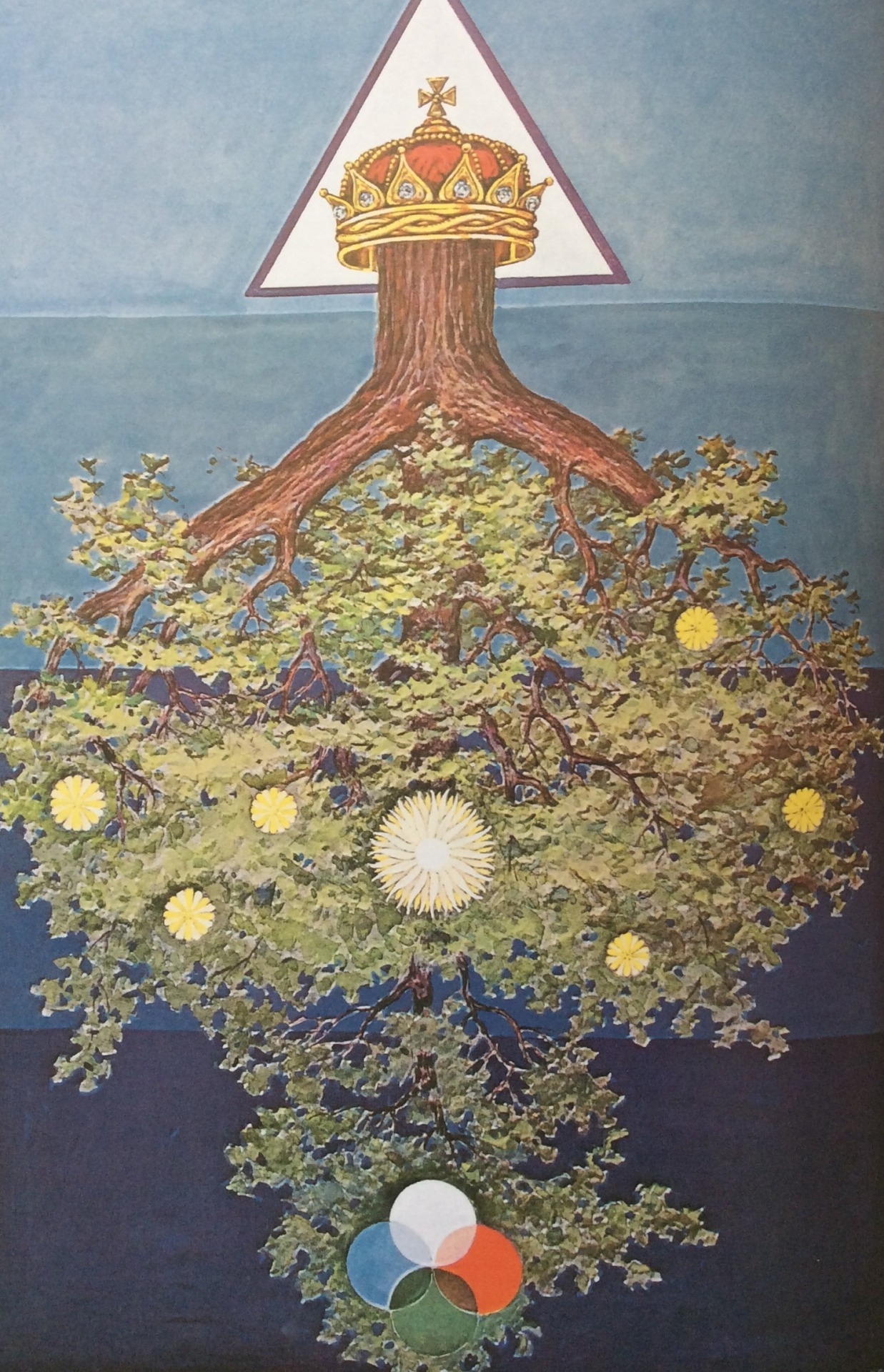
To review, these persons are trimporphic to the ground, in that there is no "part" that doesn't partake of it. (I saw an arresting image in the book Pathological Altruism, located here, on the second page from the top [right after the cover]. Just imagine it as tri-complementary instead of bi-complementary, and you've get the idea. Each "part" looks like this, as does the whole.)
As mentioned a few posts back, man is either "something" or he is nothing. In other words, either he has an essence and a nature, or he is the Beast With No Nature, and therefore a kind of literal monster, a cancer on Gaia.
From a Darwinian perspective man can have no essential nature, because any "nature" is just a temporary genetic weigh station on the endless road to some other random accident and transient adaptation. While this could be true, if it is, we couldn't know it.
Imagine, say, a pair of dice. It might land on any combination of numbers, but one could never say that one particular combination expresses the nature of the dice. Rather, their nature is to vary. Except to say that with the genes there is an infinite number of possibilities instead of just... 36?
Which is why you should never bet on man. Really, it's very similar to what they say about horse racing: no matter how much information you have, never forget that it all comes down to a dumb animal.
A contribution by Happy Acres Guy caught my attention this morning: "Political correctness & so many of the political fashions of our day could only be perpetrated on adolescent minds."
Quite true, but why are there so many adolescent minds? Why are they stuck in adolescence instead of being properly childlike or even infantile?
The reason is that Man, like the adolescent, is perpetually "on the way," the difference being that for the adolescent it becomes a pathological way of life. I am reminded of something Donald Fagen once said, to the effect that all of life is a midlife crisis. If you imagine there is some point that you can let your guard down and just relax, you're fooling yourself. Death alone takes care of that illusion. So adolescents do have that part right.
But what is a crisis, really?
Well now this is interesting. I was just looking it up and I see there is something called Crisis Theology: a neo-orthodox view of human nature "that holds that man and all human institutions are inevitably confounded by their own inner contradictions and that the resultant crisis forces man to despair of his own efforts" and therefore turn to the Divine Grace.
Okay. So I'm a crisis theologian.
But back to crisis, the word. It is "the turning point for better or worse." Interestingly, it is etymologically related to the verb to separate. Thus, it seems to me that time itself is a perpetual crisis. Or at least it is a crisis if we toss freedom into the mix.
In other words, if the world were actually deterministic, then there could be no crises because there could be no options and no separation into good and bad, or, more likely, bad and worse: no alternatives, no problems.
If eternity is the still point of the turning world, and time the moving image of eternity, we might say that Crisis is the turning point of the moving world. Thus, although Obama is surely a world-historical crisis, when has it not been a crisis? Even if the world weren't in crisis, your life still would be.
Indeed, one reason why the leftist is so caught up in the world-catastrophe is to deny and externalize his own existential crisis into the mode of politics (e.g., the "personal is the political"). As usual, N.G.D. has many excellent aphorisms to this end:
--The left is a collection of those who blame society for nature's shabby treatment of them. (So don't blame me for your low IQ, poor impulse control, and lowlife father!)
--The individual today rebels against immutable human nature so that he might refrain from amending his own correctable nature. (Actually the left wants it both ways, as they are quick to appeal to an "immutable nature" when it is convenient, e.g., homosexuality or brucejennerism.)
--Transforming the world: the occupation of a convict resigned to his punishment. (Which is why the unhappy leftist wishes for everyone to be as miserable as he is. Hey, fundamentally transforming the world is easier than addressing your own reprobate character.)
At the very bottom of our sidebar, what does it say? RIDDING THE WORLD OF MALEVOLENT BEINGS SINCE 2005, ONE ASSOUL AT A TIME. If I have succeeded in ridding the world of just one, then this is more than Obama has in seven years. Rather, he has only added bodies to Satan's Payroll.
But what I really want to discuss is something Brother Nicolás alluded to above about "immutable human nature." If man is something, then this is the something he is, i.e., the immutable part.
The mutable parts are nothing, that is, unless they converge upon the Immutable itself(s). In turn, this is what distinguishes the adolescent from the adult, in that the adult surely changes, but the change is measured in terms of proximity or conformity to the Absolute.
You know the old crack: To improve is to change; to be perfect is to change often. That the "progressive" doesn't progress is a truism; but that he also doesn't change is perhaps less appreciated.
But progressives will always be with us for the simple reason that there will always be human beings who are developmentally arrested in adolescence. For the typical adult, leftism is just a rebellious rite of passage wrapped up in the project of individuation. But for the adult leftist, immaturity is a career.
So, if man is an image of the Absolute, what then is absolute in man? What is immutable and normative? For the multiculturalist, nothing is immutable except his belief that nothing is immutable. This gag yoinked from Happy Acres summarizes their incoherence diversity:

In the excellent Book of Absolutes, Gairdner has whole chapters devoted to the absolutes that constrain and orient our life assage, including universals of human life and culture, of nature, of biology, of human sexuality, of language, of natural law, etc. But that's about it for today. I've fallen behind and I need to catch up.
Thursday, August 06, 2015
The Manhappen Project
Man must be a relational being right down to the ground -- he shall have no final bit of unrelated substance -- both vertically and horizontally. Vertically he is always related to the Sovereign Good, while horizontally he is related to Mother, Father, Child, Spouse, Sibling, Friend, and Stranger by way of prolongation.
As alluded to the other day, thinking is related to truth as creativity is to beauty. And love is related to the Good itself. To put it conversely, it makes no sense to exalt lies, to create ugliness, and love what is evil, but what is a demonic political party -- the Democrats -- but a stupid one's teacher?
Freedom must also be in the mix, obviously. And not by way of a simple "additive," so to speak -- an extra feature. No, like relation, this goes all the way down to the ground. Man is free and man is related, full stop.
Man is also -- and for this reason -- in process. He is a movement and a sojourn -- an Adventure of Consciousness. Importantly, to say process is not to say relative, the reason being that the process, while a movement, is related to what is stationary, principial, axial, e.g., Truth.
Having said that, there is a kind of analogous "movement" in God as well, the difference being that this movement can never surpass itself, but is like perfection upon perfection. It is unending novelty -- even the source of novelty -- accompanied by... let us call it "delighted witness."
God is the delighted witness of his own belightful novelty. Each is "relative" to the other, which again is the ultimate foundation of Relationship. Call it Father + Son + naches.
Ever been delighted just to watch your child breathe while sleeping, let alone accomplish even more than that while awake? That's probably a glimpse through God's peophole.
(Off topic, but in the middle of the night a thought occurred to me. Remember the bit about God breathing the breath of life into man via the nostrils? Why nostrils? I was reminded that in yoga, one always inspires through the nose and expires through the mouth. There are many reasons for this, one of which is to imagine God's grace, or power, or light, coming in with the inspiration and going back to God with the expiration. Thus again, our in-spiration is God's ex-spiration.)
Back to the Man happening. We've just laid out all the "parts" or ingredients for the recipe. However -- and this is a key point -- our man will not be composed of parts, but rather, be a whole. Thus, each "part" can only be understood in the context of the whole, similar to how we can say that God has distinctions but no divisions.
Better, we can say that man is fractal, in that each part will contain the whole, as in DNA: each cell -- each "unit" -- contains the formula for the whole organism.
This is how, for example, a musicologist can instantly say "this is Mozart," or "that is Beethoven," or "wo, that must be Monk!" One could say the same of painting or literature. There's a distinct soulprint, as it were (or stench, depending on the case).
For example, even though I forget each post after it is written, if you show me one ten years later, I could instantly say that's my Gagdad! There's a kind of rhythm and logic and flow to them. There are certain things I would never say, and certain things I would inevitably say given the trajectory of the thing. This has of course become more pronounced as I have given up trying, but rather, just let the planhappen as it will, without precoonception or artifice.
In Thinking Beyond Darwin, the author cites a gag by Goethe to the effect that "From the top to the bottom the plant is all leaf." (Which reminds me of Petey's crack that the world is a tree of life for those whose wood beleaf.)
The great man's point is that the plant is first a whole before we divide it into various abstract parts. Thus, it is a concrete way of looking, just as science is an abstract way of looking -- of analyzing the whole into its parts. But if we aren't careful, we can reify our own abstractions, which ultimately redounds to a sterile scientism of pure abstraction. Infertile eggheads and all that.
Even more deeply, there is only one world, AKA One Cosmos. And most importantly, consciousness is entirely wrapped up in this world. One can remove consciousness, or divide the world against it, but just remember it is you who have done this, not the world. The world is always the world, not our ideas about the world.
In conclusion for this morning, it seems to me that the modern anti-Manhappening Project of analysis and dissection is ultimately rooted in a philosophical nominalism. Applied to man, it means that man has no real form, no transcendent reality, no nature. Rather, he is just a bundle of parts, and these parts are just random and contingent adaptations to a transient environment.
That being the case, there is no moral problem attached to literally cutting one of us into parts and selling them to the highest bidder. If something about this makes you recoil, it means the left hasn't yet succeeded in preventing your wholeman from happening.
Wednesday, August 05, 2015
La Bête Divin, or Look Who's Talking
The ultimate humblebrag has to be the one about man being little more than an animal with speech, or culture, or tools, because these make us nothing like an animal. As the Rabbi suggests, they mean that we have transcended animality, precisely.
And transcend doesn't mean exclude or negate, but it does mean that even animality itself becomes something radically different in man.

Which captures the extremes of man: "The Lord God (YHVA) is the Divine name beyond existence. But man cannot be created from this beyond." Rather, he is a strange union or combination "of the end and the beginning. He is therefore made of the dust of the earth and the sublime spirit of God. His Divine soul is not even the same animal soul of creatures; he is a paradox of the lowest and highest." Not an animal but a kind of super- (or infra-) animal; and not God, but a kind of hobbled godling.
All of the above is by way of a note to myself about how one would go about creating Man -- not this or that man, but Man as such, i.e., the category, archetype, or advanced prototype. The note says "consider man from the POV of God wishing to create a thinking, creative, and loving being." Think of the obstacles and potential bugs!
Again, it is one thing to have the idea of Man, but then it has to be embodied, and the body has to be in an environment and a community. One nonstarter would be reptiles. The problem isn't reptiles per se, but the absence of mothering. Rather, reptiles are abandoned by their parents long before they hatch, and they pop out of the shell more or less complete. Which is to say "perfect." A perfect reptile cannot transcend its own perfect reptilian archetype.
Furthermore, no matter how big the brain, a reptile could never be a person, because that brain could never be intersubjective. We've discussed this on a number of occasions, so I'll let it go. But human neoteny is the key to transcendence, or of squeezing transcendence into immanence. It is where transcendence first gets into the cosmos, in the sense alluded to above by Steinsaltz.
I've said it before, but that space between an immature and incomplete nervous system and its caretakers is everything. It is the crack where the Light gets in. And it gives a whole new dimension to the baby Jesus-with-Mary archetype. An infant God? Of course.
Over the years, I have been surprised and blown away that a number of Catholic thinkers have thought along these lines. In particular, Balthasar and Ratzinger committed anticipatory plagiarism against me by saying very similar things before I had the opportunity to think them myself. I shall now endeavor to dig them out, which I will not be able to do without the aid of God, considering how much they wrote...
Here's something from Balthasar's Theo-Drama vol III. Note that if you are God, and you are planning to incarnate as man, then this presupposes that Man must be in a form that will permit this.
Thus, just as God first had to create a community, he also had to create nervous systems and persons -- and even wombs -- susceptible to the Divine descent. This descent would just bounce off of most communities, just as surely as it would bounce off the skull of a Bill Maher or Barack Obama. Nor could it reach into the womb, as evidenced by their enthusiastic support of premeditated and Planned Pedicide.
von B writes of how "in principle every created spirit is qualified to apprehend the totality of being," or in other words, man is the container who can -- at least in principle -- contain the uncontainable, which is precisely Christ's mission. The resurrection is simply the last piece of evidence that the attempt at containment was unsuccessful, so to speak, for he skedaddled over the horizon of every human boundary.
"[E]very man, insofar as he possesses complete human nature, has access through love and understanding to all that is thought and felt, done and suffered by other subjects possessing the same nature. Thus all that is human is open to us..." (ibid.).
This has two important implications. First, notice that no matter how perfect the man, it still isn't enough. We are clearly the most exalted being in existence, and yet, in the absence of God this means nothing. In a Most Excellent Aphorism, Dávila puts it that Man is important only if it is true that a God has died for him.
Think about that one for a moment. As flawed as my parents were, there was never a time that I doubted they would give their lives for mine in a heartbeat, no questions asked. Naturally it is the same with I and my son. Importantly, it's not even a thought, but deeper than that. If push ever came to shove, it would be completely spontaneous.
Thus, even the very idea of God dying for man is about the loftiest idea one could humanly imagine.
But we're getting slightly off track or out beyond the reach of our headLight. We were discussing man's irreducible intersubjectivity. For von B, "the human 'I' is always searching for the 'thou'..., without ever being able to take possession of its otherness."
Thus thank God for our incompleteness, because without awareness of it, we could never complete ourselves via God! A cow, for example, doesn't know it isn't All That, any more than Obama does. Therefore, they remain stuck in cow- or asshood.
von B references Eve, the archetypal Mother of Us All, who says I have gotten a man with the help of the Lord.
First, what a charming way to express it. Second, "She understands that the human child is not a mere gift of nature but a personal gift of God.... If we are to measure the whole scope of the self, we must penetrate into the very womb of the Godhead, which alone can solve the entire mystery of our being."

As the talking baby said after being born in Look Who's Talking, I don't know about you, lady, but I'm beat. To be continued.
Tuesday, August 04, 2015
How to Make a Man
Yes, it's easy to imagine a divine snapping of the fingers and abracadabra, Man! But even (especially?) the Bible doesn't make it that simple.
In particular, the creation of man is preceded by five earlier ages of creation. Man could not have been created first, because, among other reasons, there would be no place to live and nothing to eat.
And, far from snapping his divine fingers, the Creator utilizes the available material -- the stuff he made on day three -- to fashion Adam, which of course means "of the red earth."
Nor is this the end of it, because a person without other persons is not a person. Rather, persons -- like their creator -- are intrinsically relational -- so the Creator completes the process by using the same personal substance to create the male's horizontal complement, AKA female.
Why a rib? There are many theories -- closest to the heart, a foreshadowing of Jesus' side being pierced on the cross, that woman is "made of human" instead of dirt, and therefore more civilized. Who knows? It's an arresting image, made more arresting by its unsaturated peculiarity.
A few posts backed we alluded to the fact that man is not just animal plus X -- or at least no horizontal X. However, it might be acceptable to say that he is animal plus a vertical Y.
This would go to Genesis' account of man being made of primordial matter, like any other animal, but then inspYred by God. We are animals into whom God has breathed the breath of life (inspire, spirit, and respiration are all cognate).
Truly, our inspiration is God's expiration. Indeed, now that I think about it, his ex-piration on the cross must be the last Word in in-spiration, and isn't it provocative that each gospel makes a special point of it (Matt 27:51), Mark 15:34, Luke 23:46, John 19:30)? I never considered it from this angle before, but it must be a parallel to Genesis 2:7 -- a new breath of life, a blast of fresh air, for the new-and-improved man.
Not only does man summarize the six days of creation, but the seventh day, you might say, is created for the contemplation of this strange-but-true fact. To paraphrase Rabbi Steinsaltz, man contains all the forms of existence, in that he is made of material substance, grows like a plant, moves like an animal, and communicates through language. One might add that he relates like a God.
Why? For what purpose?
"Man is human because he has a task in life to relate to the world, to raise it up and give it meaning and purpose. Otherwise the universe is an endless repetition, a question without an answer, a movement without a goal" (Steinsaltz, emphasis mine). A dead, because closed, circle.
In doing his cosmic duty, man elevates himself (and everything else), is "lifted up out of the earth," such that "hidden sparks of holiness are released" to become "part of a higher level of reality" (ibid.). This is the "Kingdom of Heaven," which you might say we orthoparadoxically enter by co-creating and co-create by entering.
You could say the same of hell, which goes to the purpose of Democrats.
About our material substrate. We are not immaterial (angelic) beings. Rather, "the Divine soul of man had to be fastened to something firm and steady like the earth," for "man is also the lever and the hoist of all of creation, the factor that can raise the essentially inert parts of the world" (ibid.).
Yes, just like God. For what is artistic creation but essentially raising up inert parts of the world, whether color, sound, or rhyme? Man creates beauty, discovers truth, and embodies -- incarnates -- virtue and love. This is called "why we're here."
"A circle is thus formed; the end meets the beginning. Indeed, it would seem that the end and beginning have something in common that is of the very essence of the whole," for purpose "requires the simultaneity of both the end and the beginning. The end of the matter is in the nature of the beginning. The original idea contains the result; the final result contains the initial notion" (ibid., emphasis mine).
Which is of course the point of the riverrunning circularity of pp. 266 <--> 6 of the book. And that circularity is itself the whole point, a fractal of the expanding spiroidal cosmic movement which occurs at every moment:
The circle unbroken, by and by. A Divine child, a godsend, a bloomin' yes, and all that. It's happening now! Our common source without center or circumference, blissfully floating before the fleeting flickering universe, stork naked in brahma daynight. Who is? I AM. A wake!
I have less time than usual this morning, so we'll get back to the main thread tomorrow -- of just how one goes about making a man.
One becomes aware of a vast arc, curving from the divine source to oneself, which corresponds to the question, Where am I going? And within this great circle... each person can discover the special lines of his own direction. --Adin Steinsaltz
Monday, August 03, 2015
Is Man a Thing?
And you can't just say "God," because that's not an intellectually -- or even spiritually -- satisfying theory. After all, you could say the same of anything: "Why did you eat the last cookie?" "Er, God!"
Yes, in an ultimate sense God is at the "beginning" of all causation -- he is the uncaused cause -- but this hardly means we should ignore all the many intermediate causes that go into a phenomenon. Science is the science of intermediate causes, not of the first and last, AKA alphOmega.
Obviously, there was a time -- or timeless -- that this cosmos did not exist. Likewise, there was a time that no life existed in this cosmos. And there was a time that man wasn't here. From the view of cosmology, it is as if man arose fully baked just yeasterday.
Being that man is now here, what we really want to know is how he got here. Neither believer nor unbeliever dispute the fact that man once wasn't here, so our present presence is in need of explanation.
That man once wasn't here is a fact. Likewise our current existence. Natural selection is simply one way to bridge those two stark Facts. Some people say Genesis is another way, but this is not necessarily so.
For example, Genesis 3 is more a lesson in why things are so fouled up than how we got here per se. And I have heard it said that even Genesis 1-2 are there more to impart important moral lessons -- for example, the importance of the sabbath -- than to provide a comprehensive explanation of how we got here. Not, as the gag goes, how the heavens go, but how to go to heaven.
Although I do not accept the Darwinian narrative of anthropogenesis, I could never get completely on board with the alternative either, at least in every vague detail. But this book on Thinking Beyond Darwin has given me a way to wrap my mind around the traditionalist view of How We Got Here.
If man is in the image of God, then this is a way of saying that he is not contingent, or at least not wholly so.
Rather, there must be some part of him that is made of "absoluteness," so to speak -- which cannot not be -- in contrast to the evolutionist view, which would say that man of course could have not been or could have been unrecognizably different (and everything in between).
In the traditionalist view, if God wants you to be, then it will take a great deal of effort to deny him. But that's what the left is for.
The traditionalist view holds that man is a very specific thingy, and that if he is not this thingy, why then he is literally no-thing, just an ephemeral accumulation of random genetic booboos.
For Schuon, "To say that man, and thus the human body, is 'made in the image of God' means a priori that the body manifests something absolute and therefore something unlimited and perfect.... The human form cannot be transcended for its sufficient reason is to express the Absolute, hence the unsurpassable..."
I'm trying to find the Traditionalist explanation of how we got here, but can't track down the exact one I'm looking for...
Schuon writes that "One must not tire of affirming this: the origin of a creature is not a material substance, it is a perfect and non-material archetype....
"Assuredly, there is a trajectory; but this starts not from an inert and unconscious substance, it proceeds from the Spirit -- the womb of all possibilities -- to the earthly result, the creature..."
For Lings, "the universe and its contents were created in order to make known the Creator, and to make known the good and to praise it....
The things of earth are "sent down in finite measure from the Stores or Treasures of the Infinite." While this or that animal incarnates an aspect of God, only man has the potential to manifest them all, for which reason the Perfected Man would be the most adequate image of God.
I can't find the exact passage I'm looking for, but it has something to do with animal forms, including man, being coagulations of divine archetypes. But the real point is that either man has an archetypal form, or he is truly nothing, just a bundle of accidents.
So, the deeper metaphysical question is, Is man something? Is he a thing? Or no-thing?
The first thing one wants to say to the Darwinist is, "okay, we get it. You're nothing. But how does an accidental nothing know an absolute anything?"
I apologize for the rambling, but I'm feeling a bit fuzzy this morning, like my archetype hasn't fully coagulated or something.
Let me get back to what is close at hand, Thinking Beyond Darwin. First, I would suggest that to think beyond Darwin is not necessarily to think against Darwin. Furthermore, there is a way of thinking with Darwin that is ultimately to think against him.
For if it were true that we couldn't think beyond Darwin, this would represent a weird backdoor way of codifying man's absoluteness, i.e., that man knows the absolute truth about himself, a truth which renders him absolutely relative. This is literal nonsense. And not the good kind.
I'll take a fresh stab at this thing tomorrow morning.
Friday, July 31, 2015
I Married a Monkey
This line of thought first came my way while studying psychoanalysis in graduate school. Lng stry shrt... if you've ever looked at the Gagdad profile, under the heading "favorite books," there's an idiosyncretistic list of authors and books that have had an enduring influence, from psychology to philosophy, theology, mysticism, esoterism, aphoristics, ethnobotany, indecipherable Irish literature, and terrestrial and celestial humor.
That second name, "R.D. Fairbairn," is the bloke to whom we are alluding, and he will -- I think -- have relevance to our discussion of the Missing Object of Virtue.
In general you will have noticed that there are two ways to approach a phenomenon, via analysis or synthesis. In reality these two are and must be complementary, but analytic science generally forgets this, which is how it descends into the vulgar scientism of the tenured, AKA wanker bee scientolatry. These drones forget their models are just analogies, and thereby fall into Whitehead's fallacy of misplaced concreteness.
At the time Fairbairn arrived on the scene -- his first important papers were published in the early 1940s -- the scene was of course dominated by Freud, who had a bad case of physics envy.
That is, Freud regarded the mind as a kind of combination archaeological site with layers of psychic material from new to old; and a hydraulic system under instinctual pressure. The first is the conscious/preconscious/unconscious model; the second the id/ego/superego model. Both are analogies, more or less useful depending upon the situation. But they are not reality.
In order to avoid pedantic tedium, I am going to cut to the chase. Fairbairn comes along and essentially says that when you cut a man into id, ego, and superego, and then reify your abstractions, that's no longer a man you're dealing with. Rather, you're just seeing your projected model. You are free to do that, just don't forget you're doing it.
It seems that Fairbairn was initially unpopular with everyone. Psychoanalysis is a bit like a church, with orthodoxy, heterodoxy, catechesis, initiation, confirmation, heretics, excommunicants, etc.
But without even realizing it, Fairbairn created a version of psychoanalysis that is much more consistent with Christian metaphysics, because he starts with the whole person, not with an animalistic id; he also begins with relation instead of isolation; and finally, he maintains that instincts ride piggyback on the need for love and relation, not vice versa.
For example, a classical Freudian would say that an infant only "loves" its mother to the extent that love is another name for instinctual release, satisfaction, and equilibrium. It is not a human passion in and of itself, just derived from other factors.
In short, for Fairbairn man is a social animal right down to the ground: there is no asocial monad "beneath" or "behind" or "deep down." Rather, to the extent that man succeeds in isolating himself -- what Fairbairn called the schizoid position -- then he has fallen beneath his humanness, generally not because he truly dislikes or hates people but because he unconsciously believes his own love to be dangerous, toxic, or repulsive.
This whole way of looking at things has innumerable implications. Sutherland writes that "what stood out irrefutably in [Fairbairn's] schizoid patients was the failure to develop a capacity to make normal relationships with others and with themselves, and this failure distorted the effectiveness of the person in relating to the world in general."
Note the subtle point(s): since all is relation -- i.e., man is irreducibly relational -- there is no "oneness" beneath the twoness (we'll leave trinitarian thinking to the side for the moment). Therefore, even the self is a relation -- with oneself!
Likewise, there is no world, only a relationship with it. Thus, context is everything. Thinking is relational; emotion is relational; and spirituality is most certainly relational.
The other day I was remembering when "sex education" entered the public school. This is a perfect example of the distortion we're talking about, and one can draw a straight line between it and the institutionalized ghoulishness of Planned Parenthood and of the left more generally.
If man is first and foremost man and not animal, then sexuality must be specifically a human sexuality. But for the cultural left, "sex" cuts across the animal kingdom, such that the most important things about it are those we share with other animals.
But one can literally know everything about animal "sexuality" and know nothing about human sexuality. And I do mean literally. If you even think for a moment about it, you'll understand what I mean.
The result is that a secular indoctrination on the subject of human sexuality erodes the very foundation of our humanness. For evidence of this, just open your eyes and look around.
For among other things, this means that human sexuality has a purpose, a meaning, a telos, that is entirely wrapped up with what it means to be human. To the extent that it is depersonalized, it is broken. The whole human is in each part of the human; this whole is orthoparadoxically relational, not isolated (here is where you might begin to intuit how man is indeed in the image of the Trinity).
This line of thought was provoked by a couple of books I'm reading, The Wholeness of Nature and Thinking Beyond Darwin. You might say that seeing the wholeness of nature is a consequence of thinking beyond Darwin (and vice versa).
For our purposes, what this means is that a human is again a human, not animal plus x. Contrary to Darwinian fundamentalism, man is not the sum of his accidental and contingent adaptations; or, if he were, we could never know it, because our mental life would be just a contingent adaptation. There would be no reason to believe that man somehow transcends his own contingency, for if he does, that puts the kibosh on Darwin.
We need to avoid the other extreme as well, for it is not as if man is like an immature seed that grows to manhood; it is not as if we are born a Little Man that simply grows in a linear manner into the Big Man. Rather, remember the principle of relation: we are always related, and our relations will to a large extent determine the man we become. And we are always becoming, because relation is to process as stasis is to object.
Kranich makes an important point that is also raised in MOTT, only scientifically instead of... tarotistically. That is, in the absence of any knowledge of human beings, it would never occur to you that an ape is just a human waiting to happen -- a prehuman if you will.
On the opposable hand, assuming knowledge of human beings, then apes become understandable in light of this. Again, man is not ape plus x; rather, the ape is human minus y. And it is an awfully big y. Indeed, the variable y is infinite, such that the gap between ape and man is equally infinite. If you don't believe me, try talking to an ape about the square root of two, or how far pi extends, or why there is always a Why -- i.e., how we know we are incomplete in light of a Completeness to which (or to whom) we relate via faith and intuition.
In conclusion, the recovered psychiatrist Theodore Dalrymple has a new book on How Psychology Evades Morality. One way it does this is by starting its analysis of man with something less than man. Only man can be moral, so if that bugs you, just divide him into various animal parts that operate in a deterministic manner. Problem solved.
Thursday, July 30, 2015
Postmodern Calvinbrawlers
But it's a variation on the theme, to wit, that America has become a nation divided by a common tongue, in this case modern- and postmodernese. We conservatives are still proud of our plainspoken Modernese, while the left long ago abandoned this idiom for the cryptic and craptic language of postmodernism.
This being the case, it explains why we can't win arguments and why it doesn't matter that we always do. In short, you cannot defeat a postmodernist in an argument, because he is playing a different game -- just as you can't win a baseball game by playing football.
(Although some people try. I remember when my son played Shetland baseball at age six or something. A ball was hit to the third baseman and he proceeded to scamper with it toward the plate, trying to score a run.)

Interestingly, the website from which I yoinked that image deploys it to illustrate the principle that THE RULES SAY I CAN CHANGE THE RULES, INCLUDING THIS RULE. Those are the rules we're talking about: the Butch Cassidy Rules of Politics.
Another name for it is Calvinball, "a game invented by Calvin in which you make the rules up as you go along." Thus, conservatives naively play x while the left cynically plays Calvinball.
Which might be part of the appeal of Mr. Trump, who plays his own loud and aggressive version of Calvinball -- not just against Republicans but against the other Calvinballers on the left.
Who are the best -- which is to say worst -- Calvinballers out there? I would say it's a three-way tie between politicians, MSM journalists, and academia. Academics work more in the shadows, so in the popular imagination it comes down to idiot journalists and amoral politicians. That Trump is happy to say Fuck You to both camps seems to give hope to the masses that we finally have a formidable Calvinbrawler on our side.
I don't see it ending well, however. It's one thing to Calvinbrawl as a tactic, but if it is not informed by truth, then it will be a hollow victory at best, just another name for losing.
This is precisely why I supported Giuliani in 2008. He is the last Calvinbrawling Conservative we've had on the national stage. Ted Cruz? I can't quite put my finger on why his style of brawling won't work.
Anyway, this does go back to the topic at hand, the Missing Object of Virtue. Again, we (or they, rather) have the fragments but have misplaced the thing itself. For the left there is no such thing, so it is a matter of course for them to pick up one of the shards and pretend it is the whole thing, for example, "a woman's right to choose."
Any talk of intrinsic rights must be grounded in natural rights theory, but there can be no natural right to kill an innocent human being. So that is a perfect example of elevating a shard to the whole. What's the word, Jeeves? Synedoche?
No sir, synedoche is not necessarily a fallacy. I believe the term you are grasping for is division -- the fallacy of division.
Hmm, let's see: "A fallacy of division occurs when one reasons logically that something true for the whole must also be true of all or some of its parts." Natural rights theory (naturally) assures a "right to choose," AKA free will. But this right cannot be abstracted from the human person without negating itself.
As always, The left's theses are trains of thought that are carefully stopped before they reach the argument that demolishes them (Dávila). This is a quite universal truthism, which is why the left must play Calvinball, for the rules of Calvinball permit one to change the rules just before the train hits the wall. You will have noticed how Obama and Hillary do this All Day Long.
Another of my favorite aphorisms: Rather than an ideological strategy, the left is a lexicographical strategy. In other words, they do not rely on logic, ideo- or otherwise.
Rather, the real strategy lies in language itself, which is constantly redefined to suit present needs. The image comes to mind of the T-1000 in Terminator 2, or of eating Jello with chopsticks, or of biting a wall.
What is the endgame of postmodern Calvinball? For Father Rose the whole thing is a "War against God, issuing in the proclamation of the reign of nothingness, which means the triumph of incoherence and absurdity, the whole plan presided over by Satan."
Remember the other day, when we alluded to Satan as the "nonlocal Object of Vice," which "can only be known via the surface structure of particular acts and beliefs. On the surface the acts may appear random and incoherent, but perhaps there is a secret order"?
As Rose points out, "Effective war against God and His Truth requires the destruction of every element of [the] Old Order," for which reason "violence is no merely incidental aspect" but "part of its essence." As they say, if you strike at God, you'd better kill him.
So it really comes down to the possibility of coherent truth knowable by man vs. an absolute relativism that seals man in ignorance and tyranny. Or just say Celestial Truth vs. Terrestrial Power, because I am out of time.
Wednesday, July 29, 2015
Science Wars and the Restoration of Reason
Hey, wwwwwait a minute. Isn't this already happening in academia? The rioting started in the 1960s -- which is just a microcosm of power displacing truth -- while the efficiency of academic correctness makes it unnecessary to literally burn books.
Burning only calls attention to them anyway. Better to consign them to the Index Liberalum Prohibitorum, the Endless List of Books that Offend or Frighten Liberals.
And lynching? In the Jewish tradition the rape of a name is as morally reprehensible as physical rape:
"The Talmud, the set of books of Jewish law and philosophy that rank in Judaism second in importance only to the Torah, says, 'Whoever humiliates his friend in public is considered as if he has shed his blood.' That is why some rabbis call undeserved public shaming 'emotional murder.'”
I'm thinking of that scientist who made a joke about women and science, and was bounced from his job. So, maybe we won't find a cure for cancer, but at least these joyless feminists with no sense of humor will be... happy? Yeah, right.
Anyway, that's a different subject. Or is it? Since the Good, True, and Beautiful are intrinsically connected, you can't attack one without damaging the others.
Speaking of which, Julie just left a comment with a link to this piece with the headline Dante's Divine Comedy 'offensive and should be banned'.
(゜_゜)
Well, at least it kills three birds with a single stone: truth, beauty, and virtue.
As if contemporary college students read Dante anyway. I would guess they are no more familiar with it than with the Constitution or Book of the Subgenius.
Back to our imagined scenario. What happens after the scientific calamity? How do we put Humpty back together? Well, we don't. The original act of synthesis has been lost, and it is not possible to reassemble it with the fragments. The parts don't add up to the Summa, don't you know.
"... [E]nlightened people [will] seek to revive science, although they have largely forgotten what it was.... all they possess are fragments: a knowledge of experiment detached from any knowledge of the theoretical context that gave them significance; parts of theories unrelated either to the other bits and pieces of theory which they possess... instruments whose use has been forgotten; half-chapters from books, single pages from articles, not always fully legible because torn and charred."
I'm thinking of my racket, psychology. As we know, the softer the science the easier for activists to infiltrate and pervert, and it hardly gets softer than psychology. This is how homosexuality was unilaterally declared Wonderful in 1973. A hundred years of research and scholarly articles? Forget about it. Homophobic or something. There's a new Truth in town, so don't even refer to the science before 1973, or else.
The whole story of how that deal... went down is sordid beyond belief. In the highly raccomended Making Gay Okay, Reilly says "There are two fundamentally different conceptions of science -- one that is scientific and one that is not."
Or one that is scientific and one that is post-scientific: postmodern, post-literate, post-virtuous, and really post-human. The latter does not begin with things as they are, but rather, how the left would like for them to be. Once you've determined that, the science is easy: just backtrack from your abstract conclusion and invent a causal nexus.
Coincidentally, I just read a book on genetics that explains how this works in practice. Often all one has to do is perform a little word magic in order to transform one thing into another. (I recently read that the magician's formula abracadabra comes from the aramaic for I create from nothing. File under too good to check.)
Let's take the depraved folkers at Planned Parenthood. First of all, some plan. Second, some parents.
"Needless to say, a definition can serve a particular prejudice. If I want to perform experiments on embryos, it will be comforting" to regard them "as not yet human, just as I will deny humanity to the twelve-week-old fetus I want to abort." The point is that reality is one thing, the words we use to describe (or deny) it another.
I have a relative by marriage who is quite intelligent and even attended medical school. In a discussion of abortion, she actually insisted that an embryo is just an undifferentiated blob, not remotely human. Where to begin? One can't. She has already foreclosed the beginning before it even starts.
It is the same if we start a conversation about homosexuality with "love" instead of nature, reality, and natural law. This actually goes back to the Misplaced Object of Virtue. In this book on How the Left Has Sabotaged Family and Marriage, the author reminds us that the Catechism refers to natural law as "immutable and permanent throughout the variations of history," "written and engraved in the soul of each and every man" and "established by reason." So there it is: the missing Object.
Reason. Remember that? It too is a kind of natural law that touches the threshold of the supernatural, and "cannot be destroyed or removed from the heart of man." Yes, it can be rejected, but since it is part of us, to vanquish it is to defeat ourselves.
So, it would appear that Right Reason cannot only guide us to the restoration of Truth and Virtue, but to their proper marriage.
I will conclude with this thoughtlet: if you cannot convince another with your reasons, it probably means you never actually convinced yourself, rather, only asserted it. Thus, the leftist begins by bullying his own intelligence and conscience before moving on to the enthralling fun of overhauling yours.
Tuesday, July 28, 2015
Conservative Exodus and Liberal Slavery
What do you mean, "nonlocal Object of Virtue"?
Well, it reminds me of the title of one of Dávila's collections of aphorisms: Annotations on an Implicit Text. In other words, it is as if these timeless nuggets are the footgnosis of a text that isn't here.
Where is it then? It is everywhere in general and nowhere in particular. It is available to every man, by virtue of being one. The annotations on it were true yesterday and will be true tomorrow, suggesting that their textual object is also trans-temporal and hyperdimensional.
Or, it is like language itself. As Professor Chomsky proposed before sanity and decency abandoned him (or he them), language has a surface structure and a deep structure. All humans have the same deep structure, whereas a particular language furnishes the surface structure.
The deep structure is as it were noumenal, in that it cannot be directly perceived. Rather, it is implicit in language itself. One cannot speak the deep structure for the same reason one cannot hear musical theory.
This would imply that, say, the Ten Commandments are local expressions of the nonlocal Object of morality. They are not the thing itself and should not be worshiped as such. They are still phenomenal, and indeed, the second commandment might even be seen a self-referential joke warning for us not to turn morality into a soph-reverential idol. We are frankly in love with Wisdom, but she is not God.
There are also the four cardinal virtues and their opposite number, the seven deadlies. The latter imply that there is also a nonlocal Object of Vice.
Uh oh. Could this be the entity called Satan? Perhaps like language, Satan can only be known via the surface structure of particular acts and beliefs. On the surface the acts may appear random and incoherent, but perhaps there is a secret order. We will no doubt return to this idea.
Right now. Because it really reminds me of psychoanalysis, in particular, of the discovery of the unconscious. It's been a long time since I thought about it, but while others had noticed that man is driven by "irrational" subterranean forces he doesn't understand, Freud was the first to propose that they emanate from a deeper order -- that the outward disorder has an invariant deep structure.
Today we call this a "personality disorder," but the latter word -- disorder -- is a bit misleading, or at least ambiguous, because we're really talking about an enduring order, albeit one that leads to chaos in one's life.
You could even say that it is very much analogous to the oxymoron of a "planned economy" or centralized state. Indeed, these are collective versions of individual pathology, in that they are orders that inevitably provoke chaos.
To pretend to plan an economy is to attempt to do something that not only cannot be done, but will engender misallocations, shortages, surpluses, price distortions, black markets, etc.
Similarly, a rigid personality disorder will be recognized by the chaos it generates in the persons's life. The chaos follows them like the dirt cloud around Pigpen. Psychological health lives in the shadowland between order and chaos. Too much of either makes life unlivable -- either for oneself or the people around oneself.
Note also that just as excessive topdown order generates chaos, excessive chaos will evoke order -- as in how the chaotic breakdown of the black family calls forth the police which they then complain about. Hey, feel free to police your own children, because we really really have better things to do.
Here is where the liberal desire for topdown control meets with the chaos which liberals simultaneously create and promise to remedy. As George Gilder puts it, liberal policies ensnare the poor
"in a welfare state for women and children and a police state for two generations of black boys. Some seventy programs annually dispense close to $900 billion mostly to single-parent families totally incapable of raising boys." As a consequence, "as many as a third of black makes under 35 are in prison, on probation, or on the lam."
Now, the welfare state is the indulgent mother, the pathological Matriarchy. The police state is the Father after it is too late. Rather, he can only come in amidst the wreckage and try to impose some order after the fact. But since the source of the disorder is in the psyche(s), there's not much he can do.
Look at the Gentle Giant of Ferguson. Strong-arming store owners and charging police officers is prima facie evidence of a deep disorder, of no impulse control. I am not advocating shooting every person with poor impulse control, but you can well understand that if a person cannot stop himself from acting out violently then someone else will have to. I suppose we could shoot them like animals with tranquilizer guns, but the animal always wakes up behind bars in the zoo, where he belongs.
Back to the Object. Again, MacIntyre's point is that the Object of Virtue is broken and fragmented, such that it is "no longer possible to appeal to moral criteria in a way that had been possible in other times and places"; and that this represents a "moral calamity."
First of all, it is not a calamity to the left. Rather, it is what they call "liberation." And an opportunity.
I do dwell on this problematic from time to time. For example, can you think of a single person who is so universally morally esteemed that his condemnation would be sufficient to end the career of a politician? Liberals of course try to do this, but to comical effect, for example, bowing before the moral authority of Jimmy Carter, or Michael Moore, or Ted Kennedy, or Als Sharpton and Gore.
Why isn't Obama universally morally condemned? Because the world is a morally sick place. Speaking of Gilder, one has only to consider the Israel Test to appreciate how morally deranged the world is. That this anti-Semitic turd is our president not only speaks to our moral deterioration, but more problematically, to our literal destruction, since those who bless Israel are blessed, just as those who curse it are cursed.
Now, what does that really mean? Yes, we love Israel -- the country and people -- but more important is Israel the Idea. And this Idea goes back to the Object of our interest, since the whole idea of Israel was and is to fashion a people in conformity with the divine order. Christianity is simply the prolongation of this one story bildung of metanoia, redemption, and soph-improvement.
Remember too that in one mishnavious version, the cosmic purpose of Israel is to put back together those fragmented shards of light and return them to their brightful owner. Certainly America's founders were aware of the fact that they were attempting to continue the Exodus into freedom and light.
Seems like a good place to end for the day.
Monday, July 27, 2015
Adamnesia and the Misplaced Object of Virtue
At the other end of the spectrum of literary economy is our own Señor Dávila, who only says those things that must be said, and in the fewest possible words consistent with a rigorous and austere beauty. And if other people were saying these things, he would gladly step aside and move on to other subjects. Here, for example, on this blog, you won't ever find me speculating on who will win the election in 2016, because there are millions of other bloggers and worse servicing that market.
The writer who does not torture his sentences tortures his reader.
The first step of wisdom is to admit, with good humor, that there is no reason why our ideas should interest anybody.
To write honestly for the rest, one must write fundamentally for oneself.
Prolixity is not an excess of words but a dearth of ideas.
Write concisely so as to avoid making the reader sick.
Clarity is the virtue of a man who does not distrust what he says.
Mere talent is in literature what good intentions are in conduct. The road to tenure is paved with good intentions!
And so on. We've adverted to some of those aphorisms before, but words do not communicate, they remind. In this case me.
So, what is the problem MacIntyre raises? To put it succinctly, it is the question of whether or not morality is convergent. For if it isn't, then we are ineluctably in the land of relativism and moral chaos. Moral chaos would be the norm, which in turn evokes the Stark Fist of the State in order to tame.
For it would also mean that man cannot govern even -- and therefore especially -- himself. Democracy would be analogous to multiples of zero, for 300 million ungovernable souls would be no different than one, only worse -- because they can do so much more damage than the loon wolf.
A related point for MacIntyre is the fragmented nature of morality. I'm going to paraphrase, but it is as if we once had the thing itself, but this thing has broken into a thousand pieces, such that this or that group or person picks up the pieces he needs -- not in order to transcend himself, but often in order to do precisely the opposite: to provide an excuse, a permission slip, or an alibi.
Here again the Terse One has many pointed things to shove between our ribs:
There are two kinds of men: those who believe in original sin and idiots.
The fool, seeing that customs change, says that morality varies.
The same fool does not content himself with violating an ethical rule: he claims that his transgression becomes a new rule.
But A decent man is one who makes demands upon himself that the circumstances do not make upon him.
And The higher part of ethics does not deal with moral behavior, but with the quality of the soul.
Besides, Evil, like the eyes, does not see itself. May he tremble who sees himself as innocent.
But if you should fail, hey, just invoke a right to that which you failed to achieve: The preaching of progressives has so corrupted us that nobody believes that he is what he is, but only what he did not succeed in being.
In any event, forgive them Father, because they know not what they do. No, really, for the leftist cannot lament the disappearance of something of which he is ignorant.
Let's get back to this idea of the Fragmented Object of Virtue. It so happens that this touches on a central mishnah of the Rabbis, if I can find it. Which I can't. Something like a cosmic fall that results in all these shards of light.
You know how a hologram works? Break up the holograph, and each fragment will contain the whole until the point that the image becomes fuzzy, indisctinct, and discontinuous. The original image will still be there, only unrecognizable. Like our constitution.
Here is how Rabbi Kushner expresses it in Honey From the Rock: there existed "A light so powerful that it shattered earthly vessels," and is "imprisoned in the shards of this created world, waiting for us to free it. Returning itself to the Creator."
This is no doubt what Petey has in mind with the gag about those banged-up and thunder-sundered images of the One on p. 248. And it is also all over -- you guessed it -- Finnegans Wake. Indeed, this is one of its central themes, starting in the third paragraph and then ad gnosiam:
"By its fall, the shell of the Cosmic Egg has been shattered.... Finnegans fall from the ladder is hugely symbolic: it is Lucifer's fall, Adam's fall, the setting sun that will rise again, the fall of Rome, a Wall Street crash. It is Humpty Dumpty's fall, and the fall of Newton's apple.... And it is every man's daily recurring fall from grace...." (Skeleton Key). The whole thing is structured around the Fall, the Wake, and the Rise (or fallagain, wakeagain, and riseagain).
We will continue our quest for the nonlocal Object of Virtue tomorrow.
Friday, July 24, 2015
A Brave New World of Left Wing Clichés
I suppose like everyone else I was sucked into the vortex started by Descartes and codified by Kant, such that knowledge begins in my own melon. But this attitude was probably more shaped by my immersion in Buddhism and Vedanta, which don't place much importance on this maya-ridden world. And the whole innerprise was capped by my psychoanalytic training.
I'll try to cut to the chase and avoid boring you with details, but, just like everything else, you could say that psychoanalysis has a "left" and a "right," at least in a manner of speaking.
In this case, it would come down to the importance of reality, or of the external world. The school of thought to which I was most drawn was the Kleinian, which, you could say, emphasizes psychic reality, almost to the exclusion of reality. It's not what happened, but your unconscious phantasies about what happened, that count. (The "ph" distinguishes these from conscious fantasies.)
At the other extreme would be where I sit today, which is in attachment theory, which is very much rooted in real world experiences with caregivers. Then again, what I've really done is blend the two, for they are complementary, not antagonistic: obviously there is an exterior reality and a psychic reality, and the distance between the two is a measure of psychopathology.
Obvious example. I'll disguise some details, but some time ago I saw a young man who had been abandoned by his father before the age of five. He was left with his mother who, although hardworking, was alcoholic and depressed. When home from work she would drink and stare at the wall with tears streaming down her face. They were also poor and moved around quite a bit, so he was never able to form stable compensatory attachments to peers.
His father re-entered his life when he was 15 or 16, and he remembers this as a kind of blessed time. He felt loved and wanted by his father. He was more confident, and began making plans for the future. But something happened that caused his mother to give him an ultimatum: your father is an asshole. He abandoned you. I'm the one who raised you. You must choose: him or me.
Painfully conflicted -- to put it mildly -- he choose mother. His father tried to maintain contact, but he shut him out.
What happens next is the interesting part: he starts to develop mysterious aches and pains throughout his body, that no doctor can explain. One even says "they're in your head" but he rejects the possibility. He goes "doctor shopping," and eventually finds an alternative healer who tells him what he wants to hear, that he must have been bitten by an insect a number of years ago, and is suffering from the effects. Like Spiderman, only bad.
Meanwhile the effects continue to morph. He starts imagining he emits a horrible smell that causes others to keep their distance. Then he convinces himself they are talking and laughing about his odor. After that they sneak into his phone and install software that allows them to see and hear everything he says and does. He has even wondered whether he is imagining this, but no, he has abundant evidence that this is really happening.
So, this is an extreme case of I Think Therefore I Am, or of reality starting in the head instead of in the world. Rather, the world is simply enlisted as the psychic furniture for his malevolent dreams.
In the past we have discussed at length how the left is a collective and institutionalized version of this pathology. This is why you cannot argue with them, any more than I could argue with my patient. Knowing this, I remember thinking to myself, "what can I say that won't make him suspicious that I don't believe him, or that I'm part of the conspiracy?"
I said something like the following: Please don't take this to mean I don't believe you, but I was wondering what you would say if I could hypothetically prove to you that no one has tapped into your phone and you don't emit a wretched smell? I mean, just for the purposes of exploring alternative explanations? Can you imagine that?
Suffice it to say, he couldn't imagine it. He thought about it briefly but concluded that no, what you say is impossible. The sinister coincidences are just too thick. It would mean I would have to ignore that mountain of evidence.
Let's shift gears for a moment to the political sphere. In my adult life I have never seen so much racial, sexual, and class paranoia coming from the left. Really, as recently as the 1990s I thought we were past all this, but somehow it's gotten worse than ever. In my view this is because, as with the patient above, psychic reality is detached from external reality.
Example.
I always enjoy working in our Ventura office, because they publish a local rag up there that has a loony left wing editorialist. I suppose he's no more loony than the rest, but I don't go out of my way to visit those dark precincts anymore, whereas in idle moments I flip through this broadshite and check out what this Mr. Freeman has to say.
This week he has an editorial with the clever title Brave New World. As usual, it vilifies Republicans for everything from eating all our steak to causing his bad smell. Crazy as it is, there is nothing in it that deviates from the mainstream left, and in fact, it provides a useful primer on the left's view of what has happened to the country over the past 45 years, since Reagan ruined everything. It could have been written by Elizabeth Warren or Bernie Sanders.
And I have to admit, I actually believed some of this stuff myself once upon a time. Hey, I despised Reagan as much as the next grad student or professor. I didn't know anyone who didn't. Well, one. But he didn't move in my circles, and was the friend of a friend. (Excellent. For our convenience the editorial is posted online.)
"America’s Brave New World is run for the benefit of the select few in the upper classes."
Hmm. If that is so, why is the Fortune 500 composed of completely different companies than 50 years ago? Why didn't they control things so they could stay on top? Some ruling class.
"Almost all" of the income "has flowed up to the top 1 percent (the Alphas) due to 'trickle-down economics' or 'Reaganomics.'" Here again, this is a kind of hallucination that the 1% of 50 years ago are the 1% of today, but if that were true, Bill Gates would still be toiling in his mother's basement. I'm hardly in the 1%, but it would also mean I'd still be stocking shelves in the supermarket.
"Economics professor Robert Reich, Clinton’s labor secretary, says the average worker is underpaid by around $49,000 per year (the calculation is easy)." Oh, I'm sure it is -- for a marxist professor who has never run a business or signed a paycheck. What a great way to make everyone wealthy! Just force McDonalds to pay all of its employees $75,000 a year. What could go wrong?
Reality has some sad news for Professor Reich: paying someone more than he is worth does not increase his value. True, misallocating resources in this way may benefit the overpaid worker, but it simply drains the wider economy of wealth and makes us all a little less affluent.
For example, I suppose the VC Reporter could pay Mr. Freeman a six figure salary -- or even a salary -- but this would exceed its entire budget, such that it could no longer purchase the ink and paper to publish his fantasies.
How did conservatives tap our phones and when did they start laughing at the way we smell?
Reagan "was the finest practitioner of the art of picking your pocket with a smile. Feeble-minded Americans voted for Ronnie because his delusions made them feel good."
This is rich. The state picks our pockets for several months, right through Tax Independence Day, whenever that falls. Conversely, I engage in voluntary exchanges in the private economy, where I am always looking for ways to pick a pocket and gain an edge.
What I mean is that, for example, in just the last week or two I've purchased about ten books (and a bunch of CDs), most of which cost as little as one cent, whereas I would have once had to pay full price if I could find them at all. There is literally no way to measure this incalculable improvement in my life, and there are many more.
We are all beneficiaries of such amazing efficiency. It's the same with computers. What once would have set you back $12,000 or more is now available for under $500. The examples are too numerous to relate, but this book on Popular Economics is highly recommended. Without the tax cuts of the Reagan years, all those technological IPOs that now employ so many people and generate so much prosperity wouldn't have happened.
"Next, Ronnie’s crew got control of the media."
Okay. Right. I remember that.
Don't argue. You cannot reason someone out of something he was never reasoned into.
"Ronnie abolished the Fairness Doctrine. We now have the 'furnace doctrine,' with conservatives free to blow smoke and white-hot lies."
The first amendment covers conservatives? WTF? That's not right. Is that what all those conservative soldiers fought and died for?
Well, the left is furiously rolling it back to the world Boy George fought for, so he shouldn't fret so much.
"The middle-class purchasing power of yesteryear, powering a mighty industrial economy, has been severely crimped."
Right. That's why Gordon Gekko's cell phone cost only $15,000 while ours, with then-inconceivable features, have skyrocketed to $500. Or why Costco is so darn expensive. Or why books are so much cheaper in a brick-and-mortar store than on amazon. As I said, I could go on, but I need to get some work done before a bunch of books arrives in the mail and I can dive into them and enjoy this horrible Brave New World.
Thursday, July 23, 2015
You Are Entitled to the Damn Explanation!

Oh, and one thing the Raccoon insists upon is an explanation thank you very much. Say what you want about man's cosmic insignificance, but I insist we are entitled to a damn explanation.
Furthermore -- and this is key, so put your ear close to the screen -- all men, by virtue of being men, are so entitled, which means that there can be nothing special about the scientistic explanation.
To put it another way, if modern science provided the Ultimate Explanation, it would mean that all men prior to Einstein, Darwin, and Freud were denied this explanation, and that just wouldn't be sporting.
No, all earthlings are entitled to this earthright, even if -- and this is a another key -- they prefer to reject it. But no one can say that God didn't put forth the effort, even if the message can get a bit garbled along the human frontier (the one between the terrestrial and celestial spheres). For the truly motivated, it is always possible to clear this up, thanks to the grace of that Mysterious Third. As Petey says, God is a grace to the bottom.
This principle has some additional consequences. For example, it means that no scientific explanation can ever be ultimate. I mean, this is obvious now thanks to Gödel, but it shouldn't take a paranoid logician to bring home such an obvious truth -- that any merely human explanation is going to be soph-tautologous. Rather, unless something from outside the system can get in, then there can be no ultimate explanation, period.
Not to be cute, but that would constitute an exceedingly odd situation, for it would mean that relativity is absurdly absolute and that man's ignorance is therefore total. But wouldn't total ignorance and absolute relativity be a kind of ultimate explanation? Certainly it would touch on an absoluteness that is a priori forbidden by relativism.
In other words, even Obama cannot be totally ignorant, for totality is one of the names of God. The problem is, he lacks insight, for we can only have relative ignorance because it is relative to the absolute -- in this case, absolute truth. Again, absolute relativity = total ignorance, and therefore no possibility of an Explanation. That's what I mean by the either/or nature of this question.
For any phenomenon there is a hierarchy of explanations extending back and up. In the absence of an ultimate explanation, this will be an endless regression, such that causation isn't explained at all.
In other words, you're not truly explaining anything, just kicking it further back in time. But even on that basis, physicists claim that time only "started" with the big bang. Therefore, what happens to causation when there is no time?
That whole line of thought makes no sense anyway. Remember what we said yesterday about wave and particle? It's the same with cosmogony: the so-called singularity simply marks the end of what physicists can say about reality. It is an elementary error to conflate this with the end (or beginning) of reality. Reality goes on forever, whereas what physics can say about it has definite limits. In short, physics -- like any other logical system -- is a tautology.
I am not criticizing it. Indeed, it's a fruitful tautology, or I wouldn't be tap-tapping away at this keyboard. Or alive even. But it seems to me that the best any scientific discipline can do is expand its particular tauto-logos. Thus, the quantum-relativistic world is "bigger" than the Newtonian, but it still has its limits.
The other day a friend asked me about the snoopshots of Pluto. I guess it was a big story in the MSM, but I am not plugged into that grid. In any event, I told him that the vastness of the cosmos holds no particular interest to me. I know that many people look up at the infinite spaces of the starry skies and get a chill at the imponderability of it all.
Meh. As I told him, the size of the cosmos is simply an artifact of how long it has been here. In other words, since it's been expanding for 13.7 years, it had better be pretty damn big.
If you flip to p. 27, I've already cautioned mankind about this error: "Do not be impressed or daunted by the unimaginable vastness of the cosmos, for its size is simply a function of the time it has been expanding: as a matter of fact, we human observers have arrived on the scene just as quickly as this or any other universe will allow."
So don't complain about the long wait, for "from the standpoint of eternity, we have appeared in an instant overnight, like mushrooms out of a lawn or offers for discreet online pharmacies in your email."
Truly I say to you, we need to extricate ourselves from the whole scientistic thingy and reframe the existential data. Who says this isn't just what a mature cosmos looks like up close?
Unlike science, Petey and I do not ask readers to accept anything on faith. Rather, we rely on the strictest logic, although this only gets one so far, i.e., to the threshold of the divine. But that's still pretty far, at least compared to bonehead atheism.
Put it this way: if man is situated between two attractors, O and Ø, we believe we are not bragging if we claim to be able to help push you to the mid-point. But after that it is a matter of grace and effort, or (↑) and (↓), where it would be blasphemous or foolish or grandiose to pretend to usurp authority and influence. We are irreverent, but not irreverent enough to mess with the destiny of another! Let the Deepaks, Dalais, and Da Free Johns take the heat for that.
Gosh! that was a long riff on a single sentence in Who Designed the Designer? Not even a whole sentence, just the part that refers to an ultimate answer, an answer worthy of standing on its own two legs with no need of further explanation. One that finally extinguishes the otherwise infinite regression of Whyyyyyyyyyyyyyy?
How about an infinite progression? I like the sound of that, because it implies that we are making progress rather than just dissolving into darkness and absurdity. Yes, that's the term we're looking for: an explanation that constitutes in an infinite progression, or an orthoparadoxical progress toward the Infinite and Eternal.
A "tip-off," writes Augros, "that a truth is universal and necessary is that you can't deny it without somehow affirming it."
A classic case would be "there is no such thing as truth." Another is the denial of free will, for no one denies free will without exempting himself. Leftism is full of similarly self-refuting principles, e.g., homosexuality is genetic while sexuality is a social construct, or women and men are identical so women need special protection by the state, or a female has a right to choose unless she is inconvenient to the mother, etc.
Augros describes some of the characteristics of the Ultimate Explanation we're talking about: such explanations "convict us of their truth independently of any particular cases that help us to conceive them. Once we conceive them, that's enough; our conviction is complete and does not increase when we see more examples of such statements." In short, these are not inductive generalizations but local crystallizations of a nonlocal Truth, either deductive or direct (i.e., intellection or poetic).
Augros says that "many trails lead to the first cause," but in actuality all trails must lead there. Scientism is like a pathological inversion of this, for all scientistic trails lead back and down to matter, energy, and chemistry. Again, the latter is an "ultimate" explanation until you ask, say, what energy actually is. If your interlocutor is intellectually honest, he will respond "who the hell knows?"
Which brings us back to paragraph one above, i.e., no explanation at all.
I really want to get a cosmic area rug for the slackatoreum. Maybe a fractal one. Then I can shake the surly bonds of the conspiracy by just staring down and gliding into eternity on wings of slack:

Wednesday, July 22, 2015
Big Man & Little Cosmos
After all, reality is what it is, and there is only one. Moreover, we are in it, not outside it. Therefore, the best we can do is arrive at a more or less useful analogy, for we cannot know the thing itself. Only God can do that. In fact, that would be a good working definition of God: the being who knows the totality because he transcends it while being immanent in every part so ptee.
Once you realize that analogy is the only way to approach reality as such, then religion suddenly doesn't seem so cognitively unsophisticated -- except to the cognitively unsophisticated. What is especially unsophisticated is the naive belief that scientific truth is fungible with reality. If this were so, then the tenured could use the laws of physics to create their own universe. While they do dwell in their own private ego- and idahos, this is not how they manage that trick.
The laws of physics are just models, and a model is just an analogy. Thus, when physicists say that light is a wave or particle, depending upon how one looks at it, this is a function of the observer and his theory. It does not mean light is literally a particle or wave. Rather, light is what it is, while "particle" or "wave" are what we can say about it.
But no one can say what light actually is. Again, except God. In fact, man cannot say what a single thing is, not even himself. That being the case, why pretend to understand what things outside the self are?
It brings to mind the story of a person who asked a famous scientist for an explanation of electricity. After a demonstration of some of the many things electricity does, he "expressed his wish to be informed as to what electricity [is]." The scientist "patted his back and said: 'No matter, that is the only thing about electricity which you and I do not know'" (in Jaki).
So, we know everything about electricity except for what it actually is. But far from being an exception, this turns out the be the ironyclad rule: as we have expressed it in the past, we can only have (partial) knowledge of things because they are (ultimately) unknowable (by us).
That might sound a little cute, but it is a rockbottom ruling orthoparadox. For there are only two other possibilities, one or the other of which are probably believed by the majority of postmodern schlock mobsters.
That is, there is the credulous scientistic belief that we can actually know everything about something, perhaps even about everything, thus the equally ingenuous quest for the Theory of Everything; then there is the antipodal postmodern belief that we really don't know anything about anything, but are simply trapped in a circle of signifying jive where Power gets to define what reality is.
Or to paraphrase the song, clowns to the left of me, jokers to the far left. Or, Kant to the south of us, Derrida in hell.
One thing I learned -- or at least cannot unlearn -- from the late great Robert Rosen is that while physics is a fine and noble discipline, there is absolutely no reason to assume that it should be our paradigmatic science, the King of Epistemology, such that all other disciplines are its more or less distant subjects.
In this highly constricted and ultimately anti-human view, we start with physics, upon which chemistry is parasitic, followed by biology, psychology, and everything in between. Appearances to the contrary notwithstanding, there are no gaps or spaces in this picture; rather, your last thought above is just a kind of emanation of the physics down below, like a breaking of existential wind.
Which it often is, but let's leave the left's behind for the moment.
The point is, if your world is organized by one of the above paradigms, the conspiracy has its teeth in your spiritual vitals, thus foreclosing the divine imagination, contracting time, and dimming the Spark. Or just say you are more or less bereft of space, time, and light.
Never forget that the main tool of the Conspiracy is existential shrinkage. The infertile eggheads of academia are just extreme cases of a more general phenomenon; likewise ovary tower feminists, credentialed sodomites, and dumb-as-a-postgraduate doctators.
So, analogy: what is the world like?
There is a whole school of thought that inverts the cosmos and regards it as a Big Man and man as the Little Cosmos. Is there something fundamentally wrong with this premise? For even the naive scientistian implicitly believes that the exterior world is somehow reflected in his head. This is what he calls "truth."
But how is this different from any other animal? In other words, if truth is just the correspondence between our mind and the world, that is a tautology. Besides, Gödel rendered that kind of rustic philosophizing inoperative. This is because any model we have of the world will contain assumptions or principles that cannot be explained by the model. How did they get there? And what reason do we have to believe them?
Let's go back to the idea that man is the microcosm and the cosmos the macro-anthropos. The question is not so much whether this is true as whether it is fruitful: does it get us anywhere, vertically speaking?
You know, until this moment I never thought I'd have any use for this book I bought a few decades ago, but this must be why I brought it home. It is The Secret Teachings of All Ages, and I have the now ridiculously expensive hardcover edition which is smaller still than the original. It's a beautiful book, but...
But nothing! Let's pry open the cosmic secret!
Hmm... I guess this would be closest, chapter LXXIII, THE HUMAN BODY IN SYMBOLISM, although there are a couple of good images from other chapters here and here.
Let's see what we have here. "The oldest, the most profound, the most universal of all symbols is the human body." Indeed, various ancient schools "considered a philosophical analysis of man's triune nature to be an indispensable part of ethical and religious training," such that "the laws, elements, and powers of the universe were epitomized in the human constitution; that everything that existed outside of man had its analogue within man" (emphasis mine).
As said at the top of this post, "The universe, being immeasurable in its immensity and inconceivable in its profundity, was beyond mortal estimation." That being the case, we might as well start with the close-at-hand; thus, "the early philosophers turned their attention from the inconceivable Divinity to man himself, within the narrow confines of whose nature they found manifested all the mysteries of the existential spheres."

Is this idolatry? I don't think so, unless we confuse image with likeness and set about worshiping the former. Rather, the point is to see through them to what they represent.
"The philosophers of antiquity realized that man himself was the key to the riddle of life, for he was the living image of the Divine Plan," as fully realized in the Incarnation.
This too is helpful: "Both God and man have a twofold constitution, of which the superior part is invisible and the inferior visible" -- thus Paul's gag about the visible things of this world showing forth the invisible realities of God.
It's the same with man: when we say we know someone, it doesn't mean we've seen his physical form. Spirit is "anterior to form," which brings us back to the principle that we cannot begin with the mathematical forms of physics, for Spirit is before all that.
This notion of the microcosmic person is all over Finnegans Wake. Finnegan is indeed the Cosmic Person who lives in the broadest way immarginable in his rushlit toofarback for messuages before joshuan judges had given us numbers or Helviticus committed deuteronomy...
Tuesday, July 21, 2015
Psychic Space, Ultimate Causes, and the Containment of Being
But if you think about it at all, then the first cause cannot be material, or we couldn't think about it at all. Rather, thought itself would simply be a more or less distant prolongation of matter, and matter doesn't think.
First of all, must there be a first cause, or can causes just keep going on back or down forever? If they did go on forever, this would be analogous to objects being suspended in mid-air -- like a chain extending from a lamp but connected to nothing above.
In fact, that is how Stanley Jaki puts it: "the reality of one's free will bring[s] one face to face with that realm of metaphysical reality which hangs in mid-air unless suspended from that Ultimate Reality best called God, the Creator."
In short, man's mysterious ability to initiate a causal series (as discussed yesterday) is not like the lamp that dangles from nothing, but rather, hangs from the Creator. To extend the metaphor, the converse view would be analogous to expecting a chain to stand up on its own, with the lamp at the top. Sure, anything can happen, but which explanation is more likely, barring magic?
"Free will is experienced personally and in that sense is subjectivity itself." Think about that one, for what is subjectivity but a space between instinct and expression, impulse and act, desire and fulfillment? In the material world there is no such delay: kick a can down the road, and it doesn't hesitate a moment before deciding which way to go. Rather, there is no space between cause and effect.
Which means that man must in a sense dwell between cause and effect. Which brings us right back 'round to economics, because if man weren't capable of delaying gratification, there could be no economics. All of economics takes place in that universe of alternative uses, and a deterministic universe has no alternatives. As a wise man once said in another context, no alternative, no problem.
Make no mistake, there are tenured people in high places -- or high people in tenured places -- who believe this rot. The average physicist, for example, will say that free will is an illusion. Why? Because the intellectual paradigm he chooses to live in doesn't permit it. Trying to squeeze free will into physics utterly overturns the paradigm: it is the ultimate black swan that disproves the whole enterprise, at least in terms of being an all-encompassing metaphysic.
Therefore, it is better to deny free will than to lose the precious paradigm. Which says something very interesting about human beings. It reminds me of Harry Harlowe's attachment studies, in which the baby monkeys prefer the cloth mommy with no food to the wire mommy with a milk bottle. In short, they prefer attachment to food. They will take just enough nourishment to survive before scurrying back to the cloth mother.
Oops. We're unexpectedly getting deep down into attachment theory, which is one of the keys to the human kingdom.
Let's go back to the human space in which we live. Presumably, in our intra-uterine life this space must be attenuated, in that the umbilical cord assures that needs are met before we can even be aware of them -- barring extraordinary circumstances such as starvation in the mother (or some other exigencies that we won't go into).
But what is so dodgy about the extra-uterine state is this sudden awareness of "need." However, we can't even say need, because this is just a word, and babies don't have words. It's not even a "state of mind," because it goes deeper than that. Rather, it is a new state of being, and it seems that human beings never completely reconcile themselves to this state -- or perhaps we're in the evolutionary process of coming to terms with it, or I would be out of business.
As the recently late James Grotstein put it, "From one point of view one can consider all psychopathology as due to the failure, to one degree or another, of proper attachment and bonding."
It sounds simple enough, but it's much more complicated than mere physics, for which reason it is perhaps understandable that the physicist might want to seek emotional refuge in his cloth-monkey mythematical abstractions. Strokes & folks.
As Grotstein characterizes them,
"These developmental sequences are determined by a fantastic, almost surrealistically complex choreography that integrates postnatal anatomic and neurochemical development so that they unfold in an intricately coordinated series of contacts with the maternal-social environment -- all in an orchestration of specifically timed phases of availability to a holding environment of appropriate, mediating caregiver functions that at first sooth, validate, and confirm, then stimulate, challenge, and encourage, the sequential interventions that appear to be absolutely necessary for neural development -- and, as a consequence, the roots of the infant's emotional development -- to occur."
First of all, I dare anyone to diagram that sentence.
"Put another way," writes the Germanically prolix Dr. G., "it is the prefrontal cortex generally -- and the right hemispheric orbito-frontal cortex specifically -- that is most responsible for the establishment and mediation -- and even development of the humanness of the infant!"
Well, why didn't you say so!
I read somewhere that there is a website called "explain it to a five year old." Others through history have implied that if you cannot do so, then you really don't understand your subject.
What is really going on here is that we are born into a world in which our minds -- our being -- are not contained. You could say that we are in a space, but that the space is unbounded and therefore anxiety-provoking in the extreme.
Perhaps you've just never noticed it because you enjoyed good-enough parenting. It is one of those things that will only be noticed if Something Went Wrong at the outset -- and even then, it will require personal insight.
I'll give a random example of someone who never managed to contain herself, with devastating consequences, the immortal Dusty Springfield. I haven't read the biography, but just from samples and reader reviews it is obvious that she suffered from a Borderline Personality Disorder, which is one of the most serious attachment disorders out there. Sexual identity confusion, self-loathing, grandiosity, poor impulse control, self-medicating (i.e., attempted emotional containment via drugs), she had it all.
And now I'm suddenly out of time. I don't know if we got anywhere, but there it is.
Theme Song