Friday, October 18, 2013

Know Thyself, Know ThyGod

Good news. I understand the books will finally arrive here this afternoon.

True enough, I arranged for the cheapest possible shipping, but matters were further delayed because the mule was not permitted to cross federal lands. I asked the rider why he couldn't simply maneuver around the sawhorses, but it seems he's not here legally, so he didn't want to risk exposure.

I tried to assure him that the officials usually responsible for ignoring immigration laws weren't even there on the job to ignore them, but his only frame of reference is his own government, which is at least serious about keeping Mexicans out of Mexico.

So, where does this leave us?

We were just wondering whether it is true that change is intrinsically bad, while immutability and independence are always good. The Greeks looked at this vale of sorrows and quickly concluded that it was essentially a trainwreck in comparison to the beautiful, abstract, unchanging realm of platonic ideas. Their advice: get out. Tune in (to the Ideas), turn on (to the One), and drop out (of the many).

Which is one big reason why the Incarnation represented such foolishness to these gentiles. It essentially turned common philosophical sense upside down, by suggesting that there was something intrinsically noble, valuable, and redeeming about this crazy world.

For, why in heaven would God, the absolute principle, infinitely distant, free of change, unsullied by hand or tongue, ever submit to such indignity? Why would eternity ever consent to time, of all things?

Besides, how could the intrinsically changeless ever even have knowledge of the intrinsically changeable? To know something is to be changed by it, since it requires the conformity of knower to known; thus, the knower is partly determined by what he knows.

Think about it: just as it would be impossible for a being of pure contingency to know the absolute, it is impossible for a being of pure necessity to know -- and therefore be changed by -- the contingent.

Hartshorne relates this way of thinking to (what he believes to be) a common fallacy whereby irrational extremes condition and relate to one another -- for example, one vs. many, unity vs. plurality, matter vs. spirit, chance vs. determinism, exterior vs. interior.

But what if the truth is in the middle -- not in terms of some weak-minded compromise, but rather, an ultimate principle that is always two-sided?

Looked at this way, immutability is just human nonsense, a pure abstraction that can't even be thought, since it conforms to no object or experience (experience itself being experience of change). Could it be that immutability is an instance of (-k), just as is radical determinism, or materialism, or a logical atomism of exterior relations only?

Well, I say: what's your problem with time? Hartshorne maintains that the Greek prejudice against time persisted into the middle ages, envisioning a God for whom "the entirety of things is eternal, spread out immutably as datum for omniscience. Nothing is really past or future, and nothing is first nonexistent and then existent."

That's all well and good, but have you really considered the implications? For one thing, it implies that God's "decision" to create the world is "both eternal and yet not necessary," which -- recalling what was said above about extremes of logic -- makes the world a kind of "eternal accident" (an example of an unproductive paradox as opposed to a fruitful orthoparadox).

Again: what if we simply take the words "create" and "creator" seriously. Thus, "in the beginning" the Creator creates. And he never stops creating, for the vertical beginning is always now.

And having created, the Creator is "changed." How do we know he has changed? Because he sees what he has created, and sees that it is good. I'm not usually a biblical literalist, but what's wrong with taking this literally?

"Let Us make man in Our image, according to Our likeness." So, "male and female He created them" (note the Us-them parallel, implying intersubjectivity both above and below).

If we are in the image of God, it very much matters what God is like. And if God is free of change, then so too should we strive to be that way. We should be more like progressives, who never learn, who never change, and who never create.

But what if there are "additions to truth" in "every new act of creativity?" Well, for one thing, what a blast it would be to be God! And what a joy and privilege to participate in his infinite creativity! Otherwise, if it's just the same old same old forever -- well, to quote the book:

Vishnu were here, but just His lux, God only knows only God, and frankly, ishvara monotheotonous -- no one beside Him, no nous, same old shunyata yada yada...

Literally!

Thursday, October 17, 2013

Power, Truth, Freedom, and Proof that Liberals Don't Exist

Dennis Prager often says that he prefers clarity to disagreement. In other words, rather than arguing per se, it's more productive and less threatening to simply express one's position as clearly and dispassionately as possible, without dissembling, prevarication, evasion, logical fallacies, and other tricks of the tenured.

At the same time, when he has a fundamental disagreement with a guest or caller, he says that, just as he acknowledges the weaknesses or problems entailed in his position, they should have the intellectual honesty to acknowledge those in theirs.

For example, I will acknowledge that liberty has its downside, in that it requires a mature and responsible citizenry, and who wants to grow up if he doesn't have to? But liberals refuse to acknowledge the problems resulting from a massive and intrusive state that provides "security" while inducing passivity, immaturity, and a sense of entitlement in its beneficiaries.

I think we can apply Prager's two principles to our venture into process theology. That is to say, I am happy to acknowledge any difficulties that arise from a point of view that seems to limit divine omnipotence and omniscience (as conventionally understood).

But a person holding the traditional view needs to be honest about the insoluble problems to which it gives rise, most notoriously, the problem of evil (and that is far from the only one). Try as you might, so long as God has the power to mitigate evil, then he is complicit.

This is ironic, in that Christianity, unique among the religions, seems to convey exactly the opposite lesson -- i.e., that even God himself is subject to great evil.

For me, one of the most shocking implications of the Incarnation is that God submits to his own creation -- to history, to human nature, to suffering, and to cosmic injustice. This is unlike any other notion of God, either before or since. And clearly, the apostles had a great deal of difficulty wrapping their minds around it. I mean, what is the point if your god can't just go all Chicago on his enemies, like, say Allah or Obama?

If memory serves, there are some illuminating passages that touch on these questions in chapter four of Meditations on the Tarot, The Emperor. Let's see if we can pull out some relevant nuggets.

First of all, our Unknown Friend emphasizes that God governs by authority and not by force -- force in this context being synonymous with necessity. If God is omnipotent in the traditional sense, then everything ultimately reduces to force and therefore necessity.

But for UF, "Compulsion is only an expedient in which one takes recourse to remedy a lack of authority." Thus, the Emperor "does not have a sword or any other weapon. He rules by means of the sceptre, and by the sceptre alone."

Divine authority only reaches through to the person through a love of the good. It seems that this is the lesson God wishes for us to internalize, for "omnipotent force" doesn't turn out well, neither on heaven nor on earth.

After all, the most successful nation on earth has also been the most free of compulsion (at least BOE, Before the Obama Era) and most oriented to the God of freedom, whereas the most cruel and oppressive ones have been rooted in omnipotent force -- and not only the secular ones. For example, the compulsion of sharia mirrors the force of Allah; as above, so below.

For Unknown Friend, the true Emperor mirrors the divine emptiness (kenosis) in his own humble submission (via love) to a higher authority. For "God governs the world by authority, and not by force. If this were not so, there would be neither freedom nor law in the world..."

And the "first three petitions of the Lord's prayer" are recalled for "the purpose of affirming and increasing divine authority and not divine power." After all, there would be no need to petition a God of force only.

Finally, Unknown Friend emphasizes what was alluded to above, that in the Crucifix we see "the image expressing the paradox of almighty God reduced to a state of extreme powerlessness. And it is in this paradox that one sees the highest revelation of the Divine in the whole history of mankind. One sees there the most perfect revelation of the God of love."

If God is omnipotent in the more vulgar sense, then atheist vulgarians have a valid point: "Why does he not give a visible sign, if not of his power, at least of his existence? Why does he not defend his own interests?" Or in short, Come down from the cross, and then maybe we'll believe you!

A subtle point: truth and power are easily conflated. So, how can this pathetically powerless victim possibly be a reflection of the highest truth? For UF, those who "worship the idol of power" will never see this. But at the same time, there are those who explicitly believe it, but who implicitly draw the wrong lesson, and convert divine love to power.

UF says there are actually two forms of this mischief. There are "those who aspire to the ideal of the 'superman'"; and "those who believe in a God" who is "responsible for all that happens." In other words, omnipotence is either introjected or projected.

For the latter, "Their faith in God depends only on the power of God; if God was powerless, they would not believe in him. It is they who teach that God has created souls predestined to eternal damnation and others predestined to salvation; it is they who make God responsible for the entire history of the human race, including all its atrocities." Again, omnipotence implies necessity, and therefore no freedom.

The bottom line is that "the idol of power has such a hold on some human minds that they prefer a God who is a mixture of good and evil, provided he is powerful, to a God of love who governs only by the intrinsic authority of the Divine -- by truth, beauty and goodness -- i.e., they prefer a God who is actually almighty to the crucified God."

Interestingly, we come back to the meaning of liberty mentioned above in paragraph three. For real freedom is synonymous with real existence. In other words, if I am not free, I am just an extension, or prolongation, or effect, of something else, something necessary.

This being the case, freedom must be "the highest gift," since it is nothing less than the gift of real existence. So: "Love existence, and you have chosen heaven; hate it and you have chosen hell" -- one iteration of the latter being the liberal fascism that renders one a mere extension of the state or of some tinpothead dictator.

God is all powerful in history so long as there is faith; and he is crucified so far as one turns away from him. -- Meditations on the Tarot

Wednesday, October 16, 2013

Memo to God: Surprise Me!

Yesterday we were discussing the things that can be, those that can't be, and those that must be (or cannot not be) -- AKA, the possible, the impossible, and the necessary.

Every conceivable thing or event falls into one of these three categories, and each is the negation of the other. For example, what is possible isn't necessary, and what is necessary cannot be impossible.

In some ways this is wrapped up with the nature of time -- i.e., of time's arrow. For example, the past is the completely necessary -- for it cannot not be -- whereas the present is the node of possibility, or the "place" where the possible becomes actual.

Hartshorne introduces an interesting twist here, suggesting that the "unconditionally necessary" and the "always" are essentially synonymous. This is because to say that something must be is the same as saying that it cannot possibly not-be.

Therefore, "a thing is eternal if its 'being' is necessary: and if it is eternal its 'being' is necessary." A corollary of this is that "no eternal thing exists potentially" (remember what was said above about the categories excluding one another).

The bottom line is that Unconditional necessity and eternity are equivalent.

Now, God, who is "necessary being," is obviously eternal. Conversely, the cosmos is perpetually becoming. It is never in a final state; or, each moment is the final state of everything that has come previously, except there's no stopping the process. "Each moment a (partly) new total 'reality' comes to be, containing items not in a previous reality."

It very much reminds me of the structure of consciousness, and probably for very good reasons. In another book Hartshorne makes an observation that really clangs my bong, to the effect that most errors in thinking about God are rooted in errors in thinking about human nature.

Again, if we are "in the image of God," then it very much matters that we understand the nature of this image, not just for its own sake ("know thyself"), but in order to gain insight into the ultimate, the eternal, the necessary. There's really no other way, since we cannot comprehend God directly, only indirectly, via analogy. After all, God's most complete revelation is said to be a person. Sounds like a hint to me.

As we've been saying, Hartshorne insists that any form of radical determinism is an impossibility. For one thing, it conflates the three categories, with the result that everything becomes eternal (because necessary). A cosmos without possibility -- i.e., without freedom -- is nonsense; very pure (i.e., completely abstract) nonsense, but nonsense nevertheless.

We now come to a ticklish fork in the theological road, a sorting mechanism that will send you down one path or the other. That is to say, if God is omniscient in the traditional sense, then this eliminates the possible, or at the very least renders it an illusion of time.

For even if you try to escape the consequences by suggesting that we are really and truly free -- even though God knows ahead of time what we will do -- then you've still elevated the can-be to the must-be. Therefore, not only have you covertly made man eternal (because necessary), you've drained the cosmos of any possible human meaning, because meaning is always a relation. And frankly, in making man eternal, you've granted him the prerogative of a god!

Now, to say that the present is the node of possibility is not to say that it contains no necessity at all. Rather, the present is obviously a kind of crossroads of possibility and necessity, of contingency and determinism, of plans and luck. Necessity, while "outside" time, is also "in" time. Not so contingency, which is only in time.

Thus, we could also say that the present moment is the meeting point of time and eternity, bearing in mind that even eternity does not have the "power" to make time run in the opposite direction, which would be the equivalent of transforming the necessary into the contingent. And that would be absurd. There can be no such thing as "contingent possibilities not in time," nor "conceivable accidents in eternity."

Again, eternal things aren't just "possible"; rather, they must be. Which is one reason why we can know of their existence, since contingent things cannot be known before they happen, a priori, whereas eternal things may only be known that way (since they cannot fail to be in any possible cosmos).

Tradition insists that God is not only necessary, but utterly free of contingency, since the former is said to be intrinsically superior to the latter.

Well, says who? Taking your own life as an analogy, if it were completely plotted out in advance, utterly necessary, would this really be a superior form of existence? Well, you can have it. I'll take adventure, creativity, possibility, and surprise, which are only available now, in time.

"God may be wholly immutable, independent, and absolute in whatever senses it is good to be so, and uniquely mutable, dependent, and relative in whatever sense capacity to change, dependence, or relativity (as in sensitive sympathy) is an excellence" (Hartshorne, emphasis mine).

Tuesday, October 15, 2013

What Can Be, What Can't Be, and What Must Be

So, in this book I'm reading, Insights & Oversights of Great Thinkers, Hartshorne careens through the entire history of western philosophy, from the pre-Socratics through 20th century continental philosophy, showing why they were wrong and he is right.

Oh sure, he spends a little time on the "insights," by which he means "areas where they agree with me." So he can at times be a little overbearing. But perhaps this is because he was relatively isolated from the mainstream of philosophy, and had to fend off attacks (or worse, indifference) from every direction -- not just from non-theists but from theists as well. I suppose that can make a guy a little defensive.

I wouldn't say he reduces his predecessors to straw men. Rather, he clearly knows his stuff, having studied each philosopher in much greater detail than I would ever want to. Me, I prefer to just say what I think, minus all the, er, scholarship.

And while I don't hesitate to enlist cluminaries from the past to support the Raccoon cause, I don't think I spend that much time picking apart the ones who don't. That always strikes me as narcissistic, in the peripheral sense that a common associated feature of the narcissist is that he knows all about what he doesn't like, but won't come right out and say what he does value, or cherish, or hold as a first principle. That would make him too vulnerable, too subject to attack or ridicule.

In this regard, Obama is quintessential. His whole campaign revolved around the things he hates, mainly Bush, Bush, Bush, War, and the Successful. As for what he does believe, this was kept as vague as possible. And little about this has changed in the subsequent five years, as he spends most of his time demonizing opponents while downplaying his own beliefs.

Of course, another part of this is that he knows his beliefs are normative among the tenured but abnormative among the normal. Therefore, all leftists must lie about their beliefs. However, these beliefs were nurtured in the narcissistic jerk circle of academia, so it still comes back to inappropriate self-regard and inability to deal with criticism and dissent. Which is why they dismiss dissent by projecting malevolent motives into us, e.g., racism, sexism, homophobia, etc.

Anyway, this book can get a little tedious when Hartshorne gets into the details of why, for example, Leibniz or Spinoza were wrong about this or that fine point of metaphysics. I suppose this is why I am so drawn to Schuon, who is able to reduce opponents to jello with a barbed comment or two. Saves a lot of time.

Example?

Well, on this page you can click on the philosophy or -er you'd like to see Schuon eviscerate (or exalt, depending). Let's see. How about modern philosophy in general?:

"Modern philosophy is a liquidation of evidences, and therefore fundamentally of intelligence; it is no longer in any degree a sophia, but much more like a 'misosophy.'"

Biff!

"A science that is called 'exact' is in fact an 'intelligence without wisdom,' just as postscholastic philosophy is inversely a wisdom without intelligence."

Bam!

"rationalism properly so called is false not because it seeks to express reality in rational mode, so far as this is possible, but because it seeks to embrace the whole of reality in the reason, as if the latter coincided with the very principle of things."

Boom!

Okay, let's get personal. Kant?

"What is crucial in Kantianism is not its pro domo logic and its few very limited lucidities, but the altogether 'irrational' desire to limit intelligence; this results in a dehumanization of the intelligence and opens the door to all the inhuman aberrations of our century. In short, if to be man means the possibility of transcending oneself intellectually, Kantianism is the negation of all that is essentially and integrally human."

Furthermore, Kantianism is "the archetype of theories seemingly divorced from all poetry": "its starting point or 'dogma' is reducible to a gratuitous reaction against all that lies beyond the reach of reason; it voices, therefore, a priori an instinctive revolt against truths which are rationally ungraspable and which are considered annoying on account of this very inaccessibility. All the rest is nothing but dialectical scaffolding, ingenious or 'brilliant' if one wishes, but contrary to truth."

Most anyone who is aware of Schuon considers him to be the most brilliant metaphysician of the 20th century, if not ever. But the Stanford Encyclopedia of Philosophy makes a similar claim of Hartshorne. Looks like we have a rumble on our hands!

Let's highlight some passages from Insights & Oversights, and see if we can avoid the rumble and instead aim for a synthesis. Let's begin with the nature of the Absolute, of God. We can quickly reduce this to three possibilities: 1) God does not exist, 2) God exists as immutable reality, or 3) God both exists and is subject to a kind of change.

One of Hartshorne's central themes is that the Greek bias for divine immutability wormed its way into Christian theology and western metaphysics more generally, obscuring the irrationality and inconsistency of such a view. For example, "Aristotle's God" -- AKA the unmoved mover -- is "totally uninfluenced by the course of [historical/human] events, in solitary immutable splendor." Thus, "he influences the world that cannot influence him."

Just on the face of it -- forgetting what we have been told about God -- does this make sense? Of course, it doesn't have to make sense, but Hartshorne is seeking something deeper; that is, he is looking for statements about reality which could, could not, or must be true -- or which are contingent, impossible, or necessary. And he believes an immutable God cannot exist, while the mutable God must exist.

In his chapter on Plato, Hartshorne references a statement in Gorgias, that "he who is incapable of communication is also incapable of friendship." This is self-evident, and yet, if God is immutable, then he cannot be our "friend." But aren't there scriptural passages that explicitly reference friendship with Jesus or the Holy Spirit?

For Hartshorne, "the capacity to be moved by others is inherent in awareness as such." This is quintessentially true of the human world, which is an internally related world of irreducible intersubjectivity.

For me, this is the key to understanding the Trinity, which we might say is the very principle of intersubjectivity and exchange -- of a primordial connectedness to the other, through which "influence" is both conveyed and received. Neither love nor knowledge are possible in the absence of this mutual influence.

As such, it is strictly impossible to have an intersubjective relationship with someone who is incapable of being influenced by us. Rather, this would be analogous to having a relationship with a rock, or a comatose person. We register the rock, but the rock cannot register us. We may learn about Obama, but Obama is completely ignorant of us.

It again comes back to what we mean by "love" and by "creativity." The Greeks tried to conceive of something "superior" to love, in positing a divine reality that is wholly closed off to influence -- like the stoic philosopher writ large.

We will pick up this thread tomorrow....

Monday, October 14, 2013

Announcing My Cosmic Orientation

Well, I guess it's time to emerge from the closet and declare my Orientation: I am a process philosopher -- or as least would be if I were a philosopher. So I guess I'm a process blogger. Or in the process of becoming one, since in this view, most nouns are actually quite verblike. But in any event, it's no use trying to hide the truth from myself. I am what I am.

Some people will say: big deal. It's not as if we didn't already know you were "different." Why, when you were a little boy, you even enjoyed dressing up as Alfred North Whitehead. Honestly, who did you think you were fooling?

So it's not really a case of being converted from one orientation to another. Rather, it's more a case of being "reminded" of what I already think; or, of making explicit what is implicit. It is much more an exercise in recollection than in assimilating something new, and of trying to develop a completely consistent view of things.

Having said that, I cannot say I am a Whiteheadian, nor am I a Hartshornean. There are still many details that need to be worked out, in order to reconcile process and Tradition. As we are about to discuss, Hartshorne says many things that bang my interior gong. However, he often says them in a slightly irritating way. He can be way too dismissive of tradition, not to mention of scripture, revelation, miracles, and other elements of religion as concretely understood and practiced. He is not especially charitable toward people with whom he disagrees, and there is hardly a whiff of the sacred or holy in his writings.

Rather, even when Hartshorne is talking about theology, he sounds more philosophical. More generally, it is as if he wants to reduce all of theology to natural theology. His God can appear so diminished that he hardly seems worthy of worship. But I think that is an example of an area that can be tweaked into a more expansive perspective.

On the positive side, I think the process view is definitely the way to go if we want to reconcile religion and science -- and everything else, for that matter. It furnishes a paradigm in which everything can be understood as a necessary consequence of everything else.

For Hartshorne, a world without God is literally unthinkable. That suits religious people just fine. However, such people will generally be uncomfortable with the corollary -- that so too is God without a world unthinkable! This is because creativity is elevated to the transcendental of transcendentals. God must create, on pain of violating his own nature. Another way of saying it is that God is free, and freedom is the absence of determination that makes creation possible.

Speaking of universal paradigms, let's begin with a discussion of Hartshorne's view of metaphysics. The book I'm working on is part of a series on "systematic philosophy," defined as "any philosophical enterprise that functions with a perspective from which everything can be addressed" (emphasis mine).

In short, we want to understand everything in such a way that nothing important is left out, or explained away, or subjected to question-begging reductionism. Thus -- to cite one obvious example -- any form of materialism is ruled out at the start, since it simply cannot cope with mind.

And on a more subtle level, Hartshorne points out that materialism is entirely abstract. Superficially one might think of it as overly concrete, but it's the opposite: the notion of "pure matter" is unalloyed abstraction, untethered to any human experience (or even experienceable experience). Thus, "matter"

"is just a word for our ignorance," and "the main charge against materialism is not that it fails to explain mind, but rather that it fails to explain anything. It merely tells us to pay attention to the spatial properties of things" (Hartshorne).

It is also to confuse prediction with understanding, so the same critique applies to determinism. Any form of radical determinism -- whether natural or supernatural -- is pure nonsense. It is a human construct, certainly not a divine one.

And yet, it is a perennial seduction for man, whether in the form of "predestination," or Islamic occasionalism, or physical determinism. For example, I ran across this article at Scientific American about a physicist who rejects the idea that "God plays dice," and believes that the indeterminism of quantum physics is just an illusory superstructure over a deeper realm of classical, local determinacy.

It is amazing to see the contortions one must go through in order to consistently maintain such a view -- and here it doesn't matter if one is a physicist or theologian, for the attempt to deny the reality of freedom in the cosmos results in some ugly-ass pretzel logic. Professor ’t Hooft

"thinks the notorious randomness of quantum mechanics is just a front. Underneath, the world obeys perfectly sensible rules." Now, why does be believe this? No reason. Just because he does. The idea bangs his gong, just as process bangs mine. The only difference is, he's wasting his life. Which I mean literally, since he believes in a scientific (or scientistic) version of predestination called "superdeterminism," in which

"free will is an illusion. Worse, actually. Even regular determinism -- without the 'super' -- subverts our sense of free will. Through the laws of physics, you can trace every choice you make to the arrangement of matter at the dawn of time."

But "Superdeterminism adds a twist of the knife. Not only is everything you do preordained, the universe reaches into your brain and stops you from doing an experiment that would reveal its true nature. The universe is not just set up in advance. It is set up in advance to fool you."

Ironically, this reminds me of creationists who insist that dinosaur bones are just there to fool us.

Has it not occurred to the professor that if the cosmos is "set up in advance" to fool us, there is no special exemption for him?

This goes to a much deeper metaphysical issue surrounding the whole idea of necessity. For Hartshorne, there is no such thing as necessity in the absence of its "complementary ultimate," contingency. Necessity is another word for determinism, and is therefore just another purely human abstraction. In point of fact, nothing is necessary except for God. And even God's a priori necessity is an abstraction compared to his concrete actuality.

In other words -- and I guess this is an example of one of Hartshorne's controversial positions -- God surely must be. However, the precise manner in which he is is undetermined -- just as it is for any other person! Descartes could say "I think, therefore I am." But who or what is this "I" that supposedly is? Just because I exist, it hardly means that I exist as a kind of static entity. If we believe that, we have once again been seduced into the realm of human abstraction, which is not the same as transcendence per se.

It seems that this seduction is rooted in the Greek idea that complete immutability and independence is superior to change, dependence, and receptivity. To "receive" is to be passive, and to be passive is bad. But passivity is how we learn about the world. We do not, as do the leftists, actively superimpose some ideological superstructure on the world. That is indeed "active," but is it good? No, because it renders knowledge of reality impossible.

So there are good and bad forms of both independence and dependence. This resonates with me, because this is one of the measures of psychological growth, one of the vectors of maturity. A completely independent person would be a kind of monster, unmoved by human sympathy, incapable of love or knowledge. At the other extreme is an infantile or childish dependence that prevents individuation from the family, tribe, or culture. Rather, what we want to see is mature dependence, which has much in common with what we know of as grown-up love.

I take 'metaphysics' to be the central concern of philosophy, meaning by the term the search for 'universal and necessary truths of existence'.... An unconditionally necessary truth... is one whose denial does not make coherent sense...., [involving] conceptions so ultimate and general that anything conceivable is a special case of them. --Hartshorne

To be continued. After all, it's a process, not a thing.

Thursday, October 10, 2013

Priceless Cheap Book Offer

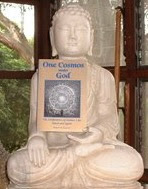
Good -- or indifferent, depending on your point of view -- news for One Cosmos readers! Long-time stalkers will recall the seemingly once in a laughtome offer of 2006, when I came into the possession of 100 copies of my book, One Cosmos Under God: The Unification of Matter, Life, Mind, and Spirit. Readers long ago snapped up the original 100, but I still get the occasional request for a personally enscrypted copy.

Well, the distributor is reducing its inventory, and my publisher gave me the option of taking them off its grubby hands. I impulsively and unwisely purchased a bunch more than I can possibly unload, so the offer is back on, only this time with twice the desperation!

Remember, these won't be merely "signed" copies, as my competitors deign to hastily scribble off. Rather, each copy is adorned with a lovingly handcrafted and personalized metaphysical wisecrack or insult, an official pronouncement of Raccoon membership, or perhaps a limerick of questionable taste, each different from the other, because no Raccoon is alike.

And remember -- the book will no doubt become a valuable collector's item if I am ever convicted of a well-publicized major crime or felled by a meteor.

A Love Offering of just $10 will suffice, and this pittance will even cover schlepping & fondling.

BTW, this is the new CORRECTED EDITION that fixes some embarrassing typos and other infelicities in the first printing.

If you'd like one, e-mail me at: earthtobob99@gmail.com

Or, just send a check, along with any instructions for enscribblement, to:

Robert Godwin

26141 Veva Way

Calabasas, CA

91302

*****

Back to the isness at hand. We were outlining Schuon's "universal metaphysic," to see if this can be harmonized with process theology.

Again, in order to visualize the spatial distinction between absolute and infinite, we may think of the former as point, the latter as extension; similarly, "in time the absolute is the moment, and the infinite is duration."

In terms of matter, the absolute is the ether, the "primordial substance" (prakriti in Vedanta) while "the infinite is the indefinite series of substances." In terms of form, the absolute is "the sphere" -- one more reason why we call it O -- which is widely considered the most "simple, perfect, and primordial form," whereas the infinite is "the indefinite series of more or less complex forms." Etc.

Now, there is an obvious conflict between Schuon's view and the Christian view of creation. Again, Schuon comes very close to an emanationist position, in which creation is a kind of inevitable vertical descent from plane to plane.

Conversely, Christianity always emphasizes the freedom with which God creates. In this view, creation is said to be completely unnecessary, an utterly free gift for which God receives nothing in return (since he is already complete, lacking absolutely nothing).

A few posts back I hinted at a way to harmonize these positions, and I think the key lies in horizontalizing Schuon's verticality, while converting a relation of dependence to one of complementarity.

For example, in Schuon's view, the absolute is prior to the infinite, even if the infinite is a necessary consequence of absoluteness. Another traditional way of saying this is that it is in the nature of things for the Sovereign Good to radiate its goodness outward. After all, a goodness that didn't spontaneously share it's goodness wouldn't be very nice.

But what if we tweak this formulation slightly, and see absolute and infinite as complementarity, whereby the one is impossible in the absence of the other? Here we can easily see how this would apply to Christian theology, since -- as far as I know -- it would be incorrect to suggest that the Son "emanates" from the Father in a vertical fashion.

Rather -- and this is a bit of an orthoparadox -- the Father is "primary," so to speak, but nevertheless, he has never existed without the Son. It is not as if the Father-Absolute (what we call Abbasolute) one day decided to have a Son. No, Father-Son is not a vertical relation but a complementary one.

And if I am not mistaken, this goes to the theological dispute that finally split the Eastern and Western churches, i.e., the filioque. In brief, for the East, the Holy Spirit proceeds from the Father alone, whereas in the West the Holy Spirit proceeds from Father and Son.

I don't want to reopen old wounds, but it seems to me that the latter formulation is a defense against the vertical/emanationist view, in that it emphasizes the irreducible complementarity and intersubjectivity of Father and Son. In short, it characterizes ultimate reality in terms of relation rather than subordination.

It's like the old days, when we had three coequal branches of government instead of this peevish tyrant who thinks congress only exists to ratify his delusions.

Once again, I don't have sufficient time to get more deeply into things. All of this is still quite preluminary...

Wednesday, October 09, 2013

Andrew Breitbart and Ultimate Reality

Hartshorne calls his approach to metaphysics "neoclassical," which only puts him at odds with two groups: the great majority of philosophers who devalue or reject metaphysics entirely (or pretend to, anyway), and the minority who still embrace traditional or classical metaphysics, e.g., Catholic Thomists or perennialist/traditionalists of the Guenon-Schuon school.

Let's begin by summarizing Schuon's conception, and then see if there is any way to tweak this toward a process view, something he would have admittedly abhorred, for reasons we will try to illuminate (mainly because it seems to imply an "evolutionist" metaphysic that always caused his blood pressure to spike to unsafe levels).

In the compilation Splendor of the True there is a helpful chapter entitled Summary of Integral Metaphysics (also found in the indispensable Survey of Metaphysics and Esoterism). In the preface to the latter, he states that "there are truths inherent in the human spirit that are as if buried in the 'depths of the heart.'" As such, they may be thought of "as potentialities or virtualities in the pure Intellect" (i.e., the nous, not the profane ego).

In short, these ultimate truths are latent within us, but need to be activated by metaphysical understanding, which is gained either explicitly, via metaphysics as such, or implicitly, via revelation. In other words, what revelation reveals is the universal metaphysic -- or information about the nature of the Absolute: about ultimate reality and about how this bears upon our origins, our purpose, and our destiny.

Unlike animals, man may know -- or at least be aware of -- the Absolute, in the absence of which we couldn't think at all. That is to say, man's intelligence is not proportioned just to the physical world, or to culture, or to reason. Rather, it is proportioned to a transcendent reality that conditions all these lesser modalities, the latter of which fall "immensely beneath the scope of our intelligence."

The very principle of truth is unthinkable in the absence of the Absolute, which is why infrahuman metaphysics such as materialism and reductionism are non-starters. They are not "humanistic" at all, but rather, the opposite. There is nothing human about secular humanism, because to reject transcendence only ends up disfiguring man. A person without transcendence looks like the hideous Miley Cyrus, if not outside, then inside.

Thus, "our soul proves God because it is proportioned to the divine nature," which in turn reveals our purpose. In the absence of this divine-human dialectic (or dia-logue), human existence is of course absolutely meaningless (which is a contradiction in terms, but whatever).

In any event, "For the inferior man, only what is contingent is real, and he seeks by his method to lower principles to the level of contingencies when he does not deny them purely and simply."

But how can a purely contingent being presume to be so obnoxiously absolutist -- for example, like those aggressively tenured products of natural selection?

This is an example of what happens when one rejects metaphysics: one's thought has no center, no ground, no external consistency. Thus, metaphysical Darwinism is indeed internally consistent, i.e., logical within itself. It just can't apply to reality without refuting its own consistency and completeness.

Or in other words, if it is true, then it is false, for if only what is contingent is real, then there's no reality deserving of the name, and we're off to the deconstructive races, into diversity, relativism, and class warfare -- into the lightless world of unalloyed tenure.

As a very brief aside, I'm really enjoying Breitbart's last book, Righteous Indignation. It tells of his gradual emancipation from unthinking, default ambient-cultural liberalism toward the reality of conservative principles, and in many ways parallels my own developmental road trip.

And although our temperaments are very different, I think, had he lived, he would have eventually pursued those principles all the way to the toppermost of the poppermost, into the permanent metaphysical truths embodied in religion. If one keeps evolving at his rate, there's really no place else to grow.

There is an illuminating passage on p. 159, where he concedes that "I'm not religious, and I'm certainly no theologian, but if there is one thing in religion that speaks to me, it is the idea of absolute truth.

"In fact," -- sounding more than a little like a full-blooded Raccoon -- "the word truth has meaning only if it is absolute. And absolute truth will set us all free from the grip of the [Democrat/MSM] Complex, because the Complex lives in the clouds, in the theoretical heavens" of pure abstraction.

I mean, once you realize there's an Absolute Truth, you're knocking on heaven's door (or Toots' Tavern). Recall what Schuon said above about those virtual truths "inherent in the human spirit" that are "buried in the 'depths of the heart.'"

Now, one reason why metaphysics is foolishly rejected is because people imagine it is completely remote and abstract, unrelated to practical existence. But this is only half true. Yes, it is abstract, but as Hartshorne emphasizes, the abstraction is unthinkable in the absence of the concrete.

In this regard, it is analogous to Aristotle's correction of Plato's belief in an abstract and disembodied realm of pure ideas. Rather, we only encounter the form in the substance, and vice versa.

In reality -- ironically -- it is leftism that is purely abstract. This has been demonstrated time and again whenever the left has gained power and attempted to force their beautiful abstractions upon recalcitrant reality. What is Obamacare but a baroque abstraction that cannot possibly comport with concrete reality? To characterize this a priori mismatch in terms of "bugs" or "glitches" is analogous to insisting that phrenology will work just fine with a few tweaks. (Same problem with global warming: right theory, wrong planet.)

Back to Schuon's conception. Again, at risk of making him rotate in his sarcophagus, what I want to do here is find out if there is a way to reconcile his universal metaphysics with a more process view of God.

For Schuon (as for Breitbart!), "we must begin with the idea that the supreme reality is absolute and therefore infinite."

Thinking in terms of geometry, absolute may be thought of as a kind of adamantine point, whereas infinite may be thought of as radiating out from this central point. This would appear to encompass both sides of God, in that the absolute "is solely and totally itself," whereas the infinite "is not determined or limited by any boundary." Rather, "it is in the first place Potentiality or Possibility as such," and "hence Virtuality." Thus, without this "All-Possibility there would be neither Creator nor creation..."

Ah ha! Did you see that? I think I detect a little opening for process to get an edge in Word-wise. But right now I'm out of time, so to be continued.

Tuesday, October 08, 2013

Why Does God Bother?

Time only for a speedpost this morning.

So, why bother at all? Is it so important that I come up with some tendentious new slant on the same old rant? Am I like the federal government, which must continue to function, because if it doesn't, everyone will realize how irrelevant it is? Am I worried that no one will notice if there's no gnosis here?

To be honest, I am plagued by a kind of creeping uselessness if I fail to post. The main thing that makes my life extra-ordinary is it's focus on the trans-ordinary, on what surpasses me.

Or rather, the reverse: the task is essentially to refract eternity through time; or in other words, to elevate the mundane via the transmundane. Only in so doing does life become a true adventure of consciousness, through which we participate in God's own adventure.

Speaking of which, there are a lot of things I don't like about process theology, but a few others to which I am strongly attracted. The question before the house is whether this attraction is really coming from the Attractor, or whether it is just the way I'd prefer reality to be.

In particular, I'm referring to the idea of true creativity, spontaneity, and adventure -- and therefore, change -- existing in God.

After all, if God isn't "changed" by his creation, why does he bother? What's the point? If he truly knows how it will all end, in every detail, then I don't get it. Yes, you could affirm the traditional idea that he creates as pure gift, but again, isn't the point of a gift a transfer of feeling? A gift is just the signifier of a transaction.

But the traditional view holds that God gives without getting or needing anything in return. Frankly, he can't receive anything, because he's already complete. Just as you can't make water wetter by adding more water, you can't make God lovelier by adding more love.

Well, I don't care. I don't like that vision of God, and that's all there is to it.

Yes, you can go too far in the opposite direction, and make God too human, but that's not what we're talking about. Rather, as Hartshorne suggests, there is simply no possibility of determinism on any level of reality. Determinism is an impossibility, an absurdity, a nothing. If it existed, then surely we couldn't know it, because the knowledge wouldn't be distinct from the determined. Everything would be exactly as it is, with no possibility of change, novelty, or surprise. While something might superficially appear to undergo change, if the change is determined, then it isn't really change.

But without the possibility of change, I don't see why human existence is worth the trouble. And if determinism is the case, then life is neither worth nor not worth the trouble. Rather, it just is. It's something to endure in all its absurdity until the curtain closes.

However, if we participate in the Absolute -- or the Absolute participates in us -- then this changes everything.

In process theology, God is still "the supreme cause and influence," but he is also "affected by the contingent world, a world which is external as well as internal to him." In short -- and for some reason this is heretical -- "God influences us eminently, but we also influence God, something that devout worshipers have always believed [see, I'm not the only one], or at least hoped" (McMurrin).

Now, I do believe that we need to be supremely cautious in entering these waters, for there is abundant room for error. But Hartshorne echoes what I alluded to above, in writing that "if we could not influence God, our existence would be simply vain."

Of course, that doesn't prove it's true, but another thing I've never understood is why God would want us to internalize a belief system that makes to sense to us, and violates both our reason and our experience.

If God is a person, then he is a thou to our I. The corollary to this is that he is an I to our thou. In other words, there is a dia-logue, and "this dialogue is religion. God creates us as free creatures, but in our free creativity we add to the divine life. Our creativity is God's potentiality being actualized" (ooh, I like that, which is why I emphasized it).

Now, I realize that this appears to erode God's omniscience, but not necessarily. Rather, we just need to think of omniscience in a different way. God, of course, knows all there is to know about all there is. But some things isn't, at least not yet. If we are truly free and the future isn't written in stone, it's not yet knowable. Therefore, it is still the case that "nothing surpasses God." It's just that God eternally surpasses himself.

Nor does it mean God doesn't "have a plan." But a plan is not identical to the way we fulfill it. The blueprint isn't the building.

I like the idea of God surpassing himself. I just find it very appealing, and it seems to me that this would be a good explanation for why the Trinity is the Way It Is -- or Are, rather. God is still very much necessary existence. But instead of necessary being, he is necessary becoming. To say that God is in any way necessary seems to limit him, but this isn't true. "Necessary being" is just a way of saying that it is impossible for God to not exist.

The only difference is again that God's being eternally surpasses itself. In that sense he is "static," in that ever-surpassing trinitarian LoveTruthBeauty is the universal reality.

So, that's why I blog. "Freedom is 'becoming,' which is the creation of definiteness where causation has made alternatives possible to free decision or action. The future is open, indefinite, and indeterminate, The past is closed, definite, and, I presume, determined" (McMurrin).

And yes, "in the last analysis all knowledge is circular; it is simply a question of who has the biggest circle." So all this cosmic expounding is my little way to keep the cosmos expanding, i.e, to keep growing in O, as O grows in I.

Monday, October 07, 2013

Obama: Prince of Chaos, Maker of Impossible Worlds

This piece by Victor Davis Hanson on Obama as Chaos has some important insights that I hope to tie into our discussions of information theory and process theology. It highlights something I've noticed about Obama, but not been quite able to articulate. It's something all prominent leftists do, but Obama is just so brazen about it, that one hardly knows how to respond.

That is to say, not only is he untruthful, but he doesn't even lie. Rather, he's way beyond -- or before, to be exact -- lying, since lying requires an implicit knowledge of a "stable" truth that is then lied about. In short, the lie is parasitic on truth.

Thus, lying is always reactionary -- for example, Bill Clinton's compulsive lying is much more transparent -- whereas it is as if Obama first softens the cognitive battlefield with rhetorical cluster bombs, thus degrading the ability to think at all. At least when Clinton says something, you can be pretty sure the opposite is true. That's not chaos, but a kind of predictable order.

Again, as we've been saying, information, novelty, and upside surprise require a low-entropy, ordered, and stable channel in which to carry the message. But Obama reduces that ordered channel to chaos, so the question of truth doesn't even arise. If one were to take Obama's chaotic verbalizations seriously, and try to find some kind of harmony, progress, or"emergent truth" in them, it would be quite literally impossible, because there is no possibility of information there.

It is possible to synthesize opposites into a higher union (or to intuit the union prior to their bifurcation). But it is impossible to do this with, say, the chaotic "word salad" of a schizophrenic. More to the point, the purpose of such verbalization is to generate chaos, not to rise above it. The purpose is to attack the foundational cognitive links that are built upon in order to ascend to higher and more comprehensive systems of knowledge.

Hanson observes that "Amid all the charges and countercharges in Washington over the government shutdown, there is at least one common theme: Barack Obama’s various charges always lead to a dead end. They are chaos, and chaos is hard to understand, much less refute" (emphasis mine).

To which I would add that chaos is impossible to understand, and that's the point. But remember, low entropy randomness and high entropy information can be difficult to distinguish, which is precisely why so many tenured bullshit artists are regarded as deep, or oracular, or profound.

"[W]hen the president," writes Hanson, "takes up a line of argument against his opponents, it cannot really be taken seriously -- not just because it is usually not factual, but also because it always contradicts positions that Obama himself has taken earlier or things he has previously asserted."

So, how does one deal with such a satanically chaotic character? (I refer here to the traditional identification of chaos with satanic energies.) A quick google search turns up quite a bit of material, the first result suggesting that for the Bible,

"Satan is the author of chaos and confusion, since the earth was in that chaotic state when the Spirit of the Lord hovered above it, Satan must have played a role in it being in that chaotic state, since he is the father of chaos."

It can't be quite that simple, because as Hartshorne has correctly noted, order and chaos work together in order to generate surprise. So, just as there are good and bad (i.e., tyrannical) forms of order, so too are there good and bad forms of chaos. There must be a kind of "divine chaos" as well as a satanic aping of this.

The quintessence of good chaos would be the ordered liberty the Founders attempted to enshrine in our Constitution. Bad chaos would be exemplified in various postmodern pneumopathologies that promote relativity and "diversity," and erode hierarchy, standards, and universal values. Underneath this is a rejection of verticality as such, so the attacks on God inevitably redound to the bestialization of man. This only ensures more personal and societal chaos, which requires the leviathan state to tame, or "order."

Of course, no spontaneous order can emerge from this kind of intentional chaos, for the same reason you can't make a smoothie without putting the top on the blender. Remove the top, and you just end with a chaotic mess all over the place.

VDH writes that when Obama "mellifluously asserts a teleprompted falsehood," the consequence "is not so much untruth, lies, or distortions, as virtual chaos. Is what he says untrue, contradictory of what he said or did earlier, or just nonsensical? (emphasis mine).

To paraphrase Bruce Springsteen, is a fantasy a lie that don't come true, or is it something worse, i.e., malignant chaos? And in any event, "how do you refute fantasy" without descending into chaos yourself?

Speaking of the vast differences between ordered liberty and mere democratic chaos -- i.e., tyranny of the mob -- VDH writes of how Obama inverts the nasty "chaos in the Middle East by saying that 'a wave of change has washed across the Middle East and North Africa' during his administration." Which translates to genocide for them and loss of power and prestige for us.

I wonder if Obama's chaos is facilitated by the loss of attention span induced by constant hammering from the 24 hour news sickle, or by the immediacy of the internet? Obviously, if people have no memory, then there will be no recognition of the fact that Today's Truth contradicts Yesterday's Truth.

Now, how does this relate to process theology? Well, for Hartshorne, an absolutely ordered world is simply an impossibility, for the same reason a "shapeless chaos" is: "The alternative to God's existence is not an existing chaos, but rather, nothing conceivable," i.e., no information. "Apart from God," then "no world, and no state of reality, or even of unreality, could be understood."

So: not only is it impossible to comprehend Obama's chaotic pronouncements, it's not even possible to not understand them. Mission accomplished.

Friday, October 04, 2013

The Transformative Fantasy of Leftism

In his analysis of the Devil Card, our Unknown Friend (UF) writes that the excesses of the left are always "owing to an intoxication of the will and imagination which engenders demons." So, Will + Perverse Imagination = Demon.

For example, if Marx and Engels had simply behaved as good Jews or Christians and "defended the interests of the industrial workers without having let themselves be carried away by their intoxicated imagination" (ibid.), then their ideas wouldn't have been so apocalyptically destructive. After all, every normal person wants to help the poor and needy, but it is axiomatic that helping the human animal while killing the human soul is not the best way to go about it.

Further, as Schuon commented, "Progressivism is the wish to eliminate effects without wishing to eliminate their causes..." To paraphrase him, the leftist wishes to make himself as useful as possible to a collectivity which renders the individual as useless as possible. Thus, measured in terms of the number of useless people he has enabled (i.e., wards of the state), Obama has been our most indispensable president ever.

What is worse, the left always couches its so-called empathy for the downtrodden in fantastically broad and sweeping generalizations of historical "and even cosmic significance, such as the statement that God does not exist, that all religion is only the 'opium of the people,' [and] that all ideology is only a superstructure on the basis of material interests" (MOTT). UF wrote that in the early '60s, but it is no different today, with the intoxication that fuels and pervades the Obama campaign:

"What we hear from Obama is the eternal mantra of the socialists; America is broken, millions have no health care, families cannot afford necessities, the rich are evil, we are selfish, we are unhappy, unfulfilled, without hope, desperate, poverty stricken, morally desolate, corrupt and racist. This nihilism is the lifeblood of all the democrat candidates.... When Michelle Obama claims she is only newly proud of her country, she does not exaggerate. In her world as in Obama's, they believe we are a mess, a land filled with the ignorant and unenlightened, filled with despair" (Fairchok).

As UF writes, it is always a "matter of excess -- a going beyond the limits of competence and sober and honest knowledge" -- and no leftist doubts his superior competence, knowledge, and intentions -- "having been carried away by the intoxicating impulse of radicalism, i.e. by a fever of the will and imagination to change everything utterly at a single stroke."

It is this fever dream of sweeping existential change that animates the left no less than the Islamists. As Lee Harris has written, a fantasy ideology such as Islamism is obviously not a rational response to the world, arrived at in a logical, sober manner. Rather, it is a transformative belief, meaning that its primary purpose is to psychologically transform the person who believes the fantasy.

In other words, belief in the fantasy is an end in itself -- it has no purpose other than to make the fantasy seem like reality, as if it might actually be true. Looked at this way, the real reason for 9-11 wasn't actually to bring down western civilization, which is not going to happen (unless we do it to ourselves as a result of our own fantasy ideology). Rather, it was for the Islamists to deepen their trance and make the fantasy seem more real.

It's the same with leftist economic policies, which don't just fail, but backfire. They cause all sorts of unintended consequences that the leftist never connects to the original policy -- e.g., how the welfare state eroded the structure of the black family, how racial quotas inevitably harm blacks, how rent control causes housing shortages, how subsidizing higher education simply drives up the cost, how nationalized health reduces quality and leads to rationing, how forcing banks to make bad loans to unqualified people was at the epicenter of the meltdown of 2008, etc.

The irony is that socialists aren't even good socialists. In this piece at American Spectator, Kaminsky notes that if Obama is really interested in helping the poor and disadvantaged, he's going about it in an entirely counter-productive manner. But if socialism is just a transformative belief for leftist, then actual success is entirely irrelevant. Rather, the only relevant factor is whether the leftist feels more secure in his delusions of magnanimity, compassion, and generosity.

As Kaminsky suggests, let's give Obama the benefit of the doubt and not go all conspiratorial, imagining that his destructiveness is intentional. It's tempting to think it is, but "sometimes incompetence is just incompetence." However, I would add that incompetence is not just incompetence if it is impervious to feedback from reality:

"After all," writes Kamnisky, "the people Obama most claimed to want to help, namely the lower rungs of the American income ladder, are stuck in a swamp of the president’s creation with only more punishment in sight. Median household income has plunged under this president, with a devastating 11 percent drop among black Americans. Obama has indeed redistributed our money: to unions, bankers, and political donors. He’s not even a good socialist."

Except that he's a great socialist, if we regard socialism as a transformative fantasy, not an actual theory of reality. Looked at this way, success for socialism is measured by the intensity of belief in it, and Obama's faith shows no signs of wavering. Rather, he is more pompous, smug, and condescending than ever.

Now, UF explains that the virtue of temperance protects us from the intoxicating counter-inspiration of radical fantasies -- including religious fantasies, which are not actually religious but manmade. As such, it is foolish to blame God or religion for things that emanate from the lower vertical in man.

UF makes the subtle point that one cannot engender a positive collective mind parasite. This is related to the principle that the mind parasite is an effect of "congealed" or "coagulated" psychic energy. As a result, it always "enfolds," whereas the good radiates. The former is an inward, contracting movement, whereas the latter is an expansive, radiant movement.

This may sound overly abstract, but we are all familiar with the intellectually and spiritually closed world of the left, whether it is their elite university campuses or the op-ed page of the New York Times. If you pay close attention, you may be aware of this "inverse radiation," which feels like an attack on the intellect. There is no resonance at all, only a kind of psychic vampirism.

Now, why did people respond to, say, Ronald Reagan? For the opposite reason -- the radiant positive energy which citizens were able to perceive directly. This only became more apparent when placed side by side with Jimmy Carter's withered and constipated presence.

I suppose the only novel thing about Obama is that he is selling the same constipation, but with a shallow "celebrity radiation" that one must be intoxicated (or just stupid) to appreciate. Indeed, as Fairchok writes,

"That is his appeal; he is [ironically] an actor, a performer, a cinematic presence that stirs simple emotions, emotions that have little grounding in truth. His speeches are the inane lyrics to a popular song that endures only because it has a great beat. One must not think too deeply on what Obama says, for it turns to smoke and disappears in the light of day. Ezra Klein is correct [see the bottom of yesterday's post], Obama's speeches do not inform, they pander, they propagandize, they harmonize with the mythology of despair and the chimera of entitlement. As his hagiographies proclaim, he represents a new Camelot, but one that does not hold America quite so precious, a Camelot of globalists, moral relativists and communitarians."

Now, how to drive out a demon? Easy. But hard. The easy part is that "Light drives out darkness. This simple truth is the practical key to the problem of how to combat demons. A demon perceived, i.e. on whom the light of consciousness is thrown, is already a demon rendered impotent.... A demon rendered impotent is a deflated balloon" (UF).

The hard part is that the institutions that are supposed to throw a little light -- i.e., the media-academic complex -- instead cast an intense beam of darkness. I suppose our best hope is that the left will be so successful in implementing their fantasies, that their destructiveness will finally be undeniable to a critical mass before it's too late.

Wherever politics tries to be redemptive, it is promising too much. Where it wishes to do the work of God, it becomes, not divine, but demonic. --Pope Benedict XVI

Thursday, October 03, 2013

Obama, Messiah of False Slack

Now, when I say the left is antichristic, this isn't just my opinion, but theirs, since they are defined by their rejection of transcendence in general. But this isn't just a negation or opposition, but rather, an inversion -- an inversion of the good, the true, the beautiful, and the One, among other transcendental and archetypal categories uniquely accessible to man (and without which man is not man).

In fact, yesterday I started watching this new lecture by Evan Sayet (posted at Ace of Spades), whose "grand unified theory of liberalism" exactly comports with this assessment. He attributes the pathology to their absence of discrimination, which results in seeing all differences as invidious. It's a very efficient way to commit intellectual and spiritual suicide, because it turns false to true, bad to good, ugly to beautiful, and divisiveness to unity.

Perhaps it's less inflammatory to identify Obama as a messiah of false slack. Obamacare, for example, is the greatest theft of the nation's slack since its founding. I say this because it diminishes not just our liberty, but assumes control of our lives and our most sacred property, i.e., the body. Let's face it, it's difficult to pursue happiness if the death panel decides you've had enough.

The slack that Obama pretends to give us is entirely false. The state cannot produce slack, but can only steal one person's slack and give it to another. James Taranto has pointed out that Obamacare will work beautifully, so long as people ignore its incentives -- that is, so long as the young, healthy, and stupid pay too much for their health insurance in order to subsidize the old and ill. And if they refuse to behave irrationally, then the state appropriates their slack in the traditional way, by fining -- er, taxing -- them at the point of a gun.

The really frightening thing about Obama is the "superior ignorance" nurtured by his confinement to the leftist looniversity bin, which encouraged him to regard unfounded opinions as inerrant truths. For example, his long-time membership in that racist, anti-American religious sect can only mean that he must take this diseased Marxist aberration for normative Christianity -- and take normative Christians for noxious and ignorant "bitter clingers."

But I think the real source of Obama's omniscient ignorance is that he is our first postmodern president. True, Presidents Clinton and Bush were ivy league educated, but this was when it still meant something -- before the leftist takeover of higher education. Also, the fact that Obama was a benefactor of the "diversity" fraud, means that he had even less cognitive equipment than the typical student to resist the neo-Marxist indoctrination he was about to receive.

In any event, by the time Obama attended college in the 1980s, it was possible -- even likely -- that one could pass through the university without once encountering any serious opposition to leftist indoctrination -- like one of those subatomic particles that can pass through the earth without touching matter. Dennis Prager often mentions that when he speaks on college campuses, students routinely approach him and tell him that they have never heard conservative ideas in any of their classrooms, except in a caricatured, straw-man way.

Is it any wonder that this remains Obama's primary mode of argument when it comes to addressing conservative objections? You know, "some people say that we should hunt down children of the poor and bury them alive in shallow graves. But Democrats don't believe that. We have a better idea."

Weak-minded postmodern leftists live in a kind of hermetically sealed ignorance that they call "education" or "sophistication." And this is why they feel no need to condescend to the level of those who disagree with them, since we are not just a priori wrong, but evil, misguided, and malevolent as well. These haters project their hatred into us, and then react to the hatred.

As recently as a few hundred years ago, mankind at large was mired in a slackless existence that hadn't changed all that much for the average geezer in thousands of years. It was war, famine, plague, tyranny, oppression, cruelty, poverty, illiteracy, backbreaking toil, early death, very bad smells, and repeat as unnecessary.

However, one place on earth took a great leap forward into the realm of slack, a realm that left wing medullards and proglodytes take for grunted today. The engine that drove this expansion of our slack was the free market, accompanied by its enablers -- i.e., necessary conditions -- such as private property, civil rights (founded upon the sanctity of the human person), and the rule of law.

Some say this slack doesn't really exist, that it's all a big con job by the powers that be, and that we are condemned to a world in which everything averages out to zero.

Thus, for example, the only way to have health insurance for all is to charge too much to some and not enough to others -- as if the problems of shortage and price aren't a result of government interference with the free market. Healthcare costs only began spinning out of control after massive state interference in the marketplace.

Linear-thinking leftists never understand the non-linear system of incentives they are putting in place when they enact complex legislation, so they inevitably must introduce more legislation to deal with those baleful consequences. Never forget that the government programs of the 1960s were sold as a way to end poverty, not to make it a permanent feature to justify the need for more big government.

The penultimate lie of the left -- following on the heels of absolute relativity -- is that the state is the source of our slack, or that it can even create slack, which is an intrinsic metacosmic heresy. Look at Obama's oft-cited claim that he created or saved X number of jobs. But the government can only "create" jobs by taking money out of the job-creating private sector, so he is truly selling us false slack, an entirely meretricious something-for-nothing, or "turd made fresh."

The state can surely protect slack. In fact, that is the president's primary job. His oath is to preserve and protect the Constitution, which is the guarantor of our unencumbered pursuit of slack. But with FDR a line was crossed, and people began looking to the state as the source of slack, and we can all see what has resulted.

When people depend upon the state for their slack, the pool of slack is gradually dissipated in one way or another. For the state only has three sources of slack: taxation, printing money (as if slack grows on trees!), or borrowing. Two of these come down to outright theft, while the third is simply deferred theft from future generations. My son will have less slack because of Obama's larcenous actions today.

The bottom lyin' is that Obama is trying to increase the slack of the takers by stealing it from the makers. This will never work, because in the real slack-generating economy, nothing happens until someone sells something -- until there is a voluntary exchange of value resulting in an increase in slack for both parties.

But in the anti-slack world of the left, nothing happens until the government forcibly takes something from someone. Thus, the whole foul enterprise is rooted in involuntary transactions masquerading as slack.

However, this can't go on forever, because the problem with leftism is that you eventually run out of other people's slack.

Wednesday, October 02, 2013

Don't Worry, Obama is Not the Antichrist

Well, first of all, I have a cold. Thus, no can blog. Yesterday was the worst, but I think I've turned a coroner. Still plagued by low physical and mental energy, however.

But that doesn't mean we can't have a little fun at Obama's expense! Back in 2009, you may recall that we posted the occasional "Anti-Christ Update" to gauge Obama's progress in wrecking the greatest nation on earth. I'd like to reviscerate some of these old eviscerations, just to see how well they hold up in light of his holdup of the country.

In general, there are always going to be problems when infantile omnipotence collides with the reality principle. In fact, Obama addressed this just yesterday, comparing the trainwreck of Obamacare to a bug in an Apple product. Rrrright: when you think of the federal bureaucracy, isn't the first thing that comes to mind the most successful company in the world?

Given the level of unsustainable fantasy that was projected into Obama prior to actually doing anything, we knew the country was going to be in for a screwed aweakening when this Nobody from Nowhere underwent the formality of actually existing as Someone doing Something.

In short, we are now living in the dark future of which these blognostications were shadows. Here are some excerpts:

First of all, let's get this out of the way at the outset. Are we calling Obama the antichrist?

Yes, of course.

Nah, just kidding. Let's just say an embodiment of the antichristic principle. Please, let's be mature, and discuss this in terms of abstract cosmic principles, without getting personal. No need to demonize someone just because he's an instrument of satan. Besides, he's just the vehicle, not the driver. The surfer, not the wave. The bong, not the smoke.

Now, what do we mean by "antichrist?" I would say that, as Christ is Word-made-flesh, the realm of the antichristic would analogously represent the "lower principle" made flesh -- the instantiation, as it were, of the energies of the Fall (speaking of apples and bugs).

So first of all, one must believe that man is in some sense a fallen being with a built-in design flaw. You don't have to be a fanatic about it. You only have to know that "something ain't right" with the earthlings, however you wish to conceptualize it.

Being aware of this principle is our greatest inoculation against utopian leftist schemes to perfect mankind, which always -- always -- result in unanticipated cosmic belowback. We might think of the left as the Good Intentions Paving Company, and we all know where that road leads.

Secondly, you would have to believe that it is possible for the energies responsible for the Fall to be personified -- or, let us say, both focused and dispersed like a beam of darkness through the concavity or convexations of man's heart. As Christ is a blinding light, antichrist would be, oh, darkness visible. Thus, to those who live in spiritual darkness, it might appear as a false light -- as, say, a single match is brighter than the sun in an enclosed room, cut off from the real source of light.

The Serpent -- to paraphrase our Unknown Friend -- symbolizes advanced intelligence ("the most cunning of the beasts") turned wholly toward the horizontal. Thus, it is a perversion of man's intellect, as it represents a self-sufficient naturalism and total (small r) realism that betrays the vertical source of human intelligence. As such, we would expect one aspect of the antichrist to be high intelligence combined with extraordinary vapidity, at least for those with spiritual discernment.

But this cannot merely be the philosophical vapidity of the doctrinaire atheist or scientistic materialist, or it could never gain traction in the human heart, which always hungers for Spirit, even (or especially) if it is the false kind. Rather, it would have to come cloaked in some sort of seductive or hypnotic faux verticality. It would indeed have to be charismatic and charming, bearing in mind the root meaning of former, which is "divine gift," and of the latter, which is "incantation" or "magic spell."

A spiritually normal person would be alarmed if he possessed this kind of influence over others, for it is always a great danger to mess with the destiny of others. At the very least, it would be an occasion for the deepest humility, combined with concern over the precarious state of the souls under his influence. I mean, if someone were inclined to worship me, the first thing I'd want to say is, what the hell is wrong with you?!

Most people, if they knew the implications, would not want this power, because they would know that they are neither worthy of it nor competent to deal with it, any more than they are competent to perform brain surgery. But a person with narcissistic issues will be too intoxicated by the power and adulation to care about the souls with whom he is toying. They are just props, part of his psychic furniture.

This power is a heavy responsibility and is not to be taken lightly. The spiritually normal person knows that any charis is only on loan to him (or courses through him locally from a nonlocal source), and that he is not free to use it as he will.

Rather, one is only free to use this power if it is aligned with its vertical source and with vertical principles, i.e., Truth, Love, Beauty, and Unity (not relativism, idiot compassion, aesthetic barbarism, and diversity). There is something coming through the charismatic, not from him, and as soon as one realizes this, it is an occasion for, yes, gratitude, but also fear and trembling. It is analogous to the power to send men to die for their country, only on the vertical plane. It is the ability to inspire selfless martyrs, but for what purpose? Our satanic Islamist enemies are clearly selfless idealists under the influence of charismatic leaders. So what?

Our Unknown Friend asks the questions, "Can one produce artificially intellectual, moral or spiritual inspiration? Can the lungs produce the air which they need for respiration?" No, of course not: "the very process of breathing teaches the laws of obedience, poverty, and chastity, i.e. it is a lesson (by analogy) of grace. Conscious breathing in of the reality of grace is Christian Hatha-yoga. Christian Hatha-yoga is the vertical breathing of prayer and benediction -- or, in other words, one opens oneself to grace and receives it."

Unknown Friend goes on to say that the antichrist represents "the ideal of biological and historical evolution without grace." This is a key idea, for what is a progressive? A progressive is someone who believes fervently in progress while fanatically denying its possibility, since progress can only be measured in light of permanent truths and transcendent ideals.

The antichrist "is the ultimate product of this evolution without grace and is not an entity created by God," since divine creation is always a vertical act or descent. Yes, all things ultimately "come from God," in the same sense that all light comes from the sun, but think of all the infernal uses to which man may put the light, darkling!

Now, in this closed and absurcular dialectic, Obama is ultimately a creator of those who created him. Unknown Friend writes that, just as there are spiritual beings who reveal themselves "from above," there are what he calls egregores, which are "engendered artificially [and collectively] from below."

Thus, "as powerful as they may be," they "have only an ephemeral existence," the duration of which "depends entirely on galvanising nourishment on the part of their creators." (As Obama's projected power begins to fade and the illusion is punctured, we'll see more and more people publicly asking, "what was I thinking?" in supporting this intellectual cypher. The answer is, "you weren't. You were fantasizing." Of course, others -- the true believers -- will "dig in.")

As such, the really frightening thing about these kinds of amorphous demagogues is that they are given life and nourished by the rabble they nourish and to whom they give faux life, in a spiritually barren cycle. The result is either spiritual asphyxiation or starvation, or probably both. And starved and suffocating men are capable of anything.

Ultimately, the antichrist is the shadow of the totality of mankind, as Jesus was the immanent shadow, so to speak, of the transcendent Divine Principle. The antichrist represents all that man is, and can be, in the absence of divine grace. It is he who transported Jesus to the highest earthly mountain "and showed him all the kingdoms of the world and their glory" and said to him All these things I will give you if you will fall down and worship me.

The secular extremist or fanatical progressive worships his own creation, and in so doing, gives birth to the antiword. Materially, it results in a statist Tower of Babel, whereas spiritually it results in a gelatinous tower of leftist babble (i.e., the vacuous but seductive demagogue who will lead the people in the direction of their most base impulses and envious desires).

We'll leave you with this classic from Ezra Klein, just to remind you that we're not exaggerating:

Obama's finest speeches do not excite. They do not inform. They don't even really inspire. They elevate. They enmesh you in a grander moment, as if history has stopped flowing passively by, and, just for an instant, contracted around you, made you aware of its presence, and your role in it. He is not the Word made flesh, but the triumph of word over flesh, over color, over despair.... The tens of thousands of new voters Obama brought to the polls tonight came because he wrapped them in that experience, because he let them touch politics as it could be, rather than merely as it is.

Tuesday, October 01, 2013

Dreaming Along with God: To Infinity, and Beyond!

There's a helpful chapter in this book on Hartshorne's theory of order and disorder -- helpful because it speaks to our recent discussions of information theory, in particular, the differences between order, chaos, and information, and how they work together to produce meaningful change.

For example, "to deny the meaning of chaos is also to deny the meaning of order." This is an example of what Hartshorne calls "the logic of ultimate contrasts," a subject to which we will return momentarily. In a very real sense, the seeds of order are impotent in the absence of a fertile soil of chaos.

Furthermore, "The theological consequences of making order absolute would be that the Cosmic Orderer is responsible for all evils."

We might say that evils take place "due to the chaotic element. And if it be asked, 'Why does God not eliminate the chaos entirely?', the reply is, 'Because this is meaningless.' Order is just the limiting of chaos, as a river is the channeling (not the absence) of water."

In short, even God's power cannot be exercised on something that does not, and cannot, exist, i.e., order without chaos: "In this context, we might well think of evil as the overflowing of the banks," as "typified in the destructiveness of a flood."

However, there are also evils that result from too much control, as in the left's coercive, top-down approach of trying to solve problems by eroding liberty. Thus, both excessive and insufficient order can contribute to evil, and if chaos and spontaneity are covalent, these two "must be protected against by being overwhelmed by order."

Hartshorne's novel solution to this conundrum "is to grant everything, including God, some measure of both order and chaos." Again, an absolute order or an absolute chaos would both negate information, creativity, and novelty. For example, an accomplished musician always plays on the boundary between order and chaos; he does not simply reproduce the piece in a rote manner, but allows for creativity and surprise.

Theologians have typically ascribed the order of the cosmos to God, and then puzzled over the disorder. But what if the ultimate category is not order or chaos, but order and chaos? This immediately reminds me of the Jewish principle that the unit of mankind is not male or female, but male and female.

Which brings us back to the logic of ultimate contrasts. What are some of the ultimate contrasts that characterize existence? Let's see: Time/Eternity. One/Many. Absolute/Relative. Wave/Particle. Continuous/Discrete. Subject/Object. Transcendence/Immanence. Form/Substance. Freedom/Necessity. Abstract/Concrete. Whole/Part. Finite/Infinite. Individual/Group.

How are we to understand these pairs? It seems to me that the traditional way is to emphasize one to the neglect of the other -- as if one may be derived from the other, say, relative from absolute.

But what if these are not static dualities or polarities, but rather, ultimate complementarities? What this would mean is that, for example, Absolute + Relative is somehow "more" than Absolute alone, or One + Many is "more" than One alone.

In turn, this would go to the question posed in yesterday's post, Does God suffer? If we respond "yes" to this question, the suffering can be explained with recourse to the logic of ultimate contrasts -- that change and changelessness in God are somehow more than changelessness alone.

In the past, I have viewed the same principles in a modified vertical-emanationist way, a la Schuon. In other words, in his system -- which he regards as the "universal metaphysic" -- you might say that there is the changeless, apophatic God at the top, which in turn gives rise to the confessional/cataphatic God of religion, the God whom we may know and relate to.

This latter God -- say, YHVH -- is not the Absolute, but rather, the "relatively absolute." The true Absolute is beyond anything we can say about it, e.g., the ain sof of Kabbalistic thought, or the nirguna brahman of Vedanta, or Eckhart's unknowable grunt (ground).

But here again, what if -- to continue with the above example -- YHVH and ain sof are not two levels, but rather, a single reality that necessarily includes both poles, i.e., more horizontal/complementary than vertical/emanationist?

In the past, I have borrowed an analogy from psychoanalysis to illuminate this idea. If you've studied a little psychology, you've probably learned that we have a conscious mind (the ego) and an unconscious mind (the id). Typically, this is visualized as a kind of space with a horizontal boundary, with conscious above and unconscious below.

But this isn't how it actually works. Rather, you have to think of conscious/unconscious as a true complementarity that is present in all mental occasions. In other words, there is unconsciousness in every conscious act or thought or feeling, and consciousness in all unconscious ones. No one could possibly know themselves entirely; this is a literal impossibility, and if you don't realize this, just pay attention to your dreams.

Speaking of which, I think the dreamer/dream relation can be a useful way to think about God. The dreamer, for example, is inexhaustibly creative. It is not as if you can have one last dream and be done with it. Rather, dreaming is what the dreamer does -- just as creation is what the Creator does.

Or, as Whitehead put it, The many become one and are increased by one.

Monday, September 30, 2013

Does God Suffer?

It is a commonplace that Christian theology evolved in an intellectual matrix of Greek thought. This is not surprising, since this latter tradition was -- and in many ways, still is -- the most complete and consistent system of thought available, and the early fathers wanted their new sect to benefit from the prestige of such an association (the same can be said for making clear the continuity with the venerable Hebrew Bible).

The Catholic church considers the Greek matrix providential, but in the past we've speculated on whether this connection is truly necessary or perhaps contingent, and how Christianity might have developed in a different intellectual climate -- most recently with regard to our series of posts on Jesus Purusha, i.e., Christ incarnating as a Hindu instead of a Jew.

More to the point, if Christ is "universal," then it seems to me that so too should his "metaphysical penumbra" be universal.

In other words, there really shouldn't be "Greek way" or "Hindu way" or "Chinese way" to understand him, but just one way -- which should in turn reflect a universal metaphysic. A universal metaphysic is one that cannot be reduced to anything more basic or fundamental, and is discernible in every event or occasion of reality.

The process theologian John Cobb writes of how "Philosophical theology has been deeply influenced by Greek thought," which in turn "reflected Greek values. These values included the appraisal of eternity as superior to time, and of being as superior to becoming."

Thus, this presupposes an ultimate reality that is essentially static, since movement implies change, and if something is already perfect, then change can only diminish it.

For this reason, God is considered "pure act," with no possibility of anything being added to or subtracted from him: "For the divine perspective change does not occur, since the whole temporal process is always co-present." Our distinctions of time past, present, and future "hold only from the creaturely point of view."

A corollary of this is that God's perspective is "real" whereas ours is fundamentally unreal. Here we see an implicit connection with Hindu-Buddhist theories of maya, of the essential unreality of the manifestation, of appearances. (Then again, the compassion of the bodhisattva impels him to forgo nirvana in favor of a return to the world of suffering and change, implying that compassion is superior to -- or perhaps covalent with -- enlightenment.)

It also means that what we believe we are free to choose has somehow already been chosen, and that "our sense of creativity, of rendering determinate what was, prior to that act, not determinate, is an illusion." Thus, "our sense of responsibility is undercut."

You can't pretend this isn't an issue, for the Protestant split obviously produced various theologies of predestination (both religious and secular/scientistic), and we routinely hear the phrase "everything happens for a reason" -- as if God designed the Holocaust for reasons known only to him, or even just gave some little girl leukemia.

Many people who are otherwise positively disposed toward religion cannot get past this hurdle of the simultaneous existence of divine omniscience and evil (and let's face it, there's plenty of evil that isn't just attributable to human freedom).

Perhaps we need to rethink what we mean by the idea of "perfection." To take one obvious example, a "perfect lover" is not unchanged by our love for him or her, just as we are not unchanged by their love for us. Is it possible to conceive of a "higher" and more "perfect" kind of love than this, in which the participants are completely unchanged by the experience? I don't see how, without love turning into something it is not.

A related issue is whether God suffers. We all want to believe he does -- that he suffers with us -- and I think it takes a skilled theologian to prove he doesn't. For example, "The early church knew that Jesus had suffered death on the cross, and there were those who drew the conclusion that God suffered in Jesus's suffering. But the church drew back from from this conclusion," as "'God the Father' could not suffer."

This again parallels the Greek idea that it "is a mark of weakness and inferiority" to be acted upon, and to thus "be vulnerable to the actions of others over which one cannot exercise control." Rather, the Greek ideal emphasized "the basic invulnerability necessary to excellence."

Let's again toy with the idea -- or principle -- that man is in the image of the divine. What this means is that our accidents and contingencies do not reflect the divine reality, but rather, only our essence. In other words, what truly and necessarily defines us as human -- or, let us say, persons -- would have to have some divine analogue.

Now, what truly and necessarily defines a human? What are the conditions without which we cannot be persons? I think, prior to everything else, we must be intersubjectively open systems. Clearly, the notion of God-as-Trinity reflects this principle, in that the Trinity is not static at all, nor is it closed. Rather, it is the very essence of dynamism, of self-giving, and of receptivity.

Likewise, Cobb notes that "True human excellence does not involve insensitivity or indifference to others, but rather empathy with them.... This is especially important when others are suffering."

If we were to transpose this imperfect ability of ours to the divine plane, it would imply that "the divine perfection means that God perfectly receives all that happens in the world and perfectly responds to it. Far from being unaffected by our suffering and joy, God suffers fully with us and rejoices fully with us" (emphasis mine).

Importantly, this does not represent an anthropomorphization of God, but rather, a divinization of man. The same can be said of all man's divine qualities, prerogatives, and responsibilities, including his obligation to truth, his capacity for beauty, his striving for nobility, not to mention all the various flavors of love, e.g., philia, agape, caritas, eros, etc.

Well, all of this is still quite preliminary. Maybe I can dive into the heart of the matter tomorrow.

Friday, September 27, 2013

Man's Faith in God's Faith in Man

Some interesting comments yesterday about divine foreknowledge, free will, the nature of prophecy, etc.

In rereading the post, the following passage caught my attention: "Rather, I can only provide some general outlines and directions, but I hope to begin fleshing things out on Monday. Anyway, don't jump to any conclusions just yet. It will all make sense in the end."

First of all: Napoleon, like anyone can even know that.

But... I do know it, at least in a kinda sorta way. I mean, I don't know it like I know the sun is shining outside, but I have this intuition that a number of diverse strands will somehow come together and make sense.

So, it's not yet knowledge. Nor is it foreknowledge, because it's not like a mathematical equation, which, given the variables, has only one solution. You know the feeling. Call it... faith.

Faith is always a kind of unKnowing, because it's not just blind stupidity or flat ignorance, but an irreplaceable mode in the search for meaning, guided -- or lured -- by an invisible gradient of deepening coherence. Faith points and we follow -- it's analogous to our natural compass that points us toward foodsexgrog, but on a higher plane. It's a supernatural compass.

The world is full of “particulars,” of loose ends and bits of disconnected information. The deeper philosophy will be the one that connects the most fragments into a unified whole. Therefore, reality is both “present” and hidden from us, depending on our skill in weaving our own psychopneumatic area rug and pulling the cosmic womb together.

But this goes to what one commenter said yesterday vis-a-vis the differences between present, past, and future. These three are so different that it is difficult to see how they relate to the same word, time.

For the past is fully real (or realized), the present is the space of possibility, and the future hasn't happened at all, so it is not "real" in the same way as the first two.

Anyway, you might say that faith is the substance of things hoped for and the evidence of things unSeen. Thus, it is both substance and evidence, but not a physical substance and not empirical or (merely) rational evidence.

This got me to thinking: faith is said to be such a commendable virtue, I wonder if there is something analogous with God?

Again, I go back to the principle that man is in the image of the Absolute, so if this modality is so critical to our existence, why wouldn't it also be present in God, albeit in some analogous fashion? (Or, more properly, our faith would have to be an analogue of God's faith.)

So, is there any evidence that God has faith? Or is there some kind of reciprocity going on, whereby we have faith in God and God has faith in us?

You biblical scholars out there will be better at this than I am, but my first impulse was to check out my concordance in search of God's faith, and there it was, all over the place. For example,

Even with the Holy One who is faithful (Hos 11:12).

But as God is faithful, our word to you was not Yes and No (2 Cor 1:18).

He who calls you is faithful, who also will do it (2 Thes 23:24).

... for He who promised is faithful (Heb 10:23)

He is faithful and just to forgive us our sins and to cleanse us from all unrighteousness (1 Jn 1:9).

So, it's almost as if we are called upon to have faith in God's faith in us. If God's faith is analogous to ours, I suppose it would mean he "hopes" we do the right thing, just as I hope this series of posts will make sense.

In both cases, the faith is not just "passive"; or rather, it is passive in the sense of opening up an unsaturated space of freedom and possibility in the now, but active in the sense of movement toward the source of our faith, which in turn is the "vector of coherence," so to speak, or the density and interconnectivity of wholeness. Our faith is the shadow cast back and down by the light of this wholeness.

This again touches on the issue of God's omniscience, and whether it is possible to have the same sort of omniscience vis-a-vis the past, present, and future.

It seems to me that omniscience of the past is not especially problematic, because it consists only of "what happened." And knowledge of the present would flow from God's interior prehension of the whole -- or in other words, there would be no coherent whole, no cosmos at all, in the absence of God.

But what of the future? When God "prophesizes," I wonder if it is, in a way, analogous to my "prophecy" that this series of posts will somehow "all make sense in the end." Thus, it wouldn't so much mean This is going to happen, and I know exactly how, but rather, Don't worry. This is gonna happen, even if the particulars aren't all worked out yet.

Thus, this would allow for genuine surprisal in history, and God's ongoing "adjustment" to it, so to speak, to bring about the "ordained" outcome. In other words, there are many roads, none of which were built in a day, all leading to home.

Well, that's about it for today. Still no time to get into the unseen substance of what I was hoping for.

Theme Song

Theme Song