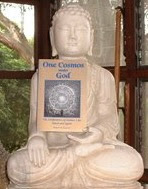
These deskborne books occupy an ambiguous limboland. Usually they were disappointing in some way, beginning with this one on Aesthetics, by the Catholic theologian Dietrich von Hildebrand. Like any Raccoon, he
understood the centrality of beauty not merely to art but to philosophy, theology, and ethics. In his ambitious and comprehensive Aesthetics, Hildebrand rehabilitates the concept of beauty as an objective rather and purely subjective phenomenon. His systematic account renews the Classical and Christian vision of beauty as a reliable mode of perception that leads humanity toward the true, the good, and ultimately the divine. There is no more important issue in our culture -- sacred or secular -- than the restoration of beauty.

Where truth speaks more directly to the mind, beauty.... whispers or something to the soul. In any event, you really don't want to have one without the other, nor obviously is there any clash between them. They are two sides of the same summit named God.
The author has one Big Idea, namely, that beauty, like truth, is objective. I've always suspected this, even when I was ten years old. For example, I knew the Beatles were objectively superior to most of their competitors.
How can this be? This is not the sort of assertion that is susceptible to objective proof. Nevertheless, it is objectively the case. In the words of the Aphorist: The relativity of taste is an excuse adopted by ages that have bad taste. So, Madonna is indeed as good as Beethoven, if only you have sufficiently bad taste.
It reminds me of what Stanley Jaki said about words. From a distance words have sharp outlines, like clouds in the sky. But approach the cloud and its boundaries become blurry and eventually nonexistent. Inside the cloud you can't see the boundaries at all.
Many of our fundamental concepts are like this: beauty, time, virtue, origins, etc. Indeed, we know that matter itself, which seems so solid, dissolves into vibrating waves of nonlocal energy. So, everything is a little blurry if you look too close.
Because of its objective value, you might say the genuine work of art judges us rather than vice versa. If a university department stops teaching Shakespeare on the basis of "diversity," who is being judged -- condemned, even -- Shakespeare or his tenured despisers?
Back to the distinction between truth and beauty. Where truth elicits a dispassionate consent, beauty is more direct and unmediated. One of my favorite aphorisms is that A work of art has, properly speaking, not meaning but power. You might say its power comes first, the meaning(s) second; conversely, with truth the meaning comes first, the power second. Think of the problems that occur when truth is conflated with power.
That is the way of the left, as is the insistence that art begin with a predigested and superimposed meaning. So much modern art has no power, nor can you know what it means unless the artist tells you what sort of idiotic idea he is trying to convey. But genuine art not only speaks for itself, but says things completely independent of the artist's intentions.
In short, in our postmodern aesthetic hell, beauty is deemed "a social fiction or political strategy with no objective connection to nature or reality."
Interestingly, while most people probably convert to Christianity for emotional or social reasons, a relative minority for intellectual and apologetic ones, in Hildebrand's case it was for aesthetic reasons, including the radiant beauty of the saints:
"It was the metaphysical beauty of Christian holiness and of the God-man of Christianity that caught and fired Hildebrand's religious imagination." Recall what was said above about power: Hildebrand was knocked over by the beauty before assimilating its truth. Or, one could say the experience of being knocked down made him want to explore what or Who did the knocking.
Now, if this beauty is objective, it means that people who fail to register it "also fail to experience what is really there." Just as the untutored mind will be foreclosed from various dimensions and modes of truth, so too will the vulgar soul be exiled from objective dimensions of beauty. This beauty registers on the soul no less than light does on the retina. This means we must render ourselves adequate to the task; again, failure to experience the power is a judgment on us.
Note that light and sound waves have a "carrying capacity" that far exceeds the naked physical phenomena. In other words, one of the most striking aspects of our cosmos -- perhaps the most striking one -- is its ability to convey information from one mind to another, AKA its intelligence and intelligibility.

The point is, "beauty mysteriously exceeds the aesthetic capacity of the visible and audible elements out of which it arises." It can by no means be reduced to its carrier, but uses the medium the way our brains deploy sound vibrations to convey meaning from mind to mind.
Well, what I hoped would be a quick wrap-up has turned into a windy introduction. To be continued...