Here is another vertical murmurandom from four years back and down the road, but it feels new to me, especially now that I have substantially edited and updated it. The editing ended up taking at least an hour, which is how long it takes to drive a new post into the ground anyway.
Reader Kahn the Road recently attended a ten day Buddhist meditation retreat, during which time he lived as a shut-yer-trappist monk and attempted to pull himself up by his own buddhastraps via "silence, dietary restrictions, no reading, writing, outside communications, etc."
Although he had a favorable impression, he was left with ambivalence about "the complete detachment required and the lack of room for a deeper spiritual understanding beyond reduction of the worldly experience to neutral throbs and tingles in the body." As such, "it didn't take long for me to realize that a serious Buddhist practice wasn't for me, although it is comforting to know that such a path is there."
"My question remains, however, how does one access the ever fine line between faith and complacency?"
First of all, I'm not sure if I'm qualified to dodge this question head on or just dance around it in a more oblique manner. In other words, even BS artistry has its limits.
What I can do -- or what anyone can do -- is treat the matter as a verticalisthenic exercise and draw upon the usual nonlocal theodidactic energies to guide us either toward the answer, or toward the conclusion that the question is too good to deserve a sudden death-by-answer.
Or, in plain lingo, we'll just plant the question in the old extra-conscious mind, then go about writing this post in the usual leisurely way in the hope -- or faith -- that any answers are somehow wefted into our warped perspective.
Because I've found that that is how life generally works, at least when it works. The thing is, you can pretend do everything in a "conscious" way, just as you can pretend that the world is analogous to a non-linear machine with no hidden variables.
But in either case you're still going to be subject to primordial powers (not to mention principalities) that are beyond the individual. In other words, the real world doesn't go away just because our soul has been captured, domesticated, and contained by some ideolatry, whether Darwinism, Marxism, scientism, whatever.
Unfortunately, this can sound like deepaking the chopra, but it really comes down to the upplication of the will, only with one's totality -- i.e., "all thy mind, heart, and strength," instead of just with one's surface ego.
To a certain eggstent it's a hatch 22, since this wingless flight involves "willing with one's totality," when the ability to do so would, in a sense, represent the final end of the spiritual ascent -- which is to say, to be one, or whole, or fully integrated, with no subterranean crosscurrents and mind parasites with agendas of their own: if thine eye be single, thy whole body shall be full of light.
Easy for I AM to say!
Again, people tend to denigrate the ego, even though -- back off man, I'm a psychologist! -- having a coherent and stable ego represents a significant developmental achievement for most people. This is why in the Wholly Bobble we noted that your typical folker is (•••), not (•). To live as (•••) means that one's I is not single, and that one will necessarily be at cross-purposes with oneself and thereby dissipate one's power. Conversely, one's share of the Power is magnified as one approaches the One (even while one becomes less identified with it, i.e., "thy will, not mine").
Furthermore, there is no way to "cure" this fragmented existential condition "from the bottom up," being that the "bottom" is fragmentation as such, while the "top" is where the Oneness abides.
Rather, real and enduring organization is ordered from the top down. To attain this would be to live in conformity with the divine will, or to see "thy will be done on earth (i.e., at the bottom) as it is in heaven (at the top)."
All spiritual paths involve 1) doctrine, and 2) method, AKA "reality and how to know it" (or, to be perfectly accurate, how to be it, or to combine Truth and Being -- which can only be separated in the human mind anyway, and nowhere else).
In Raccoon parlance, we say that it comes down to the combination of metaphysical or noetic know-how and spiritual or pneumatic be-who, but both are necessary to avoid error on the one hand, and hypocrisy or mere barren intellectualism on the other. The point is, we need to activate the Truth in order to make it efficacious in our lives, or to "set us free." Free from what? From lies, for starters.
Back when I was in graduate school in the 1980s, one of the first things I gnosissed about psychology was that, unlike, say, biology or physics, there is no organizing paradigm to make sense of it all. And to say that there is no organizing paradigm amounts to the same thing as saying that the science is in a primitive state. It would be as if physicists had no basic agreements, and just came up with hundreds of ad hoc theories to explain the appearances of things.
Now, tenured superstition notwithstanding, science is intrinsically spiritual, being that it too involves the reduction of multiplicity to unity.
Problems arise when scientists do this "within" their own narrow discipline, but not across disciplines (like a vertical plumline that unites them all), which is why, for example, there is no way for science to unify matter and life, or life and mind, or mind and spirit, even though we unproblematically do it every day by virtue of being alive.
This is where the Raccoon project comes in, as we can mischievously scamper across disciplines under cover of darkness (our "gnocturnal O-mission"), unlike the tenured, who work only by day, and who have no nightvision giggles with which to get the pundamentals right.
So the first thing I noticed about psychology was that it was clearly in a "pre-paradigmatic" state, with no one agreeing upon the fundamentals, let alone the details.
One of the reasons leftists have been able to come in and take over the field -- or why the patients have taken over the asylum -- is because the absence of a proper Popperdigm is an invitation to deconstruction, since there is no stable "construction" to begin with. The less coherent the paradigm, the more leftists are able to take over the discipline with "feelings" instead of proper thought. Hence their successful transformation of the humanities into the subhumanities.
Please note that when one is in the grip of a Feeling, that is indeed a kind of oneness, at least while the feeling lasts. For example, how long did the Obama-feeling last? I can't say, because I never had it.
Anyway, Bion noticed the same problem back in the 1950s. Even in psychoanalysis -- which is a subspecialty of a specialty -- there were dozens of sub-subspecialties, i.e., various competing theories not only trying to account for the same phenomena, but creating phenomena of their own, which is what a theoretical paradigm -- good or bad -- does.
In other words, to a large extent, percept follows concept; or to put it in the colloquial, "you see what you believe." Combine this with "never trust a fact without a good theory to support it," and you have a situation in which people essentially live in their own private Idaho.
Long story short, that's why Bion felt it necessary to develop an abstract system of symbols, or "empty categories," to apply to the subjective mindscape and to bring unity to an otherwise hopelessly fragmented field. Being that no one else was apparently going to do it, I merely adopted the same approach to the spiritual dimension. After all, we have Christians, Jews, Buddhists, etc., all claiming to have adequate maps of the spiritual dimension, plus efficacious means with which to get there. They can't all be right... unless...
So you see, the problem again comes down to the relationship between language and spirit. However, unlike cutandry euclidian space, the space of the mind is "hyperdimensional," meaning that it has more than four dimensions. This applies both to psychological space and to the spiritual space of which it is a declension, or a lower dimensional projection.
This is a key idea, being that a realm of lesser dimensions cannot produce one of greater ontological dimensions, which is why it has always been understood by traditional metaphysics that the realm of matter is the final precipitate, or "crystallization," of the involution of spirit (just as the lower animals are a "projection," or descent, of the Cosmic Man, which is the only principle that makes sense of an otherwise blind evolutionism).
It is also why the "many" is located in the more material dimensions, whereas unity specifically abides at the top; the more we move up the evolutionary chain, the greater the unity. Man is the vertical axis that spans the One and the many, and he can obviously go in either direction, depending upon a variety of factors.
A spiritual practice is nothing less than the recovery -- one might say resurrection -- of unity -- which is to say, being + truth, in all their manifestations. The language of revelation turns out to be a form of symbolism that furnishes keys to knowledge of suprasensible realities, keys which are of the same "substance" as the eternal realm they describe. That's why they make for such nourishing and attractive meals.
Now, back to Kahn's question, which, as you might remember, I've purposely forgotten, or "un-Remembered," so as to allow nonlocal dental factors to chew on it: ""My question remains, however, how does one access the ever fine line between faith and complacency?"
Again, to become "whole" is to be organized "from the top down," or from the inside out. This is what we call O-->(n). The more one becomes whole, the more powers one has at one's disposal, for wholeness counters the dissipation and fragmentation of profane living. A Whole Person is always a powerful person, both as a cause and an effect. A Whole Person is also "charismatic," in that his words and actions will have an existential "heft," since they are not alienated from the fullness of Being.
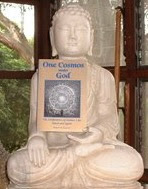
So I suppose the question is, how does one achieve this wholeness without already having it? Again, I think it comes down to making a commitment on every level of one's being to making it so. I suppose, to a certain extent, I discuss this toward the end of my book, with the "Ten Commanishads and Upanishalts for Extreme Seekers."
I see there's even a helpful little summary on page 244: "In short..., the spiritual life involves making the transition from mindlessly willing for that which we uncritically yearn, to consciously yearning for that which we actually want (that is, enlightenment and liberation). In making this transition, it may appear as if our conventionally understood 'horizontal' freedom is diminishing, which is true. However, the point is to exchange it for a more expansive 'vertical' freedom that is relatively unconstrained by material circumstance, so that the old freedom is eventually regarded as a comparative enslavement."
Then what happens? Page 247: "Thus, in our properly oriented right-side-up universe, its unity and coherence are experienced from the top-down, in light of our source and destiny in the non-local singularity at the end of the cosmic journey." Blah blah blah, yada yada yada, I suppose you could say that the Buddhist paradoxically "cleaves through detachment" to the empty plenum, while the Raccoon has an unapologetic passion for wholeness and therefore eternal Being which, from downbelow, can look like a void, for the same reason that an abundance of light can render one blind.
Cosmic weather permitting, I'd like to discuss all of the above in the context of a book I recently read, Ages of the Spiritual Life, tomorrow or maybe Friday.