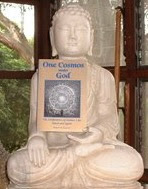
I never did finish the discussion of Purcell's
From Big Bang to Big Mystery before veering into
Hitler and the Germans, but the two are actually intimately related, in that Purcell's whole approach is deeply indebted to Voegelin, who is without question one of the most wide-ranging thinkers who ever lived.
One reason Voegelin is qualified to describe and analyze the spiritual and intellectual pathologies that made Hitler possible, is because he spent his life trying to understand the logospheric and pneumatic conditions that make
humanness possible. Again: unless we know what health is, we won't be in a position to recognize, diagnose, and treat pathology.
Also, Voegelin himself embodied the very quest he describes, without in any way compromising his scholarship. Analogously, it takes a mystic to write about mysticism, which is precisely what is wrong with most academic works on mysticism, or even on religion in general.
As described in the
Coonica, it is the difference between mere (k) and (n), or ego-based knowledge and nous-centered intellect-vision. Clearly, when it comes to religion, anything other than interior, experiential knowledge is an abstraction. This is not to say that certain things cannot be a matter of faith, but faith itself is tacit foreknowledge of as yet undiscovered realities, or it is not worthy of the name.
And a deep and secure faith is already a kind of confirmation that resonates through the being and yields a harvest of its own. In other words, it is creative -- one might say organic -- never static.
This is also the difference between good and bad dogma, or just dogma properly understood. Dogma is a
tool, not just a static system to be superimposed on the intellect. It is a probe with which we poke around in the suprasensible dark, in the way a blind man uses a cane to innervisualize the space within which he moves.
Now, is dogma -- and religion -- misused and misunderstood?
Please. Grow up. This is like asking if humans are humans, which they tend to be.
Everything touched by humans can be and is misused and abused -- science, art, religion, democracy, sex, grog, music, education, baseball (the DH), my comment section. There is no end of things that are goods in themselves until humans get their hands on them.
Why is this? That would require a very lengthy explanation (which I've already done), hence the virtue of dogma, i.e., man's fallen condition, which is a kind of compact and shorthand wisdom that gets one straight to the bottom lyin'. Most people don't have the time or the mental capacity to think this through on their own, which is unnecessary anyway if they just take it on faith that
yeah, man is pretty f'ed up, okay? So don't imagine otherwise, or you are headed for a very rude awhackening upside the head.
Consider America's founders, who were so imbued with the idea of man's dubious character that they hardly needed to make it explicit. Rather, the question was what to do about it, i.e., how to create a government that could overcome, or at least compensate for, the fact that it would be run by men, of all people. One often hears complaints about how difficult it is to "get things done in Washington," or lamentations of "why can't they just get along?"
Uh
doy. The whole system was designed to
prevent an authoritarian clusterfuck such as Obamacare from ever seeing the light of day. That it was only rammed through in the teeth of bipartisan opposition via bribery, bullying, kickbacks, and legislative trickery, tells you all you need to know. Even leaving aside its plain unconstitutionality, it violates the very spirit -- and wisdom -- upon which the nation was founded.
To jump ahead a bit, Voegelin defines the essence of health as a condition of intellectual and spiritual openness. Just as there are intellectual illiterates, there are spiritual illiterates.
And when Voegelin uses the term "illiterate," he doesn't mean it in the sense of merely being unable to read. Rather, especially in a mass-educated society such as ours, the ability to read has little to do with actually being
literate, as our troll ably proves every day with the breezy self-assurance of the dense. For Voegelin, it is not just the failure to assimilate good literature, but the inability to even recognize it.
For our troll, some cut-and-paste nonsense pulled up from the fringes of the internet is as deep and learned as, say, Voegelin, or Plato, or Eckhart, or Thomas, or Schuon, or the Upanishads, or Tomberg, or Balthasar, or the whole host of magnificent thinkers who have graced mankind by illuminating and mapping the transcendent order.
I was about to say that without them we'd be in a deep hole, but that wouldn't be quite correct, because in a two-dimensional world there are neither holes nor peaks, just... desires and fears, or pleasure and pain.
Which is certainly one way to order one's life, but it doesn't in any way correspond to the wider order of the cosmos, and the whole point of life, if we could express it in a single sentence, is to conform oneself to the order of reality. For what is the alternative? To order oneself to illusion? That works too, at least for a time, but reality has a way of breaking through the little manmade orders we impose upon it. And killing lots of people in the process.
Ironically, to think in so simplistic a manner -- i.e., God isn't real because science supposedly says so (itself a gross misunderstanding of, and insult to, science) -- is so deeply anti-human as to beggar belief, because in one cretinous wave of the grubby hand it eliminates all that is best and brightest in man's 50,000 year quest to understand his ground and destiny.
This was Voegelin's main beef with academia, and it is identical to our own mockery of the tenured. In his book
Amanesis, he discusses this from up close, since he spent 50-odd years in that environment, and was in a position to know. He writes of how postmodern ideologues -- whether beholden to Marxism, positivism, scientism, evolutionism, Freudianism, whatever -- all share the same characteristic of being
closed systems which lose the ability to perceive reality over -- or under -- their own projections.
In other words, once one assimilates an ideology, percept follows concept, to such an extent that this second reality places a kind of blanket over first reality, which is never seen again. It is still there, of course, and continues to be
unconsciously recognized. Thus, the ideologue senses this real reality -- in the same way that the person of faith senses real reality, except that the ideologue works feverishly to deny the perception.
This is why there can be no leftism in the absence of political correctness or some similar coercive structure to enforce their version of reality, since maintaining the second reality requires a kind of systematic advance-warning system to prevent people from traveling down certain chains of observation or reasoning. If that happens, the whole swindle collapses.
Voegelin asks -- and this was back in 1977 -- "Why do they [the tenured] expressly prohibit anybody to ask questions concerning the sectors of reality they have excluded from their personal horizon? Why do they want to imprison themselves in their restricted horizon and to dogmatize their prison reality as the universal truth? And why do they want to lock up all mankind in the prison of their making?"
That was for you, Barry: Why? What makes you qualified to do this, aside from a cosmic narcissism that is simultaneously outlandishly grandiose and childishly petty? A mind as small as Obama's can only appear capacious to someone living in an intellectual hovel.
I repeat: this is
not the open spirit in which this nation was founded, which was fundamentally a spirit of
liberty, or one might say "spiritual freedom."
Now what is this "spiritual freedom?" Well, for any flatlander, such as our troll, it is a nonsense term. There's nothing we can do for him. But from the Raccoon perspective, it is all about
vertical freedom, although vertical freedom is impossible, or at least quite difficult, in an atmosphere deprived of horizontal freedom. The damage that socialism, statism, and communism do to economic reality is one thing, but the more tragic and enduring damage is to the
soul, which can again lose contact with the spiritual environment because of the systematic denial imposed by the regime.
Life, liberty, and the pursuit of happiness are none other than the irreducible prerequisites of a spiritually and intellectually open stance toward the cosmos. The first two are obvious, since you won't get very far in your quest without your life and the freedom to live it in the manner you see fit.
But nor will you get very far without pursuing
happiness, by which the founders certainly didn't mean pleasure, or convenience, or power. Rather, they meant it in the classic Greek sense of actualizing one's powers -- one's gifts -- in the direction of virtue. That is life. That is liberty. That is happiness. That is firing on all cylinders in hyperspace.
In the course of his journey among the primitive tribes of the tenured, Voegelin discovered a kind of restrictive horizon "similar to the consciousness that I could observe in the political mass movements" of the 20th century. Of course, one can only recognize the restriction if one is coming from a wider and more open horizon, which Voegelin surely was.
In the United States, he noticed the now obvious problem of people such as our troll, who are educated well beyond their intelligence, i.e., "the populist expansion of the universities, accompanied by the inevitable inrush of functional illiterates into academic positions in the 1950s and 1960s." Far from Santorum's characterization of Obama's "elitism" for believing everyone should go to college, it is quite the opposite, for when everyone goes to college, everyone will be as functionally illiterate and anti-intellectual as Obama, and everyone will be a Democrat.
Regarding this openness to the subjective cosmic horizon, Voegelin writes that navigating it "is a ceaseless action of expanding, ordering, articulating, and correcting itself.... It is a permanent effort at responsive openness to the appeal of reality, at bewaring premature satisfaction, and above all at avoiding the self-destructive phantasy of believing" that reality "can be mastered by bringing it into the form of a system."
To say that reality is much richer than the ideological fantasies of the tenured is simultaneously obvious and yet necessary, since we are all victims of these fantasies in one way or another. Our human duty is to rebel against any system that attempts to imprison us in some manmode idiotolatry. This means to be in solidarity with man as such, and to acquaint oneself with the best man has to offer in his encounter with open existence over the centuries.
For history is the chronicle of consciousness exploring and differentiating itself in continuous dialectic with the Ground, with O, the source of order. Alternatively, one can just say, "duh, science say only matter real," and be done with it.