In fact, it is probably fair to say that most of our knowledge is of this order. During the course of our education, there are few things that we ever experience on a first hand basis. For example, I am not an economist. But I have faith in Ludwig von Mises, Fredrich Hayek, and Thomas Sowell, whereas I regard Paul Krugman as an ideological hack, even perhaps crazy. Similarly, I am not a quantum cosmologist, but I am quite certain that this field will never arrive at a "theory of everything," if only due to Gödels's theorems. I am not a biologist, but I have no doubt whatsoever that the theory of natural selection is absurdly incomplete. Etc.
So if some skeevy televangelist or door-to-door religious salesman tells me that God exists, I don't give it much weight. On the other hand, if a man of great intellect, erudition, experience, and virtue says so, then my ears perk up. As with most everything, one must consider the source. Our trolls do not consider me a credible source, which should be the end of their sophering fixation on this site, but for whatever tangled intrapsychic reason, it isn't. Which is fine. Truth being what it is, they teach us many valuable lessons.
But in any event, you will never hear me attempting to convince a reader of my credibility, which I could never do anyway. Either you regard me as credible, or you don't -- although I assume that this credibility has been slowly earned through time, based upon your own personal experience with the substance of these posts. It is perhaps similar to the good will one builds up with particular musical artists. If they come out with a new work that doesn't speak to us, we are willing to put in the effort required to penetrate it. For example, I initially didn't "get" modern jazz, but I accepted it on faith that these men weren't merely musical frauds trying to separate me from my cash.
And let me add for those readers who do regard me as credible -- which is always a leap -- I would never under any circumstances take this for granted or do anything to jeopardize it. We know you have a choice in your vertical travel, and we thank you for choosing trans-Bob airways. But the credibility can only be re-earned with every flying post. Besides, it's not the person, it's the fruits. If that weren't the case, I would have no credibility anyway.
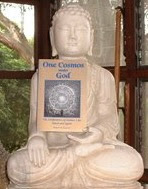
 I'm not like that surly tree in the Wizard of Oz. Anyone is free to come by and pick an apple off me, because where I got 'em, they didn't cost a thing. Although gratitude would naturally compel you to purchase my book without my having to beg. What? Okay, I'll beg.
 Schuon points out that the classical proofs of God occupy a kind of "in between" area on the vertical plane. Above them is the direct intellection or mystical experience of God, while below them is the profane rationalism of the flatlanders. Thus, we know in advance that these proofs can only "indicate" or support the journey. But that's actually saying a lot, because by dwelling in them, one may very well unexpectedly find oneself drawn up into the Great Attractor (more on which below). It's like innocently rubbing some sticks together at a gas station, and all of a sudden the whole place goes up in flames.
It should also be pointed out that man has a right to a God who doesn't offend his intellect. Clearly, not every man is in need of such a God, but some of us surely are. To ignore human diversity and say that God only cares for the stupid is to posit a god in whom I cannot believe.
One frequently encounters fundamentalists and fideists who distrust the intellect in general and gnosis in particular, as if we are the presumptuous ones. But it's actually the other way around. How dare they suggest that God cannot be known in ways other than scripture! There is no intrinsic reason for any ontological break between mind and spirit, psyche and pneuma. Great Neptune, you have no right to reject scholasticism before you have even deeply understood it, barnacle head!
Let us begin with a premise on which we can all agree, theist and atheist alike, for if it isn't true, then no real thought of any kind is possible (that is, if thought is adequate to truth): "it is necessary to begin with the idea that human intelligence coincides in its essence with certainty of the Absolute."
Please note that you don't necessarily have to have had a personal experience of the Absolute. Rather, you simply must posit it, and understand that no coherent thought or discourse is possible in its absence. It is the ontological "condition without which." In turn, the human subject is the "condition with which."
While the prior existence of the Absolute is self-evident to the even minimally awakened intellect, in our present Age of Stupidity, the "awareness of 'accidents' has stifled the intuitive awareness of 'Substance,' and from this has come an intelligence that is systematically superficial, fixed upon a fragmentary reality."
Do you see the problem? Either you are an absolutist or you are a relativist. And if the latter, you condemn yourself ahead of time to falsehood, fragmentation, disharmony, immorality, ugliness. Or at least you will have no ontological basis for distinguishing between these and their opposites. Rather, one can only appeal to tastes, fashions, authority, or the ubiquitous urge for conformity.
The Absolute simply is. It cannot be proven with logic, since it is its own proof, not to mention the fact that it is the basis for the existence of any proof at all -- obviously! For to affirm that anything is "absolutely true" is to have brought oneself into the orbit of the Absolute and outside the obit of relativism.
So it is with this prior understanding that one should approach the proofs of God. If you cannot make this leap, then you are excused. It will come as a surprise to our trolls that you are under no external compulsion to continue reading this evil and stupid blog.
{Are they gone? Good. Let's continue.}
To the stubbornly godless man, the following statement by Schuon will appear as a tautology or even a clever trick: "in the spiritual order a proof is of assistance only to the man who wishes to understand and who, because of this wish, has in some measure understood already." Conversely, "it is of no practical use to one who, deep in his heart, does not want to change his position and whose philosophy merely expresses this desire."
Reason flees from such a self-enclosed individual, who can easily find intellectual justification for his static condition. I remember it well! To say that the proofs are of no use because they don't work for everyone is like saying that ebonics should be taught because proper English grammar and syntax don't work for everyone.
As mentioned above, everything hinges upon that first ontological choice between Absolute and relative. Once you have chosen the latter, then there is no hope for you -- at least until you reverse course and undo what you done did. Upon this choice depends one's conception of truth. For the absolutist, truth is discovered; for the relativist, truth is created -- which is just another way of saying that there is no truth at all, only opinion.
For the absolutist, "truth does not depend on reasoning -- obviously truth is not created by reason." Rather, it "reveals itself or becomes explicit thanks to the key provided by the mental operation." Within this act of understanding, there is always something that "escapes the thinking process rather as light and color elude the grasp of geometry."
I'm sure all of you have felt this "something." Perhaps you are feeling it now. It is similar to that extra ingredient that elevates artistry over competence, the profound over the prosaic, Magnus over goddinpotty, etc. To suggest that this gulf could ever be reduced to "quantity" is absurd. And stupid.
Qualities are not arbitrary, or they wouldn't be qualties. Rather, to say that one thing is better, or truer, or more virtuous than another, is to acknowledge the vertical hierarchy that can only end (and begin) in the Absolute, on pain of our humanness being a pure miracle hanging suspended in mid-air, like, I don't know, like something just hanging there in mid-air suspended. Yes, we are suspended, but from above, like Larry King's pants. The alternative is just too hideous to contemplate -- i.e., a pantless Larry King.
To be continued... all quoted material taken from Frithjof Schuon's Logic and Transcendence...