The mode of science is entirely lunar, in that it seeks to "reflect" matter. Which is fine for science. Just don't confuse it with philosophy or metaphysics, much less theology.
The lunar mode can only comprehend that which is discontinuous, never that which is continuous. In fact, if I am not mistaken, the word "science" is etymologically related to "cut," which is what science must do in order to understand anything. But the cutting is in the mind of the scientist, and cannot be confused with what is ultimately real, and which unites the scientific knower with what he knows. Matter is atomistic, malleable, and infinitely divisible. Using only the tools of science, it is impossible to even approach the problem of intrinsically continuous and holistic properties such as life and mind.
But the Gospel of John confronts us with the creative Word, "which is the light and life of men." Here, intelligence "has the task of understanding the whole world as the organisatory act of the Word and Jesus Christ as the cosmic Word made flesh." Whereas lunar intelligence seeks to understand "that which is," this logocentric mode seeks to participate "in the becoming of that which is to be." It is not just to be "born again," but to give birth -- which is to participate in the intrinsic and eternal creativity of the Word. (This is the Voidgin Birth alluded to in my book.)
Real creativity is clearly a kind of higher life and higher life that is continuous with, or a mirror of, the divine activity. The point is, on the intellectual plane, approaching God doesn't just require a leap of faith, but a leap of creative activity -- which is also its seal of authenticity. It is again one of the things I intended to convey by the symbol O-->(n), as it is a continuous flow, "or river of water of life," not something fixed and dead.
UF writes that it involves the true union of intelligence and the intuition of faith. In the typical believer, it seems that these two modes are "engaged," but they have to move on to a true marriage, and become "one flesh." It is not simply one mode added to the other, but a real harmonious -- and creative -- union. (There is much more on this union in the following letter, The Sun, which I suppose we'll be getting into tomorrow.)
UF singles out several thinkers whom he believes approached or achieved this fusion of faith and intelligence, including Origen, Denys, Aquinas, Jacob Boehme, Berdayev, and Teilhard de Chardin. He also has a lot of praise for Bergson, with whom I again have only a general familiarity. But he includes an extended passage from Bergson that well captures what we are discussing here. He makes reference to the circularity of mere logic, and the need to break out of this closed world:
"If we had never seen a man swim, we might say that swimming is an impossible thing, in as much as, to learn to swim, we must begin by holding ourselves up in water and, consequently, already know how to swim. Reasoning, in fact, always nails us down to the solid ground."
You can no doubt appreciate the baleful consequences of our scientistic jester's mundane and earthbound intelligence, which is again in servitude to that which is infinitely beneath its scope and station: "It looks to the least developed and the most primitive for the cause and the explanation of what is most developed and the most advanced in the process of evolution.... it retreats into matter. It does something with regard to the world which would be absurd with regard to a work of art.... Intelligence which prefers retreating to flying must inevitably arrive at the impasse of absurdity.... And the absurd... this is suicide for intelligence" (MOTT).
Bergson continues: "But if, quite simply, I throw myself into the water without fear, I may keep myself up well enough at first by merely struggling, and gradually adapt myself to the new environment: I shall learn to swim.... if the risk be accepted, action will perhaps cut the knot that reasoning has tied and will not unloose."
This reminds me of the anecdote in my book about the yeshiva student who is asked if he knows how to swim: "No, but I understand swimming." The analogy with our jester is exact, whose pride forbids him from leaving the solid shore, but who nevertheless imagines that he understands what it means to dive into the Ocean. (By the way, I hope it is understood that I am not "scorning" or beating up on him, but merely using him as a handy object lesson. He will be the first to assure you that he is not in the least offended. If he were vulnerable, sincere, or honest enough to be capable of taking offense, I would handle it in a much different manner.)
So our intelligence must take the plunge in order to leave the prison of materialism: "[L]eap it must, that is, leave its own environment. Reason, reasoning on its powers, will never succeed in extending them, though the extension would not appear at all unreasonable once it were accomplished." For example, one could publish thousands of studies on the nature of walking on solid ground, but they "will never yield a rule for swimming: come, enter the water, and when you know how to swim, you will understand how the mechanism of swimming is connected with that of walking. Swimming is an extension of walking, but walking would never have pushed you on to swimming."
That is a critical point, for from the perspective of walking, the leap to swimming looks "discontinuous." But from the perspective of swimming, one can appreciate the continuity, which is none other than "the God of the gaplessness" of reality. Science sees "gaps" that it imagines the religious believer fills in with "God." But it's actually the other way around. Once one leaps into the Word, one sees how there are no gaps at all, and why it is so easy for science to fill the apparent ones!
This, in case you didn't know, is the reason why I arranged my book so that the chapters are both continuous and discontinuous, from nothing (or beyond-being) to being, matter to life, life to mind, and mind to spirit (in other words, there are distinct "chapters," even though the sentences that link them run together). Only from the point of view of the first half of each pair does the second look discontinuous. But from the point of view of the second, one doesn't just "see," but one unproblematically lives the continuity. One swims.
After all, doesn't your body easily unify matter and life without you having to think about it? And doesn't your mind easily unify intelligence, life, and matter? And doesn't the Raccoon naturally live the unity of matter, life, mind and Spirit, or O? Of course. And there is no "technique" for doing so, accept for aspiring (↑) to the nonlocal Grace (↓) that meets us more than halfway, and then coontemplatively "breathing" in its eternal rhythm. We could never do it ourselves, not in 13.7 billion years.
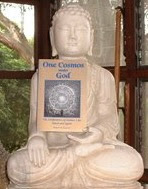
The unity comes from the top, not the bottom, of the cosmic hierarchy. Which is why it is indeed One Cosmos Under God.
Esoterism is not a collection of extraordinary and unknown things, but rather it is above all a less ordinary and less known way of seeing ordinary and known things -- of seeing their profundity --Meditations on the Tarot
Abandon All Hopelessness, Ye Who Enter Here
 (image courtesy of the Frothy One)