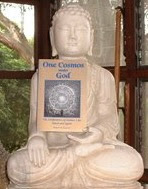
This is something Will touched on in his comments yesterday, and something that has been in the back of my mind for a while as an idea for a post, but I wasn't sure if I had the ability to translate Petey's pontifications into plain English. In fact, I'm still not sure.
But Will made some excellent points yesterday, which implicitly touch on how we have, in the last 100 years, essentially deferred the field of ontology to physicists, even though, if he is honest, the most brilliant quantum physicist doesn't really know what the hell is going on. In the end, he can only make inferences about reality that are strictly limited by the nature of small-r reason, which is a tool of the mind, not the totality thereof.
Popular books on quantum physics are a dime a dozen, but nearly all of them are marred by the confusion of method and ontology, i.e., what physicists may say of reality vs. the infinitely larger domain of what we may know of it. And when they speculate, it is almost always in a worthless, new-age sort of way, i.e., "you create reality." As always, the real Secret is that the Secret protects itself from such debased and deepaked bozos and hucksters -- and from trolls, by the way.
It's a cliche, but truly, to study ontology -- the nature of being -- with the scientific method is very much like undertaking a study of Shakespeare by analyzing the chemical properties of the ink and paper with which he wrote his plays. Here we can understand how method very much determines the content of what we see.
One is very aware of this in the field of psychology, since there are so many competing theories that attempt to map the mind. This is something I noticed very early on in graduate school, and it essentially leaves one with only three options. One, you can pick one particular theoretical orientation -- which is somewhat analogous to converting to a particular religion -- and essentially become a devotee (which I am not necessarily criticizing, BTW). Two, you can become a cynic and say that meaning is just arbitrary, and that we simply superimpose fanciful models on the mind that have no more substance than drawing lines in the ocean.
Or, you can attempt to make all of the theories make sense in light of a greater whole that contains many more dimensions than three or four. This was my approach, and in fact, I laid it out in my first scholarly publication back in 1991 (based on part of my doctoral dissertation) -- back when I was trying to be a scholar instead of whatever it is I am now.
In fact, even the course of my subsequent life reflects the reality I was attempting to convey in that first paper, in that I found that I could not possibly devote myself to one discipline (let alone, one school of psychology) in such a way that it could adequately coontain the Gagdad spirit. Or, that would have been the problem, precisely. I would have had to literally I-amputate significant parts of myself in order to fit into this or that narrow discipline.
Thus, if my critics want to say that I am an undisciplined non-scholar, I have no objection. That's sort of the point. As brother Blake once cracked, "I must create a system or be enslaved by another man's." I would much prefer to simply have a creative and "upwardly spiraling" engagement with O than to internalize someone else's (K) about it, (K) that always has an expiration date -- unless it is grounded in revelation.
This is why, for example, Christopher Hitchens' latest work of (K) that attempts to contain O will soon disappear like an old People Magazine that the janitors take home at night, while human beings will still be trying to decode the Bible in 1,000 or 10,000 years. Or, if they are not, then it will mean that the Human Being did not survive in a recognousable form -- perhaps bodily, but not spiritually.
After all, it is not less bizarre that revelation should be treasured in 10,000 years than it is treasured today. For someone who has already abdicated his humanness -- his specifically human spirit and human way of engaging O -- he is already mystified as to why anyone would take religion seriously. Of all the miracles associated with Jesus, none is more miraculous than the following: that this gospel will be preached throughout the whole world, as a testimony to all nations. What a completely bizarre, even unsane, thing to suggest! After all, not only did Jesus write nothing down, but he died an anonymous peasant at a time when most men were slaves and the means of transmitting official knowledge was vouchsafed to a chosen few. But then, for this "prediction" to actually come to pass.... mind-boggling.
This is a mystery that is insufficiently appreciated. The secular scholar is at a loss to explain it. Or, like the physicist, he is limited by the "miner's helmet" he uses to examine the evidence. Therefore, since there can by definition be no objective truth to either the ideas of Jesus or the Idea of Jesus, the scholar must essentially rely upon a pathological model of mankind.
In other words, human beings must essentially be crazy for such ideas to spread like wildfire. But as Schuon pointed out on a number of occasions, if human beings are so fundamentally crazy or stupid that even their greatest minds of the past could not tell the difference between fantasy and reality, then there is no compelling reason to believe that human beings should now be so wise that they can accurately pronounce on the nature of reality. In short, they would still be too stupid and crazy.
The most efficient way to dismiss my views is to simply say, that Coon is crazy -- which, of course, has been said of those far greater than I. In fact, reader Zi gave voice to this view just the other day: whatever I write, it is simply "Bob's pathology, and he should not suggest that others share it.... Bob worships his own psychopathology, which is fine, but just don't pretend that others should."
I am loathe to offer an invitation to a troll, but perhaps Zi could flesh this idea out a bit, i.e., define exactly what he means by "pathology," and explain why anyone would be motivated to "worship" it. Perhaps he doesn't realize it, but my book does give an account of how and why this can and does happen. But it does not prove that there is not an object worthy of worship, any more than a pervert who likes having sex with shoes proves that coonjugal love is pathological.
Now, where was I. Yes, the idea that we are human beings and that there is a realm of knowledge that is specifically applicable to that privileged station. In other words, we are not merely matter, so that no theory of physics can account for us or speak to our true inner nature. Nor can any theory of biology, including natural selection -- regardless of its undoubted truth in its own domain -- account for, or speak to, the human Center.
No. Only spiritual truths of one form or another speak to this human center. No one really argues otherwise, only over the ontological status of the truths and the part of us to which these deeper truths are intelligible. To cite just one obvious example, you will often notice that for the secularized person, they become preoccupied with culture in general and "art" in particular. It is a banality to point out that some time ago, the museum became the new church for secularized sophisticates.
But unless art is rooted in transcendent reality, it will eventually become -- as we have seen -- a monstrosity. In accordance with the Fall, it will simply "slide downhill" 32 feet per second per second, toward something that is less than man, properly so-called. Here is a fine example, linked to Drudge the other day. Remember, this is Art:

Hmm, sorry about that. Not exactly Madonna With Child, but definitely Child of Madonna. You will notice that it doesn't even really show anything, and yet, it is nevertheless pornographic.
As it so happens, as I have mentioned before, my father-in-law is a vociferous anti-theist in the manner of Christopher Hitchens. However, it is also possible that he is the most cultured man I know. Having lived most of his life in Manhattan, when he retired to Florida, he found the absence of culture intolerable, so he did something about it. He founded the Sarasota Film Society in order to bring quality films and various artistic events to the area. If I am not mistaken, it grew into the most successful venture of its kind in the entire country.
I have always been struck by the inherent contradiction of loving and needing transcendence -- i.e., art -- while denying its possibility. If there is such a thing as "quality" art, where does this quality reside? Merely in good technical execution, as my father-in-law has argued when pressed? Or merely in telling an entertaining story? I once told him that if he were truly what he thinks he is, then he would simply run porno films and not be concerned with this fanciful thing called "art."
But whether he likes the idea or not -- and he doesn't -- he is an irreducibly spiritual man with spiritual needs. These needs cannot be reduced to anything else, e.g., Darwinian "sexual selection," which essentially promulgates the theory that the real reason for art is to get chicks. Yes, there is an undeniable element of truth to this, but to suggest that this is the "whole truth" is patently absurd. I don't really care if Van Morrison wrote Astral Weeks to impress Janet Planet. I only care that his music was central in speaking to and even "awakening" a dormant part of myself -- an explicitly spiritual part (although the word "part" is misleading).
Now, back to scripture and revelation, which is either a result of pathology or an elaborate way to get chicks. Or, it is a theurgent memorandum from ourSelf to ourself, designed for that purpose. To be continued.