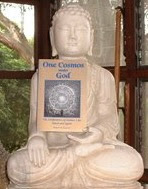
They say that the sales of a book will be diminished by the percentage of pages that contain any kind of mathmatical equation. People might pluck the book from the shelf, but as soon as they see any numbers, they put it back.
I'm afraid it's the same with my symbolic oquations, perhaps with the exception of O, since it can camouflage itself as a letter. But throw in stuff like (•), →, (¶), or •••(¶)•••, and people start to recoil. There, see. Wait! Come back!
But for me, these symbols were a kind of lifesaver -- or mind saver -- because they allowed me to see through to the unity beneath all of the various revelations I had immersed myself in at the time -- not just across revelations, but within them. Really, it's like musical notation. Imagine how musically limited we would be in the absence of an abstract system to describe it.
The other day I was reading about an album Sinatra made with the Duke Ellington band in the 1960s. Sinatra always worked with the very best studio guys, who both had jazz chops and could also sight read as easily as you're reading this post. But as great as they were, no one in the Ellington band could sight read. Ellington wrote hundreds of compositions, and the band learned each one by simply playing it. In a way, it makes each composition a unique entity that cannot be seen as anything more simple or abstract than itself.
This is largely the position mankind at large was in prior to the scientific revolution. No one knew, for example, that the same force that caused the apple to fall from the tree, also caused the earth to fall through the curved space around the sun -- or, in Newtonian terms, that there was an underlying g-force that accounted for such diverse phenomena.
So imagine my surprise when I discovered the similarities between certain yogic approaches and Orthodox Christianity. Faced with such a similarity, one has several options. One could say that one is a debased or partial form of the other; or that one is a premonition of the other; or like Schuon, that each is true in its own right and in its own human world; or that they are symbolic or mythological expressions of perennial truth.
In my case, I suppose you could say that I attempted to develop a "general theory of spirituality" that would apply to all particular spiritual experiences, so that modern people who otherwise cannot appreciate religion could begin to access its priceless wisdom. And I am particularly interested in reaching the many westerners who are attracted to Buddhism or yoga, because only a revitalization of Christianity will save the West -- and therefore the world. We need you on our side. There is nothing in eastern religions that cannot be found in Christianity, but much in Christianity that is responsible for our uniquely valuable civilization.
Please bear in mind that the experience always takes precedence, and that the symbols are merely a means of "storage and communication," so to speak. Instead of musical notation, it's spiritual notation. But in neither case does it exist for its own sake. Rather, the purpose of music is to be played, heard, and understood. And the purpose of spiritual experience is to discover your true self, and therefore, God (and/or vice versa).
Sherrard writes that "to know oneself may be said to be a condition of knowing God.... In other words, if one cannot know God without knowing oneself, one also cannot know oneself without knowing God. To be ignorant of oneself is thus to be ignorant of the divine source of one's being. If to be ignorant of oneself is to fail to achieve an authentic human life, then by the same token to be ignorant of God is to fail to achieve an authentic human life."
So, each is a prerequisite for the other, which is why I say that (¶) is a kind of "prolongation" of O, whereas (•) is a reflection of Ø. Thus, you can see that I simply abstract the essence of what a Sherrard is conveying. Then it's up to you to refill the abstraction with your own experience. The purpose of life is to reflect and embody eternity within time, or let us say O through (¶).
For a real life example of what happens when someone fails to know themselves -- and therefore God -- see Scipio's two recent posts on the eternally clueless Maureen Dowd.
On one of Scipio's pieces, I left a comment about having viewed the Ingmar Bergman film Wild Strawberries yesterday evening. If you haven't seen the film, it's about an elderly professor who is about to receive some kind of honor. During the course of the journey to where he is to receive the award, he reflects upon his life.
I haven't gotten to the end of the film yet, but one can sense that it is all about a kind of nightmarish realization that he died long ago, and that he is solely identified with (•). The painful realization that he has missed out on his own life comes to him in the form of disturbing dreams and images. At one point, his daughter in law says to him, You know so much. And yet you know nothing.
This is the fate of all (k). It really has no living relationship to O, but is merely a kind of cloak with which intellectuals cover themselves in order to produce a kind of self-generated warmth and security. But upon your death -- or birth, it's up to you -- this (k) dissolves like a dirt clod in the water. It just decomposes and returns to the earth, ashes to ashes, dust to dust.
There is a living source and a living knowledge (n), and only this is free from the grip of Death. It is what you take with you when you grow. The rest of your intellectual baggage is eternally lost in the errport.
@ American Thinker, another dangerously false self, Obama.
Showing posts sorted by relevance for query scipio. Sort by date Show all posts
Showing posts sorted by relevance for query scipio. Sort by date Show all posts
Tuesday, July 07, 2009


Monday, June 01, 2009
Obsessive-Compulsive Political Disorder and the Hopelessness of Hope
We left off last Friday discussing those evil twin towers of the leftist narrative, utiopianism and revolutionism. You say you want a revolution? Good! You got one. Scipio ponders the gruesome details here.
So you're happy now, right? Utopia is right around the coroner, is it not?
Ho!
Leftists are constitutionally incapable of noticing that their revolutionism is always at odds with their utopianism, and only "delays" the latter (but only forever). Therefore, what's the solution? More revolutionism. As Obama promised -- or threatened -- the other day, you ain't seen nothin' yet! This leads to the odd situation in which the revolutionism becomes the utopia. The utopia itself can never come about. Rather, the fun is in trying.
For all of those aging boomers who miss the '60s, this is the reason why: it was a time of manically "hopeful revolutionism," indeed like adolescence itself (mania is always a defense against depression). Of course, it didn't take long for the revolution to turn distinctly dystopic; therefore, it had to somehow be sustained without ever achieving its goal. To actually achieve the goal would be the end of the revolution, and therefore the end of hope. The secret of Democrat power is to forever keep its drones suspended in a state of hopeless hope. The more hopeless you are, the more false hope they have to promise you.
In the absence of revolutionary hope, we would have to accept man for what he is, and start from that depressing but sober realization. Which is what our wise founders did.
It reminds me very much of the great psychoanalyst D.W. Winnicott's observations about the unconscious phenomenology of shoplifting. He noticed that the compulsive shoplifter didn't necessarily steal out of greed or need. Rather, he did so in hope. In that suspended tick of time in which the theft is taking place, the shoplifter experiences a kind of exalted hope that lifts him out of his existential despair. Of course, the effect is only temporary and must be reenacted again and again.
This is a profound observation, because it doesn't just apply to shoplifters, but to most any kind of compulsive behavior. A compulsion is a kind of mini-narrative, except that it is entirely circular and lands you right back where you started. Behind the compulsion is some sort of unconscious or semi-conscious hope: hope for safety, or esteem, or fulfillment, or health, or whatever. But the compulsion cannot actually be fulfilled, or the person would be reduced to a state of hopelessness. So the little drama must be compulsively staged and reenacted, often with more elaborate details, but no change in the underlying structure.
Again, it is the narrative that counts, not the facts. Facts that do not fit into the narrative are not only ignored, but actively attacked. This is not a "passive" kind of madness, but quite active, for this is where the leftist places his misplaced faith: in their specifically Christian counter-narrative. They will defend this narrative with all of the tools at their disposal, even while concealing its nature, often even (or especially) to themselves.
To bring the narrative fully into the light would rob it of its mystery, for in the end, there is nothing mysterious about it. It's like the withered little man beneath the Darth Vader costume. It's just plain old secular socialism, underneath which is the hope for an immanent utopia, or heaven on earth. Thus, it hopes for the impossible, and gets it every time.
Today the church has largely gone from shaping history to being either shaped or bypassed altogether by the historical forces it brought into being (such as Christian hope). Nowhere is this more evident than in "liberation theology," which appropriates the Christian narrative for the purpose of destroying it. Anyone who thinks it is unimportant that Obama found his soul's rest in just such a degraded theology is a fool, for he has now made himself the central actor in that counter-narrative, even while claiming to have left that particular church behind. He hasn't left it. Rather, he's finally taking it seriously, backing up his faith with bold actions, not just words.
The point is, man must live in drama, and a drama has conflict and resolution. For the Christian, the primary locus of the conflict is within the self, and secondarily between powers at play in the world -- powers that "enlist" actors to read their lines and do their bidding. And the hope is for eternal salvation, not temporal utopia.
For the leftist, the principle conflict is superficially between "haves and have-nots," but the deeper conflict is between finite having and infinite wanting. And that is a conflict that can never be resolved, for the very reason that man's wanting is infinite -- as infinite as his imagination.
There is nothing you can give a man that will extinguish his wanting more, unless that man is on a spiritual path through which he transcends, or at least masters, that kind of mimetic desire (which is to be distinguished from appetite, which is natural desire uncontaminated by mimesis or compulsion). In other words, in addition to desire being infinite in itself, man always wants what the other guy has, just because the other guy has it.
I suppose it's possible to completely transcend desire in the manner of a Ramana Maharshi, but moderation is the more practical means of dealing with it. As Dennis Prager recommends, you should give yourself little proscribed areas for the enactment of "moderate vice."
For example, with me, it's my Blue Note collection. Yesterday I snagged an out-of-print rarity from some poor sucker for only ten bucks, when they often go for the absurdly high price of $150. Did that make me happy? Yes, for a moment. But now I really "need" this one, which is fetching a preposterous $90. Thus, it's a kind of deadly game between me and a future sucker. I just have to wait him out, then move in for the kill.
But let's say I eventually collect every rare and out of print Blue Note. Would that make me happy? Fulfilled? Of course not! If anything, it would make me less happy, because it would be the end of my little game.
Again, I think this is the deep structure of the naive leftist, who is playing a game he hopes to win, but in winning will leave him without hope. Thus, Obama must find a way to keep the preposterous fantasies of hope alive, even while never fulfilling them (which he cannot do anyway, of course).
It's the same with the naive scientist or Darwinist. Let's say Queeg's fondest hopes are fulfilled, and that no one ever again utters the words "intelligent design." Then what? It won't even make any practical difference in the world, let alone bring about the secular eschaton. At least I can listen to my CDs.
Likewise the Darwinian geek who gets all excited about this or that discovery. But why? He already knows that the narrative has no meaning or purpose. Therefore, he must fool himself into thinking that things have meaning, when they really don't. It's a little game that the Darwinian plays with himself, in order to make his meaningless existence bearable. But if you call them on it, you will notice that they get as touchy as a Muslim over a cartoon of Mohammed.
Bottom line: the left is on a (counter) religious crusade. And as we all know, you can knock a man down, spit in his face, and slander his name all over the place, but don't you mess with his crusade ruse.
So you're happy now, right? Utopia is right around the coroner, is it not?
Ho!
Leftists are constitutionally incapable of noticing that their revolutionism is always at odds with their utopianism, and only "delays" the latter (but only forever). Therefore, what's the solution? More revolutionism. As Obama promised -- or threatened -- the other day, you ain't seen nothin' yet! This leads to the odd situation in which the revolutionism becomes the utopia. The utopia itself can never come about. Rather, the fun is in trying.
For all of those aging boomers who miss the '60s, this is the reason why: it was a time of manically "hopeful revolutionism," indeed like adolescence itself (mania is always a defense against depression). Of course, it didn't take long for the revolution to turn distinctly dystopic; therefore, it had to somehow be sustained without ever achieving its goal. To actually achieve the goal would be the end of the revolution, and therefore the end of hope. The secret of Democrat power is to forever keep its drones suspended in a state of hopeless hope. The more hopeless you are, the more false hope they have to promise you.
In the absence of revolutionary hope, we would have to accept man for what he is, and start from that depressing but sober realization. Which is what our wise founders did.
It reminds me very much of the great psychoanalyst D.W. Winnicott's observations about the unconscious phenomenology of shoplifting. He noticed that the compulsive shoplifter didn't necessarily steal out of greed or need. Rather, he did so in hope. In that suspended tick of time in which the theft is taking place, the shoplifter experiences a kind of exalted hope that lifts him out of his existential despair. Of course, the effect is only temporary and must be reenacted again and again.
This is a profound observation, because it doesn't just apply to shoplifters, but to most any kind of compulsive behavior. A compulsion is a kind of mini-narrative, except that it is entirely circular and lands you right back where you started. Behind the compulsion is some sort of unconscious or semi-conscious hope: hope for safety, or esteem, or fulfillment, or health, or whatever. But the compulsion cannot actually be fulfilled, or the person would be reduced to a state of hopelessness. So the little drama must be compulsively staged and reenacted, often with more elaborate details, but no change in the underlying structure.
Again, it is the narrative that counts, not the facts. Facts that do not fit into the narrative are not only ignored, but actively attacked. This is not a "passive" kind of madness, but quite active, for this is where the leftist places his misplaced faith: in their specifically Christian counter-narrative. They will defend this narrative with all of the tools at their disposal, even while concealing its nature, often even (or especially) to themselves.
To bring the narrative fully into the light would rob it of its mystery, for in the end, there is nothing mysterious about it. It's like the withered little man beneath the Darth Vader costume. It's just plain old secular socialism, underneath which is the hope for an immanent utopia, or heaven on earth. Thus, it hopes for the impossible, and gets it every time.
Today the church has largely gone from shaping history to being either shaped or bypassed altogether by the historical forces it brought into being (such as Christian hope). Nowhere is this more evident than in "liberation theology," which appropriates the Christian narrative for the purpose of destroying it. Anyone who thinks it is unimportant that Obama found his soul's rest in just such a degraded theology is a fool, for he has now made himself the central actor in that counter-narrative, even while claiming to have left that particular church behind. He hasn't left it. Rather, he's finally taking it seriously, backing up his faith with bold actions, not just words.
The point is, man must live in drama, and a drama has conflict and resolution. For the Christian, the primary locus of the conflict is within the self, and secondarily between powers at play in the world -- powers that "enlist" actors to read their lines and do their bidding. And the hope is for eternal salvation, not temporal utopia.
For the leftist, the principle conflict is superficially between "haves and have-nots," but the deeper conflict is between finite having and infinite wanting. And that is a conflict that can never be resolved, for the very reason that man's wanting is infinite -- as infinite as his imagination.
There is nothing you can give a man that will extinguish his wanting more, unless that man is on a spiritual path through which he transcends, or at least masters, that kind of mimetic desire (which is to be distinguished from appetite, which is natural desire uncontaminated by mimesis or compulsion). In other words, in addition to desire being infinite in itself, man always wants what the other guy has, just because the other guy has it.
I suppose it's possible to completely transcend desire in the manner of a Ramana Maharshi, but moderation is the more practical means of dealing with it. As Dennis Prager recommends, you should give yourself little proscribed areas for the enactment of "moderate vice."
For example, with me, it's my Blue Note collection. Yesterday I snagged an out-of-print rarity from some poor sucker for only ten bucks, when they often go for the absurdly high price of $150. Did that make me happy? Yes, for a moment. But now I really "need" this one, which is fetching a preposterous $90. Thus, it's a kind of deadly game between me and a future sucker. I just have to wait him out, then move in for the kill.
But let's say I eventually collect every rare and out of print Blue Note. Would that make me happy? Fulfilled? Of course not! If anything, it would make me less happy, because it would be the end of my little game.
Again, I think this is the deep structure of the naive leftist, who is playing a game he hopes to win, but in winning will leave him without hope. Thus, Obama must find a way to keep the preposterous fantasies of hope alive, even while never fulfilling them (which he cannot do anyway, of course).
It's the same with the naive scientist or Darwinist. Let's say Queeg's fondest hopes are fulfilled, and that no one ever again utters the words "intelligent design." Then what? It won't even make any practical difference in the world, let alone bring about the secular eschaton. At least I can listen to my CDs.
Likewise the Darwinian geek who gets all excited about this or that discovery. But why? He already knows that the narrative has no meaning or purpose. Therefore, he must fool himself into thinking that things have meaning, when they really don't. It's a little game that the Darwinian plays with himself, in order to make his meaningless existence bearable. But if you call them on it, you will notice that they get as touchy as a Muslim over a cartoon of Mohammed.
Bottom line: the left is on a (counter) religious crusade. And as we all know, you can knock a man down, spit in his face, and slander his name all over the place, but don't you mess with his crusade ruse.
Saturday, June 27, 2009
Innocence Lost, Found, and Stolen
So,  when we die, the mask slips off. But while we live, the mask is in place, to a greater or lesser degree. This immediately brings to mind Adam, whose fall is simultaneous with the placement of the mask. One moment he's walking in the cool of the evening with the Creator, the next moment he's confabulating all over the place. The confabulation fills the gap between divine and human reality.
"Adam, where are you?"
"Er, I was hiking in Appalachia. Yeah, that's it."
Innocence lost. In-nocens, i.e., free from guilt or sin thorough lack of knowledge of evil; blameless; harmless in effect or intention; candid; lack of guile, sophistication or self-consciousness; artless; ingenuous.
So the guilty always wear a mask. The corollary of this is that those who wear a mask are guilty. Which is why they wear it (although sometimes it's for protection -- to hide the true self until it's safe to come out).
"Michael, where were you?"
"Er, I was just sleeping with this boy. I do it all the time. Taking another person into your bed is a beautiful, innocent thing."
Over at Return of Scipio, a (our?) Will made a comment about how Jackson spent his life trying "to reverse the course of spiritual/psychological evolution in [his] egotistical desire to return to a 'land of innocence.'" However, "one can’t return to the land of innocence. If one tries, the result is psychological fragmentation, the center cannot hold."
This is an interesting point, because it suggests that the Fall is associated with the principle of entropy, which results from the fact that time travels in one direction, i.e., that it is irreversible. It is not analogous to a film, which can be run forward or backward. For example, in our world we might see a cup fall to the floor and shatter. But we never see broken fragments on the floor fly onto the table and form a cup. Spilled milk stays that way. Shattered innocence too.
 In the case of Jackson, he didn't just wear a mask; he became his own hollow weenie mask. Remember what we were saying yesterday about how in the post-mortem state, there is no "friction" from matter to interfere with thought? One of the perils of great wealth is that it can, in a way, do something similar, so that there is no friction between fantasy and reality. Dreams and wishes can instantly become hearses, no matter how much buggering is involved. But in the process, the real person dies -- slowly and insidiously.
Note also that, instead of being in the image and likeness of the Creator, Jackson had the power to remake (or de-make) himself in the image of himself. He became like a god, and he was his own hideous creation. But this cannibalistic creation fed off the innocence of others in order to maintain its spurious sense of life. Truly, s/h/it was a vampire.
This is why the case of Michael Jackson is so familiar to us. Read Peter Guralnick's great biography of Elvis. Nothing new here. As fantasy displaces reality, it takes more and more energy -- or, let us say psychic substance -- to prop up the fantasy. The fantasy is not real -- it is parasitic -- but like any system, it requires an input of energy to go on being.
I don't want to delve too deeply here into esoteric psychoanalytic theories, but what occurs next is the development of a "psychic twin," or dopplegänger, that displaces -- or exists side by side -- with the real self. Imagine in your mind a kind of ghost that feeds off the psyche, and eventually drains it of substance. This is what we saw in Jackson: by the time he "died," he was already a hideously decayed corpse, kept afloat in a sea of time-stopping opioids. He was just the last to know.
No, wait a minute. The MSM is the last to know. But that's understandable, since the MSM mostly consists of the living dead -- corpses, zombies, and assorted ghouls. So one of their own has... you can't call it "died," since that's redundant. Nor can you call it "grief," since there's so much manic glee associated with it. Call it a "monster party" with all the ghouls in attendance: Larry King, Deepak Chopra, Geraldo, Al Sharpton, all reminiscing about their fellow ghoul. All the corpses are weeping today: Elizabeth Taylor, Madonna, Justin, Britney.
But where is the person with sufficient childlike innocence to blurt out the simple truth to these undead souls? I mean, Dude, he fucked little boys!
Regarding his choice of embalming fluids -- we are hearing stories of demerol, soma, dilaudid, oxycontin -- several of these heroin derivatives do have the property of arresting time. I well remember my colonoscopy in 2007 -- yes, it haunts one forever -- specifically, the blissful afterglow of the anusthesia. For the rest of the day, I was absently floating in a kind of Eden, just observing my thoughts -- my existence, really -- like so many passing clouds.
One could get used to that. However, remember what we said above about the entropic, irreversible nature of time. We live in the middle-earth area between Eden and Heaven, so to speak. As Will mentioned in his comment, we cannot go backward, nor can we remain static, on pain of rotting from within. Rather, once out of paradise, the soul is in motion. Where is it going? Well, that depends on you. In conjunction with some friendly nonlocal operators, of course.
In my book, I discussed the nature of this motion, and the saints, mystics, and assorted pneumanauts who represent the exact opposite of Michael Jackson. Caught up in the deathstream that runs from future to past, he marshaled all of his earthly powers to try to return to the lost paradise of childhood. But that way is ultimately blocked by cherubim bouncers with flaming swords. Nobody gets past them, although many celebrities try to crash the gates in their long black limousines.
In contrast, the saint faithfully throws himself into the lifestream that carries us forward to our deustiny, that "return-route to the forgotten country from which humans set out Before the Beginning. Venturing across the great divide separating man from the incorruptible sphere of the gods, our virtual adventurers then found themselves pulled into the orbit of the Great Attractor, the very ground and goal of existence, the unseparate Source of all being, a mostly uninhabited region at the outskirts of consciousness, the Final, Absolute Reality where cosmos flowers into deity and Bang! you're divine."
No lies. No mask. Holy childhood, shabbatman! Innocence found! It's always in the last place you look....
 when we die, the mask slips off. But while we live, the mask is in place, to a greater or lesser degree. This immediately brings to mind Adam, whose fall is simultaneous with the placement of the mask. One moment he's walking in the cool of the evening with the Creator, the next moment he's confabulating all over the place. The confabulation fills the gap between divine and human reality.
 "Adam, where are you?"
"Er, I was hiking in Appalachia. Yeah, that's it."
Innocence lost. In-nocens, i.e., free from guilt or sin thorough lack of knowledge of evil; blameless; harmless in effect or intention; candid; lack of guile, sophistication or self-consciousness; artless; ingenuous.
So the guilty always wear a mask. The corollary of this is that those who wear a mask are guilty. Which is why they wear it (although sometimes it's for protection -- to hide the true self until it's safe to come out).
"Michael, where were you?"
"Er, I was just sleeping with this boy. I do it all the time. Taking another person into your bed is a beautiful, innocent thing."
Over at Return of Scipio, a (our?) Will made a comment about how Jackson spent his life trying "to reverse the course of spiritual/psychological evolution in [his] egotistical desire to return to a 'land of innocence.'" However, "one can’t return to the land of innocence. If one tries, the result is psychological fragmentation, the center cannot hold."
This is an interesting point, because it suggests that the Fall is associated with the principle of entropy, which results from the fact that time travels in one direction, i.e., that it is irreversible. It is not analogous to a film, which can be run forward or backward. For example, in our world we might see a cup fall to the floor and shatter. But we never see broken fragments on the floor fly onto the table and form a cup. Spilled milk stays that way. Shattered innocence too.
 In the case of Jackson, he didn't just wear a mask; he became his own hollow weenie mask. Remember what we were saying yesterday about how in the post-mortem state, there is no "friction" from matter to interfere with thought? One of the perils of great wealth is that it can, in a way, do something similar, so that there is no friction between fantasy and reality. Dreams and wishes can instantly become hearses, no matter how much buggering is involved. But in the process, the real person dies -- slowly and insidiously.
 Note
 also that, instead of being in the image and likeness of the Creator, Jackson had the power to remake (or de-make) himself in the image of himself. He became like a god, and he was his own hideous creation. But this cannibalistic creation fed off the innocence of others in order to maintain its spurious sense of life. Truly, s/h/it was a vampire.
This is why the case of Michael Jackson is so familiar to us. Read Peter Guralnick's great biography of Elvis.
 Nothing new here. As fantasy displaces reality, it takes more and more energy -- or, let us say psychic substance -- to prop up the fantasy. The fantasy is not real -- it is parasitic -- but like any system, it requires an input of energy to go on being.
 I don't want to delve too deeply here into esoteric psychoanalytic theories, but what occurs next is the development of a "psychic twin," or dopplegänger, that displaces -- or exists side by side -- with the real self. Imagine in your mind a kind of ghost that feeds off the psyche, and eventually drains it of substance. This
 is what we saw in Jackson: by the time he "died," he was already a hideously decayed corpse, kept afloat in a sea of time-stopping opioids. He was just the last to know.
No, wait a minute. The MSM is the last to know. But that's understandable, since the MSM mostly consists of the living dead -- corpses, zombies, and assorted ghouls. So one of their own has... you can't call it "died," since that's redundant. Nor can you call it "grief," since there's so much manic glee associated with it. Call it a "monster party" with all the ghouls in attendance: Larry King, Deepak Chopra, Geraldo, Al Sharpton, all reminiscing about their fellow ghoul. All the corpses are weeping today: Elizabeth Taylor, Madonna, Justin, Britney.
But where is the person with sufficient childlike innocence to blurt out the simple truth to these undead souls? I mean, Dude, he fucked little boys!
Regarding his choice of embalming fluids -- we are hearing stories of demerol, soma, dilaudid, oxycontin -- several of these heroin derivatives do have the property of arresting time. I well remember my colonoscopy in 2007 -- yes, it haunts one forever -- specifically, the blissful afterglow of the anusthesia. For the rest of the day, I was absently floating in a kind of Eden, just observing my thoughts -- my existence, really -- like so many passing clouds.
One could get used to that. However, remember what we said above about the entropic, irreversible nature of time. We live in the middle-earth area between Eden and Heaven, so to speak. As Will mentioned in his comment, we cannot go backward, nor can we remain static, on pain of rotting from within. Rather, once out of paradise, the soul is in motion. Where is it going? Well, that depends on you. In conjunction with some friendly nonlocal operators, of course.
In my book, I discussed the nature of this motion, and the saints, mystics, and assorted pneumanauts who represent the exact opposite of Michael Jackson. Caught up in the deathstream that runs from future to past, he marshaled all of his earthly powers to try to return to the lost paradise of childhood. But that way is ultimately blocked by cherubim bouncers with flaming swords. Nobody gets past them,
 although many celebrities try to crash the gates in their long black limousines.
 In contrast, the saint faithfully throws himself into the lifestream that carries us forward to our deustiny, that "return-route to the forgotten country from which humans set out Before the Beginning. Venturing across the great divide separating man from the incorruptible sphere of the gods, our virtual adventurers then found themselves pulled into the orbit of the Great Attractor, the very ground and goal of existence, the unseparate Source of all being, a mostly uninhabited region at the outskirts of consciousness, the Final, Absolute Reality where cosmos flowers into deity and Bang! you're divine."
No lies. No mask. Holy childhood, shabbatman! Innocence found! It's always in the last place you look....
Friday, August 21, 2009
The Interior Logic of Ultimate Reality
Good news for in-home neuronauts and extreme seekers. There's a new translation of Schuon's religious cult classic, Logic and Transcendence. I read the old one, and frankly wasn't aware of a problem with the trancelight, which I found to be quite bright. However, I must admit, this one has less of a German accent. Also, the earlier edition was difficult to track down, and used copies were rather expensive on amazon.
Amazing that such an important book is #774,487 on amazon. It reminds me of something one of those old-school conservatives said about literacy. Even (or perhaps especially) so-called intellectuals simply substitute science for real thought, which places the fallen intellect in servitude to Ø, not O.
Albert Nock felt that government-run education had had the effect "of degrading intellectual standards and impoverishing the quality of literature": "Within my lifetime the country became largely literate, thus opening up an immense market made up of persons who were unable to read but were able to pass literary produce through their minds." For most people, reading is hardly better than watching TV. They say apes can't read. Wanna bet? Ever visited dailykos? Ever looked at a sewer through a glass bottom boat?
It also has the effect of increasing the interior reach of state propaganda. As we know, no one is more brainwashed than the tenured. Indeed, they're "the first to go," the canaries out of their ghoulminds. I am quite certain that Scipio would be unemployable in a public school. Indeed, they'd probably try to arrest him. Which wouldn't be a good move. He's not only dangerous, he's armed.
Irving Babbitt agreed that where there is no vision, the people perish, "but where there is sham vision, they perish even faster." And science, unconstrained by perennial truth, is the quintessence of a sham vision, for it is simply the animal senses extended and magnified. Let's not even talk about Obama's scam vision. I'd like to get away from politics.
Logic and Transcendence is one of Schuon's more important books, if only because it's an actual book. Most of the rest of his books are simply collections of essays on a diversity of topics. What I'd like to do is go through it chapter by chapter -- one chapter per post -- and see how that works out.
Schuon writes in such a compact manner, that it would be impossible to proceed faster than that, even with a short chapter. His writing falls somewhere between theology, gem-cutting, and sutras, the latter of which literally refers to a "thread" that holds beads, "and more metaphorically refers to an aphorism (or line, rule, formula), or a collection of such aphorisms in the form of a manual" (wiki).
As such, a sutra always requires commentary by a gentleman slacker or pneumatic gasbag of the spiritual sort. Indeed, for the esoterist, the Bible is actually a quintessential compendium of sutras, which has always been the rabbinical approach. You might call the Torah the "Mosaic Sutras." Sutras are one of the ways the secret protects itself.
In a brief introduction, Schuon addresses the problem of the degradation of the intellect, which causes many so-called intellectuals to regard religion as an intellect-free zone. As a result, esoterism is conflated with occultism, or Gnosticism, or a vague mysticism, when it is in fact an exact science -- the science of the Real, or Absolute, as it were.
We can still reason about the Absolute, but it requires a different approach than reasoning about the relative. In the end, genuine mysticism is any "inward contact with realities that are directly or indirectly divine," while real gnosis (as opposed to the heresy of Gnosticism) pertains to knowledge associated with one of those realities (in other words, one may make emotional contact, aesthetic contact, intellectual contact, etc.).
Many if not most exoteric religionists also have problems with esoterism, and they are right to be suspicious of wolves in sheep's clothing such as Deepak Chopra. However, this can obscure the fact that exclusive fidelity to exoteric notions can lead "to errors much more problematic than gnosis." In my view, so-called religious fundamentalism is as abusive of the intellect as scientific fundamentalism. A religion that does not speak to the intellect is no religion at all, for the intellect is what sets us apart from the beasts.
The first chapter is called The Contradiction of Relativism. It is an intellectual palate cleanser of the first order. If you read, understand, and assimilate this chapter, it should function like a spiritual antibiotic, killing all your cognitive parasites and teaching you how to think in O. But of course, you must take the full dose, or the infection can return even stronger and more resistant. And the full dose generally requires about 78 years for the average male, closer to 80 for the average female.
Really, you could read just the first sentence and go home: "Relativism reduces every element of absoluteness to relativity while making a completely illogical exception in favor of this reduction itself."
Thanks very much for coming out, folks, and drive home safely! It's been fun blogging for you these past four years!
What? Encore? You're too kind! What's that, Dupree? No they're not! They're saying B'aaaaaaaaaaaaaaawwwwwwwwwwwB.
In my opinion, relativism is the fundamental mind parasite. (And you will have noticed that many on the left are quite open about declaring the opposite: that absolutism is the greatest threat to mankind.) For to be a relativist is to absolutely say that there is no absolute truth, precisely. "One might just as well say that there is no language or write that there is no writing."
There is no writing!
Thus, the "initial absurdity" of relativism "lies in the implicit claim to be unique in escaping, as if by enchantment, from a relativity that is declared to be the only possibility." This is why scientism is magic. Metaphysical Darwinism is magic. Secular leftism is magic. The opposite of Christianity is not science; it is magic.
Now, in order for truth to exist -- or to be known -- there must be objectivity. In a way, truth and objectivity are synonymous. In the postmodern world, subjectivity is absurdly conflated with consciousness, which leads to... absurdity on stilts.
For as truth and objectivity are reflections of one another, so too are relativism and subjectivity. If it is true that one cannot escape from one's subjectivity, then Yes, this is just a fragile and roundabout way of saying that truth is impossible. They're just giving you the long-distance reacharound. But five percent of nothing is still nothing.
But as Schuon points out, the fact that we are even able to conceive of subjectivity means that we are capable of transcending it. Subjectivity "would not even be conceivable for a man who was totally enclosed in his subjectivity." An animal, or a goddinpotty, dwell in pure subjectivity, but don't know it, for to know it is to be objective, precisely.
Or, let us say that it is the first crack in the cosmic egg into which we may plunge the wedge of intellect and begin the process of natural s'lacktion. It is in this manner that we are initiated into the world of the fertile egghead. Or, if you prefer, this is how one enters one's christallus coCoon and caterpults one's buddhafly into the upper atmasphere.
Conversely, to venture into the other side of the cosmic divide is to plunge oneself into error. Through it, "the door may be opened to all manner of misunderstandings, degradations, and deceptions." To which one might add seductions, unhip gnosis, and egoic immortality projects.
Oh my. We're out of time. This is going more slowly than I had anticipated. Is this a timed test?
Amazing that such an important book is #774,487 on amazon. It reminds me of something one of those old-school conservatives said about literacy. Even (or perhaps especially) so-called intellectuals simply substitute science for real thought, which places the fallen intellect in servitude to Ø, not O.
Albert Nock felt that government-run education had had the effect "of degrading intellectual standards and impoverishing the quality of literature": "Within my lifetime the country became largely literate, thus opening up an immense market made up of persons who were unable to read but were able to pass literary produce through their minds." For most people, reading is hardly better than watching TV. They say apes can't read. Wanna bet? Ever visited dailykos? Ever looked at a sewer through a glass bottom boat?
It also has the effect of increasing the interior reach of state propaganda. As we know, no one is more brainwashed than the tenured. Indeed, they're "the first to go," the canaries out of their ghoulminds. I am quite certain that Scipio would be unemployable in a public school. Indeed, they'd probably try to arrest him. Which wouldn't be a good move. He's not only dangerous, he's armed.
Irving Babbitt agreed that where there is no vision, the people perish, "but where there is sham vision, they perish even faster." And science, unconstrained by perennial truth, is the quintessence of a sham vision, for it is simply the animal senses extended and magnified. Let's not even talk about Obama's scam vision. I'd like to get away from politics.
Logic and Transcendence is one of Schuon's more important books, if only because it's an actual book. Most of the rest of his books are simply collections of essays on a diversity of topics. What I'd like to do is go through it chapter by chapter -- one chapter per post -- and see how that works out.
Schuon writes in such a compact manner, that it would be impossible to proceed faster than that, even with a short chapter. His writing falls somewhere between theology, gem-cutting, and sutras, the latter of which literally refers to a "thread" that holds beads, "and more metaphorically refers to an aphorism (or line, rule, formula), or a collection of such aphorisms in the form of a manual" (wiki).
As such, a sutra always requires commentary by a gentleman slacker or pneumatic gasbag of the spiritual sort. Indeed, for the esoterist, the Bible is actually a quintessential compendium of sutras, which has always been the rabbinical approach. You might call the Torah the "Mosaic Sutras." Sutras are one of the ways the secret protects itself.
In a brief introduction, Schuon addresses the problem of the degradation of the intellect, which causes many so-called intellectuals to regard religion as an intellect-free zone. As a result, esoterism is conflated with occultism, or Gnosticism, or a vague mysticism, when it is in fact an exact science -- the science of the Real, or Absolute, as it were.
We can still reason about the Absolute, but it requires a different approach than reasoning about the relative. In the end, genuine mysticism is any "inward contact with realities that are directly or indirectly divine," while real gnosis (as opposed to the heresy of Gnosticism) pertains to knowledge associated with one of those realities (in other words, one may make emotional contact, aesthetic contact, intellectual contact, etc.).
Many if not most exoteric religionists also have problems with esoterism, and they are right to be suspicious of wolves in sheep's clothing such as Deepak Chopra. However, this can obscure the fact that exclusive fidelity to exoteric notions can lead "to errors much more problematic than gnosis." In my view, so-called religious fundamentalism is as abusive of the intellect as scientific fundamentalism. A religion that does not speak to the intellect is no religion at all, for the intellect is what sets us apart from the beasts.
The first chapter is called The Contradiction of Relativism. It is an intellectual palate cleanser of the first order. If you read, understand, and assimilate this chapter, it should function like a spiritual antibiotic, killing all your cognitive parasites and teaching you how to think in O. But of course, you must take the full dose, or the infection can return even stronger and more resistant. And the full dose generally requires about 78 years for the average male, closer to 80 for the average female.
Really, you could read just the first sentence and go home: "Relativism reduces every element of absoluteness to relativity while making a completely illogical exception in favor of this reduction itself."
Thanks very much for coming out, folks, and drive home safely! It's been fun blogging for you these past four years!
What? Encore? You're too kind! What's that, Dupree? No they're not! They're saying B'aaaaaaaaaaaaaaawwwwwwwwwwwB.
In my opinion, relativism is the fundamental mind parasite. (And you will have noticed that many on the left are quite open about declaring the opposite: that absolutism is the greatest threat to mankind.) For to be a relativist is to absolutely say that there is no absolute truth, precisely. "One might just as well say that there is no language or write that there is no writing."
There is no writing!
Thus, the "initial absurdity" of relativism "lies in the implicit claim to be unique in escaping, as if by enchantment, from a relativity that is declared to be the only possibility." This is why scientism is magic. Metaphysical Darwinism is magic. Secular leftism is magic. The opposite of Christianity is not science; it is magic.
Now, in order for truth to exist -- or to be known -- there must be objectivity. In a way, truth and objectivity are synonymous. In the postmodern world, subjectivity is absurdly conflated with consciousness, which leads to... absurdity on stilts.
For as truth and objectivity are reflections of one another, so too are relativism and subjectivity. If it is true that one cannot escape from one's subjectivity, then Yes, this is just a fragile and roundabout way of saying that truth is impossible. They're just giving you the long-distance reacharound. But five percent of nothing is still nothing.
But as Schuon points out, the fact that we are even able to conceive of subjectivity means that we are capable of transcending it. Subjectivity "would not even be conceivable for a man who was totally enclosed in his subjectivity." An animal, or a goddinpotty, dwell in pure subjectivity, but don't know it, for to know it is to be objective, precisely.
Or, let us say that it is the first crack in the cosmic egg into which we may plunge the wedge of intellect and begin the process of natural s'lacktion. It is in this manner that we are initiated into the world of the fertile egghead. Or, if you prefer, this is how one enters one's christallus coCoon and caterpults one's buddhafly into the upper atmasphere.
Conversely, to venture into the other side of the cosmic divide is to plunge oneself into error. Through it, "the door may be opened to all manner of misunderstandings, degradations, and deceptions." To which one might add seductions, unhip gnosis, and egoic immortality projects.
Oh my. We're out of time. This is going more slowly than I had anticipated. Is this a timed test?
Monday, May 18, 2009
A Role to Die For in the Cosmic Drama
We're still slowly making our way through the Theo-Logic, which is, of course, the logic of God. And his logic is not our logic, so....
Actually, that's not quite correct. His logic is our logic, but ours is not his. That is to say, his logic transcends but includes our logic, analogous to how calculus transcends but includes simple mathematics.
For example, this is why many liberal fools imagine that it is morally inconsistent or hypocritical to be in favor of, say, capital punishment for murderers but against abortion, or to be against torture but in favor of harsh interrogation of terrorists: same act, different rules. Liberals think this means they have proven we are moral relativists, when we are the exact opposite. How can this be?
The real problem is that a liberal living in flatland is by definition someone who only knows moral math but not moral calculus. Schuon expressed it well when he said that a particular virtue is consciousness of a plane of reality. The more conscious one becomes of the plane, the less one has to think about how to convert it to a rule.
In fact, it is not at all difficult to find examples of how the ethical rule often clashes with the moral reality. Unfortunately, this leads people to reject the Absolute that is reflected through religion, but which can never be fully captured within religion, that is, within a finite formula. Rather, the formula is like language itself, which is supposed to be transparent to the meaning it conveys.
The same applies to moral rules -- say, the Ten Commandments. First of all, bear in mind that this is not something I would tell a child or a leftist, because it would just confuse him. For example, I'm not going to tell Future Leader that the rule against lying must be placed in the context of a total truth that we cannot know.
No. Just like learning a sport, he must start with the basics, otherwise I'll have a young Obama or Bill Clinton on my hands, men who use their intellectual gift to distort and maim the truth.
Better yet, it is like music. One must spend years internalizing those "rigid rules" of music -- scales, chords, and finger exercises -- before one becomes conscious of the plane from which music arises. You cannot start out by being a rule-breaker such as Thelonious Monk. It is only because he is a genius that he can hit a "wrong" note but resolve it in the context of a higher musical space. For the non-genius, the wrong note is just a clam -- an error. You could say that a Monk such as Thelonious comes not to abolish the musical law, but to fulfill it.
I suppose something is still rattling around in my subconscious. It was a comment by Scipio about Notre Dame perversely honoring Obama for "spitting in the face of God." In the comment, he mentioned that "The American Catholic Church has been in schism for decades. Weak, vacillating and corrupt priests and bishops had made it so. But they cannot at all affect the truth of her teachings. To abandon Catholicism is to abandon Reason itself."
I don't want to put words in his mouth, but I would presume this to mean the Reason of reason, the Truth of truth, the Goodness of the good, the Beauty of the beautiful, the Freedom of the free, the Love of love, the Justice of the just, and the Oneness of the harmony.
In each case, the former transcends but includes the latter, just as the Church transcends its flawed members, who can by definition never am-body the total truth entrusted to it. In fact, we have a special name for those who come closest to doing so: saints. And even then, not every moral saint is an "intellectual saint," so to speak. In other words, only one man ever reflected the totality of the higher planes within the lower. And this was because he didn't "have" truth but "was" Truth.
It is the denial of this implicit metaphysic that leads directly to relativism of all kinds, and from there straight to hell on earth. This is the hell that Obama speaks for and from.
To cite just the latest example, to say that he wants judges who are "empathic" is to say that he wants lawless judges. Which would be fine if the judge were "lawless" from above rather than below -- who can see, for example, that there is no "right to abortion" in the Constitution, despite what a bunch of Supreme Pettifuggers might think.
But as Bob Dylan said, "to live outside the law you must be honest," which automatically excludes the relativists of the left, since relativism is "dishonesty itself." It is the lie-made-true, which is naturally an impossibility. But they never stop trying.
The problem is, religion and secularism represent rival claims to totality, except that totality is precisely what the secularist denies up front.
I apologize for the ramble, but yesterday I was reviewing volume one of the Theo-Drama, which, in the final analysis, is all about the dialectic -- or drama -- between infinite and finite freedom.
The problem isn't that man is unfree, assuming that he is not living in literal slavery or attending a politically correct university. Rather, the problem is that man's freedom is not absolute but finite; it is constrained, for example, by death. As is the case with truth, our freedom is inexplicable in the absence of an absolute freedom that we can never possess, but which we can know about.
The question is -- and this is a question God must "ask himself" -- how can I overcome man's "no" without denying him the precious gift of freedom that I have granted him? You could say -- so to speak, of course -- that this is the question God must have pondered before coming up with the idea of the Incarnation.
Or, from our side of the divide, we could reverse engineer the Incarnation, or play metaphysical Jeopardy: A: The Incarnation. Q: How does God overcome man's rejection of Him without denying him his freedom?!
Now, to say "Yes" to the Incarnation is -- again, among other things -- a way for finite freedom to participate in absolute freedom, is it not? It is, to paraphrase Balthasar, to make the finite life of man co-extensive with the infinite life of God. Or, in more Raccoonish terms, it is to play a role in the eternal cosmic drama. To play this role is to simultaneously discover one's reason for being and the meaning of meaning.
I know that I am embedded in this cosmic drama, and it is without a doubt the epic of a lifetime. But what if one is a metaphysical Darwinian? Sure, there is "drama" there as well. The drama of passing along one's genes before being eaten. That's it. This is why I say that it is a "pornographic" world view, because it simultaneously shows "everything" while revealing nothing. It is the world unveiled of its hierarchical veils and forms, beneath which is.... bupkis, to quote Moses.
To paraphrase Balthasar again, you might say that God becomes what he isn't in order to kill it. He becomes "separate" from himself in order to finally end the separation.
Where does that leave us? It leaves us with the task of appropriating and assimilating God in order to become something we could never be in the absence of his radical intervention: ourselves. Jesus is simultaneously God's "anthrop-ology" and man's theo-ology. But thanks to his "solution," they are now two sides of the same coin. But only if you cash in your chimp.
Ascent you a son, amen for a child's job! That's the New Man, we're just putting him on. --One Cosmos, the Home Version
Actually, that's not quite correct. His logic is our logic, but ours is not his. That is to say, his logic transcends but includes our logic, analogous to how calculus transcends but includes simple mathematics.
For example, this is why many liberal fools imagine that it is morally inconsistent or hypocritical to be in favor of, say, capital punishment for murderers but against abortion, or to be against torture but in favor of harsh interrogation of terrorists: same act, different rules. Liberals think this means they have proven we are moral relativists, when we are the exact opposite. How can this be?
The real problem is that a liberal living in flatland is by definition someone who only knows moral math but not moral calculus. Schuon expressed it well when he said that a particular virtue is consciousness of a plane of reality. The more conscious one becomes of the plane, the less one has to think about how to convert it to a rule.
In fact, it is not at all difficult to find examples of how the ethical rule often clashes with the moral reality. Unfortunately, this leads people to reject the Absolute that is reflected through religion, but which can never be fully captured within religion, that is, within a finite formula. Rather, the formula is like language itself, which is supposed to be transparent to the meaning it conveys.
The same applies to moral rules -- say, the Ten Commandments. First of all, bear in mind that this is not something I would tell a child or a leftist, because it would just confuse him. For example, I'm not going to tell Future Leader that the rule against lying must be placed in the context of a total truth that we cannot know.
No. Just like learning a sport, he must start with the basics, otherwise I'll have a young Obama or Bill Clinton on my hands, men who use their intellectual gift to distort and maim the truth.
Better yet, it is like music. One must spend years internalizing those "rigid rules" of music -- scales, chords, and finger exercises -- before one becomes conscious of the plane from which music arises. You cannot start out by being a rule-breaker such as Thelonious Monk. It is only because he is a genius that he can hit a "wrong" note but resolve it in the context of a higher musical space. For the non-genius, the wrong note is just a clam -- an error. You could say that a Monk such as Thelonious comes not to abolish the musical law, but to fulfill it.
I suppose something is still rattling around in my subconscious. It was a comment by Scipio about Notre Dame perversely honoring Obama for "spitting in the face of God." In the comment, he mentioned that "The American Catholic Church has been in schism for decades. Weak, vacillating and corrupt priests and bishops had made it so. But they cannot at all affect the truth of her teachings. To abandon Catholicism is to abandon Reason itself."
I don't want to put words in his mouth, but I would presume this to mean the Reason of reason, the Truth of truth, the Goodness of the good, the Beauty of the beautiful, the Freedom of the free, the Love of love, the Justice of the just, and the Oneness of the harmony.
In each case, the former transcends but includes the latter, just as the Church transcends its flawed members, who can by definition never am-body the total truth entrusted to it. In fact, we have a special name for those who come closest to doing so: saints. And even then, not every moral saint is an "intellectual saint," so to speak. In other words, only one man ever reflected the totality of the higher planes within the lower. And this was because he didn't "have" truth but "was" Truth.
It is the denial of this implicit metaphysic that leads directly to relativism of all kinds, and from there straight to hell on earth. This is the hell that Obama speaks for and from.
To cite just the latest example, to say that he wants judges who are "empathic" is to say that he wants lawless judges. Which would be fine if the judge were "lawless" from above rather than below -- who can see, for example, that there is no "right to abortion" in the Constitution, despite what a bunch of Supreme Pettifuggers might think.
But as Bob Dylan said, "to live outside the law you must be honest," which automatically excludes the relativists of the left, since relativism is "dishonesty itself." It is the lie-made-true, which is naturally an impossibility. But they never stop trying.
The problem is, religion and secularism represent rival claims to totality, except that totality is precisely what the secularist denies up front.
I apologize for the ramble, but yesterday I was reviewing volume one of the Theo-Drama, which, in the final analysis, is all about the dialectic -- or drama -- between infinite and finite freedom.
The problem isn't that man is unfree, assuming that he is not living in literal slavery or attending a politically correct university. Rather, the problem is that man's freedom is not absolute but finite; it is constrained, for example, by death. As is the case with truth, our freedom is inexplicable in the absence of an absolute freedom that we can never possess, but which we can know about.
The question is -- and this is a question God must "ask himself" -- how can I overcome man's "no" without denying him the precious gift of freedom that I have granted him? You could say -- so to speak, of course -- that this is the question God must have pondered before coming up with the idea of the Incarnation.
Or, from our side of the divide, we could reverse engineer the Incarnation, or play metaphysical Jeopardy: A: The Incarnation. Q: How does God overcome man's rejection of Him without denying him his freedom?!
Now, to say "Yes" to the Incarnation is -- again, among other things -- a way for finite freedom to participate in absolute freedom, is it not? It is, to paraphrase Balthasar, to make the finite life of man co-extensive with the infinite life of God. Or, in more Raccoonish terms, it is to play a role in the eternal cosmic drama. To play this role is to simultaneously discover one's reason for being and the meaning of meaning.
I know that I am embedded in this cosmic drama, and it is without a doubt the epic of a lifetime. But what if one is a metaphysical Darwinian? Sure, there is "drama" there as well. The drama of passing along one's genes before being eaten. That's it. This is why I say that it is a "pornographic" world view, because it simultaneously shows "everything" while revealing nothing. It is the world unveiled of its hierarchical veils and forms, beneath which is.... bupkis, to quote Moses.
To paraphrase Balthasar again, you might say that God becomes what he isn't in order to kill it. He becomes "separate" from himself in order to finally end the separation.
Where does that leave us? It leaves us with the task of appropriating and assimilating God in order to become something we could never be in the absence of his radical intervention: ourselves. Jesus is simultaneously God's "anthrop-ology" and man's theo-ology. But thanks to his "solution," they are now two sides of the same coin. But only if you cash in your chimp.
Ascent you a son, amen for a child's job! That's the New Man, we're just putting him on. --One Cosmos, the Home Version
Wednesday, July 01, 2009
Dead Men Waking
So, anything that doesn't have its roots aloft in the divine life is essentially dead -- or undead is more like it, since it is the negation of Life, not its opposite. Our undead self consists of identification with various mind parasites, and it is from this pseudo-self "that we have to be rescued, or saved." Deliverance from this state is a kind of resurrection in this life.
"Basically, then, it is a matter of dying to this false self of our ego-consciousness and to its loves and desires, for this self is our dead self" (Sherrard). We must transition from the egocentric to the theocentric position, which is the true basis for the anthropocentric position; as I mentioned in my book, worship of God activates a kind of latent dialectical space between O and (¶), and this is the fruitful space in which it all goes down.
O "strengthens" and vivifies (¶), while (¶) becomes the "lens" through which the energies of O are refracted. In contrast, the local ego, or (•), basically repels the divine energies (↓). And it is too proud and self-sufficient to reach beyond itself to its source (↑), so the cycle of spiritual metabolism is completely disrupted on both ends. You either asphyxiate or become anorexic.
As I've mentioned before, I can imagine some people thinking that the symbolic system of gnotation I use in OCUG to map spiritual growth is a little cold, or idiosyncratic, or abstract. But I explained there that the whole point is that the symbols must be filled with transpersonal experience, otherwise they remain empty categories.
For example, here is how Sherrard describes what I would call (↑): the "condition of being reborn, or resurrected... cannot be accomplished without the fulfilling of another condition: that we continually aspire towards and form links with the divine world, the world of eternity. The purpose of the spiritual life is not achieved through some abstract conception of the Kingdom of Heaven, or even through belief, in the pious sense, in the Kingdom of Heaven. It is achieved through strengthening our living relationship with the Kingdom of Heaven, and through cultivating in ourselves those organs through which we can experience the life of eternity."
This approach properly emphasizes both sides of the dialectic. Obviously, without the grace of (↓), nothing is possible. I mean, you can try, but good luck. More often than not, you'll ether just go in circles while engaging in some kind of glorified auto-hypnosis, or what we call spiritual Ønanism. In reality, it is just unhip gnosis by another name.
If there is a purpose of life -- and there is -- it can only be understood and actualized in reference to eternity. It's not going to be found down here -- that is, unless we have achieved the ability to see eternity in time, or the nonlocal radiating through the lens of the local.
Indeed, this is how human existence is to be understood: man is the local being through whom the nonlocal may be received and transmitted to the others in the form of truth, love, beauty, etc. Our job is to receive and assimilate (↓), but to then propagate it horizontally (<--¶-->).
If we fail to engage in our verticalisthenics (↑) in this life -- and therefore fail to activate and bring forward the (¶) -- then buddy, you've screwed yourself bigtime. "We will remain impervious to the light of eternity and to the blessings of the Kingdom of Heaven, locked up in our subjective dreams which are by now second nature to us. Surrounded by the spiritual world -- as we are in fact all the time -- we will not be aware of it: we will be outside it, exterior to it, in hell."
Do you see why? The local ego is "exteriority" as such. When you think about it, it's the only thing that is "outside" the cosmos. It is merely a kind of Darwinian adaptation to external circumstances, and is therefore largely a mirror of the environment. It is more or less exiled from spirit, and in need of deliverance, or salvation. This is why various cultures are so crazy, because they have no living relationship to the truth that transcends the quasi-animal ego. Ultimately they are just neurotic or psychotic collective adaptations to the ubiquitous problem of having a mind. For example, read Scipio's post yesterday about the gories of Islam:
"Imagine if any other religion acted as does Islam -- Christianity for example. If Christians made war upon cartoons? If Christians made war upon Buddhist statues? If Christians chopped off heads on camera? If Christians sent legions of suicide killers into schoolhouses? If Christians murdered their daughters for violations of ‘honor?’ If Christians boasted about blasting civilian airliners from the sky? If Christians were involved in almost every war on the planet? If Christians at the Vatican regularly stampeded and trampled to death hundreds of their own? If Christian youth made a sport of raping non-Christian girls? If Christians hunted down and killed all who tried to leave the faith? If Christians sent out hit squads to murder all who insulted the faith? If Christians around the globe jumped with glee after the towers fell? If Protestant and Catholic Christians engaged themselves in mutual slaughter? If Christians sexually mutilated their adolescent girls?"
I don't just blame Islam for their mess. Rather, I blame man. Mankind is the problem, therefore more mankind surely cannot be the solution. This actually goes to one of the quintessential differences between the illiberal left and conservative liberals, something which Dennis Prager reminded me of yesterday: the leftist "loves" mankind, but treats individuals with contempt -- in the same way that the Islamist loves the idea of everyone living under a worldwide Caliphate worse than death, but has no problem butchering and maiming individual Muslims, who are worthless to him.
But the conservative liberal has no great regard for mankind. Rather, he loves individuals and individualism. Which is why an illiberal statist such as Obama must be his sworn enemy. The leftist pretends he can cure mankind with various material inducements, or simply by coercively rearranging the socioeconomic floors of the cultural titanic.
Won't work. Can't work. Wrong species. You're not going to get people out of hell by imposing it on them. Rather, they must realize where they are, and then make the effort to leave. Obama says, "don't worry. No need to change. We love you just the way you are. We'll just change everything else but you."
Real change and real hope can only result from real rebirth. First and foremost, we must nourish and cultivate the subtle organs of spiritual perception, or cʘʘnvision. Engaging in a serious spiritual practice simultaneously opens us to spiritual energies and influences (not just from God, but from certain authorized Deputies and helpful nonlocal operators).
Equally importantly, this will "awaken and galvanize in us the latent spiritual potentialities of our being, those that foster our rebirth, that allow us to transmute our consciousness, to free it from its hidebound ego-centered state in such a way that it is once again able to perceive and mirror divine realities and to interpenetrate with the consciousness of God" (Sherrard).
So the day-to-deity work of spirituality involves severing certain links and nourishing others. Conversely, egoic death-in-life consists of feeding and strengthening the links that keep us bound to illusion and sin, and ignoring those energic channels that would liberate us from our fetters. So the choice is yours: undead man walking, or dead man waking.
More tomorrow on how to circumnavelgaze and I-ambulate around in Bob's peculiar map of hyperspace...
"Basically, then, it is a matter of dying to this false self of our ego-consciousness and to its loves and desires, for this self is our dead self" (Sherrard). We must transition from the egocentric to the theocentric position, which is the true basis for the anthropocentric position; as I mentioned in my book, worship of God activates a kind of latent dialectical space between O and (¶), and this is the fruitful space in which it all goes down.
O "strengthens" and vivifies (¶), while (¶) becomes the "lens" through which the energies of O are refracted. In contrast, the local ego, or (•), basically repels the divine energies (↓). And it is too proud and self-sufficient to reach beyond itself to its source (↑), so the cycle of spiritual metabolism is completely disrupted on both ends. You either asphyxiate or become anorexic.
As I've mentioned before, I can imagine some people thinking that the symbolic system of gnotation I use in OCUG to map spiritual growth is a little cold, or idiosyncratic, or abstract. But I explained there that the whole point is that the symbols must be filled with transpersonal experience, otherwise they remain empty categories.
For example, here is how Sherrard describes what I would call (↑): the "condition of being reborn, or resurrected... cannot be accomplished without the fulfilling of another condition: that we continually aspire towards and form links with the divine world, the world of eternity. The purpose of the spiritual life is not achieved through some abstract conception of the Kingdom of Heaven, or even through belief, in the pious sense, in the Kingdom of Heaven. It is achieved through strengthening our living relationship with the Kingdom of Heaven, and through cultivating in ourselves those organs through which we can experience the life of eternity."
This approach properly emphasizes both sides of the dialectic. Obviously, without the grace of (↓), nothing is possible. I mean, you can try, but good luck. More often than not, you'll ether just go in circles while engaging in some kind of glorified auto-hypnosis, or what we call spiritual Ønanism. In reality, it is just unhip gnosis by another name.
If there is a purpose of life -- and there is -- it can only be understood and actualized in reference to eternity. It's not going to be found down here -- that is, unless we have achieved the ability to see eternity in time, or the nonlocal radiating through the lens of the local.
Indeed, this is how human existence is to be understood: man is the local being through whom the nonlocal may be received and transmitted to the others in the form of truth, love, beauty, etc. Our job is to receive and assimilate (↓), but to then propagate it horizontally (<--¶-->).
If we fail to engage in our verticalisthenics (↑) in this life -- and therefore fail to activate and bring forward the (¶) -- then buddy, you've screwed yourself bigtime. "We will remain impervious to the light of eternity and to the blessings of the Kingdom of Heaven, locked up in our subjective dreams which are by now second nature to us. Surrounded by the spiritual world -- as we are in fact all the time -- we will not be aware of it: we will be outside it, exterior to it, in hell."
Do you see why? The local ego is "exteriority" as such. When you think about it, it's the only thing that is "outside" the cosmos. It is merely a kind of Darwinian adaptation to external circumstances, and is therefore largely a mirror of the environment. It is more or less exiled from spirit, and in need of deliverance, or salvation. This is why various cultures are so crazy, because they have no living relationship to the truth that transcends the quasi-animal ego. Ultimately they are just neurotic or psychotic collective adaptations to the ubiquitous problem of having a mind. For example, read Scipio's post yesterday about the gories of Islam:
"Imagine if any other religion acted as does Islam -- Christianity for example. If Christians made war upon cartoons? If Christians made war upon Buddhist statues? If Christians chopped off heads on camera? If Christians sent legions of suicide killers into schoolhouses? If Christians murdered their daughters for violations of ‘honor?’ If Christians boasted about blasting civilian airliners from the sky? If Christians were involved in almost every war on the planet? If Christians at the Vatican regularly stampeded and trampled to death hundreds of their own? If Christian youth made a sport of raping non-Christian girls? If Christians hunted down and killed all who tried to leave the faith? If Christians sent out hit squads to murder all who insulted the faith? If Christians around the globe jumped with glee after the towers fell? If Protestant and Catholic Christians engaged themselves in mutual slaughter? If Christians sexually mutilated their adolescent girls?"
I don't just blame Islam for their mess. Rather, I blame man. Mankind is the problem, therefore more mankind surely cannot be the solution. This actually goes to one of the quintessential differences between the illiberal left and conservative liberals, something which Dennis Prager reminded me of yesterday: the leftist "loves" mankind, but treats individuals with contempt -- in the same way that the Islamist loves the idea of everyone living under a worldwide Caliphate worse than death, but has no problem butchering and maiming individual Muslims, who are worthless to him.
But the conservative liberal has no great regard for mankind. Rather, he loves individuals and individualism. Which is why an illiberal statist such as Obama must be his sworn enemy. The leftist pretends he can cure mankind with various material inducements, or simply by coercively rearranging the socioeconomic floors of the cultural titanic.
Won't work. Can't work. Wrong species. You're not going to get people out of hell by imposing it on them. Rather, they must realize where they are, and then make the effort to leave. Obama says, "don't worry. No need to change. We love you just the way you are. We'll just change everything else but you."
Real change and real hope can only result from real rebirth. First and foremost, we must nourish and cultivate the subtle organs of spiritual perception, or cʘʘnvision. Engaging in a serious spiritual practice simultaneously opens us to spiritual energies and influences (not just from God, but from certain authorized Deputies and helpful nonlocal operators).
Equally importantly, this will "awaken and galvanize in us the latent spiritual potentialities of our being, those that foster our rebirth, that allow us to transmute our consciousness, to free it from its hidebound ego-centered state in such a way that it is once again able to perceive and mirror divine realities and to interpenetrate with the consciousness of God" (Sherrard).
So the day-to-deity work of spirituality involves severing certain links and nourishing others. Conversely, egoic death-in-life consists of feeding and strengthening the links that keep us bound to illusion and sin, and ignoring those energic channels that would liberate us from our fetters. So the choice is yours: undead man walking, or dead man waking.
More tomorrow on how to circumnavelgaze and I-ambulate around in Bob's peculiar map of hyperspace...
Subscribe to:
Posts (Atom)
Theme Song