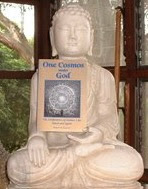
I apologize to anyone I haven't offended, but I'm just too far behind in my remunerative work to continue posting. The patented One Cosmos method of applied non-doodling isn't possible -- or realizable -- if I cannot see before me that vast, trackless desert of slack extending over the purplish-pink ultra-human horizon, i.e., the summa vocation. Hopefully, normal isness upperations will continue once I catch up.
You could say that slack is the nonspecific ether through which we fly with wings of repose. Yeah, something like that.
Even reposting takes time, time needed to get things done in clockworld. Unlike my household gnome, I am embodied, and that's just the way it is.
The Raccoon is not so constituted as to grovel at anyone's surface. Squeezed for timelessness, it's like being rushed through your sleep -- as if, if you really hurry, you can complete eight hours of sleep in just six hours. When that happens, you eventually start dreaming during the day. Conversely, when the Conspiracy impinges, it's like being forced to wake while you really need to be dreaming.
Pretty soon you're completely "awake," but not in the good way. Rather, in such a way that all of the vertical springs, all the interstices of mystery, are bottled up with that familiar tenuro-media excreta that is somehow indigestibly concrete and adhesively slimy.
So, consider this an open thread, if you wish. Here is something to start the conversation, an email from a reader:
"As a longtime reader and fan of yours, I am attuned to your unique style. Yet occasionally I have trouble getting the point of a particular post (assuming there is one) reading it in the conventional top to bottom manner. When that happens I have found better results reading them backwards, not literally, but starting with the last paragraph and working up. Have I hit on something here? A useful technique for reading comprehension? An undiagnosed disability perhaps?"
To which we responded off the top of our head from the center of our cloud: "That is a provocative thought. I think I'll pass it on to readers for comment. Could be because I myself have no idea what the post is about until it somehow wraps itself up at the end, which it does nine times out of ten. The post just kind of finishes itself and says "I'm done. You can get on with your life now."
Wednesday, March 21, 2012


Tuesday, March 20, 2012
Circular Logic and Absolute Stupidity
When progressives talk about "progress," they cannot mean the same thing we do, for objective progress is precisely what is rendered impossible in their metaphysic.
One can approach this from various angles, but the result is always the same, for a determined stupidity at the start of a journey assures stupidity at the end -- like insisting that if only one travels far enough, one can prove that parallel lines meet, and then setting out for points unknowable.
Since there is no "fixed point" in leftism, it can claim no truth and hence no measure of progress. Schuon hits the troll on the head in his usual pithy style: "To claim that knowledge as such could only be relative amounts to saying that human ignorance is absolute."
Either that thought will appeal to you, and be used as a stepping stone to higher things, or you will literally find it "repulsive," in that it will repel you onto a relative and therefore subjective, idiosyncratic, and ultimately arbitrary path. Mal voyage!
Once on that false path, no matter how rigorously one otherwise applies reason, one will be in a world that is fundamentally unreal. Therefore, one will be apportioning clouds, sowing the wind, spanking the monkey, etc. That is the bad kind of cosmic circle -- as the French put it, the cirque du jerkeil.
The cosmos is, of course, "structured," so to speak, as a circle, but it is a benignly inspiraling one, not a viciously repetitive one, i.e. an eternal return, or a Neitzsche you can't scratchy. When I first realized this, I thought I had hit on something kind of unique. Now I wish I had compiled all of the statements I've stumbled upon that affirm the same thing.
For example, this one, by Schuon: "There are basically but three miracles: existence, life, intelligence; with intelligence, the curve springing from God closes on itself like a ring which in reality has never parted from the Infinite."
In fact, even prior to the establishment of the first Raccoon lodge on March 4, 1355, Thomas Aquinas had used exactly this organizational structure for the Summa: a chain of interior and exterior certitudes forming a Great Circle of Being:
"In the emergence of creatures from their first source is revealed a kind of circular movement, in which all things return, as to their end, back to the very place from which they had their origin in the first place."
There is a two-way journey; one can call it out and back, or down and up, or many and one, or conspiracy and slack, or just ø and O.
In any -- and every -- event, there is a "Journey away from Home, where creatures actively unfold their diverse dynamic natures as finite participations in the divine perfection and as centers of self-expressive and self-communicating action and interaction with each other, thus forming a universe, that is, a system of many real beings joined together by their interaction to form the community of all existents -- the ultimate of all communities. This part of the journey was called the exitus (journey out)" (Clarke).
This is accompanied by the journey back toward the Great Attractor, O, whereby creation is "drawn by this same Source through the pull of the Good built in to the very nature of every being through the mediation of final causation," or what Bob calls the the personal telovator or cosmic eschalator.
The bottom -- and top -- line is that this "ultimate One now appears as both the Alpha and the Omega, the Beginning and End, at once the Source and the Goal of the restless dynamism of all nature, of all finite beings."
It's just that in human beings, this restless longing, this passion for wholeness, has become conscious, and this consciousness, you might say, is the initial "spark" (?!) that occurs when two tingles mingle and abysses meet, i.e., the Divine and human:
"There is religious conversion which is 'being grasped by ultimate concern. It is an other-worldly falling in love....' The outcome of such conversion is that the Holy Spirit and the human spirit encounter profoundly" (Norris).
Love at first Light.
One can approach this from various angles, but the result is always the same, for a determined stupidity at the start of a journey assures stupidity at the end -- like insisting that if only one travels far enough, one can prove that parallel lines meet, and then setting out for points unknowable.
Since there is no "fixed point" in leftism, it can claim no truth and hence no measure of progress. Schuon hits the troll on the head in his usual pithy style: "To claim that knowledge as such could only be relative amounts to saying that human ignorance is absolute."
Either that thought will appeal to you, and be used as a stepping stone to higher things, or you will literally find it "repulsive," in that it will repel you onto a relative and therefore subjective, idiosyncratic, and ultimately arbitrary path. Mal voyage!
Once on that false path, no matter how rigorously one otherwise applies reason, one will be in a world that is fundamentally unreal. Therefore, one will be apportioning clouds, sowing the wind, spanking the monkey, etc. That is the bad kind of cosmic circle -- as the French put it, the cirque du jerkeil.
The cosmos is, of course, "structured," so to speak, as a circle, but it is a benignly inspiraling one, not a viciously repetitive one, i.e. an eternal return, or a Neitzsche you can't scratchy. When I first realized this, I thought I had hit on something kind of unique. Now I wish I had compiled all of the statements I've stumbled upon that affirm the same thing.
For example, this one, by Schuon: "There are basically but three miracles: existence, life, intelligence; with intelligence, the curve springing from God closes on itself like a ring which in reality has never parted from the Infinite."
In fact, even prior to the establishment of the first Raccoon lodge on March 4, 1355, Thomas Aquinas had used exactly this organizational structure for the Summa: a chain of interior and exterior certitudes forming a Great Circle of Being:
"In the emergence of creatures from their first source is revealed a kind of circular movement, in which all things return, as to their end, back to the very place from which they had their origin in the first place."
There is a two-way journey; one can call it out and back, or down and up, or many and one, or conspiracy and slack, or just ø and O.
In any -- and every -- event, there is a "Journey away from Home, where creatures actively unfold their diverse dynamic natures as finite participations in the divine perfection and as centers of self-expressive and self-communicating action and interaction with each other, thus forming a universe, that is, a system of many real beings joined together by their interaction to form the community of all existents -- the ultimate of all communities. This part of the journey was called the exitus (journey out)" (Clarke).
This is accompanied by the journey back toward the Great Attractor, O, whereby creation is "drawn by this same Source through the pull of the Good built in to the very nature of every being through the mediation of final causation," or what Bob calls the the personal telovator or cosmic eschalator.
The bottom -- and top -- line is that this "ultimate One now appears as both the Alpha and the Omega, the Beginning and End, at once the Source and the Goal of the restless dynamism of all nature, of all finite beings."
It's just that in human beings, this restless longing, this passion for wholeness, has become conscious, and this consciousness, you might say, is the initial "spark" (?!) that occurs when two tingles mingle and abysses meet, i.e., the Divine and human:
"There is religious conversion which is 'being grasped by ultimate concern. It is an other-worldly falling in love....' The outcome of such conversion is that the Holy Spirit and the human spirit encounter profoundly" (Norris).
Love at first Light.
Monday, March 19, 2012
God's Endless Search for Man
The problem with the left is not a bad philosophy, but no philosophy at all. The left is truly "post-philosophical," which is what allows them to routinely hold views that are internally inconsistent, and more generally, to appeal to expedient principles -- an oxymoron -- as the need arises to defend what can only amount to raw power and self-interest.
No, this is not just polemical, because this is precisely what the more sophisticalated among them aver, without so much as a fig leaf over their straight faces. We are indeed in a "post-metaphysical" age, which is indistinguishable from a post-philosophical age, which in turn results in a post-serious thinking age, or what Dennis Prager calls "the age of stupidity."
When the tenured break out the "post-metaphysics" canard, what they really mean is post-Western civilization in general and post-Judeo-Christian in particular. The only way to jettison those two obstacles to their aspirations is to discredit them entirely. Not to seriously engage them, because to engage them would be to leave oneself beclowned (just as engaging the Constitution would put an end to the left's schemes).
Therefore, these more venerable ideas must be dismissed with a kind of a priori contempt, as if man learned nothing at all during his first 200,000 years on the planet. If nothing else, the mere presence of a species for 200,000 years argues for an essence or nature that defines the species. But this is not a problem if one's post-philosphical and post-intellectual outlook tosses aside the whole notion of essence.
Rather, if man is but the effect of wholly random causes, he has no essence. That being the case, we are free to turn him into anything we wish. For example, if we raise a boy as a girl, he will become one. For the left, the only thing in man that is absolutely fixed is homosexuality. That and the right to a dead baby. Unless the baby is homosexual. Then it's murder.
The only way to overcome what man has learned about himself over the eons -- much of it rather unflattering -- is to adopt an attitude of abject cynicism. Now, as we see in our troll, this attitude is one of extreme corrosiveness, in the sense that it naively prides itself on being able to dissolve any argument before reaching its conclusion. This is why I refer to it as "negative omniscience."
Unlike positive omniscience, or "knowing everything," this is the negative capability of knowing nothing. One routinely encounters it in clinical practice, among paranoiacs (in a more crude form) and narcissists (in more subtle forms).
Most of you have probably been around a hard-bitten paranoiac or conspiracy theorist with whom you simply cannot reason. If you carefully explain to them with facts, evidence, and logic, say, how implausible it is to suggest that George Bush "lied us into war" -- or, for that matter, that Bill Clinton is a mass murderer, or Barack Obama is an Islamist agent -- they will roll their eyes and dismiss you as hopelessly naive. But their blustering self-confidence is always brittle at the core, and rooted in fear and doubt, which is why they cannot tolerate ambiguity.
As Clarke discusses, "The very notion of constructing a unified systematic philosophical inquiry into being as a whole... has been abandoned by contemporary philosophers." An exception to the rule is Whiteheadian process philosophy, which is how I initially got into the racket. In fact, I don't think he can be surpassed if one is attempting to construct a metaphysic on merely scientific grounds, i.e., to draw out the metaphysical implications of modern science.
But man is obviously not restricted to the scientific mode of knowing. Rather, as Schuon writes, "One of the keys to the understanding of our true nature and our ultimate destiny is the fact that the things of this world never measure up to the real range of our intelligence." For "Our intelligence is made for the Absolute, or it is nothing."
I don't regard this statement as remotely poetical, or romantic, or "in a manner of speaking." Rather, everything must have its sufficient reason, and the only sufficient reason for man's restless search for the Absolute is the Absolute. This is the real reason why science never rests content with any hypothesis (with the exception of manmade global warming, which, like homosexuality and the right to abortion, is another absolute).
But if man were only provoked to seek out the Absolute from the short end of the cosmos, this would be a cosmic itch he could never scratch, for it is not possible for a finite being to reach the Infinite.
Therefore, just as man is on a perpetual search for God, history reveals God's perpetual search for man. If one prefers, one may express it in abstract terms, and say that man, everywhere we find him, is characterized by (↑). But likewise, culture, everywhere we find it, is imbued with traces of (↓).
In the end -- as we shall see -- man's search for God is God's search for man, for there is no other way of looking at it, assuming God is God.
To put it another way, every culture is characterized by a search for the ground, the ultimate principle, the unchanging. As Norris describes, this is the "search from below." He references Cardinal Newman, who remarked that "all the nations" seek God, and that "by feeling their way toward him, succeed in finding him." However, it is necessary to discern the principial truth within "the corrupt legends" with which it is inevitably mixed.
However, the story of the people of Israel is not just another story of (↑), but more importantly, a -- the -- story of (↓): "it is not we who seek God, it is rather God who seeks us out." And for Christians, (↑) and (↓) meet -- or Cross paths -- in the person of Christ, who is both ground and destiny: "Here the human search from below, in its many different modalities and incarnations... effectively meets the divine descending search..."
Thus, "the Eternal enters time, the Whole lies hidden in the part, God takes on a human face." More to the point, "dialogue" becomes the possibility of "union" when the Absolute crosses "the ontological abyss separating the infinite and infinite." Again, to say that man cannot accomplish this union in the absence of (↓) is a truism.
Which is where the Holy Spirit comes in, for he may be fruitfully thought of as an ongoing form of (↓), so that our sincere search is never in vain. The Holy Spirit "is the finisher and polisher of divine revelation with regard to us." Norris references an illuminating passage by the Orthodox bishop Ignatios of Latakia:
Without the Holy Spirit, God is far away,
Christ stays in the past,
the Gospel is a dead letter,
the Church is simply an organization,
authority a matter of dominion,
mission a matter of propaganda,
the liturgy no more than an evocation,
Christian living a slave morality.
(↓) is indeed the cosmic vertilizer spread over the ground. Which is why so much fruit grows in these parts. And why it just lays there uneaten, rotting on the grounds of your typical university, in favor of their highly processed, manmade junk metaphysics.
No, this is not just polemical, because this is precisely what the more sophisticalated among them aver, without so much as a fig leaf over their straight faces. We are indeed in a "post-metaphysical" age, which is indistinguishable from a post-philosophical age, which in turn results in a post-serious thinking age, or what Dennis Prager calls "the age of stupidity."
When the tenured break out the "post-metaphysics" canard, what they really mean is post-Western civilization in general and post-Judeo-Christian in particular. The only way to jettison those two obstacles to their aspirations is to discredit them entirely. Not to seriously engage them, because to engage them would be to leave oneself beclowned (just as engaging the Constitution would put an end to the left's schemes).
Therefore, these more venerable ideas must be dismissed with a kind of a priori contempt, as if man learned nothing at all during his first 200,000 years on the planet. If nothing else, the mere presence of a species for 200,000 years argues for an essence or nature that defines the species. But this is not a problem if one's post-philosphical and post-intellectual outlook tosses aside the whole notion of essence.
Rather, if man is but the effect of wholly random causes, he has no essence. That being the case, we are free to turn him into anything we wish. For example, if we raise a boy as a girl, he will become one. For the left, the only thing in man that is absolutely fixed is homosexuality. That and the right to a dead baby. Unless the baby is homosexual. Then it's murder.
The only way to overcome what man has learned about himself over the eons -- much of it rather unflattering -- is to adopt an attitude of abject cynicism. Now, as we see in our troll, this attitude is one of extreme corrosiveness, in the sense that it naively prides itself on being able to dissolve any argument before reaching its conclusion. This is why I refer to it as "negative omniscience."
Unlike positive omniscience, or "knowing everything," this is the negative capability of knowing nothing. One routinely encounters it in clinical practice, among paranoiacs (in a more crude form) and narcissists (in more subtle forms).
Most of you have probably been around a hard-bitten paranoiac or conspiracy theorist with whom you simply cannot reason. If you carefully explain to them with facts, evidence, and logic, say, how implausible it is to suggest that George Bush "lied us into war" -- or, for that matter, that Bill Clinton is a mass murderer, or Barack Obama is an Islamist agent -- they will roll their eyes and dismiss you as hopelessly naive. But their blustering self-confidence is always brittle at the core, and rooted in fear and doubt, which is why they cannot tolerate ambiguity.
As Clarke discusses, "The very notion of constructing a unified systematic philosophical inquiry into being as a whole... has been abandoned by contemporary philosophers." An exception to the rule is Whiteheadian process philosophy, which is how I initially got into the racket. In fact, I don't think he can be surpassed if one is attempting to construct a metaphysic on merely scientific grounds, i.e., to draw out the metaphysical implications of modern science.
But man is obviously not restricted to the scientific mode of knowing. Rather, as Schuon writes, "One of the keys to the understanding of our true nature and our ultimate destiny is the fact that the things of this world never measure up to the real range of our intelligence." For "Our intelligence is made for the Absolute, or it is nothing."
I don't regard this statement as remotely poetical, or romantic, or "in a manner of speaking." Rather, everything must have its sufficient reason, and the only sufficient reason for man's restless search for the Absolute is the Absolute. This is the real reason why science never rests content with any hypothesis (with the exception of manmade global warming, which, like homosexuality and the right to abortion, is another absolute).
But if man were only provoked to seek out the Absolute from the short end of the cosmos, this would be a cosmic itch he could never scratch, for it is not possible for a finite being to reach the Infinite.
Therefore, just as man is on a perpetual search for God, history reveals God's perpetual search for man. If one prefers, one may express it in abstract terms, and say that man, everywhere we find him, is characterized by (↑). But likewise, culture, everywhere we find it, is imbued with traces of (↓).
In the end -- as we shall see -- man's search for God is God's search for man, for there is no other way of looking at it, assuming God is God.
To put it another way, every culture is characterized by a search for the ground, the ultimate principle, the unchanging. As Norris describes, this is the "search from below." He references Cardinal Newman, who remarked that "all the nations" seek God, and that "by feeling their way toward him, succeed in finding him." However, it is necessary to discern the principial truth within "the corrupt legends" with which it is inevitably mixed.
However, the story of the people of Israel is not just another story of (↑), but more importantly, a -- the -- story of (↓): "it is not we who seek God, it is rather God who seeks us out." And for Christians, (↑) and (↓) meet -- or Cross paths -- in the person of Christ, who is both ground and destiny: "Here the human search from below, in its many different modalities and incarnations... effectively meets the divine descending search..."
Thus, "the Eternal enters time, the Whole lies hidden in the part, God takes on a human face." More to the point, "dialogue" becomes the possibility of "union" when the Absolute crosses "the ontological abyss separating the infinite and infinite." Again, to say that man cannot accomplish this union in the absence of (↓) is a truism.
Which is where the Holy Spirit comes in, for he may be fruitfully thought of as an ongoing form of (↓), so that our sincere search is never in vain. The Holy Spirit "is the finisher and polisher of divine revelation with regard to us." Norris references an illuminating passage by the Orthodox bishop Ignatios of Latakia:
Without the Holy Spirit, God is far away,
Christ stays in the past,
the Gospel is a dead letter,
the Church is simply an organization,
authority a matter of dominion,
mission a matter of propaganda,
the liturgy no more than an evocation,
Christian living a slave morality.
(↓) is indeed the cosmic vertilizer spread over the ground. Which is why so much fruit grows in these parts. And why it just lays there uneaten, rotting on the grounds of your typical university, in favor of their highly processed, manmade junk metaphysics.
Subscribe to:
Posts (Atom)
Theme Song