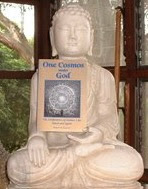
Continuing with yesterday's post, we are a firm believer in evolution. What we do not understand -- in principle, mind you -- is how a believer in natural selection can simultaneously maintain a belief in evolution, since the one precludes the other.
Let's define our terms. In order to avoid a common misconception, I should point out that when I say evolution, I do not mean evolutionism, which is another species entirely.
The latter is the metaphysical doctrine that says that ultimate reality involves a kind of unfolding from primordial substance. It reduces to pantheism -- or elevates matter to God -- as everything is seen as an explication of what lies hidden in potential in mere matter. It violates reason and common sense, as it not only tries to derive the higher from the lower, but ultimately, if pressed to its conclusion, everything from nothing. Life must reduce to death, mind to matter, truth to falsehood, and your little theory of evolutionism to a sacred cow pie. And you just stepped in it.
As mentioned in previous posts, the idea of evolution had literally been around for thousands of years (two thousand, anyway) prior to Darwin. Maritain points out that a number of the pre-Socratics hit upon the notion, which is not surprising, since it is one of the possibilities presented to us as we first attempt to see beneath phenomena to the Real.
If we think of these men as analogous to children (by which I do not mean to insult them; rather, that, philosophically speaking, man was in the position of a child, starting with nothing), then we can understand how one might arrive at the notion that all is change, or being, or one. In other words, they are searching for the ultimate abstraction, or principle, which can account for each and every particular instance (which is indeed the purpose of metaphysics).
So Maritain reminds us that various forms of evolutionism were taught by Greek thinkers of the fifth and sixth centuries BC, such as Anaximander, Empedocles, and Heraclitus, the latter of whom is famous for teaching that "all is change," and that one cannot step into the same stream twice.
But again, if this is true, then it must also apply to Heraclitus' doctrine, so that if he is right, he is wrong. The same applies, of course, to modern Darwinists, to the extent that they elevate the science to a metaphysic.
Maritian traces the evolution of philosophy -- which is to say, the increased proximity to wisdom -- from these early thinkers, through Plato and Aristotle and on to St. Thomas. And when I say evolution, I mean evolution. I do not mean random change, as if there is no essential difference between Heraclitus, Aristotle, and Thomas, and that one might as well flip a coin to determine which of them was closer to truth.
No, when I say that philosophy -- and science, for that matter -- has evolved, this is what I mean: that it betrays a clear and recognizable direction that only the fool or tenured could deny.
Not to speak ill of the dead, but this denial is precisely what my late uncle-through-marriage -- the esteemed University of Chicago historian -- maintained. It so happens that he was friendly with Thomas Kuhn, who wrote the celebrated Structure of Scientific Revolutions. In one of those rare occasions that I was completely wrong, I argued that Kuhn was not implying that there was no such thing as objective scientific progress. Admittedly, I didn't actually know this. Rather, I just assumed that no one could be that stupid. I was a little naive back then.
So, when we talk about philosophic or scientific progress, what are we really talking about? In other words, what is the measure of progress, besides getting a lot of free stuff from the government on somebody else's dime? So far Maritain hasn't come right out and said it, but perhaps the most noticeable change we see between, say, the pre-Socratics through Aquinas, involves the power of abstraction.
In fact, we can trace this path all the back to animals, who have no powers of abstraction. In many ways man is defined by this power, which is largely rooted in language, and prior to that, in my opinion, the hand. Yes, the hand, because it is nature's first all-purpose tool. Because the hand can do this and the hand can do that, we grasp the underlying principle of grasping.
Remember a couple of posts ago, our discussion of how applied cynicism is the cure for a corrosive cynicism gone wild? Wouldn't you know it, the very next day Maritain made exactly the same point vis-a-vis the Socratic method, and here I was thinking I was being original again.
Note that both the cause and effect of cynicism is the absence of truth. I suppose postmodernists must pride themselves on being the first humans to be courageous enough to embrace the truth that there is no truth, but that is an ahistorical fiction.
Rather, this kind of relativism had already taken philosophy to a dead end by the time Socrates arrived on the scene.
I'm starting to run out of time, so I'll just let Maritain take over the cosmic bus from here. Bear in mind that he's talking about conditions 2400 years ago, not today:
"[T]heir concepts were embroiled in confused strife, an interminable battle of opposing probabilities. The immediate and obvious result of these attempts at philosophizing seemed the bankruptcy of speculative thought."
"It is not, therefore, surprising that this period of elaboration produced a crisis in the history of thought, at which an intellectual disease imperiled the very existence of philosophic speculation. This intellectual disease was sophistry, that is to say, the corruption of philosophy.
"Sophistry is not a system of ideas, but a vicious attitude of the mind.... For the aim and rule of their knowledge was no longer that which is, that is to say, the object of knowledge, but the interest of the knowing subject....
"[T]he most characteristic feature of all alike was that they sought the advantages conferred by knowledge without seeking truth.
"They sought the advantages conferred by knowledge so far as knowledge brings its possessor power, pre-eminence, or intellectual pleasure. With this in view, they put themselves forward as rationalists and walking encyclopedias; to every question they had an answer, deceptively convincing....
"They did not seek truth.... For with men and children alike destruction is the easiest method of displaying their strength.... Every law imposed upon man they declared to be an arbitrary convention...."
Well, that's the history. It reappeared in the 1960s, this time as farce. Time will tell if we ever reenter the stream of progress.
Friday, February 24, 2012


Thursday, February 23, 2012
The Christian Cure For Religion
No time for a post made of all-new materials, but almost enough to properly edit this precogitated one from exactly five years ago, which is likely before you were born again anyway. Although it was essentially dug up at random, wouldn't you know, it addresses concerns that have lately been bubbling up or trickling down into my local CIA branch (the Cosmic Intelligence Agency).
For example, near the end of yesterday's post I mentioned that "If one takes the long view of man, I believe one will see something like the following: a kind of original immersion in mythological subjectivism, followed by a gradual awakening (at least in the Christian West) to an objective apprehension of the exterior world (which sees the first stage as hopelessly childish), followed by a return to, and recovery of, our original position, only now able to assimilate "the world" (in the scientific sense) into its grand meta-mythos. In a way, it's like thesis-antithesis-synthesis, in this case, of cosmos, man, and God."
I bumped into similar concerns in Jacques Maritain's Introduction to Philosophy, which attempts to take the Story of Wisdom as far back into the recesses of history as the evidence will allow.
What is somewhat new to me is the attempt to sketch a kind of linear development between what amounted to mere animals to the full flowering of philosophy represented by Plato and Aristotle. Prior to that, there were innumerable false paths and nul de slacks that left man enslaved to his lower nature. Clearly, something had to happen -- something extra-genetic -- in order for man to awaken to his full potential. As for why an animal supposedly fashioned by the random accidents of natural selection has this infinite potential -- well, don't ask. I mean, don't ask the tenured.
In any event, this unexpected discovery of the true path "must be regarded as extraordinary when we consider the multitude of wrong roads taken by so many philosophers and philosophic schools" (ibid.).
For Maritain, philosophy is none other than wisdom, "the wisdom of man qua man." Interestingly, he suggests that the full flowering of Greek philosophy c. 600 BC was not just a development but a recovery, something that Schuon and other perennialists maintain. For example, as Joseph Campbell well knew, the truths of various primitive myths, no matter how degraded or corrupted, often betray a kind of metaphysical blueprint. This common deep structure, according to Maritain, suggests a "primitive tradition, common to the different branches of the human race and going back to the origin of mankind." (BTW, that book I linked to yesterday was Campbell's magnum opus in his lifetime study of these primordial myths.)
To the extent that this collective wisdom existed, it "inevitably deteriorated," as "little by little the rust of oblivion gathered upon it, error defiled it, and it fell prey to the corruptions of polytheism and the more degraded forms of religion," e.g., sacrifice, magic, idolatry, global warming, etc.
I'd better stop now, because I'm running out of time to edit the old post. But let's read it in light of what has been suggested above:
In the Coonifesto I wrote of the "big bang" of consciousness that occurred around 45,000 years ago, when genetic Homo sapiens sapiens crossed the vertical threshold into actual humanness, an event that is most vividly memorialized in the beautiful art that suddenly appears in the more trendy caves of the Upper Paleolithic.
However, it is a bit of an understatement to say that human cerebration wasn't necessarily a cause for celebration, since we continued roving about in what anthropologists call "bands" of hunter-gatherers, but what we now call "urban wilderness gangs," or "the NBA." Each of these gangs numbered about 50 homie sapiens, and each gang was at war with all of the others. Paranoia ran deep, because any encounter with another roster of creeps would usually result in violence, death, serious injury, rape, or theft of your bling.
Therefore, according to Nicholas Wade -- and here is something I hadn't considered before -- the evolution from foraging to settling down, or what is called "sedentism" (i.e., "wifing your baby-mama"), represented a revolution nearly as radical as the creative explosion itself. In fact, Wade says exactly this:
"Archaeologists have little hesitation in describing the transition to sedentism as a revolution, comparable to the one that defines the beginning of the Upper Paleolithic 50,000 years ago when behaviorally modern humans emerged from their anatomically modern forebears."
The human ingression into the interior of the cosmos -- the vertical -- truly occurs at what might be conceptualized as a "right angle" to history as such. The first dramatic evidence of this right angle occurs roughly 45,000 years ago, but it turns out that the revolution of sedentism was hardly less dramatic, in that it went against the grain of most everything that had passed for humanness up to that time. The biggest hurdle was that humans had to learn to somehow get along in larger groups without killing each other. In order to do this, they had to develop a more abstract way than kinship to forge a unity. In a way, they had to develop a deeper understanding of abstraction itself.
Now, perhaps you may have noticed that one of the points of my book and blog is to widen, so to speak, the "arc of salvation" so as to encompass the entire history of the cosmos, beginning before the big bang and venturing into future (or spatially vertical) realms beyond ego. But if one considers Genesis esoterically, it does this as well.
One of the supernaturally odd things about scripture is that it is always one step ahead, somehow awaiting us when we arrive there. As such, it speaks -- with great wisdom, I might add -- of both of these revolutions that preceded the formal arc of salvation that begins with the covenant with the ancient Israelites. Somehow collective or archetypal memory of these primordial events -- events which occurred before the dawn of writing -- is encoded in scripture.
Someone yesterday complained again about my tendency to get sidetracked when I promise to write about a certain topic, but Coons, this is very easy to do when you are trying to write about the entire cosmos. In doing so, you have to develop a certain wide angle frame of mind that doesn't lend itself to dwelling in particulars for any length of time, at risk of losing the vision of the whole.
Here is a perfect example of a cosmic artery that I could venture down and which could justify an entire book, but I don't want to get too sidetracked here. Suffice it to say that the fine book The Beginning of Wisdom goes into great detail about what the Torah has to say about human behavior before the covenant, and it is does not flatter mankind. It is so much more deep and wise than the typical PC romantic view of human nature that it is somewhat breathtaking.
Trad Coon Joseph forwarded me something by Frederick Turner (I don't know the source), who writes that "The most ancient of the religions of history, Judaism, might be the deepest taproot of human religion, our strongest and clearest connection with the whole creative history of the universe. Judaism's collective mythic memory goes back even before the Black Sea inundation, over seven thousand years ago, with hints in the Cain and Abel story of the dawn of the Neolithic revolution, when the farmer Cains replaced the hunter-gatherer Abels [i.e., the revolution of sedentism and the beginning of human sacrifice]; there is even a kind of reflected whisper, in the story of Eden, of the time when humans first recognized their own uniqueness as animals and imagined their own personal death [the big bang of consciousness 45,000 years ago]."
In fact, scripture contains many references to mans' default religion, human sacrifice, as the Torah is even honest enough (for how could it not be?) to document the Jews' own backsliding in this area (spiritually untutored man's "default God" is Moloch). To this day, I would guess that the majority of useless academics will argue that human beings were not cannibalistic despite the mountains of evidence that they were. Again, this just emphasizes how much more unblinking wisdom there is in Genesis than in gliberal academia. Genesis is anything but politically correct, which is perhaps one more reason that leftists despise it so. Naturally, scripture explains them much more adequately than they could ever explain it. In fact, it is perfectly accurate to say that Genesis "saw leftists coming" in a number of delightfully ironic stories.
There are many good books on mankind's practice of human sacrifice, but perhaps the best one is Violence Unveiled by Gil Bailie, because he places it in the context of the overall arc of salvation. I cannot possibly do justice to his full argument here, but in his view, mankind at large was actually in desperate need of a cure for religion, and Christianity turned out to be this cure. "Ironically," Jesus was a victim -- and as a result, a permanent reminder -- of one of the things he came to cure, the ritual scapegoating of victims in order to forge social solidarity and drain off the violent impulses. For nothing creates social cohesion and temporarily eases the war of each against all so much as when everyone's aggression is hypnotically focused on a sacrificial victim, in a process that represents "unanimity minus one."
Once you understand the sacrificial mechanism, you only see it everywhere. It is a sort of master key that explains the inexplicable, especially in regions outside Judeo-Christendom untouched by the arc of salvation. To cite one obvious example, what do you think it is that maintains any semblance of solidarity in the entire Muslim world (or the U.N., come to think of it) -- including, sad to say, the majority of Muslims blessed to be living in the Judeo-Christian world? What unifies this disparate group that would otherwise mindlessly be killing each other, as they are doing in Iraq?
Obviously, it is the ritual scapegoating of Jews. I have no opinion as to whether there may actually be some obscure light of vertical revelation contained somewhere in Islam -- the existence of certain Sufi sects argues that there might be, but they represent far, far less than 1% of all Muslims, and nowhere are they considered remotely normative. No, sorry to say that what unifies the Islamic world -- including wretched Muslim spokesholes such as CAIR -- is human sacrifice. But this irrational obsession with hatred of scapegoats is not an "aberration" if we consider the entire arc of salvation, including the period of time before the old covenant, i.e., Phase I.
As I mentioned yesterday, not only did the ancient Jews begin to reflect superior ideals that far surpassed their contemporaries, but these ideals have still failed to permeate into many modern groups -- e.g., in Africa, China, and Islam. Not only that, but the modern West has produced its own permanent counter-revolution in the form of the international left, which, since it rejects the cure for religion, is reverting back to primordial religion -- undisguised born-again paganism in the form of body mutilation, magic (almost all new agers and integralists are leftists), infrahuman entertainment, the cult of celebrity, blood worship (multiculturalism), pantheistic environmentalism, sexual license unbound from any sacred context, etc.
To be continued....
For example, near the end of yesterday's post I mentioned that "If one takes the long view of man, I believe one will see something like the following: a kind of original immersion in mythological subjectivism, followed by a gradual awakening (at least in the Christian West) to an objective apprehension of the exterior world (which sees the first stage as hopelessly childish), followed by a return to, and recovery of, our original position, only now able to assimilate "the world" (in the scientific sense) into its grand meta-mythos. In a way, it's like thesis-antithesis-synthesis, in this case, of cosmos, man, and God."
I bumped into similar concerns in Jacques Maritain's Introduction to Philosophy, which attempts to take the Story of Wisdom as far back into the recesses of history as the evidence will allow.
What is somewhat new to me is the attempt to sketch a kind of linear development between what amounted to mere animals to the full flowering of philosophy represented by Plato and Aristotle. Prior to that, there were innumerable false paths and nul de slacks that left man enslaved to his lower nature. Clearly, something had to happen -- something extra-genetic -- in order for man to awaken to his full potential. As for why an animal supposedly fashioned by the random accidents of natural selection has this infinite potential -- well, don't ask. I mean, don't ask the tenured.
In any event, this unexpected discovery of the true path "must be regarded as extraordinary when we consider the multitude of wrong roads taken by so many philosophers and philosophic schools" (ibid.).
For Maritain, philosophy is none other than wisdom, "the wisdom of man qua man." Interestingly, he suggests that the full flowering of Greek philosophy c. 600 BC was not just a development but a recovery, something that Schuon and other perennialists maintain. For example, as Joseph Campbell well knew, the truths of various primitive myths, no matter how degraded or corrupted, often betray a kind of metaphysical blueprint. This common deep structure, according to Maritain, suggests a "primitive tradition, common to the different branches of the human race and going back to the origin of mankind." (BTW, that book I linked to yesterday was Campbell's magnum opus in his lifetime study of these primordial myths.)
To the extent that this collective wisdom existed, it "inevitably deteriorated," as "little by little the rust of oblivion gathered upon it, error defiled it, and it fell prey to the corruptions of polytheism and the more degraded forms of religion," e.g., sacrifice, magic, idolatry, global warming, etc.
I'd better stop now, because I'm running out of time to edit the old post. But let's read it in light of what has been suggested above:
In the Coonifesto I wrote of the "big bang" of consciousness that occurred around 45,000 years ago, when genetic Homo sapiens sapiens crossed the vertical threshold into actual humanness, an event that is most vividly memorialized in the beautiful art that suddenly appears in the more trendy caves of the Upper Paleolithic.
However, it is a bit of an understatement to say that human cerebration wasn't necessarily a cause for celebration, since we continued roving about in what anthropologists call "bands" of hunter-gatherers, but what we now call "urban wilderness gangs," or "the NBA." Each of these gangs numbered about 50 homie sapiens, and each gang was at war with all of the others. Paranoia ran deep, because any encounter with another roster of creeps would usually result in violence, death, serious injury, rape, or theft of your bling.
Therefore, according to Nicholas Wade -- and here is something I hadn't considered before -- the evolution from foraging to settling down, or what is called "sedentism" (i.e., "wifing your baby-mama"), represented a revolution nearly as radical as the creative explosion itself. In fact, Wade says exactly this:
"Archaeologists have little hesitation in describing the transition to sedentism as a revolution, comparable to the one that defines the beginning of the Upper Paleolithic 50,000 years ago when behaviorally modern humans emerged from their anatomically modern forebears."
The human ingression into the interior of the cosmos -- the vertical -- truly occurs at what might be conceptualized as a "right angle" to history as such. The first dramatic evidence of this right angle occurs roughly 45,000 years ago, but it turns out that the revolution of sedentism was hardly less dramatic, in that it went against the grain of most everything that had passed for humanness up to that time. The biggest hurdle was that humans had to learn to somehow get along in larger groups without killing each other. In order to do this, they had to develop a more abstract way than kinship to forge a unity. In a way, they had to develop a deeper understanding of abstraction itself.
Now, perhaps you may have noticed that one of the points of my book and blog is to widen, so to speak, the "arc of salvation" so as to encompass the entire history of the cosmos, beginning before the big bang and venturing into future (or spatially vertical) realms beyond ego. But if one considers Genesis esoterically, it does this as well.
One of the supernaturally odd things about scripture is that it is always one step ahead, somehow awaiting us when we arrive there. As such, it speaks -- with great wisdom, I might add -- of both of these revolutions that preceded the formal arc of salvation that begins with the covenant with the ancient Israelites. Somehow collective or archetypal memory of these primordial events -- events which occurred before the dawn of writing -- is encoded in scripture.
Someone yesterday complained again about my tendency to get sidetracked when I promise to write about a certain topic, but Coons, this is very easy to do when you are trying to write about the entire cosmos. In doing so, you have to develop a certain wide angle frame of mind that doesn't lend itself to dwelling in particulars for any length of time, at risk of losing the vision of the whole.
Here is a perfect example of a cosmic artery that I could venture down and which could justify an entire book, but I don't want to get too sidetracked here. Suffice it to say that the fine book The Beginning of Wisdom goes into great detail about what the Torah has to say about human behavior before the covenant, and it is does not flatter mankind. It is so much more deep and wise than the typical PC romantic view of human nature that it is somewhat breathtaking.
Trad Coon Joseph forwarded me something by Frederick Turner (I don't know the source), who writes that "The most ancient of the religions of history, Judaism, might be the deepest taproot of human religion, our strongest and clearest connection with the whole creative history of the universe. Judaism's collective mythic memory goes back even before the Black Sea inundation, over seven thousand years ago, with hints in the Cain and Abel story of the dawn of the Neolithic revolution, when the farmer Cains replaced the hunter-gatherer Abels [i.e., the revolution of sedentism and the beginning of human sacrifice]; there is even a kind of reflected whisper, in the story of Eden, of the time when humans first recognized their own uniqueness as animals and imagined their own personal death [the big bang of consciousness 45,000 years ago]."
In fact, scripture contains many references to mans' default religion, human sacrifice, as the Torah is even honest enough (for how could it not be?) to document the Jews' own backsliding in this area (spiritually untutored man's "default God" is Moloch). To this day, I would guess that the majority of useless academics will argue that human beings were not cannibalistic despite the mountains of evidence that they were. Again, this just emphasizes how much more unblinking wisdom there is in Genesis than in gliberal academia. Genesis is anything but politically correct, which is perhaps one more reason that leftists despise it so. Naturally, scripture explains them much more adequately than they could ever explain it. In fact, it is perfectly accurate to say that Genesis "saw leftists coming" in a number of delightfully ironic stories.
There are many good books on mankind's practice of human sacrifice, but perhaps the best one is Violence Unveiled by Gil Bailie, because he places it in the context of the overall arc of salvation. I cannot possibly do justice to his full argument here, but in his view, mankind at large was actually in desperate need of a cure for religion, and Christianity turned out to be this cure. "Ironically," Jesus was a victim -- and as a result, a permanent reminder -- of one of the things he came to cure, the ritual scapegoating of victims in order to forge social solidarity and drain off the violent impulses. For nothing creates social cohesion and temporarily eases the war of each against all so much as when everyone's aggression is hypnotically focused on a sacrificial victim, in a process that represents "unanimity minus one."
Once you understand the sacrificial mechanism, you only see it everywhere. It is a sort of master key that explains the inexplicable, especially in regions outside Judeo-Christendom untouched by the arc of salvation. To cite one obvious example, what do you think it is that maintains any semblance of solidarity in the entire Muslim world (or the U.N., come to think of it) -- including, sad to say, the majority of Muslims blessed to be living in the Judeo-Christian world? What unifies this disparate group that would otherwise mindlessly be killing each other, as they are doing in Iraq?
Obviously, it is the ritual scapegoating of Jews. I have no opinion as to whether there may actually be some obscure light of vertical revelation contained somewhere in Islam -- the existence of certain Sufi sects argues that there might be, but they represent far, far less than 1% of all Muslims, and nowhere are they considered remotely normative. No, sorry to say that what unifies the Islamic world -- including wretched Muslim spokesholes such as CAIR -- is human sacrifice. But this irrational obsession with hatred of scapegoats is not an "aberration" if we consider the entire arc of salvation, including the period of time before the old covenant, i.e., Phase I.
As I mentioned yesterday, not only did the ancient Jews begin to reflect superior ideals that far surpassed their contemporaries, but these ideals have still failed to permeate into many modern groups -- e.g., in Africa, China, and Islam. Not only that, but the modern West has produced its own permanent counter-revolution in the form of the international left, which, since it rejects the cure for religion, is reverting back to primordial religion -- undisguised born-again paganism in the form of body mutilation, magic (almost all new agers and integralists are leftists), infrahuman entertainment, the cult of celebrity, blood worship (multiculturalism), pantheistic environmentalism, sexual license unbound from any sacred context, etc.
To be continued....
Wednesday, February 22, 2012
The Only Cure for Cynicism is More Cynicism
In order for the modern liberal project to succeed, even the very idea of truth must be rejected and eliminated. If that sounds harsh or polemic, it is not intended to, not even remotely. For we too reject truth, the difference being that we eventually leave that stage and move on.
The above characterization of modern left-liberalism amounts to a banality, something any self-aware and intellectually honest man of the left should be able to recognize and acknowledge in himself -- even be proud of, for it is his creed and confession.
To put it another way, if the liberal cannot affirm his rejection of truth (or affirmation of relativism, which is the same thing), then he is living a lie. Oddly, we see his truth -- such as it is -- where he cannot.
To say "truth" is to say absolute, timeless, and universal. For example, James Madison affirmed that "the natural right of human beings to be governed only with their consent" is an "absolute truth" (quoted in Arkes).
Conversely, one of the most renowned liberal philosophers, Richard Rorty, says that "truth is not the sort of thing one should expect to have a philosophically interesting theory about." Rather, "'truth' is just the name of a property which all true statements share."
Similarly, good and evil do not exist in any objective manner. Rather, "certain acts" are "good ones to perform, under the circumstances," but there is nothing "general and useful to say about what makes them all good" (ibid.).
Now, that's an honest liberal, someone who makes no apologies for spending his life indulging in what Schuon calls the "esoterism of stupidity." And of course, if truth and virtue aren't more than mere conventions, or contingent properties of sentences and actions, then we are the ones engaged in an esoterism of stupidity.
To be sure, both of us cannot possibly be right. However, one wonders what it would mean for a man like Rorty to be "right," aside from saying that his sentences are grammatically correct.
From our perspective, Rorty was possessed of -- for he did not possess it -- an intellect that essentially sunk under the weight of its own irony and cynicism. As they say of the ironist, everything must be placed in quotes, e.g., "truth," "love," "virtue," etc. A relative of mine who died a few days ago was the same way. In his case, he was a well known University of Chicago historian. What I don't understand about these people is why they place so much innocent faith in their own cynicism, which is a kind of "negative capability" that dissolves truth like acid.
I understand the tendency, because in my experience it is something that most any intellectual will confront. The difference, at least in my case, is that I was 26 or 27 before I took the plunge into the Life of Mind, and worked a blue collar job until age 32, so I had some acquaintance with real life before encountering all the dangerous abstractions of the tenured, which tend to ensnare defenseless children when their heads are still full of mush, so they end up spending their whole lives in the liberal sandbox.
Later, by the age of 40, I made the explicit decision to turn away from that life, since I recognized that it was literally a kind of nothing that led nowhere. Yes, one could enjoy the retrograde thrill of doing battle with other infertile eggheads, or the misplaced pride in being an alpha smarty-pants, but even then not with any finality. As with fashion, there is always an arbitrary change of sensibilities around the corner.
Besides, my psychoanalytic training taught me that most people don't believe things because they're true, but because they want and even need to believe them. In this context, reason is just a tool one deploys to explain one's convictions in an a posteriori manner. Most people are living out impersonal myths that long precede them, and to the extent that the myth is not critically examined, one will carry it to the grave.
There is great profundity in Jesus' wise crack to the effect that we too should be as wise as serpents but innocent as doves. For me, the idea of being "wise as a serpent" immediately brings to mind cynicism. Yes, Jesus is counseling us to be cynical, but surely not as an end in itself. Rather, it is thoroughly tied in with the recovery of innocence, which properly lies on the other end of cynicism.
Perhaps an autobiographical example will help. Not mine, but Sri Aurobindo's (and I raise his example not to promulgate Vedanta, but first because it comes readily to mind, second because I believe that what he describes is universal, a kind of stage we must all pass through on the journey back to God).
Whatever else he was, little Auro was clearly a brilliant lad, educated at Cambridge, fluent in several languages, recipient of various academic prizes. But when he later turned to spiritual development, he came to a point that he saw through this game -- and it is a game -- first from a lateral, and then vertical, perspective. In a letter, he wrote that
"The capital period of my intellectual development was when I could see clearly that what the intellect said might be correct and not correct, that what the intellect justified was true and its opposite also was true. I never admitted a truth in the mind without simultaneously keeping it open to the contrary of it.... And the first result was that the prestige of the intellect was gone."
Now that I think about it, I had this experience quite vividly around the time I was working on my master's degree, during the last period of my life that I smoked marijuana. On the one hand, I was learning all this academic stuff which all the experts agreed one must know in order to call oneself a "psychologist."
However, the vast majority of it was only two or three hits away from being not just so many words, but utterly beside the point. Frankly it was more than a little frightening at first, because it is as if there really is no ground, and it was up to me to just choose one of these ideologies I was learning about. We all must face this abyss, which is the logical corollary of the cynic, in order to come out stronger and more robust at the other end.
It took Aurobindo some fourteen years "to travel the Western path" (referring to his education), and nearly as long to undo it, so to speak, a phenomenon with which most of my readers will be familiar, assuming they've been the recipient of a liberal soulwash via public education.
But one way or another, "All developed men, those who get beyond the average," must somehow "separate the two parts of the mind, the active part which is a factory of thoughts, and the quiet masterful part which is at once a Witness and a Will, observing them, judging, rejecting, eliminating, accepting," etc. If you fail to accomplish this (assuming you are the thinking type), you will likely end up a mere laborer in a thought factory, where, as the saying goes, you must publish or perish, and then perish anyway.
The next step will also be familiar to One Cosmos readers, the encounter with a Truth that "is not an expression of ideas arrived at by speculative thinking." Rather, one must apprehend spiritual truth "through experience and a consciousness of things which arises directly out of that experience or else underlies or is involved in it." It is a recognition and a discovery, not a deduction or analysis.
You will have noticed that our ʘCD troll always comes at us from a perspective that is simultaneously bitterly cynical and childishly naive, the latter of which is but a counterfeit form of innocence. No matter how many times we say it, he cannot grasp that we have been where he is, that we are intimately familiar with that plane of consciousness, and that we ultimately found it both cramped and inadequate.
If one takes the long view of man, I believe one will see something like the following: a kind of original immersion in mythological subjectivism, followed by a gradual awakening (at least in the Christian West) to an objective apprehension of the exterior world (which sees the first stage as hopelessly childish), followed by a return to, and recovery of, our original position, only now able to assimilate "the world" (in the scientific sense) into its grand meta-mythos. In a way, it's like thesis-antithesis-synthesis, in this case, of cosmos, man, and God.
For Joseph Campbell, "the first function of mythology is to awaken and maintain in the individual a sense of wonder and participation in the mystery of this finally inscrutable universe." And in our day, "the old notion of a once-upon-a-time First Cause [in the linear or horizontal sense] has given way to something more like an immanent ground of being, transcendent of conceptualization [i.e., beyond the reach of cynicism], which is in a continuous act of creation now."
I don't know that anyone could put it better than John Scottus Eriugena, who wrote that "the universal goal of the entire creation is the Word of God. Thus both the beginning and the end of the world subsist in God's word," which is "the manifold end without end and the beginning without beginning, being without beginning save for the Father."
And the way to this realization is "to be purged from all ignorance, illuminated by all wisdom, and perfected by all deification," for, in the words of Balthasar "fulfillment of the creature within the world's terms is unthinkable." Thus, it takes a hopeless cynic to vanquish the secretly hopeful cynic.
The above characterization of modern left-liberalism amounts to a banality, something any self-aware and intellectually honest man of the left should be able to recognize and acknowledge in himself -- even be proud of, for it is his creed and confession.
To put it another way, if the liberal cannot affirm his rejection of truth (or affirmation of relativism, which is the same thing), then he is living a lie. Oddly, we see his truth -- such as it is -- where he cannot.
To say "truth" is to say absolute, timeless, and universal. For example, James Madison affirmed that "the natural right of human beings to be governed only with their consent" is an "absolute truth" (quoted in Arkes).
Conversely, one of the most renowned liberal philosophers, Richard Rorty, says that "truth is not the sort of thing one should expect to have a philosophically interesting theory about." Rather, "'truth' is just the name of a property which all true statements share."
Similarly, good and evil do not exist in any objective manner. Rather, "certain acts" are "good ones to perform, under the circumstances," but there is nothing "general and useful to say about what makes them all good" (ibid.).
Now, that's an honest liberal, someone who makes no apologies for spending his life indulging in what Schuon calls the "esoterism of stupidity." And of course, if truth and virtue aren't more than mere conventions, or contingent properties of sentences and actions, then we are the ones engaged in an esoterism of stupidity.
To be sure, both of us cannot possibly be right. However, one wonders what it would mean for a man like Rorty to be "right," aside from saying that his sentences are grammatically correct.
From our perspective, Rorty was possessed of -- for he did not possess it -- an intellect that essentially sunk under the weight of its own irony and cynicism. As they say of the ironist, everything must be placed in quotes, e.g., "truth," "love," "virtue," etc. A relative of mine who died a few days ago was the same way. In his case, he was a well known University of Chicago historian. What I don't understand about these people is why they place so much innocent faith in their own cynicism, which is a kind of "negative capability" that dissolves truth like acid.
I understand the tendency, because in my experience it is something that most any intellectual will confront. The difference, at least in my case, is that I was 26 or 27 before I took the plunge into the Life of Mind, and worked a blue collar job until age 32, so I had some acquaintance with real life before encountering all the dangerous abstractions of the tenured, which tend to ensnare defenseless children when their heads are still full of mush, so they end up spending their whole lives in the liberal sandbox.
Later, by the age of 40, I made the explicit decision to turn away from that life, since I recognized that it was literally a kind of nothing that led nowhere. Yes, one could enjoy the retrograde thrill of doing battle with other infertile eggheads, or the misplaced pride in being an alpha smarty-pants, but even then not with any finality. As with fashion, there is always an arbitrary change of sensibilities around the corner.
Besides, my psychoanalytic training taught me that most people don't believe things because they're true, but because they want and even need to believe them. In this context, reason is just a tool one deploys to explain one's convictions in an a posteriori manner. Most people are living out impersonal myths that long precede them, and to the extent that the myth is not critically examined, one will carry it to the grave.
There is great profundity in Jesus' wise crack to the effect that we too should be as wise as serpents but innocent as doves. For me, the idea of being "wise as a serpent" immediately brings to mind cynicism. Yes, Jesus is counseling us to be cynical, but surely not as an end in itself. Rather, it is thoroughly tied in with the recovery of innocence, which properly lies on the other end of cynicism.
Perhaps an autobiographical example will help. Not mine, but Sri Aurobindo's (and I raise his example not to promulgate Vedanta, but first because it comes readily to mind, second because I believe that what he describes is universal, a kind of stage we must all pass through on the journey back to God).
Whatever else he was, little Auro was clearly a brilliant lad, educated at Cambridge, fluent in several languages, recipient of various academic prizes. But when he later turned to spiritual development, he came to a point that he saw through this game -- and it is a game -- first from a lateral, and then vertical, perspective. In a letter, he wrote that
"The capital period of my intellectual development was when I could see clearly that what the intellect said might be correct and not correct, that what the intellect justified was true and its opposite also was true. I never admitted a truth in the mind without simultaneously keeping it open to the contrary of it.... And the first result was that the prestige of the intellect was gone."
Now that I think about it, I had this experience quite vividly around the time I was working on my master's degree, during the last period of my life that I smoked marijuana. On the one hand, I was learning all this academic stuff which all the experts agreed one must know in order to call oneself a "psychologist."
However, the vast majority of it was only two or three hits away from being not just so many words, but utterly beside the point. Frankly it was more than a little frightening at first, because it is as if there really is no ground, and it was up to me to just choose one of these ideologies I was learning about. We all must face this abyss, which is the logical corollary of the cynic, in order to come out stronger and more robust at the other end.
It took Aurobindo some fourteen years "to travel the Western path" (referring to his education), and nearly as long to undo it, so to speak, a phenomenon with which most of my readers will be familiar, assuming they've been the recipient of a liberal soulwash via public education.
But one way or another, "All developed men, those who get beyond the average," must somehow "separate the two parts of the mind, the active part which is a factory of thoughts, and the quiet masterful part which is at once a Witness and a Will, observing them, judging, rejecting, eliminating, accepting," etc. If you fail to accomplish this (assuming you are the thinking type), you will likely end up a mere laborer in a thought factory, where, as the saying goes, you must publish or perish, and then perish anyway.
The next step will also be familiar to One Cosmos readers, the encounter with a Truth that "is not an expression of ideas arrived at by speculative thinking." Rather, one must apprehend spiritual truth "through experience and a consciousness of things which arises directly out of that experience or else underlies or is involved in it." It is a recognition and a discovery, not a deduction or analysis.
You will have noticed that our ʘCD troll always comes at us from a perspective that is simultaneously bitterly cynical and childishly naive, the latter of which is but a counterfeit form of innocence. No matter how many times we say it, he cannot grasp that we have been where he is, that we are intimately familiar with that plane of consciousness, and that we ultimately found it both cramped and inadequate.
If one takes the long view of man, I believe one will see something like the following: a kind of original immersion in mythological subjectivism, followed by a gradual awakening (at least in the Christian West) to an objective apprehension of the exterior world (which sees the first stage as hopelessly childish), followed by a return to, and recovery of, our original position, only now able to assimilate "the world" (in the scientific sense) into its grand meta-mythos. In a way, it's like thesis-antithesis-synthesis, in this case, of cosmos, man, and God.
For Joseph Campbell, "the first function of mythology is to awaken and maintain in the individual a sense of wonder and participation in the mystery of this finally inscrutable universe." And in our day, "the old notion of a once-upon-a-time First Cause [in the linear or horizontal sense] has given way to something more like an immanent ground of being, transcendent of conceptualization [i.e., beyond the reach of cynicism], which is in a continuous act of creation now."
I don't know that anyone could put it better than John Scottus Eriugena, who wrote that "the universal goal of the entire creation is the Word of God. Thus both the beginning and the end of the world subsist in God's word," which is "the manifold end without end and the beginning without beginning, being without beginning save for the Father."
And the way to this realization is "to be purged from all ignorance, illuminated by all wisdom, and perfected by all deification," for, in the words of Balthasar "fulfillment of the creature within the world's terms is unthinkable." Thus, it takes a hopeless cynic to vanquish the secretly hopeful cynic.
Tuesday, February 21, 2012
There's No Shame in Being a Liberal
A couple of weeks ago we discussed several universal principles -- or moral absolutes -- that any normal person should be able to discover on his own. One of these is the "silver rule," i.e., do not do unto others what you would not have them do unto you.
For example, since most people are presumably happy and relieved they weren't dismembered and sucked out of their womb, it's just good manners to extend the same courtesy to others.
Of course, someone who hates his life or detests or devalues himself (or others) will reason otherwise, but that's the whole point: note that I use the qualifier normal. Obviously, when dealing with an abnormal person, all bets are off. Until quite recently, "normality" and "reason" were pretty much synonymous terms. A person who had gone mad had "lost his reason."
In fact, let's consult the thesaurus and consider some of the synonyms for crazy: bereft of reason, reasonless, irrational, unreasonable, haywire, off the hinges, minus some buttons, one brick shy of a full load, rowing with one oar in the water, etc.
Each of these implies that something vital is missing. And that missing thing touches on the essence of our humanness, which has to do with reason, or, more to the point, being able to give reasons. Only human beings can give reasons for what they believe, plan, do, and have done.
But reason isn't "just anything." It cannot be the same as "giving pretexts," at which human beings are also fiendishly adept. Rather, reason is either universal -- which is another way of saying absolute -- or it is not reason (and then there is no reason). For example, the principle of the excluded middle cannot be true on Mondays, Wednesdays, and Fridays, or true here but not in another cosmos. Rather, it is true, period.
How do we know this? Because if it weren't true, we could never know it. In other words, there are certain axioms of reason that permit reason to take place, and without which it cannot. If something isn't even what it is and not something else, then surely we cannot reason about it.
Note, for example, how such a perversion of logic permits the leftist's unseemly enthusiasm for abortion. The Constitution makes reference to people and persons, but nowhere, of course, does it distinguish between persons inside and outside the womb. This is because the Framers weren't rubes or idiots, and did not want to appear as such. In a document intended to speak to the ages, they didn't want to insert clauses and qualifiers that any minimally educated person already knows, and only an ill-educated or miseducated person can not know.
For example, Arkes points out that many of the Framers didn't want to include an explicit prohibition of ex post facto laws, since the injustice of such is self-evident to any reasoning person. To permit ex post facto laws -- in which the state can prosecute behavior that was legal at the time it was undertaken -- undermines the very basis of jurisprudence. And just as there are axioms without which reason or justice cannot take place, there are moral axioms without which moral reasoning is impossible.
The Constitution does distinguish between persons, for example, between persons over and under age 25 (to be a representative), between persons who have been citizens for more or less than seven years, or between persons over and under 30 (senator). But nowhere does it suggest, imply, or even hint at the notion that a person under 25 or 30, or a citizen of less than seven years, is not a person. Indeed, even slaves were persons, which was an explosive little premise inserted into the Constitution that would assure the eventual elimination of slavery, on pain of a fatal self-contradiction.
So how did we ever get this crackpot idea that a person is not a person if he is less than nine months old, and therefore doesn't come under the protection of the law? Before 1973, it never occurred to any normal person that an eight month old human being isn't a human being. What sort of reasons were given, what sophistry promulgated, what semantics deployed, to deny that self-evident truth?
It occurs to me that one of the properties -- or penumbra, if you will -- of reason is that human beings are a little embarrassed when they are exposed as being unreasonable. In fact, more generally, if you consider the sources of shame, they often revolve around the exposure to public view of a side of ourselves that is "less than human," or animal.
What puzzles me is how the justices responsible for the judicial sophistry of Roe v. Wade weren't positively mortified at their abandonment of reason, if not while writing the decision, at least afterwards, when it was picked apart and exposed for what it is. A normal person responds to the shameful exposure of his lack of reason by rectifying the situation. (Think of Col. Nicholson's mortification in Bridge on the River Kwai, when he exclaims, What have I done?! That's the reaction a decent man, albeit too late to undo what he's done.)
But an abnormal person, either because he cannot tolerate shame or because he has abandoned it altogether, will dig in his heels and insist that he is being reasonable. You will have noticed that one of the problems in arguing with a leftist is not just that they are unreasonable, but that they cannot be shamed.
Examples are far too numerous to chronicle: Ted Kennedy was not ashamed of his treasonous contact with the Soviet Union to try to undermine President Reagan; Jane Fonda is not ashamed of her deep-throated support for our enemies; Jimmy Carter is not ashamed of his anti-Semitism; Obama is not ashamed of his spiritual apprenticeship under the vile Rev. Wright; Jesse Jackson is not ashamed of his personal enrichment through corporate blackmail; Joe Biden is not ashamed of his sudden abandonment of natural rights law when it became necessary to slander and vilify Judge Bork.
Arkes describes the process through which Justice Blackmun hatched the novel idea that a human being isn't one. Since he couldn't find it in the Constitution, he noticed that whenever the latter refers to "persons," they're always doing something, "such as voting or migrating or escaping from being extradited" (Arkes).
Ah ha! The next point is subtle, perhaps too subtle if you're not a constitutional scholar, so pay close attention: notice that you never see folks inside the womb voting, or migrating, or being extradited. "From these clues he concluded that 'persons' did not refer to people before they were born and mobile." This is a clear instance of bogus induction to a first principle, which means that it isn't really first. Rather, it's just the secondary conclusion of a prior false premise. Might as well argue that a paralyzed or sleeping person is no longer himself but something else entirely.
Recall what was said above about giving pretexts rather than reasons. Only an abnormal person does this, at least without feeling shame. I know this because of my work as a forensic psychologist. When I write a report, I never want to reason in such a way that I am ashamed of what I am saying.
But the typical forensic psychologist has no shame (to say nothing of the attorneys, who have long since overcome their ability to feel shame), and that is what I am up against. You know, whores. People who conclude first, and find the pretexts later.
Even on its face, Blackmun's logic doesn't pass the snuff test, because you'd better have some extraordinarily compelling reasons to justify the snuffing of millions upon millions of unique human lives. Why? Because the first sentence of the Constitution states that its very reason for being is to secure certain specified Blessings for ourselves and for our Posterity (upper case letters in original).
Posterity, what does that mean? Among other things, it means future generations, who are by definition none other than the presently unborn. They too are entitled to the Blessings secured by the Constitution.
And what is a Blessing, anyway? In my dictionary, to bless means to consecrate or hallow, or to pronounce holy.
Human life is sacred. Who knew?
The security of a people... must lie in a frequent recurrence to first principles. --John Marshall
For example, since most people are presumably happy and relieved they weren't dismembered and sucked out of their womb, it's just good manners to extend the same courtesy to others.
Of course, someone who hates his life or detests or devalues himself (or others) will reason otherwise, but that's the whole point: note that I use the qualifier normal. Obviously, when dealing with an abnormal person, all bets are off. Until quite recently, "normality" and "reason" were pretty much synonymous terms. A person who had gone mad had "lost his reason."
In fact, let's consult the thesaurus and consider some of the synonyms for crazy: bereft of reason, reasonless, irrational, unreasonable, haywire, off the hinges, minus some buttons, one brick shy of a full load, rowing with one oar in the water, etc.
Each of these implies that something vital is missing. And that missing thing touches on the essence of our humanness, which has to do with reason, or, more to the point, being able to give reasons. Only human beings can give reasons for what they believe, plan, do, and have done.
But reason isn't "just anything." It cannot be the same as "giving pretexts," at which human beings are also fiendishly adept. Rather, reason is either universal -- which is another way of saying absolute -- or it is not reason (and then there is no reason). For example, the principle of the excluded middle cannot be true on Mondays, Wednesdays, and Fridays, or true here but not in another cosmos. Rather, it is true, period.
How do we know this? Because if it weren't true, we could never know it. In other words, there are certain axioms of reason that permit reason to take place, and without which it cannot. If something isn't even what it is and not something else, then surely we cannot reason about it.
Note, for example, how such a perversion of logic permits the leftist's unseemly enthusiasm for abortion. The Constitution makes reference to people and persons, but nowhere, of course, does it distinguish between persons inside and outside the womb. This is because the Framers weren't rubes or idiots, and did not want to appear as such. In a document intended to speak to the ages, they didn't want to insert clauses and qualifiers that any minimally educated person already knows, and only an ill-educated or miseducated person can not know.
For example, Arkes points out that many of the Framers didn't want to include an explicit prohibition of ex post facto laws, since the injustice of such is self-evident to any reasoning person. To permit ex post facto laws -- in which the state can prosecute behavior that was legal at the time it was undertaken -- undermines the very basis of jurisprudence. And just as there are axioms without which reason or justice cannot take place, there are moral axioms without which moral reasoning is impossible.
The Constitution does distinguish between persons, for example, between persons over and under age 25 (to be a representative), between persons who have been citizens for more or less than seven years, or between persons over and under 30 (senator). But nowhere does it suggest, imply, or even hint at the notion that a person under 25 or 30, or a citizen of less than seven years, is not a person. Indeed, even slaves were persons, which was an explosive little premise inserted into the Constitution that would assure the eventual elimination of slavery, on pain of a fatal self-contradiction.
So how did we ever get this crackpot idea that a person is not a person if he is less than nine months old, and therefore doesn't come under the protection of the law? Before 1973, it never occurred to any normal person that an eight month old human being isn't a human being. What sort of reasons were given, what sophistry promulgated, what semantics deployed, to deny that self-evident truth?
It occurs to me that one of the properties -- or penumbra, if you will -- of reason is that human beings are a little embarrassed when they are exposed as being unreasonable. In fact, more generally, if you consider the sources of shame, they often revolve around the exposure to public view of a side of ourselves that is "less than human," or animal.
What puzzles me is how the justices responsible for the judicial sophistry of Roe v. Wade weren't positively mortified at their abandonment of reason, if not while writing the decision, at least afterwards, when it was picked apart and exposed for what it is. A normal person responds to the shameful exposure of his lack of reason by rectifying the situation. (Think of Col. Nicholson's mortification in Bridge on the River Kwai, when he exclaims, What have I done?! That's the reaction a decent man, albeit too late to undo what he's done.)
But an abnormal person, either because he cannot tolerate shame or because he has abandoned it altogether, will dig in his heels and insist that he is being reasonable. You will have noticed that one of the problems in arguing with a leftist is not just that they are unreasonable, but that they cannot be shamed.
Examples are far too numerous to chronicle: Ted Kennedy was not ashamed of his treasonous contact with the Soviet Union to try to undermine President Reagan; Jane Fonda is not ashamed of her deep-throated support for our enemies; Jimmy Carter is not ashamed of his anti-Semitism; Obama is not ashamed of his spiritual apprenticeship under the vile Rev. Wright; Jesse Jackson is not ashamed of his personal enrichment through corporate blackmail; Joe Biden is not ashamed of his sudden abandonment of natural rights law when it became necessary to slander and vilify Judge Bork.
Arkes describes the process through which Justice Blackmun hatched the novel idea that a human being isn't one. Since he couldn't find it in the Constitution, he noticed that whenever the latter refers to "persons," they're always doing something, "such as voting or migrating or escaping from being extradited" (Arkes).
Ah ha! The next point is subtle, perhaps too subtle if you're not a constitutional scholar, so pay close attention: notice that you never see folks inside the womb voting, or migrating, or being extradited. "From these clues he concluded that 'persons' did not refer to people before they were born and mobile." This is a clear instance of bogus induction to a first principle, which means that it isn't really first. Rather, it's just the secondary conclusion of a prior false premise. Might as well argue that a paralyzed or sleeping person is no longer himself but something else entirely.
Recall what was said above about giving pretexts rather than reasons. Only an abnormal person does this, at least without feeling shame. I know this because of my work as a forensic psychologist. When I write a report, I never want to reason in such a way that I am ashamed of what I am saying.
But the typical forensic psychologist has no shame (to say nothing of the attorneys, who have long since overcome their ability to feel shame), and that is what I am up against. You know, whores. People who conclude first, and find the pretexts later.
Even on its face, Blackmun's logic doesn't pass the snuff test, because you'd better have some extraordinarily compelling reasons to justify the snuffing of millions upon millions of unique human lives. Why? Because the first sentence of the Constitution states that its very reason for being is to secure certain specified Blessings for ourselves and for our Posterity (upper case letters in original).
Posterity, what does that mean? Among other things, it means future generations, who are by definition none other than the presently unborn. They too are entitled to the Blessings secured by the Constitution.
And what is a Blessing, anyway? In my dictionary, to bless means to consecrate or hallow, or to pronounce holy.
Human life is sacred. Who knew?
The security of a people... must lie in a frequent recurrence to first principles. --John Marshall
Monday, February 20, 2012
Everybody Love 'Dem Dead Presidents
Remember when Grant could get you out of whatever you're in? Good times...
Subscribe to:
Posts (Atom)
Theme Song