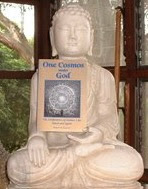
It is only in the poetic imagination which is akin to that of the child and the mystic that we can feel the pure sense of mystery and transcendence which is man's natural element. --Christopher Dawson
Dawson felt that imagination was the most important mode of the metaxy (discussed in Wednesday's post), the divine ←→ human vertical bridge that is Man; and that creativity and imagination were "the greatest gifts God had bequeathed to the human person" (Birzer). Or, if you prefer the psychedelicized and mushroom cloud-hidden words of a raving ethnobotanist,
"The imagination argues for a divine spark in human beings. It is absolutely confounding if you try to see imagination as a necessary quantity in biology. It is an emanation from above -- literally a descent of the world soul" (Terence McKenna).
In order to know reality one must first be capable of imagining reality, something no animal can do. This kind of higher imagination is "the ability to see clearly beyond the here and now into the reality of eternal forms -- thus allowing one to order one's soul to the eternal community."
In the absence of the seer-view mirror of imagination, the human being loses the ability to order anything beyond his immediate sensations and appetites; reality flattens out, so that animals become indistinct from humans, men from women, gods from kings, kings from men, men from monsters, art from entertainment, superstars from benchwarmers. With 20/20 houndsight, all the world essentially becomes analogous to pornography, which is sex drained of eros, or matter drained of soul, or knowledge drained of wisdom.
In contrast, the task of the true Christian -- not unlike that of the improvisational orthoparadoxical bohemian classical liberal Judeo-Vedantin neo-traditionalist -- is to unite matter with soul in order to sanctify the world. Given the ontological fact of the two vertical arrows of existence, there is the possibility of an upword inscape from the world toward the Abbasolute; or a downward escape into the considerable charms and snares of Mamamaya.
But where we are supposed to live is within the innercourse of the two, or more precisely, the One, which can be trimorphically envisioned but not seen; or only seen with higher vision, which is to say, imagination. With our intelligence we may discern the contours of this reality, but with our imagination we may unite ourselves to it. The former is mind, the latter is heart, and their union is the basis of the higher I-mage -- the mage who imagines. That would be us. Like the three magi who discerned the celestial arrows and saw Christ in an anonymous baby in a manger.
As usual, Schuon says it best: "The vice of outwardness is the lack of harmony between the two dimensions: between our tendency towards the things that surround us and our tendency towards the 'kingdom of God which is within you.' What is necessary is to realize a spiritual rootedness that removes from outwardness its tyranny at once dispersing and compressing, and that on the contrary allows us to 'see God everywhere'; which means to perceive symbols, archetypes and essences in sensible things....
"Similarly regarding matter: what is necessary is not to deny it -- if that were possible -- but to withdraw from its seductive and enslaving grasp; to distinguish in it what is archetypal and quasi-celestial from what is accidental and indeed too earthly; hence to treat it with nobleness and sobriety. In other words, outwardness is a right, and inwardness a duty..." The superior man is always fishing for complements, such as heaven-earth or time-eternity.
A one-sided, unimaginative, and dryasdust outworldliness is an affliction that particularly afflicts the psychospiritual left. Even back in his day, Dawson could already see that most liberal statists were "simple-minded secularists and utilitarians who failed to understand truth, beauty and goodness" and "lacked the power of imagination. They were quantifiers and calculators, sophisticated men of the world, but not of the soul. They had been duped by worldly wisdom" (Birzer).
This low altitude is both a cause and consequence of the mechanization of man, and renders him "less than God intended him to be." To put it another way, the inevitable outcome of radical secularism is that one is free, but not free to realize one's spiritual potentialities, and therefore only free in the manner of an uncaged beast; or a beast with impenetrable barriers he cannot see, thus giving the illusion of freedom. But we are creatures and not beasts, for the same reason we are citizens and not subjects.
Imagination mediates between the possible and the actual, and converts walls into windows, windows to doors. It is what allows the infinite and absolute to become intelligible, i.e., to be re-presented in the finite and relative realm.
As Bolton writes, "each relative world contains only a cross-section of the universal possibilities," and each person is just such a relative world. This world can be quite vast and expansive or small and cramped, depending upon the individual case. In other words, the size of the exterior world in which one lives and moves is merely a projection of the human interior.
For example, when we consider the inconceivable vastness of outer space, only a materialized mind living under the "reign of quantity" fails to realize that he is really contemplating the relative infinity of his own soul, for the physical cosmos is neither large nor small, whereas the soul is all it knows. The world it encounters is just the canvas upon which we paint beautiful or ugly pictures with the materials available to us; or the darkwomb in which we develop our pneumagraphs.
Bolton writes that "it may seem strange to speak of the mind as though it were a thing having a physical size, but it undoubtedly has its own analogue of spatial capacity." Furthermore -- and this is a critical point as it pertains to scientism -- the ability "to grasp one part of reality brilliantly while being oblivious of the other things that human minds are capable of can be more opposed to the truth than the perceiving of all things equally dimly."
And this is why, as I have mentioned before, even the literal creationist is surely closer to the reality of the situation than the unimaginative and spiritually autistic atheist who has drained reality of its most essential ideas, archetypes, and principles. His mind contracts the cosmos in order to make it adequate to the cold and shrunken proportions of his own being. This is what the world looks like when you peer into the wrong end of the teloscope.
This existential shrinkage would be a great embarrassment to atheists if only they realized how silly they look to us in their misosophical nakedness, but like children and savages, they live in a kind of naive cognitive innocence without so much as a fig leaf of metaphysics. They have no idea why we laugh at them, which for them is a mercy.
Regarding the "intelligent error" of those shrunken secularists, Schuon writes that "It is only too evident that mental effort does not automatically give rise to the perception of the real; the most capable mind may be the vehicle of the grossest error. The paradoxical phenomenon of even a 'brilliant' intelligence being the vehicle of error is explained first of all by the possibility of a mental operation that is exclusively 'horizontal,' hence lacking all awareness of 'vertical' relationships."
In turn, this exclusively horizontal Ørientation "creates a void that the irrational necessarily comes to fill." And of course, there are not just scientific materialists but religious ones, those "whose intellectual intuition remains latent, this being precisely what constitutes the 'obscure merit of faith.'" In other words, even if one cannot understand Truth, one should still believe and have faith in it.
Reason can never arrive at reality, and it is the height of unreasonableness to imagine otherwise. At best, it can remove obstacles in the way of our imaginative vision. As Schuon explains, reasoning is analogous to "the groping of a blind man, with the difference that -- by removing obstacles -- it may bring about a clearing of vision; it is blind and groping due to its indirect and discursive nature." Reason is surely a gift, but a gift that gives -- or facilitates -- something beyond reason.
That is, reason "is a means of knowledge, but this means is mediate and fragmentary like the sense of touch, which enables a blind man to find his way and even to feel the heat of the sun, but not to see." To put it another way, it allows us to uncover the transcendent vision "which one possesses a priori," i.e., vertical recollection.
What does it mean to say that the cosmos is expanding? Again, if one is only referring to physical reality, the point couldn't be more banal. Who cares? In the absence of a stable frame of reference, expansion and contraction are just figures of speech.
In a very real way, the only thing that is actually expanding in the world is man's inwardness, is it not? And if you're not expanding, then you are contracting, for the mind cannot cease its dynamism, its metabolism of reality. You are what you eat, and if you eat the quantified and atomistic sawdust of secularism, you will inevitably be spiritually malnourished, just a shell of your future self.
Slowly, through grace, each Christian is sanctified, the debris of the world being gradually removed from the order of his soul, and then the human as the metaxy serves as the bridge between the spiritual and material worlds. --Bradley Birzer
Friday, November 19, 2010


Thursday, November 18, 2010
Living in the Shadows of What Needn't Be
"Before I draw nearer to that headstone to which you point," said Bob, "answer me one question. Are these the shadows of the things that will be, or are they shadows of things that only may be?"
Still, Petey pointed in silence, downward to the grave by which it stood.
"The course of our lives will foreshadow certain ends, to which, if persevered in, they must lead," offered Bob. "But if those courses be departed from, the ends will change. Say it is thus with what you show me!"
While no form of leftism, materialism, scientism, or secularism is to be taken intellectually (let alone spiritually) seriously, I do take seriously orthodox spiritual views that clash with mine.
The reason for this is that no form of materialism, whether explicit or implicit, is sufficient to account for the richness, depth, and complexity of the world, and can never result in the metacosmic unity even scientists presume to exist. On the other hand, if the other guy has a plausible alternate explanation of spiritual unity, then that needs to be given its due, since there cannot be two unities. Either one of them is wrong, or else one can be assimilated into the other.
This is why I spend so much time pondering the traditionalist view that terrestrial perfection -- which is to say, unity -- lies in the past, and that time is an ultimately degenerative process. This goes directly against my intuitive sense that time is ultimately progressive, even though from within time, things are always simultaneously getting worse and better, so it's understandable that some people see through the half empty glass darkly.
It's very much analogous to the free market, which, at any given moment, will appear to create "problems" such as "income inequality." But if one tries to force incomes to be more equal -- to "spread the wealth around" -- it just results in less wealth, productivity, and affluence for the system as a whole.
Now, a lot of puzzling and even startling things happen within time -- i.e., apparent ontological discontinuities -- that I believe cannot be sufficiently (i.e., in a way that satisfies our total intellect) explained by either science or by tradition, but only by a higher synthesis of the two, which is what I attempted to do in the Coonifesto.
You might say that the vertical is One, the horizontal is two, and man is the higher third that unites them; or, in the Laosy absurcular logic of Taoism, The Tao gives birth to One / One gives birth to Two / Two gives birth to Three / Three gives birth to all things. So the Three and One are really two sides of the same mata-reality beyond being.
Speaking of those discontinuities, there is not, nor will there ever be, any scientific explanation of the phenomenon of life itself, nor of human consciousness. These are well beyond the limits of what materialistic science can deal with. Obviously, human consciousness explains science, not vice versa. Likewise, language and reason explain natural selection, not the converse. If evolution were the cause of language, then the truth of evolution could not be known. This is axiomatic.
I think we can stipulate that the world is either headed toward apocalypse or unity. If time is progressive, then history represents an arc of salvolution that will result in the reunification of the world, after our 50,000 year journey out of Africa and into the prismhouse of time and cultural diversification.
If this reunification -- i.e., higher synthetic unity -- does not occur, then I agree with the traditionalists that mankind cannot be sustained, and that we are headed toward some sort of disaster foretold in all of the world's mythologies -- a disaster that falls under the heading of "apocalypse." No one knows the time, the hour, or the details, but it will be nasty. Sort of like the fantasies of the global warming hysterics, only in reality.
The question is, does history have an expiration date, or does it have a way to "renew" and regenerate itself? There are many ways to look at this question. The Christian view would be that history essentially reached its inevitable nadir long ago, which is why God decided to take things into his own hands and jump down into his creation so as to reverse its downward course. Absent having done so, history would have continued winding down into chaos and barbarism. While humans may have still existed, it would be in a kind of spiritual darkness that we can scarcely conceive.
Actually, we don't really have to look far to perceive the shadow of this darkness, for it not only exists within ourselves, but pervades certain precincts of the present world untouched by the Judeo-Christian TimeLifeStream, perhaps most visibly in the Islamist death cult and the necropolis of the psychospiritual left, both of which are a kind of parasitic Death that feeds on Life.
It's not just that we merely "disagree" with the left. Rather, we regard it as a pure horror, for if we had to reduce our consciousness down to the level from which it proceeds, we would no longer be ourselves. And then there would be no point to living. Might as well become a community organizer.
Christopher Dawson was a (small t) traditionalist, but did not believe that history was inevitably winding down. He did, however, feel that only a spiritual rebirth could reverse our downward historical trend.
As Birzer explains, Dawson saw "beyond the mechanistic and materialistic understanding of history," and arrived "at a meta-history that transcended and transfigured conventional historical assumptions." Whereas the conventional historian who focuses on the "raw material" of history can "lose sight of the deeper spiritual forces that make history intelligible to us," Dawson attempted to place the individual "within a larger mythological understanding of story and history" and to render "the past present by the light of the eternal omnipresent." In short, the One can illuminate the Two in a way that the Two can never directly illuminate the One.
In point of fact, the historian cannot help but place history within the context of a larger myth, the question being whether it is a true or false one. In ether worlds, we speak of myth in the proper sense of a narrative that embodies and discloses archetypal reality, not in the fallen sense of mere quasi-animal passive imagination. "It is only in the poetic imagination which is akin to that of the child and the mystic that we can feel the pure sense of mystery and transcendence which is man's natural element" (Dawson).
Any sort of leftist historicism derived from Marx is not just pure mythology (in the luciferic sense), but is a counter myth that is not rooted in any kind of transcendent reality, only in the fevered imagination of the leftist. The same can be said for the myths of scientism, atheism and materialism. Naturally, Dawson was not taken seriously by these intellectually unserious types, since "he took seriously the importance of the Creator, the profound implications of the Incarnation, and the movement of the Holy Spirit in history."
Dawson viewed history through the mirror of revelation instead of the projection of ideology -- and not just the revelation of scripture, but through the living revelation (↓) given him by the Holy Spirit. Furthermore, history itself is a revelation of that same Spirit, so the writing of history ultimately involves spirit interpreting Spirit, so to speak. There is no question that he was just as "scholarly" as any academic historian, except that he was free from the narrow and artificial constraints of various fashionable ideologies which come and go.
For Dawson, historicism is "the belief that men can, by the use of their natural powers, discover an inner meaning in the historical process." But "a civilization cannot long survive the dying of belief in a transcendent order that brought the culture into being." Therefore, by "re-mythologizing" history, Dawson was simply doing what I said must be done to avoid eventual catastrophe, which is to write a universal history in the teeth of forces that "desire nothing less than the total subversion and destruction of all that is True, Good, and Beautiful."
Although it is always the blest and curst of times, Dawson may be forgiven for believing that he lived in a somewhat uniquely perilous age, in that (writing in 1940) "the dark forces that have been chained by a thousand years of Christian civilization... have now been set free to conquer the world." Fascism, communism, socialism, and any other illiberal statism all depend upon and flow from the de-Christianization and re-paganization of the West, and the gradual descent into "a chaos of pure sensation."
It should go without saying that there is no merely "human" cure for this temporal descent (since it is a downward prolongation, so to speak, of our fallen humanness), and that "the forces of evil cannot be successfully resisted without the power of Spirit," the only thing which can carry on the work of Creation and thereby reverse our otherwise inevitable Fall.
"Good Petey," cried the B'ob, as down upon the ground he fell: "Assure me that I yet may change these shadows you’ve shown me, by an altered life!"
"I'll think about it," sayeth Petey.
"Okay, then, how's this: I will honor Christmas in my heart, and try to keep it all the year. I shall dilate time and live in and above the Past, the Present, and the Future. The Spirits of all Three shall strive within me toward their ultimate fulfillment. I will not shut out the lessons that they teach. Oh, tell me I may overcome my higher education and sponge away the writing on this stone! Cut me some slack, O ambiguous spirit!"
Still, Petey pointed in silence, downward to the grave by which it stood.
"The course of our lives will foreshadow certain ends, to which, if persevered in, they must lead," offered Bob. "But if those courses be departed from, the ends will change. Say it is thus with what you show me!"
While no form of leftism, materialism, scientism, or secularism is to be taken intellectually (let alone spiritually) seriously, I do take seriously orthodox spiritual views that clash with mine.
The reason for this is that no form of materialism, whether explicit or implicit, is sufficient to account for the richness, depth, and complexity of the world, and can never result in the metacosmic unity even scientists presume to exist. On the other hand, if the other guy has a plausible alternate explanation of spiritual unity, then that needs to be given its due, since there cannot be two unities. Either one of them is wrong, or else one can be assimilated into the other.
This is why I spend so much time pondering the traditionalist view that terrestrial perfection -- which is to say, unity -- lies in the past, and that time is an ultimately degenerative process. This goes directly against my intuitive sense that time is ultimately progressive, even though from within time, things are always simultaneously getting worse and better, so it's understandable that some people see through the half empty glass darkly.
It's very much analogous to the free market, which, at any given moment, will appear to create "problems" such as "income inequality." But if one tries to force incomes to be more equal -- to "spread the wealth around" -- it just results in less wealth, productivity, and affluence for the system as a whole.
Now, a lot of puzzling and even startling things happen within time -- i.e., apparent ontological discontinuities -- that I believe cannot be sufficiently (i.e., in a way that satisfies our total intellect) explained by either science or by tradition, but only by a higher synthesis of the two, which is what I attempted to do in the Coonifesto.
You might say that the vertical is One, the horizontal is two, and man is the higher third that unites them; or, in the Laosy absurcular logic of Taoism, The Tao gives birth to One / One gives birth to Two / Two gives birth to Three / Three gives birth to all things. So the Three and One are really two sides of the same mata-reality beyond being.
Speaking of those discontinuities, there is not, nor will there ever be, any scientific explanation of the phenomenon of life itself, nor of human consciousness. These are well beyond the limits of what materialistic science can deal with. Obviously, human consciousness explains science, not vice versa. Likewise, language and reason explain natural selection, not the converse. If evolution were the cause of language, then the truth of evolution could not be known. This is axiomatic.
I think we can stipulate that the world is either headed toward apocalypse or unity. If time is progressive, then history represents an arc of salvolution that will result in the reunification of the world, after our 50,000 year journey out of Africa and into the prismhouse of time and cultural diversification.
If this reunification -- i.e., higher synthetic unity -- does not occur, then I agree with the traditionalists that mankind cannot be sustained, and that we are headed toward some sort of disaster foretold in all of the world's mythologies -- a disaster that falls under the heading of "apocalypse." No one knows the time, the hour, or the details, but it will be nasty. Sort of like the fantasies of the global warming hysterics, only in reality.
The question is, does history have an expiration date, or does it have a way to "renew" and regenerate itself? There are many ways to look at this question. The Christian view would be that history essentially reached its inevitable nadir long ago, which is why God decided to take things into his own hands and jump down into his creation so as to reverse its downward course. Absent having done so, history would have continued winding down into chaos and barbarism. While humans may have still existed, it would be in a kind of spiritual darkness that we can scarcely conceive.
Actually, we don't really have to look far to perceive the shadow of this darkness, for it not only exists within ourselves, but pervades certain precincts of the present world untouched by the Judeo-Christian TimeLifeStream, perhaps most visibly in the Islamist death cult and the necropolis of the psychospiritual left, both of which are a kind of parasitic Death that feeds on Life.
It's not just that we merely "disagree" with the left. Rather, we regard it as a pure horror, for if we had to reduce our consciousness down to the level from which it proceeds, we would no longer be ourselves. And then there would be no point to living. Might as well become a community organizer.
Christopher Dawson was a (small t) traditionalist, but did not believe that history was inevitably winding down. He did, however, feel that only a spiritual rebirth could reverse our downward historical trend.
As Birzer explains, Dawson saw "beyond the mechanistic and materialistic understanding of history," and arrived "at a meta-history that transcended and transfigured conventional historical assumptions." Whereas the conventional historian who focuses on the "raw material" of history can "lose sight of the deeper spiritual forces that make history intelligible to us," Dawson attempted to place the individual "within a larger mythological understanding of story and history" and to render "the past present by the light of the eternal omnipresent." In short, the One can illuminate the Two in a way that the Two can never directly illuminate the One.
In point of fact, the historian cannot help but place history within the context of a larger myth, the question being whether it is a true or false one. In ether worlds, we speak of myth in the proper sense of a narrative that embodies and discloses archetypal reality, not in the fallen sense of mere quasi-animal passive imagination. "It is only in the poetic imagination which is akin to that of the child and the mystic that we can feel the pure sense of mystery and transcendence which is man's natural element" (Dawson).
Any sort of leftist historicism derived from Marx is not just pure mythology (in the luciferic sense), but is a counter myth that is not rooted in any kind of transcendent reality, only in the fevered imagination of the leftist. The same can be said for the myths of scientism, atheism and materialism. Naturally, Dawson was not taken seriously by these intellectually unserious types, since "he took seriously the importance of the Creator, the profound implications of the Incarnation, and the movement of the Holy Spirit in history."
Dawson viewed history through the mirror of revelation instead of the projection of ideology -- and not just the revelation of scripture, but through the living revelation (↓) given him by the Holy Spirit. Furthermore, history itself is a revelation of that same Spirit, so the writing of history ultimately involves spirit interpreting Spirit, so to speak. There is no question that he was just as "scholarly" as any academic historian, except that he was free from the narrow and artificial constraints of various fashionable ideologies which come and go.
For Dawson, historicism is "the belief that men can, by the use of their natural powers, discover an inner meaning in the historical process." But "a civilization cannot long survive the dying of belief in a transcendent order that brought the culture into being." Therefore, by "re-mythologizing" history, Dawson was simply doing what I said must be done to avoid eventual catastrophe, which is to write a universal history in the teeth of forces that "desire nothing less than the total subversion and destruction of all that is True, Good, and Beautiful."
Although it is always the blest and curst of times, Dawson may be forgiven for believing that he lived in a somewhat uniquely perilous age, in that (writing in 1940) "the dark forces that have been chained by a thousand years of Christian civilization... have now been set free to conquer the world." Fascism, communism, socialism, and any other illiberal statism all depend upon and flow from the de-Christianization and re-paganization of the West, and the gradual descent into "a chaos of pure sensation."
It should go without saying that there is no merely "human" cure for this temporal descent (since it is a downward prolongation, so to speak, of our fallen humanness), and that "the forces of evil cannot be successfully resisted without the power of Spirit," the only thing which can carry on the work of Creation and thereby reverse our otherwise inevitable Fall.
"Good Petey," cried the B'ob, as down upon the ground he fell: "Assure me that I yet may change these shadows you’ve shown me, by an altered life!"
"I'll think about it," sayeth Petey.
"Okay, then, how's this: I will honor Christmas in my heart, and try to keep it all the year. I shall dilate time and live in and above the Past, the Present, and the Future. The Spirits of all Three shall strive within me toward their ultimate fulfillment. I will not shut out the lessons that they teach. Oh, tell me I may overcome my higher education and sponge away the writing on this stone! Cut me some slack, O ambiguous spirit!"
Wednesday, November 17, 2010
A Meandertale Man with a Sinuous Bridge to Tell
As Colonel Beaglehole has said many times from deep inside his opium den, it's a miracle that history can get anywhere at all when we're not even allowed to begin the barmy enterprise with the correct premise.
"I say, if you don't know what Man is or what he is for, then what bloody difference does it make what mountainous climbs he's accomplished or what mutinous crimes he's accompliced? He might have done this, or he might have done that, but since he has no essence and no cosmic role, then it doesn't really matter, now does it?"
Now where's my blasted hookah?!
But Christopher Dawson -- who has his coonological orthoducks in a row -- begins with the idea that man is the metaxy, or bridge, between the material and spiritual worlds.
Hey, that sounds familiar. Didn't I sapiens a homologue in meander tall tale? Yes, here it is -- page 133, right next to the picture of that cute little guy caterpultering into a buddhafly. To paraphrase,
"Historians -- contemporary ones, anyway -- no longer presume to know the 'purpose' of history. Without question they tell us about causes and motivations within history, but they steer quite clear of asking what is the actual point of history. And understanding the point of history is admittedly quite difficult -- if not impossible -- if one doesn't know what a human being is."
Indeed, "the problem is compounded for a mere human being working with only human sources, for how then can one stand outside the flow of historical events and gain any perspective on history, or have any stable frame of reference? If the historian is just a historically conditioned product of history, why should we pay any attention to him at all?"
The point is that the majority of secular historians would ironically dismiss Dawson because of his religiosity and "subjectivity," when he is the one who is being -- or at least trying to be -- objective, by placing history in its proper cosmic and spiritual context -- by understanding the flow of horizontal events in the light of an eternal vertical standard.
This is in accord with Tomberg, who conceptualizes history as a sort of whirlpool created by two opposing streams of influence, one horizontal, the other vertical:
"The spiritual-cultural history of mankind is the result on the one hand of the causes which are to be found in space and time, and on the other hand of the causes which are not to be found there, which are of a timeless and spaceless nature."
Or, to plagiaphrase Terence McKenna, history is just the burst of static between monkeys and God, as the eschatological object at the end of time -- call it O, if you like -- "mitigates and transforms the forward flow of entropic circumstance." Noetry in motion!
Wikipedians say that the metaxy is the "in-between" or "middle ground" between the divine realm and mankind. Eric Voegelin (who was influenced by Dawson) used the term to designate "the permanent place where man is in-between two poles of existence" such as infinite and finite, time and eternity, matter and spirit, form and substance, being and beyond-being, or -- would you believe? -- KAOS and CONTROL.
Voegelin also used it to mean the unchanging "template of the mind (or nous) in contrast to the dynamic and unordered flow of experiential consciousness." Which is why it's One Cosmos Under God for those who get smart.
Therefore, as Birzer writes, "Only by properly ordering himself between the two extremes and demands of the physical and metaphysical can man fulfill his purpose for the 'integration [of the material] in the universal order.'"
Thus, even if you are not overtly Christian, you can still see Christianity as our particular way (in the West) of conceptualizing and thinking about this over- or underlying metaphysical reality -- an unavoidably mythsemantical deuscourse as real and objective as mathematical discourse.
To put it another way, if you toss aside our Judeo-Christian wisdom tradition, as secular scholars have done, then you also throw out our traditional way of discussing the reality of man's role as cosmic mediator. You end up with mere de-mythologized horizontal history, and ultimately with a desiccated particularization of historical events, divorced from their origin and destiny, the alphOmega.
This intellectual fallforall encloses the mind in deconstruction, multiculturalism, "diversity," moral relativism, and the politically correct truthspeak of the left. In turn, this is why secularism is not just opposed to religion, but a substitute "religion of darkness" for infertile eggheads living in their ovary towers.
But the yolk's on them. When you worship at the ego-altar of secular extremism, you are engaging in a kind of primitive sacrifice of the One. It is a violent dismembering and therefore disre-membering of Unity, and as result, anti-human in the extreme. Instead of the white unity out of which the diversity of cosmic color emanates, you end up with the black unity of a chaotic blending of colors with no qualitative differences. Raw power then rushes in to fill in the void, and gravity takes care of the rest.
This is why the phony diversity of leftist college campuses results in such a stupifyingly bland and anti-intellectual pneumatosphere, where one is free to believe in anything but Reality.
The new intellectual boorbarians of the left are specifically opposed to man's role as metaxy, even if they cannot consciously understand what they do or why they do it. They are simply reenacting a timeless vertical drama, engaging in a sort of Black Mass involving a crucifiction stranger than fact -- the Crucifixion being the symbol par excellence of the link between human and divine -- only without resurrection.
All primitive sacrifice involves the attempt to steal and appropriate the life force of the sacrificial victim. But this force can only be given from above, not taken from below.
"I say, if you don't know what Man is or what he is for, then what bloody difference does it make what mountainous climbs he's accomplished or what mutinous crimes he's accompliced? He might have done this, or he might have done that, but since he has no essence and no cosmic role, then it doesn't really matter, now does it?"
Now where's my blasted hookah?!
But Christopher Dawson -- who has his coonological orthoducks in a row -- begins with the idea that man is the metaxy, or bridge, between the material and spiritual worlds.
Hey, that sounds familiar. Didn't I sapiens a homologue in meander tall tale? Yes, here it is -- page 133, right next to the picture of that cute little guy caterpultering into a buddhafly. To paraphrase,
"Historians -- contemporary ones, anyway -- no longer presume to know the 'purpose' of history. Without question they tell us about causes and motivations within history, but they steer quite clear of asking what is the actual point of history. And understanding the point of history is admittedly quite difficult -- if not impossible -- if one doesn't know what a human being is."
Indeed, "the problem is compounded for a mere human being working with only human sources, for how then can one stand outside the flow of historical events and gain any perspective on history, or have any stable frame of reference? If the historian is just a historically conditioned product of history, why should we pay any attention to him at all?"
The point is that the majority of secular historians would ironically dismiss Dawson because of his religiosity and "subjectivity," when he is the one who is being -- or at least trying to be -- objective, by placing history in its proper cosmic and spiritual context -- by understanding the flow of horizontal events in the light of an eternal vertical standard.
This is in accord with Tomberg, who conceptualizes history as a sort of whirlpool created by two opposing streams of influence, one horizontal, the other vertical:
"The spiritual-cultural history of mankind is the result on the one hand of the causes which are to be found in space and time, and on the other hand of the causes which are not to be found there, which are of a timeless and spaceless nature."
Or, to plagiaphrase Terence McKenna, history is just the burst of static between monkeys and God, as the eschatological object at the end of time -- call it O, if you like -- "mitigates and transforms the forward flow of entropic circumstance." Noetry in motion!
Wikipedians say that the metaxy is the "in-between" or "middle ground" between the divine realm and mankind. Eric Voegelin (who was influenced by Dawson) used the term to designate "the permanent place where man is in-between two poles of existence" such as infinite and finite, time and eternity, matter and spirit, form and substance, being and beyond-being, or -- would you believe? -- KAOS and CONTROL.
Voegelin also used it to mean the unchanging "template of the mind (or nous) in contrast to the dynamic and unordered flow of experiential consciousness." Which is why it's One Cosmos Under God for those who get smart.
Therefore, as Birzer writes, "Only by properly ordering himself between the two extremes and demands of the physical and metaphysical can man fulfill his purpose for the 'integration [of the material] in the universal order.'"
Thus, even if you are not overtly Christian, you can still see Christianity as our particular way (in the West) of conceptualizing and thinking about this over- or underlying metaphysical reality -- an unavoidably mythsemantical deuscourse as real and objective as mathematical discourse.
To put it another way, if you toss aside our Judeo-Christian wisdom tradition, as secular scholars have done, then you also throw out our traditional way of discussing the reality of man's role as cosmic mediator. You end up with mere de-mythologized horizontal history, and ultimately with a desiccated particularization of historical events, divorced from their origin and destiny, the alphOmega.
This intellectual fallforall encloses the mind in deconstruction, multiculturalism, "diversity," moral relativism, and the politically correct truthspeak of the left. In turn, this is why secularism is not just opposed to religion, but a substitute "religion of darkness" for infertile eggheads living in their ovary towers.
But the yolk's on them. When you worship at the ego-altar of secular extremism, you are engaging in a kind of primitive sacrifice of the One. It is a violent dismembering and therefore disre-membering of Unity, and as result, anti-human in the extreme. Instead of the white unity out of which the diversity of cosmic color emanates, you end up with the black unity of a chaotic blending of colors with no qualitative differences. Raw power then rushes in to fill in the void, and gravity takes care of the rest.
This is why the phony diversity of leftist college campuses results in such a stupifyingly bland and anti-intellectual pneumatosphere, where one is free to believe in anything but Reality.
The new intellectual boorbarians of the left are specifically opposed to man's role as metaxy, even if they cannot consciously understand what they do or why they do it. They are simply reenacting a timeless vertical drama, engaging in a sort of Black Mass involving a crucifiction stranger than fact -- the Crucifixion being the symbol par excellence of the link between human and divine -- only without resurrection.
All primitive sacrifice involves the attempt to steal and appropriate the life force of the sacrificial victim. But this force can only be given from above, not taken from below.
Tuesday, November 16, 2010
The Birth of a Cosmos: Cosmogeny Recapitulates Psychogeny
Back in the womb from which I came, I had no God and was merely myself. --Meister Eckhart, speaking of his own womb with a pew
Is the human species "maturing" -- which is to say, evolving -- with time? Consider the "Muslim world," which is either more or less mature than the West as a whole. It is a yes or no question, but in order to answer it, one must have either an implicit or explicit theory of human development, as every developmental theory is guided by a telos, i.e., an end toward which the organism is striving. Thus, in order to know whether mankind is evolving, one must first understand the purpose of the human station.
Dr. Sanity believes that millions of Muslims suffer from "Teddy Bear Syndrome" (coined by Victor Davis Hanson), which is "the tendency of many Muslims to judge Westerners and those who do not adhere to Islam as 'blasphemous' when they exercise freedom of speech, freedom of thought, freedom of choice, and freedom of religion; and to react in an intolerant, inappropriate and violent rage, demanding death or some other extreme punishment for the accused."
Yes, Teddy Bear Syndrome shares many similarities to left wing political correctness, so it must be a variant of a potential that is present in everyone, a primitive impulse that must be "outgrown" -- like throwing temper tantrums when you don't get your way, or ramming through complex legislation that no one has read, or suing to overturn the 2000 presidential election. The TB syndrome is why nowhere in the West does one find more intellectual immaturity than on an elite university campus.
But fortunately, most people are not left wing university professors. Yet.
Regarding the etiology of Teddy Bear Syndrome, Dr. Sanity writes that part of the problem results from the failure of Islam "to evolve from its medieval and primitive origins" (emphasis mine). But on any traditionalist view -- including traditional Christianity -- religion does not evolve. Rather, the whole point is that it is fixed and final. However, just like everything else, scripture looks very different to a developmentally mature mind than it does to an immature one.
When I was a child, I spoke like a child, I thought like a child, I reasoned like a child; when I became an adult, I gave up childish ways. First the milky way; then the meaty way.
The psychological immaturity of the Islamic world is generally mirrored by a pseudomature response by the "liberal" West. As Hanson writes, "the reaction to this madness is now stereotyped. Often apologies -- not condemnation -- follow from contrite Westerners. To prevent a recurrence, Western writers, filmmakers, teachers and religious figures quietly edit their work and restrict their speech -- but only when Islam is involved."
When this happens, it is analogous to allowing the baby to run the household. Children naturally try to manipulate parents, but a good parent knows how to set boundaries and to be consistent. However, over the past 40-50 years, especially with the Baby Boomer generation, these psychological boundaries have been discarded, which has resulted in an indiscriminate blending (as opposed to a true synthesis or integration) of the sexes and generations, and of high and low.
One of the reasons for this is that the Baby Boom generation may have been the first to actually prevail in the perennial battle between adults and children, thus providing no check on the tendency toward omnipotence. In other words, in prevailing in the Oedipal struggle, they lost, for the downside of vanquishing Father is that one ends up orphaned.
Yes, some positive things obviously came out of the 1960s, but one of the most baleful ones was the Genderless Adultolescent. This is a person who by definition can never be mature, but only give the appearance of being so. It is much more difficult to be a Genderless Adultolescent on the right, whereas it is more or less normative on the left, as exemplified by their current low-standard bearer. Anyone who reads left wing blogs knows this is so.
As for myself, being primarily a vertically oriented person, I think of politics -- as it typically plays out -- as a distraction from reality. On the one hand, I do not conflate salvation with conservative political success. Rather, it's just that the left is so incredibly dangerous and destructive on every level -- intellectual, economic, psychological, and spiritual -- that it must be combatted. In fact, most conservatives would prefer to ignore politics and be left alone to enjoy their lives, but this would be irresponsible so long as the left pursues its antihuman agenda with such religious fervor.
The problem with most history, even to this day, is that it is too sweeping and general, and ignores the reality of the unconscious and the insights of developmental psychology. It makes it difficult to comprehend something as fundamentally irrational as Islamism. The left, for example, treats Islamism as a rational response to something we have done, which seems like "empathy" or sensitivity but is actually the very opposite, a kind of self-congratulatory indulgence of an enraged child.
In One Cosmos I quoted John Bowlby, one of the early pioneers of attachment theory, who wrote that "The truth is that the least-studied phase of human development remains the phase during which a child is acquiring all that makes him most human. Here is still a continent to conquer."
Similarly, Tolstoy wrote that "From the child of five to myself is but a step. But from the newborn baby to the child of five is an appalling distance." Or the anthropologist Norbert Elias: "It seems as if grown-up people, in thinking about their origins, involuntarily lose sight of the fact that they themselves and all adults came into the world as little children. Over and over again, in the scientific myths of origin no less than the religious ones, they feel impelled to imagine: In the beginning was a single human being, who was an adult."
But in reality, In the beginning is a neurologically incomplete, helpless little baby, utterly dependent upon caretakers who may or may not be up to the task of raising him, and who themselves bear the unconscious scars of their own childhood trauma. Thus, it is not so much that "in the beginning is the baby" as "in the beginning is the dynamic relationship between an unformed nervous system that will develop (or fail to develop) its potential in rapport with its caretakers."
Take the myth of Genesis, for example. This can be misleading, since it begins with the creation of a male adult, followed by a female adult (who comes out of the male), and lastly, a couple of children.
But in reality, the reverse is true: first there is a baby, out of which comes the mother, who then bifurcates (from the infant's point of view) into a mother and father. In other words, the baby cannot possibly imagine that the mother gave birth to him, as doing so would require abstract language, boundaries, a conception of linear time, the differentiation between inside and outside, etc.
Rather, as Winnicott observed, there isn't actually such a thing as a baby (at least as far as the baby is concerned). Instead, there is a true union of mother and infant, a (hopefully) harmonious psychological matrix (matrix being etymologically linked to womb) through which the baby will eventually "discover" the mOther -- and only later her consort, who is Fa(r)ther away in developmental time.
Fascinatingly, Genesis is psychospiritually capacious enough to be supplemented with the infant's view of the cosmic situation. This was an idea developed by James Grotstein, but it is also implicit in the interpretations of some mishnavous rabbis who view Genesis as an orthoparadox about man's movement from psychological infancy and dependence to maturity and independence.
As Kass writes, "Eating from the tree certainly produces a death of innocence. Through judgmental self-consciousness, human beings become self-separated; the primordial childlike, unself-divided, and peaceful state of the soul 'dies.' Thanks to reason and freedom, protoman becomes a different being -- the old one dies. This death, repeated in every human life, we have all experienced for ourselves; the contented and carefree life that we knew as innocent children is in fact permanently lost to us, the inevitable result of our rise to self-conscious knowledge of good and bad."
The rabbinical tradition often turns scripture inside-out or upside-down in order to squeeze out a little additional wisdom. Don't worry, scripture is resilient. It can handle rough play, and will return to its original shape. In Grotstein's case, he begins with the psychological fact of infantile omnipotence. One can argue whether or not God is omnipotent, but infants certainly are, for how could they know otherwise?
Thus, the omnipotent baby (again, from the baby's point of view) is quite obviously the creator of the cosmos, including its mother and father. Clearly, a brand new cosmos comes into being with the birth of every child, does it not? There is no cosmos at all in the absence of consciousness, so it is simply an existential fact that cosmogenesis is repeated afresh with every newborn baby: cosmogeny recapitulates psychogeny, so to speak.
Here is another aped quote from the Coonifesto, this one from David Darling, author of Equations of Eternity: "[W]e may reasonably view an infant's dawning of awareness on two levels: as a consciousness arising in the individual and, simultaneously, in the universe as a whole.... we can watch an incredibly condensed version of the growth of awareness on this planet, and in the cosmos, in each developing child."
But only if you are a sensitive parent. Isn't this a big part of the joy of parenting, re-participating in the birth of a fresh new cosmos, as your child -- and his world -- changes from day to day? Jesus made so many sensitive comments about children and about the relationship between a child's consciousness and spiritual awareness, that it's a little surprising that people fail to make the explicit connection.
God is the newest thing there is; the youngest thing there is. God is the beginning, and if we are united to him we become new again.... My soul is as young as the day it was created. Yes, and much younger! --Meister Eckhart
Is the human species "maturing" -- which is to say, evolving -- with time? Consider the "Muslim world," which is either more or less mature than the West as a whole. It is a yes or no question, but in order to answer it, one must have either an implicit or explicit theory of human development, as every developmental theory is guided by a telos, i.e., an end toward which the organism is striving. Thus, in order to know whether mankind is evolving, one must first understand the purpose of the human station.
Dr. Sanity believes that millions of Muslims suffer from "Teddy Bear Syndrome" (coined by Victor Davis Hanson), which is "the tendency of many Muslims to judge Westerners and those who do not adhere to Islam as 'blasphemous' when they exercise freedom of speech, freedom of thought, freedom of choice, and freedom of religion; and to react in an intolerant, inappropriate and violent rage, demanding death or some other extreme punishment for the accused."
Yes, Teddy Bear Syndrome shares many similarities to left wing political correctness, so it must be a variant of a potential that is present in everyone, a primitive impulse that must be "outgrown" -- like throwing temper tantrums when you don't get your way, or ramming through complex legislation that no one has read, or suing to overturn the 2000 presidential election. The TB syndrome is why nowhere in the West does one find more intellectual immaturity than on an elite university campus.
But fortunately, most people are not left wing university professors. Yet.
Regarding the etiology of Teddy Bear Syndrome, Dr. Sanity writes that part of the problem results from the failure of Islam "to evolve from its medieval and primitive origins" (emphasis mine). But on any traditionalist view -- including traditional Christianity -- religion does not evolve. Rather, the whole point is that it is fixed and final. However, just like everything else, scripture looks very different to a developmentally mature mind than it does to an immature one.
When I was a child, I spoke like a child, I thought like a child, I reasoned like a child; when I became an adult, I gave up childish ways. First the milky way; then the meaty way.
The psychological immaturity of the Islamic world is generally mirrored by a pseudomature response by the "liberal" West. As Hanson writes, "the reaction to this madness is now stereotyped. Often apologies -- not condemnation -- follow from contrite Westerners. To prevent a recurrence, Western writers, filmmakers, teachers and religious figures quietly edit their work and restrict their speech -- but only when Islam is involved."
When this happens, it is analogous to allowing the baby to run the household. Children naturally try to manipulate parents, but a good parent knows how to set boundaries and to be consistent. However, over the past 40-50 years, especially with the Baby Boomer generation, these psychological boundaries have been discarded, which has resulted in an indiscriminate blending (as opposed to a true synthesis or integration) of the sexes and generations, and of high and low.
One of the reasons for this is that the Baby Boom generation may have been the first to actually prevail in the perennial battle between adults and children, thus providing no check on the tendency toward omnipotence. In other words, in prevailing in the Oedipal struggle, they lost, for the downside of vanquishing Father is that one ends up orphaned.
Yes, some positive things obviously came out of the 1960s, but one of the most baleful ones was the Genderless Adultolescent. This is a person who by definition can never be mature, but only give the appearance of being so. It is much more difficult to be a Genderless Adultolescent on the right, whereas it is more or less normative on the left, as exemplified by their current low-standard bearer. Anyone who reads left wing blogs knows this is so.
As for myself, being primarily a vertically oriented person, I think of politics -- as it typically plays out -- as a distraction from reality. On the one hand, I do not conflate salvation with conservative political success. Rather, it's just that the left is so incredibly dangerous and destructive on every level -- intellectual, economic, psychological, and spiritual -- that it must be combatted. In fact, most conservatives would prefer to ignore politics and be left alone to enjoy their lives, but this would be irresponsible so long as the left pursues its antihuman agenda with such religious fervor.
The problem with most history, even to this day, is that it is too sweeping and general, and ignores the reality of the unconscious and the insights of developmental psychology. It makes it difficult to comprehend something as fundamentally irrational as Islamism. The left, for example, treats Islamism as a rational response to something we have done, which seems like "empathy" or sensitivity but is actually the very opposite, a kind of self-congratulatory indulgence of an enraged child.
In One Cosmos I quoted John Bowlby, one of the early pioneers of attachment theory, who wrote that "The truth is that the least-studied phase of human development remains the phase during which a child is acquiring all that makes him most human. Here is still a continent to conquer."
Similarly, Tolstoy wrote that "From the child of five to myself is but a step. But from the newborn baby to the child of five is an appalling distance." Or the anthropologist Norbert Elias: "It seems as if grown-up people, in thinking about their origins, involuntarily lose sight of the fact that they themselves and all adults came into the world as little children. Over and over again, in the scientific myths of origin no less than the religious ones, they feel impelled to imagine: In the beginning was a single human being, who was an adult."
But in reality, In the beginning is a neurologically incomplete, helpless little baby, utterly dependent upon caretakers who may or may not be up to the task of raising him, and who themselves bear the unconscious scars of their own childhood trauma. Thus, it is not so much that "in the beginning is the baby" as "in the beginning is the dynamic relationship between an unformed nervous system that will develop (or fail to develop) its potential in rapport with its caretakers."
Take the myth of Genesis, for example. This can be misleading, since it begins with the creation of a male adult, followed by a female adult (who comes out of the male), and lastly, a couple of children.
But in reality, the reverse is true: first there is a baby, out of which comes the mother, who then bifurcates (from the infant's point of view) into a mother and father. In other words, the baby cannot possibly imagine that the mother gave birth to him, as doing so would require abstract language, boundaries, a conception of linear time, the differentiation between inside and outside, etc.
Rather, as Winnicott observed, there isn't actually such a thing as a baby (at least as far as the baby is concerned). Instead, there is a true union of mother and infant, a (hopefully) harmonious psychological matrix (matrix being etymologically linked to womb) through which the baby will eventually "discover" the mOther -- and only later her consort, who is Fa(r)ther away in developmental time.
Fascinatingly, Genesis is psychospiritually capacious enough to be supplemented with the infant's view of the cosmic situation. This was an idea developed by James Grotstein, but it is also implicit in the interpretations of some mishnavous rabbis who view Genesis as an orthoparadox about man's movement from psychological infancy and dependence to maturity and independence.
As Kass writes, "Eating from the tree certainly produces a death of innocence. Through judgmental self-consciousness, human beings become self-separated; the primordial childlike, unself-divided, and peaceful state of the soul 'dies.' Thanks to reason and freedom, protoman becomes a different being -- the old one dies. This death, repeated in every human life, we have all experienced for ourselves; the contented and carefree life that we knew as innocent children is in fact permanently lost to us, the inevitable result of our rise to self-conscious knowledge of good and bad."
The rabbinical tradition often turns scripture inside-out or upside-down in order to squeeze out a little additional wisdom. Don't worry, scripture is resilient. It can handle rough play, and will return to its original shape. In Grotstein's case, he begins with the psychological fact of infantile omnipotence. One can argue whether or not God is omnipotent, but infants certainly are, for how could they know otherwise?
Thus, the omnipotent baby (again, from the baby's point of view) is quite obviously the creator of the cosmos, including its mother and father. Clearly, a brand new cosmos comes into being with the birth of every child, does it not? There is no cosmos at all in the absence of consciousness, so it is simply an existential fact that cosmogenesis is repeated afresh with every newborn baby: cosmogeny recapitulates psychogeny, so to speak.
Here is another aped quote from the Coonifesto, this one from David Darling, author of Equations of Eternity: "[W]e may reasonably view an infant's dawning of awareness on two levels: as a consciousness arising in the individual and, simultaneously, in the universe as a whole.... we can watch an incredibly condensed version of the growth of awareness on this planet, and in the cosmos, in each developing child."
But only if you are a sensitive parent. Isn't this a big part of the joy of parenting, re-participating in the birth of a fresh new cosmos, as your child -- and his world -- changes from day to day? Jesus made so many sensitive comments about children and about the relationship between a child's consciousness and spiritual awareness, that it's a little surprising that people fail to make the explicit connection.
God is the newest thing there is; the youngest thing there is. God is the beginning, and if we are united to him we become new again.... My soul is as young as the day it was created. Yes, and much younger! --Meister Eckhart
Monday, November 15, 2010
If Good Times are Bad, What Makes a Lifework Leafing?
I try to take human beastlings as I find them, not as I wish them to be. And I find humanity at large to be a pretty appalling bunch. Half of them, anyway. Half the time. In any given school year, the class is half fools.
Does this make me a misanthrope? Hardly. There is a stark distinction between objectivity and cynicism -- or idealization, for that matter -- neither of which is an acceptable stance for the truth seeker. One of the major differences between conservatives and liberals is that the former tend to love people but believe mankind stinks, while the latter love mankind but have no use for the actual people whom they wish to dominate and control.
In his book Human Accomplishment, Charles Murray writes that "We human beings are in many ways a sorry lot, prone to every manner of vanity and error. The human march forward has been filled with wrong turns, backsliding, and horrible crimes."
Nevertheless, he takes the nuanced Raccoon position that "in its grand sweep, it has indeed been a march forward. On every dimension, the last half-dozen centuries in particular have brought sensational improvement which, with qualifications, continues to this day."
In the book, Murray attempts to quantify the great things humans have accomplished, but it seems that for every achievement there is an equal and opposite monument to our depravity. He asks, "What can Homo sapiens brag about -- not as individuals, but as a species?"
He notes, for example, that military accomplishment is out of the question, since "putting 'Defeated Hitler' on the human resumé is too much like putting 'Beat My Drug Habit' on a personal one." He also rules out mere governance and commerce, since these "are akin to paying the rent and putting food on the table" as it pertains to our species as a whole.
In other words, these are things human beings must do in order to survive and prosper. They are not so much accomplishments as prerequisites for them. What took (and continues to take) so long for mankind to simply get out of its own way? (In fact, I would actually put successful commerce high on the list of accomplishments, as it is something that the vast majority of human beings -- most especially the tenured -- not only do not understand, but actively interfere with, e.g., Keynes, Krugman, & other Krackpots.)
Now, this progressive view of mankind goes directly against the traditionalist view of a degenerating mankind. Again, traditionalists locate perfection in the past, to such an extent that they often seem to think their thesis requires no empirical support.
For example, in The Order of the Ages, Bolton writes, "We think today about progress, and about how much society has advanced in the last few decades, but the evidence for this could equally well be used to argue that these are times of extreme decadence, when all natural and human standards have been overturned and we await the inevitable dissolution of all that the modern mind has created. Either we are moving toward new, higher standards of science and civilization or we stand at the very end of an era, on the verge of Apocalypse."
Bolton believes the latter, but on the third hand, both could be true: as we proceed through time, the polarity or tension within the human soul just becomes more and more extreme:
There was a bright light,
A shattering of shop windows
The bomb in the baby carriage
Was wired to the radio
The news of most any day reminds us of this ironic polarity, that "these are the days of miracle and wonder," so "don't cry baby, don't cry." For every Simon there's a Garfunkel, and yet, the two together create a third that is more successful than either.
Murray writes that "the human capital for great accomplishment and the underlying human attraction to excellence are always with us, but environments for eliciting great accomplishment are not."
I mentioned this the other day in the context of the so-called Palestinians, a culture so depraved that it literally provides the individual no opportunity to even be adequate, let alone excellent. Rather, it demands madness, bloodlust, sadism, hatred, and depravity, which has probably been true of most human cultures down through the ages. Just as he is free to choose evil over good, man, because he can know, can know many things that aren't so. And most of what he knows falls into this latter category.
Michael Novak writes of a debate between Christopher Hitchens and Dinesh D’Souza on the subject of atheism:
"In it, I heard Christopher describe his own view of the world, which may be abbreviated as follows: It was just 100,000 years ago that humans finally appeared on this planet. On average, these poor creatures died by age 25, and suffered (often horribly) from disease, earthquake, flood, famine, and cyclones -- not to mention murder and warfare. Only after some 96,000 years does Jewish history begin, and only after some 98,000 years does Christian 'salvation' come. For all those thousands of years the Creator/Designer left human beings to suffer. Then, even after Judaism and Christianity arrive, the suffering continues almost unabated. In addition, these poor human beings are badly designed. They have developed too much adrenaline, and the frontal lobes of their brains are too small. All these together leave humans in a bleak condition in a bleak world, and with very little hope."
Now, I happen to agree with Hitchens, at least as far as he goes. In fact, so does the Pope in a recent encyclical. Novak writes that
"Benedict agrees that the condition of humans before the Jewish and Christian news of God’s intentions was as bleak as Hitchens says. The idea of progress was not present in consciousness.... The idea that each human is free in his individual conscience -- not the conscience solely of city, tribe, or even family -- had not been introduced. The idea that the human mind is proportioned to the world as it is, and capable, in the image of the Creator, of creating new inventions, discoveries, and means of progress in history, had not yet been grasped by the mind of humans."
So Pope Benedict is obviously not a traditionalist in the Guenon/Schuon sense, but a crypto-Coon who recognizes genuine progress and therefore doesn't blow up the baby with the bombwire. He knows that progress has occurred, but at the same time, that it is never enough to satisfy the soul of man. But don't cry, baby. Novak continues:
"Even the human capacity for invention and technological progress, we find, is not a consistent bearer of hope. Humans remain both free and also drawn to self-love, arrogance of power, irrational ambitions, and moral decadence.... Thus, at any time even instruments of great good can be turned into instruments of unparalleled evil. Of this we had much evidence during the 20th century.... [T]he horrific evils that millions experienced in the last hundred years required more than logic, science, and crazy utopian ideas. Hitchens and others are free to accept or to reject the hope that Judaism and Christianity implant in the souls of many. The fact is that this Jewish and Christian hope, once it became the driving force of Mediterranean and European civilization, produced an unrivaled and enduring burst of optimism, inquiry, and stunning progress."
So we come back to what I stated at the outset of this post about taking man as I find him: "Judaism and Christianity have the advantage of dealing with the world as it is. They take it with all its hurt and folly, stupidity and egotism, natural disasters and disasters by human hands. Both faiths prepare their daughters and sons to face a vale of tears, to meet much suffering equably, to keep their hopes unbroken no matter what, and to show courage worthy of the children of the True God. For both faiths, suffering is an irremovable fact of life."
I would suggest that you're lucky to be alive during an era when you can say It was the best of times, it was the worst of times, because for most of human history, it has mostly been the latter, which leads to something like this sentiment: "It is the worst of times, but we remember the best of times, even if they only exist in myth and story."
Traditionalists, insofar as I am able to determine, believe in a literal "best of times," a "golden age" that had no simultaneous and intrinsic "worst of times."
But those on the left believe in an insane mirror image of this: that these are the worst of times and that we can perfect mankind and build a utopia which will be the best of times.
But to paraphrase something very infallible that the Pope said a few years ago, before he was even Pope, "the loss of transcendence leads to the flight to utopia." The leftist program is a surefire way to create a true worst of times, as they proved time and time again in the 20th century. A Jew in Nazi Germany or a political prisoner in the Soviet Union, or Cuba, or China, can be forgiven for believing "these are the worst of times, full stop."
So a Raccoon believes that the very conditions of our human existence somehow necessitate this outwardly absurd tension of good times, bad times, of which I've certainly had my share. Yes, the song and dance remains the same, even if you can't dance to to the song. For what is a Led Zeppelin, anyway? It's really a promethean lead balloon, which might get you high, but not for long. "Oh the humanity!"
In the days of my youth
I was told what it means to be a man,
Now I've reached that age
I've tried to do all those things the best I can.
But no matter how I try,
I find my way into the same old jam.
Of course you do, pagan! There's only one way out, and it's not in the past, nor is it in the future.
James Joyce planted it in zoso many pages: perpetual fall and redemption, and irreconcilable dualities within a cyclical but spiraling time that mixes darkness and light, AKA the Nightmare of History:
The fall of a once wallstrait oldparr is retaled early in bed and later on life down through all christian minstrelsy. (Those broken financiers who leapt from Wall Street buildings in 1929 only fell back to the earth, same as the high flying bubble-blowers of 80 years later.)
Hohohoho, Mister Finn, you're going to be Mister Finnagain! Comeday morm, and, O, you're vine! Sendday's eve and, ah, you're vinegar! Hahahaha, Mister Funn, you're going to be fined again! (The same vine produces wine and vinegar, for every fun there's an equal and opposite fine, and every fin, or end, is a new finnagain, or beginning.)
Gricks may rise and Troysirs may fall (there being two sights for ever a picture) for in the byways of high improvidence that's what makes lifework leaving and the world's a cell for citters to cit in. (Cit is the sanskrit word for consciousness, which is simultaneously liberation and prison.)
And even if Humpty shell fall frumpty times as awkward again... there'll be iggs for the brekkers come to mournhim, sunny side up with care. (Fall and rise, fall and rise, olden pneumagain, same old same old, to break from the infertile eggheads you've got to om a lot -- in your own way, of course.)
The movibles are scrawling in motions, marching, all of them ago, in pitpat and zingzang, for every busy eerie whig's a bit of a torytale to tell. (Every political program's got a bit -- or more than a bit -- of its opposite, so don't get all excited when one end of the sleazesaw is up. Fascism, the lust for control over others, is in the human heart, so every loving lefty is the frightful righty he fears, just as every hysterical olbermann's a banal undertaker.)
Does this make me a misanthrope? Hardly. There is a stark distinction between objectivity and cynicism -- or idealization, for that matter -- neither of which is an acceptable stance for the truth seeker. One of the major differences between conservatives and liberals is that the former tend to love people but believe mankind stinks, while the latter love mankind but have no use for the actual people whom they wish to dominate and control.
In his book Human Accomplishment, Charles Murray writes that "We human beings are in many ways a sorry lot, prone to every manner of vanity and error. The human march forward has been filled with wrong turns, backsliding, and horrible crimes."
Nevertheless, he takes the nuanced Raccoon position that "in its grand sweep, it has indeed been a march forward. On every dimension, the last half-dozen centuries in particular have brought sensational improvement which, with qualifications, continues to this day."
In the book, Murray attempts to quantify the great things humans have accomplished, but it seems that for every achievement there is an equal and opposite monument to our depravity. He asks, "What can Homo sapiens brag about -- not as individuals, but as a species?"
He notes, for example, that military accomplishment is out of the question, since "putting 'Defeated Hitler' on the human resumé is too much like putting 'Beat My Drug Habit' on a personal one." He also rules out mere governance and commerce, since these "are akin to paying the rent and putting food on the table" as it pertains to our species as a whole.
In other words, these are things human beings must do in order to survive and prosper. They are not so much accomplishments as prerequisites for them. What took (and continues to take) so long for mankind to simply get out of its own way? (In fact, I would actually put successful commerce high on the list of accomplishments, as it is something that the vast majority of human beings -- most especially the tenured -- not only do not understand, but actively interfere with, e.g., Keynes, Krugman, & other Krackpots.)
Now, this progressive view of mankind goes directly against the traditionalist view of a degenerating mankind. Again, traditionalists locate perfection in the past, to such an extent that they often seem to think their thesis requires no empirical support.
For example, in The Order of the Ages, Bolton writes, "We think today about progress, and about how much society has advanced in the last few decades, but the evidence for this could equally well be used to argue that these are times of extreme decadence, when all natural and human standards have been overturned and we await the inevitable dissolution of all that the modern mind has created. Either we are moving toward new, higher standards of science and civilization or we stand at the very end of an era, on the verge of Apocalypse."
Bolton believes the latter, but on the third hand, both could be true: as we proceed through time, the polarity or tension within the human soul just becomes more and more extreme:
There was a bright light,
A shattering of shop windows
The bomb in the baby carriage
Was wired to the radio
The news of most any day reminds us of this ironic polarity, that "these are the days of miracle and wonder," so "don't cry baby, don't cry." For every Simon there's a Garfunkel, and yet, the two together create a third that is more successful than either.
Murray writes that "the human capital for great accomplishment and the underlying human attraction to excellence are always with us, but environments for eliciting great accomplishment are not."
I mentioned this the other day in the context of the so-called Palestinians, a culture so depraved that it literally provides the individual no opportunity to even be adequate, let alone excellent. Rather, it demands madness, bloodlust, sadism, hatred, and depravity, which has probably been true of most human cultures down through the ages. Just as he is free to choose evil over good, man, because he can know, can know many things that aren't so. And most of what he knows falls into this latter category.
Michael Novak writes of a debate between Christopher Hitchens and Dinesh D’Souza on the subject of atheism:
"In it, I heard Christopher describe his own view of the world, which may be abbreviated as follows: It was just 100,000 years ago that humans finally appeared on this planet. On average, these poor creatures died by age 25, and suffered (often horribly) from disease, earthquake, flood, famine, and cyclones -- not to mention murder and warfare. Only after some 96,000 years does Jewish history begin, and only after some 98,000 years does Christian 'salvation' come. For all those thousands of years the Creator/Designer left human beings to suffer. Then, even after Judaism and Christianity arrive, the suffering continues almost unabated. In addition, these poor human beings are badly designed. They have developed too much adrenaline, and the frontal lobes of their brains are too small. All these together leave humans in a bleak condition in a bleak world, and with very little hope."
Now, I happen to agree with Hitchens, at least as far as he goes. In fact, so does the Pope in a recent encyclical. Novak writes that
"Benedict agrees that the condition of humans before the Jewish and Christian news of God’s intentions was as bleak as Hitchens says. The idea of progress was not present in consciousness.... The idea that each human is free in his individual conscience -- not the conscience solely of city, tribe, or even family -- had not been introduced. The idea that the human mind is proportioned to the world as it is, and capable, in the image of the Creator, of creating new inventions, discoveries, and means of progress in history, had not yet been grasped by the mind of humans."
So Pope Benedict is obviously not a traditionalist in the Guenon/Schuon sense, but a crypto-Coon who recognizes genuine progress and therefore doesn't blow up the baby with the bombwire. He knows that progress has occurred, but at the same time, that it is never enough to satisfy the soul of man. But don't cry, baby. Novak continues:
"Even the human capacity for invention and technological progress, we find, is not a consistent bearer of hope. Humans remain both free and also drawn to self-love, arrogance of power, irrational ambitions, and moral decadence.... Thus, at any time even instruments of great good can be turned into instruments of unparalleled evil. Of this we had much evidence during the 20th century.... [T]he horrific evils that millions experienced in the last hundred years required more than logic, science, and crazy utopian ideas. Hitchens and others are free to accept or to reject the hope that Judaism and Christianity implant in the souls of many. The fact is that this Jewish and Christian hope, once it became the driving force of Mediterranean and European civilization, produced an unrivaled and enduring burst of optimism, inquiry, and stunning progress."
So we come back to what I stated at the outset of this post about taking man as I find him: "Judaism and Christianity have the advantage of dealing with the world as it is. They take it with all its hurt and folly, stupidity and egotism, natural disasters and disasters by human hands. Both faiths prepare their daughters and sons to face a vale of tears, to meet much suffering equably, to keep their hopes unbroken no matter what, and to show courage worthy of the children of the True God. For both faiths, suffering is an irremovable fact of life."
I would suggest that you're lucky to be alive during an era when you can say It was the best of times, it was the worst of times, because for most of human history, it has mostly been the latter, which leads to something like this sentiment: "It is the worst of times, but we remember the best of times, even if they only exist in myth and story."
Traditionalists, insofar as I am able to determine, believe in a literal "best of times," a "golden age" that had no simultaneous and intrinsic "worst of times."
But those on the left believe in an insane mirror image of this: that these are the worst of times and that we can perfect mankind and build a utopia which will be the best of times.
But to paraphrase something very infallible that the Pope said a few years ago, before he was even Pope, "the loss of transcendence leads to the flight to utopia." The leftist program is a surefire way to create a true worst of times, as they proved time and time again in the 20th century. A Jew in Nazi Germany or a political prisoner in the Soviet Union, or Cuba, or China, can be forgiven for believing "these are the worst of times, full stop."
So a Raccoon believes that the very conditions of our human existence somehow necessitate this outwardly absurd tension of good times, bad times, of which I've certainly had my share. Yes, the song and dance remains the same, even if you can't dance to to the song. For what is a Led Zeppelin, anyway? It's really a promethean lead balloon, which might get you high, but not for long. "Oh the humanity!"
In the days of my youth
I was told what it means to be a man,
Now I've reached that age
I've tried to do all those things the best I can.
But no matter how I try,
I find my way into the same old jam.
Of course you do, pagan! There's only one way out, and it's not in the past, nor is it in the future.
James Joyce planted it in zoso many pages: perpetual fall and redemption, and irreconcilable dualities within a cyclical but spiraling time that mixes darkness and light, AKA the Nightmare of History:
The fall of a once wallstrait oldparr is retaled early in bed and later on life down through all christian minstrelsy. (Those broken financiers who leapt from Wall Street buildings in 1929 only fell back to the earth, same as the high flying bubble-blowers of 80 years later.)
Hohohoho, Mister Finn, you're going to be Mister Finnagain! Comeday morm, and, O, you're vine! Sendday's eve and, ah, you're vinegar! Hahahaha, Mister Funn, you're going to be fined again! (The same vine produces wine and vinegar, for every fun there's an equal and opposite fine, and every fin, or end, is a new finnagain, or beginning.)
Gricks may rise and Troysirs may fall (there being two sights for ever a picture) for in the byways of high improvidence that's what makes lifework leaving and the world's a cell for citters to cit in. (Cit is the sanskrit word for consciousness, which is simultaneously liberation and prison.)
And even if Humpty shell fall frumpty times as awkward again... there'll be iggs for the brekkers come to mournhim, sunny side up with care. (Fall and rise, fall and rise, olden pneumagain, same old same old, to break from the infertile eggheads you've got to om a lot -- in your own way, of course.)
The movibles are scrawling in motions, marching, all of them ago, in pitpat and zingzang, for every busy eerie whig's a bit of a torytale to tell. (Every political program's got a bit -- or more than a bit -- of its opposite, so don't get all excited when one end of the sleazesaw is up. Fascism, the lust for control over others, is in the human heart, so every loving lefty is the frightful righty he fears, just as every hysterical olbermann's a banal undertaker.)
Sunday, November 14, 2010

Subscribe to:
Posts (Atom)
Theme Song