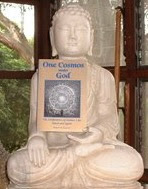
Our omninameable troll asked if Buddhism could support the scientific enterprise, now that it's conveniently up and running thanks to Christianity. The answer is a qualified "yes," in the sense that, once your body is grown, you can survive on gummy bears and RC cola.
One thing I like about Jaki -- and which no doubt limited his appeal to the 'nadless wimps of political correctness -- is that he was a pretty obnoxious guy (in a righteously ringtailed way). He always renders to his ideological opponents the swift kick in the ass of which they are so desperately in need. Here's how he expressed it:
"One need not be a Buddhist to be a good historian of Buddhist thought and culture, but nothing can dispense the historian from a thorough effort to understand what it means for a Buddhist to be a Buddhist and to achieve things by virtue of that Buddhism. The theistic contribution to science and to history, and the Christian concreteness of that theism, demand no less in the way of scholarly treatment and integrity" (emphasis mine).
In contrast, those Buddhists who truly believed and practiced Buddhism arrived at bupkis (which is the yiddish rendering of the shunyada-yada-yada of "the Void"). There's no insult in saying this. It's just a fact. It's no more an insult than, say, reminding people that the only Palestinian contribution to the world is the suicide belt.
So I suppose one can always be a Western make-believe Buddhist and practice at the margins of science, but only if one ignores metaphysical consistency and rejects those parts of Buddhism that clash with a scientific worldview -- most notably, the absence of a Creator.
Again, the underlying unity of the cosmos results from the fact that "the ways of God are simplicity itself, for in God will and mind are fused in the simplest unity." Science did not develop in the Buddhist world because it could not develop in the Buddhist world. It can only graft itself onto an already developed Western science, and only then at the cost of ignoring some of its own most cherished assumptions.
Ultimately, the same barriers that prevent the apprehension of the Creator put up roadblocks to the development of science. One loses the unifying bridge that connects change to change, and instead apprehends only perpetual change from which the only escape is into the void of shunyata.
In other words, the only thing that doesn't change is the meaninglessness of it all. But "the existence of God becomes possible, nay, well-nigh inevitable to any lover of consistency." Conversely, "an epistemology that obstructs the ways to God also blocks the advance on the road to science."
The main point is that there is no reason whatsoever for the present postmodern and anti-Christian fragmentation of our worldview into religion, the arts, science, and dozens if not hundreds of scientific specialties and subspecialties with no way to reconcile them. After all, the unity is there. The unity is a fact, even if science is powerless to explain the fact.
As mentioned in my book, the simple reality of the matter is that all levels, dimensions, and modes of reality are seamlessly harmonized in the human being in such a manner that science cannot, and will never, account for it, for it is the prior condition that makes the very practice of science (and the existence of scientists) possible -- e.g., the completely unreasonable harmony between a human mind that was supposedly selected for eating and mating being capable of peering into the deepest and most hidden mathematical recesses of the cosmos.
Unfortunately, some people are just incapable of spiritual wonderment, which is not a banal "absence of explanation," but the positive intuition of a deeper -- nay, the deepest -- level of explanation. It is not (-k) but (+n). The same goes for mystery, sanctity, holiness, innocence, and, of course, slack. To suggest that these are "unreal" only because they are inaccessible to the cold and grasping hands of the scientistic materialist is the height of naivete. And no, you can't measure naivete with a slide rule either. But there it is.
The unwashed horde of the tenured likes to pretend that someone like Galileo was somehow opposed to the Christian God, when the opposite is true:
"Little if any effort is made, for instance, to recall the role played in Galileo's scientific methodology by his repeated endorsements of the naturalness of perceiving the existence of God from the study of the book of nature. Much the same silent treatment is given to Galileo's view of the human mind as a most excellent and most special product of the Creator."
Whoomp!, there it is in all its metaphysical clarity and simplicity: there is a Creator, and he is revealed in the book of nature, but only to beings who are themselves mirrorcles of the Divine Mind.
Alternative explanations are not only too silly to take seriously, but more importantly, reactionary to the core. Their real interest is in perversely denying a Creator but profiting from all the benefits of having one -- benefits like a rational and unitary cosmos, a transcendent reality that is uniquely disclosed to the mind of man, evolutionary progress, a scientific ethic that disinterestedly seeks truth, and much more.
Saturday, February 06, 2010


Friday, February 05, 2010
You Must Have a Whole In Your Head!
Yes, you must.
For among other things, science would be impossible if not for the whole in your head. This nonlocal whole is what guides and sponsors "the metaphysical quest for the reality of God," which -- like it or not -- is "the only support of that universal intelligibility which alone can satisfy man's inquiring mind and provide a solid basis for his actions."
In the absence of this whole, science becomes an ad hoc enterprise, a pile of debris with no unifying center, no genuine coherence, and no ultimate aim. It becomes all bricks with no mortar, an arch with no keystone, the Beatles with no Ringo.
I'm just going to flip through the book we're discussing, and note some of the things that arrested my attention.
Again, as mentioned yesterday, if it doesn't take off and become self-sustaining, it isn't science: "the invention and the progress of science are of one and the same nature." The phases of its progress "are but the replay of the original invention, a sequence of similar insights, and perhaps of efforts more or less equal."
Thus, "if the ancient Hindus and Chinese made no progress in astronomy, it was only because they did not invent it." To be sure, they had some of the elements of science, e.g., close observation of celestial phenomena, but other ingrained assumptions prevented the emergence of true science. The difference is as dramatic as that between a live baby and a stillbirth. Both are "infants," but only one goes on to grow and mature.
For Jaki, it is "not deism but Christian theism that served as a principal factor helping the scientific enterprise reach self-sustaining maturity." He gets into the metaphysical assumptions of cultures where science was stillborn, one of which is belief in cyclical time and eternal recurrence.
For example, in Hinduism there is the "treadmill of the yugas," which is clearly inconsistent with the irreversible time of the Christian West. Likewise, the ancient Greeks could not reconcile change and permanence: "if there was only change and nothing permanent," then "any explanation became meaningless." And "if change was only apparent," then "explanation was unnecessary."
Even -- or perhaps especially -- Plato developed the "dichotomy between a perfect world of ideas and a shadowy realm of matter," which placed science on the latter side, i.e., the study of derivative and deceptive shadows dancing on the walls of the cave. Aristotle followed by placing an ontological division between terrestrial and celestial matter, which again fails to apprehend the radical wholeness and unity that undergirds all of creation.
Jaki points out how common it is for even -- or again, perhaps especially! -- the man of genius to "be blinded by the logic of his initial presuppositions." Get those presuppositions wrong, and everything you build upon those assumptions will be wrong, regardless of your intellectual candlepower.
To jump ahead a bit, Jaki shows with example after example that a functional science must steer a middle course between a naive empiricism and dreamy idealism. This is why, ultimately, a science that denies either the vertical or the horizontal breaks down into metaphysical incoherence. To build a house you need bricks and mortar and effort and a blueprint.
So "science failed to become an open-ended avenue in the great ancient cultures just as their quest for the ultimate in intelligibility, which is the quest for God, failed to go convincingly beyond man's own self..."
In other words, in Eastern religions, the ultimate in intelligibility is the interior self, which, in a way, makes them very much compatible with the Kantianism that radically split the western world between noumena and phenomena. If reality and intelligibility are within, why waste one's life studying the ceaseless changes of maya-matter? Doing so only deepens the illusion and attachment to what has no reality, precisely.
All of this changes if the phenomenal world is not just an accidental byproduct of Brahman, but the intentional creation of a rational Creator who wishes to be known. Yes, the world is still contingent, but the contingency is shot through with intelligibility, not just deception and mystification.
Thus, Aquinas could affirm the Raccoon principle that "all knowing beings implicitly know God in any and every thing they know." If you really know what knowledge is, you know that it could only be anchored in the permanent, the absolute, and the eternal. Otherwise it is opinion, precisely, in a world where only opinion is possible. And to have "faith in opinion" makes no sense at all.
A second principle is of the utmost importance, and this is the very idea of a universe, for anyone who says "universe" says "God." No one has ever seen this thing called "universe," and no one ever will. Rather, it is the assumption of an internally related "totality of contingent but rationally coherent beings."
At every turn, the combination of contingency and intelligibility serves "as a pointer to an ultimate in intelligibility," which is ultimately "outside" the universe of space and time, and yet, mysteriously accessible to man's intellect. In the absence of this intimate connection, there is no reason in the world to believe that our knowledge is "true." Therefore, there is no objective knowledge at all. Rather, the world is just one big elite university humanities department.
Until the end of his life, Darwin was haunted by a particular thought, and well he should have been, for it is the logical corollary of his incoherent and nihilistic system: "With me, the horrid doubt always arises whether the convictions of man's mind, which has been developed from the mind of lower animals, are of any value or at all trustworthy. Would anyone trust the convictions of a monkey's mind, if there were any convictions in such a mind?
The question answers itself, but only in someone with a modicum of philosophical consistency and intellectual honesty.
To be continued....
For among other things, science would be impossible if not for the whole in your head. This nonlocal whole is what guides and sponsors "the metaphysical quest for the reality of God," which -- like it or not -- is "the only support of that universal intelligibility which alone can satisfy man's inquiring mind and provide a solid basis for his actions."
In the absence of this whole, science becomes an ad hoc enterprise, a pile of debris with no unifying center, no genuine coherence, and no ultimate aim. It becomes all bricks with no mortar, an arch with no keystone, the Beatles with no Ringo.
I'm just going to flip through the book we're discussing, and note some of the things that arrested my attention.
Again, as mentioned yesterday, if it doesn't take off and become self-sustaining, it isn't science: "the invention and the progress of science are of one and the same nature." The phases of its progress "are but the replay of the original invention, a sequence of similar insights, and perhaps of efforts more or less equal."
Thus, "if the ancient Hindus and Chinese made no progress in astronomy, it was only because they did not invent it." To be sure, they had some of the elements of science, e.g., close observation of celestial phenomena, but other ingrained assumptions prevented the emergence of true science. The difference is as dramatic as that between a live baby and a stillbirth. Both are "infants," but only one goes on to grow and mature.
For Jaki, it is "not deism but Christian theism that served as a principal factor helping the scientific enterprise reach self-sustaining maturity." He gets into the metaphysical assumptions of cultures where science was stillborn, one of which is belief in cyclical time and eternal recurrence.
For example, in Hinduism there is the "treadmill of the yugas," which is clearly inconsistent with the irreversible time of the Christian West. Likewise, the ancient Greeks could not reconcile change and permanence: "if there was only change and nothing permanent," then "any explanation became meaningless." And "if change was only apparent," then "explanation was unnecessary."
Even -- or perhaps especially -- Plato developed the "dichotomy between a perfect world of ideas and a shadowy realm of matter," which placed science on the latter side, i.e., the study of derivative and deceptive shadows dancing on the walls of the cave. Aristotle followed by placing an ontological division between terrestrial and celestial matter, which again fails to apprehend the radical wholeness and unity that undergirds all of creation.
Jaki points out how common it is for even -- or again, perhaps especially! -- the man of genius to "be blinded by the logic of his initial presuppositions." Get those presuppositions wrong, and everything you build upon those assumptions will be wrong, regardless of your intellectual candlepower.
To jump ahead a bit, Jaki shows with example after example that a functional science must steer a middle course between a naive empiricism and dreamy idealism. This is why, ultimately, a science that denies either the vertical or the horizontal breaks down into metaphysical incoherence. To build a house you need bricks and mortar and effort and a blueprint.
So "science failed to become an open-ended avenue in the great ancient cultures just as their quest for the ultimate in intelligibility, which is the quest for God, failed to go convincingly beyond man's own self..."
In other words, in Eastern religions, the ultimate in intelligibility is the interior self, which, in a way, makes them very much compatible with the Kantianism that radically split the western world between noumena and phenomena. If reality and intelligibility are within, why waste one's life studying the ceaseless changes of maya-matter? Doing so only deepens the illusion and attachment to what has no reality, precisely.
All of this changes if the phenomenal world is not just an accidental byproduct of Brahman, but the intentional creation of a rational Creator who wishes to be known. Yes, the world is still contingent, but the contingency is shot through with intelligibility, not just deception and mystification.
Thus, Aquinas could affirm the Raccoon principle that "all knowing beings implicitly know God in any and every thing they know." If you really know what knowledge is, you know that it could only be anchored in the permanent, the absolute, and the eternal. Otherwise it is opinion, precisely, in a world where only opinion is possible. And to have "faith in opinion" makes no sense at all.
A second principle is of the utmost importance, and this is the very idea of a universe, for anyone who says "universe" says "God." No one has ever seen this thing called "universe," and no one ever will. Rather, it is the assumption of an internally related "totality of contingent but rationally coherent beings."
At every turn, the combination of contingency and intelligibility serves "as a pointer to an ultimate in intelligibility," which is ultimately "outside" the universe of space and time, and yet, mysteriously accessible to man's intellect. In the absence of this intimate connection, there is no reason in the world to believe that our knowledge is "true." Therefore, there is no objective knowledge at all. Rather, the world is just one big elite university humanities department.
Until the end of his life, Darwin was haunted by a particular thought, and well he should have been, for it is the logical corollary of his incoherent and nihilistic system: "With me, the horrid doubt always arises whether the convictions of man's mind, which has been developed from the mind of lower animals, are of any value or at all trustworthy. Would anyone trust the convictions of a monkey's mind, if there were any convictions in such a mind?
The question answers itself, but only in someone with a modicum of philosophical consistency and intellectual honesty.
To be continued....
Thursday, February 04, 2010
The Road of Science and the Ways to God
Only have time for a very brief post....
Well, the bad news is that I've lost the Kabbalah thread, so we'll have to get back to it later. The good news is that I just finished Stanley Jaki's The Road of Science and the Ways to God, and I'd like to spend a post or two on that. It was originally presented as the Gifford Lectures for 1975 and 1976. In case you don't know, these lectures were established at the bequest a certain Lord Gifford in order to "promote and diffuse the study of Natural Theology in the widest sense of the term -- in other words, the knowledge of God."
In the course of writing my book, I read a number of the previous Gifford Lectures, since they are highly relevant to what I was trying to do. Let's see... from the list on the wiki page, I see that I read Josiah Royce, Alfred North Whitehead, Arthur Eddington, Werner Heisenberg, Michael Polanyi, Reinhold Niebuhr, Christopher Dawson, Arnold Toynbee, John Eccles, John Polkinghorne, Holmes Rolston, Charles Taylor, Richard Swinburne, Keith Ward, and Ian Barbour. They are all quite rigorous, nothing remotely like the wooly-headed blather you see in the typical new-age "quantum whatever" books, on the one hand, or in the self-satisfied middlebrow fare of the village atheist crowd, on the other.
Along those lines, this probably wouldn't be the best book to introduce yourself to Jaki's thought. It's quite dense and technical, with well over 100 pages of footnotes. A better recommendation would be his intellectual autobiography, A Mind's Matter, or another synthesis of his thought, Means to Message: A Treatise on Truth.
For those who don't know, Jaki was both a Catholic priest and a professor of physics. Here's a brief synopsis from the wiki page:
"After completing undergraduate training in philosophy, theology and mathematics, Father Jaki gained doctorates in theology and in physics.... He also did post-doctoral research in Philosophy of Science at Stanford University, UC Berkeley, Princeton University and Institute for Advanced Study, Princeton. Father Jaki authored more than two dozen books on the relation between modern science and orthodox Christianity.... Jaki was also among the first to claim that Gödel's incompleteness theorem is relevant for theories of everything in theoretical physics. Gödel's theorem states that any mathematical theory that includes certain basic facts of number theory (and is computably enumerable, i.e. whose formulas can be explicitly listed) will be either incomplete or inconsistent. Since any 'theory of everything' will certainly be consistent, it must be either incomplete or unable to prove basic facts about the integers."
In The Road of Science, Jaki endeavors to prove beyond doubt that science developed (which is obvious), and only could have developed (a more subtle point), in the Christian West. At the same time, he shows that the road of science and the way to God are anything but incompatible. Rather, they go hand in hand; in a rightly ordered mind, the one should facilitate the other.
We joke around a lot about our uneducable trolls, or the idiocy of vacuous demagogues like Charles the Queeg, but seriously, the reality of the situation is 180 degrees from the latter's childishly dogmatic and authoritarian view, for science can only function with a background of certain distinct metaphysical assumptions, which are Christian to the core. Sever science from this core, and you immediately end up with an incoherent metaphysic that can never be made "whole," and has all sorts of unintended consequences -- not just for science, but more critically, for the soul of man, for man cannot properly function without a rational and rightly oriented faith in reality.
Even the most confused atheist must acknowledge that science was developed by Christian men, and that their Christianity was not "peripheral" but central to the pursuit. To point out that the order of the cosmos could only have come from a transcendental source does not repel a normal person from science. Rather, it only make them more fascinated by it. Conversely, if scientism tells us that we inhabit a meaningless cosmos with no possibility of objective truth or morality, then this is hardly a spur for normal people to take an interest in it beyond the technological goodies it makes possible.
Jaki writes that there is but "a single intellectual avenue forming both the road of science and the ways to God." It is an indisputable fact that "Science found its only viable birth within a cultural matrix permeated by a firm conviction about the mind's ability to find in the realm of things and persons a pointer to their Creator."
Furthermore, even if the individual scientist is unaware of the fact, "all great creative advances of science have been made in terms of an epistemology germane to that conviction" about the intelligibility of the cosmos and the mind's ability to disclose it. Thus, "wherever that epistemology was resisted with vigorous consistency, the pursuit of science invariably appears to have been deprived of its solid foundation."
Pseudo-intellectuals and anti-Christian bigots will no doubt bring up ancient Greece, or China, or the early Muslim world, but that is indeed the point. It's not that difficult to "discover" reality. The hard part is sustaining the discovery. The essential point is that to truly discover science is to simultaneously discover its self-sustaining nature. It doesn't just mysteriously stop, as it did in those non-Christian cultures.
For to discover science is to discover discovery and to unleash progress. In other words, the mark of true science is a kind of inevitable, self-sustaining progress in scientific knowledge. But for a host of reasons, people are by and large fearful of change, so science (not to mention its close cousin, the free market) has been strangled in its crib. Nothing causes as much radical change as science and free markets, which is why the left opposes both.
And please bear in mind that when I say this, I am referring to science proper, not to the narrow scientism of a Queeg, which is a reactionary metaphysic that can only be embraced by someone who has overt contempt for the truth in all its fullness; for "Scientism is never a genuine reverence for science but a harnessing of science for a nonscientific purpose. Since that purpose is fixed, science can only serve it by remaining fixed, namely, by remaining in its supposedly final stage," and then "taking that final stage to be free of metaphysics."
But God -- thank God -- always takes d'light in shattering our little human containers, because you have to break a few eggheads to make a cosmic omelette.
Well, the bad news is that I've lost the Kabbalah thread, so we'll have to get back to it later. The good news is that I just finished Stanley Jaki's The Road of Science and the Ways to God, and I'd like to spend a post or two on that. It was originally presented as the Gifford Lectures for 1975 and 1976. In case you don't know, these lectures were established at the bequest a certain Lord Gifford in order to "promote and diffuse the study of Natural Theology in the widest sense of the term -- in other words, the knowledge of God."
In the course of writing my book, I read a number of the previous Gifford Lectures, since they are highly relevant to what I was trying to do. Let's see... from the list on the wiki page, I see that I read Josiah Royce, Alfred North Whitehead, Arthur Eddington, Werner Heisenberg, Michael Polanyi, Reinhold Niebuhr, Christopher Dawson, Arnold Toynbee, John Eccles, John Polkinghorne, Holmes Rolston, Charles Taylor, Richard Swinburne, Keith Ward, and Ian Barbour. They are all quite rigorous, nothing remotely like the wooly-headed blather you see in the typical new-age "quantum whatever" books, on the one hand, or in the self-satisfied middlebrow fare of the village atheist crowd, on the other.
Along those lines, this probably wouldn't be the best book to introduce yourself to Jaki's thought. It's quite dense and technical, with well over 100 pages of footnotes. A better recommendation would be his intellectual autobiography, A Mind's Matter, or another synthesis of his thought, Means to Message: A Treatise on Truth.
For those who don't know, Jaki was both a Catholic priest and a professor of physics. Here's a brief synopsis from the wiki page:
"After completing undergraduate training in philosophy, theology and mathematics, Father Jaki gained doctorates in theology and in physics.... He also did post-doctoral research in Philosophy of Science at Stanford University, UC Berkeley, Princeton University and Institute for Advanced Study, Princeton. Father Jaki authored more than two dozen books on the relation between modern science and orthodox Christianity.... Jaki was also among the first to claim that Gödel's incompleteness theorem is relevant for theories of everything in theoretical physics. Gödel's theorem states that any mathematical theory that includes certain basic facts of number theory (and is computably enumerable, i.e. whose formulas can be explicitly listed) will be either incomplete or inconsistent. Since any 'theory of everything' will certainly be consistent, it must be either incomplete or unable to prove basic facts about the integers."
In The Road of Science, Jaki endeavors to prove beyond doubt that science developed (which is obvious), and only could have developed (a more subtle point), in the Christian West. At the same time, he shows that the road of science and the way to God are anything but incompatible. Rather, they go hand in hand; in a rightly ordered mind, the one should facilitate the other.
We joke around a lot about our uneducable trolls, or the idiocy of vacuous demagogues like Charles the Queeg, but seriously, the reality of the situation is 180 degrees from the latter's childishly dogmatic and authoritarian view, for science can only function with a background of certain distinct metaphysical assumptions, which are Christian to the core. Sever science from this core, and you immediately end up with an incoherent metaphysic that can never be made "whole," and has all sorts of unintended consequences -- not just for science, but more critically, for the soul of man, for man cannot properly function without a rational and rightly oriented faith in reality.
Even the most confused atheist must acknowledge that science was developed by Christian men, and that their Christianity was not "peripheral" but central to the pursuit. To point out that the order of the cosmos could only have come from a transcendental source does not repel a normal person from science. Rather, it only make them more fascinated by it. Conversely, if scientism tells us that we inhabit a meaningless cosmos with no possibility of objective truth or morality, then this is hardly a spur for normal people to take an interest in it beyond the technological goodies it makes possible.
Jaki writes that there is but "a single intellectual avenue forming both the road of science and the ways to God." It is an indisputable fact that "Science found its only viable birth within a cultural matrix permeated by a firm conviction about the mind's ability to find in the realm of things and persons a pointer to their Creator."
Furthermore, even if the individual scientist is unaware of the fact, "all great creative advances of science have been made in terms of an epistemology germane to that conviction" about the intelligibility of the cosmos and the mind's ability to disclose it. Thus, "wherever that epistemology was resisted with vigorous consistency, the pursuit of science invariably appears to have been deprived of its solid foundation."
Pseudo-intellectuals and anti-Christian bigots will no doubt bring up ancient Greece, or China, or the early Muslim world, but that is indeed the point. It's not that difficult to "discover" reality. The hard part is sustaining the discovery. The essential point is that to truly discover science is to simultaneously discover its self-sustaining nature. It doesn't just mysteriously stop, as it did in those non-Christian cultures.
For to discover science is to discover discovery and to unleash progress. In other words, the mark of true science is a kind of inevitable, self-sustaining progress in scientific knowledge. But for a host of reasons, people are by and large fearful of change, so science (not to mention its close cousin, the free market) has been strangled in its crib. Nothing causes as much radical change as science and free markets, which is why the left opposes both.
And please bear in mind that when I say this, I am referring to science proper, not to the narrow scientism of a Queeg, which is a reactionary metaphysic that can only be embraced by someone who has overt contempt for the truth in all its fullness; for "Scientism is never a genuine reverence for science but a harnessing of science for a nonscientific purpose. Since that purpose is fixed, science can only serve it by remaining fixed, namely, by remaining in its supposedly final stage," and then "taking that final stage to be free of metaphysics."
But God -- thank God -- always takes d'light in shattering our little human containers, because you have to break a few eggheads to make a cosmic omelette.
Wednesday, February 03, 2010
The Descent of Homo Slackiens
As I've mentioned before, I am a simple man with simple needs. Way back in high school -- after graduating high school, to be precise -- when it came time to chart the course of the pathless Gagdad path, I reduced it all to two non-negotiable demands.
First, I needed to somehow support myself without ever working on a full time basis, since I knew even back then that my real interplanetary cosmonautical mission would never be remunerative. I don't know why I was so confident about it, but even when I had no skills, no prospects, and no future, I was quite certain that I was having more fun than the people who did have those things.
In other words, I noticed that the people who tried to purchase slack with money ended up having less slack, because it took so much time and energy to acquire the money. In truth, these people weren't really in it for the slack, but for other things such as power, prestige, vital excitement, attention, etc. More often than not, they're just running away from their own mind parasites, which are what actually create the barrier between O and (•).
Very few people are truly motivated by slack, and willing to risk all in order to acquire it. Which is one more reason why I do not recommend my path to anyone, since you had better be certain at the outset that you are willing to risk all -- that you are truly on fire for O, and that no earthly consolation can make up for its loss. I don't want to be responsible for the people who realize too late that they are really motivated by the usual mundane human desires.
I might add that one cannot really "acquire" slack, since it is our prior condition. Thus, if we set up all sorts of elaborate means to acquire slack, it can end up leaving us slackless. Many people say they want slack, but they truly wouldn't know what to do with it if they had it. They would instantaneously become bored, or depressed, or persecuted, or adrift.
Secondly, I never wanted to have to use an alarm clock. I was so traumatized by the drudgery of high school and the tyranny of dragging myself out of bed each morning for such a meaningless endeavor, that I vowed never to perpetuate the exercise once I was out of high school.
This is just a roundabout way of saying that I slept in this morning, and that it's too late for a new post. However, due to the mirrorcle of cooncidence, the first old post that I grabbed from two years back actually touches on the above. So here it is:
Be quiet and know that I am God. --Psalms 46:10 (New Life Version)
SHUT UP! SIT DOWN! (Ben Stern Version)
Our God says, "Calm down, and learn that I am God!" (Contemporary English Version)
Turn off your mind, relax and float downstream. (John, Album 7, Track 14)
Be still, and know that I am God. (New International Version)
Own a still, and it's much easier to do that. (Cousin Dupree's Version)
Cease striving and know that I am God. (New American Standard)
Have Slack and know that I AM. (Dobbs Version)
Rishi does it. Take your shoes off & set a spell. Relux & call it a deity. Disbeaware we disappear (who hesychasts is lost). (Petey's OM Version)
Next up in the arkive is this one, originally called Weekend Sermon: Advanced Leisure Studies. At the time I started the blog, I was writing mostly about politics, as do other Uncle Fromms such as Dr. Sanity and Shrinkwrapped. I guess I was reluctant to let 'er rip, spiritually speaking, because I didn't know if there would be any audience for the Way of the Coon, and whether the introduction of overt spirituality would alienate my already tiny audience. Which it eventually did. The blue meat is always more popular to the red man.
So I floated the idea of writing about spiritual matters once a week, just to mix things up a bit. There were only a few comments, most of which were mine, so that wasn't very encouraging. However, one commenter -- oddly, I don't recall him ever commenting again -- lavished the highest possible praise, writing,
Sir, I believe you are a Christian Subgenius.
Well. This humble Bob does not expect to be compared to the One True Bob or to his fraudulent but eternal Church, which offers the following formulation:
THE SOURCE: JEHOVAH-1
THE TEACHER: J.R. "BOB" DOBBS
THE GOAL: SLACK
THE OBSTACLE: THE CONSPIRACY AND ITS DUPES, THE NORMALS
THE WAY: THE CASTING OUT OF FALSE PROPHETS
THE WEAPON: TIME CONTROL
In truth, Raccoons do not deviate far from this template, as our spiritual program of evolving toward the Infinite Slack of the transcendent I AM cannot be separated from our worldly struggle against flatland leftist conspiracy dupes who are all about diminishing and stealing our spiritual, intellectual, political, and financial Slack. Not to mention the false prophets of the New Age, such as Deepak Chopra and his oily ilk.
Anyway, this was my first overtly "spiritual" post, in which I attempted to perform a Bobectomy on my own ego in real time while engaging in spontaneous (for it can only be spontaneous) O-->(n). But I don't think I fell headwrong and heartlong into that method on a day-to-deity basis until around six months later, in the spring of 2006.
*****
The Advanced Leisure Studies below the title of this blog [not there anymore] is not a gag. In fact, there is nothing more serious and important than leisure. The Catholic philosopher Josef Pieper wrote a classic little book on the topic, noting that the very possibility of culture rests on a foundation of leisure -- a sphere of activity that is entirely detached from our immediate wants and needs, free from practical or political considerations -- free from the tyranny of the horizontal.
For leisure is the gateway to the timeless, to the Vertical Church of Perpetual Slack -- that is, if you are able to slow down your thoughts long enough to locate one of the little springs dotting the landscape of your mind, pleasantly bubbling down from above. If your religion is working for you, it is because it has helped you tap into one of these springs.
In his book, Pieper points out that the word for leisure in Greek is skole, and in Latin, scola, both meaning "school." Therefore, leisure, properly understood, is a school, an unhurried realm where some sort of learning takes place; a mystery school, as it were.
Leisure gives access to the unmoved mover within, the still point of the turning mind, the sabbit hole we may enter, not by grasping and struggling, but by opening and receiving. It doesn't mean not doing anything. Rather, it means reliberately doing nothing, even in the midst of doing something -- returning to the pregnant Nothing from whence you came, even now. It is to quiet the mind, withdraw from the world, and open oneSelf to energies that do not emanate from time, but from the timeless.
The external world forces us to dance to its jagged rhythms, but here, at the center, is the leisurely rhythm of eternity, against which thoughts are like passing birds. In fact, this is all you need know in order to unKnow what we're talking about:
Body Like Mountain
Mind Like Sky
Thoughts Like Clouds
As memory reflects the past, silence is like a mirror that reflects and makes present the above, whether it is called heaven, brahman, tao, nirvana, moksha, the One. With all due respect, merely believing in God is a weak substitute. Better to know God, because that is how he ex-ists, that is "stands out" from his otherwise hidden ground. Only humans can manifest the unmanifest God.
The book of Genesis tells the story of our fall. It may be interpreted in many ways, but one way is to see it as a fall away from the timeless, vertical dimension of spontaneous communion with the Creator and the enjoyment of Boundless Slack, into the horizontal world of sweat, toil, pain and frenzied activity. Interestingly, even the Creator, after six days of activity, stood back, relaxed, and just enjoyed the show. From what they say, it was good. Like him, we must occasionally relux and call it a deity.
Science searches for the horizontal beginning of the cosmos. That beginning is located at the outskirts of the material world, where we may trace the faint exhalations of the Big Bong.
Spirituality searches in the opposite direction for the vertical center and source of the cosmos, which is located deep within each person, slightly to the north. It may be thought of as the "I" that is to "AM" as Life is to Matter. It is what makes Being come alive. It is what makes you a light-filled Lumin Being instead of the ssslithery ssslackless kind that keeps messing up the Garden, Homo serpentine.
First, I needed to somehow support myself without ever working on a full time basis, since I knew even back then that my real interplanetary cosmonautical mission would never be remunerative. I don't know why I was so confident about it, but even when I had no skills, no prospects, and no future, I was quite certain that I was having more fun than the people who did have those things.
In other words, I noticed that the people who tried to purchase slack with money ended up having less slack, because it took so much time and energy to acquire the money. In truth, these people weren't really in it for the slack, but for other things such as power, prestige, vital excitement, attention, etc. More often than not, they're just running away from their own mind parasites, which are what actually create the barrier between O and (•).
Very few people are truly motivated by slack, and willing to risk all in order to acquire it. Which is one more reason why I do not recommend my path to anyone, since you had better be certain at the outset that you are willing to risk all -- that you are truly on fire for O, and that no earthly consolation can make up for its loss. I don't want to be responsible for the people who realize too late that they are really motivated by the usual mundane human desires.
I might add that one cannot really "acquire" slack, since it is our prior condition. Thus, if we set up all sorts of elaborate means to acquire slack, it can end up leaving us slackless. Many people say they want slack, but they truly wouldn't know what to do with it if they had it. They would instantaneously become bored, or depressed, or persecuted, or adrift.
Secondly, I never wanted to have to use an alarm clock. I was so traumatized by the drudgery of high school and the tyranny of dragging myself out of bed each morning for such a meaningless endeavor, that I vowed never to perpetuate the exercise once I was out of high school.
This is just a roundabout way of saying that I slept in this morning, and that it's too late for a new post. However, due to the mirrorcle of cooncidence, the first old post that I grabbed from two years back actually touches on the above. So here it is:
Be quiet and know that I am God. --Psalms 46:10 (New Life Version)
SHUT UP! SIT DOWN! (Ben Stern Version)
Our God says, "Calm down, and learn that I am God!" (Contemporary English Version)
Turn off your mind, relax and float downstream. (John, Album 7, Track 14)
Be still, and know that I am God. (New International Version)
Own a still, and it's much easier to do that. (Cousin Dupree's Version)
Cease striving and know that I am God. (New American Standard)
Have Slack and know that I AM. (Dobbs Version)
Rishi does it. Take your shoes off & set a spell. Relux & call it a deity. Disbeaware we disappear (who hesychasts is lost). (Petey's OM Version)
Next up in the arkive is this one, originally called Weekend Sermon: Advanced Leisure Studies. At the time I started the blog, I was writing mostly about politics, as do other Uncle Fromms such as Dr. Sanity and Shrinkwrapped. I guess I was reluctant to let 'er rip, spiritually speaking, because I didn't know if there would be any audience for the Way of the Coon, and whether the introduction of overt spirituality would alienate my already tiny audience. Which it eventually did. The blue meat is always more popular to the red man.
So I floated the idea of writing about spiritual matters once a week, just to mix things up a bit. There were only a few comments, most of which were mine, so that wasn't very encouraging. However, one commenter -- oddly, I don't recall him ever commenting again -- lavished the highest possible praise, writing,
Sir, I believe you are a Christian Subgenius.
Well. This humble Bob does not expect to be compared to the One True Bob or to his fraudulent but eternal Church, which offers the following formulation:
THE SOURCE: JEHOVAH-1
THE TEACHER: J.R. "BOB" DOBBS
THE GOAL: SLACK
THE OBSTACLE: THE CONSPIRACY AND ITS DUPES, THE NORMALS
THE WAY: THE CASTING OUT OF FALSE PROPHETS
THE WEAPON: TIME CONTROL
In truth, Raccoons do not deviate far from this template, as our spiritual program of evolving toward the Infinite Slack of the transcendent I AM cannot be separated from our worldly struggle against flatland leftist conspiracy dupes who are all about diminishing and stealing our spiritual, intellectual, political, and financial Slack. Not to mention the false prophets of the New Age, such as Deepak Chopra and his oily ilk.
Anyway, this was my first overtly "spiritual" post, in which I attempted to perform a Bobectomy on my own ego in real time while engaging in spontaneous (for it can only be spontaneous) O-->(n). But I don't think I fell headwrong and heartlong into that method on a day-to-deity basis until around six months later, in the spring of 2006.
*****
The Advanced Leisure Studies below the title of this blog [not there anymore] is not a gag. In fact, there is nothing more serious and important than leisure. The Catholic philosopher Josef Pieper wrote a classic little book on the topic, noting that the very possibility of culture rests on a foundation of leisure -- a sphere of activity that is entirely detached from our immediate wants and needs, free from practical or political considerations -- free from the tyranny of the horizontal.
For leisure is the gateway to the timeless, to the Vertical Church of Perpetual Slack -- that is, if you are able to slow down your thoughts long enough to locate one of the little springs dotting the landscape of your mind, pleasantly bubbling down from above. If your religion is working for you, it is because it has helped you tap into one of these springs.
In his book, Pieper points out that the word for leisure in Greek is skole, and in Latin, scola, both meaning "school." Therefore, leisure, properly understood, is a school, an unhurried realm where some sort of learning takes place; a mystery school, as it were.
Leisure gives access to the unmoved mover within, the still point of the turning mind, the sabbit hole we may enter, not by grasping and struggling, but by opening and receiving. It doesn't mean not doing anything. Rather, it means reliberately doing nothing, even in the midst of doing something -- returning to the pregnant Nothing from whence you came, even now. It is to quiet the mind, withdraw from the world, and open oneSelf to energies that do not emanate from time, but from the timeless.
The external world forces us to dance to its jagged rhythms, but here, at the center, is the leisurely rhythm of eternity, against which thoughts are like passing birds. In fact, this is all you need know in order to unKnow what we're talking about:
Body Like Mountain
Mind Like Sky
Thoughts Like Clouds
As memory reflects the past, silence is like a mirror that reflects and makes present the above, whether it is called heaven, brahman, tao, nirvana, moksha, the One. With all due respect, merely believing in God is a weak substitute. Better to know God, because that is how he ex-ists, that is "stands out" from his otherwise hidden ground. Only humans can manifest the unmanifest God.
The book of Genesis tells the story of our fall. It may be interpreted in many ways, but one way is to see it as a fall away from the timeless, vertical dimension of spontaneous communion with the Creator and the enjoyment of Boundless Slack, into the horizontal world of sweat, toil, pain and frenzied activity. Interestingly, even the Creator, after six days of activity, stood back, relaxed, and just enjoyed the show. From what they say, it was good. Like him, we must occasionally relux and call it a deity.
Science searches for the horizontal beginning of the cosmos. That beginning is located at the outskirts of the material world, where we may trace the faint exhalations of the Big Bong.
Spirituality searches in the opposite direction for the vertical center and source of the cosmos, which is located deep within each person, slightly to the north. It may be thought of as the "I" that is to "AM" as Life is to Matter. It is what makes Being come alive. It is what makes you a light-filled Lumin Being instead of the ssslithery ssslackless kind that keeps messing up the Garden, Homo serpentine.
Tuesday, February 02, 2010
Religious Realities and Scientistic Fantasies
Things still haven't settled back down to normal in the Gagdad household, so I've randomly selected a post from two years ago that looked like it might need some work to get it up to speed. In it, I was trying to say something important, but it's kind of a subtle and counter-intuitive idea that can easily be misunderstood. So let's clean it up and see if it makes more sense this time.
To tip you off up front, it has to do with the paradoxical idea that a robust imagination must precede the intellect if you want to become a fully functioning human. Conversely, the modern notion that we could ever describe the universe without imagination is, ironically, a naive and simplistic fantasy.
A fundamental problem for human beings is that magic, iMAGInation, and illusion are actually their "default" state, while reality and disillusion are only learned (which is why science appeared so late in history, and only in the Judeo-Christian West). This is a subtle argument, so please pay attention. It's one of the keys to the Enigma of Man, who is ultimately responsible for imagining all of reality, so that if his imagination is undeveloped or misused, he will fail in his gnocturnal O-mission and miss the whole point of being here in this dreamscape. It's a huge responsibility, but someone's gotta do it.
Just remember, we are speaking in great generalities, which is always the case in metaphysics, which involves the most general statements one may make about reality. You may even think of what I am about to say as a "modern fable" about our psychic origins, a fruitful myth of psychogenesis. So just judge it by its fruitfulness, i.e., its suitability for intellection.
Because human beings are born in a neurologically immature, completely helpless state, we are steeped in illusion and fantasy while our brain and nervous system are being assembled. Early experience is "hardwired" in, so that the substrate of the human mind is built on the illusion that we are not really helpless and powerless, but that our painful and frightening needs will be magically alleviated through our wishes and desires. No one is as (potentially) powerful as an infant, since an infant is omnipotent.
For example, we are cold, lonely and hungry. We cry. Suddenly we are swooped up, carressed, comforted, and spoken to in a soothing manner. Nourishment appears out of nowhere, converting painful stomach contractions into pleasant fullness, while at the same time we are bathed in the radiance of a soft, enveloping, benign universe we will eventually know as "mother." But at this point it doesn't have a name, since we obviously don't even possess language yet. It just is. It is the psychic ground from which the (m)other will only gradually emerge.
Given what Winnicott called "good-enough mothering," we will gradually become “disillusioned” from the idea that we are the center of the universe, that our feelings are urgently important to other people, that life is fair, that it is possible for all our needs to be magically taken care of -- that it is possible for heaven to exist on earth. Under ideal circumstances, we will first have the edenic experience described above, only to be gradually awakened from it in a non-traumatic way, as the reality principle seeps in little by little. A conservative is born!
For a variety of reasons, other children will never experience this blissful paradise, experience it only sporadically and unreliably, or be traumatically banished by the premature impingement of reality (which is usually a result of a failure of parental empathy, which in turn is likely rooted in their own infantile trauma; it is difficult to give to others what one has never experienced).
For such individuals, there will always be a painfully nostalgic, pre-articulate longing for what they missed, the infantile utopia in which frustration does not exist and desire is instantly converted to satisfaction. A few of these individuals will be lucky enough to obtain lifetime tenure at a major university, but the rest must deal with an unyielding world that does not and cannot mirror our unresolved infantile needs, for they are literally "infinite" and without boundaries.
I think this underlying template of infantile illusion has a lot to do with false beliefs. Not merely false in the sense of “untrue,” because no one can know everything, and it is not possible to get through life without holding some beliefs for which there is no proof or which will later be proven wrong. Plus, healthy fantasy plays a vital role in the ability to imagine and engage with the Real. What I am talking about is not so much false beliefs as what might be called “motivated stupidity.” These are beliefs that are not only untrue, but could not possibly be true, and yet, are embraced just as fervently as any truth. You might call this the realm of "lower vertical fantasy."
In fact, one of the giveaways that we are dealing with motivated stupidity is that the false belief is held onto more fervently than a demonstrably true belief. Someone who thinks something is true is generally more than willing to submit the truth to scrutiny and to allow reality (i.e., the Real, not to be confused merely with the exterior world, the fallacy of scientism) to arbitrate. But when a belief rooted in motivated stupidity is challenged, it raises the psychological hackles of the individual, triggering a cascade of easily observable defense mechanisms: projection, denial, splitting, rage, etc.
I think the problem of motivated stupidity especially afflicts contemporary liberalism. President Bush is not Hitler. He is not, as Cindy Sheehan said, "the biggest terrorist in the world." The war in Iraq is not being waged for the purpose of enriching his "wealthy friends." "Global warming" did not cause hurricaine Katrina (in fact, global temperature has been unchanged since 2001). President Bush is not a racist. Unlike liberals, he doesn't hate Condi Rice or Clarence Thomas just because they're black. Contrary to what John Edwards says, there are not 200,000 veterans living under bridges that are crumbling on them. Women don't earn "87 cents on the dollar," more jobs are created than lost as a result of global trade, third world poverty is not caused by our wealth, and the environment is getting better, not worse.
True, we are in a crisis, but as always, it is a crisis of stupidity.
As I mentioned a couple of days ago, it is much more difficult to do battle with a weak mind than a strong one. You understand their assumptions but they don't understand yours, so you inevitably end up on their level and thus on their home court. Plus, weak thinkers embrace their false ideas in a manner disquietingly similar to religious groups who predict the second coming, or the arrival of space ships, or the Cubs winning the World Series, but who do not modify their beliefs when the event fails to come about. In fact, it is a well-known observation that a few of the disappointed may depart from such a group, while the majority only become more thoroughly entrenched in their belief system, defending it all the more stridently. No matter what happens, attendance never dwindles at Wrigley Field, and liberals believe in Keynesian economics.
What this obviously means -- obvious to a Raccoon, anyway -- is that the primary purpose of worldly beliefs is not necessarily to comprehend reality. Rather, secular ideologies are superimposed on a deeper ground of emotional need for comfort, predictability, and meaning. There is a deep emotional need for the world to make sense, even if the explanation actually makes no sense outside its own closed cognitive circle. This is why people throughout history have believed such systematic nonsense. (This also touches on the critical importance of a revealed belief system, but I won't get into that at the moment.)
(I wish I had time to get into details, but Thomas Sowell's wonderful new book, Intellectuals and Society, just eviscerates the pervasive fantasies that uphold leftist thought. I wish someone would drop several thousand copies from helicopters over each of our elite universities -- preferably the hardcover edition, so they could inflict maximum damage.)
What sets humans apart from the animals is not just our ability to know reality, but our even more striking ability to not know it -- to create patently erroneous systems of thought that we then inhabit, and which actually compromise our survival prospects or reduce the quality of life (cf. Sick Societies, by Edgerton). No lion ever entertained the idea that it might be healthier to live on grasses rather than flesh. Penguins don’t decide to live near the equator, where it isn’t so cold. Only human beings can hold ideas that are completely illogical and self-defeating, since only human beings are desperately in need of an ideology, or "mental-emotional environment," to organize the external world and their internal experience, irrespective of whether it is actually functional or true. One way or another, false beliefs are the crock-in-trade of the clinical psychologist. Virtually all patients are in pain because of false beliefs.
In fact, there can be no doubt whatsoever that the majority of beliefs human beings have held about the world down through history have been false, usually ridiculously so. For example, just consider medicine. Until the early 20th century, the average visit to a doctor was likely to leave one in worse shape, not better. But useless or harmful treatments helped people cope with their otherwise intolerable anxiety, and were obviously psychologically preferable to the frightening truth: that no one actually knew why you were sick or how to cure you.
Last night, while watching parts of the Democratic debate, I wasn't just struck by the vacuity of the combatants, but equally importantly, the low intellectual level of the MSM questioners. In all of these debates, nearly all of the questions come framed in wacky leftist assumptions, as if they are just natural to the human condition instead of a perverse aberration. Why doesn't someone ask, "where in the Constitution does it say that the federal government is permitted to run healthcare?," or "on what grounds do you think it is permissible for the government to steal people's money at gunpoint in order to fund your collectivist fantasies?"
So there is something about human beings that makes them uniquely susceptible to bad ideas. Therefore, it would appear to be axiomatic that there must be something about bad ideas that is paradoxically adaptive. But adaptive to what? Clearly, they are adaptive to internal reality, to the emotional needs and anxieties of the person who holds them. Leftists don't really want Bush to be Hitler. They need him to be. Desperately. As uncomfortable as it is, it is far preferable to being left alone with their own internal infantile anxieties, with nowhere to project them. The internal world is just as real and enduring as the external. Thus, it will be interesting to see what they do with their hallucinatory hatred should a Democrat win the White House. Suffice it to say, it won't just go away, since that's not how mind parasites operate.
In fact -- and this should go without saying, but it doesn't -- the internal world is ultimately the source of the external world, since, if we remove the human subject, there is no world at all. Unless we deeply understand the nature of this human subject -- both vertically and horizontally -- including its genesis, its potential pathologies, and its ultimate purpose, we will end up not knowing where we came from, why we're here, or how to get where we are supposed to go; in short, our origins, our present being, and our cosmic destiny.
These are questions that genuine religion is here to answer. Or, to put it another way, manmade fantasies that try to answer these questions end up becoming false religions.
To tip you off up front, it has to do with the paradoxical idea that a robust imagination must precede the intellect if you want to become a fully functioning human. Conversely, the modern notion that we could ever describe the universe without imagination is, ironically, a naive and simplistic fantasy.
A fundamental problem for human beings is that magic, iMAGInation, and illusion are actually their "default" state, while reality and disillusion are only learned (which is why science appeared so late in history, and only in the Judeo-Christian West). This is a subtle argument, so please pay attention. It's one of the keys to the Enigma of Man, who is ultimately responsible for imagining all of reality, so that if his imagination is undeveloped or misused, he will fail in his gnocturnal O-mission and miss the whole point of being here in this dreamscape. It's a huge responsibility, but someone's gotta do it.
Just remember, we are speaking in great generalities, which is always the case in metaphysics, which involves the most general statements one may make about reality. You may even think of what I am about to say as a "modern fable" about our psychic origins, a fruitful myth of psychogenesis. So just judge it by its fruitfulness, i.e., its suitability for intellection.
Because human beings are born in a neurologically immature, completely helpless state, we are steeped in illusion and fantasy while our brain and nervous system are being assembled. Early experience is "hardwired" in, so that the substrate of the human mind is built on the illusion that we are not really helpless and powerless, but that our painful and frightening needs will be magically alleviated through our wishes and desires. No one is as (potentially) powerful as an infant, since an infant is omnipotent.
For example, we are cold, lonely and hungry. We cry. Suddenly we are swooped up, carressed, comforted, and spoken to in a soothing manner. Nourishment appears out of nowhere, converting painful stomach contractions into pleasant fullness, while at the same time we are bathed in the radiance of a soft, enveloping, benign universe we will eventually know as "mother." But at this point it doesn't have a name, since we obviously don't even possess language yet. It just is. It is the psychic ground from which the (m)other will only gradually emerge.
Given what Winnicott called "good-enough mothering," we will gradually become “disillusioned” from the idea that we are the center of the universe, that our feelings are urgently important to other people, that life is fair, that it is possible for all our needs to be magically taken care of -- that it is possible for heaven to exist on earth. Under ideal circumstances, we will first have the edenic experience described above, only to be gradually awakened from it in a non-traumatic way, as the reality principle seeps in little by little. A conservative is born!
For a variety of reasons, other children will never experience this blissful paradise, experience it only sporadically and unreliably, or be traumatically banished by the premature impingement of reality (which is usually a result of a failure of parental empathy, which in turn is likely rooted in their own infantile trauma; it is difficult to give to others what one has never experienced).
For such individuals, there will always be a painfully nostalgic, pre-articulate longing for what they missed, the infantile utopia in which frustration does not exist and desire is instantly converted to satisfaction. A few of these individuals will be lucky enough to obtain lifetime tenure at a major university, but the rest must deal with an unyielding world that does not and cannot mirror our unresolved infantile needs, for they are literally "infinite" and without boundaries.
I think this underlying template of infantile illusion has a lot to do with false beliefs. Not merely false in the sense of “untrue,” because no one can know everything, and it is not possible to get through life without holding some beliefs for which there is no proof or which will later be proven wrong. Plus, healthy fantasy plays a vital role in the ability to imagine and engage with the Real. What I am talking about is not so much false beliefs as what might be called “motivated stupidity.” These are beliefs that are not only untrue, but could not possibly be true, and yet, are embraced just as fervently as any truth. You might call this the realm of "lower vertical fantasy."
In fact, one of the giveaways that we are dealing with motivated stupidity is that the false belief is held onto more fervently than a demonstrably true belief. Someone who thinks something is true is generally more than willing to submit the truth to scrutiny and to allow reality (i.e., the Real, not to be confused merely with the exterior world, the fallacy of scientism) to arbitrate. But when a belief rooted in motivated stupidity is challenged, it raises the psychological hackles of the individual, triggering a cascade of easily observable defense mechanisms: projection, denial, splitting, rage, etc.
I think the problem of motivated stupidity especially afflicts contemporary liberalism. President Bush is not Hitler. He is not, as Cindy Sheehan said, "the biggest terrorist in the world." The war in Iraq is not being waged for the purpose of enriching his "wealthy friends." "Global warming" did not cause hurricaine Katrina (in fact, global temperature has been unchanged since 2001). President Bush is not a racist. Unlike liberals, he doesn't hate Condi Rice or Clarence Thomas just because they're black. Contrary to what John Edwards says, there are not 200,000 veterans living under bridges that are crumbling on them. Women don't earn "87 cents on the dollar," more jobs are created than lost as a result of global trade, third world poverty is not caused by our wealth, and the environment is getting better, not worse.
True, we are in a crisis, but as always, it is a crisis of stupidity.
As I mentioned a couple of days ago, it is much more difficult to do battle with a weak mind than a strong one. You understand their assumptions but they don't understand yours, so you inevitably end up on their level and thus on their home court. Plus, weak thinkers embrace their false ideas in a manner disquietingly similar to religious groups who predict the second coming, or the arrival of space ships, or the Cubs winning the World Series, but who do not modify their beliefs when the event fails to come about. In fact, it is a well-known observation that a few of the disappointed may depart from such a group, while the majority only become more thoroughly entrenched in their belief system, defending it all the more stridently. No matter what happens, attendance never dwindles at Wrigley Field, and liberals believe in Keynesian economics.
What this obviously means -- obvious to a Raccoon, anyway -- is that the primary purpose of worldly beliefs is not necessarily to comprehend reality. Rather, secular ideologies are superimposed on a deeper ground of emotional need for comfort, predictability, and meaning. There is a deep emotional need for the world to make sense, even if the explanation actually makes no sense outside its own closed cognitive circle. This is why people throughout history have believed such systematic nonsense. (This also touches on the critical importance of a revealed belief system, but I won't get into that at the moment.)
(I wish I had time to get into details, but Thomas Sowell's wonderful new book, Intellectuals and Society, just eviscerates the pervasive fantasies that uphold leftist thought. I wish someone would drop several thousand copies from helicopters over each of our elite universities -- preferably the hardcover edition, so they could inflict maximum damage.)
What sets humans apart from the animals is not just our ability to know reality, but our even more striking ability to not know it -- to create patently erroneous systems of thought that we then inhabit, and which actually compromise our survival prospects or reduce the quality of life (cf. Sick Societies, by Edgerton). No lion ever entertained the idea that it might be healthier to live on grasses rather than flesh. Penguins don’t decide to live near the equator, where it isn’t so cold. Only human beings can hold ideas that are completely illogical and self-defeating, since only human beings are desperately in need of an ideology, or "mental-emotional environment," to organize the external world and their internal experience, irrespective of whether it is actually functional or true. One way or another, false beliefs are the crock-in-trade of the clinical psychologist. Virtually all patients are in pain because of false beliefs.
In fact, there can be no doubt whatsoever that the majority of beliefs human beings have held about the world down through history have been false, usually ridiculously so. For example, just consider medicine. Until the early 20th century, the average visit to a doctor was likely to leave one in worse shape, not better. But useless or harmful treatments helped people cope with their otherwise intolerable anxiety, and were obviously psychologically preferable to the frightening truth: that no one actually knew why you were sick or how to cure you.
Last night, while watching parts of the Democratic debate, I wasn't just struck by the vacuity of the combatants, but equally importantly, the low intellectual level of the MSM questioners. In all of these debates, nearly all of the questions come framed in wacky leftist assumptions, as if they are just natural to the human condition instead of a perverse aberration. Why doesn't someone ask, "where in the Constitution does it say that the federal government is permitted to run healthcare?," or "on what grounds do you think it is permissible for the government to steal people's money at gunpoint in order to fund your collectivist fantasies?"
So there is something about human beings that makes them uniquely susceptible to bad ideas. Therefore, it would appear to be axiomatic that there must be something about bad ideas that is paradoxically adaptive. But adaptive to what? Clearly, they are adaptive to internal reality, to the emotional needs and anxieties of the person who holds them. Leftists don't really want Bush to be Hitler. They need him to be. Desperately. As uncomfortable as it is, it is far preferable to being left alone with their own internal infantile anxieties, with nowhere to project them. The internal world is just as real and enduring as the external. Thus, it will be interesting to see what they do with their hallucinatory hatred should a Democrat win the White House. Suffice it to say, it won't just go away, since that's not how mind parasites operate.
In fact -- and this should go without saying, but it doesn't -- the internal world is ultimately the source of the external world, since, if we remove the human subject, there is no world at all. Unless we deeply understand the nature of this human subject -- both vertically and horizontally -- including its genesis, its potential pathologies, and its ultimate purpose, we will end up not knowing where we came from, why we're here, or how to get where we are supposed to go; in short, our origins, our present being, and our cosmic destiny.
These are questions that genuine religion is here to answer. Or, to put it another way, manmade fantasies that try to answer these questions end up becoming false religions.
Sunday, January 31, 2010
Lost & Found Cosmic American Soul
*No post today.* All hell broke loose with the excitement of Mrs. G.'s return last night. Wanda got a bad case of the zoomies and almost tore off a footpad in the backyard. Lotta blood. Had to take her to the animal ER for stitches, and then she couldn't get used to the victorian collar, so she was softly whimpering much of the night, making it hard to sleep. However, we're having an interesting little discussion on the metaphysics of Dark Knight at the end of the previous post, so feel free to join in...
****.
I like to think I know my Cosmic American music, but somehow the great Bettye LaVette had escaped my attention. I picked up a used CD of hers the other day, and was blown away. She's been around since the early 1960s, but didn't finally break through and achieve a modicum of success until the 2000s. Check it out:
Here's a more recent clip of her performing The Who's Love Reign O'er Me before a reverent Pete Townshend and Roger Daltry. Not exactly her style of music, but the look on their faces is priceless:
Another good one:
****.
I like to think I know my Cosmic American music, but somehow the great Bettye LaVette had escaped my attention. I picked up a used CD of hers the other day, and was blown away. She's been around since the early 1960s, but didn't finally break through and achieve a modicum of success until the 2000s. Check it out:
Here's a more recent clip of her performing The Who's Love Reign O'er Me before a reverent Pete Townshend and Roger Daltry. Not exactly her style of music, but the look on their faces is priceless:
Another good one:
Subscribe to:
Posts (Atom)
Theme Song