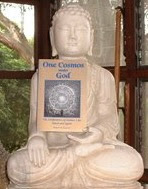
No, I'm not going wobbly on you, but I'd like to try to weave together the book we had been discussing -- The One and The Many -- with Father Rose's discussion of the soul after death.
Why? I don't know, just a little glass bead parlor game I like to play, that is, putting two random things side by side and seeing how they can be reconciled into a higher unity. For one thing, it helps me vault myself into the unKnown, beyond the edge of the subjective space I've already colonized. You might say it's my hobby. I mean, if you really only want Father Rose's take, you can always get his book.
Remember, all science -- including the science of God -- involves the reduction of multiplicity to unity, or in apprehending the unity underlying the multiplicity. But also, I feel as if I'm actually learning something if, instead of just rewordgitating someone else's work, I let the ingredients macerate in my own crockpot. I may well end up saying the same thing, but at least it will have my own grubby soulprint on it. It may be a crock, but at least it's my own.
As a matter of fact, much of this morbid discussion comes down to the question of whether the soul exists. If she does, then I don't think it's much of a stretch to say that she is nonlocal (both in space and time) and that she could under no absurcumstances result from a strictly blind material process. Therefore, the soul must continue after the event of biological death, or it's not much of a soul, now is it?
Before we veered in this new deadly direction, Bolton was just about to get into this. He notes that Descartes affirms the existence of the soul, but then diminishes its significance by equating it "with things the Scholastics would have called its accidents," that is, mere thoughts. This is in contrast to Aquinas, who maintained (correctly, in my opinion) that the soul must be an individual substance which determines "the nature of the whole person, independently of the conscious phenomena of thoughts and sensations they may entertain."
Now, most any person infected with the soul-killing virus of postmodernism will say that Aquinas is not only wrong, but that he cannot possibly be correct, since he is making an "essentialist" argument, and we all know that essences do not exist. There is no enduring self; rather, it's just a side effect -- a persistent illusion -- that is recreated on a moment-to-moment basis by brain activity. Thus, not only is it not unchanging, but it is always changing, until you croak. Like your body -- or better yet, like a whirlpool -- it is a function of its own activity. At this very moment we're all circling the drain, and soon enough we'll all be down it.
But for Aquinas, the soul is the form of the body; or, body is the substance of soul. The soul is its "immaterial type and causal principle," which is precisely the opposite of the postmodern view that insists the soul is the accidental expression of the body.
There are so many insurmountable problems with the latter view, that it could only gain traction in a world that has lost any sense of the wisdom and truth at its own origin and center. For to say that all is accident and contingency is to say that nothing can be known by nobody, and that there's no earthly reason to pretend to know it anyway.
This is a strictly insane worldview, which would make sanity a kind of insanity, since there would no ontological basis for any kind of stability or continuity, much less post-biological continuity. (Here again, the conservative project of honoring and conserving the "permanent things" is another word for sanity in a world gone mad with relativism and nihilism.)
I think this little preface is helpful, because it lays a foundation for some of the things Father Rose says, which otherwise might sound implausible. We left off with his account of the two angels who meet the newly reposed, like a couple of taxi drivers waiting down at the terminal when you disembark from the plane. I can see them now, holding an improvised cardboard sign saying GOODWIN. (People always add in the extra O.)
By the way, Father Rose makes the important point that while angels are immaterial in relation to us, they are material in relation to God; this accords with the idea of the "ray of creation" extending from the cosmic center to the periphery, and which becomes increasingly material the further it extends from the center. You will have no doubt noticed that as you develop spiritually, you become "lighter" and more "transparent," so to speak. You may become especially aware of it during a religious service, while meditating, doing hatha yoga, etc.
Father Rose next discusses the "visions of heaven" that are sometimes seen by dying people, and which are possibly false and misleading. Often, "these visions are not spiritual, but worldly. They are so quick, so easily attained, so common, so earthly in their imagery, that there can be no serious comparison of them with the Christian visions of heaven..." One immediately thinks of Islamist visions of the afterlife, -- the 72 virgins, and all the rest -- which are pure demonic fantasy disgorged from the primitive unconscious.
In order to provide some additional context, Father Rose next discusses "how man, having originally been capable of the sensuous perception of spirits, has generally lost this capacity as a result of the fall." Interestingly, "by a man's own means," he "can enter into communion with fallen spirits; but he cannot enter into communion with angels except by God's will."
Now, I don't think it matters whether one regards the Fall as literal or metaphorical, for the more important point is the perennial truth it conveys. And it is surely true that, for whatever reason, as a man develops spiritually, it is as if he recover a capacity to discern the spiritual world.
In a way, this is no more mysterious -- indeed, probably less so! -- than what happens to an infant. One of the first things I noticed about having a child is that it is literally like watching someone miraculously age in reverse -- like a person recovering from a crippling stroke. At first he's paralyzed, nonverbal, and incontinent; he can't walk, feed himself, or auto-regulate his emotions.
But it's not just a "physical" recovery. Rather, day by day, he enters the nonlocal human realm and discovers -- recovers? -- himSelf. And I believe -- no, I'm convinced -- that this is a lifelong process. That is, in a very real sense, life is the process of "becoming who you already are." Only someone who is profoundly and tragically alienated from himself is incapable of sensing this.
I might add that this is one of the seals of authenticity in genuine mental illness, e.g., a real depression or anxiety disorder. One of the most difficult aspects of depression is the loss of one's self, as it causes a kind of profound ontological -- and therefore spiritual -- disorientation. Everything that connected oneself to oneself and to the world suddenly goes dead -- as if someone cut the lines. All the signposts of meaning vanish, so that the world becomes flat and empty.
To me, that is death. In other words, "death" is not something that could occur "after" life, only "within" it. It's like they say -- the opposite of love is not hate, but indifference. To lose one's soul is to be dead, whenever it occurs.
To be continued....
Tuesday, December 15, 2009


Monday, December 14, 2009
Hey, What Happens When We Die?
After all these years, Walt finally reveals his agenda: forget all the peripheral stuff, "I want to hear more about the Person [and] the (real) individual." In short, what about Walt?
But you know what they say -- something to the effect that one letter to the editor is equivalent to maybe a thousand or so others who feel the same way. Just yesterday I was telling Mrs. G. that I really object to spiritual teachers who go wobbly at critical points, and evade the issue with gauzy platitudes -- or, at the other extreme, come up with some eccentric BS to paper over the gaps in their spiritual knowledge base. I can't tell you how often this happens. Or maybe you already know.
It was in the context of a discussion of What Happens When You Die?, which, when you think about it, is functionally equivalent to What About Walt?
I remember how it got started. In just the last few days, Tristan has been asking questions about death. He's certainly seen enough of it, since he's so obsessed with superheroes, and those guys leave an awful lot of bodies in their wake. I mentioned to Mrs. G. that the most clear, compelling, and unambiguous account I've ever read is by Father Serpahim Rose, who wrote a controversial book on the subject.
Two things about Father Rose's account: first, he pulls no punches, and is extremely straightforward. However, unlike the occult and paranormal new-age types who appear on Larry King, his is not an eccentric account that cannot be reconciled with tradition and collective experience. To the contrary, he undertook a careful study of the matter, from the earliest desert fathers to more recent luminaries such as Theophan the Recluse, in order to put forth a rather detailed vision that is surprising in its specificity, and yet, does not overreach and spookulate in the manner of new age pneumapaths.
And although his vision is undoubtedly "fantastical," all I can say is that it intuitively reasonated with me on a level beyond sense. It has the ring of Truth and Fire. He writes with a great deal of authority, and yet, like Schuon, I wouldn't call him "authoritarian." In fact, this is a common misconception in dealing with an enlightened or realized person.
Yes, like Paul Anka, their wisdom slices like a hammer, but the point is not to hurt but to help you -- to help break up knots, impasses, and blockages that are interfering with your inward mobility. If and when Cousin Dupree comes at you with his flame thrower, do run away. Even so, he never takes a corrective action merely for purposes of insultainment, but for inneratunement. The wise troll understands this and says thank you sir, may I have another?
Jesus himself came after people with a big ol' sword, and for you etymologists out there, you know that science is related to cut -- as in to cut reality right down the middle, between Truth and error, or Life and Death. Thus, any number of scientists are cut by their own sword, since they have no celestial idea of how to properly wield it. Like Charles Johnson, they grasp the wrong end, using it as a blunt instrument while bloodying their own soft and girlish hand.
I hope that all people, materialist and religious alike, can agree that if one confines oneself to this world, one will have a pretty paltry existence. Everyone -- and I mean everyone -- also lives on "the other side," for you couldn't do otherwise and still be human. In other words, heaven and earth -- the celestial and terrestrial -- clearly intersect, and humans spend most of their time at this intersection.
For example, the most materialistic scientist, if he has a passion for truth, actually has a passion for heaven. He is trying to enter that spherical realm that transcends and circumscribes the earth, and to understand it from a godlike perspective. To the extent that pursuing truth gives him "pleasure" -- which it surely does -- only a true moron would conflate this more subtle type of pleasure with lower types of merely hedonistic pleasure. Otherwise, why not eat pizza and ice cream all day instead of developing string theory, or working on the genome?
So Christianity merely takes this a bit further, into the first principles that also reveal our last ends. As Father Rose put it, it "tells us about what we are going to be doing in eternal life. It is to prepare us for something eternal, not of this world. If we think only about this world, our horizon is very limited, and we don't know what's after death, where we came from, where we're going, what's the purpose of life. When we talk about the beginning of things, or the end of things, we find out what our whole life is about."
As Damascene explains, one purpose of Father Rose's project was to present false teachings as clearly -- and fairly -- as possible, in order to expose their errors. One cannot say of him that he didn't give the devil his due. In fact, he begins with a survey of the contemporary "near death" and "out of body" literature, which surely has something to it, but is twisted and misunderstood by scoundrels who merely wish to sell books, not save souls.
Whatever else you can say of them, I don't think there is any serious question that people have had these experiences (their interpretation is another matter). Indeed, my own father had one after suffering an abdominal aneurysm, and my father-in-law -- who is and remains a devout atheist -- had one at the time he underwent a very risky open heart surgery. In his case, he was very aware of having a choice to "drift away" or "come back" at the conclusion of the procedure. Of course he chose the latter, just for spite.
Just kidding. But I can say that I don't think I've ever met anyone with such a fierce will to live.
As we all know, people who undergo these near death experiences often report roughly similar experiences of encountering "beings of light." Father Rose analyzes this evidence in light of Orthodox experience and doctrine -- both written and oral.
An important point: much of what Father Rose discusses is empirical, or at least phenomenological, nor could it be otherwise. This is true in studying any human reality, for example, what it feels like to be in love. In so doing, you have to take people at their word. You cannot study love "from the outside." Nor can the scientist who presumes to educate us about Man really have any idea what he's talking about unless he's at least kissed a girl. But enough about Charles Johnson.
As mentioned above, Father Rose does not equivocate. He does not patronize with warm platitudes. He does not go wobbly just when things are getting interesting. Thus, Tradition affirms that "the newly deceased is usually met by two angels.... The mission of these angels is to take the soul of the newly reposed on its journey into the afterlife. There is nothing vague about them, either in appearance or action; having a human appearance, they firmly grasp the 'subtle body' of the soul and conduct it away."
And then....
Damn! I hate to go wobbly on you at a critical juncture, but I'm flat out of time. To be continued.....
But you know what they say -- something to the effect that one letter to the editor is equivalent to maybe a thousand or so others who feel the same way. Just yesterday I was telling Mrs. G. that I really object to spiritual teachers who go wobbly at critical points, and evade the issue with gauzy platitudes -- or, at the other extreme, come up with some eccentric BS to paper over the gaps in their spiritual knowledge base. I can't tell you how often this happens. Or maybe you already know.
It was in the context of a discussion of What Happens When You Die?, which, when you think about it, is functionally equivalent to What About Walt?
I remember how it got started. In just the last few days, Tristan has been asking questions about death. He's certainly seen enough of it, since he's so obsessed with superheroes, and those guys leave an awful lot of bodies in their wake. I mentioned to Mrs. G. that the most clear, compelling, and unambiguous account I've ever read is by Father Serpahim Rose, who wrote a controversial book on the subject.
Two things about Father Rose's account: first, he pulls no punches, and is extremely straightforward. However, unlike the occult and paranormal new-age types who appear on Larry King, his is not an eccentric account that cannot be reconciled with tradition and collective experience. To the contrary, he undertook a careful study of the matter, from the earliest desert fathers to more recent luminaries such as Theophan the Recluse, in order to put forth a rather detailed vision that is surprising in its specificity, and yet, does not overreach and spookulate in the manner of new age pneumapaths.
And although his vision is undoubtedly "fantastical," all I can say is that it intuitively reasonated with me on a level beyond sense. It has the ring of Truth and Fire. He writes with a great deal of authority, and yet, like Schuon, I wouldn't call him "authoritarian." In fact, this is a common misconception in dealing with an enlightened or realized person.
Yes, like Paul Anka, their wisdom slices like a hammer, but the point is not to hurt but to help you -- to help break up knots, impasses, and blockages that are interfering with your inward mobility. If and when Cousin Dupree comes at you with his flame thrower, do run away. Even so, he never takes a corrective action merely for purposes of insultainment, but for inneratunement. The wise troll understands this and says thank you sir, may I have another?
Jesus himself came after people with a big ol' sword, and for you etymologists out there, you know that science is related to cut -- as in to cut reality right down the middle, between Truth and error, or Life and Death. Thus, any number of scientists are cut by their own sword, since they have no celestial idea of how to properly wield it. Like Charles Johnson, they grasp the wrong end, using it as a blunt instrument while bloodying their own soft and girlish hand.
I hope that all people, materialist and religious alike, can agree that if one confines oneself to this world, one will have a pretty paltry existence. Everyone -- and I mean everyone -- also lives on "the other side," for you couldn't do otherwise and still be human. In other words, heaven and earth -- the celestial and terrestrial -- clearly intersect, and humans spend most of their time at this intersection.
For example, the most materialistic scientist, if he has a passion for truth, actually has a passion for heaven. He is trying to enter that spherical realm that transcends and circumscribes the earth, and to understand it from a godlike perspective. To the extent that pursuing truth gives him "pleasure" -- which it surely does -- only a true moron would conflate this more subtle type of pleasure with lower types of merely hedonistic pleasure. Otherwise, why not eat pizza and ice cream all day instead of developing string theory, or working on the genome?
So Christianity merely takes this a bit further, into the first principles that also reveal our last ends. As Father Rose put it, it "tells us about what we are going to be doing in eternal life. It is to prepare us for something eternal, not of this world. If we think only about this world, our horizon is very limited, and we don't know what's after death, where we came from, where we're going, what's the purpose of life. When we talk about the beginning of things, or the end of things, we find out what our whole life is about."
As Damascene explains, one purpose of Father Rose's project was to present false teachings as clearly -- and fairly -- as possible, in order to expose their errors. One cannot say of him that he didn't give the devil his due. In fact, he begins with a survey of the contemporary "near death" and "out of body" literature, which surely has something to it, but is twisted and misunderstood by scoundrels who merely wish to sell books, not save souls.
Whatever else you can say of them, I don't think there is any serious question that people have had these experiences (their interpretation is another matter). Indeed, my own father had one after suffering an abdominal aneurysm, and my father-in-law -- who is and remains a devout atheist -- had one at the time he underwent a very risky open heart surgery. In his case, he was very aware of having a choice to "drift away" or "come back" at the conclusion of the procedure. Of course he chose the latter, just for spite.
Just kidding. But I can say that I don't think I've ever met anyone with such a fierce will to live.
As we all know, people who undergo these near death experiences often report roughly similar experiences of encountering "beings of light." Father Rose analyzes this evidence in light of Orthodox experience and doctrine -- both written and oral.
An important point: much of what Father Rose discusses is empirical, or at least phenomenological, nor could it be otherwise. This is true in studying any human reality, for example, what it feels like to be in love. In so doing, you have to take people at their word. You cannot study love "from the outside." Nor can the scientist who presumes to educate us about Man really have any idea what he's talking about unless he's at least kissed a girl. But enough about Charles Johnson.
As mentioned above, Father Rose does not equivocate. He does not patronize with warm platitudes. He does not go wobbly just when things are getting interesting. Thus, Tradition affirms that "the newly deceased is usually met by two angels.... The mission of these angels is to take the soul of the newly reposed on its journey into the afterlife. There is nothing vague about them, either in appearance or action; having a human appearance, they firmly grasp the 'subtle body' of the soul and conduct it away."
And then....
Damn! I hate to go wobbly on you at a critical juncture, but I'm flat out of time. To be continued.....
Sunday, December 13, 2009
Verbicide and Thought Control: If You Strike At the Word, Make Sure You Kill Him
How about a little Sunday Sermon at the Wee Church of Perpetual Slack, out on the edge of the vertical frontier?
The poor old cogitio -- I think therefore I am -- takes a lot of abuse, both from materialists and non-dualists, but Descartes was really just affirming a banality that is impossible to eradicate and live to see it: that the cleft between the exterior/objective and interior/subjective worlds is the most fundamental datum of our existence.
Monists at both extremes -- the materialists on the one hand, and the non-dualists on same one -- eliminate the duality, but at the expense of all qualities. For the materialist, the most sublime human virtues and qualities are secondary reflections of meaningless and impersonal electrical and chemical processes, while for the non-dualist they result from the deceptive play of maya.
But Bolton asks the question of whether the mind/matter or soul/world duality is "simply a falsehood, or is it a truth which is open to abuse?"
Good question, because most "heresies" -- including especially secular ones -- are not so much wrong as imbalanced or out of context. Often an error is merely an overemphasized but partial truth. For example we are surely material; but are we only material?
Likewise, mankind is indeed "one." But this hardly justifies socialism, since he is also -- and more fundamentally -- an individual. Similarly, it is surely a self-evident truth that human beings are "created equal." But contemporary liberals convert this to a lie in their tyrannical efforts to enforce their notions of material equality.
It is also common -- for it is one of Obama's primary rhetorical devices -- to convert an unwanted truth to a preferred lie by distorting it beyond recognition. Thus, people who support free enterprise are "greedy," or those who are skeptical of the pseudo-science of climate change are "anti-science."
Truly, there are many liberals who will never be forgiven for what they have done to the divine gift of language, for to abuse language is a kind of slow-motion genocide -- to say nothing of deicide; when you abuse words, you abuse the Word.
Nor can one harm language without damaging oneSelf. Often psychotherapy comes down to reconnecting words to emotional and psychic reality. It is fair to say that any psychopathology involves some significant disruption in the ability to mentalize experience through language. Sick people always have an unglishable secret life that is cordoned off from the reach of words.
Just remember: if you smite a king, you'd better make sure you kill him. And if you abuse language, you'd better make certain that you kill it dead, so that it is no longer possible to even think or say truth. Only if things no longer make sense can nonsensical things be forced upon you by the left.
This diabolical project is nearly complete in academia and the mass media, where the Lie reigns supreme. Dog around with these liars and you wake up fleeced. But the problem with any totalitarianism -- whether in its hard or soft forms -- is that any truth threatens the whole structure. It's like science, in which a single black swan disproves millions of observations that only white swans exist -- which is why in science, "consensus" is conformity and one man makes a majority.
There is something in the heart of the leftist that longs to be swaddled in certainty. Here again, this is not necessarily a bad thing, just a truth corrupted. For there is nothing more certain than the Absolute. Problems arise when human beings suppose that the Absolute abides on our side of creation. If it does, then man is God.
And historical experience reveals time and again that Man is a jealous god, for he doesn't like to be reminded that certain things are fundamentally outside his control, like, oh, let's say, the climate, or the economy, or the media.
It's so simple, really. For example, it only takes a single instance of something that defies the totalistic explanation of metaphysical Darwinism for it to be untrue. And there are any number of things that are not, and can never be, explained by Darwinism. Not only is ours an empirical argument, but a principial one. For example, a single instance of man knowing a transcendent truth falsifies the entire structure of materialism, whatever form it takes, both in fact and in principle.
Now, knowledge of any kind presupposes a relationship between knowing and being, or mind and essence. In other words, to say "knowledge" is to say "mind in communion with being." And not just communion, but union-in-difference, for only in difference can we "read out" what is implicit in the communion. (Not for nothing are knowledge and intercourse coonflated in Genesis; which is why the worst knowledge is still pretty damn Good.)
Here again, this is what I symbolize as O --> (k), which is not actually an abstraction, but as concrete a description as it is possible for human beings to have.
For this is actually a complementarity between whole and part, or a kind of spiraling vector flow of the former into the latter. Clearly, the one would be inconceivable in the absence of the other -- in other words, we couldn't know truth if we weren't at one with it, and yet, we also couldn't know it if we weren't separate from it.
Just as in the case of Love, it takes three to tango. Knower-Known-Knowledge is as irreducible as Lover-Love-Beloved. In each case, it is One for Three and Three for One.
You don't know me from the wind
You never will, you never did
I'm the little jew
who wrote the Bible
I've seen the nations rise and fall
I've heard their stories, heard them all
but love's the only engine of survival
Your servant here, he has been told
to say it clear, to say it cold:
It's over, it ain't going
any further
And now the wheels of heaven stop
you feel the devil's riding crop
Get ready for the future:
it is murder --Leonard Cohen, The Future
The poor old cogitio -- I think therefore I am -- takes a lot of abuse, both from materialists and non-dualists, but Descartes was really just affirming a banality that is impossible to eradicate and live to see it: that the cleft between the exterior/objective and interior/subjective worlds is the most fundamental datum of our existence.
Monists at both extremes -- the materialists on the one hand, and the non-dualists on same one -- eliminate the duality, but at the expense of all qualities. For the materialist, the most sublime human virtues and qualities are secondary reflections of meaningless and impersonal electrical and chemical processes, while for the non-dualist they result from the deceptive play of maya.
But Bolton asks the question of whether the mind/matter or soul/world duality is "simply a falsehood, or is it a truth which is open to abuse?"
Good question, because most "heresies" -- including especially secular ones -- are not so much wrong as imbalanced or out of context. Often an error is merely an overemphasized but partial truth. For example we are surely material; but are we only material?
Likewise, mankind is indeed "one." But this hardly justifies socialism, since he is also -- and more fundamentally -- an individual. Similarly, it is surely a self-evident truth that human beings are "created equal." But contemporary liberals convert this to a lie in their tyrannical efforts to enforce their notions of material equality.
It is also common -- for it is one of Obama's primary rhetorical devices -- to convert an unwanted truth to a preferred lie by distorting it beyond recognition. Thus, people who support free enterprise are "greedy," or those who are skeptical of the pseudo-science of climate change are "anti-science."
Truly, there are many liberals who will never be forgiven for what they have done to the divine gift of language, for to abuse language is a kind of slow-motion genocide -- to say nothing of deicide; when you abuse words, you abuse the Word.
Nor can one harm language without damaging oneSelf. Often psychotherapy comes down to reconnecting words to emotional and psychic reality. It is fair to say that any psychopathology involves some significant disruption in the ability to mentalize experience through language. Sick people always have an unglishable secret life that is cordoned off from the reach of words.
Just remember: if you smite a king, you'd better make sure you kill him. And if you abuse language, you'd better make certain that you kill it dead, so that it is no longer possible to even think or say truth. Only if things no longer make sense can nonsensical things be forced upon you by the left.
This diabolical project is nearly complete in academia and the mass media, where the Lie reigns supreme. Dog around with these liars and you wake up fleeced. But the problem with any totalitarianism -- whether in its hard or soft forms -- is that any truth threatens the whole structure. It's like science, in which a single black swan disproves millions of observations that only white swans exist -- which is why in science, "consensus" is conformity and one man makes a majority.
There is something in the heart of the leftist that longs to be swaddled in certainty. Here again, this is not necessarily a bad thing, just a truth corrupted. For there is nothing more certain than the Absolute. Problems arise when human beings suppose that the Absolute abides on our side of creation. If it does, then man is God.
And historical experience reveals time and again that Man is a jealous god, for he doesn't like to be reminded that certain things are fundamentally outside his control, like, oh, let's say, the climate, or the economy, or the media.
It's so simple, really. For example, it only takes a single instance of something that defies the totalistic explanation of metaphysical Darwinism for it to be untrue. And there are any number of things that are not, and can never be, explained by Darwinism. Not only is ours an empirical argument, but a principial one. For example, a single instance of man knowing a transcendent truth falsifies the entire structure of materialism, whatever form it takes, both in fact and in principle.
Now, knowledge of any kind presupposes a relationship between knowing and being, or mind and essence. In other words, to say "knowledge" is to say "mind in communion with being." And not just communion, but union-in-difference, for only in difference can we "read out" what is implicit in the communion. (Not for nothing are knowledge and intercourse coonflated in Genesis; which is why the worst knowledge is still pretty damn Good.)
Here again, this is what I symbolize as O --> (k), which is not actually an abstraction, but as concrete a description as it is possible for human beings to have.
For this is actually a complementarity between whole and part, or a kind of spiraling vector flow of the former into the latter. Clearly, the one would be inconceivable in the absence of the other -- in other words, we couldn't know truth if we weren't at one with it, and yet, we also couldn't know it if we weren't separate from it.
Just as in the case of Love, it takes three to tango. Knower-Known-Knowledge is as irreducible as Lover-Love-Beloved. In each case, it is One for Three and Three for One.
You don't know me from the wind
You never will, you never did
I'm the little jew
who wrote the Bible
I've seen the nations rise and fall
I've heard their stories, heard them all
but love's the only engine of survival
Your servant here, he has been told
to say it clear, to say it cold:
It's over, it ain't going
any further
And now the wheels of heaven stop
you feel the devil's riding crop
Get ready for the future:
it is murder --Leonard Cohen, The Future
Saturday, December 12, 2009
Omniscience, Contempt, and the Sealed World of the Left
This is kind of a rambly, free-associating post. Oh well, it's Saturday, so there's no need to adapt to the rigid style dictates of the Conspiracy.
As I have mentioned, I came to my senses in the usual way, initially going off the shallow end through atheism, liberalism, and non-dualism, before eventually recovering my sacred Slack. Indeed, even at the time I completed my book, I certainly didn't think of myself as any kind of "spiritual authority," so not only was I less willing to identify those self-styled gurus whom I now consider to be destructive frauds and con-men, but I probably still had one foot in that world. (I still don't think of myself as an authority, but I do have a clearer vision of the spiritual landscape, so I can better distinguish up from down.)
It's the same way with one's political philosophy. Most former liberals can testify to the difficulty of embracing and identifying with a group that one had previously demonized. In George Nash's excellent Reappraising the Right: The Past & Future of American Conservatism, he has a chapter on the history of neoconservatism. I had been aware of the broad outlines, but not all the details. Perhaps there is a fable in here.
Briefly, for those of you who don't know the whole story, the original neocons were a group of liberals who became increasingly disaffected with the Democrat party as it was gradually taken over by the left, in a process that was more or less complete with the nomination of the radical McGovern in 1972.
Specifically, the liberal neocons were disgusted by the rampant anti-Americanism of the left, along with their dangerously weak and naive foreign policy. Initially they attempted to reform the Democrats from within, by championing such people as Scoop Jackson and especially Daniel Patrick Moynihan. But by 1980, it dawned on them that it was a hopeless case, and that the Democrats were not going to deviate from becoming the regressive and reactionary clowns they are today.
Still, the neocons had a great deal of difficulty identifying with the conservative movement, and jumping in with both feet. One reason for this is that they were what you might call urban intellectual snobs. True, many were Jewish as well, but that doesn't so much go to religion as it does to education. Jews, since they are disproportionately educated, are quite naturally disproportionately indoctrinated in the strange ways of the left -- that is, if they are secular, or merely culturally Jewish. None of this applies to seriously religious Jews, such as Dennis Prager, who are overwhelmingly conservative.
Thus, for these men, there was a kind of double distrust of conservatism, since they were largely Jewish + intellectual, while much of the right is Christian + regular folks who live in the real world, not the abstract fantasy world of the liberal looniversity bin.
Also, the neocons disproportionately came from the world of the social sciences, whereas most conservative intellectuals were more literary men (in the old sense of the term, like a T.S. Eliot, not in the post-literate postmodern sense). As such, they still clung to the idea of the liberal welfare state (which had been given a huge boost by a corrupted sociology and psychology, and their odious Doctrine of the Immaculate Victim), only finally letting go of it when empirical proof came of its destructive nature with the publication of books such as Losing Ground, by Charles Murray. After that, there was no way one could remain a welfare state liberal and still live in reality. (In other words, they still needed scientific proof of the destructiveness of liberalism, as they were alienated from the religious and literary worlds of wisdom, whereby one knows truth intuitively and directly).
In hindsight, I think this is when we really see the Democrats become completely unhinged, to the point that it is no longer possible to have a rational conversation with a liberal. It's not even necessarily that they are dishonest, although many of course are. It's just that they live an a completely insular bubble, and feel superior to anyone who lives outside their secure little feeltank. Their main argument is not even an argument, just an attitude: contempt. It's so transparently childish: if Bush says it, it's contemptible; but if Obama says the same thing, it's brilliant and visionary.
Liberals affect the same attitude toward climate change skeptics, -- really, on most any issue. (While looking for the hockey game the other night, I caught a few minutes of Stephanie Miller on Larry King, cluelessly insisting that AGW was an unquestioned truth, and that anyone who thought otherwise was a contemptible tool of evil oil companies.) And they are able to get away with it because of a compliant media that shares the identical worldview, so they never learn how to argue. This is why they attack Fox and talk radio, because their very existence is an insult (and unconscious threat) to their omniscience. Conservatives routinely go on liberal programs such as Meet the Press, but it is impossible to imagine Obama submitting to an interview with Dennis Prager or Rush Limbaugh. It would truly be a battle of wits with an unarmed twit.
Again, I well remember this attitude, because I once held it. Yesterday I was talking with Mrs. G. about this. How, she asked, is it possible for these people to remain so sealed off from reality? I thought back about what I was like in the 1980s, when I was a Reagan-hating, NPR-listening, Nation-subscribing graduate student. Not only was I completely outside the reach of any conservative influences -- for back then there was only National Review, and that was about it -- but I sealed my fate with the reliable defense mechanism of contempt -- or what is called in the psychoanalytic literature "envy" or "devaluation" -- which is one of the most common means to maintain omnipotence.
Thus, if I had met a conservative, I would have simply had contempt for him, thereby relieving me of the need to take him seriously and actually engage his arguments. I mean, I was in a Ph.D. program! What are you, some kind of corporation-loving businessman? 'Nuff said! I remember one such conversation with a conservative. It occurred one morning on the graveyard shift, when I was still working in the supermarket. It was a 24 hour store, and we'd get two or three customers between midnight and six, at which time you'd have to stop what you were doing and mosey on up to the cash register.
Somehow, the customer and I got into a discussion of politics, and he calmly explained to me the economic miracles that were being unleashed before my very eyes, with Reagan's transformation of the economy -- however many consecutive quarters of extraordinary economic expansion, not to mention record tax revenues, which only failed to reduce the deficit because of a recalcitrant congress that would never have allowed significant government cuts.
But I literally could not hear the argument, and I mean that literally. It just didn't compute, because mine was a faith, not a philosophy. And not the good kind of faith, because it was not open but closed, in the manner of the atheist or Darwinist who reduces reality to his silly little monkey way of knowing it.
Er, remind me. Is there supposed to be some kind of fable here? Yes, well, to continue the story, it took even longer for the neocons to not only come to peace with the religious dimension, but to actually begin exploring and embracing it. Only in so doing can one become a truly deep thinker, so the irony is that these heretofore conventional intellectuals are now moving into the realm of what I call the "meta-intellectual," or perhaps "trans-intellectual," or mind in service to its transcendent source. Perhaps someday they will catch up with the neocoons, for we're nothing special, just people who enjoy living in reality in all its modes and dimensions, which, at the very least, must include mind, body, and Spirit.
As I have mentioned, I came to my senses in the usual way, initially going off the shallow end through atheism, liberalism, and non-dualism, before eventually recovering my sacred Slack. Indeed, even at the time I completed my book, I certainly didn't think of myself as any kind of "spiritual authority," so not only was I less willing to identify those self-styled gurus whom I now consider to be destructive frauds and con-men, but I probably still had one foot in that world. (I still don't think of myself as an authority, but I do have a clearer vision of the spiritual landscape, so I can better distinguish up from down.)
It's the same way with one's political philosophy. Most former liberals can testify to the difficulty of embracing and identifying with a group that one had previously demonized. In George Nash's excellent Reappraising the Right: The Past & Future of American Conservatism, he has a chapter on the history of neoconservatism. I had been aware of the broad outlines, but not all the details. Perhaps there is a fable in here.
Briefly, for those of you who don't know the whole story, the original neocons were a group of liberals who became increasingly disaffected with the Democrat party as it was gradually taken over by the left, in a process that was more or less complete with the nomination of the radical McGovern in 1972.
Specifically, the liberal neocons were disgusted by the rampant anti-Americanism of the left, along with their dangerously weak and naive foreign policy. Initially they attempted to reform the Democrats from within, by championing such people as Scoop Jackson and especially Daniel Patrick Moynihan. But by 1980, it dawned on them that it was a hopeless case, and that the Democrats were not going to deviate from becoming the regressive and reactionary clowns they are today.
Still, the neocons had a great deal of difficulty identifying with the conservative movement, and jumping in with both feet. One reason for this is that they were what you might call urban intellectual snobs. True, many were Jewish as well, but that doesn't so much go to religion as it does to education. Jews, since they are disproportionately educated, are quite naturally disproportionately indoctrinated in the strange ways of the left -- that is, if they are secular, or merely culturally Jewish. None of this applies to seriously religious Jews, such as Dennis Prager, who are overwhelmingly conservative.
Thus, for these men, there was a kind of double distrust of conservatism, since they were largely Jewish + intellectual, while much of the right is Christian + regular folks who live in the real world, not the abstract fantasy world of the liberal looniversity bin.
Also, the neocons disproportionately came from the world of the social sciences, whereas most conservative intellectuals were more literary men (in the old sense of the term, like a T.S. Eliot, not in the post-literate postmodern sense). As such, they still clung to the idea of the liberal welfare state (which had been given a huge boost by a corrupted sociology and psychology, and their odious Doctrine of the Immaculate Victim), only finally letting go of it when empirical proof came of its destructive nature with the publication of books such as Losing Ground, by Charles Murray. After that, there was no way one could remain a welfare state liberal and still live in reality. (In other words, they still needed scientific proof of the destructiveness of liberalism, as they were alienated from the religious and literary worlds of wisdom, whereby one knows truth intuitively and directly).
In hindsight, I think this is when we really see the Democrats become completely unhinged, to the point that it is no longer possible to have a rational conversation with a liberal. It's not even necessarily that they are dishonest, although many of course are. It's just that they live an a completely insular bubble, and feel superior to anyone who lives outside their secure little feeltank. Their main argument is not even an argument, just an attitude: contempt. It's so transparently childish: if Bush says it, it's contemptible; but if Obama says the same thing, it's brilliant and visionary.
Liberals affect the same attitude toward climate change skeptics, -- really, on most any issue. (While looking for the hockey game the other night, I caught a few minutes of Stephanie Miller on Larry King, cluelessly insisting that AGW was an unquestioned truth, and that anyone who thought otherwise was a contemptible tool of evil oil companies.) And they are able to get away with it because of a compliant media that shares the identical worldview, so they never learn how to argue. This is why they attack Fox and talk radio, because their very existence is an insult (and unconscious threat) to their omniscience. Conservatives routinely go on liberal programs such as Meet the Press, but it is impossible to imagine Obama submitting to an interview with Dennis Prager or Rush Limbaugh. It would truly be a battle of wits with an unarmed twit.
Again, I well remember this attitude, because I once held it. Yesterday I was talking with Mrs. G. about this. How, she asked, is it possible for these people to remain so sealed off from reality? I thought back about what I was like in the 1980s, when I was a Reagan-hating, NPR-listening, Nation-subscribing graduate student. Not only was I completely outside the reach of any conservative influences -- for back then there was only National Review, and that was about it -- but I sealed my fate with the reliable defense mechanism of contempt -- or what is called in the psychoanalytic literature "envy" or "devaluation" -- which is one of the most common means to maintain omnipotence.
Thus, if I had met a conservative, I would have simply had contempt for him, thereby relieving me of the need to take him seriously and actually engage his arguments. I mean, I was in a Ph.D. program! What are you, some kind of corporation-loving businessman? 'Nuff said! I remember one such conversation with a conservative. It occurred one morning on the graveyard shift, when I was still working in the supermarket. It was a 24 hour store, and we'd get two or three customers between midnight and six, at which time you'd have to stop what you were doing and mosey on up to the cash register.
Somehow, the customer and I got into a discussion of politics, and he calmly explained to me the economic miracles that were being unleashed before my very eyes, with Reagan's transformation of the economy -- however many consecutive quarters of extraordinary economic expansion, not to mention record tax revenues, which only failed to reduce the deficit because of a recalcitrant congress that would never have allowed significant government cuts.
But I literally could not hear the argument, and I mean that literally. It just didn't compute, because mine was a faith, not a philosophy. And not the good kind of faith, because it was not open but closed, in the manner of the atheist or Darwinist who reduces reality to his silly little monkey way of knowing it.
Er, remind me. Is there supposed to be some kind of fable here? Yes, well, to continue the story, it took even longer for the neocons to not only come to peace with the religious dimension, but to actually begin exploring and embracing it. Only in so doing can one become a truly deep thinker, so the irony is that these heretofore conventional intellectuals are now moving into the realm of what I call the "meta-intellectual," or perhaps "trans-intellectual," or mind in service to its transcendent source. Perhaps someday they will catch up with the neocoons, for we're nothing special, just people who enjoy living in reality in all its modes and dimensions, which, at the very least, must include mind, body, and Spirit.
Friday, December 11, 2009
The Selfishness of the Selfless
With regard to non-dualism, you may ask yourself, "what's in it for me"? The answer is, of course, bupkis. Not that one should adopt a religion solely for reasons of self-interest. Still, there's a limit, isn't there? For one may be unselfish without obliterating the self. In fact, one may only be unselfish if there is a self to push against. Without gravity holding us down, we could never jump and achieve vertical liftoff. Rather, we could only float around from nowhere to nothing.
One important area in which Christianity and non-dualism radically diverge is over the question of hope. In the former, not only is hope permitted, but it is one of the theological virtues. In contrast, in non-dualism there is nothing to hope for and no one to hope for it, for neither sappy hope nor the dopey hoper are within the scope of the Real.
A couple of days ago, some astute commenter -- Warren, it was -- mentioned that one of the benefits of non-dualism is that it authorizes one to indulge one's impulses without having to feel guilt or shame before the transcendent Other. Non-dualists may dispute this characterization, but they really don't have an ontological leg to stand on, for just who is doing the disputing? And just what are they pulling if we have no legs? (Not that there's anything wrong with that.)
Is it any wonder that the list of self-styled non-dualists and "independent gurus" who have set up shop in the West -- e.g., Da Free John, Chogyam Trungpa, Deepak Chopra, Krishnamurti, Rajneesh, and all the rest -- reveals a litany of duplicitous sexual, financial, and spiritual abuse? They are always -- either conveniently or inconveniently -- blindsided by the very desires they deny and claim to have transcended.
Are there Christians who engage in such bad behavior? Of course! But at least we are able to affirm that it is objectively and intrinsically wrong, and to ground morality in unchanging standards. Nor are there Christians who, after busted, claim that they are "crazy wise" spiritual teachers using paradoxical means to spur enlightenment in their followers -- you know, "it wasn't sexual abuse. I was just trying to teach the boy not to dissociate spiritual love from physical pleasure" or something. (Allen Ginsberg used to say this of the graduate students he sodomized.)
Bolton points out that if the non-dualists were correct, then there could be no objectively real developmental scale of being, especially as applied to human maturation. For them, "self development" could only mean a greater and more persistent reification of the very entity that causes all of the problems. To say "self development" would ultimately be indistinguishable from "illusion development," or "elaboration of the primal cosmic fantasy."
But that is not at all what happens in real psychospiritual development; rather, the opposite occurs. Indeed, I can see it in my own son, who came into the world a completely self-centered bundle of raging desires that needed to be satisfied now, if not sooner. He had no "self," no ego to moderate, transform, symbolize, or channel these impulses. Now that he has a blossoming little self, he is (becoming) kind, empathic, generous, and even capable of delaying his impulses, so he's already ahead of Tiger Woods on that score.
As Bolton puts it, "the degree of self-awareness which we have now does not, as such, make anyone self-centered unless it is corrupted. On the contrary, it makes one aware of self-centeredness as such, so that it can be corrected.... Only self-reflection can correct faults like self-centeredness. It would therefore follow that higher degrees of self-reflection should make possible so many higher degrees of unselfishness at the same time." Animals are never selfish or immoral, because nothing in them transcends their impulses and appetites. But enough about Hollywood liberals.
The non-dualist claims to trump Christian metaphysics, since the great scale of being of the latter is again ultimately subsumed into the realm of maya. But this, in my opinion, is one of the primary reasons why science either never developed or was prematurely quashed in these cultures. As Bolton writes, it is "the monistic schools of thought which can be seen to have the more limited option, that of confining the whole range of higher reality to the human state."
In other words, Christian metaphysics fills the gap between human and God with a whole hierarchy of spiritually real stations. There are only gaps in existence if we consider it from the bottom up -- e.g., the infinite ontological discontinuities between nothing and existence, matter and life, life and mind, etc. But if viewed from the top-down, the discontinuities vanish -- including ones we don't even know about until we arrive there through spiritual practice. Thanks to God, we are not "points" that vainly strive from the bottom up, but "lines" dangled from the top-down. If not for those lines, we could never be "fishers of men." There would be no exit from the closed circle of matter.
A human being can never totally "know himself," or he would be God, the Absolute. This is another way of saying that consciousness cannot know itself; or, it can know that it is, never what it is. Thus, there is surely "something self-contradictory about a supposedly absolute knowledge of God residing in an entity which cannot explain itself to itself," but rather, only extinguish the question by abolishing the questioner.
To paraphrase Bolton, disease is not cured by killing the patient. Unless Obamacare becomes law.
It seems that I barely get warmed up before it's time to go. To be continued...
One important area in which Christianity and non-dualism radically diverge is over the question of hope. In the former, not only is hope permitted, but it is one of the theological virtues. In contrast, in non-dualism there is nothing to hope for and no one to hope for it, for neither sappy hope nor the dopey hoper are within the scope of the Real.
A couple of days ago, some astute commenter -- Warren, it was -- mentioned that one of the benefits of non-dualism is that it authorizes one to indulge one's impulses without having to feel guilt or shame before the transcendent Other. Non-dualists may dispute this characterization, but they really don't have an ontological leg to stand on, for just who is doing the disputing? And just what are they pulling if we have no legs? (Not that there's anything wrong with that.)
Is it any wonder that the list of self-styled non-dualists and "independent gurus" who have set up shop in the West -- e.g., Da Free John, Chogyam Trungpa, Deepak Chopra, Krishnamurti, Rajneesh, and all the rest -- reveals a litany of duplicitous sexual, financial, and spiritual abuse? They are always -- either conveniently or inconveniently -- blindsided by the very desires they deny and claim to have transcended.
Are there Christians who engage in such bad behavior? Of course! But at least we are able to affirm that it is objectively and intrinsically wrong, and to ground morality in unchanging standards. Nor are there Christians who, after busted, claim that they are "crazy wise" spiritual teachers using paradoxical means to spur enlightenment in their followers -- you know, "it wasn't sexual abuse. I was just trying to teach the boy not to dissociate spiritual love from physical pleasure" or something. (Allen Ginsberg used to say this of the graduate students he sodomized.)
Bolton points out that if the non-dualists were correct, then there could be no objectively real developmental scale of being, especially as applied to human maturation. For them, "self development" could only mean a greater and more persistent reification of the very entity that causes all of the problems. To say "self development" would ultimately be indistinguishable from "illusion development," or "elaboration of the primal cosmic fantasy."
But that is not at all what happens in real psychospiritual development; rather, the opposite occurs. Indeed, I can see it in my own son, who came into the world a completely self-centered bundle of raging desires that needed to be satisfied now, if not sooner. He had no "self," no ego to moderate, transform, symbolize, or channel these impulses. Now that he has a blossoming little self, he is (becoming) kind, empathic, generous, and even capable of delaying his impulses, so he's already ahead of Tiger Woods on that score.
As Bolton puts it, "the degree of self-awareness which we have now does not, as such, make anyone self-centered unless it is corrupted. On the contrary, it makes one aware of self-centeredness as such, so that it can be corrected.... Only self-reflection can correct faults like self-centeredness. It would therefore follow that higher degrees of self-reflection should make possible so many higher degrees of unselfishness at the same time." Animals are never selfish or immoral, because nothing in them transcends their impulses and appetites. But enough about Hollywood liberals.
The non-dualist claims to trump Christian metaphysics, since the great scale of being of the latter is again ultimately subsumed into the realm of maya. But this, in my opinion, is one of the primary reasons why science either never developed or was prematurely quashed in these cultures. As Bolton writes, it is "the monistic schools of thought which can be seen to have the more limited option, that of confining the whole range of higher reality to the human state."
In other words, Christian metaphysics fills the gap between human and God with a whole hierarchy of spiritually real stations. There are only gaps in existence if we consider it from the bottom up -- e.g., the infinite ontological discontinuities between nothing and existence, matter and life, life and mind, etc. But if viewed from the top-down, the discontinuities vanish -- including ones we don't even know about until we arrive there through spiritual practice. Thanks to God, we are not "points" that vainly strive from the bottom up, but "lines" dangled from the top-down. If not for those lines, we could never be "fishers of men." There would be no exit from the closed circle of matter.
A human being can never totally "know himself," or he would be God, the Absolute. This is another way of saying that consciousness cannot know itself; or, it can know that it is, never what it is. Thus, there is surely "something self-contradictory about a supposedly absolute knowledge of God residing in an entity which cannot explain itself to itself," but rather, only extinguish the question by abolishing the questioner.
To paraphrase Bolton, disease is not cured by killing the patient. Unless Obamacare becomes law.
It seems that I barely get warmed up before it's time to go. To be continued...
Thursday, December 10, 2009
I AM is Somebody
Chapter four of The One and the Many discusses the well known fallacy of ignotum per ignotius. Need I say more?
Er, yes. Actually, I had never heard of this fallacy prior to reading this book, but it's a big one that infects bad philosophies at the very foundation. And exactly what is it? It involves "an unknown thing supposedly being made known by means of some other unknown thing" -- like two negatives adding up to a positive. (The most extreme case must be the postmodernist who claims that "nothing can be known and I know it!)
As we have discussed in the past, science proceeds from the known to the unknown, i.e., (k) --> O, whereas religious practice proceeds from the unknown to the known, or O --> (n); or, on a slightly more concrete plane, you could say that science proceeds from facts to principles, whereas religion proceeds from principles to facts.
According to Bolton, "Genuine explanations relate the unknown factor to one which is already understood, while the more superficial ones relate it to something familiar, though not well understood."
To rip an example from the headlines, look at the intrinsic fallacies involved in the tautological science of "climate change" (climate stasis -- now there would be a novel theory!). The warmystics take something with which they are familiar -- their computer models -- and substitute it for something they want to understand -- the "global climate." But as Bolton says, "unfortunately, familiarity can be confused with understanding, and in such cases, things can appear to be understood when they are not." For example, I am familiar with electricity. But I would only be pretending if I said I understood it.
If I may take the liberty of translighting Bolton into plain english, the nondualists try to explain reality, which they do not understand, with reference to consciousness, which they also do not understand. Voila! Perfect understanding.
B-b-b-but hold on a sec. The fallacy here is that nondualism "aims at a state of awareness, which is taken to be an ideal despite the fact that a non-self-aware consciousness is in any case the normal condition of nearly all forms of animal life." Indeed, this is the case for the great majority of human beings, most especially the further we travel into the past or the left, when people were "aware of themselves more as members of races or tribes than as individuals."
In fact, in a patented, non-greasy formula I have applied at length, "developmental time = cultural space," so that different nations, cultures, and subcultures reflect differing levels of psychospiritual development. As Bolton puts it, "Insofar as we can understand past cultures, it appears that large numbers of ordinary people in the last few millennia had little awareness of their own egos, not through any spiritual practice, but simply through ignorance. And yet, despite such facts, monists and non-dualists look to this twilight zone of consciousness as though it were the embodiment of some fine ideal" (emphasis mine).
As a psychologist who often deals with these types of human beings, I can assure you that they're out there -- people who have not yet reached the stage at which their self can be an object to itself. I don't like to say this, only because willfully malevolent assouls take it the wrong way, but these people occupy a shadowy zone somewhere between animal and human. Either that, or some people are "supermen," like a new species that has emerged from the soil of the humanimal hybrid. (To be clear, I don't agree with either characterization.)
Bolton touches on a subject that is central to my thinking, and arises out of my understanding of developmental psychoanalysis. Specifically, there is no doubt in my mind that human consciousness unfolds along a developmental coontinuum, and that it has a telos, or purpose, just as in the case of any other organ; it is just that this organ -- consciousness -- happens to be nonlocal and hyperdimensional instead of local, material, and fixed in four dimensions.
Non-dualists (and one could easily add multiculturalists, moral relativists, and romantic anthropologists), according to Bolton, "ignore the fact that self-aware consciousness is the highest kind of consciousness in this world, and regard it as a burden instead, and envy what they take to be the unreflecting peace of the backward parts of mankind among whom tribalism rules."
Well, first of all, it is a burden. Duh! It's not a struggle to be as stupid as Harry Reid or Barbara Boxer, who "travel light," if you catch my drift. I am reminded of when William F. Buckley was asked why he always remained seated during his television program -- something to the effect of, Because of the great weight of what I know. Who wouldn't want to cast this burdensome knowledge aside and go native once in awhile? But that's what beer is for. As Toots Mondello taught us, you can't spell "beer" without BE. Which is why he was always 'AMmered.
This is something I simply cannot accept: that the human subject, with all its marvelous abilities, is just a "a spiritual dead-end," as Bolton puts it, or a nul de slack as Petey does. Is it really that simple? That the modern self that is painstakingly won from the formless and infinite void should just be tossed back there like a little fish?
This is like saying that the human organism, in all its infinite complexity, is really of no more ultimate value than a simple rock star. Does the arrow of spiritual development really point down and back, to a "place" where humans never existed?
Not for me, and not for Bolton, who asks, "What if these higher orders of self-awareness could become as concretely real as the one we already possess? In that case, the path of spiritual advance would move into ever-greater complexity, not into reduction. The fact that man has a self-aware consciousness, even if only one degree of it, confirms the belief that he belongs to the order of spirits."
One important caveat, however. In my belief and experience, "complex" is not synonymous with "complicated." To the contrary, the more spiritually advanced the person, the more simple and transparent -- not to mention humble -- they become. Why? Because they have successfully incorporated and assimilated more consciousness into a higher dynamic unity, with fewer split-off and semi-autonomous parts at cross-purposes with oneself. In contrast, complicated and convoluted people -- the beasts of high maintenance -- are almost always "unspiritual," because they lack the wholeness -- both in time and space -- to truly embody the spiritual. So,
If your I be single, your whole body will be full of light.
Er, yes. Actually, I had never heard of this fallacy prior to reading this book, but it's a big one that infects bad philosophies at the very foundation. And exactly what is it? It involves "an unknown thing supposedly being made known by means of some other unknown thing" -- like two negatives adding up to a positive. (The most extreme case must be the postmodernist who claims that "nothing can be known and I know it!)
As we have discussed in the past, science proceeds from the known to the unknown, i.e., (k) --> O, whereas religious practice proceeds from the unknown to the known, or O --> (n); or, on a slightly more concrete plane, you could say that science proceeds from facts to principles, whereas religion proceeds from principles to facts.
According to Bolton, "Genuine explanations relate the unknown factor to one which is already understood, while the more superficial ones relate it to something familiar, though not well understood."
To rip an example from the headlines, look at the intrinsic fallacies involved in the tautological science of "climate change" (climate stasis -- now there would be a novel theory!). The warmystics take something with which they are familiar -- their computer models -- and substitute it for something they want to understand -- the "global climate." But as Bolton says, "unfortunately, familiarity can be confused with understanding, and in such cases, things can appear to be understood when they are not." For example, I am familiar with electricity. But I would only be pretending if I said I understood it.
If I may take the liberty of translighting Bolton into plain english, the nondualists try to explain reality, which they do not understand, with reference to consciousness, which they also do not understand. Voila! Perfect understanding.
B-b-b-but hold on a sec. The fallacy here is that nondualism "aims at a state of awareness, which is taken to be an ideal despite the fact that a non-self-aware consciousness is in any case the normal condition of nearly all forms of animal life." Indeed, this is the case for the great majority of human beings, most especially the further we travel into the past or the left, when people were "aware of themselves more as members of races or tribes than as individuals."
In fact, in a patented, non-greasy formula I have applied at length, "developmental time = cultural space," so that different nations, cultures, and subcultures reflect differing levels of psychospiritual development. As Bolton puts it, "Insofar as we can understand past cultures, it appears that large numbers of ordinary people in the last few millennia had little awareness of their own egos, not through any spiritual practice, but simply through ignorance. And yet, despite such facts, monists and non-dualists look to this twilight zone of consciousness as though it were the embodiment of some fine ideal" (emphasis mine).
As a psychologist who often deals with these types of human beings, I can assure you that they're out there -- people who have not yet reached the stage at which their self can be an object to itself. I don't like to say this, only because willfully malevolent assouls take it the wrong way, but these people occupy a shadowy zone somewhere between animal and human. Either that, or some people are "supermen," like a new species that has emerged from the soil of the humanimal hybrid. (To be clear, I don't agree with either characterization.)
Bolton touches on a subject that is central to my thinking, and arises out of my understanding of developmental psychoanalysis. Specifically, there is no doubt in my mind that human consciousness unfolds along a developmental coontinuum, and that it has a telos, or purpose, just as in the case of any other organ; it is just that this organ -- consciousness -- happens to be nonlocal and hyperdimensional instead of local, material, and fixed in four dimensions.
Non-dualists (and one could easily add multiculturalists, moral relativists, and romantic anthropologists), according to Bolton, "ignore the fact that self-aware consciousness is the highest kind of consciousness in this world, and regard it as a burden instead, and envy what they take to be the unreflecting peace of the backward parts of mankind among whom tribalism rules."
Well, first of all, it is a burden. Duh! It's not a struggle to be as stupid as Harry Reid or Barbara Boxer, who "travel light," if you catch my drift. I am reminded of when William F. Buckley was asked why he always remained seated during his television program -- something to the effect of, Because of the great weight of what I know. Who wouldn't want to cast this burdensome knowledge aside and go native once in awhile? But that's what beer is for. As Toots Mondello taught us, you can't spell "beer" without BE. Which is why he was always 'AMmered.
This is something I simply cannot accept: that the human subject, with all its marvelous abilities, is just a "a spiritual dead-end," as Bolton puts it, or a nul de slack as Petey does. Is it really that simple? That the modern self that is painstakingly won from the formless and infinite void should just be tossed back there like a little fish?
This is like saying that the human organism, in all its infinite complexity, is really of no more ultimate value than a simple rock star. Does the arrow of spiritual development really point down and back, to a "place" where humans never existed?
Not for me, and not for Bolton, who asks, "What if these higher orders of self-awareness could become as concretely real as the one we already possess? In that case, the path of spiritual advance would move into ever-greater complexity, not into reduction. The fact that man has a self-aware consciousness, even if only one degree of it, confirms the belief that he belongs to the order of spirits."
One important caveat, however. In my belief and experience, "complex" is not synonymous with "complicated." To the contrary, the more spiritually advanced the person, the more simple and transparent -- not to mention humble -- they become. Why? Because they have successfully incorporated and assimilated more consciousness into a higher dynamic unity, with fewer split-off and semi-autonomous parts at cross-purposes with oneself. In contrast, complicated and convoluted people -- the beasts of high maintenance -- are almost always "unspiritual," because they lack the wholeness -- both in time and space -- to truly embody the spiritual. So,
If your I be single, your whole body will be full of light.
Wednesday, December 09, 2009
The New Sons of Liberty and the Cosmic Scofflaws of the Left
Judging by the comments, it seems that many readers are already aware of the relationship between metaphysics and political philosophy. Again: get the first question wrong, and everything else follows with it. Not only must you get your ontology straight, but also your anthropology. Otherwise you step into the abyss, which is what virtually every government did prior to the establishment of the United States.
I'm currently reading an outstanding book on this very subject, We Still Hold These Truths: Rediscovering Our Principles, Reclaiming Our Future (it must be temporarily out of print, because it shouldn't be nearly that expensive, but it is highly recommended when the price comes down). I'm going to try to weave in some of Spalding's insights as we further discuss Bolton's critique of nondualism -- which, if the latter forms the basis of one's ontology, leads to a radically different conception of politics, being that it eliminates the individual, whereas America's founders were precisely concerned with protecting the individual and allowing him to flourish.
In so doing, the Founders thought deeply about how and where to ground individual liberty. In other words, to simply affirm liberty without grounding it in something metaphysically real is no less rootless or self-serving than to affirm the absolute right of your leftist neighbor to the fruits of your labors. And if "all is one" -- if the individual is an illusion -- then your neighbor surely has that right. If I am you and you are me, then hey, your stuff is mine. Party at Deepak's walled compound! Dibs on the ruby eyeglasses!
Spalding quotes John Adams, who was responding to a question about the real meaning of the American Revolution: "The revolution was in the minds and hearts of the people.... This radical change in the principles, opinions, sentiments and affections of the people was the real American Revolution." In other words, this was primarily an interior revolution; nor could it have been successful if this hadn't been the case, for merely exterior revolutions -- as nearly all revolutions are -- only bring about a new set of tyrants.
And it is of course highly higher and highestly important to again emphasize that conservatism is interior and interiorizing whereas leftism is exterior and exteriorizing (i.e., the latter diminishes free will, effaces the individual by reducing him to a group member [e.g., black, female, homosexual, etc.] and promotes his passive victimhood).
Again, consider the stark epistemological consequences that follow from the different ontologies of left and right: "[A]mong the learned elites of our universities and law schools -- those who teach the next generation, shape our popular culture, and set the terms of our political discourse -- the self-evident truths upon which America depends have been supplanted by the passionately held belief that no such truths exist, certainly no truths applicable to all time" (Spalding).
Which is why, ever since this truly sinister metaphysic has become common currency, the federal government can today act "with little regard for the limits placed upon it by the Constitution, which many now regard as obsolete." The leftist assault on the Constitution has been so thorough, that to even point out the truism that a government takeover of healthcare is shockingly unconstitutional is to auto-marginalize oneself.
In other words, for the left, to be American is to be un-American. Obama himself was uncharacteristically honest in acknowledging his belief that America's founders "got it wrong" in their failure to address the issue of material inequality (which, of course, they did address by creating a system through which the self-interest of the individual could freely operate to the benefit of all).
America was intended to be the "workshop of liberty," not the sweatshop of collectivist serfdom. Ironically, Obama is the one public official who swears to God that he is a conservative -- that he will preserve and protect the Constitution, not allow it to be maimed by the tenured pettifuggers of the left.
It is no coincidence whatsoever that the left must eradicate any trace of religion in order to eliminate the principle barrier (along with the sanctity of private property and the family, and the chrome to back them up) to the intrusive and acquisitive reach of the state.
For to affirm God is to sharply limit the state; indeed, it is to affirm that the state and its laws have no legitimacy to the extent that they contravene the transpolitical Laws of Nature and of Nature's God (as the Declaration expresses it). We have no obligation to obey laws that are fundamentally immoral.
For the Founders, "the idea of human dignity, that we are created in the image of God, forms the theological underpinning of the ideas of human nature and human equality -- core principles of liberty" (Spalding). Which is why, for the ACLU and its fellow travelers, the Constitution is unconstitutional. And which is why they feel so free to change it into something more congenial to their interests. But a Constitution that doesn't mean what is says and say what it means, merely means what powerful men want it to mean, and we are right back to the Rule of Men, not of Law. Which, of course, is the whole point of the left.
But metaphysical conservatism stands athwart the left and says STFU! Here is how John Dickenson put it back in the day (1766): the rights essential to human happiness "are created in us by the decrees of Providence, which establish the laws of our nature. They are born with us; exist with us; and cannot be taken from us by any human power, without taking our lives. In short, they are founded on the immutable maxims of reason and justice" (quoted in Spalding).
Radical then, radical now. In this wide-angle cosmic context, one can see that the leftist counter-revolutionaries are entirely reactionary. Job one for them is to undo what the Founders done did.
Note as well that Nature's Law, as understood by the Founders, obviously did not -- and could not -- apply only to America. Rather, to the extent that it was true, then it was true for all time and for all peoples and even humanities departments. So much for diversity and multiculturalism!
In this regard, Spalding references William Blackstone -- a deep influence on the Founders' thinking -- who wrote that the metacosmic law "is of course superior in obligation to any other. It is binding over all the globe, in all countries, and at all times; and such of them as are valid derive all their force, and all their authority, mediately or immediately, from this original."
Thus, real conservatism is simply impossible -- for it is grounded in "nothing" -- if its archetypal, transpolitical roots are not perpetually watered from above.
I'm currently reading an outstanding book on this very subject, We Still Hold These Truths: Rediscovering Our Principles, Reclaiming Our Future (it must be temporarily out of print, because it shouldn't be nearly that expensive, but it is highly recommended when the price comes down). I'm going to try to weave in some of Spalding's insights as we further discuss Bolton's critique of nondualism -- which, if the latter forms the basis of one's ontology, leads to a radically different conception of politics, being that it eliminates the individual, whereas America's founders were precisely concerned with protecting the individual and allowing him to flourish.
In so doing, the Founders thought deeply about how and where to ground individual liberty. In other words, to simply affirm liberty without grounding it in something metaphysically real is no less rootless or self-serving than to affirm the absolute right of your leftist neighbor to the fruits of your labors. And if "all is one" -- if the individual is an illusion --
 then your neighbor surely has that right. If I am you and you are me, then hey, your stuff is mine. Party at Deepak's walled compound! Dibs on the ruby eyeglasses!
Spalding quotes John Adams, who was responding to a question about the real meaning of the American Revolution: "The revolution was in the minds and hearts of the people.... This radical change in the principles, opinions, sentiments and affections of the people was the real American Revolution." In other words, this was primarily an interior revolution; nor could it have been successful if this hadn't been the case, for merely exterior revolutions -- as nearly all revolutions are -- only bring about a new set of tyrants.
And it is of course highly higher and highestly important to again emphasize that conservatism is interior and interiorizing whereas leftism is exterior and exteriorizing (i.e., the latter diminishes free will, effaces the individual by reducing him to a group member [e.g., black, female, homosexual, etc.] and promotes his passive victimhood).
Again, consider the stark epistemological consequences that follow from the different ontologies of left and right: "[A]mong the learned elites of our universities and law schools -- those who teach the next generation, shape our popular culture, and set the terms of our political discourse -- the self-evident truths upon which America depends have been supplanted by the passionately held belief that no such truths exist, certainly no truths applicable to all time" (Spalding).
Which is why, ever since this truly sinister metaphysic has become common currency, the federal government can today act "with little regard for the limits placed upon it by the Constitution, which many now regard as obsolete." The leftist assault on the Constitution has been so thorough, that to even point out the truism that a government takeover of healthcare is shockingly unconstitutional is to auto-marginalize oneself.
In other words, for the left, to be American is to be un-American. Obama himself was uncharacteristically honest in acknowledging his belief that America's founders "got it wrong" in their failure to address the issue of material inequality (which, of course, they did address by creating a system through which the self-interest of the individual could freely operate to the benefit of all).
America was intended to be the "workshop of liberty," not the sweatshop of collectivist serfdom. Ironically, Obama is the one public official who swears to God that he is a conservative -- that he will preserve and protect the Constitution, not allow it to be maimed by the tenured pettifuggers of the left.
It is no coincidence whatsoever that the left must eradicate any trace of religion in order to eliminate the principle barrier (along with the sanctity of private property and the family, and the chrome to back them up) to the intrusive and acquisitive reach of the state.
For to affirm God is to sharply limit the state; indeed, it is to affirm that the state and its laws have no legitimacy to the extent that they contravene the transpolitical Laws of Nature and of Nature's God (as the Declaration expresses it). We have no obligation to obey laws that are fundamentally immoral.
For the Founders, "the idea of human dignity, that we are created in the image of God, forms the theological underpinning of the ideas of human nature and human equality -- core principles of liberty" (Spalding). Which is why, for the ACLU and its fellow travelers, the Constitution is unconstitutional. And which is why they feel so free to change it into something more congenial to their interests. But a Constitution that doesn't mean what is says and say what it means, merely means what powerful men want it to mean, and we are right back to the Rule of Men, not of Law. Which, of course, is the whole point of the left.
But metaphysical conservatism stands athwart the left and says STFU! Here is how John Dickenson put it back in the day (1766): the rights essential to human happiness "are created in us by the decrees of Providence, which establish the laws of our nature. They are born with us; exist with us; and cannot be taken from us by any human power, without taking our lives. In short, they are founded on the immutable maxims of reason and justice" (quoted in Spalding).
Radical then, radical now. In this wide-angle cosmic context, one can see that the leftist counter-revolutionaries are entirely reactionary. Job one for them is to undo what the Founders done did.
Note as well that Nature's Law, as understood by the Founders, obviously did not -- and could not -- apply only to America. Rather, to the extent that it was true, then it was true for all time and for all peoples and even humanities departments. So much for diversity and multiculturalism!
In this regard, Spalding references William Blackstone -- a deep influence on the Founders' thinking -- who wrote that the metacosmic law "is of course superior in obligation to any other. It is binding over all the globe, in all countries, and at all times; and such of them as are valid derive all their force, and all their authority, mediately or immediately, from this original."
Thus, real conservatism is simply impossible -- for it is grounded in "nothing" -- if its archetypal, transpolitical roots are not perpetually watered from above.
Subscribe to:
Posts (Atom)
Theme Song