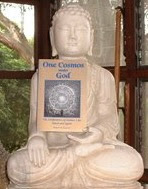
A post from two years ago, with some further reflections.... I apologize for the length, but I got carried away for a minute. If you only want to read the new parts, they more or less end with the asterisks.
Magnus left a comment yesterday: "Bob, you write about how you recognized Schuon as a vehicle of grace, but you don't agree with everything he says, and he sure wouldn't have agreed with everything of what you say. It mildly amuses me that this sums up how I relate to you. I see some things quite differently, but that never held me back from riding your spiritual coat tails. I am not in a position to only buy lamp oil from people I agree with in all things."
Yesterday a re-quest popped into my head -- or was it an order? -- follow the depth. That's pretty much what I try to do, irrespective of the discipline or source, in that each post is simply a spontaneously rewordgitated murmurandom from the deep space of vertical understanding. I assume it's the same way with you, in that there's something in us that is not only able to distinguish truth from falsehood on the horizontal axis in the cØnventional way, but also on the vertical axis in the cʘʘnvisional way.
For me, everything revolves around this thing called "understanding." This is true for everyone, theist and atheist alike. Humans "understand" stuff, and then pass along that understanding to others. However, it's not just that human beings understand different things, but that understanding itself takes place at differing levels of depth. It is axiomatic that something can be true on a shallow level but false on a deeper level. Therefore, if you want to prevent people from knowing about that deeper truth, you don't have to even argue. Rather, all you have to do is erect a barrier to depth. We call this barrier "public education," and we call the trolls who man the barriers "the tenured."
A few moments ago I was searching through the June 2007 arkive for a repost, but didn't find much that moved me. Which is odd when you think about it, because I'm the one who wrote the stuff, so why should I be moved by my own writing? The problem is, I found most of it to be "too understandable." It was like "blah blah blah, bob bob bob." As I mentioned last Sunday, I was experiencing some sort of disturbance in the force that month, which was making it difficult to blog. I mean, I could still do it, but not at the level of depth to which I am accustomed. I could not "surpass myself," so to speak. Rather, I could only "achieve myself," which isn't saying much.
Here is what I mean. I'm trying to shed some obscurity on that transient moment when this delightful thing called "understanding" takes place, as understanding is the gateway to depth. Back when I was in school, I rarely had this feeling. If anything, school was a systematic way to bypass the whole magical world of understanding.
Perhaps I should clarify. When I talk about "understanding," I am actually talking about realization, not a mere transfer of information from mind to mind. It takes no intelligence or skill to transmit facts, nor does it require a realization on the part of the receiver.
But most everything I write about is intended to transmit a kind of living realization that takes place in the moment -- not just for you, but for me as well. This is why it cannot be planned ahead of time, because if it were, it would tend to become fact-based instead of realization-based.
Here again, I am totally indebted to Bion for showing me the way in this regard. One of his central points was that undergoing psychotherapy was not an educative process. It's not as if the analyst is the teacher and the patient is the student, and all the analyst has to do is reeducate the patient. If that were true, you could just read a book and be "cured."
Rather, the trick is that the patient must realize the truths of psychoanalysis as they pertain to him specifically. This is why Bion conceptualized the overall therapeutic situation as O. To even say that there is a patient and a doctor is to pretend to know what O is, and to defensively prevent it from emerging in a spontaneous way.
Are you following me? Do you understand so far?
So if you were in therapy with Bion, he would not see a "patient." Rather, there would only be this field of O that is co-created by the participants and which undergoes transformations and disturbances of various kinds. The therapist comments on the disturbances, the patient comments on the comments, etc. It's all spontaneously unfolding and evolving now. Very jazz-like, come to think of it.
As I have mentioned before, in my book, I simply applied the same idea to the realm of Spirit. Last week I quoted Gurdjieff, who said that I have very good leather to sell to those who wish to make shoes. Do you see the point? He doesn't sell shoes. Rather, he only sells the good leather for you to make your own shoes, which is to say, to have a realization. Paradoxically, if he gives you the shoes, you cannot have the leather!
But it is absolutely no different with religion: if someone gives you the answer, you can't have it. It will be like a museum piece, or like a couch covered with plastic, or like a toe with no body attached. You want a toe? I can get you a toe, believe me. There are ways, people. You don't wanna know about it, believe me. Hell, I can get you a toe by 3 o'clock this afternoon... with nail polish.
But so what? What are you going to do with it? Keep it on your mantle?
Oh, you want a fossil of the "missing link," is that it? Hell, I can get you one of those too. But what good is a fossil if you don't even realize what a human being is? LGF. Fuckin' amateurs....
***Back to the post as it appeared two years ago:
On the horizontal axis, things are either true or false in the unambiguous scientific sense. But only on the vertical axis can you get into "profound truths," some of which might even superficially contradict one another. This, of course, is one of the fundamental errors of atheism and other misosophies. One of the reasons the vast majority of normal people reject atheism is that it's so trite and shallow. Our vertical truth detector knows that nothing can be that simplistic, let alone everything.
A profound truth is one that qualitatively ties together and organizes a greater quantity of phenomena on both the inner and outer planes. Thus, the more shallow the level, the more truths multiply; whereas the deeper one ventures, the more all-encompassing the truth, until one finally arrives at the One Truth: "to know much, you must know little" (and vice versa).
But even then it's not that simple, because on the vertical axis truths can be expressed in such a way that they "carry their own depth." Or, you might say that they simultaneously elucidate and demonstrate. The sayings of Jesus are quintessential in this regard. When he speaks, he is not just talking about the vertical, but at the same time showing it to you, tying together the interior and exterior dimensions of reality. After all, he is the vertical made horizontal, so to speak.
This is more or less what I meant about Schuon being a vehicle of grace, in that he too has the power to "make present" that of which he is speaking, which is always more or less O, approached from a multitude of vectors. As he put it in the preface to one of his books, "Metaphysics aims in the first place at the comprehension of the whole Universe, which extends from the Divine Order to terrestrial contingencies." Further, this order offers "humanly crucial openings, which is all the more important in a world wherein the abuse of intelligence replaces wisdom." In my book, I compare these openings to the vertical springs that dot the horizontal landscape. Once your cʘʘnvision is operative, these inscapes are hidden in plain sight every where and eventually -- one hopes -- when.
As Schuon wrote -- and which I could add as a disclaimer to each of my posts -- "Everything has already been said, and well said; but one must always recall it anew, and in recalling it one must do what has already been done: to actualize in thought certitudes contained, not in the thinking ego, but in the transpersonal substance of human intelligence."
This is why Schuon's writings -- like the cosmos itself -- never merely contain what they contain. Rather, they are activated in unpredictable ways upon contact with them (indeed, as mentioned yesterday, ways to which he might even object!) by one's own gnosis. This is why he can say in the preface of another work that "there is the order of principles, which is immutable, and the order of information -- traditional or otherwise -- of which one can say that it is inexhaustible."
Orthoparadoxically, although O is immutable, it flows with the ceaseless novelty of its intrinsic Threeness. Conversely, the infinite number of facts on the horizontal plane never adds up to the Infinite, only to the many, or the false infinite. The facts of our existence -- of Being -- are only tied together in depth by virtue of the deeper reality explicated through traditional metaphysics, but which must be realized anew by each person.
Which does not mean that you must be a metaphysician to appreciate this deep unity. Rather it is our prior condition, and available to anyone -- it is man's birthright, and part of what makes him man -- but "extended" and given voice and body through providential religious doctrine and practice. Religion is always fundamentally about deep unity, which is another way of saying deep meaning -- or the depth of meaning and the meaning of depth, both of which completely elude materialistic reduction: the secret protects itself, especially from the cold and greedy hands of the flatlanders, who can only "know" but not understand.
And in fact, this is why Schuon is never a syncretist, as he is always writing from the standpoint of primordial unity: "it is one thing to manufacture a doctrine by assembling scattered ideas as best one can, and quite another to recognize the single Truth contained in various doctrines on the basis of what we willingly call the sophia perennis." If he sometimes draws from this or that tradition, it is not a result of mixture, but generally for the purposes of illuminating an underemphasized doctrine in one tradition by way of another -- which in turn underscores the totality of each tradition and ultimately reinforces one's faith in their divine origin.
Human beings are mental beings, and to the extent that religion cannot offer a deep and satisfying vision to man's intellect, then it has failed in its saving mission. A religion should not only illuminate your mind, but save it -- and not just from "the world," but from yourself. Can I get a witness? Thank you. Left to his own devices and voices, there is obviously no end to the nonsense man will come up with. But one of the reasons he attempts to come up with these harebrained schemes is that faith and gnosis have become severed from one another in modern times. It is analogous to trying to illuminate what is off the road by following your headlight beams, which is a sure way to miss the splendor of the True, subtly illuminating itself off to the side in the dark woods.
The sapiential dimension of religion has generally been lost, and one of Schuon's central missions was to restore this element, so that religion may once again speak to intellectually gifted men. Religious doctrines "provide a comprehensive and qualitative knowledge of the cosmos," even though it seems that the majority of modern men have lost their ability to grasp "the compatibility between the symbolic expressions of tradition and the material discoveries established by science." (Obviously, my book was an attempt to demonstrate this deep and even necessary compatibility.)
It is as if modern man wishes for the deeper truth that reveals the unity of the vertical and horizontal to be of the same character as profane horizontal knowledge, which it can never be. With this benighted approach, man forecloses in advance that which he wishes to know. Today, few so-called intellectuals are even capable of comprehending the arguments of a Meister Eckhart or Denys the Areopagite, for they aren't even in contact with the plane from which they speak and to which their writings apply.
Proofs of God are not linear equations, as in 2 + 2 = 4. Rather, their proof is contained in their formulation, very much in the manner that the "proof" of a great work of art is not separable from the work itself. The genuine work of art is its own proof, its own certificate of authenticity. It is vertically self-confirming, is it not? And although a particular instance, it is proof of the existence of art in general -- as well as of the artist. When we say that "the word became flesh," this is by virtue of the principle that the Divine takes on qualities that are accessible to man, and which speak to him through their very substance. They demonstrate both that the cosmos does not contain itself, nor that man contains himself -- that he is only man by dint of his self-transcendence.
Thankfully, man's mind is not closed but open; it is open both horizontally and vertically. It opens out to the infinite -- or, to be perfectly accurate, the infinite opens into us: O--> (n). Praise God! And pass the I AM notion!
Although Schuon's writings are the essence of humanism -- being that they not only speak to the deepest level of our humanness, but attempt to preserve and resurrect it -- "humanism" has come to take on its opposite meaning in our disordered times. Thus, so-called humanists are actually profoundly anti-human, and specifically present us with a doctrine that cannot speak to the total man -- and therefore participate in genocide, both literal and symbolic -- or should we say, both vertically and horizontally. This de facto subhumanism can only speak to the fragmentary husk of man, not to the kernel (of which it naturally denies the existence) and embodies "the will to make oneself as useful as possible to a humanity as useless as possible."
Which is why Schuon's humanism is so useless to most people, whose own uselessness precedes them in advance of any encounter with the Real. For, to paraphrase Schuon, they blame the truth for their own refusal to admit it.
Follow the depth. And avoid the deeply shallow false lucidity of the terrible simplifiers.
Sunday, June 07, 2009


Saturday, June 06, 2009
Seeing God with Trinocular Vision
A post from last year, with a lot of pneumaterial.... it's getting late, so I'm posting without spiel-checking....
We've posted on this subject in the past -- which is to say, when the mind expands, what does it expand into? To the extent that the mind exists as a real entity, does it have an edge? We certainly talk as if it does. And what does the edge shade off into? And what exactly expands? The content? The space? Or is it simply the density of connectedness? If so, how do ideas hang together in the scaffolding of the mind?
This sounds like an abstract subject, but as a matter of fact, it comes into play in the nature of my "work" in forensic psychology. For example, exactly what is a "psychiatric injury?" I am routinely asked to answer this unanswerable question. Or at least it is unanswerable in linear and atomistic med-legal terms. This way of speaking conceals an entire implicit ontology of the mind and of mental causation which is about as naive as you could imagine. I could answer the question, but I would have to employ coonspeak, i.e., freevangelical pundamentalism, and you can imagine how well that would go over with a judge. Even the wisest Latina judge wouldn't know what I was talking about.
This is one of the problems of language which goes to what I was saying yesterday about speaking vs. being spoken by it. Most talk about the mind is so loaded with implicit assumptions that it is not only difficult to escape them, but you end up being enslaved by them without even knowing it. After all, no one even knows what consciousness is, and yet we all walk around as if we do.
Here again, Bion was on the case. He noticed -- I mean, how can you not? -- that psychoanalysis was riven by all of these different theories and models. In fact, you could say the same of religion, or even of a single religion. Take Islam for example. Is it really as the terrorists say, a violent, bloodthirsty, intolerant, and tyrannical system? Or is it as the moderates say, merely a closed-minded, superstitious, backward, oppressive and misogynist one?
Put it this way: when Muslims can laugh at themselves, they will have left the iron age and entered the irony age. And only when that happens, can one address the problem of language, or how to use words to express what words can never say. And one of the things they can never say is "God," since God is the one thing that could never, by definition, be contained by anything except his own nature. So in a way, to say "God" is to deface him, unless you are exceedingly careful. Because if you're not, I can guarantee you that your interlocutor will not mean the same thing by the symbol "God" (especially if he's a liberal). It will contain different things, often radically different things. Obviously I do not mean the same thing when I use the word as does Obama, or Osama, or yo' mama, for that mater.
For those of you who have the home version, you know that this is addressed in chapter four, section one, Unknowing and How to Communicate It: The Hazards of Talking Pure Nonsense. Indeed, I see that the table of coontents even has a nice little quote from the great Abraham Heschel, who said that "Wonder or radical amazement, the state of maladjustment to words and notions, is a prerequisite for an authentic awareness of that which is." So if anyone wonders why I write in the maladjusted way I do, that's why. I do this in two ways: one of them "overdoes" it, while the other "underdoes" it. The idea is to meet in the muddle.
For example, if someone picks up my book, reads the first few pages, and says to himself, "boy, this guy really overdid it with the punny business and jehovial witticisms," I say, yes, exactly. But the same person might read chapter four and say, "hmm. I think he underdid it a little. What's 'O' supposed to mean? Couldn't he say just a little more?"
No, I could not, for I was specifically trying to overcome the problem of language. You could say that my effort to define O overflows with holographic meta-meaning in the Cosmogenesis and Cosmobliteration sections. Get it?
Now, back to the post as it appeared last year:
If you actually think about it in a deep way, it's a bit like assessing the damage to a cloud caused by bumping into another cloud. What caused the cloud's injury? What did the cloud look like before the accident? Was it a fully functioning cloud, a proud cumulonimbus? Would it have eventually produced rain, or was it merely a frivolous and unserious cirrus cloud, a meteorological slacker? Were there other causes? Did this cloud have pre-existing problems? Apportion exact percentages to all the causes. Were 51% of the causes related to the injury in question?
It's madness. This, by the way, is why I know that liberals are demagoging the veterans-with-PTSD issue. And demagoging is their stock-in-tirade. As we already know, liberals can only relate to the military if they can convert them to victims. The diagnosis of PTSD is perfect in this regard, as it can magically convert virtually all combat veterans into victims of PTSD, being that war is intrinsically traumatic.
Now, as it so happens, over the past two decades, I've dealt with any number of cases of PTSD. And while the diagnosis is real, it is almost always a transient condition that eventually resolves on its own or with a little help, especially if the person was healthy to begin with. In my experience, the only exceptions to this have been people who had significant pre-existing psychiatric issues.
To put it bluntly, they were not particularly well put together to begin with. Thus, you sometimes hear the liberal media report stories of "gross injustice," because a vet was denied benefits on the "pretext" of having a pre-existing mental condition, often a personality disorder. But if I were the evaluating doctor, I can well imagine arriving at the identical conclusion. Yes, abuses can take place, but personality disorders are quite common these days.
Anyway. That's a liberal for you. Always speaking power to Truth and lies to the powerless. Or, you could say that liberalism is a systematic way to convert good impulses into bad ones through a defective ideology -- in particular, compassion into cruelty. It is the mirror image of the free market, which converts supposedly "bad" impulses into mutually beneficial outcomes.
Back to the question at hand: What kind of space is the mind? If it is holographic and multi-dimensional, we need a language that parallels that fact, or it will mislead. What does it imply about the nature of mental space to say that something can be deep? Or "shallow"? Or "transcendent"? Or "repressed"? Or "projected"?
Let's look at it this way. The only reason we experience mental space at all is because we live at the intersection of the vertical and horizontal. This is what it means to be "bi-cosmic." If we lived only in the former, we would be like the angels, who abide in a kind of static, archetypal, quasi-eternal space. If we lived only in the latter, we would be like animals and Darwinians, who essentially live on the surface of the senses. But the differing vertices of the vertical and horizontal axes create a new kind of space, similar to the way our two eyes, which have slightly different angles, create binocular vision, or our two ears create the possibility of the three-dimensional stereo image (thanks to my new Martin Logan speakers I just purchased the other day. I rarely buy anything extravagant for myself, but I decided to go for it. Anyone else out there have a pair? Of Martin Logans, I mean? What a sound for sore ears! It's like having a whole new CD collection.)
Here again, this might sound overly abstract, but it really isn't. As I've mentioned before, we talk about the "unconscious mind" as if it were a sort of reservoir, or fluid ocean, that lies "beneath" the solid and dependable ego. But obviously, that is merely a spacial metaphor borrowed from our experience of the external world. In reality, the situation is much more like one of those blinky toys (is that what they're called?), where if you turn it at a different angle, a different picture appears. The unconscious is analogous to this, in that it is "embedded" in every conscious act; you could say that the unconscious is "in" the ego, and vice versa.
That being the case, the same thing applies to the higher world. They are always here, but we must "tweak" the picture and look at it from a slightly different angle for it to "jump out." And if you want to do this on a continuous basis, you need to practice it -- which is what a spiritual practice is all about!
For example, the whole point of all the laws and rituals for the Orthodox Jew is to try to look at virtually everything "from the divine angle." It is a kind of karma yoga that involves the constant recollection of God in most every activity. Thus, it shouldn't feel burdensome, but liberating; far from being restrictive, it should open one out to a much "deeper" or "higher" space. But if the living spirit is lost and only the letter remains, one can well understand how it could become about as joyful as Michelle Obama flying coach on date night.
Frithjof Schuon often spoke of what has been lost with modernity, in particular, a kind of collective "spirit" that we can scarcely imagine today, partly because we are so distracted and even hypnotized by our conveniences. But as hard as life was in the past, there is no evidence that people were any less happy than we are today. In fact, there is reason to believe that they were actually more content in spite of it all. I think of how Judaism survived down through the centuries despite being so persecuted. Why not just abandon it? Again, there must have been such a supernatural payoff, that we have difficulty wrapping our minds around it today. The same can be said of the early Christian martyrs.
To paraphrase something Theodore Dalrymple once said, "misery rises to the level of the means available to alleviate it," which is an ironyclad law that liberals will never understand, for to understand it is to instantly liberate oneself from the magical prescriptions of liberalism. Of course the implementation of liberal policies only results in more greed, more bitterness, more envy, more sexual conflict, more of a sense of entitlement. But the prescription is always more of the same, which then creates the need for.... more of the same!
Clearly, despite the "war on poverty," there is more envy and bitterness today than there was in the 1950s, when conditions were immeasurably worse. A "poor" person today lives beyond the dreams of an affluent person in the 1950s, but it doesn't matter so long as one lives in the single vision of flatland liberalism, divorced from the liberating vertical energies that cause one's world to expand without limits. No one in the '50s had the internet, cell phones, air bags, statins, SSRIs, Martin Logans, test tube babies, analog insulin.... the list is endless.
As Perry describes it, the vertical axis is the only real "exit" from the burden of existence. Have you ever noticed how you feel "lighter" after a religious service? It's because you are lighter. I used to attend services at the Vedanta temple in Hollywood, and wouldn't pay to much attention to the words. Rather, I would just close my eyes and focus on the sensation of vertical liftoff.
The vertical passage is God's way "in" to manifestation, and our way "out." Or, you could say that God's expiration is our inspiration. I actually practice this consciously; when I meditate, I imagine that my inhalation corresponds to God's exhalation, and vice versa. There is a reason why spirit and breath are synonymous in the esoteric literature. When you inhale, take it all the way from the crown of head down to the heels, and when you exhale, pour it from your heart and out the top of your head while repeating the Name.
We've posted on this subject in the past -- which is to say, when the mind expands, what does it expand into? To the extent that the mind exists as a real entity, does it have an edge? We certainly talk as if it does. And what does the edge shade off into? And what exactly expands? The content? The space? Or is it simply the density of connectedness? If so, how do ideas hang together in the scaffolding of the mind?
This sounds like an abstract subject, but as a matter of fact, it comes into play in the nature of my "work" in forensic psychology. For example, exactly what is a "psychiatric injury?" I am routinely asked to answer this unanswerable question. Or at least it is unanswerable in linear and atomistic med-legal terms. This way of speaking conceals an entire implicit ontology of the mind and of mental causation which is about as naive as you could imagine. I could answer the question, but I would have to employ coonspeak, i.e., freevangelical pundamentalism, and you can imagine how well that would go over with a judge. Even the wisest Latina judge wouldn't know what I was talking about.
This is one of the problems of language which goes to what I was saying yesterday about speaking vs. being spoken by it. Most talk about the mind is so loaded with implicit assumptions that it is not only difficult to escape them, but you end up being enslaved by them without even knowing it. After all, no one even knows what consciousness is, and yet we all walk around as if we do.
Here again, Bion was on the case. He noticed -- I mean, how can you not? -- that psychoanalysis was riven by all of these different theories and models. In fact, you could say the same of religion, or even of a single religion. Take Islam for example. Is it really as the terrorists say, a violent, bloodthirsty, intolerant, and tyrannical system? Or is it as the moderates say, merely a closed-minded, superstitious, backward, oppressive and misogynist one?
Put it this way: when Muslims can laugh at themselves, they will have left the iron age and entered the irony age. And only when that happens, can one address the problem of language, or how to use words to express what words can never say. And one of the things they can never say is "God," since God is the one thing that could never, by definition, be contained by anything except his own nature. So in a way, to say "God" is to deface him, unless you are exceedingly careful. Because if you're not, I can guarantee you that your interlocutor will not mean the same thing by the symbol "God" (especially if he's a liberal). It will contain different things, often radically different things. Obviously I do not mean the same thing when I use the word as does Obama, or Osama, or yo' mama, for that mater.
For those of you who have the home version, you know that this is addressed in chapter four, section one, Unknowing and How to Communicate It: The Hazards of Talking Pure Nonsense. Indeed, I see that the table of coontents even has a nice little quote from the great Abraham Heschel, who said that "Wonder or radical amazement, the state of maladjustment to words and notions, is a prerequisite for an authentic awareness of that which is." So if anyone wonders why I write in the maladjusted way I do, that's why. I do this in two ways: one of them "overdoes" it, while the other "underdoes" it. The idea is to meet in the muddle.
For example, if someone picks up my book, reads the first few pages, and says to himself, "boy, this guy really overdid it with the punny business and jehovial witticisms," I say, yes, exactly. But the same person might read chapter four and say, "hmm. I think he underdid it a little. What's 'O' supposed to mean? Couldn't he say just a little more?"
No, I could not, for I was specifically trying to overcome the problem of language. You could say that my effort to define O overflows with holographic meta-meaning in the Cosmogenesis and Cosmobliteration sections. Get it?
Now, back to the post as it appeared last year:
If you actually think about it in a deep way, it's a bit like assessing the damage to a cloud caused by bumping into another cloud. What caused the cloud's injury? What did the cloud look like before the accident? Was it a fully functioning cloud, a proud cumulonimbus? Would it have eventually produced rain, or was it merely a frivolous and unserious cirrus cloud, a meteorological slacker? Were there other causes? Did this cloud have pre-existing problems? Apportion exact percentages to all the causes. Were 51% of the causes related to the injury in question?
It's madness. This, by the way, is why I know that liberals are demagoging the veterans-with-PTSD issue. And demagoging is their stock-in-tirade. As we already know, liberals can only relate to the military if they can convert them to victims. The diagnosis of PTSD is perfect in this regard, as it can magically convert virtually all combat veterans into victims of PTSD, being that war is intrinsically traumatic.
Now, as it so happens, over the past two decades, I've dealt with any number of cases of PTSD. And while the diagnosis is real, it is almost always a transient condition that eventually resolves on its own or with a little help, especially if the person was healthy to begin with. In my experience, the only exceptions to this have been people who had significant pre-existing psychiatric issues.
To put it bluntly, they were not particularly well put together to begin with. Thus, you sometimes hear the liberal media report stories of "gross injustice," because a vet was denied benefits on the "pretext" of having a pre-existing mental condition, often a personality disorder. But if I were the evaluating doctor, I can well imagine arriving at the identical conclusion. Yes, abuses can take place, but personality disorders are quite common these days.
Anyway. That's a liberal for you. Always speaking power to Truth and lies to the powerless. Or, you could say that liberalism is a systematic way to convert good impulses into bad ones through a defective ideology -- in particular, compassion into cruelty. It is the mirror image of the free market, which converts supposedly "bad" impulses into mutually beneficial outcomes.
Back to the question at hand: What kind of space is the mind? If it is holographic and multi-dimensional, we need a language that parallels that fact, or it will mislead. What does it imply about the nature of mental space to say that something can be deep? Or "shallow"? Or "transcendent"? Or "repressed"? Or "projected"?
Let's look at it this way. The only reason we experience mental space at all is because we live at the intersection of the vertical and horizontal. This is what it means to be "bi-cosmic." If we lived only in the former, we would be like the angels, who abide in a kind of static, archetypal, quasi-eternal space. If we lived only in the latter, we would be like animals and Darwinians, who essentially live on the surface of the senses. But the differing vertices of the vertical and horizontal axes create a new kind of space, similar to the way our two eyes, which have slightly different angles, create binocular vision, or our two ears create the possibility of the three-dimensional stereo image (thanks to my new Martin Logan speakers I just purchased the other day. I rarely buy anything extravagant for myself, but I decided to go for it. Anyone else out there have a pair? Of Martin Logans, I mean? What a sound for sore ears! It's like having a whole new CD collection.)
Here again, this might sound overly abstract, but it really isn't. As I've mentioned before, we talk about the "unconscious mind" as if it were a sort of reservoir, or fluid ocean, that lies "beneath" the solid and dependable ego. But obviously, that is merely a spacial metaphor borrowed from our experience of the external world. In reality, the situation is much more like one of those blinky toys (is that what they're called?), where if you turn it at a different angle, a different picture appears. The unconscious is analogous to this, in that it is "embedded" in every conscious act; you could say that the unconscious is "in" the ego, and vice versa.
That being the case, the same thing applies to the higher world. They are always here, but we must "tweak" the picture and look at it from a slightly different angle for it to "jump out." And if you want to do this on a continuous basis, you need to practice it -- which is what a spiritual practice is all about!
For example, the whole point of all the laws and rituals for the Orthodox Jew is to try to look at virtually everything "from the divine angle." It is a kind of karma yoga that involves the constant recollection of God in most every activity. Thus, it shouldn't feel burdensome, but liberating; far from being restrictive, it should open one out to a much "deeper" or "higher" space. But if the living spirit is lost and only the letter remains, one can well understand how it could become about as joyful as Michelle Obama flying coach on date night.
Frithjof Schuon often spoke of what has been lost with modernity, in particular, a kind of collective "spirit" that we can scarcely imagine today, partly because we are so distracted and even hypnotized by our conveniences. But as hard as life was in the past, there is no evidence that people were any less happy than we are today. In fact, there is reason to believe that they were actually more content in spite of it all. I think of how Judaism survived down through the centuries despite being so persecuted. Why not just abandon it? Again, there must have been such a supernatural payoff, that we have difficulty wrapping our minds around it today. The same can be said of the early Christian martyrs.
To paraphrase something Theodore Dalrymple once said, "misery rises to the level of the means available to alleviate it," which is an ironyclad law that liberals will never understand, for to understand it is to instantly liberate oneself from the magical prescriptions of liberalism. Of course the implementation of liberal policies only results in more greed, more bitterness, more envy, more sexual conflict, more of a sense of entitlement. But the prescription is always more of the same, which then creates the need for.... more of the same!
Clearly, despite the "war on poverty," there is more envy and bitterness today than there was in the 1950s, when conditions were immeasurably worse. A "poor" person today lives beyond the dreams of an affluent person in the 1950s, but it doesn't matter so long as one lives in the single vision of flatland liberalism, divorced from the liberating vertical energies that cause one's world to expand without limits. No one in the '50s had the internet, cell phones, air bags, statins, SSRIs, Martin Logans, test tube babies, analog insulin.... the list is endless.
As Perry describes it, the vertical axis is the only real "exit" from the burden of existence. Have you ever noticed how you feel "lighter" after a religious service? It's because you are lighter. I used to attend services at the Vedanta temple in Hollywood, and wouldn't pay to much attention to the words. Rather, I would just close my eyes and focus on the sensation of vertical liftoff.
The vertical passage is God's way "in" to manifestation, and our way "out." Or, you could say that God's expiration is our inspiration. I actually practice this consciously; when I meditate, I imagine that my inhalation corresponds to God's exhalation, and vice versa. There is a reason why spirit and breath are synonymous in the esoteric literature. When you inhale, take it all the way from the crown of head down to the heels, and when you exhale, pour it from your heart and out the top of your head while repeating the Name.
Friday, June 05, 2009
The Messiah and the Dark Side of the Moonbat
What does God's little theo-drama have to do with us? For Balthasar, it is not a doctrine but a reality, the reality of the trinitarian God. Your mission, should you accept it, is to "appropriate this reality," to "enter into it and become absorbed into it," and to make it your own subjectivity. At once, you assimilate it into yourself while at the same time you become assimilated into it. Be careful though, because apparently some death is involved.
Think of how the assimilation of culture works for the child. Is he assimilating it, or does it assimilate him? Or how about language? Do we speak it, or does it speak us? This might seem like an idle question, but as I pointed out in my book, the average person is actually spoken by language. They more or less consist of a storehouse of disconnected memes that they rewordgitate like prerecorded tapes, depending upon which button you push. Indeed, this is what makes them so boring. But Petey never repeteys himsoph.
A person who is actually alive to language and operating out of a "free center" is always a dangerous person -- dangerous to the establishment. Perhaps I should clarify. "Establishment" is a term used by Bion to denote the "group container," as it were. It can only be understood dialectically, in relation to what Bion called the "mystic" or "messiah" (again, you need to strip these -- at least initially -- of their religious overtones).
Man is obviously a social animal who belongs to various groups. The first group is infant-breast (or even mouth-breast). And although it is becoming more of a rarity, some of us move on from there. However, it must be emphasized that the identical mechanisms that characterize that first group can and do operate in later ones, such as "culture."
As I explained in my book, whatever else it is, culture is first and foremost a psychological container that can be more or less in touch with reality -- just like a person. Thus, an orthodox Raccoon would not ask why this or that culture is so freaking crazy. Rather, he would ask why some are relatively sane. If you realize how crazy people are, then you understand why cultures are the way they are. Or, to put it another way, only someone who is completely blind to the dark side of human nature can proudly call themselves a "multiculturalist." Might as well boast that you have Multiple Personality Disorder.
You could say that a culture is just a neurosis writ large, while a neurosis is just a private culture. And the latter is a culture, because you don't have to be a clinical psychologist to know that the average person is at cross-purposes with himself because he is inhabited by various alter-egos with differing agendas, which we call mind parasites. Mind parasites generally operate unconsciously, while the conscious mind makes excuses for them in order to confer a spurious sense of unity upon the self -- a coherent narrative.
But this narrative is always a lie (more or less), as it is in the service of mind parasites, not Truth. Thus, to surrender to Truth is always a threat to the mind parasites. You might even imagine that you don't have any until you try to act in such a way that threatens them. One of the reasons I enjoy reading autobiographies of genuine saints and mystics is that they always go into detail about this -- about how they dealt with the rebellious mind parasites that were stirred up by virtue of their attempting to conform themselves to the Divine. So to enter the spiritual path is to declare war on your mind parasites, precisely.
Again, the establishment features the identical defense mechanisms that are present in the most basic group, i.e., mouth-breast. These include splitting, projection, internalization, deification, evacuation, envy, contempt and triumph. None of these has any necessary relationship to truth. For example, a person who is projecting may say something that is technically true, but that isn't why he's saying it. Rather, for that person, the real truth is the function of his defense mechanism, which is to expel the bad from the psyche in order to maintain homeostasis.
The mind is obviously an "order-seeking" organ. However, like all systems, it is open and at disequilibrium. As such, it can never actually achieve homeostasis except when you are dead (and it goes without saying that one may continue biological life long after one is intellectually dead, a point which is proven by the existence of the tenured). Therefore, all man-made intellectual systems, no matter how lofty, will have a component of the most primitive infantile anxiety, which comes down to the fantasy that I possess the breast (to be pedantic, this unconscious process is actually spelled phantasy, to distinguish it from conscious fantasy).
To cite one obvious example, the naive Darwinian who truly believes that his ideology provides any kind of adequate explanation of the human situation is really acting out of the most primitive defense imaginable -- just whistling past the graveyard. Please note that this does not apply to someone who simply embraces the science in a disinterested way, knowing that it's only a scientific abstraction, not to be confused with reality.
Only when people begin to invest psychic energy in these things do you see the primitive defenses coming to the fore. Obviously there are things worth getting excited over. Ida is not one of them. Nor even is the genome, since we share 98% or more of our DNA with chimps, 40% with a banana, and 30% with Keith Olbermann. But since a banana is infinitely more intelligent than a Keith Olbermann, there is more to life than DNA.
According to the sadly out of print New Introduction to the Work of Bion (used copies for only $84 to $140), "Attempts to evacuate, deify, or dogmatize are defensive reactions in the face of catastrophic change," a principle that applies "to any scientific, religious, therapeutic, or social group."
Change. Where have I heard that before? Oh yes. It appears that we are in the midst of some catastrophic changes these days. And what does the catastrophic change elicit and call out from the deep?
Yes, precisely. The Messiah. But of course, the Messiah is only the visible side of the moon. We all know that there is a dark side of the moonbat, so that whenever we see such a bright, gory sun god cast himself upon our alien shore (Henry Miller), we should always look for those other primitive mechanisms that surround him, because it's all just one great big defense. Against what? Against reality. Thus, to quote Vanderleun quoting some even grander loon, the more things change, the more they stay insane.
This is why in a creepily unprecedented way, the entire liberal media extablishment is working as a farce-multiplier for Obama's political deification. After all, no one is in the midst of a bigger crisis than the liberal media, who are in the process of becoming extinct, messiah or no messiah. Or, put this way: even the real God couldn't save newspapers. You could name Jesus editor of Snoozeweek, and even he couldn't wake it from the dead.
The more threatened the group, the more violent the projection and other primitive defenses. This is why they cannot stop demonizing conservatives, despite the fact that conservatives have absolutely no political power at this time. But if you wade into some of the more prominent left wing sites, they sound as if we are still on schedule for President Bush's theofascist takeover of the government. They must obsess over Bush and Cheney in order to "cleanse" the messiah of their own psychic toxins. After all, the toxins have to go somewhere. It's just a fact of psychic life: behind deification you will always find defecation.
It reminds me of an ironic comment that Bion made upon emigrating from England to the United States when he was well into his 60s. When asked why, he said something to the effect that in England he was so weighted down with honors that he was in danger of sinking without a trace. There is much truth to this, as it is possible to kill a man through idealization just as easily as through denigration. I ask you: how many so-called Christians kill Christ in this way?
Balthasar was certainly on the case. Why? Because the real messiah is exceedingly dangerous. He is not the cure for catastrophic change. Rather, he is its cause. He sets up his "death-jump" into history "as a model: he lures men from their limits out into the same inevitably deadly adventure. His fire is to burn on in others. Now and then he actually succeeds, like dynamite, in blasting a soul into the air, and far and wide the windows rattle and the foundations of houses quake."
BOOM!
Ah, but "what does one do when there is threat of conflagration? One hedges it in. One attempts to deprive the fire of its fuel and, if necessary, whole city-blocks have to be blown up and demolished. A bare strip is made through a burning forest, or, if it is a plains burning, a wide ditch is dug. So too must we attempt to hem him in. Create all around him a space void of air where neither fire nor love can breathe! Choke him -- but gently" (Heart of the World).
So, how can you tell a real messiah from a false one? The real one gets crucified. But only every day.
Think of how the assimilation of culture works for the child. Is he assimilating it, or does it assimilate him? Or how about language? Do we speak it, or does it speak us? This might seem like an idle question, but as I pointed out in my book, the average person is actually spoken by language. They more or less consist of a storehouse of disconnected memes that they rewordgitate like prerecorded tapes, depending upon which button you push. Indeed, this is what makes them so boring. But Petey never repeteys himsoph.
A person who is actually alive to language and operating out of a "free center" is always a dangerous person -- dangerous to the establishment. Perhaps I should clarify. "Establishment" is a term used by Bion to denote the "group container," as it were. It can only be understood dialectically, in relation to what Bion called the "mystic" or "messiah" (again, you need to strip these -- at least initially -- of their religious overtones).
Man is obviously a social animal who belongs to various groups. The first group is infant-breast (or even mouth-breast). And although it is becoming more of a rarity, some of us move on from there. However, it must be emphasized that the identical mechanisms that characterize that first group can and do operate in later ones, such as "culture."
As I explained in my book, whatever else it is, culture is first and foremost a psychological container that can be more or less in touch with reality -- just like a person. Thus, an orthodox Raccoon would not ask why this or that culture is so freaking crazy. Rather, he would ask why some are relatively sane. If you realize how crazy people are, then you understand why cultures are the way they are. Or, to put it another way, only someone who is completely blind to the dark side of human nature can proudly call themselves a "multiculturalist." Might as well boast that you have Multiple Personality Disorder.
You could say that a culture is just a neurosis writ large, while a neurosis is just a private culture. And the latter is a culture, because you don't have to be a clinical psychologist to know that the average person is at cross-purposes with himself because he is inhabited by various alter-egos with differing agendas, which we call mind parasites. Mind parasites generally operate unconsciously, while the conscious mind makes excuses for them in order to confer a spurious sense of unity upon the self -- a coherent narrative.
But this narrative is always a lie (more or less), as it is in the service of mind parasites, not Truth. Thus, to surrender to Truth is always a threat to the mind parasites. You might even imagine that you don't have any until you try to act in such a way that threatens them. One of the reasons I enjoy reading autobiographies of genuine saints and mystics is that they always go into detail about this -- about how they dealt with the rebellious mind parasites that were stirred up by virtue of their attempting to conform themselves to the Divine. So to enter the spiritual path is to declare war on your mind parasites, precisely.
Again, the establishment features the identical defense mechanisms that are present in the most basic group, i.e., mouth-breast. These include splitting, projection, internalization, deification, evacuation, envy, contempt and triumph. None of these has any necessary relationship to truth. For example, a person who is projecting may say something that is technically true, but that isn't why he's saying it. Rather, for that person, the real truth is the function of his defense mechanism, which is to expel the bad from the psyche in order to maintain homeostasis.
The mind is obviously an "order-seeking" organ. However, like all systems, it is open and at disequilibrium. As such, it can never actually achieve homeostasis except when you are dead (and it goes without saying that one may continue biological life long after one is intellectually dead, a point which is proven by the existence of the tenured). Therefore, all man-made intellectual systems, no matter how lofty, will have a component of the most primitive infantile anxiety, which comes down to the fantasy that I possess the breast (to be pedantic, this unconscious process is actually spelled phantasy, to distinguish it from conscious fantasy).
To cite one obvious example, the naive Darwinian who truly believes that his ideology provides any kind of adequate explanation of the human situation is really acting out of the most primitive defense imaginable -- just whistling past the graveyard. Please note that this does not apply to someone who simply embraces the science in a disinterested way, knowing that it's only a scientific abstraction, not to be confused with reality.
Only when people begin to invest psychic energy in these things do you see the primitive defenses coming to the fore. Obviously there are things worth getting excited over. Ida is not one of them. Nor even is the genome, since we share 98% or more of our DNA with chimps, 40% with a banana, and 30% with Keith Olbermann. But since a banana is infinitely more intelligent than a Keith Olbermann, there is more to life than DNA.
According to the sadly out of print New Introduction to the Work of Bion (used copies for only $84 to $140), "Attempts to evacuate, deify, or dogmatize are defensive reactions in the face of catastrophic change," a principle that applies "to any scientific, religious, therapeutic, or social group."
Change. Where have I heard that before? Oh yes. It appears that we are in the midst of some catastrophic changes these days. And what does the catastrophic change elicit and call out from the deep?
Yes, precisely. The Messiah. But of course, the Messiah is only the visible side of the moon. We all know that there is a dark side of the moonbat, so that whenever we see such a bright, gory sun god cast himself upon our alien shore (Henry Miller), we should always look for those other primitive mechanisms that surround him, because it's all just one great big defense. Against what? Against reality. Thus, to quote Vanderleun quoting some even grander loon, the more things change, the more they stay insane.
This is why in a creepily unprecedented way, the entire liberal media extablishment is working as a farce-multiplier for Obama's political deification. After all, no one is in the midst of a bigger crisis than the liberal media, who are in the process of becoming extinct, messiah or no messiah. Or, put this way: even the real God couldn't save newspapers. You could name Jesus editor of Snoozeweek, and even he couldn't wake it from the dead.
The more threatened the group, the more violent the projection and other primitive defenses. This is why they cannot stop demonizing conservatives, despite the fact that conservatives have absolutely no political power at this time. But if you wade into some of the more prominent left wing sites, they sound as if we are still on schedule for President Bush's theofascist takeover of the government. They must obsess over Bush and Cheney in order to "cleanse" the messiah of their own psychic toxins. After all, the toxins have to go somewhere. It's just a fact of psychic life: behind deification you will always find defecation.
It reminds me of an ironic comment that Bion made upon emigrating from England to the United States when he was well into his 60s. When asked why, he said something to the effect that in England he was so weighted down with honors that he was in danger of sinking without a trace. There is much truth to this, as it is possible to kill a man through idealization just as easily as through denigration. I ask you: how many so-called Christians kill Christ in this way?
Balthasar was certainly on the case. Why? Because the real messiah is exceedingly dangerous. He is not the cure for catastrophic change. Rather, he is its cause. He sets up his "death-jump" into history "as a model: he lures men from their limits out into the same inevitably deadly adventure. His fire is to burn on in others. Now and then he actually succeeds, like dynamite, in blasting a soul into the air, and far and wide the windows rattle and the foundations of houses quake."
BOOM!
Ah, but "what does one do when there is threat of conflagration? One hedges it in. One attempts to deprive the fire of its fuel and, if necessary, whole city-blocks have to be blown up and demolished. A bare strip is made through a burning forest, or, if it is a plains burning, a wide ditch is dug. So too must we attempt to hem him in. Create all around him a space void of air where neither fire nor love can breathe! Choke him -- but gently" (Heart of the World).
So, how can you tell a real messiah from a false one? The real one gets crucified. But only every day.
Thursday, June 04, 2009
God's Eternal Surprise Party: Just Add Love
Thesis: God is love. Antithesis: God is dead. Synthesis: Love conquers death. That seems to be the secret formula -- one of the "abstractions" we were discussing yesterday. Or, you could say that God is the "negation of negation," which I believe is what Meister Eckhart said.
By the way, I'm going to try to speedblog a bit, otherwise we'll never get to the end of this. Do you realize that nearly every post this year (excluding reruns) has been about Balthasar, and yet, we've hardly made a dent? We never got beyond volumes one of the Glory of the Lord and the Theo-Logic, and now I'm only on page 68 of the Theo-Drama. I'm afraid that old readers will drop off one by one, and that no new readers will want to come on board because they'll think this is a hyper-specialized blog catering to Balthasar freaks and stalkers.
I don't want that to happen, because I do still want to convey a "universal" message. As I have mentioned before, even if I were officially Catholic, I'm not so sure I'd want to be a "Catholic blog," because then I think I'd have (even) less credibility to outsiders, and it would be much too easy to categorize and dismiss me, instead of being relatively easy to do so.
And although I realize I am fooling myself, I would also like to appeal to a secular audience, at least those for whom their intellectual condition is not fatal. Remember, despite appearances, we are not arguing "from" Christian orthodoxy, but toward it. (In fact, you could even argue that this movement "toward" Christianity is the proper mode, but we'll let that go for now.)
To cite just one example, I talk about the Trinitarian nature of God. Christian theologians say that this is something that mankind could never have arrived at independently in the absence of God revealing it to us. Otherwise, the highest conception of man can only be the One (a la Plotinus) or "beyond being" (a la Shankara or Schuon).
But I think I actually did kinda sorta more or less arrive at this idea independently. I don't think it's so difficult. All you have to do is posit "love" rather than "one" as the highest state. Once you do that, then love automatically implies threeness: lover, beloved, and the love that passes between them. The rest is just commentary. A lot of it.
In my case, oddly enough, I arrived at this conception via modern psychoanalysis, not theology, much less revelation. As I have mentioned before, the structure of my book mirrors somewhat my own journey from lukewarm atheism to promiscuous poly-monotheism.
But in chapter three, in analyzing how man became hu-man and how God put the sapiens into a bunch of homos, I explained how the emergence of man would have been strictly impossible if it hadn't rested on a foundation of being "members of one another," which is an extremely unusual state to be in, i.e., interior relatedness. Human relationships are not like two atoms coming together, but more like an organism with diverse parts. Or, you could say that the private particles are a function of the holographic wave, and that waving to yourself would be stupid.
In short, intersubjectivity is prior to individual subjectivity ("maleandfemale He created them"). And since intersubjectivity is an ultimate ontological category, it was sort of a no-brainer for me to jump to the conclusion that God, whatever else he is, must be intersubjective, consisting of distinct and unconfused "parts" that are nevertheless inseparable "members of one another."
And, just as it is for human beings, it turns out that love is the medium in which this intersubjectivity has its being. Love is what floats your boat on those holographic waves of being. This can be misleading, because we cannot think of this love in any abstract way -- as if it can somehow exist outside a lover and beloved, or ship and lighthouse.
Again, if everything reduces to one, then love gets blown out of the water. Indeed, if you start with One, and then add love to it after the fact, then -- anyway you try to spin it -- you're talking about a narcissistic God who is in love with himself, or who lives allone in a pineapple under the sea.
Furthermore, God being God, you would have to say that love is only an illusion, an aspect of maya. It's just God pulling the wool over his own eyes. But let no man say that O stands for Onanism.
Again, once you posit love as ultimate, then an intrinsically "flowing" intersubjective trinity follows from that. What does that mean? Many things.
For example, the "highest state" cannot be any kind of empty void or static unity, but must be the essence of love, which is boundless self-giving and grateful receiving. You will notice that power has nothing to do with it.
Indeed, as we touched on yesterday, to live in this state is to be peculiarly powerless, since one does not "control" the loved one. Or, to the extent that you do try to control the beloved, love withers and shades off into possession, or you end up like that Othello fellow. Love is a dangerously vulnerable position to be in -- the more love, the more vulnerable.
There again, this would imply that God does not "possess," or horde, or withhold. Just as his power is in his powerlessness, his treasure is in his giving. Here is how we may understand the "paradox" of the powerless and abandoned Jesus on the cross being the highest expression of God's power and love and glory, hallelujah. I would say that without this master key of intersubjective love, it makes no sense at all, and we simply have to accept it on faith: "Er, I realize this looks bad, but trust me.... "
This also implies that the Godhead must be eternal surprise, the very opposite of predictability, boredom, tedium, LGF, MSM journalism, etc. I've heard atheists argue that even if heaven existed, they wouldn't want to be there, because it would be too boring.
Au coontraire! God by his very nature must be "full of surprises." Indeed, why do you think human beings like surprises? Have you ever noticed that all other animals hate surprises? We used to have an extrarordinarily intelligent dog who was a freakishly good security guard. It was a kind of OCD. If anything in the house was in a slightly different place, she'd notice. And she wouldn't like it. She didn't even like it if I did something unpredictable. I might jump up and cheer at a base hit, and she'd start barking at me. Sit down! Shut up! No sudden movements! Achtung!
Now, children especially love surprises. Perhaps they know something we don't know. As a matter of fact, as I explained in chapter three of my book, neoteny is a key that unlocks or breaks down many doors, neoteny being none other than a state of "permanent immaturity." Think about that: only human beings are (potentially) in a state of permanent immaturity. All other animals have a fixed endpoint to their development, but a proper human being keeps developing until he draws his last breath.
But there are two types of immaturity, aren't there? In a way, you could say that these parallel holy vs. assouly childlikeness. In order to enter heaven -- which is where God makes his crib -- you must be childlike, never childish -- you know, just a touch of infanity.
Children live in a state of trust and spontaneity, at least so long as they are given the proper environment. But the childish are only caricatures of this: not spontaneous but impulsive; not faith-ful but gullible; not obedient but conformist; not grounded but stubborn; not affectionate but clinging; not loving but narcissistic.
But enough about liberals.
Wo. Getting late. Where are we, anyway? Oh. Page 68. Do you see the problem? I started on page 68. And now I've gotten up to page 68. Same old same mold, to put it mildewy. If God didn't keep placing all these unpredictable surprises in my Way, I'm just sure I'd find him....
By the way, I'm going to try to speedblog a bit, otherwise we'll never get to the end of this. Do you realize that nearly every post this year (excluding reruns) has been about Balthasar, and yet, we've hardly made a dent? We never got beyond volumes one of the Glory of the Lord and the Theo-Logic, and now I'm only on page 68 of the Theo-Drama. I'm afraid that old readers will drop off one by one, and that no new readers will want to come on board because they'll think this is a hyper-specialized blog catering to Balthasar freaks and stalkers.
I don't want that to happen, because I do still want to convey a "universal" message. As I have mentioned before, even if I were officially Catholic, I'm not so sure I'd want to be a "Catholic blog," because then I think I'd have (even) less credibility to outsiders, and it would be much too easy to categorize and dismiss me, instead of being relatively easy to do so.
And although I realize I am fooling myself, I would also like to appeal to a secular audience, at least those for whom their intellectual condition is not fatal. Remember, despite appearances, we are not arguing "from" Christian orthodoxy, but toward it. (In fact, you could even argue that this movement "toward" Christianity is the proper mode, but we'll let that go for now.)
To cite just one example, I talk about the Trinitarian nature of God. Christian theologians say that this is something that mankind could never have arrived at independently in the absence of God revealing it to us. Otherwise, the highest conception of man can only be the One (a la Plotinus) or "beyond being" (a la Shankara or Schuon).
But I think I actually did kinda sorta more or less arrive at this idea independently. I don't think it's so difficult. All you have to do is posit "love" rather than "one" as the highest state. Once you do that, then love automatically implies threeness: lover, beloved, and the love that passes between them. The rest is just commentary. A lot of it.
In my case, oddly enough, I arrived at this conception via modern psychoanalysis, not theology, much less revelation. As I have mentioned before, the structure of my book mirrors somewhat my own journey from lukewarm atheism to promiscuous poly-monotheism.
But in chapter three, in analyzing how man became hu-man and how God put the sapiens into a bunch of homos, I explained how the emergence of man would have been strictly impossible if it hadn't rested on a foundation of being "members of one another," which is an extremely unusual state to be in, i.e., interior relatedness. Human relationships are not like two atoms coming together, but more like an organism with diverse parts. Or, you could say that the private particles are a function of the holographic wave, and that waving to yourself would be stupid.
In short, intersubjectivity is prior to individual subjectivity ("maleandfemale He created them"). And since intersubjectivity is an ultimate ontological category, it was sort of a no-brainer for me to jump to the conclusion that God, whatever else he is, must be intersubjective, consisting of distinct and unconfused "parts" that are nevertheless inseparable "members of one another."
And, just as it is for human beings, it turns out that love is the medium in which this intersubjectivity has its being. Love is what floats your boat on those holographic waves of being. This can be misleading, because we cannot think of this love in any abstract way -- as if it can somehow exist outside a lover and beloved, or ship and lighthouse.
Again, if everything reduces to one, then love gets blown out of the water. Indeed, if you start with One, and then add love to it after the fact, then -- anyway you try to spin it -- you're talking about a narcissistic God who is in love with himself, or who lives allone in a pineapple under the sea.
Furthermore, God being God, you would have to say that love is only an illusion, an aspect of maya. It's just God pulling the wool over his own eyes. But let no man say that O stands for Onanism.
Again, once you posit love as ultimate, then an intrinsically "flowing" intersubjective trinity follows from that. What does that mean? Many things.
For example, the "highest state" cannot be any kind of empty void or static unity, but must be the essence of love, which is boundless self-giving and grateful receiving. You will notice that power has nothing to do with it.
Indeed, as we touched on yesterday, to live in this state is to be peculiarly powerless, since one does not "control" the loved one. Or, to the extent that you do try to control the beloved, love withers and shades off into possession, or you end up like that Othello fellow. Love is a dangerously vulnerable position to be in -- the more love, the more vulnerable.
There again, this would imply that God does not "possess," or horde, or withhold. Just as his power is in his powerlessness, his treasure is in his giving. Here is how we may understand the "paradox" of the powerless and abandoned Jesus on the cross being the highest expression of God's power and love and glory, hallelujah. I would say that without this master key of intersubjective love, it makes no sense at all, and we simply have to accept it on faith: "Er, I realize this looks bad, but trust me.... "
This also implies that the Godhead must be eternal surprise, the very opposite of predictability, boredom, tedium, LGF, MSM journalism, etc. I've heard atheists argue that even if heaven existed, they wouldn't want to be there, because it would be too boring.
Au coontraire! God by his very nature must be "full of surprises." Indeed, why do you think human beings like surprises? Have you ever noticed that all other animals hate surprises? We used to have an extrarordinarily intelligent dog who was a freakishly good security guard. It was a kind of OCD. If anything in the house was in a slightly different place, she'd notice. And she wouldn't like it. She didn't even like it if I did something unpredictable. I might jump up and cheer at a base hit, and she'd start barking at me. Sit down! Shut up! No sudden movements! Achtung!
Now, children especially love surprises. Perhaps they know something we don't know. As a matter of fact, as I explained in chapter three of my book, neoteny is a key that unlocks or breaks down many doors, neoteny being none other than a state of "permanent immaturity." Think about that: only human beings are (potentially) in a state of permanent immaturity. All other animals have a fixed endpoint to their development, but a proper human being keeps developing until he draws his last breath.
But there are two types of immaturity, aren't there? In a way, you could say that these parallel holy vs. assouly childlikeness. In order to enter heaven -- which is where God makes his crib -- you must be childlike, never childish -- you know, just a touch of infanity.
Children live in a state of trust and spontaneity, at least so long as they are given the proper environment. But the childish are only caricatures of this: not spontaneous but impulsive; not faith-ful but gullible; not obedient but conformist; not grounded but stubborn; not affectionate but clinging; not loving but narcissistic.
But enough about liberals.
Wo. Getting late. Where are we, anyway? Oh. Page 68. Do you see the problem? I started on page 68. And now I've gotten up to page 68. Same old same mold, to put it mildewy. If God didn't keep placing all these unpredictable surprises in my Way, I'm just sure I'd find him....
Wednesday, June 03, 2009
God's Eternal Calculus
Why? Why this way? By virtue of what principle?
These are questions I constantly ask myself in contemplating the theo-drama. There is a big part of me that cannot fully participate in the drama in its particulars, because this part of me is looking for the abstract or universal principles embodied in it. It's something of a catch 22, because the moment you start to contemplate the deeper theme of a work of art, you are no longer in it, so to speak. Rather, you're lifted above it and considering it from the outside.
A truly great work of art will operate seamlessly on both levels. I'd cite Shakespeare, but I'd be a fake here. Instead, let's pick something more my speed, say, One Flew Over the Cuckoo's Nest. This film works as pure entertainment, but also as an allegory of the confrontation between the messiah and the establishment. In the end, the messiah (McMurphy) is crucified by the establishment (Nurse Rached), but his death is converted to new life by Big Chief, who internalizes McMurphy's essence and escapes from the bughouse.
Vis-s-vis the Christian theo-drama, here's the problem I have: the moment you see it as a drama, you have "ironized" it. You have placed a kind of distance between you and it. The premodern world didn't have this distance. Rather, they were able to immerse themselves in the drama, without ever knowing they were in one.
It reminds me of how Future Leader is able to immerse himself in, say, Peter Pan, without having any idea that it is really a fable about a girl on the cusp of puberty who is deeply ambivalent about having to leave the magical world of childhood behind. Yes, it works on both levels, but the "point" of the plot is the theme, not vice versa.
It seems to me that this is a real problem in the postmodern world; specifically, how can we lose ourselves in a drama we know to be one? Or, to turn it around, once we start analyzing the drama, are we no longer fully a part of it?
Now, I definitely feel as if I am in a drama, except I call it the cosmo-drama. The drama has been going on for as long as I can remember. You might also call it The Inward Adventure. I can only write from personal experience and describe how it feels from the inside, which is what I attempted to do in Chapter 4 of my book. That chapter might seem abstract, but it is actually my attempt to distill what seem to me to be the "general principles" beneath the cosmo-drama.
I really only have one measure of my life, and it is the day-to-deity "progress" I make in the cosmo-drama. There is no question whatsoever that it involves a kind of "movement." But what is "moving?" And what is it moving toward? And what is the medium in which it moves? If you are a Christian, I suppose you'd say that the soul is moving toward God within the medium of consciousness. But in order to avoid the problem of cognitive saturation, I reduce it to (¶) being pulled into the Great Attractor of O.
Aurobindo said something to the effect that there is a soul within and a Grace above, and this is all you know or need to know. I think that to surrender to this dynamic reality is the essence of religiosity, i.e., what you might call the "theo-metabolism" of (↓↑). This process is real, as real as cellular metabolism. There's just no question about it.
Speaking of which, I can't tell you how many times I've placed the symbol (↓↑) in the margins of the Theo-Drama. Let's see if I can find some good examples.
Here's a passage that speaks to the dynamic of (¶) and O. Balthasar states that one of his constant themes is "the relationship between earth (man's 'place') and heaven (God's 'place')," and that "the world has a teleology, a destination in God; mankind and its history is moving toward that great 'harvest,'" in which we slough off everything that is unworthy of eternity -- or it is cast into the fire. He quotes Suso, who wrote that "the spark of the soul... does not rest until it returns to the divine Ground whence it came and where it was in its uncreated state."
Here is another passage that illuminates the (↓↑): "Heaven and earth are there for one another; their original distance and abiding distinctness from one another has been established in order that they can approach one another" (emphasis his).
Here's a good one: "Man wants to soar up, but the Word wants to descend. Thus will the two meet half-way...." Both arrows are actually a single process, as "the going forth is no less unconditional than the return.... And perhaps the going forth from God is still more divine than the return home, since the greatest thing is not for us to know God and reflect this knowledge back to him as if we were gleaming mirrors, but for us to proclaim God as burning torches proclaim the light." You know, to be bright fleshlights, lumen beings, just His lux.
God's going out is his eternal return. Here is Balthasar imagining Christ's inner dialogue: "What flows down into me vertically from you, my Source, this I have spread far and wide horizontally over the earth's expanse. And what was our eternal life, shared by both of us horizontally, up above in the circle of eternity, this I have brought down vertically to the very depths of the earth."
This is from man's point of view: "This Now when our two names have met is my birthday in eternity, and no time shall ever erase this Now.... Here is creation and a new beginning.... The rigid envelope which enclosed me from the outside and preserved my emptiness now shatters to fragments..."
Why yes, congratulations on the equation of your cosmic birth! You haven't perceived the hologram to to your private particle? Come in, open his Presence, and report for karmic duty. Ho!
Again, the question I admittedly can't help asking myself is, is the Christian theo-drama superimposed on these more abstract principles? Or is it the "thing itself," about which it is improper to look for abstract principles?
In a way, this mirrors the advance of science, which could not take place until human beings were capable of looking at the world abstractly. You could say that the most momentous leap of consciousness occurred when one of our furbears noticed with astoneagement that two rocks and two sticks reduced to this abstract thing called "two." After that it was off to the human race.
Or, it's like evolution become conscious of itself. For billions of years, the cosmos evolved all by itself. But now that human beings are aware of the drama of evolution, doesn't that mean that we are no longer fully in it? This is why I insist that either evolution explains man, or man explains evolution. If it explains us, then that reduces to a tautology: evolution explains evolution. You can leave man out of the equation.
Or can you?
Is it the end? Nothing that ends is any longer there. Is it the beginning? The beginning of what? In the beginning was the Word. What kind of word? What incomprensible, formless, meaningless word? But look: What is this light glimmer that wavers and begins to take form in the endless void? A nameless thing, more solitary than God, it emerges out of pure emptiness. It is no one. It is anterior to everything. Is it the beginning? --Balthasar
Well? I think it must be something like the absurcular process outlined in my book: Take us before & beyond this womentary maninfesation, reveal not the horizontal but our inmost upmost vertical bigending.
These are questions I constantly ask myself in contemplating the theo-drama. There is a big part of me that cannot fully participate in the drama in its particulars, because this part of me is looking for the abstract or universal principles embodied in it. It's something of a catch 22, because the moment you start to contemplate the deeper theme of a work of art, you are no longer in it, so to speak. Rather, you're lifted above it and considering it from the outside.
A truly great work of art will operate seamlessly on both levels. I'd cite Shakespeare, but I'd be a fake here. Instead, let's pick something more my speed, say, One Flew Over the Cuckoo's Nest. This film works as pure entertainment, but also as an allegory of the confrontation between the messiah and the establishment. In the end, the messiah (McMurphy) is crucified by the establishment (Nurse Rached), but his death is converted to new life by Big Chief, who internalizes McMurphy's essence and escapes from the bughouse.
Vis-s-vis the Christian theo-drama, here's the problem I have: the moment you see it as a drama, you have "ironized" it. You have placed a kind of distance between you and it. The premodern world didn't have this distance. Rather, they were able to immerse themselves in the drama, without ever knowing they were in one.
It reminds me of how Future Leader is able to immerse himself in, say, Peter Pan, without having any idea that it is really a fable about a girl on the cusp of puberty who is deeply ambivalent about having to leave the magical world of childhood behind. Yes, it works on both levels, but the "point" of the plot is the theme, not vice versa.
It seems to me that this is a real problem in the postmodern world; specifically, how can we lose ourselves in a drama we know to be one? Or, to turn it around, once we start analyzing the drama, are we no longer fully a part of it?
Now, I definitely feel as if I am in a drama, except I call it the cosmo-drama. The drama has been going on for as long as I can remember. You might also call it The Inward Adventure. I can only write from personal experience and describe how it feels from the inside, which is what I attempted to do in Chapter 4 of my book. That chapter might seem abstract, but it is actually my attempt to distill what seem to me to be the "general principles" beneath the cosmo-drama.
I really only have one measure of my life, and it is the day-to-deity "progress" I make in the cosmo-drama. There is no question whatsoever that it involves a kind of "movement." But what is "moving?" And what is it moving toward? And what is the medium in which it moves? If you are a Christian, I suppose you'd say that the soul is moving toward God within the medium of consciousness. But in order to avoid the problem of cognitive saturation, I reduce it to (¶) being pulled into the Great Attractor of O.
Aurobindo said something to the effect that there is a soul within and a Grace above, and this is all you know or need to know. I think that to surrender to this dynamic reality is the essence of religiosity, i.e., what you might call the "theo-metabolism" of (↓↑). This process is real, as real as cellular metabolism. There's just no question about it.
Speaking of which, I can't tell you how many times I've placed the symbol (↓↑) in the margins of the Theo-Drama. Let's see if I can find some good examples.
Here's a passage that speaks to the dynamic of (¶) and O. Balthasar states that one of his constant themes is "the relationship between earth (man's 'place') and heaven (God's 'place')," and that "the world has a teleology, a destination in God; mankind and its history is moving toward that great 'harvest,'" in which we slough off everything that is unworthy of eternity -- or it is cast into the fire. He quotes Suso, who wrote that "the spark of the soul... does not rest until it returns to the divine Ground whence it came and where it was in its uncreated state."
Here is another passage that illuminates the (↓↑): "Heaven and earth are there for one another; their original distance and abiding distinctness from one another has been established in order that they can approach one another" (emphasis his).
Here's a good one: "Man wants to soar up, but the Word wants to descend. Thus will the two meet half-way...." Both arrows are actually a single process, as "the going forth is no less unconditional than the return.... And perhaps the going forth from God is still more divine than the return home, since the greatest thing is not for us to know God and reflect this knowledge back to him as if we were gleaming mirrors, but for us to proclaim God as burning torches proclaim the light." You know, to be bright fleshlights, lumen beings, just His lux.
God's going out is his eternal return. Here is Balthasar imagining Christ's inner dialogue: "What flows down into me vertically from you, my Source, this I have spread far and wide horizontally over the earth's expanse. And what was our eternal life, shared by both of us horizontally, up above in the circle of eternity, this I have brought down vertically to the very depths of the earth."
This is from man's point of view: "This Now when our two names have met is my birthday in eternity, and no time shall ever erase this Now.... Here is creation and a new beginning.... The rigid envelope which enclosed me from the outside and preserved my emptiness now shatters to fragments..."
Why yes, congratulations on the equation of your cosmic birth! You haven't perceived the hologram to to your private particle? Come in, open his Presence, and report for karmic duty. Ho!
Again, the question I admittedly can't help asking myself is, is the Christian theo-drama superimposed on these more abstract principles? Or is it the "thing itself," about which it is improper to look for abstract principles?
In a way, this mirrors the advance of science, which could not take place until human beings were capable of looking at the world abstractly. You could say that the most momentous leap of consciousness occurred when one of our furbears noticed with astoneagement that two rocks and two sticks reduced to this abstract thing called "two." After that it was off to the human race.
Or, it's like evolution become conscious of itself. For billions of years, the cosmos evolved all by itself. But now that human beings are aware of the drama of evolution, doesn't that mean that we are no longer fully in it? This is why I insist that either evolution explains man, or man explains evolution. If it explains us, then that reduces to a tautology: evolution explains evolution. You can leave man out of the equation.
Or can you?
Is it the end? Nothing that ends is any longer there. Is it the beginning? The beginning of what? In the beginning was the Word. What kind of word? What incomprensible, formless, meaningless word? But look: What is this light glimmer that wavers and begins to take form in the endless void? A nameless thing, more solitary than God, it emerges out of pure emptiness. It is no one. It is anterior to everything. Is it the beginning? --Balthasar
Well? I think it must be something like the absurcular process outlined in my book: Take us before & beyond this womentary maninfesation, reveal not the horizontal but our inmost upmost vertical bigending.
Tuesday, June 02, 2009
Because I Said So vs. Because I Did So (or My Way is the High Way)
Does the existence of man denote a self-imposed limit on God's freedom? Much of the Theo-Drama touches on this touchy question without providing any tangible answer. Yes, there are easy answers to the question if one reverts to dogma. But that just recalls my father's all-purpose answer: "because I said so." Some of us can't be satisfied with that response, even if it conveys the truth. Instead, we want to know why you say so.
I haven't yet had to say that to my son, and I hope I never do. Not to say I can't be authoritarian. However, instead of "because I said so," I might say, for example, because that's the way it is. In other words, it is not "I" who says so, but reality which does. I would then explain why reality operates in this frustrating or painful manner, and how reality always "bites back" if you violate it.
Let's say Andrew Sullivan comes to me in tears, asking why he can't marry his boyfriend. I would calmly explain that a man cannot marry a man, that it is an impossibility. If he pressed the issue, I wouldn't end the conversation with "because I said so." Rather, I would explain that this is the way it is, and that even if the law imposes homosexual marriage on us, homosexuals still cannot live in a state of "marriage," any more than I can make my aunt a trolley car by judicial fiat, or a Fiat by judicial folly.
It seems to me that "because I said so" indicates a position of weakness. But if one is in a weak position, one should simply acknowledge it. Just say, "I don't really know," or "it sounded like a good idea at the time." Don't pretend you have all the answers.
So Balthasar asks the question -- a question we all need to ask our Father -- is God "powerless in the face of autonomous man's 'No'? And how is this divine powerlessness related to the Godforsakenness of his Son on the Cross?"
The answer inevitably shades off into theo-drama, which is the "long" answer to that question, precisely (for it takes ages to be fully revealed). In other words, the structure of the theo-drama would seem to imply something about the nature of God's power over his own creation -- that there are certain limits that even he will not violate. It's as if he needs to operate within his own self-imposed boundaries in order to try to overcome man's autonomous "No," otherwise the Victory is tainted.
Here again, it would be easy enough for God to just say because I said so. Isn't this the way things work in the Islamic world? Sharia is the imposition of "God's will" on everyone, like it or not. "But why must we force women to live in black bags, or murder our rebellious daughters, or beat men who shave their beards?" Shut up!, he explained.
Much of this follows from the conception of a monistic god, which then imposes a strict dualism of god-->man. But the Trinitarian God is fundamentally different, as its intrinsic activity involves the self-emptying of the Father with respect to the Son.
Again, the Father doesn't "hold back" anything, but "gives his all." Thus, his power is in his powerlessness, so to speak. But within the Trinity, this gift is accepted by the Son with eternal gratitude and humility, and then "returned" to the Father in an "enriched" form, if we may put it thus.
Apparently, we have no real access to the goings-on inside the Trinity. However, I think I can get some sense of the eternal delight in observing how this plays out with my own son. The amount of love and care that parents give to their infant cannot be measured. It's about as close to "infinite" as you can imagine, in part because their needs are infinite.
But now that he's four years old, we're starting to see the love we poured into him, not just returning to us, but spreading out into the world. What can I say? It's a marvelous thing to behold.
Yes, you could say that it's only your own love returning back to you, so what's the big deal? And yet, it is a big deal. Something happens to the love by virtue of letting it go and pouring it into your infant, before whom you are helpless. Let Mrs. G tell you stories about the profound helplessness a mother feels toward a colicky baby. Some mothers have been known to abuse or murder their babies rather than tolerate the pain of that helplessness.
My mind just went to the image of Christ's pain on the cross. But imagine the pain of the Father! Now my mind flashes to Saddam torturing children in the presence of their parents. If you have children, you know that this is "unimaginable" pain, probably even outside satan's limits. And yet, this literally unimaginable pain is at the very heart of the Christian mystery. What's going on?
So you can see right away that God's answer to the question of "why," goes way beyond "because I said so." The question now becomes more like, "why are you doing this to yourself? You're God. You don't have to endure this unimaginable pain. Just smite Man and be done with it. He's not worth it."
Hmmmmmm....
Hmmmmmm....
Hmmmmmm....
While we wait for an answer, consider this: "Infinite love is seen, in that God has identified himself with what is alien to him in order to kill it." In math, the multiplication of two negatives is a positive. Could it be that Death x Death = Life? Or Pain x Pain = Joy?
Can death be killed? If so, can we kill our own death? Inquiring minds want to know!
They say that one of the problems in having a child is that your heart is no longer in your own body. Rather, it's now set loose in the world, outside your body, running around free. It's completely helpless and vulnerable -- anything can happen, and you have no control over it. And yet, God sets loose his heart into the world. What madness is this!
Again, why would one set loose one's most cherished possession in this world, of all places?! I can't even imagine doing that with my child. Rather, I will do everything within my power to protect him from the world. Our culture has become the enemy. When "in" it, you are in hostile territory. Any spiritually sane person understands this.
But God's heart wanders around everywhere, high and low: with whores, drunks, lepers, tax collectors, leftists. For this heart, in order to overcome death, must embrace all. He must taste the whole existentialada.
Imagine flushing your child down the toilet, and you get the idea. There can be no limits to his descent, not even human limits. Rather, he must descend to the hidden dimensions of the cosmos, to the vast network of filthy arteries beneath our brightly lit cultures, every last dreadful one of them. He must break free of every "prison of finitude," only in order to find himself in a more vast prison system.
But why? Why must it be this way?
All of this must be so. And it must be hidden, and men have no inkling of what is occurring. They simply walk on past it as over the dark pipes and drains that form the gruesome catacombs under our big cities. Up above the sun is beaming; peacocks fan out their tails; young people frolic with glee, their light clothes puffed by the wind -- and no one knows the price. --Balthasar, Heart of the World
To be continued...
I haven't yet had to say that to my son, and I hope I never do. Not to say I can't be authoritarian. However, instead of "because I said so," I might say, for example, because that's the way it is. In other words, it is not "I" who says so, but reality which does. I would then explain why reality operates in this frustrating or painful manner, and how reality always "bites back" if you violate it.
Let's say Andrew Sullivan comes to me in tears, asking why he can't marry his boyfriend. I would calmly explain that a man cannot marry a man, that it is an impossibility. If he pressed the issue, I wouldn't end the conversation with "because I said so." Rather, I would explain that this is the way it is, and that even if the law imposes homosexual marriage on us, homosexuals still cannot live in a state of "marriage," any more than I can make my aunt a trolley car by judicial fiat, or a Fiat by judicial folly.
It seems to me that "because I said so" indicates a position of weakness. But if one is in a weak position, one should simply acknowledge it. Just say, "I don't really know," or "it sounded like a good idea at the time." Don't pretend you have all the answers.
So Balthasar asks the question -- a question we all need to ask our Father -- is God "powerless in the face of autonomous man's 'No'? And how is this divine powerlessness related to the Godforsakenness of his Son on the Cross?"
The answer inevitably shades off into theo-drama, which is the "long" answer to that question, precisely (for it takes ages to be fully revealed). In other words, the structure of the theo-drama would seem to imply something about the nature of God's power over his own creation -- that there are certain limits that even he will not violate. It's as if he needs to operate within his own self-imposed boundaries in order to try to overcome man's autonomous "No," otherwise the Victory is tainted.
Here again, it would be easy enough for God to just say because I said so. Isn't this the way things work in the Islamic world? Sharia is the imposition of "God's will" on everyone, like it or not. "But why must we force women to live in black bags, or murder our rebellious daughters, or beat men who shave their beards?" Shut up!, he explained.
Much of this follows from the conception of a monistic god, which then imposes a strict dualism of god-->man. But the Trinitarian God is fundamentally different, as its intrinsic activity involves the self-emptying of the Father with respect to the Son.
Again, the Father doesn't "hold back" anything, but "gives his all." Thus, his power is in his powerlessness, so to speak. But within the Trinity, this gift is accepted by the Son with eternal gratitude and humility, and then "returned" to the Father in an "enriched" form, if we may put it thus.
Apparently, we have no real access to the goings-on inside the Trinity. However, I think I can get some sense of the eternal delight in observing how this plays out with my own son. The amount of love and care that parents give to their infant cannot be measured. It's about as close to "infinite" as you can imagine, in part because their needs are infinite.
But now that he's four years old, we're starting to see the love we poured into him, not just returning to us, but spreading out into the world. What can I say? It's a marvelous thing to behold.
Yes, you could say that it's only your own love returning back to you, so what's the big deal? And yet, it is a big deal. Something happens to the love by virtue of letting it go and pouring it into your infant, before whom you are helpless. Let Mrs. G tell you stories about the profound helplessness a mother feels toward a colicky baby. Some mothers have been known to abuse or murder their babies rather than tolerate the pain of that helplessness.
My mind just went to the image of Christ's pain on the cross. But imagine the pain of the Father! Now my mind flashes to Saddam torturing children in the presence of their parents. If you have children, you know that this is "unimaginable" pain, probably even outside satan's limits. And yet, this literally unimaginable pain is at the very heart of the Christian mystery. What's going on?
So you can see right away that God's answer to the question of "why," goes way beyond "because I said so." The question now becomes more like, "why are you doing this to yourself? You're God. You don't have to endure this unimaginable pain. Just smite Man and be done with it. He's not worth it."
Hmmmmmm....
Hmmmmmm....
Hmmmmmm....
While we wait for an answer, consider this: "Infinite love is seen, in that God has identified himself with what is alien to him in order to kill it." In math, the multiplication of two negatives is a positive. Could it be that Death x Death = Life? Or Pain x Pain = Joy?
Can death be killed? If so, can we kill our own death? Inquiring minds want to know!
They say that one of the problems in having a child is that your heart is no longer in your own body. Rather, it's now set loose in the world, outside your body, running around free. It's completely helpless and vulnerable -- anything can happen, and you have no control over it. And yet, God sets loose his heart into the world. What madness is this!
Again, why would one set loose one's most cherished possession in this world, of all places?! I can't even imagine doing that with my child. Rather, I will do everything within my power to protect him from the world. Our culture has become the enemy. When "in" it, you are in hostile territory. Any spiritually sane person understands this.
But God's heart wanders around everywhere, high and low: with whores, drunks, lepers, tax collectors, leftists. For this heart, in order to overcome death, must embrace all. He must taste the whole existentialada.
Imagine flushing your child down the toilet, and you get the idea. There can be no limits to his descent, not even human limits. Rather, he must descend to the hidden dimensions of the cosmos, to the vast network of filthy arteries beneath our brightly lit cultures, every last dreadful one of them. He must break free of every "prison of finitude," only in order to find himself in a more vast prison system.
But why? Why must it be this way?
All of this must be so. And it must be hidden, and men have no inkling of what is occurring. They simply walk on past it as over the dark pipes and drains that form the gruesome catacombs under our big cities. Up above the sun is beaming; peacocks fan out their tails; young people frolic with glee, their light clothes puffed by the wind -- and no one knows the price. --Balthasar, Heart of the World
To be continued...
Monday, June 01, 2009
Obsessive-Compulsive Political Disorder and the Hopelessness of Hope
We left off last Friday discussing those evil twin towers of the leftist narrative, utiopianism and revolutionism. You say you want a revolution? Good! You got one. Scipio ponders the gruesome details here.
So you're happy now, right? Utopia is right around the coroner, is it not?
Ho!
Leftists are constitutionally incapable of noticing that their revolutionism is always at odds with their utopianism, and only "delays" the latter (but only forever). Therefore, what's the solution? More revolutionism. As Obama promised -- or threatened -- the other day, you ain't seen nothin' yet! This leads to the odd situation in which the revolutionism becomes the utopia. The utopia itself can never come about. Rather, the fun is in trying.
For all of those aging boomers who miss the '60s, this is the reason why: it was a time of manically "hopeful revolutionism," indeed like adolescence itself (mania is always a defense against depression). Of course, it didn't take long for the revolution to turn distinctly dystopic; therefore, it had to somehow be sustained without ever achieving its goal. To actually achieve the goal would be the end of the revolution, and therefore the end of hope. The secret of Democrat power is to forever keep its drones suspended in a state of hopeless hope. The more hopeless you are, the more false hope they have to promise you.
In the absence of revolutionary hope, we would have to accept man for what he is, and start from that depressing but sober realization. Which is what our wise founders did.
It reminds me very much of the great psychoanalyst D.W. Winnicott's observations about the unconscious phenomenology of shoplifting. He noticed that the compulsive shoplifter didn't necessarily steal out of greed or need. Rather, he did so in hope. In that suspended tick of time in which the theft is taking place, the shoplifter experiences a kind of exalted hope that lifts him out of his existential despair. Of course, the effect is only temporary and must be reenacted again and again.
This is a profound observation, because it doesn't just apply to shoplifters, but to most any kind of compulsive behavior. A compulsion is a kind of mini-narrative, except that it is entirely circular and lands you right back where you started. Behind the compulsion is some sort of unconscious or semi-conscious hope: hope for safety, or esteem, or fulfillment, or health, or whatever. But the compulsion cannot actually be fulfilled, or the person would be reduced to a state of hopelessness. So the little drama must be compulsively staged and reenacted, often with more elaborate details, but no change in the underlying structure.
Again, it is the narrative that counts, not the facts. Facts that do not fit into the narrative are not only ignored, but actively attacked. This is not a "passive" kind of madness, but quite active, for this is where the leftist places his misplaced faith: in their specifically Christian counter-narrative. They will defend this narrative with all of the tools at their disposal, even while concealing its nature, often even (or especially) to themselves.
To bring the narrative fully into the light would rob it of its mystery, for in the end, there is nothing mysterious about it. It's like the withered little man beneath the Darth Vader costume. It's just plain old secular socialism, underneath which is the hope for an immanent utopia, or heaven on earth. Thus, it hopes for the impossible, and gets it every time.
Today the church has largely gone from shaping history to being either shaped or bypassed altogether by the historical forces it brought into being (such as Christian hope). Nowhere is this more evident than in "liberation theology," which appropriates the Christian narrative for the purpose of destroying it. Anyone who thinks it is unimportant that Obama found his soul's rest in just such a degraded theology is a fool, for he has now made himself the central actor in that counter-narrative, even while claiming to have left that particular church behind. He hasn't left it. Rather, he's finally taking it seriously, backing up his faith with bold actions, not just words.
The point is, man must live in drama, and a drama has conflict and resolution. For the Christian, the primary locus of the conflict is within the self, and secondarily between powers at play in the world -- powers that "enlist" actors to read their lines and do their bidding. And the hope is for eternal salvation, not temporal utopia.
For the leftist, the principle conflict is superficially between "haves and have-nots," but the deeper conflict is between finite having and infinite wanting. And that is a conflict that can never be resolved, for the very reason that man's wanting is infinite -- as infinite as his imagination.
There is nothing you can give a man that will extinguish his wanting more, unless that man is on a spiritual path through which he transcends, or at least masters, that kind of mimetic desire (which is to be distinguished from appetite, which is natural desire uncontaminated by mimesis or compulsion). In other words, in addition to desire being infinite in itself, man always wants what the other guy has, just because the other guy has it.
I suppose it's possible to completely transcend desire in the manner of a Ramana Maharshi, but moderation is the more practical means of dealing with it. As Dennis Prager recommends, you should give yourself little proscribed areas for the enactment of "moderate vice."
For example, with me, it's my Blue Note collection. Yesterday I snagged an out-of-print rarity from some poor sucker for only ten bucks, when they often go for the absurdly high price of $150. Did that make me happy? Yes, for a moment. But now I really "need" this one, which is fetching a preposterous $90. Thus, it's a kind of deadly game between me and a future sucker. I just have to wait him out, then move in for the kill.
But let's say I eventually collect every rare and out of print Blue Note. Would that make me happy? Fulfilled? Of course not! If anything, it would make me less happy, because it would be the end of my little game.
Again, I think this is the deep structure of the naive leftist, who is playing a game he hopes to win, but in winning will leave him without hope. Thus, Obama must find a way to keep the preposterous fantasies of hope alive, even while never fulfilling them (which he cannot do anyway, of course).
It's the same with the naive scientist or Darwinist. Let's say Queeg's fondest hopes are fulfilled, and that no one ever again utters the words "intelligent design." Then what? It won't even make any practical difference in the world, let alone bring about the secular eschaton. At least I can listen to my CDs.
Likewise the Darwinian geek who gets all excited about this or that discovery. But why? He already knows that the narrative has no meaning or purpose. Therefore, he must fool himself into thinking that things have meaning, when they really don't. It's a little game that the Darwinian plays with himself, in order to make his meaningless existence bearable. But if you call them on it, you will notice that they get as touchy as a Muslim over a cartoon of Mohammed.
Bottom line: the left is on a (counter) religious crusade. And as we all know, you can knock a man down, spit in his face, and slander his name all over the place, but don't you mess with his crusade ruse.
So you're happy now, right? Utopia is right around the coroner, is it not?
Ho!
Leftists are constitutionally incapable of noticing that their revolutionism is always at odds with their utopianism, and only "delays" the latter (but only forever). Therefore, what's the solution? More revolutionism. As Obama promised -- or threatened -- the other day, you ain't seen nothin' yet! This leads to the odd situation in which the revolutionism becomes the utopia. The utopia itself can never come about. Rather, the fun is in trying.
For all of those aging boomers who miss the '60s, this is the reason why: it was a time of manically "hopeful revolutionism," indeed like adolescence itself (mania is always a defense against depression). Of course, it didn't take long for the revolution to turn distinctly dystopic; therefore, it had to somehow be sustained without ever achieving its goal. To actually achieve the goal would be the end of the revolution, and therefore the end of hope. The secret of Democrat power is to forever keep its drones suspended in a state of hopeless hope. The more hopeless you are, the more false hope they have to promise you.
In the absence of revolutionary hope, we would have to accept man for what he is, and start from that depressing but sober realization. Which is what our wise founders did.
It reminds me very much of the great psychoanalyst D.W. Winnicott's observations about the unconscious phenomenology of shoplifting. He noticed that the compulsive shoplifter didn't necessarily steal out of greed or need. Rather, he did so in hope. In that suspended tick of time in which the theft is taking place, the shoplifter experiences a kind of exalted hope that lifts him out of his existential despair. Of course, the effect is only temporary and must be reenacted again and again.
This is a profound observation, because it doesn't just apply to shoplifters, but to most any kind of compulsive behavior. A compulsion is a kind of mini-narrative, except that it is entirely circular and lands you right back where you started. Behind the compulsion is some sort of unconscious or semi-conscious hope: hope for safety, or esteem, or fulfillment, or health, or whatever. But the compulsion cannot actually be fulfilled, or the person would be reduced to a state of hopelessness. So the little drama must be compulsively staged and reenacted, often with more elaborate details, but no change in the underlying structure.
Again, it is the narrative that counts, not the facts. Facts that do not fit into the narrative are not only ignored, but actively attacked. This is not a "passive" kind of madness, but quite active, for this is where the leftist places his misplaced faith: in their specifically Christian counter-narrative. They will defend this narrative with all of the tools at their disposal, even while concealing its nature, often even (or especially) to themselves.
To bring the narrative fully into the light would rob it of its mystery, for in the end, there is nothing mysterious about it. It's like the withered little man beneath the Darth Vader costume. It's just plain old secular socialism, underneath which is the hope for an immanent utopia, or heaven on earth. Thus, it hopes for the impossible, and gets it every time.
Today the church has largely gone from shaping history to being either shaped or bypassed altogether by the historical forces it brought into being (such as Christian hope). Nowhere is this more evident than in "liberation theology," which appropriates the Christian narrative for the purpose of destroying it. Anyone who thinks it is unimportant that Obama found his soul's rest in just such a degraded theology is a fool, for he has now made himself the central actor in that counter-narrative, even while claiming to have left that particular church behind. He hasn't left it. Rather, he's finally taking it seriously, backing up his faith with bold actions, not just words.
The point is, man must live in drama, and a drama has conflict and resolution. For the Christian, the primary locus of the conflict is within the self, and secondarily between powers at play in the world -- powers that "enlist" actors to read their lines and do their bidding. And the hope is for eternal salvation, not temporal utopia.
For the leftist, the principle conflict is superficially between "haves and have-nots," but the deeper conflict is between finite having and infinite wanting. And that is a conflict that can never be resolved, for the very reason that man's wanting is infinite -- as infinite as his imagination.
There is nothing you can give a man that will extinguish his wanting more, unless that man is on a spiritual path through which he transcends, or at least masters, that kind of mimetic desire (which is to be distinguished from appetite, which is natural desire uncontaminated by mimesis or compulsion). In other words, in addition to desire being infinite in itself, man always wants what the other guy has, just because the other guy has it.
I suppose it's possible to completely transcend desire in the manner of a Ramana Maharshi, but moderation is the more practical means of dealing with it. As Dennis Prager recommends, you should give yourself little proscribed areas for the enactment of "moderate vice."
For example, with me, it's my Blue Note collection. Yesterday I snagged an out-of-print rarity from some poor sucker for only ten bucks, when they often go for the absurdly high price of $150. Did that make me happy? Yes, for a moment. But now I really "need" this one, which is fetching a preposterous $90. Thus, it's a kind of deadly game between me and a future sucker. I just have to wait him out, then move in for the kill.
But let's say I eventually collect every rare and out of print Blue Note. Would that make me happy? Fulfilled? Of course not! If anything, it would make me less happy, because it would be the end of my little game.
Again, I think this is the deep structure of the naive leftist, who is playing a game he hopes to win, but in winning will leave him without hope. Thus, Obama must find a way to keep the preposterous fantasies of hope alive, even while never fulfilling them (which he cannot do anyway, of course).
It's the same with the naive scientist or Darwinist. Let's say Queeg's fondest hopes are fulfilled, and that no one ever again utters the words "intelligent design." Then what? It won't even make any practical difference in the world, let alone bring about the secular eschaton. At least I can listen to my CDs.
Likewise the Darwinian geek who gets all excited about this or that discovery. But why? He already knows that the narrative has no meaning or purpose. Therefore, he must fool himself into thinking that things have meaning, when they really don't. It's a little game that the Darwinian plays with himself, in order to make his meaningless existence bearable. But if you call them on it, you will notice that they get as touchy as a Muslim over a cartoon of Mohammed.
Bottom line: the left is on a (counter) religious crusade. And as we all know, you can knock a man down, spit in his face, and slander his name all over the place, but don't you mess with his crusade ruse.
Subscribe to:
Posts (Atom)
Theme Song