When all the senses are stilled, when the mind is at rest, when the intellect wavers not -- that, say the wise, is the highest state. --Katha Upanishad
The fourth commandment, “remembering the sabbath,” is another one that materialists naturally strain to comprehend. But like the other commandments, it has a literal meaning, a moral meaning, a symbolic meaning, an esoteric meaning, and a Raccoon meaning.
The literal meaning, of course, follows from the idea that God purportedly took "six days" to create the world, and on the seventh, sat down, cooled his heels, and just enjoyed the show. Furthermore, he didn’t merely spend the time doing “nothing.” Rather, he specifically contemplated the fact that his creation was “good.” Since we are created in the image of God, we are called upon to imitate this pattern by being productive for six days but then resting and rejewvenating on the seventh -- to relux and call on a deity.
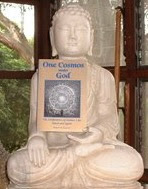
But this commandment has so many important implications that it’s almost impossible to cover them all in a single post. I discussed some of them in my book, specifically, on pp. 236-238. First of all, if “observing the sabbath” meant nothing more than taking it easy on Saturday or Sunday, it would hardly have much intrinsic spiritual significance. But clearly, since it is included in the Decalogue, it must be of the utmost spiritual importance. But how? I don't know. Go ask a rabbi. Let me finish this coffee and think for a minute. Hey, where's Petey, anyway? It's already 6:30. Late again. Oh, I forgot.... it's his sabbath.
In order to understand this commandment, we must go back to the very beginning of Genesis, where God eternally “creates the heavens and the earth.” In the esoteric view, this refers to the continuous separation of the vertical (heaven, eternity, the Absolute) and horizontal (earth, time, the relative world). So long as we are in the horizontal -- the horizontal alone -- we are indeed “strangers in this world.” In the absence of the vertical, it is a sort of absurd hell, or at best, a meaningless pleasure palace in which we should mindlessly chase after our lusts and desires until crying time. “A raging animal inside of a dying carcass,” as I believe I once heard Alan Watts put it.
But “remembering the sabbath” has to do with vertical recollection, and cultivating the leisure necessary to achieve it. It is literally re-membering, for it involves reacquainting oursophs with our ground of being before things get too out of hand. In other worlds, it is possible to get so lost in the horizontal -- one’s horizontal commitments can become so complex and all-consuming -- that it is difficult to find one’s way back to that OMnipresent hole in creation known as the sabbath.
For the sabbath ultimately represents a shorthand way of discussing those little springs that dot the landscape of being, through which vertical energies bubble forth from the ground. Every night, before going to sleep, I make it a point to remember how and where I drank from one of these springs during the day. No matter how difficult my day, I can almost always remember some point at which I was “given my daily bread,” so to speak -- some point at which the vertical energies shone through and lit up the inside. Come to think of it, it often happens while making one of these little morning raids on the wild godhead. It’s a big reason I write them. I wake up looking for one of those little springs bubbling up around my computer. As always, the challenge is to make sure I bring a big enough crock.
In any event, it is specifically because the sabbath is “built in” to the cosmos that vertical energies can enter and leave the “kingdom of man.” In other words, we aren’t trapped here below deck in the dark hull of the horizontal, merely sailing toward our doom. It is the reason why prayer, meditation, contemplation, and lectio divina all work. These are all activities that make the vertical presence present, because they allow us to step outside the relentless stream of time and sit on the shore for a bit, “watching the river flow.”
Through these inactivities, we may turn toward what is “behind” or “above” the external world and its nihilocracy of urgent nonsense. Existence is woven from the warp and weft of horizontal and vertical energies, and if you are wholly committed to the former, you can well understand how you might become completely warped.
Now critically, the purpose of the sabbath isn’t just to gear us up for the horizontal, a brief reprieve from the toil and drudgery of existence. Rather, the reverse is true. Although there is a rhythm and a dialectic between the sabbath and the worldly, in my view, the entire purpose of creation is the sabbath, not understood literally, but esoterically as our ever-present link to the whole. Keeping the sabbath holy is etymologically linked to the idea of “wholeness” and healing. I don’t intend to bash the left again, but one thing you will notice about “progressives” is that they are relentless. The idea of the sabbath is foreign to them, because it has been replaced by the idea of trying to force perfection in the horizontal, something which can never happen. For one thing, it is already happening. But only now. And now. And now.
In other words, you must occasionally step back from creation -- as did God -- and realize that it is already good. It is only for us to realize it. But this realization is more of a challenge than you realize. Like the injunction against envy -- which is actually a reward and not an “order" -- the ability to truly experience “sabbath consciousness” is also a reward. It is something that most people have a great deal of difficulty achieving. Therefore, they displace their own inability to experience the simple joy of being, and project it into the future, when the revolution creates Sugar Candy Mountain on earth -- when everyone uses mass transit, when Walmart is driven out of business, and when the last real man has been castrated with the entrails of the last conservative. In short, progressives habitually turn an existential defect into a virtue, since politics is their religion, 24/7/365. To “remember” the sabbath would mean forgetting about the revolution, and that would be the one sin.
When we are caught up in the stream of time, the unity of reality is broken up into hopes, dreams, regrets, wishes, plans, resentments, etc. You cannot get away from these things so long as you are in time, because they are a function of time. The only way out is up and in, where we are called upon to live as if we are already in paradise. In truth, the sabbath is not a recollection but a “memoir of the future.” Here, the world does not need to be worked on or improved, merely enjoyed as it is. In a strange way, we would live in paradise if people were only capable of realizing that we already do. Just toss a frame over your shoulder and enjoy the work of the old master painter.
After all, this present moment of your life is the end result of thousands and thousands of little plans, goals, choices, and decisions you have made over the course of your life. Are you able to step back for a moment and realize that this is it, that this is the very moment you've been waiting for, the result of all your plans coming to fruition? Or are you in reality simply addicted to “planning” as a way to escape the moment?
In the final unalysis, the sabbath must be internalized, so that one has access to it at all times, like a portable slacktuary, a zone of silence, a realm of inner peace between you and the world. For as much as you may think that you are in the world, the opposite is generally true. The world is in you, pal -- it sinks its teeth into you and will not let go, which is why we have to consciously practice letting it go and “dying” to the world.
For the sabbath is also a rehearsal for the Big Sabbath, when it is dark and no man can work anyway. As Petey quipped in One Cosmos, “The paradox at the heart of the sabbath is that you must live your life as if you already abide in the eternal, because you do, but aspire to get there as if your life depends upon it, because it does. The former is more difficult than the latter, because your worries, anxieties, plans, and conventional aspirations trick you into thinking there is another way out. And if you believe that, you are doing the adversary’s heavy lifting for him, and giving him his black sabbath rest.” So relax and die a little.
Lay me down / In silence easy / To be born again / To be born again / In another world / Got a home on high / Ain't nothing but a stranger in this world / I'm nothing but a stranger in this world / Got a home on high / In another land / So far away / Way up in the heaven / In another time / In another place --Van Morrison, Astral Weeks
Saturday, August 16, 2008


Friday, August 15, 2008
The Cosmic and Spiritual Retardation of Philosophical Darwinists (7.26.10)
We may be sure that the series of forms does not lead on into infinite progress; it must have a definite completion. The very nature of the scale necessitates this conclusion, because it is a scale, and an ascending one.... It must culminate in what is absolutely whole and self-sufficing, for anything else would contradict and negate all that makes the prior progression recognizable as an ascending scale.... In short, the very nature of the scale necessitates its completion by a reality answering to St. Anselm's definition of God -- that than which nothing greater (or more complete, or more perfect) can be conceived. --Errol Harris, Revelation Through Reason
"Evolution" is just a way of saying "temporal continuity," which must exist if anything is to exist. In other words, if not for time, then everything would have to happen at once. (The word "evolve" is etymologically related to "unroll," as in an ancient scroll.)
And "temporal continuity" is just another way of saying "memory." For example, a person with alzheimer's loses his memory, and therefore his temporal continuity. It's always now, disconnected from all the other nows. Therefore, it's not even really now anymore, because now is only now in relation to a then.
One of my beefs with philosophical Darwinism is that, like an alzheimer's patient, it isolates its own conclusions from the greater context of cosmic evolution. For as Harris writes, "The modern conception of nature is of a continuous evolutionary process, linking the purely physical with the biological, the biological with the psychological, and the psychological with the social, moral, artistic, and religious experiences of man."
Given this temporal continuity, it is wholly arbitrary to define things in terms of the past instead of the present, since everything is in the process of becoming. In other words, in studying any phenomenon, it is important to know what it is in its mature form. If you only study a caterpillar in an isolated slice of time, you won't know anything about its connection to butterflies.
Likewise, if you study the Big Bang in isolation from the human knower, you're missing the whole point, again, because you're arbitrarily excluding the temporal continuity that even allows a subject to know about and comprehend the Big Bang -- which is without a doubt the most astonishing thing about the Big Bang! I still can't get over it.
A couple of posts back we spoke of the importance of spatial boundaries in human development. Only with the creation of a "semipermeable membrane" can the human subject properly evolve. But it is equally true of temporal boundaries. Again, if we weren't bounded in time, we could not be, for we would be the Absolute. But time for human beings is not merely duration. Rather, the point is to metabolize time, so as to create a deeper form of continuity in one's life, or a personal history.
Here again, I'm afraid that this is beginning to sound overly abstract, when it's meant to be as concrete as can be. For example, the typical therapy patient comes in with various temporal discontinuities. These are like "holes" in the psyche, except that they are gaps in time rather than space. As Freud said, the neurotic person suffers from "reminiscences," except that the reminiscences have lives and agendas all their own, disconnected from one's central identity. In short, they are mind parasites, or rogue elements within the psyche. And they are rogue elements because they have split off from the central government, which should ideally have a monopoly on memory.
Let's make this very personal in order to render it more vivid. I remember my first heartbreak at the age of 18. It triggered such a deep level of depression that only years later, in therapy, was I able to piece together what had actually happened.
To make a long story short, that heartbreak was just the occasion to feel a whole host of emotions that had been placed in escrow since my earliest childhood, from before I could even speak. They were there, stored away in a kind of atemporal eternity, just waiting for the appropriate experience through which to express themselves, or to deploy themselves in time. But because of the temporal discontinuity, I could not connect A and C at the time. I thought it all had to do with that dastardly C, which it couldn't have, since it was an effect that so far exceeded its cause.
But Darwinists routinely do the same thing. For example, the human subject so far exceeds the material shuffling of genetic material, that only a fool or a mental patient would deny the deeper temporal continuity. And on the deepest level, it should be a bananaty to peel out that in our cosmos, matter has the astonishing potential to sponsor life and human consciousness. As such, matter cannot possibly be what the physicist says it is, just as life cannot possibly be what the Darwinist says it is, for both, in their own way, deny temporal continuity. Again, they take an arbitrary time slice and impose a manmade boundary where there is none.
So if we're going to take time seriously, we would have to agree with Harris that "the product of an evolutionary process is, and must be, potential at its beginnings, and if what is inchoate at first becomes progressively unfolded as the process continues, the nature of the final outcome will be the key to the understanding of both the process itself and its origin."
Thus, the Darwinist wants to have it both ways: there is a continuous evolutionary series that culminates in man, and yet, this culmination may be reduced to a wholly random and mechanical iteration of genetic shuffling. Again, to do this not only abolishes man and all he values, but it ironically abolishes evolution, because it says that what has evolved has no intrinsic meaning that isn't reducible to the real meaning, which is simply genes in meaningless competition for survival. Frankly, this is psychotic, only intellectually psychotic instead of emotionally psychotic. Again, the psychotic mind dismembers temporal continuity and as a result lives in its own private hell.
It is also ironic that the Darwinist stresses the importance of adaptation to one's environment. For me -- and I am quite sure this is true of all Raccoons -- if I were forced to adapt my soul to the impoverished intellectual environment of philosophical Darwinism, it would be exceedingly painful, very much like living in a totalitarian state in which I had to subordinate my essential identity to the group's ideology. I am only able to articulate and evolve the most vital parts of myself through the pneuma-cognitive environment of the perennial religion. If I could not do this, it would be like a living death. It would be like a musician who was forbidden to ever pick up an instrument. How on earth am I to become myself in the absence of the appropriate spiritual environment to nurture and sustain my spiritual evolution?
Now, I don't doubt that Queeg or our scientistic jester -- or all of the infamous spiritual retards* such as Hitchens, Dawkins, and Harris -- feel perfectly "at home" in the Darwinist environment, just as there are millions of people who get their entertainment from video games or their food from McDonalds. But I could no more feed my soul with Darwinism than I could stuff my body with Big Macs, or listen to rap music all day, or read Harlequin romances. Rather, I have a soul with very particular needs, and to be deprived of the means to fulfill those needs would be spiritual death -- which is to say, death.
Again, given the temporal continuity of the cosmos, there is surely horizontal cause and effect. No one would dispute that. But at the same time, an effect cannot exceed its cause, most especially when we are talking about an "infinite" effect. And make no mistake: the human subject partakes of the infinite and the absolute, even if some human subjects prefer to exile themselves to the relative and the finite. They are obviously free to do so, but they are only free to do so because freedom is real -- which is again to say that it partakes of the absolute. But such is the life of a spiritual retard. They just can't crack the cosmic egg, and want to cram the rest of us into their poultry little vision of reality.
For the temporal unfolding is in reality no more nor less than the serial self-articulation of the whole, which, as realized, is eternally complete. The eternal whole is therefore, without qualification, prior to the temporal process, and to speak of temporal posteriority in reference to it is to misunderstand its character. It is not what comes last but what includes and sublates all temporal series. --Errol Harris, Revelation Through Reason: Religion in the Light of Science and Philosophy
*And when I use the term "spiritual retard," I certainly do not mean it in the sense of an insult (much less to mentally retarded people) but as a literal diagnosis. It's obviously not a good thing, but it is no more an insult than is a diagnosis of cancer. There are intellectual retards, spiritual retards, aesthetic retards, moral retards, etc.
"Evolution" is just a way of saying "temporal continuity," which must exist if anything is to exist. In other words, if not for time, then everything would have to happen at once. (The word "evolve" is etymologically related to "unroll," as in an ancient scroll.)
And "temporal continuity" is just another way of saying "memory." For example, a person with alzheimer's loses his memory, and therefore his temporal continuity. It's always now, disconnected from all the other nows. Therefore, it's not even really now anymore, because now is only now in relation to a then.
One of my beefs with philosophical Darwinism is that, like an alzheimer's patient, it isolates its own conclusions from the greater context of cosmic evolution. For as Harris writes, "The modern conception of nature is of a continuous evolutionary process, linking the purely physical with the biological, the biological with the psychological, and the psychological with the social, moral, artistic, and religious experiences of man."
Given this temporal continuity, it is wholly arbitrary to define things in terms of the past instead of the present, since everything is in the process of becoming. In other words, in studying any phenomenon, it is important to know what it is in its mature form. If you only study a caterpillar in an isolated slice of time, you won't know anything about its connection to butterflies.
Likewise, if you study the Big Bang in isolation from the human knower, you're missing the whole point, again, because you're arbitrarily excluding the temporal continuity that even allows a subject to know about and comprehend the Big Bang -- which is without a doubt the most astonishing thing about the Big Bang! I still can't get over it.
A couple of posts back we spoke of the importance of spatial boundaries in human development. Only with the creation of a "semipermeable membrane" can the human subject properly evolve. But it is equally true of temporal boundaries. Again, if we weren't bounded in time, we could not be, for we would be the Absolute. But time for human beings is not merely duration. Rather, the point is to metabolize time, so as to create a deeper form of continuity in one's life, or a personal history.
Here again, I'm afraid that this is beginning to sound overly abstract, when it's meant to be as concrete as can be. For example, the typical therapy patient comes in with various temporal discontinuities. These are like "holes" in the psyche, except that they are gaps in time rather than space. As Freud said, the neurotic person suffers from "reminiscences," except that the reminiscences have lives and agendas all their own, disconnected from one's central identity. In short, they are mind parasites, or rogue elements within the psyche. And they are rogue elements because they have split off from the central government, which should ideally have a monopoly on memory.
Let's make this very personal in order to render it more vivid. I remember my first heartbreak at the age of 18. It triggered such a deep level of depression that only years later, in therapy, was I able to piece together what had actually happened.
To make a long story short, that heartbreak was just the occasion to feel a whole host of emotions that had been placed in escrow since my earliest childhood, from before I could even speak. They were there, stored away in a kind of atemporal eternity, just waiting for the appropriate experience through which to express themselves, or to deploy themselves in time. But because of the temporal discontinuity, I could not connect A and C at the time. I thought it all had to do with that dastardly C, which it couldn't have, since it was an effect that so far exceeded its cause.
But Darwinists routinely do the same thing. For example, the human subject so far exceeds the material shuffling of genetic material, that only a fool or a mental patient would deny the deeper temporal continuity. And on the deepest level, it should be a bananaty to peel out that in our cosmos, matter has the astonishing potential to sponsor life and human consciousness. As such, matter cannot possibly be what the physicist says it is, just as life cannot possibly be what the Darwinist says it is, for both, in their own way, deny temporal continuity. Again, they take an arbitrary time slice and impose a manmade boundary where there is none.
So if we're going to take time seriously, we would have to agree with Harris that "the product of an evolutionary process is, and must be, potential at its beginnings, and if what is inchoate at first becomes progressively unfolded as the process continues, the nature of the final outcome will be the key to the understanding of both the process itself and its origin."
Thus, the Darwinist wants to have it both ways: there is a continuous evolutionary series that culminates in man, and yet, this culmination may be reduced to a wholly random and mechanical iteration of genetic shuffling. Again, to do this not only abolishes man and all he values, but it ironically abolishes evolution, because it says that what has evolved has no intrinsic meaning that isn't reducible to the real meaning, which is simply genes in meaningless competition for survival. Frankly, this is psychotic, only intellectually psychotic instead of emotionally psychotic. Again, the psychotic mind dismembers temporal continuity and as a result lives in its own private hell.
It is also ironic that the Darwinist stresses the importance of adaptation to one's environment. For me -- and I am quite sure this is true of all Raccoons -- if I were forced to adapt my soul to the impoverished intellectual environment of philosophical Darwinism, it would be exceedingly painful, very much like living in a totalitarian state in which I had to subordinate my essential identity to the group's ideology. I am only able to articulate and evolve the most vital parts of myself through the pneuma-cognitive environment of the perennial religion. If I could not do this, it would be like a living death. It would be like a musician who was forbidden to ever pick up an instrument. How on earth am I to become myself in the absence of the appropriate spiritual environment to nurture and sustain my spiritual evolution?
Now, I don't doubt that Queeg or our scientistic jester -- or all of the infamous spiritual retards* such as Hitchens, Dawkins, and Harris -- feel perfectly "at home" in the Darwinist environment, just as there are millions of people who get their entertainment from video games or their food from McDonalds. But I could no more feed my soul with Darwinism than I could stuff my body with Big Macs, or listen to rap music all day, or read Harlequin romances. Rather, I have a soul with very particular needs, and to be deprived of the means to fulfill those needs would be spiritual death -- which is to say, death.
Again, given the temporal continuity of the cosmos, there is surely horizontal cause and effect. No one would dispute that. But at the same time, an effect cannot exceed its cause, most especially when we are talking about an "infinite" effect. And make no mistake: the human subject partakes of the infinite and the absolute, even if some human subjects prefer to exile themselves to the relative and the finite. They are obviously free to do so, but they are only free to do so because freedom is real -- which is again to say that it partakes of the absolute. But such is the life of a spiritual retard. They just can't crack the cosmic egg, and want to cram the rest of us into their poultry little vision of reality.
For the temporal unfolding is in reality no more nor less than the serial self-articulation of the whole, which, as realized, is eternally complete. The eternal whole is therefore, without qualification, prior to the temporal process, and to speak of temporal posteriority in reference to it is to misunderstand its character. It is not what comes last but what includes and sublates all temporal series. --Errol Harris, Revelation Through Reason: Religion in the Light of Science and Philosophy
*And when I use the term "spiritual retard," I certainly do not mean it in the sense of an insult (much less to mentally retarded people) but as a literal diagnosis. It's obviously not a good thing, but it is no more an insult than is a diagnosis of cancer. There are intellectual retards, spiritual retards, aesthetic retards, moral retards, etc.
Thursday, August 14, 2008
Darwinism and Other Barriers to Human Evolution
So, time is the medium of both development and dissolution, growth and decay, synthesis and dispersal, metabolism and catabolism. On the one hand, evolution can result in the great organic synthesis of our beautiful Judeo-Christian civilization. On the other hand, it can result in the retrograde phenomenon of reductionistic Darwinism. Thus, in a sense, time can move both forward and backward, at least human time, which is measured in terms of evolution or development, not mere change or horizontal reshuffling.
Again, time is not mere change, but, like space, "conditions" the contents within it. Just as gravity is a property of curved space, there are many implications that flow from the nature of psychic space. We touched on some of those implications a couple of weeks ago, in the context of a discussion of the "symmetrical logic" of the unconscious mind. Once you appreciate the nature of the symmetrical space of the unconscious (and supraconscious) mind, you see how critical it is to human knowing and being. In reality, the human state (at least in health) is always a dialectical synthesis of symmetrical and asymmetrical modes of knowing. Even the most left-brained science is always rooted in a metaphysical dream that generally goes unacknowledged.
But note that for a strict Darwinist, there cannot even be any objective standard of human normality. In fact, this was one of the first things that intrigued me when I entered graduate school in the early 1980s. I was particularly interested in psychopathology, but not for its own sake. It was an odd situation, because this is just when the political correctness that now dominates academia had begun to strangle the intellect. Thus, it was possible to learn all about various kinds of psychopathology, but no one wanted to go out on a limb and risk defining normality, or the point of being human -- which is to say, the point of life. Because once you do that, you have condemned a large portion of humanity, including whole cultures.
As a result, you then end up reducing psychotherapy to the elimination of pain -- even if the pain is sending a vital message about a pathological way of living. Or you define health on an entirely subjective basis as "do your own thing," "follow your bliss," or some other such new age blather. Again, in such a situation ( which can be called metapsychopathology, to coin a term) there are no objective criteria of psychological health. This is catastrophic in so many ways, but one of them is that genuine maturity does not necessarily involve the elimination of emotional pain, but the tolerance of emotional pain.
I mean, this is something that every parent knows -- or at least should know. Children don't mature as a result of indulgence and the elimination of pain. In fact, one of the most painful aspects of good parenting is to be able to tolerate your child's pain, and not try to instantaneously make it go away! I would much prefer to be in pain than to see my son in pain, but often it is necessary. Truly, he is narcissistic enough without me adding fuel to the fire.
The problem is, when you're the center of the universe, you're in for a rude awakening one way or the other. And we all start out as the center of the universe. Only later do we gradually discover that we're at the periphery. And only with a mature spiritual practice do we regain the center, except at a higher level. Unless you are Deepak Chopra, in which case you revert to infantile omnipotence and call it enlightenment.
This is what happens to any field, including psychology, when it completely detaches itself from philosophy, theology, metaphysics, and other deeper (and more human) modes of analysis. As we were mentioning the other day, you will end up generating a pseudo-autonomous subdiscipline that cannot be integrated with everything else.
Now, no matter how loudly and crudely Darwinists protest to the contrary, humanness is an achievement; it is higher on the vertical scale, not merely one more horizontal arrangement of genetic material. Furthermore, some human beings are objectively better than others, which is to say they have achieved greater "humanness" -- which is not something you can say of any other animal. There are not objective degrees of sheepness or pigginess. True, Michael Moore is a perfect ass, but that is in a manner of speaking.
And once you admit of verticality, you must acknowledge that there is a hierarchical toppermost of of the poppermost that conditions the scale from top to bottom, so you have conceded that the Absolute exists. Which is why Darwinists don't want to concede an inch on this subject, even if it mires them in metaphysical incoherence and stupidity. They are fundamentally committed to intellectual devolution, or the elimination of Man as Such, come what may.
Another way of saying it is that the time of classical physics is reversible. But human time is irreversible, partly because it is developmental. The abstract reversible time of classical physics is like a film that can be run forward or back, or like a mathematical operation that is symmetrical. However, if a cup falls off your table and shatters onto the floor, that is an irreversible process.
The irreversibility of time is tied in with the concept of entropy, which is also irreversible. In the long run, the universe is said to be analogous to a.... to a mortal coil, or a spring that will one day be completely sprung.
But none of this applies to human reality, which is not primarily in the physical or biological realms. To be perfectly accurate, it is "in" those realms, but not entirely "of" them. Rather, a human being transcends but includes (as Ken Wilber would put it) biology and physics, but could never by any stretch of the imagination be reducible to them.
Now, the end result of a temporal series cannot be a member of the series. That is, time is simply a series of events with no "end" or telos. But most everything human beings do, both explicitly and implicitly, has a point, and that point is not equivalent to one more event in the series. For example, the purpose of your life is not just one of the events that constitutes it, ¿comprende? Nor is the theme of a great novel reducible to the plot. Rather, the plot represents the temporal unfolding of the theme.
It is just so for the Raccoon. Once one enters "Coon Time™," one begins to see the events of one's life cohere in the most astonishing, even "miraculous" way, as if they are being "coonditioned" from above; or, as if there is some hidden relationship between what are normally called "inside" and "outside." Soon enough, we discover that the bright line that scientism imposes between these two modes is not so bright after all. And why should it be? On what basis, save for metaphysical whimsy, can anyone say that matter is anterior to consciousness rather than vice versa?
Are we saying, like Deepak, that human consciousness creates reality? No, that is manifestly not what we are saying. Rather, what we are saying is that the human subject is a sort of projected mirror of the dialectical synthesis of subject and object that constitutes what we call "reality." We can try to draw a bright line between subject and object, but that line is entirely manmade. Nature doesn't know anything about it, which is why, for example, math can be lodged in matter, or brains can be lodged in higher consciousness. Once you start to look at the world in this way, you soon begin to realize where all the truth and beauty are coming from, and why we'll never run out of them unless Darwinists and other materialists succeed in their mad attempt to eliminate the goal of the human state.
Again, that goal cannot be part of the temporal series. Rather, it must be eternal and unchanging, not subject to change. Health is etymologically related to wholeness, and this is exquisitely true of human health. So the question becomes, what constitutes a "whole human?" Christianity provides its own archetype in the form of Jesus, who constitutes the "perfect unblended blend," so to speak, of humanness and divinity. Likewise the saints, who represent fixed stars of truth, virtue and beauty (for virtue is human beauty in action).
But what are the fixed stars of Darwinism? Well, first of all, it is an absurd question from "within" the narrow constraints of philosophical Darwinism. Again, no one will ever accuse a Darwinist of being intellectually consistent. But I suppose the fixed star is "survival," even though survival can have no ontological superiority over extinction. I mean, who really cares, except perhaps the one doing the surviving? And even then, natural selection cares only for the group, and is ruthless about weeding out the genes that don't benefit its survival.
Now, there is just no question that Hitler was animated by this metaphysic (as you can see in the sidebar, I'm currently reading a book about him; can't yet say whether I can recommend it). Is this to say that he was a Darwinist, or that Nazism was just some sort of logical extension of Darwinism? No, not at all. It is venturing on the impossible to even suggest that Hitler ever read Darwin in the original. Rather, he was familiar with his ideas -- of which he approved -- only through the popular literature.
But even then, Hitler never "reasoned up" from facts to ideology. Rather, he developed his sinister ideology by 1920 or so, and his only interest in books and ideas was to find things that confirmed his prejudices and preconceptions. Thus, he would have considered Darwinism through the lens of his ideology. Happily for him and tragically for the rest of humanity, he not only found nothing in Darwinism to oppose his ideology, but much to support it, for Darwinism has no intrinsic basis for opposing evil or promoting human evolution. Rather, that's our job.
Again, time is not mere change, but, like space, "conditions" the contents within it. Just as gravity is a property of curved space, there are many implications that flow from the nature of psychic space. We touched on some of those implications a couple of weeks ago, in the context of a discussion of the "symmetrical logic" of the unconscious mind. Once you appreciate the nature of the symmetrical space of the unconscious (and supraconscious) mind, you see how critical it is to human knowing and being. In reality, the human state (at least in health) is always a dialectical synthesis of symmetrical and asymmetrical modes of knowing. Even the most left-brained science is always rooted in a metaphysical dream that generally goes unacknowledged.
But note that for a strict Darwinist, there cannot even be any objective standard of human normality. In fact, this was one of the first things that intrigued me when I entered graduate school in the early 1980s. I was particularly interested in psychopathology, but not for its own sake. It was an odd situation, because this is just when the political correctness that now dominates academia had begun to strangle the intellect. Thus, it was possible to learn all about various kinds of psychopathology, but no one wanted to go out on a limb and risk defining normality, or the point of being human -- which is to say, the point of life. Because once you do that, you have condemned a large portion of humanity, including whole cultures.
As a result, you then end up reducing psychotherapy to the elimination of pain -- even if the pain is sending a vital message about a pathological way of living. Or you define health on an entirely subjective basis as "do your own thing," "follow your bliss," or some other such new age blather. Again, in such a situation ( which can be called metapsychopathology, to coin a term) there are no objective criteria of psychological health. This is catastrophic in so many ways, but one of them is that genuine maturity does not necessarily involve the elimination of emotional pain, but the tolerance of emotional pain.
I mean, this is something that every parent knows -- or at least should know. Children don't mature as a result of indulgence and the elimination of pain. In fact, one of the most painful aspects of good parenting is to be able to tolerate your child's pain, and not try to instantaneously make it go away! I would much prefer to be in pain than to see my son in pain, but often it is necessary. Truly, he is narcissistic enough without me adding fuel to the fire.
The problem is, when you're the center of the universe, you're in for a rude awakening one way or the other. And we all start out as the center of the universe. Only later do we gradually discover that we're at the periphery. And only with a mature spiritual practice do we regain the center, except at a higher level. Unless you are Deepak Chopra, in which case you revert to infantile omnipotence and call it enlightenment.
This is what happens to any field, including psychology, when it completely detaches itself from philosophy, theology, metaphysics, and other deeper (and more human) modes of analysis. As we were mentioning the other day, you will end up generating a pseudo-autonomous subdiscipline that cannot be integrated with everything else.
Now, no matter how loudly and crudely Darwinists protest to the contrary, humanness is an achievement; it is higher on the vertical scale, not merely one more horizontal arrangement of genetic material. Furthermore, some human beings are objectively better than others, which is to say they have achieved greater "humanness" -- which is not something you can say of any other animal. There are not objective degrees of sheepness or pigginess. True, Michael Moore is a perfect ass, but that is in a manner of speaking.
And once you admit of verticality, you must acknowledge that there is a hierarchical toppermost of of the poppermost that conditions the scale from top to bottom, so you have conceded that the Absolute exists. Which is why Darwinists don't want to concede an inch on this subject, even if it mires them in metaphysical incoherence and stupidity. They are fundamentally committed to intellectual devolution, or the elimination of Man as Such, come what may.
Another way of saying it is that the time of classical physics is reversible. But human time is irreversible, partly because it is developmental. The abstract reversible time of classical physics is like a film that can be run forward or back, or like a mathematical operation that is symmetrical. However, if a cup falls off your table and shatters onto the floor, that is an irreversible process.
The irreversibility of time is tied in with the concept of entropy, which is also irreversible. In the long run, the universe is said to be analogous to a.... to a mortal coil, or a spring that will one day be completely sprung.
But none of this applies to human reality, which is not primarily in the physical or biological realms. To be perfectly accurate, it is "in" those realms, but not entirely "of" them. Rather, a human being transcends but includes (as Ken Wilber would put it) biology and physics, but could never by any stretch of the imagination be reducible to them.
Now, the end result of a temporal series cannot be a member of the series. That is, time is simply a series of events with no "end" or telos. But most everything human beings do, both explicitly and implicitly, has a point, and that point is not equivalent to one more event in the series. For example, the purpose of your life is not just one of the events that constitutes it, ¿comprende? Nor is the theme of a great novel reducible to the plot. Rather, the plot represents the temporal unfolding of the theme.
It is just so for the Raccoon. Once one enters "Coon Time™," one begins to see the events of one's life cohere in the most astonishing, even "miraculous" way, as if they are being "coonditioned" from above; or, as if there is some hidden relationship between what are normally called "inside" and "outside." Soon enough, we discover that the bright line that scientism imposes between these two modes is not so bright after all. And why should it be? On what basis, save for metaphysical whimsy, can anyone say that matter is anterior to consciousness rather than vice versa?
Are we saying, like Deepak, that human consciousness creates reality? No, that is manifestly not what we are saying. Rather, what we are saying is that the human subject is a sort of projected mirror of the dialectical synthesis of subject and object that constitutes what we call "reality." We can try to draw a bright line between subject and object, but that line is entirely manmade. Nature doesn't know anything about it, which is why, for example, math can be lodged in matter, or brains can be lodged in higher consciousness. Once you start to look at the world in this way, you soon begin to realize where all the truth and beauty are coming from, and why we'll never run out of them unless Darwinists and other materialists succeed in their mad attempt to eliminate the goal of the human state.
Again, that goal cannot be part of the temporal series. Rather, it must be eternal and unchanging, not subject to change. Health is etymologically related to wholeness, and this is exquisitely true of human health. So the question becomes, what constitutes a "whole human?" Christianity provides its own archetype in the form of Jesus, who constitutes the "perfect unblended blend," so to speak, of humanness and divinity. Likewise the saints, who represent fixed stars of truth, virtue and beauty (for virtue is human beauty in action).
But what are the fixed stars of Darwinism? Well, first of all, it is an absurd question from "within" the narrow constraints of philosophical Darwinism. Again, no one will ever accuse a Darwinist of being intellectually consistent. But I suppose the fixed star is "survival," even though survival can have no ontological superiority over extinction. I mean, who really cares, except perhaps the one doing the surviving? And even then, natural selection cares only for the group, and is ruthless about weeding out the genes that don't benefit its survival.
Now, there is just no question that Hitler was animated by this metaphysic (as you can see in the sidebar, I'm currently reading a book about him; can't yet say whether I can recommend it). Is this to say that he was a Darwinist, or that Nazism was just some sort of logical extension of Darwinism? No, not at all. It is venturing on the impossible to even suggest that Hitler ever read Darwin in the original. Rather, he was familiar with his ideas -- of which he approved -- only through the popular literature.
But even then, Hitler never "reasoned up" from facts to ideology. Rather, he developed his sinister ideology by 1920 or so, and his only interest in books and ideas was to find things that confirmed his prejudices and preconceptions. Thus, he would have considered Darwinism through the lens of his ideology. Happily for him and tragically for the rest of humanity, he not only found nothing in Darwinism to oppose his ideology, but much to support it, for Darwinism has no intrinsic basis for opposing evil or promoting human evolution. Rather, that's our job.
Wednesday, August 13, 2008
The Economics of Time and the Metabolism of God
Not much time... the clock is ticking... but when is it not ticking? I guess we only notice the ticking when we don't have enough of it... or too much it. I don't know about you, but that's what school was like for me. I was bored out of my skull, which perversely causes time to slow to a crawl. How's that for a novel bobservation!
And writing these posts specifically requires timelessness. But at the same time, I suppose I wouldn't even bother to try if it weren't for the time constraint. As I may have mentioned before, this is one of the things that surprised me about having a child. We waited to do so until my life was pretty much over. The idea was to cram everything into one book (and one life), because that would be it. The end of Part One of my life. On to Part Two, in which there would be no time for reading, thinking, writing, etc. Which was fine with me. I was done. I said what I needed to say. Time for death and rebirth.
So it's come as a big surprise that I've been able to be so productive over these past three years, much more so than during all the years before. How does that work? Assuming that what I've written is of value -- which of course it may or may not be, depending on your point of view -- the value only emerged within the context of time scarcity. But this is apparently why it is possible for our lives to be meaningful: because they take place within time, and time is short.
Which is interesting when you think about it, because the materialist or existentialist take the exact same set of facts and (assuming they are self-consistent) come to the opposite conclusion: that because WE'RE ALL GONNA DIE!, it's all meaningless. But in my case, it was all much less meaningful when I lived in the illusion of eternity.
I guess the fundamental question is, why is slack precious? Like anything else, it is precious because it is scarce (even though it is simultaneously "eternal" and therefore unlimited). But even then, it is only valuable if you know what to do with it. I definitely had more slack prior to April 20, 2005, a day that will live in infancy. Only now do I realize that I really didn't know what to do with my slack, because there was too much of it. It was just like an economy in which money becomes less valuable because of inflation. The other day I heard that in Zimbabwe they now have a billion dollar bill. Thus, you can have a situation in which more and more buys less and less.
So there is no question that the fact of death is precisely what confers meaning on our lives. In fact, a moment's reflection will inform you that you couldn't even know you were alive in the absence of death, any more than you could have bodily existence in the absence of spatial boundaries. In other words, our bodies bind and define us in space, while our death binds and defines us in time. I remember once hearing Alan Watts make this point in a lecture, to the effect that if our life did not come to an end, it would be no different than if our height did not come to an end, and we grew to infinite size -- which is no size at all. As we were saying yesterday, existence is synonymous with definition, and to define is to give boundaries. Thus, God's first act is one of definition or separation of the upper waters from the lower waters. Good call, Moses!
Much of psychological growth entails the acquisition of boundaries. This is a fine example of a profound subject that will have no meaning for the materialist, for how can something immaterial (and probably illusory anyway) have a boundary? It's like placing a sharp line between the sky and a cloud. In reality there is no such border, no place where the empty sky ends and the cloud begins.
Nevertheless, psychological growth is founded upon the development of what we might call a semi-permeable membrane, only on the subjective plane. As you know by now, I wasn't paying attention in biology class, partly due to boredom, partly due to Suzie Campbell sitting at the adjacent desk, but I do remember that term: "semi-permeable membrane." In order for something to be alive, it obviously must have a boundary, or it will be indistinguishable from the environment. But at the same time, the membrane must allow for the passage of information and energy in and out.
There again, that's another subtle point. The very first living being created the ontological category of "inside." There was no "interior" to the cosmos until that very first itsy bitsy teeny tiny turned around on itself and said, like the Everly Brothers, "let it be me." (Not to get ahead of the story, but as it so happens there is an ontological interior that was necessarily prior to its appearance in time, AKA, God, or I AM; but we'll save that for later.)
Just so, in order to be a person and not just an anonymous performing flea in the mother of all Chinese fire drills, we must be psychologically distinct from the group. Just as our bodies are born into a physical environment with which we exchange food, water, and oxygen, we are also born into a psychological environment in which we exchange information and emotion, which are conveyed in a number of ways, including touch, sound (which transmits meaning even before we understand words), introjection, and projection (which are just two sides of the same phenomenon).
That latter concept -- projection -- is a critical one in developmental psychology, in that it is an artifact of our being "members of one another" on the psychic plane, just as our bodies are members of the same biosphere. Just as no body can declare independence from the biosphere without dying, no human being can declare independence from the "psychosphere" without undergoing a psychological death -- like, say the Joker. Again, I haven't seen the film, so I'm operating on second hand information, but it seems that he is radically separate from the human environment, a kind of psychopath on stilts.
Because that is what a psychopath is: a radical individualist who does not share any interior relationship with other human beings. What we call empathy is really the ability of one interior to know another and share in its joys and pain. A sociopath specifically lacks this faculty, which is why they can treat subjects like objects. They are truly undead which is an entirely distinct ontological category from life and death. The reason for this is that the undead person still must "metabolize" experience in order to go on being, but he will be unable to distinguish between life and death, good and evil, love and hate, lies and truth. It would be analogous to a living being that is unable to distinguish between food and feces. If that were the case, we would all be tenured.
One of my first academic papers was on the subject of dissipative structures (i.e., open systems that exchange matter, energy, and information with the environment) and their implications for human psychological development. I don't have time or space to get into details here, but to a certain extent, in my book I applied the same ideas to our relationship with God, or the Absolute, or O if you like. Here again, just as there is surely a material environment and a psychological environment, there is a sprititual environment. You all know it well, as it is characterized by such enduring phenomena as the sacred, the holy, the celestial light, the fullness of being, the presence of presence, the influx of grace, the mercy of Petey, etc.
Now, just as the possibility of human psychological development is dependent upon becoming an open system with "wise and loving" others, the possibility of human spiritual growth is entirely founded upon the ability to become an open system with that which transcends us, i.e., the Permanent Real. In the final analysis, this is the "way of the Raccoon," which is to say, to become an open system with O by any means necessary. To a certain extent -- and within intrinsic limits -- we all have to identify the means and method that are personal to us, or our "spiritual idiom." We all have to eat, but we don't eat the same things. You may like pepperoni on your pizza, while Dupree likes crawfish and burnt bacon.
Likewise, we all fall in love, but we all know how that works -- one person's deal of a lifetime is another's bargain bin castoff. It seems that our love has a specific idiom that clicks into place when we meet the right person. I felt that click on my very first date with Mrs. G in May of 1984. Somehow, that single "click" was loaded with all the implicatiosn that woytld take years to unpack. One of them is now crawling into my lap and prevebting me fgrom tyoibet]ng. why? becyanuese he has certain idiomatic needs that he would like for me to fulfill RIGHT NOW, since it is always RIGHT NOW for him, like he has ultimate slack but no slack at the same time.
There. He's watching Curious George now. Be a good little monkey!
Anyway, one doesn't "get married"; rather, one "makes a marriage" (through the resultant boundaries) in order to find out what it is, which will require time. Marriage is only a container, not its content.
I suppose we could go so far as to say that we need to discover a similar "click" on the spiritual plane -- to "fall in love," as it were, or create the boundaries that will allow us to find out "what God is." For many folks, they have what amounts to an "arranged marriage" with their religion. Sometimes this works out, while other times it ends in divorce and disillusionment.
So we're all looking for that nonspatial One with whom to settle down and sail hopefully foriver rafter, 'til we remerge with our wholly sea.
Well, he's back. End of slack. Beginning of meaning.
And writing these posts specifically requires timelessness. But at the same time, I suppose I wouldn't even bother to try if it weren't for the time constraint. As I may have mentioned before, this is one of the things that surprised me about having a child. We waited to do so until my life was pretty much over. The idea was to cram everything into one book (and one life), because that would be it. The end of Part One of my life. On to Part Two, in which there would be no time for reading, thinking, writing, etc. Which was fine with me. I was done. I said what I needed to say. Time for death and rebirth.
So it's come as a big surprise that I've been able to be so productive over these past three years, much more so than during all the years before. How does that work? Assuming that what I've written is of value -- which of course it may or may not be, depending on your point of view -- the value only emerged within the context of time scarcity. But this is apparently why it is possible for our lives to be meaningful: because they take place within time, and time is short.
Which is interesting when you think about it, because the materialist or existentialist take the exact same set of facts and (assuming they are self-consistent) come to the opposite conclusion: that because WE'RE ALL GONNA DIE!, it's all meaningless. But in my case, it was all much less meaningful when I lived in the illusion of eternity.
I guess the fundamental question is, why is slack precious? Like anything else, it is precious because it is scarce (even though it is simultaneously "eternal" and therefore unlimited). But even then, it is only valuable if you know what to do with it. I definitely had more slack prior to April 20, 2005, a day that will live in infancy. Only now do I realize that I really didn't know what to do with my slack, because there was too much of it. It was just like an economy in which money becomes less valuable because of inflation. The other day I heard that in Zimbabwe they now have a billion dollar bill. Thus, you can have a situation in which more and more buys less and less.
So there is no question that the fact of death is precisely what confers meaning on our lives. In fact, a moment's reflection will inform you that you couldn't even know you were alive in the absence of death, any more than you could have bodily existence in the absence of spatial boundaries. In other words, our bodies bind and define us in space, while our death binds and defines us in time. I remember once hearing Alan Watts make this point in a lecture, to the effect that if our life did not come to an end, it would be no different than if our height did not come to an end, and we grew to infinite size -- which is no size at all. As we were saying yesterday, existence is synonymous with definition, and to define is to give boundaries. Thus, God's first act is one of definition or separation of the upper waters from the lower waters. Good call, Moses!
Much of psychological growth entails the acquisition of boundaries. This is a fine example of a profound subject that will have no meaning for the materialist, for how can something immaterial (and probably illusory anyway) have a boundary? It's like placing a sharp line between the sky and a cloud. In reality there is no such border, no place where the empty sky ends and the cloud begins.
Nevertheless, psychological growth is founded upon the development of what we might call a semi-permeable membrane, only on the subjective plane. As you know by now, I wasn't paying attention in biology class, partly due to boredom, partly due to Suzie Campbell sitting at the adjacent desk, but I do remember that term: "semi-permeable membrane." In order for something to be alive, it obviously must have a boundary, or it will be indistinguishable from the environment. But at the same time, the membrane must allow for the passage of information and energy in and out.
There again, that's another subtle point. The very first living being created the ontological category of "inside." There was no "interior" to the cosmos until that very first itsy bitsy teeny tiny turned around on itself and said, like the Everly Brothers, "let it be me." (Not to get ahead of the story, but as it so happens there is an ontological interior that was necessarily prior to its appearance in time, AKA, God, or I AM; but we'll save that for later.)
Just so, in order to be a person and not just an anonymous performing flea in the mother of all Chinese fire drills, we must be psychologically distinct from the group. Just as our bodies are born into a physical environment with which we exchange food, water, and oxygen, we are also born into a psychological environment in which we exchange information and emotion, which are conveyed in a number of ways, including touch, sound (which transmits meaning even before we understand words), introjection, and projection (which are just two sides of the same phenomenon).
That latter concept -- projection -- is a critical one in developmental psychology, in that it is an artifact of our being "members of one another" on the psychic plane, just as our bodies are members of the same biosphere. Just as no body can declare independence from the biosphere without dying, no human being can declare independence from the "psychosphere" without undergoing a psychological death -- like, say the Joker. Again, I haven't seen the film, so I'm operating on second hand information, but it seems that he is radically separate from the human environment, a kind of psychopath on stilts.
Because that is what a psychopath is: a radical individualist who does not share any interior relationship with other human beings. What we call empathy is really the ability of one interior to know another and share in its joys and pain. A sociopath specifically lacks this faculty, which is why they can treat subjects like objects. They are truly undead which is an entirely distinct ontological category from life and death. The reason for this is that the undead person still must "metabolize" experience in order to go on being, but he will be unable to distinguish between life and death, good and evil, love and hate, lies and truth. It would be analogous to a living being that is unable to distinguish between food and feces. If that were the case, we would all be tenured.
One of my first academic papers was on the subject of dissipative structures (i.e., open systems that exchange matter, energy, and information with the environment) and their implications for human psychological development. I don't have time or space to get into details here, but to a certain extent, in my book I applied the same ideas to our relationship with God, or the Absolute, or O if you like. Here again, just as there is surely a material environment and a psychological environment, there is a sprititual environment. You all know it well, as it is characterized by such enduring phenomena as the sacred, the holy, the celestial light, the fullness of being, the presence of presence, the influx of grace, the mercy of Petey, etc.
Now, just as the possibility of human psychological development is dependent upon becoming an open system with "wise and loving" others, the possibility of human spiritual growth is entirely founded upon the ability to become an open system with that which transcends us, i.e., the Permanent Real. In the final analysis, this is the "way of the Raccoon," which is to say, to become an open system with O by any means necessary. To a certain extent -- and within intrinsic limits -- we all have to identify the means and method that are personal to us, or our "spiritual idiom." We all have to eat, but we don't eat the same things. You may like pepperoni on your pizza, while Dupree likes crawfish and burnt bacon.
Likewise, we all fall in love, but we all know how that works -- one person's deal of a lifetime is another's bargain bin castoff. It seems that our love has a specific idiom that clicks into place when we meet the right person. I felt that click on my very first date with Mrs. G in May of 1984. Somehow, that single "click" was loaded with all the implicatiosn that woytld take years to unpack. One of them is now crawling into my lap and prevebting me fgrom tyoibet]ng. why? becyanuese he has certain idiomatic needs that he would like for me to fulfill RIGHT NOW, since it is always RIGHT NOW for him, like he has ultimate slack but no slack at the same time.
There. He's watching Curious George now. Be a good little monkey!
Anyway, one doesn't "get married"; rather, one "makes a marriage" (through the resultant boundaries) in order to find out what it is, which will require time. Marriage is only a container, not its content.
I suppose we could go so far as to say that we need to discover a similar "click" on the spiritual plane -- to "fall in love," as it were, or create the boundaries that will allow us to find out "what God is." For many folks, they have what amounts to an "arranged marriage" with their religion. Sometimes this works out, while other times it ends in divorce and disillusionment.
So we're all looking for that nonspatial One with whom to settle down and sail hopefully foriver rafter, 'til we remerge with our wholly sea.
Well, he's back. End of slack. Beginning of meaning.
Tuesday, August 12, 2008
Croaking Hoaxters Don't You Think the Joker Laughs at You?
What is intelligibly diverse must be unified and whole, and only what is whole and unified can be intelligibly diverse. At the same time, only what is diversified can be intelligibly one. This is because change requires continuity if it is to be change of anything at all, and the parts of what is continuous must be distinguishable or else it congeals to a dimensionless point (or instant).... Although a whole is a single unity, it is at the same time a unified diversity. The reality of time, therefore, establishes concurrently the reality of a whole which is nontemporal. --Errol Harris, The Reality of Time
I will cooncede at the outset that this rambling post did not come together into a unified diversity in the manner one might have hoped. Why? Because there simply wasn't enough time to compensate for all of the distractions, in order for the One to perform its unifying magic over the many. Therefore, I will leave it to you to make sense of it, or to decide whether it is intelligibly diverse or just an unintelligible blobservation.
Atheistic types like to accuse religious folks of being naively uncritical about scripture, and no doubt many are. But the same can be said for radical secularists who adopt a naive and credulous stance toward the natural sciences, as if they require no metaphysical foundation, and simply "speak for themselves." But there is no meaningful scientific observation that isn't theory-laden, and as soon as one examines the implicit theories with which science is laden, one is led back into the realm of pure metaphysics. And once that happens, you soon discover that the naive religionists are not so naive after all.
As Errol Harris writes, "all the stock arguments against metaphysics, from Kant to Wittgenstein, have long been exposed as self-refuting, so that far from being impossible, metaphysics is indispensable and unavoidable, always inescapably presupposed in whatever philosophical position is adopted -- even one that repudiates it."
Now, metaphysics aims at the comprehension of the cosmos in its totality, both in its vertical and horizontal aspects. Any scientistic metaphysic which aims only at an explanation of the horizontal world eliminates in one stroke the very realm where metaphysical truth abides. This is the principial realm of which the horizontal is merely a derivative "prolongation," which is why it is said, for example, that the Torah is prior to the world, or why Jesus could say that "Heaven and earth shall pass away, but my words shall not pass away." Likewise, "In the beginning was the word, and you know the drill, so I won't repeat it here."
Of metaphysical certitude, Schuon writes that it results from the "coincidence between truth and our being; a coincidence that no raytiocination could invalidate. Contingent things are proven by factors situated within their order of contingency, whereas things deriving from the Absolute become clear by their participation in the Absolute, hence by a 'superabundance of light'... which amounts to saying that they are proven by themselves. In other words, universal truths draw their evidence not from our contingent thought, but from our transpersonal being, which constitutes the substance of our spirit and guarantees the adequacy of intellection."
I suppose there is one way to avoid metaphysics, and that is to be genuinely psychotic, and to truly live in a world without a priori meaning, sense, and coherence (although even there, people like Matte Blanco and Bion have provided theoretical keys that allow us to appreciate the order beneath psychotic disorder). I am told that the Joker in the new Batman film is such a person. Of him, commenter Dusty writes that he is
"a perfect personification of transcendent evil. That is, the act of rejecting transcendence a priori at the same time downwardly transforms that person into an inverted reflection of the saving grace from above. True transcendent evil is a faceless force until given temporary one by an earthly personality. Notice that the joker in Dark Knight is in truth a faceless terror all throughout. He really has no personal history: no name; his clothes are self-made; the past that he does reveal turns out to be contradiction and lies; and even the face that we do see is painted in the style of the Jungian archetype of the mad clown. There's nothing there but a trail of violence and disaster. Whence did he come? Where did he go?"
You see? A diversified chaos, with no wholeness or unity. You might say that he is deconstruction personified, or the archetype of Tenured Man:
"He is chaos personified, and the only connection that he does have with grace is a masochistic-like dependency on the archetypal hero who opposes his will. Even the darkest of nights, night within night, evil for the sake of evil, must necessarily maintain contact with the light, or else there would exist an absolute hell, which is strictly impossible unless God chose to suffer it himself. But if God is Good, he would choose eternal delight, and not an eternal dark night."
Those two paragraphs are loaded with insights that need to be unpacked. For example, gnotice how our scientistic jester is indeed dependent upon us, not vice versa. We do not seek him out, and do our best to ignore his irrelevance. But he "must necessarily maintain contact with the light," hence his desire to associate with us rather than with his own kind, which would indeed be a kind of cold and dry hell. Just imagine those scintillating conversations between blind atheists sharing stories of what they cannot see!
Let's discuss the idea of "a perfect personification of transcendent evil." Now evil cannot actually be transcendent. Rather, it can only mimic and mock transcendence by "escaping" the obligations of our humanness from below. I'm just free associating here, but this is one of the things that creeped me out about the opening ceremony of the Olympics a few nights ago. I only caught the first 20 minutes or so before turning if off. Yes, I could see that there was a kind of bombastic majesty taking place, but toward what end? Toward man as ant, or the elimination of man as such. It was like a leftist mass, I suppose.
2008 drummers playing in lockstep? Give me one immortal jazz drummer. Give me Philly Joe Jones, Art Blakey, Tony Williams, or Jack DeJohnette, all playing around with the beat, adding their own flavor, throwing in their own unpredictable syncopations, being individuals. For that is what America is all about: not the ant as ant, nor the ant in opposition to the hive, but rising above -- i.e., transcending -- it. If Art Blakey had been one of those 2008 drummers, he'd probably now be in a slave labor camp.
So man can "transcend" -- or at least get around -- the ego from above or from below. In the case of a great jazz musician, while he "stands out," it can never be in a "selfish" way, or it won't be jazz anymore. Rather, the whole point is that in real jazz, each of the parts is subordinate to an emergent "higher unity" that is being spontaneously created in the moment, in an organismic manner. For example, back in the 1930s, Louis Armstrong would often be thrown together with a bunch of musical stiffs who couldn't approach his level of virtuosity. As such, the results aren't really "jazz." It's more like when the Harlem Globetrotters defeat the Washington Generals night after night. It might be a spectacle, but it's not really sport.
I don't think it's any coincidence that jazz was invented in America, as it is our quintessential art form, combining as it does a maximum of freedom (which is to say, individuality) and discipline, for it requires much, much more discipline to be a great jazz musician than it does to be in a glorified marching band. Likewise, anyone with a mediocre intellect can understand science. But not everyone can understand Aquinas or Schuon or Aurobindo, or so many other true theologians.
Now, the cosmos is ordered (as we all know, cosmos is from the Greek word for order). Everywhere we look, order. There is incredible mathematical order in the equations of physics, in chemistry, in the genome, everywhere. There is also order in the human psyche and in the human spirit, two distinct categories that people have tended to conflate over the past 300 years or so. But the psyche is more or less the area addressed by psychology, while the spirit is the domain of religion (although there is admittedly much overlap, as there must be, just as there is overlap between physics and chemistry, or chemistry and biology).
Toward the end of the 19th century, at the peak of reductionistic materialism, there was an attempt to reduce the psyche to a purely material or "energic" phenomenon (and to eliminate the spirit altogether). One sees this in the early theories of Freud, which absurdly reduce the mind to a kind of pressure cooker seeking to let off the "steam" of primitive instincts and impulses; or in the behaviorists, who imagined that there was no such thing as a psyche, only behavior.
In fact, there are people who still believe this. I remember during my internship, getting into a heated debate with a fellow intern who was a behaviorist. At the time, I didn't yet realize that the discussion would be as pointless as trying to bring light to our scientistic jester. After all, how does one impart truth to someone who believes only in behavior? I suppose by physically striking him on the head with a book. Anyway, this is an example of a man who voluntarily cashed in his humanness for a kind of faux liberation, in which nothing means anything. Rather, it's all just behavior. Thus, he succeeded in escaping the pain of the human state "from below."
Isn't this what the Joker would say? He's just a behaviorist with the courage of his absence of convictions. He's just a mindless man thinking. Or, in behaviorist terms, just a dead man walking, or not even a zombie. In a way, he is death.
Existence is unavoidably tied up with language -- with the Word -- because to have existence is synonymous with having a definition, even if we cannot put it into purely logical words. For example, Just Thomism writes that
"The idea of soul arises when we notice that some bodies are alive and others are not. Our judgment of what is alive and what is not is far from infallible, but it remains that among the physical things we know, some are alive and others are not. Words like 'soul' were first imposed from primitive theories of what made a living thing alive: early words for soul simply meant 'breath'; although it is unclear if they thought that breath was really soul or if it was more the clearest sign of whatever soul was. Theories about the soul quickly became more precise. The Greeks had a vast multitude of opinions about what makes something living -- the best of which was that the soul was some kind of organization in a body which involved the mixture of various elements in the right proportion."
Thus, for someone who is alienated from their soul, it will simply be a kind of nonsense word that corresponds to nothing real, like "unicorn." This is one of the crude arguments that bonehead atheists commonly make, all the while imagining themselves to be sophisticated, courageous, or clear thinking. But the joke is on them, for
"Our modern scientists who deny the spiritual existence of the soul because they can account for human life without it are no different than a bookbinder who denies the existence of writing style or syntax because he can account for the whole book without mentioning them at all. In a sense he is right. He can completely account for the book without once invoking syntax or grammar. For that matter, the marketer, bookseller, and distributor needn't speak of syntax and grammar in order to give their own complete account of a book. Their way of analyzing a book into its relevant parts doesn't need to include this" (Just Thomism).
So our jester is correct, in that he does adequately convey the universal truths of the undead.
I will cooncede at the outset that this rambling post did not come together into a unified diversity in the manner one might have hoped. Why? Because there simply wasn't enough time to compensate for all of the distractions, in order for the One to perform its unifying magic over the many. Therefore, I will leave it to you to make sense of it, or to decide whether it is intelligibly diverse or just an unintelligible blobservation.
Atheistic types like to accuse religious folks of being naively uncritical about scripture, and no doubt many are. But the same can be said for radical secularists who adopt a naive and credulous stance toward the natural sciences, as if they require no metaphysical foundation, and simply "speak for themselves." But there is no meaningful scientific observation that isn't theory-laden, and as soon as one examines the implicit theories with which science is laden, one is led back into the realm of pure metaphysics. And once that happens, you soon discover that the naive religionists are not so naive after all.
As Errol Harris writes, "all the stock arguments against metaphysics, from Kant to Wittgenstein, have long been exposed as self-refuting, so that far from being impossible, metaphysics is indispensable and unavoidable, always inescapably presupposed in whatever philosophical position is adopted -- even one that repudiates it."
Now, metaphysics aims at the comprehension of the cosmos in its totality, both in its vertical and horizontal aspects. Any scientistic metaphysic which aims only at an explanation of the horizontal world eliminates in one stroke the very realm where metaphysical truth abides. This is the principial realm of which the horizontal is merely a derivative "prolongation," which is why it is said, for example, that the Torah is prior to the world, or why Jesus could say that "Heaven and earth shall pass away, but my words shall not pass away." Likewise, "In the beginning was the word, and you know the drill, so I won't repeat it here."
Of metaphysical certitude, Schuon writes that it results from the "coincidence between truth and our being; a coincidence that no raytiocination could invalidate. Contingent things are proven by factors situated within their order of contingency, whereas things deriving from the Absolute become clear by their participation in the Absolute, hence by a 'superabundance of light'... which amounts to saying that they are proven by themselves. In other words, universal truths draw their evidence not from our contingent thought, but from our transpersonal being, which constitutes the substance of our spirit and guarantees the adequacy of intellection."
I suppose there is one way to avoid metaphysics, and that is to be genuinely psychotic, and to truly live in a world without a priori meaning, sense, and coherence (although even there, people like Matte Blanco and Bion have provided theoretical keys that allow us to appreciate the order beneath psychotic disorder). I am told that the Joker in the new Batman film is such a person. Of him, commenter Dusty writes that he is
"a perfect personification of transcendent evil. That is, the act of rejecting transcendence a priori at the same time downwardly transforms that person into an inverted reflection of the saving grace from above. True transcendent evil is a faceless force until given temporary one by an earthly personality. Notice that the joker in Dark Knight is in truth a faceless terror all throughout. He really has no personal history: no name; his clothes are self-made; the past that he does reveal turns out to be contradiction and lies; and even the face that we do see is painted in the style of the Jungian archetype of the mad clown. There's nothing there but a trail of violence and disaster. Whence did he come? Where did he go?"
You see? A diversified chaos, with no wholeness or unity. You might say that he is deconstruction personified, or the archetype of Tenured Man:
"He is chaos personified, and the only connection that he does have with grace is a masochistic-like dependency on the archetypal hero who opposes his will. Even the darkest of nights, night within night, evil for the sake of evil, must necessarily maintain contact with the light, or else there would exist an absolute hell, which is strictly impossible unless God chose to suffer it himself. But if God is Good, he would choose eternal delight, and not an eternal dark night."
Those two paragraphs are loaded with insights that need to be unpacked. For example, gnotice how our scientistic jester is indeed dependent upon us, not vice versa. We do not seek him out, and do our best to ignore his irrelevance. But he "must necessarily maintain contact with the light," hence his desire to associate with us rather than with his own kind, which would indeed be a kind of cold and dry hell. Just imagine those scintillating conversations between blind atheists sharing stories of what they cannot see!
Let's discuss the idea of "a perfect personification of transcendent evil." Now evil cannot actually be transcendent. Rather, it can only mimic and mock transcendence by "escaping" the obligations of our humanness from below. I'm just free associating here, but this is one of the things that creeped me out about the opening ceremony of the Olympics a few nights ago. I only caught the first 20 minutes or so before turning if off. Yes, I could see that there was a kind of bombastic majesty taking place, but toward what end? Toward man as ant, or the elimination of man as such. It was like a leftist mass, I suppose.
2008 drummers playing in lockstep? Give me one immortal jazz drummer. Give me Philly Joe Jones, Art Blakey, Tony Williams, or Jack DeJohnette, all playing around with the beat, adding their own flavor, throwing in their own unpredictable syncopations, being individuals. For that is what America is all about: not the ant as ant, nor the ant in opposition to the hive, but rising above -- i.e., transcending -- it. If Art Blakey had been one of those 2008 drummers, he'd probably now be in a slave labor camp.
So man can "transcend" -- or at least get around -- the ego from above or from below. In the case of a great jazz musician, while he "stands out," it can never be in a "selfish" way, or it won't be jazz anymore. Rather, the whole point is that in real jazz, each of the parts is subordinate to an emergent "higher unity" that is being spontaneously created in the moment, in an organismic manner. For example, back in the 1930s, Louis Armstrong would often be thrown together with a bunch of musical stiffs who couldn't approach his level of virtuosity. As such, the results aren't really "jazz." It's more like when the Harlem Globetrotters defeat the Washington Generals night after night. It might be a spectacle, but it's not really sport.
I don't think it's any coincidence that jazz was invented in America, as it is our quintessential art form, combining as it does a maximum of freedom (which is to say, individuality) and discipline, for it requires much, much more discipline to be a great jazz musician than it does to be in a glorified marching band. Likewise, anyone with a mediocre intellect can understand science. But not everyone can understand Aquinas or Schuon or Aurobindo, or so many other true theologians.
Now, the cosmos is ordered (as we all know, cosmos is from the Greek word for order). Everywhere we look, order. There is incredible mathematical order in the equations of physics, in chemistry, in the genome, everywhere. There is also order in the human psyche and in the human spirit, two distinct categories that people have tended to conflate over the past 300 years or so. But the psyche is more or less the area addressed by psychology, while the spirit is the domain of religion (although there is admittedly much overlap, as there must be, just as there is overlap between physics and chemistry, or chemistry and biology).
Toward the end of the 19th century, at the peak of reductionistic materialism, there was an attempt to reduce the psyche to a purely material or "energic" phenomenon (and to eliminate the spirit altogether). One sees this in the early theories of Freud, which absurdly reduce the mind to a kind of pressure cooker seeking to let off the "steam" of primitive instincts and impulses; or in the behaviorists, who imagined that there was no such thing as a psyche, only behavior.
In fact, there are people who still believe this. I remember during my internship, getting into a heated debate with a fellow intern who was a behaviorist. At the time, I didn't yet realize that the discussion would be as pointless as trying to bring light to our scientistic jester. After all, how does one impart truth to someone who believes only in behavior? I suppose by physically striking him on the head with a book. Anyway, this is an example of a man who voluntarily cashed in his humanness for a kind of faux liberation, in which nothing means anything. Rather, it's all just behavior. Thus, he succeeded in escaping the pain of the human state "from below."
Isn't this what the Joker would say? He's just a behaviorist with the courage of his absence of convictions. He's just a mindless man thinking. Or, in behaviorist terms, just a dead man walking, or not even a zombie. In a way, he is death.
Existence is unavoidably tied up with language -- with the Word -- because to have existence is synonymous with having a definition, even if we cannot put it into purely logical words. For example, Just Thomism writes that
"The idea of soul arises when we notice that some bodies are alive and others are not. Our judgment of what is alive and what is not is far from infallible, but it remains that among the physical things we know, some are alive and others are not. Words like 'soul' were first imposed from primitive theories of what made a living thing alive: early words for soul simply meant 'breath'; although it is unclear if they thought that breath was really soul or if it was more the clearest sign of whatever soul was. Theories about the soul quickly became more precise. The Greeks had a vast multitude of opinions about what makes something living -- the best of which was that the soul was some kind of organization in a body which involved the mixture of various elements in the right proportion."
Thus, for someone who is alienated from their soul, it will simply be a kind of nonsense word that corresponds to nothing real, like "unicorn." This is one of the crude arguments that bonehead atheists commonly make, all the while imagining themselves to be sophisticated, courageous, or clear thinking. But the joke is on them, for
"Our modern scientists who deny the spiritual existence of the soul because they can account for human life without it are no different than a bookbinder who denies the existence of writing style or syntax because he can account for the whole book without mentioning them at all. In a sense he is right. He can completely account for the book without once invoking syntax or grammar. For that matter, the marketer, bookseller, and distributor needn't speak of syntax and grammar in order to give their own complete account of a book. Their way of analyzing a book into its relevant parts doesn't need to include this" (Just Thomism).
So our jester is correct, in that he does adequately convey the universal truths of the undead.
Monday, August 11, 2008
The Origin and Center of the Human State
Why did this pop into my melon while making my coffee this morning? As Bertie Wooster would say, it's not the sort of thing one springs on a lad with a morning head. But it must have been an artifact of a passing thoughtlet I had yesterday, to the effect that for the radical secularist, they will have all sorts of beliefs, but none of the beliefs can fit together in any integral way, or be justified in any ultimate sense. It will all just be ad hoc and disconnected, with no possibility of unity. I would find such a situation completely unsatisfying intellectually, let alone spiritually. I wouldn't -- and didn't -- give up until I had found the missing unity from which it all emanates, revolves around, and returns.
For example, let's say we have a simpleminded secular person who believes in the literal truth of Darwinism. But he also believes, say, in monogamous marriage. Why? How do you square that circle in any kind of necessary way, as opposed to an arbitrary way? You can't. You just live a fractured existence and don't think about all of the cracks in its foundation.
Or, what if you believe there is no intrinsic difference between animals and humans, but you also believe we shouldn't be allowed to marry the former or eat the latter. Why? On what basis? Homosexuals often argue that they should be allowed to marry because one occasionally sees animals of the same "gender" going at it. But we also see some monkeys eat babies. Can we infer from this that it is acceptable to consume our young?
Or, let us say, we have a typical soul-damaged ACLU activist who spends his meaningless life trying to efface any remnant of our precious Judeo-Christian heritage. Eventually, if he is persistent enough, he will sniff out the very source of the problem, which is that our rights derive from the Creator. As such, we are only Americans in any intrinsically meaningful sense to the extent that there is a Creator. No Creator, no America or Americans. Or, if we are just Americans in the absence of the Creator, then we are just like any other nation, in which our rights come from the state, and we in turn become serfs instead of real men who are free to live from the Center of being, from the inside out, or from O-->(n).
None of this should be seen as remotely abstract. Rather, it is as concrete as can be, as are the implications. For example, the wicked Deepak never tires of criticizing the United Stated as uniquely evil, a place run by deluded Christian fundamentalists. Most recently, this pompously crude and illiterate evil clown (and for the existential implications of evil clowns, please read Dusty's comment at the end of the previous thread) wrote of how the people who hate the United States for our imperialistic war against Iraq are entirely justified in doing so, and that we need to humble ourselves before the democrazy of world opinion.
One of the problems with the left is that they are so casually hyperbolic in their use of language (an effect of having no moral center), that when the real thing comes along, they don't have the words for it. For example, if one is a racist for believing that Obama is a vapid celebrity, what do you call an actual racist? Likewise, when a real imperial war of aggression occurs, such as the one we are seeing between Russia and Georgia, what do you call it? Because if it's no different than Bushitler's invasion of Iraq, then there's no need for concern, is there? As soon as Georgia is capable of defending itself against internal and external enemies, Putin will pull out and let them live autonomously and independently. No problem.
At the same time, Deepak is so morally depraved that his moronic blog defends China. Those of us who are critical of its human rights record are really just annoyed because China "does not toe our line." We are just victims of "stupidity, ignorance, foolishness, and pure dumbness."
Let's get back to the the simpleminded secularist, who doesn't trouble himself with developing a coherent metaphysic. As we all know, he lives in the soil of Judeo-Christian values, even while polluting and poisoning it with his infertile fertilizer, or worthless B.S. I sometimes wonder if the global warming hoax is an unconscious projection of this process. In other words, secularists are making the planet more and more uninhabitable for the human soul, but imagine that the problem has something to do with material reality (since they deny spiritual reality).
It very much reminds me of a depressed person who is in denial of their depression. Such a person will inevitably feel physically ill, with low energy and lots of aches and pains, but they will call it something else, like "fibromyalgia" or "chronic fatigue" or "myofascial pain" (not that these things don't occasionally exist; only that, in my experience, the problem is usually depression). In other words, they misrecognize the psychic and project it onto the field of the body.
It seems that the collective left -- being that they a priori deny the soul -- misrecognize their resultant spiritual pain and emptiness, and instead weep for the earth. In turn, because they cannot recognize evil (and in fact usually deny it altogether), they inevitably call things evil that are manifestly not evil. But in fact, in order to be conistent, if global warming is real, then by any standard, Al Gore or John Edwards are deeply evil people, given the massive sizes of their carbon footprints. Or, put it this way: I'll start to believe in global warming when Al Gore takes it seriously enough to live as simply as I do.
Now, cultures do not evolve -- and could never have evolved -- in the manner of disjointed secular materialist projection. Rather, they evolve organically, with everything a reflection of everything else, both vertically and horizontally. In fact, I remember Schuon saying something to the effect that traditional cultures... here, let me find it. I don't trust my morning head to get it right.
"The whole existence of... traditional peoples in general, is dominated by two key-ideas, the idea of Center and the idea of Origin. In the spatial world where we live, every value is related in some way to a sacred Center, which is the place where Heaven has touched the earth; in every human world there is a place where God has manifested Himself in order to pour forth His grace. And it is the same for the Origin, which is the quasi-timeless moment when Heaven was near and terrestrial things were still half-celestial; but in the case of civilizations having a historical founder, it is also the period when God spoke, thus renewing the primordial covenant for the branch of humanity concerned."
Beautiful. Note what happens when secularists ever attempt to create a new or improved culture from the top down, as in the French Revolution: chaos. It generates chaos because it is completely manmade and arbitrary, and is detached from the very soil that makes the secularist possible. In other words, the secularist is just one of the possibilities of a Judeo-Christian culture that values the sanctity of the individual, who can become whatever he wishes, even if it means cashing in his humanness. But we should not stand by idly and allow them to turn our beautiful civilization upside-down just because they have no contact with its Center and Origin.
Look at this mess of a post. I've gotten completely derailed from the point I wanted to make -- you know, the thought that popped into my head while making my coffee. So let's return to the Center and Origin of this post, which was this: We all know that the simpleminded secular atheist or lizard is paradoxically proud of his meaningless intellect, believing himself to live in the world of "science," "logic," "objectivity," etc., while we religious types live in our supposedly comforting myths and fairy tales. Fair enough.
I remember Einstein, a Princeton professor of some note, saying something to the effect that for the physicist, time cannot ultimately be real. Rather, it is only a "stubborn illusion," a side effect, as it were, of a more fundamental reality that is atemporal. Okay, fine. That makes no sense, but a lot of things about modern physics make no sense to our reason or our experience. Because if it is true, nothing is really happening, including the statement that it isn't. At the very least, we could never say that "this temporal state" is more valuable than "that temporal state." Rather, all temporal states are of equal value, just different arrangements of value-neutral energy. It would be like saying that this ripple on the water is better than that one. If you've seen one ripple, you've seen them all.
But for the Darwinist, time is anything but a "stubborn illusion." Rather, it is everything, given that time is the "place" where evolution plays out. In other words, as we discussed a couple of posts back, Darwinian evolution presupposes the reality of time, which is intrinsically irreversible (even if they refuse to concede that it is also developmental, which it most assuredly is). In Darwinian time, 2 plus 2 equals four, but 4 minus 2 can never get you back to two, any more than you can actually reverse the aging process. And they don't really have any idea of how 2 plus 2 gets to 5 (or monkey + monkey = human), but that's a subject for a different post.
So how do we reconcile the reality of time with the reality of physics? I mean, I know how I do it, but how does the simpleminded secularist? For example, the Raccoon knows that evolution is developmental for the very reason that there is a cosmic Center and Origin (non)located on the vertical plane. For this reason, we know that the human state is superior to the animal state, and that life is "higher" than matter. But for the physicist, there isn't even any way to identify any fundamental difference between living and non-living matter. Rather, life is simply a relatively rare configuration of matter, but that is all.
Likewise, for the Darwinist, the human is just a relatively rare kind of animal. Whatever he is, it can all be reduced to his animal nature, whatever that is, just as life can be reduced to energy, whatever that is. So the secularist ultimately adheres to the philosophy of "whatever." Get him to acknowledge and articulate his first principles, and you will indeed discover that they are "whatever," or "chit happens."
But seriously, folks. How does chit happen? Let's leave to one side the question of how existence happens. What we really want to know is how existence becomes experience, how experience becomes truth, and how truth may know the Absolute. It may do so because Truth is a declension from the Absolute, not another arbitrary state of physics or a result of random genetic errors.
For example, let's say we have a simpleminded secular person who believes in the literal truth of Darwinism. But he also believes, say, in monogamous marriage. Why? How do you square that circle in any kind of necessary way, as opposed to an arbitrary way? You can't. You just live a fractured existence and don't think about all of the cracks in its foundation.
Or, what if you believe there is no intrinsic difference between animals and humans, but you also believe we shouldn't be allowed to marry the former or eat the latter. Why? On what basis? Homosexuals often argue that they should be allowed to marry because one occasionally sees animals of the same "gender" going at it. But we also see some monkeys eat babies. Can we infer from this that it is acceptable to consume our young?
Or, let us say, we have a typical soul-damaged ACLU activist who spends his meaningless life trying to efface any remnant of our precious Judeo-Christian heritage. Eventually, if he is persistent enough, he will sniff out the very source of the problem, which is that our rights derive from the Creator. As such, we are only Americans in any intrinsically meaningful sense to the extent that there is a Creator. No Creator, no America or Americans. Or, if we are just Americans in the absence of the Creator, then we are just like any other nation, in which our rights come from the state, and we in turn become serfs instead of real men who are free to live from the Center of being, from the inside out, or from O-->(n).
None of this should be seen as remotely abstract. Rather, it is as concrete as can be, as are the implications. For example, the wicked Deepak never tires of criticizing the United Stated as uniquely evil, a place run by deluded Christian fundamentalists. Most recently, this pompously crude and illiterate evil clown (and for the existential implications of evil clowns, please read Dusty's comment at the end of the previous thread) wrote of how the people who hate the United States for our imperialistic war against Iraq are entirely justified in doing so, and that we need to humble ourselves before the democrazy of world opinion.
One of the problems with the left is that they are so casually hyperbolic in their use of language (an effect of having no moral center), that when the real thing comes along, they don't have the words for it. For example, if one is a racist for believing that Obama is a vapid celebrity, what do you call an actual racist? Likewise, when a real imperial war of aggression occurs, such as the one we are seeing between Russia and Georgia, what do you call it? Because if it's no different than Bushitler's invasion of Iraq, then there's no need for concern, is there? As soon as Georgia is capable of defending itself against internal and external enemies, Putin will pull out and let them live autonomously and independently. No problem.
At the same time, Deepak is so morally depraved that his moronic blog defends China. Those of us who are critical of its human rights record are really just annoyed because China "does not toe our line." We are just victims of "stupidity, ignorance, foolishness, and pure dumbness."
Let's get back to the the simpleminded secularist, who doesn't trouble himself with developing a coherent metaphysic. As we all know, he lives in the soil of Judeo-Christian values, even while polluting and poisoning it with his infertile fertilizer, or worthless B.S. I sometimes wonder if the global warming hoax is an unconscious projection of this process. In other words, secularists are making the planet more and more uninhabitable for the human soul, but imagine that the problem has something to do with material reality (since they deny spiritual reality).
It very much reminds me of a depressed person who is in denial of their depression. Such a person will inevitably feel physically ill, with low energy and lots of aches and pains, but they will call it something else, like "fibromyalgia" or "chronic fatigue" or "myofascial pain" (not that these things don't occasionally exist; only that, in my experience, the problem is usually depression). In other words, they misrecognize the psychic and project it onto the field of the body.
It seems that the collective left -- being that they a priori deny the soul -- misrecognize their resultant spiritual pain and emptiness, and instead weep for the earth. In turn, because they cannot recognize evil (and in fact usually deny it altogether), they inevitably call things evil that are manifestly not evil. But in fact, in order to be conistent, if global warming is real, then by any standard, Al Gore or John Edwards are deeply evil people, given the massive sizes of their carbon footprints. Or, put it this way: I'll start to believe in global warming when Al Gore takes it seriously enough to live as simply as I do.
Now, cultures do not evolve -- and could never have evolved -- in the manner of disjointed secular materialist projection. Rather, they evolve organically, with everything a reflection of everything else, both vertically and horizontally. In fact, I remember Schuon saying something to the effect that traditional cultures... here, let me find it. I don't trust my morning head to get it right.
"The whole existence of... traditional peoples in general, is dominated by two key-ideas, the idea of Center and the idea of Origin. In the spatial world where we live, every value is related in some way to a sacred Center, which is the place where Heaven has touched the earth; in every human world there is a place where God has manifested Himself in order to pour forth His grace. And it is the same for the Origin, which is the quasi-timeless moment when Heaven was near and terrestrial things were still half-celestial; but in the case of civilizations having a historical founder, it is also the period when God spoke, thus renewing the primordial covenant for the branch of humanity concerned."
Beautiful. Note what happens when secularists ever attempt to create a new or improved culture from the top down, as in the French Revolution: chaos. It generates chaos because it is completely manmade and arbitrary, and is detached from the very soil that makes the secularist possible. In other words, the secularist is just one of the possibilities of a Judeo-Christian culture that values the sanctity of the individual, who can become whatever he wishes, even if it means cashing in his humanness. But we should not stand by idly and allow them to turn our beautiful civilization upside-down just because they have no contact with its Center and Origin.
Look at this mess of a post. I've gotten completely derailed from the point I wanted to make -- you know, the thought that popped into my head while making my coffee. So let's return to the Center and Origin of this post, which was this: We all know that the simpleminded secular atheist or lizard is paradoxically proud of his meaningless intellect, believing himself to live in the world of "science," "logic," "objectivity," etc., while we religious types live in our supposedly comforting myths and fairy tales. Fair enough.
I remember Einstein, a Princeton professor of some note, saying something to the effect that for the physicist, time cannot ultimately be real. Rather, it is only a "stubborn illusion," a side effect, as it were, of a more fundamental reality that is atemporal. Okay, fine. That makes no sense, but a lot of things about modern physics make no sense to our reason or our experience. Because if it is true, nothing is really happening, including the statement that it isn't. At the very least, we could never say that "this temporal state" is more valuable than "that temporal state." Rather, all temporal states are of equal value, just different arrangements of value-neutral energy. It would be like saying that this ripple on the water is better than that one. If you've seen one ripple, you've seen them all.
But for the Darwinist, time is anything but a "stubborn illusion." Rather, it is everything, given that time is the "place" where evolution plays out. In other words, as we discussed a couple of posts back, Darwinian evolution presupposes the reality of time, which is intrinsically irreversible (even if they refuse to concede that it is also developmental, which it most assuredly is). In Darwinian time, 2 plus 2 equals four, but 4 minus 2 can never get you back to two, any more than you can actually reverse the aging process. And they don't really have any idea of how 2 plus 2 gets to 5 (or monkey + monkey = human), but that's a subject for a different post.
So how do we reconcile the reality of time with the reality of physics? I mean, I know how I do it, but how does the simpleminded secularist? For example, the Raccoon knows that evolution is developmental for the very reason that there is a cosmic Center and Origin (non)located on the vertical plane. For this reason, we know that the human state is superior to the animal state, and that life is "higher" than matter. But for the physicist, there isn't even any way to identify any fundamental difference between living and non-living matter. Rather, life is simply a relatively rare configuration of matter, but that is all.
Likewise, for the Darwinist, the human is just a relatively rare kind of animal. Whatever he is, it can all be reduced to his animal nature, whatever that is, just as life can be reduced to energy, whatever that is. So the secularist ultimately adheres to the philosophy of "whatever." Get him to acknowledge and articulate his first principles, and you will indeed discover that they are "whatever," or "chit happens."
But seriously, folks. How does chit happen? Let's leave to one side the question of how existence happens. What we really want to know is how existence becomes experience, how experience becomes truth, and how truth may know the Absolute. It may do so because Truth is a declension from the Absolute, not another arbitrary state of physics or a result of random genetic errors.
Subscribe to:
Posts (Atom)
Theme Song