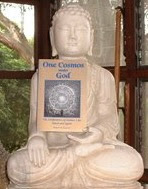
Here is your weekly soiled bobservation from two years past. As always, I try to pluck the best items from the bunch -- or at least one with unfilfulled potential -- but it seems to me that the pickin's were somewhat slim that month. I wonder why? Let me think back....
I don't know. Just an echo of the Rhythm of Eternity, I suppose. Can't always be inspired, although one does one's best.
As it so happens, this one touches on the topic we've been discussing this week. It was originally called On Meditation and Prayer: How to Depart and Bewholed. Let's see if I can nudge it a bit and get it up on its feet. Or at least make it entertaining. Or insultaining, with a few zingers from Dupree's belowtorch.
*****
Let’s pull another reader’s question out of the cosmic hopper, this one from Twisted Knickers, who asked, “I'm another one of those in the back of the class trying to keep up, and I'd appreciate it if you could recommend some books on learning to meditate. Or, maybe you could offer some meta-advice on how to navigate through the choices.”
“I'd also like to hear your thoughts on the contrast between traditional Christian meditation and the 'Eastern' types of meditation.”
In fact, yesterday I received an email from another reader with a similar question, who asked about a book entitled The Power of Focusing (which I had never heard of). “My question to you is whether you've heard of ‘focusing,’ whether you have any experience with it, and if you would recommend a person in search of the Truth to give it a try?”
[Focusing? What a novel concept. I always thought that being a scatter-brain was the key to the spiritual enterprise. After all, you folks saw the comment section at brother Deepak's site. If this doesn't demonstrate the power of frivolousness, I don't know what does, because this is the power that drives Deepak's empire. Isn't it fascinating how with capitalism, a sinister mediocretin can actually harness stupidity and shallowness and convert them into material power? And this is the very capitalism that Deepak would decry as "greedy" or "exploitative." The irony.]
In my view, there is nothing magical about meditation per se. I myself practiced it for many years without really getting anywhere, and I am sure this is true of many spiritual seekers, especially those drawn toward Buddhism. Many irreligious or anti-religious Westerners are looking for what they regard as a “rational” alternative to religion, so they turn to things like Zen, which is largely a non-theistic (not atheistic) psycho-spiritual technology.
Ultimately I found Zen and similar "bare witnessing" approaches to be rather dry, although there are obviously many wise and lovely aspects to Buddhism -- I suppose it's partly a matter of personal inclination, or one's dharma, to reference a buddha-ism. (I also have a lot of problems with the deeply immoral non-violence of Buddhism, at least as preached in the West, but that’s another subject; another irony though, because the Zen of the Samurai was hardly non-violent -- quite the opposite.)
In the West, Buddhism is often wrenched from its cultural matrix and reduced to a kind of shallow "realizationism." I agree with Schuon that “meditation cannot of itself provoke illumination; rather, its object is negative in the sense that it has to remove inner obstacles that stand in the way, not of a new, but of a preexistent and ‘innate’ knowledge of which it has to become aware. Thus meditation may be compared not so much to a light kindled in a dark room, as to an opening made in the wall of that room to allow the light to enter -- a light which preexists outside and is in no way produced by the action of piercing the wall.... The role of meditation is thus to open the soul, firstly to the grace which separates it from the world, secondly to that which brings it nearer to God and thirdly to that which, so to speak, reintegrates it into God.”
I find this to be a perfectly accurate description, because it is in accord with my own personal experience and with another one of my nonlocal authorities, Sri Aurobindo. (Yes, I know, Schuon would have a lot of problems with Sri Aurobindo, who was not a strict traditionalist, but that’s between the two of them.) For Aurobindo, the only purpose of meditation is to silence the lower mind or “frontal” personality in order to make an opening in what he calls the “psychic being.”
For Raccoon purposes, we may think of the psychic being simply as the vertical self that is both “deeper” and “higher” than the ordinary, worldly, conditioned ego. It is both "behind" and "above"; or, you may think of it as a line that extends from the principle to the manifestation, from God to man, or from O to (n). Using the lingo of modern physics, the ego is local, while the psychic being is nonlocal; or, (•) is particle, whereas (¶) is wave. In fact, for most people, (•) will be a kind of particle, or "crystalized" aspect of (¶). But the Raccoon "reverses figure and ground" in order to ride the wild surf of O. Or, he "reverses the vector flow" that causes us to live at the outskirts of being, at what I call the "terminal moraine" of the senses. Instead, he gathers himself inward and upward, and "breathes the eternal."
In short, as I tried to get across on pp. 219-224 of One Cosmos, the dual purpose of meditation is to 1) achieve stillness or mental silence, or (---); and 2) to maintain openness, surrender, or self-offering, or (o). I specifically define “faith” in this context as a sort of “expectant silence,” as we do our part to make ourselves a receptacle for the power or grace that transcends us. We are literally attempting to make contact with the spiritual world (or person), which always engenders an influx of forces. Again, the important point is not the meditation -- which is only a means -- but preparing ourselves for the subtle energy of grace, or (↓).
Depending on various personal factors, the grace appears in different guises. For some it will be more of a higher emotional experience, for others, awareness of the sacred and holy. For some it will simply manifest as an unaccountable change in personality, for others, newfound abilities or a deeper understanding of spiritual matters. It is not at all uncommon to actually feel this energy, often in the heart region or above the head. In fact, tantric yoga attempts to commandeer this energy and “take heaven by storm,” so to speak, which I would not recommend. Occasionally things can get out of hand.
Schuon is again exceptionally clear when he notes that “the contact between man and God [in meditation] becomes contact between the intelligence [he is referring here to the higher mind] and Truth, or relative truths contemplated in view of the Absolute.... Meditation acts on the one hand upon the intelligence, in which it awakens certain consubstantial ‘memories,’ and on the other hand upon the subconscious imagination which ends by incorporating in itself the truths meditated upon, resulting in a fundamental and as it were organic process of persuasion.”
This, I believe, accounts for what the immortal Dilys has called the “draining the swamp” aspect of true meditation and prayer -- why it not only opens us to the higher, but has the practical effect of cleansing, purifying, and “deconditioning” the lower mind as well. This is again why I am not a big fan of “empty” meditation of the Zen variety, especially when removed from the overall sacred and cultural matrix that guides, contains, and reflects it.
As touched upon above, another point to consider is that meditation is only an “exercise” or an adjunct to the spiritual life. It cannot be its purpose or end. Just as exercise has the purpose of making the body more healthy and fit in general -- not just while one is exercising -- meditation is a verticalisthenic that should carry over into one’s moment to moment life. In other words, insofar as it is possible, we should make the effort throughout the day to live in that silent (---) and open (o) state, in which we are not so involved with the ceaseless barrage of mechanical chatter and internal propaganda coming from the lower mind and the external cultural wasteland. Most of these "thoughts" are probably just chattering mind parasites anyway, either individual or collective.
This is why I am so drawn to Orthodox Christianity, because it really emphasizes everything we have been discussing above. Another of my nonlocal authorities, St. Theophan the Recluse, writes of how the lower mind is entangled with the world like an opium addict. It cannot get enough of what it really doesn’t need: "There is a lot of motion, but no life.” And “the reason there is no life in such a life is that it does not occupy and nourish all the aspects of human life, but only a small portion of it. And this small portion stands in last place, not even touching the center of human life.”
St. Theophan writes that “within each person is a spirit, the highest aspect of human life (¶). It is the force (↑) that draws that person from the visible to the invisible, from the temporal to the eternal, from the creation to the Creator.”
Writing of the ego, or frontal personality (•), St. Theophan notes that we might think that someone is “deep in thought.” But “in reality, he is deep in emptiness.... Observe yourself, and you will see that the greater part of our time is spent on such empty and straying thought. Some days, not a single substantial thought enters the mind.” Do our trolls not prove this point?
Not a single substantial thought. How true. This can actually happen to an entire freaking lifetime -- much more often than you might think. But here again, this is why I believe it is so important to have a religious framework for one’s “thinking.” As I have had O-->(k)sion to mention many times in the past, the very purpose of an authentic, revealed religion is to be able to think fruitfully about the otherwise unthinkable. Through meditation, concentration and prayer, we may take this thinking deeper and deeper -- or higher and higher -- into the vertical. Put it his way: religions are vertical languages that go hand in hand with the horizontal languages of math and science. Evolution is the evolution of both.
St. Theophan’s specific advice regarding meditation and prayer is to think of it as the state of standing before God with the mind in the heart. Body, soul, and spirit all have their own special ways of knowing, and this is the way to know God, as opposed to “knowing about” God with the mind. Another Orthodox text simply says to “establish peace and recollection within yourself and ask for the inspiration and guidance of the Holy Ghost.” St. Theophan says it is “simple: it is prayer -- children talking to their Father, without any subtleties...”
And one more thing: don’t look for immediate “results.” Rather, just do it for its own sake. Just make it a routine part of your life, like exercising or brushing your teeth. In my case, I’ve hardly missed some sort of physical workout a single day in my adult life. One has to adopt the same attitude as it pertains to exercising the Spirit. It’s the least you can do to devote at least 15 or 20 minutes a day to turning your mind to higher things (↑), so that the Higher Thing may turn to you (↓).
Meditation / Concentration / Prayer: These three words epitomize the spiritual life, while at the same time indicating its principal modes. Meditation, from our standpoint, is an activity of the intelligence in view of understanding universal truths; concentration, for its part, is an activity of the will in view of assimilating these truths or realities existentially, as it were; and prayer in its turn is an activity of the soul directed towards God. --Fritjhof Schuon
Saturday, July 19, 2008


Friday, July 18, 2008
On Participating Joyfully in the Sorrows of the World: Isn't it Great to Love This Much?
Some final thoughts on the subject of identity, individualism, caste, creativity, and the human role in the pneumacosmic economy. Because if we have no role, then the Buddhists and Hindus are correct, that our humanness is "nothing," except perhaps an opportunity to realize our nothingness. In this view, nothing x nothing = a kind of paradoxical empty plenitude, or effervescent emptiness.
I agree with Warren that Schuon -- and this is really no secret -- was a more-or-less crypto-Vedantin, perhaps because this was the only way he could reconcile all the world's religions. But I don't think you can do this without eliminating something quite central to Christianity, and it is precisely this question of the eternal worth and infinite preciousness of the individual.
Part of the problem involves the definition of "individual," because in my view, most people do not become individuals, which is to say, themselves. And this is especially true in more traditional cultures, as there is no question that man's "social-ism" is chronologically, developmentally, and ontologically anterior to his "narciss-ism" (and I am using both of these words in a value-neutral sense; the point is, the individual emerges from the group, just as one's personal identity emerges from a matrix of unconsciousness).
Now, as I mentioned the other day, I believe the Buddhist path represents "the easy way out." It is one of resignation born of despair and hopelessness. I well remember once discussing this with my analyst some 20 years ago, and he made a wise crack that's stuck with me ever since. I must have been saying something about the superiority of "detachment" and such, when he said something to the effect that it wasn't difficult to see the wisdom in such an view when life was so obviously short, nasty, brutish, uncertain, arbitrary, tedious, and disease-ridden. But he was making a more direct point to me, having to do with an unconscious desire to essentially "refuse" my incarnation and withdraw from the game. (At the time, I was very much drawn to Zen and the like.)
Clearly, in my analyst's view, this would not represent any kind of advance, but a capitulation. Being that he was Jewish, perhaps this was a factor, in that Judaism, perhaps even more than Christianity, is very much this worldly. It is very much a religion of descent, of bringing the divine energies into this world rather than escaping up and out. The idea that a Jew could "leave the community," renounce marriage and family, move to a monastery, and obliterate one's personal identity is pretty much meshuggenah. In fact, there is a Talmudic idea that one cannot be a rabbi if one doesn't have children, because that is the only way to understand the depth of God's love for mankind. It's very concrete, not abstract.
But if you look at the conditions of life 500, or 1000, or 2000 years ago, who wouldn't want to move into a cave near the mouth of the Ganges and detach from it all -- just withdraw inward and ascend up and out? Obviously it can be done. But I sometimes wonder if it's just an elaborate means of self-hypnosis. Of note, none of the societies that adopt this view were particularly functional, at least until they began importing western values.
To paraphrase John Lennon, "I'm not anti-Buddhist, anti-Buddha, or anti-non-theism. I'm not knockin' it or putting it down. I'm just saying it as a fact and it's true more for Raccoons than for others. I'm not saying that we're better or greater, or comparing us with Buddha as a person or God as emptiness or whatever it is. I just said what I said and it was wrong. Or it was taken wrong. And now it's all this."
To illustrate my point about the difficulty of the Raccoon path, I remember seeing an interview with Tony Snow ( a Catholic convert) about a year ago. They began discussing Snow's cancer, and he began to break down, fighting back the tears. The interviewer -- who was also close to tears -- said something to the effect of, "You've got a lot to live for." Snow's pained response encapsulated the Raccoon view: Isn't it great to love this much?
Looked at in one way, you could say, "hell no! It sucks to love this much. If I were a single guy living in a cave, I could just slip off into the infinite, and not even notice the transition." But here is a man who found a way to value his own crucifixion -- and for those of you with small children, you know what I mean, because that's what it is. And yet, Snow didn't back away from it. Just like you-know-who, he actually embraced his fate. He did not think "my attachment to my loved ones is the source of pain." Rather, he said "my attachment to my loved ones is infinitely precious. I must not back away from it, but throw myself into it even more passionately."
Passion. Where have I heard that before? Judaism also has a passion for this Life, which is everything to it. This is why it is such a monstrosity to exchange the Palestinian beasts of depravity -- who are "living death" -- for the dead Israeli soldiers, who are "stolen life."
Likewise, the Christian God does not evade embodiment, life, and history. To the contrary, he plunges in feet first, into all of the muck, slime, confusion, obscurity, and ambiguity of the human state. If you think I'm exaggerating, this is one of the things that even the wisest pagans of the time could not comprehend, being that they believed the highest wisdom to consist of detachment and ascent. They could scarcely imagine a God who would actually choose this horrible situation, much less in a worthless and screaming baby born of anonymous peasants. That's crazy! As Pierre Hadot writes, this
"was one of the reasons for pagan hostility towards the mystery of the Incarnation." Porphyry asked, "How can we admit that the divine became an embryo, and that after its birth, it was wrapped up in swaddling clothes, covered with blood, bile, and even worse things?" "One could say that every philosophy of this period tried to explain the presence of [the] divine soul in a terrestrial body. Each was responding to the anxious interrogation of men who felt like strangers in this lower world" (Hadot).
In fact, it was in this climate that the heresy of Gnosticism (not to be confused with gnosis) was born, as it was a form of life-denial, rooted in the idea that existence wasn't just a mistake, but the perverse creation of a hostile demi-god. One can easily understand how a sophisticated person of the time could arrive at this conclusion. Imagine the faith it took to think otherwise.
But is it more or less difficult for us? For the blessings of modernity only make the world all the more enticing. Two thousand years ago it wasn't that difficult to be detached from children, since infant mortality was so extraordinarily high. People realized this, and didn't put a lot of emotional investment in a child until there was some certainty that he would survive. But even then, without the experience of passionate attachment at the foundation of the personality, the person will grow up with a schizoid, or paranoid, or borderline core -- meaning that they will either be emotionally detached from others, or project the bad content of their mind outward, thereby creating an eerily malevolent world, or be driven to extremes of impulsivity and a kind of "stably unstable" bipolar moodiness.
I suppose the question is, how do we truly reconcile Eastern and Western approaches without artificially reducing Christianity to Vedanta? Perhaps sophisticated Westerners need to get over their inferiority complex, and say that it is incumbent upon the Eastern religions to get a clue and to reconcile themselves with the Judeo-Christian values of America. Can it be done? Oh, I think so.
It is surely no coincidence that Sri Aurobindo was educated in the Christian West from a very early age. He eventually graduated with honors from Cambridge, and it was only then, at the age of 21 or so, that he returned to India. At the time, he knew nothing about Indian philosophy, and only later developed his own version of it, still rooted in tradition but adding some clearly Western concepts.
Quoting from the wiki article, it states that "One of Sri Aurobindo's main philosophical achievements was to introduce the concept of evolution into Vedantic thought.... Aurobindo rejected the materialistic tendencies of both Darwinism and Samkhya, and proposed an evolution of spirit along with that of matter, and that the evolution of matter was a result of the former."
But perhaps most importantly, "Sri Aurobindo rejected a major conception of Indian philosophy that says that the World is Maya (illusion) and that living as a renunciate was the only way out. He says that it is possible, not only to transcend human nature but also to transform it and to live in the world as a free and evolved human being with a new consciousness and a new nature which could spontaneously perceive the truth of things, and proceed in all matters on the basis of inner oneness, love and light" (emphasis mine).
Bingo! The Way of the Raccoon, whatever your religion. Elsewhere Aurobindo wrote that such an approach necessarily altered "our whole normal view of things; even in preserving all the aims of human life, it will give them a different sense and direction."
Isn't it great to love so much?
The first victory is to create an individuality. And then later, the second victory is to give this individuality to the Divine. And the third victory is that the Divine changes your individuality into a divine being.
There are three stages: the first is to become an individual; the second is to consecrate the individual, that he may surrender entirely to the Divine and be identified with Him; and the third is that the Divine takes possession of this individual and changes him into a being in His own image, that is, he too becomes divine. --The Mother
I agree with Warren that Schuon -- and this is really no secret -- was a more-or-less crypto-Vedantin, perhaps because this was the only way he could reconcile all the world's religions. But I don't think you can do this without eliminating something quite central to Christianity, and it is precisely this question of the eternal worth and infinite preciousness of the individual.
Part of the problem involves the definition of "individual," because in my view, most people do not become individuals, which is to say, themselves. And this is especially true in more traditional cultures, as there is no question that man's "social-ism" is chronologically, developmentally, and ontologically anterior to his "narciss-ism" (and I am using both of these words in a value-neutral sense; the point is, the individual emerges from the group, just as one's personal identity emerges from a matrix of unconsciousness).
Now, as I mentioned the other day, I believe the Buddhist path represents "the easy way out." It is one of resignation born of despair and hopelessness. I well remember once discussing this with my analyst some 20 years ago, and he made a wise crack that's stuck with me ever since. I must have been saying something about the superiority of "detachment" and such, when he said something to the effect that it wasn't difficult to see the wisdom in such an view when life was so obviously short, nasty, brutish, uncertain, arbitrary, tedious, and disease-ridden. But he was making a more direct point to me, having to do with an unconscious desire to essentially "refuse" my incarnation and withdraw from the game. (At the time, I was very much drawn to Zen and the like.)
Clearly, in my analyst's view, this would not represent any kind of advance, but a capitulation. Being that he was Jewish, perhaps this was a factor, in that Judaism, perhaps even more than Christianity, is very much this worldly. It is very much a religion of descent, of bringing the divine energies into this world rather than escaping up and out. The idea that a Jew could "leave the community," renounce marriage and family, move to a monastery, and obliterate one's personal identity is pretty much meshuggenah. In fact, there is a Talmudic idea that one cannot be a rabbi if one doesn't have children, because that is the only way to understand the depth of God's love for mankind. It's very concrete, not abstract.
But if you look at the conditions of life 500, or 1000, or 2000 years ago, who wouldn't want to move into a cave near the mouth of the Ganges and detach from it all -- just withdraw inward and ascend up and out? Obviously it can be done. But I sometimes wonder if it's just an elaborate means of self-hypnosis. Of note, none of the societies that adopt this view were particularly functional, at least until they began importing western values.
To paraphrase John Lennon, "I'm not anti-Buddhist, anti-Buddha, or anti-non-theism. I'm not knockin' it or putting it down. I'm just saying it as a fact and it's true more for Raccoons than for others. I'm not saying that we're better or greater, or comparing us with Buddha as a person or God as emptiness or whatever it is. I just said what I said and it was wrong. Or it was taken wrong. And now it's all this."
To illustrate my point about the difficulty of the Raccoon path, I remember seeing an interview with Tony Snow ( a Catholic convert) about a year ago. They began discussing Snow's cancer, and he began to break down, fighting back the tears. The interviewer -- who was also close to tears -- said something to the effect of, "You've got a lot to live for." Snow's pained response encapsulated the Raccoon view: Isn't it great to love this much?
Looked at in one way, you could say, "hell no! It sucks to love this much. If I were a single guy living in a cave, I could just slip off into the infinite, and not even notice the transition." But here is a man who found a way to value his own crucifixion -- and for those of you with small children, you know what I mean, because that's what it is. And yet, Snow didn't back away from it. Just like you-know-who, he actually embraced his fate. He did not think "my attachment to my loved ones is the source of pain." Rather, he said "my attachment to my loved ones is infinitely precious. I must not back away from it, but throw myself into it even more passionately."
Passion. Where have I heard that before? Judaism also has a passion for this Life, which is everything to it. This is why it is such a monstrosity to exchange the Palestinian beasts of depravity -- who are "living death" -- for the dead Israeli soldiers, who are "stolen life."
Likewise, the Christian God does not evade embodiment, life, and history. To the contrary, he plunges in feet first, into all of the muck, slime, confusion, obscurity, and ambiguity of the human state. If you think I'm exaggerating, this is one of the things that even the wisest pagans of the time could not comprehend, being that they believed the highest wisdom to consist of detachment and ascent. They could scarcely imagine a God who would actually choose this horrible situation, much less in a worthless and screaming baby born of anonymous peasants. That's crazy! As Pierre Hadot writes, this
"was one of the reasons for pagan hostility towards the mystery of the Incarnation." Porphyry asked, "How can we admit that the divine became an embryo, and that after its birth, it was wrapped up in swaddling clothes, covered with blood, bile, and even worse things?" "One could say that every philosophy of this period tried to explain the presence of [the] divine soul in a terrestrial body. Each was responding to the anxious interrogation of men who felt like strangers in this lower world" (Hadot).
In fact, it was in this climate that the heresy of Gnosticism (not to be confused with gnosis) was born, as it was a form of life-denial, rooted in the idea that existence wasn't just a mistake, but the perverse creation of a hostile demi-god. One can easily understand how a sophisticated person of the time could arrive at this conclusion. Imagine the faith it took to think otherwise.
But is it more or less difficult for us? For the blessings of modernity only make the world all the more enticing. Two thousand years ago it wasn't that difficult to be detached from children, since infant mortality was so extraordinarily high. People realized this, and didn't put a lot of emotional investment in a child until there was some certainty that he would survive. But even then, without the experience of passionate attachment at the foundation of the personality, the person will grow up with a schizoid, or paranoid, or borderline core -- meaning that they will either be emotionally detached from others, or project the bad content of their mind outward, thereby creating an eerily malevolent world, or be driven to extremes of impulsivity and a kind of "stably unstable" bipolar moodiness.
I suppose the question is, how do we truly reconcile Eastern and Western approaches without artificially reducing Christianity to Vedanta? Perhaps sophisticated Westerners need to get over their inferiority complex, and say that it is incumbent upon the Eastern religions to get a clue and to reconcile themselves with the Judeo-Christian values of America. Can it be done? Oh, I think so.
It is surely no coincidence that Sri Aurobindo was educated in the Christian West from a very early age. He eventually graduated with honors from Cambridge, and it was only then, at the age of 21 or so, that he returned to India. At the time, he knew nothing about Indian philosophy, and only later developed his own version of it, still rooted in tradition but adding some clearly Western concepts.
Quoting from the wiki article, it states that "One of Sri Aurobindo's main philosophical achievements was to introduce the concept of evolution into Vedantic thought.... Aurobindo rejected the materialistic tendencies of both Darwinism and Samkhya, and proposed an evolution of spirit along with that of matter, and that the evolution of matter was a result of the former."
But perhaps most importantly, "Sri Aurobindo rejected a major conception of Indian philosophy that says that the World is Maya (illusion) and that living as a renunciate was the only way out. He says that it is possible, not only to transcend human nature but also to transform it and to live in the world as a free and evolved human being with a new consciousness and a new nature which could spontaneously perceive the truth of things, and proceed in all matters on the basis of inner oneness, love and light" (emphasis mine).
Bingo! The Way of the Raccoon, whatever your religion. Elsewhere Aurobindo wrote that such an approach necessarily altered "our whole normal view of things; even in preserving all the aims of human life, it will give them a different sense and direction."
Isn't it great to love so much?
The first victory is to create an individuality. And then later, the second victory is to give this individuality to the Divine. And the third victory is that the Divine changes your individuality into a divine being.
There are three stages: the first is to become an individual; the second is to consecrate the individual, that he may surrender entirely to the Divine and be identified with Him; and the third is that the Divine takes possession of this individual and changes him into a being in His own image, that is, he too becomes divine. --The Mother
Thursday, July 17, 2008
The Great Cosmic Casting Couch and the Role of a Lifetime
Before we implement the caste system, a couple of readers wanted some clarification. I'm hardly an expert on the subject, but I'll give it the old Coonish try.
Rick asks, "So Bob, do you think a person can be built for two or more [castes]? I think you are saying there is a 'predominant' one for a person and that even then most will not be great at it. Which is fine. It’s the forcing yourself to be exceptional at it, and convincing yourself you are when you are not, that is not good. And you’re speaking 'generally.' But I look at the categories and I clearly see a little farmer and hunter and warrior in me too. Seems the blessings of modernity finally allow it. The real world outside of your predominant caste will provoke those lesser ones. In other words, you may need ‘em someday."
That's a good point. Reminds me of astrology, in which one has a dominant sun sign, but within the context of various other archetypes, aspects, houses, elements, transits, and cycles, so that each horoscope is as unique as a... a human being.
The second question is from an anonymous commenter who boasts of living "in an abandoned refrigerator carton in a vacant lot. My box is lined with carpet scraps and is quite snug and cozy. I use the computer at the public library. I turn in aluminum cans and so forth to get spending money."
What this resourceful man wants to know is, "So, what caste am I, anyway? Am I the lowest or is there an even lower one?"
Let's start with these latter questions, being that I sense they have more comedic potential. First of all, there is an unavoidable political dimension to the questions, in that the caste of which he speaks only exists during a Republican administration. During such Hard Times, hordes of these untouchables suddenly appear as if by magic, living in their cardboard boxes and pushing shopping carts around the city. But when a Democrat is in office, the problem just as suddenly "disappears," and there are no longer any members of this caste. This is the nature of "liberal compassion." It is so powerful, that mere good intentions are sufficient to make the problem go away, at least until a Republican returns to office.
Caste. Exactly what is it? Schuon writes that "in its spiritual sense, caste is the 'law' or dharma governing a particular category of men in accord with their qualifications." The Bhagavad-Gita says that it is "better to perish in one’s own law; it is perilous to follow the law of another.... [S]imilarly the Manava-Dharma Shastra says: 'It is better to carry out one’s own proper functions in a defective manner than to fulfill perfectly those of another; for he who lives accomplishing the duties of another caste forthwith loses his own.'” The point is, there is real existential peril and pain involved in failure to identify one's caste.
Of the castes, Schuon only mentions four, but as Rick implies, the modern world would seem to suggest that there are many more niches to fill within the pneumacosmic economy -- which is again one of the great blessings of America, not just that we are free to move from level to level (vertically) or category to category (horizontally), but may also make a "mid-course correction" at any age. It's never too late to discover your role in the Cosmic Adventure!
Regarding the four castes, "There is first of all the intellective, speculative, contemplative, sacerdotal type, which tends towards wisdom or holiness.... Next there is the warlike and royal type, which tends towards glory and heroism.... this type will readily be active, combative and heroic, hence the ideal of the 'heroicalness of virtue.' The third type is the respectable 'average' man: he is essentially industrious, balanced, persevering; his center is love for work that is useful and well done, and carried out with God in mind.... Lastly there is the type that has no ideal other than that of pleasure in the more or less coarse sense of the word; this is concupiscent man who, not knowing how to master himself, has to be mastered by others, so that his great virtue will be submission and fidelity."
Again, we are not interested in the institutional application of these principles in any top-down manner. Rather, for Raccoon purposes, their only value is in the idea that we do possess our own "soul imprint," so to speak, which must be "actualized" in this life. In the past, I have discussed this in terms of Bollas's idea of the "unthought known" and its relationship to the discovery of our own unique idiom of expression, which would represent the "exteriorization" of our inwardness, so to speak. This is where liberty and the sanctity of private property come in, because it is obviously quite impossible to discover oneself except under conditions of freedom, nor can this exteriorization of the interior occur unless the soul can choose those objects that "resonate" with it.
That probably sounds too abstract, but I think you will find that it is actually quite concrete and "experience near." For example, Bollas talks about how a person's dwelling is like a sort of "soul museum" -- like walking through an objectified dreamscape in which the "contents are visible," as Van Morrison put it in song. To say that a sanctuary is where the soul and intellect find their rest is to say that there is a "good fit" between the inward and the outward. Thus, one person's sanctuary can be another's dreary airport terminal. I am often shocked at what people call "home," since my soul would be quite restless, if not totally alienated, there; but there you go. Different cloaks for different blokes.
In my case, whatever the external trappings, I usually go straight for the books and CDs. That tells me everything I need to know about what kind of person I'm dealing with (although what is hanging on the wall -- i.e., what they call "art" -- is another dead giveaway). This may sound... I don't know, petty, but I am utterly disoriented if someone has the complete works of Michael Buble or Harry Connick, but no Sinatra. Frankly, I don't know what to say to such a person. Just make my apologies and slowly back away.
You see, it's a matter of essentials. I am reminded of Ray Charles, who said that he could tell everything he needed to know about a woman by holding her wrist. Someone said to him, "that's preposterous. How can you tell everything about a person by touching their wrist?" To which Ray responded: "I didn't say everything. I said everything I need to know." (Which reminds me: How does one become a Raelette? Easy. You let Ray.)
Some people have no clear or articulate idiom, and that is part of the problem. For if you haven't discovered the soul, then you will not have found its idiom. Or, to put it the other way around, to find the soul's idiom is to have found the soul, precisely. Look at me. I would say that I didn't fully discover my idiom and truly flesh it out until I began blogging. This is a critical point, and again goes to what Rick was saying about the diversity of modernity, and the many more opportunities to identify and occupy niches and sub-niches.
As I have probably mentioned before, my book was difficult -- or at least laborious -- to write, in large measure -- which I now realize in hindsight -- because I had no audience. It was as if I were trying to develop a unique idiom, but absent any context. It's analogous to an artist who must simultaneously express himself and invent the means to do so. Looking back on it, I can definitely say that for much of my life, I felt like "an artist without an art form," and now I know why: I had to invent the art form, or the idiom, for my soul's expression. And of course, it's an ongoing process. For example, in reading that post yesterday from early '06, I could see how far I've come since then. And where I've come is "toward me."
Again, not necessarily just in terms of "content," but in expression, which turns out to be a vital component of the content! For this reason, I would never worry about someone "stealing my ideas," because they would have to "steal me," which no one could ever do. Or, put it this way: it is obviously possible to steal a scientific idea, or just discover it before someone else does. But no one could steal my idiom, because it is unique to my soul. For this reason I say, to paraphrase Walt Whitman: This is no blog, comrade. Who touches this touches a man! Or a soul, to be precise; cut it, and it bleeds my blood. So I suppose it's a body as well: again, the exteriorization of my deepest interior, for what it's worth. It is my "image and likeness."
Another important point is what Bollas calls "the erotics of being." This refers to the deeply satisfying feeling of expressing the soul's idiom and having it understood by someone else. It is "erotic" in the sense that it is soul-to-soul touch. People occasionally or constantly ask me when I might write the next book, and the answer is "possibly never," one reason being that it could never be as satisfying as the blogging, through which I have the privilege of indulging in the "erotics of being" every morning. With a book, I would have to be too self-conscious and couldn't "pull out all the stops." Even as it is, I am surprised that my publisher went along with some of the unorthodox features of my existing book. No one knew back then about the lost tribe of Raccoons, and how we share a similar idiom.
Now, back to our box-dwelling reader. Is there a lower caste? First, he might be confusing caste with socioeconomic status, for one's essential caste doesn't change with material circumstances. There are obviously wealthy people who are outcasts (one thinks of Hollywood) and noble and dignified people of modest means who have a natural aristocracy about them. They know who they are. These are often the people for whom liberal outcasts have contempt that they express under the guise of "helping the little guy." In point of fact, liberals are "little guys," i.e., constricted and emaciated souls. We are not, for we contain the very cosmos that contains the liberal.
Regarding those Hollywood liberals, one has only to examine their idiom -- i.e., their dreadful films -- to know everything you need to know about them. They must live in a kind of grinding soul-poverty that is scarcely imaginable to a Raccoon. What kind of soul thinks that these projects needed to exist, or even have a right to?
The lowest caste is a kind of "anti-caste," being that it has to do with a person who has no center, or else has a completely exteriorized and therefore dissipated soul. He then chases his soul outward, which results only in additional fragmentation and further distance from himself, as his soul drains into the terminal moraine of the senses.
Nevertheless, such a person, according to Schuon, is "salvageable through submission to someone better than he, and who will serve as his center. This is exactly what happens -- but on a higher plane which may concern any man -- in the relation between disciple and spiritual master." Recall that a couple of weeks ago, I was discussing how this has worked in my life. I have repeatedly discovered "spiritual masters" who at once served as a "surrogate center" and a means to discover my own idiom. Once that occurs, then you can relinquish the model, because the center is now "inside," so to speak.
The other day, Hoarhey was asking about people who are (•••) or even (•••••). What about them? Schuon talks about the "pariah," who arises from a "mixture of castes." One thinks of Deepak, who combines the sacerdotal with the material, and is therefore "capable of everything and nothing." In fact, this probably applies to all cult leaders and spritual frauds, who may have some level of spiritual insight, only mixed with other factors and tendencies, and which results in the inevitable "acting out" that we always see in such people -- the abuses, the contradictions, the broken moral compass, the rules that apply to followers but not the leader, etc. L. Ron Hubbard, Da Love Ananda, Rajneesh.... One could think of dozens more.
"The pariah has neither center nor continuity; he is nothingness eager for sensations; his life is a disconnected series of arbitrary experiences." Again, one commonly encounters this type in new age circles -- those "masters" who confuse the absence of a center with a kind of false transcendence. One can always sense when one is dealing with such a person, because their teaching will have no true depth, continuity, or resonance. It is very ad hoc, and they nearly always reject and belittle tradition, because it calls their absence of a transcendent center to account. They are also "charismatically creepy" or "creepily charismatic."
For as Schuon notes, "there is a supra-human Center which is always available to us, and whose trace we bear within ourselves, given that we are made in the image of the Creator." So although manifestation is a kind of great casting couch, ultimately there is really only one Role, and that's all that matters.
You know what they say: it's Frank's world, baby. We just love in it.
Rick asks, "So Bob, do you think a person can be built for two or more [castes]? I think you are saying there is a 'predominant' one for a person and that even then most will not be great at it. Which is fine. It’s the forcing yourself to be exceptional at it, and convincing yourself you are when you are not, that is not good. And you’re speaking 'generally.' But I look at the categories and I clearly see a little farmer and hunter and warrior in me too. Seems the blessings of modernity finally allow it. The real world outside of your predominant caste will provoke those lesser ones. In other words, you may need ‘em someday."
That's a good point. Reminds me of astrology, in which one has a dominant sun sign, but within the context of various other archetypes, aspects, houses, elements, transits, and cycles, so that each horoscope is as unique as a... a human being.
The second question is from an anonymous commenter who boasts of living "in an abandoned refrigerator carton in a vacant lot. My box is lined with carpet scraps and is quite snug and cozy. I use the computer at the public library. I turn in aluminum cans and so forth to get spending money."
What this resourceful man wants to know is, "So, what caste am I, anyway? Am I the lowest or is there an even lower one?"
Let's start with these latter questions, being that I sense they have more comedic potential. First of all, there is an unavoidable political dimension to the questions, in that the caste of which he speaks only exists during a Republican administration. During such Hard Times, hordes of these untouchables suddenly appear as if by magic, living in their cardboard boxes and pushing shopping carts around the city. But when a Democrat is in office, the problem just as suddenly "disappears," and there are no longer any members of this caste. This is the nature of "liberal compassion." It is so powerful, that mere good intentions are sufficient to make the problem go away, at least until a Republican returns to office.
Caste. Exactly what is it? Schuon writes that "in its spiritual sense, caste is the 'law' or dharma governing a particular category of men in accord with their qualifications." The Bhagavad-Gita says that it is "better to perish in one’s own law; it is perilous to follow the law of another.... [S]imilarly the Manava-Dharma Shastra says: 'It is better to carry out one’s own proper functions in a defective manner than to fulfill perfectly those of another; for he who lives accomplishing the duties of another caste forthwith loses his own.'” The point is, there is real existential peril and pain involved in failure to identify one's caste.
Of the castes, Schuon only mentions four, but as Rick implies, the modern world would seem to suggest that there are many more niches to fill within the pneumacosmic economy -- which is again one of the great blessings of America, not just that we are free to move from level to level (vertically) or category to category (horizontally), but may also make a "mid-course correction" at any age. It's never too late to discover your role in the Cosmic Adventure!
Regarding the four castes, "There is first of all the intellective, speculative, contemplative, sacerdotal type, which tends towards wisdom or holiness.... Next there is the warlike and royal type, which tends towards glory and heroism.... this type will readily be active, combative and heroic, hence the ideal of the 'heroicalness of virtue.' The third type is the respectable 'average' man: he is essentially industrious, balanced, persevering; his center is love for work that is useful and well done, and carried out with God in mind.... Lastly there is the type that has no ideal other than that of pleasure in the more or less coarse sense of the word; this is concupiscent man who, not knowing how to master himself, has to be mastered by others, so that his great virtue will be submission and fidelity."
Again, we are not interested in the institutional application of these principles in any top-down manner. Rather, for Raccoon purposes, their only value is in the idea that we do possess our own "soul imprint," so to speak, which must be "actualized" in this life. In the past, I have discussed this in terms of Bollas's idea of the "unthought known" and its relationship to the discovery of our own unique idiom of expression, which would represent the "exteriorization" of our inwardness, so to speak. This is where liberty and the sanctity of private property come in, because it is obviously quite impossible to discover oneself except under conditions of freedom, nor can this exteriorization of the interior occur unless the soul can choose those objects that "resonate" with it.
That probably sounds too abstract, but I think you will find that it is actually quite concrete and "experience near." For example, Bollas talks about how a person's dwelling is like a sort of "soul museum" -- like walking through an objectified dreamscape in which the "contents are visible," as Van Morrison put it in song. To say that a sanctuary is where the soul and intellect find their rest is to say that there is a "good fit" between the inward and the outward. Thus, one person's sanctuary can be another's dreary airport terminal. I am often shocked at what people call "home," since my soul would be quite restless, if not totally alienated, there; but there you go. Different cloaks for different blokes.
In my case, whatever the external trappings, I usually go straight for the books and CDs. That tells me everything I need to know about what kind of person I'm dealing with (although what is hanging on the wall -- i.e., what they call "art" -- is another dead giveaway). This may sound... I don't know, petty, but I am utterly disoriented if someone has the complete works of Michael Buble or Harry Connick, but no Sinatra. Frankly, I don't know what to say to such a person. Just make my apologies and slowly back away.
You see, it's a matter of essentials. I am reminded of Ray Charles, who said that he could tell everything he needed to know about a woman by holding her wrist. Someone said to him, "that's preposterous. How can you tell everything about a person by touching their wrist?" To which Ray responded: "I didn't say everything. I said everything I need to know." (Which reminds me: How does one become a Raelette? Easy. You let Ray.)
Some people have no clear or articulate idiom, and that is part of the problem. For if you haven't discovered the soul, then you will not have found its idiom. Or, to put it the other way around, to find the soul's idiom is to have found the soul, precisely. Look at me. I would say that I didn't fully discover my idiom and truly flesh it out until I began blogging. This is a critical point, and again goes to what Rick was saying about the diversity of modernity, and the many more opportunities to identify and occupy niches and sub-niches.
As I have probably mentioned before, my book was difficult -- or at least laborious -- to write, in large measure -- which I now realize in hindsight -- because I had no audience. It was as if I were trying to develop a unique idiom, but absent any context. It's analogous to an artist who must simultaneously express himself and invent the means to do so. Looking back on it, I can definitely say that for much of my life, I felt like "an artist without an art form," and now I know why: I had to invent the art form, or the idiom, for my soul's expression. And of course, it's an ongoing process. For example, in reading that post yesterday from early '06, I could see how far I've come since then. And where I've come is "toward me."
Again, not necessarily just in terms of "content," but in expression, which turns out to be a vital component of the content! For this reason, I would never worry about someone "stealing my ideas," because they would have to "steal me," which no one could ever do. Or, put it this way: it is obviously possible to steal a scientific idea, or just discover it before someone else does. But no one could steal my idiom, because it is unique to my soul. For this reason I say, to paraphrase Walt Whitman: This is no blog, comrade. Who touches this touches a man! Or a soul, to be precise; cut it, and it bleeds my blood. So I suppose it's a body as well: again, the exteriorization of my deepest interior, for what it's worth. It is my "image and likeness."
Another important point is what Bollas calls "the erotics of being." This refers to the deeply satisfying feeling of expressing the soul's idiom and having it understood by someone else. It is "erotic" in the sense that it is soul-to-soul touch. People occasionally or constantly ask me when I might write the next book, and the answer is "possibly never," one reason being that it could never be as satisfying as the blogging, through which I have the privilege of indulging in the "erotics of being" every morning. With a book, I would have to be too self-conscious and couldn't "pull out all the stops." Even as it is, I am surprised that my publisher went along with some of the unorthodox features of my existing book. No one knew back then about the lost tribe of Raccoons, and how we share a similar idiom.
Now, back to our box-dwelling reader. Is there a lower caste? First, he might be confusing caste with socioeconomic status, for one's essential caste doesn't change with material circumstances. There are obviously wealthy people who are outcasts (one thinks of Hollywood) and noble and dignified people of modest means who have a natural aristocracy about them. They know who they are. These are often the people for whom liberal outcasts have contempt that they express under the guise of "helping the little guy." In point of fact, liberals are "little guys," i.e., constricted and emaciated souls. We are not, for we contain the very cosmos that contains the liberal.
Regarding those Hollywood liberals, one has only to examine their idiom -- i.e., their dreadful films -- to know everything you need to know about them. They must live in a kind of grinding soul-poverty that is scarcely imaginable to a Raccoon. What kind of soul thinks that these projects needed to exist, or even have a right to?
The lowest caste is a kind of "anti-caste," being that it has to do with a person who has no center, or else has a completely exteriorized and therefore dissipated soul. He then chases his soul outward, which results only in additional fragmentation and further distance from himself, as his soul drains into the terminal moraine of the senses.
Nevertheless, such a person, according to Schuon, is "salvageable through submission to someone better than he, and who will serve as his center. This is exactly what happens -- but on a higher plane which may concern any man -- in the relation between disciple and spiritual master." Recall that a couple of weeks ago, I was discussing how this has worked in my life. I have repeatedly discovered "spiritual masters" who at once served as a "surrogate center" and a means to discover my own idiom. Once that occurs, then you can relinquish the model, because the center is now "inside," so to speak.
The other day, Hoarhey was asking about people who are (•••) or even (•••••). What about them? Schuon talks about the "pariah," who arises from a "mixture of castes." One thinks of Deepak, who combines the sacerdotal with the material, and is therefore "capable of everything and nothing." In fact, this probably applies to all cult leaders and spritual frauds, who may have some level of spiritual insight, only mixed with other factors and tendencies, and which results in the inevitable "acting out" that we always see in such people -- the abuses, the contradictions, the broken moral compass, the rules that apply to followers but not the leader, etc. L. Ron Hubbard, Da Love Ananda, Rajneesh.... One could think of dozens more.
"The pariah has neither center nor continuity; he is nothingness eager for sensations; his life is a disconnected series of arbitrary experiences." Again, one commonly encounters this type in new age circles -- those "masters" who confuse the absence of a center with a kind of false transcendence. One can always sense when one is dealing with such a person, because their teaching will have no true depth, continuity, or resonance. It is very ad hoc, and they nearly always reject and belittle tradition, because it calls their absence of a transcendent center to account. They are also "charismatically creepy" or "creepily charismatic."
For as Schuon notes, "there is a supra-human Center which is always available to us, and whose trace we bear within ourselves, given that we are made in the image of the Creator." So although manifestation is a kind of great casting couch, ultimately there is really only one Role, and that's all that matters.
You know what they say: it's Frank's world, baby. We just love in it.
Wednesday, July 16, 2008
Beauty, Milk, Poop, Soul Jazz, and the Miscaste Obama
As I mentioned to a commenter yesterday, although I obviously cite Schuon a lot, I cannot say I am a disciple, nor do I believe he is infallible. One big reason I can't be a disciple is that I am quite certain that he would disapprove of my use of his ideas. In fact, if he were still alive, I would probably live in fear that he would find out about me and Go Medieval on my... person, like Dupree did to LaFayette last night.
I am reminded of when James Joyce was asked if he had relied upon the ideas of Giambattista Vico in his Finnegans Wake, and he responded "I would not pay overmuch attention to these theories, beyond using them for all they're worth." So I don't pay much attention to Schuon aside from playgiarizing with him 'til the sacred cows go OM, but hopefully in an inimitable Raccoonish, space age au-go-go manner that may look vulgar to the uninitiated, for the same reason that someone might mistakenly regard Potato Head Blues as primitive "jungle music" instead of a divinely hip transmission from Gabriel himself.
I suppose our main point of disagreement -- that would be me and Fritz -- is over the issue of adherence to strict traditionalism. In my case, I have a dilemma, and the best analogy I can think if is the difference between a jazz musician and a classical musician. Schuon is like a stately, dignified, and somber classical musician. But I am like what a condescending British reviewer once wrote of the early Beatles: Authentic R & B in the American Negro Tradition.
I suppose it comes down to two issues, 1) the value of the individual over the collective, and 2) how this impacts creativity, since creativity takes on a different inflection as it passes through the individual. Schuon was obviously preoccupied with how the rise of narcissistic individualism -- and with it, the loss of transcendence, norms, and standards -- had led to the kind of aesthetic anarchy we see today, where so-called "artists" produce works of "eternal worthlessness," if one may so put it. "Art for art's sake" is no art at all, for it deprives art of its sufficient reason, which is to serve as a bridge between man and God. To paraphrase Schuon, in serving only man, it inevitably betrays him in the process. Most modern art isn't even bad, just "nothing."
So while Schuon clearly had an appreciation of the dark side of modernity, he didn't seem to have any feel whatsoever for the totalitarian nature of premodern cultures, in which one really wasn't free to "become who you are." One was free to adhere to a "celestial archetype," so to speak, but not to discover or elaborate one's uniqueness.
Now, this latter process can clearly be abused, and I think it is fair to say that it is the central Pathology of our Times. For example, it seems that everyone is urged to be creative, when there are only a handful of people who are capable of being creative in a worthwhile way. It's no different than urging everyone to be Michael Jordan. What would be the point, except to pretend that everyone is good at basketball?
So the narcissism and individualism of our day places value on the individual to such an extent that it has the effect of -- in psychoanalytic terms -- conflating milk and feces; which is to say, breast and the lower GI tract. I remember the first time I heard this formulation in graduate school, and thinking that my professor was surely speaking metaphorically or just insane. Nope. The pathological narcissist imagines he's giving you milk when he's actually feeding you poop; in short, he's not a bountiful breast but a toxic asshole. Once you get a feel for this, you can really appreciate the ubiquity of the dynamic. Ever wonder how Noam Chomsky can be so prolific? Because the large intestine never sleeps. Likewise, mass culture is a sewer. Literally.
Nevertheless. One of the things I'm constantly trying to work out is the relationship between modernity and tradition, or individual and collective. Surely there must be a way to individuate that leads "upward" and which "crystalizes" our celestial essence, as opposed to downward, where it is dissipated and supplanted by a hypertrophied and promethean terrestrial ego. I mean, I can see how this path does usually lead downward into vulgarity, stupidity, and excess -- a gross and cringe-inducing "song of myself" -- but is there a way to be oneself in the context of timeless truth?
I admit that this may be completely self-serving, but I think so, and I believe that this is ultimately the entire basis of the American experiment in a culture of liberty, i.e., of conservative classical liberalism. True, the founders wanted to liberate themselves from various religious, political, and cultural strictures of old Europe, but at the same time, they clearly did not value liberty for its own sake, but only to the extent that it had a spiritual telos. This is obvious from their writings on the subject, so I won't waste time debating the knuckleheads who think otherwise.
Here's the problem, though: very few people can play jazz, for it combines the virtues of intense discipline with total freedom and abandon. It is the "sound of surprise," but not only surprise, which is just another name for anarchy.
Now, one reason I don't pretend to be some kind of "guru" is that I don't believe I can generalize my specific path to others, at least on any kind of wholesale basis. Perhaps to a very limited extent on a kind of boutique level, but only if the so-called "student" already has the makings of a master. To be honest, this is why I have never tried to get a job at a university. Many people who've heard me on a particularly inspired rant have asked, "why aren't you a teacher?," and the reason is, I could never handle teaching a bunch of idiots and mediocrities, and that is what college has become. Since we now have the egalitarian belief that everyone should have a college education, colleges are full of people who have no business being there. I know plenty of Ph.D.s who can't even write coherently or think deeply.
It's no different than suggesting that everyone should be in the military, when it is equally clear that warriors are special people who belong to their own caste and develop their own culture. As I have written before, I am a big believer in the "caste system," so long as it is not enforced in a "top-down" way that limits the freedom to discover one's gift and one's place. For example, my father was a quintessential "merchant," in that he was a born salesman. He loved people, and people loved doing business with him. He eventually became a sales executive on the strength of an 8th grade education, but it didn't matter, because he had such an innate feel for doing business with people.
In my case, I imagined that I would be capable of the same thing, but as I have written about in the past, I flunked out of business school. I was literally like a retard. Not only was it "not my dharma," but it took me a long time and a lot of floating on the Luck Plane to discover what my dharma was.
Similarly, I have a relative -- we have been estranged for years -- who is a fine artisan, in such a way that it comes completely naturally to him, but imagines himself to be a "scholar." For whatever reason, he rejects his God-given caste, and wants to be an "intellectual," so he writes books that would make fine benches or ottomans, but they certainly have no intellectual or literary merit. But you will have noticed that at least 90% of what comes out of academia is of this nature, since it is produced by people who don't belong there. They're in the wrong caste. (In contrast to this relative, I would have a hard time making a bookshelf out of two cinderblocks and a wood plank.)
Speaking of which, one cannot help noticing that an awful lot of people who reckon themselves to be members of the "priestly caste" don't belong there. Here again, because of the individualism of the age, virtually anyone can declare himself guru and usurp that role. Thus, a Deepak, or Tony Robbins, or Wayne Dyer, or all the others, who are certainly effective, if sociopathic, merchants, but who are not any kind of transmitters of wisdom, to put it charitably.
Look at Obama. What is he? That's part of the problem, because he clearly doesn't know. He's certainly not "priestly" or spiritual, based upon his long-time membership in a racist cult. He's not intellectual, based upon his skin-deep grasp of the issues, and a mind that seems to consist of little more than recycled leftist cliches with no discernible center. He's not a warrior; quite the opposite, as he has no feel whatsoever for military culture. He's not a leader, as his basic masculinity is too much in doubt. He's pretending to be something, but even he doesn't seem to know what it is. Apparently, he wasn't even a good community agitator, like Al Sharpton.
Yes, America is the "land of opportunity," in that anyone can be anything. But if this results in no one knowing their place, what good is it? In Obama's case, he's basically offering himself as a mirror to be what a certain lost segment of the population needs him to be. It's actually a kind of two-way mirror that -- not to invoke Godwin's law -- is at the basis of fascism, in which the leader embodies the people, and vice versa. Except in this case, both are "empty," so it's a kind of "negative fascism." The trouble is, we truly won't know what rushes in to fill that void until he's in office.
Hey, how did I get here? This is not my subject. This is not my beautiful post. I had wanted to continue our discussion of beauty, but merely preface it with my misgivings about completely jettisoning modernity. Unlike Schuon, I can't help believing that it has produced some worthwhile stuff despite the preponderance of subhuman garbage, and that our task, as always, is to "redeem the times" and find a way to reconcile the temporal and timeless.
For example, we all know about Bach. But he was just one of hundreds of court musicians who were patronized by various syphilitic kings, dukes, and princes, but whose work we never hear about, because it was just uninspired, derivative, and repetitive schlock. Likewise, we know about Shakespeare, but surely there must have been a multitude of bad playwrights in 16th century England?
In a couple hundred years, no one will know anything about 1960s rock music except perhaps the Beatles, Stones, Dylan, Kinks, Who, Brian Wilson, and a handful of others who achieved timelessness, depth, luminosity, and universality. But it would obviously be fallacious to imagine that they were the norm, and that there were no Freddie and the Dreamers, Sopwith Camel and Iron Butterfly.
Now. Now it is time to go to work. Oh well. As always, free association is free, and you get what you pay for.
I am reminded of when James Joyce was asked if he had relied upon the ideas of Giambattista Vico in his Finnegans Wake, and he responded "I would not pay overmuch attention to these theories, beyond using them for all they're worth." So I don't pay much attention to Schuon aside from playgiarizing with him 'til the sacred cows go OM, but hopefully in an inimitable Raccoonish, space age au-go-go manner that may look vulgar to the uninitiated, for the same reason that someone might mistakenly regard Potato Head Blues as primitive "jungle music" instead of a divinely hip transmission from Gabriel himself.
I suppose our main point of disagreement -- that would be me and Fritz -- is over the issue of adherence to strict traditionalism. In my case, I have a dilemma, and the best analogy I can think if is the difference between a jazz musician and a classical musician. Schuon is like a stately, dignified, and somber classical musician. But I am like what a condescending British reviewer once wrote of the early Beatles: Authentic R & B in the American Negro Tradition.
I suppose it comes down to two issues, 1) the value of the individual over the collective, and 2) how this impacts creativity, since creativity takes on a different inflection as it passes through the individual. Schuon was obviously preoccupied with how the rise of narcissistic individualism -- and with it, the loss of transcendence, norms, and standards -- had led to the kind of aesthetic anarchy we see today, where so-called "artists" produce works of "eternal worthlessness," if one may so put it. "Art for art's sake" is no art at all, for it deprives art of its sufficient reason, which is to serve as a bridge between man and God. To paraphrase Schuon, in serving only man, it inevitably betrays him in the process. Most modern art isn't even bad, just "nothing."
So while Schuon clearly had an appreciation of the dark side of modernity, he didn't seem to have any feel whatsoever for the totalitarian nature of premodern cultures, in which one really wasn't free to "become who you are." One was free to adhere to a "celestial archetype," so to speak, but not to discover or elaborate one's uniqueness.
Now, this latter process can clearly be abused, and I think it is fair to say that it is the central Pathology of our Times. For example, it seems that everyone is urged to be creative, when there are only a handful of people who are capable of being creative in a worthwhile way. It's no different than urging everyone to be Michael Jordan. What would be the point, except to pretend that everyone is good at basketball?
So the narcissism and individualism of our day places value on the individual to such an extent that it has the effect of -- in psychoanalytic terms -- conflating milk and feces; which is to say, breast and the lower GI tract. I remember the first time I heard this formulation in graduate school, and thinking that my professor was surely speaking metaphorically or just insane. Nope. The pathological narcissist imagines he's giving you milk when he's actually feeding you poop; in short, he's not a bountiful breast but a toxic asshole. Once you get a feel for this, you can really appreciate the ubiquity of the dynamic. Ever wonder how Noam Chomsky can be so prolific? Because the large intestine never sleeps. Likewise, mass culture is a sewer. Literally.
Nevertheless. One of the things I'm constantly trying to work out is the relationship between modernity and tradition, or individual and collective. Surely there must be a way to individuate that leads "upward" and which "crystalizes" our celestial essence, as opposed to downward, where it is dissipated and supplanted by a hypertrophied and promethean terrestrial ego. I mean, I can see how this path does usually lead downward into vulgarity, stupidity, and excess -- a gross and cringe-inducing "song of myself" -- but is there a way to be oneself in the context of timeless truth?
I admit that this may be completely self-serving, but I think so, and I believe that this is ultimately the entire basis of the American experiment in a culture of liberty, i.e., of conservative classical liberalism. True, the founders wanted to liberate themselves from various religious, political, and cultural strictures of old Europe, but at the same time, they clearly did not value liberty for its own sake, but only to the extent that it had a spiritual telos. This is obvious from their writings on the subject, so I won't waste time debating the knuckleheads who think otherwise.
Here's the problem, though: very few people can play jazz, for it combines the virtues of intense discipline with total freedom and abandon. It is the "sound of surprise," but not only surprise, which is just another name for anarchy.
Now, one reason I don't pretend to be some kind of "guru" is that I don't believe I can generalize my specific path to others, at least on any kind of wholesale basis. Perhaps to a very limited extent on a kind of boutique level, but only if the so-called "student" already has the makings of a master. To be honest, this is why I have never tried to get a job at a university. Many people who've heard me on a particularly inspired rant have asked, "why aren't you a teacher?," and the reason is, I could never handle teaching a bunch of idiots and mediocrities, and that is what college has become. Since we now have the egalitarian belief that everyone should have a college education, colleges are full of people who have no business being there. I know plenty of Ph.D.s who can't even write coherently or think deeply.
It's no different than suggesting that everyone should be in the military, when it is equally clear that warriors are special people who belong to their own caste and develop their own culture. As I have written before, I am a big believer in the "caste system," so long as it is not enforced in a "top-down" way that limits the freedom to discover one's gift and one's place. For example, my father was a quintessential "merchant," in that he was a born salesman. He loved people, and people loved doing business with him. He eventually became a sales executive on the strength of an 8th grade education, but it didn't matter, because he had such an innate feel for doing business with people.
In my case, I imagined that I would be capable of the same thing, but as I have written about in the past, I flunked out of business school. I was literally like a retard. Not only was it "not my dharma," but it took me a long time and a lot of floating on the Luck Plane to discover what my dharma was.
Similarly, I have a relative -- we have been estranged for years -- who is a fine artisan, in such a way that it comes completely naturally to him, but imagines himself to be a "scholar." For whatever reason, he rejects his God-given caste, and wants to be an "intellectual," so he writes books that would make fine benches or ottomans, but they certainly have no intellectual or literary merit. But you will have noticed that at least 90% of what comes out of academia is of this nature, since it is produced by people who don't belong there. They're in the wrong caste. (In contrast to this relative, I would have a hard time making a bookshelf out of two cinderblocks and a wood plank.)
Speaking of which, one cannot help noticing that an awful lot of people who reckon themselves to be members of the "priestly caste" don't belong there. Here again, because of the individualism of the age, virtually anyone can declare himself guru and usurp that role. Thus, a Deepak, or Tony Robbins, or Wayne Dyer, or all the others, who are certainly effective, if sociopathic, merchants, but who are not any kind of transmitters of wisdom, to put it charitably.
Look at Obama. What is he? That's part of the problem, because he clearly doesn't know. He's certainly not "priestly" or spiritual, based upon his long-time membership in a racist cult. He's not intellectual, based upon his skin-deep grasp of the issues, and a mind that seems to consist of little more than recycled leftist cliches with no discernible center. He's not a warrior; quite the opposite, as he has no feel whatsoever for military culture. He's not a leader, as his basic masculinity is too much in doubt. He's pretending to be something, but even he doesn't seem to know what it is. Apparently, he wasn't even a good community agitator, like Al Sharpton.
Yes, America is the "land of opportunity," in that anyone can be anything. But if this results in no one knowing their place, what good is it? In Obama's case, he's basically offering himself as a mirror to be what a certain lost segment of the population needs him to be. It's actually a kind of two-way mirror that -- not to invoke Godwin's law -- is at the basis of fascism, in which the leader embodies the people, and vice versa. Except in this case, both are "empty," so it's a kind of "negative fascism." The trouble is, we truly won't know what rushes in to fill that void until he's in office.
Hey, how did I get here? This is not my subject. This is not my beautiful post. I had wanted to continue our discussion of beauty, but merely preface it with my misgivings about completely jettisoning modernity. Unlike Schuon, I can't help believing that it has produced some worthwhile stuff despite the preponderance of subhuman garbage, and that our task, as always, is to "redeem the times" and find a way to reconcile the temporal and timeless.
For example, we all know about Bach. But he was just one of hundreds of court musicians who were patronized by various syphilitic kings, dukes, and princes, but whose work we never hear about, because it was just uninspired, derivative, and repetitive schlock. Likewise, we know about Shakespeare, but surely there must have been a multitude of bad playwrights in 16th century England?
In a couple hundred years, no one will know anything about 1960s rock music except perhaps the Beatles, Stones, Dylan, Kinks, Who, Brian Wilson, and a handful of others who achieved timelessness, depth, luminosity, and universality. But it would obviously be fallacious to imagine that they were the norm, and that there were no Freddie and the Dreamers, Sopwith Camel and Iron Butterfly.
Now. Now it is time to go to work. Oh well. As always, free association is free, and you get what you pay for.
Tuesday, July 15, 2008
Beauty and the Beasts
If truth is what we must know, then beauty is what we must create and virtue is what we must cultivate. Therefore, the path of the Raccoon is one of continuous discernment, which automatically precludes the sort of bland "all-is-one" approach favored by many of our trolls. For to dis-cern is to sift and separate; according to Webster's it is "to detect with other senses than vision," "to come to know or recognize mentally," and "to see or understand the difference." It is to know by seeing directly, not by discursive logic (which it transcends but does not violate).
So this path surely involves "seeing the differences," but not with Darwinian eyes, which see only what the genes want them to see. For example, a frog will starve to death before eating a perfectly good insect that isn't moving, or die of thirst before drinking a California wine. But the way of the Raccoon involves recognizing the differences between truth and error, appearances and reality, beauty and ugliness, virtue and sin, ego and Self, Petey and Deepak. To be objective -- which no mere animal can do -- is to touch the Absolute.
You will have noticed that we have two main types of trolls, one no better than the other; on the one hand, we have the self-refuting materialists, bonehead atheists, and scientolaters, such as Ray -- those metaphysical yahoos who think that myopia is just another kind of vision; on the other hand, we have the new age "integralist" types whose real beef, if you scratch beneath the surface, is with discernment, or with thought itself. The former live in a world of geometry with no music, while the latter live in a cloud with no boundaries.
I suppose we also get the occasional leftist troll, but they are almost always marked by an acrid soul stench that suffuses their every utterance -- a "bad will" that is functionally the opposite of discernment, so that it sows confusion and generates vulgarity and stupidity.
For the proud scientolaters there is hope, since they still seem to value truth and logic, at least within a very narrow range of application. And for the fuzzy new-age integralists there is hope, since they still seem to value compassion, although in such a way that it loses its value, being that it is without the discernment and severity that imbue it with integral truth. But the leftists are truly in love with falsehood, ugliness, and rebellion, so they can't be helped, at least by me.
Yesterday, one of the "cloudy" types took issue with my statement that the Raccoon wages a battle on two fronts, "against those who reduce religion to a kind of dense and stupid materialism, and those who turn materialism into a dense and stupid religion (lizards and other scientolaters who are refractory to human Intelligence, and who would childishly eliminate the realm of eternal truth and the uncreated intellect that may uniquely know it)."
For the cloudy type who hates conflict and judgment (which he confuses with judgmentalism), the task is to merely efface the gulf between good and evil or truth and error by oozing platitudes and calling it "enlightenment" or something equivalent. These new age blobs render everything indistinct, which creates a kind of inverse image of enlightenment, in that it is a unity "from below" instead of "above." It doesn't transcend thought, but fails to even reach it.
This becomes abundantly clear when you read their writings, which cannot fail to demonstrate "where they are coming from," which is to say, below. I often crack on Deepak, but I could just as easily pick on dozens of other self-proclaimed gurus who manifest the identical errors, not just in terms of the content, but in the very form of their thinking. Suffice it to say that they are not "thinking in O," or they could not believe what they believe.
Here -- not to get too sidetracked, but let's examine the latest idiocy from the Enlightened One, Deepak. Like all members of the Reality Based Community, he persists in the belief that we are losing the war in Iraq, mainly because he deeply wishes for us to lose, i.e., for evil to prevail over good.
First of all, Deepak calls the United States a "pitiful, helpless giant," and says that "History is repeating itself almost verbatim today in Iraq" and that we must "face the reality that wars are not always won" (ironically, a reality he cannot accept, since his side is losing).
As with Vietnam, we just have to admit defeat and surrender to the genocidal monsters, although Deepak clearly believes that we are the genocidal and imperialistic monsters. As such, he declares that we must not only end the war, but "make reparations for the immense devastation we recklessly caused." Our brave men and women did not liberate Iraq, nor are they attempting the bring the light of democracy to a part of the world where it has never existed. Rather, like Nazi Germany, our efforts in Iraq are nothing but "a naked exercise in national pride." Thus, "The giant had to swagger across the world stage, bringing war where there was no cause."
Do you see how this wicked man lives in an upside down world -- intellectually, morally, and even aesthetically, as revealed by his barbarous and graceless use of language? Furthermore, he conceals it all under the pompous and sanctimonious belief that he is spiritually superior to the rest of us, operating out of "higher consciousness." He also -- not surprisingly -- insists that that vacuous, chronic liar, Obama, will bring the same "quantum leap" in politics that Deepak brings to spirituality: "So far he's relied on realism, flatly telling the public that the war has been a debacle."
Oh, really? Unlike Deepak, Obama's very problem is that he knows he cannot get elected only with the support of idiots, hate-mongers, and the reality-challenged. In short, he is trying to finesse a way to court normal people without alienating his base of crazies.
Anyway. Enough ugliness. Back to beauty. Again, I've been reading this collection of Schuon's writings on art, beauty, and aesthetics, so I think I'll just reflect on some of the thoughts it has provoked. (All quoted material is from the book.)
Again, one way the Creator manifests his qualities to us is through beauty, both through "virgin nature" and through genuine works of art. This itself provides a hint, for when man acts as "creator," he is exercising his deiform nature by imitating the Creator -- at least to the extent that his artistic creations mirror divine qualities. Art is no less a human need than knowledge, since "Man lives by Truth and Beauty."
I am sure that most Raccoons are well aware of this, which is why we are magnetically attracted to both, which must be "metabolized" and interiorized; they must be woven into our very substance, so that the soul may "realize" its intrinsic Truth and Beauty.
All other animals are creatures; only man is both creature and creator. Again, this means that we span creation vertically and "axially," from top to bottom. "Man by his theomorphism is at the same time a work of art and also an artist; a work of art because he is an 'image,' and an artist because this image is that of the divine Artist."
Yesterday a new toll left a curious comment objecting to my statement that I try to express perennial truth in a novel way (a la jazz improvisation), whereas scientific truth by its very nature is subject to change, and does not fundamentally value novel expression; in other words, only in spiritual expression is beauty a necessary component, as it involves more "total" or integral truth.
Another way of saying it is that "Human art, like divine Art, includes both determinate and indeterminate aspects, aspects of necessity and freedom, of rigor and joy." Thus, science expresses "relatively necessary" truths which cannot account for our freedom to know and express them, nor is there any necessary component of cosmic "joy," or ananda, in them. (Although there is obviously a kind of "passional joy" involved in the scientific pursuit.)
But real art memorializes "the interference of the uncreate in the created, of the eternal in time, of the infinite in space, of the supraformal in forms; it is the mysterious introduction into one realm of existence of a presence which in reality contains and transcends that realm and could cause it to burst asunder in a sort of divine explosion."
So creation itself is just such a "divine explosion," and human art is a remembrance of this explosion, which the profane artist confuses with mere rebellion or "transgression." Bad art is explosive as well, except that it explodes reality, not illusion -- just as Deepak crudely explodes decency, truth, and felicity of expression.
In ether worlds,
A self-willed division, expulsion & exile, and badda-bing, badda-
BANG!
a wondrous thunder rends it all asunder. The molten infinite pours forth a blazen torrent of incandescent finitude, as light plunges an undying fire into its own shadow (oops! a dirty world) and falls in love with the productions of time... --The Coonifesto
So this path surely involves "seeing the differences," but not with Darwinian eyes, which see only what the genes want them to see. For example, a frog will starve to death before eating a perfectly good insect that isn't moving, or die of thirst before drinking a California wine. But the way of the Raccoon involves recognizing the differences between truth and error, appearances and reality, beauty and ugliness, virtue and sin, ego and Self, Petey and Deepak. To be objective -- which no mere animal can do -- is to touch the Absolute.
You will have noticed that we have two main types of trolls, one no better than the other; on the one hand, we have the self-refuting materialists, bonehead atheists, and scientolaters, such as Ray -- those metaphysical yahoos who think that myopia is just another kind of vision; on the other hand, we have the new age "integralist" types whose real beef, if you scratch beneath the surface, is with discernment, or with thought itself. The former live in a world of geometry with no music, while the latter live in a cloud with no boundaries.
I suppose we also get the occasional leftist troll, but they are almost always marked by an acrid soul stench that suffuses their every utterance -- a "bad will" that is functionally the opposite of discernment, so that it sows confusion and generates vulgarity and stupidity.
For the proud scientolaters there is hope, since they still seem to value truth and logic, at least within a very narrow range of application. And for the fuzzy new-age integralists there is hope, since they still seem to value compassion, although in such a way that it loses its value, being that it is without the discernment and severity that imbue it with integral truth. But the leftists are truly in love with falsehood, ugliness, and rebellion, so they can't be helped, at least by me.
Yesterday, one of the "cloudy" types took issue with my statement that the Raccoon wages a battle on two fronts, "against those who reduce religion to a kind of dense and stupid materialism, and those who turn materialism into a dense and stupid religion (lizards and other scientolaters who are refractory to human Intelligence, and who would childishly eliminate the realm of eternal truth and the uncreated intellect that may uniquely know it)."
For the cloudy type who hates conflict and judgment (which he confuses with judgmentalism), the task is to merely efface the gulf between good and evil or truth and error by oozing platitudes and calling it "enlightenment" or something equivalent. These new age blobs render everything indistinct, which creates a kind of inverse image of enlightenment, in that it is a unity "from below" instead of "above." It doesn't transcend thought, but fails to even reach it.
This becomes abundantly clear when you read their writings, which cannot fail to demonstrate "where they are coming from," which is to say, below. I often crack on Deepak, but I could just as easily pick on dozens of other self-proclaimed gurus who manifest the identical errors, not just in terms of the content, but in the very form of their thinking. Suffice it to say that they are not "thinking in O," or they could not believe what they believe.
Here -- not to get too sidetracked, but let's examine the latest idiocy from the Enlightened One, Deepak. Like all members of the Reality Based Community, he persists in the belief that we are losing the war in Iraq, mainly because he deeply wishes for us to lose, i.e., for evil to prevail over good.
First of all, Deepak calls the United States a "pitiful, helpless giant," and says that "History is repeating itself almost verbatim today in Iraq" and that we must "face the reality that wars are not always won" (ironically, a reality he cannot accept, since his side is losing).
As with Vietnam, we just have to admit defeat and surrender to the genocidal monsters, although Deepak clearly believes that we are the genocidal and imperialistic monsters. As such, he declares that we must not only end the war, but "make reparations for the immense devastation we recklessly caused." Our brave men and women did not liberate Iraq, nor are they attempting the bring the light of democracy to a part of the world where it has never existed. Rather, like Nazi Germany, our efforts in Iraq are nothing but "a naked exercise in national pride." Thus, "The giant had to swagger across the world stage, bringing war where there was no cause."
Do you see how this wicked man lives in an upside down world -- intellectually, morally, and even aesthetically, as revealed by his barbarous and graceless use of language? Furthermore, he conceals it all under the pompous and sanctimonious belief that he is spiritually superior to the rest of us, operating out of "higher consciousness." He also -- not surprisingly -- insists that that vacuous, chronic liar, Obama, will bring the same "quantum leap" in politics that Deepak brings to spirituality: "So far he's relied on realism, flatly telling the public that the war has been a debacle."
Oh, really? Unlike Deepak, Obama's very problem is that he knows he cannot get elected only with the support of idiots, hate-mongers, and the reality-challenged. In short, he is trying to finesse a way to court normal people without alienating his base of crazies.
Anyway. Enough ugliness. Back to beauty. Again, I've been reading this collection of Schuon's writings on art, beauty, and aesthetics, so I think I'll just reflect on some of the thoughts it has provoked. (All quoted material is from the book.)
Again, one way the Creator manifests his qualities to us is through beauty, both through "virgin nature" and through genuine works of art. This itself provides a hint, for when man acts as "creator," he is exercising his deiform nature by imitating the Creator -- at least to the extent that his artistic creations mirror divine qualities. Art is no less a human need than knowledge, since "Man lives by Truth and Beauty."
I am sure that most Raccoons are well aware of this, which is why we are magnetically attracted to both, which must be "metabolized" and interiorized; they must be woven into our very substance, so that the soul may "realize" its intrinsic Truth and Beauty.
All other animals are creatures; only man is both creature and creator. Again, this means that we span creation vertically and "axially," from top to bottom. "Man by his theomorphism is at the same time a work of art and also an artist; a work of art because he is an 'image,' and an artist because this image is that of the divine Artist."
Yesterday a new toll left a curious comment objecting to my statement that I try to express perennial truth in a novel way (a la jazz improvisation), whereas scientific truth by its very nature is subject to change, and does not fundamentally value novel expression; in other words, only in spiritual expression is beauty a necessary component, as it involves more "total" or integral truth.
Another way of saying it is that "Human art, like divine Art, includes both determinate and indeterminate aspects, aspects of necessity and freedom, of rigor and joy." Thus, science expresses "relatively necessary" truths which cannot account for our freedom to know and express them, nor is there any necessary component of cosmic "joy," or ananda, in them. (Although there is obviously a kind of "passional joy" involved in the scientific pursuit.)
But real art memorializes "the interference of the uncreate in the created, of the eternal in time, of the infinite in space, of the supraformal in forms; it is the mysterious introduction into one realm of existence of a presence which in reality contains and transcends that realm and could cause it to burst asunder in a sort of divine explosion."
So creation itself is just such a "divine explosion," and human art is a remembrance of this explosion, which the profane artist confuses with mere rebellion or "transgression." Bad art is explosive as well, except that it explodes reality, not illusion -- just as Deepak crudely explodes decency, truth, and felicity of expression.
In ether worlds,
A self-willed division, expulsion & exile, and badda-bing, badda-
BANG!
a wondrous thunder rends it all asunder. The molten infinite pours forth a blazen torrent of incandescent finitude, as light plunges an undying fire into its own shadow (oops! a dirty world) and falls in love with the productions of time... --The Coonifesto
Monday, July 14, 2008
See, Learn, Breathe, Remember, and Know
Little time this morning, and this time I mean it. It all depends upon how long Future Leader decides to sleep. I feel like the great Art Pepper playing with a broken saxophone between drug busts. If he can touch the eternal under those circumstances, then so can I!
Some people complain about the lack of continuity around here, but frankly, I don't even remember what I wrote about last Friday, so there's nothing to continue. I guess you could say that the continuity is always in the vertical, not the horizontal. And the vertical, as it extends downward, is always fresh; this is because it is not caused by the past but rather, is a recollection of the above, only presented in a novel formulation. In other words, the expression may be novel, but the truth it expresses is entirely objective and unchanging. This is in contrast to scientific truth, which is always changing, but doesn't value novel expression.
Along these lines, this weekend I read a provocative, possibly apocryphal, story about Plato, who was asked toward the end of his life what he had hoped to achieve with his life's work. After rolling the question around in his prodigious melon, he responded that it was "to have raised human debate above the level of opinion."
I don't think it would even occur to the great majority of our contemporary sophisticates that this is even possible for philosophy or theology. In short, it's a non-issue. But oddly, they do seem to think it is possible for science, even though science cannot even account for the existence of the truth-bearing scientist. As we were discussing yesterday, science doesn't even have a category for the Cosmic Inside where human beings have access to a realm of transcendental truth, beauty, virtue, and other realities that shade up toward divinity, not back and down toward dead matter. Thus, the scientolatry of trolls and lizards is in reality a metaphysical non-starter.
Now, as far as we know, Plato (or Socrates) was the first to recognize the essential relationship between Truth and Beauty. In the Coonifesto, you will perhaps recall that, of the three transcendentals, I felt that our relationship to Beauty was even more problematic (on strictly Darwinian grounds) than our access to Truth and Virtue.
The latter two categories also become silly in the hands of a Darwinist, but at least they have some arguments, weak and self-refuting though they may be. The reason they become silly is that both categories must be rendered relative by Darwinism, so that they can no longer be what they are -- very similar to "homosexual marriage," which is obviously impossible in principle, so they must redefine the word.
Likewise, since Truth is impossible in the Darwinian paradigm, they simply redefine it, which automatically makes it less than what it is. Again, as Plato implies, truth is not opinion, nor does it change. Rather, truth is true, eternally. It does not "evolve," and requires no context or qualifiers. It simply is. We must adapt to it, not vice versa.
In the human realm, mathematical truth perhaps comes closest to this, in the sense, for example, that 2 + 2 will always = 4. But that is a trivial truth compared to the deeper metaphysical truths disclosed -- or simultaneously veiled and revealed -- by revelation.
As I wrote in the Coonifesto, there are at least a couple of insurmountable hurdles for any Darwinist explanation of our humanness. First is the inexplicable suddenness with which it occurred, and second is the vast new dimension that was awaiting us when we arrived there some 35,000 to 40,000 years ago. If you cannot appreciate the weirdness of this, then you just can't appreciate weirdness, because it is without a doubt the weirdest thing that has ever happened, dwarfing even the creatio ex nihilo of the Big Bang or the ife-lay ex atter-may of the biological singularity. (If I were Terence McKenna, I might recommend a heroic dose of psilocybin, which can apparently flatten the most resistant ego. But I'm not, so I won't.)
Again, materialism is not just a dysfunctional and subhuman philosophy unfit for Man. Rather, it has the insidious effect of rendering the person who believes it less than a man. In this regard, it is a kind of auto-genocide. If it were ever to happen that all -- or even a significant majority of -- humans fell into it, it would spell the end of mankind, because Man is not a machine, but a living soul or divine spark which is in conformity to a divine archetype.
Again: the Raccoon struggle is on two fronts, against those who reduce religion to a kind of dense and stupid materialism (the Islamists, and to a lesser extent, the "spiritual materialism" of any fundamentalism), and those who turn materialism into a dense and stupid religion (lizards and other scientolatrists who are refractory to human Intelligence, and who would childishly eliminate the realm of eternal truth and the uncreated intellect that may uniquely know it).
With regard to mankind's sudden "creative explosion" that occurred some 40,000 years ago, I posed the question in my book of just what humans discovered when they discovered the realms of art, religion, love, truth, beauty, language, music, etc. In other words, what is the ontological status of these things, without which we would not be human? Again, for a reductionistic Darwinist they cannot be "real," so that the human state must be nothing more than an absurd aberration from the cosmic norm. We are just "refugees from nothing," or "fugitives from entropy."
I suppose these thoughts have been provoked afresh by reading Schuon's Art from the Sacred to the Profane: East and West, which is actually a compendium of his writings on beauty in general and art in particular, assembled by his widow. Platonist that he was, I know of no one who was more profound and sensitive than Schuon to the meaning and importance of transcendental Beauty in the total Divine-Cosmic economy. The book is full of countless passages that essentially make the same point in different ways, that beauty, like truth, is a mode of Divine-to-human communication; and therefore, like truth, it carries an obligation. For, just as truth is what we must believe, beauty is what we must create.
Therefore, it is surely no coincidence that so much falsehood and ugliness emanate from the left, which erodes the entire basis of truth (e.g., multiculturalism, deconstruction, moral relativism, political correctness, etc.), and produces ugly and soul-corrupting works of "art" that have no right to exist (in other words, such dreadful works must be "permitted" but never condoned, just as Lie-bearing groups such as the KKK or ACLU or CAIR must be permitted but not condoned).
Now, human beings would not have access to truth, beauty, and virtue unless they themselves were a "mode of the infinite." As I wrote in the book, the existence of human beings tells us much more about the nature of the cosmos than physics, biology, or any other form of reductionism will ever tell us about the human station (and our role in the cosmic economy).
This is so obvious, and yet, it apparently needs to be "relearned" by a mankind that has fallen into the metaphysically opaque world of materialism, which reduces man to either a hardened (in the case of the scientolaters) or dispersed state (in the case of the animal hedonists and libertines of the left). But it shouldn't be controversial to say that even a Darwinist knows more about evolution than it can know about him, because to know is to simultaneously transcend and contain, two categories that science assumes but can never explain.
That humans may know universal truth -- even universally true scientific truth -- means that humans are universal. In other words, just as it is presumed that the laws of physics apply universally to all of creation, it is presumed that the human state gives us unique access to these universal truths. Thus, the human being is, in a sense, the universe. As Aristotle observed, the soul is all it knows, and since it can know the All -- well, you figure it out.
Again, I am not making any kind of "horizontal" argument here. Rather, I am making a timelessly true vertical "argument"; but even this is misleading, because I am again simply riffing on the invariant chords of vertical truth, hopefully in a pleasing way, for this truth must be clothed in beauty, which is to say rhythm and musicality. In other words, it must share in the essence or substance of what it is attempting to coonvey, something the troll never fails to forget (for the ugly state of troll-stupidity is vertical I-amnesia, precisely; just watch).
Yesterday we spoke of the Great Within which science (super)naturally assumes but is powerless to explain. This Great Within is only available to us now, which ultimately means that we have access to the Eternal in all times and places. It is here -- at this crossroads -- that we achieve the divine union of reason and faith, those quintessentially horizontal and vertical, or male and female, modalities.
"It is within this marriage that logical reasoning is transcended by in-sight, in-tuition, and in-spiration. Each of these words, by their etymology, re-cognize the inner nature of direct cognition or in-tellection" (Critchlow).
So, get in more often, and See, Learn, Breathe, Remember, and Know.
Some people complain about the lack of continuity around here, but frankly, I don't even remember what I wrote about last Friday, so there's nothing to continue. I guess you could say that the continuity is always in the vertical, not the horizontal. And the vertical, as it extends downward, is always fresh; this is because it is not caused by the past but rather, is a recollection of the above, only presented in a novel formulation. In other words, the expression may be novel, but the truth it expresses is entirely objective and unchanging. This is in contrast to scientific truth, which is always changing, but doesn't value novel expression.
Along these lines, this weekend I read a provocative, possibly apocryphal, story about Plato, who was asked toward the end of his life what he had hoped to achieve with his life's work. After rolling the question around in his prodigious melon, he responded that it was "to have raised human debate above the level of opinion."
I don't think it would even occur to the great majority of our contemporary sophisticates that this is even possible for philosophy or theology. In short, it's a non-issue. But oddly, they do seem to think it is possible for science, even though science cannot even account for the existence of the truth-bearing scientist. As we were discussing yesterday, science doesn't even have a category for the Cosmic Inside where human beings have access to a realm of transcendental truth, beauty, virtue, and other realities that shade up toward divinity, not back and down toward dead matter. Thus, the scientolatry of trolls and lizards is in reality a metaphysical non-starter.
Now, as far as we know, Plato (or Socrates) was the first to recognize the essential relationship between Truth and Beauty. In the Coonifesto, you will perhaps recall that, of the three transcendentals, I felt that our relationship to Beauty was even more problematic (on strictly Darwinian grounds) than our access to Truth and Virtue.
The latter two categories also become silly in the hands of a Darwinist, but at least they have some arguments, weak and self-refuting though they may be. The reason they become silly is that both categories must be rendered relative by Darwinism, so that they can no longer be what they are -- very similar to "homosexual marriage," which is obviously impossible in principle, so they must redefine the word.
Likewise, since Truth is impossible in the Darwinian paradigm, they simply redefine it, which automatically makes it less than what it is. Again, as Plato implies, truth is not opinion, nor does it change. Rather, truth is true, eternally. It does not "evolve," and requires no context or qualifiers. It simply is. We must adapt to it, not vice versa.
In the human realm, mathematical truth perhaps comes closest to this, in the sense, for example, that 2 + 2 will always = 4. But that is a trivial truth compared to the deeper metaphysical truths disclosed -- or simultaneously veiled and revealed -- by revelation.
As I wrote in the Coonifesto, there are at least a couple of insurmountable hurdles for any Darwinist explanation of our humanness. First is the inexplicable suddenness with which it occurred, and second is the vast new dimension that was awaiting us when we arrived there some 35,000 to 40,000 years ago. If you cannot appreciate the weirdness of this, then you just can't appreciate weirdness, because it is without a doubt the weirdest thing that has ever happened, dwarfing even the creatio ex nihilo of the Big Bang or the ife-lay ex atter-may of the biological singularity. (If I were Terence McKenna, I might recommend a heroic dose of psilocybin, which can apparently flatten the most resistant ego. But I'm not, so I won't.)
Again, materialism is not just a dysfunctional and subhuman philosophy unfit for Man. Rather, it has the insidious effect of rendering the person who believes it less than a man. In this regard, it is a kind of auto-genocide. If it were ever to happen that all -- or even a significant majority of -- humans fell into it, it would spell the end of mankind, because Man is not a machine, but a living soul or divine spark which is in conformity to a divine archetype.
Again: the Raccoon struggle is on two fronts, against those who reduce religion to a kind of dense and stupid materialism (the Islamists, and to a lesser extent, the "spiritual materialism" of any fundamentalism), and those who turn materialism into a dense and stupid religion (lizards and other scientolatrists who are refractory to human Intelligence, and who would childishly eliminate the realm of eternal truth and the uncreated intellect that may uniquely know it).
With regard to mankind's sudden "creative explosion" that occurred some 40,000 years ago, I posed the question in my book of just what humans discovered when they discovered the realms of art, religion, love, truth, beauty, language, music, etc. In other words, what is the ontological status of these things, without which we would not be human? Again, for a reductionistic Darwinist they cannot be "real," so that the human state must be nothing more than an absurd aberration from the cosmic norm. We are just "refugees from nothing," or "fugitives from entropy."
I suppose these thoughts have been provoked afresh by reading Schuon's Art from the Sacred to the Profane: East and West, which is actually a compendium of his writings on beauty in general and art in particular, assembled by his widow. Platonist that he was, I know of no one who was more profound and sensitive than Schuon to the meaning and importance of transcendental Beauty in the total Divine-Cosmic economy. The book is full of countless passages that essentially make the same point in different ways, that beauty, like truth, is a mode of Divine-to-human communication; and therefore, like truth, it carries an obligation. For, just as truth is what we must believe, beauty is what we must create.
Therefore, it is surely no coincidence that so much falsehood and ugliness emanate from the left, which erodes the entire basis of truth (e.g., multiculturalism, deconstruction, moral relativism, political correctness, etc.), and produces ugly and soul-corrupting works of "art" that have no right to exist (in other words, such dreadful works must be "permitted" but never condoned, just as Lie-bearing groups such as the KKK or ACLU or CAIR must be permitted but not condoned).
Now, human beings would not have access to truth, beauty, and virtue unless they themselves were a "mode of the infinite." As I wrote in the book, the existence of human beings tells us much more about the nature of the cosmos than physics, biology, or any other form of reductionism will ever tell us about the human station (and our role in the cosmic economy).
This is so obvious, and yet, it apparently needs to be "relearned" by a mankind that has fallen into the metaphysically opaque world of materialism, which reduces man to either a hardened (in the case of the scientolaters) or dispersed state (in the case of the animal hedonists and libertines of the left). But it shouldn't be controversial to say that even a Darwinist knows more about evolution than it can know about him, because to know is to simultaneously transcend and contain, two categories that science assumes but can never explain.
That humans may know universal truth -- even universally true scientific truth -- means that humans are universal. In other words, just as it is presumed that the laws of physics apply universally to all of creation, it is presumed that the human state gives us unique access to these universal truths. Thus, the human being is, in a sense, the universe. As Aristotle observed, the soul is all it knows, and since it can know the All -- well, you figure it out.
Again, I am not making any kind of "horizontal" argument here. Rather, I am making a timelessly true vertical "argument"; but even this is misleading, because I am again simply riffing on the invariant chords of vertical truth, hopefully in a pleasing way, for this truth must be clothed in beauty, which is to say rhythm and musicality. In other words, it must share in the essence or substance of what it is attempting to coonvey, something the troll never fails to forget (for the ugly state of troll-stupidity is vertical I-amnesia, precisely; just watch).
Yesterday we spoke of the Great Within which science (super)naturally assumes but is powerless to explain. This Great Within is only available to us now, which ultimately means that we have access to the Eternal in all times and places. It is here -- at this crossroads -- that we achieve the divine union of reason and faith, those quintessentially horizontal and vertical, or male and female, modalities.
"It is within this marriage that logical reasoning is transcended by in-sight, in-tuition, and in-spiration. Each of these words, by their etymology, re-cognize the inner nature of direct cognition or in-tellection" (Critchlow).
So, get in more often, and See, Learn, Breathe, Remember, and Know.
Subscribe to:
Posts (Atom)
Theme Song