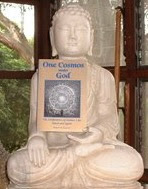
Last night we had a question from charter Coon Kahn the Road, who came off the road long enough to pose it. He recently attended a ten day Buddhist meditation retreat, during which time he lived as a shut-your-trappist monk, with "silence, dietary restrictions, no reading, writing, outside communications, etc."
Although he had a favorable impression, he was left with ambivalence about "the complete detachment required and the lack of room for a deeper spiritual understanding beyond reduction of the worldly experience to neutral throbs and tingles in the body." As such, "it didn't take long for me to realize that a serious Buddhist practice wasn't for me, although it is comforting to know that such a path is there."
"My question remains, however, how does one access the ever fine line between faith and complacency?"
I'm not sure if I should dodge this question head on, or dance around it in a more oblique manner. I think the latter. What I'll do is just plant the question in the old unconscious mind, then go about writing this post in the usual leisurely way, and hope that the answers somehow get wefted into my warped response.
Because I've found that that's how life works. The thing is, you can do it in a consciously unconscious way, or in an unconsciously unconscious way, but in either case, you are going to harness primordial powers that are beyond the individual. Unfortunately, this can sound rather new-agey, but it really comes down to the application of will, only with one's totality -- i.e., "all thy mind, heart, and strength," instead of just with one's surface ego.
To a certain extent it's a catch 22, since this involves "willing with one's totality," when the ability to do so would, in a sense, represent the final end of the spiritual ascent -- which is to say, to be one, or whole, with no subterranean crosscurrents and mind parasites with agendas of their own: if thine eye be single, thy whole body shall be full of light.
Again, people denigrate the ego, even though having a coherent and stable ego represents a significant achievement for most people. This is why in the Coonifesto I noted that most regular folkers are (•••), not (•). To live as (•••) means that one's I is not single, and that one will necessarily be at cross-purposes with oneself and thereby dissipate one's power.
Furthermore, there is no way to "cure" this fragmented condition "from the bottom up," being that the "bottom" is fragmentation as such, while the "top" is where the Oneness abides. We want to be organized "from the top down," which is where aspiration, rejection, and surrender come in, as discussed in yesterday's post. To achieve this would be to live in conformity with the divine will, or to see "thy will be done on earth (i.e, at the bottom) as it is in heaven (at the top)."
All spiritual paths involve 1) doctrine, and 2) method, AKA "reality and how to know it" (or, to be perfectly accurate, how to be it, or to combine Truth and Being -- which can only be separated in the human mind anyway). In Raccoon parlance, we say that it comes down to the combination of metaphysical know-how with spiritual be-who, but both are necessary to avoid error on the one hand, and hypocrisy or mere barren intellectualism on the other. The point is, we need to activate the Truth in order to make it efficacious in our lives, or to "set us free."
Oh yes. I should always emphasize that I'm not pretending to be some kind of guru here, only describing how it works for me. But at the same time, I'm always trying to figure out the "general principles" that seem to apply to all cases, that is, the "deep structure" of spiritual growth. Why do I do this? I don't know. I guess I'm just built this way. All I know is that spiritual growth is no less real than physical or psychological growth. We know a lot about the former, and quite a bit about the latter (at least if we ignore academic psychology), so there is no fundamental reason why we can't understand the dynamics of spiritual growth.
Again, this is what was so liberating for me when I discovered the works of Bion back in 1985, to be exact. Let's reminisce a little bit.... I had just started my Ph.D program in the fall of 1983, so this would be about a year and a-half later. The first thing you notice about psychology is that, unlike, say, biology or physics, there is no organizing paradigm to make sense of it all. And to say that there is no organizing paradigm amounts to the same thing as saying that the science is in a primitive state. It would be as if physicists had no basic agreements, and just came up with hundreds of ad hoc theories to explain the appearances of things.
Science is intrinsically spiritual, being that it too involves the reduction of multiplicity to unity. I don't want to get too sidetracked here, but the problem is, they do this "within" their own narrow discipline, but not across disciplines, which is why there is no way, for example, for science to ever unify matter and life, or life and mind, or mind and spirit. This is where the Raccoon project comes in, as we can mischievously scamper across disciplines under cover of darkness (our "gnocturnal O-mission"), unlike the tenured, who work only "by day," if you catch my drift.
So the first thing I noticed about psychology was that it was clearly in a "pre-paradigmatic" state, with no one agreeing upon the fundamentals, let alone the details. (This, by the way, is one of the reasons leftists have been able to come in and take over the field; the absence of a paradigm is like an invitation to deconstruction, since there is no stable "construction" to begin with. The less coherent the paradigm, the more leftists are able to take over the discipline with "feelings" instead of proper thought.)
Anyway, Bion noticed the same problem back in the 1950s. Even in psychoanalysis -- which is a subspecialty of a specialty -- there were dozens of sub-subspecialties, i.e., various competing theories not only trying to account for the same phenomena, but creating phenomena of their own, which is what a theoretical paradigm -- good or bad -- does. In other words, to a large extent, percept follows concept; or to put it in the colloquial, "you see what you believe." Combine this with "never trust a fact without a good theory to support it," and you have a situation in which people essentially live in their own private idaho.
Long story short, that's why Bion felt it necessary to develop an abstract system of symbols, or "empty categories," to apply to the subjective mindscape and to bring unity to an otherwise hopelessly fragmented field. Being that no one else was apparently going to do it, I merely adopted the same approach to the spiritual dimension. After all, we have Christians, Jews, Buddhists, etc., all claiming to have adequate maps of the spiritual dimension, plus efficacious means with which to get there. They can't all be right... unless...
So you see, the problem again comes down to the relationship between language and spirit. I won't even waste my time with someone who argues that spirit is "not real," for they are simply making an honest confession about themselves, which is why the Raccoon says, "let the dead bury the tenured," and "let Ray pleasure himself blind with his infertile nOnanism."
Now, here is what I've discovered. First of all, unlike euclidian space, the space of the mind is "hyperdimensional," meaning that it has more than four dimensions. This applies both to psychological space and to the spiritual space of which it is a declension, or a lower dimensional projection.
This is a key idea, being that a realm of lesser dimensions cannot produce one of greater ontological dimensions, which is why it has always been understood by traditional metaphysics that the realm of matter is the final precipitate, or "crystallization," of the involution of spirit (just as the lower animals are a "projection," or descent, of the Cosmic Man).
It is also why the "many" is located in the more material dimensions, whereas unity specifically abides at the top; the more we move up the evolutionary chain, the more the unity. Man is the vertical axis that spans the One and the many, and he can obviously go in either direction, depending upon a variety of factors. A spiritual practice is nothing less than a recovery of unity -- which is to say being + truth, in all their manifestations. The language of revelation turns out to be a form of symbolism that furnishes keys to knowledge of suprasensible realities, keys which are of the same "substance" as the eternal realm they describe. That's why they make for such nourishing and attractive meals.
Now, back to Kahn's question, which I've purposely forgotten, or "un-Remembered," so as to allow other forces to work on it: ""My question remains, however, how does one access the ever fine line between faith and complacency?"
Again, to become "whole" is to be organized "from the top down," or from the inside out. This is what we call O-->(n). The more one becomes whole, the more powers one has at one's disposal, for wholeness counters the dissipation and fragmentation of profane living. A Whole Person is always a powerful person, both as a cause and an effect. A Whole Person is also "charismatic," in that his words and actions will have an existential "heft," since they are not alienated from the fullness of Being.
So I suppose the question is, how does one achieve this wholeness without already having it? Again, I think it comes down to making a commitment on every level of one's being to make it so. I suppose, to a certain extent, I discuss this toward the end of my book, with the "Ten Commanishads and Upanishalts for Extreme Seekers." I haven't read them in a couple of years, so let me take a quick look, and see if I still believe myself....
Hmm... okay.... good... good... check... check... oh yes, very good... no argument there... yes... yes... yup.
I see there's even a helpful little summary on page 244: "In short, to paraphrase Mouravieff, the spiritual life involves making the transition from mindlessly willing for that which we uncritically yearn, to consciously yearning for that which we actually want (that is, enlightenment and liberation). In making this transition, it may appear as if our conventionally understood 'horizontal' freedom is diminishing, which is true. However, the point is to exchange it for a more expansive 'vertical' freedom that is relatively unconstrained by material circumstance, so that the old freedom is eventually regarded as a comparative enslavement."
Then what happens? Page 247: "Thus, in our properly oriented right-side-up universe, its unity and coherence are experienced from the top-down, in light of our source and destiny in the non-local singularity at the end of the cosmic journey." Blah blah blah, yada yada yada, I suppose you could say that the Buddhist paradoxically "cleaves through detachment" to emptiness, while the Raccoon has an unapologetic passion for wholeness and therefore eternal Being.
Friday, July 11, 2008


Thursday, July 10, 2008
The Shine of Your Japan, the Sparkle in Your China
What a pithy comment by Magnus Itland on a key difference between Christianity and Buddhism: "I think Jesus could have made a great Buddha if he had decided to not die for all those scurvy bastiches. He could have just wandered the world and compassionately told people to save themselves: 'after all, that's what I did.'"
First of all, this is not in any way to criticize Buddhism. For one thing, I don't yet have any idea what I'm going to say about it. Furthermore, there are certain deep similarities between Buddhism and Christianity, in addition to the differences.
For example, both stand in relation to much older revelations. In the case of Christianity, it is obviously an offshoot of Judaism, while Buddhism was an outgrowth of Hinduism. Moreover, both represent a "universalizing" of the traditions from which they sprang. Just as Judaism has a "tribal" and cultural component, so too does Hinduism. You rarely see a Westerner calling himself "Hindu," because in a certain sense one can't really be Hindu unless one is from India.
Plus, Hinduism has a lot of the ritualistic or "mythological" trappings from which Westerners are usually trying to escape when they embrace Buddhism, which seems to them to be more concrete, experiential and even "scientific." It seems that many Westerners turn toward Buddhism because they see it as a kind of religion purged of superstition. Looking back on it, this is undoubtedly what motivated my interest in it many years ago.
But as I have mentioned before, I didn't make any real progress with it. In my case -- just as implied in Magnus' comment -- I didn't really get anywhere until I gave up "self power" for "other power." Now I rely solely upon grace, although I naturally still do everything in my power to pretend that I am worthy of it. In a way, the slack-path of the Raccoon is very much analogous to "the lazy man's way to riches," being that there are two ways to become wealthy. The first is to go about getting what you want; the second is to cultivate gratitude for what one has. It should go without saying that there are no poor Raccoons.
For me, the turning point occurred in 1995, when I became a disciple of Sri Aurobindo, a path which begins and ends with the practice of aspiration, rejection, and surrender. From this stance it was very easy to transition to a more Christian viewpoint, being that it pretty much involves the identical verticalisthenic exercise: aspiration toward the higher, rejection of that which is contrary to God, and surrender to the grace -- which of course has its "severe" and "merciful" and aspects, i.e., purification (both by fire and water) and consolation.
In one sense, God loves us "unconditionally," but in another sense, quite the opposite -- which is our salvation, just as is a father who has expectations of his child. This is a generalization, of course, but mother love tends to be more unconditional, while father love has strings attached -- thank God, I might add, since I can already see in my three year-old that the fine line between civilization and barbarity is rooted in his fear of my being disappointed in him. Wisdom begins with fear of Dad. As above, so below.
Interestingly, although Future Leader is obviously intensely bonded to his mother, the nature of the bond couldn't be more different. For example, he actually gets a kick out of pushing her buttons. He clearly thinks she's cute and even funny when she's angry. Far from being frightened by her reactions, he seems to enjoy provoking them -- like a Hollywood liberal who claims to be living in a fascist state while taking such evident narcissistic pride in being a "courageous" rebel who provokes the fascists of whom he is supposedly so fearful. They pretend to be afraid of President Bush, even while they laugh at him as irrelevant.
This is what happens to a mind -- and culture -- with no father principle. There are never any consequences, and therefore, no standards and no emotional or spiritual growth. This is what is meant by God's "severity," which is clearly a mode of compassion. But new-age idiots tend to be utterly blind to this, which is why they reject Christianity as "judgmental," "narrow-minded," or "patriarchal."
Again, just as Christianity (from its standpoint) transcends (or fulfills) the Mosaic law, Buddhism transcends the Vedas (or, it could be argued that it returns Vedanta to its first principles in their most abstract essence, i.e., that the world is illusion, that Brahman alone is real, and that Atman and Brahman are not-two).
How coonvenient. Magnus just left another comment, expanding upon his previous one: "Jokes aside, there is a big difference between Jesus and Buddha, certainly according to what the two of them claimed. You could say they are complementary, to put a positive angle on it. The Buddha represents the upward movent of the human soul, whereas the Christ represents the Divine coming down... and not in a stately, dignified visit to meet the ascending soul halfway, but a desperate dive from the throne of Heaven to the murky depths of Hades itself, to rescue the black sheep that were beyond any other help. Or that's how I have learned to know it. But there may be 99 others who see it differently."
That is just where I was about to go with this. Using the symbols from my book, you could say that Buddha represents (↑), while Jesus is the quintessence of (↓). Nevertheless, any full-service revelation is going to have both arrows, although it will obviously give priority to one or the other. In a sense, you could say that each doctrine will have its "shadow" side that is simply underemphasized. Sometimes this shadow is seen in a kind of exoteric formulation by the masses, while other times it is seen as an esoteric "extension" understood by spiritual elites.
To cite an obvious example, one of the earliest formulations of Christianity is that God became man so that man might become God (so to speak). This is sort of what I was driving at with the circular structure of my book, which ultimately signifies the downward arrow of God meeting with the upward arrow of man, in an eternally spiroidal circle of creation transcending itself in Oneness.
And in Mahayana Buddhism there is the Bodhisattva principle, through which you might say that a (↑) comes back down for our benefit and becomes a (↓), and will remain so until every last (•) becomes (0).
Schuon points out the truism -- unfortunately lost on our overeducated middlebrow masses -- that a given revelation cannot be like a New York Times editorial, aimed only at a tiny enclave of pompous jackasses. To the contrary, it must be for everyone: the revelation must meet "not only the spiritual needs of an elite but the manifold demands of a total human collectivity, and thus of a society containing the most diverse minds and aptitudes."
As such, in the case of Christianity, it veils the clearly esoteric or "inner" dimension "of its dogmas and sacraments by declaring them to be 'unfathomable' and 'incomprehensible,' and by qualifying them as 'mysteries.'" Again, you can well understand the necessity of this when you see what becomes of spiritual doctrine in the hands of the wrong heads, as in the case of uncomprehending trolls or lizards. They can't help bringing higher knowledge down to their crude level, or (n) to (k). Better to simply draw a fence around it and declare it a "mystery" than to let it be sullied by the barbarous hands of troll or lizard. But of course, for the Raccoon," "mystery" is a mode of knowledge, not some kind of intellectual "deprivation," much less mystification. Thus the paradoxical truism that Petey always speaks "perfect nonsense."
When speaking of the esoteric or inner teaching, one must deal with the ubiquitous problem of the Swine and Dogs, those infrahumans who can take the most sublime wisdom and convert it into a worldly image of themselves. "Swine" might sound harsh, but what else can you call someone who not only doesn't understand, but insists on the superiority of his ignorance? Remember, when Jesus walked the earth, the word "tenured" did not exist.
Schuon notes that Buddhism adopted a different strategy to protect its inner teaching, by giving it a "rational" as opposed to "mystical" cast. Nevertheless, we can see how the intensely mystical Christianity of the early fathers meets with the rationalism of the scholastics, while the rational character of Buddhism later makes room for "the sacramental image of the Blessed One, which Image is derived from the very shadow of the Buddha, and was left by him as a 'remembrance' to his spiritual posterity, hence as a means of grace; in consequence, the bodily appearance of the Buddha is said to be a teaching no less than is his doctrine" (Schuon).
Well, it's work o'clock, so I'd better stop here. If there is sufficient interest, we'll pick up this thread tomorrow.
*Title playgiarized from Bodhisattva by Steely Dan
First of all, this is not in any way to criticize Buddhism. For one thing, I don't yet have any idea what I'm going to say about it. Furthermore, there are certain deep similarities between Buddhism and Christianity, in addition to the differences.
For example, both stand in relation to much older revelations. In the case of Christianity, it is obviously an offshoot of Judaism, while Buddhism was an outgrowth of Hinduism. Moreover, both represent a "universalizing" of the traditions from which they sprang. Just as Judaism has a "tribal" and cultural component, so too does Hinduism. You rarely see a Westerner calling himself "Hindu," because in a certain sense one can't really be Hindu unless one is from India.
Plus, Hinduism has a lot of the ritualistic or "mythological" trappings from which Westerners are usually trying to escape when they embrace Buddhism, which seems to them to be more concrete, experiential and even "scientific." It seems that many Westerners turn toward Buddhism because they see it as a kind of religion purged of superstition. Looking back on it, this is undoubtedly what motivated my interest in it many years ago.
But as I have mentioned before, I didn't make any real progress with it. In my case -- just as implied in Magnus' comment -- I didn't really get anywhere until I gave up "self power" for "other power." Now I rely solely upon grace, although I naturally still do everything in my power to pretend that I am worthy of it. In a way, the slack-path of the Raccoon is very much analogous to "the lazy man's way to riches," being that there are two ways to become wealthy. The first is to go about getting what you want; the second is to cultivate gratitude for what one has. It should go without saying that there are no poor Raccoons.
For me, the turning point occurred in 1995, when I became a disciple of Sri Aurobindo, a path which begins and ends with the practice of aspiration, rejection, and surrender. From this stance it was very easy to transition to a more Christian viewpoint, being that it pretty much involves the identical verticalisthenic exercise: aspiration toward the higher, rejection of that which is contrary to God, and surrender to the grace -- which of course has its "severe" and "merciful" and aspects, i.e., purification (both by fire and water) and consolation.
In one sense, God loves us "unconditionally," but in another sense, quite the opposite -- which is our salvation, just as is a father who has expectations of his child. This is a generalization, of course, but mother love tends to be more unconditional, while father love has strings attached -- thank God, I might add, since I can already see in my three year-old that the fine line between civilization and barbarity is rooted in his fear of my being disappointed in him. Wisdom begins with fear of Dad. As above, so below.
Interestingly, although Future Leader is obviously intensely bonded to his mother, the nature of the bond couldn't be more different. For example, he actually gets a kick out of pushing her buttons. He clearly thinks she's cute and even funny when she's angry. Far from being frightened by her reactions, he seems to enjoy provoking them -- like a Hollywood liberal who claims to be living in a fascist state while taking such evident narcissistic pride in being a "courageous" rebel who provokes the fascists of whom he is supposedly so fearful. They pretend to be afraid of President Bush, even while they laugh at him as irrelevant.
This is what happens to a mind -- and culture -- with no father principle. There are never any consequences, and therefore, no standards and no emotional or spiritual growth. This is what is meant by God's "severity," which is clearly a mode of compassion. But new-age idiots tend to be utterly blind to this, which is why they reject Christianity as "judgmental," "narrow-minded," or "patriarchal."
Again, just as Christianity (from its standpoint) transcends (or fulfills) the Mosaic law, Buddhism transcends the Vedas (or, it could be argued that it returns Vedanta to its first principles in their most abstract essence, i.e., that the world is illusion, that Brahman alone is real, and that Atman and Brahman are not-two).
How coonvenient. Magnus just left another comment, expanding upon his previous one: "Jokes aside, there is a big difference between Jesus and Buddha, certainly according to what the two of them claimed. You could say they are complementary, to put a positive angle on it. The Buddha represents the upward movent of the human soul, whereas the Christ represents the Divine coming down... and not in a stately, dignified visit to meet the ascending soul halfway, but a desperate dive from the throne of Heaven to the murky depths of Hades itself, to rescue the black sheep that were beyond any other help. Or that's how I have learned to know it. But there may be 99 others who see it differently."
That is just where I was about to go with this. Using the symbols from my book, you could say that Buddha represents (↑), while Jesus is the quintessence of (↓). Nevertheless, any full-service revelation is going to have both arrows, although it will obviously give priority to one or the other. In a sense, you could say that each doctrine will have its "shadow" side that is simply underemphasized. Sometimes this shadow is seen in a kind of exoteric formulation by the masses, while other times it is seen as an esoteric "extension" understood by spiritual elites.
To cite an obvious example, one of the earliest formulations of Christianity is that God became man so that man might become God (so to speak). This is sort of what I was driving at with the circular structure of my book, which ultimately signifies the downward arrow of God meeting with the upward arrow of man, in an eternally spiroidal circle of creation transcending itself in Oneness.
And in Mahayana Buddhism there is the Bodhisattva principle, through which you might say that a (↑) comes back down for our benefit and becomes a (↓), and will remain so until every last (•) becomes (0).
Schuon points out the truism -- unfortunately lost on our overeducated middlebrow masses -- that a given revelation cannot be like a New York Times editorial, aimed only at a tiny enclave of pompous jackasses. To the contrary, it must be for everyone: the revelation must meet "not only the spiritual needs of an elite but the manifold demands of a total human collectivity, and thus of a society containing the most diverse minds and aptitudes."
As such, in the case of Christianity, it veils the clearly esoteric or "inner" dimension "of its dogmas and sacraments by declaring them to be 'unfathomable' and 'incomprehensible,' and by qualifying them as 'mysteries.'" Again, you can well understand the necessity of this when you see what becomes of spiritual doctrine in the hands of the wrong heads, as in the case of uncomprehending trolls or lizards. They can't help bringing higher knowledge down to their crude level, or (n) to (k). Better to simply draw a fence around it and declare it a "mystery" than to let it be sullied by the barbarous hands of troll or lizard. But of course, for the Raccoon," "mystery" is a mode of knowledge, not some kind of intellectual "deprivation," much less mystification. Thus the paradoxical truism that Petey always speaks "perfect nonsense."
When speaking of the esoteric or inner teaching, one must deal with the ubiquitous problem of the Swine and Dogs, those infrahumans who can take the most sublime wisdom and convert it into a worldly image of themselves. "Swine" might sound harsh, but what else can you call someone who not only doesn't understand, but insists on the superiority of his ignorance? Remember, when Jesus walked the earth, the word "tenured" did not exist.
Schuon notes that Buddhism adopted a different strategy to protect its inner teaching, by giving it a "rational" as opposed to "mystical" cast. Nevertheless, we can see how the intensely mystical Christianity of the early fathers meets with the rationalism of the scholastics, while the rational character of Buddhism later makes room for "the sacramental image of the Blessed One, which Image is derived from the very shadow of the Buddha, and was left by him as a 'remembrance' to his spiritual posterity, hence as a means of grace; in consequence, the bodily appearance of the Buddha is said to be a teaching no less than is his doctrine" (Schuon).
Well, it's work o'clock, so I'd better stop here. If there is sufficient interest, we'll pick up this thread tomorrow.
*Title playgiarized from Bodhisattva by Steely Dan
Wednesday, July 09, 2008
Doctor, There's a Hole in My Crater! (7.09.12)
And a ghost in my post! Somehow this post didn't come together in the manner one might have hoped. There seems to be a big "hole" in the middle of it, a hole I wasn't able to fill with my Sacred Shovel. Then again, perhaps it is expedient that I must leave you and go to work, which will allow you to put your shoulder to the plow and try to make some sense of it on your own.
Let's talk about this smoking crater at the center of history. First of all, it doesn't just represent a horizontal discontinuity that divides history between BCE and AD, but a permanent vertical entrance -- and exit. So there is both temporal and a spatial discontinuity; there are horizontal energies memorialized and sent forward by tradition, but vertical energies that continue to rain down and fertilize tradition "from above." (It's also where the saints and bodhsattva's rise and fall in and out, and where Petey and I meet for launch.)
Usually, to forget one of these streams results in a lack of spiritual efficacy, although not always, being that allowances must be made for the spirit blowing where -- and in whom -- it will. Still, the cross serves as an apt reminder of the vertical and horizontal energies that meet and harmonize in the crater of the human heart (or heart-mind). Of course, the heart must be "broken," which is a kind of space that lets the light in.
With regard to the horizontal aspect of the crater, "before" and "after" take on absolute meanings instead of just relative ones. This reminds me of Einstein's Theory of Relativity, which is based on the absoluteness of the speed of light. Just as time slows down as we approach the speed of light, so too does history as we approach the crater. Prayer, contemplation, meditation, ritual, slack retrieval -- these are all vertical modalities that both slow down and dilate time (for the one is a function of the other) and allow us to exit history. Woo hoo!
This is surely what I must have been referring to on Page 181 of the Coonifesto, where it is written: "As a consequence of their apparently death-bound little selves, human beings began envisioning and longing for the whole, for an ideal existence located somewhere in the past, an eden, or in the future, a heaven, where all tensions are resolved, the circle is unbroken, and we are returned to the source from whence we came." On the following page, it is written that a few vertical explorers were able to follow "a newly discovered current of being through to its non-local source upstream, far away from the terminal moraine of the outward-turned senses." They then identified "a passage [which is to say, a hole] hidden in plain sight, through which lay yet another altogether surprising but felicitous discovery: A Mighty Strange Attractor at the..."
Hmm. That's strange. The sentence ends just like that, at the end of the chapter. It's like the last stair is missing, and the book just drops off into a big crater or something... Oh well...
Anyway, if you read the pre-Christian pagan literature, you can see that this yearning for redemption or escape was becoming particularly intense and explicit as the Christic singularity approached -- for example, the poet.... what's his name, Jeeves?
That's right, Virgil. In his Eclogues, he writes of "a new age that is about to begin. A child, the first born of the new age, is on his way from heaven" (Beckett):
A great series of centuries is born from the whole of time
now a virgin returns, the golden age returns;
now its firstborn is sent to us, down from the height of heaven.
Look kindly, goddess of childbirth, on the birth of this boy;
for him shall the people of iron fail, and a people of gold
arise in all the world
Come soon (for the hour is at hand) to the greatness of your glory,
dear offspring of the gods, great child of Jove himself!
Look how the round world bends in its weight,
the lands, the tracts of the sea and the deep sky;
look how all things rejoice in the coming time!
In order to be able to think about this, we need to appreciate the effect of a hyperdimensional object crashing down into history ("look how the round world bends in its weight") and then sending its waves both "forward" and "back" ("look how all things rejoice in the coming time!") As I mentioned yesterday, I am well aware of how these temporal waves have been sent "forward" -- not just by the impact of the original event, but amplified through time by the collective ("tradition") and by certain fleshlights (saints, doctors, mystics, etc.). Look at Augustine. He was already 400 years out from the singularity, and yet, still feeling its shockwaves as if it had happened just yesterday.
In fact, just as with physical entropy, it seems that if the original wave isn't renewed and given periodic "boosts," it will begin to fade. I can feel this quite vividly if, say, I read the early fathers -- who were much closer to the impact of the singularity -- and compare them to your uncoontemporary purveyor of average churchianity. In fact, this is one of the reasons Schuon was such an advocate of tradition, since there is a kind of spiritual entropy that slowly neutralizes the revolutionary effect of the revelation and eventually replaces it with the "human nature" it is designed to remedy. This entropic effect must be constantly battled, both in the individual and collective. Call it "conservative" if you like, but it's trying to conserve an explosive revolution!
Think, for example, of how liberals take us further and further away from the original intent of our timeless "political revelation," the Constitution. The process is very similar -- which is why a so-called "conservative" is simply someone who wishes to preserve the radical spiritual revolution of the Founders.
In truth, all valid spiritual traditions will have something analogous to the Smoking Crater. Certainly the Torah serves this purpose in Judaism, for it is the infinite written in finite form. As such, it "explodes" all attempts to contain or reduce it to any mere human dimension. It's like a bomb that never stops exploding; or perhaps like a bush that burns continuously without being consumed.
Similarly, of Buddhism, Schuon writes that "Like a magnet, the beauty of the Buddha draws all the contradictions of the world and transmutes them into radiant silence; the image deriving therefrom appears as a drop of the nectar of immortality fallen into the chilly world of forms and crystallized into a human form, a form accessible to men."
In this regard, we can see that Christ is also like a lens in which the vertical energies are gathered and focused, just like a magnifying glass that can use the sun's rays to start a brushfire -- which Dupree insists he did not set, because he was here with me at the time. Schuon calls this an "amazing condensation of the Message in the image of the Messenger," who also represents the "infinite victory of the Spirit," or the priority of the vertical over the horizontal. Note that Jesus said "it is expedient for you that I go away." Why is that? Because he needed to make sure that the crater stayed empty, which is to say, full of mystery.
Now, certain aspects of the teaching -- the "whole truth" -- can only actualize in time, as the waves move forward. This is because, to paraphrase Schuon, the original event must create the context for certain implications to be worked out. This is the necessity of the Church, or of Tradition, which "has the function, not only of communicating vital truths, but also of creating an environment adapted to the manifestation of spiritual modes of a particular character."
He goes on to point out that in all religions, "some few centuries after its foundation, one sees a fresh flowering of a kind of second youth, and this is due to the fact that the presence of a collective and material ambience, realized by the religion itself, creates conditions allowing -- or requiring -- an expansion of an apparently new kind." One thinks of the fifth century that produced an Augustine and Denys, or 13th that produce both Eckhart and Aquinas. Or how Hinduism produced Shankara or Buddhism Nagarjuna (the spiritual genius, not the idiot blogger) only many centuries later.
As Schuon writes, the descent of the Holy Spirit would be inconceivable "without the departure of Jesus," through which he can become "present" for all time. Otherwise, his mere physical presence might have created a kind of idolatry, or "saturation" of the space where God is found. No space, no God, no service.
Again, that space is the smoking crater, but it is where the vertical energies flow. And of course, there are various heresies that essentially get the balance wrong between Father, Son, Holy Spirit, Us, and the Crater. You could also say that the Crater is necessary for man, since his worldly ego is essentially a precipitate or crystallization of a mode of consciousness that mirrors materiality.
But the higher self is a sort of mirror of the empty space of that crater, which has the effect of turning us "inward," toward our own existential crater that can never be filled by worldly things. As Ray constantly teaches us, to think in the material mode is to "think in opposition to intelligence," while to orient ourselves around the mysterious crater helps us to think beyond ourselves, into the Great Within.
In this regard, negation or "unknowing" has always been understood to be a kind of ultimate affirmation; for in the end, the Void turns out to be a kind of plenum, whereas the solidity of the world turns out to be a kind of existential nothingness, or samsaric void. As such, we must practice detachment from the latter void in order to be filled with the former Void. Me? I'm just a space cadet, apophatic nobody.
Let's talk about this smoking crater at the center of history. First of all, it doesn't just represent a horizontal discontinuity that divides history between BCE and AD, but a permanent vertical entrance -- and exit. So there is both temporal and a spatial discontinuity; there are horizontal energies memorialized and sent forward by tradition, but vertical energies that continue to rain down and fertilize tradition "from above." (It's also where the saints and bodhsattva's rise and fall in and out, and where Petey and I meet for launch.)
Usually, to forget one of these streams results in a lack of spiritual efficacy, although not always, being that allowances must be made for the spirit blowing where -- and in whom -- it will. Still, the cross serves as an apt reminder of the vertical and horizontal energies that meet and harmonize in the crater of the human heart (or heart-mind). Of course, the heart must be "broken," which is a kind of space that lets the light in.
With regard to the horizontal aspect of the crater, "before" and "after" take on absolute meanings instead of just relative ones. This reminds me of Einstein's Theory of Relativity, which is based on the absoluteness of the speed of light. Just as time slows down as we approach the speed of light, so too does history as we approach the crater. Prayer, contemplation, meditation, ritual, slack retrieval -- these are all vertical modalities that both slow down and dilate time (for the one is a function of the other) and allow us to exit history. Woo hoo!
This is surely what I must have been referring to on Page 181 of the Coonifesto, where it is written: "As a consequence of their apparently death-bound little selves, human beings began envisioning and longing for the whole, for an ideal existence located somewhere in the past, an eden, or in the future, a heaven, where all tensions are resolved, the circle is unbroken, and we are returned to the source from whence we came." On the following page, it is written that a few vertical explorers were able to follow "a newly discovered current of being through to its non-local source upstream, far away from the terminal moraine of the outward-turned senses." They then identified "a passage [which is to say, a hole] hidden in plain sight, through which lay yet another altogether surprising but felicitous discovery: A Mighty Strange Attractor at the..."
Hmm. That's strange. The sentence ends just like that, at the end of the chapter. It's like the last stair is missing, and the book just drops off into a big crater or something... Oh well...
Anyway, if you read the pre-Christian pagan literature, you can see that this yearning for redemption or escape was becoming particularly intense and explicit as the Christic singularity approached -- for example, the poet.... what's his name, Jeeves?
That's right, Virgil. In his Eclogues, he writes of "a new age that is about to begin. A child, the first born of the new age, is on his way from heaven" (Beckett):
A great series of centuries is born from the whole of time
now a virgin returns, the golden age returns;
now its firstborn is sent to us, down from the height of heaven.
Look kindly, goddess of childbirth, on the birth of this boy;
for him shall the people of iron fail, and a people of gold
arise in all the world
Come soon (for the hour is at hand) to the greatness of your glory,
dear offspring of the gods, great child of Jove himself!
Look how the round world bends in its weight,
the lands, the tracts of the sea and the deep sky;
look how all things rejoice in the coming time!
In order to be able to think about this, we need to appreciate the effect of a hyperdimensional object crashing down into history ("look how the round world bends in its weight") and then sending its waves both "forward" and "back" ("look how all things rejoice in the coming time!") As I mentioned yesterday, I am well aware of how these temporal waves have been sent "forward" -- not just by the impact of the original event, but amplified through time by the collective ("tradition") and by certain fleshlights (saints, doctors, mystics, etc.). Look at Augustine. He was already 400 years out from the singularity, and yet, still feeling its shockwaves as if it had happened just yesterday.
In fact, just as with physical entropy, it seems that if the original wave isn't renewed and given periodic "boosts," it will begin to fade. I can feel this quite vividly if, say, I read the early fathers -- who were much closer to the impact of the singularity -- and compare them to your uncoontemporary purveyor of average churchianity. In fact, this is one of the reasons Schuon was such an advocate of tradition, since there is a kind of spiritual entropy that slowly neutralizes the revolutionary effect of the revelation and eventually replaces it with the "human nature" it is designed to remedy. This entropic effect must be constantly battled, both in the individual and collective. Call it "conservative" if you like, but it's trying to conserve an explosive revolution!
Think, for example, of how liberals take us further and further away from the original intent of our timeless "political revelation," the Constitution. The process is very similar -- which is why a so-called "conservative" is simply someone who wishes to preserve the radical spiritual revolution of the Founders.
In truth, all valid spiritual traditions will have something analogous to the Smoking Crater. Certainly the Torah serves this purpose in Judaism, for it is the infinite written in finite form. As such, it "explodes" all attempts to contain or reduce it to any mere human dimension. It's like a bomb that never stops exploding; or perhaps like a bush that burns continuously without being consumed.
Similarly, of Buddhism, Schuon writes that "Like a magnet, the beauty of the Buddha draws all the contradictions of the world and transmutes them into radiant silence; the image deriving therefrom appears as a drop of the nectar of immortality fallen into the chilly world of forms and crystallized into a human form, a form accessible to men."
In this regard, we can see that Christ is also like a lens in which the vertical energies are gathered and focused, just like a magnifying glass that can use the sun's rays to start a brushfire -- which Dupree insists he did not set, because he was here with me at the time. Schuon calls this an "amazing condensation of the Message in the image of the Messenger," who also represents the "infinite victory of the Spirit," or the priority of the vertical over the horizontal. Note that Jesus said "it is expedient for you that I go away." Why is that? Because he needed to make sure that the crater stayed empty, which is to say, full of mystery.
Now, certain aspects of the teaching -- the "whole truth" -- can only actualize in time, as the waves move forward. This is because, to paraphrase Schuon, the original event must create the context for certain implications to be worked out. This is the necessity of the Church, or of Tradition, which "has the function, not only of communicating vital truths, but also of creating an environment adapted to the manifestation of spiritual modes of a particular character."
He goes on to point out that in all religions, "some few centuries after its foundation, one sees a fresh flowering of a kind of second youth, and this is due to the fact that the presence of a collective and material ambience, realized by the religion itself, creates conditions allowing -- or requiring -- an expansion of an apparently new kind." One thinks of the fifth century that produced an Augustine and Denys, or 13th that produce both Eckhart and Aquinas. Or how Hinduism produced Shankara or Buddhism Nagarjuna (the spiritual genius, not the idiot blogger) only many centuries later.
As Schuon writes, the descent of the Holy Spirit would be inconceivable "without the departure of Jesus," through which he can become "present" for all time. Otherwise, his mere physical presence might have created a kind of idolatry, or "saturation" of the space where God is found. No space, no God, no service.
Again, that space is the smoking crater, but it is where the vertical energies flow. And of course, there are various heresies that essentially get the balance wrong between Father, Son, Holy Spirit, Us, and the Crater. You could also say that the Crater is necessary for man, since his worldly ego is essentially a precipitate or crystallization of a mode of consciousness that mirrors materiality.
But the higher self is a sort of mirror of the empty space of that crater, which has the effect of turning us "inward," toward our own existential crater that can never be filled by worldly things. As Ray constantly teaches us, to think in the material mode is to "think in opposition to intelligence," while to orient ourselves around the mysterious crater helps us to think beyond ourselves, into the Great Within.
In this regard, negation or "unknowing" has always been understood to be a kind of ultimate affirmation; for in the end, the Void turns out to be a kind of plenum, whereas the solidity of the world turns out to be a kind of existential nothingness, or samsaric void. As such, we must practice detachment from the latter void in order to be filled with the former Void. Me? I'm just a space cadet, apophatic nobody.
Tuesday, July 08, 2008
Live Grenades and the Smoking Crater at the Center of History
Ximeze wonders about those mysterious "light-threads" that "unroll through time via history." These vertical "light-memes" -- or what I call archetypal depth charges dropped from on high -- radiate down into history and make contact with minds that are receptive to them. From a handful of spiritual geniuses -- Paul, Shankara, Buddha -- they spread into the general population, and then "bear fruit further along the time-path." In a way, it's very much an inverse analogy of the way a vine grows, from one central root and then out in every direction -- except in this case, the root of the vine is above rather than below.
This reminds me of a metaphor from Meditations on the Tarot, in which our Unknown Friend compares a seed to a nuclear explosion; only it is a constructive bomb as opposed to a destructive one: "each little little acorn is such a 'constructive bomb' and the oak is only the visible result of the slow 'explosion' -- or blossoming out -- of this 'bomb.'"
Yes, the celestial depth charges "blow your little mind," as they dismantle your manmade scaffolding and rebuild -- actually, regrow -- the mind anew. In turn, a New World comes into existence, which is the meaning of birth, for every birth is the birth of the Totality. But just remember: you only get one chance at a second birth. It's called your "life."
"Pockets of lucidity" appear here and there throughout profane history, as the divine light is prolonged through time. In hindsight, an "Arc of Salvation" becomes recognizable, a sort of rolling horizontal revelation to go along with the vertical. In this regard, we can indeed trace a continuous line -- or wave -- of light, say, from the Hebrew prophets -- and the ancient Greek philosophers -- to America's founders. Looking down, I see these waves lapping at my feet as I type this. The water is both warm and transparent.
In turn, the American Constitution is very much analogous to our timeless "political revelation," something that even liberals are forced to at least pretend is true, even though, at the same time, they do everything within their power to erode and undermine it. In fact, they usually adopt the strategy of using the Constitution to subvert it, e.g., extending civil rights to terrorists, compelling citizens to discriminate on the basis of race, forcing us to redefine the fundamental unit of civilization, etc. In this regard, an original sindicate such as the ACLU is "politically satanic," in that they not only subvert the Light, but oppose it.
Some people call the vertical depth charges "myths." The same people inevitably replace the true myths with false ones, e.g., Marxism, Darwinism, Global Warming, etc. Schuon describes the steep descent from luminous Myth to darkland fantasy:
"When true myths are done away with, they inevitably come to be replaced by artificial myths; and in fact, a mode of thought content to rely on its logic alone while operating in a realm where this logic opens up no horizons, becomes defenseless against the various scientistic 'mythologies,' rather as the abolition of religion leads finally not to a rational view of the Universe, but to a counter-religion which will not be long in devouring rationalism itself" (emphases mine).
How True is that? Artificial myths are never liberating, but always "enclosing" (although they compensate for this with a horizontal dissipation masquerading as freedom). While genuine myth, in the higher sense of the word, opens up the subjective horizon toward the Boundless Infinite -- and indeed, helps us to fruitfully think about it -- the artificial myths of scientism -- not to mention the leftism which is its political action wing -- place boundaries on the Final Frontier, i.e., consciousness -- which is analogous to trying to grow an oak tree in a five gallon pot. But Raccoons -- unlike Lizards -- are not Potted Plants.
Again, as Schuon points out, it is the height of naivete to say that there is "religion" and "irreligion." Rather, there is only religion and counter-religion -- which includes, of course bad and perverse forms of what typically goes by the name of religion. To use these crazies (or morons) to attack the legitimacy of revelation would be like using the ACLU to attack the legitimacy of the rule of law, or Al Gore to attack science.
Note also that the abandonment of religion -- and when I say "religion," I am specifically referring to the Divine Sparks alluded to above, as they are prolonged horizontally, in particular, in the luminous minds that miraculously grow in the fertile soil of Tradition -- leads to the devouring of rationalism itself. This is such a critical point, for it is the key that explains the deep irrationality that animates both the insane kos kids of the left and the intelligent stupidity of LGF. Reject the vertical and that's what you end up with: horizontal darkness and confusion, shepherded at every step by Pride and even grandiosity.
And when I say "grandiosity," I am using that word as a kind of shorthand to describe the Postmodern Pathology that revolves around narcissism, (false) individualism, libertinism (which results from having no transcendent boundary conditions), and an intrinsically absurd -- and therefore demonic -- "absolute relativity," or "the impossible made possible."
Was that clear? No? Let Schuon shed some further obscurity on the subject: "[T]o treat man as absolutely free -- he who is not absolute -- is to set free all evils in him, without there remaining any principle which would limit them. All this goes to show that basically it is a kind of abuse of language to give the name 'science' to a knowledge that leads only to practical results while revealing nothing concerning the profound nature of the phenomena."
This scientistic misuse of logic results in the ability to draw patently false and even monstrous conclusions from "true" premises. For example, if Darwinism is true, then the radicals of PETA are absolutely correct that there is no moral distinction between killing a chicken and murdering a human. Nor can the killing of a fetus -- or even an infant who cannot take care of itself -- be morally problematic, as Peter Singer maintains. For if there is no God, then man becomes God, i.e., the Absolute. And if you don't understand that, then you very stupid, lizard brain.
Yesterday I discussed the question of "why I love Jesus." There is another perhaps idiosyncratic reason I didn't get into, but it follows logically from what I wrote about how he "saved my mind." Now, I am quite sure that my particular bewilderness adventure does not comport with that of most other Christians -- especially protestants and evangelicals -- who seem to come first to Christ, and then let the implications work themselves out from there, often in -- you will excuse me -- ways that don't place much of a premium on logic, consistency, or intellection. Which is fine. The way of the bhakti is perfectly valid and efficacious.
But in my case, it was the reverse. That is, I actually began at a point of vague hostility, but the more I immersed myself in the lighterature of certain particularly luminous minds -- including the early fathers, but especially one of those "light threads" that runs through people like Origen, Denys the Areopgite, John Scottus Eriugena, and Meister Eckhart -- the more I began to appreciate the conspicuous "smoking crater" at the Center of it All, and without which none of this luminous wisdom would have been possible. I mean, you can't really miss it. It's like the Grandest Canyon.
And what -- or who -- is responsible for this smoking crater, this giant hole in the center of creation? Perhaps this is a delicate subject, but one thing that always gave me the Jesus willies was this idea of substitute atonement. But now that I am aware of the smoking crater and the radiant Light that continues to glow from its center, I realize why it's there. It is because someone was selfless and heroic enough to dive on the Mother of All Live Grenades in order to at least give the rest of us a fighting chance. And no greater love has any man.
This reminds me of a metaphor from Meditations on the Tarot, in which our Unknown Friend compares a seed to a nuclear explosion; only it is a constructive bomb as opposed to a destructive one: "each little little acorn is such a 'constructive bomb' and the oak is only the visible result of the slow 'explosion' -- or blossoming out -- of this 'bomb.'"
Yes, the celestial depth charges "blow your little mind," as they dismantle your manmade scaffolding and rebuild -- actually, regrow -- the mind anew. In turn, a New World comes into existence, which is the meaning of birth, for every birth is the birth of the Totality. But just remember: you only get one chance at a second birth. It's called your "life."
"Pockets of lucidity" appear here and there throughout profane history, as the divine light is prolonged through time. In hindsight, an "Arc of Salvation" becomes recognizable, a sort of rolling horizontal revelation to go along with the vertical. In this regard, we can indeed trace a continuous line -- or wave -- of light, say, from the Hebrew prophets -- and the ancient Greek philosophers -- to America's founders. Looking down, I see these waves lapping at my feet as I type this. The water is both warm and transparent.
In turn, the American Constitution is very much analogous to our timeless "political revelation," something that even liberals are forced to at least pretend is true, even though, at the same time, they do everything within their power to erode and undermine it. In fact, they usually adopt the strategy of using the Constitution to subvert it, e.g., extending civil rights to terrorists, compelling citizens to discriminate on the basis of race, forcing us to redefine the fundamental unit of civilization, etc. In this regard, an original sindicate such as the ACLU is "politically satanic," in that they not only subvert the Light, but oppose it.
Some people call the vertical depth charges "myths." The same people inevitably replace the true myths with false ones, e.g., Marxism, Darwinism, Global Warming, etc. Schuon describes the steep descent from luminous Myth to darkland fantasy:
"When true myths are done away with, they inevitably come to be replaced by artificial myths; and in fact, a mode of thought content to rely on its logic alone while operating in a realm where this logic opens up no horizons, becomes defenseless against the various scientistic 'mythologies,' rather as the abolition of religion leads finally not to a rational view of the Universe, but to a counter-religion which will not be long in devouring rationalism itself" (emphases mine).
How True is that? Artificial myths are never liberating, but always "enclosing" (although they compensate for this with a horizontal dissipation masquerading as freedom). While genuine myth, in the higher sense of the word, opens up the subjective horizon toward the Boundless Infinite -- and indeed, helps us to fruitfully think about it -- the artificial myths of scientism -- not to mention the leftism which is its political action wing -- place boundaries on the Final Frontier, i.e., consciousness -- which is analogous to trying to grow an oak tree in a five gallon pot. But Raccoons -- unlike Lizards -- are not Potted Plants.
Again, as Schuon points out, it is the height of naivete to say that there is "religion" and "irreligion." Rather, there is only religion and counter-religion -- which includes, of course bad and perverse forms of what typically goes by the name of religion. To use these crazies (or morons) to attack the legitimacy of revelation would be like using the ACLU to attack the legitimacy of the rule of law, or Al Gore to attack science.
Note also that the abandonment of religion -- and when I say "religion," I am specifically referring to the Divine Sparks alluded to above, as they are prolonged horizontally, in particular, in the luminous minds that miraculously grow in the fertile soil of Tradition -- leads to the devouring of rationalism itself. This is such a critical point, for it is the key that explains the deep irrationality that animates both the insane kos kids of the left and the intelligent stupidity of LGF. Reject the vertical and that's what you end up with: horizontal darkness and confusion, shepherded at every step by Pride and even grandiosity.
And when I say "grandiosity," I am using that word as a kind of shorthand to describe the Postmodern Pathology that revolves around narcissism, (false) individualism, libertinism (which results from having no transcendent boundary conditions), and an intrinsically absurd -- and therefore demonic -- "absolute relativity," or "the impossible made possible."
Was that clear? No? Let Schuon shed some further obscurity on the subject: "[T]o treat man as absolutely free -- he who is not absolute -- is to set free all evils in him, without there remaining any principle which would limit them. All this goes to show that basically it is a kind of abuse of language to give the name 'science' to a knowledge that leads only to practical results while revealing nothing concerning the profound nature of the phenomena."
This scientistic misuse of logic results in the ability to draw patently false and even monstrous conclusions from "true" premises. For example, if Darwinism is true, then the radicals of PETA are absolutely correct that there is no moral distinction between killing a chicken and murdering a human. Nor can the killing of a fetus -- or even an infant who cannot take care of itself -- be morally problematic, as Peter Singer maintains. For if there is no God, then man becomes God, i.e., the Absolute. And if you don't understand that, then you very stupid, lizard brain.
Yesterday I discussed the question of "why I love Jesus." There is another perhaps idiosyncratic reason I didn't get into, but it follows logically from what I wrote about how he "saved my mind." Now, I am quite sure that my particular bewilderness adventure does not comport with that of most other Christians -- especially protestants and evangelicals -- who seem to come first to Christ, and then let the implications work themselves out from there, often in -- you will excuse me -- ways that don't place much of a premium on logic, consistency, or intellection. Which is fine. The way of the bhakti is perfectly valid and efficacious.
But in my case, it was the reverse. That is, I actually began at a point of vague hostility, but the more I immersed myself in the lighterature of certain particularly luminous minds -- including the early fathers, but especially one of those "light threads" that runs through people like Origen, Denys the Areopgite, John Scottus Eriugena, and Meister Eckhart -- the more I began to appreciate the conspicuous "smoking crater" at the Center of it All, and without which none of this luminous wisdom would have been possible. I mean, you can't really miss it. It's like the Grandest Canyon.
And what -- or who -- is responsible for this smoking crater, this giant hole in the center of creation? Perhaps this is a delicate subject, but one thing that always gave me the Jesus willies was this idea of substitute atonement. But now that I am aware of the smoking crater and the radiant Light that continues to glow from its center, I realize why it's there. It is because someone was selfless and heroic enough to dive on the Mother of All Live Grenades in order to at least give the rest of us a fighting chance. And no greater love has any man.
Monday, July 07, 2008
Memo to God: It's Not You I Want, I'm Just Lookin' For My Mind
One of the great ironies of the Darwinist argument is the insistence that materialists have a monopoly on truth and therefore intelligence. Now, I don't have to remind the reader that materialism is just as much a religion as any other; or, to be exact, it is just like a religion, only smaller. For to think that one could ever replace a real religion with a manmade one is to not know what religion is, and to therefore make oneself stupid, precisely.
Any form of materialism -- including reductionistic Darwinism -- is just a manifestation of "intelligent stupidity." Obviously, academia is pervaded by varieties of intelligent stupidity. So too are LGF, dailykos, huffpo, or any other beachhead of bovinity, whether "right" or "left." For the former ultimately reduces to the the latter, being that the first principle of true conservatism is awareness of the transcendent order to which man owes his primary allegiance and which is his reason for being, while the first principle of leftism is that there is no transcendent order, and that matter is All.
I apparently have to remind some readers that our dispute can never be with science per se, nor any banal "scientific finding" either. Rather, it is precisely with this covert transformation of science into a pseudo-religion, which then has the effect of rendering the person who believes in it stupid.
For this is the descent from intellect to mere intellectualism, the latter of which is rooted in pride rather than conformity to truth. One cannot really simultaneously be proud and a lover of truth. Truly, science is one of the glories of man -- a claim that no mere scientist could ever make, being that glory is a transcendent category irreducible to any material explanation. In other words, scientific truth glorifies the Divine Mind, not the mind of the scientist who denigrates mind to begin with. This should be obvious to all.
Speaking of which, this reminds me that a few months back, I was tagged in one of those internet meme games, but never responded. The question was, "why do you love Jesus?" My case may be a peculiar one, but it is because he saved my mind.
I don't want to get to sidetracked here, but bear in mind that I am speaking not just of Jesus per se, but of "the mind of Christ," i.e., the eternal Word in all its diverse and saving manifestations. In this regard, I may be using the word more lucely than a traditional Christian may be comforterble with, but I am referring to that celestial light which illuminates both mind and world, neither of which can comprehended on their own level. Which also goes to the issue of why it would be absurd to suggest that I could be some sort of guru or such, a charge that trolls inevitably throw out from time to time. For if I were to do that, I would be no better than the confused materialist who claims truth for himself.
Put it this way: a Raccoon is a lover of truth and a seeker after wisdom. I am so grateful to the light-filled teachers who helped to lift my mind out of the bog of materialism and other errors, that I can never repay them -- except perhaps by freely passing along what they freely passed into me. I love them and I always will. This is not any kind of mere fideism or sentimentalism, but is rather a sort of "continuous miracle" that takes place in my head, of all places. I am reminded of the Merle Haggard song, I'm Looking For My Mind:
'Cause I lost my mind the day I lost your love
I'm not crazy, but sometimes I wish I was
If you turn around and find me crawling close behind
It's not you I want, I'm lookin' for my mind
Sometimes I wonder if the trolls who can't stay away from this blog might unconsciously feel the same way. It's not me you want, you're just looking for your Mind!
Along these lines, last week Dennis Prager had a program in which he asked listeners if their life had turned out as they had planned or envisioned it when they were, say, 18 years old. Or, to put it another way, if someone had told you at 18 how your life would turn out, would you have been surprised?
In my case, "surprise" would be an understatement. The discontinuity between what I was and who I am is so radical, that it is analogous to "creation from nothing" -- which, when you think about it, is not a metaphor, for it is the essence of metanoia. So when I say that my mind was "saved," I literally mean that I was saved from nothing, AKA, a living death in some manmode misosophy. And how could a feller not be grateful for that?
Because there's really no middle ground here. It's either nothing or everything; meaninglessness or a kind of hyper-meaningfulness; existentialism or essentialism; nihilism or God. Intelligent stupidity -- whereby a man conforms his mind to the great material sea of nothing -- results in intelligence never discovering its sufficient reason and man falling far beneath himself. It is to never discover Intelligence as such, which is of the same substance as the Absolute, or the "word" that passes between it and the relative. As I mentioned in the Coonifesto, religion does indeed have a bridge to sell you -- the bridge between the One and the many, the Absolute and the relative, Eternity and time, Creator and creature, Word and intellect.
As Schuon points out, the scientist (and I'm just going to use this word as shorthand, bearing in mind that I am again referring to the reductionistic and materialistic thinker) elevates knowledge of physical things -- i.e., the relative -- to the absolute. In so doing, he substitutes "exactness" for intelligence, and "it is indeed this very 'exactness' which excludes the decisive operations of pure intelligence, since a meticulous and often arbitrary cataloguing of facts which are possibly insignificant -- or are rendered such thanks to the point of view adopted -- replaces the intellectual perception of the nature of things."
In turn, this is why science can make so many preposterous claims about the human condition, since they do not admit an irreducible "human condition" to begin with. And this is the wedge where all the inexhaustible stupidity rushes into the scientistic mind -- this wedge between the material and archetypal planes, to put it succinctly.
Now. Now. I like saying that when I'm trying to get back on track, but pretending that I was never off it.
Now, here is perhaps the biggest conceit of science, although there are many. But I notice that this is a notion that the hopelessly naive lizards tend to regurgitate, that is, the idea that science simply deals with a world of unproblematic "facts" as we find them, untainted by any subjective biases, metaphysical assumptions, or preconceptions. To this silliness it is difficult to respond with anything other than a robust "Ho!" It's as if they've never even heard of the philosophy of science, much less metaphysics.
Scientists -- although they can account neither for free will nor freedom of inquiry (i.e., a fully open and receptive mind, free of all preconceptions) -- have this barmy idea that they are engaged in "a complete liberty of investigation." However, "this is an illusion since modern science, like every other science, cannot avoid starting out in its turn from an idea: it is the dogma concerning the exclusively rational and more or less 'democratic' nature of intelligence."
Here again, this is where intelligence dies by its own hand and becomes stupidity when detached from religious metaphysics, for it is assumed that intelligence is simply a sort of quantity that everyone possesses and which can know scientific truth (which is the only "real" truth). In fact, the conclusion does at least follow the premise, since virtually any idiot can "understand" a scientific truth once it has been discovered by someone a little brighter.
It takes no great intelligence to understand Darwinism, for what is there to understand? Random mutation + environmental selection. Got it. Where's my BA in biology? The idea that it will "endanger our children's scientific education" to suggest that the integral truth is a little more complicated than this, is pure kooky talk.
Raccoon Truth is not nearly as simplistic as scientistic truth, as many readers can attest, some of whom weren't entirely sure that I wasn't "crazy" when they first stumbled upon this blog. Think about that for a moment, for it is the same thing I was alluding to above, with respect to how my mind was "saved" by Divine Intellect in all its manifestations.
Anyway, as Schuon points out -- and surely this is true -- "There are truths that can be attained only by intuitive intellection, and this in fact does not lie within the capacity of every man of sound mind." Furthermore, just as logic requires materials on which to operate, the Intellect itself requires a Revelation "in order to actualize its own light in more than a fragmentary manner," for again, revelation is intellect objectified, and like knows like.
Running out of time here.... I guess we'll have to pick this up tomorrow....
Any form of materialism -- including reductionistic Darwinism -- is just a manifestation of "intelligent stupidity." Obviously, academia is pervaded by varieties of intelligent stupidity. So too are LGF, dailykos, huffpo, or any other beachhead of bovinity, whether "right" or "left." For the former ultimately reduces to the the latter, being that the first principle of true conservatism is awareness of the transcendent order to which man owes his primary allegiance and which is his reason for being, while the first principle of leftism is that there is no transcendent order, and that matter is All.
I apparently have to remind some readers that our dispute can never be with science per se, nor any banal "scientific finding" either. Rather, it is precisely with this covert transformation of science into a pseudo-religion, which then has the effect of rendering the person who believes in it stupid.
For this is the descent from intellect to mere intellectualism, the latter of which is rooted in pride rather than conformity to truth. One cannot really simultaneously be proud and a lover of truth. Truly, science is one of the glories of man -- a claim that no mere scientist could ever make, being that glory is a transcendent category irreducible to any material explanation. In other words, scientific truth glorifies the Divine Mind, not the mind of the scientist who denigrates mind to begin with. This should be obvious to all.
Speaking of which, this reminds me that a few months back, I was tagged in one of those internet meme games, but never responded. The question was, "why do you love Jesus?" My case may be a peculiar one, but it is because he saved my mind.
I don't want to get to sidetracked here, but bear in mind that I am speaking not just of Jesus per se, but of "the mind of Christ," i.e., the eternal Word in all its diverse and saving manifestations. In this regard, I may be using the word more lucely than a traditional Christian may be comforterble with, but I am referring to that celestial light which illuminates both mind and world, neither of which can comprehended on their own level. Which also goes to the issue of why it would be absurd to suggest that I could be some sort of guru or such, a charge that trolls inevitably throw out from time to time. For if I were to do that, I would be no better than the confused materialist who claims truth for himself.
Put it this way: a Raccoon is a lover of truth and a seeker after wisdom. I am so grateful to the light-filled teachers who helped to lift my mind out of the bog of materialism and other errors, that I can never repay them -- except perhaps by freely passing along what they freely passed into me. I love them and I always will. This is not any kind of mere fideism or sentimentalism, but is rather a sort of "continuous miracle" that takes place in my head, of all places. I am reminded of the Merle Haggard song, I'm Looking For My Mind:
'Cause I lost my mind the day I lost your love
I'm not crazy, but sometimes I wish I was
If you turn around and find me crawling close behind
It's not you I want, I'm lookin' for my mind
Sometimes I wonder if the trolls who can't stay away from this blog might unconsciously feel the same way. It's not me you want, you're just looking for your Mind!
Along these lines, last week Dennis Prager had a program in which he asked listeners if their life had turned out as they had planned or envisioned it when they were, say, 18 years old. Or, to put it another way, if someone had told you at 18 how your life would turn out, would you have been surprised?
In my case, "surprise" would be an understatement. The discontinuity between what I was and who I am is so radical, that it is analogous to "creation from nothing" -- which, when you think about it, is not a metaphor, for it is the essence of metanoia. So when I say that my mind was "saved," I literally mean that I was saved from nothing, AKA, a living death in some manmode misosophy. And how could a feller not be grateful for that?
Because there's really no middle ground here. It's either nothing or everything; meaninglessness or a kind of hyper-meaningfulness; existentialism or essentialism; nihilism or God. Intelligent stupidity -- whereby a man conforms his mind to the great material sea of nothing -- results in intelligence never discovering its sufficient reason and man falling far beneath himself. It is to never discover Intelligence as such, which is of the same substance as the Absolute, or the "word" that passes between it and the relative. As I mentioned in the Coonifesto, religion does indeed have a bridge to sell you -- the bridge between the One and the many, the Absolute and the relative, Eternity and time, Creator and creature, Word and intellect.
As Schuon points out, the scientist (and I'm just going to use this word as shorthand, bearing in mind that I am again referring to the reductionistic and materialistic thinker) elevates knowledge of physical things -- i.e., the relative -- to the absolute. In so doing, he substitutes "exactness" for intelligence, and "it is indeed this very 'exactness' which excludes the decisive operations of pure intelligence, since a meticulous and often arbitrary cataloguing of facts which are possibly insignificant -- or are rendered such thanks to the point of view adopted -- replaces the intellectual perception of the nature of things."
In turn, this is why science can make so many preposterous claims about the human condition, since they do not admit an irreducible "human condition" to begin with. And this is the wedge where all the inexhaustible stupidity rushes into the scientistic mind -- this wedge between the material and archetypal planes, to put it succinctly.
Now. Now. I like saying that when I'm trying to get back on track, but pretending that I was never off it.
Now, here is perhaps the biggest conceit of science, although there are many. But I notice that this is a notion that the hopelessly naive lizards tend to regurgitate, that is, the idea that science simply deals with a world of unproblematic "facts" as we find them, untainted by any subjective biases, metaphysical assumptions, or preconceptions. To this silliness it is difficult to respond with anything other than a robust "Ho!" It's as if they've never even heard of the philosophy of science, much less metaphysics.
Scientists -- although they can account neither for free will nor freedom of inquiry (i.e., a fully open and receptive mind, free of all preconceptions) -- have this barmy idea that they are engaged in "a complete liberty of investigation." However, "this is an illusion since modern science, like every other science, cannot avoid starting out in its turn from an idea: it is the dogma concerning the exclusively rational and more or less 'democratic' nature of intelligence."
Here again, this is where intelligence dies by its own hand and becomes stupidity when detached from religious metaphysics, for it is assumed that intelligence is simply a sort of quantity that everyone possesses and which can know scientific truth (which is the only "real" truth). In fact, the conclusion does at least follow the premise, since virtually any idiot can "understand" a scientific truth once it has been discovered by someone a little brighter.
It takes no great intelligence to understand Darwinism, for what is there to understand? Random mutation + environmental selection. Got it. Where's my BA in biology? The idea that it will "endanger our children's scientific education" to suggest that the integral truth is a little more complicated than this, is pure kooky talk.
Raccoon Truth is not nearly as simplistic as scientistic truth, as many readers can attest, some of whom weren't entirely sure that I wasn't "crazy" when they first stumbled upon this blog. Think about that for a moment, for it is the same thing I was alluding to above, with respect to how my mind was "saved" by Divine Intellect in all its manifestations.
Anyway, as Schuon points out -- and surely this is true -- "There are truths that can be attained only by intuitive intellection, and this in fact does not lie within the capacity of every man of sound mind." Furthermore, just as logic requires materials on which to operate, the Intellect itself requires a Revelation "in order to actualize its own light in more than a fragmentary manner," for again, revelation is intellect objectified, and like knows like.
Running out of time here.... I guess we'll have to pick this up tomorrow....
Sunday, July 06, 2008
I Ain't Gonna Work on Darwin's Farm No More: The Limits of a Limitless Science (7.16.11)
... [T]he notion of forest does not become invalid just because it is not possible to define quantitatively the number of trees that would constitute not merely a grove but a forest. It is not possible to find the number of pages that would necessarily constitute a book and not a mere pamphlet.... Human knowledge... concerns two separate realms, quantities and non-quantities, and these two realms are irreducible to one another. --Stanley Jaki
This is tomorrow's post today.... or today's post tomorrow, depending on how things unfold. It's just that I woke up early, it's nice and quiet, and I have this indeterminate amount of slack to play with, whereas tomorrow I'll be more pressed for timelessness.
First of all, the second part of the title of this post is not original to me, but to the philosopher of science Stanley Jaki, who has a collection of essays by that name. In fact, he also has a book entitled The Savior of Science, on the vital relationship between Christian theology and the development of science:
"Beginning with an overview of failed attempts at a sustained science by the ancient cultures of Greece, China, India, and the early Muslim empire, Jaki shows that belief in Christ -- a belief absent in all these cultures -- secured for science its only viable birth starting in the High Middle Ages. In the second part of the book Jaki argues that Christian monotheism alone provides the intellectual safeguards for a valid cosmological argument, restores the sense of purpose destroyed by theories of evolution, and secures firm ethical guidelines against fearful abuses of scientific know-how." (BTW, just ignore the hostile review by the fellow who didn't quite understand the book. Actually, he has written better books; this summary of his ideas is probably my favorite.)
Are there limits to the scientific method, or is it absolute? Clearly the answers are "yes" and "no," respectively. In fact, as Jaki points out, "one may rightly say that there is nothing so important as to ascertain the limits to which science can rightfully be put to use." For example, Darwinians inform us that human beings are just replicating machines, or the gene's way of making more genes. If they truly believe that, is it permissible to treat a human being as a machine? Why not? Just because we "feel" it would be bad? What if other people such as Peter Singer or Adolf Hitler feel it would be a good idea to murder certain people?
There are very sharp limits to the scientific method, one of which is that it specifically applies to the relative, not the absolute. Another intrinsic limit would be Gödel's theorems. Others include quantifiability: "science ceases to be competent whenever a proposition is such as to have no quantitative bearing" (Jaki). This is why, when the scientist forces his paradigm into areas that intrinsically elude its competence, he always sounds stupid, like the adolescent kos kid or middlebrow Lizards.
For if the scientistic mind were capable of understanding these subtle metaphysical matters, they wouldn't be true. To put it another way, there are times that it just isn't possible to descend to the low intellectual level of the Lizard or bonehead materialist. Rather, they must ascend (or evolve!) with a discontinuous leap upward. This upward leap is called "faith." But it is every bit as justified as putting one's faith in the teacher of a subject one doesn't yet understand. Understanding will come, if only you give up your pride and allow it to. It is hardly blind faith, but backed by the full faith and credit of brilliant transpersonal visionaries who have seen much further, deeper, and higher than you ever will with your tiny lizard brain. That is a guarantee.
Science can only operate within a matrix of a freedom that it is powerless to explain. Rather, it just assumes a freedom that nevertheless "cannot be." But where did this idea of freedom come from? Muslims certainly don't believe in it -- much less value it -- and to the extent that scientists do, they can't account for it. Is it a good thing? Obviously, most people, right up to the present time, don't believe so. Even in America, "land of the free," at least half the population are freedom-hating liberals -- most of whom probably harbor the conceit that they are more "logical" and "scientific" than religious believers!
Spengler points out the irony that Muslims and atheists are much closer in their metaphysical assumptions than are Christians with either, which is why Muslim apostates so often become atheists, for it is much easier for them to understand "no God" than a loving one:
"Islam is much closer in character to atheism than to Christianity or Judaism. Although the 'what' of Muslim and atheistic thinking of course are very different..., the 'how' is very similar. Secular liberalism, the official ideology of almost all the nations of Western Europe, offers hedonism, sexual license, anomie, demoralization and gradual depopulation. Muslims do not want this....
"For Muslim teaching, God is absolutely transcendent. His will is not bound up with any of our categories, even that of rationality.... Ibn Hazm went so far as to state that God is not bound even by his own word, and that 'nothing would oblige him to reveal the truth to us. Were it God's will, we would even have to practice' idolatry.
"What does it mean for God to be 'absolutely transcendent'? .... Allah does not limit himself by ordering the world through natural law, for natural laws would impinge on his absolute freedom of action. There are no intermediate [i.e, horizontal] causes, in the sense of laws of nature. Mars traverses an ellipse around the sun not because God has instituted laws of motion that require Mars to traverse an ellipse, but because Allah at every instant directs the angular velocity of Mars. Today, Allah happens to feel like pushing Mars about in an ellipse; tomorrow he might just as well do figure-eights."
Here is the money quote which demonstrates the moronic convergence of Muslms and the Lizards who despise them: "That notion of a god who accepts no limitation, not even the limit of laws of nature that he created, characterizes mainstream Muslim thought since the 11th century. St Thomas Aquinas wrote of its deficiency, drawing on the critique of the 12th-century Jewish theologian and philosopher Moses Maimonides. Despite its vehement and haughtily carried-forward idea of the unity of God, Islam slides into a monistic paganism.... Allah is no more subject to laws of nature than the nature-spirits of the pagan world who infest every tree, rock and stream, and make magic according to their own whimsy" (emphases mine).
The cognitive problems of Islam are more than self-evident. But note that phrase: a god who accepts no limitation. Functionally speaking, this is no different than the scientistic god who accepts no vertical limitation, and deems itself fit to pronounce on subjects that far transcend it, thereby reducing intrinsically transcendent categories such as virtue, beauty, truth, freedom, dignity, nobility, charity, compassion, etc., to the deceptive and self-flattering survival strategies of genes. Only the sober Darwinist sees through the ruse of these ruthless and entirely self-interested genes.
The brilliant Roger Kimball says something similar, in citing E.O. Wilson's morally and intellectually insane comment that “an organism is only DNA’s way of making more DNA.”
"Now, just sit back and think about that. Think, for example, of your favorite organism -- your spouse, for example: is he or she only DNA’s way of making more DNA? Is E. O. Wilson himself only a mechanism for the production of deoxyribonucleic acid?" (This is what I mean when I say that Darwinism is logically self-refuting.)
Likewise, that renowned metaphysical yahoo, Richard Dawkins, says that we are just a "robot-vehicle blindly programmed to preserves the selfish molecules known as genes." Not only does this idiocy converge with the fatalistic and freedom-hating Muslims, but with the deterministic Marxists and their many modern-day spawn who believe, for example, that poverty, rather than bad values, causes crime. I have no doubt that they will eventually identify the "gene for crime" -- if they haven't already -- which will make the tyrannical marriage between Darwinism and leftism complete. Instead of the radically transcendent religion of Islam, it will be the radically immanent religion of Scientism. But both result in a fascistic repression of our divine-human birthright, i.e., our humanness.
A couple more passages by Spengler before I attempt to tie this all together and wrap up: "the absolute transcendence of Allah in the physical world is the cognate of his despotic character as a spiritual ruler, who demands submission and service from his creatures. The Judeo-Christian God loves his creatures and as an act of love makes them free. Humankind only can be free if nature is rational, that is, if God places self-appointed limits on his own sphere of action. In a world ordered by natural law, humankind through its faculty of reason can learn these laws and act freely. In the alternative case, the absolute freedom of Allah crowds out all human freedom of action, leaving nothing but the tyranny of caprice and fate."
"The empty and arbitrary world of atheism is far closer to the Muslim universe than the Biblical world, in which God orders the world out of love for humankind, so that we may in freedom return the love that our creator bears for us. Atheism is an alternative to Islam closer to Muslim habits of mind than the love-centered world of Judaism and Christianity."
I guess I don't have to tie it all together, because that pretty much did it.
Contrary to the claim that DNA is the secret of life, life remains the secret of DNA.... Microbiology has not found a quantitative answer to the question of free will. Brain research cannot answer the question, "What is that experience, called 'now,'" which is at the very center of consciousness.... Nor is the universe as such an object for science. Scientists cannot go outside the universe in order to observe the whole of it. --Stanley Jaki
This is tomorrow's post today.... or today's post tomorrow, depending on how things unfold. It's just that I woke up early, it's nice and quiet, and I have this indeterminate amount of slack to play with, whereas tomorrow I'll be more pressed for timelessness.
First of all, the second part of the title of this post is not original to me, but to the philosopher of science Stanley Jaki, who has a collection of essays by that name. In fact, he also has a book entitled The Savior of Science, on the vital relationship between Christian theology and the development of science:
"Beginning with an overview of failed attempts at a sustained science by the ancient cultures of Greece, China, India, and the early Muslim empire, Jaki shows that belief in Christ -- a belief absent in all these cultures -- secured for science its only viable birth starting in the High Middle Ages. In the second part of the book Jaki argues that Christian monotheism alone provides the intellectual safeguards for a valid cosmological argument, restores the sense of purpose destroyed by theories of evolution, and secures firm ethical guidelines against fearful abuses of scientific know-how." (BTW, just ignore the hostile review by the fellow who didn't quite understand the book. Actually, he has written better books; this summary of his ideas is probably my favorite.)
Are there limits to the scientific method, or is it absolute? Clearly the answers are "yes" and "no," respectively. In fact, as Jaki points out, "one may rightly say that there is nothing so important as to ascertain the limits to which science can rightfully be put to use." For example, Darwinians inform us that human beings are just replicating machines, or the gene's way of making more genes. If they truly believe that, is it permissible to treat a human being as a machine? Why not? Just because we "feel" it would be bad? What if other people such as Peter Singer or Adolf Hitler feel it would be a good idea to murder certain people?
There are very sharp limits to the scientific method, one of which is that it specifically applies to the relative, not the absolute. Another intrinsic limit would be Gödel's theorems. Others include quantifiability: "science ceases to be competent whenever a proposition is such as to have no quantitative bearing" (Jaki). This is why, when the scientist forces his paradigm into areas that intrinsically elude its competence, he always sounds stupid, like the adolescent kos kid or middlebrow Lizards.
For if the scientistic mind were capable of understanding these subtle metaphysical matters, they wouldn't be true. To put it another way, there are times that it just isn't possible to descend to the low intellectual level of the Lizard or bonehead materialist. Rather, they must ascend (or evolve!) with a discontinuous leap upward. This upward leap is called "faith." But it is every bit as justified as putting one's faith in the teacher of a subject one doesn't yet understand. Understanding will come, if only you give up your pride and allow it to. It is hardly blind faith, but backed by the full faith and credit of brilliant transpersonal visionaries who have seen much further, deeper, and higher than you ever will with your tiny lizard brain. That is a guarantee.
Science can only operate within a matrix of a freedom that it is powerless to explain. Rather, it just assumes a freedom that nevertheless "cannot be." But where did this idea of freedom come from? Muslims certainly don't believe in it -- much less value it -- and to the extent that scientists do, they can't account for it. Is it a good thing? Obviously, most people, right up to the present time, don't believe so. Even in America, "land of the free," at least half the population are freedom-hating liberals -- most of whom probably harbor the conceit that they are more "logical" and "scientific" than religious believers!
Spengler points out the irony that Muslims and atheists are much closer in their metaphysical assumptions than are Christians with either, which is why Muslim apostates so often become atheists, for it is much easier for them to understand "no God" than a loving one:
"Islam is much closer in character to atheism than to Christianity or Judaism. Although the 'what' of Muslim and atheistic thinking of course are very different..., the 'how' is very similar. Secular liberalism, the official ideology of almost all the nations of Western Europe, offers hedonism, sexual license, anomie, demoralization and gradual depopulation. Muslims do not want this....
"For Muslim teaching, God is absolutely transcendent. His will is not bound up with any of our categories, even that of rationality.... Ibn Hazm went so far as to state that God is not bound even by his own word, and that 'nothing would oblige him to reveal the truth to us. Were it God's will, we would even have to practice' idolatry.
"What does it mean for God to be 'absolutely transcendent'? .... Allah does not limit himself by ordering the world through natural law, for natural laws would impinge on his absolute freedom of action. There are no intermediate [i.e, horizontal] causes, in the sense of laws of nature. Mars traverses an ellipse around the sun not because God has instituted laws of motion that require Mars to traverse an ellipse, but because Allah at every instant directs the angular velocity of Mars. Today, Allah happens to feel like pushing Mars about in an ellipse; tomorrow he might just as well do figure-eights."
Here is the money quote which demonstrates the moronic convergence of Muslms and the Lizards who despise them: "That notion of a god who accepts no limitation, not even the limit of laws of nature that he created, characterizes mainstream Muslim thought since the 11th century. St Thomas Aquinas wrote of its deficiency, drawing on the critique of the 12th-century Jewish theologian and philosopher Moses Maimonides. Despite its vehement and haughtily carried-forward idea of the unity of God, Islam slides into a monistic paganism.... Allah is no more subject to laws of nature than the nature-spirits of the pagan world who infest every tree, rock and stream, and make magic according to their own whimsy" (emphases mine).
The cognitive problems of Islam are more than self-evident. But note that phrase: a god who accepts no limitation. Functionally speaking, this is no different than the scientistic god who accepts no vertical limitation, and deems itself fit to pronounce on subjects that far transcend it, thereby reducing intrinsically transcendent categories such as virtue, beauty, truth, freedom, dignity, nobility, charity, compassion, etc., to the deceptive and self-flattering survival strategies of genes. Only the sober Darwinist sees through the ruse of these ruthless and entirely self-interested genes.
The brilliant Roger Kimball says something similar, in citing E.O. Wilson's morally and intellectually insane comment that “an organism is only DNA’s way of making more DNA.”
"Now, just sit back and think about that. Think, for example, of your favorite organism -- your spouse, for example: is he or she only DNA’s way of making more DNA? Is E. O. Wilson himself only a mechanism for the production of deoxyribonucleic acid?" (This is what I mean when I say that Darwinism is logically self-refuting.)
Likewise, that renowned metaphysical yahoo, Richard Dawkins, says that we are just a "robot-vehicle blindly programmed to preserves the selfish molecules known as genes." Not only does this idiocy converge with the fatalistic and freedom-hating Muslims, but with the deterministic Marxists and their many modern-day spawn who believe, for example, that poverty, rather than bad values, causes crime. I have no doubt that they will eventually identify the "gene for crime" -- if they haven't already -- which will make the tyrannical marriage between Darwinism and leftism complete. Instead of the radically transcendent religion of Islam, it will be the radically immanent religion of Scientism. But both result in a fascistic repression of our divine-human birthright, i.e., our humanness.
A couple more passages by Spengler before I attempt to tie this all together and wrap up: "the absolute transcendence of Allah in the physical world is the cognate of his despotic character as a spiritual ruler, who demands submission and service from his creatures. The Judeo-Christian God loves his creatures and as an act of love makes them free. Humankind only can be free if nature is rational, that is, if God places self-appointed limits on his own sphere of action. In a world ordered by natural law, humankind through its faculty of reason can learn these laws and act freely. In the alternative case, the absolute freedom of Allah crowds out all human freedom of action, leaving nothing but the tyranny of caprice and fate."
"The empty and arbitrary world of atheism is far closer to the Muslim universe than the Biblical world, in which God orders the world out of love for humankind, so that we may in freedom return the love that our creator bears for us. Atheism is an alternative to Islam closer to Muslim habits of mind than the love-centered world of Judaism and Christianity."
I guess I don't have to tie it all together, because that pretty much did it.
Contrary to the claim that DNA is the secret of life, life remains the secret of DNA.... Microbiology has not found a quantitative answer to the question of free will. Brain research cannot answer the question, "What is that experience, called 'now,'" which is at the very center of consciousness.... Nor is the universe as such an object for science. Scientists cannot go outside the universe in order to observe the whole of it. --Stanley Jaki
Subscribe to:
Posts (Atom)
Theme Song