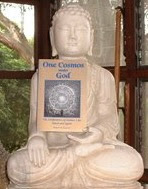
For in the Coonifesto, it is written: "Remember, even if you were to forcefully yank on the brake of the Karmic Express, its sheer momentum will continue to carry it down the tracks for a while, so that you shouldn't be surprised at the persistent weeds that continue to sprout in your spiritual garden. These are the result of karmic 'seeds' you have mindless deposited throughout your life, each with a different life cycle (many seeds take years to sprout). They will continue to sprout up long after you've stopped being naughty, just as the good seeds you are currently planting will take some time to germinate and yield their sound fruit."
Now, I know that Bob hates to sound like some kind of drug-addled hippy child of the '60s, even though many people will suspect him of being one in the final urinalysis. Yes, the idea of karma has become a kind of airy fairy subject. Nevertheless, as I mentioned a couple of posts back, the Bible is full of references to karma -- which is simply cause and effect on the moral plane -- to such an extent that the entire metaphysical system presented by the Bible breaks down if we eliminate it -- just as the physical world makes no sense in the absence of horizontal cause and effect, to the detriment of fatalistic Mohammedans everywhere.
However, causation on the moral plane can't be as simple and linear as it is on the material plane. This is easy to understand, because that's true of most everything above the level of matter. In the Primordial Tradition of which Raccoons are a nonlocal branch (although we retain our autonomy), there are always at least three degrees of being: the material, the psychological, and the spiritual worlds, corresponding to body, mind (or soul), and spirit (or intellect, i.e., the nous); in turn, these correspond to the three main ways of understanding the world, 1) empirical science (the "eye of the senses"), 2) philosophy (the eye of reason), and 3) theology and metaphysics (the contemplative eye of spirit, or pure intellection and understanding). (As I recall, Ken Wilber does a good job of explicating this in his Eye to Eye.)
Regarding the complexity of causality on the human plane, there is essentially no difference between the statements "I would like to make a fist with my hand," and "I would like to become president of the United States." Both of these are clearly teleonomic (i.e., top-down) exercises that exhaust any materialistic explanation. There is no materialistic explanation for how you can formulate the thought, "I am going to make a fist," and then do it, for no materialist knows what a thought is, much less how it can cause things to happen on the plane upon which it is supposedly wholly dependent. For a materialist, psychic causation must remain an absurdity and ultimately an illusion, equivalent to a rooster believing it causes the sun to rise.
Now, if someone says, "I would like to become president," and then becomes president, did they cause it to happen? Yes, to a certain extent. Of Aristotle's four causes -- material, formal, efficient, and final -- it is the latter which takes priority and tries to "organize" all of the lower forms of causation, similar to the way that higher levels must exploit the freedom left over by the boundary conditions of lower levels. But think of all the countless layers of causation that exist between "I want to be president" and "I am president." Finally seeing the effect of that thought might require one to "hold it" in mind for 30 or 40 years.
Now, reality is way too complex to ever have anything like complete control over our fate. However, according to Bolton, "By keeping increasingly free from certain states of mind for long enough, one may exhaust the negative reactions from the world which would need to connect with such corresponding inner states in order to be manifest. In this way, the 'cosmic debts' incurred by the use of negative energies can be dissipated."
It is probably somewhat useless to argue the point. Either you have noticed this pattern in your life or you haven't, and it actually reveals an underlying principle or it doesn't. The materialist will dismiss it a priori, as his conclusions are always buried in his premises. This is not to be confused with "thinking."
Partly because actions cannot be divorced from the state mind -- even the total being -- of the person engaging in them, there is no guarantee that the same action will redound to the same personal consequences. In short, we just don't know, which is all the more reason to be virtuous for its own sake, not for any immediate karmic "payoff." In turn, this is the benefit of understanding how the total system works, for, among other things, it gives us the patience to gracefully endure what we have coming to us and gratefully accept what we probably don't deserve anyway.
In Keys of Gnosis, Bolton points out that "it is mainly because of the wide variations among these time intervals that the succession of action and reaction passes unnoticed. A major factor here is the degree to which true values inform one's life.... The return of reactions rapidly enough for them to be recognized as such is a sign of closeness to the truth" (italics mine).
This is analogous to what I was saying the other day about how proximity to O effectively "thickens" time, so that we begin to take notice of the nonlocal web of causation that permeates our life. Indeed, it is difficult to ignore. Reminds me of a couple of tunes from Van Morrison's Poetic Champions Compose:
There are strange things happening every day / I hear music up above my head / Fill me up with your wonder / Give me my rapture today (Give Me My Rapture), and
I began to realize / the magic in my life / See it manifest in oh, so many ways / Every day is gettin' better and better / I wanna be daily walking close to you (Did Ye Get Healed?)
Conversely, "the long or indefinite delay of [reactions] is a sign that one has strayed too far from the truth to be able to atone for wrongs in this life." We want to believe we can instantaneously turn things around and realize the magic in one's life and "see it manifest in oh so many ways," but that can't possibly be true without overturning the logic of the whole system (but God knows best). Just as in science, many things are known to be true by virtue of the fact that if they weren't, then a multitude of other truths would be undermined as well, and the whole existentialada would lose coherence. It's no different on the metaphysical plane, where most things are known to be true because they must be. The karmic web of cause and effect is one such example.
This is why, unlike those new age frauds, Bob doesn't make the absurd claim that if you read his book you will somehow achieve "instant enlightenment." Rather, he makes the much more humble guarantee of eternal life while you wait.
Saturday, January 05, 2008


Friday, January 04, 2008
Rollin' Into a Strange Attractor With a Tiger in My Tummy (1.06.11)
Well, one thing was settled last night: Iowa is the new Alabama. Then again, I suppose Huckabee does have a sorta' purty mouth. But at least we have a good headline for when his campaign sinks next week in New Hampshire: Huck Fin.
Now, back to our transconscious journey through the hidden arteries of the cosmos to look for the meaning and purpose of free will, which otherwise hangs suspended from our official scientific paradigm like a loose shirttail with no footprints in the air. Either it is significant, or it's not significant. But if it's not significant, then it's difficult to account for how only its existence makes possible something as manifestly significant as science. And how can one have a science that is unable to justify the necessary conditions for its own existence, i.e., minds that are free to discover truth? That view is positively wacky, that's what it is.
I don't know how many of you saw that little Terence McKenna clip on You Tube I linked to the other day. If you did, then you can see what an extraordinarily fertile mind he had. Nevertheless, a backyard full of weeds is also fertile, so fertility itself is neither her nor there. As my father used to tell me, "you've got more fertilizer than Bandini."
I remember once during a talk, an audience member asked McKenna to speculate about something (I forget what it was), and McKenna responded -- apparently only half-ironically -- "Oh, I never speculate." To a certain extent that was actually true, since he based everything on personal experience, including countless experiences under the influence of psychedelic drugs. For him, what we call "normality" was just another arbitrary, chemically induced brain state. So in a way, he was strictly empirical, but this only goes to show how deceptive concrete appearances can be.
McKenna's freewheeling approach, while entertaining, leads to cognitive anarchy, of which he was actually a proponent. It was as if he preferred to have no portions of the mind reduced to civilization, i.e., "consensus reality," but a complete bewilderness oddventure in which every spud was radically free to live in his own private Idaho. But as we've been saying, this is not freedom, any more than knowledge can exist in a universe without unconditional truth. Or, if it is freedom, then it's the sort of tyrannical freedom discussed by bedwetting existentialists such as Sartre, i.e., indistinguishable from "nothingness."
In contrast, the whole purpose of traditional metaphysics is to show us what must necessarily be concretely true, despite appearances -- not only what is true in this here cosmos, but in any hypothetical cosmos. Metaphysics deals with the conditions of existence. Period. On a deeper level, religion discloses this objective metaphysics through its symbolic forms. The fact that scripture does this in such a way that it transcends whatever its writers thought they were writing about, leads to the conclusion that it is at the very least "inspired," but "revealed" is probably more like it. I can say this because I never speculate.
As we were saying yesterday, if you think about the barbarity of the Hebrew tribes that were handed the Jewish revelation, you know that it couldn't have sprung from the unaided mind of man as such. At best, they could have come up with childlike, spookulative fairy tales, not any kind of transcendent wisdom that would fruitfully occupy the sharpest human minds for the subsequent three or four thousand years.
Seriously, you try that -- yes, you over there, Dennett or Dawkins or Harris -- let's see one of these sods produce a single sentence that won't be forgotten just as soon as they're safely beneath the sod, let alone pored over thousands of years from now. In a way, these flatulent earthbounders are just the inevitable shadow given off by the light, sinbiotic and parasightless Nietzschean leeches on the inner reaches of primordial speechings and celestial teachings. So there.
Let's look at it -- or listen to it -- this way. Think of the thousands of musical sophisticates who have obtained Ph.D.s in music in the past half century. How many of them have written a single note of music that will be remurmured by thousands of lips hence?
In coontrast -- and I could be way wrong or naive about this, but I don't think I am -- a Johnny Cash, for example -- a musical primitive if ever there was one -- will still be appreciated. Let alone Frank Sinatra, Bob Dylan, or [early] Ray Charles. What do they "know" that the musicologists don't? For obviously these primitives possessed a form of sophisticated knowledge, even if that knowledge cannot be represented in any abstract way, and is ultimately not reducible to anything other than itself. It is literally inconceivable that there could be a pop singer who could ever surpass Sinatra, meaning that he somehow embodied "ultimate" musical knowledge. How can this be? I can't tell you. It's a secret, Mr. Jones.
Now, according to the Zohar -- the basis of esoteric Jewish thought -- the world only survives because of its secret. What's that supposed to mean? I can't tell you. It's a secret. Okay, I'll play you just a lila bit. But don't you toil, anybody!
For starters, it means that the secret is not at the bottom of the cosmos, but at the toppermost of the poppermost, like a man on a flaming pie. You're not going to disclose the secret of existence by pulverizing matter into smaller and smaller bits with bigger and bigger hammers. Since existence is a hierarchical manifestation from above, it is as if each level is "stamped" by the level immediately above. As such, there is inevitably some information that is "lost" with each successive level. Thus, the higher can disclose the lower, but the lower can only partially disclose the higher. As we have said, life isn't the secret of DNA; rather, DNA is the secret of life. And sow on, if you seed what I mean. That's the harvest part.
This is why, no matter what you say about the Creator, it's never enough because it's too damn much and can't possibly "contain" him anyway. Human language can contain what is lower than language, but never what is higher. As such, this is why the higher dimensions can only be spoken of in a poetic, symbolic, elliptical, or suggestive manner, through which the symbol unsays much more than we could ever say. I suppose it's somewhat analogous to opera. In opera, the story line is usually rather lame and skeletal. It only hints at the real action, which is taking place on a purely musical level. If the libretto were less lame -- i.e., more saturated and detailed -- this would obscure the music's ability to convey the much deeper level of transverbal meaning.
This, of course, is why Jesus speaks in parables. For one thing, being who he was, he couldn't speak in any other way. But even on a purely talktical level, this was the only way to make sure that his words would have a timeless and transcultural relevance. As the liner notes of one of my Sinatra records say (written by Stan Cornyn, King of Bad Liner Notes), he always sings like he's got an extra tank of Texaco in his tummy. Jesus too has an "extra tank of Texaco in his tummy," which means that he only says enough so that you may "participate" in what he's talking about. He never puts the pedal to the metal and screams at you -- neither Frank nor Jesus -- but is always simultaneously relaxed and intense. It is said that the greatest singers sound as if they could be singing to you while sitting in your lap.
That goes double for some of the greatest prophets. When they start yelling at you, or hectoring, or getting right in your face, that's when you know they're lousy singers, like Janis Joplin. This is because a great prophet is singing from the attractor, so that he will "draw you in," rather than drag you by the lapels. Don't get me wrong -- they do at times have to get in your face, but this takes on added significance because of its exceptional nature.
What's my point? I don't have to have a point. I'm Bob's unconscious. I can just say whatever comes to mind without censoring myself. But I never speculate.
One of my favorite strange attractors:

Here you go. You know, relaxed. Nice & easy. Takin' every step along the way. Tiger in the tummy:
Now, back to our transconscious journey through the hidden arteries of the cosmos to look for the meaning and purpose of free will, which otherwise hangs suspended from our official scientific paradigm like a loose shirttail with no footprints in the air. Either it is significant, or it's not significant. But if it's not significant, then it's difficult to account for how only its existence makes possible something as manifestly significant as science. And how can one have a science that is unable to justify the necessary conditions for its own existence, i.e., minds that are free to discover truth? That view is positively wacky, that's what it is.
I don't know how many of you saw that little Terence McKenna clip on You Tube I linked to the other day. If you did, then you can see what an extraordinarily fertile mind he had. Nevertheless, a backyard full of weeds is also fertile, so fertility itself is neither her nor there. As my father used to tell me, "you've got more fertilizer than Bandini."
I remember once during a talk, an audience member asked McKenna to speculate about something (I forget what it was), and McKenna responded -- apparently only half-ironically -- "Oh, I never speculate." To a certain extent that was actually true, since he based everything on personal experience, including countless experiences under the influence of psychedelic drugs. For him, what we call "normality" was just another arbitrary, chemically induced brain state. So in a way, he was strictly empirical, but this only goes to show how deceptive concrete appearances can be.
McKenna's freewheeling approach, while entertaining, leads to cognitive anarchy, of which he was actually a proponent. It was as if he preferred to have no portions of the mind reduced to civilization, i.e., "consensus reality," but a complete bewilderness oddventure in which every spud was radically free to live in his own private Idaho. But as we've been saying, this is not freedom, any more than knowledge can exist in a universe without unconditional truth. Or, if it is freedom, then it's the sort of tyrannical freedom discussed by bedwetting existentialists such as Sartre, i.e., indistinguishable from "nothingness."
In contrast, the whole purpose of traditional metaphysics is to show us what must necessarily be concretely true, despite appearances -- not only what is true in this here cosmos, but in any hypothetical cosmos. Metaphysics deals with the conditions of existence. Period. On a deeper level, religion discloses this objective metaphysics through its symbolic forms. The fact that scripture does this in such a way that it transcends whatever its writers thought they were writing about, leads to the conclusion that it is at the very least "inspired," but "revealed" is probably more like it. I can say this because I never speculate.
As we were saying yesterday, if you think about the barbarity of the Hebrew tribes that were handed the Jewish revelation, you know that it couldn't have sprung from the unaided mind of man as such. At best, they could have come up with childlike, spookulative fairy tales, not any kind of transcendent wisdom that would fruitfully occupy the sharpest human minds for the subsequent three or four thousand years.
Seriously, you try that -- yes, you over there, Dennett or Dawkins or Harris -- let's see one of these sods produce a single sentence that won't be forgotten just as soon as they're safely beneath the sod, let alone pored over thousands of years from now. In a way, these flatulent earthbounders are just the inevitable shadow given off by the light, sinbiotic and parasightless Nietzschean leeches on the inner reaches of primordial speechings and celestial teachings. So there.
Let's look at it -- or listen to it -- this way. Think of the thousands of musical sophisticates who have obtained Ph.D.s in music in the past half century. How many of them have written a single note of music that will be remurmured by thousands of lips hence?
In coontrast -- and I could be way wrong or naive about this, but I don't think I am -- a Johnny Cash, for example -- a musical primitive if ever there was one -- will still be appreciated. Let alone Frank Sinatra, Bob Dylan, or [early] Ray Charles. What do they "know" that the musicologists don't? For obviously these primitives possessed a form of sophisticated knowledge, even if that knowledge cannot be represented in any abstract way, and is ultimately not reducible to anything other than itself. It is literally inconceivable that there could be a pop singer who could ever surpass Sinatra, meaning that he somehow embodied "ultimate" musical knowledge. How can this be? I can't tell you. It's a secret, Mr. Jones.
Now, according to the Zohar -- the basis of esoteric Jewish thought -- the world only survives because of its secret. What's that supposed to mean? I can't tell you. It's a secret. Okay, I'll play you just a lila bit. But don't you toil, anybody!
For starters, it means that the secret is not at the bottom of the cosmos, but at the toppermost of the poppermost, like a man on a flaming pie. You're not going to disclose the secret of existence by pulverizing matter into smaller and smaller bits with bigger and bigger hammers. Since existence is a hierarchical manifestation from above, it is as if each level is "stamped" by the level immediately above. As such, there is inevitably some information that is "lost" with each successive level. Thus, the higher can disclose the lower, but the lower can only partially disclose the higher. As we have said, life isn't the secret of DNA; rather, DNA is the secret of life. And sow on, if you seed what I mean. That's the harvest part.
This is why, no matter what you say about the Creator, it's never enough because it's too damn much and can't possibly "contain" him anyway. Human language can contain what is lower than language, but never what is higher. As such, this is why the higher dimensions can only be spoken of in a poetic, symbolic, elliptical, or suggestive manner, through which the symbol unsays much more than we could ever say. I suppose it's somewhat analogous to opera. In opera, the story line is usually rather lame and skeletal. It only hints at the real action, which is taking place on a purely musical level. If the libretto were less lame -- i.e., more saturated and detailed -- this would obscure the music's ability to convey the much deeper level of transverbal meaning.
This, of course, is why Jesus speaks in parables. For one thing, being who he was, he couldn't speak in any other way. But even on a purely talktical level, this was the only way to make sure that his words would have a timeless and transcultural relevance. As the liner notes of one of my Sinatra records say (written by Stan Cornyn, King of Bad Liner Notes), he always sings like he's got an extra tank of Texaco in his tummy. Jesus too has an "extra tank of Texaco in his tummy," which means that he only says enough so that you may "participate" in what he's talking about. He never puts the pedal to the metal and screams at you -- neither Frank nor Jesus -- but is always simultaneously relaxed and intense. It is said that the greatest singers sound as if they could be singing to you while sitting in your lap.
That goes double for some of the greatest prophets. When they start yelling at you, or hectoring, or getting right in your face, that's when you know they're lousy singers, like Janis Joplin. This is because a great prophet is singing from the attractor, so that he will "draw you in," rather than drag you by the lapels. Don't get me wrong -- they do at times have to get in your face, but this takes on added significance because of its exceptional nature.
What's my point? I don't have to have a point. I'm Bob's unconscious. I can just say whatever comes to mind without censoring myself. But I never speculate.
One of my favorite strange attractors:

Here you go. You know, relaxed. Nice & easy. Takin' every step along the way. Tiger in the tummy:
Thursday, January 03, 2008
Why Good Things Happen to... People, of All Things (1.05.11)
Me again, Bob's UCS, continuing with yesterday's post (I want to say "transconscious," but Bob won't let me -- says people will get the wrong idea). Anyway, as far as I'm concerned, the question is not why good things happen to bad people, but why they happen at all. I suppose if you're a flat cosmos materialist, there's no mystery, since the only question is why pleasurable things happen, and pleasurable things happen because certain subjective sensations were selected by evolution in order to tell us when we're engaging in some life-enhancing activity that increases our survival prospects, like smoking cigarettes, eating a lot of cholesterol, or bashing somebody's head in when they don't see things our way. All of these things are good because they give pleasure.
But every conscious being knows that the moral order cannot be reduced to neurology, any more than a great work of art can be understood by reducing it to its molecular components. But if you are a materialist, then you must necessarily be a cynic, as you are able to see right through the naive people who believe in a fixed moral order. You know that they are just fooling themselves -- or worse yet, just trying to manipulate and control others -- and that good and evil don't really exist.
Yes, you know that such people are bad, which, of course, negates your frivolous argument, but so what, truth doesn't exist anyway. You know that Bach was just a musical con man, what with his sinister idea that the purpose of his music was to reveal the divine order. You know that Abraham Lincoln (see comments) was just a tyrant and demagogue who used the slavery issue to consolidate presidential power in unprecedented ways. You know that people only pretend a fetus is not a parasite in order to gain control over women's bodies. You employ strict logic to understand reality. How monkey logic can ever arrive at moral or any other kind of truth, you cannot say.
Buddy, you are without a clue. You are a One Cosmos troll, the lice on Bob's transdimensional vapor trail. But enviously suckling on the creativity of another feels good, so it must be right.
Now, as far as I can tell -- and I'm no theologian, so forgive me if I get this wrong -- one of the intrafamilial squabbles between Judaism and Christianity -- but not really, as we shall see -- is over the value of action in isolation from the state of the soul engaging in it. I have heard Dennis Prager (Medved too) speak of this on numerous occasions, that in Jewish thought, the overriding concern is the value of the action, not the motivations of the person engaging in it. Thus, bad people can do a lot of good. "Charity and pride have different aims, yet both feed the poor," say the rabbis.
There is obviously some real truth in this, but I think that overall, taken in isolation, this is a morality intended for an earlier age. Clearly, Judaism was a covenant with a people, a collective. This is perfectly appropriate, being that the individual as we understand it simply did not exist at the time of the Jewish revelation, which may have actually been vitally necessary to create the context for the interior individual to later emerge. Again I refer you to the works of Charles Taylor (who is a practicing Catholic, btw), e.g., Sources of the Self and A Secular Age, which trace the emergence of the modern self in the Christian West some 300 or 400 years ago.
This is not to say that the Jewish approach is negated by Christianity. To the extent that it is "transcended," it is only because it must be included in the Christian approach, just as Jesus said, i.e., that he did not come to abolish the law but to fulfill it. In my view, truly fulfilling the law would be to merge action and spirit, heart and body, man and God. There remain Christians who emphasize works, others who emphasize faith, but to the extent that the latter becomes "perfect," it should result in good actions.
Nevertheless, man's capacity for autoflimflammery, or pulling the wool over one's own I, is more or less infinite, so it is morally perilous to operate without the sort of external guide rails provided by a revealed moral code filtered through generations of The Wise. Or, to express it in an absolutely sweet Marie, To live outside the law you must be honest. Virtually all people need to be shown the good before they can see the good. A life spent contemplating the Law in the manner of a Jewish sage no doubt has a transformative effect on the soul, for as the Yiddish saying goes, Everyone is kneaded out of the same dough but not baked in the same oven. So, where do you think you're climbing with your crooked feet, mister bigshot?
This has direct relevance to our discussion of free will, for a good action that is forced is just as unfree as a bad action, just as a dog that is trained to assist a blind person isn't really "choosing" the good. Similarly, memorizing truth in a rote fashion can never be the same as possessing wisdom, no matter how true. Interestingly, one of the greatest spiritual accomplishments for a Mohammedan is to memorize the entire Koran, which tells you a great deal about their relationship to wisdom. To quote the rabbi again, "he falsifies who renders a verse just as it looks." Indeed, "for every answer you can find a new question."
So intentions do matter, especially when it comes to the modern self, which is much more "interior." In a way, this is more challenging than merely engaging in outwardly good deeds, for it adds a whole new world in need of "sanctification." For no sooner had this new interior self emerged, than a whole host of new evils flooded into the world, or at least exacerbated the old ones. With the modern self came the appearance of the kind of unlimited evil we witnessed in the 20th century, and which we now see in Islamofascism. Islam itself is just sort of pathetic, but becomes combustible when merged with certain "ideals" imported from the West, among them, fascism, or scientific discoveries that they couldn't have made in a thousand years due to the very nature of Islam.
As Bolton explains, "physically similar actions can differ internally." Perhaps most importantly, "the actions of conscious agents owe so much of their true nature to the beliefs and intentions with which they are performed." And it is on the level of intention that the Law (discussed yesterday) really becomes apparent and that "like attracts like." This is why people are not united by common actions, but by a common spirit that draws them together into the same spiritual attractor. Even the blatantly non-spiritual, such as dailykosbags or atheist wacktivists, are clearly operating out of a debased spiritual attractor that will be well familiar to most Raccoons. We understand them perfectly, but they cannot understand us.
In turn, this is why there is a "culture war" in America, and why those who complain that there is "too much divisiveness" are missing the whole point. John Edwards is correct: there are two Americas -- the material flatland of his liberal fantasies, and the real one. In his world, theft is moral because it is detached from the moral order that he doesn't recognize to begin with.
Bolton says that it is on the interior plane that we will especially see the effect of the Law, as we attract people and things into our life which share a similar "spirit." For example, Raccoons who "stumbled" upon this blog and to its community were actually drawn here, "attractor to attractor," something that becomes increasingly clear as one's internal attractor develops in time. Why the trolls are drawn here is a different matter entirely, although for some, there may actually be a "good spirit" that was attracted here but which is concealed by their envy and intellectual deadness. For them there is hope.
Bolton goes on to emphasize that "interior" does not necessarily mean "private," and that the interior does affect the exterior:
"By virtue of the Law, actions and orientations are never merely private, despite appearances. Consequently, a manner of being which deepens the relation to God and universal values, and so identifies with a more concrete reality, thus interacts with the ambient world simply by being a part of it. This is to be the instrument of an action of presence which necessarily attracts proportionate positive action from the world, and so liberates potentialities within it which increase its order and stability."
Which is why the rabbis teach that a minimum of 36 righteous souls in each generation is required to sustain the world. Yes, that's all it takes to keep all the do-gooders in check.
When the great Tao is forgotten, goodness and piety appear. --Tao Te Ching
But every conscious being knows that the moral order cannot be reduced to neurology, any more than a great work of art can be understood by reducing it to its molecular components. But if you are a materialist, then you must necessarily be a cynic, as you are able to see right through the naive people who believe in a fixed moral order. You know that they are just fooling themselves -- or worse yet, just trying to manipulate and control others -- and that good and evil don't really exist.
Yes, you know that such people are bad, which, of course, negates your frivolous argument, but so what, truth doesn't exist anyway. You know that Bach was just a musical con man, what with his sinister idea that the purpose of his music was to reveal the divine order. You know that Abraham Lincoln (see comments) was just a tyrant and demagogue who used the slavery issue to consolidate presidential power in unprecedented ways. You know that people only pretend a fetus is not a parasite in order to gain control over women's bodies. You employ strict logic to understand reality. How monkey logic can ever arrive at moral or any other kind of truth, you cannot say.
Buddy, you are without a clue. You are a One Cosmos troll, the lice on Bob's transdimensional vapor trail. But enviously suckling on the creativity of another feels good, so it must be right.
Now, as far as I can tell -- and I'm no theologian, so forgive me if I get this wrong -- one of the intrafamilial squabbles between Judaism and Christianity -- but not really, as we shall see -- is over the value of action in isolation from the state of the soul engaging in it. I have heard Dennis Prager (Medved too) speak of this on numerous occasions, that in Jewish thought, the overriding concern is the value of the action, not the motivations of the person engaging in it. Thus, bad people can do a lot of good. "Charity and pride have different aims, yet both feed the poor," say the rabbis.
There is obviously some real truth in this, but I think that overall, taken in isolation, this is a morality intended for an earlier age. Clearly, Judaism was a covenant with a people, a collective. This is perfectly appropriate, being that the individual as we understand it simply did not exist at the time of the Jewish revelation, which may have actually been vitally necessary to create the context for the interior individual to later emerge. Again I refer you to the works of Charles Taylor (who is a practicing Catholic, btw), e.g., Sources of the Self and A Secular Age, which trace the emergence of the modern self in the Christian West some 300 or 400 years ago.
This is not to say that the Jewish approach is negated by Christianity. To the extent that it is "transcended," it is only because it must be included in the Christian approach, just as Jesus said, i.e., that he did not come to abolish the law but to fulfill it. In my view, truly fulfilling the law would be to merge action and spirit, heart and body, man and God. There remain Christians who emphasize works, others who emphasize faith, but to the extent that the latter becomes "perfect," it should result in good actions.
Nevertheless, man's capacity for autoflimflammery, or pulling the wool over one's own I, is more or less infinite, so it is morally perilous to operate without the sort of external guide rails provided by a revealed moral code filtered through generations of The Wise. Or, to express it in an absolutely sweet Marie, To live outside the law you must be honest. Virtually all people need to be shown the good before they can see the good. A life spent contemplating the Law in the manner of a Jewish sage no doubt has a transformative effect on the soul, for as the Yiddish saying goes, Everyone is kneaded out of the same dough but not baked in the same oven. So, where do you think you're climbing with your crooked feet, mister bigshot?
This has direct relevance to our discussion of free will, for a good action that is forced is just as unfree as a bad action, just as a dog that is trained to assist a blind person isn't really "choosing" the good. Similarly, memorizing truth in a rote fashion can never be the same as possessing wisdom, no matter how true. Interestingly, one of the greatest spiritual accomplishments for a Mohammedan is to memorize the entire Koran, which tells you a great deal about their relationship to wisdom. To quote the rabbi again, "he falsifies who renders a verse just as it looks." Indeed, "for every answer you can find a new question."
So intentions do matter, especially when it comes to the modern self, which is much more "interior." In a way, this is more challenging than merely engaging in outwardly good deeds, for it adds a whole new world in need of "sanctification." For no sooner had this new interior self emerged, than a whole host of new evils flooded into the world, or at least exacerbated the old ones. With the modern self came the appearance of the kind of unlimited evil we witnessed in the 20th century, and which we now see in Islamofascism. Islam itself is just sort of pathetic, but becomes combustible when merged with certain "ideals" imported from the West, among them, fascism, or scientific discoveries that they couldn't have made in a thousand years due to the very nature of Islam.
As Bolton explains, "physically similar actions can differ internally." Perhaps most importantly, "the actions of conscious agents owe so much of their true nature to the beliefs and intentions with which they are performed." And it is on the level of intention that the Law (discussed yesterday) really becomes apparent and that "like attracts like." This is why people are not united by common actions, but by a common spirit that draws them together into the same spiritual attractor. Even the blatantly non-spiritual, such as dailykosbags or atheist wacktivists, are clearly operating out of a debased spiritual attractor that will be well familiar to most Raccoons. We understand them perfectly, but they cannot understand us.
In turn, this is why there is a "culture war" in America, and why those who complain that there is "too much divisiveness" are missing the whole point. John Edwards is correct: there are two Americas -- the material flatland of his liberal fantasies, and the real one. In his world, theft is moral because it is detached from the moral order that he doesn't recognize to begin with.
Bolton says that it is on the interior plane that we will especially see the effect of the Law, as we attract people and things into our life which share a similar "spirit." For example, Raccoons who "stumbled" upon this blog and to its community were actually drawn here, "attractor to attractor," something that becomes increasingly clear as one's internal attractor develops in time. Why the trolls are drawn here is a different matter entirely, although for some, there may actually be a "good spirit" that was attracted here but which is concealed by their envy and intellectual deadness. For them there is hope.
Bolton goes on to emphasize that "interior" does not necessarily mean "private," and that the interior does affect the exterior:
"By virtue of the Law, actions and orientations are never merely private, despite appearances. Consequently, a manner of being which deepens the relation to God and universal values, and so identifies with a more concrete reality, thus interacts with the ambient world simply by being a part of it. This is to be the instrument of an action of presence which necessarily attracts proportionate positive action from the world, and so liberates potentialities within it which increase its order and stability."
Which is why the rabbis teach that a minimum of 36 righteous souls in each generation is required to sustain the world. Yes, that's all it takes to keep all the do-gooders in check.
When the great Tao is forgotten, goodness and piety appear. --Tao Te Ching
Wednesday, January 02, 2008
Achieving Temporal Density in a Moral Cosmos (1.04.11)
How'd that happen? It was 5:00, then Bob looked up again and it was 7:30. But Bob was still in bed. Only a speed post from me, Bob's unconscious, can save us now.
For me, the most provocative chapters in Bolton's Gnosis have to do with the cosmic law of "action and reaction" and how this relates to providence and fate. Until modern times, religion had more to do with trying to "control" external circumstances, an idea which became increasingly untenable for most people with the rise of science. As a result, religion became more of an "interior" pursuit for extreme seekers, essentially applying to consciousness but not matter, so to speak. With the rise of quantum physics this has changed somewhat, since it seems that it is possible to reduce matter to a form of conscious energy, i.e., a shakti your system. But still, it seems that mainly fundamentalists and new agers (e.g., "The Secret") think they can directly influence external events in a magical way.
Bolton provides a new way to think this through, and to steer a course between what amounts to deism -- that is, a God who got the universe underway but has a hands-off policy thereafter -- and the "cosmic bellhop" of popular mythology, i.e., a God who magically fulfills our every wish like a liberal politician.
Most Raccoons would insist that.... No, let's not say "God," because in my opinion, that just confuses things. The word is so saturated, that it has implicit conclusions that foreclose the exploration before it's even begun. This is why Bob employed the symbol "O" in his book, so that it could "accumulate" meaning based upon actual experience, rather than imposing a meaning we don't intend. This is for the purpose investigating the mindmatter in a more "scientific" manner, free of unnecessary preconceptions that cloud our perception.
You might say that O begins "empty," but gradually becomes God as we fill it out with our own experience. In this regard, it is critical that the experience be ours, not someone else's, otherwise we are simply "thinking with someone else's head," something that is fine for most disciplines but a cul-de-slack when it comes to real spiritual growth.
First of all, as Bolton points out, one cannot deny the fact that scripture makes numerous references to the law of action and reaction (henceforth, "the law") -- that is, the idea that we reap what we sow, that those who live by the sword shall die by it, "forgive our debts as we forgive our debtors," etc. In a word, karma. The Bible is filled with references to karma -- that what goes around comes around, and that evil will be punished and good rewarded.
Obviously we all want this to be true, but is it true in fact? It seems that most people conclude that it can't possibly be true -- that everywhere the wicked flourish and the decent are punished. Therefore, in order to maintain the belief in a just cosmos, reward and punishment must take place on some post-mortem plane. Certainly I am willing to believe this, on purely transrational grounds alone. Of course, its easier for me to believe it, since I am unconscious, and the unconscious mind works along very different, atemporal lines, than the conscious mind. As your unconscious, I am always meting out reward and punishment in ways that appear mysterious to you, your conscious mind.
More generally, if the very structure of the universe proves to us that it must have been created, and that its creator must unnarcissarily be good, then goodness must somehow prevail "in the end." In short, we have no difficulty whatsoever in accepting ontological arguments that the cosmos must be moral through and through, even if it's often in a very indirect way due to the hierarchical complexity of manifest existence, both spatially and temporally.
Furthermore, the cosmos is obviously not a machine and man is clearly free. If the cosmos were a machine, then we would see an immediate relationship between cause and effect on the moral plane. You'd do something bad, and a lightning bolt would come down and strike you from the sky. Pathological liars like Bill Clinton or Al Gore would no sooner open their mouths than drop dead. If morality operated in this instantaneous manner, then we wouldn't actually be morally free in any meaningful way. Rather, we'd just be good to avoid the punishment. No one would be good for goodness' sake. Then there'd be no Santa Claus. Either that, or every morning would be Christmas, with gifts everywhere for yesterday's good deeds.
It is interesting that materialists naturally accept the existence of cause and effect on the material plane, and in fact, reduce all of reality to this mechanical realm. And yet, they deny the possibility of anything similar on the moral plane, which is one more reason why their metaphysic is so incoherent. But if we turn the cosmos upside down -- which is to say, right side up -- then we can see that material cause and effect is simply the "residue" of the first cause, which must be above, not below. You cannot derive free will from materialism, but you can derive matter from a freely willed universe. And as Bob mentioned yesterday, humans can only exercise freedom in a universe that has a stable foundation, so to speak, i.e., predictable boundary conditions.
Speaking of foundations, I'm beginning to run out of time here, so I've merely laid one. But I think most senior Raccoons -- assuming you weren't too much of complete a-hole before you realized you were one -- will have noticed that as you come into closer proximity to O, you also "shorten" the distance between cause and effect on the moral plane. Bob mentioned this in the Coonifesto -- I don't have time to look it up at the moment, but he makes the common observation that as one draws closer to O, the synchronicities begin piling up fast and furious, and the Law becomes more apparent. Something happens to time, whereby it "thickens" and we begin to intuit all sorts of causal connections operating along different, immaterial timelines. Eventually it begins to look as if our life were more of a conspiracy than the workings of a lone nut.
That's all I'll say at the moment. I'm outta here.
For me, the most provocative chapters in Bolton's Gnosis have to do with the cosmic law of "action and reaction" and how this relates to providence and fate. Until modern times, religion had more to do with trying to "control" external circumstances, an idea which became increasingly untenable for most people with the rise of science. As a result, religion became more of an "interior" pursuit for extreme seekers, essentially applying to consciousness but not matter, so to speak. With the rise of quantum physics this has changed somewhat, since it seems that it is possible to reduce matter to a form of conscious energy, i.e., a shakti your system. But still, it seems that mainly fundamentalists and new agers (e.g., "The Secret") think they can directly influence external events in a magical way.
Bolton provides a new way to think this through, and to steer a course between what amounts to deism -- that is, a God who got the universe underway but has a hands-off policy thereafter -- and the "cosmic bellhop" of popular mythology, i.e., a God who magically fulfills our every wish like a liberal politician.
Most Raccoons would insist that.... No, let's not say "God," because in my opinion, that just confuses things. The word is so saturated, that it has implicit conclusions that foreclose the exploration before it's even begun. This is why Bob employed the symbol "O" in his book, so that it could "accumulate" meaning based upon actual experience, rather than imposing a meaning we don't intend. This is for the purpose investigating the mindmatter in a more "scientific" manner, free of unnecessary preconceptions that cloud our perception.
You might say that O begins "empty," but gradually becomes God as we fill it out with our own experience. In this regard, it is critical that the experience be ours, not someone else's, otherwise we are simply "thinking with someone else's head," something that is fine for most disciplines but a cul-de-slack when it comes to real spiritual growth.
First of all, as Bolton points out, one cannot deny the fact that scripture makes numerous references to the law of action and reaction (henceforth, "the law") -- that is, the idea that we reap what we sow, that those who live by the sword shall die by it, "forgive our debts as we forgive our debtors," etc. In a word, karma. The Bible is filled with references to karma -- that what goes around comes around, and that evil will be punished and good rewarded.
Obviously we all want this to be true, but is it true in fact? It seems that most people conclude that it can't possibly be true -- that everywhere the wicked flourish and the decent are punished. Therefore, in order to maintain the belief in a just cosmos, reward and punishment must take place on some post-mortem plane. Certainly I am willing to believe this, on purely transrational grounds alone. Of course, its easier for me to believe it, since I am unconscious, and the unconscious mind works along very different, atemporal lines, than the conscious mind. As your unconscious, I am always meting out reward and punishment in ways that appear mysterious to you, your conscious mind.
More generally, if the very structure of the universe proves to us that it must have been created, and that its creator must unnarcissarily be good, then goodness must somehow prevail "in the end." In short, we have no difficulty whatsoever in accepting ontological arguments that the cosmos must be moral through and through, even if it's often in a very indirect way due to the hierarchical complexity of manifest existence, both spatially and temporally.
Furthermore, the cosmos is obviously not a machine and man is clearly free. If the cosmos were a machine, then we would see an immediate relationship between cause and effect on the moral plane. You'd do something bad, and a lightning bolt would come down and strike you from the sky. Pathological liars like Bill Clinton or Al Gore would no sooner open their mouths than drop dead. If morality operated in this instantaneous manner, then we wouldn't actually be morally free in any meaningful way. Rather, we'd just be good to avoid the punishment. No one would be good for goodness' sake. Then there'd be no Santa Claus. Either that, or every morning would be Christmas, with gifts everywhere for yesterday's good deeds.
It is interesting that materialists naturally accept the existence of cause and effect on the material plane, and in fact, reduce all of reality to this mechanical realm. And yet, they deny the possibility of anything similar on the moral plane, which is one more reason why their metaphysic is so incoherent. But if we turn the cosmos upside down -- which is to say, right side up -- then we can see that material cause and effect is simply the "residue" of the first cause, which must be above, not below. You cannot derive free will from materialism, but you can derive matter from a freely willed universe. And as Bob mentioned yesterday, humans can only exercise freedom in a universe that has a stable foundation, so to speak, i.e., predictable boundary conditions.
Speaking of foundations, I'm beginning to run out of time here, so I've merely laid one. But I think most senior Raccoons -- assuming you weren't too much of complete a-hole before you realized you were one -- will have noticed that as you come into closer proximity to O, you also "shorten" the distance between cause and effect on the moral plane. Bob mentioned this in the Coonifesto -- I don't have time to look it up at the moment, but he makes the common observation that as one draws closer to O, the synchronicities begin piling up fast and furious, and the Law becomes more apparent. Something happens to time, whereby it "thickens" and we begin to intuit all sorts of causal connections operating along different, immaterial timelines. Eventually it begins to look as if our life were more of a conspiracy than the workings of a lone nut.
That's all I'll say at the moment. I'm outta here.
Tuesday, January 01, 2008
Freedom, Morality, and New Year's Revolutions (1.03.11)
It's interesting that this pagan festival, the "new year," follows right on the heels of Christmas. Since pagans lived in self-renewing cyclical time, it was thought that one could actually have a fresh start with a new temporal cycle -- which is undoubtedly why we retain the atavism of new year's resolutions, and why they usually don't work. The lesson of Christmas is that a much more radical intervention is necessary for true change to occur, and that to change anything, we only have to change everything, i.e., repent, which -- now, don't get the Jesus willies -- simply means to "turn around," or revolve in order to resolve and evolve.
In short, only a new year's revolution will suffice. If time is automatically turning around and returning to its source, then it's not really necessary for us to turn around. Rather, in order to renew ourselves and gain a new start, all we have to do is ride the absurcular coattails of time, and perhaps throw in a human sacrifice for good measure. But if you are a neo-pagan embedded in profane time, then so too are those nasty habits you are resolved to change. In this regard, most problems are ultimately spiritual problems in disguise, for example, using food for every reason other than that for which it is intended in order to fill some void or satisfy some hidden impulse.
True, since Jesus was probably born in the spring, Christmas was grafted onto pagan winter festivals. However, this was not in order to imitate them, but to sanctify them -- to cleanse them of their pointless cyclicality and introduce some linearity and teleology into the situation. Once the implicit idea is promulgated that a single human life forms the axis of history and the center of the cosmos, then we are no longer half-conscious, quasi-animal beings embedded in the rhythms of nature, but awake to the irreversible, future-oriented nature of time and therefore life. Well, some of us, anyway.
Yes, this does merge with our discussion of free will, for free will is an irreducibly spiritual faculty dropped into voidgin nature from above. You might say that free will is like the seed that makes our lives potentially fruitful. But like any seed, the proper conditions are required for it to grow and thrive.
Now, as Bolton points out, there is no such thing as absolute freedom on the human plane. In fact, such an idea is a priori metaphysically absurd, since freedom can only meaningfully exist within a context of restraint or limitation. To exercise freedom is to transcend limitation, not to abolish it or pretend it doesn't exist. It is to use limitation as a springboard to vault oneself "higher" or "deeper" into this thing we call reality (which we actually co-create).
For example, let's say we wish to be radically linguistically free. We will not advance our freedom by abolishing the limitations of alphabet and grammar, but simply destroy our ability to speak meaningfully. If you do this, you will not be more free, but less free, since you will have no freedom to move about within the higher dimensional semantic space that is disclosed by language, but built upon stable rules. At best, you will have a meaningless sort of horizontal freedom in which you are only at liberty to rant and gesture, like a dailykos diarist.
This is why, in order to properly speak the language of O-bonics, linguistic precision is so necessary. You will notice that when you pick up most any "new age" type book -- in fact, unfortunately, many conventional religious books as well -- the language conveniently goes "wobbly" just at that critical juncture when you most need it. These frauds use language in such a way that they make you feel as if the fault is within you, not them. Philosophers and academics pull the same thing all the time. But if you truly understand something, then it shouldn't be difficult to find the words to convey that understanding to another, at least assuming adequate communication skills, along with good will in the reader. (I might add that where the new agers use fuzzy language to conceal their ignorance, the conventionally religious often fall back on overly rigid and saturated formulas to cover over their lack of understanding.)
As Polanyi explained, true freedom results from a higher level exploiting the freedom left over by the boundary conditions of a lower level. This is why even a machine cannot be reduced to a machine. Rather, in order to create a machine, we employ the boundary conditions of physics and chemistry to manufacture something with a purpose, say, an automobile engine. With the engine, we are free to travel from here to there, but only because of the stable and deterministic boundary conditions of physics and chemistry.
Speaking of which, one of the reasons the Mohammedans are so unfree is that their metaphysics does not permit the existence of unvarying boundary conditions free from Allah's constant meddling. In other words, instead of a rational universe that operates along the lines of fixed principles, they imagine that Allah is intervening "vertically" at every moment to directly cause everything. This is also why they are so fatalistic, which only undermines everything that religion is here to mitigate, which is to say, fate. The purpose of religion is to make us more free, not less free. But that freedom can only exist in a cosmos with predictable boundary conditions with which to build upward and inward.
By the way -- and I suppose this isn't a peripheral point -- this is why it is so absurd to suggest that liberals are "pro-freedom." I mean, we already know that this isn't true in fact, what with speech codes, political correctness, racial quotas, confiscatory taxes, etc. But these things only flow from the fact that liberalism is anti-freedom in principle, since it celebrates the elimination of all the time-tested boundary conditions -- i.e., spiritual values -- that have made Western civilization so extraordinarily successful. Truly, liberals are dreadful.
But so too are so-called libertarians who imagine they are faithful to reason but who actually erode its spiritual foundations. On Dr. Sanity's website there was a particularly disturbing example of this by an infrahuman commenter who ironically goes by the name of "A. Rational Human."
In this regard, there is no question that Randian objectivism can serve as a sort of philosophical disinfectant, clearing away so much dysfunctional and magical ideology. But if that's where you remain, then at best your mind will achieve a sort of adolescent cleverness, in which you are able to use the intellect to deny it -- or to confuse truth with method. Clearly, the most important truths are "above" reason, not subject to it (i.e., to lower, mechanical reason, not to Reason as such, i.e., the intellect or nous which "perceives" truth directly, not discursively). Transcendent truths are intrinsically true. Just because we can't reduce them to some intellectual pygmy's O-nemic, a-gnostc, and irony-poor idea of reason, that's no sane reason to throw them out.
Doing so results in moral and intellectual insanity, which is distinct from the purely emotional kind only in appearances. Such a person is just as crazy, but is able to "pass" as normal under the Reign of Quantity. Below are some examples; that this cretin says he's 70 years old only adds to the irony, because his life is a late-term celestial abortion (even though there is almost always time to "turn around," transcend nature, and embody Reason; it's just that this person's language reveals such a willfully bleak soullessness, that it is probably too late for him):
"The fact is the fetus is a total parasite by any rational understanding of the concept. It exists by virtue of what its host provides it.... If a fully formed and functioning human cannot own another human, how can a total parasite that is nothing but a POTENTIAL human own its host?
"It makes no difference if the needy one is an actual human, a potential human, a tree, a cockroach, or the earth itself.... Parasites enter the body as a result of voluntary and specific actions of the host: eating food, walking barefoot on infected soil, breathing, living with animals.... They live off the substance of the host. Sperm is NOT of the woman's body and enters by an act of sex. The fetus lives off the substance of its host. Its only a matter of rather irrelevant detail and not difference in fundamental principles.
"Not only is the woman considered nothing but a growth media and slave to the result for 20 years (sic) but also her life is to be sacrificed in the name of 'protecting' life. My my, what a really a 'loving' Christian idea. To save a life we must insist that the life of the mother be destroyed and that she has no choice in the matter.
"As for DNA, the father contributed only one half the chromosomes for the FIRST cell. The mother provides everything else up to and including birth. Give him one set of chromosomes to the father and his contribution is more than totally returned. The remaining 6 to 10 pounds came from the mother.
"I know the scientific method and by that method I can discover what is true and what is not. Belief is for those who want fantasy and myth to be true and to be able to evade what is in fact true. Science is for those who want to KNOW what is true."
*****
Yes, beneath ignorant and beyond creepy, irrespective of how you feel about Roe vs. Wade. Only a lost or dead soul could argue that abortion is actually a good thing because it eradicates parasites from our midst. Any intact soul knows that human life is sacred and that abortion is at best a necessary evil, but an evil just the same. A celestial abortion is also a calamity, but at least it's self-administered, i.e., cluelesscide. To forget what cannot be unknown is not a basis for life or liberty.
Now, where was I. Yes, not only does true spiritual freedom depend upon the boundary conditions known as eternal values, but it requires knowledge of those values. For example, A. Rational Human Being possesses no vertical freedom for the specific reason that he is utterly ignorant of the boundary conditions which make it possible.
As Bolton explains, "the same observation applies to all morally bad or defective actions. Their necessarily lower degree of freedom argues a lower degree of responsibility and guilt, or would do so if there were no such thing as culpable ignorance. Some such previous failure of free will is normally a necessary condition for worse things." And as Augustine recognized, "the saved in Heaven would no longer be able to sin, owing to their will having become perfectly free" (Bolton, italics mine).
Even if only interpreted allegorically, the point remains: we are only truly free to choose the good and know the true, unless lies and truth are interchangeable.
In short, only a new year's revolution will suffice. If time is automatically turning around and returning to its source, then it's not really necessary for us to turn around. Rather, in order to renew ourselves and gain a new start, all we have to do is ride the absurcular coattails of time, and perhaps throw in a human sacrifice for good measure. But if you are a neo-pagan embedded in profane time, then so too are those nasty habits you are resolved to change. In this regard, most problems are ultimately spiritual problems in disguise, for example, using food for every reason other than that for which it is intended in order to fill some void or satisfy some hidden impulse.
True, since Jesus was probably born in the spring, Christmas was grafted onto pagan winter festivals. However, this was not in order to imitate them, but to sanctify them -- to cleanse them of their pointless cyclicality and introduce some linearity and teleology into the situation. Once the implicit idea is promulgated that a single human life forms the axis of history and the center of the cosmos, then we are no longer half-conscious, quasi-animal beings embedded in the rhythms of nature, but awake to the irreversible, future-oriented nature of time and therefore life. Well, some of us, anyway.
Yes, this does merge with our discussion of free will, for free will is an irreducibly spiritual faculty dropped into voidgin nature from above. You might say that free will is like the seed that makes our lives potentially fruitful. But like any seed, the proper conditions are required for it to grow and thrive.
Now, as Bolton points out, there is no such thing as absolute freedom on the human plane. In fact, such an idea is a priori metaphysically absurd, since freedom can only meaningfully exist within a context of restraint or limitation. To exercise freedom is to transcend limitation, not to abolish it or pretend it doesn't exist. It is to use limitation as a springboard to vault oneself "higher" or "deeper" into this thing we call reality (which we actually co-create).
For example, let's say we wish to be radically linguistically free. We will not advance our freedom by abolishing the limitations of alphabet and grammar, but simply destroy our ability to speak meaningfully. If you do this, you will not be more free, but less free, since you will have no freedom to move about within the higher dimensional semantic space that is disclosed by language, but built upon stable rules. At best, you will have a meaningless sort of horizontal freedom in which you are only at liberty to rant and gesture, like a dailykos diarist.
This is why, in order to properly speak the language of O-bonics, linguistic precision is so necessary. You will notice that when you pick up most any "new age" type book -- in fact, unfortunately, many conventional religious books as well -- the language conveniently goes "wobbly" just at that critical juncture when you most need it. These frauds use language in such a way that they make you feel as if the fault is within you, not them. Philosophers and academics pull the same thing all the time. But if you truly understand something, then it shouldn't be difficult to find the words to convey that understanding to another, at least assuming adequate communication skills, along with good will in the reader. (I might add that where the new agers use fuzzy language to conceal their ignorance, the conventionally religious often fall back on overly rigid and saturated formulas to cover over their lack of understanding.)
As Polanyi explained, true freedom results from a higher level exploiting the freedom left over by the boundary conditions of a lower level. This is why even a machine cannot be reduced to a machine. Rather, in order to create a machine, we employ the boundary conditions of physics and chemistry to manufacture something with a purpose, say, an automobile engine. With the engine, we are free to travel from here to there, but only because of the stable and deterministic boundary conditions of physics and chemistry.
Speaking of which, one of the reasons the Mohammedans are so unfree is that their metaphysics does not permit the existence of unvarying boundary conditions free from Allah's constant meddling. In other words, instead of a rational universe that operates along the lines of fixed principles, they imagine that Allah is intervening "vertically" at every moment to directly cause everything. This is also why they are so fatalistic, which only undermines everything that religion is here to mitigate, which is to say, fate. The purpose of religion is to make us more free, not less free. But that freedom can only exist in a cosmos with predictable boundary conditions with which to build upward and inward.
By the way -- and I suppose this isn't a peripheral point -- this is why it is so absurd to suggest that liberals are "pro-freedom." I mean, we already know that this isn't true in fact, what with speech codes, political correctness, racial quotas, confiscatory taxes, etc. But these things only flow from the fact that liberalism is anti-freedom in principle, since it celebrates the elimination of all the time-tested boundary conditions -- i.e., spiritual values -- that have made Western civilization so extraordinarily successful. Truly, liberals are dreadful.
But so too are so-called libertarians who imagine they are faithful to reason but who actually erode its spiritual foundations. On Dr. Sanity's website there was a particularly disturbing example of this by an infrahuman commenter who ironically goes by the name of "A. Rational Human."
In this regard, there is no question that Randian objectivism can serve as a sort of philosophical disinfectant, clearing away so much dysfunctional and magical ideology. But if that's where you remain, then at best your mind will achieve a sort of adolescent cleverness, in which you are able to use the intellect to deny it -- or to confuse truth with method. Clearly, the most important truths are "above" reason, not subject to it (i.e., to lower, mechanical reason, not to Reason as such, i.e., the intellect or nous which "perceives" truth directly, not discursively). Transcendent truths are intrinsically true. Just because we can't reduce them to some intellectual pygmy's O-nemic, a-gnostc, and irony-poor idea of reason, that's no sane reason to throw them out.
Doing so results in moral and intellectual insanity, which is distinct from the purely emotional kind only in appearances. Such a person is just as crazy, but is able to "pass" as normal under the Reign of Quantity. Below are some examples; that this cretin says he's 70 years old only adds to the irony, because his life is a late-term celestial abortion (even though there is almost always time to "turn around," transcend nature, and embody Reason; it's just that this person's language reveals such a willfully bleak soullessness, that it is probably too late for him):
"The fact is the fetus is a total parasite by any rational understanding of the concept. It exists by virtue of what its host provides it.... If a fully formed and functioning human cannot own another human, how can a total parasite that is nothing but a POTENTIAL human own its host?
"It makes no difference if the needy one is an actual human, a potential human, a tree, a cockroach, or the earth itself.... Parasites enter the body as a result of voluntary and specific actions of the host: eating food, walking barefoot on infected soil, breathing, living with animals.... They live off the substance of the host. Sperm is NOT of the woman's body and enters by an act of sex. The fetus lives off the substance of its host. Its only a matter of rather irrelevant detail and not difference in fundamental principles.
"Not only is the woman considered nothing but a growth media and slave to the result for 20 years (sic) but also her life is to be sacrificed in the name of 'protecting' life. My my, what a really a 'loving' Christian idea. To save a life we must insist that the life of the mother be destroyed and that she has no choice in the matter.
"As for DNA, the father contributed only one half the chromosomes for the FIRST cell. The mother provides everything else up to and including birth. Give him one set of chromosomes to the father and his contribution is more than totally returned. The remaining 6 to 10 pounds came from the mother.
"I know the scientific method and by that method I can discover what is true and what is not. Belief is for those who want fantasy and myth to be true and to be able to evade what is in fact true. Science is for those who want to KNOW what is true."
*****
Yes, beneath ignorant and beyond creepy, irrespective of how you feel about Roe vs. Wade. Only a lost or dead soul could argue that abortion is actually a good thing because it eradicates parasites from our midst. Any intact soul knows that human life is sacred and that abortion is at best a necessary evil, but an evil just the same. A celestial abortion is also a calamity, but at least it's self-administered, i.e., cluelesscide. To forget what cannot be unknown is not a basis for life or liberty.
Now, where was I. Yes, not only does true spiritual freedom depend upon the boundary conditions known as eternal values, but it requires knowledge of those values. For example, A. Rational Human Being possesses no vertical freedom for the specific reason that he is utterly ignorant of the boundary conditions which make it possible.
As Bolton explains, "the same observation applies to all morally bad or defective actions. Their necessarily lower degree of freedom argues a lower degree of responsibility and guilt, or would do so if there were no such thing as culpable ignorance. Some such previous failure of free will is normally a necessary condition for worse things." And as Augustine recognized, "the saved in Heaven would no longer be able to sin, owing to their will having become perfectly free" (Bolton, italics mine).
Even if only interpreted allegorically, the point remains: we are only truly free to choose the good and know the true, unless lies and truth are interchangeable.
Monday, December 31, 2007
It's an Ideal World to Become Who You Are (12.31.10)
I hadn't really intended to spark a discussion of psychedelic experience yesterday. However, someone mentioned Terence McKenna, who made a tremendous impression on me back when I was incubating in the graveyard shift in the supermarket in the mid-1980s. I would listen to the radio on headphones while working, and they used to play his lectures on the local Pacifica radio station between midnight and 5:00 AM.
I've mentioned before that I'd never heard such a spellbinding speaker. He would weave together such an unusual combination of subjects, and somehow it would all make perfect sense at 3:00AM -- psilocybin, brain chemistry, Joyce, Whitehead, Jung, chaos theory, temporal resonance, morphic fields, linguistics, mysticism, anthropology, art, none of it seemingly "forced." Although it was definitely odd, it was no doubt genuine. It was just his unique vision.
I remember at the time wishing intensely that I could somehow become like that, but in my own way. In hindsight, I now realize that throughout my life I've had a number of "ideals" that I've been able to activate and make my own by first locating them outside myself. This is the only way I can explain certain otherwise inexplicable things that have happened to me -- or skills that I have acquired -- during my life. It is as if we really do attract and become that which we "love" or idealize; as such, there is great spiritual danger in idealizing the wrong kind of thing or person, because you will become that as well.
Terence McKenna was definitely a vital stepping stoner on the way up and back to my Self. In turn, I hope this blog can provide this service for others. I realize that some readers sort of "idealize" me in a way. It makes me uncomfortable, but I suppose it's okay so long as I merely represent the exteriorization of something that is becoming active in you -- a memoir of your own future Self, so to speak.
Joseph Chilton Pearce has discussed this in at least a couple of his books. I have no time to dig them out, but he points out that we are born with a unique psychic blueprint, which may be thought of as an in-built "expectation" for certain kinds of experience. (Here you go -- this was pretty good, The Biology of Transcendence: A Blueprint of the Human Spirit.) The blueprint is like the lock, while the experiences, or external models, are like the key that unlocks it and gives it content. In fact, Jung speaks of the archetypes -- e.g., the Great Mother, the anima, the "wise old man," the crone, etc. -- in the same way. Bion called them "preconceptions," or "empty categories" awaiting and anticipating certain experiences that will automatically "make sense" on a deep level when we have them. Your "soul mate" is not just a person, but a whole world -- a world that you paradoxically co-create in discovering it.
Of particular interest is the archetype of the Self, which is your own unique constellation of factors -- as unique as your face. When you consider the fact that the billions of people who have lived and died have all had unique faces, and yet, have more or less been psychologically "faceless," you've hit on one of the enduring tragedies of life, i.e., that most people are condemned to die before they are even born.
In One Cosmos, I don't explicitly delve much into politics at all, but if there is a coonfluence between my political and spiritual views, this is it. For if the purpose of life is to realize one's archetype, then the ultimate value of a culture or nation or political movement will be the degree to which it either impedes or makes this realization possible (see page 180): "We must each of us, in our own way, fight for the cultural circumstances that make intellectual, emotional, and spiritual growth possible, because most cultural circumstances actively suppress our growth as human beings."
As such, any purely materialistic political philosophy will be a non-starter. I never say that "Republicanism" is any kind of ideal. Far from it. It's just that the left is so incredibly dangerous and destructive to human ends, that it must be opposed, just as the Islamofascists must be. In the case of the latter, their great evil is the same: the systematic smothering of our spiritual individuation. To force women to live in bags -- i.e., to deprive them of their face -- is a terrifying metaphor of what they do to the soul, which is to say, bury it in darkness. Likewise, radical feminism sophicates the beautiful archetypal feminine form in an airless black bag of faceless ideology.
At any rate, all of the archetypes are collective save for one, which is your unique Self, and which is yours to keep as a consolation prize for this difficult journey we call life. Now, presuming there is a Creator, each person represents a unique "problem of God," something spoken of by Sri Aurobindo. And this is where we can run into a bit if trouble with institutionalized, "big box" religions, which can tend to cater to a psychological "type" rather than the individual. It doesn't have to be this way, any more than a Big Mac has to taste the same at every McDonalds in the world, but it's amazing how you can get people to choose things that aren't in their interests with enough salt and fat.
Now, there was clearly a time when it was necessary for institutionalized religion to be geared toward the collective, since it wasn't too long ago that what we call the modern individual Self did not exist -- or at least for only a very few lucky souls. If you don't believe me, try digesting Charles Taylor's 600 page explanation, Sources of the Self, followed by his latest offering, A Secular Age, and get back to me. I think he pretty much covers the waterfront on that topic.
The problem is, how do you have a timeless and unalterable truth geared toward individuals? In reality, it's not a problem at all -- it's like asking how can you have a thing called "life," and yet, all these diverse species. Or how can consciousness exist with all these individuals walking around calling themselves "I." Who is the real I?
Likewise, who is the real God? The answer may surprise you. In fact, if it doesn't surprise you, it's probably the wrong answer. More on that later. But to say that God knows the number of hairs on your head is a way of saying that he values your uniqueness.
Now, I was pleasantly surprised to see that Bolton says what amounts to the same thing in his Keys of Gnosis: "Because of the presence of its immanent principle or 'divine spark,' the soul can thus align itself with forces and influences which share its true nature, or it can align itself with forces which are alien to it and which tend to make it more and more a part of a physical system in which individuality would ultimately be lost."
Precisely. The exertion of free will becomes relevant here, for "the less free the will is, the more it functions simply in reaction to outside forces with standard responses to standard stimuli and stimulations." This is the Big Mac person, whom it is so easy for Demogogocrats to control. In all of their policies and pronouncements, they are always speaking to this type of unthinking McDullard. Occasionally the MSM gets hip to the spell, but then they fall right back to sleep, since the platitudes of contemporary liberalism speak to them on a very deeply shallow level, no matter how much they admit it to themselves.
A free will is a will that doesn't react, but acts. I think we'll be getting into this more deeply later in the week, but this is the true meaning of "turning the other cheek." For example, if someone pulls a knife on you, it is perfectly acceptable to pull a gun on them, so long as the act is not "kind for kind" on an emotional or spiritual level. This is a spiritually perilous area, and one must "walk the razor's edge" to not fall into the trap of retaliation, even while administering disinterested cosmic justice, for if done in the wrong spirit, then the wrong will return to you. I mentioned this last year, in reference to the barbarous spirit in which Saddam was put to death, in contrast to the sober manner in which Americans do the necessary deed. Those folks who were whooping it up are asking for it, karmically speaking.
Let's take some examples that come readily to mind. Liberals fantasize that we invaded Iraq for purely imperialistic reasons, or for reasons of "revenge." In fact, America never does this. Rather, it's as if we say: "if you attack us, we will force you to have democracy, liberty, free markets, and all sorts of other good things, so you'd better think twice." This is the very opposite of the type of purely talionic, punitive response which would have been carried out by ancient Rome, or the Soviet Union, or the Muslim world. Look at Israel. If they responded to the Palestinian savages in kind, they would simply eliminate them from the face of the earth and be done with them. There is no "cycle of violence" there. That's absurd.
Look at Germany and Japan. We conquered them in order to liberate them, fully in keeping with the deeper meaning of turning the other cheek. If we had responded in kind, then we would have simply destroyed them. Thus, when liberals fantasize about America being an "evil empire," it is simply a projection of their own spiritually debased state. Their talionic feelings toward President Bush could not be more childishly transparent. They really would like to torture and kill him. I mean, I've read threads in which they glory in the hope that his former spokesman will suffer and die of colon cancer, or that Dick Cheney will have a debilitating stroke. These are frightening souls existing in a very hellish dimension that they have chosen for themselves.
Now, back to free will. Bolton writes that three conditions are necessary in order to be "capable of consistent and self-originated activity.... namely, the physical strength necessary for it, a practical knowledge of what the action involves, and finally a relation of the actions to values and long-term purpose, not to accidental needs and whims."
Hmm, he forgot to mention sufficient time, of which I am now out.
*****
Cooncidentally, Mrs. G. has a post that touches on today's topic, In Memory of My Mother in Spirit, who passed away two days ago.
*****
Oh, and while I'm thinking of it -- being the end of the year and all -- I'd like to take the opportunity to thank everyone who purchased books and things through the amazon links on the blog. To my surprise, it definitely adds up, basically providing enough in amazon coupons to keep me in books, which in turn provide the fodder for more posts as I reflect upon and dialogue with them. So keep it up, since it's for your own good!
I've mentioned before that I'd never heard such a spellbinding speaker. He would weave together such an unusual combination of subjects, and somehow it would all make perfect sense at 3:00AM -- psilocybin, brain chemistry, Joyce, Whitehead, Jung, chaos theory, temporal resonance, morphic fields, linguistics, mysticism, anthropology, art, none of it seemingly "forced." Although it was definitely odd, it was no doubt genuine. It was just his unique vision.
I remember at the time wishing intensely that I could somehow become like that, but in my own way. In hindsight, I now realize that throughout my life I've had a number of "ideals" that I've been able to activate and make my own by first locating them outside myself. This is the only way I can explain certain otherwise inexplicable things that have happened to me -- or skills that I have acquired -- during my life. It is as if we really do attract and become that which we "love" or idealize; as such, there is great spiritual danger in idealizing the wrong kind of thing or person, because you will become that as well.
Terence McKenna was definitely a vital stepping stoner on the way up and back to my Self. In turn, I hope this blog can provide this service for others. I realize that some readers sort of "idealize" me in a way. It makes me uncomfortable, but I suppose it's okay so long as I merely represent the exteriorization of something that is becoming active in you -- a memoir of your own future Self, so to speak.
Joseph Chilton Pearce has discussed this in at least a couple of his books. I have no time to dig them out, but he points out that we are born with a unique psychic blueprint, which may be thought of as an in-built "expectation" for certain kinds of experience. (Here you go -- this was pretty good, The Biology of Transcendence: A Blueprint of the Human Spirit.) The blueprint is like the lock, while the experiences, or external models, are like the key that unlocks it and gives it content. In fact, Jung speaks of the archetypes -- e.g., the Great Mother, the anima, the "wise old man," the crone, etc. -- in the same way. Bion called them "preconceptions," or "empty categories" awaiting and anticipating certain experiences that will automatically "make sense" on a deep level when we have them. Your "soul mate" is not just a person, but a whole world -- a world that you paradoxically co-create in discovering it.
Of particular interest is the archetype of the Self, which is your own unique constellation of factors -- as unique as your face. When you consider the fact that the billions of people who have lived and died have all had unique faces, and yet, have more or less been psychologically "faceless," you've hit on one of the enduring tragedies of life, i.e., that most people are condemned to die before they are even born.
In One Cosmos, I don't explicitly delve much into politics at all, but if there is a coonfluence between my political and spiritual views, this is it. For if the purpose of life is to realize one's archetype, then the ultimate value of a culture or nation or political movement will be the degree to which it either impedes or makes this realization possible (see page 180): "We must each of us, in our own way, fight for the cultural circumstances that make intellectual, emotional, and spiritual growth possible, because most cultural circumstances actively suppress our growth as human beings."
As such, any purely materialistic political philosophy will be a non-starter. I never say that "Republicanism" is any kind of ideal. Far from it. It's just that the left is so incredibly dangerous and destructive to human ends, that it must be opposed, just as the Islamofascists must be. In the case of the latter, their great evil is the same: the systematic smothering of our spiritual individuation. To force women to live in bags -- i.e., to deprive them of their face -- is a terrifying metaphor of what they do to the soul, which is to say, bury it in darkness. Likewise, radical feminism sophicates the beautiful archetypal feminine form in an airless black bag of faceless ideology.
At any rate, all of the archetypes are collective save for one, which is your unique Self, and which is yours to keep as a consolation prize for this difficult journey we call life. Now, presuming there is a Creator, each person represents a unique "problem of God," something spoken of by Sri Aurobindo. And this is where we can run into a bit if trouble with institutionalized, "big box" religions, which can tend to cater to a psychological "type" rather than the individual. It doesn't have to be this way, any more than a Big Mac has to taste the same at every McDonalds in the world, but it's amazing how you can get people to choose things that aren't in their interests with enough salt and fat.
Now, there was clearly a time when it was necessary for institutionalized religion to be geared toward the collective, since it wasn't too long ago that what we call the modern individual Self did not exist -- or at least for only a very few lucky souls. If you don't believe me, try digesting Charles Taylor's 600 page explanation, Sources of the Self, followed by his latest offering, A Secular Age, and get back to me. I think he pretty much covers the waterfront on that topic.
The problem is, how do you have a timeless and unalterable truth geared toward individuals? In reality, it's not a problem at all -- it's like asking how can you have a thing called "life," and yet, all these diverse species. Or how can consciousness exist with all these individuals walking around calling themselves "I." Who is the real I?
Likewise, who is the real God? The answer may surprise you. In fact, if it doesn't surprise you, it's probably the wrong answer. More on that later. But to say that God knows the number of hairs on your head is a way of saying that he values your uniqueness.
Now, I was pleasantly surprised to see that Bolton says what amounts to the same thing in his Keys of Gnosis: "Because of the presence of its immanent principle or 'divine spark,' the soul can thus align itself with forces and influences which share its true nature, or it can align itself with forces which are alien to it and which tend to make it more and more a part of a physical system in which individuality would ultimately be lost."
Precisely. The exertion of free will becomes relevant here, for "the less free the will is, the more it functions simply in reaction to outside forces with standard responses to standard stimuli and stimulations." This is the Big Mac person, whom it is so easy for Demogogocrats to control. In all of their policies and pronouncements, they are always speaking to this type of unthinking McDullard. Occasionally the MSM gets hip to the spell, but then they fall right back to sleep, since the platitudes of contemporary liberalism speak to them on a very deeply shallow level, no matter how much they admit it to themselves.
A free will is a will that doesn't react, but acts. I think we'll be getting into this more deeply later in the week, but this is the true meaning of "turning the other cheek." For example, if someone pulls a knife on you, it is perfectly acceptable to pull a gun on them, so long as the act is not "kind for kind" on an emotional or spiritual level. This is a spiritually perilous area, and one must "walk the razor's edge" to not fall into the trap of retaliation, even while administering disinterested cosmic justice, for if done in the wrong spirit, then the wrong will return to you. I mentioned this last year, in reference to the barbarous spirit in which Saddam was put to death, in contrast to the sober manner in which Americans do the necessary deed. Those folks who were whooping it up are asking for it, karmically speaking.
Let's take some examples that come readily to mind. Liberals fantasize that we invaded Iraq for purely imperialistic reasons, or for reasons of "revenge." In fact, America never does this. Rather, it's as if we say: "if you attack us, we will force you to have democracy, liberty, free markets, and all sorts of other good things, so you'd better think twice." This is the very opposite of the type of purely talionic, punitive response which would have been carried out by ancient Rome, or the Soviet Union, or the Muslim world. Look at Israel. If they responded to the Palestinian savages in kind, they would simply eliminate them from the face of the earth and be done with them. There is no "cycle of violence" there. That's absurd.
Look at Germany and Japan. We conquered them in order to liberate them, fully in keeping with the deeper meaning of turning the other cheek. If we had responded in kind, then we would have simply destroyed them. Thus, when liberals fantasize about America being an "evil empire," it is simply a projection of their own spiritually debased state. Their talionic feelings toward President Bush could not be more childishly transparent. They really would like to torture and kill him. I mean, I've read threads in which they glory in the hope that his former spokesman will suffer and die of colon cancer, or that Dick Cheney will have a debilitating stroke. These are frightening souls existing in a very hellish dimension that they have chosen for themselves.
Now, back to free will. Bolton writes that three conditions are necessary in order to be "capable of consistent and self-originated activity.... namely, the physical strength necessary for it, a practical knowledge of what the action involves, and finally a relation of the actions to values and long-term purpose, not to accidental needs and whims."
Hmm, he forgot to mention sufficient time, of which I am now out.
*****
Cooncidentally, Mrs. G. has a post that touches on today's topic, In Memory of My Mother in Spirit, who passed away two days ago.
*****
Oh, and while I'm thinking of it -- being the end of the year and all -- I'd like to take the opportunity to thank everyone who purchased books and things through the amazon links on the blog. To my surprise, it definitely adds up, basically providing enough in amazon coupons to keep me in books, which in turn provide the fodder for more posts as I reflect upon and dialogue with them. So keep it up, since it's for your own good!
Sunday, December 30, 2007
Trippin' & Clueless in the Mosque & Media (12.30.10)
Probably no time to come up with a post, let alone sprinkle a bit of freakin' fairy dust on the bastard. But we'll try.
As we were saying yesterday, free will is not an either/or proposition, but a lengthy process of acquisition or realization that goes hand in hand and head in heart with what we call spiritual growth. It's like when liberals say "everyone's a racist." If they could just say "I and my fellow liberals are all racists," we'd agree with them wholeheadedly. Likewise, when someone says "free will doesn't exist," I want to say "in your case, I couldn't agree more."
Now, the question is, what is the main thing that interferes with freedom, and how do we eliminate the former and illuminate the ladder? I know what I think, but does anyone else in the world agree with me? I think I've found one. According to Bolton, the process of realizing freedom consists "in a progressive elimination, or at least subordination, of the alien causes which commonly manipulate the will, and a corresponding ascendency of what is owing to the will alone" (italics mytalics).
Alien causes which commonly manipulate the will. That sounds an awful lot like MIND PARASITES, those foreign agents and sinister minsters of propa' and impropaganda that we have internalized and mistake for ourSelves. You know, all of those agenda-driven hostile forces that hijack the machinery of the host or hostess -- that would be you -- and use it to crank out their own dysfunctional and anti-evolutionary thoughts, emotions and actions. You could say that the personification of the sum total of these parasites is what folks call Satan, and you wouldn't be wide of the mark.
Whatever the case may be, these "alien causes" block freedom and therefore spiritual growth. These are the machine-like parts of ourselves that are not really alive. Like viruses, they are something in between life and matter. If you could see one, you'd be horrified. It reminds me of a comment by Schuon, that "the lowest animal species, those that repel us, manifest most directly the quality of ignorance (tamas); they are repugnant to us because they are like 'living conscious matter' whereas the law of matter is precisely unconsciousness."
Other forms of matter, such as Al Sharpton, shock us for the opposite reason, for they are like a man deprived of what makes him one, which is to say, higher consciousness. Such disturbing individuals are like "decentralized" or "dissipated" consciousness. As Bertie Wooster said in another context, looking at the Reverend Al is like watching a snake egg about to hatch.
Back in the 1960s, when it was legal to study the effects of LSD, a lot of interesting psychological research was conducted on the subject of mind parasites. It was thought that by administering LSD to a patient in a controlled setting with adequate therapeutic support, you could bypass all of the ego's usual defense mechanisms and see the parasites directly, so to speak, and therefore process and work through them more rapidly.
I remember a book by Stanislav Grof -- here it is, Realms of the Human Unconscious: Observations from LSD Research -- in which he discusses how patients under the influence of LSD could actually draw pictures of their mind parasites in order to try to understand and work through them. I don't have time to dig out the book, but I remember one particular lady who drew a monstrous looking spider that had her in its grip. Of course, the mind parasite isn't actually a spider. Rather, that's just the mind's representation of the internalized hostile force which is otherwise invisible. Our minds are like "symbol making machines," so this is essentially identical to how our dreams use images to represent conflicts, impasses, and various hostile entities.
Carl Jung wrote of how the medieval pseudo-science of alchemy was actually a way to talk about mind parasites and their eradication. Bolton agrees that this process "can be envisaged in alchemical terms as a removal of the [parasitic] 'dross' which allows the [spiritual] 'gold' concealed in it to appear in pure form." What can be underemphasized, however, is that the "dross" is not a just an object, so to speak, but a subject with a will of its own -- or, to be perfectly accurate, something that can only operate in the world by taking over the human will.
When you think about it, this is not that different from how the Creator operates in the world, at least for the most part. That is, in the absence of human coupperation, it is as if God's will is "paralyzed" in the world. The traditional view is that human beings are the living bridge, or link, between God and nature, or spirit and matter, or freedom and determinism, however you want to conceptualize it. Therefore, when we say "thy will be done, on earth as it is in heaven," we mean this quite literally, don't we? This is just another way -- perhaps overly saturated for some -- of saying that the purpose of life is to manifest truth, or love, or beauty on this plane.
It's no different looked at from the opposite direction. "Satan" is a paradoxical entity, being that he represents the "center of dissipation," so to speak, and spiritual dissipation by its very nature can have no center -- no, not even the Keith Olbermann show. The point is that both mind parasites and Satan can have no ultimate reality, since they represent the internalization or personification of the negations of the good, true, and beautiful. Rather, only the perverted human will can -- and does -- make them "real": thy will be done, on earth as it is in hell or in Keith Olbermann's head, so to speak.
Let's consider this fellow Allah, for example. I won't speak to the question of whether or not there is a non-parasitic Allah and what to do about it. That is for Muslims to discover for themselves. But clearly, the Allah of the popular collective mind of much of the Muslim world is nothing but a giant mind parasite. I mean, it's so obvious that it provides a particularly vivid object study of the reality of the processes we're discussing today. Instead of blogging or writing books about it, imagine if you could just drop LSD and draw a picture of it. Personally I'd like to see Victor Davis Hanson try this.
Look, when a voice in your head tells you to load up a baby with explosives and hand it to a lady who wants to bring liberal ideals to Pakistan, you can be pretty sure it's not God. That's called a "clue." When that same voice tells you to slash off your daughter's clitoris with a rusty hood ornament, I'd say that's a hint that you're not dealing with the Creator of the Universe. When the voice tells you to force women to live in bags or to cut your daughter's throat because she doesn't want to marry that malodorous 53 year old toothless letch with all the goats in his dowry -- nope, not the real God. I know, I know, that's a lot of goats, but God has more important things on his mind than selling your daughter to the highest bidder.
So what is this sadistic and suffocating entity? It sounds like a very bad acid trip, which, in a way it is, because there's no coming down. Hell, you can't even tell them they be trippin' or they'll just trip out more, like the witches and warlocks of Hizb'Allah, Hamas, and CAIR, who say "don't wake us from our nightmare, or you'll soon be in it, my pretty!" Whether it be angry jihadis in Khartoum or jihadis angry about a cartoon, they always trippin'.
Trippin' and clueless. That's what it is. And that is a very bad combination. In fact, you can look it up in just about any history book. Almost all the real evil in the world is caused by people who are trippin' and clueless, like Hitler or Stalin or bin Laden or the liberal media. As Bolton writes, in human beings, "freely-willed and unfree actions mingle in all proportions, because external causes can condition one's will in proportion to one's lack of self-awareness" (mytalics again).
You will immediately note that this is why the left is obsessed with so-called external barriers to freedom, when the real barriers -- at least in the contemporary U.S. -- are nearly always interior. Furthermore, when you eliminate these external barriers, it doesn't really do any good, because you aren't giving people real freedom, which they will still have to cultivate once the external barrier is removed. This is why racial quotas don't work. They eliminate the external barrier but ignore the interior ones, so failure is simply deferred. Liberals just kick the can't down the road. Daniel Patrick Moynihan is just about the last liberal who tried to discuss the interior barriers -- i.e., cultural mind parasites -- but he was lynched for it by the left. Trippin' and clueless, as always.
Well, that's all for today. We'll continue this line of thought tomorrow. Bob has baby-sitting responsibilities this morning, and I pretty much have to go where he does.
As we were saying yesterday, free will is not an either/or proposition, but a lengthy process of acquisition or realization that goes hand in hand and head in heart with what we call spiritual growth. It's like when liberals say "everyone's a racist." If they could just say "I and my fellow liberals are all racists," we'd agree with them wholeheadedly. Likewise, when someone says "free will doesn't exist," I want to say "in your case, I couldn't agree more."
Now, the question is, what is the main thing that interferes with freedom, and how do we eliminate the former and illuminate the ladder? I know what I think, but does anyone else in the world agree with me? I think I've found one. According to Bolton, the process of realizing freedom consists "in a progressive elimination, or at least subordination, of the alien causes which commonly manipulate the will, and a corresponding ascendency of what is owing to the will alone" (italics mytalics).
Alien causes which commonly manipulate the will. That sounds an awful lot like MIND PARASITES, those foreign agents and sinister minsters of propa' and impropaganda that we have internalized and mistake for ourSelves. You know, all of those agenda-driven hostile forces that hijack the machinery of the host or hostess -- that would be you -- and use it to crank out their own dysfunctional and anti-evolutionary thoughts, emotions and actions. You could say that the personification of the sum total of these parasites is what folks call Satan, and you wouldn't be wide of the mark.
Whatever the case may be, these "alien causes" block freedom and therefore spiritual growth. These are the machine-like parts of ourselves that are not really alive. Like viruses, they are something in between life and matter. If you could see one, you'd be horrified. It reminds me of a comment by Schuon, that "the lowest animal species, those that repel us, manifest most directly the quality of ignorance (tamas); they are repugnant to us because they are like 'living conscious matter' whereas the law of matter is precisely unconsciousness."
Other forms of matter, such as Al Sharpton, shock us for the opposite reason, for they are like a man deprived of what makes him one, which is to say, higher consciousness. Such disturbing individuals are like "decentralized" or "dissipated" consciousness. As Bertie Wooster said in another context, looking at the Reverend Al is like watching a snake egg about to hatch.
Back in the 1960s, when it was legal to study the effects of LSD, a lot of interesting psychological research was conducted on the subject of mind parasites. It was thought that by administering LSD to a patient in a controlled setting with adequate therapeutic support, you could bypass all of the ego's usual defense mechanisms and see the parasites directly, so to speak, and therefore process and work through them more rapidly.
I remember a book by Stanislav Grof -- here it is, Realms of the Human Unconscious: Observations from LSD Research -- in which he discusses how patients under the influence of LSD could actually draw pictures of their mind parasites in order to try to understand and work through them. I don't have time to dig out the book, but I remember one particular lady who drew a monstrous looking spider that had her in its grip. Of course, the mind parasite isn't actually a spider. Rather, that's just the mind's representation of the internalized hostile force which is otherwise invisible. Our minds are like "symbol making machines," so this is essentially identical to how our dreams use images to represent conflicts, impasses, and various hostile entities.
Carl Jung wrote of how the medieval pseudo-science of alchemy was actually a way to talk about mind parasites and their eradication. Bolton agrees that this process "can be envisaged in alchemical terms as a removal of the [parasitic] 'dross' which allows the [spiritual] 'gold' concealed in it to appear in pure form." What can be underemphasized, however, is that the "dross" is not a just an object, so to speak, but a subject with a will of its own -- or, to be perfectly accurate, something that can only operate in the world by taking over the human will.
When you think about it, this is not that different from how the Creator operates in the world, at least for the most part. That is, in the absence of human coupperation, it is as if God's will is "paralyzed" in the world. The traditional view is that human beings are the living bridge, or link, between God and nature, or spirit and matter, or freedom and determinism, however you want to conceptualize it. Therefore, when we say "thy will be done, on earth as it is in heaven," we mean this quite literally, don't we? This is just another way -- perhaps overly saturated for some -- of saying that the purpose of life is to manifest truth, or love, or beauty on this plane.
It's no different looked at from the opposite direction. "Satan" is a paradoxical entity, being that he represents the "center of dissipation," so to speak, and spiritual dissipation by its very nature can have no center -- no, not even the Keith Olbermann show. The point is that both mind parasites and Satan can have no ultimate reality, since they represent the internalization or personification of the negations of the good, true, and beautiful. Rather, only the perverted human will can -- and does -- make them "real": thy will be done, on earth as it is in hell or in Keith Olbermann's head, so to speak.
Let's consider this fellow Allah, for example. I won't speak to the question of whether or not there is a non-parasitic Allah and what to do about it. That is for Muslims to discover for themselves. But clearly, the Allah of the popular collective mind of much of the Muslim world is nothing but a giant mind parasite. I mean, it's so obvious that it provides a particularly vivid object study of the reality of the processes we're discussing today. Instead of blogging or writing books about it, imagine if you could just drop LSD and draw a picture of it. Personally I'd like to see Victor Davis Hanson try this.
Look, when a voice in your head tells you to load up a baby with explosives and hand it to a lady who wants to bring liberal ideals to Pakistan, you can be pretty sure it's not God. That's called a "clue." When that same voice tells you to slash off your daughter's clitoris with a rusty hood ornament, I'd say that's a hint that you're not dealing with the Creator of the Universe. When the voice tells you to force women to live in bags or to cut your daughter's throat because she doesn't want to marry that malodorous 53 year old toothless letch with all the goats in his dowry -- nope, not the real God. I know, I know, that's a lot of goats, but God has more important things on his mind than selling your daughter to the highest bidder.
So what is this sadistic and suffocating entity? It sounds like a very bad acid trip, which, in a way it is, because there's no coming down. Hell, you can't even tell them they be trippin' or they'll just trip out more, like the witches and warlocks of Hizb'Allah, Hamas, and CAIR, who say "don't wake us from our nightmare, or you'll soon be in it, my pretty!" Whether it be angry jihadis in Khartoum or jihadis angry about a cartoon, they always trippin'.
Trippin' and clueless. That's what it is. And that is a very bad combination. In fact, you can look it up in just about any history book. Almost all the real evil in the world is caused by people who are trippin' and clueless, like Hitler or Stalin or bin Laden or the liberal media. As Bolton writes, in human beings, "freely-willed and unfree actions mingle in all proportions, because external causes can condition one's will in proportion to one's lack of self-awareness" (mytalics again).
You will immediately note that this is why the left is obsessed with so-called external barriers to freedom, when the real barriers -- at least in the contemporary U.S. -- are nearly always interior. Furthermore, when you eliminate these external barriers, it doesn't really do any good, because you aren't giving people real freedom, which they will still have to cultivate once the external barrier is removed. This is why racial quotas don't work. They eliminate the external barrier but ignore the interior ones, so failure is simply deferred. Liberals just kick the can't down the road. Daniel Patrick Moynihan is just about the last liberal who tried to discuss the interior barriers -- i.e., cultural mind parasites -- but he was lynched for it by the left. Trippin' and clueless, as always.
Well, that's all for today. We'll continue this line of thought tomorrow. Bob has baby-sitting responsibilities this morning, and I pretty much have to go where he does.
Subscribe to:
Posts (Atom)
Theme Song