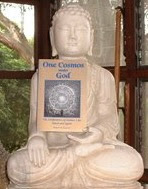
I remember Bob reading a book by Stanley Jaki in which he suggested that the existence of free will was more than sufficient to prove the existence of a trail of transcendence that leads straight back to the Creator if you only follow your nous. Yes, here it is: an intimation of "freedom or rather free will belies mere material existence.... in the final analysis, the elemental registering of free will almost exhausts whatever else can be said about its reality. Everything else is embellishment, very useful and informative as it may be, because it is irrelevant unless achieved and articulated freely."
In other words -- which I have freely chosen for the occasion -- any argument for or against free will automatically presumes its existence, which in turn proves the reality of that which is free to choose, i.e., the soul. To say that free will does not exist is to void one's argument at the outset, since one's arguments can appeal to neither truth nor to that which may know it: as Poincaré commented, "no determinist argues deterministically," so "all arguments against free will are so many proofs if it" (Jaki).
Every free act transcends matter, which is why any form of materialism is anti-liberty, which is why the secular left, dipso shitso, is so dangerous. I'm very much looking forward to Jonah Goldberg's Liberal Fascism: The Secret History of the American Left, From Mussolini to the Politics of Meaning, as I am certain that this theme will be explored, thus freeing me of the responsibility. That is, intrinsic to the project of leftism is the abolition of that which transcends matter, and therefore, the dehumanization of humans. This is why their assault on religion in general and the soul in particular is not "accidental" but absolutely essential to their goals. They must replace transcendence with immanence. Once that's accomplished, then everything else falls into place. It's like building the cage. Once the cage of immanence is complete, then man lives behind bars he can't even see, bars as strong as steel and as high as the imagination.
The problem is, not too many people think about what the existence of free will implies, since it is not quantifiable or reducible to anything but itself. Like so many other fundamental realities -- time, life, intelligence, consciousness, etc. -- it seems that we we know everything about it except what it actually is. This leads me to suspect that these fundamentals are somehow implicitly linked to one another, and that there is but one Incomprehensible Thing with several different sides, depending upon how you look at it, e.g., life is time, time is freedom, consciousness is life + time, intelligence is freedom + truth, virtue is truth + action, etc.
As Jaki writes, in a certain sense, free will "is subjectivity itself." Thus, we are free to the extent that we are a subject rather than an object. However, freedom can only be exercised in an objective world, which is to say, on objects, including "objects" within oneself (including objective pseudo-subjects that have no business being there, i.e., mind parasites).
If everything is subjective, then there can't be free will either. This leads to an interesting speculation about the necessity of the world for God's freedom. In other words, just like us, how could God be meaningfully free unless there are objects (or, in his case, subjects) to act upon? To put it another way, perhaps God's freedom is ultimately given its highest expression in the existence of the human subject which can either deny or align itself with him. Thus, denial of God is the ironyclad proof of his existence. But you knew that already.
There is no meaningful freedom in the absence of the human will, but the will is only free to the extent that it is free from certain repetitive actions and mechanical patterns of thought, which we call Mind Parasites. As Emerson wrote (cited in Jaki), "Intellect annuls Fate. So far as man thinks, he is free." But freedom itself is not necessary. Rather, its existence brings one "face to face with that realm of metaphysical reality which hangs in mid-air unless suspended from that Ultimate Reality, best called God, the Creator."
Hmm, why does that sound zimmilar to some other hearsong I've heardsung?
Starry-eyed an' laughing as I recall when we were caught
Trapped by no track of hours for they hanged suspended
The Judeo-Christian insistence "that man is free was born out of the perspective that man was given freedom not in order to do anything he wants to but that he should be able to do what he is supposed to do." We are created free so that our actions "may have that merit which only a freely performed act can have. God therefore has to remain a subtly hidden God, lest man should find himself 'constrained' to obey Him" (Jaki).
In Keys of Gnosis, Bolton widens the argument out to a truly cosmic perspective. He begins with the premise that "Free will and its opposite, determinism, form a duality in human consciousness which parallels that of Providence and Fate in the world." This makes perfect sense if freedom is only free to the extent that it both emanates from, and returns to, the Creator when exercised responsibly, and yet, can only exist in a world that is other than free, which is to say, partially determined and bound by Fate. (When "the word becomes flesh," it essentially submits itself to the world of fate which it must re-transcend -- or as Petey cryptically expressed it in the Coonifesto, "ascent you a son, amen for a child's job.")
In reality, there is no pure freedom or pure determinacy on the human plane -- or, by extension, no pure providence or fate -- but always a mingling of the two in various proportions. As Bolton explains, this is why the issue can appear confusing to people, since it's not as if freedom is an either/or proposition. Rather, each individual has a varying mixture of freedom and determinacy. Furthermore, this would imply that the central task of spiritual growth is to increase the former while diminishing the latter, i.e., mind parasites and other mechanical patterns of thought and behavior, so that we may increasingly "rise above" fate and become truly free. Here it can easily be understood how an improper kind of freedom is slavery while a proper kind of slavery is freedom. It's not actually a paradox at all, especially since the truth (and only the truth) can set you free.
Ironically, it is during our early childhood that we are most "free," i.e., unconstrained by any limits. But we actually aren't free at all, since there is no will to choose or to mediate the freedom. Thus, when we nostalgically yearn for the freedom of childhood, we are actually pining for the absence of freedom, or the "pre-free" infinity of non-choosing. For just as there is an infinity of endless numerical succession, there is also the infinity of the pre-numerical Zero. A better word would be innocence than freedom. Innocence literally means "without knowledge," and in childhood we are without knowledge of our freedom. This implies that the exercise of free will and the "fall" from the innocent paradise of infancy are indistinguishable, just as it says in Genesis. Therefore, Everything means less than zero just as Elvis said it did.
So, as Bolton writes, we are "originally unfree, but with a nascent free will which can develop to its full potential under the right conditions."
There he goes again! I mean my master, the toddler in the next room. For a long time Bob didn't want children, because he thought it would constrain his freedom. He was right. Free at last! From mybob.
I wonder if the Creator feels the same way about his unruly brood, or if he doesn't, how that could possibly be?
To be continued...
Through the mad mystic hammering of the wild ripping hail
The sky cracked its poems in naked wonder
That the clinging of the church bells blew far into the breeze
Leaving only bells of lightning and its thunder.
Striking for the gentle, striking for the kind,
Striking for the guardians and protectors of the mind,
An' the unpawned painter far behind his rightful time
And we gazed upon the chimes of freedom flashing. --Bob Dylan, Chimes of Freedom
Saturday, December 29, 2007


Friday, December 28, 2007
Queer Studies and The Mysticism of Everyday Life (12.28.10)
You are bringing some queer ideas to our ears, and we want to know what they mean. --Acts 17:20
Bolton writes that "The transcendent dimension of everyday consciousness is evidenced by unmistakable signs if one knows how to look for them. Far from needing the extraordinary experiences of a mystic, an analysis of what is well known already will suffice for this purpose." It's as if we just need to amplify our metaphysical gaydar to appreciate it, that's all.
Yes, that is certainly how I, Bob's unconscious, view the situation. I am that which causes things, on the one hand, to "overflow" or "radiate" with being, and on the other, to possess a secret "interior" known only to the human state (among creatures). Thanks to me, existence is always slightly uncanny, but in a good way. You wouldn't want to inhabit a world where all the numbers "added up." Reality is not an accounting ledger. You wouldn't want to live in a place where clouds were spheres, mountains were cones, and rivers were lines.
Supposing physicists ever discover their big TOE, which is to say, Theory of Everything; whatever it is, it will still abide within a small corner of my limitless expanse, not vice versa, so it won't eliminate the strangeness from the world, if that's what you're thinking. No, the strangeness is here to stay.
Frankly, if you don't find existence queer, then you're just not queer enough. You need your unconscious to come out of its repressive closet and play. In my view, a proper liberal education is already Queer Studies, as it should teach you to appreciate the strange reality behind banal appearances. You know the saying:
The Universe is not only queerer than we suppose, but queerer than we can suppose (J.B.S. Haldane).
One reason we know that materialism cannot possibly be true is that it's just not queer enough. Not even close. In fact, the opposite: it is banality on stilts, insipidness on tranquilizers. It puts me to sleep. Or, to be perfectly accurate, transconscousness has to already be asleep or dead in the prosaic mind of the person who propagates such an anti-queer agenda. The way I see it everybody is unconsciously queer, even if consciously they're as straight as Karl Marx. Scratch the surface, and everybody's got a fairy tale to tell.
One of the problems, according to Bolton, is that the modern mind essentially confuses the categories of concrete and abstract, and when you concretize the abstract, you end up draining reality of its irreducible queerness. One of the hallmarks of life under the repressive "reign of quantity" is that the merely physical is seen to be synonymous with the concrete, which is the end-state of a kind of philosophical dumbing-down that can go no lower than materialism. Materialism is like the anonymous bathroom sex of metaphysics, just external bodies rubbing together.
Prior to modernity, the most important distinction was that between reality and appearances. Yes, we queers care about appearance, but we care about reality even more. In fact, the ability to draw distinctions in this arena forms the basis of wisdom, for wisdom seeks the enduring reality behind appearances, which is another way of saying the concrete reality behind the ever-shifting panorama of fleeting forms. Thus, only in a world that has been systematically turned upside-down can matter be seen as the ultimate concrete instead of the instantiation of something much more enduring "from above." When did theology stop being the queen of the sciences?
I believe Bob addressed this issue in the book. Yes, here it is, pages 198-206: Saying More With Less: The Problems of Conceptual Abstractness and Concreteness. There he highlighted one of the problems with contemporary religion, that it has lost much of its potency by attempting to reconcile itself to modern materialism, which ends up purging it of queers like me. It's difficult for a queer to relate to these essentially materialistic creeds, since to accept them, we would have to pretend we're not who we are. But we're here, were queer, and we're not going away. Ever.
Ironically, the founders of great religions are always a bit queer. Take Jesus, for example. No, I'm not talking about the fact that he was unmarried, lived with his mother until he was 30, and hung out with a group of guys. Rather, almost everything he says is quite strange, but not in some kind of merely affected or annoying way, like Andrew Sullivan. Rather, most of his flamboyant utterances have an odd combination of the unexpected or surprising and the authoritative and centered. Most unpredictable people are rather flitty, decentered, and "light in the loafers," while most authoritative people are not very spontaneous or gay. So I think in Jesus -- not surprisingly -- you see the archetype of the proper bitextual dialectic between conscious and transconscious.
Another way of saying it is that Jesus speaks with a maximum of precision, and yet, in an unsaturated manner calculated to provoke unconscious resonance in the listener. He's always speaking to your inner queerness. In fact, this is one of the reasons why so many straight scientists remain closet Christians.
Here's the problem. As Bob wrote, "people tend to forget that religion points beyond itself to something that is not religion, just as reality is surely independent of the words we use to describe it." Therefore, when you concretize religion, you end up worshipping religion instead of God, something that particularly applies to the Mohammedans, but which was also true for much of Christian history, what with the endless religious wars. Schisms usually begin when someone hangs a sign that says No Queers Allowed. So ironically, the queers have to form a new heterotextual movement where they won't be persecuted for being "different." Indeed, America is fundamentally a nation of religious queers, of people who fled the repressive state religions of their homolands in order to practice their hetero faiths here.
We've all heard the cliché "queer as a Coon," which goes to the heart of what it means to live as a transdimensional Raccoon trying to "pass" in such a straight world. Coons are like everyone else. We want to get married, raise our children, and contribute to society. But being "neither fish nor fowl," we often find it difficult to relate to either the straight scientistic or institutionally religious worlds. Therefore, we have had to develop our own rituals and traditions, e.g., the annual Rite of the Water Balloons, the river ride to Raccoon Point, the Sacred Clambake, the Mambo Dance Party, etc.
I think it's safe to assume that no Raccoon thinks of these things merely as concrete forms, but rather, symbolic occasions to re-enact timeless events and and re-connect with our eternal essence. When we invoke our drinking toast -- "Fingers to fingers, thumbs to thumbs, watch out below, here she comes" -- we're obviously not just talking about "below" in an exterior gastrological sense. Rather, our oral traditions emphasize the immaterial, interior, astrological space of the soul. We always become more gay and lively after a couple of stiff ones, which serve as a kind of "bridge" between the worlds. The finger-to-thumb circle reminds us of the eternal relationship between time and eternity, and softens the permeable manbrain between them -- which never really existed to begin with. And none of us wants to live a lie. It's not our fault that we were born again this way.
... [C]ommon sense is deceived in believing the material world to be the measure of the real.... [A] spiritually-grounded power depends on a kind of identification with eternal non-material realities.... Not only is the world of sense known to us only through representations, but also the objects which cause them are, qua material, both of a lower degree of reality and inaccessible to us in their inner substance, precisely because for us they can only be represented. Where this is ignored, the real will be sought where it is least knowable, at the price of one's capacity for real knowledge. --Robert Bolton, Keys of Gnosis
Bolton writes that "The transcendent dimension of everyday consciousness is evidenced by unmistakable signs if one knows how to look for them. Far from needing the extraordinary experiences of a mystic, an analysis of what is well known already will suffice for this purpose." It's as if we just need to amplify our metaphysical gaydar to appreciate it, that's all.
Yes, that is certainly how I, Bob's unconscious, view the situation. I am that which causes things, on the one hand, to "overflow" or "radiate" with being, and on the other, to possess a secret "interior" known only to the human state (among creatures). Thanks to me, existence is always slightly uncanny, but in a good way. You wouldn't want to inhabit a world where all the numbers "added up." Reality is not an accounting ledger. You wouldn't want to live in a place where clouds were spheres, mountains were cones, and rivers were lines.
Supposing physicists ever discover their big TOE, which is to say, Theory of Everything; whatever it is, it will still abide within a small corner of my limitless expanse, not vice versa, so it won't eliminate the strangeness from the world, if that's what you're thinking. No, the strangeness is here to stay.
Frankly, if you don't find existence queer, then you're just not queer enough. You need your unconscious to come out of its repressive closet and play. In my view, a proper liberal education is already Queer Studies, as it should teach you to appreciate the strange reality behind banal appearances. You know the saying:
The Universe is not only queerer than we suppose, but queerer than we can suppose (J.B.S. Haldane).
One reason we know that materialism cannot possibly be true is that it's just not queer enough. Not even close. In fact, the opposite: it is banality on stilts, insipidness on tranquilizers. It puts me to sleep. Or, to be perfectly accurate, transconscousness has to already be asleep or dead in the prosaic mind of the person who propagates such an anti-queer agenda. The way I see it everybody is unconsciously queer, even if consciously they're as straight as Karl Marx. Scratch the surface, and everybody's got a fairy tale to tell.
One of the problems, according to Bolton, is that the modern mind essentially confuses the categories of concrete and abstract, and when you concretize the abstract, you end up draining reality of its irreducible queerness. One of the hallmarks of life under the repressive "reign of quantity" is that the merely physical is seen to be synonymous with the concrete, which is the end-state of a kind of philosophical dumbing-down that can go no lower than materialism. Materialism is like the anonymous bathroom sex of metaphysics, just external bodies rubbing together.
Prior to modernity, the most important distinction was that between reality and appearances. Yes, we queers care about appearance, but we care about reality even more. In fact, the ability to draw distinctions in this arena forms the basis of wisdom, for wisdom seeks the enduring reality behind appearances, which is another way of saying the concrete reality behind the ever-shifting panorama of fleeting forms. Thus, only in a world that has been systematically turned upside-down can matter be seen as the ultimate concrete instead of the instantiation of something much more enduring "from above." When did theology stop being the queen of the sciences?
I believe Bob addressed this issue in the book. Yes, here it is, pages 198-206: Saying More With Less: The Problems of Conceptual Abstractness and Concreteness. There he highlighted one of the problems with contemporary religion, that it has lost much of its potency by attempting to reconcile itself to modern materialism, which ends up purging it of queers like me. It's difficult for a queer to relate to these essentially materialistic creeds, since to accept them, we would have to pretend we're not who we are. But we're here, were queer, and we're not going away. Ever.
Ironically, the founders of great religions are always a bit queer. Take Jesus, for example. No, I'm not talking about the fact that he was unmarried, lived with his mother until he was 30, and hung out with a group of guys. Rather, almost everything he says is quite strange, but not in some kind of merely affected or annoying way, like Andrew Sullivan. Rather, most of his flamboyant utterances have an odd combination of the unexpected or surprising and the authoritative and centered. Most unpredictable people are rather flitty, decentered, and "light in the loafers," while most authoritative people are not very spontaneous or gay. So I think in Jesus -- not surprisingly -- you see the archetype of the proper bitextual dialectic between conscious and transconscious.
Another way of saying it is that Jesus speaks with a maximum of precision, and yet, in an unsaturated manner calculated to provoke unconscious resonance in the listener. He's always speaking to your inner queerness. In fact, this is one of the reasons why so many straight scientists remain closet Christians.
Here's the problem. As Bob wrote, "people tend to forget that religion points beyond itself to something that is not religion, just as reality is surely independent of the words we use to describe it." Therefore, when you concretize religion, you end up worshipping religion instead of God, something that particularly applies to the Mohammedans, but which was also true for much of Christian history, what with the endless religious wars. Schisms usually begin when someone hangs a sign that says No Queers Allowed. So ironically, the queers have to form a new heterotextual movement where they won't be persecuted for being "different." Indeed, America is fundamentally a nation of religious queers, of people who fled the repressive state religions of their homolands in order to practice their hetero faiths here.
We've all heard the cliché "queer as a Coon," which goes to the heart of what it means to live as a transdimensional Raccoon trying to "pass" in such a straight world. Coons are like everyone else. We want to get married, raise our children, and contribute to society. But being "neither fish nor fowl," we often find it difficult to relate to either the straight scientistic or institutionally religious worlds. Therefore, we have had to develop our own rituals and traditions, e.g., the annual Rite of the Water Balloons, the river ride to Raccoon Point, the Sacred Clambake, the Mambo Dance Party, etc.
I think it's safe to assume that no Raccoon thinks of these things merely as concrete forms, but rather, symbolic occasions to re-enact timeless events and and re-connect with our eternal essence. When we invoke our drinking toast -- "Fingers to fingers, thumbs to thumbs, watch out below, here she comes" -- we're obviously not just talking about "below" in an exterior gastrological sense. Rather, our oral traditions emphasize the immaterial, interior, astrological space of the soul. We always become more gay and lively after a couple of stiff ones, which serve as a kind of "bridge" between the worlds. The finger-to-thumb circle reminds us of the eternal relationship between time and eternity, and softens the permeable manbrain between them -- which never really existed to begin with. And none of us wants to live a lie. It's not our fault that we were born again this way.
... [C]ommon sense is deceived in believing the material world to be the measure of the real.... [A] spiritually-grounded power depends on a kind of identification with eternal non-material realities.... Not only is the world of sense known to us only through representations, but also the objects which cause them are, qua material, both of a lower degree of reality and inaccessible to us in their inner substance, precisely because for us they can only be represented. Where this is ignored, the real will be sought where it is least knowable, at the price of one's capacity for real knowledge. --Robert Bolton, Keys of Gnosis
Thursday, December 27, 2007
Celestial Abortions and Pre-partum Depression (12.27.10)
Here's a coonundrum for all you flat-cosmos linear types who imagine you can exclude me, the unconscious (which I think I'll start calling the "transconscious" or "supraconscious" in order to avoid conflation with the exclusively lower unconscious studied by psychoanalysis). First, I want you to know that although Bob took the day off yesterday, I didn't, since I never do. Rather, I am no different than your heart, your liver, or your lungs. I'm always here, churning away, wide awake while you dream and doing the vital dreamwork while you're awake.
Now, when you get right down to it, there are only a couple of options to leading a spiritual life, which we have defined as one in which the purpose of your life is to conform yourself to yourSelf, or to your divine archetype -- to paradoxically "become who you already are," so to speak. This requires that you grow in truth, wisdom and virtue, and thus close the "gap" between accident and substance, or contingency and essence. Yes, there is a real "you," but timelessness takes time, walking on water wasn't built in a day, yada yada, blah blah blah. We know this already.
Another way of saying it is that in the spiritual life we are specifically attempting to grow something that transcends time. That something is "you." This is not really controversial. For example, every living thing begins with an immature form "seeking" its mature form. Something -- whether God or Nature -- wills that babies become adults.
But this doesn't just involve changes to the physical form, especially as it pertains to human beings. Rather, everyone knows that real human change takes place on the interior plane, and that it continues well beyond the point that we have reached physical maturity. Two physically mature human specimens can have nothing in common, whereas that is never true of other animals. In fact, among all the animals, only humans can (and should) continue growing indefinitely. A mind that has stopped growing is effectively dead, as it has become a closed system. And the most damaging closure is the vertical kind.
You could say that someone who is not in some form or fashion growing toward a real nonlocal telos is effectively living as an animal. Thus, many people who think they are not spiritual actually are, for example, the artist or writer who seek true beauty in their work, or the scientist who passionately seeks timeless truth. In a more enlightened age, these activities would be understood for what they are, and could not have become detached from the greater spiritual Adventure of Consciousness -- or even become opposed to it, as happens with scientism or with debased "art" that has no spiritual direction at all (except "down" or "away" from the light).
Now, if I, the transconscious mode, did not exist, then there would be no deep continuity in your life, and thus, no actual entity that undergoes change through time. In other words, animals essentially exist only in space, in such a way that they basically mirror the external world that they co-create.
But the human has deep temporal roots that extend all the way back to his own conception -- and some would say prior even to that. The human being lives in time, but time isn't just a linear succession of discrete and disconnected moments, as the existence of memory and transtemporal vision (e.g., "prophecy") prove. Rather, the past and future are entangled in the present, not just consciously, but unconsciously.
For example, most forms of mental illness are a result of some unmetabolized -- which is to say, unsynthesized -- aspect of the past intruding upon the present. A symptom exists as an unconscious "part" that needs to be integrated into the whole. But other symptoms can emanate from the future, so to speak. This was the position of Carl Jung, who observed that much mental illness is actually a result of a spiritual stillbirth, or the pain of failing to realize one's archetype. Such a person can ransack his past, looking for "what went wrong," but he won't find it, because it's in the future, not the past, or "above," not below. Call it a spiritual prepartum depression.
As I mentioned above, there are only a couple of options to leading a spiritual life. One of them is hedonism, which ends up doing violence to the temporal aspect of human existence, as it reduces life to the mindless pursuit of discrete moments of pleasure, as if salvation consists of the accumulation of these disconnected experiences.
But the whole point is that these moments are inherently disconnected and can never surpass themselves, and in fact, usually diminish with time. In other words, the first time you do something is usually the most intense, and if you spend your life trying to achieve that level of intensity, you're just wasting your time. As Bob put it in One Cosmos, many problems are caused by trying to wring more pleasure out of something than there is in it. This can happen with food, vacations, sex, what have you, and is responsible for a lot of compulsive behavior. Anything that gives pleasure can become problematic if used in the wrong spirit.
As Bolton writes in Keys of Gnosis, the idea that happiness results from an accumulation of pleasures is pure illusion, since "each of its successive moments is in effect a separate world for experience." The bare moment "neither receives anything from, nor imparts anything to, any other moment, not even the next ones adjacent to it." Excluded from my transtemporal influence, the pursuit of moment-to-moment pleasure "does not allow the least possibility that any of them could be combined to make a total in this world..."
Now, this is why, ipso facto, there is so little wisdom on the secular left, unless it is just accidental or parasitic on some other non-leftist source. Only religion teaches one the secret of converting momentary pleasures into something enduring (this is one of the particular virtues of Judaism, which is so "this worldly" in a specifically other-worldly manner; a mishnah teaches that the first question God will ask upon your demise is why you didn't partake in all of his permitted pleasures).
One can possess perfectly normal intelligence, even superior intelligence, as they say, for example, of Bill Clinton, and yet be devoid of spiritual wisdom, since it can only exist on a transcendent plane above the linear succession of temporal moments. No one has to convince me that his 1,000 page autofellatiography is an overflowing wellspring of spiritual vacuity, devoid of wisdom.
Likeunwise, Hugh Hefner isn't reduced to sleeping with three empty-headed 20 year-olds because he lacks wisdom, but he is such a pathetically desolate soul because that is what he has spent his life doing. The one-dimensional physical beauty he compulsively seeks is a kind of perverse mirror of the five-dimensional spiritual beauty he lacks. (One reason he is a big supporter of "women's causes" is in order to reap their baleful effects.) He does provide a sort of compass for the soul, however, since at this point you could probably ask him almost any question about life and get the wrong answer. As such, his soul's journey in this life has been catastrophic. He built -- or grew -- nothing. His soul will leave the world in worse shape than it came in. He is a celestial abortion. He has unhad the time of his life by breaking it to bits.
Bolton goes on to say that "the greatest amount of pleasure of whatever kind can never exceed the greatest single instance of it, and likewise with pain." This is why, to quote Plotinus, to try to make multiplicity, "whether in time or in action, essential to happiness," is to try to put happiness together "by combining non-existents" (quoted in Bolton). What does exist is the present, only it is not actually a "bare moment" on a linear scale. Rather, it has vertical extension, and this is where pleasure can actually be deepened in a meaningful sense, and this is what true spirituality endeavors to do. It is a way for the pleasures of your life to actually accumulate and add up to One instead of none.
Now, when you get right down to it, there are only a couple of options to leading a spiritual life, which we have defined as one in which the purpose of your life is to conform yourself to yourSelf, or to your divine archetype -- to paradoxically "become who you already are," so to speak. This requires that you grow in truth, wisdom and virtue, and thus close the "gap" between accident and substance, or contingency and essence. Yes, there is a real "you," but timelessness takes time, walking on water wasn't built in a day, yada yada, blah blah blah. We know this already.
Another way of saying it is that in the spiritual life we are specifically attempting to grow something that transcends time. That something is "you." This is not really controversial. For example, every living thing begins with an immature form "seeking" its mature form. Something -- whether God or Nature -- wills that babies become adults.
But this doesn't just involve changes to the physical form, especially as it pertains to human beings. Rather, everyone knows that real human change takes place on the interior plane, and that it continues well beyond the point that we have reached physical maturity. Two physically mature human specimens can have nothing in common, whereas that is never true of other animals. In fact, among all the animals, only humans can (and should) continue growing indefinitely. A mind that has stopped growing is effectively dead, as it has become a closed system. And the most damaging closure is the vertical kind.
You could say that someone who is not in some form or fashion growing toward a real nonlocal telos is effectively living as an animal. Thus, many people who think they are not spiritual actually are, for example, the artist or writer who seek true beauty in their work, or the scientist who passionately seeks timeless truth. In a more enlightened age, these activities would be understood for what they are, and could not have become detached from the greater spiritual Adventure of Consciousness -- or even become opposed to it, as happens with scientism or with debased "art" that has no spiritual direction at all (except "down" or "away" from the light).
Now, if I, the transconscious mode, did not exist, then there would be no deep continuity in your life, and thus, no actual entity that undergoes change through time. In other words, animals essentially exist only in space, in such a way that they basically mirror the external world that they co-create.
But the human has deep temporal roots that extend all the way back to his own conception -- and some would say prior even to that. The human being lives in time, but time isn't just a linear succession of discrete and disconnected moments, as the existence of memory and transtemporal vision (e.g., "prophecy") prove. Rather, the past and future are entangled in the present, not just consciously, but unconsciously.
For example, most forms of mental illness are a result of some unmetabolized -- which is to say, unsynthesized -- aspect of the past intruding upon the present. A symptom exists as an unconscious "part" that needs to be integrated into the whole. But other symptoms can emanate from the future, so to speak. This was the position of Carl Jung, who observed that much mental illness is actually a result of a spiritual stillbirth, or the pain of failing to realize one's archetype. Such a person can ransack his past, looking for "what went wrong," but he won't find it, because it's in the future, not the past, or "above," not below. Call it a spiritual prepartum depression.
As I mentioned above, there are only a couple of options to leading a spiritual life. One of them is hedonism, which ends up doing violence to the temporal aspect of human existence, as it reduces life to the mindless pursuit of discrete moments of pleasure, as if salvation consists of the accumulation of these disconnected experiences.
But the whole point is that these moments are inherently disconnected and can never surpass themselves, and in fact, usually diminish with time. In other words, the first time you do something is usually the most intense, and if you spend your life trying to achieve that level of intensity, you're just wasting your time. As Bob put it in One Cosmos, many problems are caused by trying to wring more pleasure out of something than there is in it. This can happen with food, vacations, sex, what have you, and is responsible for a lot of compulsive behavior. Anything that gives pleasure can become problematic if used in the wrong spirit.
As Bolton writes in Keys of Gnosis, the idea that happiness results from an accumulation of pleasures is pure illusion, since "each of its successive moments is in effect a separate world for experience." The bare moment "neither receives anything from, nor imparts anything to, any other moment, not even the next ones adjacent to it." Excluded from my transtemporal influence, the pursuit of moment-to-moment pleasure "does not allow the least possibility that any of them could be combined to make a total in this world..."
Now, this is why, ipso facto, there is so little wisdom on the secular left, unless it is just accidental or parasitic on some other non-leftist source. Only religion teaches one the secret of converting momentary pleasures into something enduring (this is one of the particular virtues of Judaism, which is so "this worldly" in a specifically other-worldly manner; a mishnah teaches that the first question God will ask upon your demise is why you didn't partake in all of his permitted pleasures).
One can possess perfectly normal intelligence, even superior intelligence, as they say, for example, of Bill Clinton, and yet be devoid of spiritual wisdom, since it can only exist on a transcendent plane above the linear succession of temporal moments. No one has to convince me that his 1,000 page autofellatiography is an overflowing wellspring of spiritual vacuity, devoid of wisdom.
Likeunwise, Hugh Hefner isn't reduced to sleeping with three empty-headed 20 year-olds because he lacks wisdom, but he is such a pathetically desolate soul because that is what he has spent his life doing. The one-dimensional physical beauty he compulsively seeks is a kind of perverse mirror of the five-dimensional spiritual beauty he lacks. (One reason he is a big supporter of "women's causes" is in order to reap their baleful effects.) He does provide a sort of compass for the soul, however, since at this point you could probably ask him almost any question about life and get the wrong answer. As such, his soul's journey in this life has been catastrophic. He built -- or grew -- nothing. His soul will leave the world in worse shape than it came in. He is a celestial abortion. He has unhad the time of his life by breaking it to bits.
Bolton goes on to say that "the greatest amount of pleasure of whatever kind can never exceed the greatest single instance of it, and likewise with pain." This is why, to quote Plotinus, to try to make multiplicity, "whether in time or in action, essential to happiness," is to try to put happiness together "by combining non-existents" (quoted in Bolton). What does exist is the present, only it is not actually a "bare moment" on a linear scale. Rather, it has vertical extension, and this is where pleasure can actually be deepened in a meaningful sense, and this is what true spirituality endeavors to do. It is a way for the pleasures of your life to actually accumulate and add up to One instead of none.
Wednesday, December 26, 2007
Conservatives Trounce Progressives 25-Zip in Boxing Day Mismatch
In the Boxing Day match-up between blogging up and sleeping in, it was no contest. Blogging never really had a chance. So, out of laziosity, I decided to look at what I had posted exactly one year ago, and it was the following Boxing Day match-up between Conservative and Liberal principles. May the best man, woman, gay, lesbian, bisexual, transgendered, queer, questioning, intersexed, or curious win. Although "win" is perhaps too strong a word, since we don't want to damage the self-esteem of the non-winner. And "best" implies an oppressive hierarchy, so that won't do. How about, "may the equals equalize in their equality. If not, let's force the issue."
*****
In Chapter three of my book I survey history and culture, looking for evidence of what I call “mind parasites." I just finished a new book that confirms many of the things I wrote in that section, The Central Liberal Truth: How Politics Can Change a Culture and Save It from Itself, by Lawrence Harrison. Although Harrison identifies himself as a liberal, the book absolutely demolishes many ideas that are central to contemporary liberalism -- most particularly, multiculturalism, cultural relativism, and any kind of liberal victimology, for the book demonstrates with hard data how cultural beliefs, attitudes and values are the key to understanding the (real) progressive evolution of society.
The book is actually somewhat shockingly -- but thoroughly refreshingly -- politically incorrect, and says some things that even Colonel Beaglehole might hesitate to blurt out behind closed doors at the Drones Club. (He and Prince Philip attended the same boarding school for almost one full semester, and would often try to top one another in making what the expulsion letter referred to as "insensitive remarks.")
In the preface of the book, Harrison, a long time USAID director -- notes that all of the underdeveloped or underprivileged countries or cultures he worked in were plagued by the same things: disrespect for law, lack of cooperation with one another, acquiescence to (and extertion of) unbridled authority, passivity when encountering problems, absence of civic consciousness, lack of trust, and selfish pursuit of narrow personal interest. It is much more politically acceptable for scholars such as Jared Diamond to blame geography, insufficient resources, or “guns, germs, and steel” for the failure of so many cultures, but this entirely begs the question of why certain groups -- most notably, the Jews or East Asians -- thrive wherever they are allowed to take root. In each case, they have a "portable culture" of extremely healthy and adaptive values that stand them in good stead.
Harrsion approvingly quotes the great scholar of Islam, Bernard Lewis, who wrote that “When people realize that things are going wrong, there are two questions they can ask: One is, ‘What did we do wrong?’ and the other is ‘Who did this to us?’” The latter question leads to (or, more likely, is already rooted in) paranoia, conspiracy theories and liberal victimology, which is why the Islamists and international left share a common cause -- they have the same underlying assumptions about reality and about who is at fault for it -- which always comes down to variations of "anyone but I."
The book shows how deeply rooted are some of the pathologies of the left. I did not know this, but even in 1948 the American Anthropological Association opposed the U.N. Universal Declaration of Human Rights on the preposterous grounds that each culture must decide for itself “what is true, good, beautiful, and efficient,” and no cultures were any better or worse, just “different.” Thus, “liberals” found themselves at odds with a document calling for such things as the right to life, liberty, and security of person, equality before the law, and freedom of thought, conscience, and religion. The more progressives change....
It never ceases to amaze me that liberals think they are doing these people a favor by supporting their cultural pathologies. As is always the case with leftist thought, it is a monstrous arrogance and condescension masquerading as compassion. Harrsion quotes a brilliant African scholar named Daniel Etounga Mangelle, someone I also cited upon in my book. At a conference, he responded with sarcasm to such liberal nonsense:
"I am going to tell the truth. We Africans really enjoy living in shantytowns where there isn't enough food, health care, or education for our children. Furthermore, our corrupt chieftaincy political systems are really marvelous.... It would be boring if free, democratic elections were organized all over Africa. Were that to happen, we would no longer be real Africans, and by losing our identity -- and our authoritarianism, our bloody civil wars, our illiteracy, our forty-five year life expectancy -- we should be letting down not only ourselves but those Western anthropologists who study us so sympathetically and understand that we can't be expected to behave like human beings who seek dignity.... So let us fight with the full support of those Western scholars who have the wisdom and courage to acknowledge that Africans belong to different world.”
It is so glaringly obvious that the vast majority of really destructive racism comes from the left, not the right. Undoubtedly individual racists exist everywhere on the political spectrum, but their influence is nil compared to the institutional and ideological racism of the left. Professor John McWhorter, who happens to be black, describes in the book the devastating impact of liberal racism on African Americans. He writes that since the 1960s, the core of black identity has come to revolve around “rebellion and disaffection." Furthermore, "Misbehavior and criminality are not the only ways this is expressed. Even the most educated blacks with the most assimilated demeanors get their 'black authenticity' stripes to the extent that they subscribe to the notion that being black remains a battle forty years after the Civil Rights Act.”
McWhorter writes that young blacks are indeed “victims” -- not of what they call “racism” but of liberal ideology. This pathological and self-defeating world view would have puzzled “the black Americans who worked so hard before the 1960s to pave the way for blacks to make the best of themselves in an imperfect world. Realizing that culture is the main problem now rather than racism or societal inequity, our task is to pull black America out of [its] detour, freeing us from self-fulfilling prophecies of recreational racial indignation and returning us to a clear-eyed, proactive race leadership that will allow us to truly 'get past race' for good."
As I said, I can't believe this book was written by a so-called liberal. It actually gives me hope for the future.
In the book, Harrison lays out a helpful summary of those traits that are characteristic of the “progress-prone” culture vs. the “progress-resistant” one. They fall under four main headings: “Worldview,” “Values and Virtues,” “Economic Behavior,” and “Social Behavior,” with a total of 25 subcategories, or "factors." Almost all of the progress-prone attributes are what are now called "conservative" ideas, while ninety percent of the progress-resistant ones are -- you guessed it progressive. As always, the hurrier progressives go, the behinder they get.
Beginning with Worldview, the characteristics of progress-resistant cultures are almost an exact description of modern liberal victimology. Regarding the subcategory of “destiny,” the liberal victim is beset by “fatalism and resignation,” and imagines that the game is rigged against him in advance, thus paralyzing the will and breeding cynicism. With respect to “time orientation,” their obsessive focus on past or even present grievances discourages working hard for the future.
Under the heading of “wealth,” liberals inevitably reduce it to a zero-sum enterprise, which lies at the heart of their economically dysfunctional high tax and income-redistribution schemes. Likewise, knowledge for them tends to be “abstract, theoretical, cosmological, not verifiable.” As we have had occasion to discuss many times, liberal academia (especially the subhumanities, formerly known as the humanities) is filled with childish, kooky, and utopian cranks with abstract ideas that have no bearing on the real world. The rest are just crazy.
The one last subcategory for Worldview is religion. Here you might think that the left has the upper hand, and in many contexts (i.e., Islam) you might be correct. But Harrison makes no distinction between pre- or irrational religiosity vs. the type of sophisticated religiosity we discuss on this blog. Thus, the secular left is often more rational than primitive African animists, practitioners of Haitian voodoo, or bestial members of CAIR.
But the problem is, leftists themselves deny the superiority of western civilization and values because of their PC belief in cultural relativism, so this patronizing attitude simply enables and promotes cultural and religious dysfunction, both here and abroad. And I don’t believe for a moment that modern secularism is more rational or sophisticated than the kind of omade supra-formal neo-traditional transrational cosmic religious philosophy we discuss here and which will eventually be shared by all sentient beings. Furthermore, it remains to be seen if the societies of Western Europe will even be able to survive their own post-human secularism and irreligiosity.
So for the category of Worldview, conservatives trounce the left four to one or possibly even five-zip.
The next heading is Values and Virtues, which has three subcategories, “ethical code,” “the lesser virtues,” and “education.” Here again, I don’t see how any intellectually honest person can give the nod to the left. The values of progress-prone cultures are “rigorous within realistic norms,” while progress-resistant cultures have “elastic” values. 'Nuff said. It's hard to think of something more elastic than a Clintonan conscience, an Edwardian principle, or a whole Obamian panderpoint presentation.
Likewise, progress-prone cultures emphasize small virtues that actually end up making a huge difference, such as tidiness, courtesy, “a job well done”.... to which I might add, politeness, not cursing in public, and being free of off-putting tattoos, tongue piercings, and pagan "body art." To the progress-resistant culture, such small virtues are unimportant. (The thing that most strikes one about dailykos or huffingandpissed -- aside from the shrill adolescent anger -- is the constant unnecessary profanity. I'm all for the necessary or occasional kind, but the ceaseless flow of coarse language is one of the big reasons the left appears so barbarous to the civilized. In this regard, it is critical to emphasize that the form of their language conveys a dark spiritual substance which is its real "unintended" meaning.)
The last subcategory is Education, and here again you might think that progressives are at least in the game. But just look and look at what the progressive educational establishment has done to our educational system. They have been in complete control of lower and and even lower education in this country for at least 50 years, and the effect has been devastating. Furthermore, they are specifically opposed to truly progressive policies that could turn things around, such as fostering competition by introducing vouchers into the system. And let’s not even talk about what progressives have done to the university in the span of a single generation of vipers. For one thing, I don’t have enough time. I have to be out of the house in 45 minutes.
The next main factor is Economic behavior, which has seven subcategories. This one is so self-evidently in favor of conservatives that it’s hardly worth debating. Progress-prone cultures believe that competition leads to excellence, that advancement should be based on merit, and that work is one of the primary purposes of life (the “protestant work ethic”). They try to foster a spirit of entrepreneurship, risk-taking, innovation and investment.
Conversely, the progress-resistant are suspicious of prosperity -- it is a threat to equality because some will get rich, thus provoking envy, which must be tamped down with oppressive policies that punish the creative and productive. They are uncomfortable with competition, as it is a sign of aggression and a threat to both equality and, perhaps more importantly, privilege (such as the unearned privileges enjoyed by the leechers union, or by tenured wackademia nuts, or by New York Times idiotorialists). And, of course, they are constitutionally opposed to the idea of merit, and instead believe that the government should get involved in giving special privileges to different racial, cultural and "gender" categories.
So for economic behavior, it’s conservatives 7, progressives bupkis.
The last main factor is Social Behavior, which has the most subcategories, ten. Some of these are frankly rather bland and neutral, and it is fair to say that most Americans of whatever political stripe share them, or at least imagine they do: belief in the rule of law, a belief in checks and balances and dispersed authority, and the responsibility of elites to society. Others are a bit misleading, for conservatives clearly believe in gender equality, they just don’t believe in gender equivalence. And leftists obviously don't believe in the rule of law when it comes to the Constitution.
Other categories that are less innocuous fall clearly in favor of conservatives. For example, the progress-resistant culture has a much stronger identification with the narrow community -- i.e., multiculturalism. Progressives believe in dividing the country along racial and gender lines, so that one’s primary identification is not, say, “American” but “African American” or "Guatemalan transgendered Wiccan performance artists." If you've ever wondered why they embrace a nut like Juan Cole, it's because they have to take a Muslim named Juan seriously. Likewise, the progress-resistant culture emphasizes the collectivity rather than the individual (except when it comes to your individual right to show your breast during the Superbowl or ride a bicycle naked in public to protest the war).
The last category is Church-State relations. According to Harrison, the progress-prone culture is “secularized” and believes in a “wall between church and state,” whereas for the progress-resistant culture, “religion plays a major role in the civic sphere.” How true. The adverse impact of mixing church and state is never more clear than when the religion in question is Progressivism.
*****
In Chapter three of my book I survey history and culture, looking for evidence of what I call “mind parasites." I just finished a new book that confirms many of the things I wrote in that section, The Central Liberal Truth: How Politics Can Change a Culture and Save It from Itself, by Lawrence Harrison. Although Harrison identifies himself as a liberal, the book absolutely demolishes many ideas that are central to contemporary liberalism -- most particularly, multiculturalism, cultural relativism, and any kind of liberal victimology, for the book demonstrates with hard data how cultural beliefs, attitudes and values are the key to understanding the (real) progressive evolution of society.
The book is actually somewhat shockingly -- but thoroughly refreshingly -- politically incorrect, and says some things that even Colonel Beaglehole might hesitate to blurt out behind closed doors at the Drones Club. (He and Prince Philip attended the same boarding school for almost one full semester, and would often try to top one another in making what the expulsion letter referred to as "insensitive remarks.")
In the preface of the book, Harrison, a long time USAID director -- notes that all of the underdeveloped or underprivileged countries or cultures he worked in were plagued by the same things: disrespect for law, lack of cooperation with one another, acquiescence to (and extertion of) unbridled authority, passivity when encountering problems, absence of civic consciousness, lack of trust, and selfish pursuit of narrow personal interest. It is much more politically acceptable for scholars such as Jared Diamond to blame geography, insufficient resources, or “guns, germs, and steel” for the failure of so many cultures, but this entirely begs the question of why certain groups -- most notably, the Jews or East Asians -- thrive wherever they are allowed to take root. In each case, they have a "portable culture" of extremely healthy and adaptive values that stand them in good stead.
Harrsion approvingly quotes the great scholar of Islam, Bernard Lewis, who wrote that “When people realize that things are going wrong, there are two questions they can ask: One is, ‘What did we do wrong?’ and the other is ‘Who did this to us?’” The latter question leads to (or, more likely, is already rooted in) paranoia, conspiracy theories and liberal victimology, which is why the Islamists and international left share a common cause -- they have the same underlying assumptions about reality and about who is at fault for it -- which always comes down to variations of "anyone but I."
The book shows how deeply rooted are some of the pathologies of the left. I did not know this, but even in 1948 the American Anthropological Association opposed the U.N. Universal Declaration of Human Rights on the preposterous grounds that each culture must decide for itself “what is true, good, beautiful, and efficient,” and no cultures were any better or worse, just “different.” Thus, “liberals” found themselves at odds with a document calling for such things as the right to life, liberty, and security of person, equality before the law, and freedom of thought, conscience, and religion. The more progressives change....
It never ceases to amaze me that liberals think they are doing these people a favor by supporting their cultural pathologies. As is always the case with leftist thought, it is a monstrous arrogance and condescension masquerading as compassion. Harrsion quotes a brilliant African scholar named Daniel Etounga Mangelle, someone I also cited upon in my book. At a conference, he responded with sarcasm to such liberal nonsense:
"I am going to tell the truth. We Africans really enjoy living in shantytowns where there isn't enough food, health care, or education for our children. Furthermore, our corrupt chieftaincy political systems are really marvelous.... It would be boring if free, democratic elections were organized all over Africa. Were that to happen, we would no longer be real Africans, and by losing our identity -- and our authoritarianism, our bloody civil wars, our illiteracy, our forty-five year life expectancy -- we should be letting down not only ourselves but those Western anthropologists who study us so sympathetically and understand that we can't be expected to behave like human beings who seek dignity.... So let us fight with the full support of those Western scholars who have the wisdom and courage to acknowledge that Africans belong to different world.”
It is so glaringly obvious that the vast majority of really destructive racism comes from the left, not the right. Undoubtedly individual racists exist everywhere on the political spectrum, but their influence is nil compared to the institutional and ideological racism of the left. Professor John McWhorter, who happens to be black, describes in the book the devastating impact of liberal racism on African Americans. He writes that since the 1960s, the core of black identity has come to revolve around “rebellion and disaffection." Furthermore, "Misbehavior and criminality are not the only ways this is expressed. Even the most educated blacks with the most assimilated demeanors get their 'black authenticity' stripes to the extent that they subscribe to the notion that being black remains a battle forty years after the Civil Rights Act.”
McWhorter writes that young blacks are indeed “victims” -- not of what they call “racism” but of liberal ideology. This pathological and self-defeating world view would have puzzled “the black Americans who worked so hard before the 1960s to pave the way for blacks to make the best of themselves in an imperfect world. Realizing that culture is the main problem now rather than racism or societal inequity, our task is to pull black America out of [its] detour, freeing us from self-fulfilling prophecies of recreational racial indignation and returning us to a clear-eyed, proactive race leadership that will allow us to truly 'get past race' for good."
As I said, I can't believe this book was written by a so-called liberal. It actually gives me hope for the future.
In the book, Harrison lays out a helpful summary of those traits that are characteristic of the “progress-prone” culture vs. the “progress-resistant” one. They fall under four main headings: “Worldview,” “Values and Virtues,” “Economic Behavior,” and “Social Behavior,” with a total of 25 subcategories, or "factors." Almost all of the progress-prone attributes are what are now called "conservative" ideas, while ninety percent of the progress-resistant ones are -- you guessed it progressive. As always, the hurrier progressives go, the behinder they get.
Beginning with Worldview, the characteristics of progress-resistant cultures are almost an exact description of modern liberal victimology. Regarding the subcategory of “destiny,” the liberal victim is beset by “fatalism and resignation,” and imagines that the game is rigged against him in advance, thus paralyzing the will and breeding cynicism. With respect to “time orientation,” their obsessive focus on past or even present grievances discourages working hard for the future.
Under the heading of “wealth,” liberals inevitably reduce it to a zero-sum enterprise, which lies at the heart of their economically dysfunctional high tax and income-redistribution schemes. Likewise, knowledge for them tends to be “abstract, theoretical, cosmological, not verifiable.” As we have had occasion to discuss many times, liberal academia (especially the subhumanities, formerly known as the humanities) is filled with childish, kooky, and utopian cranks with abstract ideas that have no bearing on the real world. The rest are just crazy.
The one last subcategory for Worldview is religion. Here you might think that the left has the upper hand, and in many contexts (i.e., Islam) you might be correct. But Harrison makes no distinction between pre- or irrational religiosity vs. the type of sophisticated religiosity we discuss on this blog. Thus, the secular left is often more rational than primitive African animists, practitioners of Haitian voodoo, or bestial members of CAIR.
But the problem is, leftists themselves deny the superiority of western civilization and values because of their PC belief in cultural relativism, so this patronizing attitude simply enables and promotes cultural and religious dysfunction, both here and abroad. And I don’t believe for a moment that modern secularism is more rational or sophisticated than the kind of omade supra-formal neo-traditional transrational cosmic religious philosophy we discuss here and which will eventually be shared by all sentient beings. Furthermore, it remains to be seen if the societies of Western Europe will even be able to survive their own post-human secularism and irreligiosity.
So for the category of Worldview, conservatives trounce the left four to one or possibly even five-zip.
The next heading is Values and Virtues, which has three subcategories, “ethical code,” “the lesser virtues,” and “education.” Here again, I don’t see how any intellectually honest person can give the nod to the left. The values of progress-prone cultures are “rigorous within realistic norms,” while progress-resistant cultures have “elastic” values. 'Nuff said. It's hard to think of something more elastic than a Clintonan conscience, an Edwardian principle, or a whole Obamian panderpoint presentation.
Likewise, progress-prone cultures emphasize small virtues that actually end up making a huge difference, such as tidiness, courtesy, “a job well done”.... to which I might add, politeness, not cursing in public, and being free of off-putting tattoos, tongue piercings, and pagan "body art." To the progress-resistant culture, such small virtues are unimportant. (The thing that most strikes one about dailykos or huffingandpissed -- aside from the shrill adolescent anger -- is the constant unnecessary profanity. I'm all for the necessary or occasional kind, but the ceaseless flow of coarse language is one of the big reasons the left appears so barbarous to the civilized. In this regard, it is critical to emphasize that the form of their language conveys a dark spiritual substance which is its real "unintended" meaning.)
The last subcategory is Education, and here again you might think that progressives are at least in the game. But just look and look at what the progressive educational establishment has done to our educational system. They have been in complete control of lower and and even lower education in this country for at least 50 years, and the effect has been devastating. Furthermore, they are specifically opposed to truly progressive policies that could turn things around, such as fostering competition by introducing vouchers into the system. And let’s not even talk about what progressives have done to the university in the span of a single generation of vipers. For one thing, I don’t have enough time. I have to be out of the house in 45 minutes.
The next main factor is Economic behavior, which has seven subcategories. This one is so self-evidently in favor of conservatives that it’s hardly worth debating. Progress-prone cultures believe that competition leads to excellence, that advancement should be based on merit, and that work is one of the primary purposes of life (the “protestant work ethic”). They try to foster a spirit of entrepreneurship, risk-taking, innovation and investment.
Conversely, the progress-resistant are suspicious of prosperity -- it is a threat to equality because some will get rich, thus provoking envy, which must be tamped down with oppressive policies that punish the creative and productive. They are uncomfortable with competition, as it is a sign of aggression and a threat to both equality and, perhaps more importantly, privilege (such as the unearned privileges enjoyed by the leechers union, or by tenured wackademia nuts, or by New York Times idiotorialists). And, of course, they are constitutionally opposed to the idea of merit, and instead believe that the government should get involved in giving special privileges to different racial, cultural and "gender" categories.
So for economic behavior, it’s conservatives 7, progressives bupkis.
The last main factor is Social Behavior, which has the most subcategories, ten. Some of these are frankly rather bland and neutral, and it is fair to say that most Americans of whatever political stripe share them, or at least imagine they do: belief in the rule of law, a belief in checks and balances and dispersed authority, and the responsibility of elites to society. Others are a bit misleading, for conservatives clearly believe in gender equality, they just don’t believe in gender equivalence. And leftists obviously don't believe in the rule of law when it comes to the Constitution.
Other categories that are less innocuous fall clearly in favor of conservatives. For example, the progress-resistant culture has a much stronger identification with the narrow community -- i.e., multiculturalism. Progressives believe in dividing the country along racial and gender lines, so that one’s primary identification is not, say, “American” but “African American” or "Guatemalan transgendered Wiccan performance artists." If you've ever wondered why they embrace a nut like Juan Cole, it's because they have to take a Muslim named Juan seriously. Likewise, the progress-resistant culture emphasizes the collectivity rather than the individual (except when it comes to your individual right to show your breast during the Superbowl or ride a bicycle naked in public to protest the war).
The last category is Church-State relations. According to Harrison, the progress-prone culture is “secularized” and believes in a “wall between church and state,” whereas for the progress-resistant culture, “religion plays a major role in the civic sphere.” How true. The adverse impact of mixing church and state is never more clear than when the religion in question is Progressivism.
Tuesday, December 25, 2007
The Salient Nightlight of Christmas
I once had a dream. I dreamt that I, even though a man, was pregnant, pregnant and full with Nothingness like a woman who is with child. And out of this Nothingness God was born. --Meister Eckhart
What am I doing here? It's Christmas morning. I should be with the family.
First of all, everyone's still asleep, including Bob. This is my time -- you know, dawn, friend of the muses.
The reason why it's so friendly is because of the underlap of the two worlds -- day and night, conscious and unconscious, myth and science, internal and external, dream and "reality." You can't really "do" anything when you're completely enveiloped in dream time, whereas pure daylight bleaches out night town, so you can't unsee a thing. But this is like the bountiful breast of both worlds. It's amusing how much bobscurity you can shed on things in the half-lit world! It's as if you have just enough light to illuminate the darkness, but still enough of its absence to cast a beam of shade on the visible world.
This is obviously what Joyce was attempting in Finnegans Wake, but in his case, I think he went a little too far, perhaps because he was legally blind by the time he finished it. As such, he was pretty much immersed in the darklight. He was a bit too skewed toward the dream end of things, so it will basically take until the end of time to interpret the book and excavate all its dark and inrisible humor.
Now, a religion, if it is to be "operative," must reach very far into both worlds, as we were seeing yesterdawn. Please, I don't mean to bash atheists, but clearly, the problem with atheism is that it works fine in broad daylight but is of no use whatsoever down here in the dark, even if you leave God out of the equation. I don't really want to go down that path again, but the point is that consciousness contains atheism, while the reverse could never be true. So the question comes down to "what is consciousness?," and if you exclude my world, it's analogous to, say, defining reality by focussing exclusively on the Newtonian world but not the subatomic realm, which operates behind shockingly different nightonian blinds, and O, what the darkness knows that the light has never conceived!
This is also the problem with purely rational arguments against atheism, such as D'Souza's d'fense of d'faith, What's So Great About Christianity. I suppose such a book has its place, as it engages in "pre-evangelism," i.e., "clearing away false ideas so that the unbeliever actually has a chance to hear the arguments for Christianity."
In other worlds, but not mine, such a book can serve as a kind of antibiotic or anti-idiotic or disenfuckedup (pardon the French, even though I never will) to eliminate dysfunctional ideas and ideologies from the mind, of which there are plenty. It's just that an antibiotic doesn't give life, it just kills what is deadly to the host. You might say that D'Souza's book eliminates the false light, but you still can't use it to see in the dark or endarken the day. And if you try, you might even end up more confused, because theology can never be a merely rational undertaking or it won't take you under. The surface, that is. Only humans can know that reality has a "surface" and therefore a depth. Spirituality is simply about deepening your depth and resurfacing or perhaps reseeding your ground.
The question is, how do you reach me, and by extension, the whole person? How do you "speak" in such a way that like calls out to likeness in a totalistic way? I was pondering this last night as Bob was taking a walk around the neighborhood at around dusk. This is another time I become more active, since the boundaries overlap again. As he passed from house to house, all sorts of things made an impression on me in a nonverbal way -- the lights, the smells, the sounds of happy families.
But these were all just "parts" or aspects of something more pervasive, like ripples or currents on top of the ocean. It was as if the consciousness of the cosmos itself were different in light of the fact that so many individuals were focussed together on the same nonlocal reality. Assuming there is a world soul, a nation soul, and even a community soul, one nested in the other, there must be a kind of downward influence of whole to part, a transmission, not just of "information," but of the "spirit," i.e., the container, not just the contained. That's what it felt like, as if the container were distinctly different -- as is true of most "holy-days."
Many thoughts were hatched as Bob absently wandered the 'hood. I thought of how Christianity elevates human life to cosmic significance in such a beautiful and poetic way that bypasses the parched old ego and reaches straight down here to the water table.
No other religion equates the birth of a baby with the birth of the living God, or a mother's touch with the quintessence of the sacred: But his mother only / In her maiden bliss / Worshipped the Beloved / With a kiss. Indeed, the idea of baby-as-God would be considered a heresy among the Mohammedans and an absurdity among the Buddhists. How could this not have extraordinary implications for the way children are regarded in the different cultures?
I thought of how the decorations on the houses represent the divine light defying the darkness of the solstice, as if to say that no external force will extinguish the inner light.
I thought of how the end of time is juxtaposed to the beginning, how birth occurs in the death of winter, followed by death in the spring, even though death can never contain the spring.
I thought of the unique role of man, how he is the mediator between God and nature, and how the finite world is given a special significance by virtue of this fact. It is not merely maya, but the exteriorized logos waiting to be unpacked and redeemed by the interior logos.
So, can consciousness change the world? Yes, of course, since the world is a representation within the greater soul-field of consciousness as such. To cite just one jarring example, if you can't feel the demonic energy that emanates from the leftwing blogosphere, then you are pretty much insoulsate. That is, your soul has become so blunted that it can no longer make reliable discriminations within the realm of spirit. And if you can't do that, then you are by definition a lost soul, or at best, merely adrift.
Returning to the message of Christianity, obviously one of its primary purposes is to provide intelligible bearings for the soul's journey through this strange and wicked world, which actually is adrift and off its axis. Therefore, if we merely conform ourselves to the world, we will end up adrift as well, like climbing out of the water onto a ship that is headed toward the rocks. Rather, the soul must conform itself to its own image and likeness, which you might say is only the whole freaking point of life.
Hmm. A baby is stirring in the next room. Christmas day has officially begun.
There is only one birth -- and this birth takes place in the being and in the ground and core of the soul. This birth takes place in darkness. And not only is the Son of the heavenly Creator born in this darkness -- but you too are born there as a child of the same heavenly Creator.... And the Creator extends this same power to you out of the divine maternity bed located in the Godhead to eternally give birth. --Meister Eckhart
What am I doing here? It's Christmas morning. I should be with the family.
First of all, everyone's still asleep, including Bob. This is my time -- you know, dawn, friend of the muses.
The reason why it's so friendly is because of the underlap of the two worlds -- day and night, conscious and unconscious, myth and science, internal and external, dream and "reality." You can't really "do" anything when you're completely enveiloped in dream time, whereas pure daylight bleaches out night town, so you can't unsee a thing. But this is like the bountiful breast of both worlds. It's amusing how much bobscurity you can shed on things in the half-lit world! It's as if you have just enough light to illuminate the darkness, but still enough of its absence to cast a beam of shade on the visible world.
This is obviously what Joyce was attempting in Finnegans Wake, but in his case, I think he went a little too far, perhaps because he was legally blind by the time he finished it. As such, he was pretty much immersed in the darklight. He was a bit too skewed toward the dream end of things, so it will basically take until the end of time to interpret the book and excavate all its dark and inrisible humor.
Now, a religion, if it is to be "operative," must reach very far into both worlds, as we were seeing yesterdawn. Please, I don't mean to bash atheists, but clearly, the problem with atheism is that it works fine in broad daylight but is of no use whatsoever down here in the dark, even if you leave God out of the equation. I don't really want to go down that path again, but the point is that consciousness contains atheism, while the reverse could never be true. So the question comes down to "what is consciousness?," and if you exclude my world, it's analogous to, say, defining reality by focussing exclusively on the Newtonian world but not the subatomic realm, which operates behind shockingly different nightonian blinds, and O, what the darkness knows that the light has never conceived!
This is also the problem with purely rational arguments against atheism, such as D'Souza's d'fense of d'faith, What's So Great About Christianity. I suppose such a book has its place, as it engages in "pre-evangelism," i.e., "clearing away false ideas so that the unbeliever actually has a chance to hear the arguments for Christianity."
In other worlds, but not mine, such a book can serve as a kind of antibiotic or anti-idiotic or disenfuckedup (pardon the French, even though I never will) to eliminate dysfunctional ideas and ideologies from the mind, of which there are plenty. It's just that an antibiotic doesn't give life, it just kills what is deadly to the host. You might say that D'Souza's book eliminates the false light, but you still can't use it to see in the dark or endarken the day. And if you try, you might even end up more confused, because theology can never be a merely rational undertaking or it won't take you under. The surface, that is. Only humans can know that reality has a "surface" and therefore a depth. Spirituality is simply about deepening your depth and resurfacing or perhaps reseeding your ground.
The question is, how do you reach me, and by extension, the whole person? How do you "speak" in such a way that like calls out to likeness in a totalistic way? I was pondering this last night as Bob was taking a walk around the neighborhood at around dusk. This is another time I become more active, since the boundaries overlap again. As he passed from house to house, all sorts of things made an impression on me in a nonverbal way -- the lights, the smells, the sounds of happy families.
But these were all just "parts" or aspects of something more pervasive, like ripples or currents on top of the ocean. It was as if the consciousness of the cosmos itself were different in light of the fact that so many individuals were focussed together on the same nonlocal reality. Assuming there is a world soul, a nation soul, and even a community soul, one nested in the other, there must be a kind of downward influence of whole to part, a transmission, not just of "information," but of the "spirit," i.e., the container, not just the contained. That's what it felt like, as if the container were distinctly different -- as is true of most "holy-days."
Many thoughts were hatched as Bob absently wandered the 'hood. I thought of how Christianity elevates human life to cosmic significance in such a beautiful and poetic way that bypasses the parched old ego and reaches straight down here to the water table.
No other religion equates the birth of a baby with the birth of the living God, or a mother's touch with the quintessence of the sacred: But his mother only / In her maiden bliss / Worshipped the Beloved / With a kiss. Indeed, the idea of baby-as-God would be considered a heresy among the Mohammedans and an absurdity among the Buddhists. How could this not have extraordinary implications for the way children are regarded in the different cultures?
I thought of how the decorations on the houses represent the divine light defying the darkness of the solstice, as if to say that no external force will extinguish the inner light.
I thought of how the end of time is juxtaposed to the beginning, how birth occurs in the death of winter, followed by death in the spring, even though death can never contain the spring.
I thought of the unique role of man, how he is the mediator between God and nature, and how the finite world is given a special significance by virtue of this fact. It is not merely maya, but the exteriorized logos waiting to be unpacked and redeemed by the interior logos.
So, can consciousness change the world? Yes, of course, since the world is a representation within the greater soul-field of consciousness as such. To cite just one jarring example, if you can't feel the demonic energy that emanates from the leftwing blogosphere, then you are pretty much insoulsate. That is, your soul has become so blunted that it can no longer make reliable discriminations within the realm of spirit. And if you can't do that, then you are by definition a lost soul, or at best, merely adrift.
Returning to the message of Christianity, obviously one of its primary purposes is to provide intelligible bearings for the soul's journey through this strange and wicked world, which actually is adrift and off its axis. Therefore, if we merely conform ourselves to the world, we will end up adrift as well, like climbing out of the water onto a ship that is headed toward the rocks. Rather, the soul must conform itself to its own image and likeness, which you might say is only the whole freaking point of life.
Hmm. A baby is stirring in the next room. Christmas day has officially begun.
There is only one birth -- and this birth takes place in the being and in the ground and core of the soul. This birth takes place in darkness. And not only is the Son of the heavenly Creator born in this darkness -- but you too are born there as a child of the same heavenly Creator.... And the Creator extends this same power to you out of the divine maternity bed located in the Godhead to eternally give birth. --Meister Eckhart
Monday, December 24, 2007
'Twas Daynight Beforeafter
Why am I, Bob's unconscious, bothering to blog d'night before, and who knows, maybe even dafter? It's not as if I crave the lack of attention, even though I suppose I actually do. Oh, I don't know, maybe it's because down here, any given day is all of eternity, and all of eternity is a single day (/sarcasm).
If I am not mistaken, this is one of the "take away" points of your holiday season is it not? Don't you folks up there spend 11+ months running around like crazy, chasing the illusions of time, only to wind down at the so-called "end" of the year and reacquaint yourselves with the eternal? Isn't it just an elaborate ruse to trick you into seeing and being the way ought to anyway? It's like you finally get it through your thick skull what's important, only to forget it by the time the MLK post office strike rolls around in mid-January.
Well, I got some good news for you: the end and the beginning and the timeless and the eternal are always here anyway, since they can't be anyplace else. I know, I know, Sanity comes but once a year, but I'd hate to think what life would be like if I only popped into your life so infrequently. Given the services I provide and surfaces I prove void, I don't get much love.
As I was mentioning yesterday, I am the gestalt of the earth and the space of life -- the wholeness, the depth, the resonance, the richness, the allegorical, the metaphorical, the poetic, the mythological, the metaphysical, the paradoxable, the pundamental, all those little extra dimensions that give you access to the truly human. Without me, you'd have none of these things. Rather, everything would be just as it is, as it is for animals or materialists. I don't mean to complain, but I'm like a prophet without honor in your own faculties.
Now, having said that, I don't want you to get the wrong idea, as, say, the Jungians often do. I am not automatically "higher." Furthermore, I am not the content but merely the mode, really no different in that respect than your conscious mind. With regard to the latter, most of you are able to think in a linear and logical, "left brained" manner. That's the mode. But you will arrive at very different conclusions based upon the materials furnished to your reason, and which reason alone can never provide.
As Bob has mentioned, the psychospiritual left provides very defective materials to their left brain, which is why their ideas are so kooky when they aren't flat out monstrous. And when they are monstrous, I am ashamed to admit that it has to do with my influence.
To invoke Godwin's law at the outset, let's take the example of Adolf Hitler. What made him so dangerous? Yes, to a certain extent it was his reason, which could not be defeated on its own plane. That is, if you begin with the assumption that Jews represent a dangerous threat to the human genome, then it is not "illogical," strictly speaking, to do what you can to eliminate the threat. This is really only a step away from the radical environmentalist who begins with the assumption that humans are a "threat to the planet," so they too should be punished, say, for having children. How do you argue with such a person? You can't.
The reason you can't is because of me. Yes, faulty logic is dangerous, but faulty "translogic" is catastrophic. Again, the logic of the unconscious mind is not the logic of the conscious mind; or, if you like, the left and right brains perceive and interpret reality in very different ways. You might even say "male" and "female" ways, so long as this is understood archetypally and certainly not in any pejorative sense.
True, there is a reason why the Fall came through the female, but it was the female transferred into the male, after having first been trancemitted through the snake, who is closest to the earth and is therefore the archetype of horizontality. Thus, male, female, and snake are a kind of unholy trinity.
The snake is in direct opposition to mankind's intrinsic, "upright" verticality -- which is to say, bipedal vs. nopedal. It violates the cosmic order for a man to crawl. It makes a normal person wince to even imagine it. Nevertheless, even though the snake doesn't have a leg to stand on, that doesn't stop mater-ialists from believing his lies, mamamaya! The solution, of course, is not paterialism, but a harmonious marriage of the two principles, which produces a third thing, a "child" or sonthesis we call "reality." That's where you perpetually experience the razorredgeon of spirit in real timelessness.
In short, the Fall was an inversion of reality, similar if not identical to if not responsible for the curse of leftism, in which the cosmos is turned "upside-down" at the outset, so that the right brain is working on faulty materialistic assumptions, making it virtually impossible to defeat, since it is closed to higher truth.
Is that clear? The male principle is too weak to have either caused or resisted the Fall, but it is obviously necessary to implement it. All the real wholesale evil in the world is caused by heartfelt right-brained assumptions implemented by cold left-brain reason, from the French Revolution, to Nazism, to communism and on down.
The problem with real evildoers is that they believe what they believe, mind, heart, and soul, even -- or especially -- when they deny the latter. Thus, they are first evilbe-ers. This is the danger of atheism -- that it absurdly insists upon the truth of that which would deny the very possibility of Truth. So the individual atheist might be a harmless crank, but if his ideas were ever to be implemented on a widespread basis, it would be the end of the human being as such.
But fortunately, human beings are weak but resilient, so there is no real possibility of mankind at large adopting a metaphysic so completely at odds with its essential being. Atheistic arguments are so weak because they hold no appeal to the deeper levels of being. To put it another way, you have to be extraordinarily shallow for such an argument to satisfy your soul. Thus, atheism is not a statement about the world, but about the state of the soul who embraces it. All theories are obviously just representations of the world, not the world itself. Such a "thin" representation is ultimately self-referential.
As I said yesterday, the accurate perception of total reality requires a higher synthesis of conscious/unconscious, reason/intuition, left brain/right brain, etc., since one side of the complementarity by itself is inadequate to the task. Indeed, this is why we have the two modes, which are woven out of the very cosmos they are able to apprehend. They are not merely freak accidents of natural selection, as if we just randomly ended up with two brains that have the capacity to be synthesized into a higher noetic third. Please. If you'll believe that, what won't you believe?
In coonclusion, let me reemphasize that I am but a mode, albeit a necessary one for the comprehension and "penetration" of reality. This brings us to the question of what is the appropriate "content" for my mode? Well, for starters, how about Christmas? You know, like this.
By the way, just as there is a reason why the Fall came through the female, there is a season why the savior came through her as well.
If I am not mistaken, this is one of the "take away" points of your holiday season is it not? Don't you folks up there spend 11+ months running around like crazy, chasing the illusions of time, only to wind down at the so-called "end" of the year and reacquaint yourselves with the eternal? Isn't it just an elaborate ruse to trick you into seeing and being the way ought to anyway? It's like you finally get it through your thick skull what's important, only to forget it by the time the MLK post office strike rolls around in mid-January.
Well, I got some good news for you: the end and the beginning and the timeless and the eternal are always here anyway, since they can't be anyplace else. I know, I know, Sanity comes but once a year, but I'd hate to think what life would be like if I only popped into your life so infrequently. Given the services I provide and surfaces I prove void, I don't get much love.
As I was mentioning yesterday, I am the gestalt of the earth and the space of life -- the wholeness, the depth, the resonance, the richness, the allegorical, the metaphorical, the poetic, the mythological, the metaphysical, the paradoxable, the pundamental, all those little extra dimensions that give you access to the truly human. Without me, you'd have none of these things. Rather, everything would be just as it is, as it is for animals or materialists. I don't mean to complain, but I'm like a prophet without honor in your own faculties.
Now, having said that, I don't want you to get the wrong idea, as, say, the Jungians often do. I am not automatically "higher." Furthermore, I am not the content but merely the mode, really no different in that respect than your conscious mind. With regard to the latter, most of you are able to think in a linear and logical, "left brained" manner. That's the mode. But you will arrive at very different conclusions based upon the materials furnished to your reason, and which reason alone can never provide.
As Bob has mentioned, the psychospiritual left provides very defective materials to their left brain, which is why their ideas are so kooky when they aren't flat out monstrous. And when they are monstrous, I am ashamed to admit that it has to do with my influence.
To invoke Godwin's law at the outset, let's take the example of Adolf Hitler. What made him so dangerous? Yes, to a certain extent it was his reason, which could not be defeated on its own plane. That is, if you begin with the assumption that Jews represent a dangerous threat to the human genome, then it is not "illogical," strictly speaking, to do what you can to eliminate the threat. This is really only a step away from the radical environmentalist who begins with the assumption that humans are a "threat to the planet," so they too should be punished, say, for having children. How do you argue with such a person? You can't.
The reason you can't is because of me. Yes, faulty logic is dangerous, but faulty "translogic" is catastrophic. Again, the logic of the unconscious mind is not the logic of the conscious mind; or, if you like, the left and right brains perceive and interpret reality in very different ways. You might even say "male" and "female" ways, so long as this is understood archetypally and certainly not in any pejorative sense.
True, there is a reason why the Fall came through the female, but it was the female transferred into the male, after having first been trancemitted through the snake, who is closest to the earth and is therefore the archetype of horizontality. Thus, male, female, and snake are a kind of unholy trinity.
The snake is in direct opposition to mankind's intrinsic, "upright" verticality -- which is to say, bipedal vs. nopedal. It violates the cosmic order for a man to crawl. It makes a normal person wince to even imagine it. Nevertheless, even though the snake doesn't have a leg to stand on, that doesn't stop mater-ialists from believing his lies, mamamaya! The solution, of course, is not paterialism, but a harmonious marriage of the two principles, which produces a third thing, a "child" or sonthesis we call "reality." That's where you perpetually experience the razorredgeon of spirit in real timelessness.
In short, the Fall was an inversion of reality, similar if not identical to if not responsible for the curse of leftism, in which the cosmos is turned "upside-down" at the outset, so that the right brain is working on faulty materialistic assumptions, making it virtually impossible to defeat, since it is closed to higher truth.
Is that clear? The male principle is too weak to have either caused or resisted the Fall, but it is obviously necessary to implement it. All the real wholesale evil in the world is caused by heartfelt right-brained assumptions implemented by cold left-brain reason, from the French Revolution, to Nazism, to communism and on down.
The problem with real evildoers is that they believe what they believe, mind, heart, and soul, even -- or especially -- when they deny the latter. Thus, they are first evilbe-ers. This is the danger of atheism -- that it absurdly insists upon the truth of that which would deny the very possibility of Truth. So the individual atheist might be a harmless crank, but if his ideas were ever to be implemented on a widespread basis, it would be the end of the human being as such.
But fortunately, human beings are weak but resilient, so there is no real possibility of mankind at large adopting a metaphysic so completely at odds with its essential being. Atheistic arguments are so weak because they hold no appeal to the deeper levels of being. To put it another way, you have to be extraordinarily shallow for such an argument to satisfy your soul. Thus, atheism is not a statement about the world, but about the state of the soul who embraces it. All theories are obviously just representations of the world, not the world itself. Such a "thin" representation is ultimately self-referential.
As I said yesterday, the accurate perception of total reality requires a higher synthesis of conscious/unconscious, reason/intuition, left brain/right brain, etc., since one side of the complementarity by itself is inadequate to the task. Indeed, this is why we have the two modes, which are woven out of the very cosmos they are able to apprehend. They are not merely freak accidents of natural selection, as if we just randomly ended up with two brains that have the capacity to be synthesized into a higher noetic third. Please. If you'll believe that, what won't you believe?
In coonclusion, let me reemphasize that I am but a mode, albeit a necessary one for the comprehension and "penetration" of reality. This brings us to the question of what is the appropriate "content" for my mode? Well, for starters, how about Christmas? You know, like this.
By the way, just as there is a reason why the Fall came through the female, there is a season why the savior came through her as well.
Sunday, December 23, 2007
The Limits of an Unlimited God
Maybe its a good thing we've had so few readers lately. I'm not so sure Bob would like the idea of a lot of folks checking under the hood and peering into his unconscious. Me, I don't care. I got nothing to hide. It's not like the conscious mind down here. Rather, we have a holographic order, so one reader is equivalent to all of mankind, while all of mankind is equivalent to a single reader. Plus, I am that reader, and vice versa.
This holographic logic makes for some interesting "deductions," if you will. To be honest, it's largely what provides the "spice of life," and makes people so much different than machines. I mean, let's say they come up with "artificial intelligence." It will never actually be human intelligence because it will never have an unconscious. Even with parallel processing, it will only think in a linear and logical way, not in the holistic manner of the unconscious.
I can imagine a computer mimicking the left brain, but never the right, which is where I live. (By the way, the soul relies upon a higher synthesis of left and right brains, or conscious/unconscious, linear/non-linear, logic/intuition. Properly understood, these are not dualities but complementarities that necessarily exist in order for the soul [the micro] to be adequately proportioned to the divine mind [the macro], as we will explain below.)
For example, let's say you want to ask a machine who should be president in 2008. Easy, right? You just program all the known information about each candidate and wait for the result. Let's say it processes all the data and spits out the name Hillary Clinton. The unconscious doesn't work like that. Rather, it comes up with an instantaneous assessment using holographic logic, in which it weighs all sorts of nonverbal factors and interacts with various universal categories and particular experiences to come up with something like "I would never vote for Hillary because I don't want the most powerful man in the world to be my ex-wife." No computer could ever think with such transcendent clarity about Hillary. I mean, I don't even have an ex-wife, and yet, I feel the same way.
How's Bob doing? Oh, I guess he's okay. He's probably even feeling well enough to do some Christmas shopping tomorrow. I'm guessing he'll go in the early afternoon, since he hates waiting until the last minute. I have to say, it's possible that you've heard the last of him. I think the blogging was getting to be a bit of a grind for him, whereas it's all new to me. For me, it's completely effortless, whereas he sometimes tries too hard. He's got enough on his plate without having to worry about a stupid blog. Hey, maybe I'll start k-->O laborating with Petey! Now that would be a hoot!
Spontaneity. That's what it is. I'm all about the spontaneity, baby. I'm like one of those jazz guys who plays a twenty minute solo just to clear his throat and get on with it. Trouble is, most people don't like jazz, but that doesn't bother me. If you really want to get weird about it, you could draw out the ultimate implications of holographic logic and say that if I have a single reader, it's like Man conversing with God and God conversing with Man at the same time. You know, just a dialogue between the finite and infinite, which is all reality is anyway -- not finite reduced to infinite, but finite + infinite = meta-infinite, so to speak on this spacial equation.
A lot of stuff goes on "down here" that you probably don't know about. Like sausages, you don't want to know how thoughts are made! Not really. That was just a little joke. It's not that bad, although I suppose it depends upon the person. You wouldn't want to know how a Clinton thought is made -- a pig rectum here, a ground chicken beak there, encased in intestinal lining, lots of additives to cover up the smell. It's not pretty.
Nevertheless, or alwaysthemore, it is because of various unconscious processes that human intelligence, as Bolton puts it, "has a potential equivalent to the entire contents of the world, so that [Man's] nature cannot be fixed by any specialized set of functions like an animal's." In other words, our unconscious mind is infinite because it is a mirror of the cosmos. To be perfectly accurate, it's actually the other way around: the cosmos is infinite because it is a representation of the soul, which is infinite.
Perhaps I should say "relatively" infinite, since, technically speaking, only God is truly infinite. Nevertheless, for all practical purposes, human creativity, for example, is inexhaustible, since it is a mirror of the divine mind. True creativity is an instance of "creation out of nothing," since one is bringing something entirely new into the world, something that is not determined and not reducible to its constituent parts. This, by the way, is why Man and other animals have some interesting "design flaws," so to speak.
Strict Darwinians like to say that this is proof that man cannot possibly be "designed," but it's actually the other way around. When you create anything, there is of necessity an element of "freedom" or "randomness," or else it wouldn't be creativity. Rather, it would simply be logical deduction or machine-like causality. If Something is to come from Nothing, the Something must have an element of genuine surprise, or else it's not really novel. Is this clear? If A is the total cause of B, then B is not a product of creativity or free will (since there can only be freedom if there is indeterminacy). I believe Bob spoke to this issue in his excellent One Cosmos, which not only had a tremendous influence on me, but which I influenced in return. Let's see if I can dig up the page.
Yes, here it is. Page 72. He makes reference to Kierkegaard, who "recognized that the necessary cannot come into existence, because coming into existence is a transition from not existing to existing. The purely necessary in fact cannot essentially change, because it is always itself. In other words, novelty is truly creative and therefore contingent and unnecessary. If something is strictly determined, it cannot be novel or creative, for the same reason you cannot compose a symphony by merely applying a predetermined rule for the combination of notes."
This has all sorts of interesting implications that cause Bob to deviate from most theologians, who see God as the epitome of what is fixed and final, i.e., the Absolute. But Bob feels that God wouldn't be God if there weren't this built-in aspect of indeterminacy. Otherwise the cosmos is just a machine, so it would eliminate creativity, free will, and morality in one fool swipe. Each of these things only has meaning in a cosmos that is genuinely constituted of nature + adventure, fate + providence, matter + soul, freedom + determinacy, etc. Ironically, materialists and metaphysical monists are singing from the same Him book, since they sing Him in the same way, i.e., as a big simpleOne, if not ton.
But thanks to me, Bob is a metaphysical dualist, which, as we shall explain if we have the time, immediately redounds to a trinitarian coonception of reality. It's not so much that reality isn't One, because it is; rather, that One is intrinsically Two, and Two is intrinsically but unpredictably Three. Ironically, to make God only unlimited is to sharply limit him. Only through limits can his unlimitedness be expressed. This should be obvious.
To cite an analogy, let's say Bach had an unlimited musical imagination. The only way he could express this unlimitedness was through the limitation of musical instruments, notation, and other musicians (not to mention listeners). It's truly meaningless to separate the one from the other -- like segregating the Cheshire cat from his chick. This is what art -- and by extension, the cosmos -- is: the expression of the infinite within the finite, the latter being intrinsically necessary to the former.
I suppose the appeal of any monist metaphysic -- including most Eastern religions, such as Buddhism -- is that it eliminates the problem of duality and the hell of other people, but at the cost of sacrificing reality and meaning. There is simply no way around the fact that if God is (only) one, then God and existence are also meaningless, since there is nothing they refer to. And to say God is meaningless is to say something that cannot possibly be true, as it contradicts the divine nature.
Ultimately God must be One-in-Three and Three-in-One, since he is the source and ground of meaning. Where do you think all this freaking meaning comes from anyway, out of thin air? Not to mention, love, truth and beauty? Again, God cannot possibly be Love if he is non-dual, unless he is just the ultimate narcissist, a big Deepak Chopra in the sky. I pay no attention to these krusty old bozos who claim that All is One in an unqualified way. If that were true, then the cosmos would simply be ringling in a circus instead of spiraling inward and upward like a holy roller coaster.
Again, as Bob pointed out in One Cosmos, understanding what Man is is the key to understanding the whole existentialada, because reality is microcosmic for reasons related to what was said above about the holographic structure of the unconscious. In the unconscious mind, the part can stand for the whole, and vice versa. This is no accident, but a reflection of the intrinsic structure of reality. In turn, this is why the two key ideas to fruitful intellection are "as above, so below," and "man is the image and likeness of the Creator," for they mean that the external and internal worlds mirror the divine mind in both space and time. Only God and Man can "become" what they already are, which, in a sense, is each other:
"Human creativity is not a claim or a right on the part of man, but God's claim on, and call to man. God awaits man's creative act, which is the response to the creative act of God. What is true of man's freedom is also true of his creativity, for freedom too is God's summons to man and man's duty to God. Man awaits the birth of God in himself and God awaits the birth of man in himself" (Nicholas Berdyaev, quoted in Keys of Gnosis).
It's easy to misunderstand, but this is also what my pal Blakey meant by the crack "I know of no other Christianity and no other Gospel than the liberty of both body and mind to exercise the Divine Arts of Imagination.... Is the Holy Ghost any other than an intellectual fountain? What is the harvest of the Gospel and its labours? What is that talent which it is a curse to hide?"
Yes, you out there with the darklight. It shines in both directions in an unpredictable manner, so sometimes the only way you can appreciate how much light you're receiving is by noticing how much you're transmitting. One wonders if this isn't how God sees the Light?
Anyway, to end in a possible non-sequitur, as I realized last night, we're not in Kansas anymore. Rather, we're in Oz. Which is in Kansas. And there's no place like it. Except everywhere. And when.
*****
Okay, okay, a corrective musical experience -- Van Morrison hamming it up with Tom Jones, performing a song written by Van. It's one of the few times I've ever seen Morrison look like he's really having fun:
This holographic logic makes for some interesting "deductions," if you will. To be honest, it's largely what provides the "spice of life," and makes people so much different than machines. I mean, let's say they come up with "artificial intelligence." It will never actually be human intelligence because it will never have an unconscious. Even with parallel processing, it will only think in a linear and logical way, not in the holistic manner of the unconscious.
I can imagine a computer mimicking the left brain, but never the right, which is where I live. (By the way, the soul relies upon a higher synthesis of left and right brains, or conscious/unconscious, linear/non-linear, logic/intuition. Properly understood, these are not dualities but complementarities that necessarily exist in order for the soul [the micro] to be adequately proportioned to the divine mind [the macro], as we will explain below.)
For example, let's say you want to ask a machine who should be president in 2008. Easy, right? You just program all the known information about each candidate and wait for the result. Let's say it processes all the data and spits out the name Hillary Clinton. The unconscious doesn't work like that. Rather, it comes up with an instantaneous assessment using holographic logic, in which it weighs all sorts of nonverbal factors and interacts with various universal categories and particular experiences to come up with something like "I would never vote for Hillary because I don't want the most powerful man in the world to be my ex-wife." No computer could ever think with such transcendent clarity about Hillary. I mean, I don't even have an ex-wife, and yet, I feel the same way.
How's Bob doing? Oh, I guess he's okay. He's probably even feeling well enough to do some Christmas shopping tomorrow. I'm guessing he'll go in the early afternoon, since he hates waiting until the last minute. I have to say, it's possible that you've heard the last of him. I think the blogging was getting to be a bit of a grind for him, whereas it's all new to me. For me, it's completely effortless, whereas he sometimes tries too hard. He's got enough on his plate without having to worry about a stupid blog. Hey, maybe I'll start k-->O laborating with Petey! Now that would be a hoot!
Spontaneity. That's what it is. I'm all about the spontaneity, baby. I'm like one of those jazz guys who plays a twenty minute solo just to clear his throat and get on with it. Trouble is, most people don't like jazz, but that doesn't bother me. If you really want to get weird about it, you could draw out the ultimate implications of holographic logic and say that if I have a single reader, it's like Man conversing with God and God conversing with Man at the same time. You know, just a dialogue between the finite and infinite, which is all reality is anyway -- not finite reduced to infinite, but finite + infinite = meta-infinite, so to speak on this spacial equation.
A lot of stuff goes on "down here" that you probably don't know about. Like sausages, you don't want to know how thoughts are made! Not really. That was just a little joke. It's not that bad, although I suppose it depends upon the person. You wouldn't want to know how a Clinton thought is made -- a pig rectum here, a ground chicken beak there, encased in intestinal lining, lots of additives to cover up the smell. It's not pretty.
Nevertheless, or alwaysthemore, it is because of various unconscious processes that human intelligence, as Bolton puts it, "has a potential equivalent to the entire contents of the world, so that [Man's] nature cannot be fixed by any specialized set of functions like an animal's." In other words, our unconscious mind is infinite because it is a mirror of the cosmos. To be perfectly accurate, it's actually the other way around: the cosmos is infinite because it is a representation of the soul, which is infinite.
Perhaps I should say "relatively" infinite, since, technically speaking, only God is truly infinite. Nevertheless, for all practical purposes, human creativity, for example, is inexhaustible, since it is a mirror of the divine mind. True creativity is an instance of "creation out of nothing," since one is bringing something entirely new into the world, something that is not determined and not reducible to its constituent parts. This, by the way, is why Man and other animals have some interesting "design flaws," so to speak.
Strict Darwinians like to say that this is proof that man cannot possibly be "designed," but it's actually the other way around. When you create anything, there is of necessity an element of "freedom" or "randomness," or else it wouldn't be creativity. Rather, it would simply be logical deduction or machine-like causality. If Something is to come from Nothing, the Something must have an element of genuine surprise, or else it's not really novel. Is this clear? If A is the total cause of B, then B is not a product of creativity or free will (since there can only be freedom if there is indeterminacy). I believe Bob spoke to this issue in his excellent One Cosmos, which not only had a tremendous influence on me, but which I influenced in return. Let's see if I can dig up the page.
Yes, here it is. Page 72. He makes reference to Kierkegaard, who "recognized that the necessary cannot come into existence, because coming into existence is a transition from not existing to existing. The purely necessary in fact cannot essentially change, because it is always itself. In other words, novelty is truly creative and therefore contingent and unnecessary. If something is strictly determined, it cannot be novel or creative, for the same reason you cannot compose a symphony by merely applying a predetermined rule for the combination of notes."
This has all sorts of interesting implications that cause Bob to deviate from most theologians, who see God as the epitome of what is fixed and final, i.e., the Absolute. But Bob feels that God wouldn't be God if there weren't this built-in aspect of indeterminacy. Otherwise the cosmos is just a machine, so it would eliminate creativity, free will, and morality in one fool swipe. Each of these things only has meaning in a cosmos that is genuinely constituted of nature + adventure, fate + providence, matter + soul, freedom + determinacy, etc. Ironically, materialists and metaphysical monists are singing from the same Him book, since they sing Him in the same way, i.e., as a big simpleOne, if not ton.
But thanks to me, Bob is a metaphysical dualist, which, as we shall explain if we have the time, immediately redounds to a trinitarian coonception of reality. It's not so much that reality isn't One, because it is; rather, that One is intrinsically Two, and Two is intrinsically but unpredictably Three. Ironically, to make God only unlimited is to sharply limit him. Only through limits can his unlimitedness be expressed. This should be obvious.
To cite an analogy, let's say Bach had an unlimited musical imagination. The only way he could express this unlimitedness was through the limitation of musical instruments, notation, and other musicians (not to mention listeners). It's truly meaningless to separate the one from the other -- like segregating the Cheshire cat from his chick. This is what art -- and by extension, the cosmos -- is: the expression of the infinite within the finite, the latter being intrinsically necessary to the former.
I suppose the appeal of any monist metaphysic -- including most Eastern religions, such as Buddhism -- is that it eliminates the problem of duality and the hell of other people, but at the cost of sacrificing reality and meaning. There is simply no way around the fact that if God is (only) one, then God and existence are also meaningless, since there is nothing they refer to. And to say God is meaningless is to say something that cannot possibly be true, as it contradicts the divine nature.
Ultimately God must be One-in-Three and Three-in-One, since he is the source and ground of meaning. Where do you think all this freaking meaning comes from anyway, out of thin air? Not to mention, love, truth and beauty? Again, God cannot possibly be Love if he is non-dual, unless he is just the ultimate narcissist, a big Deepak Chopra in the sky. I pay no attention to these krusty old bozos who claim that All is One in an unqualified way. If that were true, then the cosmos would simply be ringling in a circus instead of spiraling inward and upward like a holy roller coaster.
Again, as Bob pointed out in One Cosmos, understanding what Man is is the key to understanding the whole existentialada, because reality is microcosmic for reasons related to what was said above about the holographic structure of the unconscious. In the unconscious mind, the part can stand for the whole, and vice versa. This is no accident, but a reflection of the intrinsic structure of reality. In turn, this is why the two key ideas to fruitful intellection are "as above, so below," and "man is the image and likeness of the Creator," for they mean that the external and internal worlds mirror the divine mind in both space and time. Only God and Man can "become" what they already are, which, in a sense, is each other:
"Human creativity is not a claim or a right on the part of man, but God's claim on, and call to man. God awaits man's creative act, which is the response to the creative act of God. What is true of man's freedom is also true of his creativity, for freedom too is God's summons to man and man's duty to God. Man awaits the birth of God in himself and God awaits the birth of man in himself" (Nicholas Berdyaev, quoted in Keys of Gnosis).
It's easy to misunderstand, but this is also what my pal Blakey meant by the crack "I know of no other Christianity and no other Gospel than the liberty of both body and mind to exercise the Divine Arts of Imagination.... Is the Holy Ghost any other than an intellectual fountain? What is the harvest of the Gospel and its labours? What is that talent which it is a curse to hide?"
Yes, you out there with the darklight. It shines in both directions in an unpredictable manner, so sometimes the only way you can appreciate how much light you're receiving is by noticing how much you're transmitting. One wonders if this isn't how God sees the Light?
Anyway, to end in a possible non-sequitur, as I realized last night, we're not in Kansas anymore. Rather, we're in Oz. Which is in Kansas. And there's no place like it. Except everywhere. And when.
*****
Okay, okay, a corrective musical experience -- Van Morrison hamming it up with Tom Jones, performing a song written by Van. It's one of the few times I've ever seen Morrison look like he's really having fun:
Subscribe to:
Posts (Atom)
Theme Song