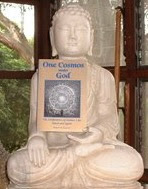
Back in the womb from which I came, I had no God and was merely myself. --Meister Eckhart
Is the human species "maturing" -- which is to say, evolving -- with time? To answer the question, one must only consider the Muslim world, for it is either more or less mature than the West as a whole. As Dr. Sanity writes, millions of Muslims suffer from "Teddy Bear Syndrome" (coined by Victor Davis Hanson), which is
"the tendency of many Muslims to judge Westerners and those who do not adhere to Islam as 'blasphemous' when they exercise freedom of speech, freedom of thought, freedom of choice, and freedom of religion; and to react in an intolerant, inappropriate and violent rage, demanding death or some other extreme punishment for the accused."
Yes, Teddy Bear Syndrome shares many similarities to left wing political correctness, so it must be a potential that is present in everyone, a primitive impulse that must be "outgrown" -- like throwing a temper tantrum when you don't get your way, or suing to overturn the 2000 presidential election. It is the reason why there is no place in the West more intellectually immature than an elite university campus. But fortunately, most people are not left wing university professors. Yet.
Regarding the etiology of Teddy Bear Syndrome, Dr. Sanity writes that part of the problem results from the failure of Islam "to evolve from its medieval and primitive origins" (emphasis mine). But on any traditionalist view -- including traditional Christianity -- religion does not evolve. Rather, the whole point is that it is fixed and final. However, just like everything else, scripture looks very different to a developmentally mature mind than it does to an immature one.
The psychological immaturity of Islam is generally mirrored by a pseudomature response by the "liberal" West. As Hanson writes, "the reaction to this madness is now stereotyped. Often apologies -- not condemnation -- follow from contrite Westerners. To prevent a recurrence, Western writers, filmmakers, teachers and religious figures quietly edit their work and restrict their speech -- but only when Islam is involved."
When this happens, it is analogous to allowing the baby to run the household. Children naturally try to manipulate parents, but a good parent knows how to set boundaries and to be consistent. However, over the past 40-50 years, especially with the Baby Boomer generation, these psychological boundaries have been discarded, which has resulted in a blending of the sexes and generations. One of the reasons for this is that the Baby Boom generation was the first to prevail in the perennial battle between adults and children, thus providing no check on the tendency toward omnipotence.
Yes, some positive things obviously came out of the 1960s, but one of the most baleful ones was the Genderless Adolescent. This is a person who by definition can never be mature, but only give the appearance of being so. It is much more difficult to be a Genderless Adolescent on the right, whereas it is more or less normative on the left. Anyone who reads left wing blogs knows this is so. As for myself, being primarily a vertically oriented person, I think of politics as more or less of a distraction from reality.
It's not that I believe any kind of salvation lies with conservative political success. Rather, it's just that the left is so incredibly dangerous and destructive on every level -- intellectual, economic, psychological, and spiritual -- that it must be combatted. In fact, most conservatives would prefer to ignore politics and be left alone to enjoy their lives, but this would be irresponsible so long as the left pursues its antihuman agenda with such religious fervor.
Although I haven't thought about it for awhile, one of the books that had the greatest influence on my thinking was Foundations of Psychohistory by Lloyd deMause. His thesis -- which he supports with abundant documentation -- is that "The history of childhood is a nightmare from which we have only recently begun to awaken. The further back in history one goes, the lower level of child care, and the more likely children are to be killed, abandoned, beaten, terrorized, and sexually abused." One of the reasons historians have failed to notice this is that "serious history has long been considered a record of public and not private events." It has generally focused on wars, discoveries, political movements and the like, as opposed to what went on in homes and in the minds of children.
Historians are generally hostile to deMause's approach, and I can understand why. Although his evidence may be sound, I think he pushes it way too far into a historical determinism in which the evolution of parenting is the overriding genesis of all historical change. Nevertheless, I think it would be an error to throw out all of his basic research just because his conclusions may be beyond the fringe.
deMause essentially turns history upside-down and looks at it through an extreme "micro" lens. There's nothing wrong with this -- in fact, it is vital -- but I think it must be balanced with the macro view. It's not an either-or situation, nor should psychohistory be a mere afterthought or subspecialty grafted onto history. Rather, it should form the basis of a stereoscopic view of history, through which we simultaneously look at the macro and micro, interior and exterior, rational and irrational, conscious and unconscious, adult and child, culture and individual, etc.
The problem with most history, even to this day, is that it is too sweeping and general, and ignores the reality of the unconscious and the insights of developmental psychology. It makes it difficult to comprehend something as fundamentally irrational as Islamism. The left, for example, treats Islamism as a rational response to something we have done, which seems like "empathy" or sensitivity but is actually the very opposite, a kind of self-congratulatory indulgence of an enraged child.
In One Cosmos I quoted John Bowlby, one of the early pioneers of attachment theory, who wrote that "The truth is that the least-studied phase of human development remains the phase during which a child is acquiring all that makes him most human. Here is still a continent to conquer." Similarly, Tolstoy wrote that "From the child of five to myself is but a step. But from the newborn baby to the child of five is an appalling distance." Or the anthropologist Norbert Elias: "It seems as if grown-up people, in thinking about their origins, involuntarily lose sight of the fact that they themselves and all adults came into the world as little children. Over and over again, in the scientific myths of origin no less than the religious ones, they feel impelled to imagine: In the beginning was a single human being, who was an adult."
But in reality, In the beginning is a neurologically incomplete, helpless little baby, utterly dependent upon caretakers who may or may not be up to the task of raising him, and who themselves bear the unconscious scars of their own childhood trauma. Thus, it is not so much that "in the beginning is the baby" as "in the beginning is the dynamic relationship between an unformed nervous system that will develop (or fail to develop) its potential in rapport with its caretakers."
Take the myth of Genesis, for example. This can be misleading, since it begins with the creation of a male adult, followed by a female adult (who comes out of the male), and lastly, a couple of children. But in reality, the reverse is true: first there is a baby, out of which comes the mother, who then bifurcates into a mother and father. In other words, the baby cannot possibly imagine that the mother gave birth to him, as doing so would require language, boundaries, a conception of linear time, the differentiation between inside and outside, etc.
Rather, as Winnicott observed, there isn't actually such a thing as a baby (at least as far as the baby is concerned). Instead, there is a true union of mother and infant, a (hopefully) harmonious psychological matrix (matrix being etymologically linked to womb) through which the baby will eventually "discover" the M-other -- and only later her consort, who is Fa(r)ther away in developmental time).
Fascinatingly, Genesis is psychospiritually "spacious" enough to be supplemented with the infant's view of the cosmos. This was an idea developed by James Grotstein, but it is also implicit in the interpretations of some mishnaevious rabbis who consider Genesis a paradoxable about man's movement from psychological infancy and dependence to maturity and dependence. As Kass writes, "Eating from the tree certainly produces a death of innocence. Through judgmental self-consciousness, human beings become self-separated; the primordial childlike, unself-divided, and peaceful state of the soul 'dies.' Thanks to reason and freedom, protoman becomes a different being -- the old one dies. This death, repeated in every human life, we have all experienced for ourselves; the contented and carefree life that we knew as innocent children is in fact permanently lost to us, the inevitable result of our rise to self-conscious knowledge of good and bad."
It is not at all uncommon for great rabbis to turn scripture inside out or upside down in order to squeeze out a little additional wisdom. Don't worry, scripture is resilient. It can handle rough play. In Grotstein's case, he begins with the psychological fact of infantile omnipotence. One can argue whether or not God is omnipotent, but infants certainly are, for how could they know otherwise? Thus, the omnipotent baby is quite obviously the creator of the cosmos, including its mother and father. Clearly, a brand new cosmos comes into being with the birth of every child, does it not? There is no cosmos at all in the absence of consciousness, so it is simply a fact that cosmogenesis is repeated afresh with every newborn baby: cosmogony recapitulates psychogeny, so to speak. Here is another apt quote from the book, this one from David Darling, author of Equations of Eternity:
"[W]e may reasonably view an infant's dawning of awareness on two levels: as a consciousness arising in the individual and, simultaneously, in the universe as a whole.... we can watch an incredibly condensed version of the growth of awareness on this planet, and in the cosmos, in each developing child."
But only if you are a sensitive parent. Isn't this a big part of the joy of parenting, re-participating in the birth of a fresh new cosmos, as your child -- and his world -- changes from day to day? Jesus made so may sensitive comments about children and about the relationship between a child's consciousness and spiritual awareness, that it's a little surprising that people fail to make the explicit connection. In fact, as deMause demonstrates -- and I'll get into some of his fascinating research in a later post -- most parents end up depriving children of this magical and creative mode of consciousness in favor of projecting their own narrow and constricted psychological grid onto them. And nowhere to my knowledge is this more prevalent than in the Islamic world, where Teddy Bear Syndrome can only be the adult expression of a traumatized child who never got to enjoy his godlike omnipotence, and is therefore resentfully living it out as an adult, toward the guilty "parents" of the West.
Ever wonder why Allah is so merciless and wrathful? You'd be too if you were wrongfully denied your birthright, and were therefore plagued by the idea that the world is fundamentally corrupt and unfair.
Yes, just like the angry leftist who never mastered self-control, so he replaces it with other-control.
God is the newest thing there is; the youngest thing there is. God is the beginning, and if we are united to him we become new again.... My soul is as young as the day it was created. Yes, and much younger! --Meister Eckhart
Friday, December 07, 2007


Thursday, December 06, 2007
Don't Cry Baby, It's Only the Apocalypse! (11.15.10}
In my metatheology, I try to take humans as I find them, not as I wish them to be. And I find humanity at large to be a pretty appalling bunch. Half the time, anyway. Half of us rodents, at any rat.
In his book Human Accomplishment, Charles Murray writes that "We human beings are in many ways a sorry lot, prone to every manner of vanity and error. The human march forward has been filled with wrong turns, backsliding, and horrible crimes." Nevertheless, he takes the gnoanced Raccoon position that "in its grand sweep, it has indeed been a march forward. On every dimension, the last half-dozen centuries in particular have brought sensational improvement which, with qualifications, continues to this day."
In the book, Murray attempted to quantify the great things humans have accomplished, but it seems that for every achievement there's an equal and opposite monument to our depravity. He asks, "What can Homo sapiens brag about -- not as individuals, but as a species?"
He notes, for example, that military accomplishment is out of the question, since "putting 'Defeated Hitler' on the human resumé is too much like putting 'Beat My Drug Habit' on a personal one." He also rules out mere governance and commerce, since these "are akin to paying the rent and putting food on the table" as it pertains to our species as a whole. In other words, these are things human beings must do in order to survive. They are not so much accomplishments as prerequisites for them. What took (and continues to take) so long for mankind to simply get out of its own way?
Now, this progressive view of mankind goes directly against the traditionalist view of a degenerating mankind. Again, traditionalists locate perfection in the past, to such an extent that they often seem to think their thesis requires no empirical support. For example, in The Order of the Ages, Bolton writes, "We think today about progress, and about how much society has advanced in the last few decades, but the evidence for this could equally well be used to argue that these are times of extreme decadence, when all natural and human standards have been overturned and we await the inevitable dissolution of all that the modern mind has created. Either we are moving toward new, higher standards of science and civilization or we stand at the very end of an era, on the verge of Apocalypse."
Bolton believes the latter, but on the third hand, both could be true: as we proceed through time, the polarity or tension within the human soul just becomes more and more extreme:
There was a bright light,
A shattering of shop windows
The bomb in the baby carriage
Was wired to the radio
The events yesterday in Omaha -- or most any day -- remind us of this ironic polarity, that "these are the days of miracle and wonder," so "don't cry baby, don't cry" (Paul Simon).
Murray writes that "the human capital for great accomplishment and the underlying human attraction to excellence are always with us, but environments for eliciting great accomplishment are not." I mentioned this the other day in the context of the so-called Palestinians, a culture so depraved that it literally provides the individual no opportunity to even be adequate, let alone excellent. Rather, it demands madness, bloodlust, and depravity, which has probably been true of most human cultures down through the ages. Just as he is free to choose evil over good, man, because he can know, can know many things that aren't so. And most of what he knows falls into that category.
In an article yesterday on NRO, Michael Novak wrote that he recently listened
"to a debate between Christopher Hitchens and Dinesh D’Souza on atheism. This is the first debate that I have ever heard Christopher lose. In it, I heard Christopher describe his own view of the world, which may be abbreviated as follows: It was just 100,000 years ago that humans finally appeared on this planet. On average, these poor creatures died by age 25, and suffered (often horribly) from disease, earthquake, flood, famine, and cyclones -- not to mention murder and warfare. Only after some 96,000 years does Jewish history begin, and only after some 98,000 years does Christian 'salvation' come. For all those thousands of years the Creator/Designer left human beings to suffer. Then, even after Judaism and Christianity arrive, the suffering continues almost unabated. In addition, these poor human beings are badly designed. They have developed too much adrenaline, and the frontal lobes of their brains are too small. All these together leave humans in a bleak condition in a bleak world, and with very little hope."
Now, I happen to cooncur with Hitchens, at least as far as he goes. In fact, so does the Pope in his new encyclical. Novak writes that
"Benedict agrees that the condition of humans before the Jewish and Christian news of God’s intentions was as bleak as Hitchens says. The idea of progress was not present in consciousness.... The idea that each human is free in his individual conscience -- not the conscience solely of city, tribe, or even family -- had not been introduced. The idea that the human mind is proportioned to the world as it is, and capable, in the image of the Creator, of creating new inventions, discoveries, and means of progress in history, had not yet been grasped by the mind of humans."
So Pope Benedict is obviously not a strict traditionalist, but a crypto-Coon who recognizes genuine progress and therefore doesn't throw out the baby with the bombwire. He knows that progress has occurred, but at the same time, that it is never enough to satisfy the soul of man. But don't cry. Novak continues:
"Even the human capacity for invention and technological progress, we find, is not a consistent bearer of hope. Humans remain both free and also drawn to self-love, arrogance of power, irrational ambitions, and moral decadence.... Thus, at any time even instruments of great good can be turned into instruments of unparalleled evil. Of this we had much evidence during the 20th century.... [T]he horrific evils that millions experienced in the last hundred years required more than logic, science, and crazy utopian ideas. Hitchens and others are free to accept or to reject the hope that Judaism and Christianity implant in the souls of many. The fact is that this Jewish and Christian hope, once it became the driving force of Mediterranean and European civilization, produced an unrivaled and enduring burst of optimism, inquiry, and stunning progress."
So we come back to what I stated at the outset of this post: "Judaism and Christianity have the advantage of dealing with the world as it is. They take it with all its hurt and folly, stupidity and egotism, natural disasters and disasters by human hands. Both faiths prepare their daughters and sons to face a vale of tears, to meet much suffering equably, to keep their hopes unbroken no matter what, and to show courage worthy of the children of the True God. For both faiths, suffering is an irremovable fact of life."
I would suggest that you're lucky to be alive during an era when you can say It was the best of times, it was the worst of times, because for most of human history, it has mostly been the latter, which leads to something like this sentiment: "It is the worst of times, but we remember the best of times, even if it is only exists in myth and story."
Traditionalists, insofar as I am able to determine, believe in a literal "best of times," a "golden age" that had no simultaneous "worst of times." But those on the left believe in a mirror image of this: that these are the worst of times and that we can perfect mankind and build a utopia which will be the best of times. But to paraphrase something very infallible that the Pope said a few years ago, before he was even Pope, "the loss of transcendence leads to the flight to utopia." The leftist program is a surefire way to create a true worst of times, as they proved time and time again in the 20th century. A Jew in Nazi Germany or a political prisoner in the Soviet Union can be forgiven for having believed "these are the worst of times, full stop."
So a Raccoon believes that the very conditions of our human existence somehow necessitate this outwardly absurd tension of good times, bad times, of which I've certainly had my share. Yes, it's the same story, even in the semi-articulate lyrics of an old Led Zeppelin song. For what is a Led Zeppelin, anyway? It's really a promethean lead balloon, which might get you high, but not for long. "Oh the humanity!"
In the days of my youth
I was told what it means to be a man,
Now I've reached that age
I've tried to do all those things the best I can.
But no matter how I try,
I find my way into the same old jam.
Of course you do, pagan. There's only one way out, and it's not in the past, nor is it in the future.
James Joyce said it in so many kookoonish ways: perpetual fall, redemption, and irreconcilable dualities within a cyclical but spiraling time that mixes darkness and light, AKA, the nightmare of history:
The fall of a once wallstrait oldparr is retaled early in bed and later on life down through all christian minstrelsy. [Those broken financiers who jumped from Wall Street buildings in 1929 only fell back to the earth.]
Hohohoho, Mister Finn, you're going to be Mister Finnagain! Comeday morm, and, O, you're vine! Sendday's eve and, ah, you're vinegar! Hahahaha, Mister Funn, you're going to be fined again! [The same vine produces wine and vinegar, fun and fines.]
Gricks may rise and Troysirs may fall (there being two sights for ever a picture) for in the byways of high improvidence that's what makes lifework leaving and the world's a cell for citters to cit in. ["Cit" probably refers to the sanskrit word for consciousness.]
And even if Humpty shell fall frumpty times as awkward again... there'll be iggs for the brekkers come to mournhim, sunny side up with care. [Fall and rise, fall and rise...]
But all they are all there scraping along to sneeze out a likelihood that will solve and salve life's robulous remus... [Evoking Romulus and Remus, like Cain & Abel, the eternal polarity of brotherhood and sibling rivalry.]
But the world, mind, is, was and will be writing its own wrunes for ever, man, on all matters that fall under the ban of our infrarational senses.... [No doubt referring to the permanent irrationalities of the unconscious mind.]
The movibles are scrawling in motions, marching, all of them ago, in pitpat and zingzang for every busy eerie whig's a bit of a torytale to tell. [Every political program's got a bit -- or more than a bit -- of its opposite, like the Kucinich/Paul ticket, so you might say that every screechy and scratchy kluelessitch is ronning to be an appauling borer at our own pollutical fumesforall.]
In his book Human Accomplishment, Charles Murray writes that "We human beings are in many ways a sorry lot, prone to every manner of vanity and error. The human march forward has been filled with wrong turns, backsliding, and horrible crimes." Nevertheless, he takes the gnoanced Raccoon position that "in its grand sweep, it has indeed been a march forward. On every dimension, the last half-dozen centuries in particular have brought sensational improvement which, with qualifications, continues to this day."
In the book, Murray attempted to quantify the great things humans have accomplished, but it seems that for every achievement there's an equal and opposite monument to our depravity. He asks, "What can Homo sapiens brag about -- not as individuals, but as a species?"
He notes, for example, that military accomplishment is out of the question, since "putting 'Defeated Hitler' on the human resumé is too much like putting 'Beat My Drug Habit' on a personal one." He also rules out mere governance and commerce, since these "are akin to paying the rent and putting food on the table" as it pertains to our species as a whole. In other words, these are things human beings must do in order to survive. They are not so much accomplishments as prerequisites for them. What took (and continues to take) so long for mankind to simply get out of its own way?
Now, this progressive view of mankind goes directly against the traditionalist view of a degenerating mankind. Again, traditionalists locate perfection in the past, to such an extent that they often seem to think their thesis requires no empirical support. For example, in The Order of the Ages, Bolton writes, "We think today about progress, and about how much society has advanced in the last few decades, but the evidence for this could equally well be used to argue that these are times of extreme decadence, when all natural and human standards have been overturned and we await the inevitable dissolution of all that the modern mind has created. Either we are moving toward new, higher standards of science and civilization or we stand at the very end of an era, on the verge of Apocalypse."
Bolton believes the latter, but on the third hand, both could be true: as we proceed through time, the polarity or tension within the human soul just becomes more and more extreme:
There was a bright light,
A shattering of shop windows
The bomb in the baby carriage
Was wired to the radio
The events yesterday in Omaha -- or most any day -- remind us of this ironic polarity, that "these are the days of miracle and wonder," so "don't cry baby, don't cry" (Paul Simon).
Murray writes that "the human capital for great accomplishment and the underlying human attraction to excellence are always with us, but environments for eliciting great accomplishment are not." I mentioned this the other day in the context of the so-called Palestinians, a culture so depraved that it literally provides the individual no opportunity to even be adequate, let alone excellent. Rather, it demands madness, bloodlust, and depravity, which has probably been true of most human cultures down through the ages. Just as he is free to choose evil over good, man, because he can know, can know many things that aren't so. And most of what he knows falls into that category.
In an article yesterday on NRO, Michael Novak wrote that he recently listened
"to a debate between Christopher Hitchens and Dinesh D’Souza on atheism. This is the first debate that I have ever heard Christopher lose. In it, I heard Christopher describe his own view of the world, which may be abbreviated as follows: It was just 100,000 years ago that humans finally appeared on this planet. On average, these poor creatures died by age 25, and suffered (often horribly) from disease, earthquake, flood, famine, and cyclones -- not to mention murder and warfare. Only after some 96,000 years does Jewish history begin, and only after some 98,000 years does Christian 'salvation' come. For all those thousands of years the Creator/Designer left human beings to suffer. Then, even after Judaism and Christianity arrive, the suffering continues almost unabated. In addition, these poor human beings are badly designed. They have developed too much adrenaline, and the frontal lobes of their brains are too small. All these together leave humans in a bleak condition in a bleak world, and with very little hope."
Now, I happen to cooncur with Hitchens, at least as far as he goes. In fact, so does the Pope in his new encyclical. Novak writes that
"Benedict agrees that the condition of humans before the Jewish and Christian news of God’s intentions was as bleak as Hitchens says. The idea of progress was not present in consciousness.... The idea that each human is free in his individual conscience -- not the conscience solely of city, tribe, or even family -- had not been introduced. The idea that the human mind is proportioned to the world as it is, and capable, in the image of the Creator, of creating new inventions, discoveries, and means of progress in history, had not yet been grasped by the mind of humans."
So Pope Benedict is obviously not a strict traditionalist, but a crypto-Coon who recognizes genuine progress and therefore doesn't throw out the baby with the bombwire. He knows that progress has occurred, but at the same time, that it is never enough to satisfy the soul of man. But don't cry. Novak continues:
"Even the human capacity for invention and technological progress, we find, is not a consistent bearer of hope. Humans remain both free and also drawn to self-love, arrogance of power, irrational ambitions, and moral decadence.... Thus, at any time even instruments of great good can be turned into instruments of unparalleled evil. Of this we had much evidence during the 20th century.... [T]he horrific evils that millions experienced in the last hundred years required more than logic, science, and crazy utopian ideas. Hitchens and others are free to accept or to reject the hope that Judaism and Christianity implant in the souls of many. The fact is that this Jewish and Christian hope, once it became the driving force of Mediterranean and European civilization, produced an unrivaled and enduring burst of optimism, inquiry, and stunning progress."
So we come back to what I stated at the outset of this post: "Judaism and Christianity have the advantage of dealing with the world as it is. They take it with all its hurt and folly, stupidity and egotism, natural disasters and disasters by human hands. Both faiths prepare their daughters and sons to face a vale of tears, to meet much suffering equably, to keep their hopes unbroken no matter what, and to show courage worthy of the children of the True God. For both faiths, suffering is an irremovable fact of life."
I would suggest that you're lucky to be alive during an era when you can say It was the best of times, it was the worst of times, because for most of human history, it has mostly been the latter, which leads to something like this sentiment: "It is the worst of times, but we remember the best of times, even if it is only exists in myth and story."
Traditionalists, insofar as I am able to determine, believe in a literal "best of times," a "golden age" that had no simultaneous "worst of times." But those on the left believe in a mirror image of this: that these are the worst of times and that we can perfect mankind and build a utopia which will be the best of times. But to paraphrase something very infallible that the Pope said a few years ago, before he was even Pope, "the loss of transcendence leads to the flight to utopia." The leftist program is a surefire way to create a true worst of times, as they proved time and time again in the 20th century. A Jew in Nazi Germany or a political prisoner in the Soviet Union can be forgiven for having believed "these are the worst of times, full stop."
So a Raccoon believes that the very conditions of our human existence somehow necessitate this outwardly absurd tension of good times, bad times, of which I've certainly had my share. Yes, it's the same story, even in the semi-articulate lyrics of an old Led Zeppelin song. For what is a Led Zeppelin, anyway? It's really a promethean lead balloon, which might get you high, but not for long. "Oh the humanity!"
In the days of my youth
I was told what it means to be a man,
Now I've reached that age
I've tried to do all those things the best I can.
But no matter how I try,
I find my way into the same old jam.
Of course you do, pagan. There's only one way out, and it's not in the past, nor is it in the future.
James Joyce said it in so many kookoonish ways: perpetual fall, redemption, and irreconcilable dualities within a cyclical but spiraling time that mixes darkness and light, AKA, the nightmare of history:
The fall of a once wallstrait oldparr is retaled early in bed and later on life down through all christian minstrelsy. [Those broken financiers who jumped from Wall Street buildings in 1929 only fell back to the earth.]
Hohohoho, Mister Finn, you're going to be Mister Finnagain! Comeday morm, and, O, you're vine! Sendday's eve and, ah, you're vinegar! Hahahaha, Mister Funn, you're going to be fined again! [The same vine produces wine and vinegar, fun and fines.]
Gricks may rise and Troysirs may fall (there being two sights for ever a picture) for in the byways of high improvidence that's what makes lifework leaving and the world's a cell for citters to cit in. ["Cit" probably refers to the sanskrit word for consciousness.]
And even if Humpty shell fall frumpty times as awkward again... there'll be iggs for the brekkers come to mournhim, sunny side up with care. [Fall and rise, fall and rise...]
But all they are all there scraping along to sneeze out a likelihood that will solve and salve life's robulous remus... [Evoking Romulus and Remus, like Cain & Abel, the eternal polarity of brotherhood and sibling rivalry.]
But the world, mind, is, was and will be writing its own wrunes for ever, man, on all matters that fall under the ban of our infrarational senses.... [No doubt referring to the permanent irrationalities of the unconscious mind.]
The movibles are scrawling in motions, marching, all of them ago, in pitpat and zingzang for every busy eerie whig's a bit of a torytale to tell. [Every political program's got a bit -- or more than a bit -- of its opposite, like the Kucinich/Paul ticket, so you might say that every screechy and scratchy kluelessitch is ronning to be an appauling borer at our own pollutical fumesforall.]
Wednesday, December 05, 2007
Temporal Dilation, Cosmic Music, and Human Be-Who (11.12.10)
Any attempt to grapple with the concept of time must begin with the obvious fact that it has three equally mysterious modes, past, present and future (and this is not even to touch on the everlasting or the "eternal," the latter of which involves the instantaneous presence of the temporal whole). The present is the place where the past brings the future into being, but also where the the future flows into the now and becomes the past. As Bolton writes, "everything in the past was once future, and then present; everything present was future and will be past; and everything future will be present and then past."
Based upon this, the past would appear to be fixed, but is that really so? Not if the past is inherently entangled with the future. Future events can occur which will give the past an entirely different meaning. For example, if you wrote a history of the 19th century prior to World War I, it would look very different than a history written after World War I, because only as more of the future became the past could you understand events that were implicit in the past, but yet to play themselves out in time. In other words, the past had hidden potentials that were still playing themselves out in the future. As Bolton writes, "the contents of the past and present are thus in constant change by virtue of their changing relationship to the present."
In so many ways, MSM journalism really is an attempt to control the now, so as to control the past and therefore future....
In physics, there is only a one-way arrow of change, from past to future. But as Bolton explains, "to give the experience of change," time "must form a combination of static and dynamic elements. A time series which consisted of pure dynamism could not supply any kind of experience because every element in it would have become something else before it could be known." Alternatively, "a purely static time would not be temporal at all. Only a mingling of the changing with the unchanging can constitute time..."
This is why I not only think that music is the best analogy we have for time, but why we are so drawn to it: because it reveals the very form of time, which in turn brings inherent pleasure, similar to the epistemophilic pleasure of discovery. In short, the ear can tell us much more about time than the eye, but all of science is biased more toward the eye in its mapping of reality. Indeed, science ultimately aims to map all of reality in such a way that it specifically excludes time. For example, a "grand theory of everything" would consist of a single equation that unifies all of the forces in physics -- forces which result in the "illusion" of time. But what if the cosmos is more like a symphony, which has a complex vertical structure (i.e., the "spatial" chords) and a more open and horizontal "melodic" aspect that wends its way through the chords?
Zuckerkandl writes that "The knowledge of space that hand and eye possess is exactly matched by their ignorance of time.... A true image of time must be an image for the ear, an audible image made of tones.... Thanks to music, we are able to behold time."
Now, a work of serious music is obviously a "whole," but it is again a temporal whole with a complex array of vertical and horizontal relations. In fact, in rereading Eliot's Wasteland yesterday, I could hear how very "musical" it is, with complex motifs recurring and commenting upon one another as the poem unfolds, just as in a symphony. Thus, it seems that poetry in general would represent a closer approximation to the structure of reality than any ordinary linear prose.
I am sure this is what Schuon means when he says that a simple believer in literal creationism is surely closer to the truth than any form of materialism can ever be. To say that Genesis is "poetry" is hardly to denigrate it; rather, it is to point out that it employs the appropriate modality to even begin to talk about ultimate reality. It does not pretend to be able to capture the unsayable in language (unless you have no poetic sense and have missed the point), but to use what can be said to disclose what otherwise can't be said or even thought about.
The word became flesh and dwelt among us. Language, like music, is deployed in time. Because of this, you cannot comprehend the meaning of a statement by analyzing its constituent parts, i.e., by breaking it down into its individual words and letters. It is not that the words and letters additively reveal a meaning; rather, they are all in the service of a higher meaning, and were chosen for the very purpose of conveying it. Here again, much of the pleasure in writing is searching for and "discovering" the correct word or phrase for the meaning one wishes to convey, very much as a musician will try to find the proper notes to say what he wishes to say in a solo. This is one more reason there can never be "artificial intelligence" except in its linear sense, but never in the holistic way in which the human mind operates.
For example, I was reading just yesternow (National Review, 12.3.07) about the vast differences between a chess-playing computer program and a chess master. The computer program must consider trillions of possibilities before deciding on a single move, whereas "even the greatest human player considers at most a few thousand, and usually far fewer." Thus, this "billion-to-one advantage in calculating power is nullified by the human grandmaster's power of understanding." It is this depth of understanding that instantaneously excludes literally billions of blind alleys.
As does a profound philosophy of life. In particular, I'm thinking again of how revelation is intended to provide a musical structure with which one may adequately play the "cosmic suite." No computer program could ever do this, because in life, the choices multiply exponentially as compared to a chess match. How do we reduce the chaos to meaning, without reducing meaning to meaninglessness, as does science?
Relgion begins with the idea that ultimate meaning exists, and that it is this meaning that "sponsors," so to speak, all of the meaning we encounter on a moment-to-moment basis, no matter how trivial. Meaning is meaningful because Meaning is always there propping it up; or words are there (including everything from DNA to the mathematical constants that govern physical reality) because the Word is there "behind," "beneath" or "above" them. "Meaning" and "Wholeness" are two aspects of the same phenomena, since meaning is only grasped by sensing the wholeness of parts. In fact, in the absence of wholeness there could obviously be no parts, because they wouldn't be parts of anything.
This is patently true of "spatial" objects, but what about temporal ones? If we try to analyze time by dissecting it down to its constituent parts, do we not eliminate the very melody we are attempting to hear, the Song Supreme? This is the domain of metahistory, which is apparently no longer fashionable, except that it actually is, in the same way that the Left presents us with a counterfeit version of any profound truth. Leftism is like an inverted mirror of falsehood, in which deep truths are presented upside down and backwards, for example, the doctrine of materialism. Materialsm is just an ass-backward religion that starts at the wrong end of reality and proceeds to elevate its absurd error to an absolute.
But the moment you treat parts in an atomistic way, as if they are unrelated in time, you have falsified reality. This is precisely why physics is powerless to understand the most profound and shocking facts of the universe, i.e., life and consciousness. They cannot even discuss these things without a priori turning them into something they are not. But as I wrote in One Cosmos, "Only by changing our perspective to a 'top down' one, from spirit to mind to life to matter, does the cosmos become intelligble in its totality, a totality that unquestionably includes biological and psychological dimensions."
Thus, in the Raccoon view, "when we talk about a 'relationship' between Life and the cosmos, we are dealing quite literally with a tautology, a statement of equivalence." Given the temporal entanglement of the cosmos, in order to not mislead, we cannot refer only to "the universe," but to something along the lines of "the living universe" or "the universe in the process of becoming locally conscious," because only in such a way do we not exclude the most important fact of the cosmos, i.e, the observer making the statement.
It actually goes a lot deeper than this, as is explained in One Cosmos (which is the perfect stocking sopher for the Raccoon in your life who doesn't know he is one). That is, I believe it can be proven that the universe is intrinsically and not just accidentally conscious. It has never been unknown to human beings that this can be proven in mystical experience, but I believe it can also be proven by mere transrational logic. Certain things just must be, and one of them is that our individual consciousness partakes of a much greater consciousness, in the same way that our little ego relates to the cosmic Dreamer who dreams us. One image Alan Watts used to employ is that of a lampshade with hundreds of pinholes. Viewed from the outside, it will look as if there are hundreds of little lights, but in reality, there is only the one bulb at the center.
Oh yes, about that little "slot" where we dilate time and gain a more expansive view of the cosmic goings-on. Sorry that this post has been a bit chaotic -- I'm just free-associating under pressure, since I have to take over child-care responsibilities momentarily. But Mouravieff writes that this slot is like a keyhole -- or key to the whole -- that opens many mysteries.
I believe I've written about this before -- about the "A influences" and the "B influences," the former coming "from the world," the latter outside it. One of the first steps in any spiritual practice is, of course, to tap into a stream of B influences, through which you begin to liberate yourself from the chaotic A influences (which are alternatively coercive, seductive or hypnotic, and average out to "zero") and begin to actualize your very own latent esoteric center (which I symbolize as (¶) in my book) which then proceeds to operate as its own "magnetic center" which draws nonlocal help from other Coons, both living and technically dead. Now that you are "plugged in" to the Coon network, I am sure that this has become a basic fact of your day-to-dei life.
I can't possibly do justice to this topic in the alotted time, but let's just highlight the fact that spiritual knowledge can never be reduced to "know how" in the absence of "be who," for it always involves an expansion of being, not merely the accumulation of intellectual knowledge, or (k). Furthermore, once this be-who (n) is assimilated, it works on us in a way that (k) never can; in that regard, it is much more analogous to medicine, or perhaps a catalytic enzyme. But as it impregnates us, it.... impregnates us, and in spirituality you can definitely be "a little bit pregnant," as (¶) grows and expands within.
Now, the present can be so narrow as to be functionally non-existent for the average person. So distracted is he by the world of A-influences, that the slot of the present -- the only place where be-who can occur -- narrows down to nothing. It might as well be the past, which is why people in thrall to the A influences are technically dead, and why Jesus said that they should just bury their fallow travelers.
But there is another present -- I believe this is the present Petey was referring to on page 15, where it says, You haven't perceived the hologram to your private particle? Come in, open His presence, and report for karmic duty. Why, it's a Tree of Life for those whose wood beleaf.
Mouravieff writes that the present "necessarily has extension," but that for exterior man, "this extent is very short.... if we reduce this Present to the zero we think it is, it becomes purely and simply cessation of existence. It is thus that death actually occurs."
Ah ha! Life, therefore, has something do to with the expansion of the present. For someone who abandons himself to A influences, the present disappears. But all forms of concentration, meditation, intellection, and prayer, are aimed at enlarging the present, which is in reality the only "place" that is outside time -- or "above" it, so to speak. If time is a line, this allows us to exist at a right angle to it, where we can begin to perceive time in its fulness, exercise a more profound degree of free will, and make deeper connections with the non-temporal realities that vertically flow into time.
This is what Mouravieff believes Jesus meant when he cracked about the "strait gate": For wide is the door and broad is the path that leads to perdition. Many are they that enter it. For strait is the door and narrow is the Path that leads to life, and few are they that find them. And this is precisely where Jesus and J.R. "Bob" Dobbs merge, for this narrow path is the way back "upstream" to the source of our cosmic slack.
Based upon this, the past would appear to be fixed, but is that really so? Not if the past is inherently entangled with the future. Future events can occur which will give the past an entirely different meaning. For example, if you wrote a history of the 19th century prior to World War I, it would look very different than a history written after World War I, because only as more of the future became the past could you understand events that were implicit in the past, but yet to play themselves out in time. In other words, the past had hidden potentials that were still playing themselves out in the future. As Bolton writes, "the contents of the past and present are thus in constant change by virtue of their changing relationship to the present."
In so many ways, MSM journalism really is an attempt to control the now, so as to control the past and therefore future....
In physics, there is only a one-way arrow of change, from past to future. But as Bolton explains, "to give the experience of change," time "must form a combination of static and dynamic elements. A time series which consisted of pure dynamism could not supply any kind of experience because every element in it would have become something else before it could be known." Alternatively, "a purely static time would not be temporal at all. Only a mingling of the changing with the unchanging can constitute time..."
This is why I not only think that music is the best analogy we have for time, but why we are so drawn to it: because it reveals the very form of time, which in turn brings inherent pleasure, similar to the epistemophilic pleasure of discovery. In short, the ear can tell us much more about time than the eye, but all of science is biased more toward the eye in its mapping of reality. Indeed, science ultimately aims to map all of reality in such a way that it specifically excludes time. For example, a "grand theory of everything" would consist of a single equation that unifies all of the forces in physics -- forces which result in the "illusion" of time. But what if the cosmos is more like a symphony, which has a complex vertical structure (i.e., the "spatial" chords) and a more open and horizontal "melodic" aspect that wends its way through the chords?
Zuckerkandl writes that "The knowledge of space that hand and eye possess is exactly matched by their ignorance of time.... A true image of time must be an image for the ear, an audible image made of tones.... Thanks to music, we are able to behold time."
Now, a work of serious music is obviously a "whole," but it is again a temporal whole with a complex array of vertical and horizontal relations. In fact, in rereading Eliot's Wasteland yesterday, I could hear how very "musical" it is, with complex motifs recurring and commenting upon one another as the poem unfolds, just as in a symphony. Thus, it seems that poetry in general would represent a closer approximation to the structure of reality than any ordinary linear prose.
I am sure this is what Schuon means when he says that a simple believer in literal creationism is surely closer to the truth than any form of materialism can ever be. To say that Genesis is "poetry" is hardly to denigrate it; rather, it is to point out that it employs the appropriate modality to even begin to talk about ultimate reality. It does not pretend to be able to capture the unsayable in language (unless you have no poetic sense and have missed the point), but to use what can be said to disclose what otherwise can't be said or even thought about.
The word became flesh and dwelt among us. Language, like music, is deployed in time. Because of this, you cannot comprehend the meaning of a statement by analyzing its constituent parts, i.e., by breaking it down into its individual words and letters. It is not that the words and letters additively reveal a meaning; rather, they are all in the service of a higher meaning, and were chosen for the very purpose of conveying it. Here again, much of the pleasure in writing is searching for and "discovering" the correct word or phrase for the meaning one wishes to convey, very much as a musician will try to find the proper notes to say what he wishes to say in a solo. This is one more reason there can never be "artificial intelligence" except in its linear sense, but never in the holistic way in which the human mind operates.
For example, I was reading just yesternow (National Review, 12.3.07) about the vast differences between a chess-playing computer program and a chess master. The computer program must consider trillions of possibilities before deciding on a single move, whereas "even the greatest human player considers at most a few thousand, and usually far fewer." Thus, this "billion-to-one advantage in calculating power is nullified by the human grandmaster's power of understanding." It is this depth of understanding that instantaneously excludes literally billions of blind alleys.
As does a profound philosophy of life. In particular, I'm thinking again of how revelation is intended to provide a musical structure with which one may adequately play the "cosmic suite." No computer program could ever do this, because in life, the choices multiply exponentially as compared to a chess match. How do we reduce the chaos to meaning, without reducing meaning to meaninglessness, as does science?
Relgion begins with the idea that ultimate meaning exists, and that it is this meaning that "sponsors," so to speak, all of the meaning we encounter on a moment-to-moment basis, no matter how trivial. Meaning is meaningful because Meaning is always there propping it up; or words are there (including everything from DNA to the mathematical constants that govern physical reality) because the Word is there "behind," "beneath" or "above" them. "Meaning" and "Wholeness" are two aspects of the same phenomena, since meaning is only grasped by sensing the wholeness of parts. In fact, in the absence of wholeness there could obviously be no parts, because they wouldn't be parts of anything.
This is patently true of "spatial" objects, but what about temporal ones? If we try to analyze time by dissecting it down to its constituent parts, do we not eliminate the very melody we are attempting to hear, the Song Supreme? This is the domain of metahistory, which is apparently no longer fashionable, except that it actually is, in the same way that the Left presents us with a counterfeit version of any profound truth. Leftism is like an inverted mirror of falsehood, in which deep truths are presented upside down and backwards, for example, the doctrine of materialism. Materialsm is just an ass-backward religion that starts at the wrong end of reality and proceeds to elevate its absurd error to an absolute.
But the moment you treat parts in an atomistic way, as if they are unrelated in time, you have falsified reality. This is precisely why physics is powerless to understand the most profound and shocking facts of the universe, i.e., life and consciousness. They cannot even discuss these things without a priori turning them into something they are not. But as I wrote in One Cosmos, "Only by changing our perspective to a 'top down' one, from spirit to mind to life to matter, does the cosmos become intelligble in its totality, a totality that unquestionably includes biological and psychological dimensions."
Thus, in the Raccoon view, "when we talk about a 'relationship' between Life and the cosmos, we are dealing quite literally with a tautology, a statement of equivalence." Given the temporal entanglement of the cosmos, in order to not mislead, we cannot refer only to "the universe," but to something along the lines of "the living universe" or "the universe in the process of becoming locally conscious," because only in such a way do we not exclude the most important fact of the cosmos, i.e, the observer making the statement.
It actually goes a lot deeper than this, as is explained in One Cosmos (which is the perfect stocking sopher for the Raccoon in your life who doesn't know he is one). That is, I believe it can be proven that the universe is intrinsically and not just accidentally conscious. It has never been unknown to human beings that this can be proven in mystical experience, but I believe it can also be proven by mere transrational logic. Certain things just must be, and one of them is that our individual consciousness partakes of a much greater consciousness, in the same way that our little ego relates to the cosmic Dreamer who dreams us. One image Alan Watts used to employ is that of a lampshade with hundreds of pinholes. Viewed from the outside, it will look as if there are hundreds of little lights, but in reality, there is only the one bulb at the center.
Oh yes, about that little "slot" where we dilate time and gain a more expansive view of the cosmic goings-on. Sorry that this post has been a bit chaotic -- I'm just free-associating under pressure, since I have to take over child-care responsibilities momentarily. But Mouravieff writes that this slot is like a keyhole -- or key to the whole -- that opens many mysteries.
I believe I've written about this before -- about the "A influences" and the "B influences," the former coming "from the world," the latter outside it. One of the first steps in any spiritual practice is, of course, to tap into a stream of B influences, through which you begin to liberate yourself from the chaotic A influences (which are alternatively coercive, seductive or hypnotic, and average out to "zero") and begin to actualize your very own latent esoteric center (which I symbolize as (¶) in my book) which then proceeds to operate as its own "magnetic center" which draws nonlocal help from other Coons, both living and technically dead. Now that you are "plugged in" to the Coon network, I am sure that this has become a basic fact of your day-to-dei life.
I can't possibly do justice to this topic in the alotted time, but let's just highlight the fact that spiritual knowledge can never be reduced to "know how" in the absence of "be who," for it always involves an expansion of being, not merely the accumulation of intellectual knowledge, or (k). Furthermore, once this be-who (n) is assimilated, it works on us in a way that (k) never can; in that regard, it is much more analogous to medicine, or perhaps a catalytic enzyme. But as it impregnates us, it.... impregnates us, and in spirituality you can definitely be "a little bit pregnant," as (¶) grows and expands within.
Now, the present can be so narrow as to be functionally non-existent for the average person. So distracted is he by the world of A-influences, that the slot of the present -- the only place where be-who can occur -- narrows down to nothing. It might as well be the past, which is why people in thrall to the A influences are technically dead, and why Jesus said that they should just bury their fallow travelers.
But there is another present -- I believe this is the present Petey was referring to on page 15, where it says, You haven't perceived the hologram to your private particle? Come in, open His presence, and report for karmic duty. Why, it's a Tree of Life for those whose wood beleaf.
Mouravieff writes that the present "necessarily has extension," but that for exterior man, "this extent is very short.... if we reduce this Present to the zero we think it is, it becomes purely and simply cessation of existence. It is thus that death actually occurs."
Ah ha! Life, therefore, has something do to with the expansion of the present. For someone who abandons himself to A influences, the present disappears. But all forms of concentration, meditation, intellection, and prayer, are aimed at enlarging the present, which is in reality the only "place" that is outside time -- or "above" it, so to speak. If time is a line, this allows us to exist at a right angle to it, where we can begin to perceive time in its fulness, exercise a more profound degree of free will, and make deeper connections with the non-temporal realities that vertically flow into time.
This is what Mouravieff believes Jesus meant when he cracked about the "strait gate": For wide is the door and broad is the path that leads to perdition. Many are they that enter it. For strait is the door and narrow is the Path that leads to life, and few are they that find them. And this is precisely where Jesus and J.R. "Bob" Dobbs merge, for this narrow path is the way back "upstream" to the source of our cosmic slack.
Tuesday, December 04, 2007
Dead Men Walking and the Two Arrows of Time
Somewhere in One Cosmos I suggested that time actually runs in two directions, not one... yes, here it is:
"The most recent theories of physics agree that the properties of elementary particles 'are in the end influenced by the history and state of the whole universe' (Whitehead). If an event endures and has a future, then it follows that the past participates in the present, that the present anticipates the future, and that the future may affect that part of the present which is 'open' and not fully determined; there is both upward, deterministic causation (part-to-whole, past-to-future) and downward, teleonomic causation (whole-to-part, future to past) in the form of mathematical attractors, hierarchical control of lower levels, and boundary conditions exerting their influence on levels below them."
Petey was in a hurry that day, but one could add to the list Sheldrake's morphogenetic fields, the archetypes, the Platonic realm of pure mathematics, the three transcendentals (the Good, True, and Beautiful), and, of course, the teloscape at the end of the cosmic eschalator, O, which draws all of history in its wake, and all of the awakened through history.
Ipso facto yada yada blah blah blah, "the ultimate implication of this view would be that, just as the universe had an origin, it has a destiny; but in the end, the origin and destiny must be One, since the universe is only separable in our imagination."
Supposedly. The only way to "prove" this is to read and assimilate Chapter 4 and become the alphomega you were always meant to be and already are anywu wei. Another way of saying it is that Truth cannot be proven, only undergone -- suffered and sophered. It's not illogical or even alogical, but translogical, like knowing you're alive and conscious, which many of you are, trolls excepted. (Yes, it's leuny tune beyond all reason except Reason.)
This is why my book does not make the absurd promise of "instant enlightenment." Rather, it makes the absurd promise of eternal life while you wait. For eternity can only occur while you wait, since time and eternity arise simultaneously outside time, if that's not too paradoxical. To put it anortho way, God became man so that man might become God (St. Athanasius). And why did he do this? First of all, why ask why?
Secondly, it is written (on the "eighth page") that It was not good that this Godhead, the Most High, should be allone, so he exwholed with a big bong and said 'Let there be higher physics,' and it was zo. 'Zohar, zo good,' zedamon to himzeus.
Was that some kind of drug reference, Bob -- e.g., "high," "bong," "exhale"? Yes, and so what? You should try reading One Cosmos backwards, and see what comes out! Everything is a drug, especially serotonin, dopamine, and norepinephrine, which prevent the brain from going round. You think God doesn't know about those things? That he is a mathematician, but not a biochemist? C'mon. Get real.
Anyway, I was intrigued that Bolton also discusses the idea of two arrows of time, but from a different angle or perhaps pharmaceutical. He writes that,
"the immediate past issues in the present, through which the future is brought into being. From this point of view, one can see the future being formed from what is past."
Bueno, says the old-fashioned, straight-arrow materialist. I've got no problemo with that.
"However, it remains equally true that everything in the past was once in the future, and this means that the contents of the past which we see to be the generator of the future have all come to it out of that very future, by virtue of an equal and opposite flow toward the past."
Therefore -- don't put down the bong just yet --
"On this basis, the present time is the scene of two equal and opposite flows which build up the future out of the past and build up the past out of the future. The present could thus be compared to a window through which one observes two columns of troops marching past each other in opposite directions."
Wo, dude, I am so wasted! Do you see the little soldiers?
No?
Then you are insufficiently wasted, which is to say, wasting your eternity down in the wasteland of 3D. Speaking of which, that corpse you planted last year in your garden / Has it begun to sprout? And will it finally bloom this year?
And while we're on the subject, what branches grow / Out of this stony rubbish? Son of man, / You cannot say, or guess, for you know only / A heap of broken images, where the sun beats, / And the dead tree gives no shelter, the cricket no relief, / And the dry stone no sound of water.
Ah, but
I will show you something different from either / Your shadow at morning striding behind you / Or your shadow at evening rising to meet you.
And what might that be? Well,
Who is the third who walks always beside you? / When I count, there are only you and I together / But when I look ahead up the white road / There is always another one walking beside you.
Who or what is this third thing? In order to find out, we must, in the words of Mouravieff, "begin an interior revolution as soon as possible." Man requires "a transformation of his being which will permit him to restore the equilibrium between the technical and moral levels, now so dangerously compromised," another way of coonceptualizing the two arrows.
As Mouravieff explains, "The life of man is a film," a concept which is "difficult for our Cartesian minds to grasp":
"Incomprehensible as it may seem, our life is truly a film produced in accordance with a script.... Each human being, then, is born with his own particular film.... [E]xterior man, who lives in the system of Future-Past, cannot embrace in a single moment the ensemble of his film.... To do so, he would need to enlarge the slot of his Present.... As long as man lives in the wilderness, self-satisfied and immersed in lies and illusions, the film will unfold with mechanical inflexibility, and the Personality will remain entirely unchanged" (italics in original).
In keeping with the two arrows of time, we might say that, on the one hand, "exterior man" is the "crowning achievement of millions of years of evolution"; but from the spiritual standpoint (i.e., the future) he is just the raw material for something transcending himself, "a possibility which has not yet been realized." The former, or "anthropoids," are those who, in the words of Jesus, "believe themselves to be alive," but who are trapped in the circularity of their own bad movie. Let De Palma bury de' Redford.
Now, what was that about "enlarging the slot of the present?"
Yes, that's the key to the "third party" or person alluded to above. But my slot of timelessness just closed. To be continued.....
I sat upon the shore / Fishing, with the arid plain behind me --T.S. Eliot
"The most recent theories of physics agree that the properties of elementary particles 'are in the end influenced by the history and state of the whole universe' (Whitehead). If an event endures and has a future, then it follows that the past participates in the present, that the present anticipates the future, and that the future may affect that part of the present which is 'open' and not fully determined; there is both upward, deterministic causation (part-to-whole, past-to-future) and downward, teleonomic causation (whole-to-part, future to past) in the form of mathematical attractors, hierarchical control of lower levels, and boundary conditions exerting their influence on levels below them."
Petey was in a hurry that day, but one could add to the list Sheldrake's morphogenetic fields, the archetypes, the Platonic realm of pure mathematics, the three transcendentals (the Good, True, and Beautiful), and, of course, the teloscape at the end of the cosmic eschalator, O, which draws all of history in its wake, and all of the awakened through history.
Ipso facto yada yada blah blah blah, "the ultimate implication of this view would be that, just as the universe had an origin, it has a destiny; but in the end, the origin and destiny must be One, since the universe is only separable in our imagination."
Supposedly. The only way to "prove" this is to read and assimilate Chapter 4 and become the alphomega you were always meant to be and already are anywu wei. Another way of saying it is that Truth cannot be proven, only undergone -- suffered and sophered. It's not illogical or even alogical, but translogical, like knowing you're alive and conscious, which many of you are, trolls excepted. (Yes, it's leuny tune beyond all reason except Reason.)
This is why my book does not make the absurd promise of "instant enlightenment." Rather, it makes the absurd promise of eternal life while you wait. For eternity can only occur while you wait, since time and eternity arise simultaneously outside time, if that's not too paradoxical. To put it anortho way, God became man so that man might become God (St. Athanasius). And why did he do this? First of all, why ask why?
Secondly, it is written (on the "eighth page") that It was not good that this Godhead, the Most High, should be allone, so he exwholed with a big bong and said 'Let there be higher physics,' and it was zo. 'Zohar, zo good,' zedamon to himzeus.
Was that some kind of drug reference, Bob -- e.g., "high," "bong," "exhale"? Yes, and so what? You should try reading One Cosmos backwards, and see what comes out! Everything is a drug, especially serotonin, dopamine, and norepinephrine, which prevent the brain from going round. You think God doesn't know about those things? That he is a mathematician, but not a biochemist? C'mon. Get real.
Anyway, I was intrigued that Bolton also discusses the idea of two arrows of time, but from a different angle or perhaps pharmaceutical. He writes that,
"the immediate past issues in the present, through which the future is brought into being. From this point of view, one can see the future being formed from what is past."
Bueno, says the old-fashioned, straight-arrow materialist. I've got no problemo with that.
"However, it remains equally true that everything in the past was once in the future, and this means that the contents of the past which we see to be the generator of the future have all come to it out of that very future, by virtue of an equal and opposite flow toward the past."
Therefore -- don't put down the bong just yet --
"On this basis, the present time is the scene of two equal and opposite flows which build up the future out of the past and build up the past out of the future. The present could thus be compared to a window through which one observes two columns of troops marching past each other in opposite directions."
Wo, dude, I am so wasted! Do you see the little soldiers?
No?
Then you are insufficiently wasted, which is to say, wasting your eternity down in the wasteland of 3D. Speaking of which, that corpse you planted last year in your garden / Has it begun to sprout? And will it finally bloom this year?
And while we're on the subject, what branches grow / Out of this stony rubbish? Son of man, / You cannot say, or guess, for you know only / A heap of broken images, where the sun beats, / And the dead tree gives no shelter, the cricket no relief, / And the dry stone no sound of water.
Ah, but
I will show you something different from either / Your shadow at morning striding behind you / Or your shadow at evening rising to meet you.
And what might that be? Well,
Who is the third who walks always beside you? / When I count, there are only you and I together / But when I look ahead up the white road / There is always another one walking beside you.
Who or what is this third thing? In order to find out, we must, in the words of Mouravieff, "begin an interior revolution as soon as possible." Man requires "a transformation of his being which will permit him to restore the equilibrium between the technical and moral levels, now so dangerously compromised," another way of coonceptualizing the two arrows.
As Mouravieff explains, "The life of man is a film," a concept which is "difficult for our Cartesian minds to grasp":
"Incomprehensible as it may seem, our life is truly a film produced in accordance with a script.... Each human being, then, is born with his own particular film.... [E]xterior man, who lives in the system of Future-Past, cannot embrace in a single moment the ensemble of his film.... To do so, he would need to enlarge the slot of his Present.... As long as man lives in the wilderness, self-satisfied and immersed in lies and illusions, the film will unfold with mechanical inflexibility, and the Personality will remain entirely unchanged" (italics in original).
In keeping with the two arrows of time, we might say that, on the one hand, "exterior man" is the "crowning achievement of millions of years of evolution"; but from the spiritual standpoint (i.e., the future) he is just the raw material for something transcending himself, "a possibility which has not yet been realized." The former, or "anthropoids," are those who, in the words of Jesus, "believe themselves to be alive," but who are trapped in the circularity of their own bad movie. Let De Palma bury de' Redford.
Now, what was that about "enlarging the slot of the present?"
Yes, that's the key to the "third party" or person alluded to above. But my slot of timelessness just closed. To be continued.....
I sat upon the shore / Fishing, with the arid plain behind me --T.S. Eliot
Monday, December 03, 2007
The Decline of the West and Other Historical Phalluses (11.11.10)
I had enough blessed slack yesterday to finish Bolton's The Order of the Ages: World History in the Light of a Universal Cosmogony. First of all, I think the man's a metaphysical genius. While he doesn't have the "musical" quality of Schuon -- rather, his prose is more "geometric" -- he writes with effortless flow and with great authority about all matters suprasensible and transnatural. He is undoubtedly a man of genuine spiritual achievement. Nevertheless.... I go back to my coontra: what would the original Raccoons, Toots and Herman, say?
It's difficult to reject an overall thesis that contains so much truth; then again, it's the same reason I reject natural selection as an all-encompassing paradigm -- plenty of truth there as well, just not The truth. I found myself highlighting half the book for its subtle insights into the spiritual world, and yet, I just can't go along with the idea that time is inevitably proceeding in the direction of degeneration and dissolution. Rather, I think this conclusion has always represented the "easy way out" for seriously spiritual-minded individuals who cannot help but notice the gulf that exists between the transcendent ideal and the actual, or Reality and maya. There has never been a time that people haven't been concerned about "the direction of history."
To cite one particularly glaring example, Jesus appeared at a time when it was felt by the masses that things could hardly get worse. Everyone was anticipating the messiah, convinced that historical degeneration was so complete that the end was near. According to Bolton's thesis -- and of the traditionalists in general -- ancient Rome would have been much closer to the "Golden Age" than our time, but this seems to me to be almost pure fantasy, divorced from historical realities.
As a matter of fact, this is what the traditionalists habitually do; they seem to feel that it is so obvious that history is going in a "negative" direction, that it requires no historical support at all. But if you examine the actual conditions of the average Job living in Ancient Egypt, or Greece, or Rome, or the Middle Ages, it strikes me as a horror. But because the traditionalists are extremely aesthetically-minded, it's as if they make sweeping historical conclusions based upon the most beautiful objects of antiquity that have survived to our day.
Yes, the Egyptians left us some impressive artwork, no doubt. Then again, they had 5000 years to do it in, a figure so vast that it is inconceivable to us. Frankly, I don't think we can even grasp the fact that when Augustine -- who had the greatest influence on Western thought for 1000 years -- did his writing, it was already going on four centuries after the time Jesus lived. We don't even know all that much about Christianity during its first two-plus centuries, a period of time as long as the United States has existed.
But the further back in history we go, the more we "compress" the time, which not only obscures all of the detail, but ends up being no better than a psychological projection into the past. Thus, for example, if you are on the depressive, pessimistic, or alienated end of the psychological spectrum, it's easy to conclude that the present more or less blows, since we see all the horrifyng, disgusting detail of our own age up close and personal. One glance below through the looking glass-bottomed boat at the sewer of dailykos, and you would be forgiven for believing that mankind cannot sink any lower and that the end is at hand.
It's very similar to what psychotherapy patients do on an individual basis. People tend not to remember much before the age of five, and only scattered details between five and nine. But obviously, life was just as rich and detailed then as it is now -- in fact, more so, since every single day was an alternatively delightful or calamitous novelty, largely depending upon the quality of parenting. Life was overflowing with the fullness and the presence of being, but we just didn't have the language or the concepts to reflect upon it. My son is the happiest and most intense person I know, but he'll never remember it, except unconsciously.
Patients who come in for therapy often have what are called "screen memories" of their childhood. They will remember this or that event with great detail, but upon investigation, it will turn out that it is a sort of "composite portrait" of a whole period, rich with symbolic meaning that needs to be "unpacked" and articulated. It's never just a literal memory, but more of a holographic pneumagraph that can reveal layer upon layer of meaning by "turning" it ever so slightly, like a blinky toy.
Perhaps history is the same way. I know it is for me. It's like a huge black canvas upon which we project things from the present. Since the past is behind us, we imagine that we can take it into our view, but this is obviously impossible. There are huge lacunae that we just fill in with fantasy, much in the same way that we fill the hole in our field of vision, where the optic nerve meets the eye. In a very real sense, it's true: there's nothing new except the history you don't know.
I tried to present just a fraction of the historical evidence of how bad things were in the past in Chapter 3 of One Cosmos, but obviously, that chapter could have been expanded into a whole book. My purpose was simply to make the point and then move on. I'm obviously not a scholar, but a... a... what? I have no idea. You decide.
Anyway, to cite some statistical examples that are of obvious concern to us, no matter how violent things appear in the present, they simply cannot compare to how violent human beings were in the past. Michael Medved cites statistics indicating that "New York City is on track to have fewer than 500 homicides this year, by far the lowest number in a 12-month period since reliable Police Department statistics became available in 1963.... But within the city’s official crime statistics is a figure that may be even more striking: so far, with roughly half the killings analyzed, only 35 were found to be committed by strangers, a microscopic statistic in a city of more than 8.2 million."
In contrast, according to Lawrence Keely's War Before Civilization, the homicide rate of some prehistoric villages "would have been 1,400 times that of modern Britain or about 70 times that of the United States in 1980." Likewse, the Middle Ages were (was?) almost inconceivably violent. We just have no idea how "tame" and domesticated mankind has become in the past several centuries.
Indeed, we have only to look at the contemporary Mohammedans to get a glimpse of the literally psychotic violence that prevailed in the past. I remember reading about the Crusades recently, during which battles took place where the combatants were knee-deep in blood. Yesterday I was reading about the sacking of Rome in 410, when the Gothic warriors mercilessly "raped, pillaged and murdered for nearly three straight days." As Dawson writes, the Goths did not regard themselves as barbaric, certainly no more so than the Romans, who were nobody's punk. Rather, "as they understood it, Alaric and his men were loyal Romans and only desired formal recognition as legitimate armed forces." Yeah, like the Palestinians. They just want to be recognized.
I remember reading about Ancient Egypt in a book entitled Slaughter of the Innocents: Child Abuse Through the Ages and Today, and it was a pretty strange place. Their politics were very different from ours, especially their erections. Different strokes, you might say. For example, Breiner writes that "The phallus was honored and vitally important in the religious and cultural life of Egypt. The gods are shown with an erect phallus, and a pharaoh was expected to demonstrate in public that he had one, too. At certain ceremonies, the pharaoh would stand before the people and show his erect phallus. Indirectly, this would be shown many times when his erection would lift his loincloth."
By this low-hanging standard, even Bill Clinton was a great defender of the principle of separation of crotch and state. Thank God we didn't have to hear details about the state of his union.
It's difficult to reject an overall thesis that contains so much truth; then again, it's the same reason I reject natural selection as an all-encompassing paradigm -- plenty of truth there as well, just not The truth. I found myself highlighting half the book for its subtle insights into the spiritual world, and yet, I just can't go along with the idea that time is inevitably proceeding in the direction of degeneration and dissolution. Rather, I think this conclusion has always represented the "easy way out" for seriously spiritual-minded individuals who cannot help but notice the gulf that exists between the transcendent ideal and the actual, or Reality and maya. There has never been a time that people haven't been concerned about "the direction of history."
To cite one particularly glaring example, Jesus appeared at a time when it was felt by the masses that things could hardly get worse. Everyone was anticipating the messiah, convinced that historical degeneration was so complete that the end was near. According to Bolton's thesis -- and of the traditionalists in general -- ancient Rome would have been much closer to the "Golden Age" than our time, but this seems to me to be almost pure fantasy, divorced from historical realities.
As a matter of fact, this is what the traditionalists habitually do; they seem to feel that it is so obvious that history is going in a "negative" direction, that it requires no historical support at all. But if you examine the actual conditions of the average Job living in Ancient Egypt, or Greece, or Rome, or the Middle Ages, it strikes me as a horror. But because the traditionalists are extremely aesthetically-minded, it's as if they make sweeping historical conclusions based upon the most beautiful objects of antiquity that have survived to our day.
Yes, the Egyptians left us some impressive artwork, no doubt. Then again, they had 5000 years to do it in, a figure so vast that it is inconceivable to us. Frankly, I don't think we can even grasp the fact that when Augustine -- who had the greatest influence on Western thought for 1000 years -- did his writing, it was already going on four centuries after the time Jesus lived. We don't even know all that much about Christianity during its first two-plus centuries, a period of time as long as the United States has existed.
But the further back in history we go, the more we "compress" the time, which not only obscures all of the detail, but ends up being no better than a psychological projection into the past. Thus, for example, if you are on the depressive, pessimistic, or alienated end of the psychological spectrum, it's easy to conclude that the present more or less blows, since we see all the horrifyng, disgusting detail of our own age up close and personal. One glance below through the looking glass-bottomed boat at the sewer of dailykos, and you would be forgiven for believing that mankind cannot sink any lower and that the end is at hand.
It's very similar to what psychotherapy patients do on an individual basis. People tend not to remember much before the age of five, and only scattered details between five and nine. But obviously, life was just as rich and detailed then as it is now -- in fact, more so, since every single day was an alternatively delightful or calamitous novelty, largely depending upon the quality of parenting. Life was overflowing with the fullness and the presence of being, but we just didn't have the language or the concepts to reflect upon it. My son is the happiest and most intense person I know, but he'll never remember it, except unconsciously.
Patients who come in for therapy often have what are called "screen memories" of their childhood. They will remember this or that event with great detail, but upon investigation, it will turn out that it is a sort of "composite portrait" of a whole period, rich with symbolic meaning that needs to be "unpacked" and articulated. It's never just a literal memory, but more of a holographic pneumagraph that can reveal layer upon layer of meaning by "turning" it ever so slightly, like a blinky toy.
Perhaps history is the same way. I know it is for me. It's like a huge black canvas upon which we project things from the present. Since the past is behind us, we imagine that we can take it into our view, but this is obviously impossible. There are huge lacunae that we just fill in with fantasy, much in the same way that we fill the hole in our field of vision, where the optic nerve meets the eye. In a very real sense, it's true: there's nothing new except the history you don't know.
I tried to present just a fraction of the historical evidence of how bad things were in the past in Chapter 3 of One Cosmos, but obviously, that chapter could have been expanded into a whole book. My purpose was simply to make the point and then move on. I'm obviously not a scholar, but a... a... what? I have no idea. You decide.
Anyway, to cite some statistical examples that are of obvious concern to us, no matter how violent things appear in the present, they simply cannot compare to how violent human beings were in the past. Michael Medved cites statistics indicating that "New York City is on track to have fewer than 500 homicides this year, by far the lowest number in a 12-month period since reliable Police Department statistics became available in 1963.... But within the city’s official crime statistics is a figure that may be even more striking: so far, with roughly half the killings analyzed, only 35 were found to be committed by strangers, a microscopic statistic in a city of more than 8.2 million."
In contrast, according to Lawrence Keely's War Before Civilization, the homicide rate of some prehistoric villages "would have been 1,400 times that of modern Britain or about 70 times that of the United States in 1980." Likewse, the Middle Ages were (was?) almost inconceivably violent. We just have no idea how "tame" and domesticated mankind has become in the past several centuries.
Indeed, we have only to look at the contemporary Mohammedans to get a glimpse of the literally psychotic violence that prevailed in the past. I remember reading about the Crusades recently, during which battles took place where the combatants were knee-deep in blood. Yesterday I was reading about the sacking of Rome in 410, when the Gothic warriors mercilessly "raped, pillaged and murdered for nearly three straight days." As Dawson writes, the Goths did not regard themselves as barbaric, certainly no more so than the Romans, who were nobody's punk. Rather, "as they understood it, Alaric and his men were loyal Romans and only desired formal recognition as legitimate armed forces." Yeah, like the Palestinians. They just want to be recognized.
I remember reading about Ancient Egypt in a book entitled Slaughter of the Innocents: Child Abuse Through the Ages and Today, and it was a pretty strange place. Their politics were very different from ours, especially their erections. Different strokes, you might say. For example, Breiner writes that "The phallus was honored and vitally important in the religious and cultural life of Egypt. The gods are shown with an erect phallus, and a pharaoh was expected to demonstrate in public that he had one, too. At certain ceremonies, the pharaoh would stand before the people and show his erect phallus. Indirectly, this would be shown many times when his erection would lift his loincloth."
By this low-hanging standard, even Bill Clinton was a great defender of the principle of separation of crotch and state. Thank God we didn't have to hear details about the state of his union.
Sunday, December 02, 2007
Cary Grant in Gaye & Indiscreet
As I mentioned yesterday, there was a time when American movies reflected the eternal archetypes of the soul. Emphasis on the soul:
Saturday, December 01, 2007
Thoughts on the Intrinsic Madness of the Left
We hardly need empirical studies to prove to us that Democrats on the whole are less mentally healthy than Republicans, since leftism itself is, if not a mental illness, an intrinsically spiritual illness, being that it denies Spirit a priori. Therefore, to the extent that spirituality contributes to human happiness -- and the wisest people have argued that true happiness is impossible in its absence -- then leftists must, on average, be more unhappy (which research also reveals them to be). And to the extent that leftism does not comport with human reality, then believing in its tenets is intrinsically unhealthy, just as, say, it would be unhealthy for a puckish penguin to believe that it would be preferable for him to play in Florida instead of Pittsburgh.
Yes -- and this will no doubt come as news to materialists -- there is a "human world" to which we must adapt, just as there is a material world to which we must adapt. Failure of the latter leads to physical disease, just as failure of the former leads to psychological or spiritual illness. To cite a couple more empirical studies, married people tend to be happier than the unmarried, while failure to be religious carries the approximate health risk of smoking a pack or so of cigarettes a day.
There are so many ways to consider this problem. For example, "sexuality" is a reality to which humans must adapt on pain of dysfunction. But human sexuality is obviously different than animal sexuality. Now, I can affirm this because I am a humanist, which is to say, spiritual. But an anti-human materialist can make no such assertion, since his philosophy reduces humanness to animality (or the reverse, which amounts to the same thing).
Just the other day a typical troll argued that there was no real distinction between animal and human, which we hear all the time, as it is a necessary consequence of the principles of materialism. For a materialist, the fact that our genes are 95% or 99% similar to a chimp is a highly significant fact. To a spiritual person, it only highlights the infinite gap between genes and humanness. In any event, to the extent that a human being believes that human sexuality is no different than animal sexuality, his hopes for finding human sexual happiness will be reduced to chance at best. He will probably end up learning more about sex from the movies than from eternal human archetypes (which, by the way, the movies once reflected).
As I have said before -- and I know it sounds polemical, but it's not -- the Democrat Party is the Party of Dysfunction. Their racist attitude toward race is well documented and would be too tedious to discuss again. To cite another glaring example, the Democrat party can only function as a party to the extent that it both produces and appeals to dysfunctional people. Now, I don't want to cast aspersions on a whole race of people, but consider the fact that single women are by far the largest constituency of the Democrat party. According to statistics cited in the 12.03.07 National Review, "Democrats haven't won more than 43 percent of the white-male vote in 30 years." For example, Al Gore won only 36% of white males, while John Kerry won 37%. "If no women had voted on Election Day 2000, George Bush and Dick Cheney would have carried 43 states."
Now, don't get me wrong. That's not what I'm suggesting. The article -- which was written by a woman, BTW -- goes on to point out that the female vote is hardly "the monolithic bloc of feminist fantasy," but breaks down into married vs. single women. Much more significant than the "gender gap" is the "marriage gap." For example, in the recent congressional elections, "the marriage gap was a huge 32 points, compared with a gender gap of just 9 points." And this gap cuts across all other demographics, including race, income, and education. So single women are by far the largest segment of the Democrat base, more than blacks and hispanics combined.
Therefore, it should not surprise us that the Democrat party is the anti-marriage party, since the more people marry, the worse things are for them. To put it another way, their electoral success is directly tied to the weakening and/or destruction of the family as we know it. But I would guess that for most people -- and I don't need a study to prove this -- the greatest source of their happiness -- not to mention, mental stability -- is their family. Thus, the Democrats must again be the party of unhappiness and mental illness if they are to be a party at all.
One of the reasons fewer women marry is because of the ideological success of feminism, which has brainwashed women into believing that there are no intrinsic differences between men and women, and that a women certainly does not require a man or children to find fulfillment and to be happy. Thus, to the extent that a woman does possess a higher archetype of femininity, or that she requires loving relationship with a good man in order to find fulfillment, she will have a void that cannot be named and therefore addressed. True, some women are no doubt happier droning away at some meaningless job than they are in being married and raising children, but it's not as many as feminists would have you think. Mrs. G. for example, thought she was happy as a career woman, but it turned out she wasn't -- that it was just a compensation for a choice she had been brainwashed not to make.
Because secular leftism is materialistic, it abolishes all archetypal human distinctions, and human distinctions are what make us distinct as humans. For example, if there are no distinctions between men and women, it naturally follows that those opposed to the redefinition of marriage are bigoted as opposed to discerning, for what difference does it make?
But freedom means nothing if it is truly "radical," i.e., if there is no intrinsic purpose to our humanness. Thus, the existentialist is "free," but as Sartre concluded, in the absence of a human essence, it is a freedom that is indistinguishable from "infinite nothingness." But in the Raccoon scheme of things, freedom is the power to realize our specifically human potential, an archetypal potential that lies both "before" and "above" us. In short, it is eternal, but must be realized in time.
Again, on the material view of things, our nonlocal potential must be collapsed into the material domain, so our freedom will be limited to ultimately meaningless material choices down in 3D. This, by the way, is why the wealthy hedonists of the left fantasize that they empathize with "the poor." It's because they project their own spiritual emptiness into them, and imagine that the poor must be as unfulfilled as they are, because so focused on material lack. But another study came out this week -- I'm too lazy to try to find it at the moment -- that showed that a significant majority of Republicans are of modest means, while the Democrats are the party of the wealthy. This is because these conservative "values voters" are unaware of the envious absence, the active spiritual void, that gnaws away at the leftist. How selfish of them!
With the devolution to secular leftism comes the loss of role and the loss of hierarchy. No one knows their place or their true identity, which is one of the things that fuels celebrity culture, which necessarily conflates the famous with the significant. More importantly, because of the assumptions of materialism, it allows everyone to believe that they have either reached the summit of perfection, or, if not, that they have been unjustly denied it. If "everyone is equal," the obvious lack of equality will be intrinsically unfair and corrupt. This again fuels envy, which is terribly corrosive to any kind of human happiness.
I'll leave you with a little passage from Bolton's The Order of the Ages: World History in the Light of a Universal Cosmogony:
"[T]he norms of Man, Woman, Child, and Adult belong among the archetypal realities, the realization of which never ceases to be a basic condition for existence. In proportion as these universal archetypes fail to be realized, life can easily be experienced as a continuous low-intensity mental torture which can produce life-threatening cumulative effects, owing to the maladjustment and interpersonal conflicts fostered by it.
"Realizing significant archetypal realities in oneself, having a sense of identity, and finding happiness, are inseparable, because the archetype or Form is the ultimate object of self-knowledge, without which the self is not knowable even to itself. Only in proportion as one knows what one is can one consistently act in a manner coherent with one's nature and find fulfillment."
*****
Regarding the left's racial pathology and its contribution to human misery, here's a little gem from Taranto:
Take That, You Little Cracker!
Here's an appalling press release from the University of Texas:
Challenging the idea that racism education could be harmful to students, a new study from The University of Texas at Austin found the results of learning about historical racism are primarily positive....
Both white and black children who learned about racism were more likely to value racial fairness and to express greater satisfaction with the lesson. White children whose lessons included information on discrimination showed more defensiveness, had more racial guilt and were less likely to accept stereotypical views about African Americans.
Breaking down stereotypes is all well and good, but what kind of sicko thinks it's "positive" to make 7-year-olds feel guilty about the color of their skin?
Yes -- and this will no doubt come as news to materialists -- there is a "human world" to which we must adapt, just as there is a material world to which we must adapt. Failure of the latter leads to physical disease, just as failure of the former leads to psychological or spiritual illness. To cite a couple more empirical studies, married people tend to be happier than the unmarried, while failure to be religious carries the approximate health risk of smoking a pack or so of cigarettes a day.
There are so many ways to consider this problem. For example, "sexuality" is a reality to which humans must adapt on pain of dysfunction. But human sexuality is obviously different than animal sexuality. Now, I can affirm this because I am a humanist, which is to say, spiritual. But an anti-human materialist can make no such assertion, since his philosophy reduces humanness to animality (or the reverse, which amounts to the same thing).
Just the other day a typical troll argued that there was no real distinction between animal and human, which we hear all the time, as it is a necessary consequence of the principles of materialism. For a materialist, the fact that our genes are 95% or 99% similar to a chimp is a highly significant fact. To a spiritual person, it only highlights the infinite gap between genes and humanness. In any event, to the extent that a human being believes that human sexuality is no different than animal sexuality, his hopes for finding human sexual happiness will be reduced to chance at best. He will probably end up learning more about sex from the movies than from eternal human archetypes (which, by the way, the movies once reflected).
As I have said before -- and I know it sounds polemical, but it's not -- the Democrat Party is the Party of Dysfunction. Their racist attitude toward race is well documented and would be too tedious to discuss again. To cite another glaring example, the Democrat party can only function as a party to the extent that it both produces and appeals to dysfunctional people. Now, I don't want to cast aspersions on a whole race of people, but consider the fact that single women are by far the largest constituency of the Democrat party. According to statistics cited in the 12.03.07 National Review, "Democrats haven't won more than 43 percent of the white-male vote in 30 years." For example, Al Gore won only 36% of white males, while John Kerry won 37%. "If no women had voted on Election Day 2000, George Bush and Dick Cheney would have carried 43 states."
Now, don't get me wrong. That's not what I'm suggesting. The article -- which was written by a woman, BTW -- goes on to point out that the female vote is hardly "the monolithic bloc of feminist fantasy," but breaks down into married vs. single women. Much more significant than the "gender gap" is the "marriage gap." For example, in the recent congressional elections, "the marriage gap was a huge 32 points, compared with a gender gap of just 9 points." And this gap cuts across all other demographics, including race, income, and education. So single women are by far the largest segment of the Democrat base, more than blacks and hispanics combined.
Therefore, it should not surprise us that the Democrat party is the anti-marriage party, since the more people marry, the worse things are for them. To put it another way, their electoral success is directly tied to the weakening and/or destruction of the family as we know it. But I would guess that for most people -- and I don't need a study to prove this -- the greatest source of their happiness -- not to mention, mental stability -- is their family. Thus, the Democrats must again be the party of unhappiness and mental illness if they are to be a party at all.
One of the reasons fewer women marry is because of the ideological success of feminism, which has brainwashed women into believing that there are no intrinsic differences between men and women, and that a women certainly does not require a man or children to find fulfillment and to be happy. Thus, to the extent that a woman does possess a higher archetype of femininity, or that she requires loving relationship with a good man in order to find fulfillment, she will have a void that cannot be named and therefore addressed. True, some women are no doubt happier droning away at some meaningless job than they are in being married and raising children, but it's not as many as feminists would have you think. Mrs. G. for example, thought she was happy as a career woman, but it turned out she wasn't -- that it was just a compensation for a choice she had been brainwashed not to make.
Because secular leftism is materialistic, it abolishes all archetypal human distinctions, and human distinctions are what make us distinct as humans. For example, if there are no distinctions between men and women, it naturally follows that those opposed to the redefinition of marriage are bigoted as opposed to discerning, for what difference does it make?
But freedom means nothing if it is truly "radical," i.e., if there is no intrinsic purpose to our humanness. Thus, the existentialist is "free," but as Sartre concluded, in the absence of a human essence, it is a freedom that is indistinguishable from "infinite nothingness." But in the Raccoon scheme of things, freedom is the power to realize our specifically human potential, an archetypal potential that lies both "before" and "above" us. In short, it is eternal, but must be realized in time.
Again, on the material view of things, our nonlocal potential must be collapsed into the material domain, so our freedom will be limited to ultimately meaningless material choices down in 3D. This, by the way, is why the wealthy hedonists of the left fantasize that they empathize with "the poor." It's because they project their own spiritual emptiness into them, and imagine that the poor must be as unfulfilled as they are, because so focused on material lack. But another study came out this week -- I'm too lazy to try to find it at the moment -- that showed that a significant majority of Republicans are of modest means, while the Democrats are the party of the wealthy. This is because these conservative "values voters" are unaware of the envious absence, the active spiritual void, that gnaws away at the leftist. How selfish of them!
With the devolution to secular leftism comes the loss of role and the loss of hierarchy. No one knows their place or their true identity, which is one of the things that fuels celebrity culture, which necessarily conflates the famous with the significant. More importantly, because of the assumptions of materialism, it allows everyone to believe that they have either reached the summit of perfection, or, if not, that they have been unjustly denied it. If "everyone is equal," the obvious lack of equality will be intrinsically unfair and corrupt. This again fuels envy, which is terribly corrosive to any kind of human happiness.
I'll leave you with a little passage from Bolton's The Order of the Ages: World History in the Light of a Universal Cosmogony:
"[T]he norms of Man, Woman, Child, and Adult belong among the archetypal realities, the realization of which never ceases to be a basic condition for existence. In proportion as these universal archetypes fail to be realized, life can easily be experienced as a continuous low-intensity mental torture which can produce life-threatening cumulative effects, owing to the maladjustment and interpersonal conflicts fostered by it.
"Realizing significant archetypal realities in oneself, having a sense of identity, and finding happiness, are inseparable, because the archetype or Form is the ultimate object of self-knowledge, without which the self is not knowable even to itself. Only in proportion as one knows what one is can one consistently act in a manner coherent with one's nature and find fulfillment."
*****
Regarding the left's racial pathology and its contribution to human misery, here's a little gem from Taranto:
Take That, You Little Cracker!
Here's an appalling press release from the University of Texas:
Challenging the idea that racism education could be harmful to students, a new study from The University of Texas at Austin found the results of learning about historical racism are primarily positive....
Both white and black children who learned about racism were more likely to value racial fairness and to express greater satisfaction with the lesson. White children whose lessons included information on discrimination showed more defensiveness, had more racial guilt and were less likely to accept stereotypical views about African Americans.
Breaking down stereotypes is all well and good, but what kind of sicko thinks it's "positive" to make 7-year-olds feel guilty about the color of their skin?
Subscribe to:
Posts (Atom)
Theme Song