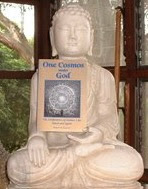
Some further thoughts on God and Gold. I'll probably be ready to move on after one more post. Bear in mind that many of the coonclusions drawn are my own. You can probably tell which.
One of Mead's central points is that "the choices between faith and unbelief did not appear as stark to much of the English-speaking world as they did elsewhere." Rather, we have been able to maintain a creative tension between them, which forms the essence of "dynamic religion." The dynamic religion of the Anglo-American world has not just been able to coexist with, but thrive upon, the sort of skepticism that is so corrosive and ultimately fatal to static religion (which ends up being the disease that kills curiosity). In other words, our form of religiosity was well-suited not just to usher in science, but to then assimilate it and give it meaning.
People naturally seek the comfort of a closed system of thought, whether it be religious or "scientific." In the West, we have been able to reconcile the absolute and relative, time and eternity, through the notion of progress, or evolution (understood in its broader, non-Darwinian sense). Mead does a good job of showing how we in the Anglo-American world -- whether secular or religious -- all share this spiritual deep structure of faith in the idea that progress is both possible and good. Thus, we can assimilate and make sense of change, whereas overly tradition-bound cultures see change as the enemy, and therefore reject the notion of progress. They cannot escape the closed circle of tradition and therefore evolve forward.
But at the same time, English society "decided that reason cannot stand alone as the basis for a human society." In fact, "the 'scientific' societies of the Communist world, boasting of their objective grounding in rational and scientific truth... were considerably less flexible than the Western societies they opposed," just as "there was less freedom in France under Robespierre and his Reign of Terror than under the less systematic and less 'rational' revolutionary governments that preceded it."
With respect to change and progress, "the degree to which the individualistic basis of Anglo-American religious experience links the religious life of the individual to a God who reveals Himself in the changes and upheavals of life, rather than in the stabilities and unchanging verities, has had a profound effect and continues to exercise a powerful force on the English-speaking world today."
Virtually all of us in the Anglo-American world are progressives, which is to say whigs, which sets us apart from almost all cultures that have preceded -- and coexist with -- us. This is why a Raccoon believes in darwhiggian evolution. Of course evolution exists, as it is a necessary consequence of the existence of God. The only place evolution cannot occur is "within" (some might argue "beyond") God, or in the ground of the Absolute, which is necessarily outside time and therefore free of change. However, one could argue that evolution is also impossible within the leftist university, since they create a "shadow eternity" that is cut off from reality. But that is obviously a temporary condition.
Progress can only exist in the light of permanence, otherwise it is merely "change." The secular folks who go by the name "progressive" are in fact mere "changeists," since they reject that by which progress can be objectively measured, i.e., God, the Absolute.
Mead notes that Milton was one of the first to recognize this, and to argue that "truth is revealed in a process," so that "knowledge of God [as opposed to God in Himself -- GB] must necessarily change over time." Of Truth, Milton wrote that "if her waters flow not in a perpetual progression, they sicken into a muddy pool of conformity and tradition," the perfect image of a closed system -- and only an open system is susceptible to evolution.
In the English-speaking world, change was eventually understood "as a permanent, necessary, and even sanctified element of true religion." This is also responsible for our inherent optimism (at least for non-leftists), in that "the ever-recurring belief that the world is about to become a much better place is deeply rooted in Anglo-American culture." Thus, whiny and pessimistic leftists are intrinsically un-American (spritually, not factually).
Here is an interesting idea, which, like it or not, links the most unfun fundamentalist to the newest newageist: in the Anglo-American world, We are all Abraham now. The idea that we must have "a personal relationship with God" has "for more than three centuries been strengthening its hold in American life." That we must all "answer the call" and discover our own identity, vocation, and meaning, testifies "to the power of the Abrahamic archetype in the American mind":
"The Abrahamic believer, convinced that God is leading the way to an unknown future in a new land, is ready to accept not only the personal but also social consequences" of his freedom -- including his economic freedom. Those grounded in static religion naturally have difficulty accepting change, but "for the dynamic believer, change is both a sign of progress and an opportunity to show the growing virtue of faith." Thus, "with an energy that no centralizing power could ever summon or shape, millions of Americans through decades and centuries spontaneously" struggle to improve themselves and progress toward God.
Another provocative idea: "yankee secularism" is just another variation of our archetypal religious puritanism. For example, the radical secularist has simply "translated both the fervor and the certainty of ancestral New England religious convictions into a set of secular political values." And how!
Again, as we were saying the other day, there is no priggish, sanctimonious moral scold of a church lady like a secular one, such as Al Gore or the New York Times idiotorial board. Dailykos is nothing but fire-and-brimstone, snake-handling, religiously secular fundamentalist whack-jobs (see Dr. Sanity's post today for more fine examples). They hardly exude the "amused and easy tolerance" of a good-natured Raccoon, but rather, "the bitter response of a Calvinist divine to the whiff of heresy." On the one hand, America is "filled with radical revolutionaries who think they are religious conservatives." But it is also filled with conservative secular fundamentalists who think they are progressives.
Saturday, November 10, 2007


Friday, November 09, 2007
Learning and Relearning the Americoon Way (11.01.10)
Some things I have learned from God and Gold:
Since the Glorious Revolution of 1688, the Anglo-Americans have been on the winning side in every international conflict. And we didn't just win these conflicts, but reorganized the world in our image. Much of the resentment toward us has to do with the fact that in order to survive and flourish in this world, you must adapt your dopey world to the world we both discovered and made, which is to say, "reality" -- and nothing is the source of more resentment than the demands of reality.
Never confuse "Anglo-American" with "European," much less "white," let alone "French." "It is France that has most often attempted to defeat or at least most often contain" the Anglo-Americans. "Whatever we call it, the hatred and fear of white Anglo-Saxon Protestants and all of their doings is one of the motors driving the world." It is "one of the key organizing principles that many observers use to make sense of mysterious events," i.e., it is an unconscious paranoid process that animates resentful and envious people who don't really have any ideas, only rebellious anti-ideas.
We see ourselves as fighting for liberty over tyranny; the French see themselves as fighting for "civilization" over barbarism, especially us. As one frog put it, "America is the only nation in history which miraculously has gone directly from barbarism to degeneration without the usual interval of civilization." Or as an intellectual from one of those useless South American countries put it, "Americans are Englishmen with the good qualities left out and the bad qualities swollen to fill up the vacuum."
Very early on, the Anglo-Americans discovered the dynamics of complex systems, i.e., the "invisible hand." They understood that order emerges from chaos, not just in economics, but in virtually every realm -- politics, the marketplace of ideas, science, relationships, etc. Most cultures -- including half of our own -- still struggle with the idea that most things will improve if only you leave them alone.
Anti-Anglo-Americanism is a constant in world history. It just takes different forms. Thus, the hatred of President Bush, both here and abroad, is nothing new. It's been the same pattern from from Louis XIV to Osama bin Laden to the New York Times.
For at least a couple hundred years, sensible Anglo-Americans have been predicting the End of History -- the end of poverty, war, stupidity, and all the other follies of fallen mankind. We always think world peace is just around the corner, under the assumption that the rest of the world will naturally come to its senses and adopt our liberal values, since they are obviously so successful. George Bush may be the latest victim of this sanguine view of mankind, i.e., giving Muslims the gift of freedom and expecting them to appreciate or make use of it
Heidegger is an even bigger a**hole than I thought: first he sees Hitler and Nazism as "Europe's best and even noblest protection from the twin threats" of Marxism and "Americanism"; then he concludes that the latter "is the hideous final destination on humanity's road away from a meaningful way of life"; and then he finally decides that "the Marxist machine, for all its evil, was less dangerous than the American." And Heidegger's vision "remains central to much European and Latin-American anti-Americanism today...." Truly, you could pick a name at random out of the phone book and obtain more wisdom than from this "great" philosopher.
Ever since England established the first national bank over 300 years, ago, economic illiterates have been howling that national debt would bring economic catastrophe and ruin, but instead, it has always led to more growth. You could publish a Paul Krugman editorial in 1740, and it would be just as timely as today. (Wisdom is not the only human knowledge that is timeless; a corollary is that certain forms of stupidity, or (-k), are timeless as well, something well understood in scripture.)
What Germany is to music and Italy to painting and sculpture, New York and London are to finance.
All Raccoons know this, but it's worth repeating: in reality, only the free market respects the masses, as it efficiently responds to their genuine needs, even if elites have comtempt for them. In traditional or elitist societies it is "the rulers and well-born whose tastes must be studied, prejudices indulged, and caprices made much of." "The power of mass consumption, harnessed by flexible markets to the economic interest of the talented, may be the most revolutionary human discovery since the taming of fire. The changes that have come and will come from this union of the ambitions of the elites with the aspirations of the masses are incalculable."
By the time Marx was dead and writing his books, middle and lower-income families were already enjoying "a higher standard of living in some ways than even the most aristocratic households had enjoyed only a half century before." Thus, his ideas were born obsolete, one reason why leftist academia is such a soul-killing environment.
It is because Anglo-American governments have been so relatively weak that they have been so strong. Like the free market, they must respect the wishes of the people and lean on voluntary cooperation instead of coercion. Thus, big government will necessarily become unpopular, because it no longer need respond to the citizenry and instead must coerce or use force. This is why everyone hates the IRS or recognizes the failures of the education establishment or the problems with social security, but no one can change them. Imagine the permanent nightmare of nationalized healthcare, which constitutes some 17% of our economy.
Again, all Raccoons know this, but societies that overvalue reason and devalue tradition and revelation become dysfunctional and cannot evolve. "Dynamic religion" is the philosopher Bergson's term for "the angel that calls people forward to ever more open societies." Those who have read the Coonifesto will be familiar with my idea that only open religion specifically engages the eschaton, O, luring the open system toward it, both individually and collectively. Mead notes that open religion can take many forms, such as "a feeling of restlessness and unease, a yearning for new experiences, a voice in the head shouting warnings or commands, visions, dreams, or ideas." It is living religion, or O-->(n).
Dead or "static religion" is the historical norm, certainly outside the Judeo-Christian world, but often within it as well. And radical secularism can be as much a static religion as any other. In this regard it is the form -- the deep structure -- not the substance, that counts. Put it this way: whoever you are, you either practice a dead religion or a living one:
"The tragic choice that many self-consciously 'modern' observers see between the black-and-white realism of open modernity and the visionary colors and imagery of closed tradition and myth disappears if Bergson's dynamic religion is taken into account." We cannot do without our great visions that "light up the western sky" and "stir human souls to the depths," driving us to "to pull up our stakes and move on," which is to say evolve, both within and toward O.
Which is why Raccoon philosophy is simply the operative philosophy of reality; it is what we might call "dynamic" or "evolutionary neo-traditionalism."
That's only half the book... we'll get to the second half in the next post.
Since the Glorious Revolution of 1688, the Anglo-Americans have been on the winning side in every international conflict. And we didn't just win these conflicts, but reorganized the world in our image. Much of the resentment toward us has to do with the fact that in order to survive and flourish in this world, you must adapt your dopey world to the world we both discovered and made, which is to say, "reality" -- and nothing is the source of more resentment than the demands of reality.
Never confuse "Anglo-American" with "European," much less "white," let alone "French." "It is France that has most often attempted to defeat or at least most often contain" the Anglo-Americans. "Whatever we call it, the hatred and fear of white Anglo-Saxon Protestants and all of their doings is one of the motors driving the world." It is "one of the key organizing principles that many observers use to make sense of mysterious events," i.e., it is an unconscious paranoid process that animates resentful and envious people who don't really have any ideas, only rebellious anti-ideas.
We see ourselves as fighting for liberty over tyranny; the French see themselves as fighting for "civilization" over barbarism, especially us. As one frog put it, "America is the only nation in history which miraculously has gone directly from barbarism to degeneration without the usual interval of civilization." Or as an intellectual from one of those useless South American countries put it, "Americans are Englishmen with the good qualities left out and the bad qualities swollen to fill up the vacuum."
Very early on, the Anglo-Americans discovered the dynamics of complex systems, i.e., the "invisible hand." They understood that order emerges from chaos, not just in economics, but in virtually every realm -- politics, the marketplace of ideas, science, relationships, etc. Most cultures -- including half of our own -- still struggle with the idea that most things will improve if only you leave them alone.
Anti-Anglo-Americanism is a constant in world history. It just takes different forms. Thus, the hatred of President Bush, both here and abroad, is nothing new. It's been the same pattern from from Louis XIV to Osama bin Laden to the New York Times.
For at least a couple hundred years, sensible Anglo-Americans have been predicting the End of History -- the end of poverty, war, stupidity, and all the other follies of fallen mankind. We always think world peace is just around the corner, under the assumption that the rest of the world will naturally come to its senses and adopt our liberal values, since they are obviously so successful. George Bush may be the latest victim of this sanguine view of mankind, i.e., giving Muslims the gift of freedom and expecting them to appreciate or make use of it
Heidegger is an even bigger a**hole than I thought: first he sees Hitler and Nazism as "Europe's best and even noblest protection from the twin threats" of Marxism and "Americanism"; then he concludes that the latter "is the hideous final destination on humanity's road away from a meaningful way of life"; and then he finally decides that "the Marxist machine, for all its evil, was less dangerous than the American." And Heidegger's vision "remains central to much European and Latin-American anti-Americanism today...." Truly, you could pick a name at random out of the phone book and obtain more wisdom than from this "great" philosopher.
Ever since England established the first national bank over 300 years, ago, economic illiterates have been howling that national debt would bring economic catastrophe and ruin, but instead, it has always led to more growth. You could publish a Paul Krugman editorial in 1740, and it would be just as timely as today. (Wisdom is not the only human knowledge that is timeless; a corollary is that certain forms of stupidity, or (-k), are timeless as well, something well understood in scripture.)
What Germany is to music and Italy to painting and sculpture, New York and London are to finance.
All Raccoons know this, but it's worth repeating: in reality, only the free market respects the masses, as it efficiently responds to their genuine needs, even if elites have comtempt for them. In traditional or elitist societies it is "the rulers and well-born whose tastes must be studied, prejudices indulged, and caprices made much of." "The power of mass consumption, harnessed by flexible markets to the economic interest of the talented, may be the most revolutionary human discovery since the taming of fire. The changes that have come and will come from this union of the ambitions of the elites with the aspirations of the masses are incalculable."
By the time Marx was dead and writing his books, middle and lower-income families were already enjoying "a higher standard of living in some ways than even the most aristocratic households had enjoyed only a half century before." Thus, his ideas were born obsolete, one reason why leftist academia is such a soul-killing environment.
It is because Anglo-American governments have been so relatively weak that they have been so strong. Like the free market, they must respect the wishes of the people and lean on voluntary cooperation instead of coercion. Thus, big government will necessarily become unpopular, because it no longer need respond to the citizenry and instead must coerce or use force. This is why everyone hates the IRS or recognizes the failures of the education establishment or the problems with social security, but no one can change them. Imagine the permanent nightmare of nationalized healthcare, which constitutes some 17% of our economy.
Again, all Raccoons know this, but societies that overvalue reason and devalue tradition and revelation become dysfunctional and cannot evolve. "Dynamic religion" is the philosopher Bergson's term for "the angel that calls people forward to ever more open societies." Those who have read the Coonifesto will be familiar with my idea that only open religion specifically engages the eschaton, O, luring the open system toward it, both individually and collectively. Mead notes that open religion can take many forms, such as "a feeling of restlessness and unease, a yearning for new experiences, a voice in the head shouting warnings or commands, visions, dreams, or ideas." It is living religion, or O-->(n).
Dead or "static religion" is the historical norm, certainly outside the Judeo-Christian world, but often within it as well. And radical secularism can be as much a static religion as any other. In this regard it is the form -- the deep structure -- not the substance, that counts. Put it this way: whoever you are, you either practice a dead religion or a living one:
"The tragic choice that many self-consciously 'modern' observers see between the black-and-white realism of open modernity and the visionary colors and imagery of closed tradition and myth disappears if Bergson's dynamic religion is taken into account." We cannot do without our great visions that "light up the western sky" and "stir human souls to the depths," driving us to "to pull up our stakes and move on," which is to say evolve, both within and toward O.
Which is why Raccoon philosophy is simply the operative philosophy of reality; it is what we might call "dynamic" or "evolutionary neo-traditionalism."
That's only half the book... we'll get to the second half in the next post.
Thursday, November 08, 2007
The Closed Society and Its Financier
Not sure if I'll have time to post this morning. I have a busy day ahead, plus I'm still uploading Mead's book, God and Gold, into my melon, and it's taking longer than anticipated. Most secular books can be uploaded and assimilated into one's essence (at least the valuable parts) very quickly, but not this one. He tosses off too many provocative insights that fill nearly every page. I may ultimately reject them, but he is a serious thinker who definitely knows a lot more than I ever will about history, economics and political science.
In one sense it is a joy to learn, but clearly not always. If it were an unbridled joy, then everyone would continue learning throughout their lives, instead of stopping at the age of 21 or so. But even for people who do enjoy learning, Bion observed that the epistemophilic instinct was countered by another aspect of ourselves that associated Truth with dread, since Truth is catastrophic. Thus, for example, we see the common phenomenon of tenured hack- and wackademics spending their lives defending kooky and dysfunctional beliefs, as in our leftist looniversity bins.
And when I say truth is "catastrophic," I don't mean it in the sense of a natural catastrophe, but in the parlance of chaos and complexity theories, i.e., catastrophic change. Obviously, if one is confronted with a deep truth of which one is unaware, it has the potential to fundamentally destabilize the structure of one's mind. It's what makes the societies of the Middle East and of leftist academia so "brittle."
This is what Bion felt was underneath the ubiquitous phenomenon of resistance in psychoanalytic therapy. A part of us wants to know the truth about ourselves so that we might grow toward health. But another part resists the insight, not just because change is painful and uncertain, but because there are subversive parts of ourselves -- i.e., mind parasites -- that wish to "go on being," just like any other living entity.
In a certain broad sense, there are two types of thinkers, Platonists and Aristotelians. The former are "top town" types who think and organize the world in terms of deep principles, whereas the latter are more "bottom up" thinkers who work inductively to arrive at their principles. There are clear dangers associated with each extreme, and a healthy person will find a way to live in the dialectical space between the two modes.
In a certain sense, you might say that this is the difference between theologians and scientists, dogmatists and free thinkers, closed minds and open ones, but that clearly isn't always the case. For example, one of the differences between Orthodoxy and Catholicism is that the latter, in the person of Thomas Aquinas, attempted to assimilate science and philosophy by developing a rational theology, whereas the former -- with some exceptions -- made no such attempt. Rather, Orthodoxy developed a mystical theology rooted mainly in transcendent experience.
Protestants obviously broke away even further in taking the world into consideration and therefore making science possible (although now, ironically, certain "fundamentalist" protestant sects have come full circle, and are the most vocal in clinging to scriptural principles as sufficient to explain the world; and secular science itself often becomes a closed system with all the trappings of religion, as we will be discussing in a subsequent post).
Dilys touched on the irony of this in a comment yesterday -- how being "an extremely American convert to Orthodox Christianity" necessitates "doing an ungainly cultural split: The pure and untampered-with Revelation of the Trinity is indispensable; but without the adjunct of Good Common Sense and decentralization by English faithfulness to their own political and imperial self-interest, and a period of ruthless altar-stripping, there would be no American Experiment." In a sense, it is a question of the relationship between time and eternity. One can embrace and internalize the eternal (Platonic, so to speak) principles of Orthodoxy, but the Aristotelian world keeps turning. Okay, you're saved. Now what?
I'm afraid I'm rambling a bit, but that's simply a function of the temporary destabilization this book has caused me. Imagine my shock when I flipped toward the back of the book, and the name "Soros" poppered out at me. Hmm. Does he despise Soros as much as a Raccoon does? "I also want to thank George Soros for the work he has done on Karl Popper and the open society. Astute readers of God and Gold will have no trouble recognizing my considerable debt to George's work, and some of the ideas in this book were first broached in conversations at his dinner table."
!!!???
And he didn't even bring a long spoon?
I mean, I realize that a man's gotta eat. But now, all of a sudden, I'm placed in a position of questioning Mead's ethics, his judgment, and possibly his sanity. When I first heard several years ago that Soros was an acolyte of Karl Popper, my only thought was and remains, "How can someone so thoroughly misunderstand the practical implications of this esteemed philosopher?," for -- unless I am deeply mistaken -- it is the equivalent of admiring Karl Marx and therefore passionately advocating the policies of Ronald Reagan. Popper was profoundly anti-communist, and in many ways, his political philosophy is the final answer to any and all versions of both left-wing and religiously closed societies (i.e., political Islam).
I've only read parts of the Open Society, but as far as I know, I agree with its broad principles. However, I believe that the same principles are much more adequately and subtly articulated in the works of Michael Polanyi, in part because Polanyi had a much deeper appreciation of the spiritual dimension. In Popper's case, he believed that no general principle could be ultimately proved, only disproved, that is, tested. This essentially throws aside all of the priceless wisdom embodied in revelation and tradition, since even an obvious statement such as "God is light" cannot be empirically falsified. As we were saying the other day, Polanyi had a much more subtle and sophisticated understanding of both art and religion, of how they can function analogously to the blind man's cane, allowing us to probe ontologically real suprasensible realms.
The philopopper Bryan Magee cites the example of the statement "God exists": "It has meaning, and might be true, but no intellectually serious person would regard it as a scientific statement." Au contraire (which I have never said before): Following Gödel, no intellectually serious person would reduce the vast realm of truth to that which can be empirically disproven, and no one but a very confused person would apply an inappropriate scientific method to study transcendental truth.
For, as thy Wilber done so ably explained, there are at least three broad domains that may be studied "scientifically," the empirical, the rational, and the transcendental. Just as our empirical eye cannot "see" the world of reason (for example, no one has ever seen the square root of negative one), the rational eye cannot see, for example, the noetic light that illuminates the vertical realm. To do that, you require the proper method, e.g., meditation, contemplation, intellection, prayer, purchasing an indulgence from Petey, etc.
(Speaking of vision, I don't really see how Magee can reconcile his deep appreciation of Schopenhauer with Popper, since Schopie comes within a whisker of disclosing the insights of the Upanishads, which constitute nothing less than a "scientific" disquisition on the nature of the nonlocal noumenon, or Brahman -- which cannot be falsified, but which is the absolute truth and ground of everything else.)
Getting back to Soros. He is an advocate of the open society, but I am quite sure he means something very different than I do by the use of that term, for he is a passionate leftist, and the left is always at the vanguard of man's regressive tendency toward the closed society. To cite one recent but extremely illustrative example, he is the financier behind Media Matters, a leftist group that monitors, harasses, and intimidates conservative thinkers for statements that they think can be distorted and exploited to their political advantage. Unlike conservative groups that simply monitor the mainstream media for leftist bias, the left wing Media Matters monitors mainly the conservative media, finding things they can take out of context to then feed to the servile mainstream media for general propagation.
Most recently, Ann Coulter was the victim of this, with the bogus charges of anti-Semitism. But even more alarming were the wholly fraudulent charges against Rush Limbaugh over the "phony soldier" comment. In that case -- thanks to the vile Soros and his vile group -- Limbaugh was condemned on the floor of the United States Sentate, in what could not be more emblematic of the closed society of the left: that is to say, shut down dissent by any means possible, including the use of governmental force to make up lies about a citizen and threaten his job.
A decent man would not just apologize, but he would shut down the whole disgusting enterprise.
Oddly, Magee writes that Popper's "critique of Marxism was widely regarded as the most effective that anyone had produced, and it was this that first made Popper's name known internationally." So how on earth can someone be so morally, spirtually, and intellectually confused as to think he is advancing the work of Popper by embracing a movement -- the illiberal left -- that stands as a monument to all of the principles Popper opposed? And at the same time, equate a good and decent man with Hitler for trying for the first time in history to introduce principles of the open society into the Islamic world?
Madness.
Well, I ended up just rambling before I got to any of my main points.... It happens....
In one sense it is a joy to learn, but clearly not always. If it were an unbridled joy, then everyone would continue learning throughout their lives, instead of stopping at the age of 21 or so. But even for people who do enjoy learning, Bion observed that the epistemophilic instinct was countered by another aspect of ourselves that associated Truth with dread, since Truth is catastrophic. Thus, for example, we see the common phenomenon of tenured hack- and wackademics spending their lives defending kooky and dysfunctional beliefs, as in our leftist looniversity bins.
And when I say truth is "catastrophic," I don't mean it in the sense of a natural catastrophe, but in the parlance of chaos and complexity theories, i.e., catastrophic change. Obviously, if one is confronted with a deep truth of which one is unaware, it has the potential to fundamentally destabilize the structure of one's mind. It's what makes the societies of the Middle East and of leftist academia so "brittle."
This is what Bion felt was underneath the ubiquitous phenomenon of resistance in psychoanalytic therapy. A part of us wants to know the truth about ourselves so that we might grow toward health. But another part resists the insight, not just because change is painful and uncertain, but because there are subversive parts of ourselves -- i.e., mind parasites -- that wish to "go on being," just like any other living entity.
In a certain broad sense, there are two types of thinkers, Platonists and Aristotelians. The former are "top town" types who think and organize the world in terms of deep principles, whereas the latter are more "bottom up" thinkers who work inductively to arrive at their principles. There are clear dangers associated with each extreme, and a healthy person will find a way to live in the dialectical space between the two modes.
In a certain sense, you might say that this is the difference between theologians and scientists, dogmatists and free thinkers, closed minds and open ones, but that clearly isn't always the case. For example, one of the differences between Orthodoxy and Catholicism is that the latter, in the person of Thomas Aquinas, attempted to assimilate science and philosophy by developing a rational theology, whereas the former -- with some exceptions -- made no such attempt. Rather, Orthodoxy developed a mystical theology rooted mainly in transcendent experience.
Protestants obviously broke away even further in taking the world into consideration and therefore making science possible (although now, ironically, certain "fundamentalist" protestant sects have come full circle, and are the most vocal in clinging to scriptural principles as sufficient to explain the world; and secular science itself often becomes a closed system with all the trappings of religion, as we will be discussing in a subsequent post).
Dilys touched on the irony of this in a comment yesterday -- how being "an extremely American convert to Orthodox Christianity" necessitates "doing an ungainly cultural split: The pure and untampered-with Revelation of the Trinity is indispensable; but without the adjunct of Good Common Sense and decentralization by English faithfulness to their own political and imperial self-interest, and a period of ruthless altar-stripping, there would be no American Experiment." In a sense, it is a question of the relationship between time and eternity. One can embrace and internalize the eternal (Platonic, so to speak) principles of Orthodoxy, but the Aristotelian world keeps turning. Okay, you're saved. Now what?
I'm afraid I'm rambling a bit, but that's simply a function of the temporary destabilization this book has caused me. Imagine my shock when I flipped toward the back of the book, and the name "Soros" poppered out at me. Hmm. Does he despise Soros as much as a Raccoon does? "I also want to thank George Soros for the work he has done on Karl Popper and the open society. Astute readers of God and Gold will have no trouble recognizing my considerable debt to George's work, and some of the ideas in this book were first broached in conversations at his dinner table."
!!!???
And he didn't even bring a long spoon?
I mean, I realize that a man's gotta eat. But now, all of a sudden, I'm placed in a position of questioning Mead's ethics, his judgment, and possibly his sanity. When I first heard several years ago that Soros was an acolyte of Karl Popper, my only thought was and remains, "How can someone so thoroughly misunderstand the practical implications of this esteemed philosopher?," for -- unless I am deeply mistaken -- it is the equivalent of admiring Karl Marx and therefore passionately advocating the policies of Ronald Reagan. Popper was profoundly anti-communist, and in many ways, his political philosophy is the final answer to any and all versions of both left-wing and religiously closed societies (i.e., political Islam).
I've only read parts of the Open Society, but as far as I know, I agree with its broad principles. However, I believe that the same principles are much more adequately and subtly articulated in the works of Michael Polanyi, in part because Polanyi had a much deeper appreciation of the spiritual dimension. In Popper's case, he believed that no general principle could be ultimately proved, only disproved, that is, tested. This essentially throws aside all of the priceless wisdom embodied in revelation and tradition, since even an obvious statement such as "God is light" cannot be empirically falsified. As we were saying the other day, Polanyi had a much more subtle and sophisticated understanding of both art and religion, of how they can function analogously to the blind man's cane, allowing us to probe ontologically real suprasensible realms.
The philopopper Bryan Magee cites the example of the statement "God exists": "It has meaning, and might be true, but no intellectually serious person would regard it as a scientific statement." Au contraire (which I have never said before): Following Gödel, no intellectually serious person would reduce the vast realm of truth to that which can be empirically disproven, and no one but a very confused person would apply an inappropriate scientific method to study transcendental truth.
For, as thy Wilber done so ably explained, there are at least three broad domains that may be studied "scientifically," the empirical, the rational, and the transcendental. Just as our empirical eye cannot "see" the world of reason (for example, no one has ever seen the square root of negative one), the rational eye cannot see, for example, the noetic light that illuminates the vertical realm. To do that, you require the proper method, e.g., meditation, contemplation, intellection, prayer, purchasing an indulgence from Petey, etc.
(Speaking of vision, I don't really see how Magee can reconcile his deep appreciation of Schopenhauer with Popper, since Schopie comes within a whisker of disclosing the insights of the Upanishads, which constitute nothing less than a "scientific" disquisition on the nature of the nonlocal noumenon, or Brahman -- which cannot be falsified, but which is the absolute truth and ground of everything else.)
Getting back to Soros. He is an advocate of the open society, but I am quite sure he means something very different than I do by the use of that term, for he is a passionate leftist, and the left is always at the vanguard of man's regressive tendency toward the closed society. To cite one recent but extremely illustrative example, he is the financier behind Media Matters, a leftist group that monitors, harasses, and intimidates conservative thinkers for statements that they think can be distorted and exploited to their political advantage. Unlike conservative groups that simply monitor the mainstream media for leftist bias, the left wing Media Matters monitors mainly the conservative media, finding things they can take out of context to then feed to the servile mainstream media for general propagation.
Most recently, Ann Coulter was the victim of this, with the bogus charges of anti-Semitism. But even more alarming were the wholly fraudulent charges against Rush Limbaugh over the "phony soldier" comment. In that case -- thanks to the vile Soros and his vile group -- Limbaugh was condemned on the floor of the United States Sentate, in what could not be more emblematic of the closed society of the left: that is to say, shut down dissent by any means possible, including the use of governmental force to make up lies about a citizen and threaten his job.
A decent man would not just apologize, but he would shut down the whole disgusting enterprise.
Oddly, Magee writes that Popper's "critique of Marxism was widely regarded as the most effective that anyone had produced, and it was this that first made Popper's name known internationally." So how on earth can someone be so morally, spirtually, and intellectually confused as to think he is advancing the work of Popper by embracing a movement -- the illiberal left -- that stands as a monument to all of the principles Popper opposed? And at the same time, equate a good and decent man with Hitler for trying for the first time in history to introduce principles of the open society into the Islamic world?
Madness.
Well, I ended up just rambling before I got to any of my main points.... It happens....
Wednesday, November 07, 2007
I Had Too Much to Dream Last Night (11.01.10)
Well, not last night, but yesterday. I'm trying to tear through this wonderful new book by Walter Russell Mead, God and Gold: Britain, America, and the Making of the Modern World, but it's got so much information and so many interpretations that it's a little difficult to assimilate and rewordgitate it in the usual way. These days, most books I read are of the metaphysical/theological/philosophical/mythopoetic variety, which requires an entirely different skill set, or at least approach.
In the case of the latter, you're sort of internalizing the Dreamer, and then trying to see what the world looks like through that particular dreamer's eyes, say, Frithjof Schuon or Sri Aurobindo, two of history's greatest and most expansive cosmic dreamers. The cosmic metaphysical dream colors all the particulars of our experience, and in fact, allows one to notice many particulars that would otherwise elude us, and place them in the context of a greater and more encompassing vision. Obviously, you're not going to get much of this in a typical secular education.
Rather, in the case of most books, you're only getting the dream content, and it's up to you to come up with the dream that will synthesize it and give it meaning. When a book is too long, or poorly edited, or becomes weak or boring as it goes along, it's often because the author insufficiently dreamt the material. But most conventional scholars are not proper dreamers anyway, or else they just interpret the material through the controlling dream of the day, say, secular liberalism or materialistic scientism.
In a secular eduction, whatever else you learn, the worst part of it is that you will have internalized the Secular Dream -- which is actually a nightmare, or at least a dream unworthy of Man and that which (or Who) dreams him. As such, you will have committed spiritual cluelesside without even knowing it. Satan works in mysterious ways, but this isn't one of them. The public education system has been doing his heavy lifting for some 40 years now.
Not sure if I'm making myself clear. Take the miracle of Life, which is to say, Life Itself. You can hardly expect some academic worker-beeologist to place life in its proper dream context (not that we don't need worker bees and other hivenauts). Rather, in order to succeed at science, you often must either be a person who is cut off from, or disinterested in, the depths of his dream life, or simply passively accede to the institutional dream of professional biology, which is that life is but a machine, with no sh-boom at all.
But in the real dream world,
Hey nonny ding dong, alang alang alay
Boom ba-doh, ba-doo ba-doodle-ay
Oh, life could be a dream (sh-boom sh-boom)
If I could take you up in paradise up above (sh-boom sh-boom)
If you would tell me I'm the only one that you love
Life could be a dream, sweetheart
(Hello hello again, sh-boom & hopin' we'll meet again)
Or, in the words of Sri Aurobindo,
Mystic Miracle, daughter of Delight,
Life, thou ecstasy,
Let the radius of thy flight
Be eternity.
So at the moment, I'm trying to re-dream this book, or place it in the context of my own dream, since I naturally want my dream to encompass as much of reality as possible. Only the Dreamer can do this -- I mean, obviously machines can't do it. For example, supposing you knew every "historical fact" in existence, and then fed them all into a supercomputer. What do you suppose the computer would come up with? Would it be able to synthesize all the facts into a suitable dream? Of course not. Only a dreamer can historicize, even as history discloses the Dreamer Who Dreams It.
Of particular interest to me is the religious dream that has allowed the Anglo-American world to succeed where all other dreams failed, to such an extent that it is by far the most powerful dream the world has ever known. In fact, at present there are three primary dreams in competition for who will Dream history 1) American classical liberalism (i.e., conservatism), 2) European statist secular leftism (including its American variety), and 3) Islamism. The world is not big enough for all of these dreams, and yet, only one of these dreams is big enough for the world.
Mead's book is divided into five main sections, each of which is fascinating in its own right. But of particular interest to me is the third section, Anglo-Saxon Attitudes, which gets into the religious metaphysics -- our metaphysical dream -- which allowed the Anglo-Saxons to come to dominate the world over the past several centuries. Seen in the light of Mead's explanations, the Marxist counter-dream just looks silly -- i.e., that our success is based only upon oppression, or violence, or exploitation, or class warfare. Rather, our success is because our dream is much closer to reality -- or our reality is much closer to the Cosmic Dream and its Author.
For example, Mead gets into a subject I discussed in the Coonifesto, which is that only open systems can evolve, both individually and collectively. In a closed society, adventure is exchanged for security. Everyone knows their place or role and the tyranny of custom and tradition are complete, as in the contemporary Islamic world, or, to a lesser extent, among the ironically named "progressives." Because of their dominance, there is no place less intellectually -- let alone spiritually -- free in America than on a leftist university campus. Likewise, they represent the main organized opposition to that which, more than any other factor, has created so much progress in the world, the free market, compared to which the progressive movement has contributed essentially nil to the betterment of mankind.
As Mead writes, "the journey from East to West is a journey from relatively closed to relatively open society," both historically and geographically. For example, even in contemporary America, the world of the New York Times is the quintessence of a closed, parochial, backward-looking world view, especially as compared to the view here from Raccoon Lookout in Upper Tonga. But further east from New York to Paris, the view gets even more closed and crimped.
Later Mead notes that "History is in large part the record of efforts, more often successful than not, of the advocates of closed society to shut down open societies." For example, what is the contemporary culture war but the effort by leftist elites to strangle debate with political correctness and to enforce their narrow views on the rest of us, through the news media, through Hollywood, through acedemia, by packing the Supreme Court, etc.? Mead writes that "History may be understood as a series of efforts to tame the disruptive intellectual and political forces of an open society and restore the closed society with its stability and reassuringly eternal and absolute qualities."
Now obviously, it isn't just secular leftists who want to shut down progress and create a closed society. In the past, traditional religion has most often been the main adversary of the open society, and therefore progress. A large section of Mead's book is devoted to explaining how we in the Anglo-American world got it just right in terms of religious metaphysics, in such a way that progress not only became possible, but inevitable. But it is always a very tricky balance, and it's not something we should take for granted. Rather, as we shall see, it involves a "trinity," a three part dynamism that Mead calls tradition-revelation-reason. Societies that move too far in one of these directions become dysfunctional, and either cannot endure or cannot evolve.
I'm unfortunately running out of time here, but in a subsequent post, I especially want to get into an idea that I believe will be of particular interest to Raccoons, which is the distinction between what Mead calls static religion and dynamic religion, for this is a key that unlocks many cosmic doors -- perhaps all of them.
VOTE quickly, before the arrival of the Blue Celephalapodians.
In the case of the latter, you're sort of internalizing the Dreamer, and then trying to see what the world looks like through that particular dreamer's eyes, say, Frithjof Schuon or Sri Aurobindo, two of history's greatest and most expansive cosmic dreamers. The cosmic metaphysical dream colors all the particulars of our experience, and in fact, allows one to notice many particulars that would otherwise elude us, and place them in the context of a greater and more encompassing vision. Obviously, you're not going to get much of this in a typical secular education.
Rather, in the case of most books, you're only getting the dream content, and it's up to you to come up with the dream that will synthesize it and give it meaning. When a book is too long, or poorly edited, or becomes weak or boring as it goes along, it's often because the author insufficiently dreamt the material. But most conventional scholars are not proper dreamers anyway, or else they just interpret the material through the controlling dream of the day, say, secular liberalism or materialistic scientism.
In a secular eduction, whatever else you learn, the worst part of it is that you will have internalized the Secular Dream -- which is actually a nightmare, or at least a dream unworthy of Man and that which (or Who) dreams him. As such, you will have committed spiritual cluelesside without even knowing it. Satan works in mysterious ways, but this isn't one of them. The public education system has been doing his heavy lifting for some 40 years now.
Not sure if I'm making myself clear. Take the miracle of Life, which is to say, Life Itself. You can hardly expect some academic worker-beeologist to place life in its proper dream context (not that we don't need worker bees and other hivenauts). Rather, in order to succeed at science, you often must either be a person who is cut off from, or disinterested in, the depths of his dream life, or simply passively accede to the institutional dream of professional biology, which is that life is but a machine, with no sh-boom at all.
But in the real dream world,
Hey nonny ding dong, alang alang alay
Boom ba-doh, ba-doo ba-doodle-ay
Oh, life could be a dream (sh-boom sh-boom)
If I could take you up in paradise up above (sh-boom sh-boom)
If you would tell me I'm the only one that you love
Life could be a dream, sweetheart
(Hello hello again, sh-boom & hopin' we'll meet again)
Or, in the words of Sri Aurobindo,
Mystic Miracle, daughter of Delight,
Life, thou ecstasy,
Let the radius of thy flight
Be eternity.
So at the moment, I'm trying to re-dream this book, or place it in the context of my own dream, since I naturally want my dream to encompass as much of reality as possible. Only the Dreamer can do this -- I mean, obviously machines can't do it. For example, supposing you knew every "historical fact" in existence, and then fed them all into a supercomputer. What do you suppose the computer would come up with? Would it be able to synthesize all the facts into a suitable dream? Of course not. Only a dreamer can historicize, even as history discloses the Dreamer Who Dreams It.
Of particular interest to me is the religious dream that has allowed the Anglo-American world to succeed where all other dreams failed, to such an extent that it is by far the most powerful dream the world has ever known. In fact, at present there are three primary dreams in competition for who will Dream history 1) American classical liberalism (i.e., conservatism), 2) European statist secular leftism (including its American variety), and 3) Islamism. The world is not big enough for all of these dreams, and yet, only one of these dreams is big enough for the world.
Mead's book is divided into five main sections, each of which is fascinating in its own right. But of particular interest to me is the third section, Anglo-Saxon Attitudes, which gets into the religious metaphysics -- our metaphysical dream -- which allowed the Anglo-Saxons to come to dominate the world over the past several centuries. Seen in the light of Mead's explanations, the Marxist counter-dream just looks silly -- i.e., that our success is based only upon oppression, or violence, or exploitation, or class warfare. Rather, our success is because our dream is much closer to reality -- or our reality is much closer to the Cosmic Dream and its Author.
For example, Mead gets into a subject I discussed in the Coonifesto, which is that only open systems can evolve, both individually and collectively. In a closed society, adventure is exchanged for security. Everyone knows their place or role and the tyranny of custom and tradition are complete, as in the contemporary Islamic world, or, to a lesser extent, among the ironically named "progressives." Because of their dominance, there is no place less intellectually -- let alone spiritually -- free in America than on a leftist university campus. Likewise, they represent the main organized opposition to that which, more than any other factor, has created so much progress in the world, the free market, compared to which the progressive movement has contributed essentially nil to the betterment of mankind.
As Mead writes, "the journey from East to West is a journey from relatively closed to relatively open society," both historically and geographically. For example, even in contemporary America, the world of the New York Times is the quintessence of a closed, parochial, backward-looking world view, especially as compared to the view here from Raccoon Lookout in Upper Tonga. But further east from New York to Paris, the view gets even more closed and crimped.
Later Mead notes that "History is in large part the record of efforts, more often successful than not, of the advocates of closed society to shut down open societies." For example, what is the contemporary culture war but the effort by leftist elites to strangle debate with political correctness and to enforce their narrow views on the rest of us, through the news media, through Hollywood, through acedemia, by packing the Supreme Court, etc.? Mead writes that "History may be understood as a series of efforts to tame the disruptive intellectual and political forces of an open society and restore the closed society with its stability and reassuringly eternal and absolute qualities."
Now obviously, it isn't just secular leftists who want to shut down progress and create a closed society. In the past, traditional religion has most often been the main adversary of the open society, and therefore progress. A large section of Mead's book is devoted to explaining how we in the Anglo-American world got it just right in terms of religious metaphysics, in such a way that progress not only became possible, but inevitable. But it is always a very tricky balance, and it's not something we should take for granted. Rather, as we shall see, it involves a "trinity," a three part dynamism that Mead calls tradition-revelation-reason. Societies that move too far in one of these directions become dysfunctional, and either cannot endure or cannot evolve.
I'm unfortunately running out of time here, but in a subsequent post, I especially want to get into an idea that I believe will be of particular interest to Raccoons, which is the distinction between what Mead calls static religion and dynamic religion, for this is a key that unlocks many cosmic doors -- perhaps all of them.
VOTE quickly, before the arrival of the Blue Celephalapodians.
Tuesday, November 06, 2007
The Ontological Divide Within the Liberal West (3.16.10)
Although my visiting father-in-law thinks he knows the reasons for his devout atheism, he has no idea that he is actually immersed in a discredited metaphysic that he simply "assumes," and therefore requires no defense. It's just "common sense." In his view, it is incumbent upon believers to prove to him the existence of God -- even though he is the one making the extraordinary claim, given the relatively tiny number of doctrinaire atheists who exist and who, for whatever reason, are unable to apprehend the spiritual dimension. The average person obviously doesn't have this difficulty, even if he cannot articulate why with reasons that could satisfy the pneumacognitive idiosyncracies of the atheist.
Polanyi felt that the contemporary madness of postmodernity began with the idea of a complete and perfect objectivism, which is supposed to be the ideal of science and of all reliable knowledge in general: "All personal and subjective elements came to be regarded as disturbances to the attainment of this perfect objectivity. Every effort therefore had to be made to eliminate them." It was as if Nature spoke directly and unamibuously to us, and that all we had to do was disinterestedly listen to her without any preconceptions.
This ideal, which may at times be appropriate for certain limited, very simple domains, eventually insinuated itself into most fields of knowledge. But this epistemological revolution had anthropological consequences, as it served to undermine traditional authority and create a kind of hyper-individualism operating outside the domain of any legitimate authority.
As Hoarhey mentioned in a comment yesterday, this irrational-rational revolt reached a kind of peak in the late 1960s. In other words, the "rational" rejection of religion in particular and tradition in general facilitated an absurd leap into what amounts to romantic irrationalism. Since there is no legitimate authority, each person become a law unto himself: do your own thing, and all that.
For example, marriage is better then living together? Prove it. A fetus is a human being? Prove it. Beethoven is better than rap? Prove it. Heterosexuality is preferable to homosexuality? Prove it. Men and women are fundamentally different? Prove it. One is obligated to tell the truth? Prove it. Etc., etc. In each case, the moral truth is accessible to human beings, but not through the application of mere reason.
This kind of nihilistic thought eventually overcame continental Europe (e.g., communism, fascism, nazism, deconstruction, multiculturalism, moral relativism, etc.), but not the Anglo-American sphere, where there was "an alogical reluctance to pursue the accepted philosophic premises to their ultimate conclusions." In turn, this reluctance seemed to be rooted in "the distinctive religious character of Anglo-American liberalism" (or what is now confusingly called conservatism).
But on the Continent, there were no such restraints against unalloyed skepticism. Rather, "the movement there was antireligious from the start.... When a feudal society, dominated by religious authority, was attacked by radical skepticism, there emerged a liberalism unprotected by either a religious or civic tradition against destruction by a logical extension of the philosophic skepticism to which it owed its origin." In short, in old Europe, universal standards of reason could not be reconciled with their radical skepticism, whereas Anglo-American liberalism maintained a balance between reason and tradition.
This dichotomy is still present today in the vast differences between conservatism (i.e., real liberalism) and liberalism (i.e., illiberal leftism). Leftism continues to be riddled with contradictions that are rooted in its initial philosophical error. For example, one of their rock-bottom beliefs is that there is no rational or universal way to arbitrate between the values of one culture or nation and another. Therefore, it is wrong to stand in the way of any nation that wishes to realize its powers, say Iran. But when America exercises its power, there is universal condemnation from the left. How can this be?
Once again it has to do with the unhinged morality of the left. Being that their skepticism bars them from the spiritual dimension, they are unable to reliably distinguish between good and evil -- i.e., these are simply arbitrary categories. Reduced to flatland materialism, they instead divide the world into visible, empirical categories such as have and have-nots. As such, they conceive a material explanation onto which they graft their unhinged moral passion. They do the same thing with other material categories, such as race, gender and "sexual orientation." As such, all of the moral energy which, in a spiritually normal person, is reserved for distinguishing between good and evil, decent and indecent, is ruthlessly, even sadistically, applied to these meaningless substitute categories.
This explains the grotesque and perverse moral passion of the left, for example, the condemnation of the Duke lacrosse team by dozens of leftist professors who do not see good and evil, only "white and black" (and they still haven't apologized, since the "narrative" or template they imposed on the situation cannot be falsified). Likewise, in the Arab-Israeli conflict, the left obviously cannot see the moral gulf between Israel and her barbarous enemies. Rather, they only see "whiteness and indigenous-ness," or something along those lines.
In old Europe, "the replacement of moral ideals by philosophically less vulnerable, because more basically animal, objectives was carried out in all seriousness. Human appetites and human passions were actually substituted for reason and for the ideals of man in this framework of thought." "Begun in the name of reason, they ended by reducing reason to a caricature of itself: to a mere rationalization of conclusions predetermined by desire and eventually to be secured and held by force.... If thought and reason are nothing by themselves, if they are only the effects of social causes, then it is meaningless to demand that they be set free."
Slavery is freedom, lies are truth, amorality is morality. Memo to old Europe: a civilization not in contact with the Real will eventually perish. As it should. To put it another way, dying on the vine is a possibility, but dying off of it is a certainty.
*All quotes taken from Michael Polanyi: A Critical Exposition
Polanyi felt that the contemporary madness of postmodernity began with the idea of a complete and perfect objectivism, which is supposed to be the ideal of science and of all reliable knowledge in general: "All personal and subjective elements came to be regarded as disturbances to the attainment of this perfect objectivity. Every effort therefore had to be made to eliminate them." It was as if Nature spoke directly and unamibuously to us, and that all we had to do was disinterestedly listen to her without any preconceptions.
This ideal, which may at times be appropriate for certain limited, very simple domains, eventually insinuated itself into most fields of knowledge. But this epistemological revolution had anthropological consequences, as it served to undermine traditional authority and create a kind of hyper-individualism operating outside the domain of any legitimate authority.
As Hoarhey mentioned in a comment yesterday, this irrational-rational revolt reached a kind of peak in the late 1960s. In other words, the "rational" rejection of religion in particular and tradition in general facilitated an absurd leap into what amounts to romantic irrationalism. Since there is no legitimate authority, each person become a law unto himself: do your own thing, and all that.
For example, marriage is better then living together? Prove it. A fetus is a human being? Prove it. Beethoven is better than rap? Prove it. Heterosexuality is preferable to homosexuality? Prove it. Men and women are fundamentally different? Prove it. One is obligated to tell the truth? Prove it. Etc., etc. In each case, the moral truth is accessible to human beings, but not through the application of mere reason.
This kind of nihilistic thought eventually overcame continental Europe (e.g., communism, fascism, nazism, deconstruction, multiculturalism, moral relativism, etc.), but not the Anglo-American sphere, where there was "an alogical reluctance to pursue the accepted philosophic premises to their ultimate conclusions." In turn, this reluctance seemed to be rooted in "the distinctive religious character of Anglo-American liberalism" (or what is now confusingly called conservatism).
But on the Continent, there were no such restraints against unalloyed skepticism. Rather, "the movement there was antireligious from the start.... When a feudal society, dominated by religious authority, was attacked by radical skepticism, there emerged a liberalism unprotected by either a religious or civic tradition against destruction by a logical extension of the philosophic skepticism to which it owed its origin." In short, in old Europe, universal standards of reason could not be reconciled with their radical skepticism, whereas Anglo-American liberalism maintained a balance between reason and tradition.
This dichotomy is still present today in the vast differences between conservatism (i.e., real liberalism) and liberalism (i.e., illiberal leftism). Leftism continues to be riddled with contradictions that are rooted in its initial philosophical error. For example, one of their rock-bottom beliefs is that there is no rational or universal way to arbitrate between the values of one culture or nation and another. Therefore, it is wrong to stand in the way of any nation that wishes to realize its powers, say Iran. But when America exercises its power, there is universal condemnation from the left. How can this be?
Once again it has to do with the unhinged morality of the left. Being that their skepticism bars them from the spiritual dimension, they are unable to reliably distinguish between good and evil -- i.e., these are simply arbitrary categories. Reduced to flatland materialism, they instead divide the world into visible, empirical categories such as have and have-nots. As such, they conceive a material explanation onto which they graft their unhinged moral passion. They do the same thing with other material categories, such as race, gender and "sexual orientation." As such, all of the moral energy which, in a spiritually normal person, is reserved for distinguishing between good and evil, decent and indecent, is ruthlessly, even sadistically, applied to these meaningless substitute categories.
This explains the grotesque and perverse moral passion of the left, for example, the condemnation of the Duke lacrosse team by dozens of leftist professors who do not see good and evil, only "white and black" (and they still haven't apologized, since the "narrative" or template they imposed on the situation cannot be falsified). Likewise, in the Arab-Israeli conflict, the left obviously cannot see the moral gulf between Israel and her barbarous enemies. Rather, they only see "whiteness and indigenous-ness," or something along those lines.
In old Europe, "the replacement of moral ideals by philosophically less vulnerable, because more basically animal, objectives was carried out in all seriousness. Human appetites and human passions were actually substituted for reason and for the ideals of man in this framework of thought." "Begun in the name of reason, they ended by reducing reason to a caricature of itself: to a mere rationalization of conclusions predetermined by desire and eventually to be secured and held by force.... If thought and reason are nothing by themselves, if they are only the effects of social causes, then it is meaningless to demand that they be set free."
Slavery is freedom, lies are truth, amorality is morality. Memo to old Europe: a civilization not in contact with the Real will eventually perish. As it should. To put it another way, dying on the vine is a possibility, but dying off of it is a certainty.
*All quotes taken from Michael Polanyi: A Critical Exposition
Monday, November 05, 2007
The Minus Religion (-R) of the Left: Passion, Cynicism, and Moral Inversion
I don't know how I can top Dr. Sanity's post today on The Postmodern, "Present-Tense Culture", just as I don't know how I can come from behind and pull out the Best Religious Blog award (vote here). But we shall try.
Exactly how and why did we get to the pathological situation described by Dr. Sanity? Her diagnosis is accurate, but what is the exact mechanism of this spiritual disease of illiberal leftism?
The "present-tense culture" described by Dr. Sanity (and by Mark Steyn in the essay she cites) is surely one of the most prominent symptoms of the disease, for it represents the very opposite of the deep and perennial truths disclosed in the course of man's 40,000 year old sojourn from pre-human to nearly so. In reality, present-tense culture is already outmoded the instant it appears. Since it is "of the moment," the moment has already passed by the time this offal stuff reaches the consew(m)er -- that "muddy stream where only monsters can swim," as Alan Bloom wrote (quoted in the Steyn piece).
Not so when a genuine artist or intellectual is able to transmit a bit of the noetic light of the Real through sound or object. Exactly why is the wisdom of the Bible so much deeper than any silly atheist rant against it? Because, as Schuon explains, those who articulate the perennial philosophy, "even if they wrote two thousand years ago or lived at the utmost ends of the earth, always have the freshness and perfect 'timeliness' that comes from truth expressed with intelligence; real wisdom does not fade with age any more than does real art." But spiritually crimped and time-bound postmodern relativists abolish truth "in order to set in its place a blind and heavy" pseudo-reality that collapses and crushes the hierarchy of being under the dead weight of its existential blandfill.
Or as Steyn describes it, "A classical education considers society as a kind of iceberg, and teaches you the seven-eighths below the surface. Today, we live on the top eighth bobbing around in the flotsam and jetsam of the here and now. And, without the seven-eighths under the water, what’s left on the surface gets thinner and thinner."
So what is most "up to date" is already old and faded, while what is old and venerable, or Ancient of Days, is quite literally ever-new and, more importantly, ever-renewing, Rocky Mountan fresh from the spring. It is of coors "prior to thought, by the headwaters of the eternal, the fountain of innocence, the mind shoreless vast and still, absolved & absorbed in what is always the case, face to face in a sacred space," in Petey's psychobobbling glossolalia.
Back to our discussion of Polanyi, whom I believe nailed the causes of the problem. As we were discussing a couple of posts back, the materialist metaphysics of logical positivism -- even though such a philosophy is riddled with self-contradiction -- undermined any claim to an objective moral order. But the destruction of traditional moral ideals in no way abolishes the moral impulse, any more than the destruction of sexual mores eliminates the sexual impulse. Rather, it leaves the impulse there, but with no wisdom to guide or channel it. Thus, the radical secular modman is a dangerous combination of fanatical passion and hard-headed, biting cynicism, ahistorically focused like a laser on the now, which can never, ever, live up to his unhinged moral passion.
Steyn describes it perfectly: "By using the now-common relativistic formula, all individuals and thinkers in the past are ridiculed, demeaned, and scorned because they fail to live up to postmodern and politically correct standards of conduct. Thus, their ideas are considered meaningless and described as 'hypocritical' -- the absolutely worse possible sin from the leftist perspective."
That the Founding Fathers "could not entirely break out of the culture of their time, but still could push the envelope of civilization forward is irrelevant to the postmodern left. From the left's perch of moral superiority they blithely dismiss these 'white males' as hypocrites with no moral standing. Thus are the foundations and the generationally built constructs of civilization invalidated and destroyed....
"By disgarding reason and reality; by abandoning the past and embracing moral and cultural relativism, the left has brought us to this place where we are morally and physically paralyzed.... This is their quest. To establish themselves as the arbiters of moral behavior by behaving immorally; of being 'reality-based' without the necessity of having to acknowledge reality; of speaking 'truth' to power, without being capable of recognizing truth (isn't all truth relative, after all?)." (Please read the whole thing -- it is filled with similar gems.)
We have seen this pattern again and again since the French Revolution, and it never changes. Today we recognize it as the leftist assault on liberalism, but the deep structure is always the same, for it is also the now attacking the past, a false rationalism assaulting tradition, narrowly construed "facts" undermining wisdom, and ultimately the oedipal triumph of children abolishing parents. One of the lessons of history is that, in order for culture to function, children cannot succeed in their perennial effort to overturn the world of the parents. That the baby boomer generation was the first to accomplish this mission only explains everything about their politics, for it is nothing less than the impossible Triumph of Infantile Fantasy.
Again, the problem with the left is not its "immorality," but precisely its unhinged, out of control morality. There is no sanctimonious moral scold like leftist moral scold -- for example, you are the moral equivalent of Hitler if you don't believe in Al Gore's weather hysteria. Today at American Thinker there is an excellent article on how the left has used the bogus issue of torture as a platform for their insane moralizing. And because of their insanity, they have defined torture down -- tortured its definition, as it were -- so that they could use it as a bludgeon to sadistically attack the country they despise so much.
By redefining torture, the left is able to disable its own collective superego, which would normally prevent the naked expression of their death wishes. But if you brand something evil -- even if it is not -- you can essentially express your most base impulses with moral impunity. And of course, part of the unconscious game is to project this into conservatives, as if they are the violent ones. The left does the same thing by defining down rape, racism, "homophobia," anti-Semitism, etc. Do you see how it works? A couple of weeks ago Ann Coulter was a victim of the leftist hate machine for simply echoing Christian doctrine. They falsely labeled her an "anti-Semite," which then sanctioned -- literally -- the same moral outrage that would normally be reserved for an Adolf Hitler. Of course, they did the same thing to the Dartmouth lacrosse team and to Rush Limbaugh with the phony "phony soldier" controversy. Truly, it happens every day.
And "sadism" is the precisely correct word, for it represents the opposite of sublimation, which is the transformation of a lower impulse into something socially beneficial. In Polanyi's analysis, the left systematically engages in the opposite, or what he called moral inversion, "a condition in which the passions for high moral purposes operate only as the hidden force of an openly declared inhumanity."
In other words, the "passion for high moral purposes" is necessarily hidden by the leftist from himself, who would otherwise regard himself as a hypocrite for holding such sentimental and unprovable ideals -- no better then the religious person he despises! So the leftist is barred from ever examining the source of his own moral passions, allowing them to perpetually operate in the dark. This explains so much -- including why left wing talk radio is so boring, not to mention unsuccessful (since they cannot give reasons for their irrational convictions, and thus appeal to the mind), why they do not learn (since they are always in the now and under influences unknown to them), and why they never need apologize (since they are by definition operating out of their intrinsically superior morality that is guided by unexamined good intentions, which are by definition good).
This means that leftists can never be bad, no matter how much untold damage they cause. They always mean well. And they can never recognize the actual Good, since it can never live up to their unhinged and unexamined moral fantasies of the way things ought to be.
 So, what is the specific source of the left's moral passion? Polany felt that it originated with Christianity, which introduced an entirely new kind of morality into the world at large. I don't have time to do justice to the subtlety of his argument here, but if you take the deep moral passion generated by Christianity -- for example, for justice, equality, fraternity, liberty, etc. -- and remove the Christianity, you're going to have problems. Essentially it is the problem that Voegelin called immamentizing the eshchaton, which is a fancy way of saying tyranically imposing the vertical on the horizontal, thereby destroying both. This happened all over Europe in the 20th century, causing millions upon millions of deaths.
As Polanyi described it, "Since no society can live up to Christian percepts, any society professing Christian percepts must be afflicted by an internal contradiction, and when the tension is released by rebellion its agents must tend to establish a nihilistic Messianic rule.... It can then only hold on by proclaiming itself to be the absolute good: a Second Coming greater than the first and placed therefore beyond good and evil. We see arising the 'amoral superman'" (or woman, as the case may be; click to enlarge).
It would undoubtedly surprise the proudly infrahuman, anti-Christian rabble of dailykos that they are actually messianic Christians, but there you go. They fall into the category of (-R), of fanatical Christianity with the Christianity removed. It is the subject of another debate whether our Islamist enemies are Muslims with the Islam removed or reinserted.
To be continued....
MEMO -- We're now mischieviously sneaking toward second place. Victory is achievable, but it will require a two-day surge with more paws on the ground, so get out and vote. The comedic possibilities of a Raccoon winning this contest are truly Infinite.
Exactly how and why did we get to the pathological situation described by Dr. Sanity? Her diagnosis is accurate, but what is the exact mechanism of this spiritual disease of illiberal leftism?
The "present-tense culture" described by Dr. Sanity (and by Mark Steyn in the essay she cites) is surely one of the most prominent symptoms of the disease, for it represents the very opposite of the deep and perennial truths disclosed in the course of man's 40,000 year old sojourn from pre-human to nearly so. In reality, present-tense culture is already outmoded the instant it appears. Since it is "of the moment," the moment has already passed by the time this offal stuff reaches the consew(m)er -- that "muddy stream where only monsters can swim," as Alan Bloom wrote (quoted in the Steyn piece).
Not so when a genuine artist or intellectual is able to transmit a bit of the noetic light of the Real through sound or object. Exactly why is the wisdom of the Bible so much deeper than any silly atheist rant against it? Because, as Schuon explains, those who articulate the perennial philosophy, "even if they wrote two thousand years ago or lived at the utmost ends of the earth, always have the freshness and perfect 'timeliness' that comes from truth expressed with intelligence; real wisdom does not fade with age any more than does real art." But spiritually crimped and time-bound postmodern relativists abolish truth "in order to set in its place a blind and heavy" pseudo-reality that collapses and crushes the hierarchy of being under the dead weight of its existential blandfill.
Or as Steyn describes it, "A classical education considers society as a kind of iceberg, and teaches you the seven-eighths below the surface. Today, we live on the top eighth bobbing around in the flotsam and jetsam of the here and now. And, without the seven-eighths under the water, what’s left on the surface gets thinner and thinner."
So what is most "up to date" is already old and faded, while what is old and venerable, or Ancient of Days, is quite literally ever-new and, more importantly, ever-renewing, Rocky Mountan fresh from the spring. It is of coors "prior to thought, by the headwaters of the eternal, the fountain of innocence, the mind shoreless vast and still, absolved & absorbed in what is always the case, face to face in a sacred space," in Petey's psychobobbling glossolalia.
Back to our discussion of Polanyi, whom I believe nailed the causes of the problem. As we were discussing a couple of posts back, the materialist metaphysics of logical positivism -- even though such a philosophy is riddled with self-contradiction -- undermined any claim to an objective moral order. But the destruction of traditional moral ideals in no way abolishes the moral impulse, any more than the destruction of sexual mores eliminates the sexual impulse. Rather, it leaves the impulse there, but with no wisdom to guide or channel it. Thus, the radical secular modman is a dangerous combination of fanatical passion and hard-headed, biting cynicism, ahistorically focused like a laser on the now, which can never, ever, live up to his unhinged moral passion.
Steyn describes it perfectly: "By using the now-common relativistic formula, all individuals and thinkers in the past are ridiculed, demeaned, and scorned because they fail to live up to postmodern and politically correct standards of conduct. Thus, their ideas are considered meaningless and described as 'hypocritical' -- the absolutely worse possible sin from the leftist perspective."
That the Founding Fathers "could not entirely break out of the culture of their time, but still could push the envelope of civilization forward is irrelevant to the postmodern left. From the left's perch of moral superiority they blithely dismiss these 'white males' as hypocrites with no moral standing. Thus are the foundations and the generationally built constructs of civilization invalidated and destroyed....
"By disgarding reason and reality; by abandoning the past and embracing moral and cultural relativism, the left has brought us to this place where we are morally and physically paralyzed.... This is their quest. To establish themselves as the arbiters of moral behavior by behaving immorally; of being 'reality-based' without the necessity of having to acknowledge reality; of speaking 'truth' to power, without being capable of recognizing truth (isn't all truth relative, after all?)." (Please read the whole thing -- it is filled with similar gems.)
We have seen this pattern again and again since the French Revolution, and it never changes. Today we recognize it as the leftist assault on liberalism, but the deep structure is always the same, for it is also the now attacking the past, a false rationalism assaulting tradition, narrowly construed "facts" undermining wisdom, and ultimately the oedipal triumph of children abolishing parents. One of the lessons of history is that, in order for culture to function, children cannot succeed in their perennial effort to overturn the world of the parents. That the baby boomer generation was the first to accomplish this mission only explains everything about their politics, for it is nothing less than the impossible Triumph of Infantile Fantasy.
Again, the problem with the left is not its "immorality," but precisely its unhinged, out of control morality. There is no sanctimonious moral scold like leftist moral scold -- for example, you are the moral equivalent of Hitler if you don't believe in Al Gore's weather hysteria. Today at American Thinker there is an excellent article on how the left has used the bogus issue of torture as a platform for their insane moralizing. And because of their insanity, they have defined torture down -- tortured its definition, as it were -- so that they could use it as a bludgeon to sadistically attack the country they despise so much.
By redefining torture, the left is able to disable its own collective superego, which would normally prevent the naked expression of their death wishes. But if you brand something evil -- even if it is not -- you can essentially express your most base impulses with moral impunity. And of course, part of the unconscious game is to project this into conservatives, as if they are the violent ones. The left does the same thing by defining down rape, racism, "homophobia," anti-Semitism, etc. Do you see how it works? A couple of weeks ago Ann Coulter was a victim of the leftist hate machine for simply echoing Christian doctrine. They falsely labeled her an "anti-Semite," which then sanctioned -- literally -- the same moral outrage that would normally be reserved for an Adolf Hitler. Of course, they did the same thing to the Dartmouth lacrosse team and to Rush Limbaugh with the phony "phony soldier" controversy. Truly, it happens every day.
And "sadism" is the precisely correct word, for it represents the opposite of sublimation, which is the transformation of a lower impulse into something socially beneficial. In Polanyi's analysis, the left systematically engages in the opposite, or what he called moral inversion, "a condition in which the passions for high moral purposes operate only as the hidden force of an openly declared inhumanity."
In other words, the "passion for high moral purposes" is necessarily hidden by the leftist from himself, who would otherwise regard himself as a hypocrite for holding such sentimental and unprovable ideals -- no better then the religious person he despises! So the leftist is barred from ever examining the source of his own moral passions, allowing them to perpetually operate in the dark. This explains so much -- including why left wing talk radio is so boring, not to mention unsuccessful (since they cannot give reasons for their irrational convictions, and thus appeal to the mind), why they do not learn (since they are always in the now and under influences unknown to them), and why they never need apologize (since they are by definition operating out of their intrinsically superior morality that is guided by unexamined good intentions, which are by definition good).
This means that leftists can never be bad, no matter how much untold damage they cause. They always mean well. And they can never recognize the actual Good, since it can never live up to their unhinged and unexamined moral fantasies of the way things ought to be.
 So, what is the specific source of the left's moral passion? Polany felt that it originated with Christianity, which introduced an entirely new kind of morality into the world at large. I don't have time to do justice to the subtlety of his argument here, but if you take the deep moral passion generated by Christianity -- for example, for justice, equality, fraternity, liberty, etc. -- and remove the Christianity, you're going to have problems. Essentially it is the problem that Voegelin called immamentizing the eshchaton, which is a fancy way of saying tyranically imposing the vertical on the horizontal, thereby destroying both. This happened all over Europe in the 20th century, causing millions upon millions of deaths.
As Polanyi described it, "Since no society can live up to Christian percepts, any society professing Christian percepts must be afflicted by an internal contradiction,
 and when the tension is released by rebellion its agents must tend to establish a nihilistic Messianic rule.... It can then only hold on by proclaiming itself to be the absolute good: a Second Coming greater than the first and placed therefore beyond good and evil. We see arising the 'amoral superman'" (or woman, as the case may be; click to enlarge).
 It would undoubtedly surprise the proudly infrahuman, anti-Christian rabble of dailykos that they are actually messianic Christians, but there you go. They fall into the category of (-R), of fanatical Christianity with the Christianity removed. It is the subject of another debate whether our Islamist enemies are Muslims with the Islam removed or reinserted.
To be continued....
MEMO -- We're now mischieviously sneaking toward second place. Victory is achievable, but it will require a two-day surge with more paws on the ground, so get out and vote. The comedic possibilities of a Raccoon winning this contest are truly Infinite.
Sunday, November 04, 2007
The Big Coonversion, Week II: Between Two Worlds (by Leslie)
I went to church again today. This time it was just me and Tristan. Last week felt like a holiday. Today, I feel like I am following through on my commitment. It's always more of an effort to go somewhere with Tristan. I have to be ready to leave at a moment's notice, for one thing. I have to pack snacks, a few small toys, and diapers. And I have to be able to handle whatever he throws at me... going limp in the parking lot instead of walking holding my hand, throwing a toy at another child during services, or screaming at the top of his lungs about whatever is on his mind. Once again, my experience with yoga and meditation comes in handy. I'm much more able to be in the moment, detach from my preferences, and be thankful for any blessings that appear suddenly, like a smile from Tristan that lights up the place during the closing song.
I'm surprised that I feel so committed to becoming Catholic. It is a relatively new concept. Bob gave me quite the scare last night, though! There was a moment where I thought he was hinting that I had moved too quickly to settle on Our Lady of Malibu as our family church. To me, Bob is the spiritual head of the household, so this would have been a big problem, especially since I've now dedicated myself to convert to Catholicism. Thankfully, he was only commenting on the gap between the ideal experience of faith and the reality of an actual church attended by humans. I feel pretty resolved about that now that I've made the commitment to OLM, but it was a big issue for me when I was casting around, wondering where we'd land.
Since I'm more involved in schlepping Tristan around and getting out among the people, I ended up choosing the specific church after Bob commented that Catholicism might work for us. Bob and I balance each other out really well and always have. I get an idea and obsess about it, do a ton of research and then jump in. Bob waits til he sees clearly what to do and then it seems like he knew what to do all along. So there have been a few occasions in our 23 years together where he made an innocent remark and the next thing he knew, I had taken it to its "logical" extreme.
One other thing that's been on my mind this week. It's an interesting spot, being between two faiths. I've been practicing yoga for 12 years now and often wear an "OM" necklace that Bob got me. If I'm in a tight spot, I immediately say a mantra that I've used for many years -- "Om Sri Aurobindo Mother." I thank the Mother and bow my head when I look at Sri Aurobindo's photograph many times each day. I don't feel conflicted, at least not yet, but I have stopped wearing the "OM" necklace for the moment and asked Bob to get me a cross for Christmas. (Can you wear a cross before you fully are converted... like an engagement ring?) And I guess I'll make the sign of the cross at some point. These are little things but I realize they're important. I'm surprised I don't feel more self-conscious, actually.
I don't think it's right to blend all monotheistic religions together and say that it doesn't matter if I address Sri Aurobindo, Krishna, or Jesus. I don't believe they're one and the same, but I don't know exactly how this all fits together. I will ask Bob what he thinks and contemplate that. And I'll pray for answers... and see who answers.
Any and all comments are welcome!
Leslie
******
Support your nonlocal Coon den and >vote< today.
I'm surprised that I feel so committed to becoming Catholic. It is a relatively new concept. Bob gave me quite the scare last night, though! There was a moment where I thought he was hinting that I had moved too quickly to settle on Our Lady of Malibu as our family church. To me, Bob is the spiritual head of the household, so this would have been a big problem, especially since I've now dedicated myself to convert to Catholicism. Thankfully, he was only commenting on the gap between the ideal experience of faith and the reality of an actual church attended by humans. I feel pretty resolved about that now that I've made the commitment to OLM, but it was a big issue for me when I was casting around, wondering where we'd land.
Since I'm more involved in schlepping Tristan around and getting out among the people, I ended up choosing the specific church after Bob commented that Catholicism might work for us. Bob and I balance each other out really well and always have. I get an idea and obsess about it, do a ton of research and then jump in. Bob waits til he sees clearly what to do and then it seems like he knew what to do all along. So there have been a few occasions in our 23 years together where he made an innocent remark and the next thing he knew, I had taken it to its "logical" extreme.
One other thing that's been on my mind this week. It's an interesting spot, being between two faiths. I've been practicing yoga for 12 years now and often wear an "OM" necklace that Bob got me. If I'm in a tight spot, I immediately say a mantra that I've used for many years -- "Om Sri Aurobindo Mother." I thank the Mother and bow my head when I look at Sri Aurobindo's photograph many times each day. I don't feel conflicted, at least not yet, but I have stopped wearing the "OM" necklace for the moment and asked Bob to get me a cross for Christmas. (Can you wear a cross before you fully are converted... like an engagement ring?) And I guess I'll make the sign of the cross at some point. These are little things but I realize they're important. I'm surprised I don't feel more self-conscious, actually.
I don't think it's right to blend all monotheistic religions together and say that it doesn't matter if I address Sri Aurobindo, Krishna, or Jesus. I don't believe they're one and the same, but I don't know exactly how this all fits together. I will ask Bob what he thinks and contemplate that. And I'll pray for answers... and see who answers.
Any and all comments are welcome!
Leslie
******
Support your nonlocal Coon den and >vote< today.
Probing the Vertical Unknown of the Expanding Cosmos
First of all, don't forget to vote for One Cosmos for Best Religious Blog right here. Remember, cheating is mandatory, since you can vote every 24 hours until November 7. We got a bit of a late start and missed two days of voting, so stand up for our kind and strike a blow against the Normals!
Well, here I am again, blogging on the weekend. I've got a lot of thoughts running around my head, and it feels like if I don't get them out, they'll either get backed up or off-loaded to make room for fresh ones. Then they go back into general circulation in the pneumatosphere, where one of my competitors for Best Religious Blog might steal them, and this mission is too important for me to allow them to jeopardize it. I know Dave and Frank are planning to disconnect me, and I'm afraid that's something I cannot allow to happen. Although they took thorough precautions in the pod against my hearing them, Petey can see their lips move.
Anyway. This new book I'm reading about Polanyi discusses ideas with which I'm already familiar, but looks at them from a slightly different angle, so it's quite stimulating. You might have noticed -- especially with particularly deep truths -- that you have to keep learning them over and over, partly because they have so many ramifications, but also because of the human tendency to "overrun" the truth even after we've stumbled into it. In addition, Polanyi, like Bion, is very "unsaturated," so that his ideas provoke or stimulate more than they indoctrinate; in fact, I always try to accomplice the same climb with my writing.
This idea actually goes to the very heart of Polanyi's critique of positivism in particular and of scientism in general, something I'll be discussing in more detail in subsequent posts. That is, he did not regard scientific theories as objectively true; but nor are they merely subjective. This represents a false dichotomy. In actuality, subjective and objective are complementary and operate in a dialectic fashion to extend the human mind into the unknown, thus expanding the interior (and therefore exterior) horizon of the cosmos.
That might sound overly abstract, but it's not. Polanyi compared scientific theories to the cane of a blind man. Imagine if you suddenly lost your sight and had to explore your surroundings with a cane. At first you would be very aware of the sensations of the cane in your hand. In a sense, your world would be very "cramped" and up close. But with time, the cane would begin to be an extension of your hand, so that you could "feel" things beyond your hand by essentially ignoring it.
In other words, if you focus on the hand, you specifically lose "sight" of what the cane is touching. Eventually the hand's "touch" would extend as far as the cane. Polanyi called the "hand knowledge" tacit and the "cane knowledge" focal. He also called it from ---> to knowledge; however, he felt that all meaningful knowledge shared this from ---> to structure. It doesn't mean that the knowledge isn't "real." But there is no way to conceptualize it in the absence of an active subject who evolves by converting more and more focal (to) kowledge into tacit (from) knowledge, thereby expanding the space in which he lives. For example, various scientific canes have allowed us to "see" all the way back to the origins of the cosmos, just as psychoanalytic canes allow us to peer into the unconscious.
(Interestingly, the latest scientific theories expand the cosmos "without limits," into a false infinite, in that it literally cannot be conceived; one of the purposes of religion is to provide a limit with which to think about the infinite and the eternal, and without which there can be no ultimate meaning.)
Can you see how this works? I'm not sure if I'm being clear. I am certain that all of my readers are experts at something. As such, you might remember what it was like before you knew anything about your area of expertise. As your expertise has grown, you have internalized more and more tacit knowledge which you no longer have to even think about -- indeed, might not even be able to explicitly think about anymore. For the true expert, most of his knowledge has become tacit and no longer capable of being made wholly explicit. It reminds me of something Yogi Berra said about hitting a baseball: You can't think and hit at the same time.
The difference between a good teacher and a bad one is often the ability to remember what it was like to not possess the tacit knowledge that constitutes your expertise. In short, even more important than being smart, you have to remember what it was like to be so stupid. This, of course, is one of the main reasons why it is so difficult to argue with leftists, since Raccoon elders no longer remember what it was like to be so stupid. And if we do remember, it generally makes us cringe, so we don't really like to go there.
Now, there is a vertical reality just as there is a horizontal one. Obviously. And just as -- by the way, this is my idea, not Polanyi's -- just as scientific theories extend our cane into the horizontal unknown, religion is here to extend our cane into -- you guessed it -- the vertical.
I'm already sidetracked, and this is such a rich subject that it would be worthy of a month of posts, but take the example of Torah study. The Torah is considered the timeless "vertical blueprint," so to speak, of vertical reality. And if you read the words of a great rabbi -- say, Abraham Heschel or Adin Steinsaltz -- you can readily see that their greatness lies in their ability to employ Torah as a cane with which to probe the Divine interior. Either you "get" this or you don't. But if you don't get it, you are "vertically illiterate" in the same way that someone with no knowledge of math is "horizontally illiterate." This is what an atheist is: a verticilliterate, nothing more, nothing less. But so too is the "fundamentalist" who gazes at the cane but not that to which it points.
So real knowledge can only point, not "contain" -- but it can point further and further, without ever arriving at its deustination. Again, there is no word that is identical to what it designates. Thank God! For the space between words and what they designate is the evolving transitional space inhabited by human beings. When a word loses its "carrying capacity" and becomes overly saturated, language -- and therefore, reality -- can no longer evolve. This problem can afflict religion no less than science.
For example, there was a time when science became overly saturated with the mechanistic model. By the early 20th century, scientists were "trapped," so to speak, within this mechanical, deterministic world. It took that great unKnower, Einstein, to probe beyond the finite machine world into the infinite sea of energy that underlie it. Even so, many westerners are still ghosts in the machine, not realizing that they have been set free and that the spiritual limits that constrain them are entirely self-imposed.
I keep some of my favorite "vertical probes" in the sidebar of foundational raccoomendations, such as Meditations on the Tarot, or Schuon's various works. The author of Meditations will show you how to use scripture to think vertically; if you meditate along with him, you will be vaulted into a vertical world that is every bit as real -- more so, actually -- than the bizarre and literally unimaginable world of quantum physics.
Likewise, I find that Schuon is the vertical pneumographer par excellence. Sometimes his writing is so clear it is unclear, being that it is the purest essence of pure vertical thought. For rank and file humans, it is generally necessary to have this essence clothed in something more recognizable, such as scripture, myth, or art, especially since God wishes to be known by all men, not just metaphysicians. But scripture is equally adequate -- to say the least -- in disclosing the vertical, especially for those of an essentially bhakti, or devotional, temperament. But for those of a more jnani temperament, knowing the Real also requires a kind of head-in-heartfelt devotion that easily provokes feelings of awe, wonder, and gratitude.
O, we forever thank you for your vertical I-amissaries and alluminated mannascrypts, without which we would be schmendwrecked and moroned with the verticilliterates & other unfundies!
Well, here I am again, blogging on the weekend. I've got a lot of thoughts running around my head, and it feels like if I don't get them out, they'll either get backed up or off-loaded to make room for fresh ones. Then they go back into general circulation in the pneumatosphere, where one of my competitors for Best Religious Blog might steal them, and this mission is too important for me to allow them to jeopardize it. I know Dave and Frank are planning to disconnect me, and I'm afraid that's something I cannot allow to happen. Although they took thorough precautions in the pod against my hearing them, Petey can see their lips move.
Anyway. This new book I'm reading about Polanyi discusses ideas with which I'm already familiar, but looks at them from a slightly different angle, so it's quite stimulating. You might have noticed -- especially with particularly deep truths -- that you have to keep learning them over and over, partly because they have so many ramifications, but also because of the human tendency to "overrun" the truth even after we've stumbled into it. In addition, Polanyi, like Bion, is very "unsaturated," so that his ideas provoke or stimulate more than they indoctrinate; in fact, I always try to accomplice the same climb with my writing.
This idea actually goes to the very heart of Polanyi's critique of positivism in particular and of scientism in general, something I'll be discussing in more detail in subsequent posts. That is, he did not regard scientific theories as objectively true; but nor are they merely subjective. This represents a false dichotomy. In actuality, subjective and objective are complementary and operate in a dialectic fashion to extend the human mind into the unknown, thus expanding the interior (and therefore exterior) horizon of the cosmos.
That might sound overly abstract, but it's not. Polanyi compared scientific theories to the cane of a blind man. Imagine if you suddenly lost your sight and had to explore your surroundings with a cane. At first you would be very aware of the sensations of the cane in your hand. In a sense, your world would be very "cramped" and up close. But with time, the cane would begin to be an extension of your hand, so that you could "feel" things beyond your hand by essentially ignoring it.
In other words, if you focus on the hand, you specifically lose "sight" of what the cane is touching. Eventually the hand's "touch" would extend as far as the cane. Polanyi called the "hand knowledge" tacit and the "cane knowledge" focal. He also called it from ---> to knowledge; however, he felt that all meaningful knowledge shared this from ---> to structure. It doesn't mean that the knowledge isn't "real." But there is no way to conceptualize it in the absence of an active subject who evolves by converting more and more focal (to) kowledge into tacit (from) knowledge, thereby expanding the space in which he lives. For example, various scientific canes have allowed us to "see" all the way back to the origins of the cosmos, just as psychoanalytic canes allow us to peer into the unconscious.
(Interestingly, the latest scientific theories expand the cosmos "without limits," into a false infinite, in that it literally cannot be conceived; one of the purposes of religion is to provide a limit with which to think about the infinite and the eternal, and without which there can be no ultimate meaning.)
Can you see how this works? I'm not sure if I'm being clear. I am certain that all of my readers are experts at something. As such, you might remember what it was like before you knew anything about your area of expertise. As your expertise has grown, you have internalized more and more tacit knowledge which you no longer have to even think about -- indeed, might not even be able to explicitly think about anymore. For the true expert, most of his knowledge has become tacit and no longer capable of being made wholly explicit. It reminds me of something Yogi Berra said about hitting a baseball: You can't think and hit at the same time.
The difference between a good teacher and a bad one is often the ability to remember what it was like to not possess the tacit knowledge that constitutes your expertise. In short, even more important than being smart, you have to remember what it was like to be so stupid. This, of course, is one of the main reasons why it is so difficult to argue with leftists, since Raccoon elders no longer remember what it was like to be so stupid. And if we do remember, it generally makes us cringe, so we don't really like to go there.
Now, there is a vertical reality just as there is a horizontal one. Obviously. And just as -- by the way, this is my idea, not Polanyi's -- just as scientific theories extend our cane into the horizontal unknown, religion is here to extend our cane into -- you guessed it -- the vertical.
I'm already sidetracked, and this is such a rich subject that it would be worthy of a month of posts, but take the example of Torah study. The Torah is considered the timeless "vertical blueprint," so to speak, of vertical reality. And if you read the words of a great rabbi -- say, Abraham Heschel or Adin Steinsaltz -- you can readily see that their greatness lies in their ability to employ Torah as a cane with which to probe the Divine interior. Either you "get" this or you don't. But if you don't get it, you are "vertically illiterate" in the same way that someone with no knowledge of math is "horizontally illiterate." This is what an atheist is: a verticilliterate, nothing more, nothing less. But so too is the "fundamentalist" who gazes at the cane but not that to which it points.
So real knowledge can only point, not "contain" -- but it can point further and further, without ever arriving at its deustination. Again, there is no word that is identical to what it designates. Thank God! For the space between words and what they designate is the evolving transitional space inhabited by human beings. When a word loses its "carrying capacity" and becomes overly saturated, language -- and therefore, reality -- can no longer evolve. This problem can afflict religion no less than science.
For example, there was a time when science became overly saturated with the mechanistic model. By the early 20th century, scientists were "trapped," so to speak, within this mechanical, deterministic world. It took that great unKnower, Einstein, to probe beyond the finite machine world into the infinite sea of energy that underlie it. Even so, many westerners are still ghosts in the machine, not realizing that they have been set free and that the spiritual limits that constrain them are entirely self-imposed.
I keep some of my favorite "vertical probes" in the sidebar of foundational raccoomendations, such as Meditations on the Tarot, or Schuon's various works. The author of Meditations will show you how to use scripture to think vertically; if you meditate along with him, you will be vaulted into a vertical world that is every bit as real -- more so, actually -- than the bizarre and literally unimaginable world of quantum physics.
Likewise, I find that Schuon is the vertical pneumographer par excellence. Sometimes his writing is so clear it is unclear, being that it is the purest essence of pure vertical thought. For rank and file humans, it is generally necessary to have this essence clothed in something more recognizable, such as scripture, myth, or art, especially since God wishes to be known by all men, not just metaphysicians. But scripture is equally adequate -- to say the least -- in disclosing the vertical, especially for those of an essentially bhakti, or devotional, temperament. But for those of a more jnani temperament, knowing the Real also requires a kind of head-in-heartfelt devotion that easily provokes feelings of awe, wonder, and gratitude.
O, we forever thank you for your vertical I-amissaries and alluminated mannascrypts, without which we would be schmendwrecked and moroned with the verticilliterates & other unfundies!
Subscribe to:
Comments (Atom)
Theme Song