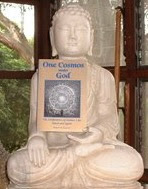
And what does he have against me?
I had intended to write something earlier in the week marking the 100 year anniversary of Frithjof Schuon's birth, which was on June 18, 1907, but somehow forgot. Who was this guy that I quote so often in my posts? After all, I am not a formal disciple of his, nor do I agree with all aspects of his philosophy (although I tremble somewhat when I don't -- he's got a way of looking straight through you with that stern expression of his).
Furthermore, I find the published writings of most of Schuon's well-known followers to be rather tedious and mediocre, and in many ways I feel I do a much better job of communicating the essence of his philosophy to a wider audience, even though I'm afraid that if Schuon were alive, he might even try to get a restraining order to stop me from misusing his ideas. I have no doubt that he wouldn't approve of my approach -- the content, let alone the tone -- but what can one do? There is also no doubt whatsoever that Schuon used the ideas of many thinkers who preceded him in ways they would not approve of. After all, no great Christian theologian ever thought of Christianity as being only an expression of a more transcendent reality, but the most adequate expression of that reality itself. So we're even on that score.
In fact -- this will be one of many sidetracks as I simply reflect out loud -- I concluded quite some time ago, in the course of my graduate work, that one must draw a distinction between "genius" and the medium in which the genius works. Take, for example, psychoanalysis. In graduate school it struck me with great force that there was no commonality between a man of genius, such as Freud, and most of Freud's followers. As they say, the genius ruins the disciples and the disciples ruin the genius. You see this pattern again and again in most fields, in which a school forms around a founder and goes downhill from there. This is not a problem for One Cosmos readers, because the whole point about being a Raccoon is that you can only be a member if you aren't one.
So you can become a psychoanalyst, but there was only one Freud. Likewise, you can become a follower of Schuon, but there was only one Schuon. The question is, how do you become a psychologist -- or a Christian, for that matter -- without being ruined by some genius who preceded you? How to see through their eyes, not just with them?
There have been some psychoanalytic geniuses after Freud, for example, Bion. But there again, I quickly realized that Bion was a genius in a way that transcended psychoanalysis, and that psychoanalysis just happened to be the medium for the expression of his genius. So it's naturally easy to get hung up on the "content" of the genius's ideas, when the more important point is the genius itself. There is a world of difference between a genius reflecting upon the mind, as opposed to some over-educated academic hack publishing his insipid thoughts about the mind.
The same is especially true of theology or philosophy, which is why 99% of it is worthless and/or harmful. It is why a Plato or Saint Augustine will always be relevant, whereas a Chomsky or Hitchens will be little noted nor long remembered, just more junk atop the worthless pile of human verbiage with a short expiration date and no bearing on eternity.
Whatever else he was, Schuon was quite simply a religious genius. I guess I must have first come across his name over 20 years ago, in reading Ken Wilber's early books. I don't remember Wilber relying on him a great deal aside from mentioning a couple of his works in the references -- one or two out of his famously long bibliographies -- and in many respects they constitute radically opposite approaches to religion and spirituality: traditionalism vs. new age. It's hard to say whether the two approaches create different types of people or whether different types of people are drawn to one or the other, but it's probably a combination of the two. In any event, Wilber is widely read in a way that Schuon never could be, as he was not a popularizer and had no desire to be known, much less to present esoteric doctrine in such away that the average college student or politician could not only understand it but find it quite congenial. Plus, Schuon was a direct vehicle of grace -- yes, I realize that's a bold statement -- which is not an insult to Wilber, since few human beings have this capacity to directly illuminate the being of another.
I know that when I first tried to read Schuon -- again, probably over 20 years ago -- he didn't appeal to me at all. This is because I was still an intellectual at the time, and an intellectual, whether he realizes it or not, is actually driven by the vital mind rather than the higher mind. Therefore, it (the vital mind) seeks excitement, novelty, and the esteem of other intellectuals. Obviously, it wants to impress others about how much it thinks it knows -- which is not all that much, especially as it pertains to ultimate issues.
Religion, on the other hand, is not about intellectual fireworks but about humbly conforming your being to Reality (although there are obviously certain explosive consequences for the intellectually gifted man -- an Augustine, or Theophan the Recluse, or Aurobindo). But few young men are really interested in being "humble," and in many ways, they're not supposed to be.
I generally go along with the traditional idea that for most men -- at least those without a special calling -- the first half of life should be spent pursuing worldly ends -- establishing an identity, a career and a family -- while the second half should be a gradual shedding of our outer identity as we reverse our gaze from the great without to the great within. It's not really a radical dichotomy, but simply a matter of emphasis (although here again, there are exceptions; there are pure men of action who are here for a spiritual mission -- Churchill comes to mind -- just as there are pure spiritual types -- Schuon being one of them -- who prove their manhood in spiritual battle. This latter type of battle is no picnic -- it is not like avoiding the draft by becoming a light-in-the-loafers army chaplain, for it is spiritual warfare, or hand to hand combat without hands.
But generally, a man who has not first become a battle-tested Man is not going to be a good candidate to spiritually transcend his manhood. Which is one of the reasons why many wimpier types are drawn to "sprituality," as it seems to give them an excuse to skip the manhood stage. I think you will find that this is why new age spirituality is so "feminized," as it is a refuge for unmanly men -- even a way for them to feel "superior" to manly men.
So anyway, Schuon was born in one of those contested parts of Europe on June 18, 1907. He spent the better part of his childhood in Basel, so he seems to have been a combination of German, French and Swiss. I would just call him "European." He described Basel as a sort of fairy-tale city which made a deep and lasting impression upon his character. Perhaps it even accounts -- at least partly -- for his utter rejection of modernity. I've never been to Europe, but I have been to Disneyland on a number of occasions, so I certainly understand what it would be like to inhabit a sort of real-life fairy tale come to life. Schuon felt that the medieval world was "normative" for human beings, and that even the Renaissance represented the beginning of a dark descent into postmodernity. It reminds me of how for the Orthodox, Catholics are Protestants.
Interestingly, my own father was European -- he was born in England -- but had no European or British identity at all. It was very much as if he were an American who had only accidentally been born in England. He even successfully eliminated his accent. I was thinking about this just the other day. The "British invasion" of the mid-1960s formed a central part of my own childhood, and one would think that I would have felt a special sort of connection to it because of my father's lineage. Although it was a completely unexpected and unanticipated phenomenon -- by that point, the flow of cultural influence was entirely a one-way street, U.S. to Europe -- my father took only a passing, bemused interest. I guess he thought it was a little funny that Americans would express interest in some old British music hall number like "I'm Henry the 8th I Am."
The idea that my father was actually from The Land of the Beatles was rather mind-blowing, but he almost never spoke of it. He absolutely loved America, and certainly didn't romanticize his cultural roots. Whenever the subject of the Royals would come up, he would mutter the word "parasites," but I never really understood why. But he knew that if he had remained in England, he would have likely been a bricklayer or performed some other kind of backbreaking labor for the rest of his life, so he wanted out just as soon as possible. Which occurred after he was discharged from the British Army in 1948.
I'm heading down another unanticipated byway, so I'll probably have to finish up this post tomorrow, but another interesting point comes to mind. Both Schuon and my father idealized America, but in rather opposite ways. My father spoke of American cowboy movies -- Tom Mix, Gene Autry, Will Rogers -- as having made a huge impression on him as a child. Perhaps you may have noticed that whenever a Brit shows up in a cowboy movie, it's always as a thematic and slightly silly or effete contrast to the manly American character -- they're either butlers, or bankers, or card players, or clueless aristocrats. Now that I think about it -- and I'm actually realizing this for the first time -- my father was really into cowboy culture. He read Western novels, liked country music, and hung out with a guy that made handmade saddles as a hobby. Plus he took us hunting, fishing, and camping all the time, back when it really was a wilderness adventure -- an encounter with the elements, relatively unmediated by civilization.
Schuon, on the other hand, idealized native American culture, and even moved to the midwest in the 1970's so that he could live close to "real" Indians. I would suggest that cowboys and Indians represent two archetypally different and somewhat incompatible ways of being "primitive." In reality, we are hopelessly modern, and can never go back to being real cowboys and Indians. People who still call themselves Indians today -- or I suppose you have to say "native Americans" -- are in my opinion a pretty pathetic lot. Unlike Schuon, I see nothing to admire about their culture. Or at least whatever good there was has to be placed in the context of an awful lot of barbarism. For me, the more I learn about native American culture, the less there is to admire.
But since Schuon grew up in Disneyland, perhaps his Disneyland was the culture of the "Red Indian," as he always referred to them (he actually became enchanted with them as a boy). And for my father, who, if he had stayed there, would have ended up being the guy who sweeps up the cigaret butts in Disneyland, America itself was Disneyland. He would have had no interest whatsoever in native American culture, since he grew up under pretty primitive conditions in rural England -- no indoor plumbing, no central heat, no electricity, and just an outhouse in back for a family of nine -- and had no desire to repeat, let alone romanticize, the experience.
In fact, my father was an odd combination of intense ambition and a kind of serene satisfaction with his lot. Yes, he did everything possible to escape the bonds of old Europe and move to a place where his spirit wouldn't be stifled and he would be able to rise to the level of his own ambitions and abilities. But once he reached a certain level, that was it. I don't think he ever got over the fact that he actually owned a house with an indoor toilet. When in 1964 we moved into a house that had two bathrooms -- coincidentally, the house in which I still live -- that was pretty much over the top, even perhaps a bit decadent. Not only did he not take basic amenities for granted, but I think he was in awe of them. From my point of view he was a man who really enjoyed simple pleasures, but from his point of view it must have felt like indulgence.
I don't know if it's temperamental or learned, but I'm pretty much the same way. I had a certain level of ambition, but I long ago achieved it and now effectively have *none*, at least for any worldly or material thing. And even then, my ambition was always an inner directed one, in that my external ambition was only for the purpose of establishing a life in which I could indulge my internal ambitions. I was thinking about this the other day in the context of Will's interview of Mrs. G. If you have a daughter, normally you would do well to counsel them against getting involved with a man who wants no responsibilty, since such a man is likely to be an irresponsible man. Rare is the man who wants no responsibilities because he genuinely needs to focus all his attention on invisible responsibilities, on a calling and a destiny that is not of this world.
Schuon was such a man, which is why the first half of his life was so painful. He had to pursue his work under impossibly precarious financial circumstances until at least the mid-1950s -- when he himself was in his fifties -- at which point he gained a degree of financial independence, not from book sales, but from disciples, for publicly he was a writer of universalist religious metaphysics, while privately he was the head of an esoteric Sufi order. His first major work, The Transcendent Unity of Religions, was not published until 1948, 1953 in English. That was the true beginning of his written work, to which we will turn tomorrow. I guess.
Saturday, June 23, 2007


Friday, June 22, 2007
In the Wake of the Impossible Dream
This is impossible. I just sat down, and the baby's already making noises in the next room. No way to blog under these coonditions.
In honor of the simmering soulstice, I think I'll just pluck something from exactly one year ago and see if it still has any relevance. Frankly, I write these things in such a daze that when I go back and review them, it's almost as if someone else wrote them and I'm reading them for the first time. I've added a few additional thoughts as they occurred to me.
Which reminds me of one of Bion's books, Second Thoughts. Between the 1950s and mid-1960s, Bion underwent some sort of profound transformation in which he changed from being an ordinary, if gifted, psychoanalyst, into an unorthodox visionary mystic philosopher. The book is a collection of scholarly essays written by his old self, looked at from the perspective of his new self. Thus, "second thoughts" has a double meaning, in that one naturally has second thoughts about things written by a self that is effectively dead and no longer exists except insofar as the tracks left on the printed page.
In a way, it is as if one has the responsibility of being one's own literary executor. The first half of Second Thoughts presents the essays, while the second half is a commentary in which Bion essentially deconstructs himself, almost as if -- no, exactly as if -- the earlier Bion were "dream material" presented for the purposes of the later Bion's analysis.
For most people, they don't undergo sufficient growth in their lifetime for this to be an issue. I was thinking about this the other day, when I made the comment about my own past being so radically disconnected from my present. Further thoughts along these lines were provoked by Will's interview of Mrs. G.... about which I'm starting to get a little jealous. I wish he'd interview me! I want some attention!
Anyway -- shh! please be quiet -- F.L. is over there, actually amusing himself, so I have a moment to develop a thought -- as I was about to say, one of the downsides of radical change is that it necessarily creates a kind of alienation -- from one's past, from previous relationships, from the culture, from any number of things. One dies to the world, and with it, one's previous self. Through the mid-1990s I had undergone a lot of change, but I was still more or less myself. I could draw a continuous if winding road from there to here.
Looked at from this angle, I can understand why so many of my generational cohort of baby boomers are so stuck in the progressive past. They're all still basically caught up in the dream of the 1960s, with no new self to critique the dream -- which is why the dream turned into a nightmare. I was about to say that my generation has got to be the most un-introspective and un-self aware in American history, but I suppose it happens with every generation, which has difficulty seeing outside its own narrow reality tunnel.
This came up just yesterday with the bulletin about how 90% of the journalists who give financial support to political candidates are leftists. At the same time, these people are so clueless that they don't even know how biased they are. Ignorance is one thing, but unconscious ignorance masquerading as sophistication is another thing entirely. But that's our MSM: self-congratulating unreflective ignorance on stilts. Increasingly they just speak to themselves, ensuring their own lack of growth -- like an animal that tries to live on its own excrement.
To the extent that you have undergone significant growth, you must necessarily look back at your past and cringe at the moronic things you thought, said, wrote, and did. You must interpret the dream from the standpoint of being awake. It's painful, in part because one must essentially "write off" a good portion of one's life as having essentially been a waste -- if not actually harmful -- or at best, a series of inevitable lessons, given the inclinations and architecture of one's particular soul. One did one's best with the knowledge and materials at hand.
But the New York Times still proudly displays the Pultizer Prize awarded to Walter Duranty, who was Stalin's greatest mouthpiece in the West. Rather than speaking Truth to Evil, the Times was the latter's stenographer. But do they have any "second thoughts?" Obviously not. The left hasn't undergone sufficient growth to be capable of that kind of self-reflection.
For the left, nothing changes, since leftism is an abstract pseudo-religion uninfluenced by the ravages of time. Indeed, that is one of its central appeals. It is "effective" not in the world, but in the soul, so to speak. That is to say, like Islamism, it is believed because of the transformative -- even intoxicating -- effect on the personality (emphasis on the toxic). I always think this while reading most any leftist writing: how intoxicated they are!
Ironic that they are at war with "faith," but real faith always questions. Because faith is faith, it can be questioned from both within and without. No one need accept faith to begin with, and once accepted, it can be constantly questioned from within. Not so leftist faith. From the beginning it has been confused with enlightenment values, hence the "science" of dialectical materialism and all its latter day descendents, including all of the major Democrat candidolts at war with true liberalism.
Hmm, this almost turned into a full post after all.
*****
The devil [is] the humanized personification -- humanized on contact with man -- of the subversive aspect of the centrifugal existential power... --F. Schuon
What is it with these hostile powers? Why are they afflicting so many spiritually sensitive souls at this particular time? What do they want and when will they go away? Why am I and so many other cosmonaughts experiencing these bizarre dreams and inexplicable physical symptoms?
In World War II, millions of good men traveled to hell in order to fight the latest incarnation of evil. What was going on then -- not politically, but cosmically? No mere human psychology can explain the level of pure evil embodied in the Japanese and German governments that inflicted such infra-human brutality on their millions of victims.
[Update -- I recently got a refresher course on the demonic brutality of imperial Japan in the book A History of the English Speaking Peoples Since 1900, which, for some reason, is still not widely appreciated -- one more reason why the left can conflate what goes on at Gitmo or what happened at Abu Ghraib with "torture." In addition to being a disgraceful torture of language -- one of the left's specialites -- it's such a dishonor to the memory Americans (and Australians, Canadians, New Zealanders, and other English speaking peoples) who were hideously tortured by these monsters. For that matter, I'll bet one in a thousand leftists doesn't have any idea what actually went on in the real Gulags. One of the reasons it is so very dangerous for the left to be in control of the educational establishment and almost all mainstream organs of information dissemination is that leftism can only operate in the dark interstices of ignorance it first must create in order to thrive -- economic ignorance, spiritual ignorance, psychological ignorance, historical ignorance, etc.]
I just finished an excellent new history of the Cold War, and it is the same story. I mean that literally, for history itself is the same story. The drama of exterior or "horizontal" history can obscure the deeper reality of interior or "vertical" history. Outwardly it looked as if a “world war” had ended in 1945, but nothing could be further from the truth. Pure evil cannot surpass itself, but Stalin, Mao, Pol Pot (and now the Islamists) and others gave it their worst shot. And they did so not only largely “under the radar,” but aided and abetted at every step along the way by an elite anti-divine and anti-evolutionary spiritual movement called “the international left.”
Although atheistic, it must be emphasized that there is nothing unspiritual about these people, being that spirituality exists on a vertical axis that descends into a kind of "negative space" below the horizontal horizon. It is a dark "dream world," just as positive spirituality operates in a kind of light-filled dream world (the cosmos itself being the warp and weft of the cosmic Dreamer).
Thankfully, this movement did not fully insinuate itself into the Democrat party and hijack liberalism until the early 1970’s, so it posed no existential threat to our ability to name and extinguish evil, for evil cannot triumph so long as virtuous and courageous men can recognize it and mercilessly burn it from our midst.
But things are different today. Once again the same evil -- the same hideous death-worshipping ontological evil that lived through men like Mao, Hitler, Stalin, Tojo -- has now lodged itself into the heart of a religion and a region of the earth. But like any other parasite, the evil that animates this movement has adapted and learned from its mistakes. It knows that its only hope of success is to convince sophisticated and cultured men that it does not exist.
Perhaps you remember the absolute outrage among sophisticated leftists when Ronald Reagan acknowledged and named this evil exactly 25 years ago, in June of 1982. Not only did the left dismiss him as wrong, but, just like President Bush, he was regarded and reviled as the real source of evil in the world. You may think that we ultimately won that particular linguistic battle once and for all, but the opposite is true. As I have had occasion to mention before, the left learns nothing from history -- that is not its role in the cosmic drama. Rather, it exists to obscure those lessons, for they issued the identical howls of outrage when President Bush recognized and named the most recent incarnations of ontological evil.
Here is what President Reagan said, updated with some obvious edits. You tell me if the left wouldn’t react identically today if these words were uttered:
“I've often wondered about the shyness of some of us in the West about standing for the ideals that have done so much to ease the plight of man and the hardships of our imperfect world....
“If history teaches anything, it teaches self-delusion in the face of unpleasant facts is folly. We see around us today the marks of our terrible dilemma -- predictions of doomsday, anti-American demonstrations, a terror war in which the West must, for its own protection, be an unwilling participant. At the same time we see totalitarian forces in the world who seek subversion and conflict around the globe to further their barbarous assault on the human spirit. What, then, is our course?... Must freedom wither in a quiet, deadening accommodation with totalitarian evil?
“We must be staunch in our conviction that freedom is not the sole prerogative of a lucky few but the inalienable and universal right of all human beings....
“All the democracies paid a terrible price for allowing the dictators to underestimate us. We dare not make that mistake again. So, let us ask ourselves, ‘What kind of people do we think we are?’ And let us answer, ‘Free people, worthy of freedom and determined not only to remain so but to help others gain their freedom as well.’
“What I am describing now is a plan and a hope for the long term -- the march of freedom and democracy which will leave Islamo-fascism on the ash heap of history as it has left other tyrannies which stifle the freedom and muzzle the self-expression of the people....”
*****
Those who lived through it well remember how Reagan was absolutely despised and reviled by the left. Their hatred of this particular speech was not the issue. Nor was Reagan himself the issue, any more than Hitler or Stalin were the issue. Reagan was simply a vehicle of much larger forces, and was opposed by the identical impersonal, anti-Divine forces that would oppose him today.
One again, our brave men are in hell, fighting satan. But the morally twisted left, which cannot recognize evil, sees the opposite. Dennis Prager routinely asks callers opposed to the liberation of Iraq if they can at least acknowledge one thing: that we are fighting evil. Not only will they not concede this point, but they are generally outraged and insulted by the question. Rather, America is the aggressor imposing its will on an occupied people.
Here is what a clear mind, uncontaminated by the toxic thinking of the left, sees:
“In the overheated exchanges that too often substitute for reasoned political discourse, definitions and distinctions can blur. But there is a huge difference between Coalition forces and the wanton, sociopath terrorist with no vestige of honor, who knows nothing but destruction and has no plan for the future other than the subjugation of others while on the path to some psychotic pathology inured by tribal culture and carcinogenic beliefs that will, if left untouched, leave people living in mud huts and slitting throats of historical enemies for another thousand years, or, if slightly more science-minded, leave them seeking nuclear weapons to reach out and destroy the world.
“We did not create this evil, although it does reveal itself more sharply by comparison in the presence of decent people. When the tactics of an enemy cross the line, sentient peoples recognize that they are no longer entitled to be called opposing forces, insurgents, freedom fighters, revolutionaries, or Jihadists -- they are terrorists....
"No living creature is safe while a rabid predator roams. No. Our people who have truly stared into the face of this terrorist demon have seen the ruby glow in its eyes. This is not a myth. This is not a politically contrived caricature, this demon is real. It usually stalks the easy prey -- children, women in crowds, families focused on prayer, rescue workers responding to people in need. Some terrorists manage to get our soldiers.”
****
But what I really wanted to touch on in this post was the nature and role of this ontological evil, and the effect it is having on spiritually sensitive souls at this particular time, as it wells up from the bowels of the earth-consciousness, opportunistically roaming about, looking for minds to colonize. I’ll have to get to that tomorrow.
There is another type of vibration, remarkable for its suddenness and violence; the seeker literally feels these vibrations swooping down upon him.... These are what Sri Aurobindo called the adverse forces. They are highly conscious forces whose sole aim, apparently, is to discourage the seeker and divert him from the path he has chosen. The first sign sign of their presence is easily perceptible: joy is clouded over, consciousness is clouded over, everything becomes shrouded in an atmosphere of tragedy....
Thus there is kind of threshold to cross if we want to find the true life force behind the troubled life of the frontal man. --Satprem
In honor of the simmering soulstice, I think I'll just pluck something from exactly one year ago and see if it still has any relevance. Frankly, I write these things in such a daze that when I go back and review them, it's almost as if someone else wrote them and I'm reading them for the first time. I've added a few additional thoughts as they occurred to me.
Which reminds me of one of Bion's books, Second Thoughts. Between the 1950s and mid-1960s, Bion underwent some sort of profound transformation in which he changed from being an ordinary, if gifted, psychoanalyst, into an unorthodox visionary mystic philosopher. The book is a collection of scholarly essays written by his old self, looked at from the perspective of his new self. Thus, "second thoughts" has a double meaning, in that one naturally has second thoughts about things written by a self that is effectively dead and no longer exists except insofar as the tracks left on the printed page.
In a way, it is as if one has the responsibility of being one's own literary executor. The first half of Second Thoughts presents the essays, while the second half is a commentary in which Bion essentially deconstructs himself, almost as if -- no, exactly as if -- the earlier Bion were "dream material" presented for the purposes of the later Bion's analysis.
For most people, they don't undergo sufficient growth in their lifetime for this to be an issue. I was thinking about this the other day, when I made the comment about my own past being so radically disconnected from my present. Further thoughts along these lines were provoked by Will's interview of Mrs. G.... about which I'm starting to get a little jealous. I wish he'd interview me! I want some attention!
Anyway -- shh! please be quiet -- F.L. is over there, actually amusing himself, so I have a moment to develop a thought -- as I was about to say, one of the downsides of radical change is that it necessarily creates a kind of alienation -- from one's past, from previous relationships, from the culture, from any number of things. One dies to the world, and with it, one's previous self. Through the mid-1990s I had undergone a lot of change, but I was still more or less myself. I could draw a continuous if winding road from there to here.
Looked at from this angle, I can understand why so many of my generational cohort of baby boomers are so stuck in the progressive past. They're all still basically caught up in the dream of the 1960s, with no new self to critique the dream -- which is why the dream turned into a nightmare. I was about to say that my generation has got to be the most un-introspective and un-self aware in American history, but I suppose it happens with every generation, which has difficulty seeing outside its own narrow reality tunnel.
This came up just yesterday with the bulletin about how 90% of the journalists who give financial support to political candidates are leftists. At the same time, these people are so clueless that they don't even know how biased they are. Ignorance is one thing, but unconscious ignorance masquerading as sophistication is another thing entirely. But that's our MSM: self-congratulating unreflective ignorance on stilts. Increasingly they just speak to themselves, ensuring their own lack of growth -- like an animal that tries to live on its own excrement.
To the extent that you have undergone significant growth, you must necessarily look back at your past and cringe at the moronic things you thought, said, wrote, and did. You must interpret the dream from the standpoint of being awake. It's painful, in part because one must essentially "write off" a good portion of one's life as having essentially been a waste -- if not actually harmful -- or at best, a series of inevitable lessons, given the inclinations and architecture of one's particular soul. One did one's best with the knowledge and materials at hand.
But the New York Times still proudly displays the Pultizer Prize awarded to Walter Duranty, who was Stalin's greatest mouthpiece in the West. Rather than speaking Truth to Evil, the Times was the latter's stenographer. But do they have any "second thoughts?" Obviously not. The left hasn't undergone sufficient growth to be capable of that kind of self-reflection.
For the left, nothing changes, since leftism is an abstract pseudo-religion uninfluenced by the ravages of time. Indeed, that is one of its central appeals. It is "effective" not in the world, but in the soul, so to speak. That is to say, like Islamism, it is believed because of the transformative -- even intoxicating -- effect on the personality (emphasis on the toxic). I always think this while reading most any leftist writing: how intoxicated they are!
Ironic that they are at war with "faith," but real faith always questions. Because faith is faith, it can be questioned from both within and without. No one need accept faith to begin with, and once accepted, it can be constantly questioned from within. Not so leftist faith. From the beginning it has been confused with enlightenment values, hence the "science" of dialectical materialism and all its latter day descendents, including all of the major Democrat candidolts at war with true liberalism.
Hmm, this almost turned into a full post after all.
*****
The devil [is] the humanized personification -- humanized on contact with man -- of the subversive aspect of the centrifugal existential power... --F. Schuon
What is it with these hostile powers? Why are they afflicting so many spiritually sensitive souls at this particular time? What do they want and when will they go away? Why am I and so many other cosmonaughts experiencing these bizarre dreams and inexplicable physical symptoms?
In World War II, millions of good men traveled to hell in order to fight the latest incarnation of evil. What was going on then -- not politically, but cosmically? No mere human psychology can explain the level of pure evil embodied in the Japanese and German governments that inflicted such infra-human brutality on their millions of victims.
[Update -- I recently got a refresher course on the demonic brutality of imperial Japan in the book A History of the English Speaking Peoples Since 1900, which, for some reason, is still not widely appreciated -- one more reason why the left can conflate what goes on at Gitmo or what happened at Abu Ghraib with "torture." In addition to being a disgraceful torture of language -- one of the left's specialites -- it's such a dishonor to the memory Americans (and Australians, Canadians, New Zealanders, and other English speaking peoples) who were hideously tortured by these monsters. For that matter, I'll bet one in a thousand leftists doesn't have any idea what actually went on in the real Gulags. One of the reasons it is so very dangerous for the left to be in control of the educational establishment and almost all mainstream organs of information dissemination is that leftism can only operate in the dark interstices of ignorance it first must create in order to thrive -- economic ignorance, spiritual ignorance, psychological ignorance, historical ignorance, etc.]
I just finished an excellent new history of the Cold War, and it is the same story. I mean that literally, for history itself is the same story. The drama of exterior or "horizontal" history can obscure the deeper reality of interior or "vertical" history. Outwardly it looked as if a “world war” had ended in 1945, but nothing could be further from the truth. Pure evil cannot surpass itself, but Stalin, Mao, Pol Pot (and now the Islamists) and others gave it their worst shot. And they did so not only largely “under the radar,” but aided and abetted at every step along the way by an elite anti-divine and anti-evolutionary spiritual movement called “the international left.”
Although atheistic, it must be emphasized that there is nothing unspiritual about these people, being that spirituality exists on a vertical axis that descends into a kind of "negative space" below the horizontal horizon. It is a dark "dream world," just as positive spirituality operates in a kind of light-filled dream world (the cosmos itself being the warp and weft of the cosmic Dreamer).
Thankfully, this movement did not fully insinuate itself into the Democrat party and hijack liberalism until the early 1970’s, so it posed no existential threat to our ability to name and extinguish evil, for evil cannot triumph so long as virtuous and courageous men can recognize it and mercilessly burn it from our midst.
But things are different today. Once again the same evil -- the same hideous death-worshipping ontological evil that lived through men like Mao, Hitler, Stalin, Tojo -- has now lodged itself into the heart of a religion and a region of the earth. But like any other parasite, the evil that animates this movement has adapted and learned from its mistakes. It knows that its only hope of success is to convince sophisticated and cultured men that it does not exist.
Perhaps you remember the absolute outrage among sophisticated leftists when Ronald Reagan acknowledged and named this evil exactly 25 years ago, in June of 1982. Not only did the left dismiss him as wrong, but, just like President Bush, he was regarded and reviled as the real source of evil in the world. You may think that we ultimately won that particular linguistic battle once and for all, but the opposite is true. As I have had occasion to mention before, the left learns nothing from history -- that is not its role in the cosmic drama. Rather, it exists to obscure those lessons, for they issued the identical howls of outrage when President Bush recognized and named the most recent incarnations of ontological evil.
Here is what President Reagan said, updated with some obvious edits. You tell me if the left wouldn’t react identically today if these words were uttered:
“I've often wondered about the shyness of some of us in the West about standing for the ideals that have done so much to ease the plight of man and the hardships of our imperfect world....
“If history teaches anything, it teaches self-delusion in the face of unpleasant facts is folly. We see around us today the marks of our terrible dilemma -- predictions of doomsday, anti-American demonstrations, a terror war in which the West must, for its own protection, be an unwilling participant. At the same time we see totalitarian forces in the world who seek subversion and conflict around the globe to further their barbarous assault on the human spirit. What, then, is our course?... Must freedom wither in a quiet, deadening accommodation with totalitarian evil?
“We must be staunch in our conviction that freedom is not the sole prerogative of a lucky few but the inalienable and universal right of all human beings....
“All the democracies paid a terrible price for allowing the dictators to underestimate us. We dare not make that mistake again. So, let us ask ourselves, ‘What kind of people do we think we are?’ And let us answer, ‘Free people, worthy of freedom and determined not only to remain so but to help others gain their freedom as well.’
“What I am describing now is a plan and a hope for the long term -- the march of freedom and democracy which will leave Islamo-fascism on the ash heap of history as it has left other tyrannies which stifle the freedom and muzzle the self-expression of the people....”
*****
Those who lived through it well remember how Reagan was absolutely despised and reviled by the left. Their hatred of this particular speech was not the issue. Nor was Reagan himself the issue, any more than Hitler or Stalin were the issue. Reagan was simply a vehicle of much larger forces, and was opposed by the identical impersonal, anti-Divine forces that would oppose him today.
One again, our brave men are in hell, fighting satan. But the morally twisted left, which cannot recognize evil, sees the opposite. Dennis Prager routinely asks callers opposed to the liberation of Iraq if they can at least acknowledge one thing: that we are fighting evil. Not only will they not concede this point, but they are generally outraged and insulted by the question. Rather, America is the aggressor imposing its will on an occupied people.
Here is what a clear mind, uncontaminated by the toxic thinking of the left, sees:
“In the overheated exchanges that too often substitute for reasoned political discourse, definitions and distinctions can blur. But there is a huge difference between Coalition forces and the wanton, sociopath terrorist with no vestige of honor, who knows nothing but destruction and has no plan for the future other than the subjugation of others while on the path to some psychotic pathology inured by tribal culture and carcinogenic beliefs that will, if left untouched, leave people living in mud huts and slitting throats of historical enemies for another thousand years, or, if slightly more science-minded, leave them seeking nuclear weapons to reach out and destroy the world.
“We did not create this evil, although it does reveal itself more sharply by comparison in the presence of decent people. When the tactics of an enemy cross the line, sentient peoples recognize that they are no longer entitled to be called opposing forces, insurgents, freedom fighters, revolutionaries, or Jihadists -- they are terrorists....
"No living creature is safe while a rabid predator roams. No. Our people who have truly stared into the face of this terrorist demon have seen the ruby glow in its eyes. This is not a myth. This is not a politically contrived caricature, this demon is real. It usually stalks the easy prey -- children, women in crowds, families focused on prayer, rescue workers responding to people in need. Some terrorists manage to get our soldiers.”
****
But what I really wanted to touch on in this post was the nature and role of this ontological evil, and the effect it is having on spiritually sensitive souls at this particular time, as it wells up from the bowels of the earth-consciousness, opportunistically roaming about, looking for minds to colonize. I’ll have to get to that tomorrow.
There is another type of vibration, remarkable for its suddenness and violence; the seeker literally feels these vibrations swooping down upon him.... These are what Sri Aurobindo called the adverse forces. They are highly conscious forces whose sole aim, apparently, is to discourage the seeker and divert him from the path he has chosen. The first sign sign of their presence is easily perceptible: joy is clouded over, consciousness is clouded over, everything becomes shrouded in an atmosphere of tragedy....
Thus there is kind of threshold to cross if we want to find the true life force behind the troubled life of the frontal man. --Satprem
Thursday, June 21, 2007
The Mrs. G Interview, Part 2: I Was a Teenage Mind Parasite!
WILL: Okay, she's back by popular demand, folks! I mean our guest interviewee, the lovely and talented Leslie Godwin, author of From Burned Out To Fired Up: A Woman's Guide to Rekindling the Passion and Meaning In Life and Work and spouse of and life-partner to Bob.
LESLIE: I'm honored, a bit surprised that you'd have me back. Around here, the blog is usually considered the domain of the wise and powerful Bob doing something mysterious with his computer from behind a plush curtain in a part of the house where no one dares to set foot. [And, I might add, where all mortals show themselves wise to tremble! Silence!!! --GB]
WILL: Right. Well, I'm sure that's pretty much the picture Raccoons have in their minds... The wheels and levers, the giant smoking computer, the projected image of Bob's disembodied head menacingly floating above the flames.... Anyway, everybody, if you haven't done so, while I'm rummaging around for the dog-eared transcript, you might check out Leslie's website.... Okay, when last we left off.... ah yes -- I asked, apparently in jest, "Just how shrewish was Bob?" and you said --
LESLIE: "Will, I'm sure you realized I was referring to myself as the shrew."
WILL: Right, that's exactly what you said. So -- this begs the question... were you really a shrew?
LESLIE: I was a real pain in the @$$ for as long as I can remember.
WILL: Well, that's refreshingly blunt. An @$$ pain from childhood? I'm curious as to where the roots of shrewishness might lay.
LESLIE: I don't have a lot of fond memories of my childhood. I mentioned that I grew up in Forest Hills, then Dobbs Ferry, NY for most of my childhood. My default childhood memory is of wanting to be buried in a book anytime I didn't have to be at school. I was both introverted and shy (now I'm just introverted), but my parents are both hyper-extroverted. They assumed that it was unhealthy to be cooped up inside all day, not to mention the hassle of my being underfoot, so they basically locked me out all day til dinner time. I ran away from home a few times with a friend, and honest-to-God I don't think that my parents even knew. I would always come back before it got dark.
WILL: So you were --
LESLIE: I'm sure looking back on this that I was clinically depressed, probably both due to nature and nurture.
WILL: I was going to say it sounds like you were an exceptionally sensitive and imaginative child who instinctively went on the offensive as a defensive ploy...
LESLIE: Wow, thirteen years of psychotherapy and I could have just asked you. What a waste of money!
WILL: Not necessarily. I charge by the word, not the session... It adds up pretty fast...
LESLIE: (Laughing) Anyway, that's the back story. Later on I became the charming combination of being insecure, sometimes angry -- mostly with boys -- and controlling as well. At times I was bossy and took things out on my little sister, Katie, which I regret even though I understand how I got that way. We had a reconciliation before she died. But I wish I could have been a little more perfect and not taken out my stress on her at all.
WILL: One Cosmos readers wouldn't know this, but you and I have talked about it, Leslie -- we both lost sisters in the same year, within a month of one another. We can have our regrets -- that's to be expected in any decent human being -- but the reconciliation is the all-important thing.
LESLIE: Yes. You were very comforting to me when we later discussed our losses, even though we didn't know each other at the time they happened. Regarding the reconciliation, I was visiting my brother-in-law (Steve) and nephew (Aiden) a few months after Katie's death -- she left behind a 2 year old son -- and Steve asked me to go through some of her personal things and organize them, throw out those that she wouldn't want Aiden to happen upon later, etc. One of the things I found was a letter I had written to her when we reconciled a major problem we were having. I can't tell you how much that meant to me to read it and see that she had saved it.
WILL: Getting back to our topic -- should I assume that you were a loner in high school?
LESLIE: Oddly, I was the last to realize it, but it turns out that I was popular in high school. For some reason about 5 years ago I read my high school yearbook and saw the very kind comments from friends, acquaintances, teachers and coaches. I guess it was my Sally Field moment (You liked me! You really liked me!). It made me look beneath my screen [superficial] memories of the time, which of course were more a function of my insecurity [mind parasites! --GB] than an accurate perception of the situation. I realized that I'd actually had a lot of friends and that people could see my good points, where I had only been focused on my weaknesses and insecurities. And I'd just assumed the yearbook would be filled with inanities like, "Stay sweet," "Have a good summer," and "2 nice + 2 be = 4 gotten."
WILL: For what it's worth, sun-sign Virgos often have an unrealistic desire for perfection and when they can't meet their own expectations -- nobody could, of course -- they beat up on themselves mercilessly. Anyway, high school... you were a social creature...
LESLIE: Yes, and while this unexpected social whirl was more fun than being a loner and hating my life, I still felt out of step being so introverted and trying to avoid my problems by hanging out with my friends -- in other words, sort of compartmentalized, being one person on the outside but another on the inside.... By the way...
WILL: Yes?
LESLIE: One other compensation was that I was a total sports nut. It became a kind of comfort object.
WILL: Yeah?
LESLIE: I especially loved the New York Giants. My favorite players were Fran Tarkenton when he was first with the Vikings and then with the Giants, and Homer Jones. As fate would have it, I was born the day after a Giants game in the Polo Grounds. My mom -- who dated Frank Gifford before marrying my dad, incidentally -- must have trudged up and down about a mile of stairs on September 17, 1960, and I popped out the next day, a Giants fan.
WILL: If I'm understanding this correctly... your pregnant-with-you mom attended a Giants game on the day before the day you were born?
LESLIE: I think it exemplifies the pattern of how I fit into their lifestyle. I'm not totally opposed to that, by the way. We're having to push Future Leader a bit out of the center of the universe right now. He's been demoted to center of the solar system until we can negotiate something a little more reasonable. Anyway, our family had Giants' seasons tickets until fairly recently. I went to their games in Yankee Stadium, one year in Shea Stadium, and then Meadowlands when it first opened. I also loved pro basketball and remember many nights listening to Marv Albert call the games on radio when I couldn't sleep.
WILL: He shoots! He scores!
LESLIE: Over the years I've become an obsessive hockey fan. And Bob got me into baseball and the Dodgers.
WILL: Well, speaking of L.A. and Bob -- in our first interview session, you used the phrase, "The Taming of the Shrew," referring to the period after you had moved to L.A. and married Bob...
LESLIE: It's all true. Bob saved me from myself.
WILL: Yes, but no one gets saved unless they want to be and are willing to put forth the effort.
LESLIE: It's still fair to say Bob did a lot of heavy lifting the first 10 years of our relationship.
WILL: What was the situation?
LESLIE: I was insecure, and had a mild panic disorder that got worse when I felt abandoned. And I was very opinionated and controlling -- not a recipe for marital bliss.
WILL: Well, would you --
LESLIE: Oh my God, I almost forgot about this... it's been a while... but I used to freak out when Bob drank beer (laughing). Can you imagine?!!
WILL: Just barely.
LESLIE: You'll have to get his side of the story on how that wasn't a dealbreaker! [It was only a mercilessly brief period around 87-88 --BG] Probably because I didn't start out that way. It was only after I had made some progress in my psychotherapy that this unpleasant symptom came up. A different person might have gone out for the evening paper and just kept going if he didn't feel the call to... to change my life in magical ways! Overheated cliché yes, but that's what happened. [That's a little over the top -- imagine something more subtle, like the cover of a Harlequin Romance with Fabio playing me --GB]
WILL: As someone pointed out in a comment -- I think it was Dilys -- "Taming of the Shrew" also has an esoteric meaning -- the process of transformation of spirit, an alchemical transformation... so when you use the word "magical," Leslie, this is not simply a romantic description. It's quite literally magical, something that transcends cliché.
LESLIE: She's so right. What a wonderful point. Anyway, somehow Bob felt there was something worth saving in me.
WILL: Two questions: How did Bob go about helping to save that someone worth saving? And who would you say she is?
LESLIE: How did he do it? Good question. He is an unbelievably loyal and tolerant person. [Plus he continued drinking beer in secret --BG] So he did as much tolerating as he could until he had to take action. He reaches a point and then, no mas. I had a very annoying set of personality traits, but I truly did want to be a better person. I would put myself through anything to grow. Kicking and screaming, but I really wanted to be healthy.
WILL: Like I said, that's what makes for a spiritual warrior -- the desire to change and the willingness to put forth the effort. Still, as you admit, you were naturally resistant. How did Bob --
LESLIE: Bob's two chief weapons were Truth and a sense of humor... And amongst his weaponry were fear, surprise, and ruthless efficiency... you get the point.
WILL: And a comfy chair. Yes, I get the point. [Series 2, Episode 2: nobody expects the Coonish Inquisition! Don't forget the plastic dish-drying rack to keep her at bay during emergencies --GB]
LESLIE: Well, it wasn't exactly the Spanish Inquisition, but I suppose it felt like it at the time... He didn't allow me to wiggle out of logical arguments. He pointed out that I was a bad sport when I flipped over the Scrabble board when he used all of his letters for the 50 point bonus....
WILL: ... umm... well... yeah...
LESLIE: -- and however pissed off I got at him for challenging me and not just giving me a hug when I would cry, I realized that whatever he was doing was helping me to grow.
WILL: In other words, Bob is the anti-Oprah. [What, Harpo? --BG]
(to be con't)
LESLIE: I'm honored, a bit surprised that you'd have me back. Around here, the blog is usually considered the domain of the wise and powerful Bob doing something mysterious with his computer from behind a plush curtain in a part of the house where no one dares to set foot. [And, I might add, where all mortals show themselves wise to tremble! Silence!!! --GB]
WILL: Right. Well, I'm sure that's pretty much the picture Raccoons have in their minds... The wheels and levers, the giant smoking computer, the projected image of Bob's disembodied head menacingly floating above the flames.... Anyway, everybody, if you haven't done so, while I'm rummaging around for the dog-eared transcript, you might check out Leslie's website.... Okay, when last we left off.... ah yes -- I asked, apparently in jest, "Just how shrewish was Bob?" and you said --
LESLIE: "Will, I'm sure you realized I was referring to myself as the shrew."
WILL: Right, that's exactly what you said. So -- this begs the question... were you really a shrew?
LESLIE: I was a real pain in the @$$ for as long as I can remember.
WILL: Well, that's refreshingly blunt. An @$$ pain from childhood? I'm curious as to where the roots of shrewishness might lay.
LESLIE: I don't have a lot of fond memories of my childhood. I mentioned that I grew up in Forest Hills, then Dobbs Ferry, NY for most of my childhood. My default childhood memory is of wanting to be buried in a book anytime I didn't have to be at school. I was both introverted and shy (now I'm just introverted), but my parents are both hyper-extroverted. They assumed that it was unhealthy to be cooped up inside all day, not to mention the hassle of my being underfoot, so they basically locked me out all day til dinner time. I ran away from home a few times with a friend, and honest-to-God I don't think that my parents even knew. I would always come back before it got dark.
WILL: So you were --
LESLIE: I'm sure looking back on this that I was clinically depressed, probably both due to nature and nurture.
WILL: I was going to say it sounds like you were an exceptionally sensitive and imaginative child who instinctively went on the offensive as a defensive ploy...
LESLIE: Wow, thirteen years of psychotherapy and I could have just asked you. What a waste of money!
WILL: Not necessarily. I charge by the word, not the session... It adds up pretty fast...
LESLIE: (Laughing) Anyway, that's the back story. Later on I became the charming combination of being insecure, sometimes angry -- mostly with boys -- and controlling as well. At times I was bossy and took things out on my little sister, Katie, which I regret even though I understand how I got that way. We had a reconciliation before she died. But I wish I could have been a little more perfect and not taken out my stress on her at all.
WILL: One Cosmos readers wouldn't know this, but you and I have talked about it, Leslie -- we both lost sisters in the same year, within a month of one another. We can have our regrets -- that's to be expected in any decent human being -- but the reconciliation is the all-important thing.
LESLIE: Yes. You were very comforting to me when we later discussed our losses, even though we didn't know each other at the time they happened. Regarding the reconciliation, I was visiting my brother-in-law (Steve) and nephew (Aiden) a few months after Katie's death -- she left behind a 2 year old son -- and Steve asked me to go through some of her personal things and organize them, throw out those that she wouldn't want Aiden to happen upon later, etc. One of the things I found was a letter I had written to her when we reconciled a major problem we were having. I can't tell you how much that meant to me to read it and see that she had saved it.
WILL: Getting back to our topic -- should I assume that you were a loner in high school?
LESLIE: Oddly, I was the last to realize it, but it turns out that I was popular in high school. For some reason about 5 years ago I read my high school yearbook and saw the very kind comments from friends, acquaintances, teachers and coaches. I guess it was my Sally Field moment (You liked me! You really liked me!). It made me look beneath my screen [superficial] memories of the time, which of course were more a function of my insecurity [mind parasites! --GB] than an accurate perception of the situation. I realized that I'd actually had a lot of friends and that people could see my good points, where I had only been focused on my weaknesses and insecurities. And I'd just assumed the yearbook would be filled with inanities like, "Stay sweet," "Have a good summer," and "2 nice + 2 be = 4 gotten."
WILL: For what it's worth, sun-sign Virgos often have an unrealistic desire for perfection and when they can't meet their own expectations -- nobody could, of course -- they beat up on themselves mercilessly. Anyway, high school... you were a social creature...
LESLIE: Yes, and while this unexpected social whirl was more fun than being a loner and hating my life, I still felt out of step being so introverted and trying to avoid my problems by hanging out with my friends -- in other words, sort of compartmentalized, being one person on the outside but another on the inside.... By the way...
WILL: Yes?
LESLIE: One other compensation was that I was a total sports nut. It became a kind of comfort object.
WILL: Yeah?
LESLIE: I especially loved the New York Giants. My favorite players were Fran Tarkenton when he was first with the Vikings and then with the Giants, and Homer Jones. As fate would have it, I was born the day after a Giants game in the Polo Grounds. My mom -- who dated Frank Gifford before marrying my dad, incidentally -- must have trudged up and down about a mile of stairs on September 17, 1960, and I popped out the next day, a Giants fan.
WILL: If I'm understanding this correctly... your pregnant-with-you mom attended a Giants game on the day before the day you were born?
LESLIE: I think it exemplifies the pattern of how I fit into their lifestyle. I'm not totally opposed to that, by the way. We're having to push Future Leader a bit out of the center of the universe right now. He's been demoted to center of the solar system until we can negotiate something a little more reasonable. Anyway, our family had Giants' seasons tickets until fairly recently. I went to their games in Yankee Stadium, one year in Shea Stadium, and then Meadowlands when it first opened. I also loved pro basketball and remember many nights listening to Marv Albert call the games on radio when I couldn't sleep.
WILL: He shoots! He scores!
LESLIE: Over the years I've become an obsessive hockey fan. And Bob got me into baseball and the Dodgers.
WILL: Well, speaking of L.A. and Bob -- in our first interview session, you used the phrase, "The Taming of the Shrew," referring to the period after you had moved to L.A. and married Bob...
LESLIE: It's all true. Bob saved me from myself.
WILL: Yes, but no one gets saved unless they want to be and are willing to put forth the effort.
LESLIE: It's still fair to say Bob did a lot of heavy lifting the first 10 years of our relationship.
WILL: What was the situation?
LESLIE: I was insecure, and had a mild panic disorder that got worse when I felt abandoned. And I was very opinionated and controlling -- not a recipe for marital bliss.
WILL: Well, would you --
LESLIE: Oh my God, I almost forgot about this... it's been a while... but I used to freak out when Bob drank beer (laughing). Can you imagine?!!
WILL: Just barely.
LESLIE: You'll have to get his side of the story on how that wasn't a dealbreaker! [It was only a mercilessly brief period around 87-88 --BG] Probably because I didn't start out that way. It was only after I had made some progress in my psychotherapy that this unpleasant symptom came up. A different person might have gone out for the evening paper and just kept going if he didn't feel the call to... to change my life in magical ways! Overheated cliché yes, but that's what happened. [That's a little over the top -- imagine something more subtle, like the cover of a Harlequin Romance with Fabio playing me --GB]
WILL: As someone pointed out in a comment -- I think it was Dilys -- "Taming of the Shrew" also has an esoteric meaning -- the process of transformation of spirit, an alchemical transformation... so when you use the word "magical," Leslie, this is not simply a romantic description. It's quite literally magical, something that transcends cliché.
LESLIE: She's so right. What a wonderful point. Anyway, somehow Bob felt there was something worth saving in me.
WILL: Two questions: How did Bob go about helping to save that someone worth saving? And who would you say she is?
LESLIE: How did he do it? Good question. He is an unbelievably loyal and tolerant person. [Plus he continued drinking beer in secret --BG] So he did as much tolerating as he could until he had to take action. He reaches a point and then, no mas. I had a very annoying set of personality traits, but I truly did want to be a better person. I would put myself through anything to grow. Kicking and screaming, but I really wanted to be healthy.
WILL: Like I said, that's what makes for a spiritual warrior -- the desire to change and the willingness to put forth the effort. Still, as you admit, you were naturally resistant. How did Bob --
LESLIE: Bob's two chief weapons were Truth and a sense of humor... And amongst his weaponry were fear, surprise, and ruthless efficiency... you get the point.
WILL: And a comfy chair. Yes, I get the point. [Series 2, Episode 2: nobody expects the Coonish Inquisition! Don't forget the plastic dish-drying rack to keep her at bay during emergencies --GB]
LESLIE: Well, it wasn't exactly the Spanish Inquisition, but I suppose it felt like it at the time... He didn't allow me to wiggle out of logical arguments. He pointed out that I was a bad sport when I flipped over the Scrabble board when he used all of his letters for the 50 point bonus....
WILL: ... umm... well... yeah...
LESLIE: -- and however pissed off I got at him for challenging me and not just giving me a hug when I would cry, I realized that whatever he was doing was helping me to grow.
WILL: In other words, Bob is the anti-Oprah. [What, Harpo? --BG]
(to be con't)
Wednesday, June 20, 2007
Absolute Truth and False Absolutism
A good theory must not only explain the data, but it cannot in the process "unexplain" things that we bloody well know to be true, as Colonel Beaglehole puts it. Obviously natural selection explains many things. However, if elevated to an all-powerful, all-encompassing paradigm, it unexplains so much that it quickly transitions from science to just bad philosophy. And yet, as with global warming, or "gender studies," or "diversity," or multiculturalism, or the homosexual agenda, or so many other hobbyhearses of the death culture, there is considerable pressure on all of us to go along with the Darwinian program on pain of not just being wrong, but being bad -- a telling clue about the unscientific nature of this moralistic exercise in mind -- and spirit -- control.
One of the ways activists achieve their aim is through a kind of mindlessly repetitive group pressure that amounts to bullying, something Al Gore has become famous for, what with his repeated insistence that there is a scientific consensus about manmade global warming. One does not argue a scientific point by bellowing that "everyone believes it," but this is increasingly the tactic of leftist agenda-driven science. No one has to argue about the existence of gravity by insisting that everyone believes in it. Rather, its existence can be demonstrated. Belief doesn't enter into it. The belief that poverty causes crime (or jihad), or that homosexuality is an inalterable genetic condition, or that men and women have identical abilities -- these and so many others are just religious dogmas of the left.
After all, this is why no one asks if you know about global warming. Rather, they ask if you believe in it. No one will have to ask if you believe in it if and when it can actually be proven. And even then, the questions of whether it is a wholly bad thing, or what, if anything, to do about it, are completely separate.
Likewise, no one would have to ask if you "believe in evolution" if it could be established as fact instead of theory. (And I am speaking, of course, of the logically self-refuting extreme reductionism of natural selection, not evolution itself; obviously the cosmos evolves, the whole question being how.)
Again, just as the left has no interest in ending racial discrimination -- indeed, they are its only organized advocates -- committed leftists have little interest in science itself unless it can be used to promote leftist ends. Thus, their attraction to global warming is political, not scientific. Global warming hysteria just happens to be an outstanding way to assault the free market system, to vastly increase the size of government, to diminish liberty, and to erode our sovereignty under the guise of "international law," perfect for leftist aims.
Just as reductionistic natural selection is a bullying tactic to try to make people feel foolish about belief in God, environmental hysteria is a way to displace the Judeo-Christian system of morality with a kind of flatland substitute. Only in such a bizarro world -- for it is literally turned upside down in vertical space -- can people perceive the United States as immoral and the U.N. as moral.
In the real world, the U.N. is a disgraceful swamp of absolute moral depravity run by criminals, tyrants, and genocidal beasts, whereas the United States is the most decent and moral nation that has ever existed. In fact, it is so liberal and open that it even allows the U.N. to exist within its borders, whereas the U.N. would never allow decency to exist within its halls, unless it were accidental -- for the U.N. is essentially rotten and accidentally good, whereas the U.S. is the converse. The U.N. ejected John Bolton in the same way a healthy person ejects a toxin from his system. For he was toxic to their evil.
But again, if we use the new faux morality of radical environmentalism, the left is able to achieve its end of depicting the United States as evil and the U.N. good, which is quite an accomplishment. In a stroke, it makes the luciferic system that opposes global spiritual evolution (of which the U.N. is only a small part) operate that much more efficiently. After all, if the left actually cared about the issue, they would spend all their time vilifying China. For that matter, if they cared about "refugees" and "occupations," the U.N. would be preoccupied with the plight of the Tibetans instead of promoting the agenda of the genocidal animals known as the "Palestinians."
Yesterday a typical know-nothing bully careened into the Cosmos and commented, "wow, you really made a fool of yourself with that post. Good thing for you your regulars don't have a clue either. Stick to somewhat clever wordplay and leave philosophizing to those who actually know something about what they are talking about. Your 'ideas' about Darwin and its implications are laughable at best."
To which one can only respond that his knowledge of God is plainly non-existent -- which is the same response I would give to any doctrinaire Darwinian. If he should ask, "what, don't you believe in evolution?," my response would be, "what, don't you know about God? You're kidding, right?" And if he says, "but God is not great," I would ask, "tell me what you know about God. No, not about what other people say or do. Tell me what you personally know." To which, if he were honest, he would have to respond, "oh, nothing." That being the case, he would be compelled to change the title of his book from "God is Not Great" to "I Know Nothing" -- or perhaps "I Am Nothing," which is what a human being unarguably is in any materialistic paradigm.
To be completely accurate, the materialist must affirm that "I Am Nothing, and So are You," for in the end, atheism is nihilism, and a nihilist is just an atheist with the courage of his absence of convictions: there is no truth and everything is permitted. As I mentioned in passing yesterday, there is no possible metaphysical basis for something wholly random, transient and accidental to know the Immutable. Or, if it can know the Immutable, then we must revise our assessment of the transience of this entity, for there is something absolute about it, something which mysteriously touches the eternal, something which cannot be surpassed. In reality, there can be no species above or beyond the human being. It is inconceivable. We are evolutions's end.
We also had a couple of commenters who advocated -- as they always do when the issue comes up -- for the spiritual continuity of human beings and animals. This is wrong belief and wrong movement, grasshopper. Of course there is continuity between animals and human beings, just as there is continuity between matter and life (or humans and God, for that matter). Nevertheless, there is also a radical ontological discontinuity between matter and life, something "present" in life that could never be seen in its constituent parts.
Naturally, being that we are alive and conscious, we are privileged to bear witness to countless fascinating spiritual hints and clues embedded in, and radiating through, matter, which "looks" at us with its outward forms of inexplicable beauty and "speaks" to us with its extraordinary inner mathematical elegance. But to suggest that this means that matter is just as spiritual as the divine consciousness that contemplates it is basically stupid, just a sort of exalted flatland Spinozean pantheism that is superficially appealing to a certain kind of middlebrow intellect, but ultimately blind to the true hierarchy of being.
In the paradigm of natural selection there can be no absolutes, no end states, no final accomplishments. Everything is a work in progress, minus the progress. Thus, the inability to explain how natural selection has produced the perfection of the human archetype, something which is an absolute end and cannot be surpassed. Anyone who looks into the eyes of his child realizes this. Yes, it is hypothetically possible -- no, inevitable -- that natural selection will continue to tinker at the margins of this archetype, but this archetype cannot surpass itself any more than perfect beauty or absolute truth can surpass itself.
This is what it means to say that human beings are in the image of their creator: that they are in their own way absolute, only in reflected form -- as above, so below. Thus, they are absolute, but only relatively so. This makes much, much more sense than the opposite -- that we are really reflections of matter, or absolutely relative: as below, so above. Despite the fact that this preposterously upside down metaphysic makes no sense at all -- for how could relativity be absolute without immediately refuting itself? -- it is what you must believe in order to be a self-consistent doctrinairre Darwinian.
Let's be honest: either we are a random, transient, and therefore meaningless organization of molecules, or we descended from something which surpasses us. Woe to the impoverished soul incapable of intuiting our source and ground in that which surpasses us. And woer still to the beasts in human form who admit hierarchy but who substitute their own imaginary mind parasites for the reality of the One.
Thus, the Raccoon is an embattled little beast who is always waging a war on two simultaneous fronts: the boneheaded and spiritually bereft anti-intellctual flatlanders of the secular left, and the cannibalistic denizens of the lower vertical with their false absolute. In fact, both of these spiritual adversaries fight on behalf of their respective false absolutes -- which is why leftism and Islamism are "absolutisms," or intrinsically false religions as opposed to true ones.
In the end, it all comes down to the choice of imposing absolutism vs. defending spiritual absolutes and their reflection in the herebelow: liberty, truth, love, beauty, decency, and the human being who embodies these and other absolutes. Underneath it all, the meaning of history's struggle can be reduced to just this one dialectic. For history, like evolution, has an end. It achieves this end any time a human being realizes the absolute in any of its diverse manifestatons, which is the sufficient reason for our existence. And, being itself absolute, there is no end to this end -- not while we live, anyway.
One of the ways activists achieve their aim is through a kind of mindlessly repetitive group pressure that amounts to bullying, something Al Gore has become famous for, what with his repeated insistence that there is a scientific consensus about manmade global warming. One does not argue a scientific point by bellowing that "everyone believes it," but this is increasingly the tactic of leftist agenda-driven science. No one has to argue about the existence of gravity by insisting that everyone believes in it. Rather, its existence can be demonstrated. Belief doesn't enter into it. The belief that poverty causes crime (or jihad), or that homosexuality is an inalterable genetic condition, or that men and women have identical abilities -- these and so many others are just religious dogmas of the left.
After all, this is why no one asks if you know about global warming. Rather, they ask if you believe in it. No one will have to ask if you believe in it if and when it can actually be proven. And even then, the questions of whether it is a wholly bad thing, or what, if anything, to do about it, are completely separate.
Likewise, no one would have to ask if you "believe in evolution" if it could be established as fact instead of theory. (And I am speaking, of course, of the logically self-refuting extreme reductionism of natural selection, not evolution itself; obviously the cosmos evolves, the whole question being how.)
Again, just as the left has no interest in ending racial discrimination -- indeed, they are its only organized advocates -- committed leftists have little interest in science itself unless it can be used to promote leftist ends. Thus, their attraction to global warming is political, not scientific. Global warming hysteria just happens to be an outstanding way to assault the free market system, to vastly increase the size of government, to diminish liberty, and to erode our sovereignty under the guise of "international law," perfect for leftist aims.
Just as reductionistic natural selection is a bullying tactic to try to make people feel foolish about belief in God, environmental hysteria is a way to displace the Judeo-Christian system of morality with a kind of flatland substitute. Only in such a bizarro world -- for it is literally turned upside down in vertical space -- can people perceive the United States as immoral and the U.N. as moral.
In the real world, the U.N. is a disgraceful swamp of absolute moral depravity run by criminals, tyrants, and genocidal beasts, whereas the United States is the most decent and moral nation that has ever existed. In fact, it is so liberal and open that it even allows the U.N. to exist within its borders, whereas the U.N. would never allow decency to exist within its halls, unless it were accidental -- for the U.N. is essentially rotten and accidentally good, whereas the U.S. is the converse. The U.N. ejected John Bolton in the same way a healthy person ejects a toxin from his system. For he was toxic to their evil.
But again, if we use the new faux morality of radical environmentalism, the left is able to achieve its end of depicting the United States as evil and the U.N. good, which is quite an accomplishment. In a stroke, it makes the luciferic system that opposes global spiritual evolution (of which the U.N. is only a small part) operate that much more efficiently. After all, if the left actually cared about the issue, they would spend all their time vilifying China. For that matter, if they cared about "refugees" and "occupations," the U.N. would be preoccupied with the plight of the Tibetans instead of promoting the agenda of the genocidal animals known as the "Palestinians."
Yesterday a typical know-nothing bully careened into the Cosmos and commented, "wow, you really made a fool of yourself with that post. Good thing for you your regulars don't have a clue either. Stick to somewhat clever wordplay and leave philosophizing to those who actually know something about what they are talking about. Your 'ideas' about Darwin and its implications are laughable at best."
To which one can only respond that his knowledge of God is plainly non-existent -- which is the same response I would give to any doctrinaire Darwinian. If he should ask, "what, don't you believe in evolution?," my response would be, "what, don't you know about God? You're kidding, right?" And if he says, "but God is not great," I would ask, "tell me what you know about God. No, not about what other people say or do. Tell me what you personally know." To which, if he were honest, he would have to respond, "oh, nothing." That being the case, he would be compelled to change the title of his book from "God is Not Great" to "I Know Nothing" -- or perhaps "I Am Nothing," which is what a human being unarguably is in any materialistic paradigm.
To be completely accurate, the materialist must affirm that "I Am Nothing, and So are You," for in the end, atheism is nihilism, and a nihilist is just an atheist with the courage of his absence of convictions: there is no truth and everything is permitted. As I mentioned in passing yesterday, there is no possible metaphysical basis for something wholly random, transient and accidental to know the Immutable. Or, if it can know the Immutable, then we must revise our assessment of the transience of this entity, for there is something absolute about it, something which mysteriously touches the eternal, something which cannot be surpassed. In reality, there can be no species above or beyond the human being. It is inconceivable. We are evolutions's end.
We also had a couple of commenters who advocated -- as they always do when the issue comes up -- for the spiritual continuity of human beings and animals. This is wrong belief and wrong movement, grasshopper. Of course there is continuity between animals and human beings, just as there is continuity between matter and life (or humans and God, for that matter). Nevertheless, there is also a radical ontological discontinuity between matter and life, something "present" in life that could never be seen in its constituent parts.
Naturally, being that we are alive and conscious, we are privileged to bear witness to countless fascinating spiritual hints and clues embedded in, and radiating through, matter, which "looks" at us with its outward forms of inexplicable beauty and "speaks" to us with its extraordinary inner mathematical elegance. But to suggest that this means that matter is just as spiritual as the divine consciousness that contemplates it is basically stupid, just a sort of exalted flatland Spinozean pantheism that is superficially appealing to a certain kind of middlebrow intellect, but ultimately blind to the true hierarchy of being.
In the paradigm of natural selection there can be no absolutes, no end states, no final accomplishments. Everything is a work in progress, minus the progress. Thus, the inability to explain how natural selection has produced the perfection of the human archetype, something which is an absolute end and cannot be surpassed. Anyone who looks into the eyes of his child realizes this. Yes, it is hypothetically possible -- no, inevitable -- that natural selection will continue to tinker at the margins of this archetype, but this archetype cannot surpass itself any more than perfect beauty or absolute truth can surpass itself.
This is what it means to say that human beings are in the image of their creator: that they are in their own way absolute, only in reflected form -- as above, so below. Thus, they are absolute, but only relatively so. This makes much, much more sense than the opposite -- that we are really reflections of matter, or absolutely relative: as below, so above. Despite the fact that this preposterously upside down metaphysic makes no sense at all -- for how could relativity be absolute without immediately refuting itself? -- it is what you must believe in order to be a self-consistent doctrinairre Darwinian.
Let's be honest: either we are a random, transient, and therefore meaningless organization of molecules, or we descended from something which surpasses us. Woe to the impoverished soul incapable of intuiting our source and ground in that which surpasses us. And woer still to the beasts in human form who admit hierarchy but who substitute their own imaginary mind parasites for the reality of the One.
Thus, the Raccoon is an embattled little beast who is always waging a war on two simultaneous fronts: the boneheaded and spiritually bereft anti-intellctual flatlanders of the secular left, and the cannibalistic denizens of the lower vertical with their false absolute. In fact, both of these spiritual adversaries fight on behalf of their respective false absolutes -- which is why leftism and Islamism are "absolutisms," or intrinsically false religions as opposed to true ones.
In the end, it all comes down to the choice of imposing absolutism vs. defending spiritual absolutes and their reflection in the herebelow: liberty, truth, love, beauty, decency, and the human being who embodies these and other absolutes. Underneath it all, the meaning of history's struggle can be reduced to just this one dialectic. For history, like evolution, has an end. It achieves this end any time a human being realizes the absolute in any of its diverse manifestatons, which is the sufficient reason for our existence. And, being itself absolute, there is no end to this end -- not while we live, anyway.
Tuesday, June 19, 2007
Gender, Feminism, and Nihilism
I wanted to continue along yesterday's line of thought into a further discussion of manhood, and of sexual -- not "gender!" -- differences in general. With regard to gender, it is a leftist mind parasite with an interesting etiology. Mansfield points out that this weasel word was actually borrowed from grammar, which is surely no coincidence, given the convergence of feminism and infrahuman literary theories such as deconstruction. What looks like a superficially trivial (but coerced) change in language usage is actually an ontologically profound (but magical) manipulation of reality, i.e., changing sex, a rich essence with both immanent (horizontal) and transcendent (vertical) implications, into gender, an impoverished concept that is ultimately nihilistic to the core.
Sex is real. Gender is pure fantasy, a word game -- and another big reason why the left is ironically referred to as the "reality based community." Because brother, if you're not even sure if you're a boy or a girl -- or you think the differences are arbitrary, or assigned by culture, or self-selected -- then you are one messed up human being. And an even more messed up political party.
As I have mentioned before on numerous occasions, religion is the true humanism, whereas humanism always redounds to subhumanism or animalism. Yesterday I tried to show how the secular left doesn't really believe half of its own nonsense, at least not in any consistent way. For example, if they truly believe that Darwinism is a scientifically proven fact as opposed to flawed and partial theory, it leads in certain inescapable ways to an extreme right wing view (I won't say conservative or classical liberal, since they have entirely different implications) in which men are clearly superior to women in the only ways that matter. Since the leftist has already dispatched any appeals to transcendent truth, all that is left is power, and since men are more powerful than women, this seems the perfect recipe for a kind of Nietzschian fascism in which the strong rule the weak.
If we are reduced to obtaining our values from nature -- from the horizontal world only -- these are the values we will take away. Leftists don't like that brutal world of each against all, and with good reason. But since they also reject transcendent truth, they are essentially left with no choice but magic, including the word magic of "gender." Only religion properly deals with the world as it actually is and how it ought to be.
Again I refer back to Christopher Matthews' moronic question to the Republican candidates as to whether they believe in Darwinism or "creationism." For my part, I would not hesitate to say that so-called creationism -- including all of the inspired commentaries on Genesis -- explains much more about human beings than does Darwinism. Again, if we hew to a strict interpretation of Darwinism, we are left with some of the caricatures I outlined yesterday, of rigid sexual roles determined by millions of years of genetic evolution. Another way of saying it is that religion is actually much more scientific than Darwinism, if we expand science to mean understanding as much of reality as possible with our (capital R) Reason -- with the supernatural light of the intellect, or nous.
One reason doctrinaire Darwnians are so philosophically shallow is that they never trace the metaphysical implications of their own Darwinism, which quickly lead to hopelessly insoluble contradictions. For example, in Darwinism there can be no essences, only change. Nothing is fixed, everything is evolving, so that even the concept of "species" is problematic for Darwinians. Any "species" is just a temporary and random cluster of adaptations to shifting environmental conditions, so they don't really exist in any ontologically real way. They certainly have no value, let alone ultimate value.
And of course, human beings are just another species, which is to say "nothing" -- just a temporary chance collection of random genetic mutations. Human beings are entirely contingent and accidental, and certainly cannot be regarded as some kind of "end point" of evolution. Obviously there can be no such thing as "humanness," for that implies an essence, and essences are strictly forbidden in Darwinism. Whatever humans are today is temporary -- they were something different yesterday and will be something different again tomorrow.
Given such a simplistic view, how could quintessentially human categories such as "manliness" actually exist? For that matter, one naturally wonders how truth could exist, including the truth of Darwinism. In other words, how can a being that is intrinsically transient and therefore relative, built on the shifting sand of unceasing genetic change, ever arrive at the immutable?
In reality, the gulf between humans and animals is not just vast, it is infinite. This is not to suggest that there are not continuities. Of course there are. But Darwinians fraudulently begin from the top-down (something their theory actually doesn't allow them to do) to explain the roots of human traits. In other words, they never start with a primitive animal and show how this or that trait will eventually transform into something "higher." Rather, they presuppose the higher, and try to find some rough analogue of it in a lower beast. In short, Darwinians accept the same intelligible hierarchy of being we all do, but simply deny it. They do not actually explain man's descent from animals, but simply project certain distinctly human traits onto animals, which explains nothing.
In reality, there is much more to our sexual differences than Darwinism can ever explain. Again, if we deconstruct human essence and locate its "parts" in the genetic past, we will be left with nothing more than an aggressive animal that will do anything to survive and reproduce, which really doesn't explain much. In order to understand the essential equilibrium between man and woman, there are at least three orders of being that must be analyzed, only one of which involves the "natural" world of Darwinism.
As Schuon points out, there is first the sexual, biological, psychological and social relationship, which no one would deny. But on top of that is the human and fraternal relationship, and finally "the properly spiritual and or sacred relationship." In the first relationship -- the only one that can be addressed by leftists, feminists, Darwinians, and secularists in general -- "there is obviously inequality, and from this results the social subordination of woman, a subordination already prefigured in her physical constitution and her psychology."
Again, this is where you are left with the narrow scientistic view of human beings. In order to transcend it, you must either evolve into a religious understanding or "make some shit up," which is what the secular left does -- for example, by denying the reality of these profound sexual differences with the word-magic of "gender."
But Schuon points out that this first relationship "is not everything," for in the dimension of essential humanness, "woman is equal to man since like him she belongs to the human species; this is the plane, not of subordination, but of friendship; and it goes without saying that on this level the wife may be superior to her husband since one human being may be superior to another, whatever the sex."
But the operative term is essential humanness, for here we are again talking about a transcendent essence which is both real and permanent -- and nothing which is permanent can be explained by the intrinsic transience of any temporary Darwinian adaptation. Or put it this way: no matter how de facto unequal men and women are as a result of the random and transient changes of Darwinian evolution, they are nevertheless eternally equal because they are human beings. This is a self-evident truth that can only be seen with the higher intellect, not one that could ever be arrived at through the application of Darwinian principles.
Now, a critical point is that in one limited sense, man and woman are more or less complementary, which implies partiality or incompleteness. But this too has a spiritual significance, being, for example, that "man stabilizes woman, [and] woman vivifies man." Elsewhere, Schuon notes that "Man, in his lunar and receptive aspect, 'withers away' without the woman-sun that infuses into the virile genius what it needs in order to blossom; inversely, man-sun confers on woman the light that permits her to realize her identity by prolonging the function of the sun."
But man and woman are not just complementary and therefore partial; rather, they are perfections, but of different archetypes. They are divine manifestations -- not in their "accidental or fallen state, but in [their] primordial and principial perfection." Thus, not only is there a human essence, but there is also a male and female essence, each of the latter representing the perfections of certain divine qualities. Looked at in this way, each sex is intrinsically perfect, something complete, whole, and not subject to fundamental change without rendering it false and ugly. As such, chastity, on its most profound level, is an "upward" escape "from the polarity of the sexes and a reintegration of the unity of the primordial pontifex, of man as such." Only on this higher level does man contain woman within himself, and vice versa
This is why it is such a great abomination for one sex to take on the attributes of the other except as something added to the essence -- and only after one's essence has been realized. One must first be a man before a gentleman -- let alone something from the complementary sex. It is also why "homosexual marriage" represents such a monstrosity -- literally. Nothing could be more nihilisitic, for again, it presupposes that man is just "anything" and therefore nothing. Either we have an essential being -- which includes sex -- or we are nothing. And if we are nothing, it hardly matters if a man marries a man, a woman, or a watermelon.
In the third relationship -- the properly spiritual or sacred -- there is, paradoxically, a kind of "reciprocal superiority": "in love... the woman assumes in regard to her husband a divine function, as does the man in regard to the woman." For on this level, the adoration of the essence of the other is "a search for the Essence or the lost paradise."
Something which is "totally itself" is incapable of change, whereas something transient can only change, with no direction, goal or purpose. The human being is capable of humanness -- of discovering his true vocation -- because he is what he is but not altogether so. If he were simply a Darwinian machine, he would be a something, but a temporary and transient something, which is indistinguishible from nothing. Only humans can become themselves because they are simultaneously what they are and what they ought to be. And a human who fails to transcend himself and become what he ought to be is not even an animal. He is nothing. A gender. Or worse, a gender studies professor.
The ambiguity of the human state is that we are as it were suspended between God -- our essence -- and the human form, which is "made of clay"; we are so to speak a mixture of divinity and dust.... Hell is as it were the revolt of the cipher, of the nothingness that seeks to be all. When a man turns away from his divine Essence, his ego becomes like a stone dragging him downwards, and his Essence turns away from him; what then fills this vacuum is the dark essence, that of formal compression and the fall. -- F. Schuon
Sex is real. Gender is pure fantasy, a word game -- and another big reason why the left is ironically referred to as the "reality based community." Because brother, if you're not even sure if you're a boy or a girl -- or you think the differences are arbitrary, or assigned by culture, or self-selected -- then you are one messed up human being. And an even more messed up political party.
As I have mentioned before on numerous occasions, religion is the true humanism, whereas humanism always redounds to subhumanism or animalism. Yesterday I tried to show how the secular left doesn't really believe half of its own nonsense, at least not in any consistent way. For example, if they truly believe that Darwinism is a scientifically proven fact as opposed to flawed and partial theory, it leads in certain inescapable ways to an extreme right wing view (I won't say conservative or classical liberal, since they have entirely different implications) in which men are clearly superior to women in the only ways that matter. Since the leftist has already dispatched any appeals to transcendent truth, all that is left is power, and since men are more powerful than women, this seems the perfect recipe for a kind of Nietzschian fascism in which the strong rule the weak.
If we are reduced to obtaining our values from nature -- from the horizontal world only -- these are the values we will take away. Leftists don't like that brutal world of each against all, and with good reason. But since they also reject transcendent truth, they are essentially left with no choice but magic, including the word magic of "gender." Only religion properly deals with the world as it actually is and how it ought to be.
Again I refer back to Christopher Matthews' moronic question to the Republican candidates as to whether they believe in Darwinism or "creationism." For my part, I would not hesitate to say that so-called creationism -- including all of the inspired commentaries on Genesis -- explains much more about human beings than does Darwinism. Again, if we hew to a strict interpretation of Darwinism, we are left with some of the caricatures I outlined yesterday, of rigid sexual roles determined by millions of years of genetic evolution. Another way of saying it is that religion is actually much more scientific than Darwinism, if we expand science to mean understanding as much of reality as possible with our (capital R) Reason -- with the supernatural light of the intellect, or nous.
One reason doctrinaire Darwnians are so philosophically shallow is that they never trace the metaphysical implications of their own Darwinism, which quickly lead to hopelessly insoluble contradictions. For example, in Darwinism there can be no essences, only change. Nothing is fixed, everything is evolving, so that even the concept of "species" is problematic for Darwinians. Any "species" is just a temporary and random cluster of adaptations to shifting environmental conditions, so they don't really exist in any ontologically real way. They certainly have no value, let alone ultimate value.
And of course, human beings are just another species, which is to say "nothing" -- just a temporary chance collection of random genetic mutations. Human beings are entirely contingent and accidental, and certainly cannot be regarded as some kind of "end point" of evolution. Obviously there can be no such thing as "humanness," for that implies an essence, and essences are strictly forbidden in Darwinism. Whatever humans are today is temporary -- they were something different yesterday and will be something different again tomorrow.
Given such a simplistic view, how could quintessentially human categories such as "manliness" actually exist? For that matter, one naturally wonders how truth could exist, including the truth of Darwinism. In other words, how can a being that is intrinsically transient and therefore relative, built on the shifting sand of unceasing genetic change, ever arrive at the immutable?
In reality, the gulf between humans and animals is not just vast, it is infinite. This is not to suggest that there are not continuities. Of course there are. But Darwinians fraudulently begin from the top-down (something their theory actually doesn't allow them to do) to explain the roots of human traits. In other words, they never start with a primitive animal and show how this or that trait will eventually transform into something "higher." Rather, they presuppose the higher, and try to find some rough analogue of it in a lower beast. In short, Darwinians accept the same intelligible hierarchy of being we all do, but simply deny it. They do not actually explain man's descent from animals, but simply project certain distinctly human traits onto animals, which explains nothing.
In reality, there is much more to our sexual differences than Darwinism can ever explain. Again, if we deconstruct human essence and locate its "parts" in the genetic past, we will be left with nothing more than an aggressive animal that will do anything to survive and reproduce, which really doesn't explain much. In order to understand the essential equilibrium between man and woman, there are at least three orders of being that must be analyzed, only one of which involves the "natural" world of Darwinism.
As Schuon points out, there is first the sexual, biological, psychological and social relationship, which no one would deny. But on top of that is the human and fraternal relationship, and finally "the properly spiritual and or sacred relationship." In the first relationship -- the only one that can be addressed by leftists, feminists, Darwinians, and secularists in general -- "there is obviously inequality, and from this results the social subordination of woman, a subordination already prefigured in her physical constitution and her psychology."
Again, this is where you are left with the narrow scientistic view of human beings. In order to transcend it, you must either evolve into a religious understanding or "make some shit up," which is what the secular left does -- for example, by denying the reality of these profound sexual differences with the word-magic of "gender."
But Schuon points out that this first relationship "is not everything," for in the dimension of essential humanness, "woman is equal to man since like him she belongs to the human species; this is the plane, not of subordination, but of friendship; and it goes without saying that on this level the wife may be superior to her husband since one human being may be superior to another, whatever the sex."
But the operative term is essential humanness, for here we are again talking about a transcendent essence which is both real and permanent -- and nothing which is permanent can be explained by the intrinsic transience of any temporary Darwinian adaptation. Or put it this way: no matter how de facto unequal men and women are as a result of the random and transient changes of Darwinian evolution, they are nevertheless eternally equal because they are human beings. This is a self-evident truth that can only be seen with the higher intellect, not one that could ever be arrived at through the application of Darwinian principles.
Now, a critical point is that in one limited sense, man and woman are more or less complementary, which implies partiality or incompleteness. But this too has a spiritual significance, being, for example, that "man stabilizes woman, [and] woman vivifies man." Elsewhere, Schuon notes that "Man, in his lunar and receptive aspect, 'withers away' without the woman-sun that infuses into the virile genius what it needs in order to blossom; inversely, man-sun confers on woman the light that permits her to realize her identity by prolonging the function of the sun."
But man and woman are not just complementary and therefore partial; rather, they are perfections, but of different archetypes. They are divine manifestations -- not in their "accidental or fallen state, but in [their] primordial and principial perfection." Thus, not only is there a human essence, but there is also a male and female essence, each of the latter representing the perfections of certain divine qualities. Looked at in this way, each sex is intrinsically perfect, something complete, whole, and not subject to fundamental change without rendering it false and ugly. As such, chastity, on its most profound level, is an "upward" escape "from the polarity of the sexes and a reintegration of the unity of the primordial pontifex, of man as such." Only on this higher level does man contain woman within himself, and vice versa
This is why it is such a great abomination for one sex to take on the attributes of the other except as something added to the essence -- and only after one's essence has been realized. One must first be a man before a gentleman -- let alone something from the complementary sex. It is also why "homosexual marriage" represents such a monstrosity -- literally. Nothing could be more nihilisitic, for again, it presupposes that man is just "anything" and therefore nothing. Either we have an essential being -- which includes sex -- or we are nothing. And if we are nothing, it hardly matters if a man marries a man, a woman, or a watermelon.
In the third relationship -- the properly spiritual or sacred -- there is, paradoxically, a kind of "reciprocal superiority": "in love... the woman assumes in regard to her husband a divine function, as does the man in regard to the woman." For on this level, the adoration of the essence of the other is "a search for the Essence or the lost paradise."
Something which is "totally itself" is incapable of change, whereas something transient can only change, with no direction, goal or purpose. The human being is capable of humanness -- of discovering his true vocation -- because he is what he is but not altogether so. If he were simply a Darwinian machine, he would be a something, but a temporary and transient something, which is indistinguishible from nothing. Only humans can become themselves because they are simultaneously what they are and what they ought to be. And a human who fails to transcend himself and become what he ought to be is not even an animal. He is nothing. A gender. Or worse, a gender studies professor.
The ambiguity of the human state is that we are as it were suspended between God -- our essence -- and the human form, which is "made of clay"; we are so to speak a mixture of divinity and dust.... Hell is as it were the revolt of the cipher, of the nothingness that seeks to be all. When a man turns away from his divine Essence, his ego becomes like a stone dragging him downwards, and his Essence turns away from him; what then fills this vacuum is the dark essence, that of formal compression and the fall. -- F. Schuon
Monday, June 18, 2007
Manliness, Maleness, and Mannish Women
Being that Harvey Mansfield's Manliness is a thoughtful, wonderfully entertaining, and very necessary book, it highlights how corrupt the major book review services are -- you know, Publishers Weekly and all the rest. Like academia and the MSM, they've been taken over by leftist activists who do not tolerate dissent and give negative reviews to works that do not meet their standards for ideological purity. And there is no way a book in praise of manliness is going to be acceptable to the left, a philosophy which specifically excludes and even pathologizes the expression of healthy -- which is to say, higher -- manliness:
"Harvard government professor Mansfield delves into philosophy, literature and science to define manliness and to argue that it should have a place in an increasingly non-gender-specific society. Throughout, Mansfield clearly states his intentions, and though he may have convinced himself he accomplished his goals, readers will be skeptical.... murky questions and non-sequitur lines of logic continue throughout.... But Mansfield's theories on gender equality are likely to create the most conversation: 'women are the weaker sex,' 'women's bodies are made to attract and to please men,' and 'now that women are equal, they should be able to accept being told that they aren't, quite' all appear on the same page. Mansfield set out to write a provocative book, but ended up penning a juvenile screed."
So said the juvenile reviewer on whom the irony is lost.
Let's start with those three passages from the book, which were seemingly deliberately taken out of context in order to shock the sensibilities of the unmanly and politically correct reader. One of the most self-serving mamamyths of our time -- a myth that can only be promulgrated on our nerves because ovary-tower leftists control most of the feminine organs of disinformation insemination -- is that conservatives are somehow "anti-science" while liberals are "pro-science." In reality, the reverse is true.
Even with regard to the one issue most mentioned by the histrionic left -- embryo stem cell research -- the question is not over the research itself but government funding of it. But the left further confuses the issue by conflating stem cell research and embryo stem cell research and then simply stating that conservatives are "against stem cell research." The left is so intellectually dishonest it just makes you want to throw up. Unless that's a remnant of the virus.
One of the issues about which the left is most insistent is the teaching of Darwinian evolution as metaphysics or a sort of secular religion rather than just a scientific theory. "You can't teach children creationism! (their scary code-word for intelligent design). You have to teach Darwinian evolution! It's been proven! No scientist disagrees with it!"
Okay, deal. Darwin is God. And what does Darwinian evolution teach about male-female differences? Darwin, of course, reduced existence to 1) a struggle for life revolving around 2) the survival of the fittest. Thus, what we see as "manliness" -- which is to say, aggressiveness, risk-taking, and defending one's possessions, including women -- is in many respects the quintessence of both. That is, men who had these traits were much more successful both in surviving and getting their genes into the next generation than the men who didn't have these traits.
And there is no way feminists can duck the issue by whining, "it's not our fault, we don't want men to be this way!" Rather, thousands of years of sexual selection by their sisterly furbears means that the attributes of the men we see today were selected by women in the never-ending competition for access to female bodies. Men are the way they are because women wanted them -- needed them, is more like it -- to be that way: strong, aggressive, confident, courageous, and willing to risk danger to themselves to defend obviously weaker and more vulnerable woman and children. In Darwin's words, this selection process resulted in men being "more courageous, pugnacious and energetic than woman" and giving them "a more inventive genius."
Let's just pause right there for a second. If Mansfield has written a "juvenile screed," what would the girlish Publisher's Weekly reviewer make of Darwin's insensitive screed? Remember a few weeks ago, when that buffoonish caricature of a man, Christopher Matthews, tried to make the Republican candidates look foolish by asking if they believed in creationism or natural selection? I wish one candidate had said, "the latter, which is why it is scientifically proven that someone who is not a man is not fit to be president, whether it is Hillary Clinton or John Edwards."
Here is what relationships look like from a purely Darwinian standpoint: "Men have manliness so as to compete with other men; women use the manliness of men to protect themselves and their children. And if women consciously manipulate men for their purposes, men dominate women for theirs. A woman may look as if she is surrendering, but in truth she is indulging her relational aggression."
Likewise, marriage has nothing to do with such unscientific and fanciful notions as "love," but is a sort of complementarity of two opposed forms of aggression. Each sex is simply manipulating the other for selfish purposes. Actually, it's not even the person who is selfish, just his or her genes.
Yes, for you male Raccoons out there, listen closely. This will keep you out of a lot of trouble: what your nervous system mistakenly perceives as female pulchritude is just a trick of the genes. Don't be fooled. Women are neither attractive nor unattractive. Their "beauty" is actually female aggression -- passive aggression, if you will -- designed to make you want to pay attention to her. No, let's be honest: to shag her. But she has all the power! She arouses general male interest, but then she gets to choose from the pool of interested candidates! How fair is that?
It seems that if males were only males -- as opposed to men -- they would simply take what they want. Why would they care what a woman thinks? Because the decent ones are men, and a manly man realizes that women are weaker and that they could easily physically overcome them if they wanted to. An unmanly man acts on the impulse. But manliness is a virtue, not a result of genetic programming.
This raises an interesting point about sexual harassment laws. Obviously these laws are terribly unscientific, because they are essentially making it against the law for males to be males. They outlaw the wisdom of our genetic programming, and that can't be right, not if you believe that Darwin trumps the Bible. Our genes mandate that for a man to get a date and for the species to survive, men should be hitting on women all day long, if only for the practice. Anything less is to shirk one's genetic duty. (I remember back when I worked in the supermarket, a friend of mine would literally hit on every attractive women, including those who were seemingly way outside his league. I asked him why, and he said something to the effect that he was just playing the percentages, and that one in ten will say yes.)
This would have been another good answer to Matthew's question about "creationism": "Yes Chris, I'm passionately pro-science. One of the first things we need to do get rid of all these sexual harassment laws, because they just interfere with the wisdom of nature. Men are men. You can't make manhood against the law. What's next, making it a crime for baseball players to spit? You wanna start arresting people because they leave the toilet seat up?"
Or, if we don't get rid of sexual harassment laws, at least we have to be scientific about them and apply them equally to women. Since female beauty is a manipulative form of genetic aggression, then we must have strict dress codes for women in the workplace. No make up. No revealing clothing. Cover up the legs. No curves, no panty lines, none of those nasty tricks to make your eyes look bigger and more alluring -- none of that. You're just taking advantage of the scientifically proven male propensity to take that as an advertisement of sexual availability, and you know it. No woman who has already been claimed by another man would dress so provocatively in public.
Frankly, I don't see how we could work this out unless we followed the Islamic model of having women wear shapeless bags with eye holes cut out. But as we know from science, men can eroticize anything except Rosie O'Donnell, so to be on the safe side we should probably screen the eyes as well, so that women can see out but men cannot see in. This is the only way to protect female nature from male nature and vice versa. Men are sick and tired of being teased and titillated by these sexually aggressive women, and we need to have laws protecting us.
But of course, it's not like that. Since women are women and not men, they need laws protecting them from men, whereas men don't need laws protecting them from women. With respect to sexual differences, this is irony #872 that eludes radical feminists. Men can respect these laws because there is something in a man's higher nature that recognizes female weakness and vulnerability. In short, these laws nudge some of the more barbarous males in the direction of manliness, even if they're just pretending. The reverse doesn't accomplish much, for example teaching "assertiveness training" to women, the reason being that you are trying to teach women to be more like men, not women (who obviously have their own specifically female ways to be assertive and get what they want). Assertiveness training "presupposes that women have a defect in that department." If it takes root, it is not a natural extension of femininity, but something added to it.
Now, if maleness is a result of millions of years of genetic selection, how can radical feminists -- and leftists in general -- come along and try to create a new kind of man in the span of a single generation or two? If Darwinism is true, how could this be scientifically possible? Suddenly we are being asked to accept an equality of the sexes that has never been known before in all of human history. Are we sure we know what we are doing in ignoring the science of natural selection?
Since patriarchy is the universal norm in human history, it must be natural and inevitable. After all, if men dominate women, it is because they have genetically selected traits that make them able to do so. If women have been oppressed for millennia by men due to sexual differences and in accordance with their nature, how is it now possible for women to overthrow their oppressors? If men are what these these women think they are, why is there no organized movement among men to defend their patriarchy? Being that we are male oppressors, one would think that we would be fighting to the last man to defend our empire!
If all civilization has been based on patriarchy, but the patriarchs responsible for our Western civilization specifically created one in which their superior physical strength was not the ultimate authority, then perhaps this patriarchy wasn't so bad after all. The radical feminists are like Gandhi -- he didn't win anything, but was given it by a morally superior adversary.
You might say that Western manliness liberated women from their biology. That's if you're going to be scientific about it.
Of course, the realilty of our sexual differences is much more complex, nuanced, and sophisticated, but to explicate it you need to turn to patriarchical religion.
"Harvard government professor Mansfield delves into philosophy, literature and science to define manliness and to argue that it should have a place in an increasingly non-gender-specific society. Throughout, Mansfield clearly states his intentions, and though he may have convinced himself he accomplished his goals, readers will be skeptical.... murky questions and non-sequitur lines of logic continue throughout.... But Mansfield's theories on gender equality are likely to create the most conversation: 'women are the weaker sex,' 'women's bodies are made to attract and to please men,' and 'now that women are equal, they should be able to accept being told that they aren't, quite' all appear on the same page. Mansfield set out to write a provocative book, but ended up penning a juvenile screed."
So said the juvenile reviewer on whom the irony is lost.
Let's start with those three passages from the book, which were seemingly deliberately taken out of context in order to shock the sensibilities of the unmanly and politically correct reader. One of the most self-serving mamamyths of our time -- a myth that can only be promulgrated on our nerves because ovary-tower leftists control most of the feminine organs of disinformation insemination -- is that conservatives are somehow "anti-science" while liberals are "pro-science." In reality, the reverse is true.
Even with regard to the one issue most mentioned by the histrionic left -- embryo stem cell research -- the question is not over the research itself but government funding of it. But the left further confuses the issue by conflating stem cell research and embryo stem cell research and then simply stating that conservatives are "against stem cell research." The left is so intellectually dishonest it just makes you want to throw up. Unless that's a remnant of the virus.
One of the issues about which the left is most insistent is the teaching of Darwinian evolution as metaphysics or a sort of secular religion rather than just a scientific theory. "You can't teach children creationism! (their scary code-word for intelligent design). You have to teach Darwinian evolution! It's been proven! No scientist disagrees with it!"
Okay, deal. Darwin is God. And what does Darwinian evolution teach about male-female differences? Darwin, of course, reduced existence to 1) a struggle for life revolving around 2) the survival of the fittest. Thus, what we see as "manliness" -- which is to say, aggressiveness, risk-taking, and defending one's possessions, including women -- is in many respects the quintessence of both. That is, men who had these traits were much more successful both in surviving and getting their genes into the next generation than the men who didn't have these traits.
And there is no way feminists can duck the issue by whining, "it's not our fault, we don't want men to be this way!" Rather, thousands of years of sexual selection by their sisterly furbears means that the attributes of the men we see today were selected by women in the never-ending competition for access to female bodies. Men are the way they are because women wanted them -- needed them, is more like it -- to be that way: strong, aggressive, confident, courageous, and willing to risk danger to themselves to defend obviously weaker and more vulnerable woman and children. In Darwin's words, this selection process resulted in men being "more courageous, pugnacious and energetic than woman" and giving them "a more inventive genius."
Let's just pause right there for a second. If Mansfield has written a "juvenile screed," what would the girlish Publisher's Weekly reviewer make of Darwin's insensitive screed? Remember a few weeks ago, when that buffoonish caricature of a man, Christopher Matthews, tried to make the Republican candidates look foolish by asking if they believed in creationism or natural selection? I wish one candidate had said, "the latter, which is why it is scientifically proven that someone who is not a man is not fit to be president, whether it is Hillary Clinton or John Edwards."
Here is what relationships look like from a purely Darwinian standpoint: "Men have manliness so as to compete with other men; women use the manliness of men to protect themselves and their children. And if women consciously manipulate men for their purposes, men dominate women for theirs. A woman may look as if she is surrendering, but in truth she is indulging her relational aggression."
Likewise, marriage has nothing to do with such unscientific and fanciful notions as "love," but is a sort of complementarity of two opposed forms of aggression. Each sex is simply manipulating the other for selfish purposes. Actually, it's not even the person who is selfish, just his or her genes.
Yes, for you male Raccoons out there, listen closely. This will keep you out of a lot of trouble: what your nervous system mistakenly perceives as female pulchritude is just a trick of the genes. Don't be fooled. Women are neither attractive nor unattractive. Their "beauty" is actually female aggression -- passive aggression, if you will -- designed to make you want to pay attention to her. No, let's be honest: to shag her. But she has all the power! She arouses general male interest, but then she gets to choose from the pool of interested candidates! How fair is that?
It seems that if males were only males -- as opposed to men -- they would simply take what they want. Why would they care what a woman thinks? Because the decent ones are men, and a manly man realizes that women are weaker and that they could easily physically overcome them if they wanted to. An unmanly man acts on the impulse. But manliness is a virtue, not a result of genetic programming.
This raises an interesting point about sexual harassment laws. Obviously these laws are terribly unscientific, because they are essentially making it against the law for males to be males. They outlaw the wisdom of our genetic programming, and that can't be right, not if you believe that Darwin trumps the Bible. Our genes mandate that for a man to get a date and for the species to survive, men should be hitting on women all day long, if only for the practice. Anything less is to shirk one's genetic duty. (I remember back when I worked in the supermarket, a friend of mine would literally hit on every attractive women, including those who were seemingly way outside his league. I asked him why, and he said something to the effect that he was just playing the percentages, and that one in ten will say yes.)
This would have been another good answer to Matthew's question about "creationism": "Yes Chris, I'm passionately pro-science. One of the first things we need to do get rid of all these sexual harassment laws, because they just interfere with the wisdom of nature. Men are men. You can't make manhood against the law. What's next, making it a crime for baseball players to spit? You wanna start arresting people because they leave the toilet seat up?"
Or, if we don't get rid of sexual harassment laws, at least we have to be scientific about them and apply them equally to women. Since female beauty is a manipulative form of genetic aggression, then we must have strict dress codes for women in the workplace. No make up. No revealing clothing. Cover up the legs. No curves, no panty lines, none of those nasty tricks to make your eyes look bigger and more alluring -- none of that. You're just taking advantage of the scientifically proven male propensity to take that as an advertisement of sexual availability, and you know it. No woman who has already been claimed by another man would dress so provocatively in public.
Frankly, I don't see how we could work this out unless we followed the Islamic model of having women wear shapeless bags with eye holes cut out. But as we know from science, men can eroticize anything except Rosie O'Donnell, so to be on the safe side we should probably screen the eyes as well, so that women can see out but men cannot see in. This is the only way to protect female nature from male nature and vice versa. Men are sick and tired of being teased and titillated by these sexually aggressive women, and we need to have laws protecting us.
But of course, it's not like that. Since women are women and not men, they need laws protecting them from men, whereas men don't need laws protecting them from women. With respect to sexual differences, this is irony #872 that eludes radical feminists. Men can respect these laws because there is something in a man's higher nature that recognizes female weakness and vulnerability. In short, these laws nudge some of the more barbarous males in the direction of manliness, even if they're just pretending. The reverse doesn't accomplish much, for example teaching "assertiveness training" to women, the reason being that you are trying to teach women to be more like men, not women (who obviously have their own specifically female ways to be assertive and get what they want). Assertiveness training "presupposes that women have a defect in that department." If it takes root, it is not a natural extension of femininity, but something added to it.
Now, if maleness is a result of millions of years of genetic selection, how can radical feminists -- and leftists in general -- come along and try to create a new kind of man in the span of a single generation or two? If Darwinism is true, how could this be scientifically possible? Suddenly we are being asked to accept an equality of the sexes that has never been known before in all of human history. Are we sure we know what we are doing in ignoring the science of natural selection?
Since patriarchy is the universal norm in human history, it must be natural and inevitable. After all, if men dominate women, it is because they have genetically selected traits that make them able to do so. If women have been oppressed for millennia by men due to sexual differences and in accordance with their nature, how is it now possible for women to overthrow their oppressors? If men are what these these women think they are, why is there no organized movement among men to defend their patriarchy? Being that we are male oppressors, one would think that we would be fighting to the last man to defend our empire!
If all civilization has been based on patriarchy, but the patriarchs responsible for our Western civilization specifically created one in which their superior physical strength was not the ultimate authority, then perhaps this patriarchy wasn't so bad after all. The radical feminists are like Gandhi -- he didn't win anything, but was given it by a morally superior adversary.
You might say that Western manliness liberated women from their biology. That's if you're going to be scientific about it.
Of course, the realilty of our sexual differences is much more complex, nuanced, and sophisticated, but to explicate it you need to turn to patriarchical religion.
Sunday, June 17, 2007
Night Music
Folks, being that I have the remnant of a satanic GI virus from the baby that's left me in no shape to blog, I give you one of Will's memoirs of plunging feet-first into the bottomless night.
*****
We all have the occasional experience that seems charged with the fantastical yet strangely vivid atmosphere of a dream. As in dreams, we come away from such experiences with a wordless, awed certainty that we have been graced with some kind of transcendental message or lesson -- when the exterior world conveys a deep message about the interior world. The following is one such experience of mine.
Once, when in a traveling mood, I journeyed to the Caribbean island of Haiti to see what I could see (this was in the day of the malevolent reign of Haitian strongman "Baby Doc" Duvalier). Haiti, to state it mildly, is a strange place. To be honest, my whole Haitian trip was strange from the beginning. I had taken a night flight from Miami on an oily, rickety old 707, being only one of about ten passengers. Judging from their tropical-seedy appearances and their sullen individual silences, I was half-convinced that most of the passengers were either drug-runners, revolutionary provocateurs, or renegade ex-pat CIA agents. There wasn't a lot of onboard chatter.
We flew over a spectacular tropical storm that generated blazing threads of whitish-purple lightning beneath us. I remember having the disconcerting impression that the plane could actually have landed on a sea of lightning. Meanwhile, it wasn't escaping me that we were flying through the fabled Bermuda Triangle. The storm didn't touch Haiti, however, and our midnight descent and landing were uneventful.
Fumbling with my carry-ons as I usually do, I was the last one off the airplane. Here's where the dreamlike strangeness truly began. As I stepped down the metal stairway that had been rolled up to the plane, I saw that all the other passengers who had deplaned before me had seemingly vanished into the night. Well, I surmised, they all had mysterious business to attend to. I, on the other hand, was the naive tourist who really didn't know what he was doing. The plane, as if scared of catching some tropical disease, had parked a good distance from the airport's solitary and utterly silent terminal, so I walked across the concourse alone, clutching my bags and camera.
Up to this point in my life, I don't think I had ever seen an actual owl. I always thought that owls were pretty cool. I was envious of people who had actually seen owls. However, walking to the terminal through the oppressively hot Haitian night air, I saw, not one, not two, but what appeared to be hundreds of owls clustering in the unruly grass on the side of the runway, a veritable parliament of owls -- more owls than one person could ever hope to see in a lifetime. Absolutely silent owls, too, save for the restive flapping of wings here and there. My Haitian welcoming committee, the owls.
After passing through a customs process conducted by two men whose boredom somehow seemed menacing, I found one lone taxi in front of the airport. I expected the driver to be fast asleep, but no, he was wide-awake and smiling. Off we went rumbling to the capital city of Port au Prince and the Hotel Oloffson where I had reservations. I should note that the Hotel Oloffson is legendary in that part of the world. The Hilton, it's not. It's what tour guides like to describe as "highly atmospheric."
The Oloffson is in fact a crumbling old Gothic gingerbread mansion, redolent of the old French Colonial days. There's no air-conditioning in the Oloffson. The suites are open-air, so bats and lizards can enter freely if they are of a mind. Don't even think about drinking the washroom tap water, of course. The tropically exotic Oloffson was the setting for much of Graham Greene's novel, The Comedians, which was later made into a not-bad movie starring Liz and Dick and Alec Guinness. Anyway, after checking into the hotel, I was pleased to find a complementary fruit basket in my room, the centerpiece of which was a whole pineapple that had been split down the middle for my convenience. I cracked it open and a spider the size of my hand came loping out.
This was my first encounter with Haiti, and make no mistake, I was fairly spooked. Looking back on it, looking at all the unnerving things that happened, the things that I would see or hear or simply feel -- and I would have to include here the very fact of Haiti itself with its terrible poverty and ancient corruption -- I now understand these things to have been a necessary prelude to what eventually would happen, to the experience, it seems, that I was there to have.
* * * * *
During the next couple of days I settled into my tourist role. I attached myself to a group of American and Canadian guests at the hotel and we were escorted around town daily by a Haitian guide who took us to the regular tourist haunts. It was fun, but after five days or so, I decided that I wanted to do a little exploring on my own. I then rented a car and prepared to drive out to the countryside for a glimpse or two at the “real” Haiti. I didn't plan on straying too far from Port au Prince, of course. I certainly planned on sticking to the roads on the maps.
Naturally I failed to take several things into account the afternoon I got into my rental car and headed out toward the dense, dark, greenery that covered most of the island. First, every late afternoon there was a twenty-to-thirty minute tropical downpour which drenched much of the island. Second, there were no paved streets outside of Port au Prince, only dirt roads that were little more than runnels. Third, in the rural areas outside of Port au Prince there was no electricity, no street lights, no gas stations.
Blissfully ignoring all of the above, I drove out of Port au Prince and onto the dirt roads that spiderlegged out of the city. I drove for several hours, stopping now and then when I spied a patch of beach or some particularly fetching vision of the vine-entangled hills. One memorable sight: Seeing Haitian children coming down a hillside after being let out of school. In their brightly colored shirts and blouses, they looked like a multicolored bead necklace slithering down the green hill.
As the sun began to sink low, I finally turned the car around and began to head back to Port au Prince. It was then the downpour came with its usual pounding force. Within a few minutes the road I was traveling turned into a mud pit. My car ground to a halt, wheels spinning uselessly. For a time I tried to inch the car forward by gunning the engine but the mud held fast. I wasn't going anywhere, I realized, until the mud dried. I turned off the engine and sat back, waiting.
The last of the sunlight was quickly draining away. Again and again, I tried to get the car rolling but to no avail. The mud seemed more viscous and clingy than ever. Well, I thought, if worst came to worst, I could sleep in the car and wait until the morning sun dried the mud. The problem was that I was not at all inclined to sleep. The night that was beginning to press in on me was like no night I had ever experienced. It was, in a word, relentless. This, I thought, was night as our ancient ancestors knew it. Night, I now understood, was considerably more than the mere absence of day.
As the minutes rolled by and the night deepened, I began to sense an utterly primitive, all-encompassing presence to the night. Within this presence was a swirling stew of dark potions that seemed to well up from the earth. I had experienced gray, dark nights before but never one that had such a menacingly primitive heart.There were things in this night, things material and immaterial. I felt like prey.
For a time I listened to the car radio, trying to remind myself that civilization was still out there. I feared draining the car battery, however, so I turned the radio off. I longed for light, any form of light, but the sky was overcast and there were sloping hills on either side of my car which seemed to imprison me in black shadow. Of course, there were no electrical lights anywhere to be seen.
Then something remarkable happened. As I sat hunched down in the car seat, I suddenly began to hear singing, not far away but all around me, sterophonically. Clear voices, a choir singing polyphonically, a melody that sounded yearningly gospel-like. I cautiously rolled down the car window and peered into the night. Faintly, I could now make out the singers, native Haitians sitting on the slopes to either side of me, lost in their spontaneous music. How long had they been there? Where did they come from? Did they do this every night? The music seemed to fill the night with a warm light. I felt myself relaxing, breathing more deeply. The night was still fearsome and raw, but I let the music be my witness, my witness in the night.
In time, a group of Haitians came down the slopes to graciously push my car out of the mud. Before the sun came up, I was back in my hotel in Port au Prince, tired but still tingling over my experience with the night music. I would have other experiences in Haiti, all of them memorable in their own way. After I had returned to Chicago and to the routine life of child of the technoligized Western World, it was only my night music experience that truly stayed with me, flickering away in my memory like a night beacon.
All memories that linger, that haunt, are there to teach us something. What does this memory teach me? I was certainly inspired by the marvelous resourcefulness of the Haitians. Having few of the technological entertainments to which we are accustomed, they formed singing communities to entertain themselves, which I have no doubt are a good deal more spiritually nourishing than are most of our entertainments. Music, too -- its transcendent power to shape the spirit, to literally quicken the air around us. And as I view such memorable experiences as being spiritual Initiations, I thrill at the symbolism: In the darkest of nights, when all seems hopeless, does the saving Light appear.
A year later, I wrote the following to honor my Haitian experience. It's simply entitled NIGHT PRAYER:
Witness, we ask You to keep us awake in the night when we need to be so.
Witness, we are unable to withstand the storms of the night by ourselves. May we have Your Light to guide us.
Witness, may we forget ourselves in You. May our restlessness be stilled, may our duty to You and all Your creatures become clear to us.
Witness, may our desire to know You not flag, may we be graced with the stamina and will power to accomplish that which You would have us accomplish.
Witness, may we joyfully accept all that You bring to us simply because it is what You will for us.
May we trust in the Unknowable Night.
*****
*****
We all have the occasional experience that seems charged with the fantastical yet strangely vivid atmosphere of a dream. As in dreams, we come away from such experiences with a wordless, awed certainty that we have been graced with some kind of transcendental message or lesson -- when the exterior world conveys a deep message about the interior world. The following is one such experience of mine.
Once, when in a traveling mood, I journeyed to the Caribbean island of Haiti to see what I could see (this was in the day of the malevolent reign of Haitian strongman "Baby Doc" Duvalier). Haiti, to state it mildly, is a strange place. To be honest, my whole Haitian trip was strange from the beginning. I had taken a night flight from Miami on an oily, rickety old 707, being only one of about ten passengers. Judging from their tropical-seedy appearances and their sullen individual silences, I was half-convinced that most of the passengers were either drug-runners, revolutionary provocateurs, or renegade ex-pat CIA agents. There wasn't a lot of onboard chatter.
We flew over a spectacular tropical storm that generated blazing threads of whitish-purple lightning beneath us. I remember having the disconcerting impression that the plane could actually have landed on a sea of lightning. Meanwhile, it wasn't escaping me that we were flying through the fabled Bermuda Triangle. The storm didn't touch Haiti, however, and our midnight descent and landing were uneventful.
Fumbling with my carry-ons as I usually do, I was the last one off the airplane. Here's where the dreamlike strangeness truly began. As I stepped down the metal stairway that had been rolled up to the plane, I saw that all the other passengers who had deplaned before me had seemingly vanished into the night. Well, I surmised, they all had mysterious business to attend to. I, on the other hand, was the naive tourist who really didn't know what he was doing. The plane, as if scared of catching some tropical disease, had parked a good distance from the airport's solitary and utterly silent terminal, so I walked across the concourse alone, clutching my bags and camera.
Up to this point in my life, I don't think I had ever seen an actual owl. I always thought that owls were pretty cool. I was envious of people who had actually seen owls. However, walking to the terminal through the oppressively hot Haitian night air, I saw, not one, not two, but what appeared to be hundreds of owls clustering in the unruly grass on the side of the runway, a veritable parliament of owls -- more owls than one person could ever hope to see in a lifetime. Absolutely silent owls, too, save for the restive flapping of wings here and there. My Haitian welcoming committee, the owls.
After passing through a customs process conducted by two men whose boredom somehow seemed menacing, I found one lone taxi in front of the airport. I expected the driver to be fast asleep, but no, he was wide-awake and smiling. Off we went rumbling to the capital city of Port au Prince and the Hotel Oloffson where I had reservations. I should note that the Hotel Oloffson is legendary in that part of the world. The Hilton, it's not. It's what tour guides like to describe as "highly atmospheric."
The Oloffson is in fact a crumbling old Gothic gingerbread mansion, redolent of the old French Colonial days. There's no air-conditioning in the Oloffson. The suites are open-air, so bats and lizards can enter freely if they are of a mind. Don't even think about drinking the washroom tap water, of course. The tropically exotic Oloffson was the setting for much of Graham Greene's novel, The Comedians, which was later made into a not-bad movie starring Liz and Dick and Alec Guinness. Anyway, after checking into the hotel, I was pleased to find a complementary fruit basket in my room, the centerpiece of which was a whole pineapple that had been split down the middle for my convenience. I cracked it open and a spider the size of my hand came loping out.
This was my first encounter with Haiti, and make no mistake, I was fairly spooked. Looking back on it, looking at all the unnerving things that happened, the things that I would see or hear or simply feel -- and I would have to include here the very fact of Haiti itself with its terrible poverty and ancient corruption -- I now understand these things to have been a necessary prelude to what eventually would happen, to the experience, it seems, that I was there to have.
* * * * *
During the next couple of days I settled into my tourist role. I attached myself to a group of American and Canadian guests at the hotel and we were escorted around town daily by a Haitian guide who took us to the regular tourist haunts. It was fun, but after five days or so, I decided that I wanted to do a little exploring on my own. I then rented a car and prepared to drive out to the countryside for a glimpse or two at the “real” Haiti. I didn't plan on straying too far from Port au Prince, of course. I certainly planned on sticking to the roads on the maps.
Naturally I failed to take several things into account the afternoon I got into my rental car and headed out toward the dense, dark, greenery that covered most of the island. First, every late afternoon there was a twenty-to-thirty minute tropical downpour which drenched much of the island. Second, there were no paved streets outside of Port au Prince, only dirt roads that were little more than runnels. Third, in the rural areas outside of Port au Prince there was no electricity, no street lights, no gas stations.
Blissfully ignoring all of the above, I drove out of Port au Prince and onto the dirt roads that spiderlegged out of the city. I drove for several hours, stopping now and then when I spied a patch of beach or some particularly fetching vision of the vine-entangled hills. One memorable sight: Seeing Haitian children coming down a hillside after being let out of school. In their brightly colored shirts and blouses, they looked like a multicolored bead necklace slithering down the green hill.
As the sun began to sink low, I finally turned the car around and began to head back to Port au Prince. It was then the downpour came with its usual pounding force. Within a few minutes the road I was traveling turned into a mud pit. My car ground to a halt, wheels spinning uselessly. For a time I tried to inch the car forward by gunning the engine but the mud held fast. I wasn't going anywhere, I realized, until the mud dried. I turned off the engine and sat back, waiting.
The last of the sunlight was quickly draining away. Again and again, I tried to get the car rolling but to no avail. The mud seemed more viscous and clingy than ever. Well, I thought, if worst came to worst, I could sleep in the car and wait until the morning sun dried the mud. The problem was that I was not at all inclined to sleep. The night that was beginning to press in on me was like no night I had ever experienced. It was, in a word, relentless. This, I thought, was night as our ancient ancestors knew it. Night, I now understood, was considerably more than the mere absence of day.
As the minutes rolled by and the night deepened, I began to sense an utterly primitive, all-encompassing presence to the night. Within this presence was a swirling stew of dark potions that seemed to well up from the earth. I had experienced gray, dark nights before but never one that had such a menacingly primitive heart.There were things in this night, things material and immaterial. I felt like prey.
For a time I listened to the car radio, trying to remind myself that civilization was still out there. I feared draining the car battery, however, so I turned the radio off. I longed for light, any form of light, but the sky was overcast and there were sloping hills on either side of my car which seemed to imprison me in black shadow. Of course, there were no electrical lights anywhere to be seen.
Then something remarkable happened. As I sat hunched down in the car seat, I suddenly began to hear singing, not far away but all around me, sterophonically. Clear voices, a choir singing polyphonically, a melody that sounded yearningly gospel-like. I cautiously rolled down the car window and peered into the night. Faintly, I could now make out the singers, native Haitians sitting on the slopes to either side of me, lost in their spontaneous music. How long had they been there? Where did they come from? Did they do this every night? The music seemed to fill the night with a warm light. I felt myself relaxing, breathing more deeply. The night was still fearsome and raw, but I let the music be my witness, my witness in the night.
In time, a group of Haitians came down the slopes to graciously push my car out of the mud. Before the sun came up, I was back in my hotel in Port au Prince, tired but still tingling over my experience with the night music. I would have other experiences in Haiti, all of them memorable in their own way. After I had returned to Chicago and to the routine life of child of the technoligized Western World, it was only my night music experience that truly stayed with me, flickering away in my memory like a night beacon.
All memories that linger, that haunt, are there to teach us something. What does this memory teach me? I was certainly inspired by the marvelous resourcefulness of the Haitians. Having few of the technological entertainments to which we are accustomed, they formed singing communities to entertain themselves, which I have no doubt are a good deal more spiritually nourishing than are most of our entertainments. Music, too -- its transcendent power to shape the spirit, to literally quicken the air around us. And as I view such memorable experiences as being spiritual Initiations, I thrill at the symbolism: In the darkest of nights, when all seems hopeless, does the saving Light appear.
A year later, I wrote the following to honor my Haitian experience. It's simply entitled NIGHT PRAYER:
Witness, we ask You to keep us awake in the night when we need to be so.
Witness, we are unable to withstand the storms of the night by ourselves. May we have Your Light to guide us.
Witness, may we forget ourselves in You. May our restlessness be stilled, may our duty to You and all Your creatures become clear to us.
Witness, may our desire to know You not flag, may we be graced with the stamina and will power to accomplish that which You would have us accomplish.
Witness, may we joyfully accept all that You bring to us simply because it is what You will for us.
May we trust in the Unknowable Night.
*****
Subscribe to:
Posts (Atom)
Theme Song