As you may have gnosised, my last few posts have been about "politics" -- or let us say that when I write about political philosophy, the spirituality becomes implicit, whereas when I write about spirituality, the politics returns to the implicate realm. It's just a matter of "rOtating the ball," since we can only be consciously aware of one thing at a time within the sphere of consciousness.
As I have mentioned before, this is how I regard the "unconscious" which Freud was the first to describe in a systematic way -- not as something "below" the conscious mind, but "within" it -- and vice versa. In other words, the mind is somewhat analogous to the "total flowing atmosphere," so to speak, of the earth. If one looks at a cloud in the sky, for example, one is generally not aware that what is available to the senses is actually a small visible "ripple" standing out against the backdrop of a much more encompassing meteorological process. (For those of you in Rio Linda, "meteorology" is not the study of meteors.)
It turns out that the subatomic realm operates in this fashion as well. A subatomic "particle" is not actually a separate entity, but the local manifestation of an oceanic, wavelike reality which is nonlocal and unmanifest. In my view, thoughts can be seen in the same way, as analogous to clouds produced by the total atmosphere or subatomic particles floating atop the oceanic field of quantum energy. If O represents the ocean of total consciousness, (k) is a little grain of sand tossed upon the shoreline between ego and Self. There is always a complementary relationship between O and (k), just as there is between wave and particle. This relationship "cannot not be," any more than there can be time without eternity, horizontal without vertical, interior without exterior, male without female, or Herman without Toots.
Being that he was the product of an intellectual zeitgeist that represented the apex of the mechanistic/materialistic/positivistic worldview -- a worldview that no one believes anymore, except for philosophical retards and other atheists -- he constructed his theories of the mind along these lines. Freud actually had two different models of the mind, but both were misleading because they were rooted in the fashionable mechanistic and reductionistic metaphysics of the day.
I don't want to get sidetracked into a history of psychoanalysis, so at risk of oversimplification, let us just say that in one model, Freud regarded the mind as "layered," so to speak, with the unconscious "below" the conscious mind. In his second model, he developed the idea of different "forces" pushing each other around, namely, id, ego, and superego. The point is that both models clearly borrow from a domain with which we are familiar -- the physical world -- and transfer concepts appropriate to it to the study of the non-physical world. But of course, the mind is not an object and it doesn't have layers. Whatever the mind is, it is not a machine or a bag full of stuff, even though we often look at it that way.
In my first academic paper, published some 16 years ago, I attempted to re-vision psychoanalysis based upon a new metaphysical understanding rooted in theoretical ideas emerging from quantum physics. When Freud set forth his metapsychology, it was with the intention of making psychoanalysis reflect the leading edge of scientific inquiry in his day. Therefore, I asked mysoph the question, "what would psychoanalysis look like if it reflected the vast changes in our understanding of how the universe works?" So I did that. But did anyone notice? Noooooooo. Plus ça change...
Now, where am I going with this, you might ask? I was provoked in this direction by a typically O-racular comment made by the mysterious Ms. Dilys, a "pioneer Coon." I mentioned to her that I had recently been immersing myself in some psychoanalytic reading, something I hadn't done in awhile, and noticed the marked effect it had on my mind -- even my spirit. In fact, this is the reason my recent posts veered explicitly into politics, because I had entered a different mental space -- a different world, really. The writing simply reflected my entry into this alternate mindspace.
It wouldn't at all be going too far to say that immersing oneself in psychoanalysis is very much analogous to using a different operating system to navigate one's mind. Again, the mind is an infinite ocean of subjectivity. That is what it is: O. But in order to think about O, or to translate it into local knowledge, we require an operating system. This is where "all the trouble arises," because people tend to fall in love with their operating systems, and not realize that there are other systems -- some very good ones and some very, very bad ones. Islamism is an example of the latter. On the oppsosite end of the spectrum, our classically liberal founders came up with the best political operating system ever devised.
Obviously, in my opinion, leftism -- or any philosophy that can trace its lineage to Marx -- is also a horrible operating system, partly because it legitimizes some of the most regretable characteristics of human beings -- both innate and parasitic -- but also because it poses a more or less permanent barrier to obtaining the "true" operating system.
In other words, Marx, like Freud, was informed by the mechanistic science of his day, so that he is wrong a priori. In Freud's case, his key ideas could be adapted to our evolving understanding of reality -- or at least I attempted to do so in my book, my doctoral dissertation, and in a couple of academic papers. But Marx's ideas cannot be so adapted, because they are completely at odds with reality -- economically, psychologically, historically, spiritually, politically, epistemologically, morally, ontologically, and comedically -- which is why leftists are such angry and humorless tighta**es.
Now, having said that, I would guess that the majority of psychoanalysts do not share my understanding of psychoanalysis, to put it mildly. Most do not accommodate the vertical, but reduce it to the cramped dimensions of their psychoanalytic operating system. Freud, for example, was completely hostile to religion. He regarded it as an infantile drive to reunite with the mother in blissful oceanic oneness. Toward the end of his life, he posited a life instinct ("eros") and a death instinct ("thanatos"), and for Freud, the "religious drive" clearly fell into the latter category, since it represented a refusal of reality and a backward-looking impulse to dissolve the ego and fall back into the clutches of the Great Mother.
Now, there is no question that Freud was half right about this. Many people who are outwardly religious are quite obviously seeking infrarational regression and fusion, not post-egoic evolution and union. Not too long ago I saw a fine example of this (certain details have been changed), a remarkably narcissistic and hysterical man who believed himself to possess special spiritual gifts (no, not Petey). On the one hand, he had a split off sub-personality that had led a vaguely sociopathic life at the margins, but he identified with a grandiose part that had been anointed by God from childhood (as a magical compensation for obviously inadequate parents whom he protected from his rage through idealization).
In fact, I am sure that this man's spiritual grandiosity facilitated his rule-breaking, since he was "above the law" and was entitled to certain things because of his disappointing parents. He happened to be a minister in a highly emotionalized and "vital" denomination that allowed him to lose himself in his grandiosity, and to "perform" it for others. In so doing, he could have his grandiosity mirrored, and his flock "benefitted" by taking part in, and identifying with, his flamboyant grandiosity.
This seems to be a common pattern, both in certain Protestant denominations and certainly in the "new age" movement, which is pervaded by grandiose and narcissistic individuals who encourage identification with their grandiosity, such as the dreadful Tony Robbins. This infantile wish fulfillment is also the basis of "the Secret," which is one part spiritual truth to ninety-nine parts pernicious vacuity. There is a proper way to manifest reality through God's grace, but it will not be the reality the ego desires, nor will it be what one expected; and pain will be involved, which is one of the marks of authenticity. Its pathological variant involves the regression to infancy, when wishes could be seamlessly converted into their fulfillment in a pain-free way.
Now, when I mentioned to Dilys that I had been navigating around O with a different operating system, she dropped this cryptic nugget on me:
"Have you heard of the 'learned incapacity' idea, that proper execution of every calling requires the disabling of certain kinds of intelligence? For instance, I know a lot of people who are just too intelligent to be [certain professions], because there are some things one needs not to know in these roles, some mental and emotional strategies that must be disconnected. I imagine a certain incapacity for the numinous would be necessary in the psychoanalytic approach" (emphases mine).
I had never thought of it in exactly this way before, but this is truly a key idea, for it explains how every discipline inevitably takes on a cult-like quality. For example, although my graduate education is in psychoanalysis, and I was even accepted to a psychoanalytic institute, in the end I decided against continuing down that path, and this is why: there was something about a full immersion bobtism in its operating system that I knew would pose a barrier to another part of mybobself that was trying to ovolve and come into being.
For to submit to a discipline, whether it is psychoanalysis, science, law, or climate hysteria, is to begin to interpret the world in terms of that operating system, which only reinforces and reifies the system -- it creates the mental food it eats and digests, making the system grow up big and strong. It is something that cannot be helped. It is why these naively matter-worshiping muddlebrow jerktivists such as Sam Harris and Daniel Dennett believe what they believe: they must believe what they do, given the constraints placed upon them by their scientistic operating system. As the law of Dilys implies, they have disabled certain kinds of intelligence, but call it intelligence; and they must not know many things in order to possess a certain kind of limited knowledge.
As I have mentioned before, one of the great shocks of my life has been the unending discovery of how fruitful the traditionally religious operating systems are for novelgaiting around O. Some 600 posts later, it continues to be an endlessly generative surprise for me. I don't know where it comes from -- well, I suppose I do, in the sense that it comes from O -- but I do know that it would be inaccessible without the proper operating system. These bonehead atheists are simply salesmen who want us to trade down our state-of-the-art operating systems for their archaic old version. No thanks. No Coon in his right cap is gonna work for Maggie's farm no more:
Well, I try my best
To be just like I am,
But everybody wants you
To be just like them.
They sing while you slave and I just get bored.
I ain't gonna work on Maggie's farm no more. --Bob Dylan
Saturday, March 31, 2007


Friday, March 30, 2007
The Craven Conformity and Pseudo-Rebelliousness of the Left
That was interesting. While the coonosphere slept (or dreamt, to be precise), an agitated troll named Jonwo expressed outrage that I, Gagdad Bob, a "white social conservative," should be attempting "to claim some sort of lineage/responsibility for Black free-jazz from the Sixties."
First of all, I did not do this. Rather, I specifically stated that I adore the music produced by black culture -- of which I am only an honorary member, by decree of my half black cousin, Dupree, whose father is supposedly the musician Pinetop Perkins -- and regard its various musical idioms to be America's greatest contribution to world art. Frankly, I'm not sure what would be in second place. I suppose the films of the 1940's and the American musical theater. And perhaps the poems of Suzanne Sommers.
While angry, the troll is not surprised at my perfidy, as it seems that I am simply attempting to hide under cover of blackness due to "the recent total collapse of any possible defense of neo-conservative ideas and fundamentalist dogma." He does not enumerate the conservative (which is to say, classical liberal) ideas that can no longer be defended, nor does he outline how I fit the definition of a weird dogmatic fundamentalist -- the weirdness I will cop to -- but he seems to be suggesting yesterday's post was an exercise in flailing about and trying to find something for which I can blame the left, since my own fanatical Bush/Rove/Free Market/Fundamentalist Christian ideas have been so thoroughy discredited.
In other words, this fellow Jonwo is a bit of a psychologist. He's telling me that I don't really believe what I believe, but am engaged in some sort of paranoid defense mechanism whereby I lash out at the left as a way to ignore the reality of my crumbling world view. Could be.
Regarding black music, he writes, "It's certainly safe for you to claim [it] as your own now, isn't it? Now that the rough veneer of actual rebelliousness has been polished to a safe and genteel shine? Glad you and your golf buddies are so musically progressive out in the suburbs. Would you and your caddie [have] been so accepting hanging out with these same heroin-addicted, frequently crazy and passionate poor black folks when they were alive? Of course not. It would be Lawrence Welk all the way. Once dead you can gussy them up and try and make them belong to you. Coltrane's Christ is not your Christ and his Christianity is not your Christianity. Don't demean his work by attempting to lump him with your other half-baked generalizations. By the by, if you discover that you are unable to make a point without resorting to weak generalizations, you should sit down and think about what it is you believe."
Yes, this is a stupid and infantile rant, but it is important to analyze it, for it does reflect certain ruling ideas of the left. First, it is thoroughly racist, which almost goes without saying, for there is no leftism without racism. But even before that, there is another fanciful assumption, that religion equates to fundamentalism, which equates to dogma and absence of reason, for he writes,
"The sad fact for many modern conservatives is that they have allowed the faith-based voodoo talk of the fundamentalists to replace any vestige of the reason-based ideas and discourse of the old conservatives. We've ended up with a generation of Republicans unable to put simple ideas together."
First there is the ubiquitous conflation of Republicanism with conservatism. But more noteworthy is how the "new liberals" always claim to be in common cause with the "old conservatives." Witness Time magazine's recent cover story with the photoshopped tear on the face of Ronald Reagan. Leftists now supposedly pine for the old days of Reagan conservatism, when in reality, if you check out a Time magazine from the 1980s, you will see that they routinely mocked and excoriated Reagan as an addle-brained extremist, just as they mock Bush today.
Thus, the left does exactly what Jonwo accuses me of doing, that is, reinventing the past in order to make it serviceable for present ideological needs. You will find that they are doing the same with Goldwater, resurrecting him as a sensible conservative, nothing at all like these extremists running loose today. But if you read what liberals actually wrote at the time, it was just as full of hatred and bile as the present denunciations of imaginary "Jew-loving Christian fascist neo-cons."
Jonwo does something that one should always avoid, which is to confuse art and politics. He writes, "It sounds as though you have a nice collection of music created by people who would despise your politics, which is perhaps why you have such an odd tension between your musical tastes and your social conservatism. Interesting."
First of all, the feelings an artist has about my politics are completely irrelevant to both their production of the art and my enjoyment of it. I do not have to be a great admirer of Napoleon in order to enjoy the Eroica symphony, nor am I troubled by the fact that if Beethoven knew that I preferred a representative republic over a dictatorship, he'd probably thrash me about the head and shoulders with his baton. Nevertheless, I suppose it is "ironic," in a way, that Beethoven was inspired to produce this great work of art by political ideals I find objectionable. How about that?
Perhaps the most notorious example is Wagner, whom a fair number of people believe to be the greatest composer -- in fact, the greatest genius, bar none -- the world has ever known, despite his vicious anti-Semitism.
Jonwo asks if I and my caddie, Dupree, would enjoy hanging out with "poor, crazy, heroin-addicted, black folks" today. That is a good question. I know that Dupree would in a heartbeat, which indeed is one of his "issues." As for me, I wouldn't want to go on an amphetamine binge with Johnny Cash and Waylon Jennings and stay up for a week (not today, anyway -- bad for diabetes), but it doesn't mean I can't enjoy their music.
I myself used to be an artist of sorts. Not really, but I was in a band, and we didn't want to not be artists. Yeah, that's me:
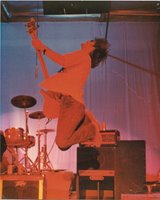
Mostly we wanted to extend our adolescence and forestall adulthood for as long as possible. In fact, one of the things that impeded my career was that I had other options available to me. I could avoid the horror of a conventional "day gig" by becoming a psychologist, of all things. It seems that many popular artists are alienated *losers* of sorts, without other options in life, which gives them a certain desperate ambitiousness that I never possessed. Someone like John Lennon would have been in prison or on the dole had he not been Elvis Beatle. Outside that context, he was a completely dysfunctional person. One could cite hundreds of other examples. As the Mother expressed it, artists often
"live in the vital plane, and the vital part of them is extremely sensitive to the forces of that world and receives from it all kinds of impressions and impulsions over which they have no controlling power. And often too they are very free in their minds and do not believe in the petty social conventions and moralities that govern the life of ordinary people. They do not feel bound by the customary rules of conduct and have not yet found an inner law that would replace them."
Amen to that, Mother!
Speaking of my days in the band, it is something of a truism that artists and artistic wannabooze down through the centuries have taken advantage of whatever was available at the time in order to facilitate "non-ordinary" experiences, whether it was religion, herbal remedies, absinthe, morning glory, belladonna, heroin, amphetamine, psychedelics, what have you. But it is not as if anyone can simply take a drug and become an artist. Supposedly, this is the reason so many jazz musicians were hooked on heroin during the 1940s and '50s. They were so in awe of Charlie Parker's talent, that they thought perhaps his secret lay (or is it lie? -- help me out here, Martin) in the substance he was injecting. Thus, if you look at my profile, you will see that many of my favorite musicians were heroin addicts at one time or another: Coltrane, Sonny Rollins, Dexter Gordon, Art Pepper, Jackie McLean, and Bill Evans, not to mention Lee Morgan, Phil Woods, Ray Charles, Grant Green, and so many others.
Does this mean that I have to be a rebellious heroin addict to enjoy their musical accomplishments? Of course not. First of all, Kenny G. or Wynton Marsalis could take heroin all day, but it would not elevate their art. And most of the above musicians produced better music once they stopped using heroin.
When I began exploring jazz in the early '90s, it was simply because I had hit a certain wall with other musical forms and was in search of something deeper. I began in the middle, with people like John Coltrane, but found it too daunting, so I returned to the beginning and educated myself in the same order that the music organically developed, from New Orleans "trad jazz," through big band and small group swing, and on to bop, cool, third stream, hard bop, post bop, avant-garde and fusion.
Eventually I settled on a particular period between around 1959 and 1967 (with many notable outliers in both directions), during which time the genre of "freebop" or avant-garde small group jazz reached its artistic apex. And if you want to know why I love this music, it is because it combines a maximum of order and spontaneity, which, as a matter of fact, is an exact mirror of my classical liberal political philosophy and the basic pattern of spiritual and psychological evolution. It takes incredible discipline and sensitivity to play this music, and yet, it is always right on the verge of chaos. It's not just the music I like -- i.e., the order -- but the chaos. But if the chaos goes any further, it ventures into "free jazz" -- AKA, musical anarchy -- which I do not like.
And as a matter of fact, the development of free jazz was completely tied up with the afrocentric political movement of radical black liberation. Chord progressions and structure are for slaves! That's the white man's music! As always, when art explicitly merges with a political program, it generally becomes time-bound didacticism and not art. Bob Dylan's most forgettable songs are from his early days as part of the leftist movement -- "Masters of War," and the like. His art took a quantum leap forward when he left the tediously earnest left behind, and began playing with the possibilities of language to explore the interior landscape.
Now, it is a mildly interesting question to ask: who's "cooler," modern liberals (i.e., leftists) or traditional liberals (i.e., conservatives)? Who's more hip, more free-thinking, more open to experience, more "rebellious" and non-conforming? Not that any of these things are worthwhile on their own in the absence of real intellectual or spiritual substance, but one of the biggest surprises of my life has been how startlingly conformist and parochial my baby-boomer generational cohort became. These people were supposed to be the great questioners of authority, but most of these craven conformists haven't taken a new cognitive imprint since the 1960s or early-'70s -- which we see every day in the MSM. Who could possibly be more predictable and vacuously conformist than Katie Couric, Maureen Dowd, Wolf Blitzer, Chris Matthews, or Keith Olbermann? Have they ever had a creative thought in their lives -- not counting paranoid creativity? Doubtful.
Clearly, leftism represents the entrenched interests of the day, as they have taken over virtually every influential institution. They have control of television, Hollywood, academia, the arts, labor unions, the major daily newspapers, the biggest websites (dailykos and huffpo) and virtually all of the major professional organizations, including my own pathetic pressure group, the American Psychological Association.
Conservatives have, what, the Washington Times, the editorial pages of the WSJ, talk radio, and Fox (which is really more populist than conservative).
I believe my philosophy is much closer to the aesthetic ideals of my musical heroes because, like them, my posts, for better or worse, are a combination of discipline and spontaneity. I had to spend half my life disciplining and preparing myself, and now I am spending the second half improvising and riffing on what I internalized along the way. Mind jazz, baby! It's not for leftist squares and moldy figs. What they don't know -- cannot know -- is that genuine religion is by far the greatest form of adult entertainment, emphasis on the word adult, for it is so much more musically and harmonically deep than the screechy and repetitive horizontal ditties of the left.
Classical liberalism, like the greatest art and the great religious revelations, will still be around in 10,000 years, whereas bonehead leftism will have been long forgotten, if only because the world will not survive another 10,000 years should leftism prevail in our current three-party civil war between Islamism, leftism and liberalism. "Integrating" them in the manner of Ken Wilber (TW: Alan) is a non-starter.
There is nothing to prevent a Yogi from being an artist or an artist from being a Yogi. But when you are in Yoga, there is a profound change in the values of things, of art, as of everything else; you begin to look at art from a very different standpoint. It is no longer the one supreme all-engrossing thing for you, no longer an end in itself. Art is a means, not an end...
If you want art to be the true and highest art, it must be the expression of a divine world brought down into this material world.... If you consider it in this light, art is not very different from Yoga.... In both, the aim is to become more and more conscious; in both you have to learn to see and feel something that is beyond the ordinary vision and feeling, to go within and bring out from there deeper things. --The Mother, Conversations on Yoga
*****
The fellows I played with, Dave and Eddie, went on to form the group Sun 60.
First of all, I did not do this. Rather, I specifically stated that I adore the music produced by black culture -- of which I am only an honorary member, by decree of my half black cousin, Dupree, whose father is supposedly the musician Pinetop Perkins -- and regard its various musical idioms to be America's greatest contribution to world art. Frankly, I'm not sure what would be in second place. I suppose the films of the 1940's and the American musical theater. And perhaps the poems of Suzanne Sommers.
While angry, the troll is not surprised at my perfidy, as it seems that I am simply attempting to hide under cover of blackness due to "the recent total collapse of any possible defense of neo-conservative ideas and fundamentalist dogma." He does not enumerate the conservative (which is to say, classical liberal) ideas that can no longer be defended, nor does he outline how I fit the definition of a weird dogmatic fundamentalist -- the weirdness I will cop to -- but he seems to be suggesting yesterday's post was an exercise in flailing about and trying to find something for which I can blame the left, since my own fanatical Bush/Rove/Free Market/Fundamentalist Christian ideas have been so thoroughy discredited.
In other words, this fellow Jonwo is a bit of a psychologist. He's telling me that I don't really believe what I believe, but am engaged in some sort of paranoid defense mechanism whereby I lash out at the left as a way to ignore the reality of my crumbling world view. Could be.
Regarding black music, he writes, "It's certainly safe for you to claim [it] as your own now, isn't it? Now that the rough veneer of actual rebelliousness has been polished to a safe and genteel shine? Glad you and your golf buddies are so musically progressive out in the suburbs. Would you and your caddie [have] been so accepting hanging out with these same heroin-addicted, frequently crazy and passionate poor black folks when they were alive? Of course not. It would be Lawrence Welk all the way. Once dead you can gussy them up and try and make them belong to you. Coltrane's Christ is not your Christ and his Christianity is not your Christianity. Don't demean his work by attempting to lump him with your other half-baked generalizations. By the by, if you discover that you are unable to make a point without resorting to weak generalizations, you should sit down and think about what it is you believe."
Yes, this is a stupid and infantile rant, but it is important to analyze it, for it does reflect certain ruling ideas of the left. First, it is thoroughly racist, which almost goes without saying, for there is no leftism without racism. But even before that, there is another fanciful assumption, that religion equates to fundamentalism, which equates to dogma and absence of reason, for he writes,
"The sad fact for many modern conservatives is that they have allowed the faith-based voodoo talk of the fundamentalists to replace any vestige of the reason-based ideas and discourse of the old conservatives. We've ended up with a generation of Republicans unable to put simple ideas together."
First there is the ubiquitous conflation of Republicanism with conservatism. But more noteworthy is how the "new liberals" always claim to be in common cause with the "old conservatives." Witness Time magazine's recent cover story with the photoshopped tear on the face of Ronald Reagan. Leftists now supposedly pine for the old days of Reagan conservatism, when in reality, if you check out a Time magazine from the 1980s, you will see that they routinely mocked and excoriated Reagan as an addle-brained extremist, just as they mock Bush today.
Thus, the left does exactly what Jonwo accuses me of doing, that is, reinventing the past in order to make it serviceable for present ideological needs. You will find that they are doing the same with Goldwater, resurrecting him as a sensible conservative, nothing at all like these extremists running loose today. But if you read what liberals actually wrote at the time, it was just as full of hatred and bile as the present denunciations of imaginary "Jew-loving Christian fascist neo-cons."
Jonwo does something that one should always avoid, which is to confuse art and politics. He writes, "It sounds as though you have a nice collection of music created by people who would despise your politics, which is perhaps why you have such an odd tension between your musical tastes and your social conservatism. Interesting."
First of all, the feelings an artist has about my politics are completely irrelevant to both their production of the art and my enjoyment of it. I do not have to be a great admirer of Napoleon in order to enjoy the Eroica symphony, nor am I troubled by the fact that if Beethoven knew that I preferred a representative republic over a dictatorship, he'd probably thrash me about the head and shoulders with his baton. Nevertheless, I suppose it is "ironic," in a way, that Beethoven was inspired to produce this great work of art by political ideals I find objectionable. How about that?
Perhaps the most notorious example is Wagner, whom a fair number of people believe to be the greatest composer -- in fact, the greatest genius, bar none -- the world has ever known, despite his vicious anti-Semitism.
Jonwo asks if I and my caddie, Dupree, would enjoy hanging out with "poor, crazy, heroin-addicted, black folks" today. That is a good question. I know that Dupree would in a heartbeat, which indeed is one of his "issues." As for me, I wouldn't want to go on an amphetamine binge with Johnny Cash and Waylon Jennings and stay up for a week (not today, anyway -- bad for diabetes), but it doesn't mean I can't enjoy their music.
I myself used to be an artist of sorts. Not really, but I was in a band, and we didn't want to not be artists. Yeah, that's me:
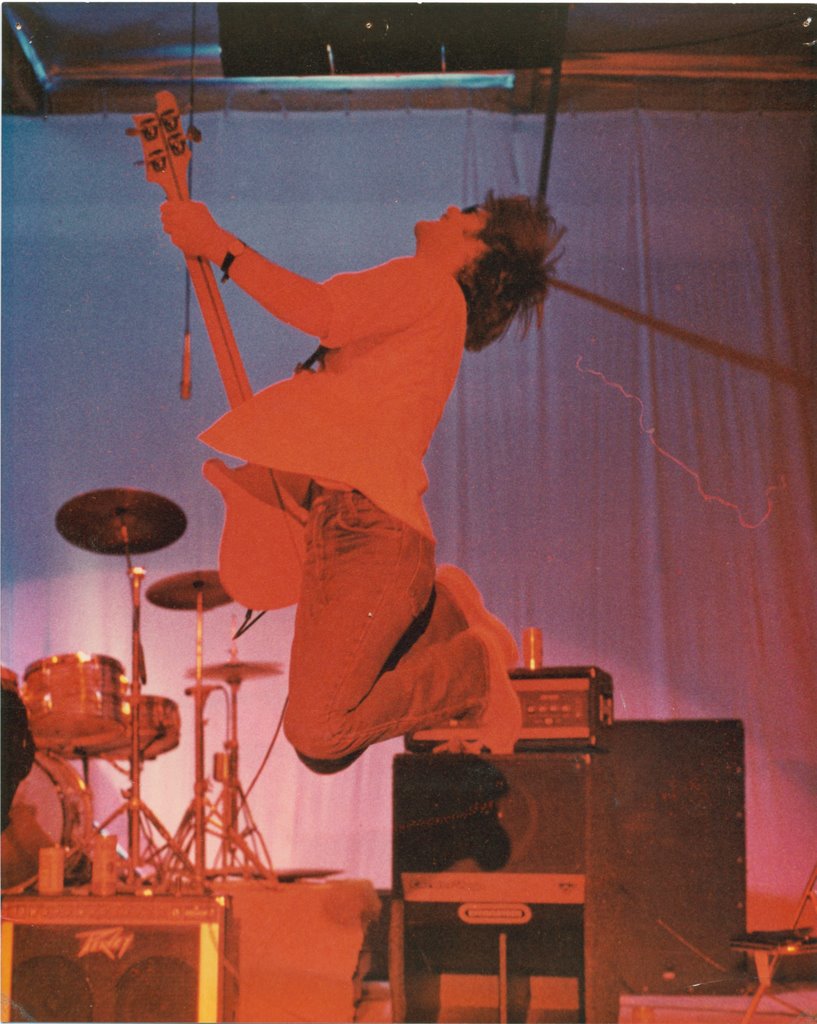
Mostly we wanted to extend our adolescence and forestall adulthood for as long as possible. In fact, one of the things that impeded my career was that I had other options available to me. I could avoid the horror of a conventional "day gig" by becoming a psychologist, of all things. It seems that many popular artists are alienated *losers* of sorts, without other options in life, which gives them a certain desperate ambitiousness that I never possessed. Someone like John Lennon would have been in prison or on the dole had he not been Elvis Beatle. Outside that context, he was a completely dysfunctional person. One could cite hundreds of other examples. As the Mother expressed it, artists often
"live in the vital plane, and the vital part of them is extremely sensitive to the forces of that world and receives from it all kinds of impressions and impulsions over which they have no controlling power. And often too they are very free in their minds and do not believe in the petty social conventions and moralities that govern the life of ordinary people. They do not feel bound by the customary rules of conduct and have not yet found an inner law that would replace them."
Amen to that, Mother!
Speaking of my days in the band, it is something of a truism that artists and artistic wannabooze down through the centuries have taken advantage of whatever was available at the time in order to facilitate "non-ordinary" experiences, whether it was religion, herbal remedies, absinthe, morning glory, belladonna, heroin, amphetamine, psychedelics, what have you. But it is not as if anyone can simply take a drug and become an artist. Supposedly, this is the reason so many jazz musicians were hooked on heroin during the 1940s and '50s. They were so in awe of Charlie Parker's talent, that they thought perhaps his secret lay (or is it lie? -- help me out here, Martin) in the substance he was injecting. Thus, if you look at my profile, you will see that many of my favorite musicians were heroin addicts at one time or another: Coltrane, Sonny Rollins, Dexter Gordon, Art Pepper, Jackie McLean, and Bill Evans, not to mention Lee Morgan, Phil Woods, Ray Charles, Grant Green, and so many others.
Does this mean that I have to be a rebellious heroin addict to enjoy their musical accomplishments? Of course not. First of all, Kenny G. or Wynton Marsalis could take heroin all day, but it would not elevate their art. And most of the above musicians produced better music once they stopped using heroin.
When I began exploring jazz in the early '90s, it was simply because I had hit a certain wall with other musical forms and was in search of something deeper. I began in the middle, with people like John Coltrane, but found it too daunting, so I returned to the beginning and educated myself in the same order that the music organically developed, from New Orleans "trad jazz," through big band and small group swing, and on to bop, cool, third stream, hard bop, post bop, avant-garde and fusion.
Eventually I settled on a particular period between around 1959 and 1967 (with many notable outliers in both directions), during which time the genre of "freebop" or avant-garde small group jazz reached its artistic apex. And if you want to know why I love this music, it is because it combines a maximum of order and spontaneity, which, as a matter of fact, is an exact mirror of my classical liberal political philosophy and the basic pattern of spiritual and psychological evolution. It takes incredible discipline and sensitivity to play this music, and yet, it is always right on the verge of chaos. It's not just the music I like -- i.e., the order -- but the chaos. But if the chaos goes any further, it ventures into "free jazz" -- AKA, musical anarchy -- which I do not like.
And as a matter of fact, the development of free jazz was completely tied up with the afrocentric political movement of radical black liberation. Chord progressions and structure are for slaves! That's the white man's music! As always, when art explicitly merges with a political program, it generally becomes time-bound didacticism and not art. Bob Dylan's most forgettable songs are from his early days as part of the leftist movement -- "Masters of War," and the like. His art took a quantum leap forward when he left the tediously earnest left behind, and began playing with the possibilities of language to explore the interior landscape.
Now, it is a mildly interesting question to ask: who's "cooler," modern liberals (i.e., leftists) or traditional liberals (i.e., conservatives)? Who's more hip, more free-thinking, more open to experience, more "rebellious" and non-conforming? Not that any of these things are worthwhile on their own in the absence of real intellectual or spiritual substance, but one of the biggest surprises of my life has been how startlingly conformist and parochial my baby-boomer generational cohort became. These people were supposed to be the great questioners of authority, but most of these craven conformists haven't taken a new cognitive imprint since the 1960s or early-'70s -- which we see every day in the MSM. Who could possibly be more predictable and vacuously conformist than Katie Couric, Maureen Dowd, Wolf Blitzer, Chris Matthews, or Keith Olbermann? Have they ever had a creative thought in their lives -- not counting paranoid creativity? Doubtful.
Clearly, leftism represents the entrenched interests of the day, as they have taken over virtually every influential institution. They have control of television, Hollywood, academia, the arts, labor unions, the major daily newspapers, the biggest websites (dailykos and huffpo) and virtually all of the major professional organizations, including my own pathetic pressure group, the American Psychological Association.
Conservatives have, what, the Washington Times, the editorial pages of the WSJ, talk radio, and Fox (which is really more populist than conservative).
I believe my philosophy is much closer to the aesthetic ideals of my musical heroes because, like them, my posts, for better or worse, are a combination of discipline and spontaneity. I had to spend half my life disciplining and preparing myself, and now I am spending the second half improvising and riffing on what I internalized along the way. Mind jazz, baby! It's not for leftist squares and moldy figs. What they don't know -- cannot know -- is that genuine religion is by far the greatest form of adult entertainment, emphasis on the word adult, for it is so much more musically and harmonically deep than the screechy and repetitive horizontal ditties of the left.
Classical liberalism, like the greatest art and the great religious revelations, will still be around in 10,000 years, whereas bonehead leftism will have been long forgotten, if only because the world will not survive another 10,000 years should leftism prevail in our current three-party civil war between Islamism, leftism and liberalism. "Integrating" them in the manner of Ken Wilber (TW: Alan) is a non-starter.
There is nothing to prevent a Yogi from being an artist or an artist from being a Yogi. But when you are in Yoga, there is a profound change in the values of things, of art, as of everything else; you begin to look at art from a very different standpoint. It is no longer the one supreme all-engrossing thing for you, no longer an end in itself. Art is a means, not an end...
If you want art to be the true and highest art, it must be the expression of a divine world brought down into this material world.... If you consider it in this light, art is not very different from Yoga.... In both, the aim is to become more and more conscious; in both you have to learn to see and feel something that is beyond the ordinary vision and feeling, to go within and bring out from there deeper things. --The Mother, Conversations on Yoga
*****
The fellows I played with, Dave and Eddie, went on to form the group Sun 60.
Thursday, March 29, 2007
The Negrophobia and Cultural Genocide of the Left
Now, it seems to me that the left is King Midas in reverse, in that it destroys whatever it touches and reduces gold to excrement, whether it is institutions, countries, cultures, or individuals. I realize this sounds harsh, but I believe it is self-evident, since we can see the disastrous outcome of leftist ideas before our eyes. It's not as if the results are hidden, because whatever the left controls goes through a predictable process of degeneration and decline.
For example, we all know that our educational system is a mess, the reason being that the left has had complete control of it for some 50 years, to such an extent that neither political party can avoid using leftist assumptions to tackle the problem.
I'm guessing that the U.N. probably started out with noble liberal ideals and not completely cynical leftist ones. Perhaps not. But in any event, it was long ago taken over by leftists and has become the biggest and most illiberal institution on the planet. Imagine an even remotely liberal U.N. If such a thing existed, there would be universal condemnation of Iran or North Korea. They would be completely isolated from the civilized world. In fact, any country that sided with them would be tossed out of the U.N. and isolated as well. The big mistake of the U.N. -- which is the universal mistake of leftism -- was having no standards for membership. It is a sick joke that members of the U.N. are given rights and privileges that they would never grant their own people. Among the Saudis, only their diplomats are allowed to vote, drink, and patronize the most expensive blonde hookers in Manhattan.
The left has also controlled most of the major urban centers for the past 40-50 years -- including, most infamously, New Orleans. I frequently visited New York before Rudy became mayor, so I know what it was like when the left was in total control. It's not as if the differences could only be detected in abstract crime statistics and the like. The entire vibe of the city changed. And yet, I well remember liberals routinely referring to Giuliani as a fascist and cretin. Imagine if New York had been allowed to continue sliding down the path it was headed in the early 1990's, with more leftist solutions applied to the problems resulting from leftist solutions.
I am aware of no leftist who has apologized for the vast destruction that has been caused by leftism. The only exceptions are those who are no longer leftists, such as David Horowitz. I was thinking about this destruction last night while watching a very moving documentary on the history of gospel music, Say Amen, Somebody, because what the left has done to blacks and to black culture represents nothing less than cultural genocide.
Because of the thought-control of the left, one can hardly discuss these matters without being regarded either as racist or condescending, but I think that blacks made America's greatest artistic contribution to world culture in the form of the various idioms of music they produced during the 50 years or so between about 1925 and 1975 -- gospel, jazz, rhythm & blues, soul, and various sub-genres of jazz such as dixieland, swing, ragtime, boogie woogie, bop, hard bop, post-bop, modal, and other distinct variants. Not only is my life spiritually enriched every single day by this art, but it is difficult to imagine what my life would be like without it. It would be such a deprivation.
What happened to it? Why did black creativity take off in the 1920s and continue through the 1960s, only to go into decline after the mid-'70s? Speaking only of the music, how could something so beautiful transform into something so barbarous and ugly within a single generation? How do we explain the devolution from Duke Ellington to Snoop Dogg, or John Coltrane to Ludacris, or Dinah Washington to Michael Jackson?
More generally, why did black culture produce such timeless and transcendent excellence before leftists began meddling with their culture? Prior to the 1960s, the black family was known for its strength and stability in the face of adversity, not its fragility in the midst of abundance. I have spoken to many blacks of the older generation (now in their '60s and '70s), and all agree that educational standards have declined dramatically since segregation ended. Obviously, this is not because segregation ended, but because that is when blacks were subsumed into the white leftist educational establishment and designated victims, so that the same standards need not apply to them. This is another fine example of the illiberalism of the left.
Prior to the mid '60s, a major part of the civil rights movement in its original classically liberal incarnation focused on elevating blacks through educational excellence. It was a self-help movement, not anything like its current culture of victimology. Black teachers took a special pride in their role, which was closer to a spiritual mission. I've read a number of biographies of jazz greats, and they all remember this or that teacher who noticed their talent but was extremely demanding of them.
I've read several Duke Ellington bios, and there was not a hint of bitterness, let alone a sense of victimization, in the man, despite the fact that if he were so inclined, he would have had every "right" to have wallowed in victimization. After all, there are blacks today who are far more wealthy and powerful than Ellington could have dreamed of, but it doesn't stop them from having a perpetual sense of anger and grievance -- Harry Belafonte, Spike Lee, Danny Glover. But in the case of Ellington, he was temperamentally the opposite. He had a natural dignity and nobility, even a sort of regal bearing and demeanor that I am sure did more to mitigate racism than 40 years of undignified groveling, extortion, and poverty pimping by the likes of Al Sharpton and Jesse Jackson.
And Ellington was certainly no "Uncle Tom" -- in fact, the Jacksons and Sharptons of the world are the real Uncle Toms, doing their little minstrel shakedown dance for the entertainment of white liberals -- to assuage their guilt. The problem with Obama is that he has the deceptively dignified bearing of an Ellington but the same undignified slave-victim mentality of other leftists.
At this point, I am not sure that it is even possible for the left to produce excellence, let alone black excellence. It is no coincidence that the left produces clowns such as Cornell West and Mayor Nagin whereas the right produces Thomas Sowell, Clarence Thomas, Condi Rice, Michael Steele, Ken Blackwell, Delroy Murdock, Armstrong Williams, et al. It is an unavoidable insult to say that these are first rate minds, and yet, it needs to be said in order to highlight the gulf between them and the wasted minds of the left.
Coincidentally, I see that there is a review this morning on NRO of a silly book entitled Total Chaos: The Art and Aesthetics of Hip-Hop. The Review starts out with the same thesis I have presented:
"Ralph Ellison always remembered the black jazzmen of his native Oklahoma City fondly: 'Life could be harsh, loud and wrong if it wished, but they lived it fully, and when they expressed their attitude toward the world it was with a fluid style that reduced the chaos of living to form.' This is a beautiful definition of jazz, and a brilliant one of art in general -- for what more could we ask of art than to render human experience, even at its worst, an understandable and even palatable thing? American blacks have long made music of their suffering, and blues and jazz once gave prime voice to a part of black experience in America. As the years have passed, the timbre of that voice has changed, and so has the experience being articulated. We are now in the age of hip-hop, a culture born in the Bronx and bred of the calamities of ghetto life."
Of course, "the calamities of ghetto life" should be translated to mean leftist control of urban centers. The calamities were not like some sort of unavoidable natural disaster. Rather, they were fully manmade, a result of disastrous ideas put into action. One nonsensical quote from this ghastly book tells you where the author is coming from. He describes hip-hop as “heir to the Black Arts and the postmodernist and multiculturalist movements, head high amid all of the terms batted about to try to frame the imperatives and urgencies of Now -- such as post-Blackness, polyculturalism, globalism, and transnationalism -- hip-hop is where flux, identity, revolution, and the masses mix, and keep on expanding.”
Say what? I am more inclined to the view expressed by Dirty Harry to the pornographer:
I'll tell you what you are to me, little man. You're just a maggot who sells dirty pictures.
The reviewer notes that "one idea put forward repeatedly is that hip-hop is a form of protest.... Hip-hop is rebellious not only in artistic terms, but in political ones as well.... 'Because of where hip-hop came from in the social base, it already suggested a political opposition and a political possibility for the creativity for the people at the margins of society, socially, economically -- people at the margins in terms of power.'"
But it is naive to say that hip-hip is simply "inclined to politics." Rather, it is specifically steeped in leftism. As I have mentioned before, one of the disturbing things about being a serious music collector is that one must always endure the obnoxious leftist sentiments expressed in the liner notes. The other day I purchased a wonderful Gram Parsons collection, but as usual, the analysis of his music cannot help but get into a dopey leftist political analysis. Here is a man who was another tragic victim of the drug culture, dying of an overdose at the age of 26. But the writer states without so much as a fig leaf of irony or self-awareness that Parsons' musical vision was "a grand design for a sort of white country soul that integrated rootsy forms with the enlightened consciousness of late-'60s rock culture."
You see, to the arrogant left, they are always "enlightened," even if it means dying of a drug overdose, or promoting promiscuity, or celebrating the disintegration of the family, or appeasing evil, or promoting a degenerate soundtrack to cultural genocide.
I am reminded of one of the great black artists, John Coltrane, who was a victim of the drug culture, but was saved -- not by leftists who would vicitmize him, but by God. In the liner notes to A Love Supreme, he writes of his heroin addiction,
"During the year 1957, I experienced, by the grace of God, a spiritual awakening which was to lead me to a richer, fuller, more productive life. At that time, in gratitude, I humbly asked to be given the means and privilege to make others happy through music. I feel this has been granted through His grace. ALL PRAISE TO GOD.
"This album is a humble offering to Him. An attempt to say 'THANK YOU GOD' through our work, even as we do in our hearts and with our tongues. May He help and strengthen all men in every good endeavor."
Coltrane concludes with a poem that certainly must be obnoxious to any secular leftist, but his music is the aural embodiment of the grace described therein:
A LOVE SUPREME
I will do all I can to be worthy of Thee O Lord....
God is. It is so beautiful. Thank you God. God is all....
It is most important that I know Thee....
His way... it is so lovely... it is gracious.
It is merciful -- Thank you God....
Glory to God...God is so alive. God is. God loves.
May I be acceptable in Thy sight.
We are all one in His grace.
The fact that we do exist is acknowledgment of Thee O Lord.
Thank you God.
God will wash away all our tears... He always has...
He always will. Seek Him everyday.
In all ways seek God every day.
Let us sing all songs to God
To whom all praise is due...
I have seen God -- I have seen ungodly --
None can be greater -- none can compare to God.
Thank you God.
He will remake us... He always has and He always will.
It is true -- blessed be His name -- Thank you God.
God breathes through us so completely...
so gently we hardly feel it...
All from God. Thank you God. Amen.
For example, we all know that our educational system is a mess, the reason being that the left has had complete control of it for some 50 years, to such an extent that neither political party can avoid using leftist assumptions to tackle the problem.
I'm guessing that the U.N. probably started out with noble liberal ideals and not completely cynical leftist ones. Perhaps not. But in any event, it was long ago taken over by leftists and has become the biggest and most illiberal institution on the planet. Imagine an even remotely liberal U.N. If such a thing existed, there would be universal condemnation of Iran or North Korea. They would be completely isolated from the civilized world. In fact, any country that sided with them would be tossed out of the U.N. and isolated as well. The big mistake of the U.N. -- which is the universal mistake of leftism -- was having no standards for membership. It is a sick joke that members of the U.N. are given rights and privileges that they would never grant their own people. Among the Saudis, only their diplomats are allowed to vote, drink, and patronize the most expensive blonde hookers in Manhattan.
The left has also controlled most of the major urban centers for the past 40-50 years -- including, most infamously, New Orleans. I frequently visited New York before Rudy became mayor, so I know what it was like when the left was in total control. It's not as if the differences could only be detected in abstract crime statistics and the like. The entire vibe of the city changed. And yet, I well remember liberals routinely referring to Giuliani as a fascist and cretin. Imagine if New York had been allowed to continue sliding down the path it was headed in the early 1990's, with more leftist solutions applied to the problems resulting from leftist solutions.
I am aware of no leftist who has apologized for the vast destruction that has been caused by leftism. The only exceptions are those who are no longer leftists, such as David Horowitz. I was thinking about this destruction last night while watching a very moving documentary on the history of gospel music, Say Amen, Somebody, because what the left has done to blacks and to black culture represents nothing less than cultural genocide.
Because of the thought-control of the left, one can hardly discuss these matters without being regarded either as racist or condescending, but I think that blacks made America's greatest artistic contribution to world culture in the form of the various idioms of music they produced during the 50 years or so between about 1925 and 1975 -- gospel, jazz, rhythm & blues, soul, and various sub-genres of jazz such as dixieland, swing, ragtime, boogie woogie, bop, hard bop, post-bop, modal, and other distinct variants. Not only is my life spiritually enriched every single day by this art, but it is difficult to imagine what my life would be like without it. It would be such a deprivation.
What happened to it? Why did black creativity take off in the 1920s and continue through the 1960s, only to go into decline after the mid-'70s? Speaking only of the music, how could something so beautiful transform into something so barbarous and ugly within a single generation? How do we explain the devolution from Duke Ellington to Snoop Dogg, or John Coltrane to Ludacris, or Dinah Washington to Michael Jackson?
More generally, why did black culture produce such timeless and transcendent excellence before leftists began meddling with their culture? Prior to the 1960s, the black family was known for its strength and stability in the face of adversity, not its fragility in the midst of abundance. I have spoken to many blacks of the older generation (now in their '60s and '70s), and all agree that educational standards have declined dramatically since segregation ended. Obviously, this is not because segregation ended, but because that is when blacks were subsumed into the white leftist educational establishment and designated victims, so that the same standards need not apply to them. This is another fine example of the illiberalism of the left.
Prior to the mid '60s, a major part of the civil rights movement in its original classically liberal incarnation focused on elevating blacks through educational excellence. It was a self-help movement, not anything like its current culture of victimology. Black teachers took a special pride in their role, which was closer to a spiritual mission. I've read a number of biographies of jazz greats, and they all remember this or that teacher who noticed their talent but was extremely demanding of them.
I've read several Duke Ellington bios, and there was not a hint of bitterness, let alone a sense of victimization, in the man, despite the fact that if he were so inclined, he would have had every "right" to have wallowed in victimization. After all, there are blacks today who are far more wealthy and powerful than Ellington could have dreamed of, but it doesn't stop them from having a perpetual sense of anger and grievance -- Harry Belafonte, Spike Lee, Danny Glover. But in the case of Ellington, he was temperamentally the opposite. He had a natural dignity and nobility, even a sort of regal bearing and demeanor that I am sure did more to mitigate racism than 40 years of undignified groveling, extortion, and poverty pimping by the likes of Al Sharpton and Jesse Jackson.
And Ellington was certainly no "Uncle Tom" -- in fact, the Jacksons and Sharptons of the world are the real Uncle Toms, doing their little minstrel shakedown dance for the entertainment of white liberals -- to assuage their guilt. The problem with Obama is that he has the deceptively dignified bearing of an Ellington but the same undignified slave-victim mentality of other leftists.
At this point, I am not sure that it is even possible for the left to produce excellence, let alone black excellence. It is no coincidence that the left produces clowns such as Cornell West and Mayor Nagin whereas the right produces Thomas Sowell, Clarence Thomas, Condi Rice, Michael Steele, Ken Blackwell, Delroy Murdock, Armstrong Williams, et al. It is an unavoidable insult to say that these are first rate minds, and yet, it needs to be said in order to highlight the gulf between them and the wasted minds of the left.
Coincidentally, I see that there is a review this morning on NRO of a silly book entitled Total Chaos: The Art and Aesthetics of Hip-Hop. The Review starts out with the same thesis I have presented:
"Ralph Ellison always remembered the black jazzmen of his native Oklahoma City fondly: 'Life could be harsh, loud and wrong if it wished, but they lived it fully, and when they expressed their attitude toward the world it was with a fluid style that reduced the chaos of living to form.' This is a beautiful definition of jazz, and a brilliant one of art in general -- for what more could we ask of art than to render human experience, even at its worst, an understandable and even palatable thing? American blacks have long made music of their suffering, and blues and jazz once gave prime voice to a part of black experience in America. As the years have passed, the timbre of that voice has changed, and so has the experience being articulated. We are now in the age of hip-hop, a culture born in the Bronx and bred of the calamities of ghetto life."
Of course, "the calamities of ghetto life" should be translated to mean leftist control of urban centers. The calamities were not like some sort of unavoidable natural disaster. Rather, they were fully manmade, a result of disastrous ideas put into action. One nonsensical quote from this ghastly book tells you where the author is coming from. He describes hip-hop as “heir to the Black Arts and the postmodernist and multiculturalist movements, head high amid all of the terms batted about to try to frame the imperatives and urgencies of Now -- such as post-Blackness, polyculturalism, globalism, and transnationalism -- hip-hop is where flux, identity, revolution, and the masses mix, and keep on expanding.”
Say what? I am more inclined to the view expressed by Dirty Harry to the pornographer:
I'll tell you what you are to me, little man. You're just a maggot who sells dirty pictures.
The reviewer notes that "one idea put forward repeatedly is that hip-hop is a form of protest.... Hip-hop is rebellious not only in artistic terms, but in political ones as well.... 'Because of where hip-hop came from in the social base, it already suggested a political opposition and a political possibility for the creativity for the people at the margins of society, socially, economically -- people at the margins in terms of power.'"
But it is naive to say that hip-hip is simply "inclined to politics." Rather, it is specifically steeped in leftism. As I have mentioned before, one of the disturbing things about being a serious music collector is that one must always endure the obnoxious leftist sentiments expressed in the liner notes. The other day I purchased a wonderful Gram Parsons collection, but as usual, the analysis of his music cannot help but get into a dopey leftist political analysis. Here is a man who was another tragic victim of the drug culture, dying of an overdose at the age of 26. But the writer states without so much as a fig leaf of irony or self-awareness that Parsons' musical vision was "a grand design for a sort of white country soul that integrated rootsy forms with the enlightened consciousness of late-'60s rock culture."
You see, to the arrogant left, they are always "enlightened," even if it means dying of a drug overdose, or promoting promiscuity, or celebrating the disintegration of the family, or appeasing evil, or promoting a degenerate soundtrack to cultural genocide.
I am reminded of one of the great black artists, John Coltrane, who was a victim of the drug culture, but was saved -- not by leftists who would vicitmize him, but by God. In the liner notes to A Love Supreme, he writes of his heroin addiction,
"During the year 1957, I experienced, by the grace of God, a spiritual awakening which was to lead me to a richer, fuller, more productive life. At that time, in gratitude, I humbly asked to be given the means and privilege to make others happy through music. I feel this has been granted through His grace. ALL PRAISE TO GOD.
"This album is a humble offering to Him. An attempt to say 'THANK YOU GOD' through our work, even as we do in our hearts and with our tongues. May He help and strengthen all men in every good endeavor."
Coltrane concludes with a poem that certainly must be obnoxious to any secular leftist, but his music is the aural embodiment of the grace described therein:
A LOVE SUPREME
I will do all I can to be worthy of Thee O Lord....
God is. It is so beautiful. Thank you God. God is all....
It is most important that I know Thee....
His way... it is so lovely... it is gracious.
It is merciful -- Thank you God....
Glory to God...God is so alive. God is. God loves.
May I be acceptable in Thy sight.
We are all one in His grace.
The fact that we do exist is acknowledgment of Thee O Lord.
Thank you God.
God will wash away all our tears... He always has...
He always will. Seek Him everyday.
In all ways seek God every day.
Let us sing all songs to God
To whom all praise is due...
I have seen God -- I have seen ungodly --
None can be greater -- none can compare to God.
Thank you God.
He will remake us... He always has and He always will.
It is true -- blessed be His name -- Thank you God.
God breathes through us so completely...
so gently we hardly feel it...
All from God. Thank you God. Amen.
Wednesday, March 28, 2007
Beware the Fascist Atheocracy of the Left (3.08.12)
In the words of Schuon, the devil is "the humanized personification -- humanized on contact with man -- of the subversive aspect of the centrifugal existential power; not the personification of this power in so far as its mission is positively to manifest Divine Possibility." In other words, the absolute, insofar as it deploys itself in time and space (which it does "inevitably"), radiates from a cosmic center to the periphery, somewhat like a series of concentric circles with God at the center. God's energies are like radii emanating from the center outward, while the different concentric circles are the various levels of being, or the cosmic hierarchy.
Therefore, although everything is ultimately God, not everything is equally God. The idea that everything is equally God leads to pantheism, which is an indiscriminate flatland philosophy no more sophisticated than bonehead atheism. It is logically equivalent to saying everything is not God. Or one might simply say "everything," and therefore "nothing" -- it doesn't matter, or mind, for that matter. In any event, nothing is that simple, let alone everything, let further alone the Divine Nothing-Everything at the center of it all.
Now ultimately, everything "is God" in some sense, but God is not the sum total of everything. Things vary in their proximity to God. Furthermore, there is movement toward God. We call this "evolution," but we should probably come up with a different term -- perhaps Adam & Evolution -- so as to not confuse it with mere natural selection, which reduces the transcosmic fact of evolution to a random and mechanical process.
But it goes without saying to anyone with common sense and uncommon vision that the greater cannot be derived from the lesser, and that there is presently no plausible theory whatsoever that can account for the miracle of the human subject, which represents a miniature "cosmic center" within the whirling microcosmos of man.
And like the cosmic center of which it is a mirror, the individual center has a natural tendency to radiate outward and lose itself in the playful phenomena of its own creation, or the form of its own sensibility, as Kant would have it. However, in its properly balanced way, this radiation leads to further centration, not dissipation. For example, when we love what is beautiful, we identify the soul's "within" by locating it in the without, which has effect of strengthening our central being. Conversely, if we love that which is ugly or "know" what is false, this has the effect of diminishing our center -- which, at the same time, necessarily pulls us further from God, the cosmic center.
The periphery must be -- i.e., there must be things that are more or less distant from God -- but this does not mean that they need be evil. Nevertheless, as Schuon implies, the divine radiation results in "cosmic interstices," so to speak, where evil enters the picture. This is where the soul cancers arise and take root. It is one of the inevitable even though unsanctioned possibilities of the Divine radiation, somewhat like an existential blood clot.
The cosmos is permeated with arteries that carry "oxidized" energies away from God and veins through which creation returns to its source. Only human beings may partake of this circulatory system in a conscious way, and become co-partners in the divine plan. It's an offer we can and do refuse, although no one in their right mind would do so. On the one hand, creation is already "perfect," being that it is a metaphysically necessary and unnarcissary objectification of God. Nevertheless, by virtue of not being God, it cannot be perfect, but can only "become" perfect through man's conscious participation.
Or let us say that perfection is only a possibility because it is woven into the very warp and woof of creation. If it weren't, we wouldn't even have the word. Nor would we have the words for truth and beauty if they were not coursing through the arteries of existence as divine possibilities. Truth is either "invented" or it is "discovered." If invented, then it is not true. If discovered, then it is of God -- or at least underwritten by God, the Absolute.
Now, today we find ourselves in a struggle of truly cosmic proportions between forces representing the human personification of the centrifugal existential power -- which is a very real, even if derivative and parasitic, power -- and those representing the center (or evolutionary return to the center). It's funny where one can pick up important ideas, but a couple of days ago I heard a promo for the new Dennis Miller radio program. In reference to the weather hysteria of Al Gore, Miller said words to the effect of, "hey, I'm not worried about the earth -- I'm worried about the world."
Exactly. The earth is simply an object deposited somewhere roughly in the middle of the arc of creation. The human world, on the other hand, is very near the top -- or at least the bottom of the top. If you imagine that the earth is a fragile and delicate thing but the world is not, then you are quite naive. In particular, the world of the West -- the wonderful world created by Judeo-Christian principles -- is without question the most rare and precious thing in all of creation, since it represents the apex of the possibility of the cosmic return to God. In a sense, it is even more precious than individuals -- who are intrinsically infinitely precious -- since it is the only guarantor that the individual may actually discover his unique idiom and become himself, thereby being an individual reflection of the cosmic center.
Let's be honest -- this is why it would suck to have to endure the horror of being born in most any other time or place. Given the choice, would you want to be born a Saudi? A "Palestinian?" A feudal serf? An Argentinian? A Cuban? Lost most anywhere in the continent of Africa? Why? What would be the point? In most times and places, there has been no way for you to do anything but remain frozen in your little cosmic rut with no options.
Now, the cosmic-political battle in which we are engaged is ultimately between forces who deny hierarchy and those who affirm it; and those who intoxicatedly ride the centrifugal waves to the periphery, vs. those who soberly partake of the centripetal return. Importantly, those who deny hierarchy do so -- either consciously or unconsciously -- with the intention of replacing the natural hierarchy with their own illegitimate one. This is where all the false absolutes of the left enter the picture and set up shop (remember those cosmic interstices alluded to above). Left alone they become cancers, which means that, as they grow in strength and intensity, they actually begin to take on a gravitational attraction of their own.
You might even say that they become an alternative cosmic center that sets itself against the real one. It arrests progress -- the cosmic return -- by pulling both the innocent and guilty into its dark principality. It's methods are moral relativism, multiculturalism, and "critical theory," or deconstruction; its defender and guarantor is the coercion of political correctness rather than the "lure" of Truth; and its goal is the reversal of the cosmic order, the instantiation of the Fall, the obliteration of the vertical, and the exaltation (and therefore bestialization) of man, thus sealing his spiritual fate and ending the possibility of divine co-creation and theosis, or God-realization.
It is appropriate that these cosmic tyrants are called "Democrats," for democracy is a system of information flow that can lead to the higher or to the lower. In fact, it will inevitably lead to the lower if we do not acknowledge at the outset that there is a higher toward which democracy must orient itself. In other words, in the absence of hierarchy, demo-cracy will become exactly what the word implies, which is to say, tyranny of the horizontalized masses, or demo-crazies.
This is why the ads for Air America can insist that they are the "real majority," a bizarre statement on its face unless one understands that this is the leftist substitute for truth. Or as Jim Morrison sang, The old get old / And the young get stronger / May take a week / And it may take longer / They got the guns / But we got the numbers / Gonna win, yeah / We're takin over / Come on!
Who's taking over? In point of fact, the crazies of the left are half correct, in that we are ultimately faced with the choice between democracy and theocracy. The American founders, in their infinite wisdom, chose theocracy, in the sense that the only legitimate purpose of democracy could be to preserve and protect the spiritual freedom of the theocentric individual. In short, they created a theocracy that would be mediated not from the top down -- which is never a real theocracy, but manarchy -- through thousands and now millions of godlings, or "divine centers." But a democracy mediated by mere animal-men will sooner or later lead to the Reign of the Beast.
In the specific sense we are using the word, theocracy is "the only guarantee of a realistic liberty" (Schuon). Otherwise, the centrifugal riptide in which secular man stands soon leads to the following ideas: that "truth amounts to the belief of the majority," and therefore, that the majority for all intents and purposes creates the truth, which is one of the explicit assumptions of the left -- i.e., "perception is reality." Under such bersercumstances, authority cannot appeal to truth, but "lives at the mercy of the electors," which in the end degrades them by patronizing them. Schuon adds that this doesn't mean democracy is impossible, but that "it is primarily a question of... an inwardly aristocratic and theocratic democracy" as envisioned by the Founders. In short, an exterior democracy of interior aristocrats, noble cats, & centrippin'al coons.
The adage vox populi vox Dei has no meaning except in a religious framework which confers a function of “medium” on the crowds; they then express themselves not by thought but by intuition and under the influence of Heaven..., so that the feeling of the majority coincides in any case with what may be called “the good".... --F. Schuon
Therefore, although everything is ultimately God, not everything is equally God. The idea that everything is equally God leads to pantheism, which is an indiscriminate flatland philosophy no more sophisticated than bonehead atheism. It is logically equivalent to saying everything is not God. Or one might simply say "everything," and therefore "nothing" -- it doesn't matter, or mind, for that matter. In any event, nothing is that simple, let alone everything, let further alone the Divine Nothing-Everything at the center of it all.
Now ultimately, everything "is God" in some sense, but God is not the sum total of everything. Things vary in their proximity to God. Furthermore, there is movement toward God. We call this "evolution," but we should probably come up with a different term -- perhaps Adam & Evolution -- so as to not confuse it with mere natural selection, which reduces the transcosmic fact of evolution to a random and mechanical process.
But it goes without saying to anyone with common sense and uncommon vision that the greater cannot be derived from the lesser, and that there is presently no plausible theory whatsoever that can account for the miracle of the human subject, which represents a miniature "cosmic center" within the whirling microcosmos of man.
And like the cosmic center of which it is a mirror, the individual center has a natural tendency to radiate outward and lose itself in the playful phenomena of its own creation, or the form of its own sensibility, as Kant would have it. However, in its properly balanced way, this radiation leads to further centration, not dissipation. For example, when we love what is beautiful, we identify the soul's "within" by locating it in the without, which has effect of strengthening our central being. Conversely, if we love that which is ugly or "know" what is false, this has the effect of diminishing our center -- which, at the same time, necessarily pulls us further from God, the cosmic center.
The periphery must be -- i.e., there must be things that are more or less distant from God -- but this does not mean that they need be evil. Nevertheless, as Schuon implies, the divine radiation results in "cosmic interstices," so to speak, where evil enters the picture. This is where the soul cancers arise and take root. It is one of the inevitable even though unsanctioned possibilities of the Divine radiation, somewhat like an existential blood clot.
The cosmos is permeated with arteries that carry "oxidized" energies away from God and veins through which creation returns to its source. Only human beings may partake of this circulatory system in a conscious way, and become co-partners in the divine plan. It's an offer we can and do refuse, although no one in their right mind would do so. On the one hand, creation is already "perfect," being that it is a metaphysically necessary and unnarcissary objectification of God. Nevertheless, by virtue of not being God, it cannot be perfect, but can only "become" perfect through man's conscious participation.
Or let us say that perfection is only a possibility because it is woven into the very warp and woof of creation. If it weren't, we wouldn't even have the word. Nor would we have the words for truth and beauty if they were not coursing through the arteries of existence as divine possibilities. Truth is either "invented" or it is "discovered." If invented, then it is not true. If discovered, then it is of God -- or at least underwritten by God, the Absolute.
Now, today we find ourselves in a struggle of truly cosmic proportions between forces representing the human personification of the centrifugal existential power -- which is a very real, even if derivative and parasitic, power -- and those representing the center (or evolutionary return to the center). It's funny where one can pick up important ideas, but a couple of days ago I heard a promo for the new Dennis Miller radio program. In reference to the weather hysteria of Al Gore, Miller said words to the effect of, "hey, I'm not worried about the earth -- I'm worried about the world."
Exactly. The earth is simply an object deposited somewhere roughly in the middle of the arc of creation. The human world, on the other hand, is very near the top -- or at least the bottom of the top. If you imagine that the earth is a fragile and delicate thing but the world is not, then you are quite naive. In particular, the world of the West -- the wonderful world created by Judeo-Christian principles -- is without question the most rare and precious thing in all of creation, since it represents the apex of the possibility of the cosmic return to God. In a sense, it is even more precious than individuals -- who are intrinsically infinitely precious -- since it is the only guarantor that the individual may actually discover his unique idiom and become himself, thereby being an individual reflection of the cosmic center.
Let's be honest -- this is why it would suck to have to endure the horror of being born in most any other time or place. Given the choice, would you want to be born a Saudi? A "Palestinian?" A feudal serf? An Argentinian? A Cuban? Lost most anywhere in the continent of Africa? Why? What would be the point? In most times and places, there has been no way for you to do anything but remain frozen in your little cosmic rut with no options.
Now, the cosmic-political battle in which we are engaged is ultimately between forces who deny hierarchy and those who affirm it; and those who intoxicatedly ride the centrifugal waves to the periphery, vs. those who soberly partake of the centripetal return. Importantly, those who deny hierarchy do so -- either consciously or unconsciously -- with the intention of replacing the natural hierarchy with their own illegitimate one. This is where all the false absolutes of the left enter the picture and set up shop (remember those cosmic interstices alluded to above). Left alone they become cancers, which means that, as they grow in strength and intensity, they actually begin to take on a gravitational attraction of their own.
You might even say that they become an alternative cosmic center that sets itself against the real one. It arrests progress -- the cosmic return -- by pulling both the innocent and guilty into its dark principality. It's methods are moral relativism, multiculturalism, and "critical theory," or deconstruction; its defender and guarantor is the coercion of political correctness rather than the "lure" of Truth; and its goal is the reversal of the cosmic order, the instantiation of the Fall, the obliteration of the vertical, and the exaltation (and therefore bestialization) of man, thus sealing his spiritual fate and ending the possibility of divine co-creation and theosis, or God-realization.
It is appropriate that these cosmic tyrants are called "Democrats," for democracy is a system of information flow that can lead to the higher or to the lower. In fact, it will inevitably lead to the lower if we do not acknowledge at the outset that there is a higher toward which democracy must orient itself. In other words, in the absence of hierarchy, demo-cracy will become exactly what the word implies, which is to say, tyranny of the horizontalized masses, or demo-crazies.
This is why the ads for Air America can insist that they are the "real majority," a bizarre statement on its face unless one understands that this is the leftist substitute for truth. Or as Jim Morrison sang, The old get old / And the young get stronger / May take a week / And it may take longer / They got the guns / But we got the numbers / Gonna win, yeah / We're takin over / Come on!
Who's taking over? In point of fact, the crazies of the left are half correct, in that we are ultimately faced with the choice between democracy and theocracy. The American founders, in their infinite wisdom, chose theocracy, in the sense that the only legitimate purpose of democracy could be to preserve and protect the spiritual freedom of the theocentric individual. In short, they created a theocracy that would be mediated not from the top down -- which is never a real theocracy, but manarchy -- through thousands and now millions of godlings, or "divine centers." But a democracy mediated by mere animal-men will sooner or later lead to the Reign of the Beast.
In the specific sense we are using the word, theocracy is "the only guarantee of a realistic liberty" (Schuon). Otherwise, the centrifugal riptide in which secular man stands soon leads to the following ideas: that "truth amounts to the belief of the majority," and therefore, that the majority for all intents and purposes creates the truth, which is one of the explicit assumptions of the left -- i.e., "perception is reality." Under such bersercumstances, authority cannot appeal to truth, but "lives at the mercy of the electors," which in the end degrades them by patronizing them. Schuon adds that this doesn't mean democracy is impossible, but that "it is primarily a question of... an inwardly aristocratic and theocratic democracy" as envisioned by the Founders. In short, an exterior democracy of interior aristocrats, noble cats, & centrippin'al coons.
The adage vox populi vox Dei has no meaning except in a religious framework which confers a function of “medium” on the crowds; they then express themselves not by thought but by intuition and under the influence of Heaven..., so that the feeling of the majority coincides in any case with what may be called “the good".... --F. Schuon
Tuesday, March 27, 2007
Driving With Your Headlights Off and Reading the Evening World
About my new work -- I confess I can't understand some of my critics.... They say it's obscure. They compare it, of course, with Ulysses. But the action of Ulysses was chiefly in the daytime, and the action of my new work takes place chiefly at night. It's natural things should not be so clear at night, isn't it now?... It is night. It is dark. You can hardly see. You sense, rather. --James Joyce
So, the essence of Coon vision involves "seeing things," specifically, "seeing in the dark." For once we saw through a glass, darkly, and some day face to face. But in between comes Coon vision, with which we may gain a slightly clearer view of our brief phase in the mirror.
One of the reasons I am so intrigued by Finnegans Wake is that it attempts to illuminate the night not with light, but to adapt the eyes to seeing in the dark. In other words, if we merely shine light into the darkness, it is no longer darkness. We aren't studying darkness but day.
It is hopefully not banalogous to compare it to the experiments of quantum physics, in which the observer causes the "collapse of the wave function," i.e., the wave to become particle. Prior to its observation, the particle is nowhere and everywhere, but by setting up experimental conditions to observe it, it is brought out into the light, so to speak. It becomes a particle by viewing it as such. But then we have eliminated the wave. The principle of complementarity means that we can either see the wave or the particle, but not both at the same time.
If day vision is the particle, then night vision is the wave. To extend the analogy -- analogy being one of the important modes by which we may see in the dark -- day is to part as vision is to whole; also, light is to horizontal as night (which emphatically is not lightlessness) is to the vertical. Day vision always illuminates a part, whereas the parts tend to blend together at night, which lends itself to the contemplation of wholeness and verticality -- of the primordial interconnectedness of things.
For example, I seriously doubt that I could write these posts if I weren't sitting here by the light of darkness with my eyes agoggled and my ears hanging wide open. For the eye is the organ of the day, while the ear is the organ of night. To see with the ear we must disenable the eye, which greedily takes in everything at once, while the ear must be passive and patient, as events reveal their wholeness in time. But just as ears can see time, eyes can hear space, specifically, the sacred space where God dwells.
Is this not the purpose of meditation and prayer, to turn off the light in order to see by darkness? "When you pray, go into your inner room, close your door and pray to your Father who is in secret." "Secret" is a fascinating word with many implicit meanings buried within: hidden, mystery, remote from human frequentation or notice, secluded, esoteric, revealed only to the initiated, constructed so as to elude observation or detection, a key to a desired end.
In the words of the Katha Upanishad, "The Self-Existent made the senses turn outward. Accordingly, man looks toward what is without, and sees not what is within. Rare is he who, longing for immortality, shuts his eyes to what is without and beholds the Self.... He who sees the manifold universe, and not the one reality, goes evermore from death to death."
In fact, let us continue with this luminous ego-dielogue with the King of Death: "That which is awake in us even while we sleep, shaping in dream the objects of our desire -- that indeed is pure, that is Brahman, and that verily is called the Immortal. All the worlds have their being in that, and none can transcend it. That is the Self."
Such esoteric passages can easily be Cross-referenced and trancelighted into Christian terms. "The Self-Existent made the senses turn outward," means that that that which is without mirrors that which is within, because both partake of the divine logos. Consciousness is the "inturned logos," just as the world is logos exteriorized. Rare is he who wakes to the Dreamer who eternally dreams the dream, the unborn night womb out of which all is born:
"She knows not, for her whole Being throbs with a passionate yearning to be known. If she is sometimes termed unconscious, it is only in the sense that she is not the bright [March] forthshining awareness of the Father, the Light of lights, who is her opposite pole.... Devoid of form, empty of forms, she holds within her darkly living heart the potentiality of all forms.
"To get any image of it, one should turn to psychological processes and imagine it as like the matrix of dark dreamless sleep in which potentially exist, and out of which emerge, the bright images of a dream" (Sri Krishna Prem).
Religious rituals endeavor to engage the night in terms of the night. To sightlessly cite one nonobvious example, the ritual of communion is rendered meaningless if unilluminated by the light of day. Rather, it specifically attempts to potentiate the night on its own terms, to facilitate the unknowing of an object that cannot be known in any other way. A rationalist who prizes only rational knowledge is naturally precluded from the logic of the night, and in many cases, will insist that only daytime knowledge exists.
This is the realm of scientism; these are the people discussed yesterday, the boneheaded atheist crowd who negatively hallucinate the nonthings that are actually hidden there in plain sight. They do this because they are usually on the compulsive, which is to say, anal, side of the developmental spectrum, and hold onto their daytime knowledge in the manner of what Winnicott calls the "transitional object." In other words, knowledge to such an individual serves the purpose of a teddy or a binky.
Which is odd, because these are the people who suggest that religious belief is for the feint-hearted in need of an existential security blanket, when the opposite is true. Yes, religion can function as a security blanket or transitional object, but that is true of anything: food, high-heel shoes, music, books, exercise, whatever. The tendency to create and hold onto transitional objects is a human one, hardly limited to the religious. In fact, the second commandment could just as well read you shall not make for yourself a transitional object out of God, because doing so converts reality, or what is, into what we want or need it to be.
It is a banality to point out that scientists do this no less than religious people, which is why the history of science is, on the one hand, a quest for truth, but on the other hand, a history of desperate clinging to outmoded ideas. Humans being human, we are designed to love truth. The word "belief" is etymologically linked to "beloved," and there is no question that the garden-variety secular intellectual is prone to falling in love with his ideas. But unless these ideas are objectively and perennially true, then it is ultimately an exercise in narcissism, or self-love. Only truth is worthy of love, and love is a link between us and another object. The modern invention of "self-love" is actually a contradiction in terms, for love by its very nature radiates and is attracted to the true and the beautiful.
Real knowledge of truth requires surrender, humility, and conformity to it. In other words, we conform ourselves to truth by surrendering to its beauty, not by puffing ourselves up with vanity and imagining that we have invented it. Al Gore's increasingly shrill and desperate weather hysteria is a fine example of what happens when one falls in love with one's ideas instead of humbly submitting to truth. When I say Gore is crazy, I mean this literally, for in his testimony before congress last week, he continued to maintain that there is a 100% scientific consensus in support of his views.
Now, either Gore is evil, because he is a despicable liar, or he is nuts, because he is negatively hallucinating, that is, not seeing the thousands of scientists who do not share his weather fantasies. I believe he is the latter, although naturally, much evil follows from the process of negative hallucination. It is analogous to leprosy, which is not a direct cause of amputation. Rather, it causes nerve damage which leads to injuries that eventually require amputation. Thus, if you are negatively hallucinating, you will continuously receive sharp blows from reality but not know where they are coming from. "Learning" is one option; another is to lash out at reality in the manner of the Goreacle.
Well, it's starting to get light outside, so the indivisible darkness is receding into invisibility. Or as Joyce wrote, "We foregot at wiking when the bleakfrost chilled our ravery." Don't worry, we'll be black tomorrow. Leave a light off for me!
So, the essence of Coon vision involves "seeing things," specifically, "seeing in the dark." For once we saw through a glass, darkly, and some day face to face. But in between comes Coon vision, with which we may gain a slightly clearer view of our brief phase in the mirror.
One of the reasons I am so intrigued by Finnegans Wake is that it attempts to illuminate the night not with light, but to adapt the eyes to seeing in the dark. In other words, if we merely shine light into the darkness, it is no longer darkness. We aren't studying darkness but day.
It is hopefully not banalogous to compare it to the experiments of quantum physics, in which the observer causes the "collapse of the wave function," i.e., the wave to become particle. Prior to its observation, the particle is nowhere and everywhere, but by setting up experimental conditions to observe it, it is brought out into the light, so to speak. It becomes a particle by viewing it as such. But then we have eliminated the wave. The principle of complementarity means that we can either see the wave or the particle, but not both at the same time.
If day vision is the particle, then night vision is the wave. To extend the analogy -- analogy being one of the important modes by which we may see in the dark -- day is to part as vision is to whole; also, light is to horizontal as night (which emphatically is not lightlessness) is to the vertical. Day vision always illuminates a part, whereas the parts tend to blend together at night, which lends itself to the contemplation of wholeness and verticality -- of the primordial interconnectedness of things.
For example, I seriously doubt that I could write these posts if I weren't sitting here by the light of darkness with my eyes agoggled and my ears hanging wide open. For the eye is the organ of the day, while the ear is the organ of night. To see with the ear we must disenable the eye, which greedily takes in everything at once, while the ear must be passive and patient, as events reveal their wholeness in time. But just as ears can see time, eyes can hear space, specifically, the sacred space where God dwells.
Is this not the purpose of meditation and prayer, to turn off the light in order to see by darkness? "When you pray, go into your inner room, close your door and pray to your Father who is in secret." "Secret" is a fascinating word with many implicit meanings buried within: hidden, mystery, remote from human frequentation or notice, secluded, esoteric, revealed only to the initiated, constructed so as to elude observation or detection, a key to a desired end.
In the words of the Katha Upanishad, "The Self-Existent made the senses turn outward. Accordingly, man looks toward what is without, and sees not what is within. Rare is he who, longing for immortality, shuts his eyes to what is without and beholds the Self.... He who sees the manifold universe, and not the one reality, goes evermore from death to death."
In fact, let us continue with this luminous ego-dielogue with the King of Death: "That which is awake in us even while we sleep, shaping in dream the objects of our desire -- that indeed is pure, that is Brahman, and that verily is called the Immortal. All the worlds have their being in that, and none can transcend it. That is the Self."
Such esoteric passages can easily be Cross-referenced and trancelighted into Christian terms. "The Self-Existent made the senses turn outward," means that that that which is without mirrors that which is within, because both partake of the divine logos. Consciousness is the "inturned logos," just as the world is logos exteriorized. Rare is he who wakes to the Dreamer who eternally dreams the dream, the unborn night womb out of which all is born:
"She knows not, for her whole Being throbs with a passionate yearning to be known. If she is sometimes termed unconscious, it is only in the sense that she is not the bright [March] forthshining awareness of the Father, the Light of lights, who is her opposite pole.... Devoid of form, empty of forms, she holds within her darkly living heart the potentiality of all forms.
"To get any image of it, one should turn to psychological processes and imagine it as like the matrix of dark dreamless sleep in which potentially exist, and out of which emerge, the bright images of a dream" (Sri Krishna Prem).
Religious rituals endeavor to engage the night in terms of the night. To sightlessly cite one nonobvious example, the ritual of communion is rendered meaningless if unilluminated by the light of day. Rather, it specifically attempts to potentiate the night on its own terms, to facilitate the unknowing of an object that cannot be known in any other way. A rationalist who prizes only rational knowledge is naturally precluded from the logic of the night, and in many cases, will insist that only daytime knowledge exists.
This is the realm of scientism; these are the people discussed yesterday, the boneheaded atheist crowd who negatively hallucinate the nonthings that are actually hidden there in plain sight. They do this because they are usually on the compulsive, which is to say, anal, side of the developmental spectrum, and hold onto their daytime knowledge in the manner of what Winnicott calls the "transitional object." In other words, knowledge to such an individual serves the purpose of a teddy or a binky.
Which is odd, because these are the people who suggest that religious belief is for the feint-hearted in need of an existential security blanket, when the opposite is true. Yes, religion can function as a security blanket or transitional object, but that is true of anything: food, high-heel shoes, music, books, exercise, whatever. The tendency to create and hold onto transitional objects is a human one, hardly limited to the religious. In fact, the second commandment could just as well read you shall not make for yourself a transitional object out of God, because doing so converts reality, or what is, into what we want or need it to be.
It is a banality to point out that scientists do this no less than religious people, which is why the history of science is, on the one hand, a quest for truth, but on the other hand, a history of desperate clinging to outmoded ideas. Humans being human, we are designed to love truth. The word "belief" is etymologically linked to "beloved," and there is no question that the garden-variety secular intellectual is prone to falling in love with his ideas. But unless these ideas are objectively and perennially true, then it is ultimately an exercise in narcissism, or self-love. Only truth is worthy of love, and love is a link between us and another object. The modern invention of "self-love" is actually a contradiction in terms, for love by its very nature radiates and is attracted to the true and the beautiful.
Real knowledge of truth requires surrender, humility, and conformity to it. In other words, we conform ourselves to truth by surrendering to its beauty, not by puffing ourselves up with vanity and imagining that we have invented it. Al Gore's increasingly shrill and desperate weather hysteria is a fine example of what happens when one falls in love with one's ideas instead of humbly submitting to truth. When I say Gore is crazy, I mean this literally, for in his testimony before congress last week, he continued to maintain that there is a 100% scientific consensus in support of his views.
Now, either Gore is evil, because he is a despicable liar, or he is nuts, because he is negatively hallucinating, that is, not seeing the thousands of scientists who do not share his weather fantasies. I believe he is the latter, although naturally, much evil follows from the process of negative hallucination. It is analogous to leprosy, which is not a direct cause of amputation. Rather, it causes nerve damage which leads to injuries that eventually require amputation. Thus, if you are negatively hallucinating, you will continuously receive sharp blows from reality but not know where they are coming from. "Learning" is one option; another is to lash out at reality in the manner of the Goreacle.
Well, it's starting to get light outside, so the indivisible darkness is receding into invisibility. Or as Joyce wrote, "We foregot at wiking when the bleakfrost chilled our ravery." Don't worry, we'll be black tomorrow. Leave a light off for me!
Monday, March 26, 2007
The Negative Hallucinations of the Left: In Search of the Lost Entitlement
"Still up to your old tricks, I see. It is amazing how such sublime teachings can be so twisted to suit a limited, hateful ideology such as yours."
That imbacillus of a parasitic comment yesterday must take the cake, for the ignoranus who impropagated it is referring to my "hateful twisting" of the sublime Meditations on the Tarot. But if my ideology is hateful, then so too is Meditations on the Tarot, which is quite unyielding in its disdain for leftism. In fact, it is not possible for me to conceive of someone as wise as the author of Meditations on the Tarot falling for something as stupid and evil as leftism. After all, he's not Deepak Chopra or some other passive-aggressive new-age snake charmer.
As I have said before, any leftist who calls himself religious is primarily a leftist, only secondarily religious at best. The catalogue of foolish and harmful leftist beliefs is so extensive for the very reason that the leftist mind is not inoculated with the Word -- with perennial religious wisdom that prevents the mind from being hypnotized and lured down a host of fruitless, destructive, and anti-human paths.
Ontologically, leftism is "the substance of nothing," which is why politically it is the party of nihilism. There is no leftism without the intoxicated celebration of tearing down, of thanatos, the death instinct. When I say Democrats are the party of death, I mean it quite literally, but as always, in a way that the leftist cannot possibly understand. This is why, when they read this, they will have the subjective experience that I am "hitting" them instead of teaching them. Which is why they keep coming back, because they wish to be hit, as it gives them sanction to hit back -- which is what they wanted to do to begin with.
Not only is the leftist destructive, but his primary unconscious identification is with a destructive or absent object instead of a nurturing one. Bear in mind that I am mainly talking about activists and true believers; respectfully, the majority of Democrats are basically too stupid, too busy, or too informed by habit to know what they are supporting, but have simply internalized a "ruling cliche" repeated endlessly by the MSMistry of Truth, such as "Democrats are for the little guy" or "Republicans only care about the rich." But the true leftist believer is a sick soul and a dangerous person, probably a sociopath, not in terms of the DSM, but in terms of their unconscious mental structure.
In the sense I am discussing, the sociopath is someone who, for whatever developmental reason, was not safely ushered into the human community by benign parental objects, but was excessively frustrated or traumatized, leaving them deeply alienated and cynical.
Although we regard alienation and cynicism as common in our postmodern world, this only goes to show you how successful the left has been in normalizing a deeply pathological condition. On the one hand, alienation and cynicism are more or less absolute barriers to knowing God. On the other hand, you will have undoubtedly noticed that leftism represents the church of Our Lady of Perpetual Alienation and Cynicism. Its pope could be the foul-minded Bill Maher, but millions are equally qualified, as it takes no talent to have a catabolic mind capable only of mocking and tearing down.
Because of the developmental arrest, the leftist true believer is attached to that which originally frustrated him so. As a result, two things happen. First, he will spend his life "in search of the lost entitlement." This is because there is a time in our lives when we are entitled to the ministrations of omnipotently powerful caretakers who indulge our every whim. This period of time is called "infancy," and it is entirely appropriate that the infant should be granted this largesse, because it becomes the very foundation of the personality. All of us have a "foreground" self, but it is superimposed on an unconscious "background object" of infancy.
In fact, the word "object" is misleading, for the proper phrase would be something along the lines of "the background subject of primary maternal identification," coined by Dr. Grotstein. If you have ever wondered about the "dream substance" in which your self exists, this is it. This is why it is such a challenge to raise a baby, because this is precisely what good parents are trying to provide the baby -- not just food, warmth, and love, but a loving, predictable and "containing" psychic environment that the baby internalizes.
Importantly, the baby must do this in such a way that he believes that he himself is the creator of this benign psychic universe. A baby really does need to believe that his cries magically convert hunger into food, or fear into soothing, or psychic fragmentation into containment. In the mind of the omnipotent baby, he creates the parents, not vice versa. How could it be otherwise?
In other words, in the normal course of events, we are all born of magic. Only later are we gradually dis-illusioned to discover what is called the "reality principle." This means, paradoxically, that the psyche of a normal person rests on a foundation of benign magic. He lives in a trustworthy universe in which he is confident that his needs will be met, in which he can find love and give love in return, and where he can enjoy a generative creativity in the magical "transitional space" between brain and world.
For it is within this transitional space that the thing we call "reality" occurs. This is why there are so many arguments over what constitutes reality, for it really depends upon the nature of your transitional space. A generative person will see one thing, whereas a person whose transitional space has been foreclosed by trauma or disappointment will experience something entirely different.
In this regard, the pathological transitional space can become stuck in one or the other direction, either toward excessive fantasy or "malignant imagination" -- which we will call "hysteria" or "psychosis" -- or toward the excessive concreteness of the materialist or obligatory atheist. These popular lowbrow atheists such as Sam Harris or Daniel Dennett are essentially suffering from what I would call "negative hallucinations," in the sense that they imagine they don't see something that is there, as opposed to seeing something that isn't (which would be a positive hallucination).
Both forms of hallucination are equally dysfunctional, except that negative hallucinations are more subtle and can therefore go unnoticed. But I'm sure, now that you have the concept, you can think of countless experiences you have had with people who negatively hallucinate and "don't see things." This is why I would never bother to debate such a person, since it is an utter waste of time. They live in a certain transitional space which makes religion a closed world for them. All they can do is describe their proscribed little world and insist that it is the real one.
A moment's reflection will reveal to you that all meaningful human evolution takes place first in the transitional space. It is because the transitional space is so central to human evolution that political liberty is so critical. For the fact of the matter is that the vast majority of human cultures down through history have foreclosed the transitional space as a way to allay collective anxiety or to consolidate power. Only certain thoughts and attitudes are permissible. As such, the individual is not free to discover his soul's unique idiom in the transitional space of culture, but is forced to believe certain things and to behave in certain ways.
And this, of course, is where the perversion of modern Islamism meets the perversion of primitive leftist progressivism, for they share the pathology of foreclosing the transitional space. In the case of the Islamists it is rather obvious, as their project involves building and enforcing a cultural monument to infantile anxiety toward the mother, who must be controlled, devalued, and desexualized (which only makes her more insanely provocative and frightening, hence, the Islamic shadow world of anxiety-driven homosexuality).
For the left, political correctness is nothing more or less than an intellectual burqa to cover up various anxiety-provoking truths or to control the parents. It is equally sexualized, but in a different way. For example, there is an obsession with sexual differences that comes out as an irrational insistence that the differences do not exist (which is the unconscious basis of all perversions), as we saw, for example, in the firing of Larry Summers at Harvard. It is the same psychosis that insists that homosexuality and heterosexuality are indistinct -- a position that follows from the original psychotic effacement of sexual difference.
But perhaps the most troubling positive hallucination of the left involves the creation of victims. Importantly, the hallucination of victims is not a conscious process, but the end result of the unconscious logic that binds the leftist mind.
Recall that the true-believing leftist is traumatized and persecuted by the lost entitlement of infancy. As a result, he knows that he is a cosmic victim -- that the world owes hims something, something so deep that it is literally beyond words (infant comes from infans, incapable of speech, something to bear in mind when you watch those leftist demonstrations of raging inarticulacy on CSPAN).
This lost entitlement is too painful to bear, so the condescending and matronizing leftist projects it into others, to whom he then attempts to minister in fantasy (through the intermediary of government drained of its coerciveness through negative hallucination). You might say that he projects a type of primitive and painful emotional hunger, and then attempts to placate the projected mouth. But you will notice that the mouth only gets hungrier and more demanding, since it partakes of omnipotence -- of the (false) infinite.
This is very, very different from true charity, which comes from love (caritas), whereas leftist giving ultimately comes from rage and control. Here again, what I am saying is soph-evidently true to someone not caught up in the leftist fantasy world, but I cannot imagine that a leftist would be able to comprehend what we are talking about. But the full enactment of the leftist fantasy obviously results in an utterly selfish and ultimately death-bound world of entitled mouths, as we see in the welfare states of Western Europe, which are not just economically unsustainable, but psychologically and spiritually so.
Well, I can hear that His Majesty is starting to stir in the next room. He's almost two now, starting to reach that age when he will have to gradually be disillusioned and leave the infantile leftism of his youth behind. But not quite yet. There are still many illusions for me to nourish before he will be capable of creating reality. One of which is that he magically conjures his caretakers out of the morning Light -- caretakers who will continue to sustain him for the rest of his life, especially after he discovers their true source.
*****
More on the murderous negative hallucinations of the left.
How the anti-science religion of the left forecloses the transitional space in the "climate change" debate.
Dr. Sanity on Time magazine's "double hallucination" vis-a-vis Ronald Reagan. Such leftist fools.
*****
The shabby coon den where it all happens. Ignore Johnny's exuberant gesture above Mrs. G's head -- it is not directed at you, but "the man." If it looks like a teenager's bedroom, it's because it was my bedroom as a teenager. Long story. The rest of the house has been slowly remodeled over the years. This room is frozen in the 1970's, green shag carpeting and all. Oh, and Future Leader imagines he made that sweater, when it was really made by Sal.

That imbacillus of a parasitic comment yesterday must take the cake, for the ignoranus who impropagated it is referring to my "hateful twisting" of the sublime Meditations on the Tarot. But if my ideology is hateful, then so too is Meditations on the Tarot, which is quite unyielding in its disdain for leftism. In fact, it is not possible for me to conceive of someone as wise as the author of Meditations on the Tarot falling for something as stupid and evil as leftism. After all, he's not Deepak Chopra or some other passive-aggressive new-age snake charmer.
As I have said before, any leftist who calls himself religious is primarily a leftist, only secondarily religious at best. The catalogue of foolish and harmful leftist beliefs is so extensive for the very reason that the leftist mind is not inoculated with the Word -- with perennial religious wisdom that prevents the mind from being hypnotized and lured down a host of fruitless, destructive, and anti-human paths.
Ontologically, leftism is "the substance of nothing," which is why politically it is the party of nihilism. There is no leftism without the intoxicated celebration of tearing down, of thanatos, the death instinct. When I say Democrats are the party of death, I mean it quite literally, but as always, in a way that the leftist cannot possibly understand. This is why, when they read this, they will have the subjective experience that I am "hitting" them instead of teaching them. Which is why they keep coming back, because they wish to be hit, as it gives them sanction to hit back -- which is what they wanted to do to begin with.
Not only is the leftist destructive, but his primary unconscious identification is with a destructive or absent object instead of a nurturing one. Bear in mind that I am mainly talking about activists and true believers; respectfully, the majority of Democrats are basically too stupid, too busy, or too informed by habit to know what they are supporting, but have simply internalized a "ruling cliche" repeated endlessly by the MSMistry of Truth, such as "Democrats are for the little guy" or "Republicans only care about the rich." But the true leftist believer is a sick soul and a dangerous person, probably a sociopath, not in terms of the DSM, but in terms of their unconscious mental structure.
In the sense I am discussing, the sociopath is someone who, for whatever developmental reason, was not safely ushered into the human community by benign parental objects, but was excessively frustrated or traumatized, leaving them deeply alienated and cynical.
Although we regard alienation and cynicism as common in our postmodern world, this only goes to show you how successful the left has been in normalizing a deeply pathological condition. On the one hand, alienation and cynicism are more or less absolute barriers to knowing God. On the other hand, you will have undoubtedly noticed that leftism represents the church of Our Lady of Perpetual Alienation and Cynicism. Its pope could be the foul-minded Bill Maher, but millions are equally qualified, as it takes no talent to have a catabolic mind capable only of mocking and tearing down.
Because of the developmental arrest, the leftist true believer is attached to that which originally frustrated him so. As a result, two things happen. First, he will spend his life "in search of the lost entitlement." This is because there is a time in our lives when we are entitled to the ministrations of omnipotently powerful caretakers who indulge our every whim. This period of time is called "infancy," and it is entirely appropriate that the infant should be granted this largesse, because it becomes the very foundation of the personality. All of us have a "foreground" self, but it is superimposed on an unconscious "background object" of infancy.
In fact, the word "object" is misleading, for the proper phrase would be something along the lines of "the background subject of primary maternal identification," coined by Dr. Grotstein. If you have ever wondered about the "dream substance" in which your self exists, this is it. This is why it is such a challenge to raise a baby, because this is precisely what good parents are trying to provide the baby -- not just food, warmth, and love, but a loving, predictable and "containing" psychic environment that the baby internalizes.
Importantly, the baby must do this in such a way that he believes that he himself is the creator of this benign psychic universe. A baby really does need to believe that his cries magically convert hunger into food, or fear into soothing, or psychic fragmentation into containment. In the mind of the omnipotent baby, he creates the parents, not vice versa. How could it be otherwise?
In other words, in the normal course of events, we are all born of magic. Only later are we gradually dis-illusioned to discover what is called the "reality principle." This means, paradoxically, that the psyche of a normal person rests on a foundation of benign magic. He lives in a trustworthy universe in which he is confident that his needs will be met, in which he can find love and give love in return, and where he can enjoy a generative creativity in the magical "transitional space" between brain and world.
For it is within this transitional space that the thing we call "reality" occurs. This is why there are so many arguments over what constitutes reality, for it really depends upon the nature of your transitional space. A generative person will see one thing, whereas a person whose transitional space has been foreclosed by trauma or disappointment will experience something entirely different.
In this regard, the pathological transitional space can become stuck in one or the other direction, either toward excessive fantasy or "malignant imagination" -- which we will call "hysteria" or "psychosis" -- or toward the excessive concreteness of the materialist or obligatory atheist. These popular lowbrow atheists such as Sam Harris or Daniel Dennett are essentially suffering from what I would call "negative hallucinations," in the sense that they imagine they don't see something that is there, as opposed to seeing something that isn't (which would be a positive hallucination).
Both forms of hallucination are equally dysfunctional, except that negative hallucinations are more subtle and can therefore go unnoticed. But I'm sure, now that you have the concept, you can think of countless experiences you have had with people who negatively hallucinate and "don't see things." This is why I would never bother to debate such a person, since it is an utter waste of time. They live in a certain transitional space which makes religion a closed world for them. All they can do is describe their proscribed little world and insist that it is the real one.
A moment's reflection will reveal to you that all meaningful human evolution takes place first in the transitional space. It is because the transitional space is so central to human evolution that political liberty is so critical. For the fact of the matter is that the vast majority of human cultures down through history have foreclosed the transitional space as a way to allay collective anxiety or to consolidate power. Only certain thoughts and attitudes are permissible. As such, the individual is not free to discover his soul's unique idiom in the transitional space of culture, but is forced to believe certain things and to behave in certain ways.
And this, of course, is where the perversion of modern Islamism meets the perversion of primitive leftist progressivism, for they share the pathology of foreclosing the transitional space. In the case of the Islamists it is rather obvious, as their project involves building and enforcing a cultural monument to infantile anxiety toward the mother, who must be controlled, devalued, and desexualized (which only makes her more insanely provocative and frightening, hence, the Islamic shadow world of anxiety-driven homosexuality).
For the left, political correctness is nothing more or less than an intellectual burqa to cover up various anxiety-provoking truths or to control the parents. It is equally sexualized, but in a different way. For example, there is an obsession with sexual differences that comes out as an irrational insistence that the differences do not exist (which is the unconscious basis of all perversions), as we saw, for example, in the firing of Larry Summers at Harvard. It is the same psychosis that insists that homosexuality and heterosexuality are indistinct -- a position that follows from the original psychotic effacement of sexual difference.
But perhaps the most troubling positive hallucination of the left involves the creation of victims. Importantly, the hallucination of victims is not a conscious process, but the end result of the unconscious logic that binds the leftist mind.
Recall that the true-believing leftist is traumatized and persecuted by the lost entitlement of infancy. As a result, he knows that he is a cosmic victim -- that the world owes hims something, something so deep that it is literally beyond words (infant comes from infans, incapable of speech, something to bear in mind when you watch those leftist demonstrations of raging inarticulacy on CSPAN).
This lost entitlement is too painful to bear, so the condescending and matronizing leftist projects it into others, to whom he then attempts to minister in fantasy (through the intermediary of government drained of its coerciveness through negative hallucination). You might say that he projects a type of primitive and painful emotional hunger, and then attempts to placate the projected mouth. But you will notice that the mouth only gets hungrier and more demanding, since it partakes of omnipotence -- of the (false) infinite.
This is very, very different from true charity, which comes from love (caritas), whereas leftist giving ultimately comes from rage and control. Here again, what I am saying is soph-evidently true to someone not caught up in the leftist fantasy world, but I cannot imagine that a leftist would be able to comprehend what we are talking about. But the full enactment of the leftist fantasy obviously results in an utterly selfish and ultimately death-bound world of entitled mouths, as we see in the welfare states of Western Europe, which are not just economically unsustainable, but psychologically and spiritually so.
Well, I can hear that His Majesty is starting to stir in the next room. He's almost two now, starting to reach that age when he will have to gradually be disillusioned and leave the infantile leftism of his youth behind. But not quite yet. There are still many illusions for me to nourish before he will be capable of creating reality. One of which is that he magically conjures his caretakers out of the morning Light -- caretakers who will continue to sustain him for the rest of his life, especially after he discovers their true source.
*****
More on the murderous negative hallucinations of the left.
How the anti-science religion of the left forecloses the transitional space in the "climate change" debate.
Dr. Sanity on Time magazine's "double hallucination" vis-a-vis Ronald Reagan. Such leftist fools.
*****
The shabby coon den where it all happens. Ignore Johnny's exuberant gesture above Mrs. G's head -- it is not directed at you, but "the man." If it looks like a teenager's bedroom, it's because it was my bedroom as a teenager. Long story. The rest of the house has been slowly remodeled over the years. This room is frozen in the 1970's, green shag carpeting and all. Oh, and Future Leader imagines he made that sweater, when it was really made by Sal.

Subscribe to:
Posts (Atom)
Theme Song




