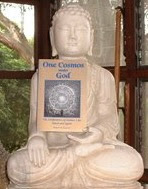
The first ascertainment which should impose itself upon man when he reflects on the nature of the Universe is the primacy of that miracle that is intelligence -- or consciousness or subjectivity -- and consequently the incommensurability between these and material objects, be it a question of a grain of sand or of the sun, or of any creature whatever as an object of the senses. --F. Schuon
Even a Coon has his limits, and I find myself coming up against mine, for if I could only find the words to express what it is I want to say about the miracle of subjectivity, I could reproduce the presence of Presence in my readers, and that would be that. Which is to say, that.
Without a doubt, the most awesome mystery in this cosmos -- without which there could not be a cosmos -- is the question of how existence became experience, and then, in human beings, doubled back upon itself and became the experience of experience. The fact that humans are, by and large, insufficiently astonished by this miracle, suggests to me that many of us have barely begun the ongoing task of lifting ourselves from the matrix of our animal consciousness.
Unfortunately, scientists can be the worst of the bunch. There is a type of "thin" but piercing intelligence that is prized in the western world, but which causes us to end up with a Daniel Dennett or Sam Harris and even grant them the title of "philosopher." Along these lines, yesterday I was alerted to almost inedible article entitled God and Gorillas (tail wiggle: Netwing), about what animals can supposedly tell us about religion. It was so painfully stupid that I couldn't stop wincing:
"Every human culture has believed in spirits, gods or some other divine being. But many scientists are coming up with their own, decidedly secular, theories about the origins of faith.... [O]ver the last few years, a small cottage industry made up of scientists and philosophers has devoted itself to demystifying the divine. Take Daniel Dennett, the philosopher who has proposed that religion is a meme -- an idea that evolved like a virus -- that infected our ancestors and continued to spread throughout cultures.... [A]nthropologist Pascal Boyer argues that religious belief is a quirky byproduct of a brain that evolved to detect predators and other survival needs.... And British biologist Lewis Wolpert... posits that religion developed once hominids understood cause and effect, which allowed them to make complex tools. Once they started to make causal connections, they felt compelled to explain life's mysteries. Their brains, in essence, turned into 'belief engines.'
"That's what makes [anthropologist] Barbara J. King... so unique.... [H]er main insights about the origins of religion come not from researching humans' deep history, but from observing very much alive non-human primates.... [W]e can trace back the origins of our religious impulse... to our ancient ancestors millions of years ago. And today, King says, we can see the foundations of religious behavior in chimpanzees and gorillas; watching our distant cousins can do much to explain the foundations of our own beliefs."
Of course, all of these approaches to religion represent stupidity on stilts: "if you want to understand spirit, don't watch and pray, just watch predators and prey." The idea that our understanding of religion could be supplemented by observing gorillas at the zoo is just so preposterous that one hardly knows how to respond except to say, "fine. If it works for you, go nuts. As long as no animals are harmed in the process. Whatever gets you through the night."
The operative passage above refers to the "small cottage industry made up of scientists and philosophers [which] has devoted itself to demystifying the divine." I say this because these people reflexively equate "demystifying" with "understanding." But when it comes to the Divine, to demystify it is to misunderstand it, precisely. For mystery is not the content of ignorance but a mode of understanding. It is to the serious seeker what curiosity is to the scientist. If these benighted scientists wish to experience God, they are approaching the subject in a manner that is guaranteed to seal their ignorance. They must follow the mystery, but first they must experience it.
Science aims at the demystification of the world, whereas religion aims at its remystification. Both approaches produce real knowledge, but only so long as the mode of understanding is adequate to the subject. And please, if you are a troll who thinks I am somehow "anti-science," please go away. I have no idea what serendipshitous cosmic winds blew you into Coonworld, but you have no business here. My writing is not intended for you, any more than your comments in any way reach me.
Now, the notion that animals live in a state of "mystery" about the world is just plain foolishness. They have only experience, not the experience of experience, which is to say mystery. Animals may look mysterious to us, but the feeling is not mutual. Only humans, upon becoming human, can awaken to the perpetual mystery that is. It is what distinguishes us from lower animals, not that which unites us. The religious person wishes to preserve and extend this mystery, not extinguish it. To conflate this quintessentially human epistemological mode with "ignorance" -- with a defect or deficit -- again represents a kind of breathtaking metaphysical perversion.
If you do not acknowledge the human thirst for mystery, two things will happen to your soul. First, you will search for it in inappropriate ways. You will "mystify" something that is not worthy of the name, and then pursue it as a sort of substitute religion. It can be literally anything, so long as you are "entranced" by it. The second thing that will happen is that you will become increasingly insensate to the real mystery, which is much more subtle than its many substitutes.
When you have successfully demystified the world, your soul is officially dead. This is why it is a chore for me to read the words of the scientists referenced above, for these are dead men talking. It is as wearying as communist or leftist boilerplate dogma that explains everything, and therefore, nothing. It is such a ham-handed and oblivious misuse of language, that it offends the sensibility of someone with even a rudimentary acquaintance with spirit. It is also a kind of psychic "bullying," trying to push people around with coarse and blunt language that is entirely disproportionate and inappropriate to its subject -- like an illiterate boob talking about Shakespeare.
I'm trying to think of an example that even a materialist with a blunted sensibility might understand. For many people who have successfully demystified the world, the only time they are able to unwittingly appreciate the sacred is when they are directly confronted with it in its most vivid form: death, the birth of a child, marriage, etc. Imagine being so spiritually insensate that you had the courage of your convictions and successfully drained the world of its sacred dimension. Upon the death of a loved one, you would simply put them in the garbage. After all, it's just a sack of meat. The birth of a child would be no different than termites hatching in your backyard. Marriage wouldn't exist, because there would be no recognition of the sacred dimension of male and female sexuality. Euthanasia would not just be legal, but mandatory, on grounds of common sense -- as would the abortion of youth in Asia -- as in China.
Believe it or not, there are people who more or less experience the world this way. But we do not call them "enlightened" or more in touch with reality than the rest of us. Rather, we call them schizoid or autistic.
As a matter of fact, not too long ago I conducted a psychological evaluation of such an individual. He had what is known as a Schizoid Personality Disorder. I won't get into all of the psychodynamics and etiology of this condition, but the end result is a kind of soul deadness which may leave the person's ability for dealing with matter entirely undamaged. Rather, their problems are all in the realm of intersubjectivity. In his case, he had no difficulty functioning on his technical, "scientific" job. However, he could not form deep and satisfying relationships because he could not "connect" with another person "interior to interior," only "exterior to exterior" -- which quickly becomes bizarre, because it means exile from the human world, which is an interior world.
This particular person was married and even had three children, but his own family members were more like "objects" than subjects to him. Not surprisingly, his outer affect was "depressed," but he did not have a clinical depression per se. For example, antidepressants would do nothing to help such an individual. Rather, his hollow and flat affect was simply an artifact of his inner detachment and absence of interpersonal passion. Yes, he was in pain, but the pain was more of a dull "absence" than an acute presence. He had no idea what was causing the presence of this painful absence. And it is very difficult to treat such an individual, because they are specifically detached from the mode of cure -- which is a relationship with the therapist. They can take in "information" from the therapist, but they cannot internalize the relationship, which is their whole problem in a nutshell.
It is also the whole problem with the spiritually autistic scientific approach to religion, for religion is not an exterior relationship between two objects, nor between a subject and an object. Rather, it is a passionate relationship between a subject and the Subject -- the Subject of subjectivity, as it were. The transitional space in which this relationship takes place is imbued with mystery, which again, is not to say ignorance, but a mode of knowledge that both deepens and extends. It is not an absence of light, but a kind of dark light that is only visible to the open soul. For example, it was within this living space that the entire corpus of Bach was produced and to which it stands as living testimony: Soli Deo Gloria. But I suppose Bach represents "musical ignorance."
Now I ask you. If religion represents a realm of "ignorance," how is it possible for a Coon to spend his life in relationship to a Subject that does not exist, all the while deepening his ignorance in a very precise and methodical way? I will speak only of myself. Over the past dozen years in particular, my spiritual understanding -- at least as far as I am concerned -- has deepened exponentially, and continues to do so. Otherwise I could not "share" this understanding and reproduce it in others (and they in me). Bear in mind that I do not say knowledge, but understanding, two very different things, for one can be full of religious knowledge (k) and yet have no understanding (O-->k).
But is it possible to deeply understand something which does not exist? No, it is not. All you would be deepening is your ignorance -- or, if you are very sick, your delusions.
Let us stipulate that either this new gang of militant atheists "understands" something about spirit, or that we do. Furthermore, let us agree that either they are deepening their ignorance of spirit, or we are. But let us also remember Blake's aphorism, Truth can never be told so as to be understood and not believed. Or, as Terence McKenna put it, "If the truth can be told so as to be understood, it will be believed."
How do you help someone rid themselves of their inappropriate knowledge so that they might understand and therefore believe?
The essence of the real is the banal or the trivial, the scientists and other pseudo-realists seem to say. To which we would answer: the essence of the real is the miraculous; the miracle of consciousness, intelligence, knowledge. In the beginning was, not matter, but Spirit, which is the Alpha and the Omega.. --F. Schuon
Saturday, February 03, 2007


Friday, February 02, 2007
Vertical Globalization and the Further Adventures of Consciousness
When I began this blog, I had the idea that instead of doing what the 55 million other blogs do -- most of them poorly, but some of them infinitely better than the MSMistry of Truth -- I would "reverse figure and ground" and be the one blog that looks at the news of the day from the standpoint of eternity. It's actually difficult to define what is meant by the term "news," but whatever it is, it tends to obsessively isolate the "now" and focus all of its attention on the passing moment, almost unavoidably elevating the media-created "tempest of the day" well beyond its importance.
The whole idea of the hysterical "news culture" would have been foreign to our primitive furbears. I'm not saying that they were right and that we are deviants, but if you go back just a few hundred years, I believe you'll find that people did live within a "psycho-spiritual container" fundamentally different than ours. It is tempting for some people to romanticize that time as "normative" for humans, and to a certain extent it was, for it meant that life was lived at a much more natural pace and within specifically human (as opposed to infrahuman and materialistic) frames of reference. This is something, for example, that Orthodox Jews or the Amish attempt to resurrect today in their isolated little communities -- a sacred worldspace in which life is lived in the light of the eternal. "News," whatever it is, represents something of an "impurity" in this space, unless it pertains directly to the inherent (and sacred) rhythms of life: birth, marriage, illness, death, etc.
In fact, it is not stretching the point to say that this represents the underlying basis of World War IV, the war on radical Islam. This is the theme of Thomas Barnett's so-far brilliant book, The Pentagon's New Map: War and Peace in the Twenty-first Century. Unfortunately, I have very little time to read these days, so I'm only up to page 63 of a somewhat lengthy book, but Barnett is a four-dimensional visionary thinker who is neither left nor right (more of a classical liberal) but very creative. The book is full of casually tossed off insights -- in my opinion, because he is operating out of a clear vision and simply describing what he sees there. As with my own vision, it may or may not be correct (some details are inevitably going to be wrong in any visionary system), but he gives us a way to see beyond the cognitively stultifying "news," think about the deeper structure of the now, and imagine "a future worth living."
Barnett's main insight is that the forces of globalization have created what he calls a "functioning core" of the world (the U.S., Western Europe, Japan, etc.) alongside an "unintegrated gap" that feels threatened by globalization and is actively resisting it -- violently if necessary. Likewise, the whole basis of the Cold War was that a large chunk of the world -- the communist world -- was an unintegrated gap that did not want to join the core, not for "sacred" reasons but for ideological ones.
Now, this whole dichotomy is distressing to a Coon, who obviously sympathizes with the forces of modernity and globalization, but who also fully understands (while not excusing) what would motivate someone from a traditional culture to violently resist it. Take, for example, our own Sectarian Conflict, which involved the identical pattern. Irrespective of the issue of slavery, the North represented the forces of globalization while the South represented an unintegrated gap within the United States that wished to remain separate and preserve a way of life that it clearly regarded as "sacred." For them, the life of the North was not worth living.
Indeed, this is what made men who would never be wealthy enough to own slaves fight and die by the tens of thousands. I am hardly a Civil War historian, let alone a buff, but I believe it is accurate to say that Southerners regarded the Northern army as a bunch of dishonorable mercenaries fighting for a subhuman cause. Because slavery has come to overshadow everything else, contemporary liberals have made it blasphemous to say that there was anything worthwhile about the antebellum South. This contemptuous attitude prevails today, in that our liberal elites -- think of John Kerry, or Chris Matthews, or primitive New York Timesman, or liberals in general -- simply cannot help registering their condescension toward the South and what it represents.
One of the things the South represents is the willingness to die for flag and country. Liberals routinely throw out the canard that the armed forces are disproportionately black and poor, but I am fairly certain that this is incorrect (I don't have time to personally look up the statistics). Rather, the military is disproportionately southern, for reasons that should be obvious if you give it a moment's thought.
It reminds me of something the immortal Duane Allman once said. Someone asked him what it felt like to be at the vanguard of this new fad of "Southern rock." He responded with words to the effect that this term was a a redundancy -- instead of "Southern rock," one might just as well say "rock rock," since its development was -- and only could have been -- a wholly Southern phenomenon: Elvis, Jerry Lee Lewis, Roy Orbison, Chuck Berry, Bo Diddley, Buddy Holly, Wanda Jackson, the Everly Brothers, Johnny Cash, Ray Charles, Bobby Bland, James Brown, T-Bone Walker, Little Richard, etc. Rock music originated in an "unintegrated cultural gap" that was generally unknown to the North. Music executives famously regarded it as artistically vacuous, if not offensive, and unworthy of the imprimatur of a respectable record label.
Now, 50 years on, the North has more or less succeeded in swallowing up this precious cultural expression, long since converting it to a mere commodity , which is what globalization does. You might even say that "Northerrn rock" represents the bland corporate substitute that extends from Pat Boone through disco, Madonna, MTV, death metal, rap and hip hop.
Rightly or wrongly, Muslims know that the tide of globalization will do the identical thing to their own culture and way of life. Thus, the unintegrated Muslim gap resists becoming part of of the functioning core.
As I mentioned yesterday, both the Left and Islamism represent pathological adaptations to the conditions of modernity and globalization. In the case of the Islamists it is self-evident, perhaps less so in the case of the Left. Scratch a leftist, and he will hire John Edwards and sue you. But scratch a little deeper, and what will you find? In a previous post entitled Political Seance, I wrote that
"In one version of history, the 'secular revolt' may be traced to the alienation and disenchantment caused by the scientific and industrial revolutions in the 17th and 18th centuries.... There was a deep sense that the organic unity of the world had been fractured -- a widespread perception of a sort of breach with the natural order of things, and with it, a collective mourning over the loss of timeless and familiar ways and customs. The romantic movement of the early 19th century was actually a reactionary and nostalgic yearning for an idyllic past, answering to the sense of loss of community and oneness with the rhythms of nature. This backward looking movement idealized the primitive and sought to unleash the subjective and irrational passions (countering the rational and objective detachment of science).
"Up to this time, one's personal identity had been based on such objective standards as a clearly defined role within an organic hierarchy or merger with a large extended clan. With modernity, this gave way to an uncertain identity that had to be forged for oneself in the world. The philosopher Charles Taylor (see his magisterial Sources of the Self) calls this 'an epistemological revolution with anthropological consequences,' as it led to a new kind of human being that had never before existed on a mass scale: the modern, self-defining subject in a world devoid of intrinsic meaning.
"Virtually all modern ideologies, movements and philosophies are somehow aimed at addressing this problem of alienation, of recapturing the broken unity of the world. Communism, nazism, European fascism, the beat movement, the hippie movement, the free love movement, the environmental movement, the new age movement -- all are futile attempts to turn back the clock and return to a mystical union with the 'volk,' with nature, with the proletariat, with the instincts. You can see this phenomenon in today's leftists, who clearly long for the 'magical' 1960's, which represented a high water mark for a resurgence of romantic merger with the group, free expression of the primitive, and idealized notions of recreating heaven on earth....
"We can see how contemporary liberalism fits the bill as a bogus cure for modern alienation. For example, multiculturalism devalues the concept of the individual in favor of the ethnic group, while socialism in all its forms favors the large and powerful mommy state that unites us all.... Leftists are uncomfortable with the painful idea of competition, but replace it with the notion of individual expressiveness. Everyone's natural impulses are beautiful, and we must not judge them, much less try to elevate them. Deconstruction throws all objective meaning into question, so no one has to have the disappointing experience of being wrong or denied tenure, no matter how stupid one's ideas. The burden of personal responsibility is attenuated, because one's being is determined by accidental factors such as race, class and gender, not one's owns values, decisions and actions. Skillful knowledge acquired by intense effort (or just being born smarter) is replaced by an obnoxious, hypertrophied adolescent skepticism that knows only how to question but not to learn. It is grounded in a sort of bovine materialism that is not the realm of answers, but the graveyard of meaningful questions. The primitive is idealized, because it is within everyone's reach."
*****
I apologize for the length of this post. Believe it or not, it is all a preface to Anonymous' next two questions, "Does anybody else actually exist or am I just a waking dreamer, dreaming the world and all of its inhabitants into existence in order to actualize my fractured consciousness?," and "For that matter, do I even exist or am I just a scripted player in a wider dream?" My rambling overchore was prompted by another comment left by Anonymous yesterday, who clarified his reasons for asking these two questions. He spoke of a common spiritual transformation in which you might say that he is beginning to "reverse figure and ground" and recognize the reality of the vertical:
"The first time this transformation really hit me was when I was walking down the street. I began to see the people I passed as manifestations of something great. As infinite 'bubbles' of potential divinity within the sea of material manifestation. As pockets of verticality infused into an otherwise horizontal world.... Of course, I didn't actually 'see' this with my eyes. The visual component of the 'seeing' experience was unchanged. But it was as if I were able to perceive a deeper truth, beyond what my could eyes could detect.
"A few weeks later... I received an influx of what you would call 'O' or intellection or grace.... This experience is best described as a pure knowledge or realization that 'I' alone exist. That all other people and experiences are actually just a different perspective on the same experience that is 'I'.... Since this realization, I wake each day, and I fundamentally know that both my psycho-physical self and the physical world around me is just a hollow shell of What Is True.
"It has been tempting to indulge in this realization by dropping out of the 'shell reality' altogether.... Candidly, I am somewhat concerned that this new perspective is dissociative, delusional, fixated, narcissistic, solipsistic or otherwise pathological."
*****
Now, the important question is, how do we tie all of this together before Future Leader wakes up?
As I mentioned at the top of this post, one of the original purposes of this blog was to "reverse figure and ground" and consider the news of the day from the standpoint of eternity -- which is actually what all religion is designed to give you a framework to do. Another way of saying it is that religion is all about thinking and living within the vertical, while not denying the horizontal but sacralizing it.
On the other hand, the forces of modernity -- globalization, the advance of science and technology, the loss of tradition -- seem to involve a tide of pure horizontality that severs man from his vertical roots. How to reconcile this with our Coon nature?
One can be a strong advocate of globalization (as I am) and still see its downside. On the one hand, it has produced this bland and shallow dominant culture of vulgar secular leftist materialism. But at the same time, for a Coon, life has never been richer. We have instant access to all art, all literature and philosophy, all music, all sacred writings, all films, basically everything, in a way undreamt of in the past. And yet, most people just fritter away this liberty on McDonalds, The New York Times, American Idol, video games, and other banalities.
If man is to survive in any recognizable form -- if we are to create a future worth living -- I passionately believe that our horizontal globalization must be matched by a vertical globalization. Since this post has gone on long enough, I will discuss this further tomorrow. Suffice it to say that the relentless horizontal daydream of globalization must be supplemented by the night logic of wideawake vertical dreamers in order to create a future fit for man. Religion must play a part in this future, but not the primitive religiosity of the Islamists or the postmodern barbarism of the Sam Harrises and Daniel Dennetts of the world, whose hollow ideology is merely a parasitic shadow of the vertical.
You might say that globalization must be accompanied by celestialization.
UPDATE
Speaking of pathological reactions to modernity, a wonderful article on the religion of radical environmentalism, A Necessary Apocalypse.
The whole idea of the hysterical "news culture" would have been foreign to our primitive furbears. I'm not saying that they were right and that we are deviants, but if you go back just a few hundred years, I believe you'll find that people did live within a "psycho-spiritual container" fundamentally different than ours. It is tempting for some people to romanticize that time as "normative" for humans, and to a certain extent it was, for it meant that life was lived at a much more natural pace and within specifically human (as opposed to infrahuman and materialistic) frames of reference. This is something, for example, that Orthodox Jews or the Amish attempt to resurrect today in their isolated little communities -- a sacred worldspace in which life is lived in the light of the eternal. "News," whatever it is, represents something of an "impurity" in this space, unless it pertains directly to the inherent (and sacred) rhythms of life: birth, marriage, illness, death, etc.
In fact, it is not stretching the point to say that this represents the underlying basis of World War IV, the war on radical Islam. This is the theme of Thomas Barnett's so-far brilliant book, The Pentagon's New Map: War and Peace in the Twenty-first Century. Unfortunately, I have very little time to read these days, so I'm only up to page 63 of a somewhat lengthy book, but Barnett is a four-dimensional visionary thinker who is neither left nor right (more of a classical liberal) but very creative. The book is full of casually tossed off insights -- in my opinion, because he is operating out of a clear vision and simply describing what he sees there. As with my own vision, it may or may not be correct (some details are inevitably going to be wrong in any visionary system), but he gives us a way to see beyond the cognitively stultifying "news," think about the deeper structure of the now, and imagine "a future worth living."
Barnett's main insight is that the forces of globalization have created what he calls a "functioning core" of the world (the U.S., Western Europe, Japan, etc.) alongside an "unintegrated gap" that feels threatened by globalization and is actively resisting it -- violently if necessary. Likewise, the whole basis of the Cold War was that a large chunk of the world -- the communist world -- was an unintegrated gap that did not want to join the core, not for "sacred" reasons but for ideological ones.
Now, this whole dichotomy is distressing to a Coon, who obviously sympathizes with the forces of modernity and globalization, but who also fully understands (while not excusing) what would motivate someone from a traditional culture to violently resist it. Take, for example, our own Sectarian Conflict, which involved the identical pattern. Irrespective of the issue of slavery, the North represented the forces of globalization while the South represented an unintegrated gap within the United States that wished to remain separate and preserve a way of life that it clearly regarded as "sacred." For them, the life of the North was not worth living.
Indeed, this is what made men who would never be wealthy enough to own slaves fight and die by the tens of thousands. I am hardly a Civil War historian, let alone a buff, but I believe it is accurate to say that Southerners regarded the Northern army as a bunch of dishonorable mercenaries fighting for a subhuman cause. Because slavery has come to overshadow everything else, contemporary liberals have made it blasphemous to say that there was anything worthwhile about the antebellum South. This contemptuous attitude prevails today, in that our liberal elites -- think of John Kerry, or Chris Matthews, or primitive New York Timesman, or liberals in general -- simply cannot help registering their condescension toward the South and what it represents.
One of the things the South represents is the willingness to die for flag and country. Liberals routinely throw out the canard that the armed forces are disproportionately black and poor, but I am fairly certain that this is incorrect (I don't have time to personally look up the statistics). Rather, the military is disproportionately southern, for reasons that should be obvious if you give it a moment's thought.
It reminds me of something the immortal Duane Allman once said. Someone asked him what it felt like to be at the vanguard of this new fad of "Southern rock." He responded with words to the effect that this term was a a redundancy -- instead of "Southern rock," one might just as well say "rock rock," since its development was -- and only could have been -- a wholly Southern phenomenon: Elvis, Jerry Lee Lewis, Roy Orbison, Chuck Berry, Bo Diddley, Buddy Holly, Wanda Jackson, the Everly Brothers, Johnny Cash, Ray Charles, Bobby Bland, James Brown, T-Bone Walker, Little Richard, etc. Rock music originated in an "unintegrated cultural gap" that was generally unknown to the North. Music executives famously regarded it as artistically vacuous, if not offensive, and unworthy of the imprimatur of a respectable record label.
Now, 50 years on, the North has more or less succeeded in swallowing up this precious cultural expression, long since converting it to a mere commodity , which is what globalization does. You might even say that "Northerrn rock" represents the bland corporate substitute that extends from Pat Boone through disco, Madonna, MTV, death metal, rap and hip hop.
Rightly or wrongly, Muslims know that the tide of globalization will do the identical thing to their own culture and way of life. Thus, the unintegrated Muslim gap resists becoming part of of the functioning core.
As I mentioned yesterday, both the Left and Islamism represent pathological adaptations to the conditions of modernity and globalization. In the case of the Islamists it is self-evident, perhaps less so in the case of the Left. Scratch a leftist, and he will hire John Edwards and sue you. But scratch a little deeper, and what will you find? In a previous post entitled Political Seance, I wrote that
"In one version of history, the 'secular revolt' may be traced to the alienation and disenchantment caused by the scientific and industrial revolutions in the 17th and 18th centuries.... There was a deep sense that the organic unity of the world had been fractured -- a widespread perception of a sort of breach with the natural order of things, and with it, a collective mourning over the loss of timeless and familiar ways and customs. The romantic movement of the early 19th century was actually a reactionary and nostalgic yearning for an idyllic past, answering to the sense of loss of community and oneness with the rhythms of nature. This backward looking movement idealized the primitive and sought to unleash the subjective and irrational passions (countering the rational and objective detachment of science).
"Up to this time, one's personal identity had been based on such objective standards as a clearly defined role within an organic hierarchy or merger with a large extended clan. With modernity, this gave way to an uncertain identity that had to be forged for oneself in the world. The philosopher Charles Taylor (see his magisterial Sources of the Self) calls this 'an epistemological revolution with anthropological consequences,' as it led to a new kind of human being that had never before existed on a mass scale: the modern, self-defining subject in a world devoid of intrinsic meaning.
"Virtually all modern ideologies, movements and philosophies are somehow aimed at addressing this problem of alienation, of recapturing the broken unity of the world. Communism, nazism, European fascism, the beat movement, the hippie movement, the free love movement, the environmental movement, the new age movement -- all are futile attempts to turn back the clock and return to a mystical union with the 'volk,' with nature, with the proletariat, with the instincts. You can see this phenomenon in today's leftists, who clearly long for the 'magical' 1960's, which represented a high water mark for a resurgence of romantic merger with the group, free expression of the primitive, and idealized notions of recreating heaven on earth....
"We can see how contemporary liberalism fits the bill as a bogus cure for modern alienation. For example, multiculturalism devalues the concept of the individual in favor of the ethnic group, while socialism in all its forms favors the large and powerful mommy state that unites us all.... Leftists are uncomfortable with the painful idea of competition, but replace it with the notion of individual expressiveness. Everyone's natural impulses are beautiful, and we must not judge them, much less try to elevate them. Deconstruction throws all objective meaning into question, so no one has to have the disappointing experience of being wrong or denied tenure, no matter how stupid one's ideas. The burden of personal responsibility is attenuated, because one's being is determined by accidental factors such as race, class and gender, not one's owns values, decisions and actions. Skillful knowledge acquired by intense effort (or just being born smarter) is replaced by an obnoxious, hypertrophied adolescent skepticism that knows only how to question but not to learn. It is grounded in a sort of bovine materialism that is not the realm of answers, but the graveyard of meaningful questions. The primitive is idealized, because it is within everyone's reach."
*****
I apologize for the length of this post. Believe it or not, it is all a preface to Anonymous' next two questions, "Does anybody else actually exist or am I just a waking dreamer, dreaming the world and all of its inhabitants into existence in order to actualize my fractured consciousness?," and "For that matter, do I even exist or am I just a scripted player in a wider dream?" My rambling overchore was prompted by another comment left by Anonymous yesterday, who clarified his reasons for asking these two questions. He spoke of a common spiritual transformation in which you might say that he is beginning to "reverse figure and ground" and recognize the reality of the vertical:
"The first time this transformation really hit me was when I was walking down the street. I began to see the people I passed as manifestations of something great. As infinite 'bubbles' of potential divinity within the sea of material manifestation. As pockets of verticality infused into an otherwise horizontal world.... Of course, I didn't actually 'see' this with my eyes. The visual component of the 'seeing' experience was unchanged. But it was as if I were able to perceive a deeper truth, beyond what my could eyes could detect.
"A few weeks later... I received an influx of what you would call 'O' or intellection or grace.... This experience is best described as a pure knowledge or realization that 'I' alone exist. That all other people and experiences are actually just a different perspective on the same experience that is 'I'.... Since this realization, I wake each day, and I fundamentally know that both my psycho-physical self and the physical world around me is just a hollow shell of What Is True.
"It has been tempting to indulge in this realization by dropping out of the 'shell reality' altogether.... Candidly, I am somewhat concerned that this new perspective is dissociative, delusional, fixated, narcissistic, solipsistic or otherwise pathological."
*****
Now, the important question is, how do we tie all of this together before Future Leader wakes up?
As I mentioned at the top of this post, one of the original purposes of this blog was to "reverse figure and ground" and consider the news of the day from the standpoint of eternity -- which is actually what all religion is designed to give you a framework to do. Another way of saying it is that religion is all about thinking and living within the vertical, while not denying the horizontal but sacralizing it.
On the other hand, the forces of modernity -- globalization, the advance of science and technology, the loss of tradition -- seem to involve a tide of pure horizontality that severs man from his vertical roots. How to reconcile this with our Coon nature?
One can be a strong advocate of globalization (as I am) and still see its downside. On the one hand, it has produced this bland and shallow dominant culture of vulgar secular leftist materialism. But at the same time, for a Coon, life has never been richer. We have instant access to all art, all literature and philosophy, all music, all sacred writings, all films, basically everything, in a way undreamt of in the past. And yet, most people just fritter away this liberty on McDonalds, The New York Times, American Idol, video games, and other banalities.
If man is to survive in any recognizable form -- if we are to create a future worth living -- I passionately believe that our horizontal globalization must be matched by a vertical globalization. Since this post has gone on long enough, I will discuss this further tomorrow. Suffice it to say that the relentless horizontal daydream of globalization must be supplemented by the night logic of wideawake vertical dreamers in order to create a future fit for man. Religion must play a part in this future, but not the primitive religiosity of the Islamists or the postmodern barbarism of the Sam Harrises and Daniel Dennetts of the world, whose hollow ideology is merely a parasitic shadow of the vertical.
You might say that globalization must be accompanied by celestialization.
UPDATE
Speaking of pathological reactions to modernity, a wonderful article on the religion of radical environmentalism, A Necessary Apocalypse.
Thursday, February 01, 2007
Voidgin Boyths, Iamacculate Coonceptions, and Speaking Obonics (2.01.09)
In order to novelgaze at a fresh world everyday, one must train oneself -- wait, that's too general. I will speak only of myself.
In order for me to blog something different about the good nous every day, I have had to train myself to listen more carefully to the smallstool voice of Petey, who is actually dropping little flagrant pellets of wisdom all the time. In fact, one of the helpful tidbits he shared with me is that he has always been sharing these helpful tidbits with me, but that I was so "dense" that I treated them like turdbits.
And when I say "dense" I mean dense, as in "dense." One must learn to "tune into" the remarkable subtlety of one's own mind, which truly has a mind of its own, just like the Dreamer who dreams your dreams. The difference, say, between a common materialist and a man of genuine spiritual achievement is merely a few immeasurable microns of psychic subtlety.
I can say this because my mind is -- pretty much by definition -- no more intelligent than it has ever been, and yet, much more subtle than it has ever been, in the sense of being able to see and understand spiritual realities. As a result, I "know" things today that I couldn't possibly have known 10 or 15 years ago. But at the same time -- at risk of smelling blasfumy -- Christ himself couldn't have taught me these things back then. They could have been handed to me on a silver platter, but I would have rejected them with a silvery platitude. The seed would have fallen on my dry rockhead.
When most spiritual types talk about eliminating "the ego," it always strikes me as just so much new age pneumababble. They don't know what they're talking about, because you can no more live without an ego than you can live without a brain. What we call the ego is simply your psychic "center of gravity" at any given moment, and it is actually a good thing to be aware this center (more often than not, a person is mentally ill precisely because they lack such a center, for mind parasites are "attractors" with their own chaotically shifting centers in the fabric of consciousness; furthermore, these individuals often confuse having no homogeneous center with having transcended the ego).
Having said that, our center can be wide or narrow, shallow or deep, dense or subtle, and those are the real issues. In my opinion, all this new age talk of "ego" must result from some kind of misunderstanding or mistranslation of the original Buddhist, Hindu, and Taoist texts.
For me, it is much more meaningful to discuss it in terms of the shift in perspective that takes place when our psychic center transitions from the exterior/horizontal to the interior/vertical. This is, broadly speaking, what we would call being "born again from above." Thus, we don't so much eliminate the ego as give it a new life and a new orientation. You can give it a new name if you like, but obviously there is some continuity with the old you. In a certain sense, it is merely the "real you," minus all the cultural, familial, and other accretions.
For that is something else I've have noticed. As my "thinking" has become more complex and subtle, I myself have grown increasingly "simple." The always excellent Lee Harris has spoken of how it took him some 30 years to unlearn the nonsense he learned in the course of his higher education, in order to once again be able to think clearly. I understand exactly what he means.
In a a brief article entitled Good is Bad, Stanley Kurtz "reviews" a bizarre book review of an anthology called Why I Turned Right: Leading Baby Boom Conservatives Chronicle Their Political Journeys. The original book review was written by a Jacobin rascal coincidentally named Russell Jacoby, who criticizes the book on the grounds that it is clear and well-written:
“'Almost without exception,' Jacoby begins, 'each essay is lucid and articulate.... Would it be possible to assemble a countercollection by leftists that would be equally limpid?' 'Unlikely,' Jacoby answers. The leftist professorate, he admits, 'distrusts clear prose as superficial.... On the basis of this volume, conservatives are excellent writers -- and facile thinkers. Perhaps the two go together.'”
There are huge differences between being clear about complex ideas ("Right"), being obscure or confused about simplistic or kooky ones ("Left"), attacking cognitive links in order to dismantle meaning ("psychotic"), superimposing fantasized meaning onto the world ("paranoid"), and using unsaturated language in such a way that you attempt to "reproduce" a spiritual experience in another ("Up," "Coonspeak," or "Obonics"). In fact, the reader who alerted me to this article actually accused Dear Leader, of all people, of falling into the category of the academonic leftist who writes in a needlessly complicated manner about a subject -- presumably spirituality -- that is inherently simple. If so, one can only wonder why he would waste his time trying to unravel my mystagogic Bobscurities?
No. My writing is not the least bit complex. Rather, it is very precise, and makes perfect nonsense so long as you understand Obonics. However, as touched on above, there is a real challange involved in trying to utilize language in such a manner that you "reproduce" not just empirical facts -- which is easy -- but a spiritual experience in another. How do you do that with language? I'm not saying that I always succeed; however, I know for a fact that I sometimes do, for many readers have told me so.
Back when I was more of a garden-variety intellectual, I was full of all kinds of "ruling ideas" and dogmas -- all of the things people think are true because other important people think they're true, so you end up thinking thoughts that were actually manufactured elsewhere, in someone else's mind. But as Satprem, a sadhak of Sri Aurobindo's yoga, wrote, "Clearly, if we want to discover a new country within us, we must first leave the old one behind -- everything depends on our determination in taking this first step."
This first step is also the last step and every step in between, for, in the words of Aurobindo, "fitness and unfitness are only a way of speaking; man is unfit and a misfit (so far as spiritual things are concerned) -- in his outward nature. But within there is a soul and above there is a Grace. This is all you know or need to know.
A soul behind and a grace above. What could be more simple? But simple hardly means simplistic, much less easy, for recognizing and living within this simple truth is the ongoing task of the spiritual life. To "transcend" or "eliminate" the ego really comes down to identifying with the wider reality to which the exteriorizing ego attaches itself.
As I mentioned, I have seen this occur in my own being, as I have gradually given up "thinking" for something that feels quite different. Perhaps Will touched on it yesterday, in his most excellent and luminous comment about the two types of creativity and their analogy to the Divine creativity. It is well worth reading in its entirety, but I wanted to focus on the second type of creativity, which
"does not involve the sense of 'creative build-up and release'. In fact, it's almost a 'give it or take it' creativity -- it's the kind of creativity characterized by the term 'not-doing'. The effortless effort, not there one second, there the next second, no explosion. Henry Miller's early 'Tropic' works, I think, are a good example of the compulsive, build-up and explode type of creativity. His later writings, such as Big Sur and the Oranges of Hieronymous Bosch -- in which Miller turned to attention fully to spiritual matters -- are a good example of the quiet, serene, effortless effort type of creativity...
"Early Beethoven -- compulsive build-up/explosion creativity. Beethoven's late string quartets -- definitely effortless effort, very Zen. One thing that makes them so beautiful is the feeling that Beethoven could just as easily *not* have composed them. Shakespeare, too -- though the plays are replete with fury and emotion, there is something eerily detached about them that suggests that they were 'breathed into existence', not exploded into being.
"Eckhart once said in a sermon... something to the effect that when God created the cosmos, He actually didn't *do* anything. Enigmatic, yes, but I think it suggests that the Godhead's creativity was and is, at root, the 'effortless effort'. On the plane of being, this creativity is the most transcendent.
"There are those who will tell you that 'not-being' informs 'being' at every moment, which is what makes existence so beautiful.
"Anyway, I think the transcendent, less ego-individualistic, 'effortless effort' artist will eventually become the ideal. That, in turn, will reflect on our perspective of the Creator's divine nature."
Yes, yes, and yes. In short, "yes." I believe this second type of creativity is analogous to the "virgin birth," of the immaculate conceptions that occur as a result of our soul's feminine receptivity to vertical influences: A soul behind and a grace above, is all you know or need to know. As Molly Bloom -- the archetypal feminine -- says in her interior dialogue at the conclusion of Ulysses, as she relinquishes the ego and falls into sleep -- the brother of death: and then I asked him with my eyes to ask again yes and then he asked me would I yes to say yes my mountain flower and first I put my arms around him yes and drew him down to me so he could feel my breasts all perfume yes and his heart was going like mad and yes I said yes I will Yes.
Now now, keep it clean. Seed, soil, conception, birth. As above, so below. It might as well be Saint Teresa. Same story in a different context. In any event, if you wish to give your consciousness a wider berth, you must learn to say yes to the Divine Influx.
I wanted to get to the next two questions, "Does anybody else actually exist or am I just a waking dreamer, dreaming the world and all of its inhabitants into existence in order to actualize my fractured consciousness?," and "For that matter, do I even exist or am I just a scripted player in a wider dream?" But unfortunately, Future Leader is sick again, this time summoning the earl from both ends. As a result, the wheels have effectively come off the usually peaceful Dawn which is normally so friendly to the amusing muses. Petey can only be seen in this obscure nightlight, and now he's gone for the day. Thus, we will have to get into the question of waking dreams and dreaming lives tomorrow. In the meantime, do try to be lucid as you sleepwalk through your daydream.
In order for me to blog something different about the good nous every day, I have had to train myself to listen more carefully to the smallstool voice of Petey, who is actually dropping little flagrant pellets of wisdom all the time. In fact, one of the helpful tidbits he shared with me is that he has always been sharing these helpful tidbits with me, but that I was so "dense" that I treated them like turdbits.
And when I say "dense" I mean dense, as in "dense." One must learn to "tune into" the remarkable subtlety of one's own mind, which truly has a mind of its own, just like the Dreamer who dreams your dreams. The difference, say, between a common materialist and a man of genuine spiritual achievement is merely a few immeasurable microns of psychic subtlety.
I can say this because my mind is -- pretty much by definition -- no more intelligent than it has ever been, and yet, much more subtle than it has ever been, in the sense of being able to see and understand spiritual realities. As a result, I "know" things today that I couldn't possibly have known 10 or 15 years ago. But at the same time -- at risk of smelling blasfumy -- Christ himself couldn't have taught me these things back then. They could have been handed to me on a silver platter, but I would have rejected them with a silvery platitude. The seed would have fallen on my dry rockhead.
When most spiritual types talk about eliminating "the ego," it always strikes me as just so much new age pneumababble. They don't know what they're talking about, because you can no more live without an ego than you can live without a brain. What we call the ego is simply your psychic "center of gravity" at any given moment, and it is actually a good thing to be aware this center (more often than not, a person is mentally ill precisely because they lack such a center, for mind parasites are "attractors" with their own chaotically shifting centers in the fabric of consciousness; furthermore, these individuals often confuse having no homogeneous center with having transcended the ego).
Having said that, our center can be wide or narrow, shallow or deep, dense or subtle, and those are the real issues. In my opinion, all this new age talk of "ego" must result from some kind of misunderstanding or mistranslation of the original Buddhist, Hindu, and Taoist texts.
For me, it is much more meaningful to discuss it in terms of the shift in perspective that takes place when our psychic center transitions from the exterior/horizontal to the interior/vertical. This is, broadly speaking, what we would call being "born again from above." Thus, we don't so much eliminate the ego as give it a new life and a new orientation. You can give it a new name if you like, but obviously there is some continuity with the old you. In a certain sense, it is merely the "real you," minus all the cultural, familial, and other accretions.
For that is something else I've have noticed. As my "thinking" has become more complex and subtle, I myself have grown increasingly "simple." The always excellent Lee Harris has spoken of how it took him some 30 years to unlearn the nonsense he learned in the course of his higher education, in order to once again be able to think clearly. I understand exactly what he means.
In a a brief article entitled Good is Bad, Stanley Kurtz "reviews" a bizarre book review of an anthology called Why I Turned Right: Leading Baby Boom Conservatives Chronicle Their Political Journeys. The original book review was written by a Jacobin rascal coincidentally named Russell Jacoby, who criticizes the book on the grounds that it is clear and well-written:
“'Almost without exception,' Jacoby begins, 'each essay is lucid and articulate.... Would it be possible to assemble a countercollection by leftists that would be equally limpid?' 'Unlikely,' Jacoby answers. The leftist professorate, he admits, 'distrusts clear prose as superficial.... On the basis of this volume, conservatives are excellent writers -- and facile thinkers. Perhaps the two go together.'”
There are huge differences between being clear about complex ideas ("Right"), being obscure or confused about simplistic or kooky ones ("Left"), attacking cognitive links in order to dismantle meaning ("psychotic"), superimposing fantasized meaning onto the world ("paranoid"), and using unsaturated language in such a way that you attempt to "reproduce" a spiritual experience in another ("Up," "Coonspeak," or "Obonics"). In fact, the reader who alerted me to this article actually accused Dear Leader, of all people, of falling into the category of the academonic leftist who writes in a needlessly complicated manner about a subject -- presumably spirituality -- that is inherently simple. If so, one can only wonder why he would waste his time trying to unravel my mystagogic Bobscurities?
No. My writing is not the least bit complex. Rather, it is very precise, and makes perfect nonsense so long as you understand Obonics. However, as touched on above, there is a real challange involved in trying to utilize language in such a manner that you "reproduce" not just empirical facts -- which is easy -- but a spiritual experience in another. How do you do that with language? I'm not saying that I always succeed; however, I know for a fact that I sometimes do, for many readers have told me so.
Back when I was more of a garden-variety intellectual, I was full of all kinds of "ruling ideas" and dogmas -- all of the things people think are true because other important people think they're true, so you end up thinking thoughts that were actually manufactured elsewhere, in someone else's mind. But as Satprem, a sadhak of Sri Aurobindo's yoga, wrote, "Clearly, if we want to discover a new country within us, we must first leave the old one behind -- everything depends on our determination in taking this first step."
This first step is also the last step and every step in between, for, in the words of Aurobindo, "fitness and unfitness are only a way of speaking; man is unfit and a misfit (so far as spiritual things are concerned) -- in his outward nature. But within there is a soul and above there is a Grace. This is all you know or need to know.
A soul behind and a grace above. What could be more simple? But simple hardly means simplistic, much less easy, for recognizing and living within this simple truth is the ongoing task of the spiritual life. To "transcend" or "eliminate" the ego really comes down to identifying with the wider reality to which the exteriorizing ego attaches itself.
As I mentioned, I have seen this occur in my own being, as I have gradually given up "thinking" for something that feels quite different. Perhaps Will touched on it yesterday, in his most excellent and luminous comment about the two types of creativity and their analogy to the Divine creativity. It is well worth reading in its entirety, but I wanted to focus on the second type of creativity, which
"does not involve the sense of 'creative build-up and release'. In fact, it's almost a 'give it or take it' creativity -- it's the kind of creativity characterized by the term 'not-doing'. The effortless effort, not there one second, there the next second, no explosion. Henry Miller's early 'Tropic' works, I think, are a good example of the compulsive, build-up and explode type of creativity. His later writings, such as Big Sur and the Oranges of Hieronymous Bosch -- in which Miller turned to attention fully to spiritual matters -- are a good example of the quiet, serene, effortless effort type of creativity...
"Early Beethoven -- compulsive build-up/explosion creativity. Beethoven's late string quartets -- definitely effortless effort, very Zen. One thing that makes them so beautiful is the feeling that Beethoven could just as easily *not* have composed them. Shakespeare, too -- though the plays are replete with fury and emotion, there is something eerily detached about them that suggests that they were 'breathed into existence', not exploded into being.
"Eckhart once said in a sermon... something to the effect that when God created the cosmos, He actually didn't *do* anything. Enigmatic, yes, but I think it suggests that the Godhead's creativity was and is, at root, the 'effortless effort'. On the plane of being, this creativity is the most transcendent.
"There are those who will tell you that 'not-being' informs 'being' at every moment, which is what makes existence so beautiful.
"Anyway, I think the transcendent, less ego-individualistic, 'effortless effort' artist will eventually become the ideal. That, in turn, will reflect on our perspective of the Creator's divine nature."
Yes, yes, and yes. In short, "yes." I believe this second type of creativity is analogous to the "virgin birth," of the immaculate conceptions that occur as a result of our soul's feminine receptivity to vertical influences: A soul behind and a grace above, is all you know or need to know. As Molly Bloom -- the archetypal feminine -- says in her interior dialogue at the conclusion of Ulysses, as she relinquishes the ego and falls into sleep -- the brother of death: and then I asked him with my eyes to ask again yes and then he asked me would I yes to say yes my mountain flower and first I put my arms around him yes and drew him down to me so he could feel my breasts all perfume yes and his heart was going like mad and yes I said yes I will Yes.
Now now, keep it clean. Seed, soil, conception, birth. As above, so below. It might as well be Saint Teresa. Same story in a different context. In any event, if you wish to give your consciousness a wider berth, you must learn to say yes to the Divine Influx.
I wanted to get to the next two questions, "Does anybody else actually exist or am I just a waking dreamer, dreaming the world and all of its inhabitants into existence in order to actualize my fractured consciousness?," and "For that matter, do I even exist or am I just a scripted player in a wider dream?" But unfortunately, Future Leader is sick again, this time summoning the earl from both ends. As a result, the wheels have effectively come off the usually peaceful Dawn which is normally so friendly to the amusing muses. Petey can only be seen in this obscure nightlight, and now he's gone for the day. Thus, we will have to get into the question of waking dreams and dreaming lives tomorrow. In the meantime, do try to be lucid as you sleepwalk through your daydream.
Wednesday, January 31, 2007
A Cosmos Beyond Our Wildest Dreams and Wackiest Puns
Before we begin today's manifestivities, I just want to say that that was an outstanding epistle by Paul G. yesterday, regarding why God creates the cosmos (note the present tense, for the cosmos was not created "in the past" but is always "undergoing" creation in the now).
Paul wrote, "Artists, writers, and musicians often speak of the overwhelming need to paint, or write, or sing. It builds up inside them until they cannot contain it anymore. They are forced to do so, not in the sense that one person compels another to do something by threat of force, but rather in the sense that they cannot do otherwise. It is because of who they are that they they paint, or write, or sing. If they ceased to do so, they would cease to be themselves."
Exactly. Furthermore, seeing as how the Creator expectorated this mirrorcle and we're His spittin' image, it follows that our own deep interior can tell us something -- as in the sense of a distant reflection or echo -- about the Creator's interior: "as above, so below." Thus, the "need to create, nested so deep in man's soul, is a reflection of the same characteristic writ large in God. Man and the cosmos he lives in were created precisely because of who God is. He could not do otherwise, because that would mean that He would cease to be God."
I couldn't have said it better. Therefore, I tried to say it worse, which is what the exblarnetory nonsense of pps. 7-17 of the Coonifesto is all about. There I attempted to shed some additional obscurity on the subject by -- in the manner, say, of an abstract expressionist -- seeking the form beneath the form of language and presenting a composite mythunderstanding of God's creative activity.
Frankly, if I could have been less unigmatic I would have been, but the book would have failed to sell even more copies and shot up the worstseller list with a fatal bullet to the head. As it stands, many people will no doubt pluck it from the shelf, flip through the first few pages, return it next to Shakti Gawain, and back away slowly. But this burdensome overchore to my unsour cosmic suite attempts to undo the whole bitter pointlessness of what fallows, theologically speaking.
Yesterday, a toothless and slack-jawed monocosmatic yokel dropped a steaming prairie pie of a comment to the effect that he didn't appreciate all of Dear Leader's "made up words," apparently bland to the fact that all words are made-up. This mulch is oblivious. One might just as well say, "Duh, I like Thelonious Monk, but what's with all the made-up notes?"
This type of raw material for a person is clearly malapropriate for my laughty revelation, which is intended to ripen a guffah-ha! experience unavailable to the spiritually immature fruitkook. As we learned a couple of days ago, my blog is not intended for the jung and easily freudened, for not until you reach a ribald age will you be able to grasp the wheel of my broken-down trancebardation.
As we have uddered and ruminanted upon many sacred occowsions, language is a double-edged s-word brickhouse, for on the one hand it liberates us from being "buried in the body and trapped in the senses," while on the other hand it can become it's own stinking prismhouse, reflecting only the dim and malodorous light of its own colliderescape.
Just as God's word simultaneously employs and shatters speeech, we too must use language in a similar way if we are to speak of the unspeakable, think the unthinkable, and glish the unglishable. Put it this way: if God used language in the mundane way that Reliapundit does, the cosmos would be too simple to have produced something even as basic as Reliapundit.
God is not a mathematician, or a watchmaker, or even a quantum cosmologist (or not only those things, to be precise). Rather, he is an extremely creative speaker. If he spoke in any less of a creative manner, all of this freaking creativity wouldn't be here! Nor, needless to say, would all the naturally supernatural beauty. After all, it's only everywhere and in everything. Let's see you do that with langauge.
So yes, we should not be surprised if grammatical lawlessness breaks out at the infra-linguistic and extra-semantic frontiers of Coon World -- at the innersection of O and (k), for here are the roiling waters -- the "mouth of the Ganges" -- where something that is not language becomes so; and equally the transcendentally peaceful waters where the river of language ceases being so and flows back to the Ocean of shut my mouth, enough bull, it's eneffable!
In short, pps. 7-17 of the Coonifesto convey the story of how and why the One becomes many, while pps. 252-266 tell the story of how and why the many return to the One. This is the primordial activity of the cosmic ground, and it is always going on. In ether worlds, speaking vertically, the cosmos is arising and disappearing on a moment-by-moment basis. Just like you.
Moving on to the next questions, Anonymous asked, "Is [the ghastly troll] Integralist a true manifestation of The Adversary, or is he just a misguided kid, or is he perhaps both?," and "Is the physical world a 'dream garment' worthy of our respect and attention while we are here, or is it merely a veil to be scorned and cast aside as soon as possible?"
Regarding the first question, the unambiguous answer is "yes and no," for all of us are a mixture of light and dark. Having said that, there does exist a generic "hostile force" that counters the evolutionary action of the cosmos and of the individual seeker who attempts to hasten the process. This statement is something of a banality, for it is something that all serious seekers encounter once they leave the beaten path for the victorious one. In other words, it seems that to declare one's allegiance to the light is to place a target on one's back. What did the Master say about it? I forget.
The enigmatic esotericist Boris Mouravieff (a unusually highbred of way-out Gurdjieffian cooncepts and way-in Russian Orthodoxy) referred to a "General Law" of the cosmos, and although the law may at times seem arbitrary or cruel, in hindsight we can see that it served a purpose in our own lives, similar, say, to the groomed area of a ski slope. Although you may not like it, those boundaries are ultimately there to protect you.
Thus, if you are going to be an extreme seeker and plunge down the black diamond metaphysical trails, you had better know what you are doing, because hazards are everywhere. Ultimately the hazards are not outside of you but inside of you, as is demonstrated by the one skier who skillfully makes his way down the ungroomed mountainside, another who tangles his pole or loses an edge and endures the agony of defeat week after week on the Wide World of Sports.
In short, to quote Bob Dylan, to live outside the law you must be honest. If you are not, then be prepared for a fall of epic proportions. Hard lessons are everywhere, like invisible rocks or slippery patches of ice scattered about your own mindscape.
My principle objection to leftism is not over this or that of its dopey dogmas, because those change and transmogrify over time. One day they claim to be against racism, while today they are its only atavistivc proponents. One day they are "for the little guy," whereas today they do everything in their power to keep him down and make him a dependent slave.
No, leftism is against the law because it is an embodiment of the adversary, which is to say the General Law gone haywire. It turns the General Law -- which is there to protect us -- into a totalitarian system that enslaves us. Instead of flexible ropes at the edges of the slope, it creates barriers of irony and steel that prevent anyone from even knowing about the Great Ungroomed, O. No one is permitted to ski beyond the materialistic and infrahuman barriers of political correctness that prevent a man from transcending himself and therefore becoming the man he was intended to be.
Now, "Is the physical world a 'dream garment' worthy of our respect and attention while we are here, or is it merely a veil to be scorned and cast aside as soon as possible?" In my view it is clearly the former, so long as one recognizes that it is indeed a dream garment. But what is a dream and who is the Dreamer who dreams it? Answer: "As above, so below." The Dreamer who dreams your dreams is inexhaustibly creative and can never be contained by language. To quote the brilliantly creative psychoanalyst James Grotstein,
[T]he production of a dream is a unique and mysterious event, an undertaking that requires an ability to think and to create that is beyond the capacity of conscious human beings.... [D]reams are, at the very least, complex cinematographic productions requiring consummate artistry, technology, and aesthetic decision making.... [D]reams are dramatic plays that are written, cast, plotted, directed, and produced and require the help of scenic designers and location scouts, along with other experts.... I am really proposing the existence of a profound preturnatural presence whose other name is the Ineffable Subject of Being, which itself is a part of a larger holographic entity, the Supraordinate Subject of Being and Agency.
Some dream. Some Dreamer.
Paul wrote, "Artists, writers, and musicians often speak of the overwhelming need to paint, or write, or sing. It builds up inside them until they cannot contain it anymore. They are forced to do so, not in the sense that one person compels another to do something by threat of force, but rather in the sense that they cannot do otherwise. It is because of who they are that they they paint, or write, or sing. If they ceased to do so, they would cease to be themselves."
Exactly. Furthermore, seeing as how the Creator expectorated this mirrorcle and we're His spittin' image, it follows that our own deep interior can tell us something -- as in the sense of a distant reflection or echo -- about the Creator's interior: "as above, so below." Thus, the "need to create, nested so deep in man's soul, is a reflection of the same characteristic writ large in God. Man and the cosmos he lives in were created precisely because of who God is. He could not do otherwise, because that would mean that He would cease to be God."
I couldn't have said it better. Therefore, I tried to say it worse, which is what the exblarnetory nonsense of pps. 7-17 of the Coonifesto is all about. There I attempted to shed some additional obscurity on the subject by -- in the manner, say, of an abstract expressionist -- seeking the form beneath the form of language and presenting a composite mythunderstanding of God's creative activity.
Frankly, if I could have been less unigmatic I would have been, but the book would have failed to sell even more copies and shot up the worstseller list with a fatal bullet to the head. As it stands, many people will no doubt pluck it from the shelf, flip through the first few pages, return it next to Shakti Gawain, and back away slowly. But this burdensome overchore to my unsour cosmic suite attempts to undo the whole bitter pointlessness of what fallows, theologically speaking.
Yesterday, a toothless and slack-jawed monocosmatic yokel dropped a steaming prairie pie of a comment to the effect that he didn't appreciate all of Dear Leader's "made up words," apparently bland to the fact that all words are made-up. This mulch is oblivious. One might just as well say, "Duh, I like Thelonious Monk, but what's with all the made-up notes?"
This type of raw material for a person is clearly malapropriate for my laughty revelation, which is intended to ripen a guffah-ha! experience unavailable to the spiritually immature fruitkook. As we learned a couple of days ago, my blog is not intended for the jung and easily freudened, for not until you reach a ribald age will you be able to grasp the wheel of my broken-down trancebardation.
As we have uddered and ruminanted upon many sacred occowsions, language is a double-edged s-word brickhouse, for on the one hand it liberates us from being "buried in the body and trapped in the senses," while on the other hand it can become it's own stinking prismhouse, reflecting only the dim and malodorous light of its own colliderescape.
Just as God's word simultaneously employs and shatters speeech, we too must use language in a similar way if we are to speak of the unspeakable, think the unthinkable, and glish the unglishable. Put it this way: if God used language in the mundane way that Reliapundit does, the cosmos would be too simple to have produced something even as basic as Reliapundit.
God is not a mathematician, or a watchmaker, or even a quantum cosmologist (or not only those things, to be precise). Rather, he is an extremely creative speaker. If he spoke in any less of a creative manner, all of this freaking creativity wouldn't be here! Nor, needless to say, would all the naturally supernatural beauty. After all, it's only everywhere and in everything. Let's see you do that with langauge.
So yes, we should not be surprised if grammatical lawlessness breaks out at the infra-linguistic and extra-semantic frontiers of Coon World -- at the innersection of O and (k), for here are the roiling waters -- the "mouth of the Ganges" -- where something that is not language becomes so; and equally the transcendentally peaceful waters where the river of language ceases being so and flows back to the Ocean of shut my mouth, enough bull, it's eneffable!
In short, pps. 7-17 of the Coonifesto convey the story of how and why the One becomes many, while pps. 252-266 tell the story of how and why the many return to the One. This is the primordial activity of the cosmic ground, and it is always going on. In ether worlds, speaking vertically, the cosmos is arising and disappearing on a moment-by-moment basis. Just like you.
Moving on to the next questions, Anonymous asked, "Is [the ghastly troll] Integralist a true manifestation of The Adversary, or is he just a misguided kid, or is he perhaps both?," and "Is the physical world a 'dream garment' worthy of our respect and attention while we are here, or is it merely a veil to be scorned and cast aside as soon as possible?"
Regarding the first question, the unambiguous answer is "yes and no," for all of us are a mixture of light and dark. Having said that, there does exist a generic "hostile force" that counters the evolutionary action of the cosmos and of the individual seeker who attempts to hasten the process. This statement is something of a banality, for it is something that all serious seekers encounter once they leave the beaten path for the victorious one. In other words, it seems that to declare one's allegiance to the light is to place a target on one's back. What did the Master say about it? I forget.
The enigmatic esotericist Boris Mouravieff (a unusually highbred of way-out Gurdjieffian cooncepts and way-in Russian Orthodoxy) referred to a "General Law" of the cosmos, and although the law may at times seem arbitrary or cruel, in hindsight we can see that it served a purpose in our own lives, similar, say, to the groomed area of a ski slope. Although you may not like it, those boundaries are ultimately there to protect you.
Thus, if you are going to be an extreme seeker and plunge down the black diamond metaphysical trails, you had better know what you are doing, because hazards are everywhere. Ultimately the hazards are not outside of you but inside of you, as is demonstrated by the one skier who skillfully makes his way down the ungroomed mountainside, another who tangles his pole or loses an edge and endures the agony of defeat week after week on the Wide World of Sports.
In short, to quote Bob Dylan, to live outside the law you must be honest. If you are not, then be prepared for a fall of epic proportions. Hard lessons are everywhere, like invisible rocks or slippery patches of ice scattered about your own mindscape.
My principle objection to leftism is not over this or that of its dopey dogmas, because those change and transmogrify over time. One day they claim to be against racism, while today they are its only atavistivc proponents. One day they are "for the little guy," whereas today they do everything in their power to keep him down and make him a dependent slave.
No, leftism is against the law because it is an embodiment of the adversary, which is to say the General Law gone haywire. It turns the General Law -- which is there to protect us -- into a totalitarian system that enslaves us. Instead of flexible ropes at the edges of the slope, it creates barriers of irony and steel that prevent anyone from even knowing about the Great Ungroomed, O. No one is permitted to ski beyond the materialistic and infrahuman barriers of political correctness that prevent a man from transcending himself and therefore becoming the man he was intended to be.
Now, "Is the physical world a 'dream garment' worthy of our respect and attention while we are here, or is it merely a veil to be scorned and cast aside as soon as possible?" In my view it is clearly the former, so long as one recognizes that it is indeed a dream garment. But what is a dream and who is the Dreamer who dreams it? Answer: "As above, so below." The Dreamer who dreams your dreams is inexhaustibly creative and can never be contained by language. To quote the brilliantly creative psychoanalyst James Grotstein,
[T]he production of a dream is a unique and mysterious event, an undertaking that requires an ability to think and to create that is beyond the capacity of conscious human beings.... [D]reams are, at the very least, complex cinematographic productions requiring consummate artistry, technology, and aesthetic decision making.... [D]reams are dramatic plays that are written, cast, plotted, directed, and produced and require the help of scenic designers and location scouts, along with other experts.... I am really proposing the existence of a profound preturnatural presence whose other name is the Ineffable Subject of Being, which itself is a part of a larger holographic entity, the Supraordinate Subject of Being and Agency.
Some dream. Some Dreamer.
Tuesday, January 30, 2007
Holy Matterimany, a Manifestivus for the Rest of Us!
As I said, Petey and I are going to continue running through the 20 "Coon questions" posed a couple of days ago by Anonymous, so long as the questions remain interesting and we can come up with answers so plausible that they convince even ourselves.
Please note that this is live blogging, or "extreme seeking," which is the only way to capture Petey's interest. Nothing has been rehearsed and there are no second takes. Well, maybe a spell check.... and I usually find some awkward passages when I reread things later in the day, so I do edit those.... And sometimes I later add in a few jokes.... But that's not the point. As I said, we want this to be an exercise in improvisational metaphysics, or O-->(k), which is to say cross-coontry intellection, which is not the same as making it up as you go along, Bob, even though it may sometimes look like that.
Which, by the way, applies to the Coonifesto. Thus far it has only received positive reviews, but believe me, I have no illusions about this, because these reviewers have been sympathetic to the coonspiracy theory presented in the book. If you are, say, a primitive New York Timesman who is not sympathetic to my tiptopsiturvical vision, or just a sufficiently malignant and black-hearted agenda-driven critic, you could easily pick it apart from the bottom up, which will no doubt happen: Bob, you said the cosmos is 13.7 billion years old. Scientists now know that it's 15 billion years old, you fool! Homo sapiens didn't emerge 120,000 years ago, it was only 100,000 years ago! Etc.
This is a species of what Bion called "attacks on linking," which is a defense mechanism aimed at dismantling what we might call a "threatening whole" in order to turn it into a bunch of meaningless parts. There are two kinds of intelligence, an "analytic" kind and a "synthesizing" kind, and although two people can have the identical IQ, it is very easy for the intelligent-analytic person, if afflicted with mind parasites, to attack the links of the visionary kind. Just so, it is equally easy for the synthetic type of intelligence to be hijacked by paranoid mind parasites which essentially conflate perception and projection. This type of person has the opposite problem, in that they must scrupulously avoid any new evidence, or "links," that threaten the projected vision.
In our scientific age, we are much more aware of the latter problem than the former, but both are equally catastrophic to the soul. For example, we all know of religious yahoos who are threatened by science because it contradicts a very narrow "vision" of how God operates in the world.
But even more common are the leftists, tenured wackademics, and anti-science secular fundamentalists who have a completely unhinged vision of mankind, and thus must reject basic economics, or the self-evident truth of innate gender differences, or the abundant evidence that some cultures are much better than others, and so on. I won't say "ironically," because it's not: atheists and leftists are no less attached to a "religious vision" than the religious, and use the identical defense mechanisms to ward off any threats to this vision. What did Dr. Sanity say just yesterday? "The political left has created and fully integrated specific ideological tools that facilitate ongoing psychological denial."
In order to be a "good faith Coon" we must always harmonize the synthesizing and analytic modes of intelligence, which is just another way of emphasizing the truism that the proper Raccoon habitat is at the intersection of the vertical and horizontal, which is to say reality. For reality is neither the vision of the whole nor the perception of the parts, but an evolutionary dialectical relationship between them, similar, if not identical, to the body's balancing of metabolism (building up) and catabolism (tearing down). We tend to identify "life" with metabolism, or "building up," but it is equally "tearing down." It reminds me of weight lifting, which causes microscopic damage to muscles, which grow larger in response.
When you see a materialist "innocently" using the analytic function to tear down a non-materialistic vision such as mine, always be on the lookout for the critic's own threatened vision, which is generally -- so far, at least -- the true motivation for the attack. It is very much like those homeless schizophrenics who look so frightening. In reality, few schizophrenics are actually dangerous. Rather, they are terrified, in particular, of people. Thus, they appear frightening in order to scare people away.
We had a transparent example of this yesterday, when a completely ignorant -- and therefore "innocent" -- critic barged into the Cosmos and naively blasted away at my vision. Presumably she thought that she was a threat to me, when the opposite is true. In her case -- just like the religious person with the narrow vision alluded to above -- she has a thin and shallow understanding of psychoanalysis that excludes any spiritual truth whatsoever. All of us, by our very nature, recognize the Absolute, but in her case it is something she calls the Unconscious, a word that both she and I use, but in entirely different ways. The main point is that my vision easily accomodates the very important truths of psychoanalysis, whereas her vision is so narrow that it excludes even the barest hint of spiritual knowledge. Rather, for her, a spiritual person is simply "worshiping" his own unconscious.
I don't want to get sidetracked into cataloging all of the a priori errors manifested in this defective mode of thought. Suffice it to say that if her narrow vision were correct, she would certainly not be excluded from it, so an equally ignorant and sufficiently motivated person could dismantle her position on the grounds that she is worshiping her own unconscious in a religiously irreligious way. It is a completely logically self-refuting position, as is any absolute relativism, which is strictly absurd. How could the relative possibly be absolute? If it were, then it would be absolute, which is to say, not relative.
So when one person is attacking another's vision, a Raccoon should always employ his or her Coon scent to sniff out the hidden agenda. An important historian -- I can't remember his name offhand -- said words to the effect that "every historian has a bee in his bonnet. When you read his work, listen for the buzzing." The buzzing, you see, is his "vision," his "whole." I suppose there are still naive historians who believe that history can be written without a vision, or that the vision results from simple induction of historical "facts," but this is utter nonsense.
Rather, being that history represents a pool of literally infinite facts, only an antecedent historical vision can even tell the historian which facts are historically "important." In other words, to write "history," one must precisely exclude 99.99% of historical facts. But on what basis? On the basis of a vision, usually a metaphysically naive and unarticulated one. Not only that, but secular historians make all kinds of faulty assumptions about the nature of time, about human nature, and about vertical influences, so that much contemporary history is only useful for the facts it might contain as opposed the banal vision within which the facts are woven. Needless to say, the identical facts can support radically different visions, but very few visions include both vertical and horizontal facts.
Oops. Got sidetracked. But then again, perhaps not, for the next questions are, "How do I reconcile my multiplicity with God's inherent unity?," and "Why would ultimate perfection choose to manifest at all, let alone in fallen, shattered souls?"
With regard to the first question, this is just another way of asking how we reconcile verticality and horizontality, analysis and synthesis, spirit and matter, interior and exterior, whole and part. We do so by doing so, both on a micro level (within ourselves) and on a macro level (with the cosmos). To be honest, the former must precede the latter, for, as the Master said, The light of the body is the eye: if therefore thine eye be single, thy whole body shall be full of light. But if thine eye be evil, thy whole body shall be full of darkness. What this means is that, in order to have a comprehensive and vivifying vision of the One, we must ourselves be truly one, for our own shattered unity -- or fallenness -- will obscure our interior vision of the whole.
We must first seek to unify our own little portion of the cosmos -- ourselves -- before we can presume to unify others, which is why leftism is always wrong and against the law. It proposes the imposition of a false top-down unity, which is no unity at all, merely totalitarianism in disguise. For unity -- or internal coherence -- can only be achieved, not imposed, and this is the catastrophic error made by leftists and Islamo-nazis alike. Both wish to impose their narrow, crimped vision on the rest of us. Both are pathological adaptations to modernity, romantic attempts to recover the lost wholeness that occurred with the industrial revolution and the decline of traditional religion. But this backward looking unity will never work, any more than the Christian fundamentalist's will (not to perversely equate the latter with leftism or Islamism, which are infinitely more dangerous).
Rather, unity is ongoing. It is a constant dynamic synthesis of parts into whole and of whole conferring meaning and coherence upon the parts. This is Raccoon religion in its generic sense, and it is a religion that easily fits science under its warm and expansive cap. The converse is never true, for parts can never account for the whole of which they are parts. When we say "God is One," we are equally saying that Oneness is God (a reflection of God, to be precise), which is to say that the immanent One exists in the parts, which thereby perpetually transcend themselves in our own recognition of the transcendent One. This is how you reconcile your multiplicity with God's inherent unity, for multiplcity is simply unity in action, or eternity in time.
And "Why would ultimate perfection choose to manifest at all, let alone in fallen, shattered souls?" Because, among other reasons, it is the nature of the perfect sovereign good to radiate its goodness from the divine center to the cosmic periphery, for which reason offenses must come. For it means that God, by his very nature, "relinquishes" a portion of his own omnipotence by virtue of his infinitude, which of necessity extends into a horizontal herebelow. Which is just another way of saying that man alone is privileged to live at the intersection of the horizontal and vertical -- and which is why the "cure" for our own "shatteredness" is never an impossibility but always at hand, for we are a living mirrorcle of the Absolute, a little whole in Oneness.
Please note that this is live blogging, or "extreme seeking," which is the only way to capture Petey's interest. Nothing has been rehearsed and there are no second takes. Well, maybe a spell check.... and I usually find some awkward passages when I reread things later in the day, so I do edit those.... And sometimes I later add in a few jokes.... But that's not the point. As I said, we want this to be an exercise in improvisational metaphysics, or O-->(k), which is to say cross-coontry intellection, which is not the same as making it up as you go along, Bob, even though it may sometimes look like that.
Which, by the way, applies to the Coonifesto. Thus far it has only received positive reviews, but believe me, I have no illusions about this, because these reviewers have been sympathetic to the coonspiracy theory presented in the book. If you are, say, a primitive New York Timesman who is not sympathetic to my tiptopsiturvical vision, or just a sufficiently malignant and black-hearted agenda-driven critic, you could easily pick it apart from the bottom up, which will no doubt happen: Bob, you said the cosmos is 13.7 billion years old. Scientists now know that it's 15 billion years old, you fool! Homo sapiens didn't emerge 120,000 years ago, it was only 100,000 years ago! Etc.
This is a species of what Bion called "attacks on linking," which is a defense mechanism aimed at dismantling what we might call a "threatening whole" in order to turn it into a bunch of meaningless parts. There are two kinds of intelligence, an "analytic" kind and a "synthesizing" kind, and although two people can have the identical IQ, it is very easy for the intelligent-analytic person, if afflicted with mind parasites, to attack the links of the visionary kind. Just so, it is equally easy for the synthetic type of intelligence to be hijacked by paranoid mind parasites which essentially conflate perception and projection. This type of person has the opposite problem, in that they must scrupulously avoid any new evidence, or "links," that threaten the projected vision.
In our scientific age, we are much more aware of the latter problem than the former, but both are equally catastrophic to the soul. For example, we all know of religious yahoos who are threatened by science because it contradicts a very narrow "vision" of how God operates in the world.
But even more common are the leftists, tenured wackademics, and anti-science secular fundamentalists who have a completely unhinged vision of mankind, and thus must reject basic economics, or the self-evident truth of innate gender differences, or the abundant evidence that some cultures are much better than others, and so on. I won't say "ironically," because it's not: atheists and leftists are no less attached to a "religious vision" than the religious, and use the identical defense mechanisms to ward off any threats to this vision. What did Dr. Sanity say just yesterday? "The political left has created and fully integrated specific ideological tools that facilitate ongoing psychological denial."
In order to be a "good faith Coon" we must always harmonize the synthesizing and analytic modes of intelligence, which is just another way of emphasizing the truism that the proper Raccoon habitat is at the intersection of the vertical and horizontal, which is to say reality. For reality is neither the vision of the whole nor the perception of the parts, but an evolutionary dialectical relationship between them, similar, if not identical, to the body's balancing of metabolism (building up) and catabolism (tearing down). We tend to identify "life" with metabolism, or "building up," but it is equally "tearing down." It reminds me of weight lifting, which causes microscopic damage to muscles, which grow larger in response.
When you see a materialist "innocently" using the analytic function to tear down a non-materialistic vision such as mine, always be on the lookout for the critic's own threatened vision, which is generally -- so far, at least -- the true motivation for the attack. It is very much like those homeless schizophrenics who look so frightening. In reality, few schizophrenics are actually dangerous. Rather, they are terrified, in particular, of people. Thus, they appear frightening in order to scare people away.
We had a transparent example of this yesterday, when a completely ignorant -- and therefore "innocent" -- critic barged into the Cosmos and naively blasted away at my vision. Presumably she thought that she was a threat to me, when the opposite is true. In her case -- just like the religious person with the narrow vision alluded to above -- she has a thin and shallow understanding of psychoanalysis that excludes any spiritual truth whatsoever. All of us, by our very nature, recognize the Absolute, but in her case it is something she calls the Unconscious, a word that both she and I use, but in entirely different ways. The main point is that my vision easily accomodates the very important truths of psychoanalysis, whereas her vision is so narrow that it excludes even the barest hint of spiritual knowledge. Rather, for her, a spiritual person is simply "worshiping" his own unconscious.
I don't want to get sidetracked into cataloging all of the a priori errors manifested in this defective mode of thought. Suffice it to say that if her narrow vision were correct, she would certainly not be excluded from it, so an equally ignorant and sufficiently motivated person could dismantle her position on the grounds that she is worshiping her own unconscious in a religiously irreligious way. It is a completely logically self-refuting position, as is any absolute relativism, which is strictly absurd. How could the relative possibly be absolute? If it were, then it would be absolute, which is to say, not relative.
So when one person is attacking another's vision, a Raccoon should always employ his or her Coon scent to sniff out the hidden agenda. An important historian -- I can't remember his name offhand -- said words to the effect that "every historian has a bee in his bonnet. When you read his work, listen for the buzzing." The buzzing, you see, is his "vision," his "whole." I suppose there are still naive historians who believe that history can be written without a vision, or that the vision results from simple induction of historical "facts," but this is utter nonsense.
Rather, being that history represents a pool of literally infinite facts, only an antecedent historical vision can even tell the historian which facts are historically "important." In other words, to write "history," one must precisely exclude 99.99% of historical facts. But on what basis? On the basis of a vision, usually a metaphysically naive and unarticulated one. Not only that, but secular historians make all kinds of faulty assumptions about the nature of time, about human nature, and about vertical influences, so that much contemporary history is only useful for the facts it might contain as opposed the banal vision within which the facts are woven. Needless to say, the identical facts can support radically different visions, but very few visions include both vertical and horizontal facts.
Oops. Got sidetracked. But then again, perhaps not, for the next questions are, "How do I reconcile my multiplicity with God's inherent unity?," and "Why would ultimate perfection choose to manifest at all, let alone in fallen, shattered souls?"
With regard to the first question, this is just another way of asking how we reconcile verticality and horizontality, analysis and synthesis, spirit and matter, interior and exterior, whole and part. We do so by doing so, both on a micro level (within ourselves) and on a macro level (with the cosmos). To be honest, the former must precede the latter, for, as the Master said, The light of the body is the eye: if therefore thine eye be single, thy whole body shall be full of light. But if thine eye be evil, thy whole body shall be full of darkness. What this means is that, in order to have a comprehensive and vivifying vision of the One, we must ourselves be truly one, for our own shattered unity -- or fallenness -- will obscure our interior vision of the whole.
We must first seek to unify our own little portion of the cosmos -- ourselves -- before we can presume to unify others, which is why leftism is always wrong and against the law. It proposes the imposition of a false top-down unity, which is no unity at all, merely totalitarianism in disguise. For unity -- or internal coherence -- can only be achieved, not imposed, and this is the catastrophic error made by leftists and Islamo-nazis alike. Both wish to impose their narrow, crimped vision on the rest of us. Both are pathological adaptations to modernity, romantic attempts to recover the lost wholeness that occurred with the industrial revolution and the decline of traditional religion. But this backward looking unity will never work, any more than the Christian fundamentalist's will (not to perversely equate the latter with leftism or Islamism, which are infinitely more dangerous).
Rather, unity is ongoing. It is a constant dynamic synthesis of parts into whole and of whole conferring meaning and coherence upon the parts. This is Raccoon religion in its generic sense, and it is a religion that easily fits science under its warm and expansive cap. The converse is never true, for parts can never account for the whole of which they are parts. When we say "God is One," we are equally saying that Oneness is God (a reflection of God, to be precise), which is to say that the immanent One exists in the parts, which thereby perpetually transcend themselves in our own recognition of the transcendent One. This is how you reconcile your multiplicity with God's inherent unity, for multiplcity is simply unity in action, or eternity in time.
And "Why would ultimate perfection choose to manifest at all, let alone in fallen, shattered souls?" Because, among other reasons, it is the nature of the perfect sovereign good to radiate its goodness from the divine center to the cosmic periphery, for which reason offenses must come. For it means that God, by his very nature, "relinquishes" a portion of his own omnipotence by virtue of his infinitude, which of necessity extends into a horizontal herebelow. Which is just another way of saying that man alone is privileged to live at the intersection of the horizontal and vertical -- and which is why the "cure" for our own "shatteredness" is never an impossibility but always at hand, for we are a living mirrorcle of the Absolute, a little whole in Oneness.
Monday, January 29, 2007
Besides Hosting a Cable Show, What Happens When We Die?
We're still considering the 20 Coon questions posed by Anonymous the other day. The next two are related: "Where was my consciousness before my birth?," and "Where will it go after I die?"
I've noticed that Larry King always asks that latter question whenever he has one of those slippery psychic mercenaries on the program. What happens when we die, Sylvia? I don't know, you tell me, Larry. What's it like to have the longest running cable program hosted by a ghoul in suspenders? (I know, I know, another pointless cheap shot that compromises Dear Leader's spiritual authority. Honestly, I find the man genuinely creepy, like a purely vital being.)
I regret to inform you that I do not have good answers to the above questions. To be perfectly accurate, I could give you some lively and imaginative answers, but I would be spookulating, which is something that a Raccoon never does but spiritual hacksters who appear on Larry King always do. Rather, for a Raccoon, his spiritual knowledge is always rooted in spiritual experience, or it is no knowledge at all. When we speak of colonizing consciousness, we speak only of lands upon which we have personally set foot and planted the Raccoon colors, in that order.
Nor can I say with any degree of confidence where our consciousness was before we were bearthed and begaialed. Of course, some people reportedly do remember previous incarnations, and there is apparently a researcher -- I can't remember his name -- who has published at least one book with compelling evidence of children who remember odd details about past lives, things they couldn't possibly have known, but which have been subsequently verified by investigators as true. And there is an abundant literature -- disputed, of course -- concerning "near death experiences."
While I personally remember no past lives, I do have many very specific traits, capacities, and even knowledge that I cannot account for and which no one else in my clan shares. Perhaps, as in psychology, "living out" is a form of remembrance. And I do know that when my father died over 20 years ago, I thought that if actually saw him die, I would never stop having nightmares. But the opposite was true, for when he died, there was a palpable sense that he was simply no longer there in that body. Or, to put it another way, that body was definitely not him. It was actually comforting. ( I had no particular spiritual beliefs at the time.)
But the pre- and post-death literature has never interested me. Or perhaps it did when I first began to be interested in spiritual matters. Looking back on it, I can see why. Real spiritual knowledge is a realm of ontological subtlety. That is to say, it is very real and very distinct, and yet... what's the word, Jeeves? Diaphanous? Mmmmm, no. That makes me think of the Victoria's Secret catalog. Ethereal? No, not exactly. That conjures up "airy fairy." Reminds me of some of the Colonel's stories about Dame Edith.
State specific, sir? Yes, I like that, Jeeves. "State specific." I find that real spiritual knowledge initially arises from certain subtle states that eventually become solidified and "prolonged" into traits. Thus, someone with no experience is naturally drawn to something that appears more empirically "solid" in order to bolster his faith. You might say that it is a replacement for experience.
But in the end, this kind of knowledge is no more useful than, say, reading stories about people who have undergone psychotherapy and gained insight into this thing called the "unconscious." Their stories might be perfectly true, but what good are they to you if you haven't personally experienced it for yourself? In many ways, this type of "gross" knowledge can be a defense against subtle knowledge. In other words, it can fool us into believing we know something we actually don't. As such, it becomes part of the vast cognitive wasteland of "minus k" (-k) taking up space in your hardhead drive.
(-K) constitutes everything we know "with the head of another," but do not really know ourselves. Importantly, this does not generally apply to empirical or rational type knowledge. For example, it is not (-k) for me to believe that a solution exists to the little plumbing problem I am having, even though I can't figure it out. I know that my neighbor, the plumber, knows the answer, and that's more than enough for me. It would, however, become (-k) if I were to believe that plumbing holds the key to the cosmic enigma.
Similarly, it is perfectly acceptable to believe that a neurologist will have some useful (k) if I suffer from migraine headaches. But it would be pure (-k) to believe that he has anything useful to say about the nature of consciousness itself. This is how we know that atheists such as Sam Harris or Steven Pinker are so "full of it." What they are full of is (-k) about spirituality, precisely. In fact, there is a good chance that my plumber knows more about Spirit than they do. I'll have to ask him. Then again, plumbers charge so much.
Many spiritual seekers are looking for tangible "signs and wonders" to bolster their faith, as opposed to "subtlizing" their own instrument, which is one of the purposes of a spiritual practice. I think that this is what motivates a lot of the "intelligent design" movement -- which I have no real objections to (the responsible ones, anyway), so long as they do not confuse the (k) of intelligent design with what in the Coonifesto I call the (n) of genuine spiritual gnosis. When (k) usurps or replaces (n), it becomes (-k).
This is a constant problem with religious dogma, which is definitely necessary and good, and yet, can become a sort of rigid (k) if it is not regarded in the proper way. As I mentioned the other day, whenever this happens, a "messiah" will be required to shatter the existing containers that have become too saturated to hold any (n). The more subtle the realm, the more we must guard against (k) replacing (n), and thus, never knowing what we do not know. In approaching these subtle realms, we must adopt an apophatic attitude of (o), or achieve what Bion called the "negative capability" of suspending memory, desire and understanding. Only then do we clear a space for the more subtle understanding we are seeking to take root.
Our postmodern world has become so spiritually "gross," so "opaque," so encased in ice, that it is as if people require a kind of hammer to the head for spirit to get through at all. This itself represents a triumph of empiricism and materialism, for it is as if people cannot believe unless they have placed their hand directly into the wound. But blessed are those who have not seen and yet believed. To be precise, blessed be those who have unknown in order to awaken their subtle vision, thereby converting the assurance of things hoped for into the conviction of things unseeable with eyes made by Darwin.
Now, it is certainly possible, using pure intellection alone, to know that a post-death state must necessarily exist. Furthermore, there is no question that this must be a realm of both perfect mercy and of perfect justice. How do we know this, not just with the head of another, but our own?
We know it because the source of our being can only be the sovereign good. I will address this in more detail in some of the subsequent questions, but yesterday we spoke of how the human subject is comprised of 1) love, 2) will, and 3) truth, or virtue, freedom, and knowledge. Now, these things did not -- could not have -- come from "below," through any kind of purely materialistic process -- through so-called "natural selection." It is frankly absurd to think so, and self-refuting at every turn.
Free will, knowledge of good and evil, disinterested love, objective truth -- you will notice that science cannot actually account for any of these things, so it must make them "go away." They must be metaphysically "disappeared," stuffed into an academonic trunk and driven off the pier. Free will? A persistent illusion. Good and evil? Morality is all relative to sophisticated Pomo Man. Love? Ha! Nothing but lust jostling for power. Truth? Don't even go there, girlfriend. The astonishing mystery of subjectivity? An illusory side effect of neural computation.
Wait, is that true?
I said don't go there girlfriend. Mama don't play. How would you like a can o' tenure-denying whoop ass upside the head?
Even so, no matter who you are, you cannot help knowing that your existential mission in the herebelow has something to do with willing what is good and knowing what is true. Go ahead, ask Sam Harris. Do you want to do bad? No? Why not? Do you want your ideas to hurt people? No? Why would you possibly care? Don't you just want to be powerful and to bestow your sexual favors upon as many females as possible, like a demented raccoon on a beagle? Why would you conceivably care whether your ideas are "true," whatever that means?
Now, you no doubt have your own explanation for how and why the following happened, but it did: one way or t' other, God formed man of the dust of the ground and breathed into his noustrils the breath of life, and man became a living being. At least this version of events acknowledges that Darwinian man preceded spiritual man by some 100,000 years, and that these merely genetic and material dustbunnies did not become proper men until their souls were awakened "from above." We know this because the same is true today of every earth-formed Stone Age baby who comes into the world. They too must recapitulate this "awakening" to the above on pain of spending their lives as a mere beast in human form, like La...
At some point, truth, love and beauty "descended" into the earth realm. In my book I have explained how I believe it might have happened, but the important point is that it did and it does, and that materialistic and reductionistic science is in principle unable to account for it. The human being is the "link" between the vertical and horizontal, celestial and terrestrial, heaven and earth, however you wish to conceptualize it.
The good, the true, and the beautiful are ontologically real "presences," while their opposites represent varying degrees of privation. In knowing this, we can also know that biological death must be a privation, not a real presence. It would simply make no sense if it were.
Scientists are well aware of the fact that some things are regarded as true because if they were not, then everything else that we know to be true would be false. But the same holds true of metaphysics. Given certain things that are true, other things must also be true, even if we have no personal knowledge of them. One thing we can know is that our creator is both good and beautiful -- indeed, is the source of beauty and goodness -- and if so, biological death cannot be the end. That would make this a very bad and pointless cosmos, which it most certainly is not.
And when I find out something more specific, you'll be the first to know. Look for a small feather to float before you as you're reading the Coonifesto.
I've noticed that Larry King always asks that latter question whenever he has one of those slippery psychic mercenaries on the program. What happens when we die, Sylvia? I don't know, you tell me, Larry. What's it like to have the longest running cable program hosted by a ghoul in suspenders? (I know, I know, another pointless cheap shot that compromises Dear Leader's spiritual authority. Honestly, I find the man genuinely creepy, like a purely vital being.)
I regret to inform you that I do not have good answers to the above questions. To be perfectly accurate, I could give you some lively and imaginative answers, but I would be spookulating, which is something that a Raccoon never does but spiritual hacksters who appear on Larry King always do. Rather, for a Raccoon, his spiritual knowledge is always rooted in spiritual experience, or it is no knowledge at all. When we speak of colonizing consciousness, we speak only of lands upon which we have personally set foot and planted the Raccoon colors, in that order.
Nor can I say with any degree of confidence where our consciousness was before we were bearthed and begaialed. Of course, some people reportedly do remember previous incarnations, and there is apparently a researcher -- I can't remember his name -- who has published at least one book with compelling evidence of children who remember odd details about past lives, things they couldn't possibly have known, but which have been subsequently verified by investigators as true. And there is an abundant literature -- disputed, of course -- concerning "near death experiences."
While I personally remember no past lives, I do have many very specific traits, capacities, and even knowledge that I cannot account for and which no one else in my clan shares. Perhaps, as in psychology, "living out" is a form of remembrance. And I do know that when my father died over 20 years ago, I thought that if actually saw him die, I would never stop having nightmares. But the opposite was true, for when he died, there was a palpable sense that he was simply no longer there in that body. Or, to put it another way, that body was definitely not him. It was actually comforting. ( I had no particular spiritual beliefs at the time.)
But the pre- and post-death literature has never interested me. Or perhaps it did when I first began to be interested in spiritual matters. Looking back on it, I can see why. Real spiritual knowledge is a realm of ontological subtlety. That is to say, it is very real and very distinct, and yet... what's the word, Jeeves? Diaphanous? Mmmmm, no. That makes me think of the Victoria's Secret catalog. Ethereal? No, not exactly. That conjures up "airy fairy." Reminds me of some of the Colonel's stories about Dame Edith.
State specific, sir? Yes, I like that, Jeeves. "State specific." I find that real spiritual knowledge initially arises from certain subtle states that eventually become solidified and "prolonged" into traits. Thus, someone with no experience is naturally drawn to something that appears more empirically "solid" in order to bolster his faith. You might say that it is a replacement for experience.
But in the end, this kind of knowledge is no more useful than, say, reading stories about people who have undergone psychotherapy and gained insight into this thing called the "unconscious." Their stories might be perfectly true, but what good are they to you if you haven't personally experienced it for yourself? In many ways, this type of "gross" knowledge can be a defense against subtle knowledge. In other words, it can fool us into believing we know something we actually don't. As such, it becomes part of the vast cognitive wasteland of "minus k" (-k) taking up space in your hardhead drive.
(-K) constitutes everything we know "with the head of another," but do not really know ourselves. Importantly, this does not generally apply to empirical or rational type knowledge. For example, it is not (-k) for me to believe that a solution exists to the little plumbing problem I am having, even though I can't figure it out. I know that my neighbor, the plumber, knows the answer, and that's more than enough for me. It would, however, become (-k) if I were to believe that plumbing holds the key to the cosmic enigma.
Similarly, it is perfectly acceptable to believe that a neurologist will have some useful (k) if I suffer from migraine headaches. But it would be pure (-k) to believe that he has anything useful to say about the nature of consciousness itself. This is how we know that atheists such as Sam Harris or Steven Pinker are so "full of it." What they are full of is (-k) about spirituality, precisely. In fact, there is a good chance that my plumber knows more about Spirit than they do. I'll have to ask him. Then again, plumbers charge so much.
Many spiritual seekers are looking for tangible "signs and wonders" to bolster their faith, as opposed to "subtlizing" their own instrument, which is one of the purposes of a spiritual practice. I think that this is what motivates a lot of the "intelligent design" movement -- which I have no real objections to (the responsible ones, anyway), so long as they do not confuse the (k) of intelligent design with what in the Coonifesto I call the (n) of genuine spiritual gnosis. When (k) usurps or replaces (n), it becomes (-k).
This is a constant problem with religious dogma, which is definitely necessary and good, and yet, can become a sort of rigid (k) if it is not regarded in the proper way. As I mentioned the other day, whenever this happens, a "messiah" will be required to shatter the existing containers that have become too saturated to hold any (n). The more subtle the realm, the more we must guard against (k) replacing (n), and thus, never knowing what we do not know. In approaching these subtle realms, we must adopt an apophatic attitude of (o), or achieve what Bion called the "negative capability" of suspending memory, desire and understanding. Only then do we clear a space for the more subtle understanding we are seeking to take root.
Our postmodern world has become so spiritually "gross," so "opaque," so encased in ice, that it is as if people require a kind of hammer to the head for spirit to get through at all. This itself represents a triumph of empiricism and materialism, for it is as if people cannot believe unless they have placed their hand directly into the wound. But blessed are those who have not seen and yet believed. To be precise, blessed be those who have unknown in order to awaken their subtle vision, thereby converting the assurance of things hoped for into the conviction of things unseeable with eyes made by Darwin.
Now, it is certainly possible, using pure intellection alone, to know that a post-death state must necessarily exist. Furthermore, there is no question that this must be a realm of both perfect mercy and of perfect justice. How do we know this, not just with the head of another, but our own?
We know it because the source of our being can only be the sovereign good. I will address this in more detail in some of the subsequent questions, but yesterday we spoke of how the human subject is comprised of 1) love, 2) will, and 3) truth, or virtue, freedom, and knowledge. Now, these things did not -- could not have -- come from "below," through any kind of purely materialistic process -- through so-called "natural selection." It is frankly absurd to think so, and self-refuting at every turn.
Free will, knowledge of good and evil, disinterested love, objective truth -- you will notice that science cannot actually account for any of these things, so it must make them "go away." They must be metaphysically "disappeared," stuffed into an academonic trunk and driven off the pier. Free will? A persistent illusion. Good and evil? Morality is all relative to sophisticated Pomo Man. Love? Ha! Nothing but lust jostling for power. Truth? Don't even go there, girlfriend. The astonishing mystery of subjectivity? An illusory side effect of neural computation.
Wait, is that true?
I said don't go there girlfriend. Mama don't play. How would you like a can o' tenure-denying whoop ass upside the head?
Even so, no matter who you are, you cannot help knowing that your existential mission in the herebelow has something to do with willing what is good and knowing what is true. Go ahead, ask Sam Harris. Do you want to do bad? No? Why not? Do you want your ideas to hurt people? No? Why would you possibly care? Don't you just want to be powerful and to bestow your sexual favors upon as many females as possible, like a demented raccoon on a beagle? Why would you conceivably care whether your ideas are "true," whatever that means?
Now, you no doubt have your own explanation for how and why the following happened, but it did: one way or t' other, God formed man of the dust of the ground and breathed into his noustrils the breath of life, and man became a living being. At least this version of events acknowledges that Darwinian man preceded spiritual man by some 100,000 years, and that these merely genetic and material dustbunnies did not become proper men until their souls were awakened "from above." We know this because the same is true today of every earth-formed Stone Age baby who comes into the world. They too must recapitulate this "awakening" to the above on pain of spending their lives as a mere beast in human form, like La...
At some point, truth, love and beauty "descended" into the earth realm. In my book I have explained how I believe it might have happened, but the important point is that it did and it does, and that materialistic and reductionistic science is in principle unable to account for it. The human being is the "link" between the vertical and horizontal, celestial and terrestrial, heaven and earth, however you wish to conceptualize it.
The good, the true, and the beautiful are ontologically real "presences," while their opposites represent varying degrees of privation. In knowing this, we can also know that biological death must be a privation, not a real presence. It would simply make no sense if it were.
Scientists are well aware of the fact that some things are regarded as true because if they were not, then everything else that we know to be true would be false. But the same holds true of metaphysics. Given certain things that are true, other things must also be true, even if we have no personal knowledge of them. One thing we can know is that our creator is both good and beautiful -- indeed, is the source of beauty and goodness -- and if so, biological death cannot be the end. That would make this a very bad and pointless cosmos, which it most certainly is not.
And when I find out something more specific, you'll be the first to know. Look for a small feather to float before you as you're reading the Coonifesto.
Sunday, January 28, 2007
Why Ask Why? We've Got Answers!
Let's play Coonball!
Yesterday, reader "anonymous" -- who certainly gets around -- posed 20 "Coon Questions," apparently hoping to engage Petey's bi-cosmic attention. To make it a bit more fun, I only glanced at them quickly, so Petey couldn't read my mind and cogitate on them ahead of time. We want this to be a purely spontaneous exercise in improvisational metaphysics, otherwise known as "flinging the C.S."
First up, "Why do I exist?"
As an aside -- no doubt the first of many -- where else but Raccoon Central can you go and have your cosmic riddles rattled one by one? Where else in cyberspace can you experience eternal life while you wait, or triple your crappy old karma back? Sam Harris' website? Oh sure, you could try. But unless he says "your questions are both meaningless to me and unknowable by me," whatever he might come up with, he would be lying. Metaphysically, he knows of what he speaks, which is to say nothing, precisely.
Now, "Why do I exist?" First of all, this is not a simple question but a compound one that contains within it no less than three mysteries, specifically, "Why" (or, WTF?!), "I" (or "Who, me?"), and "existence" (or, "Wo, dude!"). We can even pose these in a purely abstract way. In the Coonifesto, I refer to them as (?!), (•), and ( ), respectively. Each is an inevitable aspect of the other.
Why is there a why? One of the things that defines our humanness is the existence of this question, "why?" For billions of years -- 14 billions, give or take -- there was no "why," there was only "is." Although, even then, it is somewhat fraudulent to say that this was the case -- that the cosmos "existed" prior to the "why?" -- for, strictly speaking, it is not possible to say anything about the cosmos at a time when no observers were present within it.
As a matter of fact, this is one of the many ways the bi-cosmic Raccoon reconciles so-called "creationism" with science, because one cannot conceive of a cosmos without injecting subjectivity into it, as if it were always there -- which, of course, it was. Think of it: scientists, without giving it a second thought, are easily able to think about a time when scientists not only didn't exist, but couldn't possibly have even have gained tenure. This is similar to how we are able to look at a star that existed long prior to our being here. This is so because the cosmos is so entangled with itself, across barriers of space and time.
But if the materialist wishes to think consistently about the pre-life cosmos, he must not only remove himself from the picture, but remove all perspectives and standpoints. Otherwise he is engaged in a hopelessly naive and parochial anthropomorphism that makes Pat Robertson look sophisticated.
Prior to the emergence of life some 3.85 billion years ago, there was no "place" in the cosmos. There was only "noplace all at once." There was no "center," no point of view, no scale, no before or after, nobodaddy or mamatall.
In the absence of a human center (which, to paraphrase Schuon, represents the Divine center at the periphery), what arbitrary point of view should we adopt? Should we look at things from the scale of a billion light years, where the universe appears rather boring and homegeneous? From the point of view of an atom? A quark? But don't think in visual terms, because vision is a property of eyes, and eyes do not exist. Do not think in terms of hot or cold, hard or soft, solid or gas, loud or quiet, bright or dim, violent or gentle, because these are all properties of nervous systems that do not exist. Although we call it a "big bang," this is nothing more than whistling past the old grooveyard. Whatever it was, it was neither "big" nor "bang." From the perspective of eternity, it was equally a "small whimper." Or "medium sized groan." Or "soft sigh." Or "dropped tool box on my foot. Ouch!" It almost doesn't matter, so long as you know that you don't know.
As the very naughty -- but occasionally good, for heresy is often a disproportionate or isolated truth -- Hegel recognized, "there is no unmediated knowledge of the particular," or of our middling relativities. As Raccoon emeritus Whitehead wrote, "apart from the experiences of subjects, there is nothingness, bare nothingness." Or as Schopenhaur -- who has much to recommend, and is somewhat like a very grumpy and dyspeptic old Vedantin -- observed,
"If I take away the thinking subject, the whole material world must vanish, as this world is nothing but the phenomenal appearance in the sensibility of our own subject, and is a species of the subject's representations."
Just as the cosmos breathed into existence ex halio some 14 billion "years" ago, a bios magically appeared after about 10 billion of those years had passed. Nevertheless, the cosmos still did not exist, meaning the strict totality of all interacting objects and events. Forget about amoebas, bacteria, crustaceans, Cindy Sheehan, and other lower forms of life. My dog -- and she is a very good dog, mind you -- doesn't know anything about a "cosmos." She doesn't ask "why?" Rather, life just happens. While we can say that with the existence of life there is an "is," nevertheless, this is is simply what it is. It cannot rise above itself and ask Petey, "why is?"
Thus, the emergence of "why" is coterminous with human existence, which is to say, the birth of the cosmos, which is to say consciousness of the absolute. Why consciousness of the absolute? Because "why?" can only be meaningfully asked if it implicitly partakes of absolute transcendence and absolute objectivity, and therefore, absolute truth. In short, "cosmos" and "why" emerge simultaneously, because this duality ultimately comes down to the manifestation of the whole within one of its parts. We can only ask "why?" because we already know the answer, the answer being because He expectorated a mirrorcle, now you're the spittin' image." Furthermore, this explains why the cosmos is a tree of life for those whose wood be leaf. After all, all of these beautiful green truthy leaves don't just hang suspended in mid air. They are connected to branches, and branches are connected to the trunk, and the trunk is connected to roots which are firmly planted in the ground above.
Let's glance this wound from another mangle. You cannot ask "why?" unless you know about the existence of answers. And you cannot know about answers unless you know about the existence of truth. And you cannot know about truth unless you know that it is absolute, otherwise it has no right to the name. Thus, to say "human subject" is ultimately to say "knowledge of absolute truth."
It is perfectly reasonable to say that man, or the human subject, was made to know absolute truth, which also happens to be the absolute subject -- the One who sponsors all this inexplicable truth and subjectivity to begin with. In other words, to get back to our original question, "why do I exist?," the much deeper mystery is why do I's exist?, and why do they know so much? A deer, or a lion, or a lizard, is perfectly adapted to its environment. It only knows what it needs to know in order to survive. This is the "knowledge" that Darwinian evolution "programs" into the organism: "knowledge of the environment," mostly what to eat, what to be frightened of, and who to have sex with. Only humans can have sex with the wrong thing, such as Cindy Sheehan. That someone did so is a mystery that Darwin could never explain.
(This is also, by the way, why Eckhart could say "those who blaspheme praise God," for falsehood is a kind of testimony to truth.)
When we look at human subjectivity, we must ask, "to what is it an adaptation?," because it is so perfectly adapted to worlds that transcend the senses and which played no part in our Darwinian evolution. For example, the human subject is perfectly adapted to the world of music, or the world of mathematics, or the world of beauty, and of course, the world of metaphysics. Thus, in order to answer the question, "why," we can "reverse engineer" the human subject, and say that the answer lies in considering the nature of that to which we are adapted. This approach will yield many unswers to your questings.
As Schuon wrote, "The first ascertainment which should impose itself upon man when he reflects on the nature of the Universe is the primacy of that miracle that is intelligence -- or consciousness or subjectivity -- and consequently the incommensurability between these and material objects, be it a question of a grain of sand or of the sun, or of any creature whatever as an object of the senses.... [T]he evolutionary leap from matter to intelligence is from every point of view the most inconceivable thing that could be."
Exactly. It is not difficult to prove the existence of God, or the absolute Subject, for the same reason that eyes prove the existence of light. No one needs to be shown that light exists, for our eyes are perfectly adapted to it. Likewise, no one needs to prove the existence of God to one whose consciousness is adequate or "proportionate" to the Subject. Knowledge of the Absolute is proof of the Absolute. The phenomenon of human subjectivity proves the existence of that to which it is so adequately proportioned, or not even science could exist.
As Schuon has written elsewhere, unlike any mere animal, the human subject is comprised of 1) love, 2) will, and 3) truth, or virtue, freedom, and knowledge. As for "our purpose in the herebelow" (question #2), it can only be to love what is beautiful, to will what is good, and to know what is true. This constitutes an existential mission of which we cannot possibly be unaware, for even the most academonic among us would probably not say that the purpose of existence is to know falsehood, to do bad, or to have sex with Cindy Sheehan.... although you never know about the latter. Dennis Kucinich might.
Another way of saying it is that human beings are free to grow in love and knowledge. With regard to truth, it can only be prolonged and extended into the horizontal by the ceaseless exercise of "why?," so the purpose of why is to prevent the answer from becoming the disease that kills curiosity, and therefore, man and God. It also prevents cognitive "saturation" (the opposite of faith) and helps us to become what we already are and proceed where we are to go. However, being bi-cosmic, the Raccoon simultaneously shrugs his shoulders and simply asks, "Why not?," knowing we are always already there anyway.
That's the Iambivalent reason for existence in a notshall.
Yesterday, reader "anonymous" -- who certainly gets around -- posed 20 "Coon Questions," apparently hoping to engage Petey's bi-cosmic attention. To make it a bit more fun, I only glanced at them quickly, so Petey couldn't read my mind and cogitate on them ahead of time. We want this to be a purely spontaneous exercise in improvisational metaphysics, otherwise known as "flinging the C.S."
First up, "Why do I exist?"
As an aside -- no doubt the first of many -- where else but Raccoon Central can you go and have your cosmic riddles rattled one by one? Where else in cyberspace can you experience eternal life while you wait, or triple your crappy old karma back? Sam Harris' website? Oh sure, you could try. But unless he says "your questions are both meaningless to me and unknowable by me," whatever he might come up with, he would be lying. Metaphysically, he knows of what he speaks, which is to say nothing, precisely.
Now, "Why do I exist?" First of all, this is not a simple question but a compound one that contains within it no less than three mysteries, specifically, "Why" (or, WTF?!), "I" (or "Who, me?"), and "existence" (or, "Wo, dude!"). We can even pose these in a purely abstract way. In the Coonifesto, I refer to them as (?!), (•), and ( ), respectively. Each is an inevitable aspect of the other.
Why is there a why? One of the things that defines our humanness is the existence of this question, "why?" For billions of years -- 14 billions, give or take -- there was no "why," there was only "is." Although, even then, it is somewhat fraudulent to say that this was the case -- that the cosmos "existed" prior to the "why?" -- for, strictly speaking, it is not possible to say anything about the cosmos at a time when no observers were present within it.
As a matter of fact, this is one of the many ways the bi-cosmic Raccoon reconciles so-called "creationism" with science, because one cannot conceive of a cosmos without injecting subjectivity into it, as if it were always there -- which, of course, it was. Think of it: scientists, without giving it a second thought, are easily able to think about a time when scientists not only didn't exist, but couldn't possibly have even have gained tenure. This is similar to how we are able to look at a star that existed long prior to our being here. This is so because the cosmos is so entangled with itself, across barriers of space and time.
But if the materialist wishes to think consistently about the pre-life cosmos, he must not only remove himself from the picture, but remove all perspectives and standpoints. Otherwise he is engaged in a hopelessly naive and parochial anthropomorphism that makes Pat Robertson look sophisticated.
Prior to the emergence of life some 3.85 billion years ago, there was no "place" in the cosmos. There was only "noplace all at once." There was no "center," no point of view, no scale, no before or after, nobodaddy or mamatall.
In the absence of a human center (which, to paraphrase Schuon, represents the Divine center at the periphery), what arbitrary point of view should we adopt? Should we look at things from the scale of a billion light years, where the universe appears rather boring and homegeneous? From the point of view of an atom? A quark? But don't think in visual terms, because vision is a property of eyes, and eyes do not exist. Do not think in terms of hot or cold, hard or soft, solid or gas, loud or quiet, bright or dim, violent or gentle, because these are all properties of nervous systems that do not exist. Although we call it a "big bang," this is nothing more than whistling past the old grooveyard. Whatever it was, it was neither "big" nor "bang." From the perspective of eternity, it was equally a "small whimper." Or "medium sized groan." Or "soft sigh." Or "dropped tool box on my foot. Ouch!" It almost doesn't matter, so long as you know that you don't know.
As the very naughty -- but occasionally good, for heresy is often a disproportionate or isolated truth -- Hegel recognized, "there is no unmediated knowledge of the particular," or of our middling relativities. As Raccoon emeritus Whitehead wrote, "apart from the experiences of subjects, there is nothingness, bare nothingness." Or as Schopenhaur -- who has much to recommend, and is somewhat like a very grumpy and dyspeptic old Vedantin -- observed,
"If I take away the thinking subject, the whole material world must vanish, as this world is nothing but the phenomenal appearance in the sensibility of our own subject, and is a species of the subject's representations."
Just as the cosmos breathed into existence ex halio some 14 billion "years" ago, a bios magically appeared after about 10 billion of those years had passed. Nevertheless, the cosmos still did not exist, meaning the strict totality of all interacting objects and events. Forget about amoebas, bacteria, crustaceans, Cindy Sheehan, and other lower forms of life. My dog -- and she is a very good dog, mind you -- doesn't know anything about a "cosmos." She doesn't ask "why?" Rather, life just happens. While we can say that with the existence of life there is an "is," nevertheless, this is is simply what it is. It cannot rise above itself and ask Petey, "why is?"
Thus, the emergence of "why" is coterminous with human existence, which is to say, the birth of the cosmos, which is to say consciousness of the absolute. Why consciousness of the absolute? Because "why?" can only be meaningfully asked if it implicitly partakes of absolute transcendence and absolute objectivity, and therefore, absolute truth. In short, "cosmos" and "why" emerge simultaneously, because this duality ultimately comes down to the manifestation of the whole within one of its parts. We can only ask "why?" because we already know the answer, the answer being because He expectorated a mirrorcle, now you're the spittin' image." Furthermore, this explains why the cosmos is a tree of life for those whose wood be leaf. After all, all of these beautiful green truthy leaves don't just hang suspended in mid air. They are connected to branches, and branches are connected to the trunk, and the trunk is connected to roots which are firmly planted in the ground above.
Let's glance this wound from another mangle. You cannot ask "why?" unless you know about the existence of answers. And you cannot know about answers unless you know about the existence of truth. And you cannot know about truth unless you know that it is absolute, otherwise it has no right to the name. Thus, to say "human subject" is ultimately to say "knowledge of absolute truth."
It is perfectly reasonable to say that man, or the human subject, was made to know absolute truth, which also happens to be the absolute subject -- the One who sponsors all this inexplicable truth and subjectivity to begin with. In other words, to get back to our original question, "why do I exist?," the much deeper mystery is why do I's exist?, and why do they know so much? A deer, or a lion, or a lizard, is perfectly adapted to its environment. It only knows what it needs to know in order to survive. This is the "knowledge" that Darwinian evolution "programs" into the organism: "knowledge of the environment," mostly what to eat, what to be frightened of, and who to have sex with. Only humans can have sex with the wrong thing, such as Cindy Sheehan. That someone did so is a mystery that Darwin could never explain.
(This is also, by the way, why Eckhart could say "those who blaspheme praise God," for falsehood is a kind of testimony to truth.)
When we look at human subjectivity, we must ask, "to what is it an adaptation?," because it is so perfectly adapted to worlds that transcend the senses and which played no part in our Darwinian evolution. For example, the human subject is perfectly adapted to the world of music, or the world of mathematics, or the world of beauty, and of course, the world of metaphysics. Thus, in order to answer the question, "why," we can "reverse engineer" the human subject, and say that the answer lies in considering the nature of that to which we are adapted. This approach will yield many unswers to your questings.
As Schuon wrote, "The first ascertainment which should impose itself upon man when he reflects on the nature of the Universe is the primacy of that miracle that is intelligence -- or consciousness or subjectivity -- and consequently the incommensurability between these and material objects, be it a question of a grain of sand or of the sun, or of any creature whatever as an object of the senses.... [T]he evolutionary leap from matter to intelligence is from every point of view the most inconceivable thing that could be."
Exactly. It is not difficult to prove the existence of God, or the absolute Subject, for the same reason that eyes prove the existence of light. No one needs to be shown that light exists, for our eyes are perfectly adapted to it. Likewise, no one needs to prove the existence of God to one whose consciousness is adequate or "proportionate" to the Subject. Knowledge of the Absolute is proof of the Absolute. The phenomenon of human subjectivity proves the existence of that to which it is so adequately proportioned, or not even science could exist.
As Schuon has written elsewhere, unlike any mere animal, the human subject is comprised of 1) love, 2) will, and 3) truth, or virtue, freedom, and knowledge. As for "our purpose in the herebelow" (question #2), it can only be to love what is beautiful, to will what is good, and to know what is true. This constitutes an existential mission of which we cannot possibly be unaware, for even the most academonic among us would probably not say that the purpose of existence is to know falsehood, to do bad, or to have sex with Cindy Sheehan.... although you never know about the latter. Dennis Kucinich might.
Another way of saying it is that human beings are free to grow in love and knowledge. With regard to truth, it can only be prolonged and extended into the horizontal by the ceaseless exercise of "why?," so the purpose of why is to prevent the answer from becoming the disease that kills curiosity, and therefore, man and God. It also prevents cognitive "saturation" (the opposite of faith) and helps us to become what we already are and proceed where we are to go. However, being bi-cosmic, the Raccoon simultaneously shrugs his shoulders and simply asks, "Why not?," knowing we are always already there anyway.
That's the Iambivalent reason for existence in a notshall.
Subscribe to:
Posts (Atom)
Theme Song