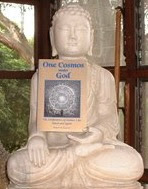
The universe itself is already a kind of disturbance, which is to say, “an action, event, or condition that interrupts peace, disorganizes a calm state, or causes physical, mental, or public commotion.”
A nuisance.
The biggest.
We do not know why we are here in the Cosmos. We do not know who built it, nor do we know why everything inside the Cosmos is as it is. We do not know if it is safe or even sane to venture outside the Cosmos. But let’s give it a shot anyway. Instead of just asking “What is it?,” let’s go up & make a visit.
I have a kinsman living there. Surely he is bound let us in.
The Triune Godhead
Throughout the Trilogy we’ve touched on the idea of a triune Godhead — or ultimate principle — while cautioning the reader that we are not necessarily tying this to the revelation of the Christian Trinity, rather, the Trinity as one way of symbolizing a universal metaphysical truth in which to ground our cosmotheandric Axioms — in particular, openness, complementarity, and substance-in-relation. These in turn redound to our final Axiom of ultimate reality as personhood, because supposing God is personal, then this requires some notion of intersubjective openness and relationality.
In this regard, I am not the first mythmatician to notice that One cannot be the first number, or even a number at all. Rather, supposing God is “One without a second,” then number as such can only come into being with the Two. Indeed, to even say that the One is one is to have added something to it. And supposing the Two “relates” to One, then we have the idea of a Third, i.e., the relationship between One, Two, and the infinite series of numbers that follows. A pure oneness lacks any notion of quantity because there is nothing outside of it to count it against. It is an unmanifested, silent infinity. Indeed, to even call it One is already a linguistic compromise. In reality, the so-called One must be more like a Zero in which concepts like number or quantity are entirely absent.
But a purely enclosed and static One is mathematical and metaphysical nul de slack To imagine the Godhead as merely Numero Uno—
The big Juan?
That can’t be the Juan we’re waiting for.
In Neoplatonic thought, the absolute One is explicitly not a number. Rather, number implies quantity, and quantity implies boundaries, comparison, and parts, and pretty soon we’ve got the whole mess of contingent existence on our hands. The Monad has none of these annoyances, for in this undifferentiated Ground of Being, no Others, nor even the concept of Otherness, are permitted entry. Which is again how Plotinus could visit there from time to timeless, except he couldn’t actually be there. Rather, he had to become no one in order to merge with the ultimate nobodaddy.
Now, we know we exist in a Cosmos, and we also know that this Cosmos is other than God, even if one doesn’t believe in God. So we definitely need to account for the possibility of our own contingent Otherness. In Neoplatonism this Otherness is a kind of useless entailment of, or emanation from, the One. It has no value in and of itself. One might say that the imperfect necessarily issues from the perfect, so it’s not just a crime to have been born, but existence itself is a kind of fall from the heights. It is what happens when the One is busy doing nothing, for it is in no way involved in, or affected by, the effluvia of emanation.
But as we have previously outlined, for cosmotheandrism the principle of Otherness is already situated in divinas. That is to say, relationality is a perfection that must be present in the Godhead. But if we start and stop our counting at Two, this results in an absolute dualism — a permanent bifurcation between opposites, or a celestial standoff. One cannot be the loneliest number, because it is not a number at all. But two can be as bad as one, supposing they don’t relate to, and harmonize with, one another.
However, if we only continue counting up to Three, then we have the notion of communion, a reciprocal flow that prevents the Two from leading separate lives in total isolation from each other. In the cosmotheandric vision, two is a crowd but three is company, for the latter goes to the connective tissue ensuring that our terms are not separate islands but a singular, dynamic con-spiracy of “breathing together.” It also means that our Cosmos will bear the stamp of this triune pattern, for example, the endless spiral of knower, known, and knowledge.
In an essay called The Interplay of the Hypostases, Schuon has a helpful way of discussing this triple primacy in purely metaphysical terms. As per Axiom 2, he begins with the complementarity of Absolute and Infinite, the latter an intrinsic aspect of the former. It is precisely because of Infinitude “that the world springs forth; the world exists because the Absolute, being such, implies Infinitude.” Of course, in the Judeo-Christian tradition creation is a free choice of God, nevertheless, this requires a principle by which he can create, this being the creative power of his Infinitude.
Thus, this dynamic principle exists in divinas even prior to the creation of this or any other Cosmos, meaning there is a kind of eternal radiation or projection within the Godhead itself, described in Christian terms as the engendering of the Logos-Son from the inexhaustible ground of the Father. One might say that through Infinitude the Absolute projects its truth, beauty, and goodness into the Other: “The principle of radiation or projection — inherent in the Absolute, in the ‘Father’ — corresponds to the ‘Holy Spirit,’ and the principle of polarization or refraction, to the ‘Son.’” Schuon compares this to a circle in which the Father would be the central point, the Son the circumference, and the Holy Spirit the radius, that latter at once a link and the means of radiation and communion.
Which, if you recall, is precisely the analogy we used to describe cosmotheandrism in the introduction to the Trilogy, in which case the center is the Theos, the circumference the material world, and the Anthropos situated in the two-way radii between. Which means that our immanent micro-circle is an image of the transcendent macro-circle. In both cases, the archetypal circle reconciles unity and diversity: “being what It is, the Absolute cannot not be immutable, and it cannot not radiate. Immutability, or remaining true to Itself; and Radiation, or gift of Itself; therein lies the essence of all that is” (ibid.).
To affirm that the Godhead is both Absolute Necessity and Infinite Possibility requires some additional explanation that may not be to everyone’s taste, but you have to admit that it is an explanation for what is otherwise inexplicable. Schuon draws another distinction in divinas “between God as Essence, or Beyond-Being, and God as Creator or Being.” The former is “absolute necessity in itself,” but “possesses the possible as an internal dimension and in virtue of its infinitude.”
As such, being itself is not only a possibility of Beyond-Being, but one might say it is possibility as such. Which is not as far as you might think from Christian orthodoxy, for which existence is the “act of being” (esse) which brings relative being into existence. In other words, there must be something beyond-being to account for being, though there was never a time when being did not exist, just as there was never a time when the Son didn’t exist. We might say that being is the endless self-determination of Beyond-Being, and that the Cosmos is a reflection of this endless process of specification.
Rather, we are talking about — in a manner of speaking — an eternal dynamic between the beyond-beingness of the Father and the beingness of the Son. Except to say that the being of the Son of course partakes of the beyond-being of the Father. Or rather, Father and Son are a way of talking about this primordial distinction that is everywhere and in everything — the idea that being itself is always already beyond-being.
Which is one reason why the Cosmos is such a nuisance, because it simply won’t stand still, rather, never stops evolving and revealing more of itself. Not to abruptly change the subject, but we have heard from the wise—
You mean you googled it?
Never mind where I got it, and the exact figures don’t matter anyway. But it is said that the information generated in 2001 alone doubled all the information available to human beings prior to that. Then in 2002 it went and doubled again. You get the idea: we are sinking under a sea information, and what comes after that?
Human voices wake us, and we drown?
The only alternative is to learn how to swim, hence the reason why cosmotheandrism is needed more than ever right about now. If everything is an entailment of our 12 Axioms, then perhaps we have a way to float above the noise and render the Cosmos less of a nuisance.