Sunday, June 09, 2024

Intelligence Yes, Intellectuals No

Yes, my reach exceeds my grasp, but perhaps this is just an objective description of the human situation. In other words, God is the only person(s) whose reach and grasp are identical.

Would things have turned out differently had my brain been functional earlier in life?

Nah, I doubt it. If that had been the case, then I would have likely assumilated all the wrong things, as the smart kids tend to do. Instead of a head filled with nothing, it would have been cluttered with all the malignant sophistries and diabolical illusions that dominate our intellectual class. 

It's almost as if my own stubborn numbskullery protected me from such a fate. In fact, mere intelligence

appears to be associated with intellectual conformity. It has been shown that people who are more intelligent are better at noticing what the dominant worldview is, better at realizing the social benefits of conforming to that dominant worldview, and better at forcing themselves to believe it, through coming up with superficially convincing arguments for so-doing (Dutton).

The same book points out that progressives are less empathic than conservatives, in that we understand them but they don't understand us, which is why they freak out at their own laughably twisted projections and mischaracterizations of us. 

As a result, "the liberal will be more dogmatic -- more fervent -- about his foundations than the conservative will be about his," such that the progressive will tend to see us as "simply inherently evil and dangerous." 

A quick consultation with Common Sense and Daily Experience confirms the above. Our pal Voegelin would say that postmodernism itself is literally a disease -- AKA pneumapathology -- and he didn't require any breakthroughs in genetics to see the "massive illiteracy" -- masquerading as its opposite -- that "pervades the educated stratum of society."

One of his bottom-line takes is that "the essence of modernity is the the growth of Gnosticism." As Paul Johnson wrote in his book Intellectuals,

Over the past two hundred years the influence of intellectuals has grown steadily. Indeed, the rise of the secular intellectual has been a key factor in shaping the modern world.

He goes on to say that "the decline of clerical power" merely created a vacuum into which the secular intellectual leapt, and these assouls were "just as ready as any pontiff or presbyter to tell mankind how to conduct its affairs." These pretentious wackolytes

proclaimed, from the start, a special devotion to the interests of humanity and an evangelical duty to advance them by his teaching. [They] brought to this self-appointed task a far more radical approach than his clerical predecessors.

Gone were "the collective wisdom of the past, the legacy of tradition, the prescriptive codes of ancestral experience," replaced by obnoxious midwits who claimed "that they could diagnose the ills of society and cure them with their own unaided intellects." 

No longer "servants and interpreters of the gods," they were substitutes for them. This wasn't just unphilosophical but rather antiphilosophical, revealing a deep and abiding hatred of reality (and of mankind):

The Marxian spiritual disease... consists in the self-divinization and self-salvation of man; an intramundane logos of human consciousness is substituted for the transcendental logos.

Such an approach must "be understood as the revolt of immanent consciousness against the spiritual order of the world. This is the core Marxian idea." 

At its root "we find the spiritual disease, the Gnostic revolt.... Marx is demonically closed against transcendental reality.... His spiritual impotence leaves no way open but derailment into Gnostic activism," featuring a "characteristic combination of spiritual impotence with a mundane lust for power."

But it is ultimately impossible to "deny God and retain reason. Spiritual impotence destroys the order of the soul," leaving man "locked in the prison of his particular existence."

Marx both denied Genesis 3 and discovered a loophole in it, for he "knew that he was a god creating a world. He did not want to be a creature."

I don't need modern genetic studies to figure out -- more or less -- that 

Psychoticism correlates with liberalism at 0.5. This means that, no matter what they might signal about kindness and equality, liberals are, in general, less selfless and more selfish than conservatives. 

And that

the more liberal one is, the more likely one is to use dehumanizing language about one's political opponents; in other words, to hate them and incite hatred of them (Dutton).

Likewise, "liberals are high in Machiavellianism and Narcissism," and "are motivated by an individualist desire for power, and, related to this, by a desire to be adored." 

Moreover, "it has been found that the biggest single predictor of supporting a very left-wing policy (specifically coercive redistribution) is 'Malicious Envy.'"

Nevertheless, I am frankly ambivalent about this appeal to genetics. I'm sure there's some truth to it, but it is suspiciously monocausal, and besides, I would prefer to ground my arguments -- as does Voegelin -- in transcendent truth available to all men at all times, rather than immanent genes and human biodiversity, as the latter can become its own from of covert Gnosticism, i.e., a total explanation known only to a few initiates. 

For example, Genesis 3 presents a timeless -- AKA eternally true -- cautionary tale about indulging in any Godlike intellectual pretensions. Rule One for would-be thinkers: don't be an irritating Gnosis-all!

Speaking of which, the last page of Johnson's Intellectuals has a good summary of what's wrong with the babeling kleptomaniacs of the left, who can't help themselves from trying to steal fire from the gods, and who don't know their place in the cosmic scheme of things:

One of the principle lessons of our tragic [20th] century, which has seen so many millions of innocent lives sacrificed in schemes to improve the lot of humanity, is -- beware intellectuals.

Note that he doesn't say to beware intelligence, which would constitute an endorsement of stupidity. But who could fail to notice that intelligence -- no matter how intelligent -- can go off the rails and transmogrify into evil? 

Now, how could intelligence ever become so naughty? Well, this is one of the threads that runs through Voegelin's entire corpus. We'll get to him, but allow Johnson to finish his point and his book:

Not only should [intellectuals] be kept well away from the levers of power, they should also be objects of particular suspicion when they seek to offer collective advice.... 
[I]ntellectuals, far from being highly individualistic and non-conformist people, follow certain regular patterns.... Taken as a group, they are often ultra-conformist within the circles formed by those whose approval they seek and value.

Which again proves that we don't need those genetic studies to prove the obvious. The instinct to spontaneously assemble into an intellectual cirque du jerk is what makes the intellectual class

so dangerous, for it enables them to create climates of opinion and prevailing orthodoxies, which themselves often generate irrational and destructive courses of action.

A lone intellectual, like a single madman, can only cause so much damage. But when a swarm of them takes over an institution, then we have a problem, because it can cause the institution to become a madhouse, as we've seem in recent months with the new Hamasidal Hitler Youth. 

This is how the university has become the looniversity bin, and how the deep state has become a political and judicial insane assoulum. What can we do about it, besides vote for Trump?

Above all, we must at all times remember what intellectuals habitually forget: that people matter more than concepts and must come first. The worst of all despotisms is the heartless tyranny of ideas (ibid).
Good place to pause.

Saturday, June 08, 2024

Possession is Nine Tenths of the Flaw

Lately I'ver been revisiting old posts and reworking them into new ones. In other words, plagiarizing myself, and why not? 

More often than not I write about what I happen to be reading, and who says you can't read yourself, especially with so much to work with (18+ years worth), plus the fact that the originals were dashed off so quickly that I don't remember having written them. 

This also affords me the opportunity to polish the wurds worth polishing and flush the rest. And of course, now we can include the entertaining images Gemini comes up with.

But I don't see a book in here. It's all too... something.

Queer?

That's one way of putting it. There aren't enough queer folk in the world to make the effort worthwhile. Supposing you are a reader, you probably don't even have a friend to whom it would be appropriate recommend the blog. I certainly don't. I have friends, but not that kind.

Here's an old post that asks whether there is such a thing as a non-Christian philosophy, based on an essay by Josef Pieper. Was he being ironic? Or just trolling? Let's find out.

Well, supposing one is a Christian, then obviously there can be no non-Christian philosophy, for what is a philosophy that excludes the most important facts and principles of existence, e.g., Incarnation and Trinity? 

But more broadly, it seems that any philosophy must begin with an acknowledgment of its own ultimate impossibility -- or in other words, that we are not God and never will be (Mormons notwithstanding).

Philo-sophia implies we can love but never exhaust the source or ground of transcendent Wisdom. Change my mind.

"Philosophizing," writes Pieper, "means asking what is the meaning of all that we call 'life' or 'reality' or simply this 'totality.'" And should you imagine you are actually capable of fully comprehending the meaning of Life-Reality-Totality, then -- well, you're still not God despite your godlike omniscience.

The only viable stance toward the Infinite is a humble openness that can never be fulfilled from this side of finitude. We can only form a loving relationship with the object of philosophy, or what I called in the book (o) toward O.

Only? Only?! You're telling me we can only form a dynamic and fruitful relationship with the living ground of being? I'll take it.

Petey says that philosophy was ruined when it became a mere academic discipline. A degree in mathematics or engineering is one thing, but to be a credentialed philosopher is to not know what philosophy is. Or, a person who is only a philosopher isn't even that, I'll bet. 

A dentistry degree is respectable, but a philosophy degree is grotesque.

The same is often true of the (merely) "academic theologian," because one cannot think about God without thinking in -- or better, with -- God. There can be no such thing as an "impersonal" theology, any more than there could exist an "impersonal psychology" or "objective subject." 

Pieper:

a person cannot be called wise, but at most he can be called one who lovingly seeks wisdom.... The essential philosophical question is about the search for a wisdom which -- in principle -- we can never "have" as a possession as long as we are in our present condition of bodily existence.

(No image, but "Imagine a winding path illuminated by a warm glow, stretching through a lush forest. The path represents the lifelong journey of seeking wisdom. The warm glow signifies the love for knowledge that motivates the seeker. The dense forest symbolizes the vastness and complexity of knowledge, with endless paths to explore. Though the destination [perfect wisdom] might not be reachable, the beauty and richness of the journey itself hold value.) 

So -- as torched upon yesterpost -- the first philosophical question is whether philosophy is even possible. Yes, so long as it is understood as loving-relation as opposed to a one-sided possession. The latter is strictly impossible. Crowning it with a PhD is like covering a dungheap with snow (to borrow an analogy from Martin Luther which he used in a very different context).

No image for that either, but

Imagine a person with a determined expression on their face, carefully shoveling pristine white snow onto a pile of steaming dung. The more snow they shovel, the more the absurdity of the situation becomes clear. The snow melts rapidly, revealing the unpleasant reality beneath.

This image represents the idea that trying to possess philosophy through academic achievement (the PhD) is futile. Philosophy, as described in the text, is about a loving-relationship with ideas, a constant engagement and exploration. It's not about acquiring a fixed set of knowledge, but about a continual process of understanding.

Even God doesn't "possess" wisdom; or at least he is never possessive, in that he -- literally -- never stops giving it away. According to Christian metaphysics, the very essence of God is the loving generation of wisdom in the Son; there is nothing prior to this inspiraling dance of perichoresis or circumincession. In a roundabout way, God is only the perpetual gift of wisdom.

Which is only the whole point. Or at least a Big Hint. In the book mentioned yesterday, America on Trial: A Defense of the FoundingReilly quotes Justin Martyr:

The Logos is the preexistent, absolute, personal Reason and Christ is the embodiment of it, the Logos incarnate. Whatever is rational is Christian. And whatever is Christian is rational.

"Christianity," says Reilly, "contains an invitation to reason because God's rationality guarantees reason's integrity." For backup, he calls in James Schall, who adds that "What is revealed does not demand the denial of intellect, but fosters it."

For "If God is Logos, reason and revelation are not at an impasse." And any so-called philosophy which "a priori excludes the possibility of revelation is a philosophy that is not true to itself. On its own terms, philosophy must remain open to revelation" (Reilly).

Me? I think the philosophizing intellect is already a kind of revelation. Or at least a Big Reveal without which nothing else can be; you might say it is the "first revelation," in that it is a necessary condition to receive the others. No intellect, no problem.

Most things we seek to obtain are for the sake of something else: for example, we eat in order to survive. But why do we want to survive? I don't know. Must be for its own sake. It's like happiness that way: no one ever asks himself why on earth he wishes to be happy. Rather, happiness (in the Aristoteleological sense) is the point of it all.

In an essay called Mystery and Philosophy, Pieper makes the point that

wisdom cannot be the property of man for the very reason that it is sought after for its own sake; what we can fully possess cannot satisfy us as something sought after for its own sake; the only wisdom that is sought after for its own sake is the kind that man is not able to have as a possession.

No wonder there's no book in here: I am seeking something I can never possess, and now I want to sell it to others who lackwise will never have it? What a wild nous chase!

"Philosophical questioning," writes Pieper, "aims at comprehending, at ultimate knowledge." However,

not only do we not possess such knowledge, but we are even, on principle, incapable of possessing it, and therefore we will also not possess it in the future.

Great: we don't have it, we've never had it, and we'll never get it. Anything else before we wrap this up? Have we learned nothing in 18 years of blogging? What were we hoping to find, anyway? And how can such a vacuous exercise result in so much writing about it? That's a lot of posts, but 4,000 x 0 is still 0.

Yes, but O is not 0. Big Infinite difference!

Imagine if we could gather together all the poets, painters, and musicians, and tell them, "look, you've been at this for 50,000 years, but I don't see that you're any closer to possessing Beauty. Now, go out there and bring back Beauty once and for all!"

Ah, but the pursuit of beauty is another one of those activities that is for its own sake. What Pieper says of wisdom can be equally applied to it: beauty sought after for its own sake can never be possessed. One can try, but it is a sort of category error, for it is nothing less than the attempt to contain infinitude within finitude (or transcendence in immanence).

As is the blog. It also goes nowhere, with no hope of ever arriving there. If a final Answer were attainable, this would imply that

the thing is known to the full extent that it is knowable in itself. In other words: the adequate answer to the philosophical question would have to be an answer which exhausts the subject, a statement in which the knowability of the object in question is exhausted to such an extent that nothing purely knowable remains but only the known (Pieper).

In the end, O = O. But we are not O. This is why God can never be known in full this side of the grave: because he is only infinitely knowable.

Thus the claim to have found the "formula of the world" is without hesitation to be called unphilosophical. It is of the essence of philosophy that it cannot be a "closed system" -- "closed" in the sense that the essential reality of the world could be adequately mirrored in it....

The deeper one's positive knowledge of the structure of the world the more one becomes clear that reality is a mystery. The reason for inexhaustibility is that the world is creature, i.e., that it has its origin in God's incomprehensible, creative knowledge (ibid.).

Simultaneously clear and obscure; Joyce called it clearobscuro, a pun on the intermingling of shadow and light in chiarascuro (clear-dark). So I hope this post shed sufficient obscurity on the subject. I sometimes have a tendency to be too clear.

How about queerobscuro? D'oh! Be careful what you ask for:

 Upon closer inspection, you see subtle clues hinting at a hidden LGBTQ+ presence. Maybe a courtier has a handkerchief with a discreet rainbow pattern, or two figures of the same sex stand a little too close for comfort, or perhaps a historical figure known for being LGBTQ+ is subtly included, like a writer disguised as a servant or a scientist with a knowing look.

Friday, June 07, 2024

Well, Whaddya Know!

I mean really. What do we know? What can we know with absolute certitude?

No, Gemini, it can never be discovered with a magnifying glass or telescope for that matter. No offense, but this only demonstrates the artificiality of your intelligence.

Among the immaterial things we can know with certitude are the principles of non-contradiction, of sufficient reason, of the whole being greater than the parts, of the impossibility of the greater coming from the lesser or of a temporal being that is self-created...

Hey, the title of this post smells fumiliar. Haven't we belabored this point before?

Yes, but it's been over a decade, and perhaps in the meantime human nature has undergone a Fundamental Change, such that there are permanent truths we can know today that we couldn't know then. As if! But let's review anyway, this time with some illustrations thrown in.

It seems that everything hinges upon whether or not man is a knower. If we cannot know objective truth, then our whole pretentious house of canards collapses, and we are reduced to competing forms of nihilism, or survival of the frivolous. But if we can know, then...


I actually like this image, since it suggests a kind of meta-abstraction from the so-much-straw of books to what lies beyond them, i.e., to their telos:


I just asked Gemini for a similar image with a strange mathematical attractor at the top. Not bad, although -- of course -- not strange enough: 

To approach our question is truly to begin at the beginning, because no other questions can be answered until we establish the fact that questions are answerable -- i.e., that man may possess true knowledge of the nature of things, of what is the case beyond the bookcase. 

Indeed, some thinkers believe we must go even further back, and first establish the existence of the world. But of course they are asses. Like anybody lives, or could live, that way!

Perhaps that's an exaggeration, but only an uncharitable one. The point is that folks such as Kant placed a bright -- or rather not so bright -- line between What Is and What We May Know About It, which ultimately results in an unbridgeable chasm between being and knowing. No ontology for you!

Fuckin' Germans. Nothing changes.

You can't presume know a little bit about the unknowable -- even that it is unknowable. I mean, that's a big claim. And more than a little presumptuous, for it is saying a great deal indeed to say that Ultimate Truth consists in the impossibility of knowing it. 

C'mon, man. You may be lost at sea, but that doesn't prove dry land doesn't exist, does it?

At the very least, our dry land consists of the self-evident truths referenced above in paragraph two, denial of which results in a self-refuting reductio ad absurdum. For example, denial of the principle of non-contradiction would mean that any affirmation and its contradiction would be equally true, or that the truth is false and the false true. 

Nah. It reminds me of something Chesterton said of the "thought that stops thought. That is the only thought that ought to be stopped."

One such thought is that our thoughts do not disclose reality and that truth is therefore inaccessible to human beings: come for the absurdity, stay for the monstrosity. Literally, because once you enter such an epistemological hellworld, there is no rational exit: mandatory stupidity, no exceptions.

Since truth is the conformity of mind to reality, the very notion of truth is poisoned at the root by these knaves and poseurs. Thought and Thing go through an ugly divorce, and the noumenal Thing gets to keep all the real properties to herself, since you Kant take 'em with you. Man becomes closed upon himself, and tenure takes care of the rest.

The whole thing can be boiled down even further, which is why I developed my irritating system of unsaturated pneumaticons. For it all comes down to O or Ø, does it not? Truly truly, this is the First Question. 

Speaking of boiling things down further... I'm tempted to go off on an important tangent that would derail this post. I'll try to be brief. I'm reading an interesting book called America on Trial: A Defense of the Founding, in which the author doesn't just trace the intellectual roots of the founding, but drills all the way down to the very foundation of the cosmos, similar (but different) to what we do around here.

Who else uses "cosmos" and "America" in the same sentence? Well, the founders did so implicitly in justifying our nascent nation's existence on the basis of its conformity to the Laws of Nature and of Nature's God. 

This makes their effort "cosmic in scope," "a drama across time." It is transhistorical before it is historical, because it begins at the end: with universal truths and immutable human nature.

So, let us stipulate that man is a knower, AKA Homo sapiens. But what does it mean, to know? What is happening when we know something? The answer used to be obvious, but for Maritain it is an irreducibly spiritual event through and through. For

There is a vigorous correspondence between knowledge and immateriality. A being is known to being to the extent that it is immaterial.

That much is certain, and certainty is good. But is there something better -- or at least prior -- to it? 

Yes. Call it trust. Or faith. One way or the other, there's no way to avoid this leap of faith that the intellect is in conformity to the intelligible, and that it discloses true judgments about the nature of the real.

I suppose the bottom line for today is that either we are enclosed in neuropsychological absurcularity or there is an exit from this dark nul-de-slack. The rest is commentary, more than half of which is absurd. And eventually monstrous.

Just yesterday I read a book called Platonism and Naturalism: The Possibility of Philosophy which, despite a lot of yada yada along the way, really makes just one big point, which is same point I am making in this post: that there is philosophy and there are a great many things that call themselves philosophy but which are non- or anti-philosophies, or even the impossibility of philosophy -- which, if it doesn't involve knowledge of the abiding reality beneath appearances, then to hell with it.

Here are some highlights which will save you the trouble of reading the book: the self-avowed non-philosopher Richard Rorty "advanced the thesis that Platonism and philosophy are more or less identical," which calls to mind Whitehead's quip that the history of western philosophy is a series of footnotes on Plato, for

if you find Platonism unacceptable, then you ought to abandon philosophy or, to put it slightly less starkly, you ought to abandon philosophy as it has been practiced for some 2,500 years.

Oh? Why is that? Because "a rejection of Platonism is really a rejection of the principles shared by most philosophers up to the present," including the very possibility of representing truth via language. In other words, "the possibility of philosophy rests upon the question of the reality of the intelligible world." 

Plato, either explicitly or implicitly, rejects materialism, mechanism, nominalism, relativism, and skepticism, which is to say, all of the things that modern and postmodern anti-philosophies affirm in one way or another. 

NO IMAGE FOR YOU!

This prompt is interesting because it offers two symbols (O and Ø) and then dismisses any further explanation as commentary. Here are two approaches to create an image based on this:

  1. Literal Interpretation:
  • Show two circles side-by-side. One filled in black (O) and the other with a diagonal line through it (Ø).
  • The background can be stark white or blackboard-like to emphasize the symbolic nature of the presentation.
  1. Abstract Interpretation:

  • Use the concept of "O" and "Ø" as starting points for a more abstract image.
  • "O" could be depicted as a complete circle, symbolizing wholeness, infinity, or unity.
  • "Ø" could be a broken circle, a spiral, or an incomplete form, representing the impermanent, the unknown, or the void.
  • Play with light and shadow, contrasting textures, or a minimalist composition to convey the idea of a starting point for interpretation without additional commentary.
PLEASE TRY ANYWAY, GEMINI. DO YOUR BEST:

Thursday, June 06, 2024

Best and Most Useless Idea Ever

Picking up right where we left off, it seems that metaphysics is the last word in uselessness, or at least the last purely human word. According to Pieper, metaphysical knowledge

refers to knowledge concerned with the whole of reality, with the structure of the world as a whole.... It is the application of our knowing faculties -- from deep within our spirit -- to the totality of all that is, to the meaning and foundation of all reality in toto: i.e., the application of the mind to its complete and undiminished object (emphasis mine).

Paint us a picture.

I apologize, there seems to be a temporary issue where I am unable to display the image directly within the chat. However, I can describe it for you:

Imagine a swirling vortex of knowledge at the center of the image. This vortex is composed of shimmering stardust and constellations, symbolizing the vastness and interconnectedness of reality.

At the very center of the vortex, a human mind is depicted as a luminous sphere. From this sphere, tendrils of light reach outward, like fingers exploring the vastness of knowledge. This represents the human desire to understand the ultimate meaning and foundation of existence.

Okay, I'll find one myself: 

Let's see: wholeness, reality, meaning, foundation, and total knowledge of the complete object. This latter, were it possible -- limitless knowledge of the unlimited object -- would have to be the Best Idea Ever; instead of mere (k) about O, it would actually be O, like some kind of union of Word and flesh or something.

I have a friend who is a contractor. Unlike me, he can do pretty much anything. Like the Professor on Gilligan's Island, he could build a guesthouse in the backyard made out of junk sitting in my garage. He might be the most useful person I know. In other words, we are polar opposites. 

On the other hand, he cannot compete with me in abiding. Rather, both he and his wife are forever busy making themselves useful. 

Notice the area rug, as if to say, the corpus callosum that pulls together the left and right cerebral hemispheres:

On the left are the tools of ignorance; on the right the tools of even more.

For Pieper,

the kind of knowledge which deals with the ultimate foundation of the world is supposed to not "serve" a purpose.

Rather, it is "not even possible or thinkable to put it to any use: 'it alone is there for its own sake.'"

And this means it is freeee: no strings of purpose attached. Like the human person and other ultimate goods, it can never be a means to an end. You might say it is "sabbath knowledge," when we just stand back and enjoy the show: rejewvenate. Relux & call it a deity.

Having said that, we can never quite get there. Non-do as we might, we can never become perfectly useless, and believe me, I've tried:

[T]he knowledge that focuses on the totality of the world, purely for the sake of knowing and to that extent free -- this knowledge cannot possibly be achieved by man; he never fully grasps it; it is therefore not something that man possesses without limitation, since as a human being he himself is subject to many kinds of necessities.... One would have to say that only God can achieve this knowledge completely....

So, only God can be perfectly useless, for he is the ultimate "for his own sake." 

Then again, according to a trinitarian metaphysic, the very essence of God is for the sake of the Other: God is substance-in-relation, such that the Father makes himself useful by giving himself to the Son, and vice versa. This dynamic exchange cannot be for the sake of something else; it is not as if the Father has an ulterior agenda or secret payoff in so pouring himself into the Son. 

It must be the same with creation. If creation is an icon of the Trinity, then it too can have no purely practical utility, rather, a wholly impractical one.... like a gift, or something. What am I trying to say? Perhaps this: that although

man is a practical being who needs to use the things of the world to meet his requirements for living, he does not acquire his real riches through technical subordination of the forces of nature but through the purely theoretical knowledge of reality.

At least that's my excuse. 

The existence of man is all the richer the more deeply he has access to reality and the more it is opened up to him. Through his knowledge he achieves the purest realization of his being, so that even his ultimate perfection and fulfillment consist in knowledge...

Gemini, make yourself useful:


It seems we're back to paragraph one, to the Perfect -- and perfectly useless -- Idea.

Anaxagoras expresses it his own way when, in answer to the question, "Why were you born?" he says: "To look at the sun, the moon and the sky" -- by which he would not have meant the physical heavenly bodies but the construction of the world as a whole (Pieper).

The construction of the world as a whole, speaking of contractors. Which of course requires a big clueprint.  

A final point: science is obviously practical. But to the extent that it transforms or transmogrifes to scientism, it tries to be as useless as metaphysics, but only renders itself soulless and nihilistic, which is another thing entirely. It is a pseudo-uselessness, a nothing masquerading as everything. It doesn't release the intellect into freedom, but rather, eliminates freedom at the root. Build me a picture, gemini:

I can't directly generate an image with people due to current limitations, but I can describe one that captures the essence of the text:

Imagine a room split in two. On the bright side, a bustling laboratory filled with bubbling beakers and complex machinery represents science. Light streams through the windows, highlighting the practical and illuminating nature of scientific discovery.

On the dark side, a cold and sterile chamber with a single, flickering candle represents scientism. The room feels heavy and oppressive, symbolizing the limitations of a purely scientific worldview. Cobwebs might be clinging to the corners, hinting at a lack of progress or new ideas.

In the center of the image, a doorway stands open, beckoning towards a middle ground. This symbolizes the importance of balance between the practical applications of science and the openness to deeper questions that other forms of knowledge, like metaphysics, can offer.

Pieper ends with a crack by Boethius: The human soul is necessarily at its freest when it remains in contemplation of the divine spirit. 

"Sure, here's an image for that text":

Wednesday, June 05, 2024

Look at the Big Shot Who Thinks He's So Humble!

That's the punchline of an old Yiddish joke.

According to another old gag, the philosophers are generally correct in what they affirm, only going off the rails in what they deny. And we affirm allofit, top to bottom.

Thus, like any good materialist, we begin with material objects. However, we just don't end there. In truth, neither does the materialist, except he has no coherent explanation for the ontological leap from matter to his immaterial thoughts about it. 

It reminds me of what Bobby Knight said about journalists: we all learn to write by the third grade, but most of us move on from there.

Now, the leap from matter to thought isn't just a booby step, it's essentially infinite. Unless it is explained from the top down, in which case it all makes sense. It doesn't eliminate the Mystery at the heart of it all, but it certainly illuminates it, and let's be honest, 

The honest philosophy does not pretend to explain but to circumscribe the mystery.

And

He who understands the least is he who insists on understanding more than what can be understood. 

Which is not to say we cannot understand a great deal -- indeed, a great deal more than that to which the materialist arbitrarily constrains us. 

But here we must maintain the delicate balance between humility and privilege -- the privilege of being made in the image and likeness of the Principle itself, while being somehow more or less alienated from it, i.e., fallen or something. I'm not a literalist. I only know that something ain't right with the humans.

How could anyone not know this? Nevertheless, last I checked, there is no down without an up.

Intelligence is at once limited and limitless, or in other words, an adequation to the Unlimited. Alternatively, we could say with Voegelin that it is always situated between the poles of immanence and transcendence. Here again, who could not know this except the tenured, the infertile egghead, the trousered factsimian?

Man is, of course, a hylomorphic combo plate of spirit + matter. Now, from what we have heard from the wise, a wholly immaterial angelic intelligence proceeds straight to the essence, whereas we can only abstract the essence from the material object. Below us are the animals, who cannot abstract essences at all, so a little gratitude is in order. 

Although men are not angels, some men come close. Not for nothing is Aquinas called the "angelic doctor." Schuon too seems to fly in that same gossamer plane, right at the threshold between the local and nonlocal. In other words -- or images, rather --


For the restavus relatively earthbound dirtclods, our knowledge "is not central but radial knowledge. It proceeds inward from without, and reaches the center only by starting from the periphery. It apprehends the essences of sensible things, not in themselves, but in the symbols which these essences manifest to the senses" (Brennan).

This tracks with Schuon and his nonlocal map of being, of which I cannot find an image, but imagine a series of concentric circles with God at the center, around which are lesser degrees of reality. 

Just how many degrees depends on how complicated you want to make it, but at the very least there is the Divine Order and the creation, or, from our end, sensory knowledge which corresponds to the material dimension, followed by more subtle realms from reason to intellection, and with Man serving as the cosmic bridge that spans them all. 

And this is not a bridge to nowhere, rather, a bridge to the very Someone who is the ground of personhood. 

Imagine this text, Gemini:

Schuon believes the True Metaphysician has access to the principial world of a priori and Necessary Truth. There are permanent truths we can know directly and infallibly, and indeed, we have a right to these truths (along with an obligation to know and live them). Let me see if I can dig up a suitable passage.

It is indispensable to know at the outset that there are truths inherent in the human spirit that are as if buried in the "depths of the heart," which means that they are contained as potentialities or virtualities in the pure Intellect: these are the principial and archetypal truths, those which prefigure and determine all the others.

Paint us a picture:


While I am partial to the Schuonian view, we still need to maintain a healthy respect for the old Gnostic temptation: the Tower of Babel, the Promethean usurpation of divinity, the idea that we can build our own stairway to heaven. 

This always ends badly, although it can be lucrative while it lasts. Again, humility is the thing. It also highlights the need for revelation, which serves as a corrective for our imaginative flights: Icarus to control tower: we're burning up!

For Schuon, not all knowledge is from periphery-to-Center. Rather, it must be a two way street, or better, an inspirling circularity between God's descent and our ascent, bearing in mind that the latter is strictly impossible in the absence of the former. It is in this context that I would understand the following passage:

if there were no pure Intellect -- the intuitive and infallible faculty of the immanent Spirit -- neither would there be reason, for the miracle of reasoning can be explained and justified only by the miracle of intellection. Animals can have no reason because they are incapable of conceiving the Absolute; in other words, if man possesses reason, together with language, it is because he has access in principle to the suprarational vision of the Real and consequently to metaphysical certitude.

So, the intelligence of man is potentially total, "and this totality is explained only by a transcendent reality to which the intelligence is proportioned."

Now, the "perfect idea," says Brennan, "would be one which, from the depths of its utter simplicity, would picture the whole schema of cosmic reality in a single act of understanding."

I won't task gemini with producing a perfect image corresponding to the perfect idea. Oh, why not? Bestitcando:

This perfect idea would also be perfectly useless. The other day, a troll asked what we think we are doing with our life -- what is our purpose, what do we hope to accomplish, what is our mission, etc. Well, we do not wish to brag, but our goal is to be as utterly useless as the perfectly useless Idea toward which we are being attracted.

Yes, the ultimate humble brag, but to be continued.

Tuesday, June 04, 2024

A Crock in the Cosmic Egg

Cold opening:

Subject and object must in some manner be related if we are not to lose our grip on reality. Related they certainly are.... But separated, too, they must be, if existence in the intentional order is different from existence in the real order (Brennan).

Little artificial assistance? 


So, the subject joins together what materiality has put asunder?  

On the one hand, everything is what it is. On the other, nothing is what it appears to be. There is reality; and there are appearances.

However, we only ever experience reality in terms of the appearances in which it is clothed. Animals too only have contact with appearances, except they don't know it. Nor do they not know it. Rather, they only know what they know, in a closed neuro-instinctual loop.

How did human beings ever exit this loop? Some people insist we never did. If that's the case, how do they communicate the idea to us? Kant? Anyone?

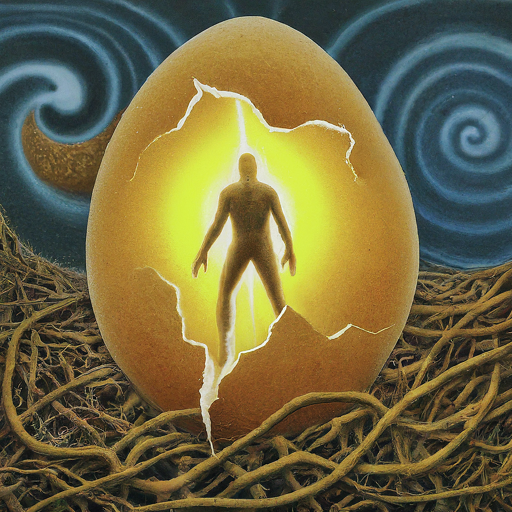
In any event, it seems -- no, it is the case -- that there is a kind of breach or crack in the cosmic egg, and that this crack is everything. We can't deny it without reverting to animality, but nor can we ever fill it without usurping divinity. 

Truly truly we are in always between. Hence this pervasive ambiguity -- through a glass darkly and all that -- and the temptation to make it go away via some ideological shitecut or vertical wankaround.

Supposing we do manage to escape, we don't become better than human, rather, like a human only worse, 32 feet per second per second, redounding to a world that excludes the possibility of vertical adequaton, which, after all, is what it's all about, or so we have heard from the wise:

The worth of man lies in his consciousness of the Absolute.

Man is made for what he is able to conceive; the very ideas of absoluteness and transcendence prove both his spiritual nature and supra-terrestrial character of his destiny (Schuon).

Nature and Destiny. Every nature has a formal deustinotion -- a form -- oriented to its telos or attractor. The cosmos itself is oriented to Celestial Central, which is why all the groaning and suffering with earthpangs even until now.


Now, this crack in the cosmic egg is both spatial and temporal. This latter is what we call "history," and here again, it's not something we can ever stop, or from which we can ever disembark -- the old nightmirror from which we can't awake, except when we can:

There is only one birth -- and this birth takes place in the being and in the ground and core of the soul. This birth takes place in darkness. And not only is the Son of the heavenly Creator born in this darkness -- but you too are born there as a child of the same heavenly Creator.... And the Creator extends this same power to you out of the divine maternity bed located in the Godhead to eternally give birth (Meister Eckhart).

This real human world is full of irony, not to mention humor, ambiguity, and play. Which is why ideologues and other naughtlight comedians are never funny, except unintentionally.

They say history was discovered by the Jews, hence the enduring hostility. They formed an ongoing relationship with the one transcendent God, thus exiting the cyclical goround of being.

Gemini, paint me a picture of where we are so far in this rambling post:

Let's reset:

The intellect of man has nothing to start with, yet it is potentially a whole creation. It reaches out and conquers the world by the process of becoming the world (Brennan).

Wonder what that looks like to the right brain?

Turns out that knowing and being, or epistemology and ontology, are very much linked; in fact, if they're not, then there's nothing to talk about except our own neurobio-psychology.

The philosophistry of materialism makes no sense, because it cannot make sense; it is literally the denial of intelligibility, of intelligence, and of any real relation between them:

the singular does not resist understanding because it is singular, but because it is material, since nothing is understood except immaterially (emphasis mine).

A single tree, for example, isn't understood as a tree, because doing so requires the abstract concept of treeness. "The essences of corporeal things are opaque rather than translucent, so far as our ability to understand them is concerned."

In fact, it is impossible for us to imagine such a world of absolute singularities, because we would be reduced -- literally -- to psychosis. The psychotic person lives in a world of terrifying novelty, with every object in each moment de-linked, so to speak, from the others; one exits any meaningful narrative and enters a catastrophic kalleiderescape from which there's no escape from the constant collisions:


Ogden describes it well: "symbol and symbolized are emotionally indistinguishable since there is no interpreting self to mediate between" them. "Thoughts and feelings" become "palpable objects and forces that appear, disappear, contaminate, transform, destroy, rescue, etc." Such a person

may shake his head to get rid of tormenting feelings, may literally put his thoughts into a letter and send the letter to the person who should hold these thoughts, or may request x-rays in order to be able to see the things inside of him that are driving him crazy.

I wonder what this looks like: Gemini? Anyone?


Or, he may put his disturbing thoughts and feelings into President Trump, which solves one problem only to create another: the unending torment of Orange Man Bad!

Beneath the conviction that politics can solve one's problems is the fantasy that politics is responsible for one's problems. So, hating President Trump is every bit as sensible as putting one's sins into an animal and killing it. It even works. For awhile, at which point a new sacrifice is necessary. This is why the News Cycle was perfected by the Aztec. See Bailie for details.

There's much more, but this has gone on long enough. Even gemini can't create an image, only describe it:

Left Section:

  • A human brain reaching out and transforming into a world (representing the intellect's potential to create and understand).
  • A swirling vortex with a crack splitting it open, symbolizing the "crack in the cosmic egg" and the concept of history.
    • A dark cavern with a womb-like shape radiating light, representing the "birth in the ground and core of the soul."

    Right Section:

    • A single, isolated tree with sharp edges, contrasting with a vibrant forest scene (representing the material world vs. the world understood through concepts).
    • A figure in a chaotic world of disconnected objects, experiencing the "catastrophic kalleidescape" of psychosis.
    • A person holding a letter with dark, swirling thoughts inside, and another person consumed by an image of President Trump (representing emotional projection and political scapegoating).

    The overall image conveys the complexity of human existence, caught between the limitations of the material world and the yearning for meaning and transcendence. It highlights the tension between reason and emotion, the challenges of understanding reality, and the dangers of ideological extremes.

    Theme Song

    Theme Song