Friday, April 14, 2017

Alternate Facts, Alternate Brains

This post is all over the place, and once again I don't have time to tie it all together. Besides, that's what commenters are for. You tell me where the rug is hidden.

Yesterday we spoke of those "enigmas which faith imposes upon the believer," but "which he accepts because he accepts God." And accepts God "not out of naivety, but thanks to a certain instinct for the essential and for the supernatural."

In short, there is a kind of direct perception or intuition of God that allows one to take the rest on board, even if some of the rest is enigmatic or impenetrable to mere reason.

For the great majority of history the great majority of men functioned with this "instinct" intact. Did the rise of rationalism (or materialism or scientism or secular leftism) result in an attenuation of the instinct, or did the weakening of the instinct result in a heightened rationalism?

Either way, there is something one-sided -- something intrinsically out of balance -- in a man who seeks truth (as all men must), but only via the left brain. Alternate facts? Of course there are alternate facts. Unless maybe you're had a stroke or head injury or attended graduate school.

And I use "left brain" as a metonym for all the modes of truth and truth-seeking that bypass or transcend mere logic of the everyday kind. Indeed, what about the nighttime logic of which, say, Finnegans Wake is an expression? Clearly, that book was not written by or for the left brain.

Which is its whole reason for being. It was "conceived as obscurity, it was executed as obscurity, it is about obscurity." But not pointless obscurity! Rather, "it's natural that things should not be so clear at night, isn't it now?" (Joyce, in Bishop). In short, it's a book about the logic of the night, written with the logic of the night (i.e., the dream logic of the right brain).

Come to think of it, why was it written at all? No doubt because people hate being caged within rationalism. If they can't escape via religion, then they'll find another way out, whether through drugs, political radicalism, literature, whatever.

There was a time in my life when I would have agreed that in the bad old days people had to settle for God, but that nowadays, thankfully, we have almighty rock music. From the age of nine or so, music was my means of escape (or inscape). In many ways it still is, only not in a way that runs counter to religion, but is confluent with it.

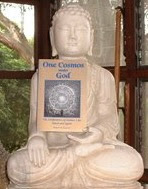
It's been a while since we gave a shout to The Symmetry of God, which may not resolve all of the enigmas faith imposes upon the believer (or right brain on left), but certainly provides a fruitful way to look at them.

Long story short, even back in graduate school I was an extreme seeker, such that I was drawn to more daring and far-reaching psychoanalytic theorists such as W.R. Bion, and in this case, Ignacio Matte Blanco. I devoured his magnum opus, The Unconscious as Infinite Sets, and if I'd thought of it first, perhaps I might have applied his ideas to religion, which is what Bomford has done.

The amazon review of Matte Blanco a little overwrought, but gives a sense of where he was coming from, and why young Bob was excited at the prospect of diving into the strange world of bi-logic with both hemispheres:

The Unconscious as Infinite Sets: An essay in Bi-logic by Ignacio Matte Blanco is an endless roller coaster ride into the deepest sources of thought and feeling. Matte Blanco writes from the inside out, from the thermonuclear source of the Sun to the warmth of its rays to the Earth. Words like quarks ricochet off the pages.

Matte Blanco splits the Mind into two realms, two bi-halves, two different logical structures, or his "bi-logic."

The depths and hell of the unbelievable, is the Unconscious, where instinct spews lava into primordial affect. Unconscious logic underlies the language of poetry, dreams, jokes, propaganda, racism, advertisement, religion, and figures of speech. This Alice in Wonderland logic is generated by the Unconscious mind by the mechanisms of condensation, displacement, symbolization, concretization and hallucinations. This logic was conceptualized by Freud as the primary process and by Matte Blanco as symmetrical logic.

The other half, the Conscious, is where instinctual energy is transduced into factually based logic that attempts to keep us from being eaten alive by our fellow carnivores. This Aristotelian logic is generated by our conscious mind; Freud conceptualized this as the secondary process and Matte Blanco as asymmetrical logic....

It goes on in that florid vein, but the point is that the wide-awake asymmetrical logic of Aristotle does not necessarily yield truth, just as the symmetrical logic of the night brain doesn't necessarily result in error and falsehood.

For example, the left brain is of little use in helping us understand the truth of poetry, music, painting, and religion. Or, to be precise, we really need to exercise bi-logic, and not just rely on one or the other. In so doing, a hidden dimension emerges, similar to how our two eyes result in spatial depth, or our two ears in stereo.

So much of religion can only be apprehended via the right brain! But when I say "right brain," what I really mean is that what we call the right brain is already an expression of the deeper reality it discloses.

In other words, we don't perceive reality the way we do just because we perceive it through right or left brains; rather, human beings have these two modes because they are required in order to disclose the fulness of reality.

Think of, say, Mr. Spock, and the dimensions of humanness from which he is excluded due to his half-Vulcanized, hypertrophic left brain.

I'm about to make a wrenching segue, but it reminds me of a critical point Steven Hayward makes in Patriotism is Not Enough: basically, that what we call "statesmanship" can never be reduced to a formula. There are many thinkers and politicians of both left and right who imagine that leadership essentially consists in having the correct theory and pushing the right buttons. Thus, a leftist such as Obama relies on Keynesian theory to push the EXPAND GOVERNMENT button, while conservatives promise to hit the REDUCE TAXES button.

You might say that ideology of any kind is always a simplification of the world into easily manageable left-brained categories. But the heart of statesmanship is the exercise of a prudence that can never be reduced to ideology, and certainly isn't any kind of linear formula.

Churchill, for example -- surely one of the greatest statesmen who ever lived -- was not what you would call a logical man; nor was he illogical. Rather, passionate, visionary, inspiring, resolute, courageous, etc. Indeed, sometimes he was superficially illogical in pursuit of translogical aims. At any rate, there was no ready formula that could tell him, say, whether or not to bomb the French fleet, just as there is no formula that can tell Trump whether or not to drop the mother of all bombs on ISIS.

The point Hayward emphasizes is that just because statesmanship cannot be reduced to a formula doesn't mean it isn't a Thing. It's a Thing alright, just not reducible to left-brain, asymmetrical logic. Like religion, which is also a Thing, but a Thing that simply cannot be cracked by the left brain. As they say, it has not pleased God to save men through logic. But that's just the personification of an ontological fact: that it is the height of illogic to imagine that reality can be contained by mere logic, any more than the day can contain the night.

Thursday, April 13, 2017

Every Problem is a Mystery, but Not Every Mystery is Problem

We left off yesterday with a comment by Schuon that I will quote in full, since it contains multiple and interlinked observations:

Only metaphysics can resolve these enigmas which faith imposes upon the believer, and which he accepts because he accepts God; not out of naivety, but thanks to a certain instinct for the essential and for the supernatural. It is precisely the loss of this instinct that allowed rationalism to flower and spread; piety having weakened, impiety was able to assert itself.

And if on the one hand the world of faith unquestionably comprises naivety, on the other hand the world of reason totally lacks intellectual and spiritual intuition, which is more serious; it is the loss of the sacred and death of the spirit.

There are so many points embedded in this paragraph ("metagraph" is more like it), that one scarcely knows where to begin. As I've already mentioned, these late works of Schuon that we've been unpacking are even more concentrated than usual.

Implied in the first sentence is that faith imposes inevitable enigmas on us. However, one might say there are "two ways out" of the enigmas, one way abstract and intellectual, the other concrete and experiential. Or in brief, Head and Heart.

The former (the headway) conveys truth via an explicit metaphysics that religion expresses more or less adequately through its implicit symbolism. The second (the heartway) is through a direct intuition (intuition being a vertical perception) that God Is.

And if God Is, then certain implicit conclusions follow, e.g., that he is Good and Just, and therefore we are not created just for the hell of it. Life has a meaning and a purpose, and since these cannot be fullyfilled on this plane -- and are often mocked -- then there must be an afterlife. Otherwise God isn't fair, which makes no sense at all, for it would imply that humans have a standard of fairness superior to God.

Of course that sentence is written out in longhand, when the whole point is that the heart doesn't necessarily explicate them in such a wideawake and cutandry way. Rather, it's more of a right-brain thingy, implicitly seen all at once -- like, I don't know, the phenomenon of love at first sight.

The point is, man is equipped with "a certain instinct for the essential and for the supernatural." Elsewhere Schuon said something to the effect that -- in a manner of speaking -- instinct represents animal intellect, whereas intellect represents human instinct.

Note that this human instinct isn't just restricted to the plane of religion, but is precisely what marks us out as human (i.e., it is literally a condition without which we wouldn't be human).

What I mean is that our "first act of mind" is the direct apprehension of a concept. And although the least of us does this automatically, science has no idea how. Let this google-selected guy break it down for you:

Understanding (or "simple apprehension") is the "first act of the mind" for two reasons. First, it lays the foundation for the "second" and "third" acts of the mind and second, it is fundamental to the difference between truly human thought and the thought possible by the higher animals (e.g. dolphins, apes, whales) and the "thought" possible by "artificial intelligence," (e.g. a computer)....

[T]he first question any person asks is "what is that?" The answer to this question, "what?" (quid in Latin), gives us the thing's essence or quiddity, its "whatness." The understanding of something's essence gives rise, in our minds, to concepts. A concept is an immaterial (sorry materialists, but you're wrong already), abstract, universal, necessary, and unchanging mental realities by which we understand the real world around us. When I see a triangle, for example, I only physically see a material, concrete, particular, contingent, changeable object. I don't physically see "triangularity" (i.e. the essence of "triangle-ness"). However, by asking that distinctly human question, "what is it," I can come to understand this essence.

Since this is the first act of mind, and because science has no idea how we can accomplish such a marvelous feat, it is entirely accurate to say that scientific materialism doesn't know the first thing about the mind (certainly nothing in Darwinism explains how this is possible).

The point is that humans, by virtue of being human, can instantaneously abstract essences from encounters with concrete things. And if we couldn't do this, we wouldn't be human.

But the Real Point is that we not only do this horizontally, but vertically. We can have concrete encounters with vertical realities through which we can experience, say, beauty. This is so ubiquitous that we can easily take it for granted, but what is the apprehension of beauty but the direct perception of an essence in a concrete object?

I don't know if we're getting far afield or moving the ball forward. Let's just say that our direct and intuitive perception of God is no more mysterious than the perception of a beautiful sunset. Which is to say, VERY! mysterious.

Speaking of which, I'm reading a book on whether or not God changes, called Does God Suffer? One reason I'm reading it is because the author comes to the exact opposite conclusion I do, and I'm very curious to see how he manages this, and if I need to revise my thought accordingly. I might add that he is quite intellectually scrupulous, and spends an entire chapter outlining the strongest arguments for why he might be wrong.

I don't want to get into his main theme, but he says a few preliminary things that touch on the present discussion -- for example, asking what it is we are doing when are doing theology? Are we beginning with the direct perception of God, as described above (the "first act," of theology, so to speak), and then trying to make intellectual sense of it? This would be the classic approach of "faith seeking understanding."

Along these lines, Weinandy makes what I consider to be a crucial distinction between a problem and a mystery. The clock on this post is starting to run out, so I'll be brief. Science treats things as problems to be solved, whereas religion deals more with mysteries to be enjoyed -- and deepened. This latter seems paradoxical, but only if you look at it from a left brain perspective.

I'm going to have to stop before I can tie all this nonsense together. Tomorrow I hope to locate the missing area rug that can accomplish this mysterious feat.

Wednesday, April 12, 2017

On the Meta-Cosmic Rights, Duties, and Limitations of Atheism

Time only for a very brief post. Let's get right to it!

In a way, theism and atheism have a mutually supporting relationship; for just as dopey religions and religious arguments can prompt one to become an atheist, likewise, the intellectually negligible arguments of Bill Maher or Richard "Vanilla Thunder" Dawkins are often the most compelling case for theism.

And since neither can be proved -- at least with the weapons of rationalism -- we are back to the unavoidable leap of faith: the very faith the rationalist finds so offensive.

Now, atheism has its rights. That being the case, it not only has corresponding duties, but the duties are necessarily prior to the rights. The duty, of course, is to Truth -- not just the lower case truth of rationalism, but the Truth of which rationalism is a prolongation or echo.

What are we supposed to do with our reason in the face of an unreasonable or frankly idiotic religion? Schuon writes that man has "legitimate needs for causality raised by certain dogmas, at least when these are taken literally..."

As such, one can scarcely "begrudge anyone for being scandalized by the stupidities and the crimes perpetrated in the name of religion," or even by the outward "antinomies between the different creeds."

However, an intellectually honest atheist will not only concede that "excesses and abuses are a part of human nature," but acknowledge with embarrassment that the apostles of pure reason -- e.g., "scientific socialism" -- have an even worse track record of excesses and abuses.

Is there a way to arbitrate between an absurcular atheism and an extravagant theism? Both camps sacrifice consistency to completeness (a la Gödel), but is there an approach to reality that is both consistent and complete?

Yes and no. Think about the fact that we can even know and understand Gödel's theorems, something a computer cannot do in principle:

1) Computing machines are essentially formal systems.

2) Gödel has shown that there are sentences—Gödel sentences—that can't be proven within a formal system, but that humans can see to be true.

3) Therefore, humans can do something that computers can't do, namely, recognise the truth of Gödel sentences.

To the extent that a rationalist understands Gödel and still clings to his rationalism, he has rendered himself an irrationalist.

In this context, you could say that religions are "theories," so to speak (or visions), of the Complete and Consistent Object that reason can only know partially, or "through a glass, darkly," as the gag goes.

But fortunately, there are ways of knowing that transcend mere (lower case) reason. Indeed, I would say that man is entitled to an explanation that satisfies the demands of his Total Intelligence.

But as Schuon writes, "Only metaphysics can resolve [the] enigmas which faith imposes upon the believer," a faith which at the same time reflects "a certain instinct for the essential and for the supernatural."

To be continued...

Tuesday, April 11, 2017

On the Momentary Presence of God

This post totally got away from me. First, I was pulled into an unforeseen but promising rabbit hole that consumed much of my blogtime.

Then the post veered into a rather deepish province that required my utmost presence, just when I was running short of timelessness. I'm tempted to delay posting this, but why not? It's a start, anyway. We'll have to wait until tomorrow to find out it it's also the end...

It's always hard to pick up the thread when we've set it aside for a few days. Maybe it's because our blogging is like journalism, only in an inverted sense.

To paraphrase Kierkegaard, everyday vulgar journalism is "of the moment, for the moment, and by the moment," such that "no man who has the least inkling of the eternal in his breast can cease to wage everlasting war" against its vacuity.

But wait a moment! Everything I write is of, for, and by the moment. So, what's the difference, if any?

Naturally we don't know, being that we are presently In the Moment and have never before pondered the question.

But the first thing that pops into our head is a comment by the Aphorist: One must live for the moment and for eternity. Not for the disloyalty of time. Sound advice, as usual, but is this what the journalist does?

It's like the difference between a properly religious existentialism vs. a merely atheistic one. Existentialism is fine, so long as it is grounded in a Being-ness, or Presence, that surpasses it.

But an existentialism reduced to mere existence is entirely soph-negating and unworthy of the man who voluntarily confines himself to its cramped confines.

Raccoons are born with the pre-knowledge that it has not pleased God to save men through tenure, let alone journalism.

Or, to put it another way, we are aware of man's limitations, in particular, his inability to save himself, especially from himself. But we are equally aware of man's privileged station in the cosmos (AKA our divine light privilege). What gives?

Ah, there's that missing thread! It goes back to the aforementioned distinction between concluding and perceiving. It turns out that even the best conclusion is a kind of "circumstantial evidence," so to speak, and that, as always, first hand evidence is the most reliable.

Being cannot be concluded, rather, only.... been. Better, it is either present or absent.

Nevertheless, we too must be present in order to participate in the Presence of Being. Which I would suggest is the whole point of religion: to facilitate perception of and access to the Presence of Being, which is again either now or always, but not "in between," in time (except as shadow, or echo).

Along these lines, Schuon writes that "modern philosophy is the codification of an acquired infirmity" revolving around "a hypertrophy of practical intelligence"; in a sense, it is the conquest of the right brain by the left, and worse, a systematic disruption of their dynamic complementarity which allows us to "perceive" the vertical (or "within" the vertical, to be precise).

"It goes without saying," writes Schuon, "that a rationalist can be right on the level of observations and experiences." But "man is not a closed system," and certainly not enclosed within himself (although fallen man never stops trying to seal the air holes and bolt the inscape hatch).

I think it is accurate to say that God is not only present, but Presence as such: Being is the presence of Presence. And I am that I am.

Friday, April 07, 2017

Excrement Masquerading as Art and Politics

Not much time this morning, and none at all next Monday. The best I can offer is a half-ration of Coon Chow:

So, how and why and when did common sense realism -- our nation's founding philosophy, or operating system -- become so devalued and marginalized?

Off the top of my head, I'm thinking that part of the answer must have to do with virtue signaling and status anxiety.

Analogously, think of the art world. I read somewhere that the French impressionists are looked down upon by certain critics. Why? Essentially because everyone likes them. That being the case, they hold no snob appeal.

There are also, of course, political reasons. The impressionists have no agenda, political or otherwise, except for the transmission of beauty.

In The Rape of the Masters, Kimball writes of how "the study of art is increasingly being co-opted by various extraneous, non-artistic, non-aesthetic campaigns." Which is to put it mildly.

And just as art has become politicized, politics has surely become aestheticized. Clearly, a great deal of the elite loathing of President Trump is on aesthetic grounds. They were more upset that he puts ketchup on steak than they were at Obama eating dogs.

Kimball notes that the undermining of art involves a kind of two-pronged attack: first is "a process of spurious aggrandizement" through which "you hail the mediocre as a work of genius, for example, or pretend that what is merely repellent actually enables our understanding of art or life."

My father-in-law was an art collector, with many very expensive works adorning his walls. Admittedly I am a simple man, but I find them visually off-putting -- AKA ugly -- or just neutral, with nothing attractive about them.

Plus, they are a stylistic jumble. There is no connecting theme, such that the overall effect is of a kind of disjointed psychotic dream. Not the kinds of specters I want hanging around my house.

But if some overeducated fool looks at one of those paintings and waxes poetic about its genius, one may be reticent to express the opinion that a five year old could do better.

Exaggeration? One could cite countless examples. Kimball notes that when a couple of well known artists "exhibited The Naked Shit Pictures -- huge photo-montages of themselves naked with bits of excrement floating about," one critic celebrated their "self-sacrifice for a higher cause, which is purposely moral and indeed Christian."

And if you do not see that -- which you do not and could not -- then it elevates the critic at your expense, you untutored, mouth-breathing yahoo.

The second strategy (after spurious self-aggrandizement) "proceeds in the opposite direction. It operates not by inflating the trivial, the mediocre, the perverse, but by attacking, diluting, or otherwise subverting greatness."

We don't have time for a full excursion into the art world, AKA Adventures in Vertical Perception. The point is, something similar has infected the political world, such that our leftist elites simultaneously aggrandize themselves and denigrate the restavus via allegiance to their strange ideas and stranger gods.

Indeed, this is precisely why they did not see Trump coming, nor why they cannot (thankfully) refrain from saying and doing things that will ensure the coming of More Trump.

As mentioned a couple of posts back, Woodrow Wilson was our first progressive political elite to denigrate the Constitution. If even literal-minded idiots such as yourselves can understand it, then it must be pretty vacuous, right? Don't we need a more sophisticated document that only the experts can appreciate and decipher?

Even the cognitively labile Jefferson had sufficient wisdom to recognize that the purpose of our Declaration of Independence was (and is, forever) "Not to find out new principles, or new arguments, never before thought of," but rather, "to place before mankind the common sense of the subject... it was intended to be an expression of the American mind."

But today, leftists will read Jefferson's comment and notice only that he said MANKIND!, thereby whining about the better man while signaling one's superior virtue.

So it's a whine-win situation, as is true in general of the celebration of liberal victimhood.

[N]othing that you will learn in the course of your studies will be of the slightest possible use to you in [later] life -- save only this -- that if you work hard and intelligently you should be able to detect when a man is talking rot, and that, in my view, is the main, if not the sole, purpose of education. --Prof. John Alexander Smith (in Kimball)

Thursday, April 06, 2017

Common Sense and its Tyrannical Alternatives

Before reading Common Sense Nation, I had never heard of the philosopher Thomas Reid, the intrepid discoverer of Common Sense. Prior to him, no one had any or knew what it was. It was as if the whole world were populated by MSNBC hosts.

All insultainment aside, Reid founded a school of thought known as common sense realism. Right away you can see why this wouldn't appeal to the tenured, as their whole mystique is based upon the essentially gnostic idea that they possess some special knowledge inaccessible to the rest of us. Therefore, common sense realism blows their cover and reveals them as the phonies and frauds they are.

Nevertheless, academia has been dining out on this anti-intellectual fraud for half a century, although there are signs their bubble is in the process of bursting.

I can't pretend to be an expert -- or, as usual, can only pretend to be -- but based upon what I've read so far, it almost appears to me that common sense realism represents a kind of return of Aristotelian-Thomist principles into the Protestant world via the side door. According to Prof. Wiki, Reid enumerated

a set of principles of common sense which constitute the foundations of rational thought. Anyone who undertakes a philosophical argument, for example, must implicitly presuppose certain beliefs, such as "I am talking to a real person," and "There is an external world whose laws do not change," among many other positive, substantive claims.

Hey, that's what I always say! (Speaking of people who discover new ideas that Aquinas thought of 700 years ago.) The point is, the very possibility of rational discourse presupposes various implicit principles that cannot not be, on pain of rendering rational discourse strictly impossible. Likewise,

For Reid, the belief in the truth of these principles is not rational; rather, reason itself demands these principles as prerequisites, as does the innate "constitution" of the human mind. It is for this reason (and possibly a mocking attitude toward Hume and Berkeley) that Reid sees belief in the principles of common sense as a litmus test for sanity.

Ditto! Which is why, for example, the American Psychological Association is not a promoter of sanity, but rather, a proponent and enabler of personal and collective insanity.

For example, like everyone else on the left, they are curiously obsessed with a normalization of sexual deviancies that couldn't be more anithetical to the natural law.

Reid observed that "before men can reason together, they must agree in first principles; and it is impossible to reason with a man who has no principles in common with you." Sure, you can do other things with such people. That's what relatives are for. It's just that they are "not fit to be reasoned with."

Anyway, it turns out that this proponent of common freaking sense and rudimentary sanity was a huge influence on the founders. For Reid, what he calls common sense is the very power in us that renders understanding possible.

Think about that one: when you understand something, it is because understanding is possible in principle. Therefore it is appropriate to ask: by virtue of what principle(s) is understanding possible?

I haven't actually thought this through in a completely systematic way, because I am not a systematic guy. More of an intuitive guy. But as I've said all along, one headrock principle surely must be that the world is intelligible to intelligence. If not, then we're all done here except for bloviating pretexts for the Power Grab.

For Reid, "self-evident truths are true and discoverable by us because of the constitution of our human nature." In its absence, "we would lack access to the foundational truths we require to be able to reason..."

The following passage caught my eye, because it too is a point I have often belabored: self-evident truths -- our innate cosmic principles -- are not arrived at by logic per se, but are the very basis of logic.

In other words, a thing cannot be true merely because it is logical, but rather, logical because true; obviously Truth is higher than logic -- one reason why Truth manifests in any number of extra- or translogical ways.

Again, the truths we are discussing are not "conclusions" but perceptions; we don't shine the light of intelligence upon them, because they are that light. Analogously, although the moon gives off light, you wouldn't use the light of the moon to try to illuminate the sun. For those of you living in Rio Linda, reason is the moon, truth the sun.

Everything we are discussing today goes to the News of the Day, i.e., the struggle over the Supreme Court. The Founders wrote our Constitution in such a way that any person using his God-given common sense could understand it.

But that just won't do for the Leftist Guild of Pasty-Faced Gnostic Pettifoggers. They have special insight into the evolving principles that undergird the constitution. Which is to say, no principles at all.

Wednesday, April 05, 2017

We Hold these Twerks to be Self-Evident

My point is this: it used to be said that we shouldn't discuss politics or religion in public, or at least with casual acquaintances. Why is this?

Because people feel passionately about these subjects, and because there is no way to resolve disagreements. Therefore, we'll just get into a passionate disagreement and our enlightened liberal friends will disown us.

But if the Founders are correct, then there is most certainly a way to resolve political disagreements, at least fundamental ones.

That is to say, our entire political system is rooted in ontological truths that are said to be self-evident. And someone who is incapable of recognizing a self-evident truth is what they called a "jackass." How and why would you bother arguing with such a person?

Now, being a human is difficult. And if we don't have access to truth, then it is just a nuisance, an annoying imposition.

Another way of putting it is that because God has created us, we are "entitled," so to speak, to truth. This no doubt sounds impertinent or presumptuous, but think about it. If you bring a child into the world, that child is absolutely entitled to your love, protection, and eventually education. It is not presumptuous for the child to expect these, for they are "in the nature of things."

God is many things, including Creator, Person, Father, and Spirit (or presence) of Truth. We are the way we are because He is the way He is. Accusing God of creating beings who love truth while denying them access to it, does no credit to God, for it renders him a deadbeat deity.

Back to our main point: that in both politics and religion there exist self-evident truths. Which is not to say they are evident to everyone at all times. For example, there are countless self-evident truths in math and logic, but we nevertheless have to be exposed to them and cognitively adequate to grasp them.

The classical liberalism of the Founders is rooted in a commonsense realism through which the "unfettered intellect" may "appreciate how divinely endowed freedom is innate to the human condition" (Curry).

But the modern left has jettisoned this self-evident truth in favor of a "counterfeit doctrine" that assumes "the state's right of almost limitless power over the individual to ensure equality of result," simultaneously ignoring human nature while trying to alter it. The result is a kind of inhuman, anti-human, or infrahuman monster.

Why monster? Many people, going back to the Bible, have observed that Hell is a place where reason is inoperative. Raccoons will have noticed that any time they have been in a hellish relationship with someone, it has been because reason was impotent.

Indeed, isn't this the meta-theme of our contemporary political scene? Here's an example of a monstrous vision of hell well beyond Dante's most perfervid imaginings: a man dressed in short shorts twerking in public to get his way. (Refer back to paragraph four above: how and why would you bother arguing with such a person? At best, you can mount a counter-twerk.)

So, the classical liberalism of the founders, in which humans have access to self-evident truths by virtue of being human, has given way to a gnostic political cult whereby an elite cadre of "self-appointed experts could explain all the mysteries of man's physical and spiritual existence."

How could it be otherwise if human beings have no access to the self-evident truths that ground and orient our lives? Modern liberalism makes no effort to conceal its lack of "confidence in the individual to think and function freely apart from government coercion." It assumes "that only properly coached and powerful elites and their technocrats [can] curb unhelpful personal expression and misguided individual choices to achieve more cosmic goals of equality and perceived collective fairness."

Lincoln made a very frightening prediction, that "the philosophy of the school room in one generation will be the philosophy of government in the next." D'oh! These leftoid monsters inculcated an entirely new set of foundational truths while our backs were turned! It is no exaggeration to say I spent the first half of my life assimilating those anti-truths, the second half trying to extricate myself from them, the third half ridiculing them.

It occurred to me while reading this book that, just as we need a Christian apologetics, all citizens should be equipped with an American apologetics. Peter said to always be ready to give a logical and coherent defense to anyone who asks you to account for your faith. But all Americans should be equally ready to give a logical and coherent account for their faith in our political system.

Might be a good idea to toss this into the "extreme vetting" procedures. Just ask applicants to give a logical and coherent account for their faith in our political system.

As an aside, we've had a few comments from a Muslim guest who believes we are being unfair to Islam. I certainly don't want to be unfair, just accurate. And there is no Islamic state, nor could there ever be one, that is founded upon extra-Koranic self-evident truths available to man by virtue of his humanness. Rather, to my knowledge, every Muslim state is rooted in a sharia law that transcends and negates (if it doesn't deny altogether) the natural law that is our common earthright.

Curry quotes the philosopher Thomas Reid -- whose commonsense realism was a major influence on the Founders -- who wrote of "certain principles or dictates of common sense" which constitute "the foundation of all reasoning" and without which we descend into contradiction and incoherence.

Reid's "fundamental insight was that our ability to make sense of our experience presupposes certain first principles." These principles "are implicit in our conduct and our thought," such that "to deny or even doubt any of them is to involve ourselves in absurdity." It is in this sense that they are self-evident. As Schuon was saying the other day about religious truths, they are recognized by a kind of perception as opposed to being "conclusions."

It comes down to asking ourselves what we are doing when we are thinking. Whatever it is, it cannot be seen directly, but rather, is implicit in the very act of thinking. What's a good analogy... I suppose it's like twerking in public, which presupposes a transcendent ability to make an ass of oneself.

Monday, April 03, 2017

The Self-Evident Truth of the Founders and the Progsplaining of Monsters

In the previous post we touched on Schuon's old-school definition of philosophy as the science of fundamental principles -- a science that operates via an intuition which "perceives" as opposed to a reason that can only "conclude." And of course, reason can only conclude based upon premises that must be furnished from another source.

In short, there is no way around an extra-rational judgment; the attempt to ground truth in reason alone quickly ends in tautology.

As Schuon puts it, "There is no faith without any knowledge, nor knowledge without any faith." That's just a fact. Any failure on your part to assent to its truth renders you a stone cold idiot, for "Faith is the intuition of the transcendent; unbelief stems from the layer of ice that covers the heart and excludes this intuition."

Now, there are two related kinds of extra-rational judgment; let us call the one "intuition," the other "faith." Each of these is a mode of perception of invisible realities.

To put it conversely, in the absence of faith and intuition, we wouldn't be able to see anything other than what we see physically, and would thereby be reduced to animality; or, we would see surfaces -- appearances -- only, with no access to underlying realities, whether scientific, aesthetic, or religious.

Faith is the implicit perception of an impending (vertical) discovery: not only will it be "rewarded" with the knowledge of which it is a foreshadow, it is already a kind of knowledge, in the same sense that a flower turning toward the light is already a kind of prelinguistic "knowledge of the sun."

Or, to quote Schuon, "The mystery of faith is in fact the possibility of an anticipatory perception in the absence of its content; that is, faith makes present its content by accepting it already, before the perception properly so-called." Faith is never static, but always on-the-way.

It seems to me that faith may be thought of as a kind of formalized intuition, whereas intuition is an informal faith.

In a way, these two have the same relationship as revelation and intellect: somewhere Schuon equates revelation to exteriorized (divine) intellect, and intellect to an interiorized revelation. Indeed, the existence of the intellect may be the most accessible miracle available to man.

The point is, a small minority of human beings are "intellectual" in the non-debased sense of the term (i.e., there are countless debased intellectuals, AKA the tenured).

But the Good News is that God is fair, such that the non-intellectual nevertheless has access to the highest wisdom available to the intellectual, via faith.

To be clear, the intellect is by no means superior to faith, for, to paraphrase Schuon, the latter involves intuition of the sophsame "intellectual object" that is the reality behind appearances. Both are ways to penetrate more deeply, from the surface to the ur-Face.

Faith is "to say 'yes' to the truth of God and of immortality – this truth which we carry in the depths of our heart," and "to see concretely what apparently is abstract." It is "a priori a natural disposition of the soul to admit the supernatural; it is therefore essentially an intuition of the supernatural, brought about by Grace."

Not to grind gears too abruptly, but all of this is just by way of a pre-ramble to discussion of another book I read over the weekend, Common Sense Nation: Unlocking the Forgotten Power of the American Idea. One might be tempted to think the ideas presented above are excessively abstract or impractical, but it turns out they are the very essence of common sense.

Recall Madison's gag about how government -- or, let's say "political science" -- is "the greatest of all reflections on human nature." The reason this is so is that if we don't get human nature right, then our political system will be either stillborn or monstrous; and if we don't get our political system right, then it will produce stillborn or monstrous humans.

It reminds me of that line about how the problem with capitalism is capitalists, whereas the problem with socialism is socialism. Analogously, the problem with Christianity is Christians, whereas the problem with Islam certainly appears to be Islam, given how every majority Muslim country is such a trainwreck.

Back to my main point, which is that America was founded upon an ontological common sense that cannot be surpassed, only denied, eroded, or attacked. Which is what the left does, all day long, especially since Woodrow Wilson, who said as much quite explicitly (for progressives were more honest about their agenda in those days).

Wilson was nothing short of an American Monster. As far as he was concerned, "the Founders' propositions were only relevant to the time of the Founders," and "because history had moved on those propositions had been rendered obsolete."

Thanks for the tip, assoul!

In other words, what the Founders regarded as "self-evident truths" amounted to nothing more than historically conditioned illusions and/or expedients.

Let Wilson progsplain it to you rubes: although "a great deal of nonsense has been talked about the inalienable rights of the individual," we now know that this was just a lot of "vague sentiment and pleasing speculation." Thanks to the pretentious bloviating of Hegel, we know better: the state is the March of God on Earth.

"For Wilson, history had moved on and, as a result, the thinking of the Founders had become, as he says in the quote above, 'nonsense.'"

What kind of person presumes to reduce the undeniable truths that permit human flourishing to mere nonsense? A demonically inspired monster, that's who.

The "self-evident truths" propounded by the Founders were the precise opposite of historically conditioned beliefs subject to future revision. What they meant by the term "self-evident" was that the power to understand these truths was available to all human beings, by virtue of being human. They are "no sooner understood than they are believed," the reason being that "they 'carry the light of truth itself'" (Arthur Herman, in Curry).

I think I'll stop here. On the Raccoon calendar it is the Feast of Opening Day, and I need to finish my work before the sacrament of the First Pitch at 1:00.

Friday, March 31, 2017

Reasoning is Believing, Seeing is Knowing, Being is Loving

Where are we? As mentioned a few weeks ago, I've been rereading some of Schuon's late works, which strike me as quite compressed and concentrated, as if he wanted to summarize his life's work as concisely -- and precisely -- as possible.

It appears that this one, The Transfiguration of Man was his last. Another collection followed, The Eye of the Heart, but it contains material written much earlier. After that he wrote nothing but poetry, until they moved him to that tower down the tracks. Which is to say, he became even more concise before slipping off to go looking for Shankara in 1998.

In reference to the book's title, he observes that "The image of man presented to us by modern psychology is not only fragmentary, it is pitiable."

To which I can only add a simultaneously enthusiastic and resigned darn tootin'. It has been many years since I related to "psychology" as anything other than a relatively enslackened way to make a living. This is very much in contrast to the way I came in, which was full of passion, idealism, and enthusiasm. Now I can't even.

Of course, I still have the same p, i, and e, only transposed -- transfigured? -- to a higher key. Psychology as such is just a more or less distant shadow of a higher and more fundamental reality.

For really, there are only two possibilities: either man is a kind of upward projection of animality; or a downward projection of divinity. He cannot be a purely "lateral" phenomenon, but is ultimately reducible to one or the other; or better, either reducible or... expansible.

But "modern thought," writes Schuon, "admits only animality, practically speaking."

When you think about it, so many arguments could be stopped in their tracks by bearing this in mind. Most opinions are nothing more than an animal making noises. Take, I don't know, Bill Maher. If he imagines himself to be something more interesting than a braying animal, then he undercuts his entire philosophy, such as it is.

The irony here is that people such as Maher explicitly regard themselves as Darwinian animals, but (like all leftards) implicitly as gods superior to the rest of us. Think of Animal Farm, where all the animals are equal but some are more equal than others.

The title of the book notwithstanding, Schuon would be the last to make a god of man. Rather, "we intend simply to take account of his true nature, which transcends the earthly, and lacking which he would have no reason for being."

That is a Big One: no reason for being. How could there be? "Reasons" are situated above, not below; the question is whether they are anchored above, or just suspended, as it were, in mid-air. If the latter, then they are again reducible to ashes and dust. And if that's the case, then to hell with it. Why bother?

What is called "philosophy" is scarcely better than psychology, and often worse. Indeed, many philosophies are nothing more than the formal articulation of the psychopathology of their developers. But philosophy once meant something, or referred to something real; it was real knowledge of real things.

Philosophy is of course the "love of wisdom." It is not the love of being wise in one's own eyes, which is nothing more than vanity and tenure. Nor is love of wisdom the same as possessing it -- or her, rather.

In any event, note the irreducibly relational structure, irrespective of pronouns.

Properly speaking, philosophy "is the science of all the fundamental principles; this science operates with intuition, which 'perceives,' and not with reason alone, which 'concludes.'"

Darn tootin'. The latter would indeed involve a kind of "possession." In contrast, perception occurs in the space between two realities, in this case, two subjects.

Not to bag on Edward Feser, who is certainly on our side, but I've read several books of his, most recently on Thomas Aquinas. What is it about them that leaves me a bit cold?

Now that I'm thinking about it in the above context, it's because they lack the relational / love / perceptual / mystical in favor of the "possession of conclusions," so to speak. Not my style. No doubt both approaches are needed, but I prefer plunging heartland into the wild godhead and seeing if I can bring back any useful reports.

All the reasoning in the world cannot lead back up to its source, or at least make that final leap. For man has "recourse to a source of certitude that transcends the mental mechanism, and this source -- the only one there is -- is the pure Intellect, or Intelligence as such."

This can easily be misunderstood, again, if we think in terms of possession as opposed to relation. Reason can never contain what contains it, obviously.

Not sure if this post ever got off the ground. Too many distractions. To be continued....

Thursday, March 30, 2017

Roads to Hell & Heaven

The road to hell is paved with good intentions. If this weren't the case, then the Democratic party would be out of business. But this hardly implies the opposite: that the road to heaven is paved with bad intentions.

In the previous post we touched on the complementarity between inwardness and outwardness, or verticality and horizontality, and how they relate to being and doing. In the subsequent chapter, Schuon highlights a related complementarity between action and intention, the former more exterior, the latter interior (and situated on the same vertical scale that in our view leads back to God).

Regarding action and verticality, it reminds us of the old gag about the yeshiva student who traveled a great distance in order to meet a particular rabbi, not to hear him discourse on the Torah, but to watch him slice bread or tie his shoes. It seems that the most mundane act discharged by an elevated soul becomes elevated along with it.

Have you ever known anyone like that? If I'm not mistaken or just making something up, I believe the word "graceful" derives from this common experience. Obviously graceful means full of grace, and the source or ground of grace is not horizontal, rather, a transparent and experience-near expression of verticality.

Likewise with any art form. An art that forgets its religious source devolves to... what is today called "art."

In a way, it all goes back to the karma yoga referenced in the previous post: the practice of any art should be just an elevated and more conscious form of karma yoga, of "performing every action sacramentally, and being free from all attachments to results."

There is a beautiful little book that collects all of Schuon's writings on the subject of Art from the Sacred to the Profane. Let's dig it out and see if he has anything to say about the so-called direction of today's post.

From the foreword: "We can think, speak, and produce works of art," and these unique qualities enable us to "contemplate and realize the Infinite."

As such, the very structure of art involves the exteriorization of the interior, a crystallization of the eternal or a flash of infinitude; it is the bisection of horizontality by verticality, or, to coin a phrase, word-made-flesh. Such works "take us up through the hierarchies of the earthly states to the angelic sources of inspiration" (Critchlow).

The existence of these flashes and crystallizations "means that we have access to Eternity at any moment" (ibid.). And there is no "seeing" art without a seeing into, or in-sight. Just the fact that we have this peculiar ability to see-into things tells us a great deal about man's vocation. How do we manage this trick -- at either end, i.e., production or consumption of art?

That wasn't a rhetorical question, for I think it takes us back to the trinitarian structure of the cosmos. Just as the Father "sees-into" the Son, and vice versa, human beings herebelow see intersubjectively into one another and into our "prolongations" represented by art. You might say that the ultimate source of art is the Beautiful radiated out and down and then refracted through the artist.

I was thinking about this last night while viewing a documentary on the late jazz pianist Michel Petrucciani, one of my favorites. First of all, if you are ever tempted to feel sorry for yourself, he's your man. I read somewhere that he broke every bone in his body merely as a result of being born. And yet, for me anyway, his music is characterized by joy, exuberance, flight, playfulness, lyricism, and other qualities that "defy gravity" (in both senses of the term).

Interesting too that he didn't allow his disability to interfere with romance. One relationship started with his asking the candidate if she wouldn't mind carrying him up the steps to the club -- no doubt his favorite pick-up line.

From the profane back to the sacred. Here is one of my favorite definitions of art: "It is the interference of the uncreate in the created, of the eternal in time, of the infinite in space, of the supraformal in forms; it is the mysterious introduction into one realm of existence of a presence which in reality contains and transcends that realm and could cause it to burst asunder in a sort of divine explosion" (Schuon).

Orthoparadox, you see: for it is essentially the presence of the container within the contained. Now, what might be the Ultimate Instance of this phenomenon? The answer is obvious, but I'll give you a moment...

What could it be but the presence of Christ in Mary's tummy? This goes to the whole mystery of Christianiy, of the Container (and thereby uncontainable) nevertheless giving itself over to containment, so to speak.

To vary the old patristic crack, "the container becomes content so that the content might become container." Note that man is contained in space and time, or by body and death. But Christ overrides both -- or bursts them asunder -- via the resurrection body.

We're getting a little far afield. Back to where we started, in paragraph two, with the distinction between action and intention. Schuon points out that the identical action "may be good or bad according to the intention," but that the converse does not hold: "an intention is not good or bad according to the action."

But among the Many Lessons Liberals Will Never Learn is that bad or imperfect actions cannot "be excused by supposing that the intention was good or even by arguing that every intention is basically good or merely because it is subjective..."

This must be why virtually every liberal idea is described by its purported intentions, never its results, e.g., the Affordable Healthcare Act. "[I]t is not enough, in such cases, for the intention to be subjectively good, it must be objectively so..." (Schuon).

Well, good luck with that, since liberalism rests on the principle of wayward subjectivity, for with multiculturalism and moral relativism, everyone is always right -- at least if one is a member of the approved victim group. Others, like Trump, are somehow always wrong, despite good intentions and positive results.

Monday, March 27, 2017

Misbegotten Duties and Vital Irresponsibilities

Programming alert: probably no posts tomorrow and Wednesday. In addition to my regular responsibilities, I am the substitute home schooler, since the wife is on a ski trip with friends. In short, I have no time for my vital irresponsibilites such as the higher non-doodling memorialized by the blog.

Speaking of which, it turns out that the following touches on the idea of "vital irresponsibilities," or at least doing things for no reason other than doing them. Pointlessness has a point, you know.

"The idea of original sin," writes Schuon, "situates the cause of the human fall in an action" -- which suggests by implication the erroneous idea that if we simply refrain from the forbidden action, then we are sinless.

But the story is supposed to embody and convey a metaphysical idea, not enjoin any particular action per se.

So, what's the big idea? For Schuon, it is "the presence in our soul of a tendency to 'outwardness' and 'horizontality,' which constitutes, if not original sin properly so called, at least the hereditary vice that it is derived therefrom."

I would say that it's not just outwardness and horizontality, but rather, these two divorced from the inwardness and verticality that are their complements.

And although they are complementary, one side of a complementarity is always primary, in this case verticality and inwardness, the reason being that verticality could never derive from horizontality, nor inwardness from outwardness.

Which for practical purposes means that the "pole of attraction which is the 'kingdom of God within you' must in the final analysis prevail over the seductive magic of the world" (ibid.). We must be master of our own domain before we are safe running loose in the world, what with its virtually infinite supply of temptations and seductions.

It reminds me of an article linked on Instapundit yesterday, What if All I Want is a Mediocre Life? It's not particularly deep or well written, but it does make a valid and even vital point about detaching oneself from what amount to worldly idols. It's really a plea for being -- or for a life of inwardness and verticality over the converse.

Now, properly speaking, being is not necessarily located in "doing nothing," so to speak. As Schuon explains, "it expresses above all an attitude of the heart; hence a 'being' and not a simple 'doing' or 'not doing.'" One can always do as an extension of being, which is the basis of karma yoga (and one can certainly practice a Christian karma yoga).

In the Bhagavad Gita, Krishna reminds Arjuna that "in this world, aspirants may find enlightenment by two different paths. For the contemplative is the path of knowledge: for the active is the path of selfless action."

Furthermore, as alluded to above, "freedom from activity is never achieved by abstaining from action. Nobody can become perfect by merely ceasing to act." Therefore, one should "perform every action sacramentally, and be free from all attachments to results."

Or, as we've said in so many ways, the True, Good, and Beautiful are not "for" anything other than themselves: one wants to know truth because it is true, and for no other reason. Likewise, action should converge upon the Good for its own sake, not for some extrinsic reward, whether in this life or the next.

So (godsplains Krishna), "Do your duty, always; but without attachment. That is how a man reaches the ultimate Truth; by working without anxiety about results." Therefore, wise up: "Shake off this fever of ignorance. Stop hoping for worldly rewards. Fix your mind on Atman. Be free from the sense of ego. Dedicate all your actions to me. Then march forth and fight."

How exactly is this different from Christian yoga or yogic Christianity? Parallels are too numerous to mention, for example, in the distinction between Mary and Martha in Luke 10:38-42. Bear in mind the One Thing Needful, and let the dead bury the tenured.

"If the requirement of the supreme Commandment is to 'love God with all thy heart, and with all thy soul and with all thy mind,'" then "the contrary attitude is the supreme sin," with various degrees in between. Again, one doesn't have to take it literally to get the message, which is probably impossible to carry out in any event, for even Jesus asks "Why call me good? None is good, except one, that is, God."

The expression may sound polemical, but it conveys a practical reality that there is no mere action one can accomplish in order to earn salvation. Jesus is essentially putting forth an impossible standard, so we don't fall into the trap of elevating ourselves to our own savior by some meritorious action.

"To be 'horizontal' is to love only terrestrial life, to the detriment of the ascending and celestial path." And "to be 'exteriorized,' is to love only outer things, to the detriment of moral and spiritual values" (Schuon).

One-sided horizontality is "to sin against transcendence, thus to forget God and consequently the meaning of life," while exclusive exteriority and outwardness "is to sin against immanence, thus to forget our immortal soul and consequently its vocation."

Truth and presence. God manifests as one or the other, the former being transcendent, the latter immanent. Actually, God manifests as one and the other, as the presence of truth and the truth of presence.

Just as Hell is simply the last word in God's respect for man's freedom, one might say that sin is the first word in his commitment to the same. "Eve and Adam succumbed to the temptation to wish to be more than they could be" -- or, to be precise, more than they could be in the absence of being grounded in God. Their usurpation equates to a claim "to be equal to the Creator," which "is the very essence of sin."

For "indeed, the sinner decides what is good, counter to the objective nature of things." What happens next is simply "the reaction of reality," which always gets the last word.

Friday, March 24, 2017

Can God Crank it Up to Eleven?

Speaking of contingency, I was just reviewing Aquinas's five proofs of God, the third one being the argument from contingency.

Let's begin by defining our terms: contingency is "a future event or circumstance that is possible but cannot be predicted with certainty." In philosophy it is basically defined negatively, as the absence of necessity.

Does this mean that contingency is somehow parasitic on necessity, as shadow is to light? I don't think so. Rather, they must be complementary, as Absolute is to Infinite, the latter being the endless iterations of the former.

If Absolute is ontologically prior to Infinite -- or if Infinite is the "first fruit," so to speak, of Absoluteness, i.e., its "radiation" -- then we might say that the Infinite as such is the realm of the many Masks of God. Infinite is also associated with relativity, as is contingency.

Having said that, Schuon adds that while "contingency is always relative," "relativity is not always contingent." In other words, it seems that, God being who he is, contingency "must be"; it is really just another way of saying that God cannot help being creative, any more than he can stop being good. Creation consists (at least in some sense) of God "radiating himself" into relativity and contingency, or terrestrial thrills, chills, and spills.

In speaking of the relative, this also introduces the idea of a dimension that "is either 'more' or 'less' in relation to another reality" -- which goes to Aquinas' fourth way, that "among beings there are some more and some less good, true, noble, and the like" (in Feser). In other words, we can only say "better" and "worse" because of an implicitly known scale of absolute value.

So, I would say that a realm of contingency must exist, even though this or that contingency may or may not come to pass. And our freedom must be located in this world of contingency, in which we may influence "what happens." Toss the fourth way into the mix, and we have the freedom to influence what happens on a vertical scale. Or in other words, we may move closer to, or more distant from, the true, good, beautiful, etc.

"What makes us happy," writes Schuon, "are the phenomena of beauty and goodness and all the other goods that existence borrows from pure Being." Again, as mentioned yesterday, "We are situated in contingency, but we live by reflection of the Absolute, otherwise we could not exist." So, there are reflections of the Absolute in the Contingent, and a big part of our task is to notice and appreciate them. They're actually everywhere, and cannot help being so.

Indeed, Schuon goes on to say that there are "two fundamental virtues to realize," first, "resignation to contingency" and second, "assimilation of the celestial message." "Resignation" hardly connotes "giving up." Rather, is it simply an acknowledgement of our cosmic situation: if we are to exist at all, it must be in a world of contingency, fluctuation, enigma, mystery, and other seeming privations. But these "privations" are ultimately just a function of not being God.

Besides, God makes amends for the privations by... how to put it... by revealing his own fulness, or by filling the gaps with his own being. For example, we alluded above to the inevitable gaps between God and creation, various "degrees of being" that are closer to or more distant from the Principle. What is the Incarnation but a kind of gratuitous gift, a divine descent, that closes the gaps and bridges the abyss? Truly, if there were no Incarnation then God would have to invent one.

Being that we are stuck here in this world of contingency and flux, we must again detect the real within the relative. As Schuon describes, "everything lies in discovering that ontologically we bear within ourselves that which we love and which in the final analysis constitutes our reason for being." Looked at this way, "contingency is but a veil" -- but a veil simultaneously veils and reveals, in that the there is obviously something behind or beneath it, something it is veiling. That is indeed the purpose of a veil.

Now we're getting somewhere, because this implies that there is a bit of absoluteness within us, and that this absoluteness is the witness or arbiter or essence that exists in dialectic with the relative, contingent, and indeterminate. You might say that our task is to identify with the "unmoved mover" at the heart of it all, which goes to Aquinas' first way, which is the argument from motion, AKA change. Raccoons are not "the change we seek." Rather, the changelessness from which we enjoy the seeking.

What is change, anyway? In the Thomist conception it is "the reduction of something from potentiality to actuality" (Feser). If God is, among other things, "all possibility," then what we call the "now" must be its specification of one possibility.

Now, for a relativist there are only veils, with nothing veiled. This can provoke a frantic search from one veil to the next, without ever being cognizant of what the veil is veiling, which is again, reality.

It reminds me of something the Aphorist says, that One must live for the moment and for eternity. Not for the disloyalty of time. In other words, at each moment the horizontal is pierced by the vertical, such that eternity is in the moment and the moment is in eternity; one might say that the moment is simply veiled eternity. And what is eternity but God's own moment?

This is another way of affirming: "Contingency on the one hand and the presence of the Absolute on the other; these are the two poles of our existence" (Schuon).

Which leads me to wonder: is there something analogous to contingency in God? I like to think so. Of course, it can't be a privation, but is rather a reflection of the divine plenum, which is like an infinite goodness and creativity that eternally surpasses itself, so to speak.

I suppose even God can't go up to 11, because that would imply that he was lacking something when he was only at 10. Therefore, it is an endless succession of 10s. And this is why no one is bored in heaven. But also why no one need be bored on earth.

Thursday, March 23, 2017

God is a Giant Disco Ball, and Other Truisms

Since we can think of nothing better to do, we've been flipping through one of Schuon's later collections of essays, The Play of Masks. Why that title? I suppose it's because each of the essays explores some aspect of the Reality and Appearances of which our world -- both interior and exterior, subjective and objective, vertical and horizontal -- is composed.

I previously mentioned that this is one of Schuon's more compact and concentrated efforts -- only 90 pages, and scarcely a wasted word. It brings to mind a challenge I've often contemplated: how to express the Maximum Truth in the minimum space.

This would involve explicating all of the principles that govern existence -- not just this existence, but any and all possible existences. It would be like reading the operating manual for creation as such.

This, of course, goes to the very meaning and purpose of metaphysics. But why do those famous metaphysicians -- e.g., Kant, Hegel, Heidegger, et al -- have to be so wordy and obscure about it?

Not to mention numerous. How in the world can there be more than one metaphysic? If there are even two, only one can be correct. Is there really no way to arbitrate between them? If not, then man has no access to truth, period, and metaphysics is indeed reduced to cosmic ønanism.

Which I reject a priori. Which I mean literally, because one of my prior convictions is that 1) truth exists, and 2) that it is accessible to man. Truth and knowledge are complementary realities; or just say the cosmos is composed of intelligence and intelligibility, which are two sides of the same reality. You might say they are the first two Masks at Play in the world.

Metaphysics, as I see it, consists of the principles that cannot not be true, on pain of total unintelligibility, meaninglessness, and absurdity. Many, if not most, popular ideas render the world just that: an essentially dark and silent prison in which any meaning we extract is imaginary and certainly time-limited, ending with death. Ironically, many metaphysics render metaphysics impossible: they are instantaneously self-refuting, as in atheism, scientism, Darwinism, etc.

In his foreword, Schuon writes that the individual chapters "are small independent treatises which often summarize the entire doctrine." Or Entire Doctrine, as I would put it. One might say that each chapter is one of those Masks alluded to in the title. Peekaboo!

The book "presents the same fundamental theses in diverse aspects." Why? Because the divine reality is like a giant Disco Ball. Now, what is a Disco Ball? It is

a roughly spherical object that reflects light directed at it in many directions, producing a complex display. Its surface consists of hundreds or thousands of facets, nearly all of approximately the same shape and size, and each having a mirrored surface.

Usually it is mounted well above the heads of the people present, suspended from a device that causes it to rotate steadily on a vertical axis, and illuminated by spotlights, so that stationary viewers experience beams of light flashing over them, and see myriad spots of light spinning around the walls of the room.

Precisely. O is situated "well above the heads of the people present." It is at the top of a vertical axis, and it is indeed illuminated by light flashing upon it.

Take the example of, I don't know, the Bible. It is quite obviously similar in structure to a disco ball, in that we may aim our intellect at it from countless angles and illuminate this or that part. Indeed, it has always been understood that scripture is like a mirror in which the soul may "see" its reflection. And it takes all kinds to make a world, so that's a lot of mirrors.

The divine disco ball has mirrors within mirrors -- it is fractally constituted -- but there are certain "principial" mirrors that reflect the metaphysical axioms we seek. "Metaphysics," writes Schuon, "aims in the first place at the comprehension of the whole Universe, which extends from the Divine Order to the terrestrial contingencies."

This alone is a Critical Point, because the contingencies are echoes or shadows of the Principle(s). We don't say they are mere prolongations of the Principle, because if that were the case, it would eliminate our freedom and enshrine a total divine determinacy.

No, freedom is another one of our first principles, and freedom consists of an ontological glass that is exactly half full. Or half empty, depending upon how one looks at it. Our freedom cannot be "total," or it could not be free. But nor can the cosmic order be total, for the same reason.

The world consists of Reality and Appearances, Person and Mask(s), with all the Wiggle Room occurring in between. These ontological interstices -- "humanly crucial openings" -- are the designated play areas, or where the slack is located, and where the prevalent winds blow upward.

You might compare our situation to the eye of the hurricane, which doesn't feel windy because the air is spiraling upward.

In any event, I'm up to a chapter called In the Face of Contingency. Contingency is precisely that ambiguous area between chance and necessity, consisting of the World of Might Happen rather than Must Happen.

There are a lot of metaphysical control freaks who don't care for contingency, but in truth, if we didn't have it there would be no surprises, so existence would get old very quickly. A surprise is a happy contingency.

"We are situated in contingency, but we live by reflection of the Absolute [disco ball], otherwise we could not exist."

Again, we could not exist because there would be no human freedom apart from the Divine Will. To ex-ist means that there is a kind of outline around the existent thing. This is why we say that God cannot possibly exist, because he cannot be contained.

As such, the freedom of O is infinite, while ours is, and must be, finite or bounded. It is bounded by, among other things, truth; or better, given direction and meaning by the Truth which "lures" on one side and "seeks" at the other. You might say that the Truth chases us until we catch it.

Getting late. To be continued....

Wo, look at the size of that discO ball!

Wednesday, March 22, 2017

God and Creation, Separate but Equivalent

Yet another writing-out-loud post. Rambling and self-indulgent? I don't know. Maybe.

Christian metaphysics holds that God creates "from nothing." But since something cannot come from nothing, this formula seems to defer the question of why there is something rather than nothing.

When we approach such questions, we are digging down to the very bottom of things, so language naturally becomes problematic. In other words, language -- our language, anyway -- is posterior to creation, to being, and to existence, such that it is difficult to deploy it to describe realities that are prior to language. As Schuon writes, error can result from "taking too seriously" such "small fatalities of language."

It's analogous to trying to describe what it was like to be an infant, before one can speak. It can't be done in real time, but it is possible in retrospect to transform the experience into words, as in psychotherapy.

Alternatively, one may simply act out infantile desires, impulses, and emotions, which is why liberal activism will always be with us.

God is the very ground of Something, such that there can be no "nothing" in him. To say that God creates from nothing is to say that there is no pre-existent material with which he creates; or that in God there is no distinction between creativity and creation.

On the human plane, the creator works with sound, color, form, or words that already exist. But imagine, for example, creating color simultaneously with painting.

Is the Creation situated "inside" or "outside" God? This again goes to the "small fatalities of language" alluded to above. The obvious answer is "both," which emphasizes the limitations of language, in which one definition would seem to exclude the other.

This may seem like an abstruse subject, but it goes to a number of practical questions, such as the nature of God's omniscience and the existence of evil. Where is evil located? If there can be nothing outside God, then it must be in God. But there is no evil in God. So where does it come from? And how is God off the hook for its existence?

As hard cases make bad law, such hard metaphysical questions have been responsible for a lot of bad theology.

Herebelow, God manifests in two ways: truth and presence. And yet, falsehood and absence "exist." How do we exit this absurcular argument? I don't have any better ideas than this:

The ontological and hence "neutral" structure of evil is "in God," but not so evil as such; in other words, privative and subversive possibilities are not in Deo except insofar as they testify to Being and therefore to All-Possibility, and not by their negative contents, which paradoxically signify non-existence or the impossible, hence the absurd.

You might say that in God, nothing, which is normally impossible, is indeed possible. If it weren't possible, then God would be denied a possibility.

In the previous post we spoke of the distinction between appearances and reality. On the one hand God is reality and not appearance. But what are appearances but of reality?

For Schuon, this goes precisely to "the mystery of Relativity," which is to say, "the possibility of an 'other than God.'" If we deny this Other Than God, we are in effect denying the world and ourselves, or creation and free will.

Properly speaking, God does not exist. Rather, he is prior to existence, prior even to being. What we call God is the very possibility of existence. Here we may draw a useful distinction, in that existence as such is already "at a distance," so to speak, from God.

For Schuon, the purpose of a religious symbolism is to provide points of reference -- at times paradoxical, and even necessarily so -- for pre-linguistic truths that are "in" our very substance (or our substance is "of" these truths). Again, being that this truth-substance is pre-linguistic, conventional language can go only so far in conveying it without paradox.

With this in mind, Schuon suggests that "there are two 'ontological regions,' the Absolute and the Relative; the first consists of Beyond-Being, and the second, of both Being and Existence, of the Creator and Creation."

From a slightly different vantage point, one may view Being and Beyond-Being on one side, with existence -- i.e., the cosmos -- on the other.

I analogize this to the conscious/unconscious divide in man. Looked at in one way, they are separate. But in reality they are complementary. Just as both are needed in order to facilitate humanness, just so, Beyond-Being and Being are the complementary "sides" of God. Father and Son? I don't know. Maybe.

Monday, March 20, 2017

Appearance and Reality, Dark and Light, Man and God

When I have nothing to say, as is the case this morning, I just start typing. The following is what came out, so I apologize in advance if it seems like one of those meandering posts from nothing to nowhere. Or in other words, another post.

To summarize our cosmic situation: there is truth and way; or doctrine and method; or divine word and human response; or ultimately, God's outspiraling descent (↓) and our inspiraling ascent (↑). Looked at this way, truth as such is already a descent, just as knowing it is already an ascent.

If this weren't the case, then there would be no such thing as, I don't know, academic grades. That is to say, truth descends, as it were, from the professor, and the grade we receive reflects our assimilation of it. In this scheme, the rogue who gets an A has ascended higher than the one like me who receives the gentleman's C.

At least back in pre-postmodern times. Now the professor dispenses opinions while students offer up their own. Any answer is fine, except it had better not be the wrong one.

Which again shows how one can pretend to deny the Absolute up front, but it always returns through the back door. For no thinking of any kind is possible in its absence. Therefore, you might as well accept this at the outset and define your Absolute and the principles that follow.

As we know, "the world" consists of appearances + reality. To know a truth means to see beyond or beneath the former to the latter. For example, the sun appears to circle the earth. But in reality, it's the other way around.

Not so fast! Einstein proved that it's both, depending upon one's frame of reference. Or, more precisely, both are orbiting a center of mass that is close to the sun, but not absolutely identical to it.

And this isn't even taking into account larger movements such as the spiraling Milky Way and the spinning supercluster of galaxies of which it is a part. So, where is the actual cosmic center around which everything is turning?

That's easy: it is in us. Supposing we could locate the physical center around which everything spins, this would only be on the horizontal plane. I know we've touched on this before, but once you acknowledge the vertical axis, then man becomes the center of creation -- or better, a projection of the Absolute Center into relativity.

So yes, the cosmos is no doubt a big place. But so what: no matter what anyone tries to tell you, man is bigger. Because the cosmos is intelligible, we may know it, which is to transcend it.

Frankly, the cosmos has to be this large in order to host Man. Its size is merely a function of how long it's been here, and it takes a cosmos 14 billion years or so to produce a man. For God that's no more than a day. Or six days, at any rate.

Now, for Schuon, one purpose of creation is "for God to be known 'from without' and starting from an 'other than He." "Purpose" goes to teleology, and Schuon suggests that right here "lies the whole meaning of the creation of man and even of creation as such."

Really? That is a Bold Statement: the whole meaning? How does he know? Isn't that a bit presumptuous?

No, it is just taking what man does -- and cannot help doing -- to its logical conclusion. Man seeks to know. Now, either truth exists, or it doesn't. If it doesn't, then our will to know -- AKA the love of Truth -- is just an absurd and meaningless feature of our pathetic existence. The mind is reduced to an accident that can know only accidents, AKA appearances. One might say that it is "appearances all the way down," on both ends, i.e., mind and world.

The final common pathway of this spiritual pathology is unremitting tenure, or a certified mediocracy from which there is no escape.

But the truth of the matter is that it is reality all the way up. At the top is the Really Real, or that without which there are only appearances with no reality, or shadows with no light.

Being that we are in the image of the Creator, it's the same with us. We can become quite "distant" from ourselves, to the point that we lose conscious contact with the Self-center. This is the case for most anyone who comes in for psychotherapy: what they essentially want to know is, what happened to me? Where did I go? And how do I get it back?

Schuon speaks of the distinction "between the man-center, who is determined by the intellect and is therefore rooted in the Immutable, and the man-periphery, who is more or less accident." Thus, we are back to appearances and reality, only on the human/interior/vertical dimension.

Shifting gears for the moment, think of Jesus, who is "true man and true God." Wha? Returning to our astronomical analogy, it is analogous to saying that something is "true planet and true sun."

But what applies to Jesus by nature applies to each of us by adoption, such that we planets can not only orbit the true sun, but (via theosis) take on characteristics of the sun. For Jesus is divine light, and you are sons of that light; and "let your light so shine before men, that they may see your good works and glorify your Father in heaven."

Conversely, "if your eye is bad, your whole body will be full of darkness." Now darkness is a, if not the, quintessential appearance, because it is totally without reality of its own, but parasitic on the light. Strictly speaking, darkness does not exist, for it is pure privation. For the same reason, man without God is nothing.

Friday, March 17, 2017

Variations on a Theme of Reality

More variations on a theme of Schuon. But I ended up having little time to improvise on it. Too many distractions. In any event, first the theme. Maestro:

♪♫ Man's spiritual alchemy comprises two dimensions, or two phases, which can be designated by the terms "doctrine" and "method," or "truth" and "way." The first element appears as the divine Word, and the second as the human response; in this sense the truth is a descent, and the way an ascent. ♪♫

This is pretty much what I was driving at with our old friends (↓) and (↑). Schuon is already pretty abstract, and I'm just abstracting from the abstraction and distilling the essence from the essential.

Right away this reminds me -- remember, we're just improvising here -- of something Nasr says in The Essential Schuon: that his writings "are characterized by essentiality, universality and comprehensiveness."

As to the first, "they always go to the heart and are concerned with the essence of whatever they deal with."

Or in other words -- and this is something we are always striving for as well, otherwise why bother writing? -- he tries to reach "to the very core of the subject he is treating" and go "beyond forms to to the essential formless Center of forms," in what amounts to "a journey that is at once intellectual and spiritual from the circumference to the Center."

Circumnavalgazing the whole existentialada, we call it, or sayling 'round the unsayable sea of being. Verticalesthenics. Same difference.

Essence. Exactly what does it mean? "The intrinsic nature or indispensable quality of something, especially something abstract, that determines its character; a property or group of properties of something without which it would not exist or be what it is; the basic, real, and invariable nature of a thing or its significant individual feature or features."

Something is essential if, when we remove it, the thing to which it attaches is no longer itself. This has many important applications, for example, what is the essence of the United States?

In order to address that question, we need to go meta, or become even more abstract and essential, for philosophy itself split in two some 700 years ago with the development of nominalism. The, er, essence of nominalism is the denial of essences, precisely, such that anyone who talks about them is talking about nothing, or certainly nothing real.

In truth, one cannot not be an essentialist, for reasons implicit in the above paragraph -- i.e., that without a notion of essence, one can't even speak of its denial. It's ultimately a variant of the postmodern "there's no such thing as truth" gag. Nominalism, like relativism, Darwinism, and scientism, is soph-beclowning.

Of course, Richard Weaver's Coon Classic Ideas Have Consequences is on just this subject.

Nominalism expands the world in a certain sense, in that everything becomes an individual instance of itself. But this is only a horizontal expansion, with no way to organize it from above.

Some people have described a bad acid trip this way: it is as if every moment becomes a catastrophic novelty, with no way to make sense of it. Psychosis has been characterized this way as well: nonstop nameless dread -- and dreadful because nameless.

In reality, it's a complementarity. Much of the history of philosophy involves some guy grabbing at one end of a complementarity and running with it. Looked at this way, a strong realist is as wrong as a strong anti-realist. For reality is a tapestry of form and substance, or music and geometry, or spirit and matter, or boxers and briefs, whatever.

But denying universals denies everything transcending experience, thus denying one's own denial. Which is an affirmation of universals.

Much of what we call "fake news" (as well as liberal fakademia) is a result of messing with concrete facts, abstract universals, and the space in between. When a Republican is caught redhanded, it's a Culture of Corruption. When a Democrat is so caught, it's just an aberration, and besides, being a Democrat has nothing to do with it. Obama? Vigorous executive. Trump? Fascist usurper.

The other evening Tucker Carlson was trying to get a Planned Parenthood executive to say whether or not a fetus is a human being. Fascinating, in a creepy way. We all know what the answer is, but she simply could not or would not say it. She was the very essence of anti-humanism.

Thursday, March 16, 2017

The Good News: Ye Are Gods! The Bad News: Ye Are Gods!

As you all know by now, I am fascinated by the idea that God creates man "in Our image, according to Our likeness" -- not just for the Trinitarian implications, but for what else it implies about man and God.

It seems that most Christians instinctively limit its meaning, for fear -- and the fear is not misplaced -- of hubristically equating man and God. So various theologians have placed sharp constraints around the concept, such that any similarities are completely dwarfed by the differences, almost to the point of rendering our deiformity meaningless.

It's as if the idea is too hot to handle, so it is essentially explained away or at least downplayed.

In a way, it reminds me of the daring rhetoric in the D of C: that all men are created equal, period. For a while this was unproblematic, until people began taking it literally and demanding that it be respected. It prompted, on the one side, the abolitionist movement, and on the other -- and for for the first time -- theories of racial inequality in order to justify slavery as a positive good.

Interestingly, the Orthodox east never got hung up on the whole image-and-likeness business. Rather than seeing it as problematic, they saw it as the whole point of the Christian innerprize, AKA theosis.

Now, before you just assume your divine status, bear in mind an important characteristic of God: that nothing and no one is more humble. D'oh! There goes your grandiosity, narcissism, will to power, and self-glorification. Those traits decidedly do not apply to the Christian God.

It reminds me of something I read the other day by this fellow Jesus, about turning the other cheek, offering one's tunic, and generally loving one's enemies. In trying to make sense of it, it occurred to me that Jesus is setting an impossible standard, and properly so. In other words, it's as if he's saying: sure, you're in the image of God. Now try acting like it!

Again: d'oh! Not so easy.

Not to make invidious comparisons, but it's easy to act like, say, certain prophets who extol violence, polygamy, and oppression. No need to get into details, but you know what I mean. (For example, compare the two very different meanings of "martyrdom.") It is not so easy to act like the God who gives himself utterly, right up to and including the Cross -- again, an almost impossible standard. But this very "impossibly" is the Divine Standard.

D'oh! Maybe I don't want to be godlike after all.

Back to Orthodoxy for a moment. I recently read a book called Everywhere Present that touches on this subject. For example,

The doctrine of the Incarnation teaches us that God has become man and dwelt among us. In the God-man Christ Jesus, heaven and earth, are united, and the distance between God and man, of whatever sort, is overcome.

That's the Good News. But it is intrinsically intertwined with some Bad News -- bad for the selfish ego, to be exact, for whom it is nothing less than a death sentence.

So yes, you are like gods (John 10:34). But it all comes down to the meaning of "you" -- or, more precisely, "I". His listeners didn't like the sound of that, so they tried to grab him "but He escaped out of their hands." For awhile, anyway.

Elsewhere Freeman writes that "Jesus did not come to make bad men good; He came to make dead men live." What, by dying?

D'oh!

We've mentioned before the idea that Jesus is simultaneously our icon of God and God's icon of man. Now, what is an icon? It is not the material thing; rather, the material is meant to be transparent, i.e., to reveal something it is pointing toward (this being the difference between idolatry and iconography).

The plain truth of the matter is that God is an icon-maker. He first made man "in His own image." And in becoming man, the man He became is described as the "image of the invisible God."

All of the above was provoked by a short passage in The Play of Masks, that "it goes without saying that God is indeed 'obliged' to be faithful to His Nature and for that reason cannot but manifest Himself" via creation; in other words, God cannot not create without failing to be God.

Again, this may sound like a "limitation," but it is really quite the opposite. To think otherwise is to place eternal sterility and eternal fecundity on the same plane -- as if any rational being would choose the former over the latter. I see God's inexhaustible creativity as his eternal divine delight.

A Big Difference here is that God obviously cannot "fall" from his nature. Rather, that possibility is uniquely reserved for man. Animals cannot fall anywhere, nor can mere matter. And the only reason man can fall is because there is somewhere to fall from, which is none other than the image and likeness referenced in paragraph one.

"Only man," writes Schuon, "participating in the divine liberty and created in order to freely choose God, can make a bad use of his freedom under the influence of that cosmic mode that is evil." Our very form predisposes us to return to our "divine Prototype," but it seems that we are situated in the context of cosmic energies that flow in both directions. Thus,

"The 'dark' and 'descending' tendency not only moves away from the Sovereign Good, but also rises up against It; whence the equation between the devil and pride."

Which brings us back to the contrary equation of divinity and humility. You might say that God's emptiness -- his kenosis -- is our fullness, but we can only maintain the fullness by giving it away, so to speak. So, grace is kind of a hot potato. If it comes your way, don't get caught trying to hold on to it, but give it away immediately!

Not sure if this post was a case of celestial co-creativity or just terrestrial rambling. "Emptying oneself" has two very different connotations.

Tuesday, March 14, 2017

The Inane Reciprocity of the Liberal House of Mirrors

Here's a provocative claim: "Without objectivity and transcendence there cannot be man, there is only the human animal; to find man, one must aspire to God" (Schuon).

This is consistent with the gag by Voegelin above our comment box, that The quest, thus, has no external 'object,' but is reality itself becoming luminous for its movement from the ineffable, through the Cosmos, to the ineffable.

In other words, you can spend your life searching for your self and not find it. Or worse, your punishment will consist in finding and being stuck with your self, precisely.

The point is, man qua man lives in the vertical space between Herebelow and Thereabove, or the metaxy.

It reminds me of something the Aphorist says: that If man is the sole end of man, an inane reciprocity is born from that principle, like the mutual reflection of two empty mirrors. As such, To believe in the redemption of man by man is more than an error; it is an idiocy.

It is customary to regard Republicans as the stupid party and Democrats as the evil party. But beneath the evil of the latter is the metaphysical idiocy alluded to by Davila. Republicans may be idiotic, but they're not usually that idiotic.

As it so often happens, I'm reading another (so far) excellent book on the history of progressivism that goes to just this idiocy.

Along these lines, one of the problems with a state-funded indoctrination is that nowhere in the course of it will you learn the truth about your state-funded indoctrination: it is a vertically closed system that cannot (or at least will not) look at itself. It takes no chances, so it excludes transcendence entirely under the tendentious guise of "separation of church and state."

Obviously, the progressive state doesn't want you to know the truth about itself. It reminds me of a story linked to Drudge yesterday, that in China it is against the law to criticize Martyrs of the Communist Revolution. The difference between us and them is that no one here needs to enact such a law. Rather, the educational establishment takes care of it without having to be coerced.

The promethean nature of progressivism was apparent from the getgo in the late 19th century. The prometheanism consisted precisely in what was said above about collapsing the metaxy and attempting to redeem ourselves, i.e., for the state to lift us by its purloined lootstraps.

Nor was this a solely secular project. If only! Rather, there was plenty of help from Christianist do-gooders, busybodies, and control freaks who understood everything about Christianity except its whole point.

Example.

The progressives' urge to reform America sprang from an evangelical compulsion to set the world to rights, and they unabashedly described their purpose as a Christian mission to build a Kingdom of Heaven on earth.

This was the infamous Social Gospel that morphed into heretical liberation theology and various other iterations. You might say that Social Justice Warriors are the same old irritating Social Gospel Warriors, minus the Gospel.

For the SGWs, salvation no longer applied to the individual. Rather, "society was the proper object of redemption," and "sin was no longer a matter of inborn immorality." In short, "sin was social in cause."

Is it just me, or does it smell like sulphur in here?

Another clever trick was to displace the invisible hand of the market to the very visible and clumsy hand of the State: "The social gospel economists, who opposed free markets but not divine purpose, relocated Him to the state."

True, God works in mysterious ways, but the greatest mystery of the progressive administrative state is how it managed to staff itself with all those thousands of angelic beings who look after us so selflessly.

Nor was there any need to wait around for Christ's return in order to fashion our new Kingdom of Heaven right here on earth. Rather, "Christian men and women, providentially equipped with science and the state, would build it with their own hands. In other words, the social gospelers believed they already held the blueprints for social and economic redemption."

So, how did that work out? They will never tell you. Which should tell you how things worked out.

In order to accomplish their mission, progressives needed of course to rid us of the Constitution and its underpinning of natural law. If there is a natural law, then it constrains what progressives can do to us, so it has to go.

Interestingly, and for the same reason, they were also quite explicitly opposed to the idea of natural economic law -- you know, little things like supply and demand, the knowledge problem, and incentives. Virtually all of the early progressive eggheads imbibed this nonsense via post-graduate study in Germany, where they prided themselves on their distinction from the primitive and old-fashioned nonsense of British classical economics.

These newly credentialed zealots "returned from Germany with their evangelical zeal to redeem America" mingled with "the latest ideas in political economy and informed by a working model of economic reform."

So, the worst in religion combined with the latest in tenured nonsense. The result was an aggravated activism that has continued afflicting us down to the present day.

Eh, that's about it for today. Still adjusting to the state-sponsored theft of that extra hour of sack time.

Theme Song

Theme Song