Wednesday, January 18, 2017

Homo-Drama and the Broad Way of History

We are discussing the importance of Frames. Without a frame of some sort -- a container -- you can't see much of anything. Arguably you can't see anything at all. Science, for example, is a frame. Metaphysical scientism is the belief that science provides the only legitimate frames for looking at the world. But what is the frame for that meta-scientific belief? That's a philosophical frame, not a scientific one.

One may look at human life through the frame of Darwinism. Nothing wrong with that. But only through the frame of Darwinism? That would be insane.

Which I mean literally. No Darwinian lives his life as a rigorously consistent Darwinian. For example, think of, say, Richard Dawkins, who argues passionately on behalf of metaphysical Darwinism. What's that all about? Doesn't he ever wonder how random mutations have resulted in his passion for "truth," of all things? Selfish genes not only don't care about truth, but could never know it to begin with.

Science provides one frame for viewing the world. Religion provides another. Nor can you just say "science," and leave it at that. For example, in order to practice psychology, you need to look at the patient through numerous frames: neurobiology, endocrinology, attachment theory, anthropology, group dynamics, religion, etc.

Indeed, this is what is so interesting about the human being: man is the intersection of all frames, from matter on up and God on down. Some people say man is homo sapiens (the wise guy), others homo ludens, highlighting our capacity for fooling around.

One could equally focus on language, art, humor, freedom, transcendence, love; we are the "political animal" but also the one consigned to an unbridgeable loneliness and solitude. Ultimately we are god and animal in the same package. Which makes for some *interesting* conflicts.

Speaking of which, we might say that God is framed for us by Jesus; and that Man is framed for God by Jesus. But Jesus cannot be reduced to a three-dimensional object, since his life -- like any other life -- takes place in time. He is framed by his own development, from embryo to infant to adolescent and on. "Incarnation" is not a kind of one-off lightning flash that occurs with the Annunciation. Rather, in the beginning is the Word, and the Word is a verb.

The point is, this divine-human frame is not like a static painting, but rather, as Balthasar discussed over five volumes and 2,631 pages (yeah, I just counted), a Theo-Drama. In being the Theo-Drama, it is also the Cosmo-Drama, the Homo-Drama, and the Everything In Between-Drama.

When did we spend that year discussing Balthasar and the Theo-Drama? 2009? I can't say I remember many details. Let's consult some old posts, which are probably old enough that none of you remember them either.

When Christianity is reduced to a creed or formula -- like the folks who hold up those John 3:16 signs at every football game -- it can lose its distinctly dramatic character. For unlike other religions, it cannot become a mere doctrine without betraying itself. After all, if a doctrine were sufficient, then God would have presumably dictated a memo and sent it down to a prophet without having to personally get involved in this messy business of history.

One of the reasons Muslims reject Christianity is that they cannot imagine God as man, since it is so beneath his station. It's unthinkable, like, say, Cary Grant playing a sewer worker or MSNBC host (yes, a distinction without a difference).

The point is that for the Christian, God's revelation fundamentally appears as historical action, as doing. His doing is anterior to our knowing. This is why no one could understand the teaching until the action -- the drama -- had been fulfilled. And even then, it took years of collective reflection upon the drama to understand its nature and significance. Indeed, we're still trying to divine the divine plot, and always will be, until history has darkened its last page.

It seems that many people try to focus on something Jesus said, or even the totality of what he said, in the absence of the underlying drama that ties it all together. But Jesus is unlike any other religious figure, about whom the facts of their lives are inconsequential to the teaching -- any more than the facts of science are determined by the personal biography of the researcher. You can study math or physics without getting into Einstein's childhood or Newton's manner of death. Likewise Buddha or Mohammed.

What this suggests is that God's truth -- or the truth he is trying to convey to us -- is again not at all analogous to scientific truth, which can be handed from mind to mind in an unproblematic way. What is the truth he is trying to convey? And why must it be presented in this way, as historical drama?

.... Here is the dilemma for God: "how to elicit the Yes of his free partner from the latter's innermost freedom" (HvB). Again, for Balthasar, the essence of the Theo-Drama is this encounter between infinite and finite freedom. How can man surrender to infinite freedom without undermining his own?

.... Jesus is God's word, and that word is primarily Yes: yes to existence, yes to life, yes to freedom, yes to love. But remember, Jesus is also man, so he is simultaneously man's ultimate Yes to God. So there is the essence of your Theo-Drama, this mutual dialogue between free partners. Again, the drama is taking place "within" God, i.e., the Trinity, but it is also happening in history, allowing us to take part in the drama -- to say Yes to it, jump on the stage, and accept our role.

Please note that when this Yes happens, it is only the beginning, not the end, of your own little theo-drama. Isn't this what Jesus promised the apostles? Not, "follow me and your problems are over," but "follow me and your problems have only just begun." "For they will hate you as they hate me."

As to how this all relates to our subject, in the following passage, just replace boundaries with frame:

Living in the higher light of this drama, everything becomes more intense with meaning. I believe that this is because the closer one draws to ontological realities, the more vivid life becomes, whether it is death, or birth, or marriage, whatever; it is near these boundaries of existence that we live most intensely, and the boundary of mundane existence necessarily shades off into the celestial. Heaven is conjoined to earth, but only by virtue of being separate from it. Thus, heaven's distance is the possibility of its proximity. Insert drama here.

The Theo-Drama is the secret history of the world. It is both written and unwritten, closed and open, again, in respect for man's freedom. I would conceptualize it as I would a work of art, in which things are conditioned from top to bottom, e.g., theme --> plot --> character --> action --> dialogue. At each level down, there is more apparent freedom, and yet, everything is ultimately conditioned and lured from above.

Got a late start this morning, so that's about it.

Tuesday, January 17, 2017

God was Framed

This thought first occurred to me in reading Michael Polanyi's Meaning, back in the 1980s. In it there is a chapter on how art of any kind always involves a frame, without which it can have no meaning.

While the frame around a painting is obvious -- setting it apart from its surroundings -- there are other types of frame. A book's covers are a kind of frame. Likewise, poetic structure and musical form.

Polanyi cites the critic I.A. Richards, who writes of how, "Through its very appearance of artificiality metre produces in the highest degree the 'frame' effect, isolating the poetic experience from the accidents and irrelevancies of everyday existence."

Rhythms are frames, both in poetry and in music (and in good prose as well). Thus, there are temporal frames (rhythm) as well as spatial frames, as in a painting. In a play or motion picture there are both spatial frames (the stage or screen) and temporal frames (the script or screenplay).

Life is framed, isn't it? In the most obvious sense it is framed by birth and death. There are also recurrent rhythms such as the seasons, holidays, birthdays, and rituals. Morning-Noon-Evening-Night is another rhythm, as are weeks and months. The liturgical year is an obvious temporal frame that confers meaning on what is otherwise a kind of one-way dissipation.

In one sense life is framed at the extremes by birth and death. However, in another sense birth and death constitute a kind of intra-life rhythm. And when you come right down to it, the birth-death rhythm is perpetual. A line from Joni Mitchell's Clouds just popped into my head: well something's lost, but something's gained / in living every day.

Watching my son grow is constant loss/gain. In a year or two I'll lose the boy but gain an adolescent, just as I lost the infant and toddler before that. A long time ago I came to the realization that all loss is a dress rehearsal for death. Or prehearsal, rather (emphasis on the hearse).

People don't normally speak in poetry, which sets it apart from regular speech. "Thus, the formal structure of a poem... forms a blockage, insulating the poem from everyday affairs" (Polanyi). As such, a frame is also a kind of wall (as is dogma, as we shall see).

Similarly, "the recital of a myth is an experience that is detached from the day-to-day concerns of the reciting person," and "raises us to a timeless moment." Therefore, it is a kind of temporal window(frame) into (and "around") the timeless. It cannot be approached or understood in any other way.

How could God, who is by definition infinite, ever be framed? Well, that is precisely the function of any religion. And just as there are good and bad poems, paintings, and melodies, religions are more or less adequate to the task.

Now, God cannot be framed by man. If he could be, then we would be God. Think of O as the container of any and all conceivable content. Thus, O is a symbol for that which can never be symbolized -- a container of what can never be contained. In the ultimate sense, religion says what cannot be said.

Is there any other religion that frames all of history in the manner of Christianity? All religions posit a beginning, but Christianity also posits its own temporal end (as opposed to a circular rhythm or endless line).

Furthermore, one of its most provocative orthoparadoxes is that the end has appeared in the middle -- which is a bit like the frame appearing within the painting. I'll bet if I look it up, there is some dadaist whose paintings consist of the frame that frames it. If not, then this one will do until the surreal thing comes along:

How did we get here? By two routes, one of which will be the topic of tomorrow's post. The other route was by way of Chesterton, who remarked that "All my life I have loved frames and limits; and I will maintain that the largest wilderness looks larger seen through a window" (in Reardon).

What an excellent orthoparadox. I've noticed the same phenomenon with respect to movies. Probably explains how movie stars are seen as gods by the vulgar.

Reardon writes of how "only a measured form -- and every form imposes a limit -- can produce freedom." Branford Marsalis (in Reardon) makes the point that in jazz "There's only freedom in structure, my man. There's no freedom in freedom" (emphasis mine).

There is no freedom in freedom. What a brilliantly concise way to put it. Nor, for that matter, is there any equality in equality, but that is the subject of a different post.

In any event, Marsalis's quip could morph into a whole post, but I think you can see where I'm going with this. However, it will have to wait until tomorrow, since I'm up against a temporal frame.

Monday, January 16, 2017

Lord Save Us From the Bullshit

Over the last several days a thought has repeatedly popped into my melon, usually in the wake of some random idiocy. It is what it is, so you'll just have to pardon the French: Wasn't Jesus supposed to save us from this bullshit?

I claim no responsibility for the thought. Rather, it is just the spontaneous fruit of forgotten meditations, as the Aphorist might put it. But since the thought kept recurring, I decided to look at it, and lo and behold, it meant something.

We are all familiar with the idea that "Jesus saves." But from what, exactly? Most people would say "from sin," but that was not my point of entry into the whole mystery. Then again, I suppose it was, since lying is a sin, and inhabiting a Lie (such as secular leftism) must be even worse.

What I want to say is that Jesus (by which I mean the whole tradition that flows from him) saved my mind. From what? Well, for starters, from mountains of bullshit. Before the transition, my mind was a vast and fertile field for the cultivation of bullshit.

Matters were only made worse by an extensive education, for The learned fool has a wider field to practice his folly, and He who understands the least is he who insists on understanding more than what can be understood (NGD).

"Christ," writes Bailie, "went to the Cross to ram a stick in the spokes of the ritual for transforming sin into the delusion of righteousness."

But you could also say he does the same to the ritual of transforming utter bullshit into the delusion of righteous truth. We see this ad nauseam in the left's ritual of transforming self-styled victims into paragons of virtue, most recently, John Lewis.

Fifty years ago Lewis was knocked upside the head by some Democrat racist (but I repeat myself), which transformed him into a Civil Rights Icon. Ever since then he has been able to conceal his grotesque political hackery behind the meretricious penumbra of civil righteousness.

Oh please. Didn't Jesus save us from this bullshit?

What is the Ultimate Bullshit? It would have to consist of the Devil appropriating the Cross for his own purposes. Is this even possible? Stupid question. Rather, is there anything we can do to prevent it?

Yesterday Instapundit linked to an editorial by a leftist minister. Here's his take on American history:

I’ll let Ta-Nehisi Coates boil it down for you. White society was not achieved through “wine tastings and ice cream socials, but rather through the pillaging of life, liberty, labor and land.” In short, through three centuries of kidnapping, torture, murder and rape. Broken teeth, broken bones and broken spirits. Families ripped apart. Children taken from their parents. Men humiliated in front of their wives. Women brutalized within earshot of their husbands. Lash after bloody lash on bare backs. Then, sleep on a bare wooden floor. No doctor, no dentist, no nothing. Just non-stop misery with a few hymns on Sunday.

Okay then. The diffusion of a few drops of Christianity into a leftist mind transforms the idiot into a perfect idiot (NGD).

If we begin with the principle that man is fallen, then nothing he does should surprise us. We certainly would not attribute to "whiteness" what is universal in all men at all times. But once blacks are elevated to righteous victims, it is (apparently) easy for the leftist to forget that they too are subject to the law of ontological gravity, AKA the fall. If they weren't, then Africa would be a paradise instead of a place no black American would choose to live.

Roger Kimball writes of a campus group called Teach! Organize! Resist!, which "intends to stage a number of on-campus protests and consciousness-raising events between Martin Luther King Jr. Day tomorrow and Mr. Trump’s inauguration Friday":

“We intend to organize,” their web site informs the world, “against the proposed expansion of state violence targeting people of color, undocumented people, queer communities, women, Muslims, and many others.” What “state violence” would that be? While you wonder about that, note too that the organizers “intend to resist the institutionalization of ideologies of separation and subordination, including white supremacy, misogyny, homophobia, Islamophobia, and virulent nationalism.” Oh, I see.

I don't. Didn't Jesus save us from this bullshit?

Technically, yes. "[W]e live downstream from the atoning Event and in cultures profoundly shaped by it," and "live buoyed by consolations that first washed over the world at the Resurrection, consolations that were the first fruit of unconsoled suffering."

A touching story of Suffering, Death, and Resurrection:

In the spring of 2013, my worst nightmare came true. Everything that I and my closest friends had spent the previous three decades building came crashing down around us. The entire international body of students and centers, 27 years of tireless work and commitment, disappeared almost overnight.

Sounds bad! What happened?

The truth is, as crazy as it sounds, I believed I was infallible. And for a very long time, the majority of my students believed it too. In the end, I lost everything and caused untold suffering to many people only because of an irrational refusal to admit the simple truth: like most human beings I am deeply flawed.

Oh please. Didn't Jesus save us from this bullshit?

Maybe, but for only 404 Euros you can join this deeply flawed man as he "continues his ongoing exploration of the role of both student and guru in a post-mythic context."

Did he say post mythic?

Lord save us from the bullshit.

Thursday, January 12, 2017

It's Your World. God's Just Living In It.

To review: the mature form of a thing discloses its reason for being, and for man this consists of theosis or deification or sanctification.

Indeed, this is axiomatic, for what could possibly be higher than these? It is probably for this reason that Leon Bloy made that crack about how “The only real sadness, the only real failure, the only great tragedy in life, is not to become a saint.”

Sure, it may be impossible for most people, but that's the point. Anything within reach won't really satisfy. What? Of course there's an Aphorism for that. More than one:

Any goal different from God dishonors us.

Christianity contradicts the trivial demands of man’s reason in order to better fulfill his essence’s deep desires.

Conversely, Hell is the place where man finds all his projects realized.

Hell was not invented by God. Rather, by man. It is simply a consequence of the gift of freedom misused.

The bottom line is that "Man is a finite being for whom God plans an infinite destiny. Consequently, man's existence was incomplete -- even in creation -- inasmuch as God intended for man a sharing in His own nature" (Reardon). Therefore, in order for human beings to share in this nature, God assumes "human nature and historical existence" (ibid.).

Note that God doesn't just assume a man, but human nature; and not just a personal history, but history as such: "The final transfiguration of the human race begins with the enfleshing of the Word," which is the only thing I can think of that could break through the walls erected by sin, by death, and even by existence itself.

Jesus is like man's window into God and God's window into man. Which is the purpose of an icon. Indeed, we could say that Jesus is the Icon of icons, a kind of two-way lens for the transmission of divine energies.

Somewhere in the distant past I wrote of These Things.

For example,

Among other things, Christianity "divinizes" both time and history. Indeed, it wouldn't be going too far to say that Christianity transforms mere time into real history, the latter of which is a movement toward something instead of just duration or decay. If time is not moving toward its own fulfillment, then it really is just a tale told by a tenured idiot, full of sound and fury but signifying a lifetime gig and adoring coeds.

Darwinians unconsciously convert science into an exciting drama of "progress," when progress is precisely what Darwinism excludes. Rather, there is only change, and change is not drama. Imagine going to a movie in which the characters and action merely change, but for no reason. You know, like one of those foreign films.

In this regard, you can see that nihilism is a kind of "reverse mysticism." A Darwinian is not permitted to say that a man has more objective value than an amoeba. The "journey" from amoeba to man is just one inconceivably long string of accidents. Therefore, it is not really a journey at all. Rather, that's just a phony narrative we superimpose on the facts, because deep down -- and even on the surface -- we would all like for reality to mean something instead of nothing.

But from a naturalistic perspective it means nothing, which makes us wonder why Darwinians were so excited the other day about the discovery of a new fossil. Why joy? I don't get it. Who cares if there are eight wonders if the eighth wonder proves that wonder is completely pointless? Let's grant Darwinians their fantasy, and suppose that this fossil finally proves that human existence is meaningless. Why would that be a cause for glee instead of sadness?

Unless -- unless we are again dealing with an unconscious narrative that is an inversion of the Christian narrative. Could it be that metaphysical Darwinians are parasites on the history they wish to deny? Yes, of course.

Right. That was all very amusing, Bob, but here is what I was actually looking for. Read it in light of how the Incarnation ingeniously deals with each of these infirmities:

As we have discussed in the past, man is always limited by what Schuon calls four "infirmities." First, we are creatures and not Creator, which is to say, "manifestation and not Principle or Being." Or, just say we are contingent and not necessary or absolute. We might not have been, but here we are.

Second, we are men, and all this implies, situated somewhere between absolute and relative, God and animal -- somewhat like a terrestrial angel or a celestial ape.

Third, we are all different, which is to say, individuals, and there can be no science of the utterly unique and unrepeatable. (Which is why, by the way, there can be no science of the cosmos itself, since there's only one; for that you need to shift cognitive gears into metaphysics and theology.)

This is a critical point, because as far as science is concerned, our essential differences must be entirely contingent, just a result of nature tossing the genetic dice. Suffice it to say that this is not a sufficient reason to account for the miracle of individuality. Well, individual jerks, maybe. But not anyone you'd want to hang out with.

Lastly, there are human differences that are indeed contingent and not essential or providential. These include negative things such as mind parasites that result from the exigencies of childhood, but also the accidental aspects of culture, language, and history. In order to exist at all, we must surely exist in a particular time and a particular place.

Elsewhere Schuon summarizes the accidents of existence as world, life, body, and soul; or more abstractly, "space, time, matter, desire."

The purpose of metaphysics is to get beneath these accidents, precisely, and hence to a realm of true objectivity and therefore perennial truth (even though, at the same time, existence, life, and intelligence especially represent a continuous reminder, or breakthrough, of the miraculous).

So, Incarnation solves all of these "problems." In short, the Creator, via Incarnation, takes on world, life, body, and soul; or space, time, matter, and desire.

"The truth is that God is drawn to us by love, that He has forcefully thrown in His lot with us, to the point of becoming one of us.... Human theotropism and divine anthropotropism are both fulfilled" (ibid.).

The moment of the Incarnation was not static.... [for] to be a living human being is not a static thing. A human being -- any human being -- is a work in progress.... Strictly speaking, therefore, the doctrine of the Incarnation does not refer simply to a human state, but to a full human life.... [God makes] himself a subjective participant in human history, someone whose existence and experience were circumscribed by the limiting conditions of time and space. --Reardon

Wednesday, January 11, 2017

Why Are We Here?

How can any conscious person not wonder about that? And how can he not realize there are only two possible reasons, one of which reduces to no reason at all. God or nihilism. The rest is distraction.

In a book called Reclaiming the Atonement, the author outlines the following reason, which sounds about right to me:

"Man was created to be joined with God in an intimate union, whereby he would be incorporated -- in the elevated measure divine grace makes possible to a human being -- into the very life of God. Man was created in order to be 'at-one' with God. Man was created for theosis. Theosis, then, is the true and proper ordo rerun [order of things]."

And "order of things" is correct, because it isn't just that man is ordered to God, but that the cosmos itself must be ordered to man if man is to be ordered to God. In a very real sense, man is the reason for the cosmos. This is why, for example, it is intelligible to us. But we can't just leave it at that; rather, we must ask why it is intelligible, and for what reason. Which goes back to the divine purpose.

As to the latter, Reardon further points out that we couldn't "share in the divine nature unless the Word shared a human nature," which is precisely why man's theosis requires God's Incarnation.

In the absence of the latter, we can still know that the cosmos is preternaturally ordered to us, but we couldn't know that we in turn are reciprocally ordered to its very creator.

Of the four causes -- material, efficient, formal, and final -- it is final cause that answers the question of why something exists. Eyes are for seeing; a car is for driving; hands are for grasping.

If you ask why cars exist, you can point to the materials of which it is composed, the people who built it, and its design, but none of these make sense without final cause: it was built in order to take us somewhere. Duh!

Note that the final cause is the last to be realized in time but the first to be contemplated in thought. I don't know how long it takes to realize a car from conception to fulfillment.

But it takes about 10 million years for solar-type stars to form, and about 10 billion for habitable planets. After that, life appears pretty quickly, but it takes another 3.5 billion years or so for self-conscious persons to arrive on the scene. It then took about 50 to 100,000 years to prepare man for the God-man.

And we've only had 2,000 years to assimilate him. As discussed in yesterday's post, the assimilation is ongrowing. As Kerouac said, walking on water wasn't built in a day.

So, when we come right down to it, everything exists for the sake of theosis. This makes perfect sense, because the purpose of something resides in its mature state. We all -- secular and religious alike - believe man "matures," the question being "how high?" -- does maturity extend all the way up, or end at some arbitrary point?

The latter makes no metaphysical sense, because a hierarchy is conditioned from the top down, i.e., it exhibits final causation.

Which helps to make sense of fallenness and sin, or at least looks at it from a slightly different angle.

By way of analogy, think of the concept of "pathology," which can only apply to living things. There cannot be a sick rock, although Al Franken comes close. The purpose of the heart, for example, is to pump blood. Anything that interferes with that -- clogged arteries, arrhythmias, valvular damage -- is pathological. Pathology only makes sense in light of final causation.

It has always been a pet peeve of mine that psychology attempts to speak of pathology in the absence of purpose. In reality it cannot be done. Rather, there will simply be an implicit and unarticulated purpose.

But ultimately, if theosis is man's purpose, then anything interfering with it will be pathological. On the spiritual plane, this is sin, precisely. Sin can only be understood in the context of what man is for. Sin, you might say, is "spiritual illness."

I'm thinking of a couple of Aphorisms:

The radical error — the deification of man — does not have its origin in history. Fallen man is the permanent possibility of committing the error.

And Radical sin relegates the sinner to a silent, gray universe, in which he drifts on the surface of the water, an inert castaway, toward inexorable insignificance.

Note that the deification of man goes to what was said above in paragraph three: it is to believe that the cosmos is mysteriously ordered to man, but to leave it at that -- to not realize that this is because man is ordered to God.

As to being relegated to that gray and silent universe, this is simply the logical consequence of denying God and hierarchy: it is as if the cosmos is ordered to man, but man is nothing. Therefore, everything is nothing.

Reardon notes that the early fathers were more aware of this than we seem to be. "The more traditional approach begins, not with fallen man, but with man in his Christian fulfillment: union with God."

So, our ultimate purpose explains sin better than sin explains the need for a sacrificial atonement.

Tuesday, January 10, 2017

Christ Mind, Beginner's Mind

Back in the day, there was a popular book called Zen Mind, Beginner's Mind. If Zen is counted as a religion, I suppose I never qualified as an unmitigated atheist. Zen is advertised as a godless religion, which isn't necessarily oxymoronic. Schuon felt, for example, that Buddhism in general has the signified (the reality), just not the signifier (the name).

Zen appeals to western intellectuals because it seems to offer the advantages of religion with none of the scandals: no dogma, no miracles, no Bearded Old Man in the Sky.

The amazon description says the author "always returns to the idea of beginner's mind, a recognition that our original nature is our true nature. With beginner's mind, we dedicate ourselves to sincere practice, without the thought of gaining anything special. Day to day life becomes our Zen training, and we discover that 'to study Buddhism is to study ourselves.' And to know our true selves is to be enlightened."

It's quite experimental, even empirical: do this, discover that. Indeed, the ultimate discovery is that this is already that, and vice versa. It sounds annoyingly paradoxical, because it seems like a long process of trying to give up trying, or a long road forward to back where you started.

It seems to me that Buddhism is essentially backward -- or downward, at any rate, i.e., to the Ground -- looking, while Christianity is unavoidably forward looking. Is this just a semantic difference -- different names for the same thing?

Back when I rejected Christianity, it was because I didn't understand it. Indeed, it can be argued that it is strictly impossible to understand Christianity without practicing it, i.e., through faith.

The above preluminaries were provoked by something Bailie says: that, as we know, Jesus promised "a Spirit would come to lead those trying to be faithful to Christ into ever greater understanding of the truth" revealed in and by him.

Thus, from the perspective of Total Truth -- of the revelation fully revealed -- we must all count ourselves "early Christians." Although "the revelation of Christ is full and complete, we are far from having surveyed its vast scope and meaning." Indeed, "the understanding that comes by faith embraces more truth than it can comprehend" (Balthasar, ibid.). We are all beginners, and every day is a new beginning.

For practical purposes -- i.e., from our side -- revelation is very much timebound; it can only reveal itself "in the fullness of time," analogous to an organic process of growth. You can't command the seed to become a mature tree; time takes time.

Thus, where Zen seems ineluctably "reductive," Christianity is necessarily "expansive," so to speak. "It is part of the mystery of the Christian revelation that it functions like a time-release medication." Conversely, we might say that Zen involves a release from time, into the eternal moment (or the moment of eternity).

Both approaches have their potential drawbacks. Bailie notes that for Christianity, the temptation always exists of forgetting "the danger of being bewitched by the spirit of the age" and separating "its healthy potential from its poisoned fruit..."

Regarding Zen, Schuon says it may "become easily mingled with anti-intellectual" sensibilities, "for it is one thing to place oneself beyond the thinking faculty and it is another to remain below that faculty's highest possibilities, even while imagining one has 'transcended' things of which one does not comprehend the first word." This is to deepak all over the chopra.

For "He who truly transcends verbal formulations will be the first to respect the ones which have given direction to his thinking in the first place and to venerate 'every word that proceedeth out of the mouth of God'" (ibid.).

Schuon alludes to an old gag to the effect that "only the pig overturns its trough after emptying it," which is like kicking the religious ladder out from under onesoph, the very ladder by which one ascends.

There is another kind of pig who steals from the trough before kicking it over: "We live in a world whose strategies for expelling the Christian truth draw on underlying forms of Christian thought for their legitimacy" (Bailie).

The left is filled with such pigs -- for example, a Meryl Streep, who bullies and slanders under the guise of being opposed to bullying and slandering. Likewise, the left embraces racial discrimination in the name of equality, coercion in the name of freedom, theft in the name of charity, entitlements in the name of rights, etc.

This morning I have one ear on the senate hearing for Jeff Sessions, in which Democrats are shamelessly engaging in all of the above. If this post is a little lame, that's why: I am slightly distracted and out of my beginner's mind.

Monday, January 09, 2017

Cure For Death Announced

A provocative point: "In the ancient world, death is fungible" (Bailie).

Which means that in the modern world death is fungible, human nature being what it is.

"Fungible" means "of such nature as to be freely exchangeable or replaceable," "the property of a good or a commodity whose individual units are capable of mutual substitution." It is "the property of essences or goods which are capable of being substituted in place of one another."

Therefore, death is just like money, only worse. You can quite literally use it to purchase life, at least in theory. It doesn't actually work, but that has never stopped people from trying. How else to understand human sacrifice, which is again the "attempt to evade death by foisting it onto another"?

Bailie makes a subtle point about how death "entered the world" as a result of the fall. As discussed in a previous post, it is not biological death that resulted, but rather, something much worse -- a total destruction of personal being, such that human life becomes haunted by death. Let's call it Death as opposed to the mere biological cessation of death.

Theologian Adrian Walker (in Bailie) suggests that "had man not fallen, he would still have to undergo an earthly end, though he would have known it as a purely joyous transition to the eschatological state, without any stain of constraint, privation, or corruption."

I wonder. Recall what was said about prelapsarian "innocence" only being known retrospectively. If true, it equally implies that the idea of a "joyous transition" can only be posited retrospectively. Nevertheless, a powerful lesson is conveyed having to do with how we regard Death: as absolute end or as some kind of new beginning.

"[I]t is in the specifically human realm that we find a strategy for evading [D]eath that consists of redirecting it toward another."

Imagine we are in a death camp. Which of course we are. Every day we observe that Death will pluck some individuals out of the camp. Can Death be bribed? Can we toss someone else into its jaws in order to appease its appetite, even if only for one day?

Sure. The Aztec certainly thought so, and they are hardly alone. But again, there must be lingering traces of this pattern in the modern world, human nature being what it is. In short: whom shall we sacrifice today?

Much of the news of the day comes down not only to locating the victim, but creating the victim. For example, each time a black person is killed by a police officer, no matter how justified, the left turns the officer into a sacrificial victim. His life is effectively over. He must disappear into the underworld and live incognito.

Bailie suggests that Death doesn't so much follow from sin as vice versa: "because of [D]eath all men have sinned." It is precisely Death that "corrupts our nature" and prompts us to do the worst things to evade it, e.g., "turning death into a cure for [D]eath, eluding [D]eath by exploiting its mystique and becoming its unwitting accomplices..."

Clearly, there is no human cure for Death. If there is a cure, it can only come from God. Which is precisely what Christianity -- or Christ -- communicates: that "at the Resurrection, the 'power of [D]eath' was broken, but not the fact of death."

"Christ came to rob [D]eath of its sting, not primarily by providing us with consolations or promises of future happiness, but rather by drawing our suffering and [D]eath into his and thus assimilating our suffering and [D]eath into the redemptive economy in ways that we simply cannot fathom."

As you all know, I flunked out of business school, so I never fathomed economics anyway. But it seems that participation in the divine economy provides a way to avoid flunking out of isness school, AKA Life.

[T]he Resurrection relieves those on whom the Easter Sun has shone of the desperate project of trying to achieve in history what can be fulfilled only eschatologically -- a fool's errand that has turned the late-modern period into a crematoria like no other in history. --Bailie

Friday, January 06, 2017

Who Gets To Be Jesus?

"A solicitude for victims and those who might remotely be seen as scapegoats is one of the most distinctive features of societies that have fallen under Christian influence" (Bailie). However, Bailie adds the important caveat that "Moral improvement operates on the individual level, where each moral agent faces particular dilemmas."

Consider how the left is struggling with how to deal with the recent brutalization of a Trump supporter by four African Americans in Chicago. They are not accustomed to interpreting victimhood on an individual basis, but rather, a collective one.

Indeed, the left is essentially a coalition of self-designated victim groups, which, in a perversion of Christianity, confers an air of sinlessness upon the victim group. Therefore it is unnecessary to actually cultivate the ability to think morally, for morality is known a priori: blacks, women, Muslims, homosexuals, and illegal immigrants are intrinsically innocent.

Even if they film themselves torturing a white person. The Washington Post conceded the attack looked bad, but couldn't help equating the torturers with the Trump supporters who will no doubt exploit the incident to misappropriate holy victim status: the "gist of the article is this: Kidnapping and torture is bad, but it's also bad that Trump supporters are using the attack to reaffirm their false notions about violence in Chicago, media bias and persecution of white people."

Here are some similar sentiments: "Calm down my white friends… your white privilege is showing." "You’re acting like white folks haven’t been doing this to [People of Color] throughout history, but now a Caucasian man gets attacked and it’s suddenly wahala (sic)." "[W]hite people cannot suffer racism, it’s an actual impossibility if you understand WTF racism is.” “I’m sick of these white men crying 'racist' when crimes are committed against whites. “[B]lack people die at the hands of white terrorists everyday." Etc.

Countless additional examples could be found. What's really at stake here is Who Gets To Be Jesus? These leftists can't help imagining that we think the way they do: that if this white person in Chicago is a victim, then all white people are victims. Which only an idiot would think.

A morally normal person doesn't think this way. Rather, we judge each case on the merits. This is precisely what the moral perverts of Black Lives Matter cannot do, in that their founding myth is the victimhood of the psychopathic thug Michael Brown. Or at least he is the exemplar and symbol of the deeper and more pervasive myth of victimhood.

The "quintessential function of primitive sacrifice" is the "attempt to evade death by foisting it onto another" (Bailie). What is so intriguing about the left is that they manage to indulge in the sacrifice while imagining that the sacrificers are the victims. Not to invoke Godwin's law, but this is precisely how the Nazis justified their genocide: to the end, they insisted they were victims of the Jews.

In Hitler's last known statement he spoke of his great "love and loyalty to my people in all my thoughts, acts, and life," and of how he was only thwarted by International Jewry, "the real criminal of this murderous struggle." He even killed himself in order to avoid being a human sacrifice by the Jews: "I do not wish to fall into the hands of an enemy who requires a new spectacle organized by the Jews for the amusement of their hysterical masses."

He makes another appeal to the sacrificial motif: "From the sacrifice of our soldiers and from my own unity with them unto death, will in any case spring up in the history of Germany, the seed of a radiant renaissance of the National Socialist movement and thus of the realization of a true community of nations. Many of the most courageous men and women have decided to unite their lives with mine until the very last." Martyrs, Vine, and Resurrection.

I've mentioned before that one can learn a great deal about mental illness by seeing it in its more extreme versions. Similarly, Hitler lays bare the sacrificial mechanism in a completely transparent way -- as did, for example, the Aztec. Their psychic economy was similar to the Third Reich, except it lasted for a couple hundred years instead of just twelve. Carroll places the number of human sacrifices at 50,000 a year, possibly more. What were they thinking?

Interestingly, Carroll writes that "While the lords and common people of the Aztec empire were rigorously conditioned to think and act collectively rather than individually" (emphasis mine) their Christian "counterparts in Spain were exactly the opposite..." For them, God himself had "been a Victim of the dark powers which ruled Tlacaellel's Mexico."

In all of history this was perhaps the most sudden and shocking confluence of the two streams of history, the sacrificial and the post-sacrificial. But that divide nevertheless persists in the human heart.

Again, so long as the creatures of the left can sustain their victim status, then their a priori innocence shields them from moral condemnation. They can rob, murder, riot, and burn down their cities, but if you hold them accountable, then you are blaming the victim. This provokes a "Christian outrage," minus the Christianity.

Once there was a world within the world, self-contained, complete within itself. On its every side were impassable barriers made by the gods... --Warren Carroll

The leftist screams that freedom is dying when his victims refuse to finance their own murders. --Nicolás Gómez Dávila

Thursday, January 05, 2017

Remystify what You Have and Demystify what You Want

Not only do we want, but we want to want. Yes, that's a bit of a cliché, but let's see if we can scratch beneath the sophist.

I'm thinking in particular of collecting. Do you collect anything? For me it is music. I've been collecting since I was about 11 or so, but if I had kept everything I've collected since then, it would probably fill my house. This hasn't happened because I mainly patronize used record stores, and trade things I no longer want for the things I do. It's a never-ending process.

It seems that you can't Want what you already have, or at least in the same way. We need a different word for the relationship: wanting a CD I don't have is phenomenologically very different from wanting one I already have. Something is demystified the moment I have it. Or perhaps "wanting" the object imbues it with mystery. But once you have it, poof. Mystery solved -- if "solved" is the right word, which it isn't. Rather, the mystery is just displaced to a new object.

No doubt "womanizing" partakes of the same process. Some men go through supermodels the way I go through CDs.

Back when I was in graduate school and pondering dissertation topics, one idea that came to mind was The Remystification of the Mind. I see that my auto-spell quickly corrected me and insisted upon Demystification. I can see why: probably nothing demystifies as quickly as a computer, particularly one connected to the internet. With it, one needn't even take the time to cultivate a robust Want. Think about what's going on when you find yourself -- and you know you do -- mindlessly clicking from site to site, looking for... what, exactly?

"Much that passes for desire today is so ephemeral and evanescent that it must be acted upon posthaste before it dissipates or is replaced by yet another mimetic enticement. Such feeble desires are quickly recycled, each giving rise, phoenix-like, to yet another effervescent faux-desire" (Bailie).

Quick! Fulfill me before the sensation passes! What's the old line? Instant gratification is too slow, or something.

Our liberal unintelligentsia speak of "micro-aggression," which comes down to a perversely cultivated ability to discover victimhood in any context. But there really is something like "micro-desire," isn't there? At the far end of wanting to want, "the halfhearted impulses that pass for desire are likely to grow more fickle, more impatient, and more in need of external stimulants and pharmacological enhancements."

Soon enough, now! isn't fast enough, and micro-desire shades off into quantum desire. This has the effect of dismembering the human now, which is all we ever have in this life.

I'm not sure if we're succeeding in getting beneath the surface. So far, just a lot of pneumababble.

Another more subtle aspect of collecting is the creation of what I would call a "micro-world." It is as if the collection stands in for some completed dream-ideal. If you can just acquire that last missing piece, the world will be complete! Which of course it never is.

By the way, I don't want to imply that I still fall for such obvious tricks of the devil. Rather, I am very much aware of the phenomenology of it all, and see it as a way to indulge my futile desires in a low-cost way. It is not as if I am throwing my money away on Porsches or fine Italian shoes or supermodels or whatever.

It seems that Jesus tries to tackle this whole desiring business head on. We know that the Buddha did too, in his own way. Come to think of it, religion is in many ways a means for properly structuring and directing desire, isn't it?

Bailie notes that in Jesus' case, he famously claims that "Whoever drinks the water I shall give will never thirst; the water I shall give will become in him a spring of water welling up to eternal life."

Such a bold statement can only be made by someone who has long meditated on the nature of desire. What he's implying is that we don't actually want what we think we want, with the result that we can never get enough of what we don't really need. That is the endless cycle of desire, and he is offering a way out of it.

So many the Aphorist's truth grenades go to this.

But before getting to them, a thoughtlet just occurred to me vis-a-vis politics. What is the left but the ideology of wanting? Everything about it comes down to compelling the state to convert desires into rights and wishes into entitlements. Your wanting becomes the state's taking.

The act of despoiling an individual of his goods is called robbery, when another individual does the despoiling. And social justice, when an entire collective entity robs him.

A proper conservatism is a much tougher sell, because it revolves around who we are as a people rather than what we want. Just make America great again, and we'll take care of the rest. Indeed, America's greatness consisted in just that: a system through which we could actualize our latent potential and rise or fall based upon our own merits.

Having said that, beware: for The gods do not punish the pursuit of happiness but the ambition to forge it with our own hands. The only licit desire is for something gratuitous, for something that does not depend on us at all.

Oh really?

That's right: Desire thinks that it desires what it desires, but it only desires God.

Indeed, One single being can be enough for you. But Man can never be enough for you.

Nevertheless, Man does not feel free as long as his passions do not enslave him -- so long as he isn't lost in the evanescent satisfaction of fleeting micro-desires.

That is a perversion of our God-given freedom. What is its real purpose?

Freedom is not indispensable because man knows what he wants and who he is, but in order for him to know who he is and what he wants.

Perhaps we could summarize by saying that we should start by remystifying what we have and demystifying what we think we want.

Everything that makes man feel that mystery envelops him makes him more intelligent (all aphorism by Nicolás Gómez Dávila).

Wednesday, January 04, 2017

I Don't Know What I Want, But I Want it Now

Very little time this morning...

Continuing with yesterday's theme, or themes rather: why the Incarnation, and what do you want? If Bailie is correct, the questions are linked, in that we want the Incarnation and all it implies.

"We spend much or all of our lives wanting, punctuated only momentarily by fleeting moments of satisfaction, rarely pondering the implications of this gigantic fact of our existence or realizing that it is what defines our species" (Bailie).

Actually, I do ponder the implications of this gigantic fact, and have done so for most of my conscious life. Not that I ever fully resolved the question, but I did notice -- certainly by adolescence -- that fulfillment of a desire didn't fill one very full, or at least for very long. Rather, it was like trying to fill a hole on the beach with water.

At the same time, I also noticed that fleeting satisfactions are all we are given in this life; and that satisfaction is satisfaction is satisfaction. You could be hugely ambitious in the hope that the fulfilled ambition would lead to some permanent satisfaction, but it doesn't work that way. I never imagined that, say, if I became a doctor or lawyer or Indian chief or whatever, that it would resolve anything fundamental.

At any rate, that was my rationale for being utterly devoid of ambition. And for awhile it was my rationale for a headlong hedonism that lasted from, oh, about 17 and a-half to 25. After that I distinctly remember the Light coming on and becoming increasingly more luminous, or at least illuminating more area.

Oh, and one more important thing I noticed was that there was no necessary relationship between desire and fulfillment. Maybe because I was given to moodiness, but I couldn't help noticing that I was often in an elevated and expansive mood for no reason at all; and that I could feel down when everything was going well. This gave me the idea that it was all up to me -- that fulfillment was some sort of interior process or state, independent of exterior circumstances.

All of these factors naturally pushed me toward eastern religions, Buddhism in particular. When the Buddha said that desire is the source of human suffering, that sounded good to me. The trouble was, my desire had merely been displaced to a deeper level: a desire to feel good all the time!

It was a classic catch 22: "desire is the source of suffering, and I desire an absence of suffering." D'oh!

Anyway, "Other creatures don't want as humans do." They want, but they don't let things get out of hand and begin desiring. Simple body-bound appetites have an appropriate object.

But again, Desire is infinite. Indeed, if you can't get someone to go along with the Absolute, you can certainly acquaint them with its first fruit, the Infinite. In truth you cannot be human and be unaware of either, but the Absolute often takes an implicit form while the Infinite is obviously very experience-near: we don't ask for much, only everything.

A human being who doesn't want is hardly worth the name. One of the most painful aspects of clinical depression is anhedonia, or the inability to experience pleasure.

Without even being consciously aware of it, "pleasure" in one form or another is our guidance system through life. It works automatically, making all sorts of micro decisions and steering us this way or that. Remove it and man is paralyzed. A deeply depressed person can do this or that, but neither one matters. Life becomes drained of all meaning.

So, desire is obviously important. It is analogous to our ability to experience pain. No one likes it, but imagine how quickly life would be over if we couldn't sense it. Pain has its place, as does desire.

But desire is not physical; it is quite literally meta-physical, in that nothing merely physical can satisfy it. We all have our animal pleasures. But "Desires, more than pleasures, define and sum up your personal identity." You know the crack: Where your treasure is, there will your heart be also.

Back in my hedonic days, the Raspberries were one of my favorite groups. They were never very popular, because they specialized in three minute power pop gems when the times called for bloated, meandering, and self-indulgent twenty minute jams with inscrutable lyrics. They had a reunion about ten years ago. Here they are, expressing an unseemly sentiment for grown men, but one that once made sense to me: I don't know what I want, but I want it NOW!

Tuesday, January 03, 2017

What Do You Want?

This is the subject of the next chapter of God's Gamble, the book with which we have been gamboling for the last month.

The Incarnation is ultimately for the purpose of salvation. But from what, exactly? What if one is unaware of any need for salvation? Well, Christ said he came not for the righteous but for the sinner, not for the healthy but for the sick. So, you are probably either a saint or just too sick to notice how sick you've become.

Which happens. The latter, I mean (there are not too many spontaneous saints, but plenty of clueless sinners).

It is analogous to how the most mentally ill people are the last to know they are mentally ill. These people are especially irritating, because they force everyone around them to adapt to their illness. There is an element of bullying to it, even if unconscious (which it usually is, again, because they aren't aware of their pathology).

I should amend what I said about people who are mentally ill being the last to know. This is generally not true of what are called "axis I" disorders, e.g., a typical anxiety or depressive condition. These are (usually) time-limited illnesses that afflict an individual -- as when one catches a cold or flu.

Axis II disorders are of a very different nature. Instead of a person with an illness, the person is the illness. These are the personality disorders, e.g., paranoid, schizoid, narcissistic, borderline, etc. Whereas neurosis is more of a surface phenomenon, the personality disorder affects the very structure of the person, all the way to the foundation -- which is why it is difficult for the person to "see" it, for it is that with which they see.

I wonder if there is something analogous on the spiritual plane, i.e., spiritual neuroses and spiritual personality disorders? If so, a neurosis will be relatively easy to "cure." Expose the person to the truth and he will be conflicted about it; although he may reflexively reject it, something inside will nevertheless ring a bell, so to speak.

But a spiritual personality disorder will be much more intense than this. Here you might see an overt war on God instead of a conflicted or ambivalent rejection. The Aphorist has quite a few that go to this, for example, The atheist devotes himself less to proving that God does not exist than to forbidding Him to exist. And Militant irreligion gradually transforms the one possessed into a simple imbecile convulsed by hatred. He incarnates his godlessness, you might say.

I'm trying to think back to what motivated me during my atheistic phase. Hmm. A mixture of things: superiority, to be sure. Although "annoyed" by believers, there was a kind of perverse joy involved in skewering them with atheistic arguments to which they had no answer.

Then again, my rationalistic arguments rarely gained any real traction in my interlocutor, so it reverted back to my own annoyance. If you think you can talk people out of their faith with mere rationalistic arguments, you are going to be very frustrated.

Allied with superiority and rationalism (i.e., pseudo-reason) is an utterly fraudulent self-sufficiency. In order to maintain the illusion, one must remain completely oblivious to one's own assumptions. The person who imagines he can think in the absence of metaphysics simply has a primitive and unexamined metaphysic. Such persons are often the toughest nuts to crack, since they are educated to the height of stupidity. Most of our tenured fall into this category: for them, Instruction does not cure foolishness; it equips it (NGD).

Obama, is our most educated -- which is to say, indoctrinated -- president. A man who refuses to bow before what is superior to him is a worthless man: rebellion or obedience. Man establishes there his godlike pride or his creaturely humility (NGD).

He who does not believe in God can at least have the decency of not believing in himself (NGD). I mean, not having faith in God is understandable. But having faith in oneself is preposterous. Unless one is utterly without self-reflection. Do you not know with whom you are dealing?

He avoids announcing to man his divinity, but proposes goals that only a god could reach, or rather proclaims that the essence of man has rights that assume he is divine. To even speak of freedom, or truth, or beauty, or love, without reference to God, is a crass usurpation, no matter how "intelligent." For As long as we do not arrive at religious categories, our explanations are not founded upon rock (ibid.).

Or rather, to drill down to the rock is to discover God. Authentic atheism is a blank page (ibid.). Nothing can be affirmed or denied -- not even nothing. It is to be sealed in absolute stupidity.

The truth does not need the adherence of man in order to be certain (ibid.). Truth is necessary. People are contingent. But -- speaking of the Incarnation -- the truth becomes contingent so that the contingent might become true.

Gosh. We haven't even scratched God's Gamble, which is what this post is supposed to be about. Bailie begins the chapter with a poem that gets "inside" the Fall, which is, among other things, a fall into multiplicity.

Now, there is nothing intrinsically wrong with multiplicity, so long as one never forgets that it is the consequence of a prior unity. But eliminating the unity necessarily renders the multiplicity absurd: Like a child / at a barbaric fairgrounds -- / noise, lights, the violent odors -- / Adam fragments himself. The whirling rides!

The poem speaks of his confused attention to everything, / impassioned by multiplicity, his despair. Thus Fragmented, / he is not present to himself. God / suffers the void that is his absence.

We can foolishly forget God, but it seems God never forgets our farce.

Next he quotes Pope Francis, who affirms that "Once man has lost the fundamental orientation which unifies his existence, he breaks down into the multiplicity of his desires." You might say that desire becomes intrinsically dis-ordered, being that it is no longer ordered to its proper object -- the only object that can possibly satisfy a desire that is literally infinite.

For as mentioned in a previous post, one aspect of the Hominization Event involves the liberation of desire from instinct. If the newly liberated desire is not rooted in unity, then it bursts into a million fragments.

The rest is history -- at least its underside. If desire isn't ordered to the Infinite, then it redounds to absurdity and frustration, "kaleidoscopic refractions of the single desire to which [our] teeming desiderata of longings must be ordered if [we] are to flourish and find fulfillment" (Bailie).

Life "disintegrates into a myriad of unconnected instants. Idolatry, then, is always polytheism, an aimless passing from one lord to another." It is not a journey, just an aimless wandering with no conceivable end.

And God must incarnate in just this collideorescape world! His rescue mission has many facets, but surely one of them is to reorder desire to its proper object. "Jesus was himself the message he came to deliver" (Bailie).

Bailie makes a provocative observation, that the very first words uttered by Jesus (in the book of John) are What do you want? (1:38; my translation reads What do you seek?, but the meaning is the same, for we seek what we want.)

"It would not be too much to say that Jesus came into the world to help humanity come to grips with that question" (Bailie).

Friday, December 30, 2016

All About Eve

Not much time this morning, so just a brief blast...

As often happens, subsequent to yesterday's post, some things came to my attention that seemed to comment upon it. For example, in a poem called The Blessed Virgin Compared to the Air we Breathe, Hopkins writes of God's infinity / Dwindled to infancy / Welcome in womb and breast, / Birth, milk, and all the rest...

"God's infinity dwindled to infancy" is what I have called divine infanity.

Then I was reading in the sequel to MOTT, Lazarus March Come Forth!, of how mother-love continues to be a kind of postnatal womb that surrounds and nurtures the growing child:

"The tendency of mother-love is to maintain its enveloping quality in order to 'bear' the child further until the ripeness of maturity.... The love of the mother holds the child in her embrace pressed to her heart, for decades on end -- perhaps until death and beyond" (emphasis mine).

Mother- (and Father-, in a different way) love is also a necessary condition -- a condition-without-which -- for the later discovery of divine love. It "makes the human being capable of comprehending or having a presentiment of divine love in a natural way by means of analogy..."

Then I was reading in another book by Tomberg (from prior to his Catholic conversion), Christ and Sophia, of how "Everything in the life of the children of Israel was to be ordered so that, after many generations, the race might produce a body suited to the work of Christ on earth..."

You could say that God needed to forge a collective womb for the descent of spirit, a preparation "for the future birth of the body intended to receive the Christ."

Jefferson famously characterized America as an "empire of liberty." But before there could be liberty on earth, it had to first descend from above, for which reason Paul says in 2 Corinthians 3:17 that the Lord is the Spirit; and where the Spirit of the Lord is, there is liberty, BOOM!

If you accept the divine logic, Israel was pregnant with Mary who was pregnant with the messiah who is pregnant with the true liberty which is pregnant with you. For in the words of the Aphorist, Liberty is indispensable not because man knows what he wants and who he is, but so that he can find out who he is and what he wants.

And I would go back and up even prior to Israel, to say that God first had to create the species and the "nations" from which Israel was chosen; and before that the biosphere, planet, and cosmos, each a "womb" for the next (i.e., earth is the womb of life as man is the womb of theosis).

As Jefferson wrote, "the God who gave us life gave us liberty at the same time." And Lincoln spoke of Americans as an "almost chosen people" and of a new birth of freedom.

So if the story of Mary is a tip-top-typological tale of incarnation and freedom, it is always metamythically conditioning history from above & beyond.

I wonder: WWSS? (What Would Schuon Say?)

The "mystery of the Incarnation has two aspects: the Word, on the one hand, and its human receptacle, on the other: Christ and the Virgin-Mother."

Or, as Bion would (un)say, Container (♀) and Contained (♂). Underneath -- or above -- it all is a kind of dialectic between the two, for there can be no contained without a container -- no Womb, no Word; and no matrix... well, just No (to God), period.

Mary is the mamamatrix "of the manifested divine Spirit" who "has suckled her children -- the Prophets and the sages -- from the beginning and outside of time..." She "personifies supra formal Wisdom" -- AKA Sophia -- and "it is from her milk that all the Prophets have drunk."

Looked at this way, Wisdom is whole milk, while scientism, materialism, leftism and all the rest are skim & scam milk.

Thursday, December 29, 2016

Hand, Teat, Womb, and Cosmic Center

It seems that Mary is at once a kind of end, center, and jumping off point. But as always, I try to look at these things from a more abstract perspective, asking mysoph: what is the principle that makes this possible (or even necessary)? Not necessarily to reduce it to myth, but rather, to elevate it to what Schuon calls the "principal" realm. Principles are precisely what shed light on appearances. And this is what Intelligence is for.

In other words, if something is possible, then it is possible in principle. So, what's the principle going on here? Or is it sui generis, meaning that it is simply an inexplicable one-off event, "a reality which cannot be reduced to a lower concept or included in a higher concept"? If so, then this renders it intellectually dissatisfying, a case of metaphysical special pleading. Eh, I don't think God would do that.

"In Mary," writes Balthasar, "Zion passes over into the Church; in her, the Word passes over into flesh; in her, the Head passes over into the body. She is near the place of super-abundant fruitfulness" (in Bailie).

That is a loaded statement! Loaded with principles, that is, from the more historo-horizontal to the ontological-vertical.

On the historical plane -- the plane of salvolution history -- Mary is like the membrane between a specific people selected for a divine mission, and the prolongation and diffusion of the message -- or Word -- vouchsafed them. Imagine a coherent beam refracted through her and radiating ovary whichaway.

But the heart of the cosmic mystery is Word passing over to flesh. Now, that this principle is true, there can be no doubt. In other words, man qua man has access to a transcendent world of truth, beauty, virtue, and unity. If truth is in our brains, then it is incarnated. Nor is it possible to disprove that truth incarnates, on pain of instantaneous intellectual beclownment.

Where this differs is that -- so to speak -- the Principle as such is incarnated. We all, by virtue of being human, can can know this or that truth. Therefore, truth again incarnates in us. But this purportedly represents the Truth incarnate. Now, that is a wild idea, but certainly not beyond imagining if we appreciate the fact that we incarnate (lower case t) truth all the time.

Now, if you believe in sanctity -- in sainthood and theosis -- then this Higher Enfleshment is pretty much the whole point: to gradually, via a nonlocal helping hand from grace, incarnate more of the truth, AKA the imitation of Christ. This is a subject to which we will return. Here I mainly want to highlight the principle.

If Mary is the "place" where this occurs, then she is quite literally the Matrix (Latin for womb) where it all goes down. This itself is dense with principles. She is, as it were, mamamatrix for paparinciple, such that baby makes Trinity. There is simply no other science, philosophy, or ideology that elevates this principle to its proper status as the hinge of salvolution (my annoying portmanteau for salvation + evolution).

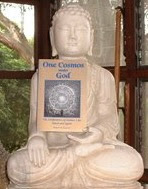
I first stole this idea of mine from an unlikely source -- or at least this source helped me crystalize the notions that had been wondering around loose in my head. I say "unlikely" because the author of The Human Animal was an atheistic psychoanalytically inspired anthropologist. Even so, when I read his account of the Hominization Event, it gave me a major guffaw-HA! experience.

Indeed, look at the cover --> It has the natural trinity written all over it: That little trinity is the very basis and possibility of the unity of man -- both collectively and intrapsychically.

Let me see if I can find an illustrative passage. But before we get to that, here's a note to myself on the inside cover: "In the symbolic pyramid of culture, very few bricks touch the ground." The reason for this is that the principles don't go all the way down -- which is what we always try to do here at One Cosmos -- that is, build the cosmic pyramid on a foundation of solid principles that cannot not be true.

Another note: "perpetuating mistaken solutions to problems --> other animals do not do this, only humans."

This also involves the perpetuation of mistaken principles, which is in turn a kind of misincarnation, is it not? For what are mind parasites but fragments of the Lie incarnate? Indeed, a fragmented truth can also become a mind parasite -- for example, truths of science taken as self-sufficient explanations.

Hmm. A lot of other interesting notes here -- for example, "mammal's greatest invention: the teat --> basis for psychic connectedness and open system."

There are actually three great inventions that rendered humanness possible: womb, teat, and infantile helplessness. The teat is definitely a turning point, such that animals become dependent in a most intimate way.

And before teat -- or at least simultaneous with it -- is the womb through which one is literally inside another (unlike the reptilian egg, which is outside the body). And the His Majesty the Helpless Baby is the most fantastic of all. He simultaneously enables, and is enabled by, the primordial familial trinity of Mother-Father-Baby.

Another fabulous invention is the hand, specifically, the one with the opposable thumb. If we didn't have hands to grasp objects, nor could we have minds to grasp ideas and principles. Think of other "tools" evolution bequeaths to the animals: they generally do one or two specific things.

Wings, for example, help birds fly, and also keep them warm. But a hand can do countless things, from punching someone in the nose to writing sonnets (to making flying machines and coats for warmth). Truly, the hand is a kind of word made flesh that must be present before Word can be made flesh, for it is our first gateway to abstraction and generalization.

In a chapter entitled Man Hands Himself a New Kind of Evolution, LaBarre notes another important point, that bipedalism had to occur first in order to free the hands; in a coonworthy bon mot, he says that "man stands alone, because he alone stands."

As for the liberated upper extremities, "the human hand is the adaptation to end all adaptations." The emancipated hand emancipates us from... from everything, really, to whatever you consider to be the highest (or lowest) reaches of mankind. It allowed us to specialize in nothing and therefore everything.

But it all redounds to nothing if individual minds aren't linked together, which goes back to the invention of the helpless infant and the resultant intersubjectivity of mother and baby: "The real evolutionary unit now is not man's mere body; it is 'all-mankind's-brains-together-with-all-the-extrabodily-materials-that-come-under-the-manipulation-of-their-hands'" (ibid.). You could say this intersubjectivity ultimately renders possible the extrabodily body of Christ alluded to in paragraph three above.

We're getting rather far afield this morning, aren't we? Back to God's Gamble. "Mary's fiat" -- i.e., the Big Yes -- "inaugurates her pregnancy and brings that of her people to term." And "She brings the Yes of Abraham to its supreme expression." In her case, "She consents not to do, but to be, to be available as a vessel of divine will." She is the explicit link between doing and being, or between law and spirit, flesh and Word.

"For Jesus to have had a real human childhood, he would have had his primary, pre-synagogue formation at his mother's breast..." (Bailie).

There are a number of references to this in the Book that are pregnant with meaning, such as older than Abraham, young as a babe's I AM, and blissfully floating before the fleeting flickering universe, stork naked in brahma daynight, worshiping in oneder in a weecosmic womb with a pew...

Tuesday, December 27, 2016

Our Father Who Wert a Heathen

This next chapter is on Our Father Abraham, who begins the story of the explicit divine-human collaboration we call salvation history.

Bailie starts with an astute comment by Balthasar, which should be read in the context of our previous post touching on primitive man's systematic refusal of history, which was enforced and renewed via sacrificial rituals. Among other things, old father Abraham said Yes to one-way time, which of course vaulted us out of our ontological nul de slack:

"God does not so much lead Abraham back to the Alpha, the origin (re-ligio), as forward to the Omega, the future fulfillment." This is an alternative to primitive religion -- even its cure, so to speak (or at least treatment); for it is "the other side of mankind's religious experience, and there is no third."

As alluded to in the previous post, if you're not moving forward you're falling behind. But "forward" only has sense in the context of its future fulfillment; or better, horizontal is only meaningful in light of the nonlocal vertical structure of things.

Either way, give Abraham credit for rejoining Alpha and Omega. "To become Christian," says Ratzinger, "means entering into the history of faith that begins with Abraham and, thus, accepting him as father" (in Bailie).

Abraham is not so much the Alpha Male as the first Omega Man.

He becomes so by placing us squarely in the bewilderness; indeed, what is salvation history but the universal, meta-cosmic bewilderness adventure? Only instead of 40 years in the desert, the wanderment is forever.

Or it would be, except for the fact that the end went to the trouble of incarnating in the middle: whatever else the Incarnation is, it is a back- and downward projection (so to speak) of the Omega into time and history.

So, man's real situation involves being suspended between two nonlocal attractors. You can call them Alpha and Omega, but if you want to express the idea abstractly you can just say Ø and O.

Indeed, this is the very definition of man -- which is to say, the animal whose environment is in the transitional space between the absurcular goround and our inspiraling deustiny. Everything happens there; or here, rather.

Time out for an Aphorism: Truth is in history, but history is not the truth (NGD). Analogously, God is in history, but history is not God.

Oh, and Modern history is the dialogue between two men: one who believes in God, another who believes he is a god. If there is an Ultimate Principle that distinguishes left from right, it is this: that the former is oriented to the Alpha, the latter to the Omega.

A progressive who "believes in God" is oxymoronic, because progressivism is founded on the divinization of Man. What they call "secular humanism" is really just human sacralization, AKA political religion. As Voeglin darkened thousands of pages trying to explain, the leftist collapses the space between O and Ø, which is why it is always so cramped and stuffy under their rule.

Note that Islamists do the same thing: they not only want to abolish the calendar, but drag us with them back to the 7th century. There too it is such a tight space that there's no room for the intellect -- as is the case on our college campuses.

Bailie alludes to "the relationship between archaic society's sacrificial center and the cyclical and backward looking fixation of pre-historic thought." They were gripped by a "fear-ridden determination to re-create an imagined past and remain safely within the orbit of its protection" -- a safe space to protect them from the ravages of time and history.

Some things never change

And again, absent the Omega, time is indeed the Great Ravager; it is entirely entropic, with no vector toward the negentropic attractor at the other end.

But life itself is surely negentropic, as is the miracle of intelligence, so these are already hints of the end in the middle of things. Properly speaking, as soon as we know truth -- any truth -- we should realize that something -- or someOne -- is up.

As we have discussed in the past, Christianity is not so much a religion as the cure for primitive religiosity: "the purpose of archaic religion was to protect its participants from the exigencies of history," i.e., "to spare them the call of Abraham or the vicissitudes of the Exodus" (ibid.).

Exactly. We had to somehow leave the orbit of Ø in order to achieve vertical liftoff. Man had "to be coaxed out of the immediate sacrificial arena" and into the great outdoors.

Just as our most furaway furbears had to climb down from the trees in order to dwell on the ground and attain bipedalism, Abraham had to leave the safety of the sacrificial arena in order to begin the mad dash from Alpha toward Omega.

This is how we become cosmic drama queens and kings -- not so much via "the discovery of some truth," but rather, by becoming actors in divine history and realizing it (Ratzinger, ibid.). Or just say called and sent.

Sent where? I'll tell you, but you can't get there without faith, hope, and love. And then you're there. Or rather, it's here. Same. Difference.

The bottom line is that our father wert a heathen, but then he waren't no more, beginning with the non-sacrifice of Isaac.

It is not the origin of religions or their cause that requires explanation, but the cause and origin of their being dimmed and forgotten. --The Aphorist

Friday, December 23, 2016

Merry Christory

The Hominization Event, among other things, involved crossing the threshold into time.

Or did it? Human beings are not so much in time as above it; or rather, we have a foot in each realm.

It's like the difference between sitting on the bank of a river (of time) vs. being in the river and pulled along by the currents. Sometimes we are completely given over to the river, for good or ill. Other times we disinterestedly watch it go by.

But that doesn't quite capture the gist, because there is also a kind of timelessness involved in giving oneself over to the river of time. The French have a term that is peripherally related to this submersion: nostalgie de la bout, or "nostalgia for the mud."

I suppose we could say there are two ways for humans to try to evade time: down and up, mud and sky.

And it seems that our most ancient ancestors defaulted toward the former. Thus the title of the next chapter under discussion, The Refusal of History. It begins with a crack by Johann Hamann to the effect that "there is no universal history without Judaism and Christianity," because the idea that we all share "in the same history, a linear history moving toward a goal, only appeared historically with the Judeo-Christian tradition."

You might say that members of the latter tradition said Yes to history -- although it must again be emphasized that the No and the Yes nevertheless coexist, and there are any number of ways to say No to history, secular progressivism being one such way.

The left flees from truths that cannot be un-known, but you can never really put the truthpaste back in the tube.

Progressivism is a collective means of stopping or reversing time, but there are also individual ways, i.e., neuroses, in which a part of the mind continues to live in an earlier time -- in childhood or even infancy.

Prior to the Jews, man's sense of historical consciousness was weak to non-existent; or, to the extent that it broke through, it was promptly repressed and denied, often through collective rituals: "If history is 'the remembered past,'" then there are "two strikingly different ways of remembering it: the mythological and the historical..."

Recall what was said yesterday about early man having to "adapt to mindedness." Bailie notes that "Archaic peoples clung, not to nature, but to religious procedures" designed to keep the gods "favorably disposed to their propitiators." It was literally a kind of circular procedure -- although the circle was wider than it is for animals, who essentially live within the subjective phase space of their instincts.

But man, in being liberated from instinct, is confronted with a kind of terrifying infinity that must somehow be tamed. "Thus these ancient cultures remained profoundly backward oriented," as if to say Please make death's footman, time, knock it off, and while you're at it, would you please make the spooky silence of the infinite spaces go away! And here's some human blood for all your trouble!

In the Christian west, we value history. It has a ground, a direction, and a purpose. Conversely, "Indian thought," for example, "has refused to concede any value to History" (Eliade, in Bailie). This is because time is thought to be a dimension of maya-illusion. Thus, the ultimate point of Vedanta is to escape time by obliterating the ego. Back to the undifferentiated matrix from which we emerged.

"As long as they remained beholden to their gods and the cycle of sacrificial rituals that appeased them, our ancient ancestors lived in a cyclical and not a historical world.... For our ancestors to step even tentatively onto the path of history, they would have to break with these 'archetypal beings' and, to some degree at least, renounce the false forms of transcendence they represented."

These archetypal beings very much remind me of what are called "transitional objects" in psychoanalysis. The latter are essentially symbolic way stations that help the child move from merger with the mother toward individuation and independence. Once safely across the psychic divide, the "security blanket" may be tossed aside.

I wonder if pagan religions are essentially transitional objects to which premodern man clung? Bailie implies as much: "other religions of the world -- ancient and contemporary -- are 'religions in waiting' -- awaiting the truth revealed by Christ..."

I'm not sure when the next post will be -- maybe Monday, but possibly Tuesday. In between we'll be celebrating Christmas, which is a Christian holiday superimposed on a pagan one. It coincides with the darkest day of the year, at which point the light increases and the days begin to imperceptibly lengthen.

You could say that Christianity lifted the holy-day out of its time-denying circle. As de Lubac remarked, "Christianity is not one of the great things of history; it is history that is one of the great things of Christianity" (in Bailie).

"For Christianity there is a progress in the truth of what it means to be. Following Christ one is permanently growing, from one beginning to another beginning. Yet Christianity is not only a part of a larger progress, it is the goal of progress itself" (Lopez, in Bailie).

If primitive man lives in the repetitive circle and secular man on the meaningless line, Christians live in the ever-renewing, progressive spiral.

Thursday, December 22, 2016

Monopsychism and Monotheism

Our fallenness is like a symmetry break, only on the vertical plane, from unity to division.

As we know, any form of religion involves the attempt to heal this breach -- to undo the damage via re-ligio, which means to "bring back or bind to God."

However, since time is a one-way phenomenon, that's not actually possible. The only way back is forward. But our primordial ancestors did not know this.

Rather, history has only recently been discovered. If man has been here for 100,000 years, then only about 5% of our existence has been in history. And even then, it took quite awhile for history to be fully disentangled from more primitive modes of being, i.e., the cyclicity of time. We will return to this subject a few posts hence.

"If human culture begins with the birth of religion, religion begins with the separation of the sacred and the profane, and the separation of the sacred and profane coincides with the apotheosis or divinization of the victim" (Bailie).

Note the symmetry break: from some unknowable prior unity (called "innocence") emerges the polarity of sacred/profane, and with it, the need for religio to undo the break and put Humpty back together -- to shove the profane back into the sacred.

In the past I have utilized catastrophe theory to try to illuminate this break. But for early man, it couldn't have been just a theoretical catastrophe; rather, it must also have been catastrophic in the colloquial sense.

Again, other animals are unaware of history, of death, of separation from reality. Although animals in the wild have much more reason to be anxious than we do, they don't worry about where the next meal is coming from, or what will happen if it doesn't come. Like the lilies of the field, they don't spin or toil.

Just as animals must adapt to the physical environment, I believe it was necessary for man to adapt to the new environment in which he found himself: the psycho-spiritual.

The reason I believe this is that we are still trying to adapt to it. Always and everywhere, the problem is thoughts and what do do with them. And there is a multitude of things we can do with them besides think them. Indeed, thinking them is often a last resort.

Whatever else we say about human sacrifice, it is one way to deal with unruly thoughts, to adapt to the curious circumstance of mindedness. If Girard is correct, then it does effectively tamp them down, at least for a while. But only for a while. It must be periodically reenacted when thoughts again threaten to overwhelm the psyche.

Let's put it this way: what is the leading edge of what we call psychological maturity? I would suggest there are two complementary factors, integration and actualization.

When a person is unintegrated, it means they lack an "organizing center," so to speak, such that thoughts take on a life of their own, often projected into the external environment.

This is how I regard pagan polytheism: as an externalization and crystallization of primitive emotions and impulses that obviously emanate from the psyche. These are "parasites" that "prevent the true God from emerging" (De Lubac, ibid.). Thus, our ancestors lived in "a beclouded but inchoate form of pre-Christian lucidity, thoroughly enveloped though it was in a sea of delusion..."

I might add that this lack of psychic integration is precisely why monotheism was so slow in emerging: the psyche is fragmented before it is integrated, so God is necessarily many before he is One.

It also explains the anthropomorphization in the Old Testament, which gradually gives way to more abstract notions of God. Chesterton wrote of how this psychic "cleansing" had to occur -- i.e., the withdrawal of projections -- before God could incarnate.

From the Christian perspective, the Old Testament chronicles the slow de-paganization of the Jewish mind in order to prepare the way for a revelation uncontaminated by our own unwanted psychic fragments.

Therefore, "the crucified Christ, as Paul insists, would eventually despoil the very cultural and religious structures he originally brought into being, making a public spectacle of them by nailing them to the cross," thus dispersing "the cloud which until then had been hiding the truth."

Wednesday, December 21, 2016

If Socialism Is Wrong, Liberals Don't Want To Be Right

So: the hominization event coincides with -- among other things -- the awakening of the conscience. Which is what exactly?

Back when I was solely under the sway of psychoanalytic theory, I would have insisted that it is simply the internalized authority of the father and of the wider culture, AKA the superego. There could be no intrinsic right or wrong, rather, convention only makes it so. You burn widows, we give them Social Security. Who can say which of us is right?

There is no question that the existence of the conscience signifies a split in the psyche, or the unavoidable presence of this nosey "other" who offers a running commentary on our thoughts and behavior. How did this happen? How did this scold gain entry into our heads? It is again reminiscent of how complex cells -- eukaryotes -- resulted from one cell getting inside another.

Bailie suggests that the conscience operates via a kind of vertical recollection. He quotes Ratzinger, who writes that it "consists in the fact that something like an original memory of the good and true (they are identical) has been implanted in us, that there is an inner ontological tendency within man, who is created in the image and likeness of God, toward the divine."

Thus, "From its origin, man's being resonates with some things and clashes with others." Our vertical recollection involves "an inner sense, a capacity to recall" a better or more "innocent" state.

And as mentioned a few posts back, Ratzinger suggests that innocence can only be known retrospectively, from the perspective of our fallenness, "from the realization that one is no longer innocent." Innocence endures "as an intimation of something for which one has no specific memory but for which one is nevertheless vaguely nostalgic..."

It seems that in a state of innocence, the conscience is either unnecessary or unnoticed.

Speaking of the superego, Ratzinger makes the psychologically astute point that the conscience can indeed devolve to a mere enforcer of societal mores: "Then the absolute call to a personal responsibility is covered over with a system of conventions that is falsely made out to be the voice of God, whereas in truth it is only the voice of the past, which fears the present and bars its way" (in Bailie).

Back when I was under the influence of psychology, I would have said that the conscience is just an abstraction from the superego. But now I would say that the superego is more or less a corruption of the conscience. I've used this example in the past... let me track it down...

Here it is, a stale bobservation from over eleven years ago. I'll quote as much as seems relevant to our present concerns:

One area where Bion differed with Freud was over the nature and function of the superego, the part of ourselves that Freud believed was responsible for our morality. The problem with Freud's conception is that the superego will reflect the particular family in which one grew up and the particular society in which one lives.

As such, the superego is not necessarily moral at all. It is essentially amoral, in that it may well punish the individual for morally good behavior and reward him for morally bad behavior, depending upon the culture.

Here we can understand why the emphasis on truth is so vital. In the Arab Muslim world, for example, they are so inundated with vicious lies about America and Israel that it would be immoral for them not to hate us. In a racist or anti-Semitic society, the superego will demand that its members be racist and anti-Semitic.

For example, the Nazi movement in Germany was animated by abstract ideals, without which they couldn't have engaged in their project to exterminate the Jews. Once the lie is established as truth, then the superego takes over, impelling the individual to act in a "moral" way, consistent with the implications of the lie.

Clearly, a casual survey of history will establish the fact that most of what people have believed down through the centuries has been untrue. We see case after case of corrupt superegos that sanction and condone slavery, witch hunts, racism, anti-Semitism, jihads, all based on one vital lie or another.

All the superego does is enforce consistency between beliefs and actions. If the beliefs are false, then the actions will likely be immoral. People rarely believe they are evil, no matter how evil they are. You can be assured that bin Laden feels morally superior to you or me, which is what permits him to murder in the name of Islamist "truth."

I believe the conscience is not identical to the supergo. Rather, the conscience is nonlocal and universal, while the superego is local and particular. The superego is simply a mechanism we evolved in order to get along in small groups. In reality, morality is universal and transcendent, applicable at all times and in all places, such as "thou shalt not murder."

In his book Freud, Women and Morality: The Psychology of Good and Evil, Eli Sagan uses a wonderfully illuminating example from Huckleberry Finn, in which Huck is in the midst of a moral dilemma between what his superego wants him to do -- return the runaway slave Jim to his master -- and what his conscience is telling him -- that Jim is a human being just like him, and that it would be evil for him to assist in re-enslaving him. First we hear Huck dealing with an attack from his superego as he considers returning Jim:

"The more I studied about this the more my conscience [actually, the superego] went to grinding me, and the more wicked and low-down ornery I got to feeling. And at last, when it hit me all of a sudden that here was the plain hand of Providence slapping me in the face and letting me know my wickedness was being watched all the time from up there in heaven, whilst I was stealing a poor old woman's nigger that hadn't done me no harm, and now was showing me there's One that's always on the lookout, and ain't a-going to allow no such miserable doings to go only just so fur and no further, I most dropped in my tracks I was so scared."

Clearly, Huck is under assault from a bullying superego for violating the racist ethic of his culture. The omniscient superego ("watching all the time") slaps him in the face, accuses him of wickedness, and causes him to become immobilized with fear. He proceeds to write a letter telling Miss Watson where Jim can be found. But as he does so, his conscience -- not superego -- begins to nag him. He lays the letter down and "set there thinking":

"And went on thinking.... and I see Jim before me all the time... we a-floating along, talking and singing and laughing. But somehow I couldn't seem to strike no places to harden me against him.... I'd see him standing my watch on top of his'n, 'stead of calling me... and see how glad he was when I came back out of the fog.... and would always call me honey and pet me, and how good he always was... and he said I was the best friend old Jim ever had in the world... and then I happened to look around and see that paper."

Caught between guilt from doing something at variance with what the superego is demanding, and an awakened conscience telling him to do the right thing, what will Huck do?

"I was a-trembling, because I'd got to decide, forever, betwixt two things, and I knowed it. I studied it a minute, sort of holding my breath, and then says to myself: 'All right, then, I'll go to hell' -- and tore it up."

Huck revokes the lie, stands up to the superego, and makes the decision to do wrong, to "take up wickedness again" by helping to free Jim.

One can only wonder. How many in the Arab Muslim world are ready to give themselves over to sin by making peace with Israel? How many are prepared to bear the guilty attacks from the superego for treating women equally? How many will stop confusing the lies of the imam with the truth of God? How many will "go the whole hog" and adopt a critical attitude toward what the Koran says about Jews and Christians?

Me? I done tore up my New York Times four years ago and been takin' to wickedness ever since. And it ain't been no easy road. Fact, if'n it waren't for old shrinkwrapped, I'd a-never knowed any lowdown evil headshrinkers, 'cept'n my own poor self.

For those who don't get the reference, ShrinkWrapped was a conservative psychiatrist blogger back in the day.

Back to Bailie. I'm running out of time here, but how could human sacrifice have been so widespread and persistent except through a corruption of the conscience that transformed wrong into right? For it represented "a system of conventions... falsely made out to be the voice of God." It also served as a kind of "purification" and "offloading" of guilt, and this mechanism surely persists to this day.

For example, to paraphrase the Aphorist, socialism is the philosophy of the guilt of others. Believe in it and you are purified of guilt -- of "white privilege," "structural racism," "patriarchy," whatever. But in so doing there must always be victims toward whom violence and repression are legitimized by the corrupt superego.

Theme Song

Theme Song