Friday, July 08, 2016

Big Win in Dallas for the Father of Lies

Since the vicious and willfully obtuse anti-police rhetoric of the left is based upon easily refuted statistics -- cf. the indispensable work of Heather McDonald (see also here) -- the events of last night must be counted as a big win for the Father of Lies. Five officers are dead because their murderer believed lies about "racist police."

In order to facilitate any great evil, lies are necessary. People act upon their assessment of what is true. If they believe a lie is the truth, then they will act on the lie and adjust their lives accordingly. Palestinians are steeped in lies about Jews, as were Nazis. When lies are accepted as true, it transforms evil actions into "moral" ones.

Human beings cannot help believing truth and behaving morally; our minds are epistemophilic (oriented to the True) as our behaviors are oriented to the Good. Therefore, in order to subvert man, it is necessary only for him to assimilate the Lie in order to converge upon the bad or evil.

Obama and the left don't want to know the truth, because they don't want the truth to be true. Therefore, they shun it in order to nurture their lower vertical impulses of envy and resentment, perpetual grievance and blessed victimhood.

The same was true of southern slaveholders vis-a-vis Christianity. Before slavery had become morally problematic, no one needed a rationale for it, religious or otherwise. Just as Obama and Black Lives Matter activists cherrypick out-of-context statistics to support what they want to believe, slaveholders tried to find biblical support for their own immoral interests.

If you can get someone to believe a lie is true, you have done Satan's heavy lifting. The rest takes care of itself. Distance from the truth doesn't matter; rather, it's that first step that counts, in that it literally places one in a parallel universe, being that the universe is made of truth: what exists is true, and vice versa. Lies are always parasitic on truth -- they have no real being -- so believing one results in a kind of ontological erosion of the soul, of real personhood.

To believe the lie is to be in the universe without being of it. It is a precise inversion of the proper state of affairs, in that it fosters a reverse transcendence into the -- or a -- lower world. Instead of using the world as a ladder or stepping stone for the purpose of climbing to higher realms, the lie places a hole in the center of existence, through which we may drop down into unreality. Remember?

"The ego becomes a hole that 'fulfills' itself by devouring other selves, leaving behind a trail... like remnant bones on a beach" (Rutler). "[T]he Mocker turns to the men and women of this age endowed with more intelligence than judgment: 'Come down from the Cross! Give me your intellect!' And we do: we do each time we call truths lies and lies truths." Same snake. Same fall. Same result.

It has always been thus, "except for one aneurysm that has paralyzed the life of the mind in our day, a convulsion imperceptible along the way so that it is hard to locate in any one philosopher" (ibid.). Derrida? Nietzsche? Kant? Descartes? How long ago did we go off course? More to the point, when did we conclude that there was no course, or that all courses were of equal value?

When the student of old attended school, he "was told to prepare for truth." Certainly he assimilated untruths along the way, but "at least he was told there was such a thing as truth" (ibid.).

But the postmodern tyranny of relativism transmitted by the perpetual adultolescents of Big Education would have us believe "that there are two sides to truth, your truth and my truth." These intellectual abusers have "betrayed childhood by robbing it of a sense of the interior life of the soul, making it unfit" for the acknowledgement and reception of any higher reality.

Instead, the victims of this intellectual con are indoctrinated to believe things that specifically block the path toward truth. This results in an "intellect that appropriates information for private ends" and thus renders inoperative its submission "to the truth for truth's sake" (ibid.).

Progressivism is really a post-civilizational neobarbarism -- just as Obama is what "comes after" the United States of America, both its ideal and its reality. (Nothing can come "after" self-evident truths except for something worse, based upon lies of various magnitude.)

Along these lines, Rutler quotes a prophetic passage by Giambattista Vico (who, by the way, was a big influence on Joyce, specifically, with regard to the circular structure of Finnegans Wake -- its "commodius vicus of recirculation" -- in which the the Same Returns throughout history, like the theme in a symphony):

Such peoples, like so many beasts, have fallen into the custom of each man thinking only of his own private interests and have reached the extreme of delicacy, or better of pride, in which they bristle and lash out at the slightest displeasure.

So, microaggression has a long genealogy.

They shall turn their cities into forests and the forests into dens and lairs of men. In this way, through long centuries of barbarism, rust will consume the misbegotten subtleties of malicious wits that have turned them into beasts made more inhuman by the barbarism of reflection...

Which is why the new barbarism of the left is even worse than the old.

Thursday, July 07, 2016

Building the Cosmic Infrastructure

We left off yesterday with the idea that history is a kind of race down from the trees of west Africa, to the wide open spaces of temporal change and development, and back up the nonlocal tree whose roots are aloft and branches down below. Is this a Christian idea, or just something I made up?

Yesterday I was reading Spitzer's God So Loved the World, in which he points out that Jesus brought "not only an entryway into the future Kingdom of Heaven, but a passageway that connected the present Kingdom to the future Kingdom."

In other words, he builds a path, a road, a bridge, from horizontal here to vertical there. The gift of the Spirit helps us complete the project of building this cosmic infrastructure, this "conduit between earth and Heaven." However, it's a project that not only takes time but keeps going over budget, given the nature of human contractors.

The Spirit is "the power of God" experienced on our end as a personal presence. "This 'presence of God' is more than merely 'the power of God' viewed as blind supernatural force; it has a subjective (indeed, intersubjective) quality." It is the more-than-human flowing through the merely human in various ways, i.e., charisms.

So the Kingdom of God is where we are headed, and the Spirit is what helps guide us there. It must also be where history is headed, indeed, the very purpose of history: "The "Kingdom of God' is the most synthetic concept in the Gospels. It is the reality that is thought to be the way, the means, and the end of humanity.... It is also identified with the divine life, and therefore, with the perfect, eternal condition of God to which all humanity is called."

Thus, word-made-flesh also ushers in the future-made-now, end-made-middle, and top-made-down; it "causes a dynamic force (the goodness of God) to enter into the world here and now."

In the past we have called the left the Good Intentions Paving Company, for we know where their projects always lead. Why is this? Because they are a repetition and prolongation of the Fall, i.e., the attempt to accomplish something without God that can only be achieved with God. Thus, the left never stops building towers of Babel and the roads between them.

Jesus advises us that we must look for the Kingdom "amid many distractions" in the world, "as well as choose it and remain faithful to it. If we do choose and remain faithful to the Kingdom, its power will affect us, making us 'Kingdom builders.'" Here again we encounter the orthoparadoxical idea that the Kingdom is the road we both build and and travel upon in order to help get us there; thus it is both path and destiny.

This is quintessentially true of Jesus, who "not only speaks of the Kingdom" but "acts it out..." As such, to the extent that he is Word, this Word is a verb, an "action word."

McKenna speaks of history as a kind of backwash from the eternal; history is a wave -- a timewave. "What we are moving toward in three dimensions is the passing of this wave of understanding into a higher dimension, the realm of the atemporal." And "the real Anti-Christ is history's distorted reflection of the Christ at the end of time." It is precisely this that causes the left to never stop immanentizing the eschaton with their good intentions.

About that atemporal reality to which we are (hope-fully) headed. Spitzer suggests that it "brings not only the satisfaction of intellectual curiosity, but the satisfaction of being immersed in tremendous beauty, the beauty of complete intelligibility, perfect symmetry, perfect creativity, perfect mind, and the perfect love behind it all." In this vision, "truth is beauty and beauty is truth; love and goodness are truth and beauty; and truth and beauty are love and goodness" beheld "in the midst of real interpersonal love" and joy.

So, the Kingdom of Heaven is really a "grace-filled adventure" toward its own fulfillment. Otherwise I just don't see the point.

Wednesday, July 06, 2016

Psychedelic Christianity

I have a little unexpected timelessness this morning to ponder the imponderable...

Back when I was in graduate school, I happily toiled as a retail clerk, often on the graveyard shift. The tranquility and silence of an empty supermarket afforded me much facetime with myself; this forced contact between me and my own dreadful abyss helps explain why, to this very day, I am able to live with myself. Or at least tolerate the bastard.

But that gets old after awhile, so I started listening to a portable radio. This was before the days of widespread talk radio, plus I was a lefty back then, so I would frequently tune into the barking lefthound side of the dial, i.e., public- and listener-supported radio. If you think what goes on there during the day is crazy, you should listen in at 3:00 AM, when no one's listening.

For many years I was devoted to a program on Pacifica Radio called Something's Happening. It was on Sunday through Friday mornings, like midnight to 6:00 AM, and featured all kinds of counter-cultural metaphysical, mystical, scientific, political, and religious sense and nonsense. (Looks like it is still on to this day.) For example, once a week it featured lectures by Alan Watts and Krishnamurti. I also remember frequent talks by Timothy Leary, Ram Dass, Noam Chomsky, Joseph Campbell, David Bohm, and various Buddhists, Jungian psychologists, astrologers, and sundry healers and holy men.

But the guest who made the biggest impression on me was the "ethnobotanist" Terence McKenna. Many if not most readers will have heard of him. He was one of the most mesmerizing speakers I had ever heard, able to somehow combine science with the psychedelic experience in such away that he made the weirdness of it all seem plausible. At least at 3:00 AM, when the world was soundasleep but the right brain was wideawake.

Although I reject a lot of his details, he definitely helped open me to the transdimensional nature of reality. Through him I was introduced to Whitehead, Joyce, mystical Christianity, and other enduring themes and interests. Ultimately I think it's because of him that I wanted to write a Really Weird Book. In fact, one of my problems with Christianity was that it wasn't weird enough. In reality it's plenty weird, but the weirdness tends to get worn away as the shocking message tumbles down the centuries.

Anyway, I was recently thumbing through a volume of his works and was reminded of how I am still attracted to the idea of a psychedelic Christianity, minus the psychedelics.

In the preface to the book, he (humbly) speaks of how he "had apparently evolved into a sort of mouthpiece for the incarnate Logos," based upon the startled reaction of his listeners: "I could talk to small groups of people with what appeared to be electrifying effect about the peculiarly transcendental matters that you will read about in these pages."

I well remember the electrifying effect, although I don't know that it would occur today, some thirty or more years later. But I know what he means when he writes that "It was as though my ordinary, rather humdrum personality had simply been turned off and speaking through me was the voice of another, a voice that was steady, unhesitating, and articulate -- a voice seeking to inform others about the power and promise" of other dimensions.

Now, religion as such is obviously about the power and promise of these other dimensions, and about revealing the hidden vertical continuity between Here and There. Back when I was conceiving the book, I concluded that, just as animals presumably evolved into a specifically human consciousness, human consciousness was evolving further into a spiritual dimension; or rather, animal neurology evolved to the point that it could enter the human space (or they could sponsor the ingression of a soul), and it is the task of human beings to further explore and acclimate themselves to a spiritual space that is prior to them. "Civilization" is its terrestrial residue.

McKenna speaks of consciousness as a "hyper-organ" that gives access "to the doorway" through which "the dead pass daily." What I would say is that mind is the first nonlocal organ, not bound by space and time but able to rise above and beyond it into realms of truth, beauty, goodness and unity. But we need to develop it in order "to navigate in hyperspace" and get to know the area.

McKenna helped me to connect everyday language to the Logos, and to show their necessary relationship. The trick is "to describe the phenomenon as accurately as possible. My task is compounded by the fact that the phenomenon I must try to describe has itself to do with the very tools of description; i.e., language.... since the phenomenon begins at the edge of language, where the concept-forming faculty gropes but finds no words, I must be careful to avoid not distinguishing between mere language-symbol-metaphor and the reality I am attempting to apply it to."

This is precisely what I attempted to do in the prologue and epilogue of the book. I'm not saying I succeeded, only that I was toying or playing with the idea of deploying language to make present the reality to which it is pointing. Or as McKenna describes it, it is a making visible of "the normally invisible syntactical web that holds both language and the world together." Hey, someone's gotta do it.

McKenna also helped me make sense of Christian eschatology, the idea that history aims at its own fulfillment beyond history; history is "the shock wave of the final actualization of the potential of the human psyche." Thus, the thing we call history is a kind of race down from the trees of west Africa, to the wide open spaces of temporal change and development, and back up the nonlocal tree whose roots are aloft and branches down below.

To be continued...

Monday, June 27, 2016

Another Open Thread

Too much going on. Now the wife needs a new hip, soon to be installed. Afterwards we'll know how much of the pain had been coming from the hip rather than the back.

Aging. Just when you're finally used to your body, it starts changing on you...

Friday, June 24, 2016

Summa Vocation

Yesterday's post quoted from one of my favorite books by Schuon, Survey of Metaphysics and Esoterism. It never ceases to amaze me how someone can write of the Invisible Real with such precision, lucidity, and brevity, with no wasted words, no wooliness, and no sentimentality. Rather, just pure light.

Reading him is accompanied by a very distinct "feeling" or sensation in me -- a paradoxical combination of freshness and recognition achieved by precious few other writers. Thus, for me it is a gymnostic exercise in vertical recollection, i.e., learning what I somehow already know deep down.

I'm looking at the foreword, written by Bruce Hanson, and it pretty much summarizes the Quasi-Venerable Way of the Raccoon. "At the level of being we are, of course, human; which is to say, every child who is born of human parents comes into the world with a human essence."

In this highly qualified sense we are "created equal."

However, "it is quite another matter to achieve our humanity in our existence; that is, to realize to the fullest degree the very promise which is already in our nature" (ibid.). Thus the gap -- or abyss, depending -- between what we are and what we are supposed to be -- between Is and Ought.

This also goes to both the source and end of our freedom: the very reason for the existence of the human station "is to choose, and to make the right choice" (Schuon).

Think of yesterday's Brexit from Big Brother's room: Great Britain chose freedom, or at least freedom for the possibility of freedom; they have reclaimed the title deed to their liberties. Now it all depends upon what they do with it.

"So, to become human is the religious task of humankind. Biological nature develops us only up to a certain point, and then we must individually, with great deliberation and full consciousness, seek the rest" (Burton).

This can sound like new age do-it-yoursophistry, but "Schuon is quick to point out that it is not through our own efforts, ultimately, that we become ourselves." We cannot pull ourselves up by our own buddhistraps.

Rather, he emphasizes our dependence upon grace, i.e., "that energy which embodies the will of Heaven. If we are to individually fulfill and express our nature, we must first recognize our radical dependence upon that Power which constituted us in the first place" (Burton). Certainly Christianity teaches the hidden power of abandonment to Divine Providence: like Father, like Son, like us. A blestavus for the restavus!

"If the human person will unconditionally make himself available to the work of that Power we call grace, grace will do the rest." It seems to me that this involves an undoing of the Fall; or, the insinuating Fall of evening was precisely adamn doing of the opposite of what we ought to be doing. And eating.

Thus, "insofar as we conform ourselves to our original nature, we participate in the divine life. As we conform ourselves to our original nature, God expresses God's self as us." Burton cites the old patristic gag that "The Spirit became flesh that the flesh might become Spirit." In between the two is the Cosmic Adventure.

I love this summary: "Schuon invites us to take seriously that the life of spirit is the fountain from which our scriptures have come to us, and to take seriously that we too can become explorers, trace the scriptures upstream, drink from the same waters and understand their meaning firsthand through the very source that inspired these scriptures" (ibid.).

Through this daily verticalisthenic exercise we may gradually "become the concrete expression of what we understand" (ibid.).

Amen for a child's job.

Thursday, June 23, 2016

Crossing the Phoenix Line

I like this winged thoughtlet found at Happy Acres:

The Fire Bird,” wrote Chambers, “is glimpsed living or not at all. In other words, realists have a way of missing truth, which is not invariably realistic.” The “Fire Bird” refers to the classical myth of the phoenix, a bird composed of fire that, since it was consumed by flames as it flew through the air, left no body. Its existence therefore could not be proved empirically, by finding its body; it had to be seen alive or not at all. Chambers’s meaning is that Burnham’s worldview demanded empirical proof for things that by their nature could not be proved but were nevertheless known to be true by those who had seen—or felt or intuited—them.

Things that by their nature cannot be proved but are nevertheless known to be true. That goes directly to the Gödel enigma we were discussing a couple posts back. You could say that Gödel proved the existence of the Fire Bird -- or that there is a category of real things (odd birds though they might be) that must exist but can never be proved.

This is all covered in The Soul's Upward Yearning, but it also reminds me of Schuon; for example,

"It is indispensable to know at the outset that there are truths inherent in the human spirit that are as if buried in the 'depths of the heart,' which means that they are contained as potentialities or virtualities in the pure Intellect: they are the principial and archetypal truths, those which determine all others."

Truth flows downward -- for it could never be the converse -- and breaks into its variegated modes (e.g., empirical, rational, mathematical, aesthetic, moral, spiritual), just as white light refracted through a prism reveals a spectrum of colors. Just as no one can say exactly when violet becomes blue or blue becomes green, no one can identify a strict demarcation between matter and life, or life and mind. This is because the whole spectrum of existence is being illuminated from above.

The white light from above cannot be seen directly, only in its reflections; reason is like the moon that is illuminated by the sun of Intellect. Thus, "if there were not pure Intellect," writes Schuon, then "neither would there be reason, for the miracle of reasoning can be explained and justified only by the miracle of intellection."

That right there is a pure expression of the Gödel enigma -- that we are always above and beyond the reason we deploy to comprehend lesser realities. For example, in this post, the writer gets a lot right but arrives at the wrong ultimate conclusion.

Yes, it is true that science cannot inform our values, that logic has fallen out of use, and that liberals argue in a circular fashion from their own false premises. However, the writer illogically concludes that "the solution is LOGIC, yes, Vulcan, Star Trek, fucking, logic."

This cannot be the case, because something outside logic must furnish the premises for logic to operate upon. And those premises must ultimately come from above, i.e., those principial and archetypal truths which determine all others. Otherwise you are trying to resuscitate a dead parrot of truth inside an oxygen deprived tautology.

A certain kind of logic presumes to tell us we are nothing more than animals. But animals do not reason. And it's not just because they aren't smart enough, rather, because they cannot conceive of the Absolute in which reason is grounded, AKA the Logos: "in other words, if man possesses reason, together with language, it is because he has access in principle to the suprarational vision of the Real and consequently metaphysical certitude" (Schuon).

This is how we can be certain the Fire Bird exists, even if we have never seen the body.

Thus the decisive error of materialism and of agnosticism is to be blind to the fact that material things and the common experiences of our life are immensely beneath the scope of our intelligence. --Schuon

Wednesday, June 22, 2016

Righteous Nobility and Lefteous Pride

We left off yesterday with affective and spiritual consolation and desolation (making four distinct categories). Being that we only touched on the subject, we may have left the impression that spiritual growth comes down to good feelings, when that is not at all the case. (Redemptive suffering is a vast subject in itself.)

For example, "the evil spirit will try to give feelings of elation and excitement about ideas that are evil" (Spitzer). It's very much like those old cartoons with a devil on one shoulder and an angel on the other: "the evil spirit attempts to coax, persuade, urge, and support with false justifications and feelings of excitement," which the Holy Spirit might counter "by presenting feelings of guilt, alienation, discord, and agitation..." It's a little like living between two lawyers.

Come to think of it, that must be why we instinctively detest trial lawyers. We all know what they're up to.

But this is the 21st century. Isn't all this premodern talk of angels and devils just the anthropomorphizing of neurological activity? I am reminded of a remark by Schuon, that "there are two pitfalls that must be avoided: to maintain that there are two gods, one good and one evil; and to maintain that evil does not exist, either objectively or intrinsically."

In other words, in evil we are dealing with a phenomenon that is both intrinsic and objective, but nevertheless not ultimate. And if we don't recognize its objective existence, we end up like Loretta Lynch, who yesterday claimed that the most effective way to deal with ISIS is through "compassion, unity, and love."

This is a fine example of the Evil One provoking a false affective consolation in Lynch. You could say that he is exploiting her untutored desire to do and be good.

That is, we are all born with a conscience that helps us distinguish good from evil. But like any other faculty, this innate conscience must be formed and developed, not just left alone like an empty field. As Spitzer writes, "the vast majority of people know general precepts by nature, but must be taught more specific precepts."

I first encountered this concept back in graduate school, where it went by the name of a "corrupt superego." The superego is essentially Freud's term for conscience, so a corrupted one converts evil into good (and vice versa), and ends up punishing the person for doing good and rewarding him for doing evil. This is how we end up with morally upside down ideologies such as communism, Nazism, and leftism more generally. Such individuals experience a subjective reward for doing bad or evil.

Indeed, what we call "leftism" (as distinguished from liberalism!) is precisely this moral inversion. It has great explanatory power -- for example, it explains why no one is as morally righteous as the leftist fighting on behalf of his demons, whether it is the redefinition of marriage, forcing us to allow men into girl's restrooms, guaranteeing to women the right to a dead baby, wrecking the world economy and forcing millions into poverty based upon inaccurate but cherished climate models etc.

"We love and are drawn to the good before we do it, and feel noble and at home within ourselves after we do it." Thus, it seems that there is a built-in moral hazard here (literally), in that we can put the cart before the horse and conflate feeling good with actually doing good. But isn't this what the left is, AKA the Intracosmic Good Intentions Paving Company?

How do we get around this moral hazard? It must be in the distinction between nobility and pride -- which can look similar but are quite opposite. Scratch a leftist and you will find that they are motivated by ungoverned pride, whether it is the intellectual pride of the tenured or the conspicuous virtue of the campus crybullies and other morally dysfunctional types.

What we want is nobility without pride. The leftist -- you will have gnosissed -- has pride without nobility. Ever see a gay pride parade? Wouldn't it be nice instead to see a gay nobility parade, with no public nudity and defiant expressions of deviance from cultural norms? One from which you wouldn't need to hide the children? Or better, no parade at all. Just a little discretion, dignity, and taste.

Exactly what is nobility in the spiritual sense? It is readiness "to sacrifice one’s interest to the truth," and "to see things 'from above' and without any baseness" (Schuon).

Thus, "Man has the right to be happy, but he must be so nobly and, what amounts to the same thing, within the framework of the Truth and the Way.... It has been said that nobility of character consists in putting honour and moral dignity above self-interest, which means in the last analysis that we must put the invisible real above the visible illusory, morally as well as intellectually" (ibid.).

In which case we come back around to discernment, i.e., between reality and appearances, creator and creation, up and down. And pride goeth before that last one.

Tuesday, June 21, 2016

Discrimination with Deference

I suspect that blogging will be light to sporadic for the remainder of June. To return to matters at hand, we're still pondering the question of whether the "atheist New Ager who meditates and claims to be enlightened is accessing" the same reality we are, and "is there a dark side to this practice?"

Again, it comes down to discernment. Yes, of spirits, but also just plain discernment, as in discrimination, distinction, and differentiation. For what is it we are attempting to discern? In the end, just truth, and truth is found everywhere, i.e., in every nook and cranny of existence.

To paraphrase Schuon, our task, always and everywhere, is to distinguish reality from appearances, no less in science than in religion. That we can even do this at all is a statement about something extraordinary in man. No other animal can discern the reality beneath appearances. That we can do so is already evidence of the spirit we seek.

Or in other words, while animals are essentially proportioned to their environment, man alone is proportioned to something far greater than the material world -- to the totality of existence and beyond, to the Absolute ground of things: "the sense of the Absolute" -- of God -- "coincides with totality of intelligence" (Schuon).

Which is why nothing short of God satisfies the intelligence, not excluding the intelligence of the godless. That is to say, the godless simply substitute a faux absolute to serve as the ground of their own intelligence, not knowing that this is a tautology; in other words, they implicitly project something of their own intelligence to serve as its own ground.

Spitzer has a good explanation of how this works in his The Soul's Upward Yearning. In fact, there is a whole chapter devoted to proving the existence of God by just this means. It's about 50 pages long. Not sure if I can condense it into a paragraph or two.

I suppose it ultimately comes down to what he calls the "Gödel enigma," which goes to how it is that human intelligence is always "beyond any set of predescribed rules and algorithms." It accounts for why any form of rationalism is simply swallowing its own tail. There is no way to get beyond it without at least implicit awareness of a truth from outside or beyond the system. That's the enigma. And thank God for it, because without it we would be as enclosed as any other animal. True, our prison pod would be slightly larger, but still a prison.

It turns out that this little enigma is the key to Everything. As Spitzer puts it, we "have the capacity to see any mathematical theory in light of the horizon of 'mathematical intelligibility,'" which simultaneously "reveals limits to our current knowledge and points to higher-level solutions within the horizon of intelligibility."

Thus, our intelligence can never be explained from below; rather, intelligence always transcends any "below" it posits out of its own substance. Human intelligence, free will, and creativity come from above and beyond; we are "the only transcendental species tacitly aware of a horizon of complete and unrestricted intelligibility," such that "God is notionally present within our consciousness, making possible free inquiry and creativity." This "implicit God" is what I mean by O. A spiritual practice is what renders O explicit.

But revelation also comes into play here, for revelation is O rendering itself explicit to and for us. Human intelligence can only approach O in an asymptotic manner, for again, our intelligence always surpasses any system it can come up with. Which is why manmade religion -- no less than rationalism -- necessarily chases its own tail. Scientology and Scientism are twins brought up in different families.

It is stupid to defer to any manmade idol. Rather, it only makes sense to defer to God.

Back to discernment of spirits. Here is the bottom line: "The most important rule is the following: if a particular spiritual idea, decision, or direction leads in the long term to an increase in faith, hope, and love, it very probably is inspired by the Holy Spirit, but if it leads to a decrease" in these, then "it probably comes from an evil spirit."

In the past I have likened it to driving an invisible car into the (equally invisible) Great Attractor. We must guide the vehicle by "feel." What is it we are feeling? Spitzer explains that we are guided by affective and spiritual consolation and desolation.

Affective consolation "refers to an experience or feeling of peace, joy, love, mystery, transcendence, sacredness, awe, glory, and ultimately home (being)."

Conversely, affective desolation is "precisely the opposite: it is a feeling or experience of being alienated from the Divine or not being at home in the Totality."

However, there is more to it than this, because sometimes God uses affective and spiritual desolation for his own ends; for example, think of the desolation you feel upon exposure to someone deepaking the chopra. If you were to experience affective consolation upon such exposure, that would be an example of the Evil One seducing you with a meretricious imitation of the real thing.

We're outta time here. To be continued...

Monday, June 20, 2016

Open Thread

Still squeezed by the conspiracy this week, so insufficient timelessness for a new post. Therefore, open thread.

Wednesday, June 15, 2016

Inspiracy and Conspiration on the Left

We never got to item four on yesterday's agenda, Is an atheist New Ager who meditates and claims to be enlightened accessing the same O->(n), or is there a dark side to this practice?

Two words: Deepak. Chopra.

First of all, I would be extremely skeptical of anyone who "claims to be enlightened" (let alone someone who sells enlightenment), because such claims are rarely made by the enlightened. Saints don't declare their sanctity. If anything, the opposite: they are most aware of their sinfulness.

Even Jesus didn't say, "hey, look at me, I'm enlightened! Buy my book!" Rather, when it is genuine, "enlightenment" is something that is witnessed and testified to by others. And it awakens and resonates with something spiritually healthy in the witness.

In this regard it is a matter of discerning spirits. By definition there is no objective way to discern a spirit, being that spirits are not objects. Nevertheless, there are ways.

For example, Jesus advises us to "Beware of false prophets" deusguised "in sheep’s clothing, but inwardly they are ravenous wolves." (This recalls Churchill's characterization of Nazis as "carnivorous sheep.")

So, how do we tell the difference? "By their fruit you will recognize them. Do people pick grapes from thornbushes, or figs from thistles?" My Bible has a cross reference to Jeremiah 23:16, where it says that these false prophets "speak a vision of their own heart, not from the mouth of the Lord."

In Spitzer's Finding True Happiness there is a whole section on Discernment of Spirits. It is appropriately contained in the chapter on Divine Inspiration and Guidance, because if there is divine inspiration, then surely there is sub- or anti-divine inspiration.

What really inspires the Islamists, for example? There is no question that they are inspired, and that this inspiration gives them the strength of will to engage in "superhuman" (antihuman) feats.

This is one reason why Obama's inability to name that which inspires them is so diabolical. By failing to say what in-spires them (or what they are in-spiring from below), it is as if he is con-spiring with them -- or with the spirit that animates them. Which he surely is, for those with eyes to see.

The question is, why does the left protect and embrace an ideology that runs directly counter to so many of its sacred cowpies, including homosexuality? It must mean that the spirit that unifies the two -- Islamism and Leftism -- is coming from a much deeper source than mere surface differences. To con-spire is to "breathe with," and both Islam and the left are definitely inhaling.

This would explain how the left could oppose Hitler one day, only to embrace him the next with the Molotov-Ribbentrop Pact. For a normal person this would cause intolerable cognitive dissonance if not ontological whiplash. But spirit is very fluid, easily dissolving such contradictions. There is a logic involved, but it is more like dream logic than the wideawakey version.

Life is hard enough. It's harder when you're stupid, but perhaps it becomes easier if you combine stupid with evil, because then the stupid doesn't burn as much -- or at least you have lots of support in your culpable stupidity.

In ten or eleven Muslim countries homosexuality is punishable by death. You can ask for gays and Muslims to unite there, but only one side will come out standing.

Here are some additional contradictions on the left which the unholy spirit helps to smooth over:

"Biological sexual differentiation must yield to voluntary gender identity," and yet, homosexuality is genetically determined; "the demonstrable failure of socialism wherever it has been tried is proof that it has not been properly implemented"; "democratic Israel is an apartheid state"; "Islam with its record of unstinting bloodshed is a religion of peace"; "a child in the womb is a mass of insensible protoplasm" (unless the mother decides otherwise); "there is no such thing as truth, an axiom regarded as true"; etc.

I say, resolving such stark contradictions is an infrahuman task that requires assistance from below.

That was an unintended snidetrip. Back to the question at hand, which is a little more subtle than it is on the pneuma-political plane (where it would be comic if it weren't so tragic), since the phenomena will generally be more of a mixed bag, a combination of good and evil, light and shadow, instead of unalloyed evil (being that there is no one good but the One).

But we're out of time, so, to be continued...

Tuesday, June 14, 2016

I. Am. Adequate!

Well, I'm off the hook again with the court. But that means I'm on the hook for reader James' questions, which I rashly promised to tackle if I didn't have jury duty. Those questions are as follows:

1) I assume that your communication with Holy Spirit began with meditation? Could you describe this in more detail?

2) In the beginning did you use any aids, such as music or spoken word? How long after beginning did you (weeks, months, years?) before O->(n).

3) Do you think this is available to everybody, or is it more of a gift or talent?

4) Is an atheist New Ager who meditates and claims to be enlightened accessing the same O->(n), or is there a dark side to this practice?

Starting with question one, the answer is Yes and No. I would say that formal communication with the Holy Spirit began with meditation (and of course it is the HS that is communicating with us, not vice versa; we are just opening ourselves to, and co-upperating with, it).

To continue with the meditation part, I began meditating in 1995, and continued doing so on a daily basis -- same time, same place -- for a full ten years. Then my son was born, and it unalterably changed the routine around here. A new phase began, which was the blog.

I'm sure I've spoken of this meditation practice before, but it was in the specific context of being an informal disciple of Sri Aurobindo. The technique was easy, so it was very much compatible with my personality style: 1) silence the mind, and 2) open oneself to the descent of the grace. There was no "self effort" at all; rather, it was entirely (as the Buddhists say) "other powered."

This appealed to me because I had actually experimented with various forms of meditation for many years prior to this, and really gotten nowhere (I can't say I was ever very disciplined about it).

In this regard, I had been trying to be a do-it-yoursopher, almost treating it as a scientific technique to transcend the ego and vault myself into a higher dimension or something. But this new way involved an implicit recognition that I myself could get nowhere, and that I had to surrender to a higher power if I were to enjoy a free launch.

Right away you can see the parallel with Christian meditation, or what is more properly called "infused contemplation." To quote Professor Wiki,

"Infused or higher contemplation (also called intuitive, passive or extraordinary) is a supernatural gift by which a person's mind and will become totally centered on God. It is a form of mystical union with God, a union characterized by the fact that it is God, and God only, who manifests himself. Under this influence of God, which assumes the free cooperation of the human will, the intellect receives special insights into things of the spirit..."

Another writer says that although "the prayer is called passive, man is not purely passive in it. On the contrary, one is never so completely and utterly active as when God moves him by the graces of mystical prayer. But in this mystical experience the 'divine partner in the dialogue' is in the foreground rather than the human response."

This is why in the book I adopted the symbols (---) and (o) for our silence and openness/receptivity before O. I suppose it takes a kind of "effort" to maintain (---) and (o), but as far as I'm concerned the yoke is on us and it's easy.

Having said all this, I have come to believe that the story of the influence of the Holy Spirit in our lives is really the story of our lives; in short, every biography is a pneumography, but every pneumography is different, since we are each unique. Our lives are a complex tapestry of horizontal and vertical influences, such that no story can be the same.

There was a time when I would have been aware of no vertical influences in my life. However, I think that anyone on a spiritual path reaches a kind of tipping point whereby they look back upon their lives and become aware of a cosmic Conspiracy of Grace that had been occurring all along. There is a recognosis of the myriad experiences, events, and meetings that had to occur for you to be where you are. From this perspective the whole thing looks contrived. No one would believe it, except that it actually happened.

Anyway, when I would engage in the meditation I would begin with a chant/prayer with words to the effect of "I surrender my life, my heart, my mind, to your light, your love, your power." Just total surrender. I give up. I can't get anywhere on my own, so it's on you. Little help, please. Throw us a bone, eh?

I would literally imagine the vertical energy coming down into the top of my skull -- you know, the seventh chakra. In order to facilitate the exchange, I would breathe it in via inhalation, and "surrender" it via exhalation (something I still do to this day). So I was literally imagining (↓↑) via respiration.

And soon enough I began to feel something in the top of my head, although it could of course be just my imagination. Nevertheless, it was a definite sensation of energy and opening, so I just stayed with it. After all, I had nothing better to do with my time, and besides, a little belief in the unbelievable never hurt anyone.

As for aids to meditation, I did sometimes have ambient music on in the background (such as Steve Roach). Also, I had an old, first generation "brainwave synchronizer" that I believe I purchased at Hammacher Schlemmer or some other overpriced gift store. I'm not sure it did anything it was advertised to do, but it did facilitate the silence and emptiness.

James makes a reference to O-->(n) which is the symbol I deploy in the book for infused contemplation -- or to put it in the most general terms possible, the communication of content from ultimate reality to us. Unbelievable? Yes, unless you believe ultimate reality exists and that we are in its image. Then it's as easy as shutting up and listening.

Having said that, this leads directly to James' next question, "Do you think this is available to everybody, or is it more of a gift or talent?" I suppose in theory it's available to everyone, but practically speaking it can't be. For example, could I write a symphony that communicates the divine presence? Yeah, but it would help to learn an instrument and to know musical theory and notation, like Bach. It would also help to totally devote my life -- not only to music, but to God, or to God-through-music.

In my case, I have totally devoted my life to God-through-words. Which is not that easy, since Bob is definitely not to language as Bach is to music. I am obviously not a great writer, but I do believe I'm an adequate one, and I have been told that I am good at conveying deep or complex ideas in a straightforward and unpretentious manner. So, I think I'm adequate to get the job done so long as this verticalisthenic exercise of (b)logostreaming is accompanied by total sincerity and surrender.

So the current structure is really no different than the meditation of old, except I surrender my mind, my heart, and my FINGERS to your light, your love, your power.

To be continued...

Monday, June 13, 2016

Blogging Under the Influence

Well, I'm in the clear for today. I wasn't needed for jury duty. In California you're on the hook for one week, but you can check in the night before and they may or may not need you. So here I am with nothing to write about, as usual.

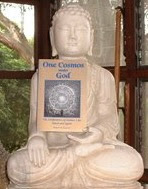
As you can see from the sidebar, I've been reading Robert Spitzer's trilogy -- soon to be a tetralogy -- on happiness, suffering and transcendence. Right now I'm in the middle of volume 2, The Soul's Upward Yearning: Clues to Our Transcendent Nature from Experience and Reason. The whole structure of the series is a bit like One Cosmos (the book), except it is much more sprawling and sometimes repetitive, taking him four books to carefully convey what I recklessly packed into one eccentric flight of fancy.

For example, in my book there is a very brief passage on What It's Like to write under the influence of the Holy Spirit. I didn't put it exactly that way, but there is something in there vis-a-vis having one's language conditioned from above, as opposed to coming out in a mechanical or precogitated way -- about truly speaking instead of being spoken by language.

As an aside, the One Cosmos book -- very much like the blog -- was simultaneously written and discovered. It is by no means a work of "scholarship," although I naturally brought in scholarly support when and where I could.

You could say that the book is both experiential and phenomenological. If read in the proper spirit of discovery, it is as if we can take a cosmic adventure together, starting at zero and ending in O. It's a whatchamacallit... a journey from innocence to experience, only on a metaphysical plane. I couldn't write the same naive book today, because I "know" too much. Now I have proper names for all the experiences.

As I've mentioned before, one of the shocks of my life is that the names for all these experiences already existed in Christianity. Thus, nowadays I deploy Christian words, symbols, and concepts for the experiences, but the experiences came first.

Which goes back to the subject of today's post, alluded to above with the remark about language and the Holy Spirit. Again, in my case, I made an independent discovery that my writing could be conditioned from above by some nonlocal force. Now I call it the Holy Spirit, but at the time it was just a seemingly disorganized raid on the wild godhead.

Anyway, in Spitzer's Book One there is a whole chapter devoted to Divine Inspiration and Guidance, with a subsection on The Inspiration of the Holy Spirit, and I've never read anything that so closely parallels my experience. For example,

"Every time I write a book or an article, I begin with a vague or general idea that suddenly turns into a very clear, detailed tractate, expressing ideas and wisdom far beyond my own."

Check.

At one point "I tried to flatter myself by thinking that, well, perhaps I was being incredibly and spontaneously insightful in the writing process..." This was around the time I was struggling with what I was going to call the cult.

"[B]ut then it occurred to me that I had never really thought about most of the fine points I was making -- not even for a moment." And "after literally dozens of occurrences of this kind of inspiration," he concluded that "while I did play some role in the writing, another wiser and more subtle agent was also integral to the process." Yes, that's right -- Petey.

"Jesus intended to give the inspiration of the Holy Spirit to all believers," such that we should call upon its in-spiration "whenever we need spiritual wisdom or want to communicate that wisdom to others." Which is pretty much all the time. Thus, you should call upon the Holy Spirit to read these posts just as much as I do to write them. Among other things, this will help you discern when I am full of it.

Which is always possible, being that I never know what I am talking about. Spitzer has the identical experience when writing on a subject that is relatively new to him. It would be accompanied by a distinct sort of excitement which is "part of the Holy Spirit's encouragement -- and if I seized the moment, I would begin speaking or writing about the subject as if it had been a product of long reflection."

In the book I refer to it as being drawn into the Great Attractor. Likewise, Spitzer says it is as if one is "drawn into ideas and ideals about which you were not previously thinking. You will probably be startled by these new ideas [?!] and wonder how they popped into your imagination..." However, "if you go with the inspiration into the new domain, you might notice how your thinking becomes expansive, and in some cases, explosive" -- what we call depth charges.

Something similar occurs to me when reading Deep Truth. Spitzer talks about this experience as well, for it must come from the same source that "guides us to all truth." "I kept thinking, 'Wow! That's right.' I didn't know why it was right (yet); I just knew that it was 'spot on.' I had an inner conviction... about truth that I could not yet justify. I... wondered how I could be so sure about something for which I had not yet mastered the rationale."

That's exactly how it is for me: there are certain truths that, when I hear them, it is as if a key fits perfectly into the lock. My mind says "case closed," such that there is no reason to spend any more time pondering the question. The gnosis is settled!

One can also experience the other side of this via our coon-scent. It is "the opposite experience of feeling a conviction about falsity" which is communicated through a feeling of emptiness or negativity or alienation or darkness. It's that feeling you get -- or that sulfuric odor you detect -- when Obama, or Pelosi, or Hillary, or Harry Reid, or Josh Earnest open their mouths.

Friday, June 10, 2016

Man is the Dice with which God Plays

Don't expect much new product around here for awhile. Next week I have jury duty! Here's another post from the wayback machine, but which has some continuity with yesterday's soiled bobservations:

In our discussion of divine and human freedom, we left off with the orthoparadoxical idea that we live in a world which is good in the sense that it manifests the Divine and its reflected qualities. Nevertheless, the creation "involves a partial and contingent aspect of badness because, not being God while existing nonetheless, it sets itself against God or tends to be the equal of God" (Schuon).

This correlates with the vertical distinction between Being and Beyond-Being, which is the basis of theodicy, through which the problem of evil is explained and God's goodness is vindicated.

In case you've forgotten, this whole discussion started last week, with a post about fate, luck, and free will. Human freedom is derived from the Divine freedom. Again, our free will could never be explained from the bottom up. Nor without it could we know good and evil, truth and illusion, beauty and ugliness, and choose between them. If we didn't have free will, we could never know it -- just as, if we couldn't know truth, we wouldn't be able to know it.

Having said that, although there are analogies between divine and human freedom, the differences must be even greater. Human beings live their lives along this ambiguous vertical bridge, with God at the top and biology, physics, and other principalities down below (sort of like the electric lines and sewer pipes under the city).

As Schuon writes, "creation implies imperfection by metaphysical necessity." And the fact that human beings necessarily have the freedom to choose badly makes matters even worse.

One problem we encounter right away is that freedom implies change, whereas we are told that God is immutable. Perhaps we need to distinguish between the freedom that applies to Beyond-Being, vs. that which applies to Being.

In Beyond-Being, freedom is in a way meaningless, because there is nothing from which to be free. Freedom only comes into play in the context of restraint, of other, of world -- of subject over and against object.

And the highest purpose of freedom is "the possibility of choosing between the Substance and accident, or between the Real and the illusory" (Schuon). Since there can be no accident within the Godhead, our freedom is obviously quite different, being that our world is a tapestry of chance and necessity.

Speaking of which, the chance aspect of the world is insufficiently appreciated, both by the tenured and the wider population. I'm currently reading an interesting book, The Black Swan: The Impact of the Highly Improbable, and would like to work some of Taleb's contrarian and counter-intuitive ideas into the mix.

It seems that people are instinctively repelled at the idea of pure luck holding so much sway over their lives, which is why both the tenured and the religious invent various ex post facto mythological narratives to explain the past. In this regard, Darwinism is no better than certain other forms of fundamentalism.

I should hasten to add that Taleb shows no signs of being in any way religious (I'm only halfway through the book), such that he seems to be trapped in his own narrative that chance is all -- and more importantly, that chance is only chance and not, say, a teleological breakthrough out of a determined system, an escape from the Machine.

Indeed, in my view, the cosmic purpose of chance is to create a non-deterministic space in which the higher can operate on the lower -- or through which final causes can influence souls and events.

If the world were a deterministic machine that functions only from the bottom up, there would be no freedom and no chance. But being wholly determined from the top would make us no more free than being determined from the bottom.

Thus, freedom and chance go together like liberty and order. It is largely because of freedom that the future is completely unpredictable. But because we are aware of the past, we superimpose narratives on it that make it seem as if the future will be similar. Thus, we are always surprised by the "black swans" that no one predicted, and yet, have the most impact on history.

For example, to the very eve of World War I, no one saw it coming. But in hindsight, historians invent narratives that make it appear inevitable. Likewise other large-scale and highly impactful events such as 9-11, the recent real estate bubble, or the Great Depression. All were foreseeable from the future.

One thing that eludes historians -- by definition -- is all of the evidence of things that didn't happen. Obviously, we cannot know what we don't know (the unknown unknown), which no doubt represents majority of (potential) knowledge.

It seems that history is always on a knife-edge, and can easily be tipped one way or the other by sometimes trivial causes. This is true of any complex system with an infinite number of variables.

We'll get back to black swans later. I just wanted to introduce the idea that randomness is both our friend and our enemy, like water or electricity. Without it we couldn't be free, but with it we're always in for an adventure.

There is no accident in Beyond-Being. But the creation, in order to be separate from God, must involve relativity and therefore contingency.

Thus, one of the purposes of a spiritual practice is to distinguish between those things that must be versus those things that may be. As Schuon describes it, being that we are the "handiwork" and not "the Principle which alone is good," man "is a good inasmuch as he manifests the Principle, but he is not good inasmuch as he is separated from it."

Again, the world is a tapestry of vertical and horizontal causes, of the real and the contingent, so we always see the one reflected in the other. This is why, for example, matter, which is otherwise so "distant" from God, has the metaphysical transparency through which beauty and truth nevertheless radiate.

And it is certainly why man may use his freedom to turn toward truth or illusion, atma or maya, O or Ø. The ego is a bipolar, janus-faced sumbitch, which it must be if we are to be free. It is why the left will always be with us, and why Bernie Sanders will never quit, both literally and figuratively.

Evil and falsehood remind us both that the world is not God (and therefore that God Is) and that there is no one good but the One.

Thursday, June 09, 2016

Where God Begins and Ends

A hectic day today, plus not much inspiration anyway, so rather than force the issue, I give you a post from six years ago. As usual, the only criterion for inflicting it upon readers is that, hey, it kept my attention. Plus, it is occasionally helpful to consult the past to see if I have changed any fundamental views, or if I am still on the same page with myself. Originally titled Within and Without the Godhead -- a reference to Beatle George's Within You and Without You.

*****

In recent days, we have been discussing the principial distinction between Being and Beyond-Being, as a prelude to mapping the vertical reality in which man has his being.

Why does any of this matter, you might ask? First of all, we've only just begun lifting and deveiloping our pneumagraphy of the vertical.

But the short answer is that it is the only metaphysic that not only makes sense, but makes total sense. Not only is it true, but all truth -- both religious and scientific -- is grounded in it. If you have a better one, I'd be happy to hear about it. But most alternatives are ridiculously shallow, inconsistent, or incomplete, at least when they aren't refuting themselves (e.g., scientism, Darwinian fundamentalism, or any other purely horizontal metaphysic).

As nine out of ten whollymen agree, only the Good is ontologically real, while evil is a deprivation; the same can be said of truth and falsehood, beauty and ugliness, freedom and slavery, liberty and leftism, capitalism and socialism. In each case, the latter term is only a cosmic possibility because it is parasitic on the former.

Schuon reminds us of Aristotle's dictum that it is in the nature of the Good to communicate or radiate itself. Here we touch on an aspect of the Trinitarian Godhead, for what is the Trinity but eternal communion?

But at this point we would like to discuss this in more general and universal terms. Plus, we are talking about the "descent" of the Good, so to speak, as opposed to the Good that abides within the Absolute. In other words, it is one thing to say that "God is good." But how does so much good end up down here, of all places?

For unlike some of our competitors, we don't spend a lot of time wondering how all the evil got here. Rather, we wonder about how all the love, truth, beauty, creativity, and freedom got here.

In speaking of "God's will," Schuon suggests that it matters whether we are talking about Being or Beyond-Being. One might say that Beyond-Being "wills" Being, and that Being wills creation. In short -- and this may unsettle Christians, but we'll find a way to make it work -- it is as if there are two levels in God, even though God of course remains one (similar to how he can be three and one).

A key point, in the words of Schuon, is that this creation or "manifestation by definition implies remoteness from its Source, so that in 'willing' manifestation, the Essence wills implicitly and indirectly that ransom which we call evil, on pain of not wishing to radiate or 'diffuse' Itself, precisely."

Again, if creation is to be -- a creation that is truly semi-autonomous and not just an extension of God -- then evil must be, even while being "impermissible." Thus, there is a reason why even in paradise there is a serpent -- who symbolizes the whole possibility of "falling vertically" further and further from the Source, even into the blind nothingness of pure evil and falsehood, i.e., hell. Here again: one might say that because God is, hell must be (since he is Justice, among other attributes).

Schuon raises a subtle but nevertheless critical point; not everyone will be comfortable with it, but I see no way around it: "[T]he Divine Will which wills moral good and for this reason forbids sin, is not the same as that which wills the world: the Will of Beyond-Being... wills the world itself, whereas the Will of Being... presupposes the world and exerts itself only within the world."

For me, this elegantly resolves the whole problem of theodicy. Sophists throughout the ages have tried to disprove the existence of God by saying that he is either omnipotent or good, but that he cannot be both, for if he can eliminate evil but doesn't, then he isn't good, and if he cannot eliminate evil, then he isn't omnipotent.

But if Schuon is correct, then this is an illusory problem rooted in a false metaphysic, in which there is only God and World, which is then covertly reduced to just God. In short, it presupposes a kind of single-level pantheism, so that God is personally responsible for everything that happens.

But that is not how the cosmos works. And it is especially not how man works, since he has free will and is able to make the conscious choice between good and evil. Our free will is a legitimate gift, not some illusory side effect of God's iron will. Rather, we may obviously go against God's will, which is the only reason why we may align ourselves with it.

The cosmos is shot through with degrees of freedom which are the residue of the Divine freedom, so to speak. Thus, we can follow its traces to the very periphery of creation, for example, in the quantum indeterminacy, or in the upward thrust of the genome.

But the higher up the vertical scale, the more freedom. This, of course, presupposes that there is a virtually infinite range of freedom within the human being as well. Being that the human being is the microcosm -- a cosmos within the Cosmos -- he may be as enslaved to an extrinsic program as an ant, or as free as the saint or sage who has conquered illusion and aligned himself with the Real.

Schuon expresses the same point in another way: "Beyond-Being desires good as radiation, manifestation or world, whereas Being desires good as the participation of things in the Divine Good."

Yes, God is good, but in different ways, depending on one's perspective. Note that after the creation, God blesses it as good. This refers to Being itself, which is essentially good, in spite of all the mischief that will ensue as the result of a quasi-autonomous creation that is relatively separate from God. It is surely a core truth that the mischief is ineveateapple.

Elsewhere I read of a good analogy. That is, I willed my son into existence. But I do not will the badness he does, even while knowing full well that he will inevitably do naughty things. To extend the analogy, willing him to exist is Beyond-Being, whereas willing him to be good is in the realm of Being.

This also speaks to the distinction between guilt and innocence. Civilization cannot exist in the absence of a system of justice, even though it can never be absolutely just (rather, only God can). There are always going to be "extenuating circumstances" if we look hard enough, especially with the development of modern pseudo-psychology, which can provide an alibi for anything.

Which is why the Christian is enjoined to love the sinner but not the sin. In other words, he is to judge acts and not souls.

You will note the cultural mayhem that ensues (and that did ensue) when this principle is ignored, and we engage in the impossible task of trying to judge souls, as the left has been doing for the past fifty years or more. We must understand criminals (except white collar or skinned criminals), empathize with them, get to the "root causes" of their sociopathy and criminality.

Or, we must understand why the Palestinians and Islamists behave like such monsters. No, actually we mustn't. Rather, we must kill them, insofar as they insist on behaving like monsters -- just it was necessary to kill Nazi and Japanese supremacists.

The left would like us to displace God and judge souls, which is strictly impossible for man. It is well above our praygrade, which is why it is preferable to stick with acts that we know to be wrong.

So, there are different levels "within" God. Or are there? That is the question. Or, the question is whether there is any support for this view in the Bible or in tradition.

There would appear to be, in the distinction between God and Godhead, the former corresponding to Being, the latter to Beyond-Being. Or, perhaps one could say that God is cataphatic, whereas Godhead is apophatic.

And Meister Eckhart often makes this distinction, without which his theology doesn't make sense. For example,

When I dwelt in the ground, in the bottom, in the stream, and in the source of the Godhead, no one asked me where I was going or what I was doing. Back in the womb from which I came, I had no God and was merely myself. And no one misses me in the place where God ceases to become.

Or

God acts but the Godhead does not act. The mystery of the darkness of the eternal Godhead is unknown and never was known and never will be known.

So, this would also resolve the question of how God can change and yet not change....

Wednesday, June 08, 2016

Jokers & Dark Knights of the Soul

I lost the post I was working on, so by way of compensation, an old post from eight years ago which I found mildly innertaining, even if its takeaway, if it has one, is somewhat obscure. It will be edited as necessary.

****

What is intelligibly diverse must be unified and whole, and only what is whole and unified can be intelligibly diverse. At the same time, only what is diversified can be intelligibly one. This is because change requires continuity if it is to be change of anything at all, and the parts of what is continuous must be distinguishable or else it congeals to a dimensionless point (or instant).... Although a whole is a single unity, it is at the same time a unified diversity. The reality of time, therefore, establishes concurrently the reality of a whole which is nontemporal. --Errol Harris

Atheistic types like to accuse religious folks of being naively uncritical about scripture, and no doubt many are. But the same can be said for radical secularists who adopt a naive and credulous stance toward the natural sciences, as if they require no metaphysical foundation and simply "speak for themselves."

But there is no meaningful scientific observation that isn't theory-laden, and as soon as one examines the implicit theories with which science is laden, one is led back into the realm of pure metaphysics. And once that happens, you soon discover that the naive religionists are not so naive after all.

As Errol Harris writes, "all the stock arguments against metaphysics, from Kant to Wittgenstein, have long been exposed as self-refuting, so that far from being impossible, metaphysics is indispensable and unavoidable, always inescapably presupposed in whatever philosophical position is adopted -- even one that repudiates it."

Now, metaphysics aims at the comprehension of the cosmos in its totality, both in its vertical and horizontal aspects. Any scientistic metaphysic which aims only at an explanation of the horizontal world eliminates in a stroke the very realm where metaphysical truth abides. This is the principial realm of which the horizontal is a prolongation -- which is why it is said, for example, that the Torah is prior to the world, or why Jesus could say that "Heaven and earth shall pass away, but my words shall not pass away." Likewise, "In the beginning was the Word, and the Word was with God..."

Of metaphysical certitude, Schuon writes that it results from the "coincidence between truth and our being; a coincidence that no ratiocination could invalidate. Contingent things are proven by factors situated within their order of contingency, whereas things deriving from the Absolute become clear by their participation in the Absolute, hence by a 'superabundance of light'... which amounts to saying that they are proven by themselves. In other words, universal truths draw their evidence not from our contingent thought, but from our transpersonal being, which constitutes the substance of our spirit and guarantees the adequacy of intellection."

I suppose there is one way to avoid metaphysics, and that is to be genuinely psychotic, and to truly live in a world without a priori meaning, sense, and coherence. I am told that the Joker in the new Batman film is such a person. Of him, commenter Dusty writes that he is

"a perfect personification of transcendent evil. That is, the act of rejecting transcendence a priori at the same time downwardly transforms that person into an inverted reflection of the saving grace from above. True transcendent evil is a faceless force until given a temporary one by an earthly personality.

"Notice that the joker in Dark Knight is in truth a faceless terror all throughout. He really has no personal history: no name; his clothes are self-made; the past that he does reveal turns out to be contradiction and lies; and even the face that we do see is painted in the style of the Jungian archetype of the mad clown. There's nothing there but a trail of violence and disaster. Whence did he come? Where did he go?"

You see? A diversified chaos, with no wholeness or unity. You might say that the Joker is deconstruction incarnate, or the archetype of Tenured Man:

"He is chaos personified, and the only connection that he does have with grace is a masochistic-like dependency on the archetypal hero who opposes his will. Even the darkest of nights, night within night, evil for the sake of evil, must necessarily maintain contact with the light, or else there would exist an absolute hell, which is strictly impossible unless God chose to suffer it himself. But if God is Good, he would choose eternal delight, and not an eternal dark night."

That comment is loaded with insights that need to be unpacked. For example, notice how our scientistic troll [we were being pestered by an irritating troll at the time] is indeed dependent upon us, not vice versa. We do not seek him out, and do our best to ignore his irrelevance. But he "must necessarily maintain contact with the light," hence his desire to associate with us rather than with his own kind, which would indeed be a kind of cold and dry hell. Just imagine those scintillating conversations between blind atheists sharing stories of what they cannot see!

Let's discuss the idea of "a perfect personification of transcendent evil." Now, evil cannot actually be transcendent. Rather, it can only mimic and mock transcendence by escaping the obligations of our humanness from below.

This is one of the things that creeped me out about the opening ceremony of the Peking Olympics a few nights ago. I only caught the first 20 minutes or so before turning if off. Yes, I could see that there was a kind of bombastic majesty taking place, but toward what end? Toward man as ant, or the elimination of man as such. It was like a leftist mass, I suppose.

2000 drummers playing in lockstep? Give me one immortal jazz drummer playing around with the beat, adding his own flavor, throwing in his own unpredictable syncopations, being an individual. For that is what America is all about: not the ant as ant, nor the ant in opposition to the hive, but rising above -- i.e., transcending -- it.

Man can "get around" the ego from above or from below. In the case of a great jazz musician, while he "stands out," it can never be in a selfish way, or it won't be jazz anymore. Rather, the whole point is that in real jazz, each of the parts is subordinate to an emergent, higher unity that is being spontaneously created in the moment, in an organismic manner.

I don't think it's any coincidence that jazz was invented in America, as it is our quintessential art form, combining as it does a maximum of freedom (which is to say, individuality) and discipline, for it obviously requires much more discipline to be a great jazz musician than it does to be in a glorified marching band. Likewise, anyone with a mediocre intellect can understand science. But not everyone can understand Aquinas or Schuon or so many other true theologians.

Now, the cosmos is ordered (as we all know, cosmos is from the Greek word for order). Everywhere we look, order. There is incredible mathematical order in the equations of physics, in chemistry, in the genome, everywhere. There is also order in the human psyche and in the human spirit, two distinct categories that people have tended to conflate over the past 300 years or so. But the psyche is more or less the area addressed by psychology, while the spirit is the domain of religion (although there is admittedly much overlap, as there must be, just as there is overlap between physics and chemistry, or chemistry and biology).

Toward the end of the 19th century, when reductionistic materialism was at its zenith, there was an attempt to reduce the psyche to a purely material or "energic" phenomenon (and to eliminate the spirit altogether). One sees this in the theories of Freud, which absurdly reduce the mind to a kind of pressure cooker seeking to let off the steam of primitive instincts and impulses; or in the behaviorists, who imagined that there was no such thing as a psyche, only behavior.

In fact, there are people who still believe this. I remember during my internship, getting into a heated debate with a fellow intern who was a behaviorist. At the time, I didn't yet realize that the discussion would be as pointless as trying to bring light to our scientistic troll. After all, how does one impart truth to someone who believes only in behavior? I suppose by physically striking him on the head with a book.

Anyway, this is an example of a man who voluntarily cashed in his humanness for a kind of faux liberation, in which nothing means anything. Thus, he succeeded in escaping the pain of the human state from below.

Isn't this what the Joker would say? He's just a behaviorist with the courage of his absence of convictions. He's just a mindless man thinking. Or, in behaviorist terms, just a dead man walking, a living death.

Existence is unavoidably tied up with language -- with the Word -- because to have existence is synonymous with having a definition, even if we cannot put it into purely logical words. For example, Just Thomism writes that

"The idea of soul arises when we notice that some bodies are alive and others are not. Our judgment of what is alive and what is not is far from infallible, but it remains that among the physical things we know, some are alive and others are not. Words like 'soul' were first imposed from primitive theories of what made a living thing alive: early words for soul simply meant 'breath'; although it is unclear if they thought that breath was really soul or if it was more the clearest sign of whatever soul was. Theories about the soul quickly became more precise. The Greeks had a vast multitude of opinions about what makes something living -- the best of which was that the soul was some kind of organization in a body which involved the mixture of various elements in the right proportion."

Thus, for someone who is alienated from his own soul, it will simply be a kind of nonsense word that corresponds to nothing real, like "unicorn." This is one of the crude arguments that bonehead atheists commonly make, all the while imagining themselves to be sophisticated, courageous, or clear thinking. But the joke is on them, for

"Our modern scientists who deny the spiritual existence of the soul because they can account for human life without it are no different than a bookbinder who denies the existence of writing style or syntax because he can account for the whole book without mentioning them at all. In a sense he is right. He can completely account for the book without once invoking syntax or grammar. For that matter, the marketer, bookseller, and distributor needn't speak of syntax and grammar in order to give their own complete account of a book. Their way of analyzing a book into its relevant parts doesn't need to include this" (Just Thomism).

So our troll is correct, in that he does adequately convey the universal truths of the undead.

Tuesday, June 07, 2016

Look What I Found

Just a short post. Not much time this morning. Feel free to add to my anemic exegesis.

The kingdom of heaven is like treasure hidden in a field, which a man found and covered up; then in his joy he goes and sells all that he has and buys that field.

The first thing that occurs to us is that the treasure is completely unmerited, or at least not tied in with any.

Rather, the man apparently stumbles upon this valuable find. It's as if he has won the lottery, except he didn't even know he had a ticket. This is unlike the pearl of great price, which the merchant was actively seeking.

All of salvation history, says Rutler, can be seen as "an account of how the bumbling and stumbling human race won the Great Lottery," for "grace is gratuitous."

This is something I was trying to impart to my son the other day. He is prone to moods in which he questions the existence of God, or proclaims the whole business to be stupid or made-up. I remind him that thus far he has grown up in a Christian context, both at school and at home (and socially), such that the graces that have come to him as a consequence may well be invisible to him.

I tell him to imagine different circumstances in which there would be no channels for these graces. As Rutler puts it, if we could see behind the veil, we would likely "be astonished at how many times holy grace dropped into our laps without recognizing it." We would see how entitled and how spoiled we had been.

There is the grace and the response to it. In the parable, the man responds to the unexpected grace by selling everything and buying the field. He presumably sells everything because in light of what he has discovered, everything amounts to nothing.

I give this claim No Pinocchios, because a de-spiritualized life is hardly worth living, especially after one has tasted the alternative. If one has never experienced the grace -- if one has shut it out, rather -- then the treasure won't even be recognized as valuable.

No doubt this is why God withdraws the grace from time to time, so we don't lose our perspective. If it were always there, we wouldn't notice it -- like my son.

"What is granted can easily be taken for granted, without the faintest amen."

Christians who have not lost their perspective do not pretend to be better than non-Christians. Rather, they just stumbled upon the treasure. And "once this sacred deposit of faith is discovered by the gift of grace, the stumbler buys the field."

Monday, June 06, 2016

Wise Men From the Yeast

The kingdom of heaven is like yeast that a woman took and mixed in with three measures of flour until all of it was leavened.

Jesus told the the crowds all these things in parables; without a parable he told them nothing. This was to fulfill what had been spoken through the prophet:

'I will open my mouth in parables; I will proclaim what has been hidden from the foundation of the world.'

The original prophecy occurs in Psalm 78: I shall open my mouth in parables; I shall speak of hidden things from of old.

Hidden since the foundation of the world. Three thoughts occur immediately: what is the foundation of the world?; what is hiding in it?; and how does Jesus know these two things?

As to the latter, either he was there or someone in a position to know told him. The Psalm goes on to say that What things we heard, these we also knew. And our fathers described them to us. It was not hidden from their children in a different generation, and will someday be known by children yet born.

So the Psalm is adverting to a lost spiritual heritage, but Jesus seems to speaking of an unknown knowledge that surpasses even this, and that no man has ever known. Rather, it has been hidden since the foundation of things.

The kingdom of heaven is like yeast. It seems that this yeast has been here since the foundation; it was mixed with the flour of creation, such that there is something in the cosmos -- something in the (supernatural) nature of things -- that causes it to "rise," so to speak.

What could it be? Now interestingly, there is no science that can function without reference to this yeast, although of course it is never acknowledged. Let us assign the variable y to this yeastly factor that pervades science, from physics to biology to interpersonal neurobiology and beyond.

Now, what do I mean that y pervades science? Well, let's begin at the bottom, with physics. For votaries of a scientistic metaphysic, physics is "the foundation of the world." There are surely things hidden there, but nothing mysterious (?!), rather, just mathematical equations and such.

For example, when Einstein came up with the theory of relativity, he discovered something that had presumably been there all along, hidden in plain sight, ever since the cosmos came into being.

The other day I was reading the original humanist manifesto, which also presumes to speak of things hidden since the dawn of existence, and to correct various misconceptions to which man is heir.

In its prelude it assures us that "The importance of the document is that more than thirty men" -- thirty men! -- "have come to general agreement on matters of final concern and that these men are undoubtedly representative of a large number who are forging a new philosophy out of the materials of the modern world."

So it's pretty important. Self-important, anyway.

Note that they are claiming to "forge a new philosophy out of the materials of the modern world," whereas Jesus claims to explicate an ancient wisdom that has been here forever. But the humanists assure us that religion has lost its significance and is "powerless to solve the problem of humans living in the Twentieth Century."

That's a bold statement. Let's examine their first point: "Religious humanists regard the universe as self-existing and not created."

Hmmm, how'd that work out? Turns out the universe is not self-existing; rather, it not only came into existence at a specific time, but time itself paradoxically came into existence with it. Furthermore, the universe is implicate with all sorts of mathematical codes, and no code can encode itself. Just ask Gödel.

"Humanism believes that man is a part of nature and that he has emerged as a result of a continuous process." Well, yes. But the statement you just made -- that man is a part of nature -- transcends nature. If it doesn't, then no true statements are possible and you are speaking from faith, not knowledge.

I don't think I want to spend this post fisking the Humanist Manifesto, deserving though it might be. But to say that man emerges as a result of a continuous process is to acknowledge that he is somehow baked into the cosmic cake. A humanist can only pretend to understand how this is possible.

We say it is possible because of the y-factor. The latter is precisely what causes -- or better, permits -- life to emerge from matter, humanness to emerge from biology, and spirit to emerge from man. The invisible yeast is always at work, otherwise the process we call "evolution" could never occur, not on any plane of existence.

The parable, says Rutler, tells us how the Kingdom of Heaven develops: "the process is slow, but it is a procession with a purpose. Through the persuasive influence of personalities transformed by love, Christians will be the yeast that raises the culture through them" -- the Resurrection being the last Word in yeastly rising.

This implies that the Resurrection itself was and is not only hidden from the foundation, but is the foundation.

"Without the yeast of grace, the human race us stale and dying.... Christ alone can save culture. There will be dark ages and golden ages, but Christ is the Light through them all."

Or the yeast. Which is to say, y.

To quote MotT,

"In order to be a religious scientist or a scientific believer honestly..., it is necessary to add to the definite horizontal aspiration the definite vertical aspiration, i.e., to live under the sign of the cross...." You might say that the horizontal axis is the flour of matter and energy, while the vertical axis is the yeast of ascent.

Friday, June 03, 2016

Arboreal Deity Cerebration

The parable of the mustard seed is the briefest of parables, but when explicated grows into a sprawling post, so that Raccoons of the world can find slack in it...

The kingdom of heaven is like a mustard seed which a man took and planted in his field; it is the smallest of all seeds, but when it has grown it is the greatest of shrubs and becomes a tree, so that birds of the air come and nest in its branches.

A footnote in my Study Bible says that the mustard seed symbolizes the disciples who "began as just a few men, but soon 'encompassed the whole earth'" -- almost like Jesus knew this would eventually happen or something.

The seed also symbolizes "faith entering a person's soul, which causes an inward growth of virtue," such that he becomes increasingly godlike (AKA theosis).

And on the opposite page, I see that there is a whole section on parables, which are "stories in word-pictures, revealing spiritual truth." In Hebrew and Aramaic, the word is also related to allegory, proverb, and riddle.

With apologies to our godless friends, parables can function a bit like koans, which, according to the google machine, are paradoxical anecdotes or riddles used in Zen to demonstrate the inadequacy of logical reasoning and to provoke enlightenment.

In like fashion, parables "give us glimpses of Him whose thoughts are not our thoughts and whose ways are not our ways." The point is to vault us out of our habitual manner of thinking.

Which is why they require a bit of "work" on our end: the meaning "is not evident to all who hear them. The listener must have spiritual ears to hear, and even then not all have the same degree of understanding."

Parables are layered, as it were; or rather, we are layered, and therefore understand the parable according to our own depth.

The Study Bible cooncurs: the parables demonstrate that "people are responsible for their own lack of receptivity: having grown dull and insensitive," they are unwilling or unable to hear or accept the message.

Importantly, insight into them "does not come simply through an intellectual understanding"; rather, they are, as it were, relatively unsaturated containers into which a kind of higher understanding -- AKA faith -- may pour itself.

Rutler adverts to the intricacy -- and mystery -- of any seed. Jesus's "earthly contemporaries would have been confounded by the system that encodes in the first inkling of a life all that the organism will become.... A seed is alive, even if it looks like little more than lint," just as "the first cell of human life is alive" even if we call it a "blastocyst."

For Rutler, the seed represents the Church, "nascent and fragile" yet destined to reach over mountains, across oceans, and even through cultures, baptizing and transforming what is worthy and leaving the rest behind.

This despite the fact that "The little seedling did not seem to have much promise, and it seemed to die when it sprouted into a cross."

It seems that the seed is simultaneously incarnation, cross, and church, i.e., Body of Christ. Or, the sprawling Body of Christ is the mature plant that has grown from its tiny seedling.

Dávila has an arboreal aphorism that relates somewhat to the above: We cannot find shelter in the Gospel alone, as we also cannot take refuge in the seed of an oak tree, but rather next to the twisted trunk and under the disorder of the branches.

Which is why to fell sacred groves is to erase divine footprints.

Having said that, Souls that Christianity does not prune never mature.

Those three aphorisms add up to the idea that the seed is planted in time, which is why it is entirely bound up with history, which is to say tradition. History is the twisted trunk and tradition the unruly branches. Some Protestants would cut down the tree of tradition to try to get back to the seed, but that is to erase footprints the divine has left in history.

Nevertheless, prudent pruning is always advised. A couple of years ago a massive tree in my side yard split in two, because a huge branch had grown too large and too remote from the central trunk.

There's a parable in there somewhere....

Thursday, June 02, 2016

Tares & Snares: Give Me Liberty or Give Me Stuff

Once upin a timeless...

The kingdom of heaven may be compared to a man who sowed good seed in his field. But while men were sleeping, his enemy came and sowed weeds among the wheat, and went away, cloaked in his darkness.

So when the plants came up and bore grain, then the weeds appeared also. And the servants of the householder came to him and said, 'Sir, did you not sow good seed in your field? How then has it weeds?'

'An enemy has done this,' he replied. The servants asked him, 'Do you want us to go and pull them up?' 'No,' he answered, 'lest in gathering the weeds, you root up the wheat along with them. Let both grow together until the harvest. At that time I will tell the reapers: Gather the weeds first and tie them in bundles to be burned; then gather the wheat into my barn.

Once again Jesus furnishes his own exegesis -- or at least decodes the symbols -- equating the field with the world, the farmer with himself, the sower of weeds with the evil one, the good seed with "the sons of heaven," the lousy seed with "sons of the evil one," the harvest with the end of time, and the reapers with his angels.

Exactly what is a tare, anyway? Sources inform me that it is a naughty weed that not only resembles wheat when young, but is indistinguishable from it. You won't be able to tell the difference until harvest time, when both have matured.

Plus their roots may become entangled below ground, so you won't be able to pull the tare without risking the wheat. Nor do you want to confuse the one with the other and eat the tare, for it apparently causes dizziness and nausea. It's bad food.

The moral of the story? This world is Messed. Up. Until the end of time.

Note how grace falls from heaven in the form of the good seed. But it is as if, on the way down, there are cross currents from another source, which contaminate what God has poured out.

Interestingly, the bad seed is specifically a counterfeit version of the good. It is as if God throws down sound money, but before it hits the ground the Evil One tosses out millions in counterfeit bills. He must have studied the genuine bills closely in order to produce the phony ones.

The parable, according to Rutler, calls us "to exercise patience with the human will as it exercises its God-given freedom," for freedom itself is neither good nor bad. Rather, it depends entirely upon what one does with it. Or, to be perfectly accurate, it depends upon the vector of the freedom, i.e., where it is aimed.

As it so happens, this is one of the biggest differences between left and right. There is a chapter devoted to this in The Great Divide: Why Liberals and Conservatives Will Never, Ever Agree. Let's check it out and see if it has anything to say about wheat and tare.

Ah, yes. Our real freedom is a natural right that does not (could not) come from the state. But modern liberalism creates and confers new freedoms that it inevitably (necessarily) sows with tares of coercion and control. In author words,

"[O]ur" -- which is to say, the left's -- "most recent ideal of freedom is a rather paradoxical one. We want a radical combination of personal rights and freedoms, but also a broad range of goods and services provided to all by the state."

One of these is not like the other!

"[T]his historically novel combination of enemy opposites" may be characterized as "libertarian [liberTAREan ho ho] socialism, under which citizens have all the personal, bodily, and especially sexual freedoms imaginable, while their former political, economic, social, and expressive freedoms are increasingly either eliminated altogether or heavily regulated by the state, its courts, and tribunals."

Ripped from the headlines, as it were.

So the state always sows tares into its bogus promises of wheat. It's another way of saying that the government that does anything for you can do anything to you.

Look at the promises of ObamaCare, or Social Security, or Medicare, whatever. There are tares enough in state subsidized college, but just wait until it's free! We are still recovering from the economic catastrophe caused by the state sowing its tares into the mortgage industry.

And here is an especially distressing story: California is sowing tares of statism into all its textbooks (as if they aren't far enough left as it is). This is to ensure that children grow up to be worthless tares fit only for hell. Which they will proceed to reproduce on earth, like good little statists.

As to the demons who sow the tares into the textbooks of innocent children? Necks & millstones, says the sower of good seed.

There is horizontal freedom and there is vertical freedom, and unless the former is informed by the latter, it reduces to nothing more than... nothing, really, because it is utterly meaningless.

In fact, to separate the vertical from the horizontal is perhaps the most efficient way to turn God's joyous wheat of freedom into tares of ontological dread and existential mischief.

Back to Rutler. He says that the parable opposes the idea of man's total depravity, "for the bad seed comes after the good seed in Christ's telling. In the beginning, the field was good, and the first seed was good. Nature is not originally evil..."

Note also that the evil one waits until good men are sleeping before he does his nefarious business, i.e., sowing the bad seed. He doesn't do it in broad daylight, being that sunlight is always the best disinfuckedup.

"The enemy obscures lucidity with euphemisms and cloaks with pride the consciences of bright minds." You might day that he focuses an intense beam of darkness so as to turn their mindfields insight-out.

Libruls are tarists, no doubt about it.

Theme Song

Theme Song