Friday, October 23, 2015

The Liberal Triumph of Disease Over Health

As some commenters pointed out yesterday, type C theology -- which also predates types A and B -- has always been the emphasis in the Orthodox world. I remember reading this in Ware's classic The Orthodox Way, that "Christ's incarnation is already an act of salvation"(emphasis mine), prior to the crucifixion. In a perfect world this would have been sufficient, but think of what happens to, say, innocence, or truth, or sanctity, in this imperfect world!

The point of the resurrection is that "Nothing that was ultimately true or real about [Christ] was lost" -- lost to this imperfect world -- and that "He continues to live in a new and transfigured form" (Smoley). As Smoley points out, this isn't just true of Jesus, but is the "deep truth" of "ourselves in our most intimate essence." I suppose we could say that what is worthy of eternity survives the terrestrial ordeal.

Note that Jesus ultimately shatters what has apparently shattered him, i.e., Death. "This polarity -- the infinite bound in the finite, the absolute in the relative -- engenders a breaking point..." It "shatters in death, only to rise again in a transfigured state, its dissipated elements giving rise to new combinations and forms" (ibid.).

Dissipation. Reminds me of my doctoral dissertation, which proved once and for all that the mind is a dissipative structure, a self-organizing system characterized by openness, far from equilibrium conditions, and autocatalysis (AKA positive feedback loops).

Then I realized that the same idea applied to vertical reality: that man is an open system in relation to God, that there is an exchange of energies between the two, and that autocatalysis takes place under the rubric of cosmotheosis.

Thus, theosis (or divinization) -- which is the whole point of life -- is really a result of this open exchange with God, in which we literally metabolize the divine substance (in the form of love, truth, beauty, etc.). There is a vertical version of autopoiesis which we might call autotheoiesis.

Which will never catch on because it is too awkward.

Note that the "auto" does not imply that this is something the self is doing (or could ever do) for itself (for that is the way of the serpent, Icarus, the Tower of Babel, etc.). Rather, it is something that happens to the self under the proper conditions, which are again, vertical openness, far from equilibrium conditions (i.e., I am not God), and positive feedback.

The feedback part can of course be tricky because The World. Am I right or am I right? The world has its agenda, and spirit has its. You could even say that the world wants you to be a certain type of person. Ultimately it wants you to be its creation, a mere extension of its horizontal energies. Either way, we will worship that which creates us.

This reminds me of... the image comes to mind of a molar pregnancy, which results in a clump of disorganized fetal tissue which is more like a tumor than a baby. It has no coherent center, but is just an incoherent blob of disconnected features, like a liberal.

Which I mean literally. For example, the Washington Post says that Hillary Clinton "triumphed" yesterday merely by "not losing her cool." Her breathtaking dishonesty and criminality are of no consequence whatsoever.

Recall what was said above about the survival of that which is fit for eternity. In the inverted world of the left, only that which is unfit for eternity survives. Truth is crucified, only this time successfully.

"Hillary Clinton had one mission during her day-long testimony in front of a House select committee investigating the 2012 attacks in Benghazi, Libya: Don't get angry."

Excuse me, but WTF? As a commenter puts it, the Post "is rewriting the dictionary now. New definition of 'triumph' does NOT include truth, veracity, or honor." Besides, if you triumph over truth, isn't that a loss? It's like a person catching a horrible disease and triumphing over health.

Back to our topic. Let's see how type C theology lines up with the unpronounceable doctrine of autotheoiesis.

Regarding salvation, Gonzalez says that "The human predicament is not that we owe a debt because of sin [type A], nor that we stand in need of illumination from on high [type B]" -- although these things are of course not excluded -- "but rather that we are subject to Satan." Or, if you prefer, we are subject to the world, as described a few paragraphs above. We become analogous to spiritual molar pregnancies.

Indeed, it is as if "growth" still occurs, but without the proper center: "It is as if we had been children who, due to an unfortunate accident, had lost mental ability... but continued to grow. Growth itself is good; but the form it now takes due to that accident is twisted."

Therefore, "we need someone to overcome the tyrant who holds us under subjection, to allow us to become once again the creatures God intended." This is growth, only growth in Christ, whereby we are nourished as local members his nonlocal body.

Part of the great difference between the life of sin and the new creation is that the former is life in subjection, which does not allow us to develop fully, whereas the latter is a life of constant growth, in which our potential is increasingly brought to fruition. --Justo Gonzalez

Thursday, October 22, 2015

History and Incarnation: Why Bother?

Here's a book from which I had been hoping a bit more, Christian Thought Revisited: Three Types of Theology. It didn't quite provide what I'm looking for, so I have a (seemingly) related book in the pipeline, Christus Victor: An Historical Study of the Three Main Types of the Idea of Atonement.

So, what am I looking for, and is it fair to blame the author for failing to flesh out my vague preconceptions? Well, to begin at the beginning, I have no problem with most everything about Christianity except for its central claim, which is this idea of vicarious atonement via human sacrifice.

I'll admit it: I have a hard time wrapping my mind around the idea of someone else dying for my sins. That's too much like liberalism: as Thomas Sowell says, what's my "fair share" of your possessions?

Which leads to another issue. Yes, I am a sinner. But a little perspective please. I don't walk around thinking that these sins condemn me to hell, and that only the most radical divine intervention conceivable can save me from myself.

I'm trying to think back to my first awareness of a different way of looking at the question, and I think it might have been this book, appropriately titled A Different Christianity: Early Christian Esotericism and Modern Thought. The book provided a definitive link from where I was at the time to where I am now, which is to say, from a more eastern/yoga influenced path to a Christian one. Or, it provided a version of Christianity which didn't offend my sensibilities and trigger the Jesus willies.

I can't say that I blame any intelligent person if they reject what amounts to a silly version of Christianity. For it is written (by Don Colacho): Every Christian has been directly responsible for the hardening of some unbeliever's heart. For that matter, Christianity does not solve "problems"; it merely obliges us to live them at a higher level.

On one end we have the fundamentalists. On the other, liberal Christianity -- or the progressive clergy in whose hands the gospel degenerates into a compilation of trivial ethical teachings (ibid.).

So, where is the Raccoon to lay his head? Is there a place for us at the Lord's table? I mean, without distorting Christianity beyond recognition? Or is it possible that certain traditions are responsible for the distortion?

Gonzalez doesn't suggest this, but he does maintain that what we are calling the Raccoon tradition, far from being some postmodern deviation, is actually prior to the others. He describes three main types of theology -- A, B, and C -- but type C (for Coon) was chronologically first, even if the other two became the mainstream.

To save time, I'll borrow from one of the amazon reviewers, who summarizes the situation well:

"As an evangelical, I have been rather frustrated with [the] view of salvation as simply a door into heaven. It has left me despairing of relevancy considering the fact that I'm not in heaven yet but still living in the here and now."

In other words,

"This book explains how much of traditional Christian theology (including evangelicalism but also Catholicism and liberal Protestantism) is based on a specific interpretation of the Bible and theology originally based on Tertullian's legalistic theology (what the author calls type A theology: the Bible is a set of laws to be obeyed). This theology has been mixed with Augustine's Neo-Platonism (type B theology) resulting in the theology dominant in the West: theology that interprets Scripture as a set of fixed, universal truths that need to be followed. God is the Judge that will punish any deviation therefrom.

"But the author shows that there was an early theology, originally from Syria and probably closest to the tradition of the New Testament. The author calls it type C theology and considers Irenaeus its main exponent. This type of theology has disappeared due to social and political circumstances. But it's a theology that considers the Christian faith not as a set of rules to be obeyed, but God's active participation in the history of mankind. In this theology history is the stage where His purposes will unfold, where His kingdom of justice will be established. This Christianity is not just relevant for the individual Christian who wants to 'change his bad behavior' but for the whole Christian community fighting evil in all its forms and manifestations (including societies)."

I did get a whiff of social justice -- a hint of liberation theology -- in Gonzalez' analysis, and that troubled me. But other aspects are intriguing.

Remember, Jesus is here and then he's gone. He leaves no written words, so it is up to his disciples to interpret What That Was All About. They have to remember highlights from what must have been a nonstop, three-year flow of conversation. What was important? What was peripheral? How does it all relate to his death? And resurrection? And more importantly, to us?

Note in this regard that the gospels are already theology. Each gospel was produced out of this or that faith community. And remember, many gospels were excluded from the canon -- not necessarily because they were completely wrong, but because some element may have been under- or overemphasized. Indeed, there was a fight to get John -- the most explosive bomb of them all -- loaded into the canon.

Gonzalez goes into an analysis of the different ways in which the three theological types approach God, creation, original sin, salvation, and other questions. The first -- type A -- is the most legalistic and sin-conscious, whereas the second -- type B -- is at the other extreme, almost neoplatonic in its embrace of immutable abstractions to the exclusion of the material world. If type A is understood in terms of the Law, then type B is concerned with Truth, only of a highly abstract, impersonal, and timeless nature.

What about type C? First of all, it is much more grounded in the gospel of John; whether it came out of John or vice versa is unclear to me, but in any event, there is definitely a different emphasis. For it, faith doesn't so much involve immutable truths... how to put it? Orthoparadoxical, don't you know. I would say that, as Word becomes flesh, it is as if the Immutable becomes the mutable. As a consequence, there is much more focus on history, since it is now leavened with and conditioned by truth. Thus,

"all that takes place within time is guided toward God's future. At creation, God has certain goals which were to be fulfilled through the process of history" (ibid.).

God enters "into the world in the work of creation and in the leading of history." And as history is a "fundamental category," creation "is the very beginning of history, which is not then the result of sin. Even had there been no sin, there would have been history."

In other words, the implication in particular of type A theology is that history only occurs because of our primordial boo boo. Absent that, then we could have presumably remained in paradise forever. But for Iranaeus -- the progenitor of type C -- it is not so much that Adam and Eve sinned per se, but that the sin consisted of a premature grasping after something for which they were not spiritually ready.

God had a plan, but they jumped the gun: "being made 'after the image of God' means that humankind has been created with Jesus Christ as the model." In other words, it is not as if man sinned, therefore God had to come up with the idea of the Incarnation. Rather, the Incarnation was in the cards all along, not just as a remedy for our total depravity:

"God did not make human beings and then decide to take human form in the incarnation, but rather, from the very beginning, God meant to become incarnate, and therefore used the incarnate Word as a model for Adam and Eve."

Again, there is history, and something that develops within it, Man. History is a dialogue or dialectic between man and God, such that human beings have "the capacity to grow to further resemble [the] Word..."

And the Law takes on a different connotation, since it is not so much about sin and punishment as to "serve the human creature in its own process of growth and development toward closer communion with God." The law has a positive and teleological function, not just a repressive one. It doesn't mean that sin doesn't exist, but that sin blocks intimacy with God and puts up a roadblock to our own spiritual evolution.

Finally, instead of vicarious atonement (although here is still that), we have in Jesus the one who successfully overcomes the world and shows us the way. He liberates us from sin, in that he defeats "the tyrant who holds us under subjection, to allow us to become once again the creatures God intended...

Gotta wrap this up, but "the main work of Christ" is "victory against the powers that [hold] us in subjection" and "opening for us, his followers, the gap through which we too can escape from bondage."

Wednesday, October 21, 2015

The Known World is the World Known

Remember in school, where they didn't teach you what to think, but how to think?

To quote Hillary Clinton tomorrow, "I have no independent recollection of that."

I frankly don't remember much of either -- the how or the what. I do remember being taught what to remember, but that's not really teaching, is it? Rather, I was simply told what to memorize.

As my son winds his way through the digestive tract of lower education, I am subject to flashbacks of the material, which is still, after all these years, occupying space in my head: Father Junipero Serra. Vasco da Gama. Magellan.

Did we learn nothing from James Cook, the first but not last white European male eaten by damn Hawaiian savages?

And of course the dates: 476. 1215. 1492. 1517. etc.

Now, there is something to be said for all members of a culture being on the same page and using the same calendar. Historian Wilfred McClay put it well in a recent Hillsdale Imprimus. Why learn history at all on the public's dime?

Because its "chief purpose" should be "a rite of civic membership, an act of inculcation and formation, a way in which the young are introduced to the fullness of their political and cultural inheritance as Americans, enabling them to become literate and conversant in its many features.... It is not merely a body of knowledge. It also ushers the individual person into membership in a common world, and situates them in space and time."

So. How's that workin' out?

Like this: "Instead, it [history] is likely to be seen as a relativistic funhouse, in which all narratives are arbitrary and all interpretations are equally valid." Either that, or a litany of white male oppression, of "endless rounds of interrogation and suspicion, aiming precisely at the destabilization of public meanings..."

But you know what? Despite my personal animus toward some of them -- I'm thinking of one in particular -- I've never eaten a single Hawaiian.

You will have noticed that the left can never be intellectually consistent, and that they always engage in the bait-and-switch. In this case, they simultaneously insist that all narratives are relative and that theirs is the One Truth. In practical terms they exchange truth for power, and they both define and enforce the former via the latter. Therefore, you will bow to the left wing narrative or suffer the consequences.

In truth, we need both to know how and what to think -- just as we need a musical instrument and something to play on it.

The left is half-right when they say that everything is relative. In fact, everything is relative: to the absolute! Therefore, all narratives must be examined in light of the One Narrative, otherwise all narratives are arbitrary, not relative.

I was just reading in this non-raccoomended book by Schuon that "Every world -- or every circle of reality -- is real within itself." That is, we all inhabit a world whose "reality is relative and fragmented, not absolute and pure":

"With regard to a circle of reality, it can be said that pure Reality is its prototype..." Thus, "the circles of fragmented reality are completely and in every respect symbols of higher and highest Reality..." Considered visually, it is as if there is the one Absolute Circle that contains us all, filled with little fractal-circles of the whole.

Now, "Every world, every circle of reality, is definable as knowledge and known," the two co-arising and being inseparable. Therefore, "'world' means knowledge and known.... As soon as one speaks of knowledge, the corresponding known must also be inevitably spoken of," such that "this mutual dependence of 'knowledge-known' is the dual aspect of the world," repeating itself ad infinitum, at every level.

Now we're getting somewhere, because the left's narrative isn't just a story, but a whole self-enclosed world. This is indeed a fundamental difference between left and right: since the former is godless, it necessarily exists in a closed cosmos in which it is violently excised from the Master Narrative, about which more tomorrow since we are out of time.

But at least we have finished with Esolen, so I can move on to the next book in my backlog. We'll end with this thoughtlet:

"A truly free people needn't care overmuch about who is sitting on the throne or who has been elected..." (Esolen). But in my lifetime, Americans have become increasingly obsessed with politics. What does this tell us? As a measure of the erosion of our freedom, we often hear that the president "runs the country" instead of just executing federal laws passed by the congress. Thus we are forced to care, since the state never stops exceeding its limited and enumerated powers.

Wouldn't it be great to not have to give a fuck about the federal government so long as it kept out the rabble and killed our nihilistic foreign enemies before they kill us?

Tuesday, October 20, 2015

Feminists Earn a Dollar for Each Hour of Eternity Squandered

I forget where I saw it -- probably at Happy Acres -- and exactly what it said, but something to the effect that there are people who long for eternity but don't know what to do with themselves on a rainy Saturday afternoon.

This implies that our fitness for eternity, like anything else, is a kind of skill. It is part of what it means to be a spiritual pathlete.

So, while looking back at the Top Ten Ways to Mess Up Your Child, the following caught my eye; it is from a 1917 eighth grade literature reader for California public schools, before John Dewey ruined everybody's lives and ate all our steak:

"Literature prepares [the student] for the hours of leisure now and later." It "makes the pupil a good companion for himself, and removes the appeal of cheap entertainments and unworthy companions."

No cheap entertainment and tawdry companions? That's cultural genocide. Against the left.

So, we need preparation for leisure, or training in Slack. This is something I have always recognized, nor is it something that escaped God's gnosis, otherwise why go to the trouble of spelling it out in Genesis 2, in which we are advised to imitate God by doing nothing for roughly 1/7 of the time.

If we apportion it to the week -- which is my preference -- instead taking it all at once, it translates to 3.4285714 hours of slacktivity per day. That sounds about right. (Note that my blogging is always from the slackspace, for which reason it is utterly without practical purpose.)

Remember, when we are in slack, we are not doing nothing, but rather, doing nothing, and this makes all the difference. A merely lazy man is not a properly enslackened man.

Esolen touches on this on p, 66, noting that there are people who "can be lazy, but they can never be at ease." The laziness is an escape, not an inscape. Thus, they are nagged by the conscience, unless they succeed in numbing it altogether, like Lamar Odom.

Now, the conscience can also be a nag when one is being properly slackful, and that's a problem. It's like a spiritual autoimmune disorder, in which the conscience cannot distinguish between the one and the other -- passive laziness and active slack -- and persecutes both with equal relish. Sometimes you must tell your conscience in no uncertain terms that you are under the Mandate of Heaven, so lay off.

Note that under the prelapsarian conditions of Eden, we presumably lived in primordial slack. I don't want to get into a fruitless he-said, she-said, God-said rehash, but suffice it to say that when the dust settled, man exchanged slack for work. Were our primordial ancestors idiots?

No more idiotic than our current crop of ovary tower feminists. The chapter we're discussing starts out with a crack by Chesterton about women who declared "that they would no longer be dictated to, and promptly became stenographers."

Ho! Reminds me of women who, when they get married, resist the patriarchy by keeping their father's surname.

If we consider the structure of Genesis, we see that Eve is susceptible to the lower promptings symbolized by the serpent, and that she pulls Adam down with her, since his weakness -- like all men -- is for Woman.

This is not to blame Eve per se, since she simply exposes Adam's own weakness. Adam faces in two directions, toward heaven and earth, and he simply defaults to the latter instead of maintaining the proper complementarity.

Using the dodgy technique of inverse analogy, the whole story implies that Woman is a kind of terrestrial axis who mirrors the metacosmic God-axis. And a moment's thought confirms that this must be the case, because there is no doubt whatsoever that when we enter the world as neurologically premature infants, our Whole World revolves around Woman, AKA M(o)ther.

But the role of mother is to eventually hand the child over to Father, i.e., the Heavenly Father (of whom the earthly father is a deputized agent).

Speaking of inverse analogies, consider how Mary is the recapitulation of Eve, only Getting it Right this Time. Whether looked at literally, symbolically, or realsymbolically, Eve, instead of taking her cue from below, takes it from above, which only turns the human cosmos back right-side up.

Once again, Mother is the axis, for without her Yes, we would all still be wandering in the bewilderness of the cosmic No!

Radical feminists proudly recapitulate the fall by screeching NO! at the top of their lungs. Here is how Esolen describes the postmodern version of the fall: "women who are indispensable as culture makers in the home" give this up in favor of becoming "dispensable and interchangeable in the workplace, and indeed subordinate..."

This must be one of the greatest cons in history -- bearing in mind that the Fall itself takes place outside history, or in trans-history. So it's really the same serpent and the same con.

And men are still to blame for allowing it to happen. Adam could always have said NO to Eve and YES to God. But modern man is so severely PCwhipped that he is too weak to resist.

Throughout this silly charade, the feminist will insist that she is acting in the name of "freedom." Which is a laugh. "In other words, you are free if you must show up at a certain place at a certain time, to do a certain well-defined and usually narrow thing for a certain salary, or else be fired." Congratulations, "you are free if you push papers for a boss nine hours a day or scrape the plaque from the teeth of strangers with bad breath" (ibid.).

Feminists love to flaunt their entirely bogus statistic of earning 71 cents on the male dollar, or whatever it is. They are clueless to the fact that for each dollar earned on a trivial job, they are exchanging something absolutely priceless. Speaking from personal vicarious experience, I know my wife would say that no amount of money would be worth what she has received from ten-plus years of motherhood. Even considering the proposition is absurd. She told the serpent to fuck off.

Yes, there is labor. But its end is leisure. We do something in order to celebrate nothing. For what is the point of a celebration? It is not a distraction, but rather, the opposite. I want to say deus-attraction, but that's a stupid way to end a post.

Monday, October 19, 2015

The Cosmic Structure of Man's Eternal Fuck Up

Last Friday I forgot the new program, which involves a weekly descent below dreck into the living hull of the knowa's arkive and pulling out an old murmurandom or two. But it all works out, because today I have to leave early, so it is more conducive to playgiarizing with myself.

For today's compilation I searched "Obama Antichrist," and what follows is a compendium of fine insultainment around that theme. Note that although the content may superficially appear to be about vulgar politics, it was all written with one eye on eternity (AKA 20/∞ coonvision), so it is supposed to disclose deeper lessons about, you know, the structure and content of ultimate reality:

There will always be a... period of adjustment when infantile omnipotence collides with the reality principle. In fact, Obama addressed this just yesterday, comparing the trainwreck of Obamacare to a bug in an Apple product. He makes an excellent point, because when you think about the federal bureaucracy, isn't the first thing that comes to mind the most successful company in the world?

Given the level of unsustainable fantasy that was projected onto Obama prior to actually doing anything, we knew the country was going to be in for a screwed awakening when this Nobody from Nowhere underwent the formality of actually existing as Someone doing Something.

In short, we are now living in the dark future of which these past blognostications were shadows.

First of all, let's get this out of the way at the outset. Are we really calling Obama the antichrist?

Yes, of course.

Nah, just kidding. Let's just say the embodiment of a hypothetical "antichristic principle." There is no need to unduly slander the man, no warrant to demonize someone just because he's an instrument of satan. Besides, he's just the vehicle, not the driver. The surfer, not the wave. The bong, not the smoke.

Now, precisely what do we mean by "antichrist?" I would say that, as Christ is Word-made-flesh -- or Absolute made relative -- the realm of the antichristic would analogously represent the "lower principle" made flesh -- the instantiation, as it were, of the energies of the Fall (speaking of apples and bugs). Among other things, it would represent the absurdity of the relative made Absolute ("ye shall be as gods").

So first of all, one must believe that man is in some sense a fallen being with a built-in design flaw. You don't have to be a fanatic about it. You have only to know that something goes persistently wrong with the earthlings, however you wish to conceptualize it. Or, to paraphrase Don Colacho, there are two kinds of men: those who believe man is fallen, and idiots.

Being aware of this principle (the fall) is our greatest inoculation against utopian leftist schemes to perfect mankind, which always -- always -- result in unanticipated cosmic belowback. We might think of the left as the Good Intentions Paving Company, and we all know where their shining paths lead. For the left, unanticipated consequences always swamp the anticipated.

In this regard, left wing "climate science" is a quintessential case: not only does it fail to predict the future, it can't even retrodict the past. You call that science? In comparison the doctrine of the Fall is on the strictest scientific grounds, as it both illuminates the past and allows for perfect prediction as to how the left's next fallie will go boom.

Once we posit the Fall, one next must posit the idea that it is possible for its energies to be personified -- or, let us say, both focused and dispersed like a beam of darkness through the concavity or convexations of man's heart. It is like a dark light speeding through the void, looking for an object to animate. Only "animate" is not quite accurate. "Zombify" is more like it, for this kind of "political awakening" is like a counterfeit born again experience.

Thus, as Christ is a blinding light, the antichristic would be darkness visible. Thus, to those who live in spiritual darkness, it might appear as a false light -- as, say, a single match is brighter than the sun in an enclosed room, cut off from the real source of light. If the central sun is analogous to the primordial truth, then when it is extinguished, a lot of lesser things may appear luminous: stars are only seen at night, just as, say, Darwinism may appear to be absolutely true when cut off from Truth as such.

The Serpent -- to paraphrase our Unknown Friend -- sssymbolizes advanced intelligence ("the most cunning of the beasts") turned wholly toward the horizontal. Thus, it is a perversion of man's intellect, as it represents a self-sufficient naturalism and total (lower case r) realism that betray the vertical source of human intelligence. As such, we would expect one aspect of the antichrist to be a facsimile of high intelligence combined with extraordinary vapidity.

Does this remind you of anyone?

Now, this cannot merely be the philosophical vapidity of the doctrinaire atheist or scientistic materialist, or it could never gain traction in the human heart, which always hungers for Spirit, even (or especially) if it is the false kind. Man is always looking for God, even when he thinks he's after some other object or idea. Otherwise we would be like animals and stay out of trouble by just falling asleep after we eat.

Rather, the object of antichristic grasping would have to come cloaked in some sort of seductive or hypnotic faux verticality. It would indeed have to be charismatic and charming, bearing in mind the root meaning of former, which is "divine gift," and of the latter, which is "incantation" or "magic spell."

A spiritually normal person would be alarmed if he possessed this kind of influence over others, for it is always a great danger to mess with someone else's destiny. At the very least, it would be an occasion for the deepest humility, combined with concern over the precarious state of the souls under one's influence. Conversely, try to imagine the grandiosity of a man who thinks he is qualified to outlaw the plans and decisions of millions of human beings with the stroke of a pen.

Most people, if they were even vaguely aware of the implications, would not want this power, because they would know that they are neither worthy of it nor competent to deal with it, any more than they are competent to perform brain surgery. But the person with issues of cosmic narcissism will be too intoxicated by the power and adulation to care about the souls with whom he is toying. They are just props, part of his psychic furniture.

This power is a heavy responsibility and is not to be taken lightly. The spiritually normal person knows that any charis (gift) is only on loan to him (or courses through him locally from a nonlocal source), and that he is not free to use it as he will.

Rather, there must be spiritual safeguards in the deployment of such a gift. One is only free to use this power if it is aligned with its vertical source and with vertical principles, e.g., Truth, Love, Beauty, and Unity (not relativism, idiot compassion, aesthetic barbarism, and diversity). There is something coming through the charismatic, not from him, and as soon as one realizes this, it is an occasion for, yes, gratitude, but also fear and trembling. It is analogous to the power to send men to die for their country, only on the vertical plane.

Our Unknown Friend asks the questions, "Can one produce artificially intellectual, moral or spiritual inspiration? Can the lungs produce the air which they need for respiration?" No, of course not: "the very process of breathing teaches the laws of obedience, poverty, and chastity, i.e. it is a lesson (by analogy) of grace. Conscious breathing in of the reality of grace is Christian Hatha-yoga. Christian Hatha-yoga is the vertical breathing of prayer and benediction -- or, in other words, one opens oneself to grace and receives it."

Unknown Friend goes on to say that the antichrist represents "the ideal of biological and historical evolution without grace." This is a key idea, for what is a progressive? A progressive is someone who believes fervently in progress while working fanatically to undermine its possibility, since progress can only be measured in light of permanent truths and transcendent ideals.

The antichrist "is the ultimate product of this evolution without grace and is not an entity created by God," since divine creation is always a vertical act or descent. Yes, all things ultimately "come from God," in the same sense that all light comes from the sun, but think of all the infernal uses to which man may put the light, darkling!

Now, in this closed and absurcular dialectic, Obama is ultimately a creator of those who created him. Unknown Friend writes that, just as there are spiritual beings who reveal themselves "from above," there are what he calls egregores, which are "engendered artificially [and collectively] from below."

Thus, "as powerful as they may be," they "have only an ephemeral existence," the duration of which "depends entirely on galvanizing nourishment on the part of their creators." As Obama's projected power begins to fade and the illusion is punctured, we'll see more and more people publicly asking, "what was I thinking?" in supporting this intellectual cypher. The answer is, "you weren't. You were fantasizing." Of course, others -- the true believers -- will dig in, for "Lord, to whom would we go?"

As such, the really frightening thing about these kinds of amorphous demagogues is that they are given life and nourished by the rabble they nourish and to whom they give faux life, in a spiritually barren cycle. The result is either spiritual asphyxiation or starvation, or probably both. And starved and suffocating men are capable of anything. Which I think explains all the outrageous lying.

Ultimately, the antichrist is the shadow of the totality of mankind, as Jesus was the immanent shadow, so to speak, of the transcendent Divine Principle. The antichrist represents all that man is, and can be, in the absence of divine grace. It is he who transported Jesus to the highest earthly mountain "and showed him all the kingdoms of the world and their glory" and said to him All these things I will give you if you will fall down and worship me. (I think that is from Meditations on the Tarot)

We'll leave you with the old classic from Ezra Klein, just to remind you that we're not exaggerating:

Obama's finest speeches do not excite. They do not inform. They don't even really inspire. They elevate. They enmesh you in a grander moment, as if history has stopped flowing passively by, and, just for an instant, contracted around you, made you aware of its presence, and your role in it. He is not the Word made flesh, but the triumph of word over flesh, over color, over despair.... The tens of thousands of new voters Obama brought to the polls tonight came because he wrapped them in that experience, because he let them touch politics as it could be, rather than merely as it is.

Friday, October 16, 2015

Give Liberals a Child to the Age of 27, and They Will Give You Back a Bigger Child

You know the old gag -- "give me a child until he is seven and I will give you the man." The left has taken that to heart, minus the man. Tack on graduate school, and the liberal motto should be: give me a child to the age of 27, and I will give you back a terminal child.

Like our reader Van, Esolen places much of the blame on John Dewey, whom he characterizes as a "philistine with a hypertrophied brain." Assouls like him are "senile without ever having been young."

That's some useful insultainment, because it is true of liberal academia in general and of our president in particular, who is simultaneously infantile and sclerotic.

Obviously their whole brains cannot be hypertrophied, but only a part. I wonder which part? We'll return to that question later. But there certainly must be a dominance of left brain over right in order for ideology to be superimposed over experience.

In fact, Dewey was explicitly anti-right brain, as it were, in that he had no use for the child's imagination.

Now, to steal or thwart a child's imagination is a serious crime, because without it, life is hardly worth living. Art, beauty, love, religion, even truth itself all disclose themselves in this transitional space.

We want to deepen and broaden this imaginal space, not foreclose it. Anything of significance is only significant because it faces in two directions, objective and subjective. You might say that we probe an object by extending our subjectivity into it in imaginative ways. See Polanyi for details.

I've mentioned this in passing before, but I believe this is one of the vital functions of religious imagery.

Let us say there is a "spiritual space" where we may have experiences of different kinds. This is something even an atheist will concede, i.e., that spiritual experience exists, even if, in his opinion, it has no object and is wholly subjective.

But a blind worm, say, could affirm the same of the third dimension. Since the worm has no means of probing it, it might as well not exist.

For us, the sense of touch (and taste) is one dimensional, and this is the world Hellen Keller lived in before her awakening to language. It is simultaneously infinite (as is a point) and yet horribly enclosed: "confined in infinite meaninglessness," you might say. Pure Ø.

The sense of smell introduces a two dimensional world, as the smell is separated from its source. Sight opens up the third dimension -- space -- while hearing opens the fourth -- time.

I would say that the spiritual sense -- and all normal humans have it -- opens up the transdimensional space.

But just because you have the space, it doesn't mean it is mapped. Humans, for example, became aware of three dimensional space long before they were able to map the globe, much less the heavens.

Looked at from a certain angle, human evolution involves the more or less accurate mapping of the spiritual dimension.

If you are a Christian, you learn, for example, that the space is trinitarian and relational. It is certainly intelligible, and this intelligibility is characterized by Light. In it we discover the divine beauty, AKA glory. We also discover objective virtues and other archetypal realities.

So, what I mean to say is that John Dewey is all wet when it comes to the imagination. In a particularly diabolical passage, he claims that children

"are occupied only with transitory physical excitations. To symbolize great truths far beyond the child's range of actual experience is an impossibility..."

To which I can only say that my 10 year old is truly wiser than John Dewey, who thinks like a retarded, neglected, or abused child who was never given the space to dream, or even just be. And then he systematically takes it out on generations of innocent children under the guise of "education."

Esolen notes in passing how Charles Darwin claimed -- big surprise -- "that poetry meant nothing to him. He had no ear for it, and he noted its loss with mild regret."

Likewise, "John Dewey had no poetry in his heart," except that in his case he "never noticed the lack." Therefore, like many contemporary atheists, he had a spiritually fatal case of Dunning-Kruger, in that he was completely unable to recognize his own spiritual impoverishment.

"A child is a human being: and human beings are made in the image and likeness of God." This "implies that the child is made for goodness and truth and beauty, and that he will respond to it, despite Dewey's absurd contempt for it..." (Esolen).

To deprive a child of the primordial knowledge in the paragraph immediately above is analogous to performing a spiritual lobotomy: a logotomy, perhaps. True, you'll create a robot or a beast, but robots can be programmed while beasts can be imprisoned.

Thursday, October 15, 2015

God is Not Seen, But the Means of Seeing

There is of course a proper kind of humanism and a healthy form of liberalism that go something like this: they give men "the freedom of the height and breadth and depth of human experience, including man's mysterious encounter with his Creator. To be free is not to live in no place and at no time but to live in one place as in the shadow of all places, and to live in time as in the morning twilight of eternity" (Esolen).

This is what Joyce is trying to drive home in both Ulysses and Finnegans Wake: human life from the perspective of eternity, or at least "temporal fullness." In the former he tries to cram it all into a single day, while in the latter he does so in a single dream. In both cases a solitary man stands for every man, or Here Comes Everybody. The point is that Anybody is Everybody if life is lived "in the shadow of all places" and "in the morning twilight of eternity."

In the case of FW, it revolves around various permanent complementarities such as male/female, old age/youth, life/death, love/hate, men of action/contemplation:

"[T]hese, by their attraction, conflicts, and repulsions, supply the polar energies that spin the universe. Wherever Joyce looks in history or human life, he discovers the operation of these basic polarities. Under the seeming aspect of diversity -- in the individual, the family, the state, the atom, or the cosmos -- these constants remain unchanged.... [He] presents, develops, amplifies, and re-condenses nothing more nor less than the eternal dynamic implicit in birth, conflict, death, and resurrection" (Campbell).

I know what you're thinking: isn't all that frantic energy just maya, i.e., cosmic illusion? That would be the Buddhist or Vedantic take, but Christians are not permitted to look at it that way. Rather, we are charged with participating in the whole existentialada and jumping into the cosmic catastrophe heart first. That's what God did: all the way from Incarnation to Crucifixion and beyond. At no point does he flinch from his commitment. Except momentarily in that garden the night before.

This is also in contrast to Schuon. I'm reading a book of his I'd never heard of, called Primordial Meditation: Contemplating the Real. First of all, I do not recommend the book except for truly extreme seekers. It was his first book, published in 1935, when he would have been 28 or so.

You might say that it contains everything he would write about later in a more refined and comprehensible manner. In contrast, this is simultaneously raw and overly eggheady, possibly because he wrote it in German, whereas all the later books are in French. (He says the latter is much more conducive to philosophical precision, while the former is more existential, symbolic, and emotional.)

You could say that the book is the diary or journal of an awakening, so in that sense has has parallels with far more digestible books such as Merrell-Wolff's Experience and Philosophy: A Personal Record of Transformation, Bede Griffith's The Golden String, or Sri Aurobindo's On Himself.

In the introduction, it says that "In these early writings it is as if an immense energy were forcing a passage through a narrow channel, or a huge mass were being compressed to its utmost. The sheer scope and power of the content constantly threaten to burst the confines of the verbal receptacle."

From the standpoint of container/contained, you could say: we're gonna need a bigger container. Schuon would spend the rest of his life attempting to do so, to find language adequate to the experience and the reality. Compare with Aurobindo: "One commences with a method, but the work is taken up by a Grace from above, from That to which one aspires, or by an irruption of the infinitudes of the Spirit" (emphasis mine).

Now, in my view, the purpose of dogma and tradition and revelation is to have a kind of God-given channel for the Spiritual Irruption. Without the channels, the irruption can be good or bad, depending. In other words, it is just, as it were, "energy." By way of comparison, think of the endless damage done by the left because of their admittedly great "moral passion." But moral passion is neither here nor there in the absence of objective morality.

What is interesting about these early journals of Schuon is that there is no attempt to frame his experiences in any known religious context. I'm only up to page 39, but so far I don't recall mention of any religion or prophet or savior. The closest he comes is p. 33, where he speaks of "The precepts given by the envoys of God," which "point to a non-contradictory attitude in man..."

So already he is giving a Vedantin twist to his experiences, such that the seeker "dissolves his own will, contradictory in itself, by becoming one with this divine Will, just as he dissolves and liberates himself..." Conversely, in a trinitarian context, one would not say that liberation comes via dissolution of the self, but through relationship to the Source.

I think I see the basis of our friendly disagreement. Note how we are always going on about those orthoparadoxical complementarities such as God/man, man/woman, time/eternity, etc. Schuon takes a different tack, and characterizes these as dualities; although there is a complementarity, it is between, on the one hand, the world of incorruptible unity, of pure reality; and on the other, the fallen world of duality and fragmentation, AKA maya.

Thus, where we see a complementarity of Creator/Creation, he sees one of Unity/dispersal. There is "pure Reality, which is above, outside and beyond Being, and fragmented Reality, which is below, within and on this side of Being." Thus, the World is a kind of negation of Being -- just as Being is a negation of God -- instead of the world being a creation motivated by love.

If I am not completely wrong, then Schuon is half-correct in asserting that everything on this side of God must by definition be a negation.

However, I would frame this in terms of creation, i.e., that things have their source in the creator God (i.e., they are not passive emanations from an impersonal God).

Or, from a slightly different angle, the reason why we can know anything about an object is because we cannot know everything about it, the latter of which being reserved for God. Even so, all knowledge and all existence speaks of God, or it neither exists nor is knowable (which amount to the same thing).

To paraphrase a remark by C.S. Lewis, God is not what I see, but the means with which I see. More generally, I think for the mature Christian, Christianity is not so much seen as the means of seeing. Once one starts seeing through its lens, then that is in itself the seeing of it.

But this is scarcely different from any scientific theory. For example, one cannot really "see" Darwinism, or leftism, or scientism. Rather, these are ways of seeing the world.

And by their fruits you shall evaluate them.

Wednesday, October 14, 2015

We Need Free College Because Liberal Robots Won't Build Themselves, You Know

Speaking of how to wreck a child, reader NoMo left a comment that "Life should begin in a world of love and boundaries. It should end in freedom and certainty. Moving a child from one to the other is parenting."

This implies that to ruin the child, all you have to do is start them on a diet of tension and ambiguity, to ensure that it ends in confusion and compulsion.

Along those lines, Esolen writes (speaking of education) that "There are only two reasons why one would study a thing that is not of ultimate concern or that does not bring delight that carries us out of ourselves, as experiences of love and beauty do.

"One is that it is useful, a means to a farther end. The other is that we have no choice. We are compelled to do it. And since the experience of love or of beauty is by its nature impossible to compel, any justification for the compulsion must rest on utilitarian grounds."

Or in other words, if you're going to compel a child to learn something unpleasant, you'd better have a damn good excuse. I know that when I was a child, no excuse was forthcoming. Rather, it was all compulsion tied to some hypothetical utility. It wasn't so much that the knowledge per se was useful, but that somehow it would turn me into a useful human being.

I can only thank God it that the project failed, and that I remain as useless today as the day I was born!

Which I mean quite literally, because a human being has no end beyond himself, so he is the last word in uselessness. A human being is not "for" any other purpose except to be more fully human -- which is where God enters the picture, because to deny God is to mutilate man, as occurred in all those atheistic paradises such as the USSR, Nazi Germany, Mao's China, etc. Note that the damage continues down the generations, because it's difficult to give what you never received, or what was violently stolen from you.

So, when education becomes a utilitarian hammer, children are the passive nails. "They are treated as advance troops in remaking the human material known as their parents" (ibid.). Note that there is no question of being "made in the image and likeness of the living God," but merely being "pawns in a sociopolitical game..."

Between innings of the baseball game I caught a few moments of last night's debate and overheard our socialist candidates going on about "free" college, as if there could exist such a thing, instead of merely shunting the cost to third parties.

But more to the point, no Democrat would favor such a thing if there were some danger of college producing human beings instead of properly indoctrinated antihuman socialist robots. Indeed, if all colleges were like, say, Hillsdale, they would deny all federal funding (which is precisely what they have done in the case of Hillsdale, since it refuses to discriminate on the basis of race).

The bottom line is that Democrats will help you get an education so long as the education makes you useful to Democrats. Otherwise you are a menace to society.

Going back to NoMo's maxim, remember that the goal is Freedom and Certitude, as opposed to license and compulsion, or dogma and relativism, or doubt and force, etc. Esolen writes of how children are "rewarded according to how well they adapt themselves to the Teaching Machine, whose judgments are at once lax (for the Machine does not actually teach a great lot) and severe (for the judgments enter the Book of Life, with implications for college and employment...)."

The other day I was chatting with the pharmacy tech -- when you have diabetes you're on a first name basis with your pharmacist -- and she asked how the boy was doing in school (the new semester had just begun).

I said something to the effect that I really didn't care, and that I'm still trying to unlearn what I didn't simply forget about my primary education. I said that we were much more concerned with him being a good person than successfully adapting to the Machine. Although she was surprised to hear my good-natured rant, I could tell from the delighted look in her eyes that she knew exactly what I was talking about. In contrast, a couple other techs overheard the conversation, and I could tell from their faces that they disapproved. You know the look -- the liberal stink eye, like Michelle Obama's permanent expression.

The Machine "is not for teaching children, but for socializing them" (ibid.). Now, "socializing" is a completely relative term. I surely want my child socialized, the question being into what?

"Socializing, writes Esolen, "does not mean that the Teaching Machine imparts the difficult virtues of courage, temperance, prudence, and justice, much less family-building and family-protecting virtues as manliness, womanliness, and chastity. Those virtues set a people free. But we do not want to a free people. Free people are not predictable. We want a managed people" (emphasis mine).

Emphasis NoMo too, because this again goes to the freedom/certitude vector of development. Instead of genuine freedom, which can only flow from those rock-solid virtues, children get predictable robots who know all about recycling, tobacco, and homosexual contributions to History.

If you've ever wondered how liberals Get That Way, it must be rooted in their subservience to the Teaching Machine, where one learns "how to make insipid cliches pass for thought, how to be 'subversive' in trivial and uniform ways, how to think 'outside the box' of tradition and wisdom and into the stainless steel cage of the politically correct..." (ibid.).

Yes, it sounds bad, but

No Matter How Bad You Think It Is

"It's worse."

Because "Chasing after truth is to a child's mind what good food and fresh air and exercise are to a child's body."

And we are all children. The alternative is to be a square and uniform brick in the leftist wall. You know, like Roger Waters.

Virtue liberates; vice enslaves. A passion for genuine beauty liberates; to submit to the ugly, the drab, the slipshod, and the squalid is to give up the noble journey.... A passion for goodness -- not niceness, not political etiquette -- liberates; to submit to the venal, the self-indulgent, the wanton, the mendacious, is to agree to be bound by lies. --Esolen

Tuesday, October 13, 2015

Obama: Proof that in America, Any Kid Can Grow Up to be Petulant!

Genesis delves into a number of our orthoparadoxical complementarities, including individual/community and male/female. It troubles me when Biblical literalists appeal to some obscure passage in Leviticus to frame their arguments against homosexuality, when the issue is so much larger than that. As Brueggeman puts it,

"On the one hand, humankind is a single entity. All human persons stand in solidarity before God. But on the other hand, humankind is a community, male and female." Neither alone is the full image, thus the community of Israel, the body of Christ, and marriage, each of which illuminates the part/whole relation: we ourselves are only whole when we are part of something larger. Which goes to the trinitarian nature of the Godhead.

Thus, Jesus "is not an idea which lives in a cosmological vacuum." Rather, "it is an explicit call to form a new kind of human community in which the members, after the manner of the gracious God, are attentive in calling each other to full being in fellowship."

Or in other words, we help each other to become more human, to actualize our potential, to become who we are, to discover our idiom.

This can only be accompliced in the proper community. In fact, most communities not only do not facilitate these things, but actively block them. I know that's how it was for me in my depressing slog through public education: it digested me rather than vice versa.

And it's only getting worse. In Psychology Today, of all places, there's a perceptive piece on how fragile students have become:

"[S]tudents’ emotional fragility has become a serious problem when it comes to grading. Some [teachers] said they had grown afraid to give low grades for poor performance, because of the subsequent emotional crises they would have to deal with in their offices. Many students, they said, now view a C, or sometimes even a B, as failure, and they interpret such 'failure' as the end of the world."

Teachers "described an increased tendency to see a poor grade as reason to complain rather than as reason to study more, or more effectively. Much of the discussions had to do with the amount of handholding faculty should do versus the degree to which the response should be something like, 'Buck up, this is college.'

"Students are afraid to fail; they do not take risks; they need to be certain about things. For many of them, failure is seen as catastrophic and unacceptable. External measures of success are more important than learning and autonomous development.

"We have raised a generation of young people who have not been given the opportunity to learn how to solve their own problems. They have not been given the opportunity to get into trouble and find their own way out, to experience failure and realize they can survive it, to be called bad names by others and learn how to respond without adult intervention. So now, here’s what we have: Young people, 18 years and older, going to college still unable or unwilling to take responsibility for themselves, still feeling that if a problem arises they need an adult to solve it."

Tell me about it. This may be my last season of coaching baseball, because I cannot believe what I am seeing: eleven or twelve year old boys who cry when they are called out, or who ask to sit out an inning because they are "too hot," or who insist on pitching when it will only hurt the team because they can't freaking throw a strike.

Before the first game, when we were handing out uniforms, one kid started crying because he wanted a different number. He became petulant and refused the jersey, even though the number he wanted was on a much larger jersey and would have looked like a dress on him. I could go on and on... But how are we producing these dysfunctional pussies? If you tell them to be a man, they genuinely have no idea what you're talking about!

The implications are not trivial, because I think this is ultimately how we end up with a president Obama. Mitt Romney received 62% of the white male vote in 2012, which translates to 100% of the white male vote.

Another unblogged book sitting on my desk is Life Under Compulsion: Ten Ways to Destroy the Humanity of Your Child. It's only so-so, but I'll bet it goes to some of what was just said above.

Esolen addresses the critical distinction between freedom and compulsion. For example, back in my day, no kid would have been "free" to pout and refuse his jersey. It was beyond the horizon of anyone's imagination, unless the kid were retarded or something. So what was this brat exhibiting, if not freedom? Such boneless wonders are "in the deadly habit of simultaneously exalting themselves and making themselves puny" (speaking of Obama!).

"I believe we are bringing children up not for the freedom we enjoy but for the compulsions we suffer. Some of those compulsion we even mistake for freedom, so that the more of them we win, the more tightly we bind ourselves, body and soul." So if that kid wins the Battle of the Jersey, he really loses, as he remains mired in his infantile compulsion.

I have to admit, I could have handled the situation better. I was so taken aback that I was caught somewhat speechless. If I could go back and do it again, I would have simply dropped the jersey at his feet, said "man up," "not my problem," or "deal with it, Private Snowball," and moved on. After all, that is what he desperately needs.

Esolen: "To be 'free' is not to do as you please but rather to realize the fulfillment of your natural and created being, without impediments." The "drive for love and truth is itself [man's] liberty." This is opposed to a range of counterfeit choices that convince the person he is free, when he really dwells "in a cramped world, spiritually and intellectually and humanly speaking."

Esolen implicitly touches on the subject of mind parasites. As we have discussed in the past (and in the book), when you are under the compulsion of a mind parasite, it can be accompanied by a subjective sense of freedom. But its freedom is really your compulsion; thus, they "make us less than human. They bind us to automatisms. They give us choice in what is evil or foolish or trivial, just as the keepers of an asylum will let their charges watch television or play poker for pennies."

This is the same liberal stupidity that sets you free. It is a wholly negative freedom, or a freedom without content, direction, or telos. Thus it is the very quintessence of nihilism, literally another word for disordered or worthless or futile. And it is, by the way, the same freedom promised by the serpent in our nonlocal garden.

"Freedom, in the end, is an intrinsic virtue, not an extrinsic condition, an accident of politics. It is not a negative -- freedom from. Instead it is positive -- freedom for." It is "the unimpeded capacity of a creature to make real the fulfillment that is built into its very nature" (Esolen).

Monday, October 12, 2015

Thank God for Atheism!

I really need to clear the spindle. Somewhere along the line the cosmic flow was bottlenecked, such that I have at least a dozen books strewn around the desk, either partially or totally unblogged. Granted, some of them aren't especially blogworthy, but even the worst of them has a few nuggets. Maybe I'll start with those and work my way up, because I can eliminate more of them that way. A less cluttered desk is a less cluttered mind.

Which reminds me: some people think this song is about God (Good Old Desk). Apparently it's just about a desk. But I think it's really about his piano. Before he was almost famous, he worked the graveyard shift in a bank, but had a nine-to-five job as songwriter with a publishing company. His "office" consisted of a small cubicle with a piano. So his desk really was his piano.

Anyway, another thing that contributes to the backblog is that I end up not blogging about things contemporaneously. The whole operation runs more smoothly when I blog about what I'm actually working on.

At the moment I'm reading a book called Essential Theological Terms, but there's not much in it worth blogging home about. More like taking my medicine or getting inoculated so as to avoid future heresies. Or completing my continuing education units for my cosmic bus driver's license.

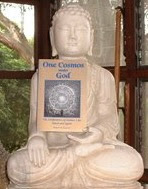
Here's a book on Genesis which we've sporadically referenced. The best thing about it may be the cover shot of the cosmos, because that's how I picture it -- like a dʘnut with a space of light in the center -- the vast space of the divine Nothing. It conveys the idea that God is at the center, and that the further from this center, the darker things get -- whether morally, ontologically, epistemologically, aesthetically, or politically.

And only man can see and understand what we just said, for "God speaks directly only to human creatures. The others [in Genesis] have no speech directed toward them at all." They are -- like all creatures -- spoken, but only man is both spoken and spoken-to.

Twice God addresses human beings as you, which he couldn't do if we didn't share an I with him. This I to I communication goes to our intimacy with the creator, with the creation, and with each other, for man

"is the speech-creature par excellence. This is the one to whom God has made a peculiarly intense commitment (by speaking) and to whom marvelous freedom has been granted (in responding)."

In a sense, freedom is founded upon our freedom to reject God. To put it conversely, if we couldn't reject God, then we wouldn't be free. Which means quite literally that the atheist can only thank God for his atheism. Again, if God doesn't exist, only He knows it. Sounds like a joke, but it is one of those statements we can know with absolute certainty. In order to rule out God, we'd obviously have to hear it from the source. Otherwise it's just a rumor.

Now that I'm thinking about it, could it be that the primordial catastrophe described in Genesis is really just a description of what happens when man becomes man? What I mean is that there is this (literally) infinite gap between all of creation -- including all its sublinguistic creatures -- and man.

Although there is of course continuity, there is also a kind of absolute wedge between us and the rest of creation. You could say that the ultimate wedge issue is Creator/creation, but the penultimate one (which is an analogue of the first) must be Man/world (since we always transcend the latter, even while being immanent in it).

The text describes this from a number of different angles, including language, law (only man is conditioned by a non-genetic Ought), relatedness (it is not good that we should be alone), knowledge (we get to name the other creatures, which implies knowledge of their forms or essences), awareness of evil (AKA the wily serpent), a nonlocal soul (which God blows into us), and the reciprocal freedom to blow him off in return.

Now, in a weird way, if not for man, then God is absent from the cosmos. In other words, only man can be conscious of God, i.e., render God present. "There is one way in which God is imaged in the world and only one: humanness!" There is a fine line, however, between this and idolatry. Man is analogous to the moon, which has only reflected light. But if we forget that, we can become lunatic moonbats and worship the wrong object.

But "God is not known through any cast or molten image. God is known peculiarly through this creature who exists in the realm of free history.... The contrast between fixed images which are prohibited and human image which is affirmed represents a striking proclamation about God and about humanness."

And it is surely a premonition of what is to come, i.e., the Incarnation, in which image and likeness are mutually illuminated in the same body. In order for this to happen it must first be possible for it to happen. Therefore, we might say that man is ultimately the possibility of God (in a manner of speaking).

Man has freedom and authority over the other creatures, but the first implies responsibility while the second implies truth. Thus, man ought to exercise power as God does, a "creative use of power which invites, evokes, and permits. There is nothing here of coercive or tyrannical power..."

And like Jesus, "the one who rules is the one who serves. Lordship means servanthood." How much you wanna bet Ben Carson would understand what was just said, whereas Barack Obama would regard it as a cow does a poem?

So, "The role of the human person is to see to it that the creation becomes fully the creation willed by God."

This whole perspective is cosmically revolutionary, such that it turns the cosmos bright-side up: "The text is revolutionary. It presents an inverted view of God, not as the one who reigns by fiat and remoteness [cf. Allah or the left], but the one who governs by gracious self-giving."

By the same toking, "It also presents an inverted view of humanness," because human beings "are not the chattel and servants of God [cf. Allah or the left], but the agents of God to whom much is given and from whom much is expected."

Friday, October 09, 2015

Freedom and Mystery: Rewordgitations of Perennial Grasping

Today is the first day of the new Friday format I just thought of. As you may or may not know, we have now passed the ten year mark in the blog's existence, and more to the point, there are almost 3,000 posts and probably millions of unexhumined words down there. So, I thought I'd exhume some of them and look at them in a new context.

The plan is to type a phrase or a few words into the search engine, see what pops up, and then skim the cream off the top. It reminds me of Schuon's Echoes of Perennial Wisdom, which extracts crystalline nuggets from his entire ouvre for our consideration. That little book is almost as aphoristic as Don Colacho. For example, here is the first echo: The worth of man lies in his consciousness of the Absolute... ute... ute... ute....

Boom! I believe that idea will come back to haunt us in some of the passages below. Of course I can't be as concise as those two luminaries; rather, I am somewhere between and beyond ecognomical and prolux, i.e. too little and too much.

So, here we go.

Either human existence is real or illusory. If real, then so too is our freedom real. In fact, as our Unknown Friend writes, freedom "is none other than the real and complete existence of a being created by God." In other words, to be "free" and "real" are synonymous terms from the spiritual point of view. For if you are not free, then you are determined by something else -- even just an extension of some other entity that is real, whether genes or class or God, it doesn't matter.

But what is freedom? Freedom implies a kind of (relatively) absolute wholeness, or center, which is a mirror of the Creator. Therefore, to illegitimately constrain or eliminate freedom is to do away with God. Again, no wonder the religiously irreligious zealots of the left are so adamantly opposed to freedom, and imagine that government can somehow create or "restore" it, when it can only respect or rescind it. --2008

Freedom must in some sense be synonymous with "real." The necessary cannot come into existence, because coming into existence is a transition from not existing to existing. Thus, the purely necessary doesn't really (or essentially) change at all, because it is always itself in a deterministic manner. Ice may look different, but it's really just frozen water. Furthermore, it doesn't have any choice in the matter so long as the temperature dips below 32˚.

But there are degrees of freedom and therefore of reality. Looked at this way, God would be the only completely real reality, as only God is not caused or conditioned by something else. But when he breathed a living spirit into Man, he exwholed a bit of his own unnarcissary being into us. Which is why we both partake of God's reality and can know of it.

If God were actually the direct cause of everything, that would again be just another way of saying that nothing really exists except for God. And predestination doesn't work for me, unless it is understood as our final, not efficient cause. In this sense we can understand the paradox that our purpose in life is to become what we "already" are; and how it is that in all of creation, humans, and only humans, can fail to accomplish this task (at least in this life).

Bolton points out that if God were the actual cause of our illusory acts of free will, "this would mean that God did not delegate any causal power to created beings. In this case, God would be the only real agent in existence, such that when wood, for instance, appeared to be burned by fire, it would really be burned by God, under the guise or veil of visible fire." Isn't this the position of the Mohammedans? Among other things, it completely obliterates the space of moral freedom and responsibility, does it not? For whatever happens, you can just plead that it was "God's will." Kill a Jew? "Wasn't me. The knife did it."

The point is, if we oversimplify God and see him as only transcendent or only immanent, various absurdities, or "intrinsic heresies," follow. Now, an intrinsic heresy is anything that I don't agree with. --2009

God or no God, Absolute or absolutely relative, O or Ø -- either way, man is uniquely privileged to speak of the highest things. The only question is: how high can One go?

Or, more to the point: how Lo does O go? For it makes no sense to affirm that God doesn't exist. Rather, a more honest statement would be that if God doesn't exist, humans could never know it, because man would have no reason to believe in any absolute, including absolute negation. With no Absolute, all is relative. Period.

By definition there can be only one Absolute, which, in my opinion, is the "sponsor," so to speak, of all the relative absolutes we use to negotiate our way through life.

It is similar to the idea that all numbers are simply multiples of one. Until one has the idea of "oneness" -- and note that it is a quality before it is a quantity -- one cannot proceed mathematically. Bion felt that the "discovery" of oneness was the single greatest leap of mankind, i.e., the idea that, for example, five rocks and five sticks share the abstract principle of fiveness.

But because there is only one Absolute it is not possible to map it, because as soon as one tries, one has created two. It is analogous to attempting to map, say, "music." On the one hand we have an abstract system of musical notation, and yet, all of the millions of melodies added together don't come close to exhausting the realm of music, which might as well be infinite. At best, we can dip into this realm of musical potential and channel its infinite possibilities in ways that are deep, interesting, and beautiful.

Might we say the same of God -- or, let us just say O, for to say "God" is already to project a lot of implicit preconceptions? In other words, what if religion, like music, is a way to translate what is otherwise unthinkable into something deep, interesting, and beautiful? Here is how Schuon describes it:

"Metaphysical Truth is both expressible and inexpressible." In fact, I would say that this is what distinguishes the exoterist from the esoterist, or the normotic personality from the transnormal Raccoon: the implicit belief on the part of the former that his particular expression fully expresses the inexpressible -- that his relativity is somehow absolute (which, of course, makes him God). --2011

Not the mystery "of" man, mind you, but the mystery that man is.

For the intrinsic relation between man and mystery is not "prepositional" but essential. This relation is deeper than language, as language too is predicated upon it. If there were no mystery, then there would be absolutely nothing to talk about and no one to hear it. You know the type.

The ultimate Mystery is customarily called God, but referred to here as O in order to preserve the Mystery.

As Rahner points out, the experience of this Mystery "is more primary than reflection and cannot be captured by reflection."

Indeed, man himself is the mirrorculous reflection of this prior Mystery, and the mysterious experience of oneself is also obviously deeper than reflection. It is the unfathomable Ocean upon which we float, AKA the Great Sea of the unThought Known.

Man is always Oriented to the Absolute Mystery. Here again you may need to respectfully forget about your seenill grammar and gravidad, because this is like no other familyar relation. "For we do not have an experience of God as we have of a tree, another person and other external realities," all of which "appear within the realm of our experience at a definite point in time and space" (Rahner).

Rahner makes the provocative point that it is impossible to imagine a future in which the human race could exist without the word "God."

As such, our atheist friends, by incessantly using the word for what they haven't experienced, halfunwittingly keep the experience alive.

The only alternative for the sincere atheist is to not just feebly hope the word will someday disappear from the human vocabulary, but "to contribute to its disappearance by keeping dead silence about it himself and not declaring himself an atheist." You know, don't just stand there saying something, but siddown and shaddup.

In order to pursue their impossible end, the atheists would need to be more like their fellow liberals, who are always trying to ban words in order to pretend that the unpleasant realities to which the words attach do not exist. But banishing the word "retard" doesn't mean you aren't one, only that you're the last to know.

So: "The mere fact that this word exists is worth thinking about," to put it mildly. For starters, as alluded to above, it's not like any other word, and yet, we still understand it, if "understand" isn't too misleading a term.

Which it no doubt is, because to understand God would be to be God. In other words, if God doesn't exist, only he knows it. And if he does exist, only man couldn't know it.

Even if we deicide that God is dead, we still need to reserve the name for what has died. But as soon as we do that, some mischievous rascal is going to start nosing around and redeuscover the empty tomb where the body is supposed to be buried. Game over. Or resumed, rather.

Nevertheless, if man were to effectively banish the word God from his Ocabulary, he would obviously still be immersed in mystery, except the mystery would "rot," so to speak, being deprived of all light and oxygen.

"The absolute death of the word 'God,'" writes Rahner, "would be the signal, no longer heard, by anyone, that man himself had died." Call it a signull. --2012

The trinocular Raccoon simply begins with God Is, or O. The rest is our problem. Unlike some of our competitors, we do not deploy reason to explore the mysteries of faith, but gnosis or intellection to explore the mysteries of Reason. --2010

Thursday, October 08, 2015

If God Doesn't Exist, Only He Knows It

Now, this is a refreshing blast from academia:

"In this paper, I take the position that a large portion of contemporary academic work is an appalling waste of human intelligence that cannot be justified under any mainstream normative ethics."

No. Really?

Our intelligentsia is like a huge drag on reality: think how rapidly we would progress without their dead weight.

True, the author's thesis is self-evident, but as Justice Holmes said, "It seems to me that at this time we need education in the obvious more than exploration of the obscure." That was then. In our time the situation is only worse. Think of it: intellectuals were already losing their grip on reality when he made that comment over a hundred years ago.

And when I say "intellectuals," I don't mean physicians, engineers, mathematicians, businessmen, etc., who all deal with a reality outside their own heads.

In contrast, intellectuals deal with ideas, and ever since Descartes came up with the idea that ideas about existence precede existence, intellectuals have been under the temptation to invert the cosmos and live in the comfort and safety of their own delusions. It is why they can have such difficulty learning, since they refuse to submit to, and be corrected by, that annoying other, the Real.

Obama is our first president totally devoted to this assbackwards metaphysic. It explains everything that has gone hideously sideways over the past 6.5 years, e.g., the economy, crime, foreign relations, the federal debt, healthcare, race relations, etc.

This is one of the things that divides left and right: the great majority of intellectuals are on the left, if only because of their dominance of (soft) academia. (Remember, "intellectual" is a neutral term, not a term of endearment; whether it is good or bad depends on the quality of the ideas. After all, even Paul Krugman and Noam Chomsky are intellectuals.)

While looking up that quote I found another relevant one: "The great act of faith is when man decides that he is not God."

Not that Holmes had all his intellectual ducks in a row. Far from it; he seems to be a good example of a brilliant man without the true center of God. And without that nonlocal attractor, thought can deviate all over the place. He was definitely suspicious of the Absolute, apparently failing to see that it is the necessary condition for any talk whatsoever of truth. Any truth is always an echo of God.

Thus, for example, he said that certitude is "generally an illusion" and (certainly?) "not the test of certainty." True, but that doesn't mean there is no valid certainty.

But then he comes close to the Truth when he says that through an understanding of "general aspects of the law" you may "connect your subject with the universe and catch an echo of the infinite, a glimpse of its unfathomable process, a hint of universal law." In other words, a deep insight into terrestrial law can provide a glimpse of the Celestial Law of which it is a penumbra. Oddly, he was not a believer in natural law, and yet, he covertly acknowledges it.

The Celestial Law? That is impossible to unambiguously express in human terms, but it is the perfect complementarity of divine Justice and Mercy.

It looks to me like Holmes was blundermind by his own brilliance. We've talked about this idea before -- that given a certain level of intelligence, there is no proposition you can't disprove to your own (dis)satisfaction, beginning with the existence of God. Thus, the good news: "the chief end of man is to frame general propositions." The bad news: "no general proposition is worth a damn." In the end, "we aim at the infinite and when our arrow falls to earth it is in flames."

That's the conclusion of a lifetime of reflection. This is a brilliant man, mind you. But it shows you what human brilliance can purchase with its own powers: it isn't worth a damn.

And that is a fact: without God, man isn't even worth a damn. How could he be? Unless we are related to the Absolute Value, then we are absolutely worthless. Holmes said so himself, that... can't find the exact quote, but something to the effect that it scarcely matters if the whole shithouse goes up in flames.

The real problem is that Holmes failed to follow through on his first heroic insight. Toward the end of his long life he wrote in a letter, "Young man, the secret of my success is that at an early age I discovered I was not God."

BingO! That is is a rock-bottom certitude, but you need to follow it all the way up. You don't petulantly conclude that "I am not God, therefore he doesn't exist," because this literally equates to "There is no God and I am He." In other words, you are stealing some of God's thundermind -- certitude -- in order to deny his enlightning -- truth.

There is a difference between thinking and truth. The purpose of thinking -- I know, who would have guessed? -- is to arrive at truth. Once you have seen the truth, then you can stop; or at least your thinking establishes a different vector: instead of going "forward" it drills down (or up).

Don Colacho has a number of relevant aphorisms, for example, The only pretension I have is that of not having written a linear book, but a concentric book.

In other words, he's always communicating from the top down or inside out. He is definitely not "searching" for truth; it is like the person who has found his beloved. Loving that person is not the same as searching for him or her, although one obviously doesn't possess the person. There is still a deepening of the relation.

In a related aphorism, he writes that Nothing is more superficial than intelligences that comprehend everything. This applies to the vulgar atheist, but to the left more generally, due to their blind respect for "intellectuals." But Man believes he is lost among facts, when he is only caught in a web of his own definitions. And boy, are liberals caught. Like this clown.

The atheist devotes himself less to proving that God does not exist than forbidding him to exist. The atheist -- and Holmes was an atheist -- is certain that God doesn't exist, but he promptly forgets about the source of certainty.

But as the Don says, man has two poles, and we needn't respect that muddled in between zone of "an animal with opinions" -- Darwinism, for example, which is the sine qua non of an animal with opinions. Granted, it is one step above gross materialism, which is a loudmouthed rock. But enough about Joe Biden.

One more aphorism: We believe in many things in which we do not believe we believe. Divine certitude, for example.

In Part I(B), I assess various theories of "the role of the intellectual," concluding that the only role for the intellectual is for the intellectual to cease to exist. In Part I(C), I assess the contemporary state of the academy, showing that, contrary to the theory advanced in Part I(B), many intellectuals insist on continuing to exist. In Part I(D), I propose a new path forward, whereby present-day intellectuals take on a useful social function by spreading truths that help to alleviate the crisis of suffering outlined in Part I(A).

I don't know what he concludes in Part I(D), but a good start would be for these useless intellectuals to learn from reality instead of projecting their visions onto it.

Tuesday, October 06, 2015

All Wet this Morning

Then God said, 'Let the waters under the heavens be gathered together into one place, and let the dry land appear'...

It seems that in the metaphysics of Genesis there are four quadrants, or realms, as it were: there is first the division of the upper (above the firmament) from the lower waters (below the firmament); only then are the lower waters gathered together such that the dry land appears. Since God calls the firmament Heaven, we have, in descending order: upper waters, heaven, lower waters (the seas), and dry land.

What could waters "above" heaven refer to? At first, before their division into upper and lower, God is hovering over them; they are dark and they are formless.

The creation of light goes to the first condition (darkness), the division into upper and lower to the second (formlessness). With light we have the possibility of vision ("the light of the body is the eye"), and with di-vision intelligibility (in other words, formlessness is the essence of unintelligibility).

The lower three worlds are spiritual, psychic, and material; or soul, mind and body; or nous, psyche and soma, respectively. What is the first, the "above heaven?" That must be the great beyond-being, i.e., the apophatic God we've heard so little about.

Now, we're just winging it here, but I see that Benoist identifies these three with verbum, lux, and vita, which, if my Latin is correct, are Word, Light, and Life.

Benoist goes on to say that the soul mediates between spirit and body; it is "the mediator between the higher and lower states of our being."

These three also sponsor three distinct forms of knowing, which are (starting with the lower), empirical-sensory, rational-imaginative, and noetic-intellection. The first two are relative, while the third approaches the absolute in an asymptotic way, i.e., always on the way without ever arriving.

Symbols -- such as the symbol of water -- act "as a bridge between the corporeal and the mental," giving us access to realities that are intelligible but immaterial: with them, it is as if we can have empirical knowledge of spiritual realities. Or just say the word can become enfleshed or the light in-formed.

One reason why these primordial symbols work is that nature is a reflection of heaven, rather than vice versa. In other words, oceans and light really do tell us something about the divine reality, since they are its reflections herebelow. Looked at this way, man is privileged to be the most adequate reflection of the divine person -- at least in potential.

In his Survey of Metaphysics and Esoterism, Schuon breaks it all down for us in non-mythopoetic language. In my view, the creation story of Genesis is a symbolic expression of these same truths. Thus, In the beginning,

"[I]t is necessary to start from the idea that the Supreme Reality is absolute, and that being absolute it is infinite."

Or in other words, in the beginning is God, the Absolute-Infinite. He is All Possibility, such that with God we can literally say that "all things are possible." In other words, for anything to undergo the formality of existing it must first be possible for it to exist: a thing's principle is prior to its actuality.

What is the Principle of God? I would say creativity, which entails a love of communicating it. Think of a genuine artist: why does he create? It must be for the pure joy of communicating d'light. As it pertains to God,

"[I]t is in the nature of the Good to wish to communicate itself: to say Good is to say radiation, projection, unfolding, gift of self." There is Principle and manifestation, or God and world, absolute and relative, heaven and earth, image and reflection, etc.

Now, consistent with what was said above about the upper and lower waters, "the celestial order includes... two 'degrees' of the Principle itself," which I identify as the apophatic and cataphatic God; the first is the "God beyond God," i.e., the Eckhartian God of whom Nothing can be said.

How to understand this important orthoparadox? I see it as analogous to man's own situation, in which our consciousness floats on an infinitely more vast ocean of trans- or supra-consciousness. You might say we are two-thirds water.

In reality, the two (solid ego and watery ground) are one, such that what we call the self is the residue of a process of the infinite-implicate order congealing into a local-explicate order -- the way in which the ocean throws its waves upon the shore, or the nonlocal sea of quantum energy tosses local particles out of its womb. It is actually a circular motion, such that

"In my flowing-out I entered creation" and "in my Breakthrough I re-enter God.... Just as God breaks through me, so do I break through God in return." And God is this "great underground river that no one can dam up and no one can stop" (Eckhart).

Monday, October 05, 2015

On the Third Day

We've been discussing the Ten Commandments of the left. Unlike the left, we don't like to reduce opposing ideas and opinions to motivations -- whether conscious or unconscious -- that would be denied by the person who holds them.

But just this morning I was thinking about some of the idiotic things I used to believe when I was a liberal, and wondering why I thought them. It couldn't have been because they were rational or factual. So, why did I believe them? What was the driving -- or organizing -- force?

Note that "driving" and "organizing" imply different vectors, the former a material or efficient cause, the latter a formal or final one. For example, a homosexual activist who is in denial of his own heterosexual trauma and conflict is in the "driven" category. Likewise the feminist who hates her femininity or the black liberal who denies feeling inferior about himself and blames white people.

What would be examples of formal or final organization? Here I think Sowell's "vision of the anointed" applies, because a vision is a top-down, future-to-present phenomenon. But visions can be functional -- say, the Empire of Liberty of the founders -- or dysfunctional -- e.g., Marxists, Islamists, MSNBseers, Obamyopics, and others along the blindness spectrum.

Importantly, either one can involve violence. For example, we violently imposed liberty on Japan and Germany, and that worked out pretty well. We also succeeded in Iraq, at least until Obama's superior vision got in the way.

Note how in the space of a year or so, Iraq turned from one of the "great success stories of the Obama administration" to a great failure of the Bush administration. It's hard to believe that this isn't a conscious and cynical manipulation on the part of Obama, but never doubt the power of visions. I see no evidence that Obama's vision is being altered one iota by all of the feedback telling him that the great global play date isn't going so well with no adults around.

"The first thing a man will do for his ideal is" -- get this -- "lie" (Schumpeter, in Sowell). But you -- by which I mean you, the Raccoon -- are not permitted to lie, not to others, and most especially to yourself. Therefore, you are under much more serious constraints than is the leftist, whose vision does not include the eighth or any other commandment, really, because if you are permitted to lie, then all commandments are negotiable or even meaningless, right?

Put conversely, if your first commandment is that there is no objective truth, then all things are permitted because there are no commandments.

This is not to say that a Raccoon never lies to himself, only that he doesn't boast about it, much less elevate it to a metaphysic. For it is written -- on p. 242 -- that man is a habitual liar who uses the left brain "to superficially 'patch up' discontinuities in being." As a result, "language is quick to explain way" the psychic holes and tears in our cosmic area rug, "creating factitious wholes and spinning a false continuity."

For just as in the quantum world, the psyche has continuous (right brain) and discontinuous (left brain) aspects. Psycho-pneumatic growth is the result of a harmonious relationship between the two. Our narrative is always being destabilized, but our task is to unify it at a higher level via psychic metabolism.

Think of how our Cosmic Mentor accomplished this in a quintessential manner. To all outward appearances his narrative was torn asunder that Friday. If he were honest with himself, any witness that day or the next would have had to say to himself: well, that didn't work out so well.

But on the Third Day, Jesus weaves the broken narrative into a higher unity, to put it mildly. Thus, the same honest witness who said that didn't work out so well now says, wo, didn't see that coming. He didn't see it coming because that was not his vision. His vision was shattered, and he was honest enough to recognize it, so when the new vision came along, he was able to see it.

But what if he were like Obama? First of all, Obama would have shared the vision of the Romans -- AKA the sufficiency of worldly power -- so the Crucifixion would have been the end of it: problem solved. No doubt he would have been awarded a Peace Prize for eliminating the menace. He certainly couldn't have foreseen the dissolution of the Roman Empire four centuries later, while the other little vision prevailed.

In any event, -- returning briefly to the Coonifesto -- "One cannot overestimate the importance of constructing a true autobiography, in which we are unified and balanced, not just in psychic space but in developmental time." For example, to the extent that the unconscious past is not remembered and integrated, "we will be haunted, rebuked, vexed, thwarted, and enticed by its its split off, subterranean promptings."

This is precisely how those Marxist dreams from Obama's worthless father have become the many nightmares for us, Obama's worthless subjects. If Obama could only have insight into his past, it would save us from his acting it out on the world stage -- call it a World Historical defense mechanism. Nor would he be the first megalomaniac to act out his petty conflicts on such a grand stage.

"We all begin the spiritual path with an abundance of alibis, self-flattery, justification, psychic holes and envelopes, temporal discontinuities, and spatial disconnections. In order to become one with reality we must first become one with ourselves," said a prior Bob.

But just to show you how a fellow can grow and adjust his own vision, I would now express it a little differently, and say that the person must become three with himselves.

Then God said, 'Let the waters under the heavens be gathered together into one place, and let the dry land appear'...

And if that reference is too obscure, here's a little hint: land is discontinuous while water is continuous. And the world is two thirds water...

Theme Song

Theme Song