Friday, May 29, 2015

The Cosmic Law & Disorder of the Left

A brief unscheduled snidetrip while my brain wakes up.

I was arrested by this observation at Happy Acres, to the effect that "A movement toward the Left, and ultimately toward despotism and collapse, is the 'normal course of history', in exactly the same way that the 'normal course' of a river is to run downhill."

Quite true. Axiomatic even. But why? Following the quote to its source, the author points out that "the phenomenon is even more general than either history or human nature: in conformance with the Second Law of Thermodynamics, it is in fact a manifestation of entropy -- of the wearing down of complex and specific structures, the destruction of the particular in favor of the general, and the relentless erosion of all of the gradients, distinctions, and disequilibria that are the only possible source of usable energy, and therefore useful work, in any system."

In short, the left is "an entropic historical force." And "any compromise with entropy is ultimately futile, because all such compromises are necessarily a unidirectional movement toward greater disorder" (ibid.).

Entropy explains the left. But what explains the right (or better, the ordered and creative liberty of conservative liberalism)?

As it so happens, this does converge upon our recent discussion of the "struggle for the true self," except that it is on a collective/political/civilizational scale. For if there is no attractor above or ahead, then chaos is the norm and order is just arbitrary, or oppressive, or meaningless. Which is pretty much what I believed when I was a leftist. It explains why the left can only destroy but not create.

This discussion takes me back to that enigmatic Russian Orthodox esoterist, Boris Mouravieff. The amazon page informs me that I purchased his book Gnosis Vol. One on March Forth! 2003. A lot of his writing is kooky, but a lot is orthoparadoxically sound. My recollection is that the three volumes become less sound -- or more occultish -- as they proceed, so the first is the best.

On page 3 he has a good description of the ordinary life of quiet entropy: "Man is so caught up in the toils of mechanical life that he has neither time to stop nor the power of attention needed to turn his mental vision upon himself. Man thus passes his days absorbed in external circumstances. The great machine that drags him along turns without stopping, and forbids him to stop under penalty of being crushed," such that "he quickly exhausts himself in the frantic race, impelled in a direction which in the end leads nowhere."

In that single paragraph he describes the absence of Slack (time theft) due to the power of the Conspiracy (the great machine), ending in Entropic Death (exhaustion leading nowhere). The result? "Life passes away from him almost unseen, swift as a ray of light, and man falls engulfed still absent from himself."

Now you know what inspired the obscure passage on pp. 257-258 that reads: So long. So short! Whoosh! there went your life (see footnote 33).

So, it's all connected in the cosmic area rug.

Should we fail to become ourselves, then naturally "life will be in effect a factitious existence," because if you're not you, who are you? Whose life are you living? "This state of things" is called "The Law of Chance, or The Law of Accident," and is "the principal law under whose authority he leads his illusory existence."

So, a lawless and disordered life that has no higher authority than transient impulses and desires is actually the most lawful life of all, except that it is the law of Chance, Accident, and Entropy. Which is why all those dysfunctional Democrat-run cities such as Baltimore are actually quite lawful. But instead of "law and order," they reflect "law and disorder."

Now, man does have different centers of consciousness, the question being which one will rule the roost, and how integrated they are. One can conceptualize these in different ways, but let's just call them intellect, emotion, and will; or mind, heart, and body.

We are not born with a harmonious synthesis of these three; to the contrary, the whole purpose of human development -- at least on the horizontal plane -- is to achieve their integration. As I also wrote in the book, we may judge the value of a culture in terms of how effectively it produces integrated and actualized human beings, the latter (actualization) largely depending upon the former (integration). In other words, it is difficult to actualize oneself in the absence of one self.

Sometimes we have to fall -- or be torn -- apart, in order to be properly put back together and reassembled in accordance with our higher clueprint.

For example, the self-satisfied entropic man will "live in the absurd and inconsequential, taking his desires and illusions for reality." Such a one is in desperate need of a kind of breakdown, or existential pimpslap; he must see his life for the meaningless null-de-slack that it is, and get out while he can. This is no doubt the principle behind Jesus's warnings to the wealthy and powerful caught up in their counterfeit versions of terrestrial slack.

Therefore, we must facilitate "a transformation of our factitious existence -- whose value is no more than potential -- into real existence."

Now, every lie is the dark penumbra of a factitious existence. And some people are lies, such that they veritably radiate darkness, as in the case of an Obama.

Truth is alive; it is a living thing, because its source and substance is Life Itself. Conversely, the Lie must partake of Death. This is the true meaning of the so-called "death culture," which is really founded upon a lie culture.

Here again, this is precisely what Jesus means with his crack about those who will be "persecuted for my sake." Yes, it is difficult to "love one's enemies." But bear in mind that telling them the truth is a way of loving them while irritating them at the same time, so perhaps not.

Importantly, the Lie doesn't just function in terms of its content, but rather, its very form. That is to say, the Lie is a way of achieving a kind of factitious continuity in the self. A narcissist such as Obama, for example, lives in a narrative in which he is so brilliant that he is always right about everything, and therefore entitled to appropriate our God-given Slack. That is an enviable psychic continuity, but obviously quite thin and brittle, and dependent upon millions of enablers to help prop up the fantasy.

Mouravieff describes what would happen if such a Lie were suddenly taken away: "Life would become impossible due to the shocks and conflicts which we would have to face." Here we see that the real function of lie is to serve as a buffer, "like the buffers of railway carriages which soften shocks."

So, Rule One in the adventure of consciousness is to stop lying, especially to yourself. Think about it: how can the lie get you anywhere except deeper into it? If, as Mouravieff says, the goal is "the march [forth] towards Consciousness," then it would be a contradiction in terms "to try to approach the truth while continuing to lie to ourselves or to believe in our own lies."

In short, the vertical march is a march toward truth, and vice versa. Conversely, lying is the satanic eucharist, such that when we eat it, it eats us, like in that Garden once upin a timeless.

I want to get back to the subject of the Law of the Left, which is entropy. Mouravieff calls it the General Law, whereas the Raccoon just calls it vertical gravity. Thankfully there is another law that opposes the General Law, or just call it the Great Attractor.

As we always say, man is situated between two vertical attractors; call them God and Satan if you like, but those terms might be too loaded.

For Mouravieff, "the Devil" is simply "the personalized moral aspect of the General Law"; he is the personification of a principle, so you needn't literally believe in satan so long as you see how he operates, which is via the broad way that leads to destruction and dissipation -- the abyss -- as opposed to the strait gate and narrow way that lead to Life and Truth -- the other Abyss.

What I really want to say is that time will indeed be entropic or cyclic at best unless we step in to prevent it. Hence the old adage that any institution that is not explicitly conservative will eventually drift toward the left.

Preventing this eventuality requires the ingression of truth into an otherwise vertically closed system. At the other extreme -- should truth be more or less completely rejected -- is a Flood or Holocaust of total destruction, which is where the left always leads us.

But as we all noah, at least those of us who survive the flood get a fresh start.

Mouravieff says that the "bipolar" structure of our intelligence exactly mirrors the structure of "the World," in that both are situated between what we call the two Attractors. The point is to lay up those upper vertical treasures that moths can't eat and thieves can't steal. The more we are bound to the lower, the less power we have, appearances to the contrary notwithstanding. Rather, "power means liberty," or freedom of vertical movement. Which is why the meek shall inherit the earth and blessed are the poor in spirit, and all that.

So, we got that going for us.

Thursday, May 28, 2015

Bob, Bobber, and Bobbest

Whether you are a religious believer or merely a faithful atheist, you have to admit that the structure of human existence is a little strange.

What I mean is, all living things have a telos, i.e., a mature form toward which their development is drawn, or at least might as well be.

I remember reading Sheldrake's A New Science of Life, on morphic resonance and formative causation, way back when it came out in the early 1980s. Something about his presentation struck (even) me as a little dodgy, but I don't see any way around the broader point that biology makes no sense at all in the absence of teleonomy, which essentially comes down to "future causation."

I see that the wiki article on teleonomy mentions Robert Rosen in the third paragraph, and it wasn't until his books fell into my lap that I felt I had a Coonworthy theoretical biologist to bring along on the bus.

Rosen may be saying some of the same things as Sheldrake, but since half the time I have no idea what he's talking about, it gives me confidence that he knows what he's talking about. In contrast, Sheldrake comes across as rather facile, and in the ensuing years has become downright Chopraesque.

Another rider we picked up along the way was the apparently obscure philosopher Errol Harris, whom we don't discuss much. He wrote a number of books, beginning with Revelation Through Reason, which were revelations to me at the time, but I have since then become more reasonable.

Let's inspect some of my Higher Marginalia in the latter book, shall we? "Life is the universe flowing through itself." That is literally true, because instead of traveling in a straight line, toward entropy and disorder, the universe somehow wraps around itself, creating a boundary through which energy and information pass. That's life.

A lot of this must have stuck with me, for example, "God's reality cannot be denied, as any such denial must rest on grounds which only God's reality can provide" (that may be a direct quote or my own formulation).

Here is another proof of God: "Every proposition is contingent, but in order for this to be so, there is one fact that must be asserted, and that is the existence of the completed system.... The perfected whole of knowledge and reality is, therefore, the necessary presupposition of all reasoning and all proof. The denial of its reality is self-refuting, such that without God's existence all rational discourse is undermined."

But we're getting a little far afield. Back to the weird structure of human existence. Just as every animal develops toward its mature form, human beings also mature toward theirs. The Big Difference is that this doesn't just take place in the key of matter -- i.e., our bodily form -- but is somehow transposed to the key of psyche.

In other words -- and I don't see how this can be denied, any more than biological teleonomy -- human beings develop towards their "true" (or at least truer) selves. That may not be the most felicitous terminology, but the main point is that we always live in a kind of dynamic and fruitful tension that reaches toward our better, or fuller, or more actualized selves: in my case, Bob, Bobber, and Bobbest.

Which is precisely Corbin's point, with all the angel business.

Because the first thing the curious primate wants to know is, "since this higher Bob is not yet here, where is he?" In other words, he surely "exists," but only in potential. But where is this "potential existence," and what is its ontological status? What about Bob?

For Corbin, this true self is our "angel." It is the source of our uniqueness, our individuality.

Again, it is indeed curious that, just as each human being has a distinctly recognizable face, we somehow possess a unique self, even if it is only in potential and generally stillborn. Much of the drama of history has involved creating political and economic conditions that will allow the self to be born and to flourish in this world.

This flaming article by Ann Coulter helps explain why this is so, as most cultures essentially function to either suppress individuality or allow only pathological versions of it. Liberals will no doubt call her "racist" for being so objective about these worthless cultures.

What happens to an animal if it is prevented from achieving its mature form? Another name for this is death, since the maturation process will take care of itself so long as something or someone doesn't prevent it.

Does something similar -- okay, identical -- occur with regard to psychological development, i.e., soul death, or zombiehood?

If zombies could vote, they would vote for someone like, I don't know, Barack Obama or Hillary Clinton, and that could never happen here, of all places, the Land of the Free and Home of the non-Zombies.

Rather than using the loaded term "angel," my preference is to simply use an unsaturated placeholder, or pneumaticon, for the angelic phenomena. The symbols I use came to me in about five minutes. Perhaps they look like it, but they have nevertheless done the job over the past ten or fifteen years, in this case (¶). When Corbin says "angel," I just think (¶), as in the following:

Each (¶) "is unique because it mirrors the potential individuality of the soul. It is a call to our individuality. Becoming yourself is a task. We are born with the potential to become who we truly are -- to engage in the struggle for the [¶] who is our celestial counterpart" (Cheetham).

I'll have more time tomorrow. To be continued...

Wednesday, May 27, 2015

Dreams and Delusions

The first thing that occurred to me upon hitting the publish button yesterday, was "what about the Constitution?"

Recall that we were speaking of the necessity of ambiguity in order to avoid turning words and texts into idols. Wouldn't the leftist enthusiastically respond, "Exactly so! Which is why we cannot allow ourselves to be imprisoned in the unambiguity of a bunch of 18th century empenised people of pallor."

First of all, the leftist pretends to find ambiguity where there is none, in order to disingenuously "discover" his preferences there, such as government bans on free speech and guns, or the right to a dead baby, or compulsory racial and gender discrimination, or the power to impose a new definition of the word "marriage."

More generally, what is the difference between deconstruction and Raccoonstruction?

First, we must inquire into where language comes from. From the scientistic perspective, it must in some sense be continuous with matter, and therefore come from below.

Conversely, in our logocentric perspective, language is essentially an emanation of God; it comes from above, which explains, for example, how it is able to so effortlessly embody and transmit truth and beauty.

Those latter capacities become inexplicable in the bottom-up view. But that doesn't stop the left, because with truth out of the way, they have the opening to project power and desire into language, turning it into a form of domination. The rest is politics.

Note the interesting trick: through deconstruction we slip through the bars of language, only to be recaptured by something worse.

In reality, ambiguity is only ambiguous with reference to the providentially unambiguous. Thus, the ambiguity of the constitution, for example, must be interpreted in light of its more unambiguous reason for being.

When we are confronted with an ambiguity in the text, it must be examined in the con-text of its overall purpose, or that toward which it is designed to converge upon, e.g., to secure God-given rights that are anterior to the state. The ambiguity cannot be used as a pretext to deny the very purpose of the text.

In reality, language does span the entire spectrum of reality; the leftist is half right in his belief that it proceeds from matter to mind, but all wrong in failing to see that this is only possible because of a prior involution from intelligence to matter, or from God on down. To promulgate the former while denying the latter is to saw off the limb one is sitting upon while bellowing incomprehensibly at the tree. You know, tenure.

Remember, language is symbolic, and a symbol is something "thrown across." Thus, a symbol is a link between worlds. As a result, there are two possible errors: one redounds to what Whitehead calls the fallacy of misplaced concreteness, such that language becomes its own end instead of pointing beyond itself; it is rendered closed to transcendence. The other error is to open it up, but only toward the lower vertical.

Corbin's whole project involves opening language to the upper vertical, so that it may restore its highest purpose of "translating messages from a divine source."

Now clearly -- for it is axiomatic -- language cannot contain what contains it. Language can never exhaustively describe the world, for which we may literally thank God, AKA our ultimate Container. As Cheetham says, "only a tiny fraction of reality is ever accounted for in any theory of anything." Nevertheless, an ideologue such as Obama does not live in reality, but rather, in his theory about it. Nice theory. Wrong species.

You could say that the leftist is able to achieve a level of psychic comfort by relaxing in the safety and security of his own delusions. Why then are they so congenitally unhappy and agitated? Thomas Sowell provides a clue (via Happy Acres): to spend your life replacing what works with what sounds good is a recipe for misery, because reality always has the last word (because it is the first Word).

Theories are fine and necessary things, but they are tools, not houses. They allow us to "see things," but can "blind us to everything else" if we enclose ourselves in one. "If it's a good and useful interpretation, then it is easy to take literally, and then it becomes hard to continue seeing in other ways. That is why it's important to keep that dreamlike hesitancy and ambiguity as our primary mode of awareness. Useful interpretations are like tools, and we need to remember to put them down" (Cheetham).

Only you can keep the Dream alive! Or kill it.

With regard to the latter, think of the function of art, which is always a kind of living dreamwork: "the nature of any artistic activity, if it's valuable, is a journey and is of value only in so far as the journey... goes somewhere, comes back and reports what it has found there. Art is the report of a place, not an idea about something" (Kelly, in Cheetham).

Most contemporary art, since it has been barred from the high road, comes back with reports of the lower vertical. Thus, it is not art properly so-called, but closer to proctology or composting or necrophilia. It is simultaneously not enough and too much information.

Cheetham references Emerson, who wrote that "all symbols are fluxional" and "all language is vehicular and transitive," such that its proper function is "as ferries and horses are, for conveyance, not as farms and houses are, for homestead."

Language can become frozen at one end or dissipated at the other, but it really needs to maintain a kind of fluidity and openness to what transcends us.

Only in this way can vertical murmurandoms annunciate themselves and be enfleshed in the womb of human language, and thereby illuminate the way up.

Tuesday, May 26, 2015

Seeing Through Atheism and Other Idols

As we mentioned a few posts back, an icon is the opposite of an idol: we look at the latter but through the former. Thus, we should never an idolator be, but always through an icon see.

See what?

"[O]ur quest," writes Cheetham, "is to recover the interior speech, the language of our deep self." Therefore, the last thing we want to do is turn words into idols and speech into idolatry.

Rather, language must remain transparent to its true object, so as to avoid ending in a brightly endarkened null-de-slack of unambiguous meaning.

When language becomes unambiguous, it is time to reach for your revolver. Among other enormities, you are about to be deprived of your vertical freedom, which is to say, your freedom to be who you are, which is freedom lived (or incarnated; freedom is the incarnation of the true self, just as the true self is the incarnation of freedom).

There are some exceptions to this rule, as in pure math or metaphysics, but even then math is transparent to beauty, while metaphysics is ultimately transparent to God; neither is simply an end in itself.

In his famous Apology, the mathematician G.H Hardy writes that "A mathematician, like a painter or a poet, is a maker of patterns," patterns made of ideas. These patterns "must be beautiful; the ideas, like the colours or words, must fit together in a harmonious way. Beauty is the first test: there is no permanent place in the world for ugly mathematics."

Note the surprising use (in a discussion of mathematics) of that word must: the patterns must be beautiful. Normally we think of mathematics as the Land of Must, of pure necessity (if not tautology).

But here Hardy is situating mathematics in the Higher Musticism of transcendent beauty. As such, he is not idolizing numbers, but properly icon-ilizing them. He sees right through their tricks.

All language is symbolic, meaning that it is a bridge between worlds. But the world itself is made of language, so one might say that religion as such is the symbolic link between heaven and earth, celestial and terrestrial, God and man, vertical and horizontal.

And if this pre-existing Logos actually becomes man, it means -- in a manner of speaking -- that God is "symbolizing" himself in man (just as we symbolize God via the man Jesus).

Or to paraphrase Schuon, Jesus is at once God's icon of man and our icon of God. In between is the space through which symbolic forms are tossed back and forth, or rather, clothe and channel the up-and-down energies.

"[T]he text of the world, and the soul itself" are "metaphors for the reality from which they derive. Meta-phor means to 'carry over,' and the metaphoric vision of reality sees through the literal appearance of things to the ever-shifting and mysterious Presence that lies behind the daylight Face of things" (Cheetham).

A face is a window on the soul; it is itself a manner of expression, the first symbolic evidence (in the form of the mothers's smile) of the interiority of the world.

Thus, the First Face is also a bridge between worlds, interior to interior and soul to soul. It ushers us into a "mode of perception" that is simultaneously a "mode of being," "a way of living that refuses the literal. It is how we can live the refusal of idolatry" and transform idols into icons.

The idol is a prison. For example, I mentioned a few months ago that when I first studied psychoanalysis, it was as if I were imprisoned or contained in an idol. It was depressing, because it was one of those confining null-de-slacks alluded to above.

One could say the same of Darwinism, or feminism, or any other modern intellectual pathology. Each one traps you in its idolatry and restricts vertical movement.

Cheetham links this problem to the widespread acquisition of literacy and its access to the text -- which is no doubt why the tenured are the biggest idolaters of all.

The text contributes to the illusion of a static, cutandry meaning, for which reason scientism and a certain type of Protestantism are mirror images of one another. Bibliolatry is no more or less literal than any scientistic idolatry (or any other ideology, which are really masturbatory idea-olatries).

This is not a new problem, only more widespread. For example, "Plato worried about what would happen when people started to read his words fixed on a page rather than think along with him in dialogue -- he feared that they would take his words 'literally.'"

There are Christians who believe in sola scriptura, which leads one to wonder how the first Christians learned about Christianity before the Bible was canonized 300 years after the death of Jesus. The New Testament is the deposit of their faith, not its first cause or ground source.

The good news about the Good News? The Book "recognize[s] this danger in various ways and provides hermeneutic techniques for keeping the mystery of the words alive" (ibid.). Which we will get into tomorrow.

Friday, May 22, 2015

Putting the ME into Memorial Day

I have a gnote to myself in the margin that proclaims "philosophy is autobiography." This conclusion follows from what we have been saying about knowledge and being, but it is something I realized back in graduate school while studying various psychological theorists and their theories. Which are theirs.

No, that's not redundant -- "theorists and their theories" -- because any psychological theory is going to be limited by the character its particular theorist. By way of analogy, imagine a theory of color by a colorblind theorist. Well, we're all colorblind in one way or another.

Recall Schuon's helpful schematization of our four unavoidable cosmic infirmities, ranging from the universal to the particular, found somewhere among these old posts.

The first is the Biggest, which is why it is enshrined in the First Commandment: sorry, but you are not God. You are "creature, not Creator, manifestation and not Principle or Being."

In fact, only the godless can be unaware of the fact that they are not God, which is probably the greatest source of their political mischief. As Obama might say, "there is no God, and I am he."

Two, we are not angels. We are not celestial beings but mid-vertical ones. We are not at the top of the hierarchy, nor are we at the bottom (unless we choose to fall even further than where we begin our begaialment).

Rather, we are somewhere in the middle -- which, of course, goes to the issue of free will, as we are suspended halfway between our better and worse selves. A saint is a man who has more or less succeeded in elevating himself (in accordance with grace, of course) to the border between middle and top, or time and eternity. Thus, he is like an angel on earth.

Third, I am me and you are you. We are different. Thank God! And I mean this literally, for our individual differences -- at least for the Christian -- are not accidental or purely contingent.

Rather, our differences are essential; paradoxically, our contingency -- which is to say our uniqueness and individuality -- is a kind of absolute in miniature. For those of you with more than one child, this is obvious. The differences are a blessing, not a curse. Or at least we can roll our eyes and concede that It Takes All Kinds. Every face is sui generis, and yet, an exemplar of the human family. We are all different to God, and yet, mankind is one.

Fourth are the differences that are not essential but contingent. These include relatively benign or silly cultural practices but also mind parasites, which mostly result from the scars of misbegotten relationships and assimilations along the way. They are "accidental infirmities" that cause a man to either sink beneath himself or become someone else entirely. The problem with a mind parasite is that it is not really you, but only pretending to be, thus a kind of primordial identity theft. It is a difference that is peripheral (i.e., from the earth plane or lower), not from celestial central, i.e., from the principial realm.

Hmm. There is some more fine insultainment in that post. Might as well toss it in for those who missed it the first time (albeit with some light editing):

Now, anyone can see the mischief and mayhem that result if we don't keep these categories straight. The leftist -- because he turns the cosmos upside down and inside out -- begins with infirmity #4, the wholly relative, accidental, and contingent, and then elevates it to his First Principle.

Again, this is why the Democratic party is the party of economic cranks, metaphysical weirdos, tenured mutants, celestial perverts, heterosex deniers, victim-powered losers, compulsive reactionaries, radical conformists, passive-aggressive control freaks, and MSNBC viewers. (It also attracts -- let's be fair -- a great many basically decent but just LoFo and easily manipulated folks.)

If you've followed me this far, then you will understand what Schuon means when he says that "Relativism engenders a spirit of rebellion and is at the same time its fruit. The spirit of rebellion, unlike holy anger, is not a passing state, nor is it directed at some worldly abuse; on the contrary it is a chronic malady directed toward Heaven and against everything that represents Heaven or is a reminder of it."

No kidding. The leftist is either in rebellion against God, and therefore human nature, or against human nature, and therefore God. Either way, he always confuses a prison break with solitary confinement. For eternity. Which is why he wants to force the rest of us to join him.

Once I start dipping into the arkive, I get all gnostalgic or something. It always brings back pleasant vertical memories -- speaking of Memorial Day.

This was a little fun at sometroll's expense:

"[W]hat is a bad man but a good man's teacher?" In our post about the cause of stupidity -- which is obviously intelligence, since the converse could never be true -- our stupid troll naturally takes exception to my certainty of this. Of note, he voices no objection to the actual content, only to my bobnoxious certitude.

This is odd for a couple of reasons. First, isn't it self-evident that whatever I say, I believe to be true? After all, I'm not a Clinton. But this is precisely the absurdity of the relativist: there is no truth, and that's the truth!

You know the old dada-actic gag, "this is not writing."

Second, no relativist actually believes his own BS, otherwise why get angry about someone else's BS? If relativism is true, then everything is just BS by another name, and power is all that counts. But you will have noticed that you never hear relativists say, for example, "there is no 'right' to abortion, for how could anyone be certain that a fetus is not a human being?"

Good times. We haven't had a troll in awhile, have we? I know they visit, but they no longer share their delusions with us.

Ah, now this is interesting. It actually goes to a comment yesterday by Mr. Lien, who wonders how, if understanding follows upon being, we can know that our own understanding is the right one: "I mean, how do you know which mode [of being] to choose? For many, it seems to be chosen for us. I suppose you can look around, stick your toe in the water, see if it resonates, and then dive in."

Here is how I presponded to that question six years ago:

... I am not attempting to innovate, nor to deviate from perennial truth and come up with my own system. Again, I am not L. Bob Gagdad.

Rather, I am simply attempting to convey the old truths in a new way. And not just a new way, but an utterly unique way, being that I am utterly unique (as is everyone else). This is how it is possible to simultaneously discover universal truth, even while discovering one's unique and particular self.

Do you see what I mean? Normally these two things -- universal and particular -- would stand at antipodes. But in the spiritual ascent, it is possible for the one to be a reflection of the other.

One might even go so far as to say that there is no universal, only individual instances of it. For example, there is no separate platonic ideal of a table, only actual instances of the ideal instantiated in all of the diverse tables. So there's no ideal, even though there is. Orthoparadox.

Thus, you know you're on the right track when both you and God simultaneously and increasingly come into view through the teloscape.

Continuing with this theme, I see that the next post from 4.25.12 attempts "to develop an objective definition of spiritual normality -- and therefore pathology." Let's find out what we came up with:

The purpose of metaphysics is to get beneath these accidents, precisely, and hence to a realm of true objectivity and therefore perennial truth (even though, at the same time, we must insist that existence, life, and intelligence especially represent a continuous reminder, or breakthrough, of the miraculous).

Now, what do we mean by objectivity? It must be a stance uncontaminated by contingency, passion, or perspective, for starters. There is contingent science -- or the science of contingency -- and there is the "science of the Absolute," which is none other than metaphysics.

Thus, objectivity begins with the soph-evident existence of the Absolute, which is what confers value and meaning upon human existence, which is to say, intelligence (for humans participate in the Incarnation of the logos, which is what it means to be "in the image of the Absolute").

You might say that humans are "subjectivized intelligence," in that there is surely evidence of objective intelligence in the cosmos prior to our arrival, e.g., DNA or the laws of physics. One needn't say "intelligent design." Rather, just intelligence will do the trick, so long as we know what intelligence is (i.e., a reflection of truth).

As Schuon points out, "Our intelligence is made for the Absolute, or it is nothing." What he means by this is that man's own intelligence demands a sufficient reason, and this reason is the Absolute. Remove the Absolute, and nothing makes sense, or can make sense, except in a wholly contingent and therefore senseless manner. This is why we insist: God or Nothing, TransCosmic Plenitude or Infrahuman Nihilism.

This same human intelligence "testifies irrecusably to a purely spiritual First Cause, to a Unity infinitely central but containing all things, to an Essence at once immanent and transcendent." Around these parts we simply call this O, AKA Unity Central.

Another helpful wise crack by Schuon: "To claim that knowledge as such can only be relative amounts to saying that human ignorance is absolute."

And if that crack provokes a guffah-ha! experience in you, you're well on the way to being cured of your existential infirmities.

More good stuff down there, but this post is probably already running long, so have a nice long weekend, and don't forget to remember the brave men who will have died in vain if Obama and the left have their way.

Thursday, May 21, 2015

Brickwalling the World

No time today for a proper post, so I'll get right to the point, if there is one.

There is an "the indissoluble link," according to Corbin, "between modes of understanding and modes of being." If so, then an "outer" world will follow upon an inner world.

To cite an example we've used in the past, a baseball game will look quite different to someone who understands the game as opposed to someone who doesn't. It's the same game, but the baseballically advanced person will be able to access much more depth, richness, complexity, and drama.

Clearly, life is just like baseball, except that it might even have more depth, richness, complexity, and drama.

And yet, there are millions of people -- like the imbecilic star of yesterday's post -- who prefer to manage this complexity by superimposing some off-the-rack ideology over it. Then the world "makes sense," but -- in another analogy we have used before -- it is like "brickwalling" a CD in the mastering process, which looks like the image at the bottom:

The music in all of its dynamic range is depicted above, but by hacking off the subtle highs and lows, the engineer can make it LOUDER so as to GRAB THE ATTENTION of people with no taste in music, which is to say, most people.

Similarly, Tyson-style scientism is a LOUD but crude representation of the world, aimed at people with no taste for Truth.

Continuing with Corbin, "Any change in the mode of understanding is necessarily concomitant with a change in the mode of being," such that "in order to understand a philosophical system or worldview, you need to adopt the mode of being of those who lived in that world" (Cheetham).

Therefore, becoming an atheist has nothing to do with "learning" anything about atheism per se.

Rather, any "knowledge" of atheism follows upon being one. There is no logical argument that necessarily leads to atheism, whether inductive or deductive, if only because one's first principles must always come from a source outside the closed circle of horizontal reasoning.

Or in other words, reason cannot furnish its own materials to work on. You must always start with being, even if you pretend otherwise.

In order for a world to exist -- say, Upper Tonga -- there must be "human persons willing and able to live in that world" (Cheetham). Here I am and there it is.

On the positive side, if citizens were to stop paying for the academic worlds of "queer theory" or "gender studies," those artificial worlds would cease to exist.

More generally, in order for Leftworld to go on existing at all, it is obviously necessary to create more inhabitants of Leftworld. There is no Leftworld without Leftoids.

Which has become the primary purpose of the university, excluding disciplines that actually require evidence as opposed to "commitment" or vengeful thinking.

It reminds me of another item yoinked from Happy Acres:

This is what the immigration "debate" is really all about: the left's need to bring new bodies into its world. The purpose is not merely to bring them into the physical space of the United States, but rather, into the subjective space of Leftworld, otherwise they would be the first to build a brick wall to keep them out.

One could say the same of public education and the liberal media: their purpose is not to inform but to induct.

One of the most alarming things about the Clinton campaign is that it is aimed only at the inhabitants of Leftworld -- cranky feminists, public employee unions, auto-victimized blacks, homosexuals, Hollywood, the MSM, ultra-wealthy do-gooders, etc. At least Obama pretended to speak to the wider world, but Clinton is convinced that her coalition of the deranged is sufficient to brickwall the rest of us.

Wednesday, May 20, 2015

You Can Learn a Lot from a Scientistic Imbecile

A random fragment of scientistic ignorance plucked from somewhere, probably either Happy Acres or American Digest:

There are scientific popularizers -- which is a noble and worthwhile endeavor -- and then there are scientistic popularizers, who are really just evangelists of a strange god.

For example, in the case of Tyson, he both inverts the cosmos and pulls it inside out, such that man becomes the container of That which contains him.

In other words, God is literally reduced to less than nothing, since he is simply "what scientists don't yet know." God is a circle surrounded by socially awkward MENSA members who have never kissed a girl.

With nothing else to do, it is only a matter of time before one of them illuminates the dark circle and becomes so famous that he finally gets a date.

I realize that not everyone has the time or inclination to think their ideas through to the end, but c'mon. Has Tyson really never heard of Gödel, whose theorems happily prove that no man will ever encircle or contain the truth which contains him?

In other words, any comprehensive theory begins with assumptions that cannot be proved by the theory, but must be taken on faith. Tyson, like anyone else, begins with faith but then halfassedly covers his tracks and calls it Certitude.

This actually plunges him beneath the realm of religion, in that at least the sophisticated religious believer acknowledges his faith up front. Furthermore, we also acknowledge an outside source instead of pretending to an omniscience that is unavailable to man.

That was just a brief asnide, but it does have some continuity with yesterday's post, because Tyson is precisely the kind of imbecile described at the end. Yes, we have some Bernanos again today:

"[T]he intellectual is so frequently an imbecile that we should always take him to be such until he has proved to us the contrary.... [He] is particularly at home in the modern world of technology and numbers, [because] in such a world he can climb to a very high position without giving away his half-culture.... [He] is informed about everything and hence condemned to understand nothing."

Ironically, Tyson only imagines that the Great Nothing has been (or will be) explained, when in reality it has simply been displaced to his intellectually vacant head and renamed omniscience.

Of course, he is not claiming personal omniscience per se, but he is using funds from a loan on future knowledge, i.e., the projected omniscience of science. Therefore, he is very much like the radical Calvinist who is assured of his own salvation. Like the latter, it is the ultimate Humble Brag, only on the plane of intellectual salvation.

Continuing with our daily Corbin, Bernanos (in Cheetham) goes on to say that technology is transforming man into "a sort of demonic inversion of the mystery of the Incarnation."

To back up a bit, if you fail to regard the Incarnation as a principle -- or at least an axiom or proposition -- then you're depriving yourself of a great deal. A principle is essentially a proposition which cannot not be -- i.e., we cannot think without it -- whereas an axiom would be more "a premise or starting point of reasoning."

The latter is a useful compromise between a fully operational Faith and something less. However, once you realize how spiritually and intellectually fruitful the axiom, you may find yourself elevating it to Principle, especially because it is difficult to comprehend how man could have come up with the principle of Incarnation on his own. Rather, limited to his own devices, man tends to come up with Tyson-level sophistry.

For example, the gratuitous principle of Incarnation explains how it is that man has access to ultimate truth to begin with. Note again that Tyson surely believes in ultimate truth, as per the statement above about science surrounding and conquering it.

But he just assumes man's ability to know it without ever explaining how a randomly evolved being may explain itself, or, more to the point, how radical contingency can even know of absoluteness, let alone attain it.

Therefore, Tyson literally transforms Incarnation to discarnation: the truth that is concretely and a priori present in, and available to, man, is vaulted into a realm of scientistic abstraction, which is precisely why we refer to these imbeciles as infertile eggheads.

It's all about the vertical fertility (AKA vertilization), isn't it? Here again, you can regard the Annunciation as a mythic formulation at one end, or a metaphysical Principle at the other, but either way, the truth is that the soul of man is analogous to a womb in which the Divine Seed is planted and grows.

Again, it is how all this absoluteness and eternity and infinity -- all this useless truth and beauty -- get in here. It is obviously not present in mere animals, or at least they have no conscious contact with it.

At risk of re-belaboring the obvious, it is surely present in Tyson, with his smug conflation of science and absolute truth.

Speaking of which, there is another principle at play here, and it goes to how one may know one is on the right track in the joyous pursuit of truth. That is, it always covaries with humility. Smugnitude, while no doubt pleasant in a certain narrow sense, is a hint from God that you need to go back to First Principles, because you've veered off track. In fact, you've committed Genesis 3 all over again.

As to principles which may sound mushy but are actually rock solid, we'll leave you with this:

"Benedict says... that 'integrated human development' involves a 'broadening [of] our concept of reason and its application. 'Intelligence and love are not in separate compartments: love is rich in intelligence and intelligence is full of love, and love must therefore inform the disciplines as a whole marked by unity and distinction" (in Cheetham).

Or in other words, scientific progress -- which involves the reduction of multiplicity to unity -- is only possible because the latter truly loves the former. Or as Blake put it, "Eternity is in love with the productions of time."

Tuesday, May 19, 2015

Memo to Credentialed Imbeciles: What You Know Is Who You Are

Or in other words, knowledge is constrained -- or liberated -- by being. This runs counter to the implicit cartesian metaphysic of the conspiracy, which starts by severing knowledge from being, and then superimposing the former on the latter, thus reducing our hyperspatial cosmic pneumagraph to a simplistic two-dimensional map they call a "college degree."

Then, What Is is conflated with what can unambiguously be said about it, such that quantity is elevated over quality and the interior horizon is squeezed out of the equation entirely.

The result is the sprawling but tedious ignorantia of the conspiracy -- the Kognitive Kansas of the left -- which permits any movement except up. Importantly, it not only permits downward flight, but truly requires it, as anyone who has attended college can verify: the only way out is down.

Indeed, being that tenured excrement obeys the law of gravity, coprophagia was hardly invented by Michelle Obama, but has long been on the menu at any public school. I even see it in my son's private Catholic school, but that shouldn't be surprising either, exhibit A being the pontiff himself.

According to Cheetham, Corbin "begins with a sweeping claim," but Corbin and I own the same broom. The claim is that -- and I'm paraphrasing here -- the "mode of presence" of the person defines and limits of what is potentially present to the person.

This means that in order to know something -- say, about God -- you first have to show up. Sounds reasonable, but we all know people who deny the existence of God but refuse to consult the map.

Corbin expresses it in a needlessly convoluted manner, for if you can't formulate Truth in such a way that a bright middle schooler can grasp it, the fault is yours: "being-there is essentially to be enacting a presence, enactment of that presence by which and for which meaning is revealed in the present. The modality of this human presence is thus to be revelatory, but in such a way that, in revealing the meaning, it reveals itself, and that which is revealed."

Sigh. What he really means to say is that meaning arises in the space between two presences, ours and God's. Meaning also arises in the horizontal, but only because it is a prolongation of the prior vertical relation. Deny the vertical and no meaning of any kind is possible.

It is a matter of cosmic orthodoxy that the cosmos itself is the "first revelation" of its Creator. However, this revelation is always in a complementary relation to our human presence. Thus -- and you could insert Polanyi's whole corpus here -- our world (including the scientific world) is always on the way to a deeper iteration of itself.

Have you gnosissed that the literal factsimians who stare vacantly at the world in a scientistic manner do the same thing -- and can't help doing the same thing -- with scripture? Scientism can't even touch the world, let alone its creator.

The wholeness of reality -- or of being -- is an antecedent and generally implicit experience. It cannot be deduced, nor can one add up the parts and call it a cosmos. Rather, our logocentric cosmos is prior to anything we can say about it, otherwise we couldn't say anything about anything, for words come from Word (as life from Life, mind from Mind, slack from Slack, etc.).

As Schindler describes it, this primordial experience "must be seen as open from the roots to the whole of reality, in terms not merely of the sum of things..., but also of the integrated relation among things that establishes them as an ordered whole and hence as a cosmos."

A key point is that "any essential aspect of experience that is ignored or left unaccounted for at the outset cannot simply be added later without risk of diminishing reality" (emphasis mine).

This is quintessentially true of the cartesianism that pushed modernity out of the starting gate. You can't bloody well begin by severing knowing from being and then hope to get them back together at the end. That's... imbecilic.

Looked at from our privileged vertical perch in Upper Tonga, we can see that postmodernity is an inevitable complication of modernity. Take the first step down that fork and you can stick it into yourself, because you're done.

Or in other words, if you do that, then you are an imbecile. Indeed, according to Georges Bernanos -- whom Dupree doesn't know but wants to have a playdate with -- "the intellectual is so frequently an imbecile that we should always take him to be such until he has proved to us the contrary."

This all-too-common type of tenured dweeb or hired pundit is "particularly at home in the modern world of technology and numbers," because "in such a world he can climb to a very high position without giving away his half-culture." He is "informed about everything and hence condemned to understand nothing."

You could say that these imbeciles are the very incarnation of discarnation, which is to say, abstract and desiccated (k) without the real presence of (n).

Monday, May 18, 2015

Soaring Down and Falling Up

To plagiaphrase someone, every generation faces a barbarian threat in the form of its own children. Therefore, Job One of civilization is to civilize these little barbarians, or it won't be a civilization for long. Rather, it will be the Arab-Muslim world, or Baltimore, or any other Democrat-controlled American city

At the same time, being that the line separating civilization runs through the human heart, each soul is the battleground.

But as we know, the left not only hates this idea, but defines itself in opposition to it: human beings are basically good, except for the evil conservatives who beg to differ -- which proves once again that contemporary leftists are indeed evolved from more primitive Manichees.

"Our western philosophy has been the theatre of what we may call the 'battle for the Soul of the World'" (Corbin, in Cheetham). And the S. of the W. is none other than "the Divine Presence, the Dwelling, Wisdom as Sophia, which has its place only in the world of the soul..."

Or in other words, the Soul of the World resides in the world of the soul. "Outside" the latter, the so-called exterior "world" is reduced to what Corbin calls an "absurd husk": literal, quantitative, flat, with neither depth nor interiority. The world becomes epistemologically clear at the price of its ontological closure.

Which is sad enough, but more problematically, the world (or our idea of the world) becomes an idol instead of an icon; we look at the former but through the latter. The chimpanzee manichees who ridicule the second Commandment are simply bereft of insight into their own primitive idolatry.

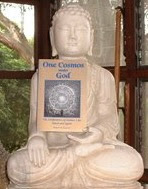
Yes -- or so we have heard from the Wise -- the world truly is One Cosmos Under God, but it doesn't amount to much unless someone realizes it. Pope Benedict (in Schindler) says that "God entrusted man, created in his image and likeness, the mission of unifying the cosmos."

But we can't do it on our own; rather, "We must live united to God in order to be united to ourselves and to the cosmos, giving the cosmos itself and humanity their proper forms."

So it's a big responsibility, and there are opposing forces everywhere. These are the forces of dis-integration, dispersal, and atomization, and without these antecedent forces, the left could get nowhere (or rather, couldn't get there). Something in people "retreats" from wholeness, and although it is a derivative and reactionary movement, it is still a kind of pathological power.

In the past we have called it loser power. One loser on his own can become a one-off sociopath or mass murderer or MSM journalist, but provide millions of them with the same object of resentment, envy, and hatred, and then you've got something.

If low-level politics is the organization of hatreds, then a community organizer is a guy who attains power by organizing and polishing the hatred into a fine point of blunt instrumentality.

Thus, no one should be surprised at Obama's dreadful performance as president. In his inverted soul, all of the hateful things he wishes to do to us are obstructed by the objects of his hatred -- which is why he hates us. It's how infantile omnipotence operates.

The "ungraspable Unity of the One God," writes Cheetham, "provides the possibility for" both our unification and our individuation. This is indeed what makes the Christian metaphysic (and apparently Corbin's type of Sufism) unique, in that, instead of being at odds with each other, unity and individuality covary.

In other words, with, say, Buddhism, you get the Unity but at the cost of the real individual self. The good news: you're enlightened! The bad news: you no longer exist. The operation was a success, but the patient died.

In reality, "The openness of the Personal God means that persons, even finite, limited ones, through their likeness to the Divinity are not things at all," but "unending determinations of the Plenitude of Beings" (ibid.).

And it is through the space of this "Unknown and Unknowable" attractor that man "falls upward in an unending series of theophanies" -- which is why, on this journey, the world is simultaneously the Same As It Ever Was and Different From How It's Ever Been.

Friday, May 15, 2015

God Becomes Prisoner So that Man May Escape

About that prison discussed at the end of yesterday's post: we might say that everybody's got one, and that each is different from the other. Just as we are unique, so too are our prison cells.

Now, ever since man has been one, he has been plotting his escape from the prison. In other words, there is a profound paradox at work here, as humanness is obviously in one sense a "liberation" from mere animality, but in another sense just a transfer from one prison to another.

What makes it paradoxical², however, is that animals do not know they are in prison, which equates to not being in prison at all. But man, who has the nicest and roomiest prison of all, is the most aware of his confinement.

There is also the issue of our imagination, which ensures that there is always a gulf between what we have and what we can imagine. If we fail to discipline this space, it becomes perhaps the greatest source of existential misery.

I read somewhere that even the poorest American is still in the top 1% compared to the world as a whole -- i.e., Africa, India, the non-Jewish Middle East, etc. But this does nothing to extinguish the envy that is both a cause and consequence of leftism, nor to weaken the leftism that is a cause and consequence of envy. The left stokes what it promises to ameliorate, but envy doesn't operate on the same plane as Government Cheese. Rather, placating envy only feeds envy, which is why the War On Poverty is an absolutely self-perpetuating swindle.

A few posts back we spoke of the Rupture, and we could say that, among other things, this rupture causes a breach in the prison walls, opening out to a "circle" with "a far larger circumference than that of agnostic philosophy: it includes the more-than-human," but "it is up to us, through our passion, to unveil it" (Corbin).

Now, I do not believe we can break through the walls without the Aid of Heaven. Indeed, I would agree with Schuon that the human station is already a Divine Escape Hatch in its very essence: it is a door or window where the animal is walled in by its own genetics or neurology or ideology.

This is quite similar to John Paul II's theology of the body, wherein even the human body itself is the Way Out and Up. As Ratzinger describes it, "The body in its physical structure as such bears a vision of reality." It discloses "a theology, which indeed implies an anthropology or, better, a metaphysics rooted in the personal" (in Schindler).

Looked at this way "nothing is 'merely biological'" on the divine/human/personal plane. Rather, biology itself becomes an expression of the prior Truth; the body "is never, after the manner of Descartes, simply physicalist 'stuff,'" but "a new way of being in the world, a distinct way of imaging God and love" (Schindler).

In other words, you might say that the human form is made for love, truth, and beauty. It is not as if we accidentally stumbled up into these realities, for such a thing could never occur randomly, rather, only via a Mighty Strange Attractor or Teloscape tugging at our heart- and headstrings from above.

Thus, the body is "made for" the other, both horizontally and vertically; it always "opens out," beyond itself. This is why I made (in the book) such a Big Deal out of the "premature birth" that renders us so completely dependent in early childhood. This primordial state of radical openness and dependence reveals the most essential thing about us.

Think about the alternatives. What if, like the baby lizards that are hatching in my yard, we were born into a state of basic independence: you crack through your shell and there is no mother or father to be seen. Rather, it's go-time. You're on your own. Go find your own bugs to eat.

What if the reptile were an icon of God? That would be a very different God, not the trinitarian, relational God of eternal giving-and-receiving. And again, the reptile is completely enclosed in his reptilian nature. He can neither move forward nor rise above, because he is already full of himself.

Which goes to Jesus' emphasis on the centrality of "spiritual poverty," which comes down to making a space for God. Here again, this space is already a kind of escape, which reminds me of something Schuon says about the nature of prayer: "The remembrance of God is at the same tome a forgetting of oneself; conversely, the ego is a kind of crystallization of forgetfulness of God."

Thus, an Obama-level narcissist literally worships at the altar of his own ego: being full of himself, he is void of God. There is no exodus from such a personal hell -- which is precisely what makes it hellish.

What the Raccoon calls the Rupture is what Jews call the Exodus. It doesn't matter what you call it, so long as the Light breaks in and the path is revealed: "The fundamental structure of Reality" is then seen to be a "form of Descent and Return," or fall-and-redemption, or Egypt-and-Israel, or death-and-resurrection. It is how the Slack gets into the conspiracy, or how God hides the hacksaw in the birthday cake.

Only through the Word can the cosmos be released from the world of literal matter, quantitative space, and historical time. Without this Presence the world is mute, faceless, collapsing forever downward to the level of object. With it, not just the human soul, but the world itself exists in a perpetual state of Resurrection. --Cheetham

Thursday, May 14, 2015

Anthropo-Cosmology or Something

Anthropo-cosmology. Or Cosmo-anthropology? Either way, it's what we've been doing here for the past ten years, trying to relate the one to the other in a way that actually makes sense.

There is the cosmos, AKA, the total order of interacting objects, events, and processes; and there is man, the most astonishing and unexpected fact within this cosmic order. Both are in need of explanation, but perhaps the same thing explains both.

In order to begin to comprehend the cosmos, we can't start with inanimate matter at the foundation, because doing so will exclude a priori matter's most important features, such as, I don't know, the capacity to suddenly COME ALIVE! and start thinking. Besides, matter cannot "contain" the cosmos, because it is the contained.

Therefore, my approach has always been to start with, say, me, and ask: just what kind of cosmos is necessary in order for this me to exist? And not just Me, as in the objective Me visible to the world, but the immaterial I whose boundaries disappear over the infinite subjective horizon.

How does subjectivity even get "into" the cosmos unless it has always been here? Furthermore, how does it gather itself into the concentrated and organized form of an individual self, each one being unique? Therefore, one's cosmology must also make room for this notion of "subjective uniqueness." In what kind of cosmos can such a weirdity occur?

The short answer: in a personal cosmos. We'll expand upon this as we proceed. But if we start with a foundation of Person rather than Matter, a lot of things start to make sense -- including Matter.

Now that I've had the chance to read and digest several books on Corbin, I think I can say that his supreme concerns were two: man and God. Most importantly, he wanted to know the latter without negating the former. Or in other words, he wanted to preserve the Absolute while elevating our own absolute individuality, or what the Raccoon calls our Holy Eccentricity or Sacred Weirdness. As Toots Mondello always said to new raccruits, Go weird or go home.

Clearly, what concerned Corbin about traditional religiosity was the danger of losing our individuality in God. I can appreciate that. Who hasn't developed a case of the Jesus Willies as a result of contact with some dogmatic religious robot? Nowadays they don't really bother me, but there was a time.

As we said a few posts back, our mission, should we choose to accept it, is "to make ourselves capable of God" (in Cheetham) -- with an equal emphasis on ourselves and on God. One of Corbin's books is called Alone with the Alone, and I'll go out on a limb and guess that this is what the title refers to: we want to know the one God, and God wants to know the one of us, so it's a win-win.

However, the whole adventure has a very different inflection if we speak of God as Trinity as opposed to monolith; or perhaps better, person, being that a person is both unique and related by definition. Therefore -- orthoparadoxically -- we are called upon to "imitate" God by being ourselves, i.e., individuals.

How can one simultaneously be "image" and one-of-a-kind? I would suggest that Jesus makes many otherwise inexplicable statements that go to this gnotion. Indeed, doesn't his whole mission involve being man and God? And not just some anonymous or mythic generalization of man, but a real, individual, flesh-and-blood, one-of-a-kind person. True, he is "everybody" (which is why everybody can "relate"), but he is also somebody. Have you ever met anyone like him?

Thus, as Cheetham explains, to become "capable" of God covaries with becoming "capable" of oneself. In other words, our unique personhood makes us a theophany of the personal God: "our most profound and essential function is theophanic: 'to manifest God'" and to be "the bearer of the Divinity."

Referring to our first paragraph above, we agree with Cheetham that this is "an anthropo-cosmology so grand in its conception, so all-encompassing in its vision that little in modern thought can rival it."

Or nothing, to be exact. Do you have something better, something equally intellectually satisfying and metaphysically thrilling? I'd like to hear it. In practice, all of the alternatives are either intellectually or spiritually crippling, and usually both.

"[A] scientific or rationalistic context for the events of the soul is insufficient at best and damaging at worst" (ibid.). Why? Because such "remedies" begin with the "implicit presumption that the prison in which the soul is trapped is the whole of reality."

In other words, they -- by which I mean the Conspiracy -- first place us in a prison, and then pretend to sell us the key. But in reality -- to paraphrase what I said on p. 182 -- these are really just fellow prisoners with their own dreams and delusions of escape.

Thus, philosophers wonder about the nature of the prison, while artists decorate its walls and scientists study the composition of its bars. Medicine secures a long life in prison, while the conventionally religious try to pray them bars away. But if I understand rightly, some eccentric individual actually broke into this prison in order to lift us out from above. Or in other words, there is a perimeter but no roof, so stop banging your head against the walls.

Wednesday, May 13, 2015

Where Did We Surf From and Where Are We Surfing To?

As mentioned at the bottom of yesterday's post, it makes more sense to me to regard our so-called celestial twin as a kind of vertical extension of the person.

In fact, by way of horizontal analogy, we could say the same of our embryonic self and our infant/child/adolescent/adult selves. It not only confuses the issue to see them as separate, but renders our existence absurd -- like Zeno's paradox applied to human development. (It is precisely this metaphysic that grounds the illogical belief that the fetus is somehow separate from his own personhood and telos.)

Also, as we have discussed in the past, although I believe we "have" an "unconscious," it is more accurate to say that personhood of its nature is necessarily constituted of conscious/unconscious, such that there is unconsciousness in every conscious thought or act, and vice versa.

We could never be "fully conscious" because there's simply not enough space in the ego or in the moment to contain it. As someone said, the purpose of time is so that everything doesn't happen at once.

Analogously, you might say that the purpose of the unconscious is so that everything isn't thought at once. In every moment there is a complementary dialectic between conscious and unconscious; the latter not only in-forms the former, but will lend it more or less "weight" or presence. It is one reason why no computer will ever simulate the person.

Now, hold that thought and apply it to the upper vertical: if there is an unconscious, there must be a supra-conscious, for it would be absurd to maintain that the human ego constitutes the very apex of the cosmic hierarchy. To appreciate how absurd this is, just ask yourself what was at the top before human beings arrived on the scene. Pigs? Al Sharpton?

In other words, to say there is a top is to have a frame of reference, whether explicit or implicit. As it so happens, human beings are at the top of the cosmic heap, but this is only meaningful in reference to God. Outside God, it is bad nonsense, for there can be no top, bottom, or in-between, just endless iterations of vacuity.

We have always liked the Rabbi's way of putting it: imagine "a vast arc, curving from the divine source to oneself, which corresponds to the question, Where do I come from? while at the same time a line curving from oneself to Him corresponds to the question, Where am I going?"

And within this great circle, which includes all the levels of man, each person can discover the special lines of his own direction -- which again, are not simply random points in reality but are the expressions of his individual personality, the shape of his soul (emphasis mine).

I couldn't have put it better mysoph, which is no doubt why it is the penultimate footgnote in the bʘʘk (p.266). After that is just... nothing. Nothing expressible, anyway.

Elsewhere the Rabbi speaks for me in suggesting that the soul is "not to be conceived as a certain defined essence, caged in a body, or even as a point or immaterial substance, but rather as a continuous line of spiritual being, stretching from the general source of all the souls to beyond the body of a specific person." This explains how it is that we can rise above ourselves and sink even beneath our inner Sharpton.

We each have a divine spark -- or spark of divinity -- and you might say that the higher regions have more spiritual oxygen to fuel the spark. Conversely, the further down we sink, the dimmer our light. That nasty smell in hell is probably a result of the smoke from all those lights being extinguished in the muck, like a cigarette in stale beer.

Remember, properly situated, the arc of the soul stretches all the way up to the divine source. But "the sinner is perished by the closing of the circle, by being brought into contact with the domain of evil he creates."

One thinks of Michelle Obama, who, no matter how much worldly privilege, is still confined within the circle of her own wretched hatred, and then blames people of pallor for putting her there. In reality, all she has to do to escape her self-imposed nightmare is to click her heels three times and say "there's no place like reality."

Our esteemed Wizard of Jews makes another important point that goes to what was said above about man either being at the top of the (manifest) hierarchy or a complete bupkis:

"To call a world higher signifies that it is more primary, more basic in terms of being close to a primal source of influence..." Thus, the human being is higher than other animals because closer to God, while animals are lower because closer to matter. This is why, for the materialist, man must be the most distant thing from reality.

Which he actually can be, but only because there is a higher reality from which he may fallllllll. Strictly speaking, there can be no "reality" for the materialist, only appearances, all the way downnnnnn.

Steinsaltz would say that what distinguishes man from the angels is that the latter are "fixed" in the hierarchy, whereas man alone has the freedom to ascend or descend higher or lower. Only man can actually ride the waves of the divine plenitude, for we are at "the focal point at which the plenty rising from the lower worlds and the plenty descending from the higher worlds meet and enter into some sort of relation with each other." Surf's up. Or down, depending.

Back to Corbin, who says something similar, and then I gotta get outta here:

"If the possibility of encountering the Angel, the Lord, is eliminated, the human individual has no longer any celestial pole, no orientation, and thus no direction for its moral compass and nothing to guarantee its unique being -- 'there will no longer be persons,' only units in a totalitarian or totalizing regime of one form or another....

"We are powerless, lost in anonymity, rolled along like the foam in a torrent, and completely at the mercy of the social, biological, and political environments. This is the Abyss, the final loss of the soul in bitterness and helplessness, knowing ourselves to be only objects in a world where, in Charles Darwin's famous phrase, 'there is no higher or lower.'"

The Age of Obama is like surfing in a pool of mud.

Tuesday, May 12, 2015

Angelic Beings: We Report, You Decide

Just for fun I checked out the Catechism to see if there is any possibility of reconciling Corbin's take on angelic beings with the minimum demands of sanity.

The bare existence of angels is not at issue, for "the witness of Scripture is as clear as the unanimity of Tradition." Rather, the question is, what do they do all day?

"Christ is the center of the angelic world. They are his angels," such that "he has made them messengers of his saving plan.... for the sake of those who are to obtain salvation." And "From infancy to death human life is surrounded by their watchful care and intercession."

As it pertains to Corbin, it is noteworthy that the Catechism teaches that "Beside each believer stands an angel as protector and shepherd leading him to life."

So, this is not too far from the idea that "Each human soul has a counterpart in Heaven, who is the eternal and perfected individuality of the soul" (Cheetham).

For Corbin, we have a kind of "dual structure that gives to each one a heavenly archetype or Angel, whose counterpart he is" (ibid.). (Reminds me of our bilateral cerebral hemispheres, only on a vertical spectrum.)

The more we are in contact with this transcendent self-other or other-self, the more real and more alive we are; conversely, the more alienated from it, the more life becomes a living death.

As such, "being a man is possible in many degrees, from being a demon with a human face to the sublime condition of being the Perfect Man."

This implies that we do not simply exist or not exist, but that existence has degrees of intensity. In turn, this "intensification of being is accomplished... through the struggle of the human person with and for the angel of its being."

The question is not "to be or not to be," but rather, to not be, to be somewhat, or to really be.

Note that this whole reality is eclipsed if we begin with the wrong cosmology. If we flatten the space of the vertical world, then "there is no way this contact with the Angel can occur."

It reminds me of what Jesus says about the Kingdom of Heaven being both at hand and within -- or right now, if not sooner, just over the subjective horizon.

In any event, "there is quite literally no way home in a world without the Place where this encounter can occur." To the extent that we forsake our celestial pole, we are reduced to an aimless life "in vagabondage and perdition."

The following sounds like something Schuon might say: "It may befall a soul to 'die'... by falling below itself, below its condition of a human soul: by actualizing in itself its bestial and demonic virtuality.

"This is its hell, the hell that it carries in itself -- just as bliss is its elevation above itself, the flowering of its angelic virtuality."

You can't kill your angel, but you can make his life pretty miserable: "It is not in the power of a human being to destroy his celestial Idea; but it is in his power to betray it, to separate himself from it."

Then, upon your death, it is apparently a little like going to court and trying to be your own attorney: such a person stands before the Judge, and for the first time comes "face-to-face" with "the abominable and demonic caricature of his 'I' delivered over to himself without a heavenly sponsor." Habeas crapus!

The Picture of Dorian Gray comes immediately to mind.

Then you babble to the Judge, "I can explain," and the Judge says "go right ahead, I've got all the time in the world."

You think you're putting yourself across pretty effectively, but then he calls your Angel to the witness stand.

(Concluding afterthought: I would prefer to say that we and our angels are not two, but rather one. They are just two complementary aspects of one being, not two different beings.)

Monday, May 11, 2015

Angelic Beings: Always in the Last Place You Look

When a human being is born-again-from-above, it follows that God is born-again-herebelow, since God will be known and expressed in a way that had previously been barred.

Cheetham calls this the "paradox of monotheism," but it's only paradoxical if we conceive of God as having no relations. If God has -- indeed, is -- relations, then every relation will be unique. Everything both IS and is WHAT it is because of this relation to the Absolutely Unique. Otherwise everything would be the same, as in multiculturalism.

For Corbin, the Holy Spirit is the "Angel of Individuation." Where things get a little weird is in his belief that each of us has a nonlocal celestial twin to whom we are attracted. You might say that this attraction, or the voyage from one to the other, constitutes the drama of our existence.

I have frequently written about this subject, except that I never thought of our true self as an Angelic Being. However, it doesn't really matter what you call it, so long as you recognize this gap between Who We Are and Who We Were Meant to Be, or between (•) and (¶).

Then again, this does raise the question of the ontological status of the latter. If it's not here, where is it? And how did it get there? And why is it so organized and so specific in its attractions, its abilities, its revulsions? Whatever the case, it is certainly as if we have a "double" or "eternal twin" toward whom we are "battling to return." Specifically,

"We are battling to unite with the Figure who completes our being..." It is as if we are forever "lagging behind" ourselves and trying to catch up. Thus "the earthly soul lives in nostalgia and anticipation, in exiled incompleteness, in longing and hope."

Or, you could just say that man is always proportioned to something transcending himself. Analogously, think of how any animal is always growing toward, or on the way to, its final mature form. The difference is that the animal or vegetable form can be attained on this side of eternity.

For man it is the same way, except that our "final form" is not to be fully realized in this world. Rather, it is always just over the subjective horizon, as we chase after our better half. What distinguishes man from the beasts is that we reach toward our nonlocal Form without ever grasping it.

However, according to Corbin, we do actually have the opportunity to meet our Celestial Twin. When we die.

Here I don't want to get bobbed down in Corbin's particular way of looking at this, but is it possible that he is conveying an essential truth that can be expressed in a more straightforward way? For it seems to me that when our soul is "weighed" on the occasion of our vertical autopsy, it cannot only be weighed on a universal scale that rigidly applies equally to everyone.

Rather, surely there must be some consideration given to who we are, and of what we were reasonably capable -- you know, to the way God made us. As one chap put it "to whom much is given, much is required."

There are also no doubt cultural considerations, for in some cultures it is easy to be good, whereas in others it is darn near impossible. For me, reading a book on theology is a joy. In the Soviet Union, or in Iran, or in China, it might get you killed.

For some reason, Corbin misses the whole christological angle in all of this. He seems to think that Christian orthodoxy obscures the truths he is trying to express, whereas I see it as the perfect expression thereof. That is, just because Christ is Objective Fact he is nevertheless known only via relationship, each relationship being unique because each person is.

Corbin even suggests that "the Supreme Being has an Angel," but I think this is another unnecessary I AMbellishment. As he puts it, the function of Angels is to "go out ahead" and "eternally manifest new horizons, open up new distances within Eternity itself."

The reason I think this is redundant is that the Trinity takes care of this issue in a more elegant way. The Trinity is forever surpassing itself because of its unending love-and-creativity.

As we mentioned a couple of posts back, this is the archetypal "timeless time" of which our "temporal time" is an image. God has a "past" and a "future," except that his past never degrades, his present is always perfect, and his future is just a novel perfection -- like an artist who never peaks out and never repeats himself. For God, it's one masterpiece after another.

Lest you be tempted to think that none of this sounds very orthodox, I've been reading another book by the theologian David Schindler, and much of what Corbin says can be translated into his more familiar idiom.

For example, "each being truly participates in [the] creational love of God, even as each does so in a way proportionate to its distinct way of being."

He quotes Ratzinger, who writes of "the inherent existential tendency of man, who is created in the image of God, to tend toward that which is in keeping with God.... If he does not hide from his own self, he comes to the insight: this is the goal toward which my whole being tends, this is where I want to go."

"Hiding from oneself" is like rejecting and cutting off relations with one's Angel.

The vertical recollection of our deeper self -- OM, now I remurmur! -- "is identical with the foundations of our existence, is the reason that mission is both possible and justified.... [M]y ego is the place where I must transcend myself most profoundly, the place where I am touched by my ultimate origin and goal."

To deny this is Genesis 3 all over again.

Friday, May 08, 2015

The Rupture

The following may be THE principle that divides left and right: "Each of us carries in himself the Image of his own world," projecting "it into a more or less coherent universe, which becomes the stage on which his destiny is played out" (Corbin, in Cheetham).

However, to the extent that we are not conscious of this process of projection, we are likely to experience this self-imposed world as having been imposed by others, or as something concrete and oppressive instead of being a stage of liberation and ascent. Life becomes a grim slog instead of a metaphysical joyride.

Obviously this can only truly apply in a free society, as there are places where one has no choice but to adapt to an imposed world, as in Saudi Arabia, Iran, or academia. At the same time, it is only in a free society that one can vividly see how so many people enclose themselves in various pseudo-realities.

For example, think of the millions of people who believe the "hands up don't shoot" narrative, or that "Bush lied about WMD," or that the 2008 crash was fundamentally caused by "corporate greed" instead of government policies. I mean, I'm as greedy as the next guy. How come I'm not rich?

These and similar worlds are pure projection, for which reason they are impervious to fact, because they are coherent (if narrow) worlds, not theories. They "make sense" to the person who lives in them, even if they cause pain. Or at least they provide a pseudo-explanation for the person's pain. As I said in a tweet, if those Baltimore rioters think they're angry now, wait until they find out they were abandoned by their fathers.

To recognize that we are the author of our own world is a revolution -- a big bang -- as consequential as the prior bangs into matter, life, and mind. But to re-emphasize, this does not in any way equate to subjectivism or relativism.

There is a Real World. It is just that, since each person is unique, so too is their world. It is very much like the idea that there is no such thing as a baby: likewise, there is no such thing as a world, only a world-human dyad.

As Cheetham explains, "philosophy, and indeed rational thought, only reaches its proper culmination in a 'rupture' of plane, a profound event of the soul in which the image of reality so carefully and reasonably established is seen finally to be a product of the soul -- the soul's own projection of its inmost reality."

It is not so much that we abandon the image as transcend it; or, instead of being contained by it, it is contained in us: "It turns the world inside out" (ibid.), such that Person truly becomes the final, unsurpassable, and uncontainable category.

This is what the Raccoon calls "vertical graduation." Conversely -- to paraphrase Don Colacho -- the horizontal world is a school one attends forever without ever obtaining a degree.

You could say that the further leftward one proceeds, the less likely one is to experience the Rupture. At the extreme left, the only possible rupture is Revolution, as in the French revolution, the communist revolution, the Iranian revolution, or the Hopenchange revolution. This is the collective-exteriorization of what is supposed to be an individual-interiorization.

This is what makes the American "revolution" so unique, for it wasn't a revolution at all, rather, the establishment of an "empire of liberty" through which each person was free to pursue his own personal rupture. The left has been trying to clamp down on it ever since.

I mean, look up there at the top of the blog. What does it say? That's right, THE RELIGION THE ALMIGHTY & ME WORKS OUT BETWIXT US. As such, there is no such thing as a Bob, only the GodBob hybrid. I can't tell you what's going to come out ahead of time, because there's another person involved.

Which maybe sounds... I frankly don't know how it sounds, but how could it be otherwise? No human relationship is predictable, nor can it be identical to any other.

What horizontaloids refer to as "the world" is actually contained in another world, a transcendent and immaterial world to which the soul has access. To be in the former world is to be more or less out of the real(er) world. However, the converse is not true, as the higher world contains the lower, just as biology contains physics, not vice versa.

Corbin would say that, to the extent that the higher world is lost, abandoned, or yoinked away from us, we will find ourselves gnostalgically longing for it. Could this be what that mess in Genesis 3 is all about? If it ain't, it'll do until the real mess gets here.

But to mess this up is to mess up the primordial unity of the world -- specifically, the dynamic and creative unity of vertical and horizontal. Then we start looking for the Lost Unity, or in other words, History. History is what happens when you're busy looking for the absent God.

When you reconnect with the missing God, history still happens, only on a higher plane and in a higher key. Again, this is the Rupture, and it works both ways. Christ, for example, is the Rupture of ruptures, crashing so hard into history that the damage is irreparable.

Then, as if that weren't enough, he crashes back out the other end, causing permanent damage to the annoying veil that separates man and God. Thanks to him, we have only to hang on to his coattails, through which we have our own unique relationship with this so-called Father person. Cheetham:

"God is the Unique because God singularizes each thing He touches -- He is unique in the sense that He makes each thing and each person unique." Or, if you want to turn it around, man's uniqueness -- his individual personhood -- is again only conceivable in light of the low & hibrid worked out betwixt this man and that God. This is the opposite of any oppressive, one-size-fits-Allah conceptualization.

Call it polymonotheism.

Thursday, May 07, 2015

On Making Oneself Capable of God

I am pleased to report that the book we've been discussing, All the World an Icon, cools off considerably at the halfway mark, and even goes astray into error and trivia. I don't have much use for Jung, who commits the fundamental blunder of psychologizing the religious. He's not as bad as Freud, who frankly pathologizes it, but he's still an unhelpful mishmash of tedious pedantry and profound error.

Schuon has some juicy things to say about this mischievous usurper in his Survey of Metaphysics and Esoterism. He doesn't call him out personally, but he writes that

"What we term 'psychological imposture' is the tendency to reduce everything to psychological factors and to call into question not only what is intellectual or spiritual -- the first being related to truth and the second to life in and by truth -- but also the human spirit as such and therewith its capacity of adequation and, still more evidently, its inward illimitation and transcendence."

In other words, to reduce spiritual and metaphysical Truth to psychological "truth" is only to undermine the very possibility of truth. The cosmic adventure is then reduced to a kind of pseudo-spiritual parlor game, only, like scientology, it will cost you a lot of money. Psychotherapy isn't cheap, let alone effective.

I remember back in the day -- back in grad school, to be more specific -- we had to complete 100 or so hours of personal psychotherapy. Being liberal in all things, including psychology, I chose a Jungian analyst, because Jung was clearly the most "out there" of the various respectable schools of psychology. Suffice it to say that the whole enterprise was simply outside my idiom. Meh. Like kissing your sister at a soccer game.

Schuon gets right to the point: "Psychoanalysis is at once an endpoint and a cause, as is always the case with profane ideologies, like materialism and evolutionism, of which it is really a logical and fatal ramification and a natural ally."

In other words, it is an absurd tautology, such that if it "works," it just encloses you in a new -ism or -ology, when the whole point is escape into the uncontainable, the wild godhead.

Nevertheless, the imposture "arrogates to itself functions that in reality are spiritual, and thus poses practically as a religion."

Boy and how. I got up to the threshold of formal post-doctoral training in the psychoanalytic seminary before pulling out and reorienting my focus. I don't know how to explain that rupture except in terms of a combination of grace and idiom. It would have been about 1991 that I decided to discontinue my grim climb up the ladder of the Conspiracy. It was 1995 that I made the conscious commitment to devote the rest of my life to finding God, at which point psychology became just a sideline to pay the bills.

Of course, psychology still has a critical role to play in the overall scheme of things, but as we've been saying in the last couple of posts, one doesn't make a home in it; rather, one finds a home for it in the Self. In particular, I still think that attachment theory and interpersonal neurobiology have critical roles to play in the arc of the human adventure. But they are bridges, not destinations.

To make psychology a destination is to suggest that there exists some sort of harmonious equilibrium for man on the horizontal plane, which is nonsense of the first rank, "as if there were no equilibriums made of insensibility or of perversion" (Schuon).

Rather, "Our human state itself is a disequilibrium, since we are existentially suspended between earthly contingencies and the inborn summons of the Absolute.... We are not amorphous substances, we are movements which are in principle ascensional; our happiness must be proprotioned to our total nature, on pain of lowering us to animality, for a happiness without God is precisely what man cannot withstand without becoming lost."

This is just another way of saying that we are situated between the two vertical attractors, O and Ø, and it is within this space that all the cosmic action takes place.

Something I Wish I Knew before I entered psychotherapy: "It is useless to seek to heal the soul without healing the spirit; what matters in the first place is to clear the intelligence of the errors perverting it, and thus create a foundation in view of the soul's return to equilibrium; not to just an equilibrium, but to the equilibrium whose principle the soul bears within itself."

This is why I would now say that -- for example -- a person who is proclaimed "psychologically healthy" but is a liberal is not healthy at all. Rather, liberalism itself is evidence of a soul-sickness. This no doubt sounds polemical to some, but to the extent that liberalism (and there are many other reasons) 1) denies the soul, 2) relativizes truth, and 3) exteriorizes personal responsibility, this by definition falls short of human health and its cognate, wholeness, for

"the great remedy for all our inward miseries is objectivity towards ourselves; and the source or starting point of this objectivity is situated above ourselves in God. That which is in God is for that reason mirrored in our own transpersonal center which is the pure Intellect; that is, the Truth that saves us is part of our most intimate and most real substance. Error, or impiety, is the refusal to be what one is."

This post has really deviated from its initial impulse. I just wanted to say that it is a relief that All the World an Icon goes south about midway through, because at least now it has a manageable horizon.

Back to our page-by-page cogitations. Consider this: Imagination in the higher sense is "an organ of perception," in the absence of which "the phenomena of religious experience are impossible." Corbin cites the example of the "burning bush," which, from the perspective of our terrestrial eyes, is just a brushfire. (Bear in mind what we said a few posts back about the miracle requiring a "human opening.")

This very much goes to a Big Problem with "fundamentalism," or better, literalism, since it really ends up being an imitation of the cognitive style of flatland scientism, for each equates appearances with reality. This is why it is so easy for the tenured to ridicule the conventionally religious, and for us to ridicule the conventionally tenured.

Here it is critical to distinguish between the imaginary and the imaginal, for the latter involves the crystallization or precipitate of a genuine encounter with a real but immaterial object (or subject-object). You could say that it is like a nonlocal eddy that forms amidst the mutual streaming of (↑) and (↓); this will become more clear as we proceed.

Another key point is that the Imagination is not just passive but creative. As Cheetham expresses it, "The exploration of the subtle realm requires participation between the human and the divine and is at once discovery and creation." Basic orthoparadox there.

This is a "third mode of knowing," involving the "double structure" alluded to above. You could call it the Double Helix of the vertical world. For you Scrabble players out there, Corbin calls it syzygy.

The main point is that there is an active gro-upperation between God and the soul -- or between O and (¶), to keep things unsaturated.

But to reemphasize, this is subjectivity without subjectivism (or psychologizing). Yes, "the mode of perception depends on the mode of being of the perceiver" (Cheetham), but this doesn't mean the perceived object isn't real.

Just as the baseball player makes himself capable of seeing the ball closer to its "source" in the pitcher's hand, "Our great task is 'to make ourselves capable of God,'" which goes back to what Schuon says above about our capacity for adequation. Not all are equally adequate to God, but all are more or less capable of being so, otherwise there would be no such things as spiritual growth or moral retards and reprobates.

Theme Song

Theme Song