Friday, March 20, 2015

Time on Steroids

The cosmos itself furnishes little points of reverence everywhere: "Suddenly, in the illumination of poetic light," objects in the external world may "become analogous to our deepest thoughts and emotions" (Taylor).

Which means that the exterior world is not exterior only, but that it radiates a kind of "inwardness." Likewise, our interior is not interior only, but is always prepared to discover itself in the outer world. It's what we do. It is why, for the elect, the world never loses that new car smell.

I am reminded of a fragrant passage by Schuon, in which he reflects upon how "the sacred mountain, seat of the Gods, is not found in space even though it is visible and tangible."

We could say the same of the sacred river, the enchanted forest, the Raccoon National Cemetery in Bismark, North Dakota, or any other holy ground: "it is as if the one who is present there had passed beyond space," and "finds himself virtually reintegrated" into its divine source (ibid.).

Thus, "Certain geographical accidents, such as lofty mountains, are connected through their natural symbolism with the great primordial sanctuaries," such that "For the man of the golden age to climb a mountain was in truth to approach the Principle; to watch a stream was to see universal Possibility at the same time as the flow of forms." But for modern man, "The gates of Heaven, mysteriously present in nature, close before him" (ibid.).

Schuon seems to have believed in a literal Golden Age, which he in turn opposed to the postlapsarian civilizational decay of the present. In other words, historical time for him is entropic and corrosive.

We, however, do not believe this; or rather, we do, except that this temporal catabolism is complemented by a negentropic and renewing flow of grace and other providential goodies. The former is of course compulsory, while the latter is (mostly) voluntary.

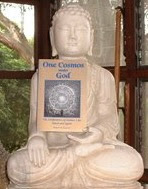
In other words, we cannot only swim against the worldly tide, but are assisted in doing so by helpful nonlocal operators. The story in this book would seem to be an example. I've never read it, but my invisible friend at Amazon recommends it to People Like Me.

So, there are still magic mountains and heavenly valleys, except that they have always really been soul-exteriorized or paradise-interiorized. I was about to say that you can always encounter them in fiction and poetry, but I suppose one can only encounter them there, i.e., in what we are calling poetic knowledge.

I might add that while recognizing the world as sacred is entirely valid as far as it goes, it goes farther than that. In other words, natural religion (or supernaturally natural, to be precise) is eventually prolonged (but not negated) by revealed religion.

I just randomly flipped open God and the Ways of Knowing, where it states that revelation proper "replaces the cyclical view of the world" with "a historical view in which time has a meaning" -- just as we said above about negentropic time. You could call it metabolic time, or time on steroids.

In this evolutionary view, time becomes a school, and like all schools, it has a beginning and (thankfully) an end. Only liberalism busses us into a tedious school from which it is impossible for anyone to graduate, forcing us to remain children forever.

The Divine Clueprint is not, in my opinion, any kind of mechanistic or linear program. It's not like a communist Five Year Plan or a liberal Bridge to the Future.

Nevertheless, it is a plan. And "it is fulfilled by progressive stages, the ages of the world, which are a divine course of instruction" (ibid.).

In this adult correspondence course -- in which time corresponds with eternity -- "there is the time of Advent, the preparation, which corresponds to the Old Testament and the choosing of Israel," followed by the Incarnation, the Resurrection, the outpouring of the Holy Spirit, etc.

Again, this is quite different from natural religion, in that we find out what this creator of nature is like: "Through these works, the living God reveals His methods of action, His customs. It is through these that we are able to know Him" as he is, rather than just through what he does.

Outta time and outta here...

Thursday, March 19, 2015

Points of Reverence for Mapping God

I have long contended that, just as there is an unconscious below, there is an unconscious above. It is not as if our ego-island merely floats on a sea of primordial unconsciousness, but rather, that it is like a bead situated on a vertical string, pulled in both directions. Nor is either direction "un" conscious; rather, the non-conscious just operates in the shadows, outside the spotlight of the the conscious self.

Moreover, like the Trinity, we cannot actually make cutandry divisions between the "parts" of our consciousness; while there are distinctions, ultimately we are one, an organismic whole. In fact, every conscious thought partakes of unconsciousness, and vice versa. Conscious / unconscious are complementary, not antagonistic. You can't have one without the other.

In health, anyway. You could say that psychological illness results when they are antagonistic, when, say, the unconscious is forcefully repressed, denied, or projected. This results in an overall diminution of consciousness, because you can't just toss out the bongwater without losing some of your bamba (again, since the mind cannot be divided that way).

So, one thing that makes me a very lonely psychologist is this idea that, just as we may have unconscious pain and conflict from below, we may have unconscious pain and conflict from above. Just as we may repress the "id," we may repress God. For Freud, the superego -- the conscience -- is ultimately just a transformation of id-aggression directed toward the ego. It is wholly learned, not innate. For example, if I regard rape as a bad thing, it is just because my own aggressive desire to rape has been turned toward myself. For Freud, this is the origin of guilt, i.e., self-rebuke.

Anyway, there is much in Poetic Knowledge that goes to vertical repression of the Above. In fact, spontaneous poetic knowing would be evidence of a smoothly functioning and integrated "supraconscious," for lack of a better term.

For example, Aquinas writes of how knowledge of God, since it cannot possibly be directly proportioned to the reason, must make use of "the symbolic poetic mode" in order to communicate its truth. Likewise, Schuon speaks of how revelation and theology contain "points of reference":

"We are here at the limit of the expressible; it is the fault of no one if within every enunciation of this kind there remain unanswerable questions.... [I]t is all too evident that wisdom cannot start from the intention of expressing the ineffable; but it intends to furnish points of reference which permit us to open ourselves to the ineffable to the extent possible, and according to what is foreseen by the Will of God" (emphasis mine).

This is a very helpful way of looking at things, because it takes us from the abstract to the experiential, and avoids pointless arguments about the literalness of scripture. Literal or not, scripture is of no use if it fails to resonate with the supraconscious, i.e., to provide points of reference necessary for thinking higher thoughts, or for transposing thought into a higher key.

Which is why the Raccoon calls them points of reverence.

The points of reverence are not the thing itself, but rather, point to the thing itself. They always implicitly point beyond themselves to that which they cannot explicitly express.

This is quintessentially true of the points of reverence we call revelation. One might say that revelation is not God, but God is revelation, at least in terms human beings can comprehend. The bibliolatrous doctrine of sola scriptura comes very close to denying this distinction, and thus the purpose of revelation.

Now, science too provides us with points of reference. And these are obviously legitimate so long as they are confined to their appropriate bounds. For clearly, even in the most perfect scientific theory imaginable there will still remain "unanswerable questions" that lay at the foot of the inexpressible and cannot breach the walls of the ineffable. Or just say Gödel.

Think about it: if God is a hyper-dimensional object, how would one go about mapping him in 3D? Isn't there a branch of mathematics that goes to this? There are relatively straightforward transformations, as in how a three-dimensional city may be plotted on a two-dimensional map. But God is of infinite dimensionality. Therefore, we could never map him on our own. Rather, he must provide the map, i.e., the points of reverence.

Which reminds me of a story E.F. Schumacher tells in Small is Beautiful. He was visiting the Soviet Union, standing outside an Orthodox church, looking at a map and trying to figure out where he was. But the church was nowhere to be seen on the map, because the God-denying authorities had removed it.

Now, how exactly is this different from public education, or academia? Let's say I'm on the university campus looking at God, but God is nowhere to be found in the syllabus. This is bound to be disorienting.

When I say "looking at God," I am of course referring to an experience of poetic knowledge. Maritain (in Taylor) speaks of a "musical unconscious" which is essentially identical to the poetic mode of knowing, in that it is "a way of seeing the world, seeing the significance of the superficial, what most would dismiss, ignore, or never notice." Through it, we open ourselves to the points of reverence that "[sound] a note from the external senses and [resonate] throughout the interior faculties..." This receptive act "effortlessly assembles impressions and spontaneously gives a spiritual knowledge of being, a kind of song of reality" (Taylor).

Just because God is unglishable, translogical, and mythsemantical, it hardly means there is "nothing there" for us to receive.

Rather, as Voegelin writes, "The truth of reality is not an ultimate piece of information given to an outside observer but reality itself becoming luminous in the events of experience and imaginative symbolization." These symbolic coordinates "give direction to the quest of truth," which is simultaneously inward, outward, upward, and onward.

Wednesday, March 18, 2015

If This Brain is Rockin', Don't Bother Knockin'

Time only for a brief evocation. You'll have to read between the lines and fill in the details.

Picking up where we ended yesterday -- which was with the affirmation that the "intellect (nous) is itself a revelation, just as revelation is a letter addressed to it."

Therefore, if we're going to be translogical, we would have to conclude that both revelation and intellect share a common substance: let's call it truth. This is really just transposing the Aristotelian view to a higher key. The fact that the soul may "know" means that "the faculties of knowledge and sensation are potentially these objects."

But since the soul cannot literally be identical to the object known, it must mean that the immaterial form is present in us, or that we are able to participate in its form. In the words of Aquinas (in Taylor), "the knowing being is naturally adapted to have also the form of some other thing."

You might say that human beings are adapted to adaptation, adequate to adequation, or conformed to conformation. Which is also why we are evolved to evolve, or to be child-like forever: neoteny rules.

This goes to the trinitarian basis of even the very possibility of knowing. You could say that we are able to get inside the known, or that the known is somehow in us, but either way, there is some heavy interpenetration going on, so if this brain is rockin', don't bother knockin'.

For Taylor, this goes to our poetic nature, in that "it is always the end of poetry to bring us sympathetically inside the experience of reality, always in search of union, fulfilling our innate desire to know."

Shifting gears for a moment, Bollas writes of how we "constantly engage objects crucial to [our] own self experiencing."

This implies a different sort of knowledge embedded in objects, knowledge of ourselves. Or rather, the form of the object resonates with our own form, making explicit what was implicit, or actualizing its latent potential. (And again, in psychoanalytic parlance, "object" includes subjects, i.e., relationships.)

But this management of objects "is part of a complex relation each of us has to ourself," such that "we inherit the tasks of our mothers and fathers." If our parents weren't very good at helping us discover our idiom, then it is likely that we will parent ourselves just as poorly: "The quality of any person's self experiencing will reflect the individual's skill in meeting idiom needs by securing evocatively nourishing objects" (ibid.).

Evocatively nourishing objects. Religion, it seems to me, is very much about contact with evocatively nourishing objects, at least if it works the way it is supposed to. As Bollas puts it, "Some objects (a book, a friend, a concert, a walk) release us into intense inner experiencings which somehow emphasize us" (emphasis mine).

It is as if these objects "lift us into some utterance of self available for deep knowing." While he's not talking about religion per se, this is obviously how religion works on an experiential basis: it "lifts us into some utterance of self available for deep knowing" -- and not available in any other way.

But of course, it is possible to block out this evocative area entirely, otherwise there would be no such thing as atheists. Likewise, it is possible to repress sexuality or any other dimension of the self.

More generally, "Some individuals are reluctant to live in the third area (the intermediate area of experience)..." They impose their own ideas on the vertical, and thus blunt its evocative and transformational possibilities.

I'm out of time this morning, so I'll just conclude by saying don't do that!

Tuesday, March 17, 2015

I Think I Sort of Disagree

Vanderleun has alerted me to a piece by David Warren called Flatman Rising. He's very forceful in his assertions, but are these assertions cosmically correct?

Warren begins with the entirely sound observation that we not only "live in flatworld," but that this has become "the ground condition for Enlightened man." Around here we call it Flatland, but it's the same idea. It is summed up by Don Colacho, who says that Modern man treats the universe like a lunatic treats an idiot, or like a liberal politician treats an MSM journalist.

Warren references the biologist Richard Lewontin, who rejects genetic determinism because -- it seems to me -- it undermines his religion, in his case, Marxism. Thus, he is a harsh critic of metaphysical and reductionist Darwinism, or -- as in the title of one of his books -- Biology as Ideology:

“Our willingness to accept scientific claims that are against common sense is the key to an understanding of the real struggle between science and the supernatural. We take the side of science in spite of the patent absurdity of some of its constructs [and] in spite of the tolerance of the scientific community for unsubstantiated just-so stories, because we have a prior commitment, a commitment to materialism."

True, but I too have a commitment to materialism. In fact, no one can be more committed to matter than the Christian, being that it is the temporal stage for the adventure of consciousness and drama of salvation.

But "commitment," of course, is a vertical category. The problem is a de-differentiation and re-fusion of vertical and horizontal. The vertical can never be negated, mind you. To even be conscious is to have transcended matter, but flatland scientism pretends to pull the subject(ive) into the object(ive) without remainder -- i.e., as if that has exhausted the need for any further explanation.

Lewontin continues: "It is not that the methods and institutions of science somehow compel us to accept a material explanation of the phenomenal world, but, on the contrary, that we are forced by our a priori adherence to material causes to create an apparatus of investigation and a set of concepts that produce material explanations, no matter how counter-intuitive, no matter how mystifying to the uninitiated. Moreover, that materialism is absolute, for we cannot allow a Divine Foot in the door.”

I'm not so sure about that. There is no problem in beginning with the material world. The only alternative is to begin in the ideational world, and thus take a wrong turn into the Great Modern Deviation that begins with Kant.

Note the real problem: modernity doesn't begin with an embrace of the material world, but rather, a rejection. No longer can we know the world, because all we can really know are the forms of our sensibility. So it's really a radical subjectivism masquerading as objectivity.

This latter is also the whole basis for the leftwing attack on science masquerading as a veneration of it. Nothing can be more subjective and relative than liberalism, so the idea that liberals "support science" is laughable. Rather, they use science, where it is convenient, to support their prior commitment to liberalism. What we call "materialism" is really pure verticality pretending to be horizontal.

The cosmically orthodox view is that knowledge indeed begins with the senses. This provides a sure foundation, but the purpose of a foundation is to build upon it.

Warren believes that most people have become unwitting votaries of an evolutionary materialism. This is a separate question. To me, it's a little like the debate over "climate change." Of course the climate is changing. That's what it does. However, it has no built-in direction, no final cause, no telos.

But it's very difficult, if not impossible, to understand the world in the absence of final causes. And if there are final causes, there is evolution toward these nonlocal attractors.

Evolve is derived from a word meaning unfold or unroll; according to Webster's, it means "to disclose by degrees to view," to disentangle, to develop. So, is the world evolving? This has nothing to do with Darwinism, mind you; or, to the extent that Darwinism has any truth to it, it would be because of this deeper context of cosmic disentangling and unfolding. Absent the latter, what we call Darwinism would be strictly impossible.

Warren is half-right in his rejection of evolutionary theologians who "think that God works through evolution." He reserves particular scorn for Teilhard de Chardin, "the ingenious Jesuit charlatan whose works had such a powerful hold on the minds of liberal churchmen around the time of Vatican II," and for whom "Church doctrine was necessarily 'evolving.'"

Truth, of course, does not evolve because it cannot evolve. But this doesn't mean we cannot evolve toward truth. In fact, I just read a completely orthodox book called God and the Ways of Knowing, that goes directly to this question. If man were not evolving, then it would have been possible for God to give the full revelation to the very first man -- or to Abraham -- but this is not how it worked in practice.

Rather, God's revelation (in the Christian view) is very much a matter of a successive unfolding -- limited by man's evolving ability to handle the truth, so to speak -- culminating in the revelation of the Trinity.

Jumping back for a moment to the blessings of our material foundation, Danielou says that "nothing is more dangerous than a religion that claims to have outdistanced reason," for "this can only lead to fanaticism, illuminism, obscurantism... lost in a jungle of superstition" (think only of the Islamists).

Remember, Christianity at its foundation is actually an empirical religion, for if there was no Incarnation then there is no Christianity. Likewise, if we cannot really know the world, then we cannot know Christ either, because we would again have only knowledge of our own neurology.

Here is another relevant passage from Danielou: God "possesses in Himself in a pre-eminent fashion both that which creates the value of mind and that which creates the value of matter. Christianity is not a spiritualism in the Platonic sense of the word, which identifies the divine with the sphere of spirit." Rather, it also has "a materialist aspect" which "is of great practical consequence" -- one consequence of which was the very development of science.

I am no uncritical fanboy of Teilhard, but I think it's unfair to say that he believed man creates Christ via evolution. Rather, my understanding -- and I could be wrong -- is that he sees Christ as the ultimate telos, the omega point that is drawing creation in his wake.

Looked at this way, Christ is not just Word-made-flesh but future-made-now, not just once, but always -- or "once and for all." God becomes man so that man might become God (or be divinized), as in the formulation of various Fathers. From our end this is a teleonomic process.

Warren claims that "God does not create through evolution, and could not possibly do so, for that would mean creating in time. God, who created time, cannot be confined (except by His own kenosis) within what He has created. Rather, God creates through time."

I would affirm rather the opposite, in that there is something of the nature of time in God, only in a supereminent manner. One reason I say this is that I don't see how man should be privileged to have something that God doesn't. To put God entirely on the eternal side of the time/eternity complementarity is to imagine a God who is unmoved and unmovable by anything that occurs in time, say, oh, suffering. Either God suffers with us or he doesn't. And if he does, he moves.

Indeed, I would go further and say that if God relates to us, then he is relative. As Hartshorne says, not only is God relative, but he is the most supereminently relative at all, in that he is the last word in compassion and empathy.

Is this not the deepest meaning of the Trinity, that it is irreducible relationship, such that relationship -- love -- is prior to substance? This is a perfection, not a limitation -- just as an unmovable human being would be far from perfect. And it seems to me that "divine time" (so to speak) is the endless perichoretic boogaloo; and that creative time is a kind of distant reflection of this in the herebelow.

Danielou looks at it in a complementary and orthoparadoxical way: it is fine to say that God is perfectly immobile so long as we immediately add that he is perfectly receptive! To quote one of the early Fathers, "He is stable and immobile, dwelling always in the same place, and yet mobile, since He radiates through all things." Complementarity.

The problem is that it is possible to affirm God so strongly that one negates man. But even God doesn't do this, or we wouldn't be here.

Just because becoming isn't everything, it doesn't follow that it is nothing. A pure "philosophy of the eternal" may end in "the negation of the value of time." There is a kind of divine omnipotence that renders man completely pointless, just a prolongation of God, with no freedom, no dignity, no meaning, and no adventure.

It is also a devaluation of our most precious divine gift, our intellect. What is it for, if not to understand? For Warren, "The very existence of this universe and of ourselves is a bottomless Mystery that cannot be 'solved.' Reason may worm about, and make its observations on our plane, but Revelation provides the only possible access to that vertical dimension."

Yes and no. Reason can actually reason all the way up to the threshold of God, affirming his existence without claiming to know what he's like. Nor do we have to check our intellect at God's door, because revelation is a prolongation of it, not a negation or radical disjunction. Indeed, intellect (i.e., the nous) is itself a revelation, just as revelation is a letter addressed to it.

Monday, March 16, 2015

The Purposeless-Driven Life

Those who wish to make a point of their lives don't remember the exhilaration of not having one, AKA holy infanity, in which life is its own point.

Or rather, life surely has a point. It's just that we don't concoct it, on pain of -- if you are intellectually honest -- immediately reducing it to pure cosmic pointlessness, since we and our dull point are necessarily finite, relative, and contingent. If there is an absolutely necessary point, then it must come from God, nor are we sharp enough to know it unless God lets us in on the secret.

The cosmos is a hierarchy, and there can be no hierarchy without a point. In fact, a hierarchy is defined by its point, toward which all its parts and levels are oriented. It is only because there is an absolute point that there can be relativity at all.

In other words, to say relative is to implicitly acknowledge the Point. The only metaphysical alternative is a kind of pure horizontality that equates to intellectual chaos, AKA unalloyed tenure.

Aren't you glad you aren't in charge of the Point? Here is precisely where we depart from the left, because they not only invent their own point -- which they are free to do -- but then exert all their efforts to impose this point on the rest of us. But what if -- I know, crazy idea -- my point is not Barack Obama's, or Hillary Clinton's, or Harry Reid's, point? I don't want to force my point on them. Beside, my point cannot be forced, rather, only freely accepted, since before I was, I AM.

If you're following me, I think you can see why liberalism is intrinsically hostile to God, since it is in competition with God for the Point of it all.

Eco (in Taylor) writes that "Aquinas was always conscious of the possibility of a pleasure which was pure and disinterested."

We could say the same of having a pure and disinterested point. Indeed, the less interested, the more pure. Think of math. The more interest we have in a certain numerical outcome, the less pure the math, as in government accounting. Math and science only advance if we are "passionately disinterested," so to speak, not invested in any particular outcome. Notice the passion of the global warmists, and how it perverts their findings!

Eco writes of how "Disinterested pleasure means pleasure which is its own end, which is not connected with the satisfaction of animal needs or with utility."

Hmm, what might that be? "An embryonic form of such pleasure already exists in play," which is "an activity whose end is its own fulfillment."

So, play has an end: itself. However, we need to distinguish this from simple objects that have their own end, say, a rock. If a rock is analogous to an atemporal, geometrical point, play is more of a rhythm and a spiral: a rhythmic spiral. It is of time, or better, time is of play. That's how the Hindoos think of it: lila, or the Divine Play. (Every lila son of adwaita is born of a voidgin. -- Petey)

Let's remember too Letter I of MoTT, the point of which is to learn concentration without effort and transform work into play so as to lighten those burdens & yokes.

Now, what is the opposite of play? That would be, er, work. Play should be spontaneous. When it is too planned, it becomes work -- like an office party, or Valentine's day. "Aristotle's principle of 'leisure preceding action' is reversed," so we are unable to approach things in a proper spirit of disinterest.

There is will and there is free will; it seems to me that the former is always interested and thus unfree. For example, an animal has will: the cat is interested in that mouse over there, and is willed to chase it.

But the cat cannot have a disinterested curiosity about the mouse. That requires freedom, slack, leisure, free will, which are precisely what the cat lacks.

But it is not as if play is free of passion. However, this passion is more in the mode of love: "The basic activity of the [free] will is love. Love is the passion of the intellect" (Conrad Baars, in Taylor). And "How different this 'loving will' is from the popular image of the will in general as the realm of high energy, exertion, and the powerhouse of 'getting things done'" (Taylor). Rather, it "rests in being rather than doing," such that -- fine quote here --

The loving will follows the wondering intellect which is open to the mystery of being (Baars).

This is what it means to wonder in the bewilderness, which we are all called upon to do in this semi-permanent state of in-betweenness, i.e., exodus. However, our bewonderment is always oriented to the Point that precedes us, without which we could never be lifted out of Groundhog Day.

Some people seem to have no sense of the day being a potential space. For the melancholic it is an unpunctuated temporality, one day no different from the next. [In contrast], The overly anxious person, perhaps feeling safe while in bed, views the day with trepidation: a hurdle to be leapt over before the next bedtime. --Christopher Bollas

Only playful orientation to the North Point keeps life from becoming a grim hurdle between two deathtimes

Friday, March 13, 2015

Any Idiot Can Pulverize a Statue, but It Takes a Real Genius to Create Ugly Art

How do we attain knowledge of something, anyway? How is it even possible? It is possible because "the soul recognize[s] in material objects a harmony identical with its own structure..." (Eco, in Taylor). But as we've been saying, it also works the other way around -- or in the other direction, rather.

That is, the objects of the world both illuminate, and are illuminated by, the soul. That's a very weird way to run a cosmos, but I wouldn't want to have it any other way, because I am convinced that this is an echo of the Trinity. You are free to call it something other than trinitarian if you like, but you must face the fact that knowledge is an endless perichoretic samba.

Perichoresis is pretty much my new favorite word -- lots of provocative stuff in the wiki article. Through a spontaneous series of clicks, I was just now led to an observation by theologian David Schindler:

"If you would understand yourself, open your mind to the Creator whose first gift to you is your existence. Then testify to what you see." That would be the ultimate instance -- or the very ground -- of recognizing the swirling harmony between being, existence, and knowledge.

Beauty can never be separated from this process. Taylor cites the example of a medieval village, which does not conform "to an imposed grid planned by a city engineer," but rather, to the "spontaneous impulse of builders in relation to the different sizes of the shops and houses.... along the rising and falling rural roads that yielded to the contours of the countryside..."

That brings back memories of Christopher Alexander. A memoir of the future to go along with Alexander's vertical recollection.

Such vertical re-cognition is "the genesis of aesthetic pleasure" (Eco). Moreover, it is "the connection between sense and intellect that precedes scientific knowledge." It is where we start our journey into world and self.

Both science and poetry begin in aesthetic arrest. Which can be taken in two ways, because some aesthetic sensibilities are more developmentally arrested than others, e.g., atheistic materialism, an ugly metaphysic to complement an unattractive soul. Beautiful souls -- expansive, open, fluid, grateful, bewondered -- spontaneously enquire elsewhy for their idiom.

But no matter how complicated you try to make things, It's always in the first place you look!

This is why, as Eco says, art may "simultaneously instruct and delight" -- except that I would say "must," since this is the sufficient reason of art. Unless you are one of those people who think the purpose of art is to produce things that are ugly and make us more stupid, e.g., a college dean or TV executive.

When I say that it's always in the first place we look, I think I mean this: that the cosmos is "a whole and living reality, significant and mysterious" (Taylor).

Note that this is the basis, the fundamental mindset, of the scientific attitude, for if the world weren't both significant and mysterious, why bother? And if the soul weren't equally significant and mysterious, why bother²?

If you really want to get to the bottamuvital, just say Creation: what is it, and how is it possible?

Again, who wants to create ugly? Doesn't ugly happen by itself? No, it takes a great deal of effort -- it's not as easy as pulverizing statues, for Modern man destroys more when he constructs than when he destroys (Don Colacho's aphorisms). It's much harder to be a performance artist than an Islamist barbarian. That's the work of an instant, whereas Madonna is the work of a lifetime.

It's orthoparadoxicality², in that so much beauty just happens by itself. Man has always recognized this: the moment there was a man, there was a soul noticing the beauty of the sky, the mountains, the sea, that cute girl over there. And The laws of biology alone do not have fingers delicate enough to fashion the beauty of a face (Don Colacho). But the wife can try to capture it with her delicate new camera:

Here's another one I like. The laws of biology alone do not have fingers delicate enough to fashion another Johnny Bench, but at least he can try:

More recent:

Thursday, March 12, 2015

You Must Be Dreaming!

Yes, it takes all kinds to make a world. But what if the world only permits one kind -- as on college campuses, or in the NFM (non-Fox media), or in the billion-strong Islamic Terristan? Then if you merely want to be yourself, you're SOL.

"The world is like a giant shopping mall," said Bob, unable to think of a less banal description. Some stores interest us, while others are almost invisible.

First, notice how this differs from all other animals, who have only particular interests that are hardwired into their brainframe. The proverbial one-eyed cat sniffs around the seafood store, while the bird dog just wants to take my baby away.

By the way -- and I'm sure I'm not the first one to think of this -- it occurred to me that one way to think about how Jesus could be fully God and fully man, is to compare it to how we are all animal and all man. Some tenured primates under the influence of 100 proof Darwinism think that just because we are all animal, this somehow fully explains our humanness. At the other end, some religious people think that just because we are human creatures, we can't really be animals.

But like Jesus, we have two natures in one person. A big difference, I suppose, is that these two natures can become fractured or perverted in man, so they don't function harmoniously. Indeed, one of the purposes of Christianity is to divinize our lower nature and bring it into harmony with the human. You might say that the animal must be crucified in order to be resurrected into something higher. As a matter of fact, I believe MoTT says something similar.

Bollas writes of our childhood "investiture of the world" with what Wordsworth calls the first Poetic spirit of our human life. Don't you remama that timeless time of infanity? I do, but not in any way that can be articulated with words. Rather, it is a felt reality, something prior to the words we use to describe it.

Indeed, "It is exceptionally difficult to capture the sense of place each of us feels within our world," the "dense textures of self experience that [bring] some known, but only marginally thinkable, recollection into being" (ibid.).

This is again the realm of Middle Earth that flourishes between the ponderable world and our own poetic sensibility. But that is where we always live: "We walk about in the metaphysical concrescence of our private idioms." Moving through this world "evokes states sponsored by the specific objects we encounter," such that "in a very particular sense, we live our life in our own private dreaming" (ibid.).

That might sound a little new-agey, but again, the work of creating a world takes place in the imaginative and resonant space of the In Between. This is one thing that leftists do not understand. In fact, their position is frankly incoherent, as they pretend to eliminate Middle Earth, reducing it at one end to a naive scientism, and dissolving it at the other into a deconstructionist tyranny of relativism.

For Bollas, "the human subject becomes the dream work of his own life," meaning that, just as in a dream, "we constantly endow objects with psychic meaning" and "walk amidst our own significance." But it's one thing to do this consciously and with insight, another thing entirely to imagine that everyone should or even can live in our particular worldspace. Strokes & folks. What is the American dream but the cosmic right to be different? And what is the leftist -- or Islamist -- nightmare but the obligation to be the same?

Here again, this is the repressive project of the left -- to shove everyone into their cramped little worldcage. But the human imagination always dwarfs any such confinement. It cannot be contained because it is the container.

The logocentric world is not made of objects or processes; rather it is made of language. The cosmos always speaks to man, for it is God's first revelation. But this is only the coondergarden. God successively reveals himself as man becomes increasingly capable of receiving and assimilating the message. The Arc of Salvation really begins with Creation; or, creation and salvation are not-two.

Danielou writes of how even our furriest of furbears found theirsoph "in a world which from its very beginning is a world of grace and sin" -- of vertical energies and alienation from them.

Danielou goes on to say that "an aptitude for religion is a human datum," which simply means that we have an innate idiom for it. We don't have to look for it. Rather, it will always find us, even if only with the objects of the world -- from the terrestrial landscape to the celestial skyscape. To paraphrase Danielou, these are like loans against future revelation. We can pay them back as God successivley reveals himself in the fullness of time.

Thus, there is "a word that God speaks to the whole earth though the visible world." Perhaps Joyce can shed some obscurity on the subject: if you are abcedminded to this claybook, what curios of signs in this allaphbed! Can you rede its world?

Well? Can you? Paul can, because "the invisible things of him, from the creation of the world, are clearly seen, being understood by the things that are made." Thus, "the whole cosmos takes on a symbolic dimension" (Danielou).

But again, that's not the end of the story, only the beginning. Subsequent revelations will occur in history and in man.

Or not, depending on the case. For, "what if I don't know which objects serve me? If I don't know, then my day" -- and my life -- "is likely to be a fraught or empty occasion" (Bollas). There are some people -- okay, many -- who "seem to have no sense of the day being a potential space."

Which the Raccoon calls "cosmopathology," in which case the mind is compelled to select idiomatic "objects that are congruent with unconscious illness," AKA mind parasites. In a free country, if you're looking for objects to reflect your soul sickness, you will have no difficulty finding them. For a drowsy man's dream is a wakeman's blightmare.

Wednesday, March 11, 2015

The Blest Things in Life are Invisible

So, I caught Nurse Ratched's press conference yesterday, and was struck by how much she really does remind me of Nurse Ratched. It's spooky. Between her and Obama, it's difficult to say who's the more irritating.

And yet, there are obviously people -- millions of them -- who not only don't find her irritating, but want her to be their Big Nurse.

Speaking of One Flew Over the Cuckoo's Nest, this reminds me of when McMurphy discovers that most of the other patients are there voluntarily. In other words, they choose to live under the tyrannical compassion of Nurse Hillary.

--Now, look... I'm voluntary here, see? I'm not committed. I don't have to stay here. I mean, I can go home anytime I want.

--You can go home anytime you want?

--That's it.

--You're bullshitting me! He's bullshitting me, right?

--No, Randall, he's telling you the truth. As a matter of fact, there are very few men here who are committed...

--Jesus, I mean, you guys do nothing but complain about how you can't stand it in this place, and then you haven't got the guts to walk out? What do you think you are, for Christ's sake? Crazy or something? Well, you're not. You're not! You're no crazier than the average asshole walking around on the streets.

--Those are very challenging observations you made, Randall. I'm sure some of the men would like to comment.

The subsequent scene is very much like yesterday's press conference except that instead of cigarets, Cheswick wants his emails (for they belong to us):

First of all, You sit down, Mr. Cheswick, and wait your turn. Go ahead, sit down! I want to first respond to this planted question about whether this phony scandal is really because Vagina.

--I would like to know about your emails. May we have your emails, please, Mrs. Clinton?

Eventually Cheswick decompensates in frustration, and all hell breaks loose: "Look, I don't want Jeb Bush's emails. And I don't want Bill Clinton's, or Colin Powell's, or John Kerry's, or Brian Williams'... Do you understand that? I want your emails, Mrs. Clinton!

Here's what I don't quite understand. Everyone who sees One Flew Over the Cuckoo's Nest presumably identifies with McMurphy. Can you imagine seeing the movie and rooting for Nurse Ratched to break his spirit?

Yet, in real life, the same people are liable to be rigid and tyrannical little Nurse Ratcheds. They're in charge of the asylum, but are crazier than the inmates. Does anyone out there think that Bill and Hillary are models of mental health? Or that they don't have a rather odd arrangement to go under the heading of "marriage"?

Speaking of films, I would bet there is a 100% correlation between people who support Hillary and people who identify with the snipees instead of The Sniper. Look at Michael Moore: his uncle was supposedly killed by a Nazi sniper, so snipers are immoral cowards!

Which is like saying my uncle was killed in a knife fight, so surgeons are sadistic butchers!

(Just to be clear, obviously not all Hillary supporters despise The Sniper, but all who despise him support Big Nurse Clinton -- or someone worse, e.g., Big Chief Warren.)

In any event, the above actually goes to what we've been discussing about idiom, because people support politicians who speak their interior language. George Washington resonates with my idiom. Likewise Abraham Lincoln or Ronald Reagan. Conversely, Obama speaks a foreign idiom, as does Hillary. There is no interior resonance whatsoever. They are irritating and unappealing in every way. They grate.

I suppose that's a good word for an environment in which you cannot discover your idiom: it grates. It goes against the psychic grain. It's intrinsically frustrating. If you're anything like me, it makes you wanna throttle somebody.

But we have to use our words. Which isn't exactly a fair fight, because they get to back up their unctuous words with the violence of the state. We can't tell the IRS: "I've gone through my records and provided you with the amount I owe. No, you cannot see my records because they belong to me."

Which we should be allowed to say, by the way. Among other things, a flat tax would restore our fourth amendment protection against involuntary colonoscopies.

Let me change the focus before she makes a maniac out of me.

Bollas writes of how "We each live amidst thousands of [idiomatic] objects that enlighten our world -- things that are not hallucinations," but whose "meaning resides in [an] 'intermediate space' or 'third area': the place where subject meets thing, to confer significance in the very moment that being is transformed by the object."

Therefore, the world -- a particular world, i.e., yours or mine -- exists in this intermediate space "between the subject's state of mind and the thing's character."

This goes very much to what we were saying a few weeks back about Interpersonal Neurobiology: that there is always the irreducible trinity of mind, brain, and relationships. The latter can never be "seen," but nor are they only in the brain or mind.

Rather, they are always in-between. In fact, I would say that they constitute in-betweenness as such. Because human beings are intrinsically relational, we live in this resonant intermediate space.

Interestingly, this whole way of thinking occupies a kind of third area between a completely uncritical realism and Kant's transcendental idealism. The former holds that we experience the world as it is, while the latter maintains that experience is essentially constrained by our innate categories of knowing.

However this Third Way combines both: that we do have access to the real world, but that we personalize the world via our own idiom. Think of two people watching the same baseball game, one who has a passion for the sport, the other knowing nothing about it. Obviously they will perceive very different things. And most of what the enthusiast perceives will be invisible, existing only in that third space.

Now, this is quintessentially true of religion. While we can all see, for example, a Catholic service, the real action is taking place in the intermediate space. More generally, the invisible action between God and man is relational and intersubjective. Revelation is revealed in this nonlocal third world, or not at all. You can ask for visible signs and wonders, but you still have to perceive their invisible significance.

To be continued...

Tuesday, March 10, 2015

Chaos and Control, Destiny and Fate: You Can't Plan for the Surprise of Your Life

It's amazing how subtle some of these dead old white men could be. Augustine, for example, writes that "'To use' is to put something at the disposal of the will, whereas 'to enjoy' is to use a thing with satisfaction, which is no longer a matter of hope but actual reality."

So, we willfully "use" a thing in the hope that it will actually satisfy us. Obviously, satisfaction is not something we can will -- even for people who have the means to will just about anything they want. Indeed, everybody tells me so: can't buy me love.

This, I think, goes to why happiness is wrapped up in surprise as opposed to planning. To plan for happiness is to attempt to appropriate satisfaction into the will, but that's just a hope, not an actuality.

And many people would rather hope for happiness than actually live it. Or, more to the point, they are presently unhappy, but live in the hope that, with the right plan, it will occur in the future. Which it never does. Unless it is in some surprising and unplanned way.

Real enjoyment seems to be a matter of love as opposed to will; love is a kind of self-offering or self-opening, while will is more of a crystalized intent. I'm not expressing that very clearly, but think of the difference between, say, the perpetually self-offering God of Christianity vs. the permanent willfulness of Allah. One is always giving, while the other is always doing. The former is a lover, the latter a q'ntrol fariq.

Which reminds me. It seems that Boko Haram has pledged its allegiance to ISIS:

I pledge allegiance to the mahdi of the Islamic State of Iraq; and to the caliphate for which it stands, one world, under sharia, with tyranny and sadism for all.

What is our fundamental problem with the Islamic state, and with Islam more generally? That they are indeed control freaks. Not only are no surprises permitted, but technically they are impossible, being that everything issues directly from the will of Allah.

This is at antipodes to Christian liberalism, which is rooted in liberty. The Christian God creates; the Muslim god compels. Is it possible to compel creativity? Not really. One can compel the circumstances for bringing it about -- i.e., self-discipline -- but it is an oxymoron to force a surprise. Sergeant Pepper was a surprise. All the groups thereafter who tried to squeeze out their own Sergeant Pepper just produced kitsch or krap.

Why did Christendom vault ahead of the rest of the world, while Islam in particular is mired in backwardness? Backwardness is actually hard, while progress is easy. How is that?

Well, think, for example, of how hard it was for the Soviet Union to control its citizens. Impossible, really. And yet, I remember reading of how Kruschev asked Nixon how the US produced enough bread to feed its people without someone at the top commanding it. In the US it is easy to feed -- and overfeed -- our people. How? By doing nothing. It happens by itself, so long as the state doesn't interfere. State interference causes bubbles, shortages, and distortions, as in housing, medicine, and college.

All of this goes directly to what we have been saying about idiom and the destiny drive, for the soul requires freedom in order to discover and actualize itself. It needs a range of potential objects, ideas, and relationships to select from, because everyone is different. We are even big enough to tolerate the presence of people to whom the Koran speaks. Which is just another way of saying that Christianity is expansive enough to contain Islam, whereas the converse is impossible. There is a reason why there can be no churches in Saudi Arabia (and no God in public schools).

"The soul recognize[s] in material objects a harmony identical with that of its own structure, and this recognition [is] the genesis of aesthetic pleasure" (Eco, in Taylor). Exactly. Bollas calls it the "erotics of being," so we're back to loving-as-knowing:

"Certain objects, like psychic 'keys,' open doors to unconsciously intense -- and rich -- experience in which we articulate the self that we are.... This selection constitutes the jouissance of the true self, a bliss released through the finding of specific objects that free idiom to its articulation.... such releasings are the erotics of being..."

Well, this morning got away from me. To be continued....

Monday, March 09, 2015

Monsters and Crosses

Aristotle once cracked that "one does not know the content of a desire unless one knows what ultimately satisfies it" (in Taylor).

This comes very close to what we mean by idiom, for just as satisfaction of a desire teaches us what we had implicitly wanted, the "destiny drive" teaches us who we are by selecting (or by being mysteriously attracted to) objects, experiences, and relationships which "materialize elements latent to [the] personality" (Bollas).

Aristotle wrote of how, "through repeated encounters with the world," experience transforms the particulars of the senses into the universals "that come to rest in the soul." Philosophy itself "lies in a broad circle about the loose space of wonder," such that this primordial wonderlust is the beginning and end of our journey. Thus, philosophy "is what it is before it can be termed knowledge" per se.

By the same token, we could say that we are who we are even before we are anyone in particular. As Bollas writes, the discovery and articulation of our idiom -- the destiny drive -- is "dependent on the environment's sensitive presentation of objects for such use."

By "environment" he means the human environment -- in particular, the parents whose job it is to figure out who this mysterious little person is and what he wants. You can't give the child "just anything" -- or in other words, treat him anonymously -- unless you want to attenuate his destiny drive and make it more complicated for him to become who he is.

Or, parents can try to implant a false destiny, which is something I see a lot of these days. Living as I do on the white trash side of the border to some mega-affluent areas (e.g., Malibu), every child has been pre-selected to attend an elite university, so grades and homework and achievement are absurdly important even in elementary school -- as if the most important point of childhood isn't to freaking have one.

I can't recall it being this way when I was a kit. Nowadays there is such an absurd mystique associated with college, which one would think couldn't have survived the experience of having actually attended one of these graveyards of curiosity. In other words, one can imagine how my father, who had an 8th grade education (back when it meant something), might have been overawed by the prospect of Higher Education.

But most boomers attended college and then some. Do they really believe it "educated" them? Or that they obtained something there that cannot be obtained elsewhere for much less money? Please. Don't confuse the Destiny Drive with the Conspiracy. That's elementary.

This is interesting: Aristotle says that while knowledge of a thing "requires possession of it," "we are not in possession of a thing until we love it."

So, you might say that love is the thing -- or the Thing prior to the thing -- for he means the "delight and desire given to this initial act of knowing," all the way up to the last toppermost of the papamost act of knowing, i.e., the beatific vision, or contemplation of God.

Why indeed is there such a thing as "the pleasures of the mind?" Why this soul-delight?

Normally we think of the hedonist as someone who simply indulges the pleasures and passions of the body. I would suggest that so long as pleasure is confined to that cramped dimension, it is prima facie evidence of a failed destiny drive; or in other words, the drive has misfired, or is maybe compensating for what has been lost "above" by pursuing what is below.

It occurs to me that this is the opposite of how Freud characterizes it. For him, pursuit of the higher is simply a sublimation of lower drives. It is a defense mechanism, a pale substitute for what we really want, which is basically food, sex, and status among the primates.

Now, there was a time that I couldn't help believing that, or at least entertaining it. After all, I was in graduate school, learning psychology from the proper authorities. To paraphrase the famous bumpkin-sticker: Freud said it, I believe it, and that settles it. I don't want to oversimplify it, but nevertheless, not a single one of my professors spoke of the soul, or of God, or of the spiritual life.

I went through maybe six months in the "Freudian mode," so to speak. Looking back on it, I can't really say whether it was the cause or consequence of a depression, but depressing it was. How could it not be? Everything I have ever done or will do is just a self-deceiving transformation of primitive instincts?

I didn't intend for this post to get all personal, but perhaps it is instructive, for that depression speaks to a Destiny Drive Fail. Here I am, in the place I am supposed to be -- or where the Conspiracy wants me to be -- and I am not happy.

But you know the old line: more tears are shed over answered prayers. Which is another way of saying thank God for pain, which is ultimately another way of saying thank God for the Cross! I've been thinking about that last one for the past week or two... How to put it...

It started with an episode of the Journey Home on EWTN. The guest was talking about how when everything was going well for him in life, it tended to swell his narcissism and grandiosity, and thus alienate him from the Cross. Conversely, his "afflictions," so to speak, brought him back down to earth and closer to God.

I think something similar happens to me. Now, let's extrapolate this to an extreme case. Let's take someone who actually does succeed in becoming a Prince of this world. Would he not be a narcissistic monster? Is one of the salutary purposes of the Cross to prevent Monsters? Otherwise, why flash it before vampires and such? And why does the anti-Christian world produce so many monsters?

That was a short paragraph, but it strikes me as loaded with meaning, with things to chew on.

So chew on. It always takes me about six months to get used to Daylight Savings Time, so I slept late and now have to get ready for work...

Friday, March 06, 2015

The Economics of Interior and Exterior Poverty

Here's one for the Glass Bead Game: what does idiom -- the unthought language of the self -- have to do with economics?

This question occurred to me while reading this piece on the Peruvian economist Hernando de Soto. The question occurred because I immediately recognized the implicit answer. Even now I haven't explicated it -- that's what the post is for -- and yet, I know the answer is there.

In fact, this is a kind of mini-example of idiom in action, or at least an analogous variant of it. It all has to do with recognition -- or re-cognition -- which is "the identification of something as having been previously seen, heard, or known."

Except that I hadn't previously cognized the connection, at least consciously. But the orthoparadoxical term "unthought known" precisely goes to this process of unconscious re-cognition. While it might sound annoying or cute -- like some overworked wordplay the B'ob might force into existence -- it's really the perfect way of expressing it: something we know in our bones but haven't consciously innertained in skulldom. You could call it the realm of the bone-known, but I think you'd agree that Bollas' term is preferable.

Let's start with a question; in fact, Shem's "first riddle of the universe,"-- "dictited to of all his little brothron and sweestureens,"-- "asking, when is a man not a man?" The winner gets "little present from the past."

Give up? "Shem himself, the doctator, took the cake, the correct solution being — all give it up? -- when he is a... Sham."

So, are you a sham or are you the real deal? And how would you know the difference?

Reality is usually thought of as what is outside ourselves. But we couldn't know that reality unless there were something equally real on the inside.

Let's discuss de Soto's view of economic reality; he speaks of how "the Third World's poorest are relegated -- banished from their nations' official economies to what he has called 'the grubby basement of the precapitalist world.'" Now, why are they so banished to this psychopneumatic backwater? Because of "a lack of enforceable property rights."

Now let's go back to idiom, that is, the private language of the self. How is this language spoken? Largely through objects in the external world. You might say that culture is the collective sum total of "psychicized" objects for personal expression.

In other words, culture is in one sense "out there," i.e., exterior to the self. And yet, cultural objects have only the meaning we lend them. If I were to drop you in, say, Saudi Arabia, or interior China, or UC Berkeley, there would be very few objects there -- a very limited vocabulary -- for the expression of your idiom. You would be unable to find -- forbidden from finding -- the objects to express your unique idiom.

Not only that -- and this is a key point -- but your idiom wouldn't even be yours. Rather, with no strictly private property, what's yours really belongs to the state, plus the state puts sharp limits on personal expression anyway.

To take an obvious example, suppose you were an artist working in the Soviet Union or in Nazi Germany. If so, your idiom would have been restricted to socialist realism or classical kitsch. In Germany, for example "modern art was [seen as] an act of aesthetic violence by the Jews against the German spirit." And only Hitler decided "who, in matters of culture, thought and acted like a Jew."

Thus the tyranny of aesthetic correctness, which is ultimately enforced by the absence of any inviolably private property, right down to the first property, which is your soul.

As our fathers told us, certain truths are soph-evident to anyman to the right of the left, that we are endowed by our Creator with the liberty to discover and appropriate our own idiom; and that this right co-arises with -- for it cannot be actualized in its absence -- the right to property.

Looked at this way, "private property" is a kind of language, the idiomatic language of the self. You want what you want, and I want what I want. Liberals hate this idea, because they want you to want only what they want. They want to restrict idiomatic expression to their own idiom.

Or just say PC, which is really a pre-emptive attack on personal idiom, on our cosmic right -- and for Raccoons, our coonstitutional duty -- to be different. Have you ever watched MSNBC? The reason why it is a failure is that it is so dreadfully boring, frankly as boring and didactic as Soviet or Nazi art.

To paraphrase George Carlin, my stuff is your junk, and your junk is my stuff. In other words, stuff I like -- objects that speak to my idiom -- might just be a collection of junk to you, like my shelf full of vintage Barbies.

But on an even deeper level, this is the source of the energy of the private economy: I will give you this for that because I want that more than I do this. Simple as.

Which is not so simple in practice, and can even get you killed in most parts of the world. de Soto himself survived the bombing of his office by socialist terrorists in 1992. As Fox Butterfield might say, "Economist Targeted for Assassination by Leftists Despite Helping Lift Millions from Poverty."

One thinker -- who uses his words instead of bombs to express his idiom -- praises de Soto "for demonstrating how property rights -- often disparaged by left-leaning intellectuals as an instrument of the privileged -- help the poor:

"He has helped explain to convincible [heh] readers how radically egalitarian the rule of law and property rights are. Plutocrats, strongmen -- they have their muscle. They can take what they choose in lawless situations. But the poor and weak are protected by the rule of law and property rights."

So the krugmaniacal Obama, that phony Shampion of the Poor, has spent the last six years undermining the very thing that relieves poverty, both exterior and interior. If he had his way, the whole world would be as financially and intellectually impoverished as MSNBC.

Thursday, March 05, 2015

A Daze of Future Past

This idea of idiom -- of certain eerily specific aesthetic objects "speaking" to us in an unfamiliarly familiar way -- seems to have spoken to the idiom of the audience. In other words, this line of thought about interior resonance seems to be resonating with your interior(s), so we'll continue the investigation.

Several people spoke of this very blog speaking to their idiom. One -- and you are not aloon -- didn't even understand it at first, and yet, was ineluctably drawn into the One Cosmos web.

This is interesting, because it highlights the element of "vertical recollection." In other words, the exterior object resonates with some interior reality, or form, or archetype, that has been "forgotten," as it were. Yes, paradise has been lost, but perhaps in the same way that our idiom has been forgotten. It is a mythic way of describing a psychic reality.

But that's only an analogy, because chances are you were never consciously aware of it, so it couldn't have been literally forgotten. But it is buried, and the problem is that life can pile more dirt on it and bury it more deeply.

Or better, as Schuon has expressed it, it is as if there is either a thick sheet of ice or that our consciousness has become fragmented and dispersed. "Mistaking the ice that imprisons us for Reality, we do not acknowledge what it excludes and experience no desire for deliverance; we try to compel the ice to be happiness.” Ooh. That's good.

Conversely, postmodernity is like a caricature of dilation. It is ec-static to the point of total dispersion.

Elsewhere Schuon writes of how our subjectivity may become crystalized or dilated, and that each of these may be positive or "privative." What is commonly called "the ego" in spiritual circles is like a privative crystalization (likeways any mind parasite). But there are also privative dilations, like the liberal totolerantarian whose mind is so open his brains fall out.

When we speak of idiom, it seems to me that we are mostly talking about liberating crystalizations, whereas a liberating dilation is essentially slack, or an attitude of openness to the real.

Our soul is a "form" -- the form of the body -- but it is also fractally "structured" in such a way that it is constituted of other forms. Of course, the immaterial is defined as that which cannot be divided, but that doesn't mean it can't have it's own particular configuration. If "the soul is all it knows," then there is infinite room for differences... speaking of unique idioms, this makes perfect nonsense to me, or almost, anyway:

"For that (the rapt one warns) is what papyr is meed of, made of, hides and hints and misses in prints. Till ye finally (though not yet endlike) meet with the acquaintance of Mister Typus, Mistress Tope and all the little typtopies. Fillstup. So you need hardly spell me how every word will be bound over to carry three score and ten toptypsical readings throughout the book of Doublends Jined..." (JJ).

I'm consulting the arkive, trying to draw up some relevant material, and found this subjoycean nonsense:

"Ah, remama when you was older than abraham and young as a babe’s I AM and the world wiz fresh anew, when heaven touched the earth and angels whispered their psycrets through the wind, rivers, mountains and stars? I do. Who could forget our universedidsay?"

But then, "as we adapt to our baffling new conditions and lose our innocence, the world is increasingly demystified and we become subject to the brutal 'reign of quantity' inside the prismhearse of the senses -- or the senses prolonged into material space, i.e., materialism. Much of spiritual growth involves the reversal of this process, or what I call the remystification of the world. For if you're not amazed, you're just wrong.

"As we fall down & out, life at the center is exchanged for life at the periphery; or, we are booted from the spacious interior to the cramped and contracted exterior."

So, "As we dissipate outward, we gain a new 'center of gravity' and lose the old center of levity. Returning to this eurhythmic center of groovity is the goal of life, or the final coonsummation. To put it another way, God is always present. It is man who is absent. Which is why we say on our celestial birthday -- which is every day: Come in, open His presence, and report for karmic duty."

It never fails. I always end up getting distructed and hypnoteased when I dig down into the arkive, because it's like I'm reading it for the first time. However, I'm obviously repeating myself, because this idea of idiom is everywhere down there. If I am -- and you are -- a pattern, then if we examine our past, we should find its soulprints everywhere. For example,

"Now, the fact that we understand objects, i.e., The World, means that the world is made of 'communication.' It is full of messages of all kinds, just waiting to be decoded -- quantum mechanical messages, genetic messages, chemical messages, pheromonal messages, divine messages, signs from the third base coach, etc.

"Thus, prior to what appears to be the most obvious ontological fact of existence, i.e., the distinction between subjects and objects, there is something even more fundamental: communication. 'Comm-unication' is the prior oneness that bifurcates into subjects and objects, and without which objects could not be known and subjects could not know them."

Or, just say Trinity. But "contrary to what atheists and other assorted morons are always saying, if this were a meaningless universe, no one could ever realize it.

"Now, interestingly -- this is getting a bit aheart of oursophs -- but what distinguishes the Trinity from those cheaply made bargain gods is that it is irreducibly communicative. Thus, this unique metaphysic renders what is otherwise quite problematic -- an intelligible cosmos that never stops communicating with its mumblers in goodsounding -- an inevitability.

"The cosmos 'speaks' because there are subjects; and because there is a Subject, the cosmos speaks. True, you are free to argue that the cosmos doesn't speak intelligibly, but not without sacrificing truth, freedom, and intelligibility. And since the substance of man is one part truth, one part freedom, the materialist commits ontological suicide.

"Which is fine. The immorality -- the unforgivable crime -- occurs when these undead body snatchers engage in the soul murder of others, especially the innocent kits. Which is why we say without exaggeration or hyperbole that the leftist takeover of the educational system is a kind of....

"Let's see, 'genocide' is already taken. Let's call it 'pneumacide,' i.e., the murder of the spirit. This is no joke, as anyone can attest who has recovered from the assault of these delumenationists. I know for a fact that I'm still recovering, and maybe always will be. It's somewhat analogous to nearly dying from some terrible illness, and then having some permanent residuals as a result.

"An image comes to mind. On the original Star Trek, they were beaming down some crew members to a particular planet. But in this case, there was a danger that they might rematerialize within solid rock, and then be unrecoverable. In so many ways, a secular brainwashing is to be beamed down into solid rock is it not? Or maybe ice.

"We must melt the ice, pulverize the rock, and regain our original fluidity. This can only occur in the Great Interiority of the subject, not by chasing phantoms in the object world, which reduces the subject to an effect rather than a cause. Freedom 'enters' in this space between subject and object, because, like truth, it is prior to both.

"But for the same reason, as Balthasar explains, man is the first entity that is freely capable of lying. That is, with the emergence of man, the Lie enters creation. In fact, if you remember your Genesis, the very first recorded statement of man is a lie to God: I heard Your voice in the garden, and I was afraid because I was naked, so I hid myself.

"The Bible often makes a critical point by virtue of the order in which something occurs, so surely the first utterance of man is fraught with existential and spiritual significance.

"In this case, you could say that the Bible records the emergence of the first liberal, in that Adam immediately tries to excuse his culpability by depicting himself as the victim: hey, you scared me! It's your fault! But that doesn't fly, so next he blames the woman. In fact, there is also an oral teaching that has been handed down from generation to generation and which still lives today, in which Adam blames his malfeasance on conservative talk radio.

"Now, the Lie is the beginning of man's self-imprisonment under that sheet of ice alluded to above. It reminds me of when children used to get trapped in those old refrigerators that locked from the outside, for once man gets into the Lie, it is very difficult to get out. For inside it is as dark, cold and airless as the hole in a troll's soul.

"Truth, like love, radiates, whereas the lie compacts and restricts. Or, looked at another way, truth is like an infinitely hard jewel, whereas the lie disperses and dissipates. The left conflates all of these categories, resulting in faux beautiful 'radiant lies' such as socialism, or the 'hardened falsehoods' of political correctness. This results in a kind of perverse mirror homage to conservatism, because the left is not about 'progress,' but about conserving their 'permanent lies.' This is also why it is such a parody of religion, since, in denying the sacred, it confers sanctity on the profane.

"Because truth radiates, we have speech, or communication. If we didn't have speech, we would combust from the heat. As HvB says, in the absence of the gift of 'saying truth,' we would be 'burned up by an inward abundance that could not be expressed outwardly. It would be like a light that had to shine in itself without being able to emit any rays.' Most Raccoons are en fuego, and the only way to turn down the heat is to post about it and try to light up some other folks. Yes, we arsons of God.

"But this heat ultimately radiates from that burning bush that is never consumed. This is an irreducible mystery, for the more light we radiate, the more comes in -- like a brush fire that begins to generate its own wind. True, the Spirit blows where it will, but it blows even harder in certain self-generated weather patterns. This has been my experience of immersing myself in the world of HvB, which is like a tornado that lifts my little house over the reignbelow. Call it a Funnel of Love."

It is a fact that the gradual approach of these ontological levels of the spirit's form of existence is synonymous with an interior 'clearing,' irradiation, and illumination of being. The spiritual substance is light in itself.... Certain accounts of this fact suggest that the levels between matter and spirit are also levels of being's intelligibility. --Theo-Logic: The Truth of the World

Hey, sorry I got hypnotized by my own past. I promise to push this subject into the land of the new tomorrow...

Wednesday, March 04, 2015

Idiom, Resonance, and Destiny

It seems that the poetic mode of knowledge is very much tied in with the slack required to exercise it. Through it "we gain our first touch... of our final purpose, which is to experience happiness, a resting from activity, a return to where we began, to a state of repose: leisure" (Taylor).

Thus -- and this is impoïetant -- "the poetic precedes the scientific" as "the passive precedes the active."

I was reminded of this the other day in the account of the 12 year old Jesus hanging out with the teachers in the temple, "both listening to them and asking them questions" (Luke 2:46, emphasis mine). So, we would do well to remember that listening and inquiring are prior to teaching or evangelizing or bloviating. We should make ourselves as receptive as Socrates, who knows only one thing. However, unlike Descartes, who uses his One Big Think as a foundation to build upon, Socrates uses his only as a vast and fruitful space of unKnowing.

This is a resonant space; or in other words, truth seems to have a "frequency" or vibrational quality that stirs our inner tuning fork. Aristotle (in Taylor) compares it "to musical modes and rhythms," such that "some philosophers say that the soul is a tuning, others, that it possesses tuning."

Now, tuning is not the tune, but we cannot play the tune unless the instrument is tuned. Therefore, playing music or thinking truth requires the proper tuning. How do we tune the soul? In other words, what would be the mind-brain-relations analogy to tuning an instrument? Remember, proper tuning only "prepares" us to play something. It is not the playing itself.

Obviously -- whether or not the educrats would express it this way -- the purpose of a public education is to help tune the soul so that it resonates with truth.

How's that working out?

What does the barbarized and liberalized (but I repeat myself) soul resonate with, anyway? I don't really want to know.

We've discussed this subject in the past, in particular, with regard to some of Christopher Bollas's ideas of the destiny drive, psychic idiom, and the unthought known. These terms are all related, in that we become ourselves (via the destiny drive) by finding the objects and relationships (idiom) that somehow precede us (i.e., are known but unthought, the unthought known).

So: "Human idiom is the peculiarity of person(ality) that finds its own being through the particular selection and use of the object [which also refers to people, ideas, and relationships]. In this restricted sense, to be and to appropriate are one."

Although I did not know it at the time (this book I'm looking at, Forces of Destiny, was published in 1989), this comes very close to a trinitarian way of looking at things. Think about it: we cannot "find our being" within ourselves per se, only in relationship, whether with people, ideas, scripture, works of art, God, etc. When we hit on one that bangs the interior gong, this means that the object is resonating with our idiom.

In this regard, "idiom" may be thought of as our unique soulprint. Now, everyone is unique, but how do we know this, and how do we make it a reality? Consider, for example, the Islamic or Academist worlds, where everyone must think the same thoughts, regardless of personal idiom. Another name for this is hell.

Of course, the same thing can happen in families, and usually does to one degree or another. For example, I was born into a family that did not share my idiom, to put it mildly, so it took quite awhile to discover the objects that bang my gong.

In one sense I was "lucky," but if Bollas is correct, there was also a Destiny Drive at work, and in hindsight I can see how I was able to manifest it by passively surrendering to its higher wisdom (or stupidity, depending on how you look at it). In other words, I never "planned" my life in a top-down way, but rather, allowed it to play out in a spontaneous and organic manner.

Not that I am a model human or anything. But at least I'm myself, so I got that going for me.

I'm sure I must have quoted this resonant passage before, but in the introduction, Bollas talks about the birth of his son: "What struck me was how he was who he is from scratch. He seemed to be in possession of his own personality, his very own unique configuration in being (what I term idiom) that has never really changed in itself."

Megadittos.

Q: "But what is this idiom? How does one provide evidence for it?"

A: I would say, start by inquiring within. What moves your soul? To what are you spontaneously attracted? What lights you up inside? This vital work "is a form of play in which the subject selects and uses objects in order to materialize elements latent to his personality, akin to a kind of personality speech, in which the lexical elements are not word signifiers but factors of personality."

Example.

Okay, the other night I watched One Flew Over the Cuckoo's Nest for the hundredth time. While doing so I had a kind of flashback to when I saw it the first ten times in 1975, when I would have been 19 or so. Importantly, I was a complete idiot at the time, with no understanding of art & stuff (or of anything else, really). However, the film resonated deeply with me, but in a seemingly unusual way.

That is -- and this is in hindsight, because I wasn't consciously aware of it at the time -- it was as if the film were comforting to me. In a weird way, it was as if I were "at home" (in a psychic sense). Hence the compulsion to repeat the experience, for reasons known but unthought by me.

I won't get into that for which I was searching. Probably just the person writing this. In any event, the point is that something about it spoke to my idiom, an idiom that I was years away from actualizing. Has anyone else had this experience with an object, work of art, idea, religion, person, etc.? I'll bet you anything Rick has. What about the rest of you?

(And I see that this post has come fullcircle, in that we are inquiring into that first touch of our final purpose, which is to experience happiness, a resting from activity, a return to where we began, to a state of repose...)

Tuesday, March 03, 2015

Barry & Bibi, Cain & Abel, Shem & Shuan

Not much time this morning if I'm going to lend an ear to the anti-Obama. Remember the old line, "peace will only come when Palestinians love their children as much as they hate Israel?" Well, Iran will be denuked when Obama loves America more than he hates Israel. Which will be never.

Let's continue with poetic knowledge -- which is also noetic and poietic, as in poïesis -- which is the handy Greek word from which poetry is derived, and means "to make":

"This word, the root of our modern 'poetry', was first a verb, an action that transforms and continues the world. Neither technical production nor creation in the romantic sense, poïetic work reconciles thought with matter and time, and person with the world."

Like I said, handy word. After all, if God is the divine logotect, then theopoiesis is surely one of his tools. I first ran across the term when I was writing my dissertation on psychoanalysis and chaos theory, the latter describing open systems that are autopoietic, or "self-creating."

Actually, such systems -- including human beings -- are more self-sustaining than self-creating, but then again, the sustaining can be accomplished in creative and uncreative, predictable and unpredictable ways, and I would say that to the extent that we cooperate with God, then the poiesis will be creative. That is, it will feature novelty, surprise, beauty, and renewal.

And when I say "renewal," I mean that it will be characterized by life. No, not necessarily biological life, but rather, the greater Life from which biology is derived, or of which it is a material echo. Life, among other things, involves continuous self-renewal. When the renewal ceases, that lets you know you are dead. But obviously, death can long precede the cessation of biological renewal. The whole point of a religious practice is to renew ourselves in order to prevent the death-in-life. L'chaim!

It must work in a way analogous to biology. I don't have time to look it up, but they say that it takes something like seven years for every molecule in our body to be replaced. Now, how long does it take to -- as Paul puts it in Colossians -- put off the old man and put on the new? This is actually a question that divides orthodox from Protestant, the latter insisting that it is a case of "once saved always saved." For too many reasons to list -- scriptural, experiential, metaphysical, etc. -- I cannot agree with that.

Hmm. Well, first of all, this post is heading off into completely unanticipated areas, but that's theo-pneumapoiesis for you. The whole point of verticalisthenics is to maintain a vertically open system by aligning ourselves with God. Then we just get out of the way and see what happens: let go and let Bob. Not Bob alone, of course, but a kind of Godbob hybrid.

What?

Excuse me, but I thought that was the whole point. Grandiose my ass. I'm not taking credit, I'm giving it. Unless I am completely in error, in which case I do take all the credit. All truth -- even the possibility thereof -- comes from God. Error is what human beings toss into the mix.

Anyway, in the wiki article on autopoiesis, there is an excerpt from the book in which the word first appeared in 1973, called Autopoiesis and Cognition: the Realization of the Living:

"It was in these circumstances... in which he analyzed Don Quixote's dilemma of whether to follow the path of arms (praxis, action) or the path of letters (poiesis, creation, production), I understood for the first time the power of the word 'poiesis' and invented the word that we needed: autopoiesis. This was a word without a history, a word that could directly mean what takes place in the dynamics of the autonomy proper to living systems."

But this question of action vs. creation is not really dichotomous. That is to say, there are obviously creative actions, just as there is uncreative production. What occurs to me is that this is one of the fundamental complementarities laid out in Finnegans Wake, the sibling rivalry between Shem the penman and Shaun the postman, the intellectual man of letters, and the worldly man of action.

I think that today we can see this rivalry playing out: Obama, the dickless "man of letters" (I didn't say they were good letters) and the man of action. Who is the more creative? Who is more open to and engaged with reality, both horizontal and vertical?

In FW, Joyce often makes fun of himself (the archetypal man of letters) for being so ineffectual and impotent. The writer envies his courageous brother, just as his hands-on brother would like to fancy himself a weighty thinker (either that or devalue the whole world of thought).

Let us consult the Key, and see if there is anything else worth considering, or whether this whole post is just a dry inkwell.

Ha! Page 21: "Shaun, now called Juan (Don Juan)," is "about to depart on a great mission."

P. 27: "The double note of love and war is to become the pervasive theme of FW.... continually outcropping in the struggles between Shem and Shaun" under various guises. "Love and war are the constant life expressions of that polarized energy which propels the universal round."

Does Shem teach us anything about Obama more generally? "The answer is not far to seek: of the two sons, Shem [the penman] is the mother's pet and Shaun the father's."

Here is Campbell's translation of Joyce. You decide: "There are a few who still maintain that Shem was of respectable stock; but every honest man today knows that his past will not bear description." Joyce: "Putting truth and untruth together a shot may be made at what this hybrid actually was like to look at."

However, Bibi is about to walk up to the plate and wake Barry to the plot, so finny for now...

Monday, March 02, 2015

God's Not Only Merely True, But Really Most Sincerely True

A few more words about Poetic Knowledge and the Recovery of Education. Bottom line: the former is possible while the latter is not. You might say that the education establishment is ineducable.

Worse, poetic knowledge is not just possible but necessary in order for a man to become one, while the education industry -- or industrialized education -- renders this impossible (unless you're very lucky).

But for the most part, if you're going to activate your poetic knowledge, or plot your gnoetry implosion, you're pretty much on your own, because the government has no interest in nurturing individuals, only mindless statebots.

But hasn't education always really been for the few? How many of the many do you meet who are actually educable? The majority are trainable, while a smaller portion are tamable. That's funny, because for the past fifty years or so we've been laboring under the delusion that everyone should attend college.

However, this doesn't make the tamable educated. Rather, it is more likely to merely tame or train the educable, or pacify the wild intellect and consign it to the secular ghetto. It's how we end up with all these credentialed yahoos who fill academia and run the government. They don't shed light, they extinguish it.

So, poetic knowledge is a retail thingummy, never wholesale. In fact, not even retail, more door-to-door, or maybe some guy selling it out of his trunk. Most people who have it don't even bother trying to sell it, because the demand is so low.

So, if you're not homeschooled, then you're probably not schooled at all. The most we can hope for in a public education is that it doesn't kill the natural desire to homeschool oneself, i.e., snuff out the naturally supernatural love of learning.

The philo-sophical life revolves around being in love with, and seeking after, Wisdom, forever. But not only do these blighted infrahumans not desire wisdom, they don't even desire the desire. In other words, they are not even aware of this death in their perichoretic family! This is not even poverty, let alone mourning, because they are so full of themselves, and IT besides. No Cross for you!

Not only has the vast majority of my education taken place in the post-postgraduate slackatoreum inside my cloud-hidden bobservatory, but I have had to simultaneously disabuse mysoph of so much of the abusive sophistry assumilated during my quote unquote education. Just yesterday I was talking to a newfriend about how shocking it is that we have a president who really believes the shit I believed in college. Perhaps you don't realize how frightening this is.

This weekend I was reading in a book by F.J. Sheed of the distinction between knowledge and understanding. Specifically, he talks about how understanding can obscure knowledge. I would put it the other way around, but it's the same difference: a premature understanding of the the world -- or of human beings, or of oneself, or of God, or of history -- serves to prevent new learning.

Again, take the example of our idiot president, whose Deep Understanding of the ways of the world was set in concrete by his mid-twenties. Since then the rest has been commentary -- and deception, since he at least knows enough that he cannot reveal his gnostic understanding to the masses.

In the book, I talked about how words can deceive, especially if they are saturated with premature and unevolving meaning. Sheen writes that if one wants to take theology seriously, "the intellect must go to work, pierce through the words to the meaning, and enrich the words with the meaning -- that they may be real words" (emphasis mine).

How do we make mere words real words? Via poetic knowledge. Through this the intellect is able to make "the reality its own, then the whole man takes over -- will, emotions, imagination" (Sheed). This is how we give birth to the word: a -- or the -- word is a womb for the growth of meaning. And when the word grows in this way, "It means making the truths our own, a living part of our being" (ibid.).

Yes, "it is in the taking possession of truth by the whole man that the whole man lives." Only through this does the otherwise one- or two-dimensional word become three- or four-dimensional (i.e., vital and/or mystical). This is real intimacy with truth, i.e., knowing knaked knowledge, knucklehead.

For "Knowledge serves love, each new truth learnt is a new reason for loving God. Love craves knowledge, craves to know: it would be strange to love God and not want to know more and more about him." And "every truth revealed by God plunges deeper than [the] finite mind can follow it," but follow we must. Or are privileged to follow!

Blessed are the poor in spirit. The corollary of this is cursed are the asssouls who are wealthy in their own eyes. Or in other words, "There are three stages in spiritual growing:

"We begin from a condition of destitution, / pass from that into a second stage of true ownership, / and from that into a third, which seems to be a return / to the first, but no longer destitute" (ibid.).

To put it another way, "We begin with silence," then "progress from that into speech," and finally transition "into silence again, not a silence we lapse into but a silence we rise into..."

So with that I'll bow to the holy STFU.

[I]nfinite love has exploded into our universe; theology is an effort to diagram the explosion. --Sheed

Theme Song

Theme Song